







• 综述与专论 • 下一篇
张孜涵, 邓苗苗, 张建, 岳英哲, 高思佳, 杨思范, 彭雅楠, 路冲冲( ), 丁新华()
收稿日期:2025-12-20
出版日期:2026-08-28
通讯作者:
路冲冲15666933997@163.com基金资助:
ZHANG Zi-han, DENG Miao-miao, ZHANG Jian, YUE Ying-zhe, GAO Si-jia, YANG Si-fan, PENG Ya-nan, LU Chong-chong(), DING Xin-hua()
Received:2025-12-20
Published:2026-08-28
摘要:
小肽(small signaling peptides, SSPs)是一类长度通常为2-100个氨基酸的功能分子,在真核生物中广泛存在,通过特异性受体识别及与激素信号通路交叉调控,精细调节植物发育与免疫。本文首先介绍了小肽的功能分类:依据核心功能,可以将小肽划分为免疫/发育信号肽(通过受体激酶介导细胞间通讯)与抗菌肽(通过膜破坏或胞内抑制直接拮抗病原体);依据来源属性,可以进一步将上述两类小肽分为损伤诱导型与主动分泌型。其次,从生物合成途径维度对基因编码的核糖体肽与非核糖体合成的肽类次生代谢物进行了区分,并探讨了其结构与活性的关联。在此基础上,系统综述了这些肽类在调控植物生长发育及免疫中的最新进展,并着重讨论了其作为生物农药靶标及分子育种标记的应用瓶颈与转化前景。最后,对小肽的跨界信号交流、受体识别多样性及合成生物学改造等方向进行了展望,旨在为植物小肽的基础研究与农业利用提供综合理论框架。
张孜涵, 邓苗苗, 张建, 岳英哲, 高思佳, 杨思范, 彭雅楠, 路冲冲, 丁新华. 小肽在植物生长发育和免疫调控中的作用[J]. 生物技术通报, doi: 10.13560/j.cnki.biotech.bull.1985.2025-1392.
ZHANG Zi-han, DENG Miao-miao, ZHANG Jian, YUE Ying-zhe, GAO Si-jia, YANG Si-fan, PENG Ya-nan, LU Chong-chong, DING Xin-hua. Roles of Small Peptides in Plant Growth, Development and Immune Regulation[J]. Biotechnology Bulletin, doi: 10.13560/j.cnki.biotech.bull.1985.2025-1392.
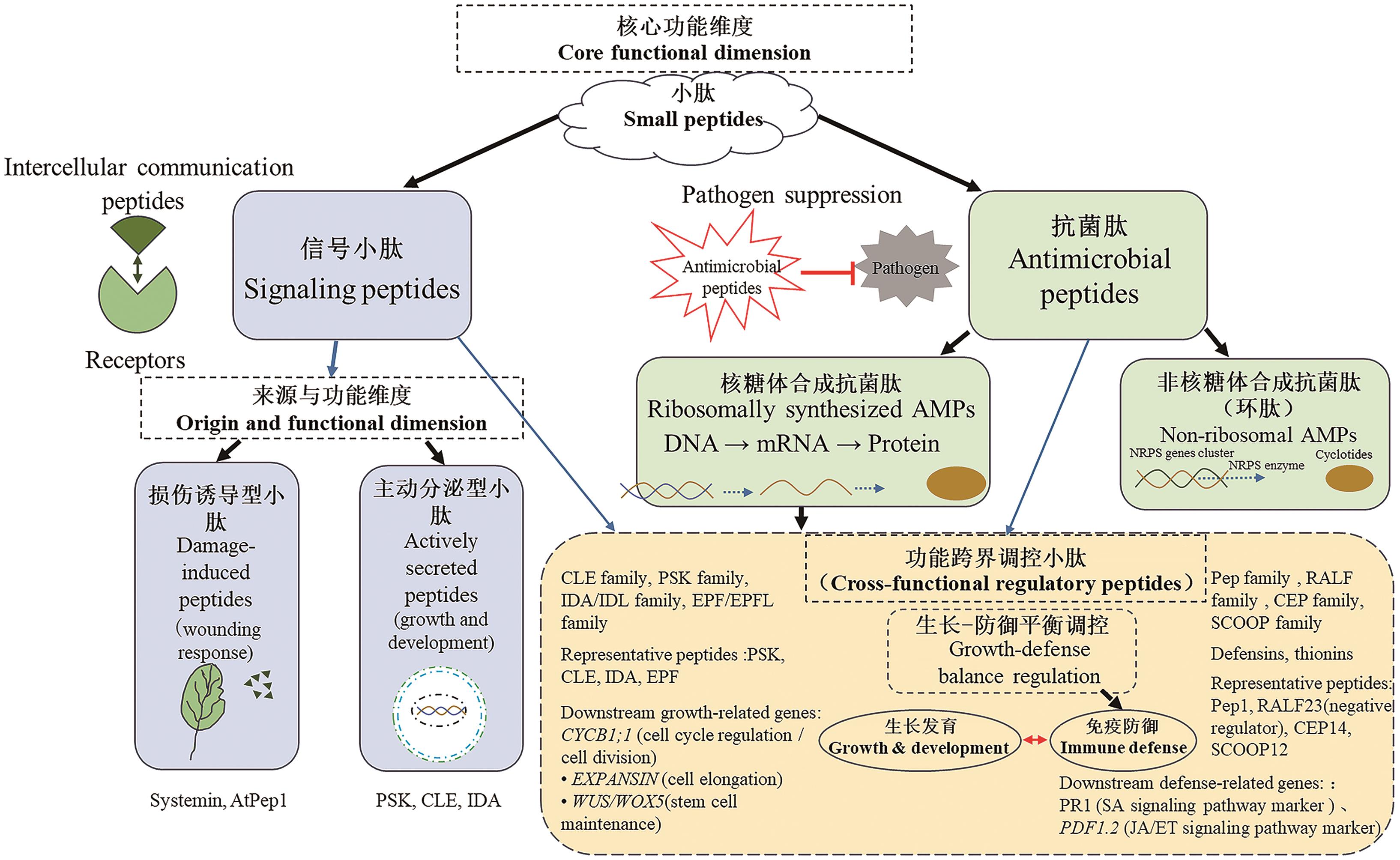
图1 植物小肽分类本图基于“核心功能-来源属性-合成途径”三维度构建小肽分类框架。左侧蓝色:信号小肽(损伤诱导型小肽、主动分泌型小肽);右侧绿色:抗菌肽(核糖体合成型、非核糖体合成型);下方黄色虚线框:跨界调控小肽,介导生长发育-免疫防御平衡调控。CLE(CLAVATA3/胚胎周围区相关家族);PSK(植物磺化肽);RALF(快速碱化因子);IDA(花序缺陷型脱落肽);EPF(表皮模式因子);Pep(植物激发肽);NRPS(非核糖体肽合成酶);CEP(C端编码肽);SCOOP(丝氨酸丰富内源肽)。黑色实线箭头:分类归属关系;蓝色虚线箭头:生物合成过程;红色双向箭头:生长-防御平衡调控关系
Fig. 1 Classification of plant small peptidesThis figure presents a classification framework of small signaling peptides based on three dimensions: “core function-origin property-biosynthesis pathway”. Left (blue): Signaling peptides (damage-induced peptides and actively secreted peptides); right (green): antimicrobial peptides (AMPs), categorized into ribosomally synthesized AMPs and non-ribosomally synthesized AMPs; bottom (yellow dashed box): cross-functional regulatory peptides, which mediate the balance regulation between plant growth and immune defense. CLE (CLAVATA3/Embryo Surrounding Region-related family); PSK (phytosulfokine); RALF (rapid alkalinization factor); IDA (inflorescence deficient in abscission), EPF (epidermal patterning factor), Pep (plant elicitor peptide); NRPS (non-ribosomal peptide synthetase); CEP (C-terminally encoded peptide); SCOOP (serine rich endogenous peptide). Black solid arrows: Classification; blue dashed arrows: biosynthesis process; red bidirectional arrows: balance regulation of growth and defense pathways
分类维度 Classification dimension | 亚类Subcategory | 来源 Origin | 受体类型 Receptor type | 功能 Function | 代表成员 Representative members |
|---|---|---|---|---|---|
| 内源损伤肽 | 损伤诱导型 | 由前体蛋白在损伤/病原胁迫下经蛋白酶切割释放 | LRR-RLK(如PEPR1、SYR1) | 放大免疫信号,系统抗性 | AtPep1、系统素 |
| 内源分泌肽 | 主动分泌型 | 由基因编码,经翻译后修饰(如磺化、羟基化)成熟 | LRR-RLK(如CLV1、PSKR1) | 调控干细胞、细胞增殖、器官脱落等 | CLV3、PSK、IDA |
表1 植物信号小肽的主要特征
Table 1 Main characteristics of plant signaling peptides
分类维度 Classification dimension | 亚类Subcategory | 来源 Origin | 受体类型 Receptor type | 功能 Function | 代表成员 Representative members |
|---|---|---|---|---|---|
| 内源损伤肽 | 损伤诱导型 | 由前体蛋白在损伤/病原胁迫下经蛋白酶切割释放 | LRR-RLK(如PEPR1、SYR1) | 放大免疫信号,系统抗性 | AtPep1、系统素 |
| 内源分泌肽 | 主动分泌型 | 由基因编码,经翻译后修饰(如磺化、羟基化)成熟 | LRR-RLK(如CLV1、PSKR1) | 调控干细胞、细胞增殖、器官脱落等 | CLV3、PSK、IDA |
分类维度 Classification dimension | 类别 Category | 主要特征 Key features | 作用机制 Mechanism of action | 代表性肽 Representative examples |
|---|---|---|---|---|
合成路径 Biosynthetic pathway | 经典核糖体合成抗菌肽 | 由基因编码的前体蛋白经加工成熟,常含多个二硫键以稳定结构[ | 多为膜破坏或酶抑制 | 防御素、硫堇蛋白[ |
| 非核糖体抗菌肽(环肽) | 由非核糖体肽合成酶(NRPS)基因簇编码并合成,其合成不依赖核糖体,常见于微生物,植物中较少 | 多为膜破坏或酶抑制,结构稳定性高 | 环肽(如某些微生物来源的抗菌肽)[ | |
作用类型 Action type | 膜破坏型 | 富含阳离子和两亲性结构,通过静电作用与疏水作用插入病原体膜,形成孔道 | 导致细胞内容物泄漏,快速杀死病原体 | 硫堇蛋白[ |
| 酶抑制型 | 通过空间位阻或竞争性结合,抑制病原体生命活动的关键酶(如几丁质合酶、蛋白酶) | 干扰病原体细胞壁合成或代谢,抑制其生长 | 防御素(如MtDef4)[ |
表2 植物抗菌肽(AMPs)的主要特征
Table 2 Main characteristics of plant antimicrobial peptides (AMPs)
分类维度 Classification dimension | 类别 Category | 主要特征 Key features | 作用机制 Mechanism of action | 代表性肽 Representative examples |
|---|---|---|---|---|
合成路径 Biosynthetic pathway | 经典核糖体合成抗菌肽 | 由基因编码的前体蛋白经加工成熟,常含多个二硫键以稳定结构[ | 多为膜破坏或酶抑制 | 防御素、硫堇蛋白[ |
| 非核糖体抗菌肽(环肽) | 由非核糖体肽合成酶(NRPS)基因簇编码并合成,其合成不依赖核糖体,常见于微生物,植物中较少 | 多为膜破坏或酶抑制,结构稳定性高 | 环肽(如某些微生物来源的抗菌肽)[ | |
作用类型 Action type | 膜破坏型 | 富含阳离子和两亲性结构,通过静电作用与疏水作用插入病原体膜,形成孔道 | 导致细胞内容物泄漏,快速杀死病原体 | 硫堇蛋白[ |
| 酶抑制型 | 通过空间位阻或竞争性结合,抑制病原体生命活动的关键酶(如几丁质合酶、蛋白酶) | 干扰病原体细胞壁合成或代谢,抑制其生长 | 防御素(如MtDef4)[ |
| 功能大类Functional category | 核心特征与作用机制 Core features and mechanisms | 作用范围 Ranges of action | 代表性分子与家族 Representative molecules and families |
|---|---|---|---|
信号小肽 Signaling peptides | 作为细胞间通讯的信使:作为配体被质膜受体(如LRR-RLKs)特异性识别,激活细胞内信号转导(如Ca²⁺、ROS、MAPK级联),间接调控生理过程 | 系统性/局部性:信号可传导,介导局部或全株协调响应 | 发育调控:CLV3 (CLE家族)[ 免疫调控:系统素[ |
抗菌肽 Direct defense peptides (AMPs) | 作为先天免疫的效应武器:不依赖植物受体,直接作用于病原体。机制包括: (1)膜攻击:破坏病原体膜完整性[ (2)酶抑制:抑制病原体关键生命活动[ | 局部性:主要在合成或侵染部位发挥直接杀伤作用[ | 防御素、硫堇蛋白[ |
表3 植物信号小肽与抗菌肽的核心特征
Table 3 Core characteristics of plant signaling peptides and antimicrobial peptides
| 功能大类Functional category | 核心特征与作用机制 Core features and mechanisms | 作用范围 Ranges of action | 代表性分子与家族 Representative molecules and families |
|---|---|---|---|
信号小肽 Signaling peptides | 作为细胞间通讯的信使:作为配体被质膜受体(如LRR-RLKs)特异性识别,激活细胞内信号转导(如Ca²⁺、ROS、MAPK级联),间接调控生理过程 | 系统性/局部性:信号可传导,介导局部或全株协调响应 | 发育调控:CLV3 (CLE家族)[ 免疫调控:系统素[ |
抗菌肽 Direct defense peptides (AMPs) | 作为先天免疫的效应武器:不依赖植物受体,直接作用于病原体。机制包括: (1)膜攻击:破坏病原体膜完整性[ (2)酶抑制:抑制病原体关键生命活动[ | 局部性:主要在合成或侵染部位发挥直接杀伤作用[ | 防御素、硫堇蛋白[ |
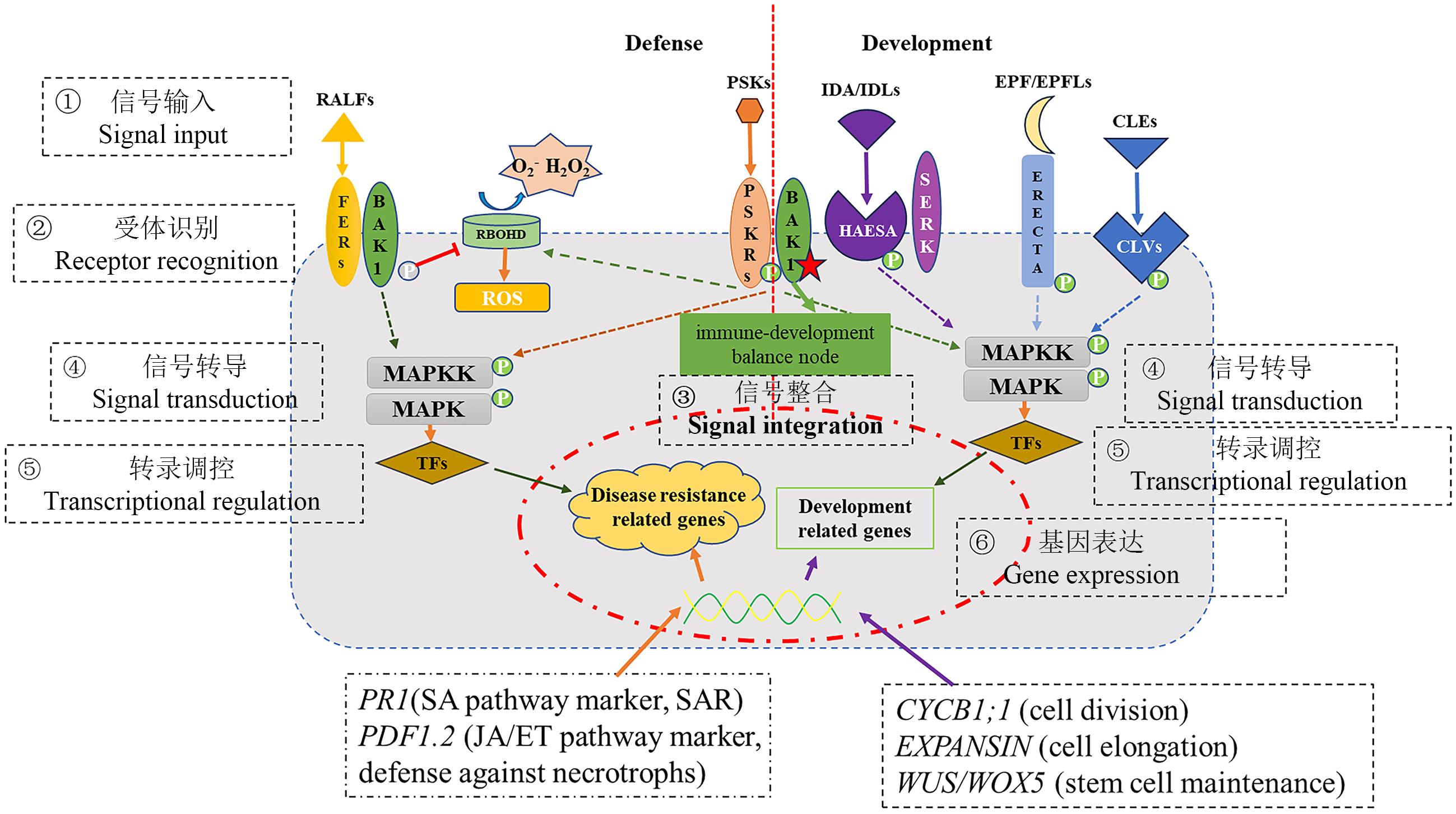
图2 植物代表性小肽家族功能与信号网络示意图本图总结了植物主要小肽家族通过细胞表面受体识别、BAK1共受体整合,最终激活生长发育(右侧)或免疫防御(左侧)响应的信号通路。小肽与相应LRR-RLK受体结合后,与BAK1形成异源二聚体,经MAPK级联、ROS爆发和Ca²⁺信号向下传递。★标记处为PSK调控生长-防御平衡的关键节点。下游靶基因包括生长相关的CYCB1;1、EXPANSIN、WUS/WOX5,以及免疫相关的PR1和PDF1.2。CLV1(CLAVATA1受体);PSK(植物磺化肽);PSKR1(植物磺化肽受体1);IDA(花序缺陷型脱落肽);HAE(HAESA受体);HSL2(HAESA-like2受体);EPF(表皮模式因子);ERECTA(ERECTA受体);PEPR1(Pep1受体);FER(FERONIA受体);BAK1(BRI1相关受体激酶1);SERK(体细胞胚胎发生受体激酶);LRR-RLK(富含亮氨酸重复序列类受体激酶);MAPK(丝裂原活化蛋白激酶);ROS(活性氧);RBOHD(呼吸爆发氧化酶同源物D);TF(转录因子);PTI(模式触发免疫);SAR(系统获得性抗性)
Fig. 2 Schematic diagram of functional and signaling networks of representative plant small peptide familiesThis diagram summarizes the signaling pathways of major plant small peptide families, which are recognized by cell‑surface receptors and integrated by the BAK1 co‑receptor, ultimately activating growth/development (left) or immune/defense responses (right). Small peptides bind to their cognate LRR‑RLK receptors, forming heterodimers with BAK1, which triggers downstream signaling via MAPK cascades, ROS burst, and Ca²⁺ signaling. The ★ indicates the key node where PSK regulates the growth-defense balance. Downstream target genes include growth-related CYCB1;1, EXPANSIN, WUS/WOX5, and immunity-related PR1 and PDF1.2. CLV1 (CLAVATA1 receptor); PSK (phytosulfokine); PSKR1 (phytosulfokine receptor 1); IDA (inflorescence deficient in abscission); HAE (HAESA receptor); HSL2 (HAESA-like2 receptor); EPF (epidermal patterning factor); ERECTA (ERECTA receptor); PEPR1 (Pep1 receptor); FER (FERONIA receptor); BAK1 (BRI1-associated receptor kinase 1); SERK (somatic embryogenesis receptor kinase); LRR-RLK (leucine-rich repeat receptor-like kinase); MAPK (mitogen-activated protein kinase); ROS (reactive oxygen species); RBOHD (respiratory burst oxidase homolog D); TF (transcription factor); PTI (pattern-triggered immunity); SAR (systemic acquired resistance)
| [1] | Tavormina P, De Coninck B, Nikonorova N, et al. The plant peptidome: an expanding repertoire of structural features and biological functions [J]. Plant Cell, 2015, 27(8): 2095-2118. |
| [2] | Murphy E, Smith S, De Smet I. Small signaling peptides in Arabidopsis development: how cells communicate over a short distance [J]. Plant Cell, 2012, 24(8): 3198-3217. |
| [3] | Hou SG, Liu DR, He P. Phytocytokines function as immunological modulators of plant immunity [J]. Stress Biol, 2021, 1: 8. |
| [4] | 胡海琳, 徐黎, 李晓旭, 等. 小肽激素调控植物生长发育及逆境生理研究进展 [J]. 生物技术通报, 2023, 39(7): 13-25. |
| Hu HL, Xu L, Li XX, et al. Advances in the regulation of plant growth, development and stress physiology by small peptide hormones [J]. Biotechnol Bull, 2023, 39(7): 13-25. | |
| [5] | 吕倩雯, 杨永芳. 植物小肽信号生物学功能及其在作物改良中研究进展 [J]. 遗传, 2023, 45(9): 813-828. |
| Lv QW, Yang YF. The biological functions of peptide signaling in plant and the advances on its utilization for crop improvement [J]. Hereditas: Beijing, 2023, 45(9): 813-828. | |
| [6] | Terras FRG, Eggermont K, Kovaleva V, et al. Small cysteine-rich antifungal proteins from radish: their role in host defense [J]. Plant Cell, 1995, 7(5): 573. |
| [7] | Shafee T, Harris K, Anderson M. Biosynthesis of cyclotides [M]//Plant Cyclotides. Amsterdam: Elsevier 2015: 227-269. |
| [8] | Broekaert WF, Terras F, Cammue B, et al. Plant defensins: novel antimicrobial peptides as components of the host defense system [J]. Plant Physiol, 1995, 108(4): 1353-1358. |
| [9] | Jones JDG, Dangl JL. The plant immune system [J]. Nature, 2006, 444(7117): 323-329. |
| [10] | Matsubayashi Y. Posttranslationally modified small-peptide signals in plants [J]. Annu Rev Plant Biol, 65(1): 385-413. |
| [11] | de Oliveira Carvalho A, Moreira Gomes V. Plant defensins and defensin-like peptides - biological activities and biotechnological applications [J]. Curr Pharm Des, 2011, 17(38): 4270-4293. |
| [12] | Sagaram US, Pandurangi R, Kaur J, et al. Structure-activity determinants in antifungal plant defensins MsDef1 and MtDef4 with different modes of action against Fusarium graminearum [J]. PLoS One, 2011, 6(4): e18550. |
| [13] | Bohlmann H, Apel K, Garcia-Olmedo F. Thionins [J]. Plant Mol Biol Rep, 1994, 12(2): S75. |
| [14] | Jha S, Chattoo BB. Expression of a plant defensin in rice confers resistance to fungal phytopathogens [J]. Transgenic Res, 2010, 19(3): 373-384. |
| [15] | Kanzaki H, Nirasawa S, Saitoh H, et al. Overexpression of the wasabi defensin gene confers enhanced resistance to blast fungus (Magnaporthe grisea) in transgenic rice [J]. Theor Appl Genet, 2002, 105(6): 809-814. |
| [16] | Sagehashi Y, Takaku H, Yatou O. Partial peptides from rice defensin OsAFP1 exhibited antifungal activity against the rice blast pathogen Pyricularia oryzae [J]. J Pestic Sci, 2017, 42(4): 172-175. |
| [17] | 田野, 王贵锋, 张向前. 植物抗菌肽的研究进展及其应用 [J]. 现代食品科技, 2017, 33(11): 285-291. |
| Tian Y, Wang GF, Zhang XQ. Research progress and application of plant antimicrobial peptides [J]. Mod Food Sci Technol, 2017, 33(11): 285-291. | |
| [18] | Finking R, Marahiel MA. Biosynthesis of nonribosomal peptides [J]. Annu Rev Microbiol, 2004, 58: 453-488. |
| [19] | Mulvenna JP, Mylne JS, Bharathi R, et al. Discovery of cyclotide-like protein sequences in graminaceous crop plants: ancestral precursors of circular proteins? [J]. Plant Cell, 2006, 18(9): 2134-2144. |
| [20] | Fletcher JC, Brand U, Running MP, et al. Signaling of cell fate decisions by CLAVATA3 in Arabidopsis shoot meristems [J]. Science, 1999, 283(5409): 1911-1914. |
| [21] | Matsubayashi Y, Sakagami Y. Phytosulfokine, sulfated peptides that induce the proliferation of single mesophyll cells of Asparagus officinalis L [J]. Proc Natl Acad Sci U S A, 1996, 93(15): 7623-7627. |
| [22] | McGurl B, Pearce G, Orozco-Cardenas M, et al. Structure, expression, and antisense inhibition of the systemin precursor gene [J]. Science, 1992, 255(5051): 1570-1573. |
| [23] | Huffaker A, Pearce G, Ryan CA. An endogenous peptide signal in Arabidopsis activates components of the innate immune response [J]. Proc Natl Acad Sci U S A, 2006, 103(26): 10098-10103. |
| [24] | van der Weerden NL, Bleackley MR, Anderson MA. Properties and mechanisms of action of naturally occurring antifungal peptides [J]. Cell Mol Life Sci, 2013, 70(19): 3545-3570. |
| [25] | Brogden KA. Antimicrobial peptides: pore formers or metabolic inhibitors in bacteria? [J]. Nat Rev Microbiol, 2005, 3(3): 238-250. |
| [26] | Saberi Riseh R, Fathi F, Vatankhah M, et al. Thionins: potential use in plant defense against pathogens [J]. Plant Mol Biol, 2025, 115(4): 77. |
| [27] | Craik DJ. Circling the enemy: cyclic proteins in plant defence [J]. Trends Plant Sci, 2009, 14(6): 328-335. |
| [28] | Tabata R, Sawa S. Maturation processes and structures of small secreted peptides in plants [J]. Front Plant Sci, 2014, 5: 311. |
| [29] | Huot B, Yao J, Montgomery BL, et al. Growth-defense tradeoffs in plants: a balancing act to optimize fitness [J]. Mol Plant, 2014, 7(8): 1267-1287. |
| [30] | Cock JM, McCormick S. A large family of genes that share homology with CLAVATA3 [J]. Plant Physiol, 2001, 126(3): 939-942. |
| [31] | Ito Y, Nakanomyo I, Motose H, et al. Dodeca-CLE peptides as suppressors of plant stem cell differentiation [J]. Science, 2006, 313(5788): 842-845. |
| [32] | Okamoto S, Ohnishi E, Sato S, et al. Nod factor/nitrate-induced CLE genes that drive HAR1-mediated systemic regulation of nodulation [J]. Plant Cell Physiol, 2009, 50(1): 67-77. |
| [33] | Kwon CT, Tang LL, Wang XG, et al. Dynamic evolution of small signalling peptide compensation in plant stem cell control [J]. Nat Plants, 2022, 8(4): 346-355. |
| [34] | 吴云飞, 储黄伟, 周志刚, 等. A类CLE多肽调节拟南芥根尖韧皮部的发育 [J]. 植物生理学报, 2014, 50(10): 1515-1522. |
| Wu YF, Chu HW, Zhou ZG, et al. A-type CLE peptides regulate the phloem development in Arabidopsis root tip [J]. Plant Physiol Commun, 2014, 50(10): 1515-1522. | |
| [35] | Hirakawa Y, Kondo Y, Fukuda H. Tdif peptide signaling regulates vascular stem cell proliferation via the WOX4 homeobox gene in Arabidopsis [J]. Plant Cell, 2010, 22(8): 2618-2629. |
| [36] | Mortier V, Den Herder G, Whitford R, et al. CLE peptides control Medicago truncatula nodulation locally and systemically [J]. Plant Physiol, 2010, 153(1): 222-237. |
| [37] | Matsubayashi Y, Takagi L, Sakagami Y. Phytosulfokine-α, a sulfated pentapeptide, stimulates the proliferation of rice cells by means of specific high- and low-affinity binding sites [J]. Proc Natl Acad Sci U S A, 1997, 94(24): 13357-13362. |
| [38] | Sauter M. Phytosulfokine peptide signalling [J]. J Exp Bot, 2015, 66(17): 5161-5169. |
| [39] | He LM, Wu LF, Li J. Sulfated peptides and their receptors: Key regulators of plant development and stress adaptation [J]. Plant Commun, 2024, 5(6): 100918. |
| [40] | Butenko MA. INFLORESCENCE DEFICIENT IN ABSCISSION controls floral organ abscission in Arabidopsis and identifies a novel family of putative ligands in plants [J]. Plant Cell Online, 2003, 15(10): 2296-2307. |
| [41] | Stenvik GE, Tandstad NM, Guo YF, et al. The EPIP peptide of INFLORESCENCE DEFICIENT IN ABSCISSION is sufficient to induce abscission in Arabidopsis through the receptor-like kinases HAESA and HAESA-LIKE2 [J]. Plant Cell, 2008, 20(7): 1805-1817. |
| [42] | Kumpf RP, Shi CL, Larrieu A, et al. Floral organ abscission peptide IDA and its HAE/HSL2 receptors control cell separation during lateral root emergence [J]. Proc Natl Acad Sci U S A, 2013, 110(13): 5235-5240. |
| [43] | Lee JS, Hnilova M, Maes M, et al. Competitive binding of antagonistic peptides fine-tunes stomatal patterning [J]. Nature, 2015, 522(7557): 439-443. |
| [44] | Uchida N, Lee JS, Horst RJ, et al. Regulation of inflorescence architecture by intertissue layer ligand-receptor communication between endodermis and phloem [J]. Proc Natl Acad Sci U S A, 2012, 109(16): 6337-6342. |
| [45] | Hughes J, Hepworth C, Dutton C, et al. Reducing stomatal density in barley improves drought tolerance without impacting on yield [J]. Plant Physiol, 2017, 174(2): 776-787. |
| [46] | Huffaker A, Dafoe NJ, Schmelz EA. ZmPep1, an ortholog of Arabidopsis elicitor peptide 1, regulates maize innate immunity and enhances disease resistance [J]. Plant Physiol, 2011, 155(3): 1325-1338. |
| [47] | Yamaguchi Y, Pearce G, Ryan CA. The cell surface leucine-rich repeat receptor for AtPep1, an endogenous peptide elicitor in Arabidopsis, is functional in transgenic tobacco cells [J]. Proc Natl Acad Sci U S A, 2006, 103(26): 10104-10109. |
| [48] | Ross A, Yamada K, Hiruma K, et al. The Arabidopsis PEPR pathway couples local and systemic plant immunity [J]. EMBO J, 2014, 33(1): 62-75. |
| [49] | Qi LX, Li J, Wang H, et al. Planthopper protein Nlsp5 is essential for salivary sheath formation and acts as a HAMP inducing plant resistance to insects [J]. Plant Biotechnol J, 2025, 23(9): 4076-4091. |
| [50] | Beloshistov RE, Dreizler K, Galiullina RA, et al. Phytaspase-mediated precursor processing and maturation of the wound hormone systemin [J]. New Phytol, 2018, 218(3): 1167-1178. |
| [51] | Wang L, Einig E, Almeida-Trapp M, et al. The systemin receptor SYR1 enhances resistance of tomato against herbivorous insects [J]. Nat Plants, 2018, 4(3): 152-156. |
| [52] | Pearce G, Moura DS, Stratmann J, et al. RALF, a 5-kDa ubiquitous polypeptide in plants, arrests root growth and development [J]. Proc Natl Acad Sci U S A, 2001, 98(22): 12843-12847. |
| [53] | Srivastava R, Liu JX, Guo HQ, et al. Regulation and processing of a plant peptide hormone, AtRALF23, in Arabidopsis [J]. Plant J, 2009, 59(6): 930-939. |
| [54] | Stegmann M, Monaghan J, Smakowska-Luzan E, et al. The receptor kinase FER is a RALF-regulated scaffold controlling plant immune signaling [J]. Science, 2017, 355(6322): 287-289. |
| [55] | Rzemieniewski J, Leicher H, Lee HK, et al. CEP signaling coordinates plant immunity with nitrogen status [J]. Nat Commun, 2024, 15: 10686. |
| [56] | Zhang ZB, Gigli-Bisceglia N, Li W, et al. SCOOP10 and SCOOP12 peptides act through MIK2 receptor-like kinase to antagonistically regulate Arabidopsis leaf senescence [J]. Mol Plant, 2024, 17(12): 1805-1819. |
| [57] | Yang WT, Zhai HW, Wu FM, et al. Peptide REF1 is a local wound signal promoting plant regeneration [J]. Cell, 2024, 187(12): 3024-3038.e14. |
| [58] | Zhang J, Lu CC, Sun YH, et al. The apoplastic protein OsCPIP8 confers dual protection by inhibiting pathogenic protease and activating rice immunity [J]. Nat Commun, 2026, 17: 201. |
| [59] | Zhao TF, Ma SJ, Kong ZY, et al. Recognition of the inducible, secretory small protein OsSSP1 by the membrane receptor OsSSR1 and the co-receptor OsBAK1 confers rice resistance to the blast fungus [J]. Mol Plant, 2024, 17(5): 807-823. |
| [60] | Zipfel C. Pattern-recognition receptors in plant innate immunity [J]. Curr Opin Immunol, 2008, 20(1): 10-16. |
| [61] | Amano Y, Tsubouchi H, Shinohara H, et al. Tyrosine-sulfated glycopeptide involved in cellular proliferation and expansion in Arabidopsis [J]. Proc Natl Acad Sci U S A, 2007, 104(46): 18333-18338. |
| [62] | Schulze B, Mentzel T, Jehle AK, et al. Rapid heteromerization and phosphorylation of ligand-activated plant transmembrane receptors and their associated kinase BAK1 [J]. J Biol Chem, 2010, 285(13): 9444-9451. |
| [63] | Somssich M, Ma QJ, Weidtkamp-Peters S, et al. Real-time dynamics of peptide ligand-dependent receptor complex formation in planta [J]. Sci Signal, 2015, 8(388): eaab0598. |
| [64] | Mosher S, Seybold H, Rodriguez P, et al. The tyrosine-sulfated peptide receptors PSKR1 and PSY1R modify the immunity of Arabidopsis to biotrophic and necrotrophic pathogens in an antagonistic manner [J]. Plant J, 2013, 73(3): 469-482. |
| [65] | Guo HQ, Nolan TM, Song GY, et al. FERONIA receptor kinase contributes to plant immunity by suppressing jasmonic acid signaling in Arabidopsis thaliana [J]. Curr Biol, 2018, 28(20): 3316-3324.e6. |
| [66] | Matsubayashi Y, Morita A, Matsunaga E, et al. Physiological relationships between auxin, cytokinin, and a peptide growth factor, phytosulfokine-α, in stimulation of Asparagus cell proliferation [J]. Planta, 1999, 207(4): 559-565. |
| [67] | Kutschmar A, Rzewuski G, Stührwohldt N, et al. PSK-α promotes root growth in Arabidopsis [J]. New Phytol, 2009, 181(4): 820-831. |
| [68] | Yadav RK, Perales M, Gruel J, et al. WUSCHEL protein movement mediates stem cell homeostasis in the Arabidopsis shoot apex [J]. Genes Dev, 2011, 25(19): 2025-2030. |
| [69] | Ding ST, Lv JR, Hu ZJ, et al. Phytosulfokine peptide optimizes plant growth and defense via glutamine synthetase GS2 phosphorylation in tomato [J]. EMBO J, 2023, 42(6): EMBJ2022111858. |
| [70] | Pearce G, Strydom D, Johnson S, et al. A polypeptide from tomato leaves induces wound-inducible proteinase inhibitor proteins [J]. Science, 1991, 253(5022): 895-897. |
| [71] | Ryan CA, Narváez-Vásquez J. The cellular localization of prosystemin: a functional role for phloem parenchyma in systemic wound signaling [J]. Planta, 2004, 218(3): 360-369. |
| [72] | Berr A, McCallum EJ, Alioua A, et al. Arabidopsis Histone methyltransferase SET DOMAIN GROUP8 mediates induction of the jasmonate/ethylene pathway genes in plant defense response to necrotrophic fungi [J]. Plant Physiol, 2010, 154(3): 1403-1414. |
| [73] | Haruta M, Sabat G, Stecker K, et al. A peptide hormone and its receptor protein kinase regulate plant cell expansion [J]. Science, 2014, 343(6169): 408-411. |
| [74] | Song Y, Wilson AJ, Zhang XC, et al. FERONIA restricts Pseudomonas in the rhizosphere microbiome via regulation of reactive oxygen species [J]. Nat Plants, 2021, 7(5): 644-654. |
| [75] | Zhao PZ, Yang H, Sun YW, et al. Targeted MYC2 stabilization confers Citrus Huanglongbing resistance [J]. Science, 2025, 388(6743): 191-198. |
| [76] | De Coninck B, De Smet I. Plant peptides-taking them to the next level [J]. J Exp Bot, 2016, 67(16): 4791-4795. |
| [77] | Cunningham FJ, Goh NS, Demirer GS, et al. Nanoparticle-mediated delivery towards advancing plant genetic engineering [J]. Trends Biotechnol, 2018, 36(9): 882-897. |
| [78] | Boutrot F, Zipfel C. Function, discovery, and exploitation of plant pattern recognition receptors for broad-spectrum disease resistance [J]. Annu Rev Phytopathol, 2017, 55: 257-286. |
| [79] | Fletcher JC. Recent advances in Arabidopsis CLE peptide signaling [J]. Trends Plant Sci, 2020, 25(10): 1005-1016. |
| [80] | Stührwohldt N, Schaller A. Regulation of plant peptide hormones and growth factors by post-translational modification [J]. Plant Biol J, 2019, 21(S1): 49-63. |
| [81] | Hou SG, Wang X, Chen DH, et al. The secreted peptide PIP1 amplifies immunity through receptor-like kinase 7 [J]. PLoS Pathog, 2014, 10(9): e1004331. |
| [82] | Wang SX, Chen Z, Tian L, et al. Comparative proteomics combined with analyses of transgenic plants reveal ZmREM1.3 mediates maize resistance to southern corn rust [J]. Plant Biotechnol J, 2019, 17(11): 2153-2168. |
| [83] | Jumper J, Evans R, Pritzel A, et al. Highly accurate protein structure prediction with AlphaFold [J]. Nature, 2021, 596(7873): 583-589. |
| [84] | Homma F, Huang J, van der Hoorn RAL. AlphaFold-Multimer predicts cross-Kingdom interactions at the plant-pathogen interface [J]. Nat Commun, 2023, 14: 6040. |
| [85] | Shahan R, Hsu CW, Nolan TM, et al. A single-cell Arabidopsis root atlas reveals developmental trajectories in wild-type and cell identity mutants [J]. Dev Cell, 2022, 57(4): 543-560.e9. |
| [86] | Montesinos L, Gascón B, Ruz L, et al. A bifunctional synthetic peptide with antimicrobial and plant elicitation properties that protect tomato plants from bacterial and fungal infections [J]. Front Plant Sci, 2021, 12: 756357. |
| [1] | 徐焱, 陈玲, 黄灵琳, 常小丽. 大豆转录因子GmWRKY23a对有益绿针假单胞菌根系定殖的调控[J]. 生物技术通报, 2026, 42(8): 287-297. |
| [2] | 王红阳, 邱艳红, 王德欣, 夏阳, 孟淑春, 徐秀兰, 张海军. NO调控植物种子休眠和萌发的研究进展[J]. 生物技术通报, 2026, 42(6): 164-174. |
| [3] | 何莛莛, 李玲娟. 合成微生物群落增强植物抗旱性的研究进展[J]. 生物技术通报, 2026, 42(5): 51-62. |
| [4] | 马世杰, 李铮, 李蔚, 郭仰东, 张娜. 光信号调控园艺作物果实发育的研究进展[J]. 生物技术通报, 2026, 42(3): 5-18. |
| [5] | 费思恬, 侯鹰翔, 李兰, 张超. 水稻赤霉素信号负调控因子SLR1的生物学功能及其调控网络[J]. 生物技术通报, 2026, 42(1): 13-30. |
| [6] | 李思博, 钱虹萍, 徐昌文, 王笑, 林金星, 崔亚宁. 植物内源激发子调控的胞内转运参与植物生长发育和逆境胁迫响应的研究进展[J]. 生物技术通报, 2025, 41(7): 17-27. |
| [7] | 刘文浩, 吴刘记, 徐芳. 小肽调控植物分生组织发育的机制及其在作物改良中的研究进展[J]. 生物技术通报, 2024, 40(7): 1-18. |
| [8] | 付威, 韦素云, 陈赢男. 植物生长发育动态QTL解析研究进展[J]. 生物技术通报, 2024, 40(2): 9-19. |
| [9] | 陈梦娇, 李洋洋, 邬倩. 谷氨酸受体蛋白调控植物生长与胁迫应答的研究进展[J]. 生物技术通报, 2024, 40(10): 62-75. |
| [10] | 胡海琳, 徐黎, 李晓旭, 王晨璨, 梅曼, 丁文静, 赵媛媛. 小肽激素调控植物生长发育及逆境生理研究进展[J]. 生物技术通报, 2023, 39(7): 13-25. |
| [11] | 叶红, 王玉昆. 植物PRR免疫受体功能研究进展[J]. 生物技术通报, 2023, 39(12): 1-15. |
| [12] | 陈广霞, 李秀杰, 蒋锡龙, 单雷, 张志昌, 李勃. 植物小分子信号肽参与非生物逆境胁迫应答的研究进展[J]. 生物技术通报, 2023, 39(11): 61-73. |
| [13] | 沈月, 陶宝杰, 华夏, 吕冰, 刘立军, 陈云. 独脚金内酯与激素互作调控根系生长的研究进展[J]. 生物技术通报, 2022, 38(8): 24-31. |
| [14] | 李毅丹, 单晓辉. 赤霉素代谢调控与绿色革命[J]. 生物技术通报, 2022, 38(2): 195-204. |
| [15] | 姜炎柯, 路冲冲, 尹梓屹, 李洋, 丁新华. 可变剪接在植物免疫中的研究进展[J]. 生物技术通报, 2022, 38(1): 215-227. |
| 阅读次数 | ||||||
|
全文 |
|
|||||
|
摘要 |
|
|||||
