







• 综述与专论 • 下一篇
任晓桐, 卢永忠( )
)
收稿日期:2025-12-28
出版日期:2026-09-14
通讯作者:
卢永忠luyz@qust.edu.cn基金资助:
REN Xiao-tong, LU Yong-zhong()
Received:2025-12-28
Published:2026-09-14
摘要:
RNA干扰(RNA interference, RNAi)是一种存在于真核生物中由小RNA介导的转录后基因沉默机制,也是甲壳类动物抗病毒免疫的核心通路和研究热点,本文系统梳理了甲壳类RNAi通路的基础研究进展、作为反向遗传学工具的应用现状及RNAi抗病毒疗法的发展态势。基础研究方面,对虾等甲壳类的Dicer-2切割病毒dsRNA产生siRNA,并与AGO2装配成RISC复合物特异性沉默病毒基因,但DNA病毒siRNA来源与VSR逃逸问题仍是研究的难点与重点。同时,对虾等也进化出环形RNA调控、JAK/STAT通路交叉对话及FoxO介导的非序列依赖性应答等辅助抗病毒机制。应用层面,RNAi已被广泛用于解析甲壳类在免疫、生殖、生长、应激、肢体再生及体色调控等生物学过程中基因的功能,同时也被用于抗病毒研究,通过注射、口服或浸泡递送靶向病毒必需基因的dsRNA,可显著降低对虾病毒感染的死亡率,但RNAi技术产业化推广仍面临VSR干扰、脱靶效应、dsRNA稳定性差、口服效率低及成本高等挑战。未来可聚焦以下研究方向:一是利用单细胞测序绘制RNAi时空图谱,解析siRNA的来源;二是开发pH响应纳米载体、益生菌活载体及病毒样颗粒等智能递送系统;三是构建“多靶点dsRNA鸡尾酒 + 抗VSR多肽 + 免疫增强剂”的联合疗法,协同抑制病毒复制并阻断VSR逃逸;四是探索CRISPR-Cas13、环形RNA及内源逆转录酶通路调控等新型RNA靶向技术,建立不依赖经典Dicer/AGO2的抗病毒策略。本文旨在为甲壳类病毒病的防控提供理论依据与实践参考。
任晓桐, 卢永忠. RNA干扰在甲壳动物抗病毒免疫中的作用研究进展[J]. 生物技术通报, doi: 10.13560/j.cnki.biotech.bull.1985.2025-1438.
REN Xiao-tong, LU Yong-zhong. Research Progress in the Role of RNA Interference in the Antiviral Immunity of Crustaceans[J]. Biotechnology Bulletin, doi: 10.13560/j.cnki.biotech.bull.1985.2025-1438.
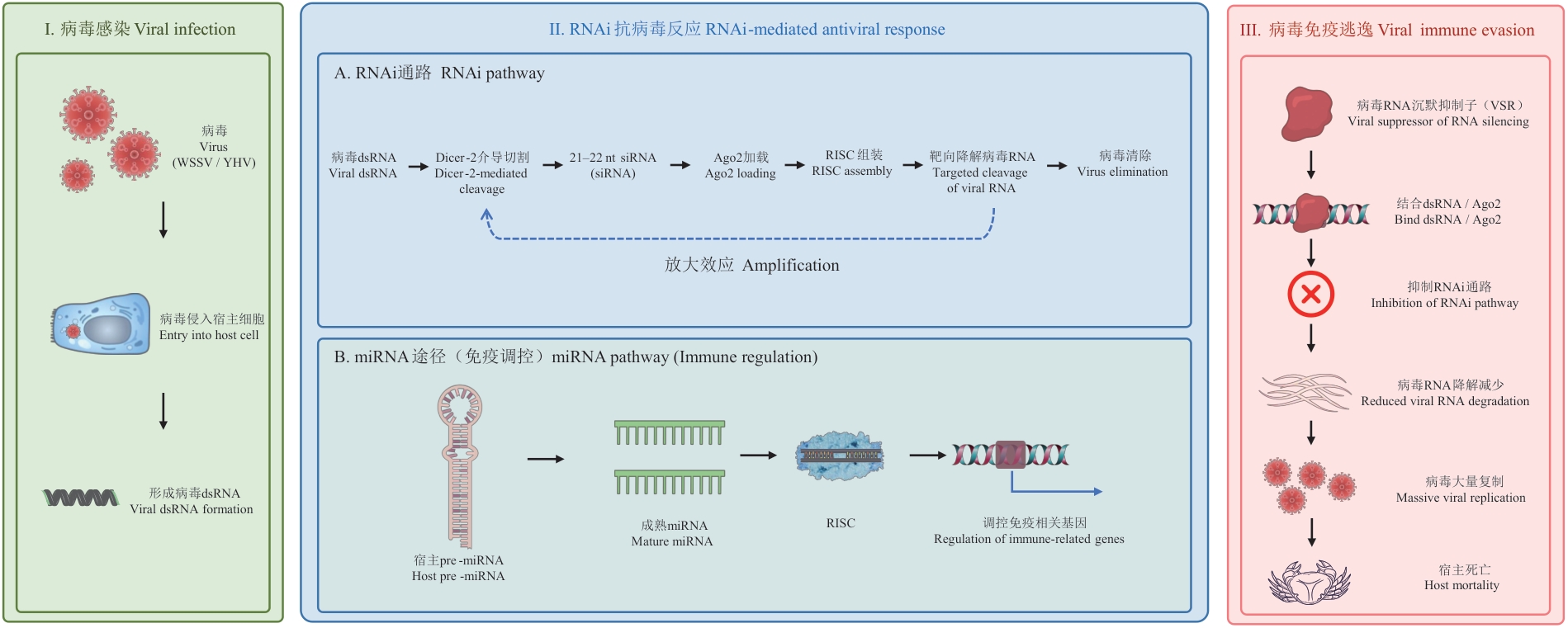
图1 甲壳类RNAi抗病毒免疫核心机制与病毒反制策略
Fig. 1 Core mechanisms of RNAi antiviral immunity and viral counter-strategies in crustaceans
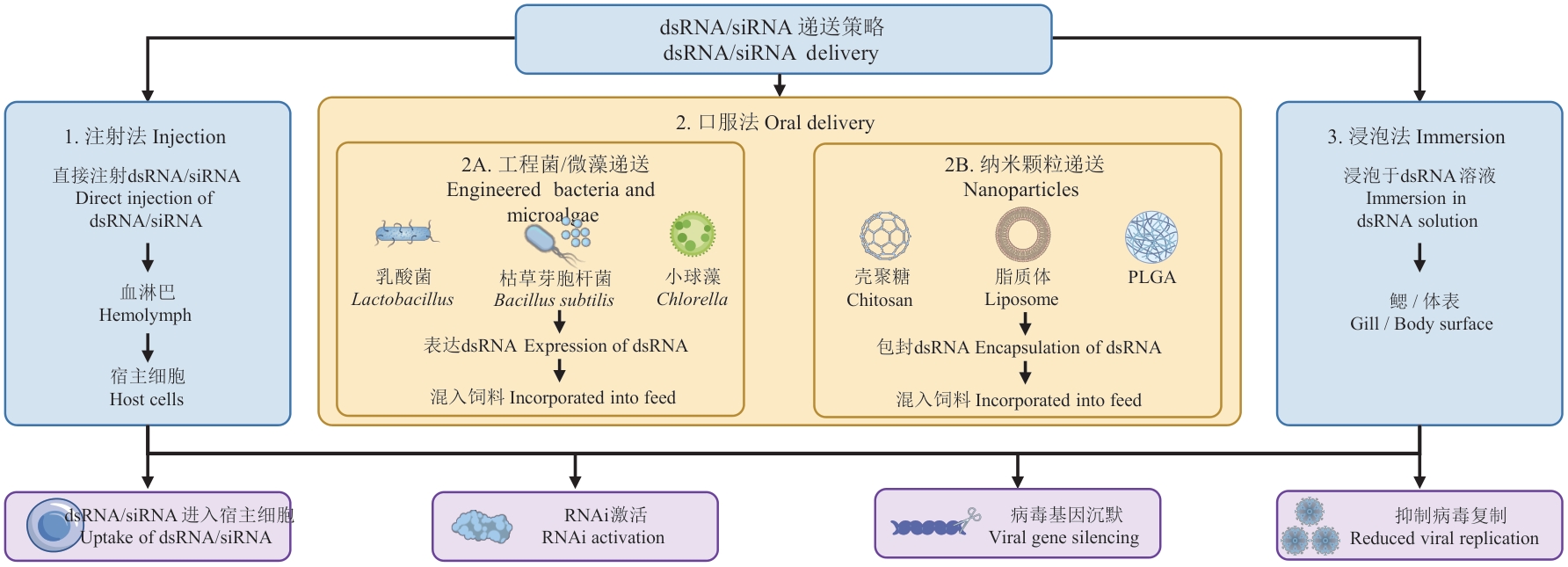
图2 甲壳类RNAi疾病防控中dsRNA递送策略示意图
Fig. 2 Schematic overview of dsRNA delivery strategies for RNAi-mediated disease prevention and control in crustaceans
| [1] | Alam MS, Islam MN, Das M, et al. RNAi-based therapy: combating shrimp viral diseases [J]. Viruses, 2023, 15(10): 2050. |
| [2] | Bonning BC, Saleh MC. The interplay between viruses and RNAi pathways in insects [J]. Annu Rev Entomol, 2021, 66: 61-79. |
| [3] | Abo-Al-Ela HG. RNA interference in aquaculture: a small tool for big potential [J]. J Agric Food Chem, 2021, 69(15): 4343-4355. |
| [4] | Zhao SD, Kong XS, Wu XF. RNAi-based immunity in insects against baculoviruses and the strategies of baculoviruses involved in siRNA and miRNA pathways to weaken the defense [J]. Dev Comp Immunol, 2021, 122: 104116. |
| [5] | Gong Y, Zhang XB. RNAi-based antiviral immunity of shrimp [J]. Dev Comp Immunol, 2021, 115: 103907. |
| [6] | Liu S, Han YH, Li WX, et al. Infection defects of RNA and DNA viruses induced by antiviral RNA interference [J]. Microbiol Mol Biol Rev, 2023, 87(2): e0003522. |
| [7] | Fajardo C, Donato M, Macedo M, et al. RNA interference applied to crustacean aquaculture [J]. Biomolecules, 2024, 14(11): 1358. |
| [8] | Zhong C, Jin NX, Liu M, et al. RNA interference-based therapeutics against aquatic viral diseases: Recent advances in fish and crustaceans (2010-2025) [J]. Fish Shellfish Immunol, 2026, 168: 110913. |
| [9] | 宋华丽, 孙效迎, 孔祥会, 等. RNA干扰技术在水产动物抗病毒和抗寄生虫研究中的应用研究进展 [J]. 生物技术通报, 2020, 36(2): 193-205. |
| Song HL, Sun XY, Kong XH, et al. Application of RNA interference technology in antiviral and antiparasitic research of aquatic animals [J]. Biotechnol Bull, 2020, 36(2): 193-205. | |
| [10] | Tare MVR, Almazan DJDN, Saquilayan KMDL, et al. A review of host and pathogen gene targets for RNAi therapeutics in shrimp disease mitigation [J]. Dev Comp Immunol, 2025, 172: 105482. |
| [11] | Samms KA, Monod EC, Ijaz A, et al. Sequence independent immune effects of white spot syndrome virus (WSSV) dsRNA complexed with phytoglycogen nanoparticles in freshwater crayfish [J]. J Invertebr Pathol, 2025, 209: 108239. |
| [12] | Zuo HL, Wang YX, Yang XY, et al. Oral RNAi delivery for targeting Ftz-F1β/JAK-STAT signaling axis to boost shrimp immunity against pathogen infection [J]. Int J Biol Macromol, 2025, 322: 146852. |
| [13] | Thongsum O, Boonkua S, Jaranathummakul S, et al. Submersion treatment of chimeric MrN-VLPs encapsulating therapeutic double-stranded RNA effectively rescues prawn viral infection [J]. J Fish Dis, 2026, 49(1): e70009. |
| [14] | Alenton RRR, Mai HN, Dhar AK. Engineering a replication-incompetent viral vector for the delivery of therapeutic RNA in crustaceans [J]. PNAS Nexus, 2023, 2(9): pgad278. |
| [15] | 周俊芳, 杨先乐, 万夕和, 等. 不同靶点shRNA干扰对虾白斑综合征病毒增殖效果分析 [J]. 华中农业大学学报, 2011, 30(1): 105-108. |
| Zhou JF, Yang XL, Wan XH, et al. Effect of the viral interference effects of shRNAs targeting different sites in white spot syndrome virus genome [J]. J Huazhong Agric Univ, 2011, 30(1): 105-108. | |
| [16] | Joo Hong S, Hong Kim K. Effects of length and sequence of long double-stranded RNAs targeting ribonucleotide reductase 2 of white spot syndrome virus (WSSV) on protective efficacy against WSSV [J]. J Invertebr Pathol, 2023, 196: 107869. |
| [17] | Pedrosa-Gerasmio IR, Saquilayan KMDL, Glori PJV, et al. A comparative review of RNAi delivery systems for shrimp aquaculture and future directions [J]. Fish Shellfish Immunol, 2025, 167: 110877. |
| [18] | Liu CZ, Li FH, Sun YM, et al. Virus-derived small RNAs in the penaeid shrimp Fenneropenaeus chinensis during acute infection of the DNA virus WSSV [J]. Sci Rep, 2016, 6: 28678. |
| [19] | Huang TZ, Zhang XB. Host defense against DNA virus infection in shrimp is mediated by the siRNA pathway [J]. Eur J Immunol, 2013, 43(1): 137-146. |
| [20] | 亓玉华, 何嘉乐, 刘萍萍, 等. 甲壳动物中白斑综合征病毒来源小RNA的特征及其保守富集的结构基础 [J]. 水生生物学报, 2026, 50(6): 55-64. |
| Qi YH, He JL, Liu PP, et al. Characteristics of white spot syndrome virus-derived small rnas in crustaceans and the structural basis of their conserved enrichment [J]. Acta Hydrobiol Sin, 2026, 50(6): 55-64. | |
| [21] | Bronkhorst AW, van Cleef KW, Vodovar N, et al. The DNA virus Invertebrate iridescent virus 6 is a target of the Drosophila RNAi machinery [J]. Proc Natl Acad Sci U S A, 2012, 109(51): E3604-E3613. |
| [22] | Wongkhaluang P, Taengchaiyaphum S, Wongpim T, et al. Activation of host endogenous reverse transcriptase in response to white spot syndrome virus infection in Penaeus monodon [J]. Fish Shellfish Immunol, 2026, 174: 111380. |
| [23] | Xing HL, Xiao W, Dai GQ, et al. Ku proteins play a positive role in the immune response against WSSV infection in Litopenaeus vannamei [J]. Fish Shellfish Immunol, 2025, 166: 110587. |
| [24] | Feijó RG, Viana JT, Maggioni R, et al. Infectious myonecrosis virus (IMNV) induces upregulation of RNAi-related genes in white shrimp Penaeus vannamei [J]. Dev Comp Immunol, 2025, 162: 105296. |
| [25] | Ren XT, Wang MT, Lu YZ. Characterization of a putative RNAi suppressor encoded by white spot syndrome virus [J]. Aquac Int, 2025, 33(7): 644. |
| [26] | Fang Y, Liu ZZ, Qiu Y, et al. Inhibition of viral suppressor of RNAi proteins by designer peptides protects from enteroviral infection in vivo [J]. Immunity, 2021, 54(10): 2231-2244.e6. |
| [27] | Guo DY, Xu W, Cui T, et al. Protein-coding circular RNA enhances antiviral immunity via JAK/STAT pathway in Drosophila [J]. mBio, 2024, 15(9): e0146924. |
| [28] | Nuanpirom J, Suksri P, Whankaew S, et al. Circular RNA identification and implication of a role of circAGO3 in the infection of white spot syndrome virus in Pacific white shrimp [J]. Fish Shellfish Immunol, 2025, 165: 110564. |
| [29] | Huang Y, Huang X, Zhang LH, et al. Chimeric RNA isoforms generated by diverse mechanisms from two C-type lectins modulate innate immunity in arthropods [J]. Proc Natl Acad Sci U S A, 2025, 122(41): e2518148122. |
| [30] | Zhang LQ, Liang Y, Qin JY, et al. CDK12 antagonizes a viral suppressor of RNAi to modulate antiviral RNAi in Drosophila [J]. mBio, 2025, 16(1): e0286824. |
| [31] | 陈田聪, 吕敏, 卢小花, 等. RNAi技术在虾免疫和生长发育的研究进展 [J]. 水产养殖, 2018, 39(10): 28-33. |
| Chen TC, Lv M, Lu XH, et al. Review on application of RNAi in immunization and growth of shrimp [J]. J Aquac, 2018, 39(10): 28-33. | |
| [32] | Xu F, Li DH, Zhang CT, et al. An aminopeptidase N homolog is associated with white spot syndrome virus infection susceptibility in Penaeus japonicus [J]. Fish Shellfish Immunol, 2026, 174: 111338. |
| [33] | Manito SG, Chen CY, de Jesús Castillo-Corea BR, et al. Functional analysis of wssv025 gene in the pathogenicity of white spot syndrome virus in Penaeus monodon [J]. Fish Shellfish Immunol, 2026, 169: 111022. |
| [34] | Liu HX, Yu Y, Gao HX, et al. Characterization of a newly identified vitellogenin-like gene (LvVTG-like) and its role in the defense against Vibrio parahaemolyticus infection in Litopenaeus vannamei [J]. Int J Biol Macromol, 2026, 369: 152720. |
| [35] | Huang YR, Li GJ, Feng LY, et al. Structural and functional characterization of SIRT1 in Litopenaeus vannamei: a regulator of energy metabolism, antioxidant system, autophagy and resistance to bacterial infection [J]. Fish Shellfish Immunol, 2026, 174: 111309. |
| [36] | Gao J, Liu CF, Liu PP, et al. Double-stranded RNA induces antiviral transcriptional response through the Dicer-2/Ampk/FoxO axis in an arthropod [J]. Proc Natl Acad Sci U S A, 2024, 121(31): e2409233121. |
| [37] | Cai PF, Zhang WY, Jiang SF, et al. A study on the functional role of the DHCR24 gene in gonadal differentiation and development of Macrobrachium nipponense [J]. Sci Rep, 2024, 14(1): 29443. |
| [38] | Huang J, Zhu WL, Peng M, et al. Cloning, identification, and functional analysis of the Foxl2 gene in Procambarus clarkii [J]. Genes, 2023, 14(12): 2190. |
| [39] | Gao ZJ, Zhang WY, Jiang SF, et al. Identification of male sex-related genes regulated by SDHB in Macrobrachium nipponense based on transcriptome analysis after an RNAi knockdown [J]. Int J Mol Sci, 2023, 24(17): 13176. |
| [40] | Xu JW, Yang WJ, Yang JS. A distinct fruitless homolog participates in reproductive maturation and pairing behavior in the brine shrimp Artemia franciscana [J]. Comp Biochem Physiol Part B Biochem Mol Biol, 2026, 285: 111243. |
| [41] | Zhang CY, Zhang XJ, Si SQ, et al. Identification and functional analysis of a key gene in the CHH gene family for glucose metabolism in the Pacific white shrimp Litopenaeus vannamei [J]. Int J Mol Sci, 2025, 26(10): 4612. |
| [42] | Huang YC, Lai XJ, Zhang ZP, et al. Identification and function analysis of steroid hormone synthesis pathway-related gene—Hsd3b in Scylla paramamosain [J]. J Steroid Biochem Mol Biol, 2024, 241: 106529. |
| [43] | Li SY, Lei YF, Liu QY, et al. Multidimensional regulatory mechanisms of LvChia2 on growth in the Pacific white shrimp (Litopenaeus vannamei) [J]. Genes, 2025, 16(9): 1110. |
| [44] | Zhang L, Sun LC, Song GH, et al. Genome-wide identification and expression of neuropeptides and their expression patterns after RNAi of CHH genes in Pacific white shrimp Litopenaeus vannamei [J]. Biology, 2024, 13(12): 1038. |
| [45] | Ge FQ, Yu QL, Zhang J, et al. E93 gene in the swimming crab, Portunus trituberculatus: Responsiveness to 20-hydroxyecdysone and methyl farnesoate and role on regulating ecdysteroid synthesis [J]. Comp Biochem Physiol Part B Biochem Mol Biol, 2024, 270: 110910. |
| [46] | Zhang T, Hu YN, Lu SY, et al. Chitin synthase is required for cuticle formation and molting in the Chinese mitten crab Eriocheir sinensis [J]. Int J Mol Sci, 2025, 26(5): 2358. |
| [47] | Men JL, Xue YJ, Fu Y, et al. Decoding the role of HIF-1α in immunoregulation in Litopenaeus vannamei under hypoxic stress [J]. Fish Shellfish Immunol, 2024, 154: 109962. |
| [48] | Ma YH, Zhu YC, Liu C, et al. Yorkie involves in immune response under hypoxia stress in Chinese mitten crab (Eriocheir sinensis) [J]. Fish Shellfish Immunol, 2025, 166: 110636. |
| [49] | Li YF, Tong RX, Li ZY, et al. Toxicological mechanism of ammonia-N on haematopoiesis and apoptosis of haemocytes in Litopenaeus vannamei [J]. Sci Total Environ, 2023, 879: 163039. |
| [50] | Zhou XX, Hou YK, Zhang Y, et al. The study of MDM2 binding protein (MTBP) in response to apoptosis in Litopenaeus vannamei under ammonia and nitrite nitrogen stress [J]. Fish Shellfish Immunol, 2025, 167: 110909. |
| [51] | Lyu K, Fan YC, Zhou XY, et al. p38 MAPK determines the sensitivity of the aquatic keystone species Moina macrocopa to toxic Microcystis: Insights into potential biomarker applications [J]. Environ Pollut, 2025, 366: 125458. |
| [52] | Shao TT, Zheng JR, He YX, et al. Bif-1 upregulates autophagy to improve nitrite tolerance of Litopenaeus vannamei by interacts with Prohibitin-2 [J]. Int J Biol Macromol, 2026, 367: 152671. |
| [53] | Li J, Zuo JM, Lv XY, et al. Hedgehog signaling is essential in the regulation of limb regeneration in the Chinese mitten crab, Eriocheir sinensis [J]. Fish Shellfish Immunol, 2023, 140: 108981. |
| [54] | Li H, Liu WJ, Zhu L, et al. Delta/Notch signaling regulates blastema formation during limb regeneration in Eriocheir sinensis [J]. Comp Biochem Physiol Part B Biochem Mol Biol, 2026, 281: 111168. |
| [55] | Li J, Fu SM, Tian YX, et al. A myogenic regulatory factor is required for myogenesis during limb regeneration in the Chinese mitten crab [J]. Int J Biol Macromol, 2024, 279: 135024. |
| [56] | Zhou XY, Yu JH, Zhang HM, et al. Crustacean cardioactive peptide (CCAP) negatively regulates sand-diving behaviour in kuruma shrimp, Penaeus japonicus [J]. Comp Biochem Physiol Part B Biochem Mol Biol, 2025, 280: 111143. |
| [57] | Li HF, Zhang LL, Wang GD, et al. Functional analysis of the NinaB-like gene in body color regulation of Neocaridina denticulata sinensis [J]. BioTech, 2026, 15(1): 15. |
| [58] | Cao XT, Wu LJ, Xu FL, et al. PcTrim prevents early infection with white spot syndrome virus by inhibiting AP1-induced endocytosis [J]. Cell Commun Signal, 2023, 21(1): 104. |
| [59] | Yang BB, Zhang L, Luo K, et al. Integrin β regulates the hepatopancreas antiviral innate immune system by affecting the expression of antimicrobial peptides in Penaeus vannamei [J]. Int J Mol Sci, 2025, 26(17): 8478. |
| [60] | Kim CY, Kim Y. In vivo transient expression of a viral silencing suppressor, NSs, derived from tomato spotted wilt virus decreases insect RNAi efficiencies [J]. Arch Insect Biochem Physiol, 2023, 112(2): e21982. |
| [1] | 马如清, 冯雪琪, 杨清岚, 汪军成, 孟亚雄, 马小乐, 李葆春, 姚立蓉, 王化俊, 司二静. 大麦条纹病菌Pg03852基因功能研究[J]. 生物技术通报, 2026, 42(1): 262-270. |
| [2] | 黄雯婧, 任思潮, 林俐, 王幼平, 吴健. RNA干扰在植物功能基因组学和遗传改良中的应用研究进展[J]. 生物技术通报, 2025, 41(9): 1-21. |
| [3] | 文静, 李倩倩, 张明达, 谭茗月, 金博阳, 沈秀丽, 杜志强. Duox 2调控克氏原螯虾肠组织抗细菌先天免疫的分子机制[J]. 生物技术通报, 2025, 41(1): 324-332. |
| [4] | 王柯然, 闫俊杰, 刘建凤, 高玉林. RNAi技术在马铃薯害虫防控中的应用和风险[J]. 生物技术通报, 2024, 40(9): 4-10. |
| [5] | 金博阳, 秦仕宇, 张明达, 李倩倩, 文静, 沈秀丽, 杜志强. 小龙虾prx 6基因在对抗金黄色葡萄球菌感染中的分子作用机制研究[J]. 生物技术通报, 2024, 40(7): 314-322. |
| [6] | 张龙喜, 吕琳, 张欢欢, 周金成, 车午男, 董辉. RNAi技术在寄生蜂中的应用研究进展[J]. 生物技术通报, 2023, 39(12): 99-108. |
| [7] | 刘晓玫, 王东鑫, 张春, 魏双施. AAV介导的RNAi对SARS-CoV-2 S基因表达的抑制作用[J]. 生物技术通报, 2022, 38(3): 188-193. |
| [8] | 郭宇飞, 闫荣媚, 张小茹, 曹威, 刘浩. 代谢工程改造黑曲霉生产葡萄糖二酸[J]. 生物技术通报, 2022, 38(11): 227-237. |
| [9] | 潘银来, 邱春辉, 王艺磊, 张子平. RNA药物的发展及其在水产上的应用[J]. 生物技术通报, 2021, 37(2): 203-215. |
| [10] | 邓普荣, 刘勇波. RNAi与转Bt基因技术协同抗虫研究进展[J]. 生物技术通报, 2021, 37(10): 216-224. |
| [11] | 徐雪亮, 王奋山, 刘子荣, 范琳娟, 季香云, 蒋杰贤, 姚英娟. RNA干扰技术在昆虫学领域研究进展[J]. 生物技术通报, 2021, 37(1): 255-261. |
| [12] | 杨文文, 倪嘉瑶, 胡蕊洁, 王华忠. 一个RNAi载体上反向重复片段的测序策略[J]. 生物技术通报, 2020, 36(5): 205-210. |
| [13] | 宋华丽, 孙效迎, 孔祥会, 李莉, 裴超. RNA干扰技术在水产动物抗病毒和抗寄生虫研究中的应用研究进展[J]. 生物技术通报, 2020, 36(2): 193-205. |
| [14] | 许祥, 董维鹏, 张少华, 冯晨毅, 刘田福, 燕炯. Fsp27基因沉默载体的构建及其对细胞脂解的影响研究[J]. 生物技术通报, 2020, 36(1): 88-94. |
| [15] | 韩翠翠, 刘立琨, 王玉春, 杨莹, 刘吉成, 周忠光. TOX3基因RNAi慢病毒载体的构建及对乳腺癌ZR-75-1细胞增殖的影响[J]. 生物技术通报, 2019, 35(7): 141-147. |
| 阅读次数 | ||||||
|
全文 |
|
|||||
|
摘要 |
|
|||||
