







生物技术通报 ›› 2026, Vol. 42 ›› Issue (10): 47-54.doi: 10.13560/j.cnki.biotech.bull.1985.2025-1470
• 技术与方法 • 上一篇
彭文慧1,2,3, 李冠初2,3, 刘永敏2,3, 马文建1( ), 郭晓贤3()
收稿日期:2026-01-02
出版日期:2026-10-26
发布日期:2026-06-10
通讯作者:
马文建ma_wj@tust.edu.cn基金资助:
PENG Wen-hui1,2,3, LI Guan-chu2,3, LIU Yong-min2,3, MA Wen-jian1(), GUO Xiao-xian3()
Received:2026-01-02
Published:2026-10-26
Online:2026-06-10
摘要:
目的 人类线粒体DNA突变与多种疾病相关,但其全长序列在原核宿主中不稳定,体外制备大片段环状DNA也较困难,亟需一套新策略来高效制备环状全长线粒体DNA,以突破线粒体遗传操作的关键技术瓶颈。 方法 首先,为有效克服传统原核克隆系统的宿主毒性问题,利用酿酒酵母(Saccharomyces cerevisiae)高效的同源重组系统将全长人线粒体基因组稳定克隆至酵母载体中;同时,通过定点编辑去除了内源的EcoR I限制性酶切位点,为克隆的mtDNA提供遗传筛选标记。随后,开发一种基于错位线性化片段的体外热循环连接新策略,以解决线性PCR产物的环化难题。该方法利用耐热连接酶在变性-复性循环中驱动异源双链黏性末端的形成,从而实现长片段DNA的高效环化。 结果 利用该策略成功制备了大小为16.6 kb的全长人线粒体基因组。限制性内切酶图谱分析及外切酶抗性实验证实,合成产物为序列正确、无缺口的共价闭合环状DNA。 结论 建立的“酵母辅助编辑-体外循环组装”技术体系,不仅解决了高质量环状全长mtDNA制备的难题,也为线粒体疾病模型的构建、人工线粒体合成以及线粒体基因治疗载体的开发提供了通用的遗传操作平台。
彭文慧, 李冠初, 刘永敏, 马文建, 郭晓贤. 基于酿酒酵母克隆与错位热循环连接的环状全长人类线粒体DNA制备[J]. 生物技术通报, 2026, 42(10): 47-54.
PENG Wen-hui, LI Guan-chu, LIU Yong-min, MA Wen-jian, GUO Xiao-xian. Synthesis of Circular Full-length Human Mitochondrial DNA Based on Yeast Cloning and Staggered Thermal Cycling Ligation[J]. Biotechnology Bulletin, 2026, 42(10): 47-54.
引物名称 Primer | 引物序列 Primer sequence (5′-3′) | 说明 Notes |
|---|---|---|
| A_F1 | tgagttacctcactcattagTATGTGTTGTCGTGCAGGTAGAGG | 小写字母为pRS415同源序列 (Lowercase letters indicate homologous sequences to the pRS415 vector) |
| D_R4 | acaaggaagtacaggacaattgATGACCCACCAATCACATGCCTATCATATAGT | |
| A_R1 | GGCCATTATCGAAGAATTTACAAAAAACAATAGC | 加粗字母为EcoR I位点内所引入的突变碱基 (Bold characters represent the mutated bases introduced within the EcoR I recognition site) |
| B_F2 | GCTATTGTTTTTTGTAAATTCTTCGATAATGGCC | |
| B_R2 | CCCTGTTCTTATGAATCCGAACAGCATAC | |
| C_F3 | GTATGCTGTTCGGATTCATAAGAACAGGG | |
| C_R3 | GGTCCATCATAGAATTTTCACTGTGATAT | |
| D_F4 | ATATCACAGTGAAAATTCTATGATGGACC | |
| 59F | /5Phos/GGCCCTCTCAGCCCTCCTAATGAC | /5Phos/为5′端磷酸化修饰 (/5Phos/ indicates a 5' phosphorylation modification) |
| 59R | /5Phos/CCTGTTAGGGGTCATGGGCTGGGTTTTACTATATGATAGGCATGTGATTGGTGGGTCATTATGTGTTGTCGTGCAGGTAGAGGC | |
| F40 | /5Phos/AAAACCCAGCCCATGACCCCTAACAGGGGCCCTCTCAGCCCTCCTAATGACCTCCGGCCTAGCCATGTGAT | |
| R41 | /5Phos/ACTATATGATAGGCATGTGATTGGTGGGTCATTATGTGTTGTCGTGCAGGTAGAGGCTTACTAGAAGTGTG |
表1 本研究所使用的引物
Table 1 Primers used in this study
引物名称 Primer | 引物序列 Primer sequence (5′-3′) | 说明 Notes |
|---|---|---|
| A_F1 | tgagttacctcactcattagTATGTGTTGTCGTGCAGGTAGAGG | 小写字母为pRS415同源序列 (Lowercase letters indicate homologous sequences to the pRS415 vector) |
| D_R4 | acaaggaagtacaggacaattgATGACCCACCAATCACATGCCTATCATATAGT | |
| A_R1 | GGCCATTATCGAAGAATTTACAAAAAACAATAGC | 加粗字母为EcoR I位点内所引入的突变碱基 (Bold characters represent the mutated bases introduced within the EcoR I recognition site) |
| B_F2 | GCTATTGTTTTTTGTAAATTCTTCGATAATGGCC | |
| B_R2 | CCCTGTTCTTATGAATCCGAACAGCATAC | |
| C_F3 | GTATGCTGTTCGGATTCATAAGAACAGGG | |
| C_R3 | GGTCCATCATAGAATTTTCACTGTGATAT | |
| D_F4 | ATATCACAGTGAAAATTCTATGATGGACC | |
| 59F | /5Phos/GGCCCTCTCAGCCCTCCTAATGAC | /5Phos/为5′端磷酸化修饰 (/5Phos/ indicates a 5' phosphorylation modification) |
| 59R | /5Phos/CCTGTTAGGGGTCATGGGCTGGGTTTTACTATATGATAGGCATGTGATTGGTGGGTCATTATGTGTTGTCGTGCAGGTAGAGGC | |
| F40 | /5Phos/AAAACCCAGCCCATGACCCCTAACAGGGGCCCTCTCAGCCCTCCTAATGACCTCCGGCCTAGCCATGTGAT | |
| R41 | /5Phos/ACTATATGATAGGCATGTGATTGGTGGGTCATTATGTGTTGTCGTGCAGGTAGAGGCTTACTAGAAGTGTG |
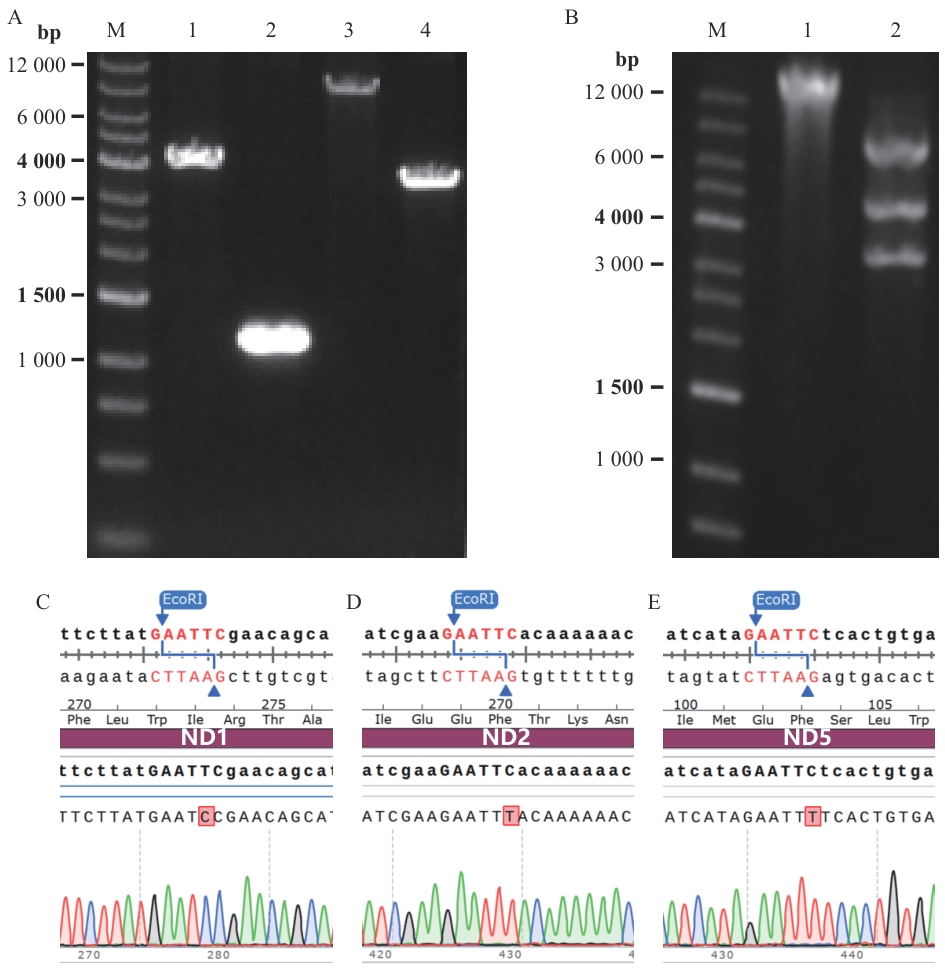
图1 无 EcoR I 位点的全长人线粒体基因组重组克隆的构建与验证A:用于酵母同源重组的4个重叠PCR片段电泳图。M:DNA marker。B:组装后全长mtDNA的验证。泳道1:引物F40/R41扩增的全长PCR产物。泳道2:Cla I和BamH I双酶切验证,显示预期大小的条带(~8 kb, 5 kb, 3.5 kb)。C-E:测序峰图确认消除了EcoR I位点的同义突变(红框所示)。分别为ND1 (m.4125T>C) (C), ND2 (m.5280C>T) (D)和ND5 (m.12645C>T) (E)。上图:野生型序列;下图:突变序列
Fig. 1 Construction and verification of recombinant clone of EcoR I-free full-length human mitochondrial genomeA: Gel electrophoresis of the four overlapping PCR fragments used for yeast homologous recombination. M: DNA marker. B: Validation of the assembled mtDNA. Lane 1: Full-length PCR product amplified by primers F40/R41. Lane 2: Restriction digest with ClaI and BamHI showing expected fragments (~8 kb, 5 kb, and 3.5 kb). C-E: Sequencing chromatograms confirming synonymous mutations (red boxes) that eliminate EcoRI sites. C: ND1 (m.4125T>C); D:ND2 (m.5280C>T); E: ND5 (m.12645C>T). Top: Wild-type sequence; bottom: mutated sequence
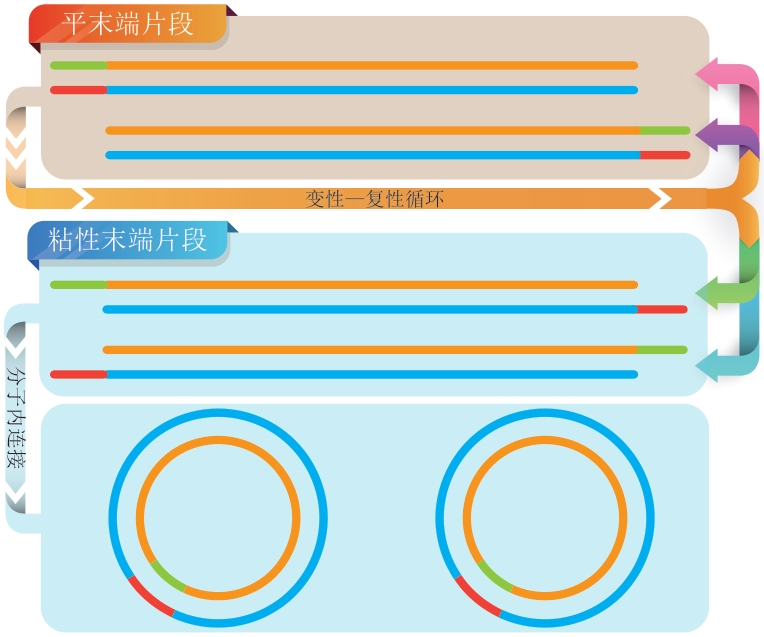
图2 错位线性化DNA片段的变复性循环连接环化策略示意图错位平末端片段进行变性-复性循环。互补链间的交叉杂交产生具黏性末端的异源双链(中图),作为分子内连接形成环状DNA(下图)的底物。平末端同源双链(上图)重新进入热循环,从而驱动平衡向环状产物积累方向移动
Fig. 2 Schematic illustration of the staggered linear DNA circularization strategyBlunt-ended fragments with staggered termini undergo denaturation-renaturation cycles. Cross-hybridization between complementary strands generates cohesive-ended heteroduplexes (middle panel) that serve as substrates for intramolecular ligation into circular DNA (bottom panel). Blunt-ended homoduplexes (top panel) are recycled through further thermal cycles, shifting the equilibrium toward circular product accumulation
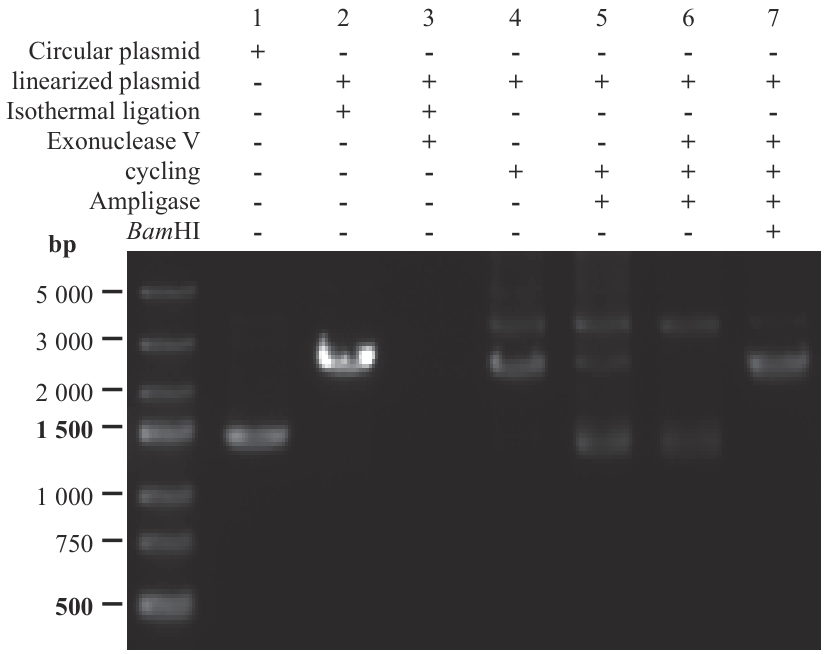
图3 pUC19错位线性化后使用变性-复性-连接循环重新环化检测与验证反应产物的琼脂糖凝胶电泳分析。泳道 1-3 (对照组):天然环状pUC19表现出对Exonuclease V的抗性(泳道1),而错位线性底物混合物则被完全降解(泳道3),验证了外切酶的选择性。泳道4:在无Ampligase参与的热循环中,底物发生复性形成开环DNA,但未形成共价闭合环状DNA。泳道5-6:完整的连接反应体系生成了多种构象产物(泳道5),经Exonuclease V处理后仍保留特异性条带(泳道6),证实成功连接成了闭合环状DNA。泳道7:对外切酶抗性产物进行BamHI单酶切,获得与初始线性底物大小一致的单一线性条带(对比泳道2),确认组装产物为正确的单体质粒
Fig. 3 Detection and validation of pUC19 recircularization via misprimed linearization followed by denaturation-renaturation-ligation cyclingAgarose gel electrophoresis analysis of the reaction products. Lanes 1-3 (Controls): Native circular pUC19 exhibits resistance to Exonuclease V digestion (Lane 1), whereas the staggered linear substrate is completely degraded (Lane 3), confirming the selectivity of the exonuclease. Lane 4: Thermal cycling without Ampligase yields re-annealed complexes (likely nicked or concatenated). Lanes 5-6: The full ligation reaction generates products (Lane 5) that remain detectable after Exonuclease V treatment (Lane 6), confirming the formation of covalently closed circular DNA. Lane 7: Linearization of the Exonuclease V-resistant product with BamHI restores a single band identical in size to the input linear substrate (Lane 2), verifying the correct assembly of the monomeric plasmid
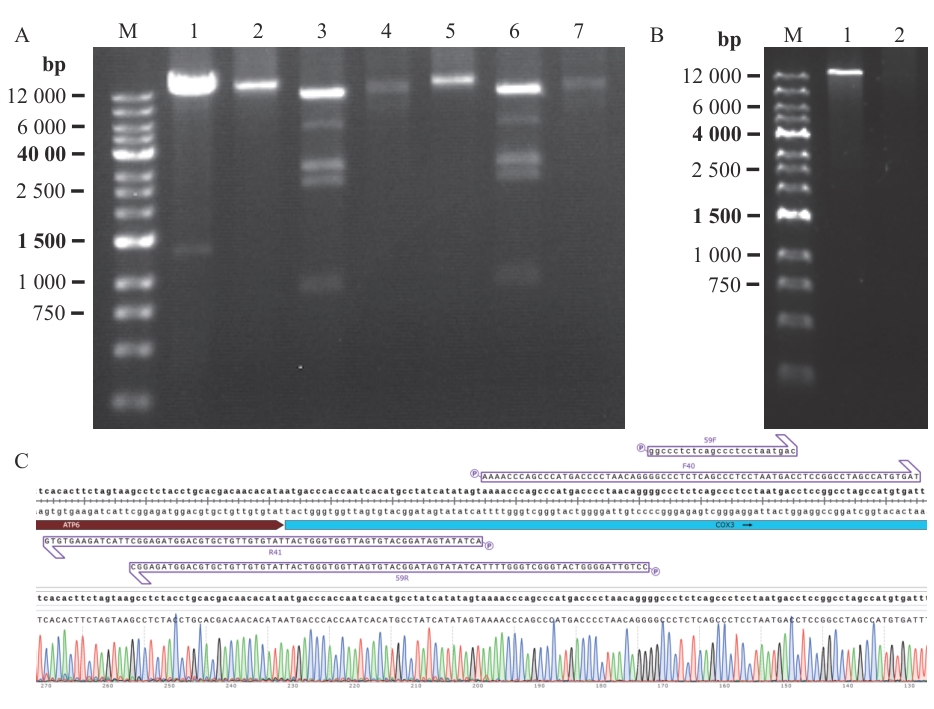
图4 全长人线粒体基因组的体外环化与验证A:环化产物的琼脂糖凝胶电泳分析。泳道1:错位线性mtDNA片段混合物。泳道2和5:分别在60 ℃和70 ℃条件下进行热循环连接的产物。泳道3和6:对应产物的Hind III酶切图谱。约5.5 kb特征条带(由3 003 bp和2 474 bp的末端片段融合形成)的出现证实了线性的首尾连接与环化。泳道4和7:经 Exonuclease V处理后的产物,显示出外切酶抗性条带,表明环状结构的存在。M:DNA Marker。B:利用T5 Exonuclease 验证共价闭合环状DNA。泳道1:环化产物保留了抗性条带,表明形成了无缺口的cccDNA。泳道2:线性mtDNA对照被完全降解。M:DNA Marker。C:连接位点的序列验证。上图:位于ATP6和COX3基因交界处的引物对(59F/R和F40/R41)结合位点示意图。下图:T5 Exonuclease抗性产物的Sanger测序峰图,证实了连接位点处序列的准确还原
Fig. 4 In vitro circularization and validation of the full-length human mitochondrial genomeA: Electrophoretic analysis of the circularization products. Lane 1: Mixture of overlapping linear mtDNA fragments. Lanes 2 and 5: Products obtained after thermal cycling ligation at 60 ℃ and 70 ℃, respectively. Lanes 3 and 6: Hind III restriction digests of the circularization products. The appearance of a characteristic ~5.5 kb band (fusion of the 3 003 bp and 2 474 bp terminal fragments) confirms successful circularization, distinct from the linear restriction pattern. Lanes 4 and 7: Products treated with Exonuclease V, showing resistant high-molecular-weight bands indicative of circular structure. M: DNA Marker. B: Validation of covalently closed circular (ccc) DNA using T5 Exonuclease. Lane 1: The cyclized product retains a resistant band, confirming the formation of nick-free cccDNA. Lane 2: Linear mtDNA control is completely degraded. M: DNA Marker. C: Sequence verification of the ligation junction. Top: Schematic illustrating the binding sites of the primer pairs (59F/R and F40/R41) at the boundary of the ATP6 and COX3 genes. Bottom: Sanger sequencing chromatogram of the T5 Exonuclease-resistant product, confirming the precise sequence restoration across the ligation site without mutations or deletions
| [1] | Schon EA, DiMauro S, Hirano M. Human mitochondrial DNA: roles of inherited and somatic mutations [J]. Nat Rev Genet, 2012, 13(12): 878-890. |
| [2] | Park J, Baruch-Torres N, Yin YW. Structural and molecular basis for mitochondrial DNA replication and transcription in health and antiviral drug toxicity [J]. Molecules, 2023, 28(4): 1796. |
| [3] | Belousova V, Ignatko I, Bogomazova I, et al. Causes of and solutions to mitochondrial disorders: a literature review [J]. Int J Mol Sci, 2025, 26(14): 6645. |
| [4] | Mei JL, Ding P, Gao C, et al. Mitochondrial diseases: molecular pathogenesis and therapeutic advances [J]. MedComm, 2025, 6(9): e70385. |
| [5] | Tapper DP, Van Etten RA, Clayton DA. Isolation of mammalian mitochondrial DNA and RNA and cloning of the mitochondrial genome [M]//Biomembranes Part K: Membrane Biogenesis: Assembly and Targeting (Prokaryotes, Mitochondria, and Chloroplasts). Amsterdam: Elsevier 1983: 426-434. |
| [6] | Mita S, Monnat RJ, Loeb LA. Direct selection of mutations in the human mitochondrial tRNAThr gene: reversion of an ‘uncloneable’ phenotype [J]. Mutat Res Mutagen Relat Subj, 1988, 199(1): 183-190. |
| [7] | Ruiz E, Talenton V, Dubrana MP, et al. CReasPy-cloning: a method for simultaneous cloning and engineering of megabase-sized genomes in yeast using the CRISPR-Cas9 system [J]. ACS Synth Biol, 2019, 8(11): 2547-2557. |
| [8] | Bigger BW, Liao AY, Sergijenko A, et al. Trial and error: how the unclonable human mitochondrial genome was cloned in yeast [J]. Pharm Res, 2011, 28(11): 2863-2870. |
| [9] | Gammage PA, Rorbach J, Vincent AI, et al. Mitochondrially targeted ZFNs for selective degradation of pathogenic mitochondrial genomes bearing large-scale deletions or point mutations [J]. EMBO Mol Med, 2014, 6(4): 458-466. |
| [10] | Reddy P, Ocampo A, Suzuki K, et al. Selective elimination of mitochondrial mutations in the germline by genome editing [J]. Cell, 2015, 161(3): 459-469. |
| [11] | Lim K. Mitochondrial genome editing: strategies, challenges, and applications [J]. BMB Rep, 2024, 57(1): 19-29. |
| [12] | Guo JY, Chen XX, Liu ZW, et al. DdCBE mediates efficient and inheritable modifications in mouse mitochondrial genome [J]. Mol Ther Nucleic Acids, 2022, 27: 73-80. |
| [13] | Cho SI, Lim K, Hong S, et al. Engineering TALE-linked deaminases to facilitate precision adenine base editing in mitochondrial DNA [J]. Cell, 2024, 187(1): 95-109, e26. |
| [14] | Yamada Y, Fukuda Y, Harashima H. An analysis of membrane fusion between mitochondrial double membranes and MITO-Porter, mitochondrial fusogenic vesicles [J]. Mitochondrion, 2015, 24: 50-55. |
| [15] | Rai PK, Craven L, Hoogewijs K, et al. Advances in methods for reducing mitochondrial DNA disease by replacing or manipulating the mitochondrial genome [J]. Essays Biochem, 2018, 62(3): 455-465. |
| [16] | Sercel AJ, Patananan AN, Man TX, et al. Stable transplantation of human mitochondrial DNA by high-throughput, pressurized isolated mitochondrial delivery [J]. eLife, 2021, 10: e63102. |
| [17] | Kukat A, Kukat C, Brocher J, et al. Generation of rho0 cells utilizing a mitochondrially targeted restriction endonuclease and comparative analyses [J]. Nucleic Acids Res, 2008, 36(7): e44. |
| [1] | 卢春秋, 梁丽存, 王苑, 黄火清, 罗会颖, 杨浩萌. 供体DNA募集提高塔宾曲霉同源重组效率[J]. 生物技术通报, 2026, 42(8): 90-96. |
| [2] | 江宏燕, 陈世春, 廖姝然, 陈亭旭, 王晓庆. 曙厉蝽和益蝽线粒体基因组全序列特征及系统发育分析[J]. 生物技术通报, 2025, 41(1): 312-323. |
| [3] | 尹号, 尤留超, 韩瑞, 高鹏程, 付磊, 储岳峰. 单链DNA退火蛋白介导细菌基因组同源重组的机制及应用研究进展[J]. 生物技术通报, 2025, 41(1): 39-48. |
| [4] | 隆静, 陈婧敏, 刘霄, 张一凡, 周利斌, 杜艳. 植物DNA双链断裂修复机制及其在重离子诱变和基因编辑中的作用[J]. 生物技术通报, 2024, 40(7): 55-67. |
| [5] | 程亚楠, 张文聪, 周圆, 孙雪, 李玉, 李庆刚. 乳酸乳球菌生产2'-岩藻糖基乳糖的途径构建及发酵培养基优化[J]. 生物技术通报, 2023, 39(9): 84-96. |
| [6] | 杨玉梅, 张坤晓. 应用CRISPR/Cas9技术建立ERK激酶相分离荧光探针定点整合的稳定细胞株[J]. 生物技术通报, 2023, 39(8): 159-164. |
| [7] | 曲春娟, 朱悦, 江晨, 曲明静, 王向誉, 李晓. 铜绿丽金龟线粒体全基因组及其系统发育分析[J]. 生物技术通报, 2023, 39(2): 263-273. |
| [8] | 林兴雨, 宋南. Atteva charopis的比较线粒体基因组研究及系统发育分析[J]. 生物技术通报, 2023, 39(12): 300-310. |
| [9] | 薛清, 杜虹锐, 薛会英, 王译浩, 王暄, 李红梅. 苜蓿滑刃线虫线粒体基因组及其系统发育研究[J]. 生物技术通报, 2021, 37(7): 98-106. |
| [10] | 张丽珊, 孙莉娜, 林镇平, 林向民. 嗜水气单胞菌非核糖体肽合成酶基因功能研究[J]. 生物技术通报, 2020, 36(4): 93-99. |
| [11] | 李小艳, 李泽琦, 汪玉倩, 于晶, 林镇平, 林向民. 嗜水气单胞菌acrA缺失菌株的构建及其生理功能的测定[J]. 生物技术通报, 2020, 36(11): 63-69. |
| [12] | 王平, 丛玲, 王春语, 朱振兴, AAshokKumar, 张丽霞, 陆晓春. 高粱A1型细胞质雄性不育系与保持系线粒体基因组分析比较[J]. 生物技术通报, 2019, 35(5): 42-47. |
| [13] | 黄放,林向民. 嗜水气单胞菌bamA、bamB、bamD突变株的构建及其对外膜蛋白转运的影响[J]. 生物技术通报, 2018, 34(5): 148-153. |
| [14] | 金巧, 刘霞, 甘志凯. 木通红喀木虱线粒体基因组的测定与序列分析[J]. 生物技术通报, 2018, 34(11): 127-135. |
| [15] | 茅佳灵, 许琳, 严明. NADP(H)相关的体外合成乳酸途径构建以及性究[J]. 生物技术通报, 2016, 32(9): 260-266. |
| 阅读次数 | ||||||
|
全文 |
|
|||||
|
摘要 |
|
|||||
