







生物技术通报 ›› 2026, Vol. 42 ›› Issue (7): 163-172.doi: 10.13560/j.cnki.biotech.bull.1985.2025-1156
• 研究报告 • 上一篇
冉丹丹1, 邰森林1, 欧小宏1,2, 周涛1,2, 徐娇1,2( )
)
收稿日期:2025-10-27
出版日期:2026-07-26
发布日期:2026-07-20
通讯作者:
徐娇xujiao2008mzk@163.com作者简介:第一联系人:同等贡献
基金资助:
RAN Dan-dan1, TAI Sen-lin1, OU Xiao-hong1,2, ZHOU Tao1,2, XU Jiao1,2()
Received:2025-10-27
Published:2026-07-26
Online:2026-07-20
摘要:
目的 尿苷二磷酸糖基转移酶(UGT)介导的糖基化修饰是植物色素合成的关键环节,鉴定乌天麻(Gastrodia elata Bl. f. glauca S. Chow)UGT基因家族成员的结构和功能,为解析不同生态型天麻茎色形成机制奠定基础。 方法 通过BLAST比对,结合Pfam和InterPro数据库鉴定乌天麻UGT基因家族成员;使用TBtools分析其理化性质、结构特征、染色体定位、系统发育、共线关系及顺式作用元件;结合转录组数据、RT-qPCR、总黄酮含量测定以及共表达网络分析,挖掘调控天麻茎色形成的关键UGT基因。 结果 从乌天麻基因组中鉴定得到50个UGT基因家族成员,均含有UDPGT保守结构域;系统进化分析显示UGT基因家族成员可聚类为10个组,其中Ⅲ、Ⅳ组成员数量最多,且部分成员在染色体上成簇分布;UGT启动子区富集光响应和激素响应元件;共线性分析表明,乌天麻与石斛、拟南芥分别存在22对和1对共线基因对。不同生态型天麻茎中UGT的相对表达量及总黄酮积累水平呈现差异,其中GeUGT72_04、GeUGT73_11和GeUGT73_15在血红天麻、绿天麻及乌天麻茎中表达量存在差异,且与总黄酮含量呈显著相关。共表达网络分析表明,GeUGT73_15与类黄酮合成相关基因PER42、FLS等呈显著正相关;GeUGT73_11则与CHS_1、4CL等呈显著负相关。 结论 不同生态型天麻茎色差异与黄酮类物质积累密切相关,GeUGT72_04、GeUGT73_11和GeUGT73_15可能通过调节天麻茎中黄酮类物质的合成,参与天麻茎色形成的调控过程,是影响天麻茎色分化的关键候选基因。
冉丹丹, 邰森林, 欧小宏, 周涛, 徐娇. 天麻尿苷二磷酸糖基转移酶基因家族鉴定与分析[J]. 生物技术通报, 2026, 42(7): 163-172.
RAN Dan-dan, TAI Sen-lin, OU Xiao-hong, ZHOU Tao, XU Jiao. Genome-wide Identification and Characterization of UDP-glycosyltransferase Gene Family in Gastrodia elata[J]. Biotechnology Bulletin, 2026, 42(7): 163-172.
| 基因Gene | 上游引物Forward primer (5'-3') | 下游引物Reverse primer (5'-3') |
|---|---|---|
| GeUGT92_01 | CGTTTGCCGCCTGGTCTATC | GGGACGGTGAAGGTGTCTGAGT |
| GeUGT72_04 | GATGCGTTGGCGTATTTGC | GCTCTCCAGCGTTGAGTTCC |
| GeUGT73_15 | TGGCTCAGCGTAAAAGAGATTG | GCCTCCAACCCTAATGCGAT |
| GeUGT78_01 | CCTCGTCGGTCATCTACATCG | AAATCCCTCTGGCAGGCTTG |
| Actin | CCGCATGAGCAAGGAAATAAC | AGGGAGGCAAGGATAGAACCA |
表1 RT-qPCR引物序列
Table 1 Primer sequences for RT-qPCR
| 基因Gene | 上游引物Forward primer (5'-3') | 下游引物Reverse primer (5'-3') |
|---|---|---|
| GeUGT92_01 | CGTTTGCCGCCTGGTCTATC | GGGACGGTGAAGGTGTCTGAGT |
| GeUGT72_04 | GATGCGTTGGCGTATTTGC | GCTCTCCAGCGTTGAGTTCC |
| GeUGT73_15 | TGGCTCAGCGTAAAAGAGATTG | GCCTCCAACCCTAATGCGAT |
| GeUGT78_01 | CCTCGTCGGTCATCTACATCG | AAATCCCTCTGGCAGGCTTG |
| Actin | CCGCATGAGCAAGGAAATAAC | AGGGAGGCAAGGATAGAACCA |
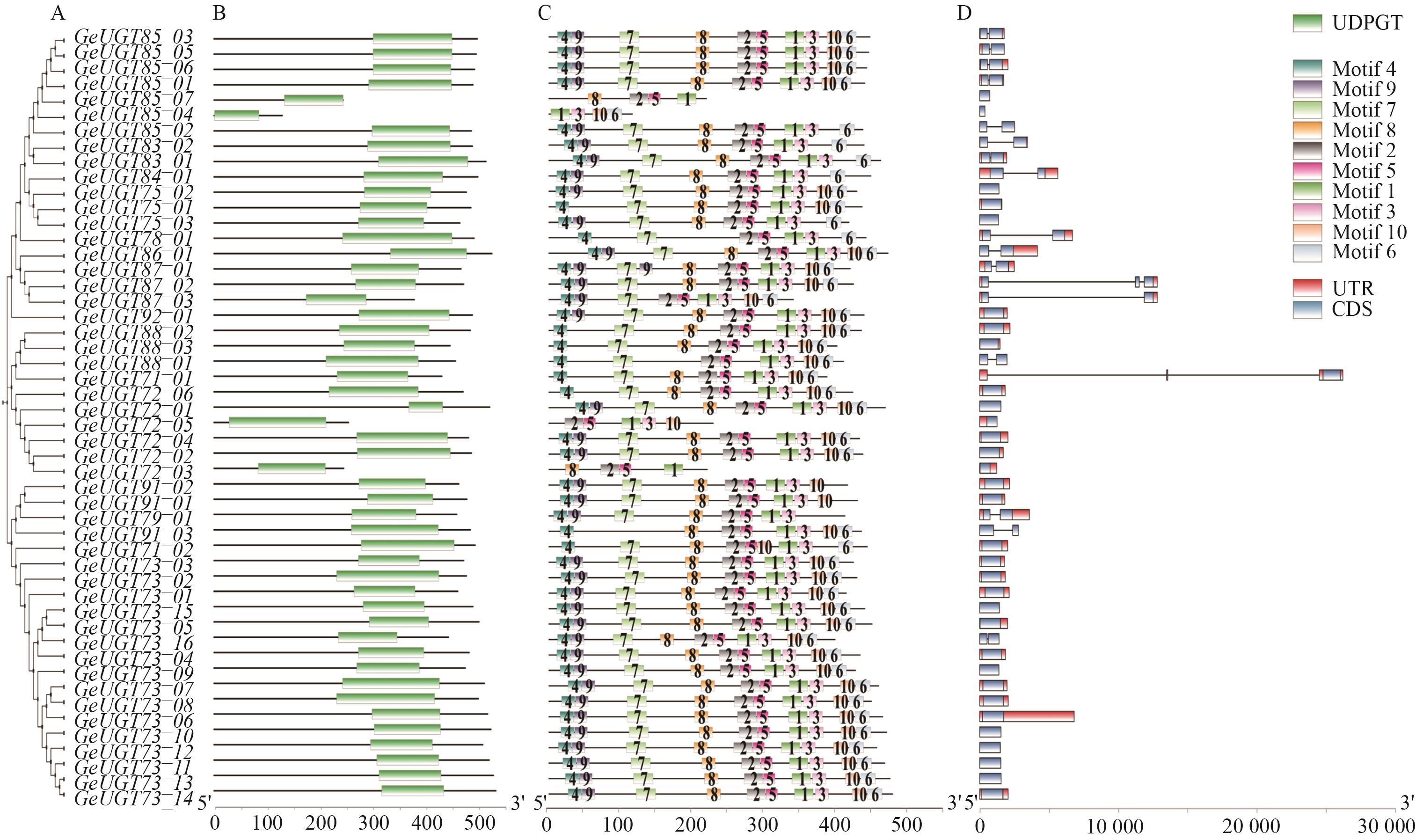
图1 乌天麻UGT基因家族成员系统发育与结构特征A:系统发育树;B:保守结构域;C:保守基序;D:基因结构
Fig. 1 Phylogenetic and structural characterization of UGT gene family members in G. elataA: Phylogenetic tree. B: Conserved domain. C: Conserved motifs. D: Gene structure
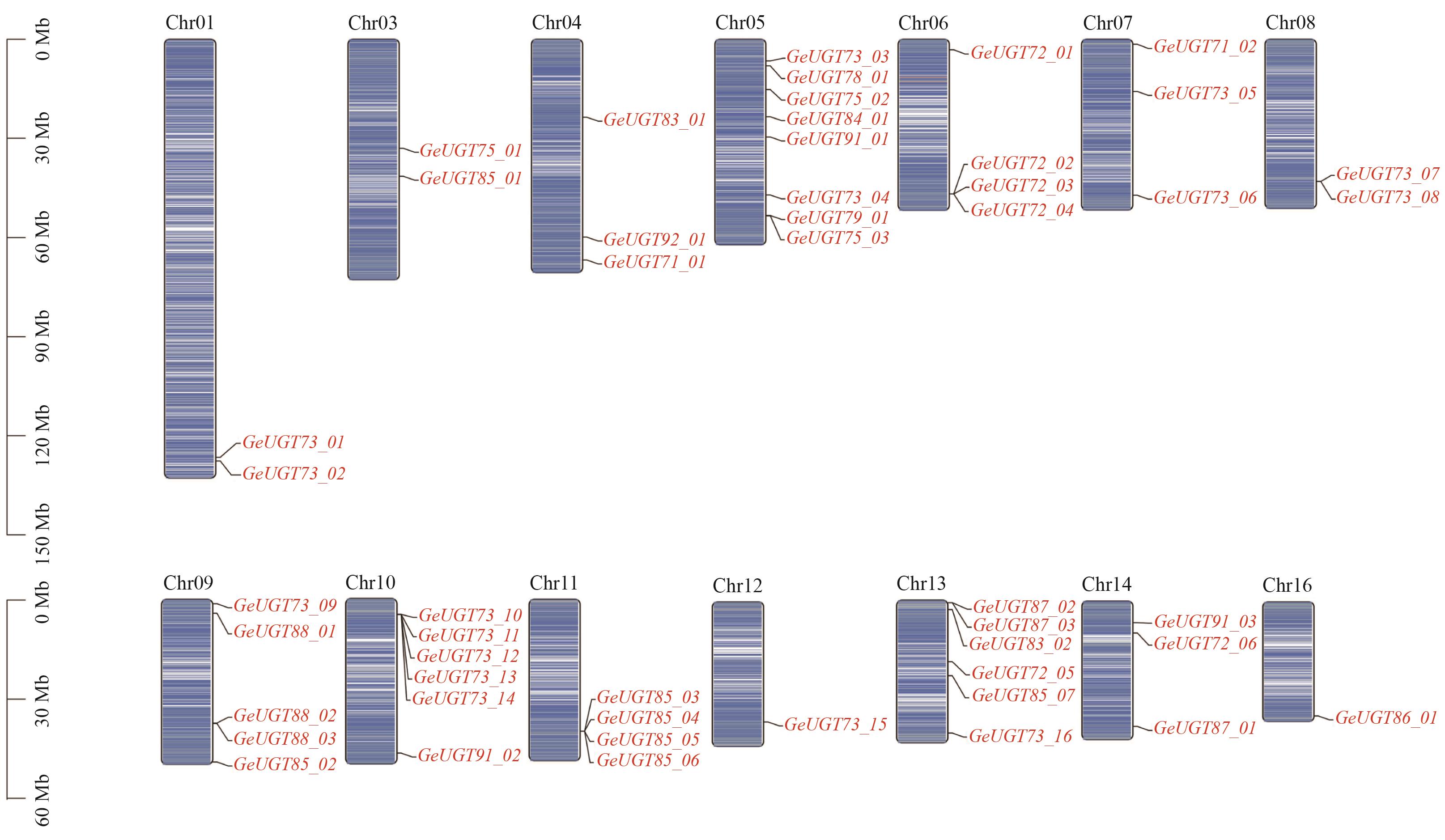
图2 乌天麻UGT基因家族成员在染色体上的分布
Fig. 2 Chromosomal distribution of UGT gene family members in G. elata
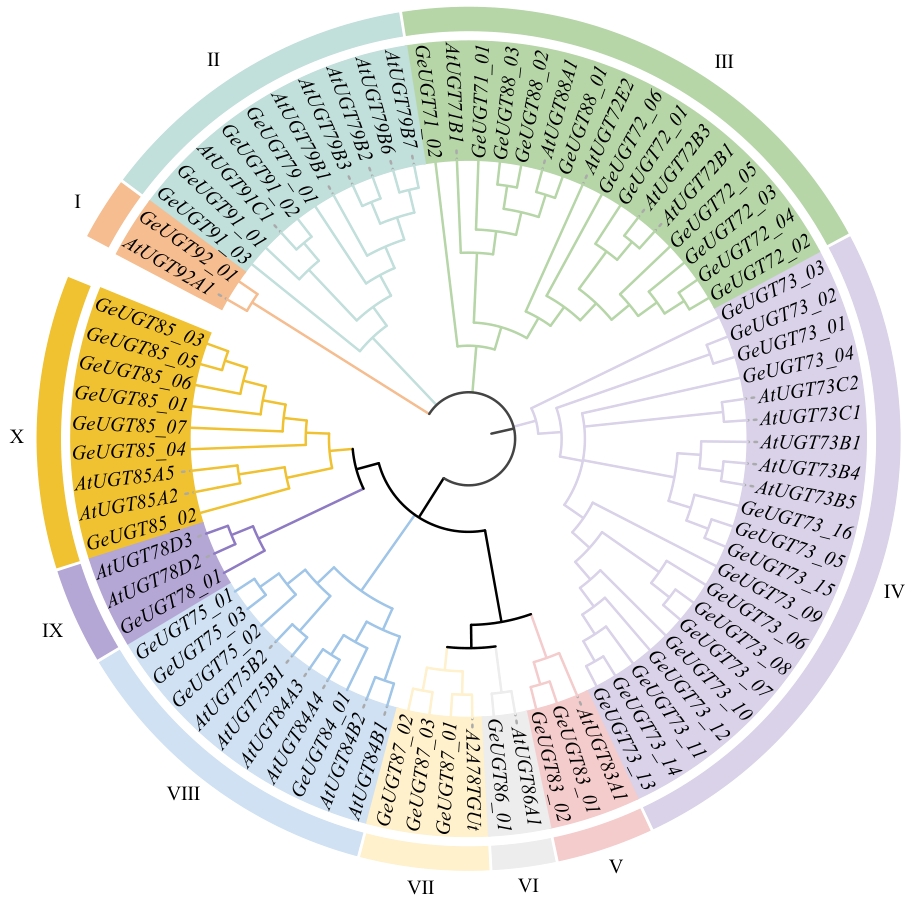
图3 乌天麻和拟南芥UGT基因家族系统发育进化树
Fig. 3 Phylogenetic tree of UGT gene family in G. elata and A. thaliana
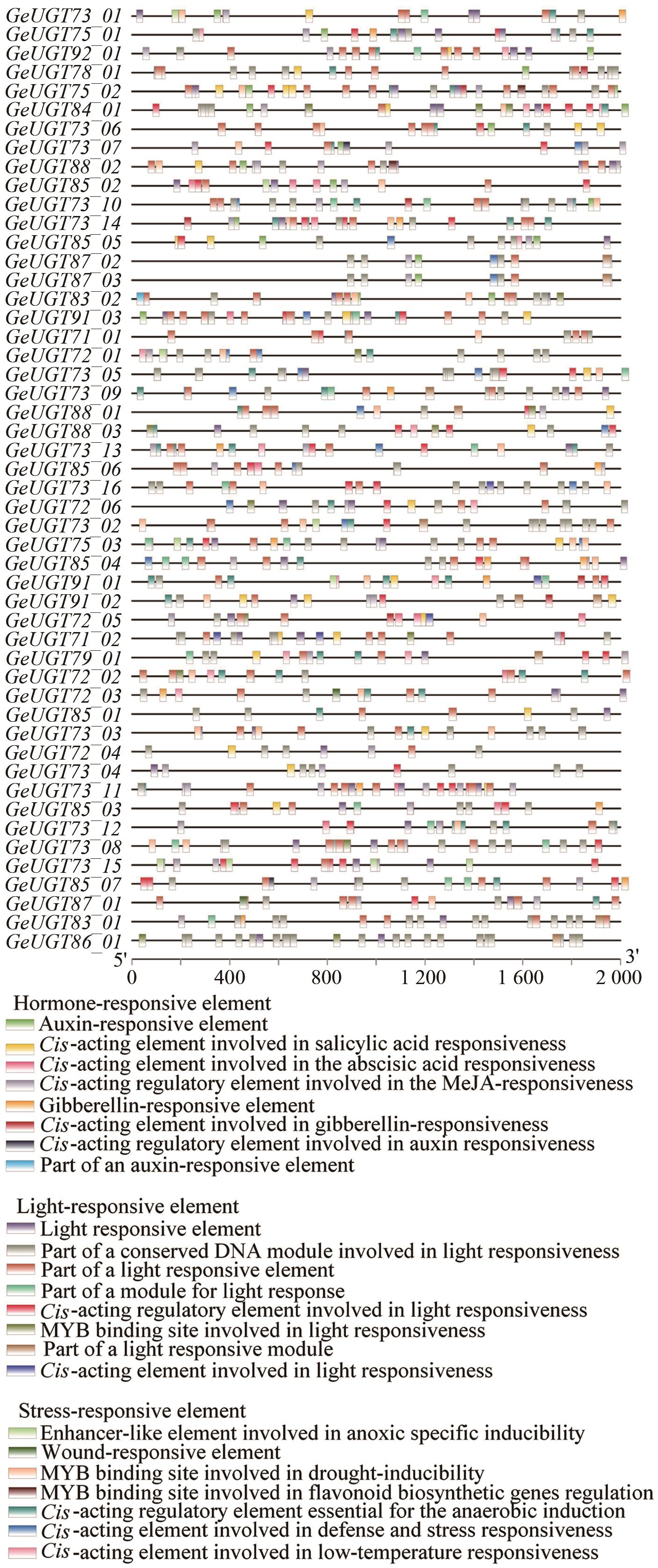
图4 乌天麻UGT基因家族成员激素、光、压力响应元件
Fig. 4 Responsive elements of hormones, light, and stress in UGT gene family members in G. elata
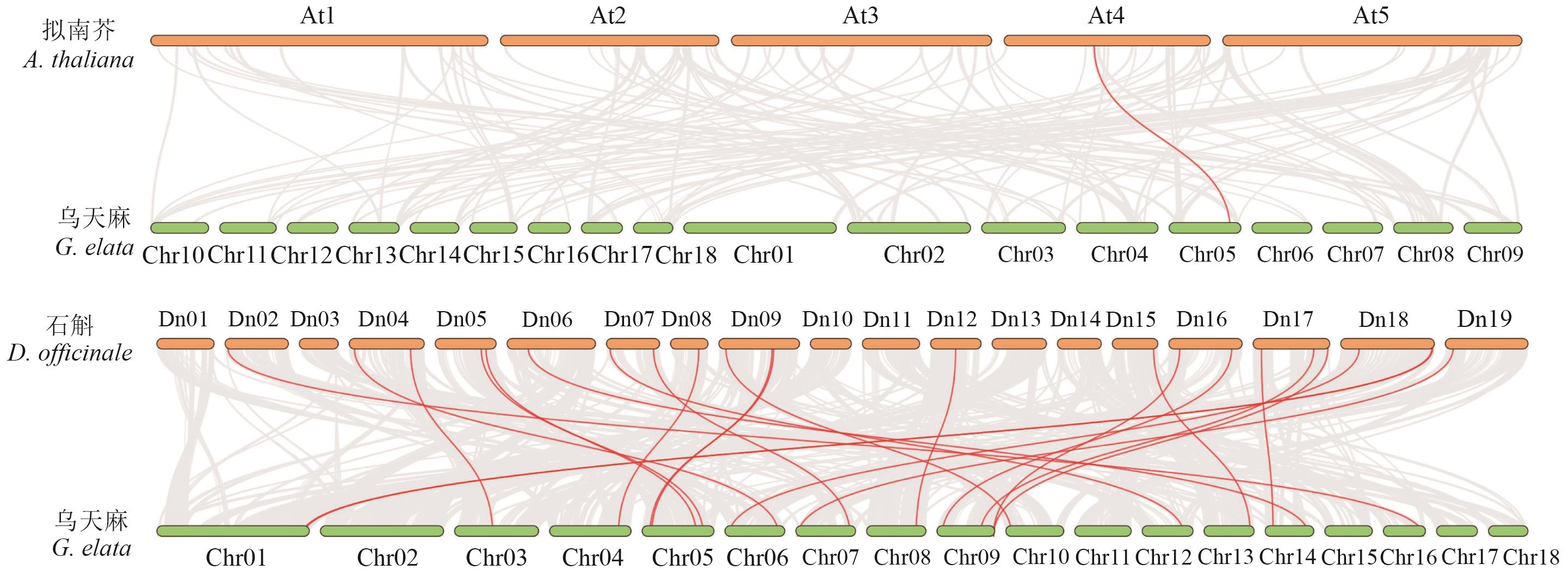
图5 UGT基因家族不同物种间共线性分析
Fig. 5 Synteny analysis of UGT gene familyacross differentspecies
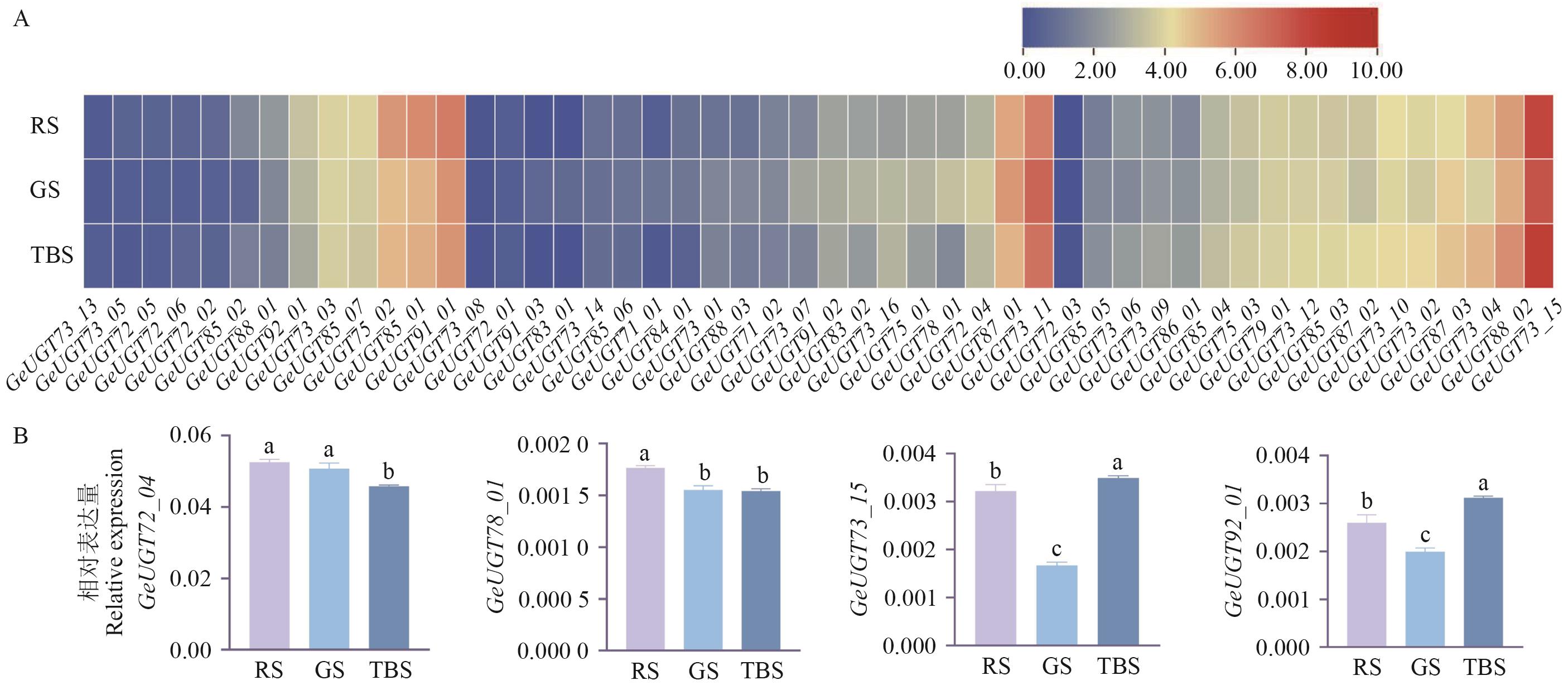
图6 天麻UGT基因表达模式分析A:3种生态型天麻茎中UGT基因表达量热图;基因的表达水平经过log2(FPKM+1)的转换;B:3种生态型天麻茎中UGT表达水平的RT-qPCR定量分析。RS:血红天麻茎;GS:绿天麻茎;TBS:乌天麻茎;不同小写字母表示差异显著性达到P<0.05,下同
Fig. 6 Analysis of UGT genes expression patterns in G. elataA: Heatmap of UGT genes expressions in the stems of three ecotypes of G. elata. Gene expressions were transformed using log2(FPKM+1). B: RT-qPCR quantification of UGT genes expression levels in stems of three ecotypes of G. elata. RS: Stem of G. elata Bl. GS: Stem of G. elata Bl. f. viridis Makino. TBS: Stem of G. elata Bl. f. glauca S. Chow. Different lowercase letters indicate statistically significant differences at P<0.05. The same below
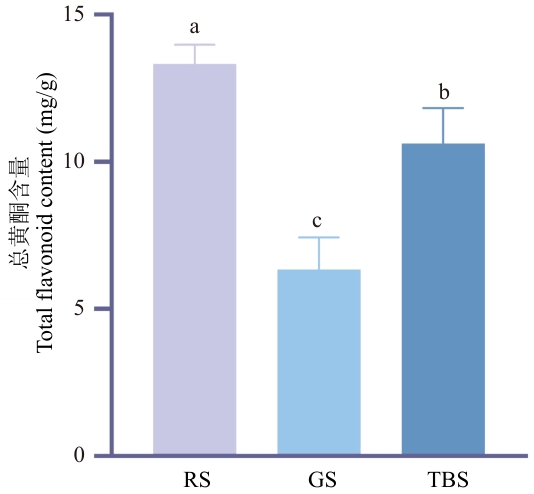
图7 三种生态型天麻茎中总黄酮含量测定
Fig. 7 Determination of total flavonoid contents in stems of three G. elata ecotypes
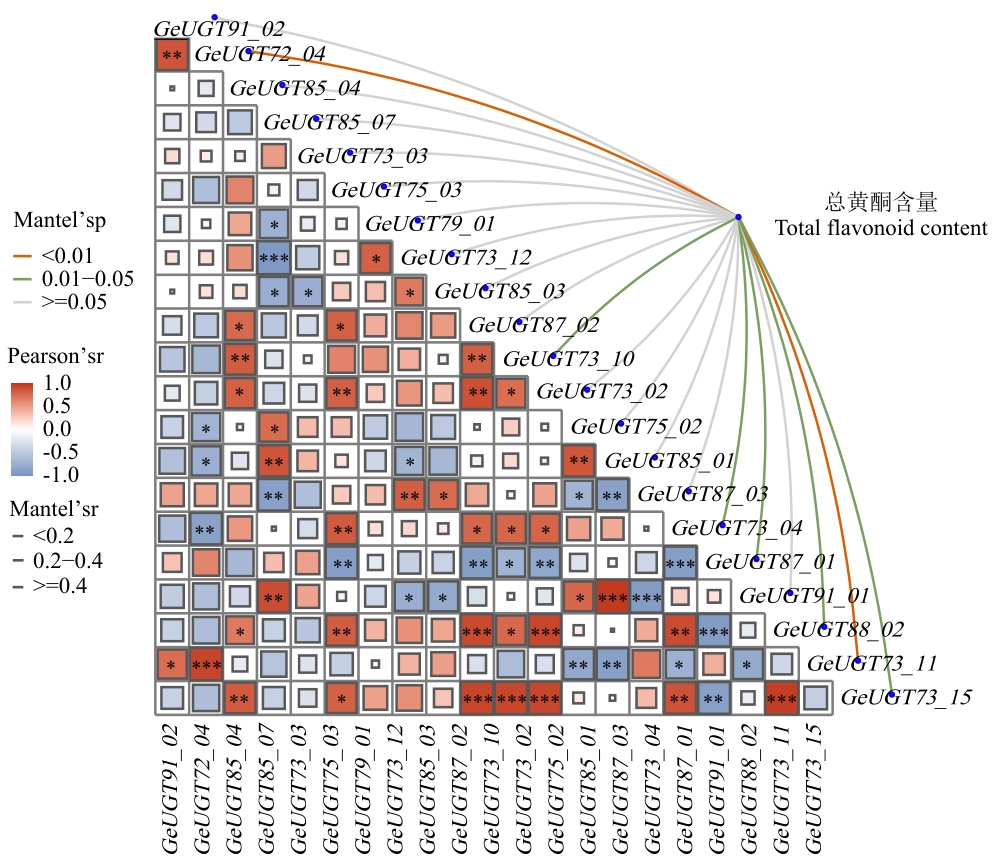
图8 总黄酮含量与UGT基因的相关性分析*,**,***表示差异显著性分别达到P<0.05,P<0.01,P<0.001
Fig. 8 Correlation between total flavonoid contents and UGT genes*, **, and *** indicate statistically significant differences at P<0.05, P<0.01, and P<0.001
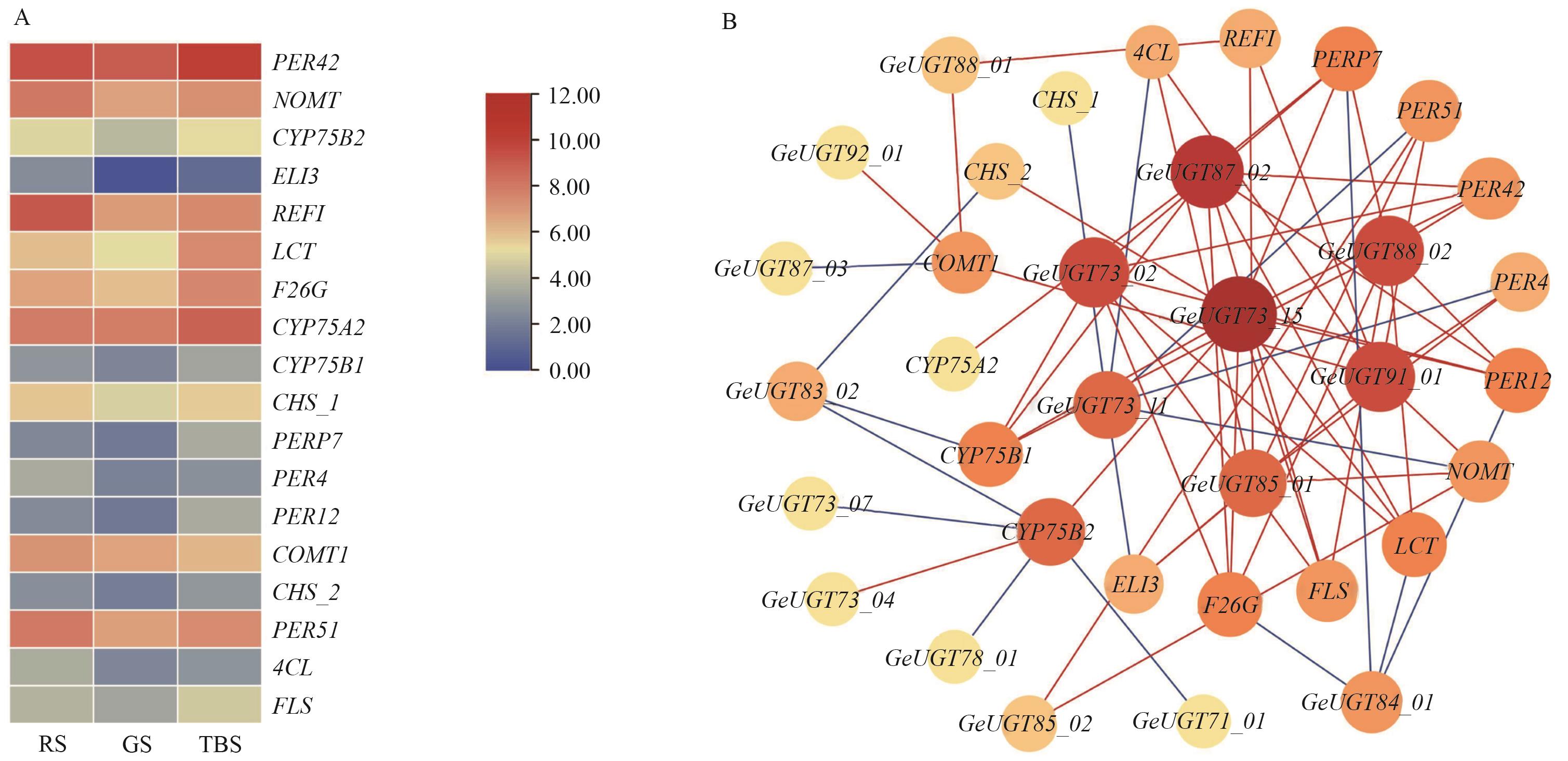
图9 类黄酮合成通路差异基因表达模式及其与UGT的共表达网络A:类黄酮合成通路差异基因表达模式;图中基因的表达水平经过log2(FPKM+1)的转换;B:类黄酮合成通路差异基因与UGT的共表达网络;共表达网络图显示类黄酮合成通路差异基因与UGT的调控关系;节点大小表示该基因与类黄酮合成差异基因的连接数,颜色深度与连接数正相关;连接线代表基因间相关性,红色为正相关(R≥0.9),蓝色为负相关(R≤-0.9)
Fig. 9 Expression patterns of differentially expressed genes in the flavonoid biosynthesis pathway and their co‑expression network with UGTA: Expression patterns of differentially expressed genes in the flavonoid biosynthesis pathway. Gene expressions were transformed using log2(FPKM+1). B: Co-expression network of UGT and flavonoid-biosynthesis DEGs. Co-expression network illustrating the regulatory relationships between differentially expressed genes in the flavonoid biosynthesis pathway and UGT. Node size indicates the number of connections each gene has with flavonoid biosynthesis-related differentially expressed genes, with darker color intensity indicating a higher number of connections. Edges indicate pairwise gene correlations: Red edges indicate positive correlations (R≥0.9), and blue edges indicate negative correlations (R≤-0.9)
| [1] | 国家药典委员会. 中华人民共和国药典. 一部 [S]. 北京: 中国医药科技出版社, 2020: 59-60. |
| Chinese Pharmacopoeia Commission. Pharmacopoeia of the People’s Republic of China. Volume I [S]. Beijing: China Medical Science and Technology Press, 2020: 59-60. | |
| [2] | 张俊, 于涵, 李召辉, 等. 药用天麻4种变型的块茎性状及ITS序列比较 [J]. 中药材, 2024, 47(1): 62-68. |
| Zhang J, Yu H, Li ZH, et al. Comparison of tuber characters and ITS sequences of four varieties of medicinal Gastrodia elata [J]. J Chin Med Mater, 2024, 47(1): 62-68. | |
| [3] | 胡艺镨, 李胜男, 徐娇, 等. 基于叶绿体基因组SSR分子标记开发鉴定5种生态型天麻 [J]. 中草药, 2025, 56(5): 1747-1754. |
| Hu YP, Li SN, Xu J, et al. Identification of five ecotypes of Gastrodia elata based on chloroplast genome SSR molecular marker [J]. Chin Tradit Herb Drugs, 2025, 56(5): 1747-1754. | |
| [4] | Xu YX, Lei YT, Su ZX, et al. A chromosome-scale Gastrodia elata genome and large-scale comparative genomic analysis indicate convergent evolution by gene loss in mycoheterotrophic and parasitic plants [J]. Plant J, 2021, 108(6): 1609-1623. |
| [5] | Lou Q, Liu YL, Qi YY, et al. Transcriptome sequencing and metabolite analysis reveals the role of delphinidin metabolism in flower colour in grape hyacinth [J]. J Exp Bot, 2014, 65(12): 3157-3164. |
| [6] | 方贤胜, 吴涛, 肖良俊. 基于广泛靶向代谢组学的浅黄色和紫色核桃内种皮成分差异分析 [J]. 食品科学, 2021, 42(12): 215-221. |
| Fang XS, Wu T, Xiao LJ. Broadly targeted metabolomics analysis of differential metabolites between light yellow and purple walnut endocarps [J]. Food Sci, 2021, 42(12): 215-221. | |
| [7] | Deng J, Chen S, Yin XJ, et al. Systematic qualitative and quantitative assessment of anthocyanins, flavones and flavonols in the petals of 108 Lotus (Nelumbo nucifera) cultivars [J]. Food Chem, 2013, 139(1/2/3/4): 307-312. |
| [8] | 张琪静. 甜樱桃果实品质研究进展 [J]. 果树学报, 2025, 42(10): 2430-2439. |
| Zhang QJ. Research advance in fruit quality of sweet cherry [J]. J Fruit Sci, 2025, 42(10): 2430-2439. | |
| [9] | Masako Fukuchi-Mizutani HO. Biochemical and molecular characterization of a novel UDP-glucose: anthocyanin 3′-O-glucosyltransferase, a key enzyme for blue anthocyanin biosynthesis, from gentian [J]. Plant Physiol, 2003, 132(3): 1652-1663. |
| [10] | 解林峰, 任传宏, 张波, 等. 植物类黄酮生物合成相关UDP-糖基转移酶研究进展 [J]. 园艺学报, 2019, 46(9): 1655-1669. |
| Xie LF, Ren CH, Zhang B, et al. Plant UDP-glycosyltransferases in flavonoids biosynthesis [J]. Acta Hortic Sin, 2019, 46(9): 1655-1669. | |
| [11] | Wang QY, Zhu J, Li B, et al. Functional identification of anthocyanin glucosyltransferase genes: a Ps3GT catalyzes pelargonidin to pelargonidin 3-O-glucoside painting the vivid red flower color of Paeonia [J]. Planta, 2023, 257(4): 65. |
| [12] | Song CK, Zhao S, Hong XT, et al. A UDP-glucosyltransferase functions in both acylphloroglucinol glucoside and anthocyanin biosynthesis in strawberry (Fragaria × Ananassa) [J]. Plant J, 2016, 85(6): 730-742. |
| [13] | 刘蒲东, 张舒婷, 申序, 等. 龙眼UGT家族全基因组鉴定、功能预测及表达模式 [J]. 应用与环境生物学报, 2021, 27(6): 1626-1635. |
| Liu PD, Zhang ST, Shen X, et al. Genome-wide identification, function prediction, and expression pattern analysis of the UGT family in Dimocarpus longan Lour [J]. Chin J Appl Environ Biol, 2021, 27(6): 1626-1635. | |
| [14] | Chen CJ, Chen H, Zhang Y, et al. TBtools: an integrative toolkit developed for interactive analyses of big biological data [J]. Mol Plant, 2020, 13(8): 1194-1202. |
| [15] | Bailey TL, Boden M, Buske FA, et al. MEME SUITE: tools for motif discovery and searching [J]. Nucleic Acids Res, 2009, 37(Web Server issue): W202-W208. |
| [16] | Tamura K, Stecher G, Kumar S. MEGA11: molecular evolutionary genetics analysis version 11 [J]. Mol Biol Evol, 2021, 38(7): 3022-3027. |
| [17] | Lescot M, Déhais P, Thijs G, et al. PlantCARE, a database of plant cis-acting regulatory elements and a portal to tools for in silico analysis of promoter sequences [J]. Nucleic Acids Res, 2002, 30(1): 325-327. |
| [18] | 徐娇, 胡正平, 何华, 等. 川续断DaNAC基因家族成员的鉴定及表达分析 [J]. 药学学报, 2021, 56(12): 3325-3330. |
| Xu J, Hu ZP, He H, et al. Identification and expression analysis of the DaNAC transcription factor family in Dipsacus asper [J]. Acta Pharm Sin, 2021, 56(12): 3325-3330. | |
| [19] | Dewanto V, Wu XZ, Adom KK, et al. Thermal processing enhances the nutritional value of tomatoes by increasing total antioxidant activity [J]. J Agric Food Chem, 2002, 50(10): 3010-3014. |
| [20] | Ihaka R, Gentleman R. R: a language for data analysis and graphics [J]. J Comput Graph Stat, 1996, 5(3): 299-314. |
| [21] | Shannon P, Markiel A, Ozier O, et al. Cytoscape: a software environment for integrated models of biomolecular interaction networks [J]. Genome Res, 2003, 13(11): 2498-2504. |
| [22] | 陈家栋, 姜武, 宋敏全, 等. 铁皮石斛尿苷二磷酸糖基转移酶(UGT)基因家族鉴定与表达分析 [J]. 中国中药杂志, 2023, 48(7): 1840-1850. |
| Chen JD, Jiang W, Song MQ, et al. Identification and expression of uridine diphosphate glycosyltransferase (UGT) gene family from Dendrobium officinale [J]. China J Chin Mater Med, 2023, 48(7): 1840-1850. | |
| [23] | Li Y, Baldauf S, Lim EK, et al. Phylogenetic analysis of the UDP-glycosyltransferase multigene family of Arabidopsis thaliana [J]. J Biol Chem, 2001, 276(6): 4338-4343. |
| [24] | 余璐瑶. 催化铁皮石斛花中黄酮苷类活性成分生物合成的糖基转移酶的功能鉴定、酶学表征和机制研究 [D]. 上海: 中国人民解放军海军军医大学, 2023. |
| Yu LY. Functional identification, expression characteristics and underlying mechanism of glycosyltransferases catalyzing the biosynthesis of flavonoid glycosides in Dendrobium catenatum flowers [D]. Shanghai: Naval Medical University, 2023. | |
| [25] | Knoch E, Sugawara S, Mori T, et al. UGT79B31 is responsible for the final modification step of pollen-specific flavonoid biosynthesis in Petunia hybrida [J]. Planta, 2018, 247(4): 779-790. |
| [26] | Yonekura-Sakakibara K, Hanada K. An evolutionary view of functional diversity in family 1 glycosyltransferases [J]. Plant J, 2011, 66(1): 182-193. |
| [27] | 狄少康, 尹青岗, 夏亚迎, 等. 大豆类黄酮糖基转移酶基因UGT73C19的功能研究 [J]. 中国农业科学, 2019, 52(20): 3507-3519. |
| Di SK, Yin QG, Xia YY, et al. Functional characterization of a UDP flavonoid glycosyltransferase gene UGT73C19 in Glycine max [J]. Sci Agric Sin, 2019, 52(20): 3507-3519. | |
| [28] | Ren CX, Xi ZQ, Xian B, et al. Identification and characterization of CtUGT3 as the key player of astragalin biosynthesis in Carthamus tinctorius L [J]. J Agric Food Chem, 2023, 71(43): 16221-16232. |
| [29] | Speeckaert N, El Jaziri M, Baucher M, et al. UGT72, a major glycosyltransferase family for flavonoid and monolignol homeostasis in plants [J]. Biology, 2022, 11(3): 441. |
| [30] | Bao HH, Yuan L, Luo YC, et al. A freezing responsive UDP-glycosyltransferase improves potato freezing tolerance via modifying flavonoid metabolism [J]. Hortic Plant J, 2025, 11(4): 1595-1606. |
| [31] | 马冰雪, 代翠红, 程大友. 甜菜色素合成关键基因的克隆及不同光质对其表达的影响 [J]. 中国糖料, 2020, 42(3): 7-13, 2. |
| Ma BX, Dai CH, Cheng DY. Cloning of key genes of pigment synthesis in beet and effects of light type on their expression [J]. Sugar Crops China, 2020, 42(3): 7-13, 2. | |
| [32] | Chen BW, Wang XR, Yu HW, et al. Genome-wide analysis of UDP-glycosyltransferases family and identification of UGT genes involved in drought stress of Platycodon grandiflorus [J]. Front Plant Sci, 2024, 15: 1363251. |
| [33] | Liu YH, Li YM, Liu Z, et al. Integrated transcriptomic and metabolomic analysis revealed altitude-related regulatory mechanisms on flavonoid accumulation in potato tubers [J]. Food Res Int, 2023, 170: 112997. |
| [34] | 朱翔飞. 芦笋早熟覆盖促发技术研究及类黄酮代谢相关基因的分离与表达分析 [D]. 杭州: 浙江大学, 2013. |
| Zhu XF. Research on mulching techniques for early production and isolation and expression analysis of flavonoid biosynthesis-relatedgenes in Asparagus officinalis L. [D]. Hangzhou: Zhejiang University, 2013. | |
| [35] | 闫庚洋, 高文, 李航, 等. 牡丹R2R3-MYB基因家族鉴定及花色形成相关基因筛选 [J]. 河南农业科学, 2025, 54(12): 121-137. |
| Yan GY, Gao W, Li H, et al. Identification of R2R3-MYB gene family and screening of genes related to flower color formation in Paeonia suffruticosa [J]. J Henan Agric Sci, 2025, 54(12): 121-137. |
| [1] | 黄旭升, 周雅莉, 贾峥嵘, 沈珊, 陈锦钗, 周广立, 李鑫鑫, 王计平, 李润植, 贾小云. 紫苏ARF转录因子家族全基因组鉴定及其在非生物胁迫响应中的功能分析[J]. 生物技术通报, 2026, 42(7): 148-162. |
| [2] | 阎晓光, 杜艳伟, 马志远, 王彬, 王国梁, 胡丹珠. 玉米ZmDIR基因家族的全基因组鉴定与表达模式分析[J]. 生物技术通报, 2026, 42(7): 126-137. |
| [3] | 熊仕发, 陈益存, 吴立文, 施翔, 张盛剿, 彭方有, 陈涛梅, 汪阳东. 白栎TCP基因家族的鉴定及功能分析[J]. 生物技术通报, 2026, 42(6): 258-266. |
| [4] | 王江清, 张蝶, 王荟洁, 袁柱东, 付艳鸿, 黄娅楠, 王洪洋. 马铃薯AP2/ERF基因家族鉴定及响应致病疫霉胁迫的表达分析[J]. 生物技术通报, 2026, 42(6): 116-127. |
| [5] | 张艾岑, 闫会, 马居奎, 张允刚, 李强. 甘薯DNA甲基转移酶和去甲基化酶基因家族的全基因组鉴定与表达分析[J]. 生物技术通报, 2026, 42(6): 1-12. |
| [6] | 李旭龙, 徐世强, 张龙, 李静宇, 何伟贤, 陈立凯, 王继华. 巴戟天萜烯合成酶基因家族鉴定、进化及表达模式分析[J]. 生物技术通报, 2026, 42(6): 314-325. |
| [7] | 金旋, 向芬, 戴翠婷, 杨辉, 李赛君, 刘红艳, 钱思维, 蔺万煌, 李维. 茶树CsTDIFL基因的克隆、表达特性分析及其对氨基酸合成的调控[J]. 生物技术通报, 2026, 42(5): 323-331. |
| [8] | 郭苗, 许家佳, 孙天国, 蔡璨, 曹婉笛, 包纪星, 沙伟, 张梅娟, 彭疑芳, 马天意. 过表达砂藓RcOLEO1基因增强拟南芥的耐旱性及耐高温性[J]. 生物技术通报, 2026, 42(5): 312-322. |
| [9] | 梁慧琪, 陈益存, 汪阳东, 赵耘霄, 高暝. 山苍子PAT1基因亚家族鉴定及其在嫁接愈合过程中的表达分析[J]. 生物技术通报, 2026, 42(5): 302-311. |
| [10] | 冯成蒿, 党雨乐, 王志泽, 聂蔚丹, 杨中敏, 杜崇. 基于RNA-seq筛选番茄防御南方根结线虫病的差异基因与RPP13的表达特征分析[J]. 生物技术通报, 2026, 42(4): 141-152. |
| [11] | 杨婷, 杨宗桃, 艾静, 王禹童, 李燕烨, 邓军, 刘家勇, 赵勇, 张跃彬. 不同基因型甘蔗表型特征及根部转录组学分析[J]. 生物技术通报, 2026, 42(4): 190-201. |
| [12] | 倪飞飞, 陈益存, 高暝, 张盛剿, 彭方有, 陈涛梅, 赵耘霄, 汪阳东. 山苍子TCP基因鉴定及其调控萜类合成的研究[J]. 生物技术通报, 2026, 42(4): 227-238. |
| [13] | 陈登科, 兰刚, 夏芝, 侯保国, 杨六六, 曹彩荣, 李朋波, 吴翠翠. 花生ZF-HD基因家族的鉴定和非生物胁迫响应分析[J]. 生物技术通报, 2026, 42(4): 114-128. |
| [14] | 孙婷, 张艳, 刘玉珊, 冯媛媛, 秦恒山, 张军, 何小岗, 张景荣. 黄秋葵AeF3H基因的克隆与功能分析[J]. 生物技术通报, 2026, 42(4): 153-160. |
| [15] | 徐泽, 周陈平, 邝瑞彬, 吴夏明, 杨敏, 刘传和, 贺涵, 魏岳荣. 番木瓜PG基因家族鉴定及其在果实软化中的功能[J]. 生物技术通报, 2026, 42(3): 349-361. |
| 阅读次数 | ||||||
|
全文 |
|
|||||
|
摘要 |
|
|||||
