







生物技术通报 ›› 2026, Vol. 42 ›› Issue (8): 133-141.doi: 10.13560/j.cnki.biotech.bull.1985.2025-1113
• 研究报告 • 上一篇
崔秀妍1, 代春阳1, 张谊婷1, 田翔2, 陈凌2, 乔治军2, 王海岗2( ), 王君杰2()
收稿日期:2025-10-16
出版日期:2026-08-26
发布日期:2026-08-17
通讯作者:
王君杰xiaoleiwangjie@163.com基金资助:
CUI Xiu-yan1, DAI Chun-yang1, ZHANG Yi-ting1, TIAN Xiang2, CHEN Ling2, QIAO Zhi-jun2, WANG Hai-gang2(), WANG Jun-jie2()
Received:2025-10-16
Published:2026-08-26
Online:2026-08-17
摘要:
目的 伪响应调节蛋白(pseudo-response regulators, PRRs)在植物昼夜节律调控与开花期调控中发挥重要作用。基于全基因组水平对糜子(Panicum miliaceum L.)伪应答蛋白基因家族进行系统鉴定,为其生物学功能提供理论依据。 方法 采用生物信息学方法,对糜子PRR基因家族进行理化性质分析、Motif、基因结构分析、共线性分析、系统进化分析,利用实时荧光定量PCR(RT-qPCR)对不同光周期处理下的糜子PRR基因家族成员表达情况进行分析。 结果 从糜子基因组中鉴定到7个PRR基因,分别命名为PmPRR1-PmPRR7,不均匀地分布在5条染色体上;系统进化分析表明,PmPRR基因分布在Group 1-Group 3亚家族中。蛋白质保守基序分析显示,有6个基因均含有Motif1、Motif2和Motif3,表明这6个基因高度保守。启动子顺式作用元件分析显示,PmPRR基因与植物光响应、生长发育、胁迫和激素调控。RT-qPCR结果表明,在不同光周期(短日照8 h、中日照14 h、长日照16 h)处理下,PmPRR基因表达水平均存在显著差异。 结论 鉴定出7个PmPRR基因,在不同光周期下,不同亚家族基因的表达模式存在差异,表明PmPRRs对糜子响应光周期变化起重要的调控作用。
崔秀妍, 代春阳, 张谊婷, 田翔, 陈凌, 乔治军, 王海岗, 王君杰. 糜子伪响应调节蛋白PRR基因家族的鉴定及对光周期的响应[J]. 生物技术通报, 2026, 42(8): 133-141.
CUI Xiu-yan, DAI Chun-yang, ZHANG Yi-ting, TIAN Xiang, CHEN Ling, QIAO Zhi-jun, WANG Hai-gang, WANG Jun-jie. Identification of the Pseudo-response Regulator PRR Gene Family in Broomcorn Millet and Its Response to Photoperiod[J]. Biotechnology Bulletin, 2026, 42(8): 133-141.
基因 Gene | 基因号 Gene number | 氨基酸数量 Number of amino acids (aa) | 分子量 Molecular weight (Da) | 理论等电点 Theoretical pI | 不稳定指数 Instability index | 脂肪指数 Aliphatic index | 总平均亲水性 Grand average of hydropathicity | 亚细胞定位 Subcellular localization |
|---|---|---|---|---|---|---|---|---|
| PmPRR1 | RLN16623.1 | 632 | 68 998.91 | 8.78 | 53.12 | 62.14 | -0.761 | 细胞核 Nucleus |
| PmPRR2 | RLM78629.1 | 522 | 58 010.95 | 6.07 | 52.84 | 65.31 | -0.608 | 细胞核 Nucleus |
| PmPRR3 | RLN39167.1 | 761 | 83 134.48 | 6.31 | 49.50 | 57.91 | -0.910 | 细胞核 Nucleus |
| PmPRR4 | RLM80225.1 | 522 | 57 978.79 | 5.75 | 51.39 | 65.69 | -0.630 | 细胞核 Nucleus |
| PmPRR5 | RLM69356.1 | 613 | 67 065.69 | 8.60 | 50.83 | 64.83 | -0.744 | 细胞核 Nucleus |
| PmPRR6 | RLM85946.1 | 623 | 69 412.30 | 6.36 | 52.53 | 67.48 | -0.827 | 细胞核 Nucleus |
| PmPRR7 | RLM86309.1 | 766 | 82 342.57 | 6.41 | 41.35 | 56.58 | -0.851 | 细胞核Nucleus |
表1 糜子PmPRR基因家族的理化性质
Table 1 Physicochemical properties of broomcorn millet PmPRR gene family
基因 Gene | 基因号 Gene number | 氨基酸数量 Number of amino acids (aa) | 分子量 Molecular weight (Da) | 理论等电点 Theoretical pI | 不稳定指数 Instability index | 脂肪指数 Aliphatic index | 总平均亲水性 Grand average of hydropathicity | 亚细胞定位 Subcellular localization |
|---|---|---|---|---|---|---|---|---|
| PmPRR1 | RLN16623.1 | 632 | 68 998.91 | 8.78 | 53.12 | 62.14 | -0.761 | 细胞核 Nucleus |
| PmPRR2 | RLM78629.1 | 522 | 58 010.95 | 6.07 | 52.84 | 65.31 | -0.608 | 细胞核 Nucleus |
| PmPRR3 | RLN39167.1 | 761 | 83 134.48 | 6.31 | 49.50 | 57.91 | -0.910 | 细胞核 Nucleus |
| PmPRR4 | RLM80225.1 | 522 | 57 978.79 | 5.75 | 51.39 | 65.69 | -0.630 | 细胞核 Nucleus |
| PmPRR5 | RLM69356.1 | 613 | 67 065.69 | 8.60 | 50.83 | 64.83 | -0.744 | 细胞核 Nucleus |
| PmPRR6 | RLM85946.1 | 623 | 69 412.30 | 6.36 | 52.53 | 67.48 | -0.827 | 细胞核 Nucleus |
| PmPRR7 | RLM86309.1 | 766 | 82 342.57 | 6.41 | 41.35 | 56.58 | -0.851 | 细胞核Nucleus |
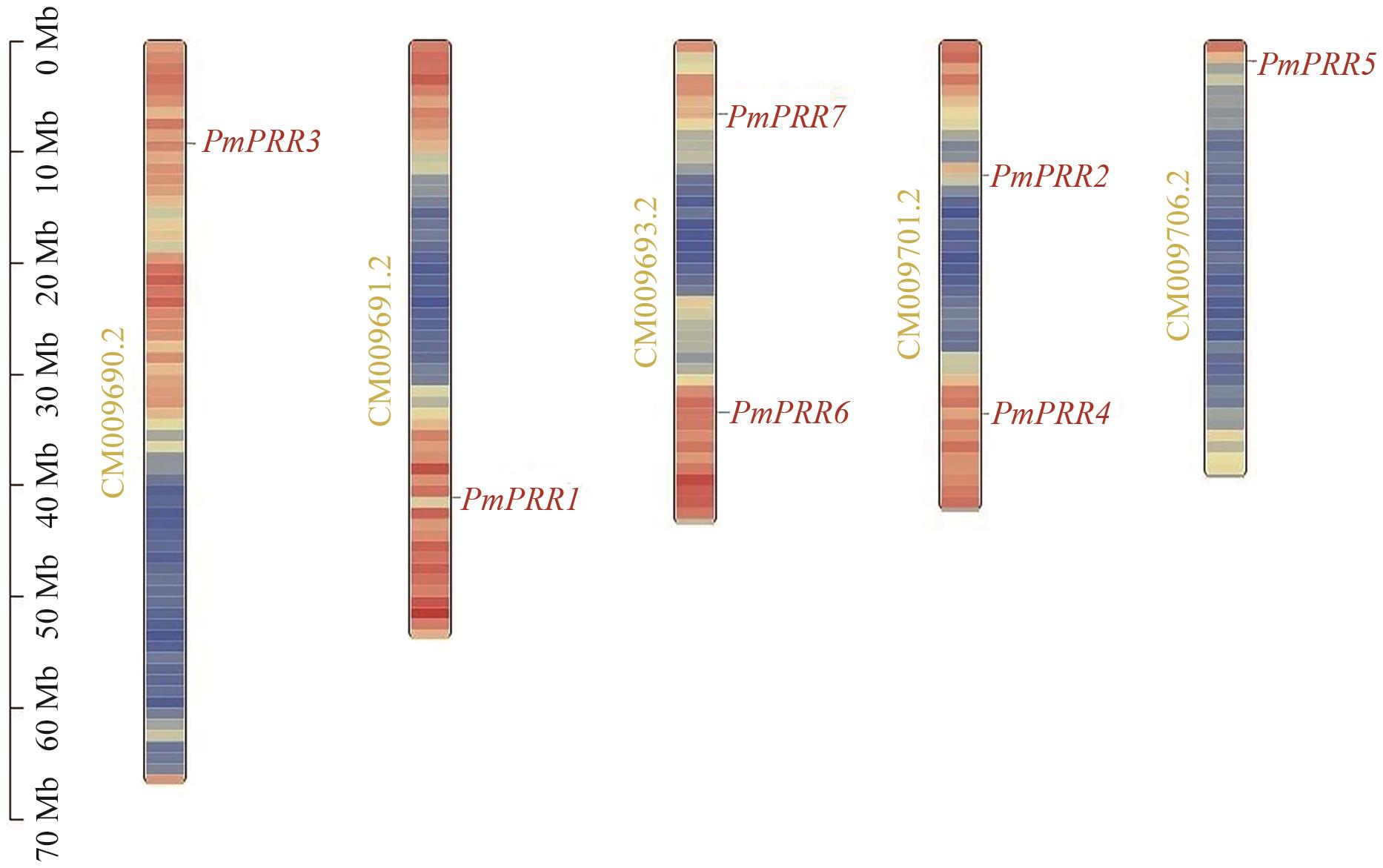
图1 糜子PmPRR基因家族在染色体上的分布
Fig. 1 Chromosome distribution of PmPRR gene family in broomcorn millet
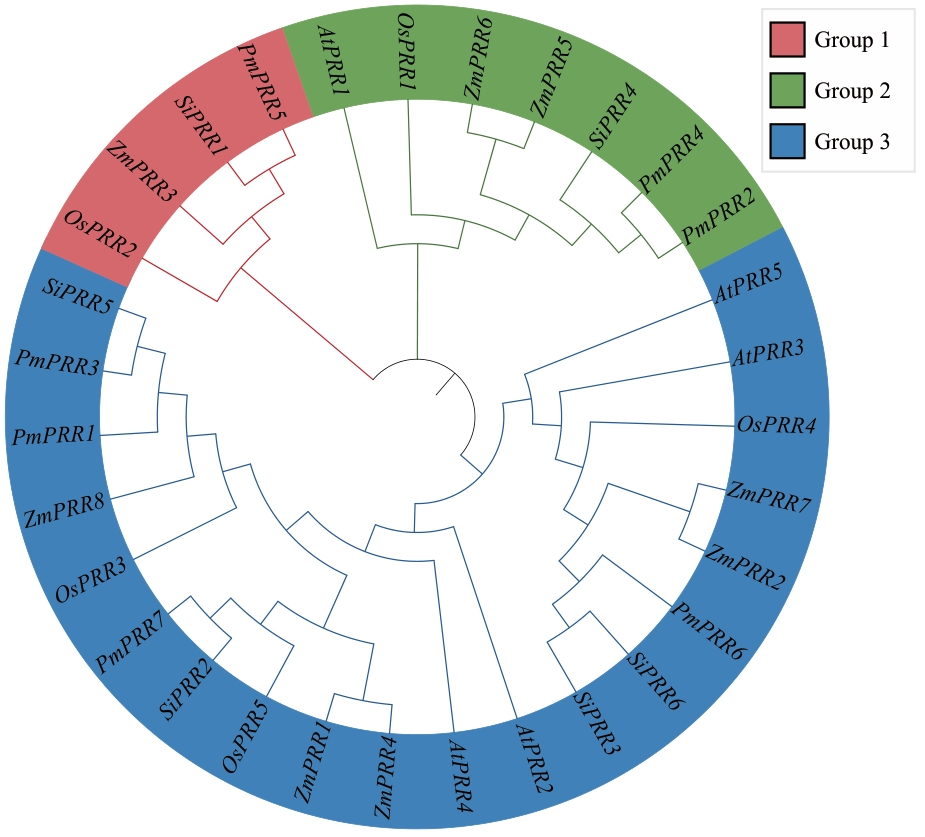
图2 糜子、拟南芥、水稻、玉米、谷子PRR蛋白的系统进化树
Fig. 2 Phylogenetic tree of the PRR protein in Panicum miliaceum (Pm), Arabidopsis thaliana (At), Oryza sativa (Os), Zea mays (Zm), and Setaria italica (Si)
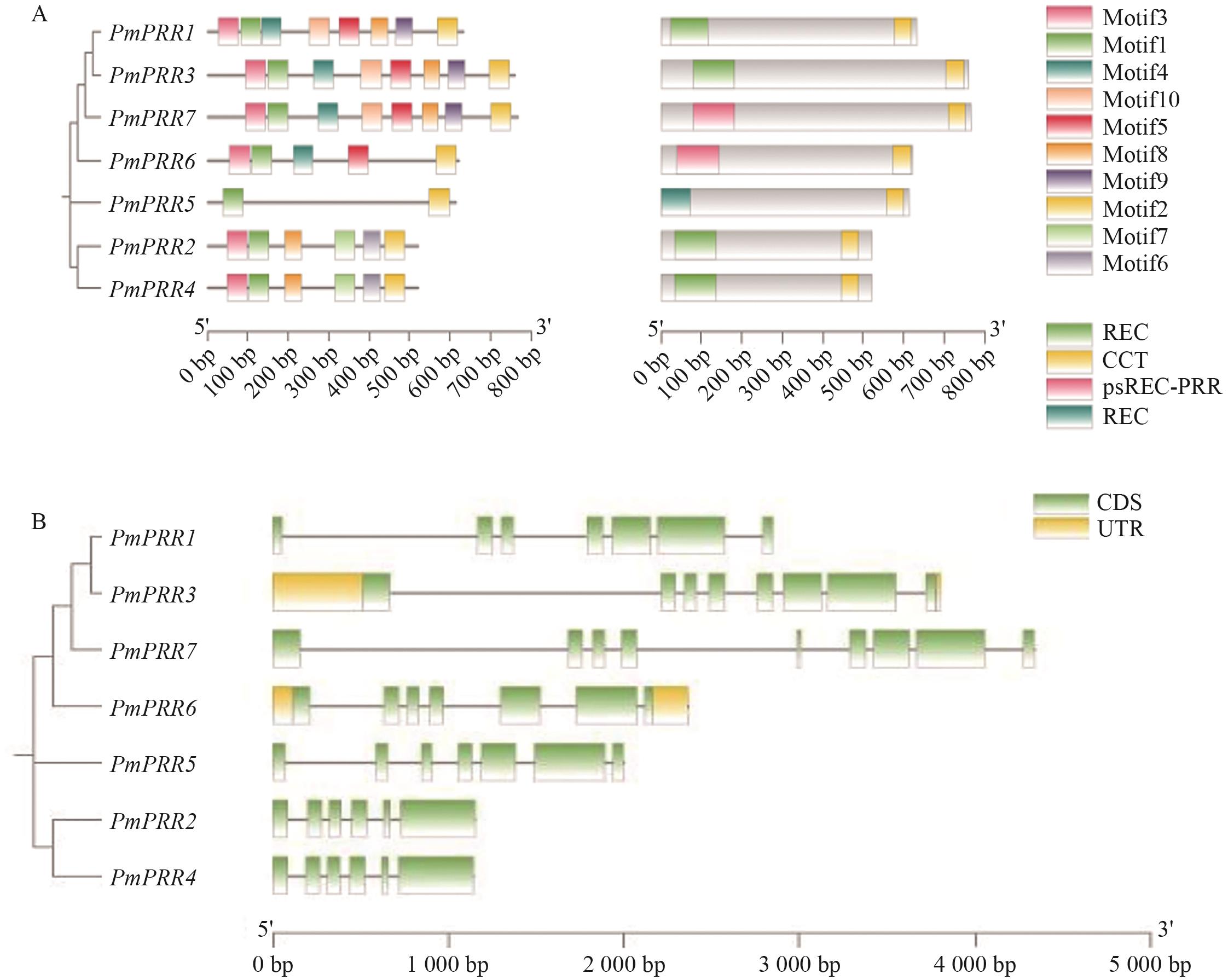
图3 糜子PmPRR基因保守基序(A)和结构(B)
Fig. 3 Conserved motifs (A) and structure (B) of PmPRR genes in broomcorn millet
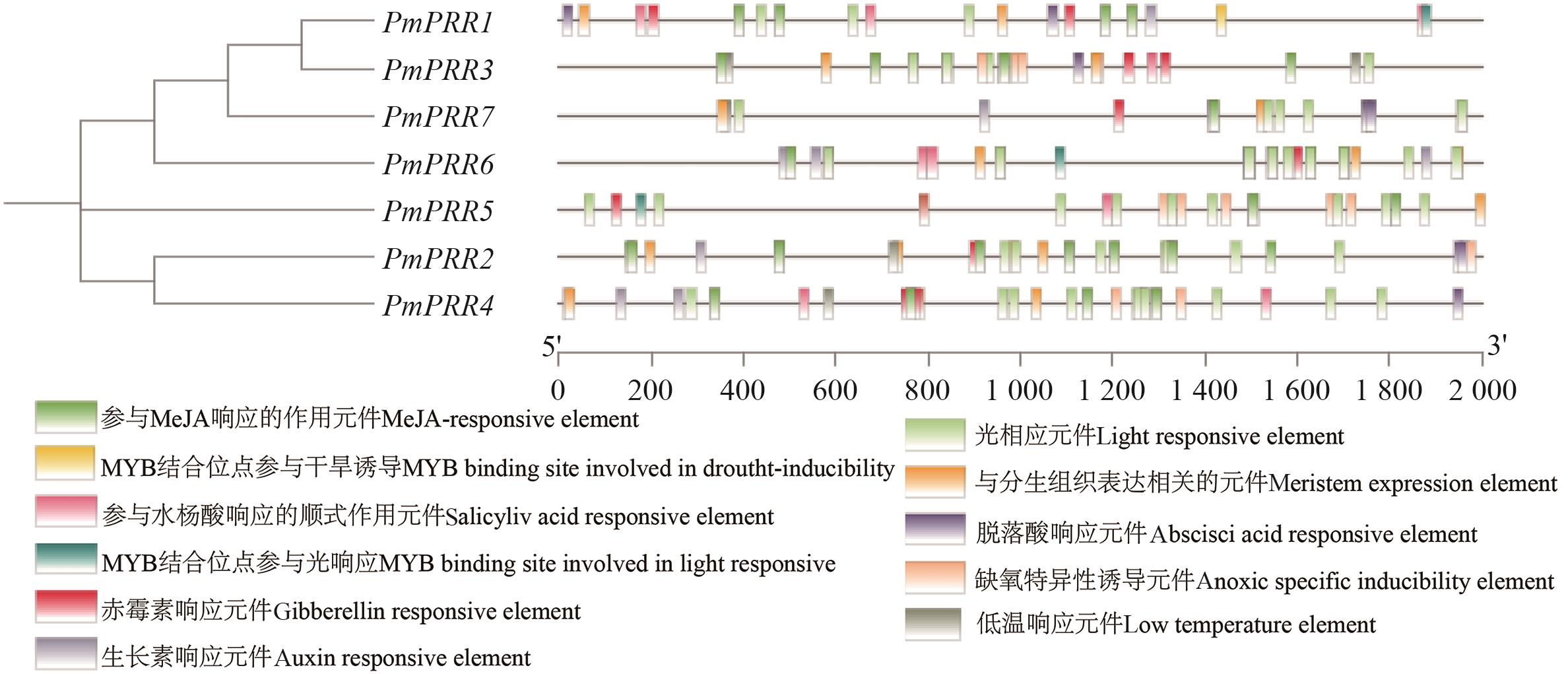
图4 糜子PmPRR基因启动子顺式作用元件分析
Fig. 4 Cis-acting elements of broomcorn millet PmPRR gene promoters
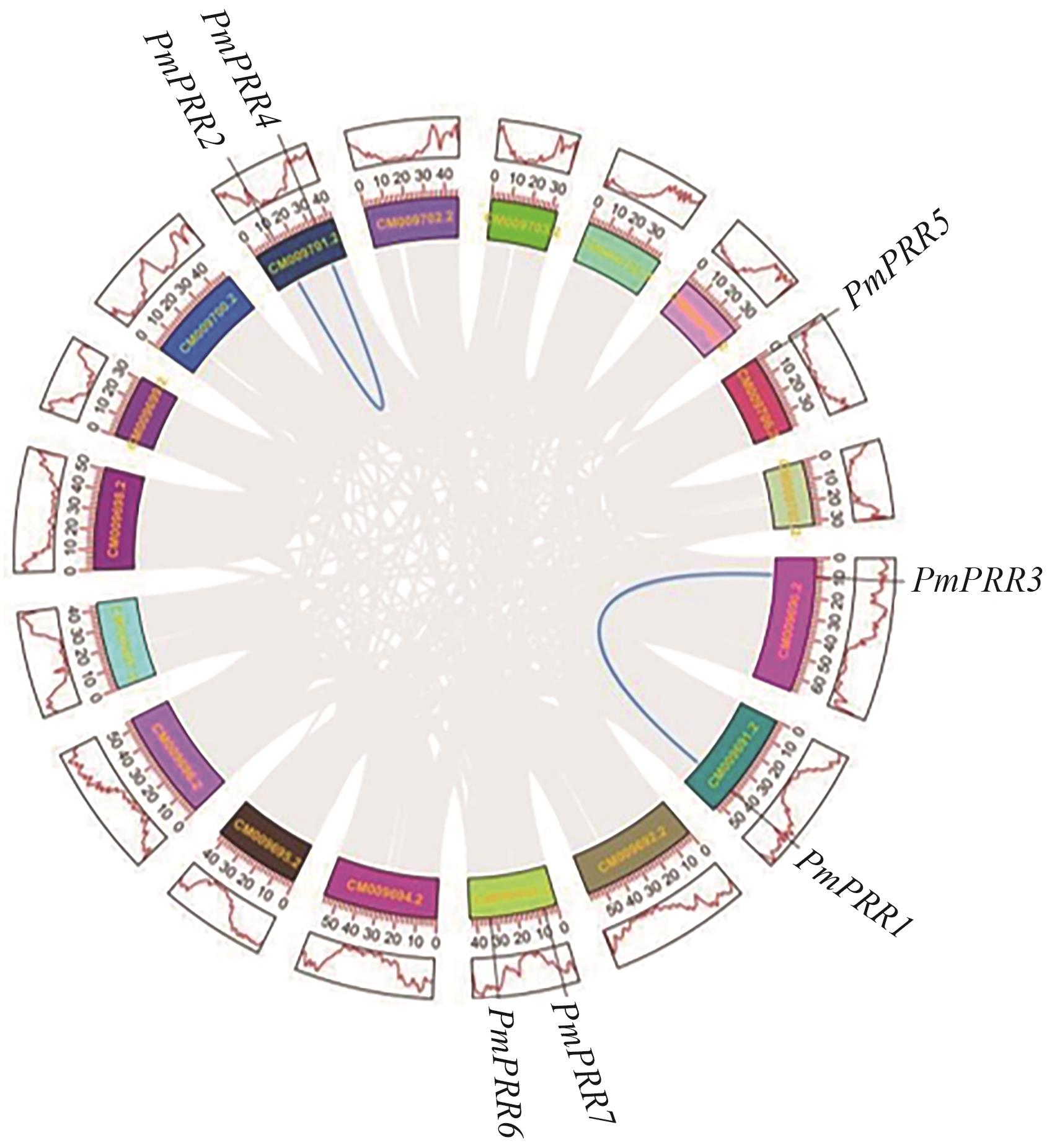
图5 糜子PmPRR基因家族的物种内共线性分析
Fig. 5 Intra-species synteny analysis of the PmPRR gene family in broomcorn millet
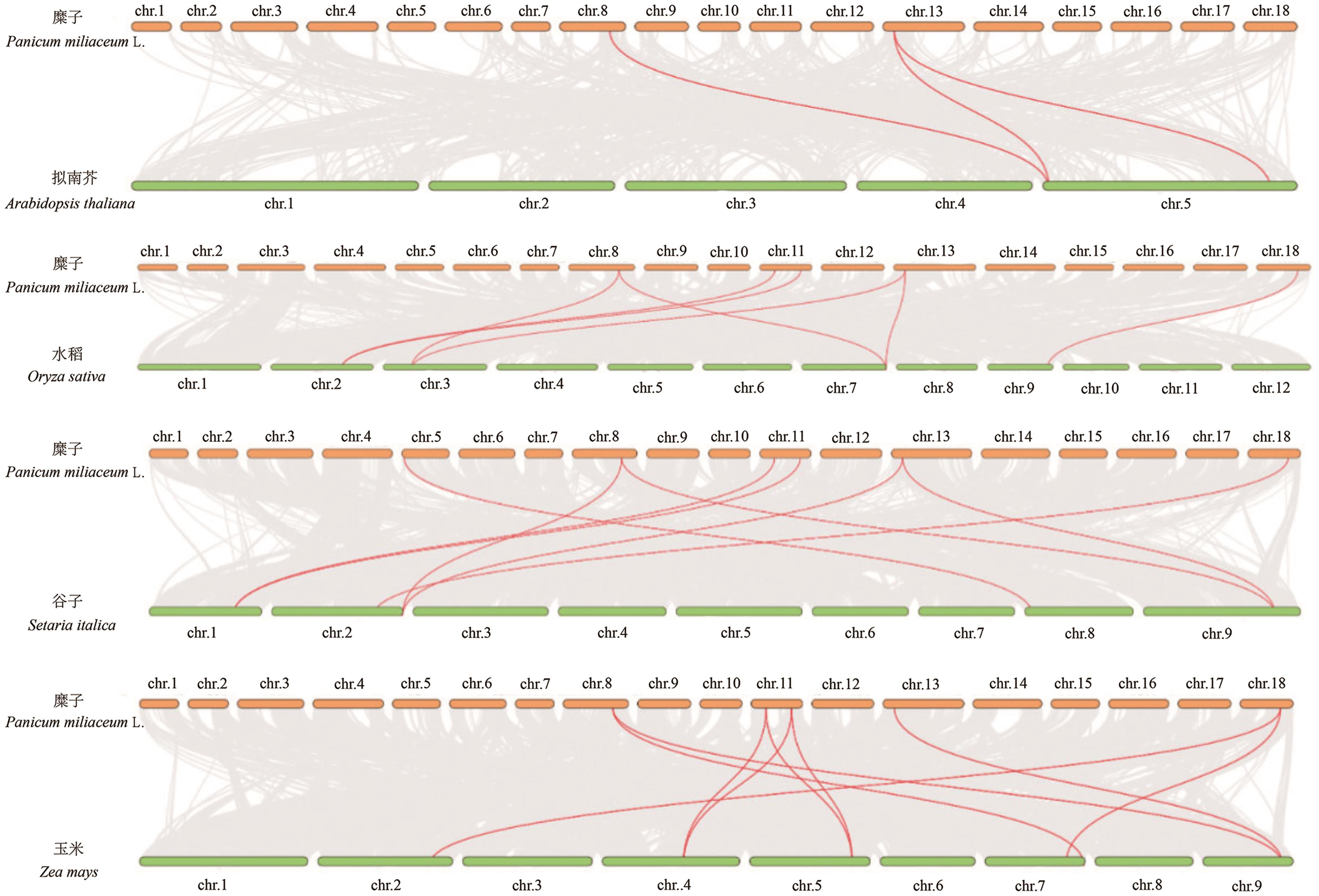
图6 糜子PmPRR基因家族成员与拟南芥、水稻、谷子和玉米PRR基因共线性分析
Fig. 6 Synteny analysis between PmPRR genes in Panicum miliaceum L.(broomcorn millet) and PRR genes in Arabidopsis thaliana, Oryza sativa, Setaria italica, and Zea mays
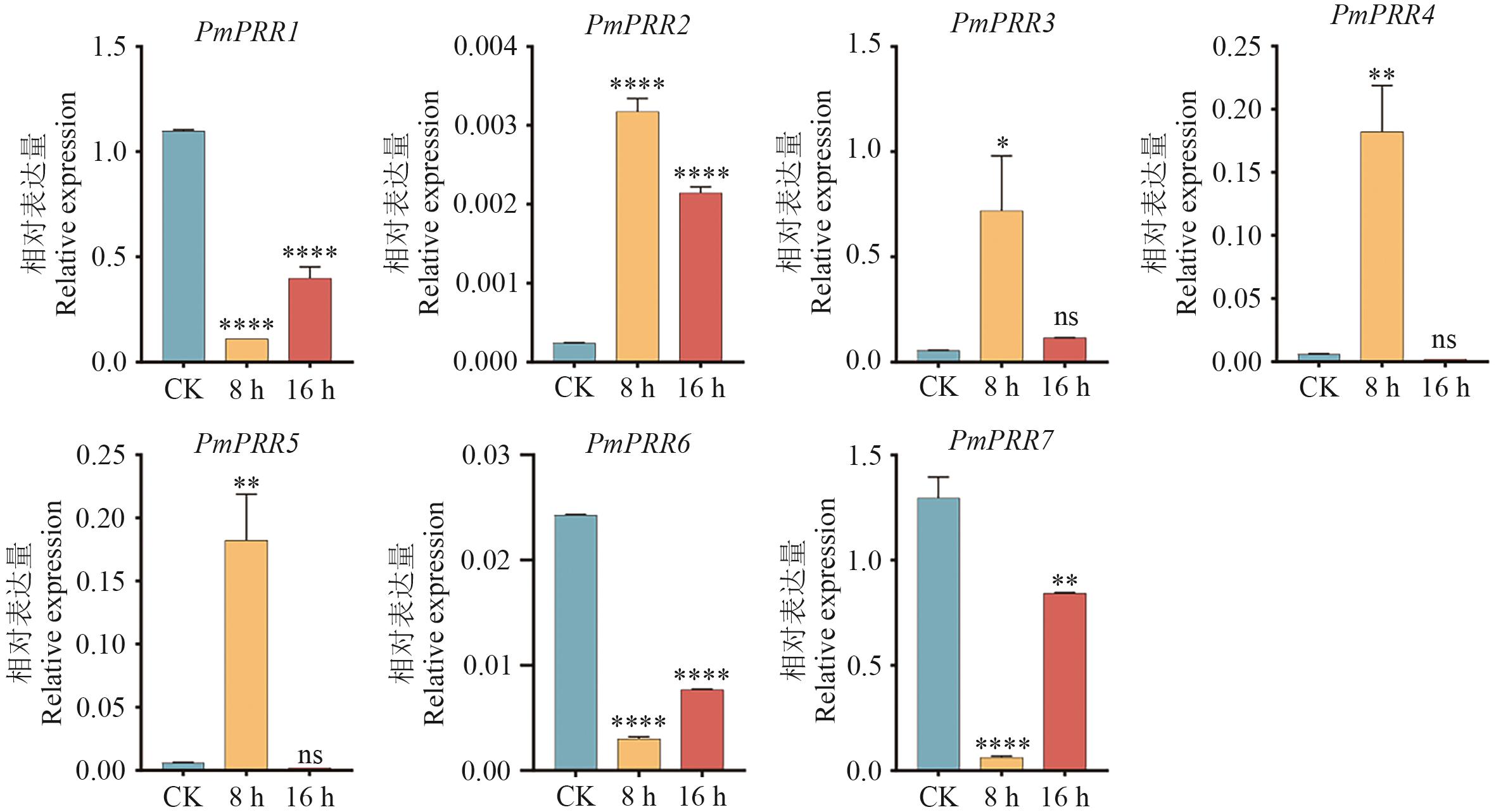
图7 糜子PmPRR基因不同光照条件下的表达量* P<0.05; ** P<0.01;**** P<0.000 1; ns: no significant differemce
Fig. 7 Expressions of the PmPRR genes in broomcorn millet under different light conditions
| [1] | Wang RY, Wang HG, Liu XY, et al. Drought-induced transcription of resistant and sensitive common millet varieties [J]. J Anim Plant Sci, 2017, 27(4): 1303-1314. |
| [2] | 刁现民, 程汝宏. 十五年区试数据分析展示谷子糜子育种现状 [J]. 中国农业科学, 2017, 50(23): 4469-4474. |
| Diao XM, Cheng RH. Current breeding situation of foxtail millet and common millet in China as revealed by exploitation of 15 years regional adaptation test data [J]. Sci Agric Sin, 2017, 50(23): 4469-4474. | |
| [3] | 李冬梅, 王洪露, 龚瑶, 等. 糜子直链淀粉、蛋白质含量对其外观品质及食味品质的影响 [J]. 食品科学, 2023, 44(4): 115-121. |
| Li DM, Wang HL, Gong Y, et al. Effects of amylose and protein contents on visual appearance and eating quality of proso millet [J]. Food Sci, 2023, 44(4): 115-121. | |
| [4] | Jiao YL, Lau OS, Deng XW. Light-regulated transcriptional networks in higher plants [J]. Nat Rev Genet, 2007, 8(3): 217-230. |
| [5] | Ezer D, Jung JH, Lan H, et al. The evening complex coordinates environmental and endogenous signals in Arabidopsis [J]. Nat Plants, 2017, 3: 17087. |
| [6] | Harmer SL, Hogenesch JB, Straume M, et al. Orchestrated transcription of key pathways in Arabidopsis by the circadian clock [J]. Science, 2000, 290(5499): 2110-2113. |
| [7] | Chory J, Wu D. Weaving the complex web of signal transduction [J]. Plant Physiol, 2001, 125(1): 77-80. |
| [8] | Garner WW, Allard HA. Effect of the relative length of day and night and other factors of the environment on growth and reproduction in plants [J]. Mon Weather Rev, 1920, 48(7): 415. |
| [9] | 陈华夏, 申国境, 王磊, 等. 4个物种CCT结构域基因家族的序列进化分析 [J]. 华中农业大学学报, 2010, 29(6): 669-676. |
| Chen HX, Shen GJ, Wang L, et al. Sequence evolution analysis of CCT domain gene family in rice, Arabidopsis, maize and sorghum [J]. J Huazhong Agric Univ, 2010, 29(6): 669-676. | |
| [10] | Salomé PA, McClung CR. PSEUDO-RESPONSE REGULATOR 7 and 9 are partially redundant genes essential for the temperature responsiveness of the Arabidopsis circadian clock [J]. Plant Cell, 2005, 17(3): 791-803. |
| [11] | Mizuno T, Nakamichi N. Pseudo-response regulators (PRRs) or true oscillator components (TOCs) [J]. Plant Cell Physiol, 2005, 46(5): 677-685. |
| [12] | Farré EM, Liu T. The PRR family of transcriptional regulators reflects the complexity and evolution of plant circadian clocks [J]. Curr Opin Plant Biol, 2013, 16(5): 621-629. |
| [13] | Mizuno T. Two-component phosphorelay signal transduction systems in plants: from hormone responses to circadian rhythms [J]. Biosci Biotechnol Biochem, 2005, 69(12): 2263-2276. |
| [14] | Makino S, Kiba T, Imamura A, et al. Genes encoding pseudo-response regulators: insight into His-to-Asp phosphorelay and circadian rhythm in Arabidopsis thaliana [J]. Plant Cell Physiol, 2000, 41(6): 791-803. |
| [15] | Matsushika A, Makino S, Kojima M, et al. Circadian waves of expression of the APRR1/TOC1 family of pseudo-response regulators in Arabidopsis thaliana: insight into the plant circadian clock [J]. Plant Cell Physiol, 2000, 41(9): 1002-1012. |
| [16] | Ming R, Hou SB, Feng Y, et al. The draft genome of the transgenic tropical fruit tree Papaya (Carica papaya Linnaeus) [J]. Nature, 2008, 452(7190): 991-996. |
| [17] | Murakami M, Ashikari M, Miura K, et al. The evolutionarily conserved OsPRR quintet: rice pseudo-response regulators implicated in circadian rhythm [J]. Plant Cell Physiol, 2003, 44(11): 1229-1236. |
| [18] | Koo BH, Yoo SC, Park JW, et al. Natural variation in OsPRR37 regulates heading date and contributes to rice cultivation at a wide range of latitudes [J]. Mol Plant, 2013, 6(6): 1877-1888. |
| [19] | 赵淑靓, 景艺峰, 刘青青, 等. 伪应答调控蛋白在植物光周期调控途径中的作用 [J]. 核农学报, 2018, 32(9): 1740-1749. |
| Zhao SJ, Jing YF, Liu QQ, et al. The role of the pseudo-response regulators in photoperiod regulation pathway in plants [J]. J Nucl Agric Sci, 2018, 32(9): 1740-1749. | |
| [20] | Murphy RL, Klein RR, Morishige DT, et al. Coincident light and clock regulation of pseudoresponse regulator protein 37 (PRR37) controls photoperiodic flowering in sorghum [J]. Proc Natl Acad Sci USA, 2011, 108(39): 16469-16474. |
| [21] | Bendix C, Marshall CM, Harmon FG. Circadian clock genes universally control key agricultural traits [J]. Mol Plant, 2015, 8(8): 1135-1152. |
| [22] | 李剑峰, 李婷, 贾小平. PRRs家族功能基因的研究进展 [J]. 植物遗传资源学报, 2019, 20(6): 1399-1407. |
| Li JF, Li T, Jia XP. Advances on unlocking the functional basis of PRRs family genes [J]. J Plant Genet Resour, 2019, 20(6): 1399-1407. | |
| [23] | Wang LW, Tian B, He Q, et al. SiPRR37 exerts dual functions in the regulation of photoperiodic flowering and contributes to the ecological adaption of foxtail millet [J]. Crop J, 2025, 13(2): 339-349. |
| [24] | 张洪伟. 小麦开花相关基因的挖掘及功能分析 [D]. 保定: 河北农业大学, 2022. |
| Zhang HW. Flowering related gene mining and their function exploration in wheat (Triticum aestivum L.) [D]. Baoding: Hebei Agricultural University, 2022. | |
| [25] | 董昭桐, 雷雅琪, 陈淼林, 等. 水稻生物钟相关基因的表达特征鉴定及其功能预测分析 [J]. 基因组学与应用生物学, 2016, 35(3): 692-705. |
| Dong ZT, Lei YQ, Chen ML, et al. Identification of expression characteristics and predictive analysis of function of circadian-related genes in rice [J]. Genom Appl Biol, 2016, 35(3): 692-705. | |
| [26] | 魏华, 王岩, 刘宝辉, 等. 植物生物钟及其调控生长发育的研究进展 [J]. 植物学报, 2018, 53(4): 456-467. |
| Wei H, Wang Y, Liu BH, et al. Deciphering the underlying mechanism of the plant circadian system and its regulation on plant growth and development [J]. Chin Bull Bot, 2018, 53(4): 456-467. | |
| [27] | 赵娟莹, 李金彪, 李皓翔, 等. 高粱BZR基因的鉴定及与籽粒性状关联分析 [J]. 植物遗传资源学报, 2025, 26(3): 507-518. |
| Zhao JY, Li JB, Li HX, et al. Identification of BZR genes and its association with grain traits in sorghum [J]. J Plant Genet Resour, 2025, 26(3): 507-518. | |
| [28] | 王欢欢, 红格日其其格, 刘亚玲, 等. 基于CRISPR/Cas9的拟南芥CCT7基因编辑载体构建及验证 [J]. 分子植物育种, 2026, 24(9): 2911-2917. |
| Wang HH, Hong G, Liu YL, et al. Construction and validation of Arabidopsis CCT7 gene editing vector based on CRISPR/Cas9 [J]. Mol Plant Breed, 2026, 24(9): 2911-2917. | |
| [29] | 袁玺垒, 王振山, 贾小平, 等. 光周期调控植物开花分子机制以及CCT基因家族研究进展 [J]. 浙江农业学报, 2020, 32(6): 1133-1140. |
| Yuan XL, Wang ZS, Jia XP, et al. Research advances on molecular mechanisms of photoperiod-regulation plant flowering and CCT gene family [J]. Acta Agric Zhejiangensis, 2020, 32(6): 1133-1140. | |
| [30] | Wang LW, Sun S, Wu TT, et al. Natural variation and CRISPR/Cas9-mediated mutation in GmPRR37 affect photoperiodic flowering and contribute to regional adaptation of soybean [J]. Plant Biotechnol J, 2020, 18(9): 1869-1881. |
| [31] | Li MW, Liu W, Lam HM, et al. Characterization of two growth period QTLs reveals modification of PRR3 genes during soybean domestication [J]. Plant Cell Physiol, 2019, 60(2): 407-420. |
| [32] | Farré EM, Kay SA. PRR7 protein levels are regulated by light and the circadian clock in Arabidopsis [J]. Plant J, 2007, 52(3): 548-560. |
| [33] | Nakamichi N, Kiba T, Henriques R, et al. PSEUDO-RESPONSE REGULATORS 9, 7, and 5 are transcriptional repressors in the Arabidopsis circadian clock [J]. Plant Cell, 2010, 22(3): 594-605. |
| [34] | Campoli C, Shtaya M, Davis SJ, et al. Expression conservation within the circadian clock of a monocot: natural variation at barley Ppd-H1 affects circadian expression of flowering time genes, but not clock orthologs [J]. BMC Plant Biol, 2012, 12: 97. |
| [1] | 黄旭升, 周雅莉, 贾峥嵘, 沈珊, 陈锦钗, 周广立, 李鑫鑫, 王计平, 李润植, 贾小云. 紫苏ARF转录因子家族全基因组鉴定及其在非生物胁迫响应中的功能分析[J]. 生物技术通报, 2026, 42(7): 148-162. |
| [2] | 辛晴, 郑永杰, 李雨华, 涂白连, 刘新亮, 张月婷, 伍艳芳. 樟树MYC转录因子的全基因组鉴定与表达分析[J]. 生物技术通报, 2026, 42(7): 214-225. |
| [3] | 冉丹丹, 邰森林, 欧小宏, 周涛, 徐娇. 天麻尿苷二磷酸糖基转移酶基因家族鉴定与分析[J]. 生物技术通报, 2026, 42(7): 163-172. |
| [4] | 阎晓光, 杜艳伟, 马志远, 王彬, 王国梁, 胡丹珠. 玉米ZmDIR基因家族的全基因组鉴定与表达模式分析[J]. 生物技术通报, 2026, 42(7): 126-137. |
| [5] | 张艾岑, 闫会, 马居奎, 张允刚, 李强. 甘薯DNA甲基转移酶和去甲基化酶基因家族的全基因组鉴定与表达分析[J]. 生物技术通报, 2026, 42(6): 1-12. |
| [6] | 熊仕发, 陈益存, 吴立文, 施翔, 张盛剿, 彭方有, 陈涛梅, 汪阳东. 白栎TCP基因家族的鉴定及功能分析[J]. 生物技术通报, 2026, 42(6): 258-266. |
| [7] | 李旭龙, 徐世强, 张龙, 李静宇, 何伟贤, 陈立凯, 王继华. 巴戟天萜烯合成酶基因家族鉴定、进化及表达模式分析[J]. 生物技术通报, 2026, 42(6): 314-325. |
| [8] | 王江清, 张蝶, 王荟洁, 袁柱东, 付艳鸿, 黄娅楠, 王洪洋. 马铃薯AP2/ERF基因家族鉴定及响应致病疫霉胁迫的表达分析[J]. 生物技术通报, 2026, 42(6): 116-127. |
| [9] | 金旋, 向芬, 戴翠婷, 杨辉, 李赛君, 刘红艳, 钱思维, 蔺万煌, 李维. 茶树CsTDIFL基因的克隆、表达特性分析及其对氨基酸合成的调控[J]. 生物技术通报, 2026, 42(5): 323-331. |
| [10] | 郭苗, 许家佳, 孙天国, 蔡璨, 曹婉笛, 包纪星, 沙伟, 张梅娟, 彭疑芳, 马天意. 过表达砂藓RcOLEO1基因增强拟南芥的耐旱性及耐高温性[J]. 生物技术通报, 2026, 42(5): 312-322. |
| [11] | 陈登科, 兰刚, 夏芝, 侯保国, 杨六六, 曹彩荣, 李朋波, 吴翠翠. 花生ZF-HD基因家族的鉴定和非生物胁迫响应分析[J]. 生物技术通报, 2026, 42(4): 114-128. |
| [12] | 刘林娅, 刘欢艳, 梁鑫钰, 宋姝熠, 何斌, 王绪英, 黄亚成. ‘红阳’猕猴桃BGAL基因家族的全基因组鉴定与表达分析[J]. 生物技术通报, 2026, 42(3): 312-323. |
| [13] | 农韦优, 赵昌祖, 钱禛锋, 丁倩, 王誉洁, 陈疏影, 何丽莲, 李富生. 蔗茅EfBBX基因家族鉴定及冷胁迫下表达模式分析[J]. 生物技术通报, 2026, 42(2): 267-277. |
| [14] | 张冬岭, 张寅生, 王建军, 叶飞宇, 卢子涵, 马晨晨, 柳华峰, 胡德升, 邓亚洲, 曹丽茹. 玉米HSFs转录因子家族在干旱胁迫下的表达特性及功能[J]. 生物技术通报, 2026, 42(2): 178-187. |
| [15] | 吴翠翠, 陈登科, 兰刚, 夏芝, 李朋波. 花生转录因子AhHDZ70的生物信息学分析及耐盐耐旱性研究[J]. 生物技术通报, 2026, 42(1): 198-207. |
| 阅读次数 | ||||||
|
全文 |
|
|||||
|
摘要 |
|
|||||
