







• 研究报告 • 下一篇
何其光, 冼雪梅, 刘辉, 袁坤, 杨洁, 王玉婷, 王真辉( ), 杨洪()
收稿日期:2026-04-16
出版日期:2026-08-28
通讯作者:
王真辉wzh-36@163.com基金资助:
HE Qi-guang, XIAN Xue-mei, LIU Hui, YUAN Kun, YANG Jie, WANG Yu-ting, WANG Zhen-hui(), YANG Hong()
Received:2026-04-16
Published:2026-08-28
摘要:
目的 探究暹罗炭疽菌(Colletotrichum siamense)侵染橡胶树过程中宿主γ-氨基丁酸(GABA)的动态变化规律,解析外源GABA对该病原菌碳氮代谢、抗氧化防御及细胞壁完整性的转录调控机制,为阐明橡胶树炭疽病菌的致病机理提供理论依据。 方法 通过比色法测定暹罗炭疽菌侵染后不同时间点(0-96 hpi)橡胶树叶片GABA含量变化;分别以GABA和NaNO3为氮源分析菌株生长情况,并进行比较转录组测序,结合荧光定量PCR验证关键差异基因;通过在含H2O2、NaCl、山梨醇、刚果红和DTT等胁迫因子的察氏培养基(以硝酸钠/GABA为氮源)培养,分析GABA对病原菌逆境耐受性和细胞壁完整性的影响。 结果 暹罗炭疽菌侵染诱导宿主GABA含量自48 hpi后显著升高,至96 hpi达到峰值(1.9 mg/g),约为对照的2.4倍。该菌可利用GABA为碳氮源维持生长;转录组测序和荧光定量PCR分析结果均表明,以GABA为氮源培养下GABA代谢支路核心酶基因(GABA-T和SSADH)及下游三羧酸循环关键酶基因(SDH-2)均显著上调表达,而内源GABA合成关键酶基因(GAD)则被显著抑制;同时,抗氧化系统相关基因(CSase、GR、GST、SOD、PRX1)及磷酸戊糖途径关键酶基因(G6PD)均显著上调。表型分析表明,GABA不仅显著增强了病原菌对非生物胁迫的耐受性,且在细胞壁合成相关基因普遍下调的情况下,提高了菌株对刚果红和DTT的耐受性。 结论 暹罗炭疽菌侵染能诱导橡胶树叶片GABA大量积累,而该菌可以外源GABA为碳氮源经GABA代谢支路回补三羧酸循环,同时激活抗氧化防御系统并维持细胞壁完整性。
何其光, 冼雪梅, 刘辉, 袁坤, 杨洁, 王玉婷, 王真辉, 杨洪. γ-氨基丁酸对暹罗炭疽菌的转录调控及胁迫耐受性的影响[J]. 生物技术通报, doi: 10.13560/j.cnki.biotech.bull.1985.2026-0437.
HE Qi-guang, XIAN Xue-mei, LIU Hui, YUAN Kun, YANG Jie, WANG Yu-ting, WANG Zhen-hui, YANG Hong. Effects of γ-aminobutyric Acid on Transcriptional Regulation and Stress Tolerance in Colletotrichum siamense[J]. Biotechnology Bulletin, doi: 10.13560/j.cnki.biotech.bull.1985.2026-0437.
引物名称 Primer name | 上游引物序列 Upstream primer sequence (5′-3′) | 下游引物序列 Downstream primer sequence (5′-3′) |
|---|---|---|
| qCsActin | GATGTGGATATCAGGAAGG | CATACTGCTTGGAGCAAGA |
| qCsGAD-1 | GGTTTGCCTGTGGTCTCGTTC | CGGTAGTGGGTAGTTGGGAATG |
| qCsGAD-2 | GGCTGGGTTGTTCCGGCTT | GTGGTTGTGCGACGACTTGGT |
| qCsGABAT-1 | GAGCACCTCATCAAGACCTACCA | CTCGTGAGCCCAGAACTTGC |
| qCsGABAT-2 | GGCAGTCTGTCTACCACCCG | CCGCCCTCGCTCTGAATAG |
| qCsSAADH-1 | CCAAGGGTTCTCAGCCGATAC | CGAAGTCGGAAAGGTTGGAAG |
| qCsSAADH-2 | CGTGCCCTGAATTTGATGAGA | CCTGGATGGTATCGCCGTAT |
| qCS-1 | TGACCAAGGAGGAGGCTTACAT | TCGGTGGGAGCACCAGAGT |
| qCS-2 | GTCCAACGAGCTGAACAACATTATC | GTCGGCCTGGTATCTGAGCAA |
| qCsSDH-1 | CTTCGTTTGTGCGACCTGCT | TTCTGGACGGTAGGCTTGAGG |
| qCsSDH-2 | GATGGAGCAGACGTGGTTCGG | GGTGGCGGATGCCGTTGA |
| qCsMDH | CGTCAACTCCACCGTTCCTATTT | AAGGCGTGACTTGGCTGAAAA |
| qGDH-1 | CCCCTACAAGGGAGGTCTGA | CCTTGGGGTTGAAGTCGGAA |
| qGDH-2 | GCAGCGCAAGAACAAAGACA | CCGGTGAAGAACGACTTCCA |
| qCsCSase-1 | GGAATACCTGAACCCAACCG | GAGTGCAAACGAAGGCCAGT |
| qCsCSase-2 | GGCCCTTCTTCTGGGTTCAA | TCGTTCGGGATTACGCTTTC |
| qCsCSase-3 | TGGTGTTGACCTCTACCGATACGA | TCCTCGGGCTGACGCAAGT |
| qCsTRX-1 | ATGGTCGTCATCCACGCTTC | TCTCGTACATGGGCTTGATTTG |
| qCsTRX-2 | CTTTGGTCCCGTCCGTGTCT | TGTTCGTGTAGAGGTGGATGGTG |
| qCsTRX-3 | ACGAGTGCTTGTGCTTGCGATAC | GAGGACACGCCTTGCGACATT |
| qCsG6PD | CCCCATTTCTTTCGCCTCTGA | TTGAATTGGATGCGGATCTCG |
| qCsGR | GTCTGGCGGAGCGTCTGTT | GCGTAGTACATGGCGGTAAAGT |
| qCsGST-1 | CATTTCGCCAACGGCTCCC | TCTCGCCCGCCAACCACTT |
| qCsGST-2 | GGAGGTCTTCCATCGCAACAA | TGGCATCTCGTCCACTCTTCG |
| qCsPRX | CATCATTGCCGACAAGGAGC | AGGAGAGGATGGTGCGGATG |
| qCsSOD-1 | TACGATGCGTTGGAACCTCAC | CGTTGTATGTTTCGATAGCCTTGT |
| qCsSOD-2 | GCTACTCTGCCCGATATGCC | GCCTCCTGGACGGTCTCAA |
| qCskatG | ATCTCATGGGCGGACCTGTAC | CCAGTAGACGGACTCATCGGAC |
表1 本研究所用RT-qPCR引物信息
Table 1 RT-qPCR primers used in this study
引物名称 Primer name | 上游引物序列 Upstream primer sequence (5′-3′) | 下游引物序列 Downstream primer sequence (5′-3′) |
|---|---|---|
| qCsActin | GATGTGGATATCAGGAAGG | CATACTGCTTGGAGCAAGA |
| qCsGAD-1 | GGTTTGCCTGTGGTCTCGTTC | CGGTAGTGGGTAGTTGGGAATG |
| qCsGAD-2 | GGCTGGGTTGTTCCGGCTT | GTGGTTGTGCGACGACTTGGT |
| qCsGABAT-1 | GAGCACCTCATCAAGACCTACCA | CTCGTGAGCCCAGAACTTGC |
| qCsGABAT-2 | GGCAGTCTGTCTACCACCCG | CCGCCCTCGCTCTGAATAG |
| qCsSAADH-1 | CCAAGGGTTCTCAGCCGATAC | CGAAGTCGGAAAGGTTGGAAG |
| qCsSAADH-2 | CGTGCCCTGAATTTGATGAGA | CCTGGATGGTATCGCCGTAT |
| qCS-1 | TGACCAAGGAGGAGGCTTACAT | TCGGTGGGAGCACCAGAGT |
| qCS-2 | GTCCAACGAGCTGAACAACATTATC | GTCGGCCTGGTATCTGAGCAA |
| qCsSDH-1 | CTTCGTTTGTGCGACCTGCT | TTCTGGACGGTAGGCTTGAGG |
| qCsSDH-2 | GATGGAGCAGACGTGGTTCGG | GGTGGCGGATGCCGTTGA |
| qCsMDH | CGTCAACTCCACCGTTCCTATTT | AAGGCGTGACTTGGCTGAAAA |
| qGDH-1 | CCCCTACAAGGGAGGTCTGA | CCTTGGGGTTGAAGTCGGAA |
| qGDH-2 | GCAGCGCAAGAACAAAGACA | CCGGTGAAGAACGACTTCCA |
| qCsCSase-1 | GGAATACCTGAACCCAACCG | GAGTGCAAACGAAGGCCAGT |
| qCsCSase-2 | GGCCCTTCTTCTGGGTTCAA | TCGTTCGGGATTACGCTTTC |
| qCsCSase-3 | TGGTGTTGACCTCTACCGATACGA | TCCTCGGGCTGACGCAAGT |
| qCsTRX-1 | ATGGTCGTCATCCACGCTTC | TCTCGTACATGGGCTTGATTTG |
| qCsTRX-2 | CTTTGGTCCCGTCCGTGTCT | TGTTCGTGTAGAGGTGGATGGTG |
| qCsTRX-3 | ACGAGTGCTTGTGCTTGCGATAC | GAGGACACGCCTTGCGACATT |
| qCsG6PD | CCCCATTTCTTTCGCCTCTGA | TTGAATTGGATGCGGATCTCG |
| qCsGR | GTCTGGCGGAGCGTCTGTT | GCGTAGTACATGGCGGTAAAGT |
| qCsGST-1 | CATTTCGCCAACGGCTCCC | TCTCGCCCGCCAACCACTT |
| qCsGST-2 | GGAGGTCTTCCATCGCAACAA | TGGCATCTCGTCCACTCTTCG |
| qCsPRX | CATCATTGCCGACAAGGAGC | AGGAGAGGATGGTGCGGATG |
| qCsSOD-1 | TACGATGCGTTGGAACCTCAC | CGTTGTATGTTTCGATAGCCTTGT |
| qCsSOD-2 | GCTACTCTGCCCGATATGCC | GCCTCCTGGACGGTCTCAA |
| qCskatG | ATCTCATGGGCGGACCTGTAC | CCAGTAGACGGACTCATCGGAC |
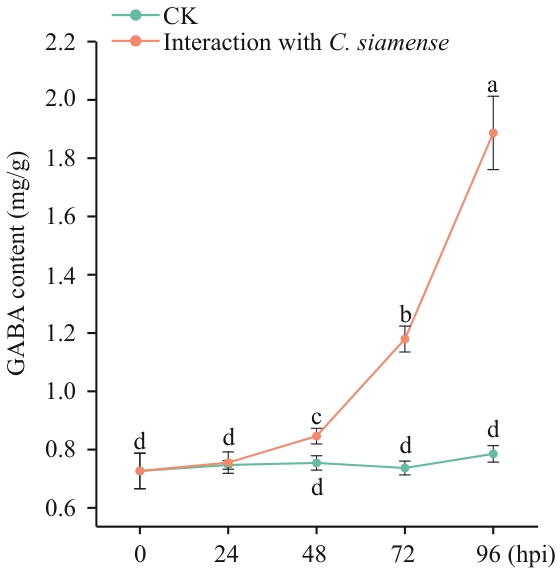
图1 暹罗炭疽菌侵染过程橡胶树叶片GABA含量
Fig. 1 Dynamics of GABA accumulation in rubber tree leaves during C. siamense infection

图2 暹罗炭疽菌对GABA的同化利用
Fig. 2 Assimilation and utilization of GABA by C. siamese
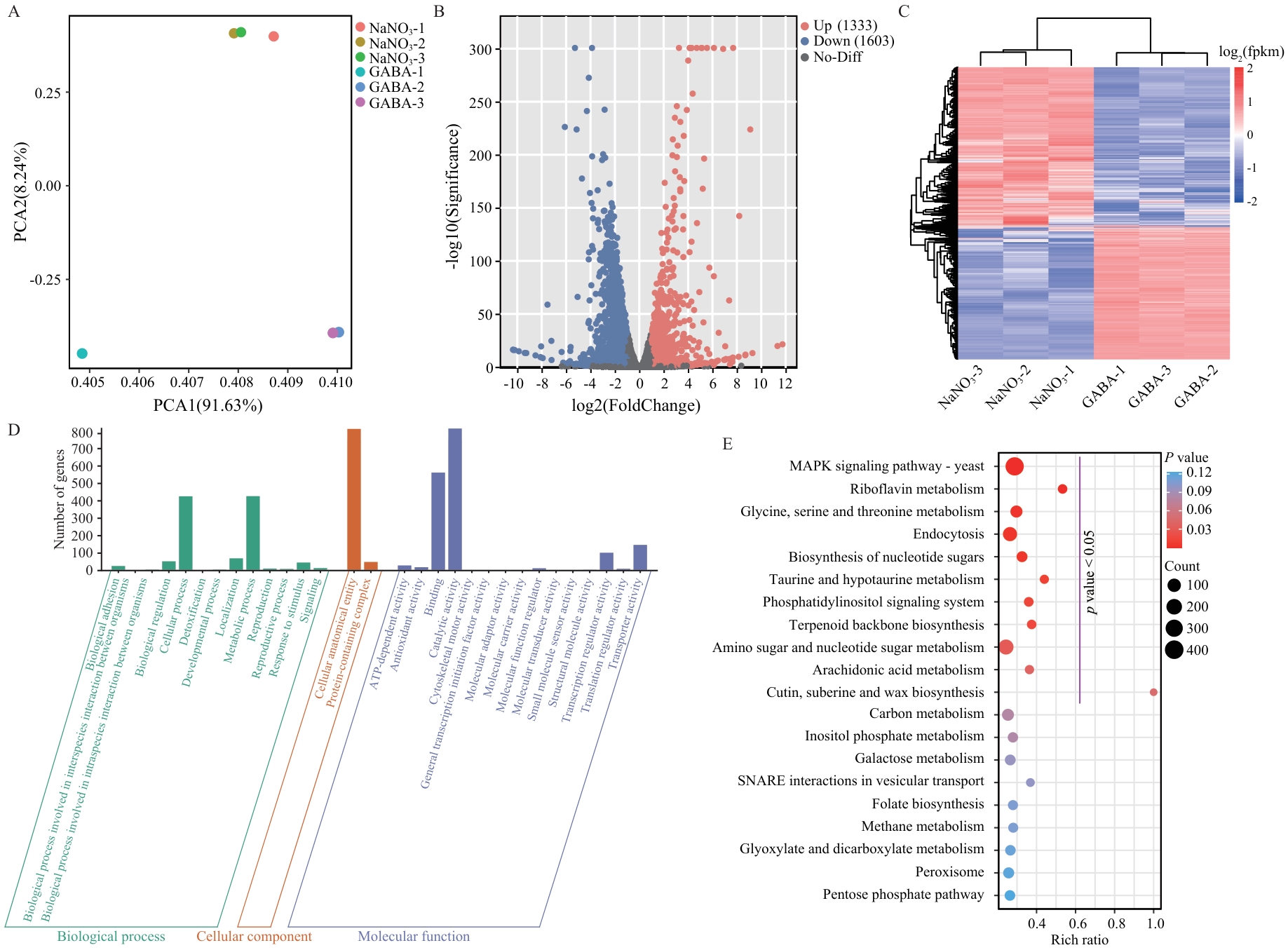
图3 暹罗炭疽菌响应GABA同化利用的转录组分析A:不同处理组间样本聚类主成分分析(PCA)图;B:差异基因分布火山图;C:差异表达基因层次聚类热图;D:差异表达基因GO注释与功能分类;E:差异表达基因KEGG富集分析
Fig. 3 Transcriptomic analysis of C. siamense in response to GABA assimilation and utilizationA: Principal component analysis (PCA) showing the clustering of samples among different treatments. B: Volcano plot of DEGs. C: Hierarchical clustering heatmap of the DEGs. D: Gene Ontology (GO) functional classification of the DEGs. E: KEGG pathway enrichment analysis of the DEGs
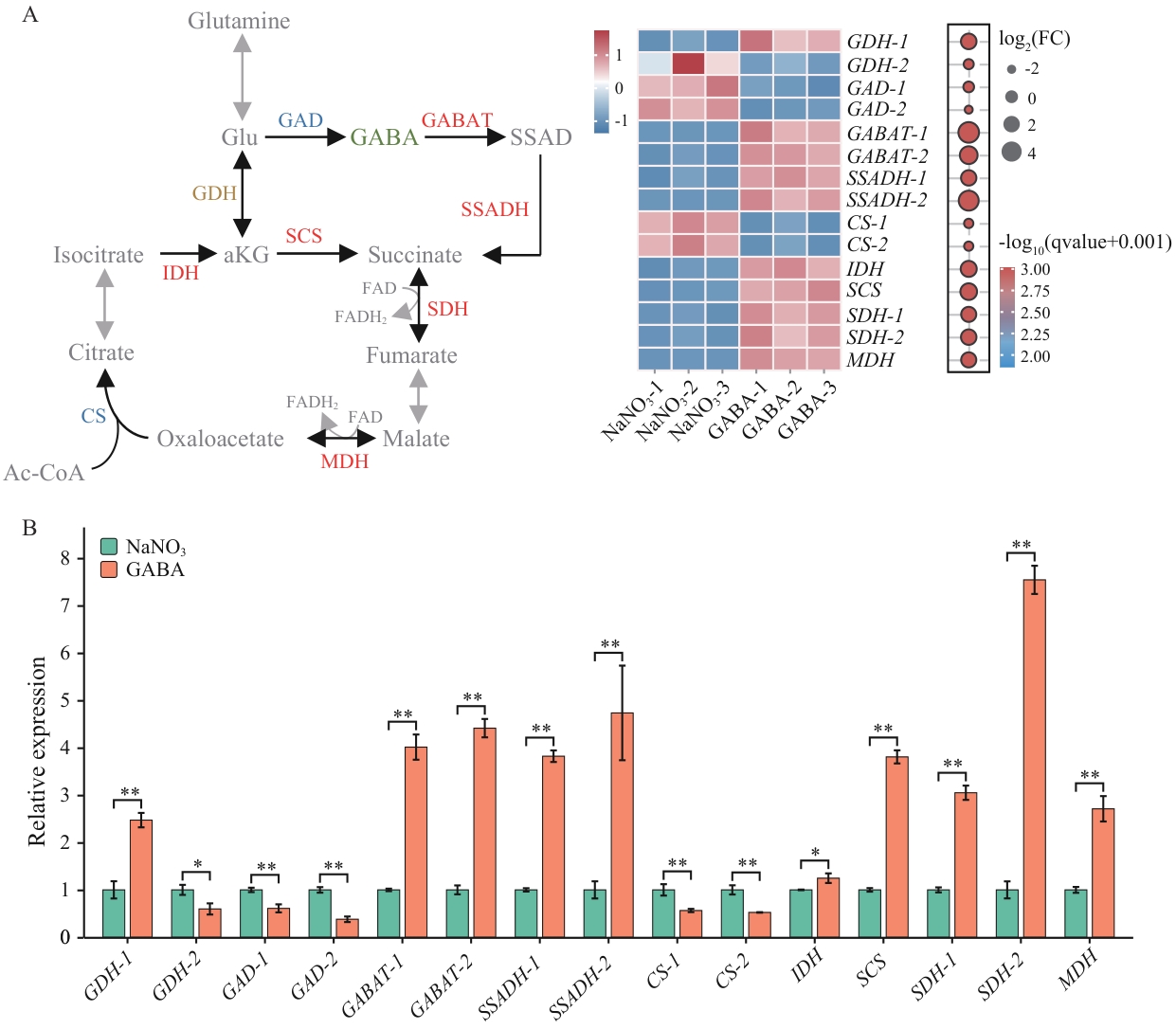
图4 暹罗炭疽菌同化外源GABA的代谢通路核心基因表达模式A:转录组中参与GABA代谢途径的基因表达模式;B:GABA代谢途径基因表达的RT-qPCR验证。* P<0.05;** P<0.01,下同
Fig. 4 Expression patterns of key genes in the exogenous GABA assimilation pathway of C. siamenseA: Expression profiles of GABA pathway‑related genes in the transcriptome; B: RT-qPCR validation of gene expression in the GABA metabolic pathway. * P<0.05; ** P<0.01, the same below
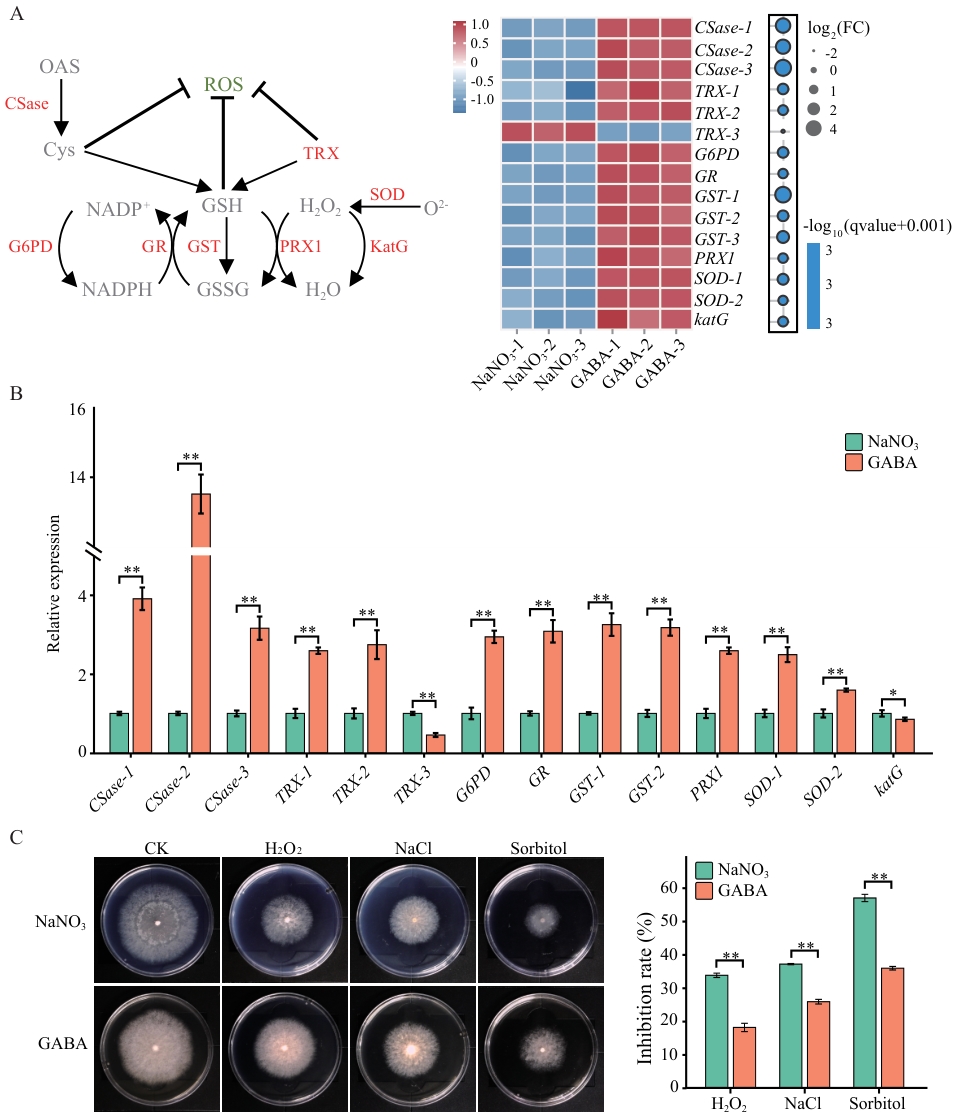
图5 GABA介导暹罗炭疽菌逆境胁迫耐受力A:转录组中ROS代谢相关基因表达模式;B:ROS代谢相关基因表达的RT-qPCR验证;C:以GABA为氮源逆境胁迫下暹罗炭疽菌生长情况
Fig. 5 GABA-mediated stress tolerance in C. siamenseA: Expression patterns of key genes associated with ROS metabolism in the transcriptome; B: RT-qPCR validation of the expression of ROS metabolism-related genes; C: growth of C. siamense under various stresses with GABA as the nitrogen source
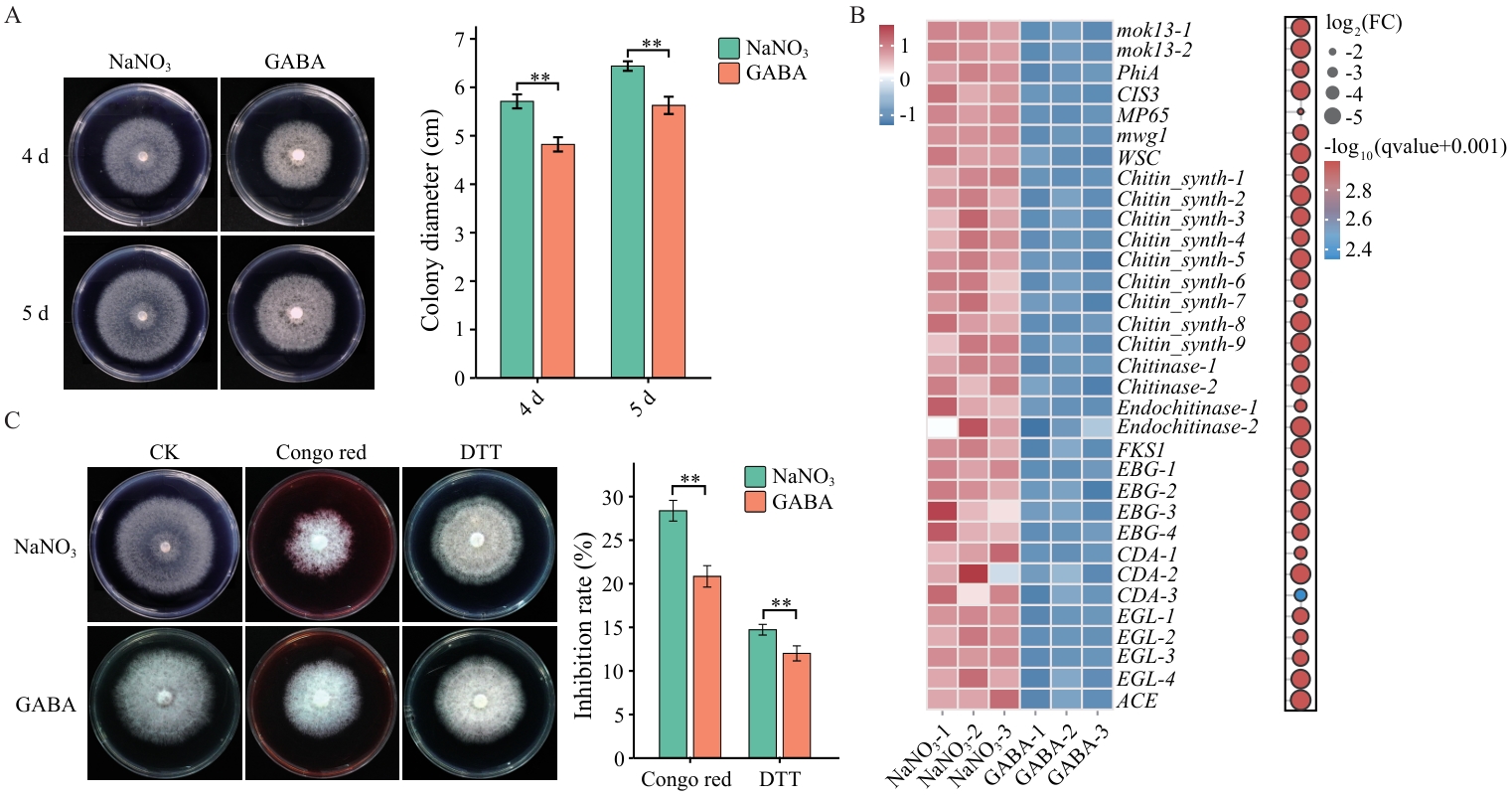
图6 GABA介导暹罗炭疽菌细胞壁完整性A:利用不同氮源培养时暹罗炭疽菌的生长情况;B:基于RNA-seq数据的细胞壁生物合成关键基因表达模式;C:不同氮源条件下对刚果红(Congo red)和DTT的敏感性
Fig. 6 GABA-mediated cell wall integrity in C. siamenseA: Growth of C. siamense cultured with different nitrogen sources; B: expression patterns of key genes involved in cell wall biosynthesis based on RNA‑seq data; C: sensitivities to Congo red and DTT under different nitrogen conditions
| [1] | 史敏晶, 张世鑫, 晁金泉, 等. 橡胶树1981'IRRDB野生种质预割诱导次生乳管分化的比较分析 [J]. 热带作物学报, 2022, 43(2): 303-310. |
| Shi MJ, Zhang SX, Chao JQ, et al. Comparison of secondary laticifer differentiation of mature tree induced by pre-tapping in 1981' IRRDB wild germplasm of rubber tree [J]. Chin J Trop Crops, 2022, 43(2): 303-310. | |
| [2] | 李博勋, 刘先宝, 陈丽琼, 等. 橡胶树主要病害研究现状与展望 [J]. 中国科学: 生命科学, 2024, 54(10): 1798-1813. |
| Li BX, Liu XB, Chen LQ, et al. Current status and prospects of research on main diseases of rubber trees [J]. Sci Sin Vitae, 2024, 54(10): 1798-1813. | |
| [3] | 林春花, 张宇, 刘文波, 等. 我国巴西橡胶树炭疽病的研究进展 [J]. 热带生物学报, 2021(3): 393-402, F0002. |
| Lin CH, Zhang Y, Liu WB, et al. Research advances on Colletotrichum leaf fall disease of rubber trees in China [J]. J Trop Biol, 2021(3): 393-402, F0002. | |
| [4] | Li QL, Bu JY, Shu J, et al. Colletotrichum species associated with mango in Southern China [J]. Sci Rep, 2019, 9: 18891. |
| [5] | Zakaria L. Diversity of Colletotrichum species associated with anthracnose disease in tropical fruit crops—a review [J]. Agriculture, 2021, 11(4): 297. |
| [6] | Liu XB, Li BX, Cai JM, et al. Colletotrichum species causing anthracnose of rubber trees in China [J]. Sci Rep, 2018, 8: 10435. |
| [7] | Dwivedi S, Garde R, Schuster S. How hosts and pathogens choose the strengths of defense and counterdefense: a game-theoretical view [J]. Front Ecol Evol, 2025, 12: 1379868. |
| [8] | Prasad A, Sharma S, Prasad M. Suppressing plant defense: scavenge the ROS! [J]. Physiol Plant, 2023, 175(3): e13942. |
| [9] | Pinto L, Soler-López L, Serrano A, et al. Between host and invaders: the subcellular cell wall dynamics at the plant-pathogen interface [J]. Annu Rev Plant Biol, 2025, 76: 255-284. |
| [10] | Cao Z, Chen HY, Zhou CL, et al. Exogenous γ-aminobutyric acid (GABA) enhanced response to abiotic stress in Hypsizygus marmoreus by improving mycelial growth and antioxidant capacity [J]. Metabolites, 2024, 14(2): 94. |
| [11] | Liu W, Wang YS, Ji T, et al. High-nitrogen-induced γ-aminobutyric acid triggers host immunity and pathogen oxidative stress tolerance in tomato and Ralstonia solanacearum interaction [J]. New Phytol, 2024, 244(4): 1537-1551. |
| [12] | Cao JX, Barbosa JM, Singh NK, et al. GABA shunt mediates thermotolerance in Saccharomyces cerevisiae by reducing reactive oxygen production [J]. Yeast, 2013, 30(4): 129-144. |
| [13] | Forlani G, Bertazzini M, Giberti S. Differential accumulation of γ-aminobutyric acid in elicited cells of two rice cultivars showing contrasting sensitivity to the blast pathogen [J]. Plant Biol J, 2014, 16(6): 1127-1132. |
| [14] | Xian L, Yu G, Wei YL, et al. A bacterial effector protein hijacks plant metabolism to support pathogen nutrition [J]. Cell Host Microbe, 2020, 28(4): 548-557.e7. |
| [15] | Solomon PS, Oliver RP. The nitrogen content of the tomato leaf apoplast increases during infection by Cladosporium fulvum [J]. Planta, 2001, 213(2): 241-249. |
| [16] | Solomon PS, Oliver RP. Evidence that γ-aminobutyric acid is a major nitrogen source during Cladosporium fulvum infection of tomato [J]. Planta, 2002, 214(3): 414-420. |
| [17] | Oliver RP, Solomon PS. Does the oxidative stress used by plants for defence provide a source of nutrients for pathogenic fungi? [J]. Trends Plant Sci, 2004, 9(10): 472-473. |
| [18] | McCraw SL, Park DH, Jones R, et al. GABA (γ-Aminobutyric acid) uptake via the GABA permease GabP represses virulence gene expression in Pseudomonas syringae pv. tomato DC3000 [J]. Mol Plant Microbe Interactions® , 2016, 29(12): 938-949. |
| [19] | Park DH, Mirabella R, Bronstein PA, et al. Mutations in γ-aminobutyric acid (GABA) transaminase genes in plants or Pseudomonas syringae reduce bacterial virulence: GABA reduces virulence of Pseudomonas [J]. Plant J, 2010, 64(2): 318-330. |
| [20] | 林春花, 杨欢, 赵晓宇, 等. 海南橡胶树炭疽菌Colletotrichum siamense 和C. fructicola的鉴定及系统发育分析 [J]. 热带作物学报, 2018, 39(1): 129-136. |
| Lin CH, Yang H, Zhao XY, et al. Identification and phylogenetic analysis of anthracnose pathogen Colletotrichum siamense and C. fructicola isolated from rubber tree in Hainan [J]. Chin J Trop Crops, 2018, 39(1): 129-136. | |
| [21] | Zhang GJ, Bown AW. The rapid determination of γ-aminobutyric acid [J]. Phytochemistry, 1997, 44(6): 1007-1009. |
| [22] | Priyashantha A, Dai DQ, Bhat D, et al. Plant-fungi interactions: where it goes? [J]. Biology, 2023, 12(6): 809. |
| [23] | Bonfante P, Anca IA. Plants, mycorrhizal fungi, and bacteria: a network of interactions [J]. Annu Rev Microbiol, 2009, 63: 363-383. |
| [24] | Cai J, Jiang YX, Ritchie ES, et al. Manipulation of plant metabolism by pathogen effectors: more than just food [J]. FEMS Microbiol Rev, 2023, 47(2): fuad007. |
| [25] | Ramesh SA, Tyerman SD, Gilliham M, et al. γ-Aminobutyric acid (GABA) signalling in plants [J]. Cell Mol Life Sci, 2017, 74(9): 1577-1603. |
| [26] | Bown AW, Shelp BJ. The metabolism and functions of gamma-aminobutyric acid [J]. Plant Physiol, 1997, 115(1): 1-5. |
| [27] | Rico A, Preston GM. Pseudomonas syringae pv. tomato DC3000 uses constitutive and apoplast-induced nutrient assimilation pathways to catabolize nutrients that are abundant in the tomato apoplast [J]. Mol Plant Microbe Interact, 2008, 21(2): 269-282. |
| [28] | Janse van Rensburg HC, Van den Ende W. Priming with γ-aminobutyric acid against Botrytis cinerea reshuffles metabolism and reactive oxygen species: dissecting signalling and metabolism [J]. Antioxidants, 2020, 9(12): 1174. |
| [29] | Singh Y, Nair AM, Verma PK. Surviving the odds: From perception to survival of fungal phytopathogens under host-generated oxidative burst [J]. Plant Commun, 2021, 2(3): 100142. |
| [30] | Fountain JC, Bajaj P, Nayak SN, et al. Responses of Aspergillus flavus to oxidative stress are related to fungal development regulator, antioxidant enzyme, and secondary metabolite biosynthetic gene expression [J]. Front Microbiol, 2016, 7: 2048. |
| [31] | Fountain JC, Bajaj P, Pandey M, et al. Oxidative stress and carbon metabolism influence Aspergillus flavus transcriptome composition and secondary metabolite production [J]. Sci Rep, 2016, 6: 38747. |
| [32] | Fountain J, Scully B, Chen ZY, et al. Effects of hydrogen peroxide on different toxigenic and atoxigenic isolates of Aspergillus flavus [J]. Toxins, 2015, 7(8): 2985-2999. |
| [33] | Lehmann S, Serrano M, L'Haridon F, et al. Reactive oxygen species and plant resistance to fungal pathogens [J]. Phytochemistry, 2015, 112: 54-62. |
| [34] | Shetty NP, Jørgensen HJL, Jensen JD, et al. Roles of reactive oxygen species in interactions between plants and pathogens [J]. Eur J Plant Pathol, 2008, 121(3): 267-280. |
| [35] | Zhao XH, Mehrabi R, Xu JR. Mitogen-activated protein kinase pathways and fungal pathogenesis [J]. Eukaryot Cell, 2007, 6(10): 1701-1714. |
| [1] | 杨洁, 王玉婷, 冯成天, 何其光, 张明亮, 袁坤, 王真辉, 刘辉. 橡胶树HbTRXh2的克隆、表达及功能分析[J]. 生物技术通报, 2026, 42(6): 250-257. |
| [2] | 杨洪, 张超, 薛雯轩, 黄韦媛, 林春花, 王立丰. bZIP转录因子CsFcr3调控暹罗炭疽菌对DMI和QoI类杀菌剂敏感性的功能研究[J]. 生物技术通报, 2025, 41(12): 342-350. |
| [3] | 马顺, 赵旭, 刘雪, 陈广坤, 高悦, 丁瑾, 张竞伊, 赵怡萌, 公丽玉, 李洪涛. γ-氨基丁酸对肉鸡抗氧化能力及盲肠菌群结构的影响[J]. 生物技术通报, 2025, 41(12): 351-359. |
| [4] | 苗昊翔, 张颖, 郭世鹏, 张健. 一株高产γ-氨基丁酸短乳杆菌TCCC13007全基因组测序及比较基因组分析[J]. 生物技术通报, 2025, 41(11): 166-176. |
| [5] | 孙志勇, 杜怀东, 刘阳, 马嘉欣, 于雪然, 马伟, 姚鑫杰, 王敏, 李培富. 水稻籽粒γ-氨基丁酸含量的全基因组关联分析[J]. 生物技术通报, 2024, 40(8): 53-62. |
| [6] | 单新雨, 李太春, 杨若晨, 段香茹, 康佳, 张英杰, 刘月琴. γ-氨基丁酸对绵羊卵巢颗粒细胞凋亡及类固醇激素分泌的影响[J]. 生物技术通报, 2024, 40(3): 312-321. |
| [7] | 吴双, 逯锐琳, 冯成天, 袁坤, 王真辉, 刘进平, 刘辉. 橡胶树HbTRXh5基因在酵母中的表达及抗逆性分析[J]. 生物技术通报, 2024, 40(12): 136-144. |
| [8] | 汪明滔, 刘建伟, 赵春钊. 植物调控盐胁迫下细胞壁完整性的分子机制[J]. 生物技术通报, 2023, 39(11): 18-27. |
| [9] | 王帅, 袁坤, 何其光, 胡义钰, 冯成天, 王真辉, 刘进平, 刘辉. 橡胶树硫氧还蛋白基因HbCXXS1的克隆及表达分析[J]. 生物技术通报, 2022, 38(12): 214-222. |
| [10] | 杨洪, 岳镒繁, 胡燕玲, 邓治, 代龙军, 李德军. 巴西橡胶树HbAIH基因的克隆及表达分析[J]. 生物技术通报, 2020, 36(5): 120-129. |
| [11] | 刘淑君, 陈苗, 王凤忠, 包郁明, 辛凤姣, 温博婷. 谷氨酸(钠)对人体肠道菌群影响的体外发酵研究[J]. 生物技术通报, 2020, 36(12): 104-112. |
| [12] | 黄元霞, 彭传海, 丁宁, 邱忠平, 李星, 邹美慧. 一种三联乳酸菌的体外降胆固醇和抗氧化能力研究[J]. 生物技术通报, 2020, 36(12): 113-120. |
| [13] | 杨洪, 胡燕玲, 岳镒繁, 邓治, 代龙军, 李德军. 橡胶树HbCPA基因的克隆、表达及生物信息学分析[J]. 生物技术通报, 2020, 36(11): 39-47. |
| [14] | 殷金瑶, 王义, 徐良向, 朱利, 王晨, 刘文波, 缪卫国. 橡胶树白粉菌(HO-73)启动子WY172不同长度片段的克隆及表达活性分析[J]. 生物技术通报, 2020, 36(1): 29-36. |
| [15] | 徐良向, 刘耀, 廖小淼, 王义, M.J.N.Rajaofera, 何其光, 刘文波, 林春花, 缪卫国. 启动子探针载体的构建及橡胶树白粉菌启动子筛选鉴定[J]. 生物技术通报, 2019, 35(1): 51-57. |
| 阅读次数 | ||||||
|
全文 |
|
|||||
|
摘要 |
|
|||||
