







生物技术通报 ›› 2025, Vol. 41 ›› Issue (8): 22-33.doi: 10.13560/j.cnki.biotech.bull.1985.2025-0255
王赛笛( ), 张高阳(), 吕欢欢, 孙忠科, 李成伟()
收稿日期:2025-03-12
出版日期:2025-08-26
发布日期:2025-08-14
通讯作者:
张高阳,男,博士,讲师,研究方向 :植物遗传合成;E-mail: gaoyangzhang@haut.edu.cn作者简介:王赛笛,女,硕士研究生,研究方向 :主粮品质加工;E-mail: wangsaidi4900@stu.haut.edu.cn
基金资助:
WANG Sai-di(), ZHANG Gao-yang(), LYU Huan-huan, SUN Zhong-ke, LI Cheng-wei()
Received:2025-03-12
Published:2025-08-26
Online:2025-08-14
摘要:
直链淀粉主要由α-1,4-糖苷键连接的D-吡喃葡萄糖单元组成,作为淀粉的重要组成部分,因其独特的分子结构和理化性能,在食品、工业和医药等领域应用广泛。直链淀粉对植物的品质有多方面的影响,不同遗传特性的植物直链淀粉含量不同,其对籽粒的加工特性以及加工后的淀粉质量、营养组成和食用口感都有重要的影响,对植物的生长发育、繁殖以及与生物非生物胁迫相关的抗逆性都有重要的影响。因此,提高植物中直链淀粉的含量应成为品质改良以及工业应用的热点。本文综述了直链淀粉的生物合成途径,分析了其合成的遗传调控,并从温度、植物生长调节剂和栽培措施等方面探讨了提高直链淀粉含量的策略,同时分析了当前直链淀粉含量提高的挑战和前景,旨在为相关研究提供参考,以推动植物中直链淀粉含量的提高,并促进其应用。
王赛笛, 张高阳, 吕欢欢, 孙忠科, 李成伟. 植物中直链淀粉合成及其含量提高策略的研究进展[J]. 生物技术通报, 2025, 41(8): 22-33.
WANG Sai-di, ZHANG Gao-yang, LYU Huan-huan, SUN Zhong-ke, LI Cheng-wei. Research Advances in Amylose Biosynthesis and Strategies for Enhancing Its Content in Plants[J]. Biotechnology Bulletin, 2025, 41(8): 22-33.
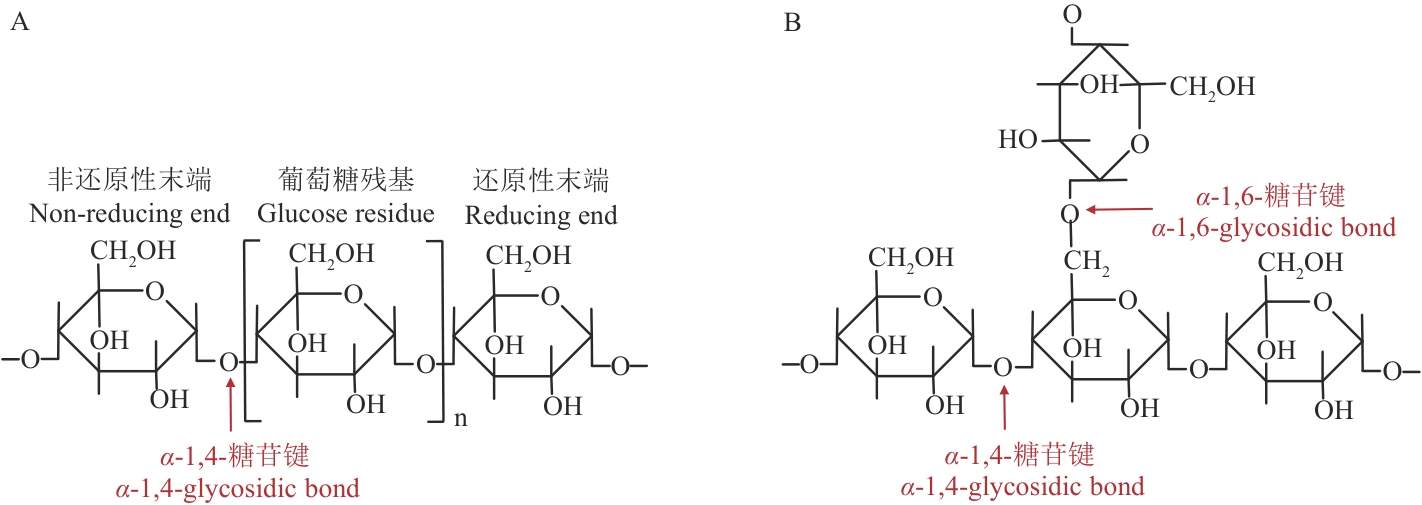
图1 直链淀粉和支链淀粉的分子结构A:直链淀粉;B:支链淀粉
Fig. 1 Molecular structure of amylose and amylopectinA: Amylose. B: Amylopectin

图2 储藏直链淀粉合成途径GBSS:颗粒结合型淀粉合成酶;SSS:可溶性淀粉合成酶;SBE:淀粉分支酶;DBE:淀粉脱分支酶
Fig. 2 Synthetic pathway of storage amyloseGBSS: Granule-bound starch synthase. SSS: Soluble starch synthase. SBE: Starch branching enzyme. DBE: Starch debranching enzyme. AGPase: ADP-glucose pyrophosphorylase
植物生长调节剂 Plant growth regulator | 植物品种 Plant variety | 途径 Pathway | 直链淀粉含量 Amylose content | 来源文献 Source reference |
|---|---|---|---|---|
6-苄氨基腺嘌呤、 水杨酸 6-BA、SA | 小麦 Wheat | 提高AGPase、GBSS、SSS、SBE活性 Increase AGPase, GBSS, SSS, SBE activity | 升高 Increase | [ |
脱落酸 ABA | 水稻 Rice | 提高UGPase、AGPase活性 Increase UGPase, AGPase activity | 升高 Increase | [ |
生长素 IAA | 高粱 Sorghum | 提高SUS、SPS活性 Increase SUS, SPS activity | 升高 Increase | [ |
脱落酸 ABA | 高粱 Sorghum | 降低SUS的活性 Decrease the activity of SUS | 降低 Decrease | [ |
亚精胺和精胺 SPD、SPE | 水稻 Rice | 增强亚精胺合酶和精胺合酶基因表达 Upregulation of spermine synthase and spermine synthase gene expression | 升高 Increase | [ |
脱落酸 ABA | 水稻 Rice | NF-YB1-SLRL2-bHLH144分子模块 NF-YB1-SLRL2-bHLH144 molecular module | 升高 Increase | [ |
6-苄氨基腺嘌呤 6-BA | 小麦 Wheat | 提高光合性能 Increase photosynthetic performance | 升高 Increase | [ |
茉莉酸甲酯 MeJA | 水稻 Rice | 浓度增加 Increase in concentration | 降低 Decrease | [ |
表1 不同植物生长调节剂对植物直链淀粉含量影响
Table 1 Effects of different plant growth regulators on amylose content in plants
植物生长调节剂 Plant growth regulator | 植物品种 Plant variety | 途径 Pathway | 直链淀粉含量 Amylose content | 来源文献 Source reference |
|---|---|---|---|---|
6-苄氨基腺嘌呤、 水杨酸 6-BA、SA | 小麦 Wheat | 提高AGPase、GBSS、SSS、SBE活性 Increase AGPase, GBSS, SSS, SBE activity | 升高 Increase | [ |
脱落酸 ABA | 水稻 Rice | 提高UGPase、AGPase活性 Increase UGPase, AGPase activity | 升高 Increase | [ |
生长素 IAA | 高粱 Sorghum | 提高SUS、SPS活性 Increase SUS, SPS activity | 升高 Increase | [ |
脱落酸 ABA | 高粱 Sorghum | 降低SUS的活性 Decrease the activity of SUS | 降低 Decrease | [ |
亚精胺和精胺 SPD、SPE | 水稻 Rice | 增强亚精胺合酶和精胺合酶基因表达 Upregulation of spermine synthase and spermine synthase gene expression | 升高 Increase | [ |
脱落酸 ABA | 水稻 Rice | NF-YB1-SLRL2-bHLH144分子模块 NF-YB1-SLRL2-bHLH144 molecular module | 升高 Increase | [ |
6-苄氨基腺嘌呤 6-BA | 小麦 Wheat | 提高光合性能 Increase photosynthetic performance | 升高 Increase | [ |
茉莉酸甲酯 MeJA | 水稻 Rice | 浓度增加 Increase in concentration | 降低 Decrease | [ |
影响因素 Factor | 调控条件 Regulatory condition | 直链淀粉含量 Amylose content | 来源文献 Source reference |
|---|---|---|---|
水分 Moisture | 轻度水分胁迫 Mild water stress | 升高 Increase | [ |
施氮肥和栽培密度 Nitrogen application and planting density | 增加 Increase | 降低 Decrease | [ |
光照强度 Illumination intensity | 减弱 Decrease | 降低 Decrease | [ |
播种期 Seeding time | 推迟 Postpone | 升高 Increase | [ |
物理方法 Physical method | 机械活化作用 Mechanical activation | 升高 Increase | [ |
化学方法 Chemical method | 酸解-湿热复合处理 Acid hydrolysis-wet heat combined treatment | 升高 Increase | [ |
表2 其他因素对水稻直链淀粉含量的影响
Table 2 Effects of other factors on amylose content in rice
影响因素 Factor | 调控条件 Regulatory condition | 直链淀粉含量 Amylose content | 来源文献 Source reference |
|---|---|---|---|
水分 Moisture | 轻度水分胁迫 Mild water stress | 升高 Increase | [ |
施氮肥和栽培密度 Nitrogen application and planting density | 增加 Increase | 降低 Decrease | [ |
光照强度 Illumination intensity | 减弱 Decrease | 降低 Decrease | [ |
播种期 Seeding time | 推迟 Postpone | 升高 Increase | [ |
物理方法 Physical method | 机械活化作用 Mechanical activation | 升高 Increase | [ |
化学方法 Chemical method | 酸解-湿热复合处理 Acid hydrolysis-wet heat combined treatment | 升高 Increase | [ |
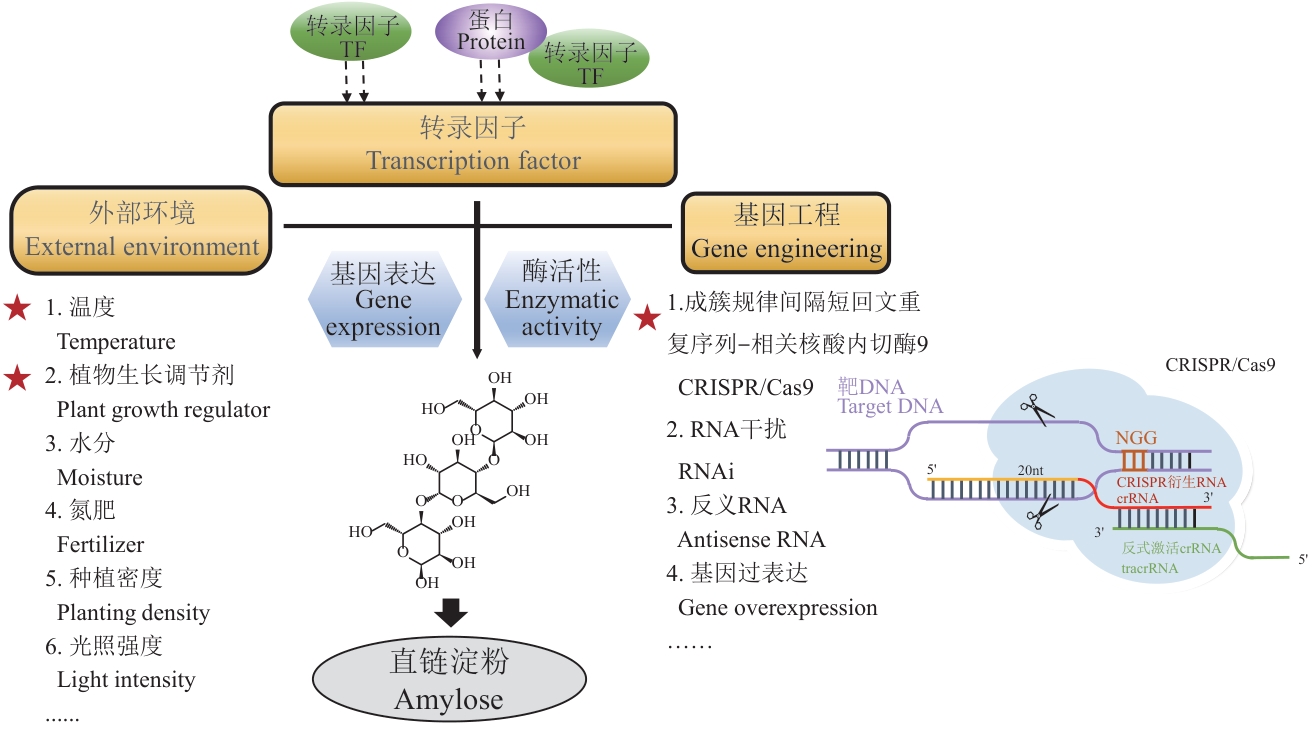
图3 影响直链淀粉合成的因素
Fig. 3 Factors affecting amylose synthesis
| [1] | Zhu JH, Yu WW, Zhang CQ, et al. New insights into amylose and amylopectin biosynthesis in rice endosperm [J]. Carbohydr Polym, 2020, 230: 115656. |
| [2] | Birt DF, Boylston T, Hendrich S, et al. Resistant starch: promise for improving human health [J]. Adv Nutr, 2013, 4(6): 587-601. |
| [3] | Li XQ, Chen RX, Wen JH, et al. The mechanisms in the gut microbiota regulation and type 2 diabetes therapeutic activity of resistant starches [J]. Int J Biol Macromol, 2024, 274: 133279. |
| [4] | Bojarczuk A, Skąpska S, Mousavi Khaneghah A, et al. Health benefits of resistant starch: a review of the literature [J]. J Funct Foods, 2022, 93: 105094. |
| [5] | Liu JM, Lu W, Liang YT, et al. Research progress on hypoglycemic mechanisms of resistant starch: a review [J]. Molecules, 2022, 27(20): 7111. |
| [6] | Martinez TM, Meyer RK, Duca FA. Therapeutic potential of various plant-based fibers to improve energy homeostasis via the gut microbiota [J]. Nutrients, 2021, 13(10): 3470. |
| [7] | Lal MK, Singh B, Sharma S, et al. Glycemic index of starchy crops and factors affecting its digestibility: a review [J]. Trends Food Sci Technol, 2021, 111: 741-755. |
| [8] | Obadi M, Qi YJ, Xu B. High-amylose maize starch: structure, properties, modifications and industrial applications [J]. Carbohydr Polym, 2023, 299: 120185. |
| [9] | Li CL, Dhital S, Gidley MJ. High amylose wheat foods: a new opportunity to improve human health [J]. Trends Food Sci Technol, 2023, 135: 93-101. |
| [10] | Arp CG, Correa MJ, Ferrero C. High-amylose resistant starch as a functional ingredient in breads: a technological and microstructural approach [J]. Food Bioprocess Technol, 2018, 11(12): 2182-2193. |
| [11] | Zhong YY, Qu JZ, Liu XX, et al. Different genetic strategies to generate high amylose starch mutants by engineering the starch biosynthetic pathways [J]. Carbohydr Polym, 2022, 287: 119327. |
| [12] | Skryhan K, Gurrieri L, Sparla F, et al. Redox regulation of starch metabolism [J]. Front Plant Sci, 2018, 9: 1344. |
| [13] | Martin C, Smith AM. Starch biosynthesis [J]. Plant Cell, 1995, 7(7): 971. |
| [14] | Stein O, Granot D. An overview of sucrose synthases in plants [J]. Front Plant Sci, 2019, 10: 95. |
| [15] | Zhong YY, Liu LS, Qu JZ, et al. The relationship between the expression pattern of starch biosynthesis enzymes and molecular structure of high amylose maize starch [J]. Carbohydr Polym, 2020, 247: 116681. |
| [16] | Figueroa CM, Asencion Diez MD, Ballicora MA, et al. Structure, function, and evolution of plant ADP-glucose pyrophosphorylase [J]. Plant Mol Biol, 2022, 108(4/5): 307-323. |
| [17] | Zhao H, Li Z, Amjad H, et al. Proteomic analysis reveals a role of ADP-glucose pyrophosphorylase in the asynchronous filling of rice superior and inferior spikelets [J]. Protein Expr Purif, 2021, 183: 105875. |
| [18] | Baroja-Fernández E, Muñoz FJ, Bahaji A, et al. Reply to Smithet al. No evidence to challenge the current paradigm on starch and cellulose biosynthesis involving sucrose synthase activity [J]. Proc Natl Acad Sci U S A, 2012, 109(14): e777. |
| [19] | Wang K, Hasjim J, Wu AC, et al. Roles of GBSSI and SSIIa in determining amylose fine structure [J]. Carbohydr Polym, 2015, 127: 264-274. |
| [20] | Denyer KAY, Johnson P, Zeeman S, et al. The control of amylose synthesis [J]. J Plant Physiol, 2001, 158(4): 479-487. |
| [21] | Zeeman SC, Kossmann J, Smith AM. Starch: its metabolism, evolution, and biotechnological modification in plants [J]. Annu Rev Plant Biol, 2010, 61: 209-234. |
| [22] | Satoh H, Nishi A, Yamashita K, et al. Starch-branching enzyme I-deficient mutation specifically affects the structure and properties of starch in rice endosperm [J]. Plant Physiol, 2003, 133(3): 1111-1121. |
| [23] | Nakamura Y, Kubo A, Shimamune T, et al. Correlation between activities of starch debranching enzyme and α-polyglucan structure in endosperms of sugary-1 mutants of rice [J]. Plant J, 1997, 12(1): 143-153. |
| [24] | Smith SM, Fulton DC, Chia T, et al. Diurnal changes in the transcriptome encoding enzymes of starch metabolism provide evidence for both transcriptional and posttranscriptional regulation of starch metabolism in Arabidopsis leaves [J]. Plant Physiol, 2004, 136(1): 2687-2699. |
| [25] | Geigenberger P. Response of plant metabolism to too little oxygen [J]. Curr Opin Plant Biol, 2003, 6(3): 247-256. |
| [26] | Mangelsen E, Wanke D, Kilian J, et al. Significance of light, sugar, and amino acid supply for diurnal gene regulation in developing barley caryopses [J]. Plant Physiol, 2010, 153(1): 14-33. |
| [27] | Hu YF, Li YP, Weng JF, et al. Coordinated regulation of starch synthesis in maize endosperm by microRNAs and DNA methylation [J]. Plant J, 2021, 105(1): 108-123. |
| [28] | Wang JC, Xu H, Zhu Y, et al. OsbZIP58, a basic leucine zipper transcription factor, regulates starch biosynthesis in rice endosperm [J]. J Exp Bot, 2013, 64(11): 3453-3466. |
| [29] | Jin SK, Xu LN, Leng YJ, et al. The OsNAC24-OsNAP protein complex activates and expression to fine-tune starch biosynthesis in rice endosperm [J]. Plant Biotechnol J, 2023, 21(11): 2224-2240. |
| [30] | Jiang TL, Xia M, Huang HH, et al. Identification of transcription factor ZmZAT8 involved in abscisic acid regulation pathway of starch synthesis in maize endosperm [J]. Pak J Bot, 2019, 51(6). DOI: http://dx.doi.org/10.30848/PJB2019-6(26 ). |
| [31] | Qi X, Li SX, Zhu YX, et al. ZmDof3, a maize endosperm-specific Dof protein gene, regulates starch accumulation and aleurone development in maize endosperm [J]. Plant Mol Biol, 2017, 93(1/2): 7-20. |
| [32] | Liu ZM, Jiang S, Jiang LL, et al. Transcription factor OsSGL is a regulator of starch synthesis and grain quality in rice [J]. J Exp Bot, 2022, 73(11): 3417-3430. |
| [33] | Zhu Y, Cai XL, Wang ZY, et al. An interaction between a MYC protein and an EREBP protein is involved in transcriptional regulation of the rice Wx gene [J]. J Biol Chem, 2003, 278(48): 47803-47811. |
| [34] | Dong Q, Xu QQ, Kong JJ, et al. Overexpression of ZmbZIP22 gene alters endosperm starch content and composition in maize and rice [J]. Plant Sci, 2019, 283: 407-415. |
| [35] | Li CB, Yue YH, Chen HJ, et al. The ZmbZIP22 transcription factor regulates 27-kD γ-zein gene transcription during maize endosperm development [J]. Plant Cell, 2018, 30(10): 2402-2424. |
| [36] | Fukayama H, Miyagawa F, Shibatani N, et al. CO-responsive CCT protein interacts with 14-3-3 proteins and controls the expression of starch synthesis-related genes [J]. Plant Cell Environ, 2021, 44(8): 2480-2493. |
| [37] | Kim ST, Kang SY, Wang YM, et al. Analysis of embryonic proteome modulation by GA and ABA from germinating rice seeds [J]. Proteomics, 2008, 8(17): 3577-3587. |
| [38] | Kumar P, Parveen A, Sharma H, et al. Understanding the regulatory relationship of abscisic acid and bZIP transcription factors towards amylose biosynthesis in wheat [J]. Mol Biol Rep, 2021, 48(3): 2473-2483. |
| [39] | Wang JD, Wang J, Huang LC, et al. ABA-mediated regulation of rice grain quality and seed dormancy via the NF-YB1-SLRL2-bHLH144 Module [J]. Nat Commun, 2024, 15(1): 4493. |
| [40] | 刘海英. 水稻转录因子OsRSR1遗传变异及调控机理研究 [D]. 哈尔滨: 东北农业大学, 2017. |
| Liu HY. Studies on the genetic variability and regulation mechanism of transcription factor RSR1 in rice [D]. Harbin: Northeast Agricultural University, 2017. | |
| [41] | Ahmar S, Hensel G, Gruszka D. CRISPR/Cas9-mediated genome editing techniques and new breeding strategies in cereals-current status, improvements, and perspectives [J]. Biotechnol Adv, 2023, 69: 108248. |
| [42] | Murugavelu GS, Harish Chandar SR, Sakthivel SK, et al. Progress and updates of CRISPR/Cas9-mediated genome editing on abiotic stress tolerance in agriculture: a review [J]. Sugar Tech, 2025, 27(1): 29-43. |
| [43] | Elsharawy H, Refat M. CRISPR/Cas9 genome editing in wheat: enhancing quality and productivity for global food security-a review [J]. Funct Integr Genomics, 2023, 23(3): 265. |
| [44] | Guo DS, Ling XT, Zhou XG, et al. Evaluation of the quality of a high-resistant starch and low-glutelin rice (Oryza sativa L.) generated through CRISPR/Cas9-mediated targeted mutagenesis [J]. J Agric Food Chem, 2020, 68(36): 9733-9742. |
| [45] | 王延鹏, 程曦, 高彩霞, 等. 利用基因组编辑技术创制抗白粉病小麦 [J]. 遗传, 2014, 36(8): 848. |
| Wang YP, Cheng X, Gao CX, et al. Creating powdery mildew-resistant wheat by genome editing technology [J]. Hereditas, 2014, 36(8): 848. | |
| [46] | 李晶莹. CRISPR/Cas9介导的水稻基因编辑技术体系构建与高抗性淀粉小麦新种质创制 [D]. 北京: 中国农业科学院, 2021. |
| Li JY. Development of different toolkits for CRISPR/Cas9-mediated rice genome editing and creation of novel wheat germplasm high in resistant starch [D]. Beijing: Chinese Academy of Agricultural Sciences, 2021. | |
| [47] | Xu Y, Lin QP, Li XF, et al. Fine-tuning the amylose content of rice by precise base editing of the Wx gene [J]. Plant Biotechnol J, 2021, 19(1): 11-13. |
| [48] | Wang ZY, Zheng FQ, Shen GZ, et al. The amylose content in rice endosperm is related to the post-transcriptional regulation of the waxy gene [J]. Plant J, 1995, 7(4): 613-622. |
| [49] | Luo S, Ma QX, Zhong YY, et al. Editing of the starch branching enzyme gene SBE2 generates high-amylose storage roots in cassava [J]. Plant Mol Biol, 2022, 108(4/5): 429-442. |
| [50] | Blennow A, Skryhan K, Tanackovic V, et al. Non-GMO potato lines, synthesizing increased amylose and resistant starch, are mainly deficient in isoamylase debranching enzyme [J]. Plant Biotechnol J, 2020, 18(10): 2096-2108. |
| [51] | Li JY, Manghwar H, Sun L, et al. Whole genome sequencing reveals rare off-target mutations and considerable inherent genetic or/and somaclonal variations in CRISPR/Cas9-edited cotton plants [J]. Plant Biotechnol J, 2019, 17(5): 858-868. |
| [52] | Baysal C, He WS, Drapal M, et al. Inactivation of rice starch branching enzyme IIb triggers broad and unexpected changes in metabolism by transcriptional reprogramming [J]. Proc Natl Acad Sci USA, 2020, 117(42): 26503-26512. |
| [53] | Fujita N, Satoh R, Hayashi A, et al. Starch biosynthesis in rice endosperm requires the presence of either starch synthase I or IIIa [J]. J Exp Bot, 2011, 62(14): 4819-4831. |
| [54] | Miura S, Crofts N, Saito Y, et al. Starch synthase IIa-deficient mutant rice line produces endosperm starch with lower gelatinization temperature than Japonica rice cultivars [J]. Front Plant Sci, 2018, 9: 645. |
| [55] | Li JY, Jiao GA, Sun YW, et al. Modification of starch composition, structure and properties through editing of TaSBEIIa in both winter and spring wheat varieties by CRISPR/Cas9 [J]. Plant Biotechnol J, 2021, 19(5): 937-951. |
| [56] | Yang Q, Ding JJ, Feng XQ, et al. Editing of the starch synthase IIa gene led to transcriptomic and metabolomic changes and high amylose starch in barley [J]. Carbohydr Polym, 2022, 285: 119238. |
| [57] | Wang HX, Wu YL, Zhang YD, et al. CRISPR/Cas9-based mutagenesis of starch biosynthetic genes in sweet potato (Ipomoea batatas) for the improvement of starch quality [J]. Int J Mol Sci, 2019, 20(19): 4702. |
| [58] | Andersson M, Melander M, Pojmark P, et al. Targeted gene suppression by RNA interference: an efficient method for production of high-amylose potato lines [J]. J Biotechnol, 2006, 123(2): 137-148. |
| [59] | Zhou WZ, Zhao SS, He ST, et al. Production of very-high-amylose cassava by post-transcriptional silencing of branching enzyme genes [J]. J Integr Plant Biol, 2020, 62(6): 832-846. |
| [60] | Zhou HJ, Wang LJ, Liu GF, et al. Critical roles of soluble starch synthase SSIIIa and granule-bound starch synthase Waxy in synthesizing resistant starch in rice [J]. Proc Natl Acad Sci USA, 2016, 113(45): 12844-12849. |
| [61] | Gurunathan S, Ramadoss BR, Mudili V, et al. Single nucleotide polymorphisms in starch biosynthetic genes associated with increased resistant starch concentration in rice mutant [J]. Front Genet, 2019, 10: 946. |
| [62] | Xiao QL, Wang YY, Du J, et al. ZmMYB14 is an important transcription factor involved in the regulation of the activity of the Zm1 promoter in starch biosynthesis in maize [J]. FEBS J, 2017, 284(18): 3079-3099. |
| [63] | Yu SW, Liao FX, Wang FM, et al. Identification of rice transcription factors associated with drought tolerance using the Ecotilling method [J]. PLoS One, 2012, 7(2): e30765. |
| [64] | Till BJ, Reynolds SH, Weil C, et al. Discovery of induced point mutations in maize genes by TILLING [J]. BMC Plant Biol, 2004, 4: 12. |
| [65] | Szurman-Zubrzycka ME, Zbieszczyk J, Marzec M, et al. Hor tillus-a rich and renewable source of induced mutations for forward/reverse genetics and pre-breeding programs in barley (Hordeum vulgare L.) [J]. Front Plant Sci, 2018, 9: 216. |
| [66] | Slade AJ, McGuire C, Loeffler D, et al. Development of high amylose wheat through TILLING [J]. BMC Plant Biol, 2012, 12: 69. |
| [67] | Asaoka M, Okuno K, Fuwa H. Effect of environmental temperature at the milky stage on amylose content and fine structure of amylopectin of waxy and nonwaxy endosperm starches of rice (Oryza sativa L.) [J]. Agric Biol Chem, 1985, 49(2): 373-379. |
| [68] | Counce PA, Bryant RJ, Bergman CJ, et al. Rice milling quality, grain dimensions, and starch branching as affected by high night temperatures [J]. Cereal Chem, 2005, 82(6): 645-648. |
| [69] | Ahmed N, Maekawa M, Tetlow IJ. Effects of low temperature on grain filling, amylose content, and activity of starch biosynthesis enzymes in endosperm of basmati rice [J]. Aust J Agric Res, 2008, 59(7): 599. |
| [70] | Zhang H, Duan L, Dai JS, et al. Major QTLs reduce the deleterious effects of high temperature on rice amylose content by increasing splicing efficiency of Wx pre-mRNA [J]. Theor Appl Genet, 2014, 127(2): 273-282. |
| [71] | Ahmed N, Tetlow IJ, Nawaz S, et al. Effect of high temperature on grain filling period, yield, amylose content and activity of starch biosynthesis enzymes in endosperm of basmati rice [J]. J Sci Food Agric, 2015, 95(11): 2237-2243. |
| [72] | 蔡水文, 陈良碧. 温度对不同类型早籼稻灌浆期间直链淀粉、蛋白质积累的影响 [J]. 生命科学研究, 2004, 8(2): 145-149. |
| Cai SW, Chen LB. Effect of temperature on the amylose and the protein accumulation in different early indica rice during grain filling stage [J]. Life Sci Res, 2004, 8(2): 145-149. | |
| [73] | Umemoto T, Terashima K. Research note: Activity of granule-bound starch synthase is an important determinant of amylose content in rice endosperm [J]. Funct Plant Biol, 2002, 29(9): 1121-1124. |
| [74] | 胡丽琴, 肖正午, 方升亮, 等. 种植季节对高直链淀粉水稻品种淀粉消化特性的影响 [J]. 作物学报, 2024, 50(9): 2347-2357. |
| Hu LQ, Xiao ZW, Fang SL, et al. Effects of planting season on digestive characteristics of high amylose content rice [J]. Acta Agron Sin, 2024, 50(9): 2347-2357. | |
| [75] | Zhang WJ, Zhao Y, Li LY, et al. The effects of short-term exposure to low temperatures during the booting stage on starch synthesis and yields in wheat grain [J]. Front Plant Sci, 2021, 12: 684784. |
| [76] | 贾志宽, 朱碧岩. 灌浆期气温的分布对稻米直链淀粉累积效应的初步研究 [J]. 云南农业大学学报, 1991, 6(2): 65-69. |
| Jia ZK, Zhu BY. Preliminary study on the accumulation effect of amylose affected by the air temperature at the filling stage of rice [J]. J Yunnan Agric Univ, 1991, 6(2): 65-69. | |
| [77] | 王贝贝, 徐旭, 赵艳, 等. 植物生长调节剂对花后渍水遮阴小麦籽粒淀粉合成和干物质积累的影响 [J]. 江苏农业学报, 2022, 38(1): 9-19. |
| Wang BB, Xu X, Zhao Y, et al. Effects of plant growth hormone on starch synthesis and dry matter accumulation of wheat grain under waterlogging and shading after anthesis [J]. Jiangsu J Agric Sci, 2022, 38(1): 9-19. | |
| [78] | Amanda D, Frey FP, Neumann U, et al. Auxin boosts energy generation pathways to fuel pollen maturation in barley [J]. Curr Biol, 2022, 32(8): 1798-1811.e8. |
| [79] | Zhang ZX, Chen J, Lin SS, et al. Proteomic and phosphoproteomic determination of ABA’s effects on grain-filling of Oryza sativa L. inferior spikelets [J]. Plant Sci, 2012, 185: 259-273. |
| [80] | Bhatia S, Singh R. Phytohormone-mediated transformation of sugars to starch in relation to the activities of amylases, sucrose-metabolising enzymes in sorghum grain [J]. Plant Growth Regul, 2002, 36(2): 97-104. |
| [81] | 杨宇尘, 杜志敏, 张小鹏, 等. 抽穗开花期喷施MeJA对粳稻产量和品质的影响 [J]. 作物杂志, 2021(2): 71-76. |
| Yang YC, Du ZM, Zhang XP, et al. Effects of spraying methyl jasmonate on yield and grain quality of Japonica rice during heading and flowering stage [J]. Crops, 2021(2): 71-76. | |
| [82] | Zhu GH, Ye NH, Yang JC, et al. Regulation of expression of starch synthesis genes by ethylene and ABA in relation to the development of rice inferior and superior spikelets [J]. J Exp Bot, 2011, 62(11): 3907-3916. |
| [83] | Fu YY, Gu QQ, Dong Q, et al. Spermidine enhances heat tolerance of rice seeds by modulating endogenous starch and polyamine metabolism [J]. Molecules, 2019, 24(7): 1395. |
| [84] | 于涛, 辛雨宁, 王军. 外源脱落酸对花后早期高温胁迫下玉米籽粒灌浆特性、淀粉积累及内源激素的影响 [J]. 应用生态学报, 2024, 35(10): 2715-2724. |
| Yu T, Xin YN, Wang J. Effects of exogenous abscisic acid on grain filling characteristics, starch accumulation, and endogenous hormones in maize under early post-anthesis high temperature stress [J]. Chin J Appl Ecol, 2024, 35(10): 2715-2724. | |
| [85] | Zhang WJ, Wang BB, Zhang AM, et al. Exogenous 6-benzylaminopurine enhances waterlogging and shading tolerance after anthesis by improving grain starch accumulation and grain filling [J]. Front Plant Sci, 2022, 13: 1003920. |
| [86] | 于安玲. 芸薹素(BR)和赤霉素(GA)对小麦籽粒淀粉积累、粒度分布及加工特性的影响 [D]. 泰安: 山东农业大学, 2011. |
| Yu AL. Effects of BR and GA on wheat grain starch granule distribution, accumulation and processing quality [D]. Tai’an: Shandong Agricultural University, 2011. | |
| [87] | 苏正川, 卿尚飞, 江默. 提高水稻谷粒直链淀粉含量的复配制剂及其施用方法: CN115777712B [P]. 2024-02-13. |
| Su Zhengchuan, Shangfei Qing, Jiang Mo. Compound preparation for increasing amylose content of rice grains and application method of compound preparation: CN115777712B [P]. 2024-02-13. | |
| [88] | Chen GY, Peng LG, Gong J, et al. Effects of water stress on starch synthesis and accumulation of two rice cultivars at different growth stages [J]. Front Plant Sci, 2023, 14: 1133524. |
| [89] | Gu JF, Chen Y, Zhang H, et al. Canopy light and nitrogen distributions are related to grain yield and nitrogen use efficiency in rice [J]. Field Crops Res, 2017, 206: 74-85. |
| [90] | Ren Y, Xu ED, Zhang PJ, et al. Impact of key agronomic traits on economic yield traits in Anhui rice (Oryza sativa L. spp. Japonica) [J]. Agronomy, 2024, 14(6): 1101. |
| [91] | Chen H, Yang GT, Xiao Y, et al. Effects of nitrogen and phosphorus fertilizer on the eating quality of indica rice with different amylose content [J]. J Food Compos Anal, 2023, 118: 105167. |
| [92] | Dong MH, Hui F, Gu JR, et al. Effect of light intensity on grain quality of rice at different spike positions during grain-filling stage [J]. Acta Autom Sin, 2013, 21(2): 164. |
| [93] | Huang M, Cao JL, Zhang RC, et al. Delayed sowing does not improve palatability-related traits in high-quality rice [J]. Food Chem Adv, 2022, 1: 100096. |
| [94] | 黄祖强, 陈渊, 梁兴唐, 等. 机械活化对木薯淀粉的直链淀粉含量及抗性淀粉形成的影响 [J]. 高校化学工程学报, 2007, 21(3): 471-476. |
| Huang ZQ, Chen Y, Liang XT, et al. Effects of mechanical activation on amylose content and resistant starch formation of cassava starch [J]. J Chem Eng Chin Univ, 2007, 21(3): 471-476. | |
| [95] | Surojanametakul V, Satmalee P, Thirathumthavorn D, et al. Combined-acid hydrolysis and heat-moisture treatment of rice flour: physicochemical properties and resistant starch [J]. J Food Meas Charact, 2023, 17(2): 1862-1876. |
| [96] | Botticella E, Testone G, Buffagni V, et al. Mutations in starch biosynthesis genes affect chloroplast development in wheat pericarp [J]. Plant Physiol Biochem, 2024, 207: 108354. |
| [1] | 邹涛圳, 李鹏飞, 李新冬, 万欢, 张燚. 微藻油脂合成及高脂藻株培育研究进展[J]. 生物技术通报, 2025, 41(1): 25-38. |
| [2] | 李亮, 徐姗姗, 姜艳军. 生物合成法生产麦角硫因的研究进展[J]. 生物技术通报, 2024, 40(1): 86-99. |
| [3] | 叶云芳, 田清尹, 施婷婷, 王亮, 岳远征, 杨秀莲, 王良桂. 植物中β-紫罗兰酮生物合成及调控研究进展[J]. 生物技术通报, 2023, 39(8): 91-105. |
| [4] | 马芳芳, 刘冠闻, 庞冰, 蒋春美, 师俊玲. 强化细胞外排提高工程菌类黄酮产量的策略[J]. 生物技术通报, 2023, 39(5): 63-76. |
| [5] | 王祥锟, 宋学宏, 刘金龙, 郭培红, 庄晓峰, 韦良孟, 周凡, 张树宇, 高攀攀, 魏凯. 新型冠状病毒亚单位疫苗研制及其高效免疫增强剂的筛选[J]. 生物技术通报, 2023, 39(1): 305-314. |
| [6] | 徐重新, 张霄, 刘媛, 仲建锋, 谢雅晶, 卢莉娜, 高美静, 刘贤金. 靶向模拟Bt Cry1C蛋白抗虫功能的人源化基因工程抗体筛选及鉴定[J]. 生物技术通报, 2022, 38(5): 191-200. |
| [7] | 徐妙云, 邢利娟, 杨明雨, 张凌萱, 王磊, 刘悦萍. 高直链淀粉禾谷类作物种质创新与利用研究进展[J]. 生物技术通报, 2022, 38(4): 20-28. |
| [8] | 马艳琴, 邱益彬, 李莎, 徐虹. 透明质酸的生物合成及其代谢工程的研究进展[J]. 生物技术通报, 2022, 38(2): 252-262. |
| [9] | 田清尹, 岳远征, 申慧敏, 潘多, 杨秀莲, 王良桂. 植物观赏器官中类胡萝卜素代谢调控的研究进展[J]. 生物技术通报, 2022, 38(12): 35-46. |
| [10] | 袁恺, 何伟, 杨云丽, 朱威宇, 彭超, 安泰, 李丽, 周卫强. 灵芝酸生物合成及代谢调控研究进展[J]. 生物技术通报, 2021, 37(8): 46-54. |
| [11] | 郭振强, 张勇, 曹运齐, 刘云云, 赵于, 吴蔼民. 燃料乙醇发酵技术研究进展[J]. 生物技术通报, 2020, 36(1): 238-244. |
| [12] | 何虎翼, 唐洲萍, 杨鑫, 樊吴静, 谭冠宁, 李丽淑, 何新民. 马铃薯淀粉合成与降解研究进展[J]. 生物技术通报, 2019, 35(4): 101-107. |
| [13] | 张智敏, 庄淼, 金锋杰. 米曲霉基因工程技术的进展[J]. 生物技术通报, 2018, 34(9): 170-176. |
| [14] | 高越, 郭晓鹏, 杨阳, 张苗苗, 李文建, 陆栋. 生物丁醇发酵研究进展[J]. 生物技术通报, 2018, 34(8): 27-34. |
| [15] | 汤波,孙照霖,戴蕴平. 牛的基因编辑技术研究进展[J]. 生物技术通报, 2018, 34(5): 41-47. |
| 阅读次数 | ||||||
|
全文 |
|
|||||
|
摘要 |
|
|||||
