







生物技术通报 ›› 2026, Vol. 42 ›› Issue (1): 262-270.doi: 10.13560/j.cnki.biotech.bull.1985.2025-0741
马如清1,2( ), 冯雪琪1,2, 杨清岚1,2, 汪军成1,2, 孟亚雄1,2, 马小乐1,2, 李葆春1,3, 姚立蓉1,2, 王化俊1,2, 司二静1,2()
收稿日期:2025-07-10
出版日期:2026-01-26
发布日期:2026-02-04
通讯作者:
司二静,副教授,研究方向 :作物遗传育种;E-mail: siej@gsau.edu.cn作者简介:马如清,硕士研究生,研究方向 :作物遗传育种;E-mail: 2454840317@qq.com
基金资助:
MA Ru-qing1,2(), FENG Xue-qi1,2, YANG Qing-lan1,2, WANG Jun-cheng1,2, MENG Ya-xiong1,2, MA Xiao-le1,2, LI Bao-chun1,3, YAO Li-rong1,2, WANG Hua-jun1,2, SI Er-jing1,2()
Received:2025-07-10
Published:2026-01-26
Online:2026-02-04
摘要:
目的 探究Pg03852基因在大麦条纹病菌中的功能,为研究该病原菌与宿主的互作机制奠定基础。 方法 基于转录组数据筛选到大麦条纹病菌侵染寄主过程中高表达基因Pg03852,通过生物信息学分析、信号肽活性检测、诱导/抑制免疫反应及RNA干扰突变体制备及致病性分析等技术研究该基因的功能。 结果 生物信息学分析表明,Pg03852基因编码276个氨基酸,二级结构以无规则卷曲为主,占比为73.19%。Pg03852为不稳定的亲水性蛋白,无跨膜区域且无保守结构域,但具有信号肽且定位在细胞外。信号肽活性检测显示,Pg03852的信号肽转化子能够在CMD-W和YPRAA上正常生长,TTC显色进一步表明该蛋白的信号肽具有分泌功能。诱导和抑制免疫反应结果显示,Pg03852不能诱导细胞坏死,但是可抑制BAX诱导的植物组织坏死。基于PEG介导的原生质体转化法获得2个RNA干扰突变体Pg03852-RNAi-1和Pg03852-RNAi-2,RT-qPCR结果显示,相较于野生型菌株QWC,Pg03852-RNAi-1和Pg03852-RNAi-2的表达量分别下降了58.76%和48.24%,而发病率较QWC分别降低了34.67%和38.00%,且菌落生长速度均显著低于野生株QWC(P<0.05)。组织学观察发现,RNA干扰突变体的菌丝更为密集、卷曲且形态纤细。台盼蓝染色与DAB染色结果发现,干扰突变体侵染所引起的细胞死亡程度与活性氧积累水平均弱于QWC。 结论 Pg03852参与大麦条纹病菌的生长发育,并在调控大麦条纹病的致病性中起关键作用。
马如清, 冯雪琪, 杨清岚, 汪军成, 孟亚雄, 马小乐, 李葆春, 姚立蓉, 王化俊, 司二静. 大麦条纹病菌Pg03852基因功能研究[J]. 生物技术通报, 2026, 42(1): 262-270.
MA Ru-qing, FENG Xue-qi, YANG Qing-lan, WANG Jun-cheng, MENG Ya-xiong, MA Xiao-le, LI Bao-chun, YAO Li-rong, WANG Hua-jun, SI Er-jing. Functional Analysis of Pg03852 Gene in Pyrenophora graminea[J]. Biotechnology Bulletin, 2026, 42(1): 262-270.
| 引物 Primer | 序列 Sequence(5'-3') | 用途 Purpose |
|---|---|---|
| Pg03852-pSuC2-F | AATTCATGAAGGTCTCACAGTTTCTCACCTGCCTCATTGCCGCGCAAGCAATCACCGCCC | 构建酵母表达载体 |
| Pg03852-pSuC2-R | TCGAGGGCGGTGATTGCTTGCGCGGCAATGAGGCAGGTGAGAAACTGTGAGACCTTCATG | |
| Pg03852-Cal I-F | CCCATCGATATGAAGGTCTCACAGTTTCT | 干扰片段克隆 |
| Pg03852-Sma I-R | TCCCCCGGGCATGAACACACCAGCAAGAA | |
| Pg03852-Kpn I-F | GGGGTACCTCCTCTCATCGGACAACACA | |
| Pg03852-Bgl II-R | GAAGATCTGTTCTCGTCACAGCCACAGA | |
| Pg03852-Xho I-F | CCGCTCGAGTCCTCTCATCGGACAACACA | |
| Pg03852-Hind III-R | CCCAAGCTTGTTCTCGTCACAGCCACAGA | |
| HygB-F | ATGAAAAAGCCTGAACTCAC | 潮霉素鉴定 |
| HygB-R | CTATTCCTTTGCCCTCGGA | |
| Pg03852-qPCR-F | AGCAACACCATACAGAGCCG | 实时荧光定量PCR |
| Pg03852-qPCR-R | GAAGCGGTAGGGGTTGTTGT | |
| PgActin-F | TGTTGACATGGCTGGTCGTGATC | 内参基因 |
| PgActin-R | TCGGCGGTGGTGGAGAAGG |
表1 引物列表
Table 1 Primer list
| 引物 Primer | 序列 Sequence(5'-3') | 用途 Purpose |
|---|---|---|
| Pg03852-pSuC2-F | AATTCATGAAGGTCTCACAGTTTCTCACCTGCCTCATTGCCGCGCAAGCAATCACCGCCC | 构建酵母表达载体 |
| Pg03852-pSuC2-R | TCGAGGGCGGTGATTGCTTGCGCGGCAATGAGGCAGGTGAGAAACTGTGAGACCTTCATG | |
| Pg03852-Cal I-F | CCCATCGATATGAAGGTCTCACAGTTTCT | 干扰片段克隆 |
| Pg03852-Sma I-R | TCCCCCGGGCATGAACACACCAGCAAGAA | |
| Pg03852-Kpn I-F | GGGGTACCTCCTCTCATCGGACAACACA | |
| Pg03852-Bgl II-R | GAAGATCTGTTCTCGTCACAGCCACAGA | |
| Pg03852-Xho I-F | CCGCTCGAGTCCTCTCATCGGACAACACA | |
| Pg03852-Hind III-R | CCCAAGCTTGTTCTCGTCACAGCCACAGA | |
| HygB-F | ATGAAAAAGCCTGAACTCAC | 潮霉素鉴定 |
| HygB-R | CTATTCCTTTGCCCTCGGA | |
| Pg03852-qPCR-F | AGCAACACCATACAGAGCCG | 实时荧光定量PCR |
| Pg03852-qPCR-R | GAAGCGGTAGGGGTTGTTGT | |
| PgActin-F | TGTTGACATGGCTGGTCGTGATC | 内参基因 |
| PgActin-R | TCGGCGGTGGTGGAGAAGG |
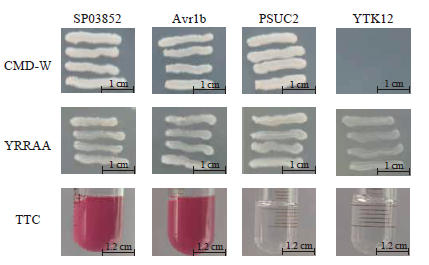
图1 Pg03852信号肽活性检测
Fig. 1 Activity assay of Pg03852 signal peptide
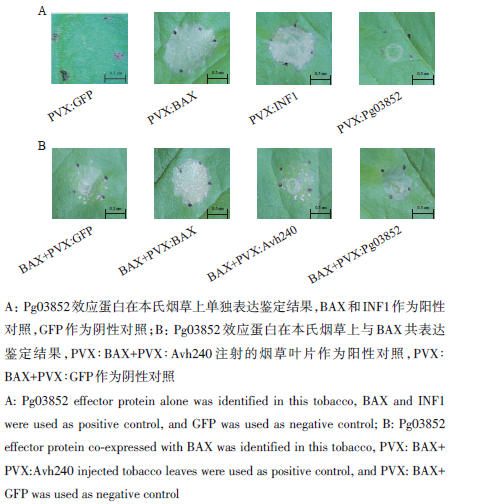
图2 Pg03852 诱导/抑制本氏烟叶片中坏死细胞死亡表型
Fig. 2 Pg03852 induces/inhibits the death phenotypes of necrotic cells in Baccata nicotiana leaves
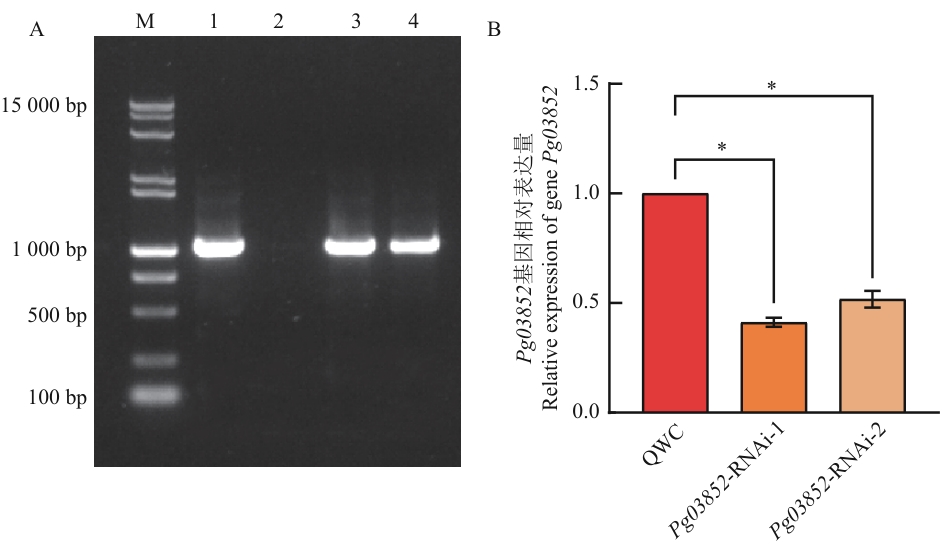
图3 干扰菌株潮霉素抗性鉴定(A)及Pg03852基因的相对表达量检测(B)A: DL 15000+2 000 DNA marker;泳道1为空载体(pSilent-1);泳道2为野生株QWC;泳道3-4为干扰突变体Pg03852-RNAi-1、Pg03852-RNAi-2。B: Pg03852的相对表达量。采用t检验,*表示在0.05水平差异显著A: Pg03852效应蛋白在本氏烟草上单独表达鉴定结果,BAX和INF1作为阳性对照,GFP作为阴性对照;B: Pg03852效应蛋白在本氏烟草上与BAX共表达鉴定结果,PVX∶BAX+PVX∶Avh240注射的烟草叶片作为阳性对照,PVX∶BAX+PVX∶GFP作为阴性对照
Fig. 3 Identification of thaumatin resistance in interfering strains (A) and detection of relative expression of the Pg03852 gene (B)A: DL 15000+2 000 DNA marker; lane 1 is the empty vector (pSilent-1); lane 2 is the wild strain QWC; lane 3-4 are the mutants Pg03852-RNAi-1 and Pg03852-RNAi-2. B. Relative expression of Pg03852. A t-test was used, and * indicates significant differences at the 0.05 levelA: Pg03852 effector protein alone was identified in this tobacco, BAX and INF1 were used as positive control, and GFP was used as negative control; B: Pg03852 effector protein co-expressed with BAX was identified in this tobacco, PVX: BAX+PVX:Avh240 injected tobacco leaves were used as positive control, and PVX: BAX+GFP was used as negative control
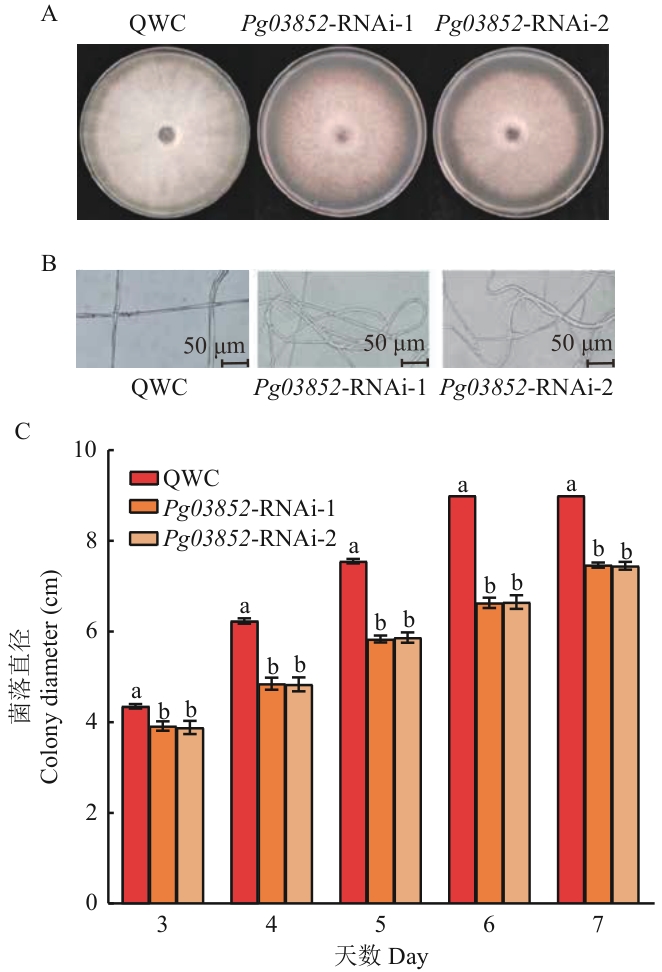
图4 在PDA培养基上接菌7 d的生长形态和生长速率及菌丝形态观察A: PDA培养基上接菌7 d的野生株QWC、干扰突变株Pg03852-RNAi-1、Pg03852-RNAi-2的生长形态;B:菌丝形态观察;C:菌株生长速率
Fig. 4 Growth morphology, growth rate, and hyphal morphology observed after 7 d of inoculation on PDA mediumA: Growth morphology of wild-type QWC, interference mutant strains Pg03852-RNAi-1, and Pg03852-RNAi-2 after 7 d of inoculation on PDA medium. B: Observation of mycelium morphology. C: Strain growth rate
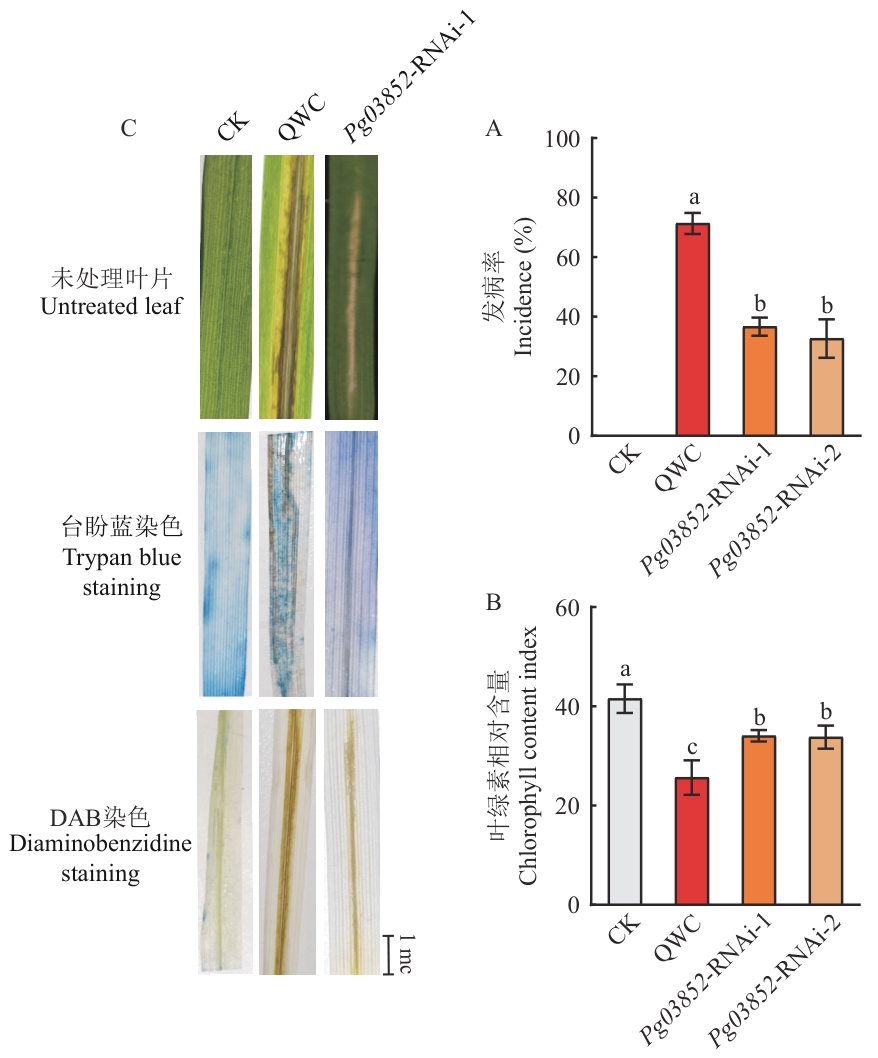
图5 致病性分析及染色A: QWC和干扰突变体发病率统计(P<0.05);B: QWC和干扰突变体叶绿素相对含量(P<0.05) C: QWC和干扰突变体的染色结果
Fig. 5 Pathogenicity analysis and stainingA: Statistics of QWC and interference mutant incidence (P<0.05). B: Relative chlorophyll content of QWC and interference mutants (P<0.05). C: Staining results of QWC and interference mutants
| [1] | 祁天涛, 司二静, 郭铭, 等. 大麦条纹病菌基因Pgr03902致病功能研究 [J]. 植物保护, 2023, 49(6): 16-22, 54. |
| Qi TT, Si EJ, Guo M, et al. Study on pathogenic function of gene Pgr03902 of barley stripe disease [J]. Plant Prot, 2023, 49(6): 16-22, 54. | |
| [2] | 朱靖环, 华为, 吴宽然, 等. 大麦条纹病菌致病性分析及抗性种质精细鉴定 [J]. 植物保护学报, 2020, 47(3): 553-561. |
| Zhu JH, Hua W, Wu KR, et al. Analysis of the pathogenicity of Pyrenophora graminea isolates and precision identification of barley resistant germplasms [J]. J Plant Prot, 2020, 47(3): 553-561. | |
| [3] | 郭铭, 孙莉莎, 司二静, 等. 大麦条纹病病菌对大麦叶片防御酶活性的影响 [J]. 西北农业学报, 2021, 30(2): 295-303. |
| Guo M, Sun LS, Si EJ, et al. Effect of Pyrenophora graminea stress to defensive enzymes activity in barley leaves [J]. Acta Agric Boreali Occidentalis Sin, 2021, 30(2): 295-303. | |
| [4] | 吴宽然, 杨建明, 朱靖环, 等. 大麦条纹病抗性及防治研究进展 [J]. 浙江农业学报, 2013, 25(4): 903-907. |
| Wu KR, Yang JM, Zhu JH, et al. Advances of research on control of barley leaf stripe disease [J]. Acta Agric Zhejiangensis, 2013, 25(4): 903-907. | |
| [5] | 高芬, 褚建梅, 李静虹, 等. 植物病原真菌致病机理研究进展 [J]. 江苏农业学报, 2014, 30(5): 1174-1179. |
| Gao F, Chu JM, Li JH, et al. Research progress in the pathogenesis of plant pathogenic fungi [J]. Jiangsu J Agric Sci, 2014, 30(5): 1174-1179. | |
| [6] | Jia HG, Zhang YZ, Orbović V, et al. Genome editing of the disease susceptibility gene CsLOB1 in Citrus confers resistance to Citrus canker [J]. Plant Biotechnol J, 2017, 15(7): 817-823. |
| [7] | 王晓东. 条锈菌三类效应蛋白通过不同策略调控寄主免疫的机理研究 [D]. 杨凌: 西北农林科技大学, 2021. |
| Wang XD. Study on the mechanism of three kinds of effector proteins of stripe rust fungus regulating host immunity through different strategies [D]. Yangling: Northwest A & F University, 2021. | |
| [8] | 杨明王, 张红雪, 霍超, 等. 植物病原真菌及卵菌SNAREs基因功能研究进展 [J]. 江苏农业科学, 2024, 52(1): 1-10. |
| Yang MW, Zhang HX, Huo C, et al. Research progress of SNAREs gene function in plant pathogenic fungi and oomycetes [J]. Jiangsu Agric Sci, 2024, 52(1): 1-10. | |
| [9] | Deslandes L, Rivas S. Catch me if you can: bacterial effectors and plant targets [J]. Trends Plant Sci, 2012, 17(11): 644-655. |
| [10] | Choi S, Prokchorchik M, Lee H, et al. Direct acetylation of a conserved threonine of RIN4 by the bacterial effector HopZ5 or AvrBsT activates RPM1-dependent immunity in Arabidopsis [J]. Mol Plant, 2021, 14(11): 1951-1960. |
| [11] | 刘鑫雨, 何礼娟, 殷金瑶, 等. 橡胶树白粉菌保守效应蛋白致病机制研究 [J]. 热带作物学报, 2024, 45(9): 1886-1894. |
| Liu XY, He LJ, Yin JY, et al. Study on the pathogenic mechanism of a conservative effector protein in rubber tree powdery mildew [J]. Chin J Trop Crops, 2024, 45(9): 1886-1894. | |
| [12] | El Kasmi F, Horvath D, Lahaye T. Microbial effectors and the role of water and sugar in the infection battle ground [J]. Curr Opin Plant Biol, 2018, 44: 98-107. |
| [13] | Qiu XF, Kong L, Chen H, et al. The Phytophthora sojae nuclear effector PsAvh110 targets a host transcriptional complex to modulate plant immunity [J]. Plant Cell, 2023, 35(1): 574-597. |
| [14] | Si E, Meng Y, Ma X, et al. Genome resource for barley leaf stripe pathogen Pyrenophora graminea [J]. Plant Disease, 2020, 104(2): 320-322. |
| [15] | 孙媛, 李梅蓉, 卢建霖, 等. RNA干扰构建载体在防治植物病毒病中的研究 [J]. 农业与技术, 2025, 45(1): 35-39. |
| Sun Y, Li MR, Lu JL, et al. Study on RNA interference construction vector in prevention and treatment of plant virus diseases [J]. Agric Technol, 2025, 45(1): 35-39. | |
| [16] | Liang QQ, Li BC, Wang JC, et al. PGPBS, a mitogen-activated protein kinase kinase, is required for vegetative differentiation, cell wall integrity, and pathogenicity of the barley leaf stripe fungus Pyrenophora graminea [J]. Gene, 2019, 696: 95-104. |
| [17] | 郭铭. 大麦条纹病菌基因Pgr07060的功能研究 [D]. 兰州: 甘肃农业大学, 2021. |
| Guo M. Functional study of the Pgr07060 gene in Pyrenophora graminea [D]. Lanzhou: Gansu Agricultural University, 2021. | |
| [18] | 侯静静. 大麦条纹病菌致病性候选基因Pgmiox功能研究 [D]. 兰州: 甘肃农业大学, 2020. |
| Hou JJ. Functional analysis of pathogenic candidate gene Pgmiox in Pyrenophora graminea [D]. Lanzhou: Gansu Agricultural University, 2020. | |
| [19] | 徐容, 邓智英, 邵陈禹, 等. 茶树DREB基因的生信分析及其调控CsPOD3的抗旱机制 [J]. 茶叶科学, 2025, 45(1): 29-42. |
| Xu R, Deng ZY, Shao CY, et al. Bioinformatic analysis of DREB genes and regulation of CsPOD3 on drought tolerance mechanisms in Camellia sinensis [J]. J Tea Sci, 2025, 45(1): 29-42. | |
| [20] | 郜江菲, 郑婉怡, 刘建明, 等. 应用SPSS27.0软件计算药物半数效应浓度的实现方法 [J]. 世界临床药物, 2025, 46(4): 401-406. |
| Gao JF, Zheng WY, Liu JM, et al. The implementation method of the calculation of 50% effective concentration by SPSS27.0 [J]. World Clin Drug, 2025, 46(4): 401-406. | |
| [21] | Wang QQ, Han CZ, Ferreira AO, et al. Transcriptional programming and functional interactions within the Phytophthora sojae RXLR effector repertoire [J]. Plant Cell, 2011, 23(6): 2064-2086. |
| [22] | Fang AF, Han YQ, Zhang N, et al. Identification and characterization of plant cell death-inducing secreted proteins from Ustilaginoidea virens [J]. Mol Plant Microbe Interactions, 2016, 29(5): 405-416. |
| [23] | 李重阳. 稻曲病菌候选效应蛋白的功能研究 [D]. 武汉: 华中农业大学, 2018. |
| Li CY. Functional study of candidate effector proteins in Ustilaginoidea virens [D]. Wuhan: Huazhong Agricultural University, 2018. | |
| [24] | 高馨梅, 邵晨曦, 梁英梅, 等. 山田胶锈菌效应蛋白GyHGSRE1的功能初探 [J]. 南京林业大学学报: 自然科学版, 2025, 49(5): 209-216. |
| Gao XM, Shao CX, Liang YM, et al. Preliminary study on the function of Gymnosporangium yamadae effector GyHGSRE1 [J]. J Nanjing For Univ Nat Sci Ed, 2025, 49(5): 209-216. | |
| [25] | 汤敬诚, 李睿, 刘文波, 等. Neopestalotiopsis thailandica全基因组分泌蛋白及其效应因子的预测分析 [J/OL]. 分子植物育种,2024:1-11. |
| Tang JC, Li R, Liu WB, et al. Genome-wide prediction and analysis of secreted proteins and effectors in Neopestalotiopsis thailandica [J/OL]. Mol Plant Breed, 2024: 1-11. | |
| [26] | 吴佳椰露, 傅艺炜, 包崇来, 等. 茄腐镰孢菌分泌蛋白与效应子的预测分析 [J]. 植物病理学报, 2025, 55(1): 32-46. |
| Wu J, Fu YW, Bao CL, et al. Genome-wide prediction and analysis of secreted proteins and effectors in Fusarium solani [J]. Acta Phytopathol Sin, 2025, 55(1): 32-46. | |
| [27] | 夏杨, 苏初连, 叶子, 等. 基于RNAi和蛋白质组学研究胶孢炭疽菌CgCDC2基因的功能 [J]. 果树学报, 2019, 36(11): 1483-1493. |
| Xia Y, Su CL, Ye Z, et al. Research on the function of CgCDC2 gene in Colletotrichum gloeosporioides with RNAi and TMT-based proteomic analysis [J]. J Fruit Sci, 2019, 36(11): 1483-1493. | |
| [28] | Si EJ, Guo M, Liu HY, et al. The essentials of PgPG1, a polygalacturonase-encoding gene for the invasion of Pyrenophora graminea to Hordeum vulgare [J]. Int J Mol Sci, 2025, 26(6): 2401. |
| [29] | Guo M, Si EJ, Hou JJ, et al. Pgmiox mediates stress response and plays a critical role for pathogenicity in Pyrenophora graminea, the agent of barley leaf stripe [J]. Plant Sci, 2025, 350: 112308. |
| [30] | Stergiopoulos I, de Wit PJGM. Fungal effector proteins [J]. Annu Rev Phytopathol, 2009, 47: 233-263. |
| [31] | Petre B, Kamoun S. How do filamentous pathogens deliver effector proteins into plant cells? [J]. PLoS Biol, 2014, 12(2): e1001801. |
| [32] | Win J, Chaparro-Garcia A, Belhaj K, et al. Effector biology of plant-associated organisms: concepts and perspectives [J]. Cold Spring Harb Symp Quant Biol, 2012, 77: 235-247. |
| [33] | Valent B, Hyun K. Recent advances in rice blast effector research [J]. Curr Opin Plant Biol, 2010, 13(4): 434-441. |
| [34] | Godfrey D, Böhlenius H, Pedersen C, et al. Powdery mildew fungal effector candidates share N-terminal Y/F/WxC-motif [J]. BMC Genom, 2010, 11(1): 317. |
| [35] | Xu WH, Meng Y, Wise RP. Mla- and Rom1-mediated control of microRNA398 and chloroplast copper/zinc superoxide dismutase regulates cell death in response to the barley powdery mildew fungus [J]. New Phytol, 2014, 201(4): 1396-1412. |
| [36] | Liu ZH, Gao YY, Kim YM, et al. SnTox1, a Parastagonospora nodorum necrotrophic effector, is a dual-function protein that facilitates infection while protecting from wheat-produced chitinases [J]. New Phytol, 2016, 211(3): 1052-1064. |
| [37] | Ye WZ, Hossain R, Pröbsting M, et al. Knock-out of BnHva22c reduces the susceptibility of Brassica napus to infection with the fungal pathogen Verticillium longisporum [J]. Crop J, 2024, 12(2): 503-514. |
| [38] | Liu SJ, Liu H, Guo MJ, et al. Knockout of GRAIN WIDTH2 has a dual effect on enhancing leaf rust resistance and increasing grain weight in wheat [J]. Plant Biotechnol J, 2024, 22(7): 2007-2009. |
| [1] | 黄雯婧, 任思潮, 林俐, 王幼平, 吴健. RNA干扰在植物功能基因组学和遗传改良中的应用研究进展[J]. 生物技术通报, 2025, 41(9): 1-21. |
| [2] | 任睿斌, 司二静, 万广有, 汪军成, 姚立蓉, 张宏, 马小乐, 李葆春, 王化俊, 孟亚雄. 大麦条纹病菌GH17基因家族的鉴定及表达分析[J]. 生物技术通报, 2025, 41(8): 146-154. |
| [3] | 王婷, 王一丹, 任姝锦, 马婷, 金梦军, 杨成德. 球炭疽菌果胶酸裂解酶基因CcPL20552克隆及表达分析[J]. 生物技术通报, 2025, 41(5): 290-299. |
| [4] | 陈琳琳, 苏增青, 姬小雅, 刘新月, 刘家瑶, 张时雨, 邢小萍, 李洪连. 类半胱氨酸蛋白酶FpMca3参与假禾谷镰孢的致病力[J]. 生物技术通报, 2025, 41(11): 272-281. |
| [5] | 文静, 李倩倩, 张明达, 谭茗月, 金博阳, 沈秀丽, 杜志强. Duox 2调控克氏原螯虾肠组织抗细菌先天免疫的分子机制[J]. 生物技术通报, 2025, 41(1): 324-332. |
| [6] | 王柯然, 闫俊杰, 刘建凤, 高玉林. RNAi技术在马铃薯害虫防控中的应用和风险[J]. 生物技术通报, 2024, 40(9): 4-10. |
| [7] | 金博阳, 秦仕宇, 张明达, 李倩倩, 文静, 沈秀丽, 杜志强. 小龙虾prx 6基因在对抗金黄色葡萄球菌感染中的分子作用机制研究[J]. 生物技术通报, 2024, 40(7): 314-322. |
| [8] | 张震, 李清, 徐菁, 陈凯园, 张春芝, 祝光涛. 马铃薯线粒体靶向表达载体的构建与应用[J]. 生物技术通报, 2024, 40(5): 66-73. |
| [9] | 潘国强, 吴思源, 刘璐, 郭惠明, 程红梅, 苏晓峰. 大丽轮枝菌(Verticillim dahliae)突变体库的构建与分析[J]. 生物技术通报, 2023, 39(5): 112-119. |
| [10] | 吴莉丹, 冉雪琴, 牛熙, 黄世会, 李升, 王嘉福. 猪源致病性大肠杆菌基因组比较与毒力因子分析[J]. 生物技术通报, 2023, 39(12): 287-299. |
| [11] | 张龙喜, 吕琳, 张欢欢, 周金成, 车午男, 董辉. RNAi技术在寄生蜂中的应用研究进展[J]. 生物技术通报, 2023, 39(12): 99-108. |
| [12] | 陈广霞, 李秀杰, 蒋锡龙, 单雷, 张志昌, 李勃. 植物小分子信号肽参与非生物逆境胁迫应答的研究进展[J]. 生物技术通报, 2023, 39(11): 61-73. |
| [13] | 刘晓玫, 王东鑫, 张春, 魏双施. AAV介导的RNAi对SARS-CoV-2 S基因表达的抑制作用[J]. 生物技术通报, 2022, 38(3): 188-193. |
| [14] | 郑向, 段左平, 张杰, 潘素君, 戴良英, 刘世名, 李魏. 大豆疫霉菌效应子研究进展[J]. 生物技术通报, 2022, 38(11): 10-20. |
| [15] | 郭宇飞, 闫荣媚, 张小茹, 曹威, 刘浩. 代谢工程改造黑曲霉生产葡萄糖二酸[J]. 生物技术通报, 2022, 38(11): 227-237. |
| 阅读次数 | ||||||
|
全文 |
|
|||||
|
摘要 |
|
|||||
