







生物技术通报 ›› 2026, Vol. 42 ›› Issue (7): 226-235.doi: 10.13560/j.cnki.biotech.bull.1985.2025-1096
• 研究报告 • 上一篇
范帆1, 李梦娇1, 杨贤鹏2, 崔莉莉1( )
)
收稿日期:2025-10-16
出版日期:2026-07-26
发布日期:2026-07-20
通讯作者:
崔莉莉sdnucll@sdnu.edu.cn基金资助:
FAN Fan1, LI Meng-jiao1, YANG Xian-peng2, CUI Li-li1()
Received:2025-10-16
Published:2026-07-26
Online:2026-07-20
摘要:
目的 磷酸三苯酯(triphenyl phosphate, TPHP)是一种常见的环境有机污染物,威胁人类健康和生态安全。明确拟南芥耐受TPHP毒性的分子机制,可为后续利用植物修复土壤TPHP污染提供参考。 方法 以拟南芥野生型Col-0为实验材料,进行TPHP暴露处理,分析其根长、鲜重和叶绿素含量等表型指标的变化,利用显著变化的表型从拟南芥突变体库中筛选耐受TPHP毒性的突变体。之后,利用图位克隆和基因组重测序分析挖掘相关候选突变基因,并利用外源激素处理进行验证。最后通过分子对接、过表达株系和突变体分析,探究拟南芥耐受TPHP毒性的潜在分子机制。 结果 经2 mg/L TPHP处理后,拟南芥野生型Col-0幼苗的根长、鲜重和叶绿素含量均显著降低。根据表型变化筛选获得耐受TPHP毒性的突变体ems-29d(ems-29 dwarf)。该突变体植株矮小,叶片深绿皱缩。重测序分析发现,该突变体中参与油菜素内酯(brassinosteroids, BR)合成的关键基因DWF4,存在C1179T的单碱基变异,导致DWF4蛋白的第306位亮氨酸转变为苯丙氨酸(L306F)。外源施加表油菜素内酯(2,4-epibrassionolide, eBL)能部分恢复ems-29d的生长抑制表型。分子对接模拟结果显示,TPHP与DWF4L306F的结合能小于与DWF4的结合能,但DWF4L306F过表达转基因株系并未提高拟南芥对TPHP的耐受性,表明突变体的抗性并非靶标抗性。最后,经TPHP处理后,DWF4的T-DNA插入突变体dwf4叶绿素含量的受抑制程度显著低于野生型,可见BR合成受阻能显著提高拟南芥对TPHP的耐受性。 结论 ems-29d中的DWF4基因突变,导致BR激素合成受阻,提高了植株对TPHP毒性的耐受。
范帆, 李梦娇, 杨贤鹏, 崔莉莉. 拟南芥耐受磷酸三苯酯毒性突变体的筛选及相关基因的功能分析[J]. 生物技术通报, 2026, 42(7): 226-235.
FAN Fan, LI Meng-jiao, YANG Xian-peng, CUI Li-li. Screening and Functional Analysis of a Triphenyl Phosphate-tolerant Mutant in Arabidopsis thaliana[J]. Biotechnology Bulletin, 2026, 42(7): 226-235.
| Sample | 3‒11.22 M | 3‒14.95 M | 3‒17.36 M | 3‒17.857 M | 3‒18.89 M | 3‒19.131 M | 3‒19.679 M | 3‒20.575 M | 3‒20.8 M |
|---|---|---|---|---|---|---|---|---|---|
| 1 | A | A | A | A | A | A | A | A | H |
| 2 | A | A | A | A | A | A | H | H | H |
| 3 | A | A | A | A | A | A | H | H | H |
| 7 | A | A | A | A | A | H | H | H | H |
| 8 | H | H | H | H | A | H | H | H | H |
| 12 | H | H | H | H | A | A | A | A | A |
| 16 | H | H | H | H | A | H | H | H | H |
| 18 | A | A | A | A | A | A | H | H | H |
| 19 | B | B | H | H | A | A | A | A | A |
| 21 | A | A | A | A | A | A | A | H | H |
| 24 | H | H | H | H | A | A | A | A | A |
| 27 | H | H | H | H | A | A | A | A | A |
| 32 | H | H | H | A | A | A | A | A | A |
| 33 | A | A | A | A | A | A | A | A | H |
| 36 | H | H | A | A | A | A | H | H | H |
表1 控制ems-29d矮小表型基因的精细定位
Table 1 Fine mapping of the gene controlling the dwarf phenotype of ems-29d
| Sample | 3‒11.22 M | 3‒14.95 M | 3‒17.36 M | 3‒17.857 M | 3‒18.89 M | 3‒19.131 M | 3‒19.679 M | 3‒20.575 M | 3‒20.8 M |
|---|---|---|---|---|---|---|---|---|---|
| 1 | A | A | A | A | A | A | A | A | H |
| 2 | A | A | A | A | A | A | H | H | H |
| 3 | A | A | A | A | A | A | H | H | H |
| 7 | A | A | A | A | A | H | H | H | H |
| 8 | H | H | H | H | A | H | H | H | H |
| 12 | H | H | H | H | A | A | A | A | A |
| 16 | H | H | H | H | A | H | H | H | H |
| 18 | A | A | A | A | A | A | H | H | H |
| 19 | B | B | H | H | A | A | A | A | A |
| 21 | A | A | A | A | A | A | A | H | H |
| 24 | H | H | H | H | A | A | A | A | A |
| 27 | H | H | H | H | A | A | A | A | A |
| 32 | H | H | H | A | A | A | A | A | A |
| 33 | A | A | A | A | A | A | A | A | H |
| 36 | H | H | A | A | A | A | H | H | H |
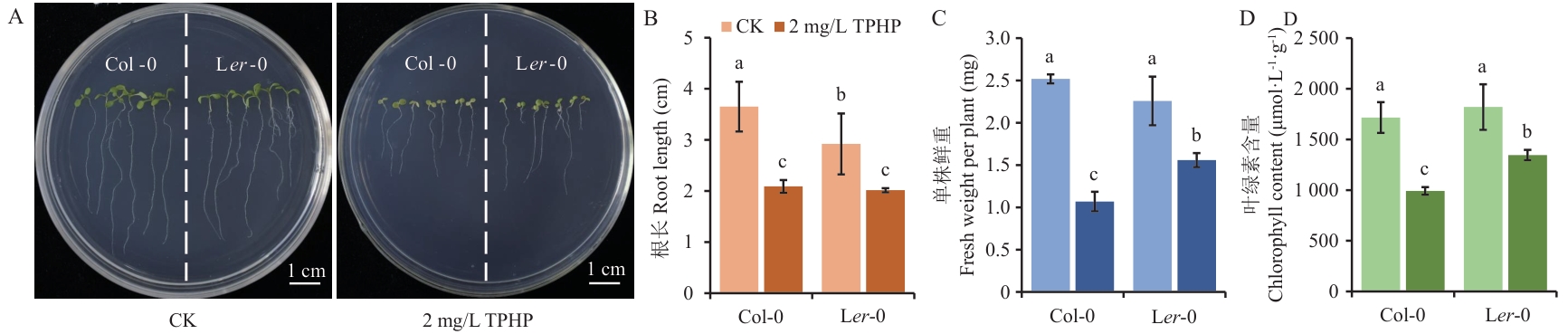
图1 在含有TPHP的培养基上生长7 d的拟南芥野生型Col-0和Ler-0A:表型;B:根长;C:单株鲜重;D:叶绿素含量。不同小写字母表示样本间差异显著(P<0.05),下同
Fig. 1 Wild-type Col-0 and Ler-0 of A. thaliana grown on the medium containing TPHP for 7 dA: Phenotype. B: Root length. C: Fresh weight per plant. D: Chlorophyll content. The different lowercase letters indicate significant differences among samples (P<0.05). The same below
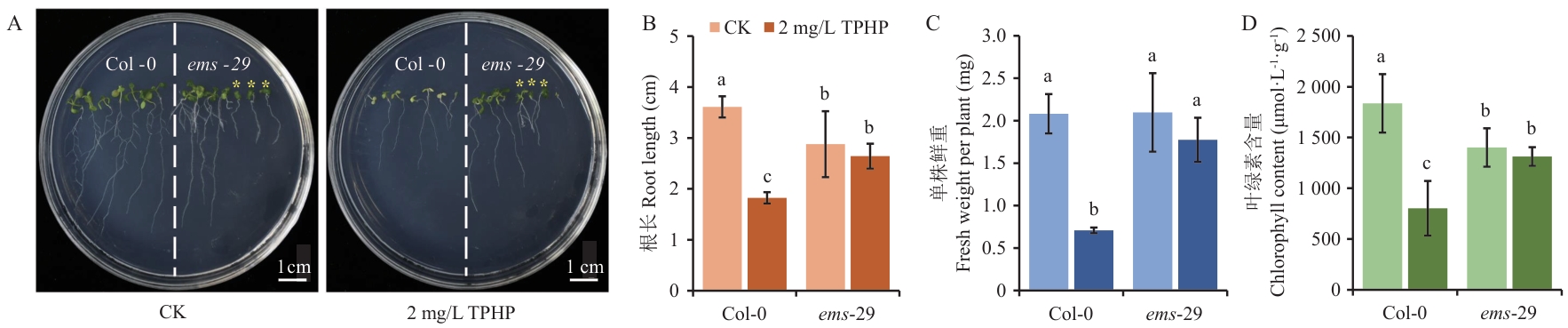
图2 TPHP处理7 d的拟南芥野生型Col-0和ems-29突变体A:表型;B:根长;C:单株鲜重;D:叶绿素含量。*指示ems-29d突变体
Fig. 2 Wild-type Col-0 and ems-29 mutant of A. thaliana after 7 d of TPHP treatmentA: Phenotype. B: Root length. C: Fresh weight per plant. D: Chlorophyll content. * indicates the ems-29d mutant
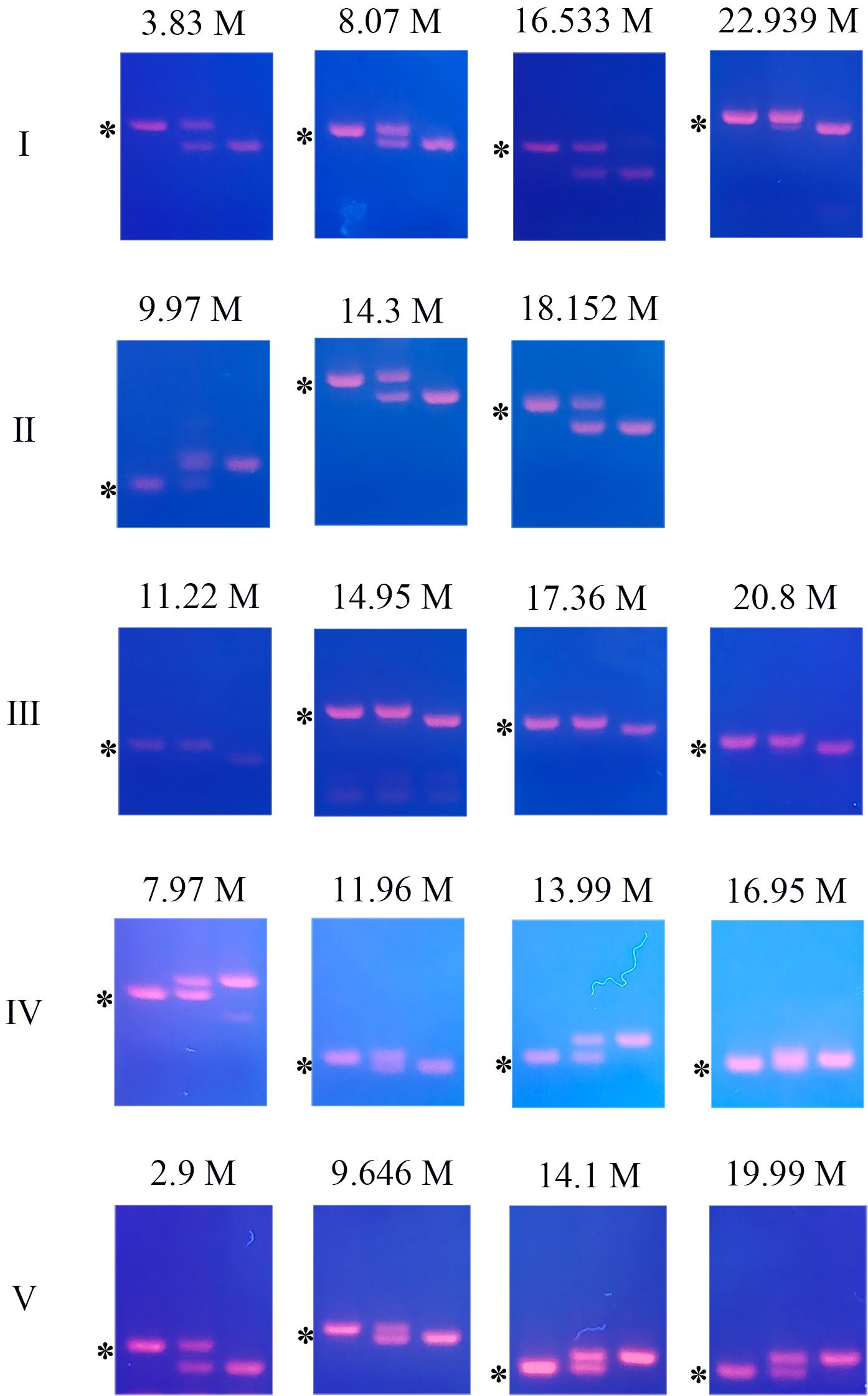
图3 ems-29d突变体DWF4基因的初定位*为Col-0条带,向右依次为ems-29突变体条带,Ler-0条带
Fig. 3 Preliminary mapping of the DWF4 gene in the ems-29d mutant* indicates the Col-0 band, moving to the right are the ems-29 mutant band and the Ler-0 band, respectively
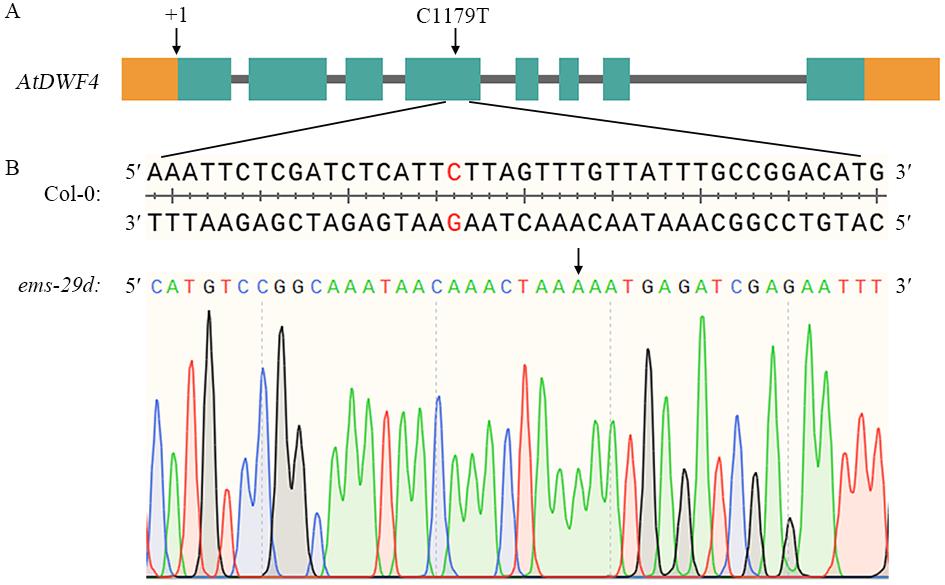
图4 ems-29d中DWF4基因突变位点分析A:DWF4基因结构模式图;B:ems-29d中DWF4基因的突变位点
Fig. 4 Analysis of mutation sites of DWF4 gene in ems-29dA: Schematic representation of DWF4 gene structure. B: Mutation site on DWF4 gene in ems-29d
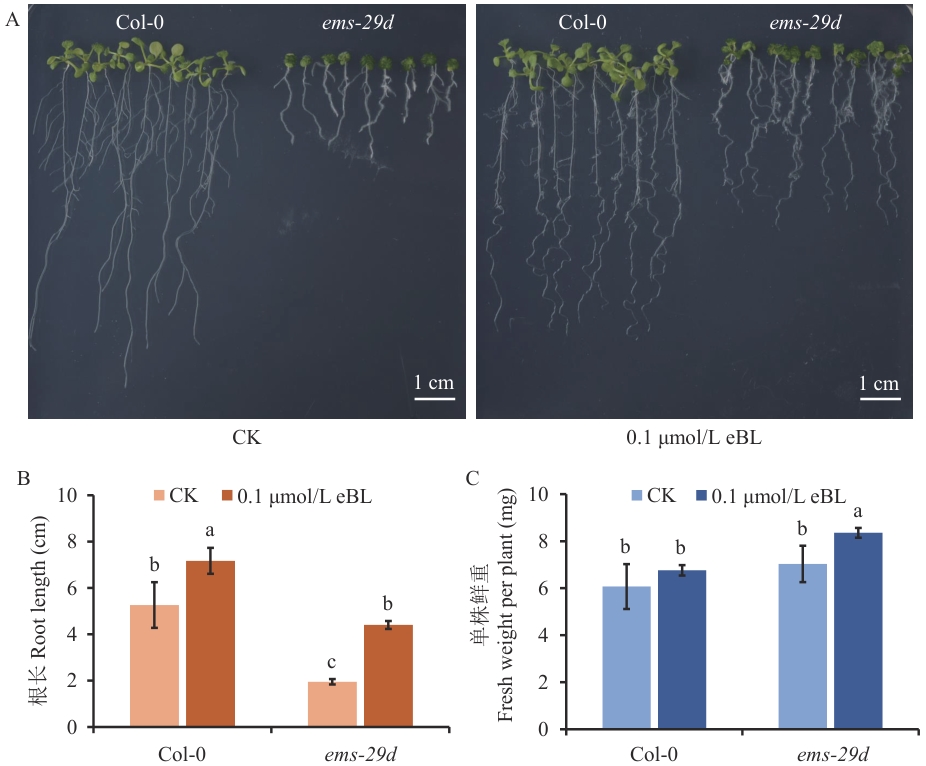
图5 0.1 μmol/L eBL处理4 d后的拟南芥野生型Col-0和ems-29d突变体A:表型;B:根长;C:单株鲜重
Fig. 5 Wild-type Col-0 and ems-29d mutant of A. thaliana after 4 d of treatment with 0.1 μmol/L eBLA: Phenotype. B: Root length. C: Fresh weight per plant
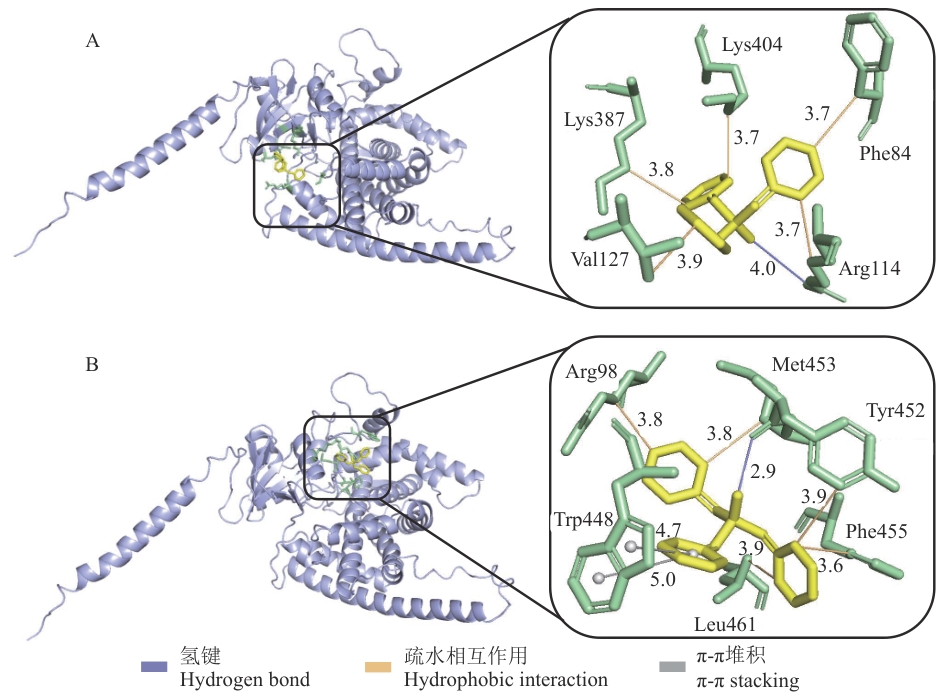
图6 TPHP与DWF4(A)及DWF4L306F(B)相互作用分析
Fig. 6 Interaction analysis of TPHP with DWF4 (A) and DWF4L306F (B)
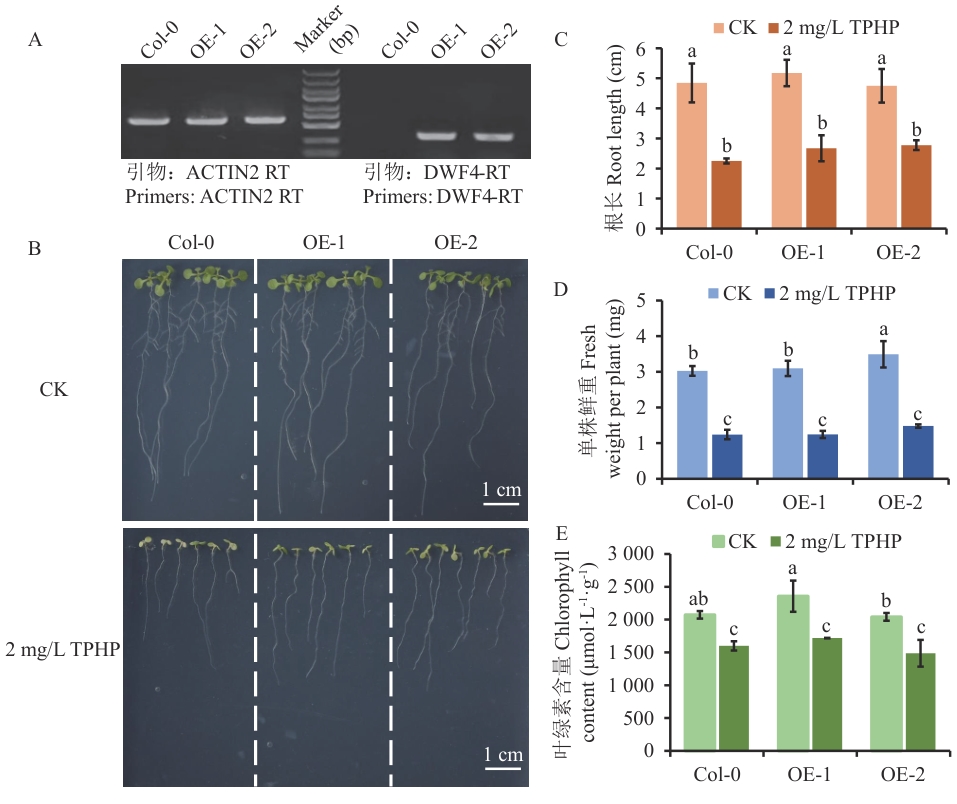
图7 TPHP处理7 d后的拟南芥野生型Col-0和DWF4L306F OE转基因株系A:DWF4L306F OE转基因株系的分子鉴定;B‒E:2 mg/L TPHP处理后拟南芥野生型Col-0和DWF4L306F OE转基因株系的表型(B)、根长(C)、单株鲜重(D)和叶绿素含量(E)
Fig. 7 Wild-type Col-0 and DWF4L306F transgenic lines of A. thaliana after 7 d of TPHP treatmentA: Molecular identification of DWF4L306F transgenic lines. B-E: Phenotypes (B), root length (C), fresh weight per plant (D) and chlorophyll content (E) of wild-type Col-0 and the DWF4L306F OE transgenic lines of A. thaliana after treatment with 2 mg/L TPHP
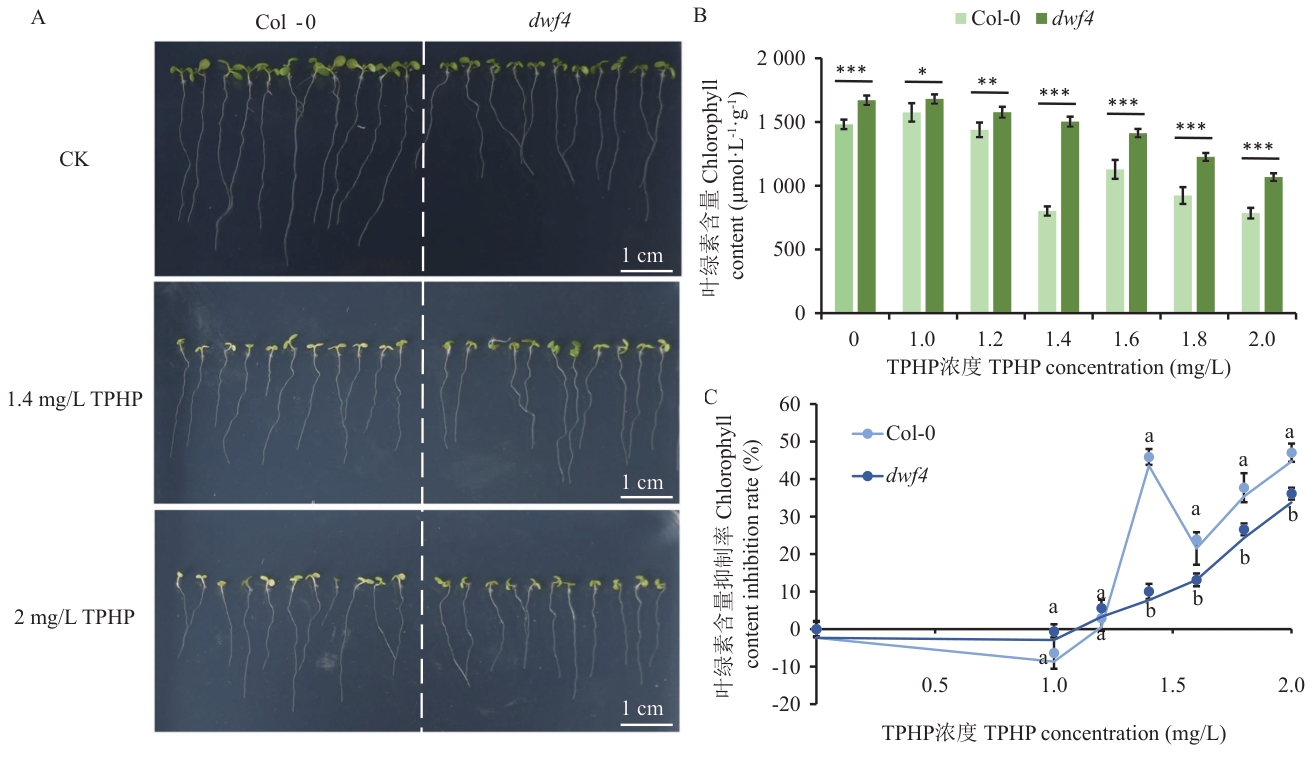
图8 在含有不同浓度TPHP的培养基上生长7 d的拟南芥野生型Col-0和dwf4突变体A:表型;B:叶绿素含量;C:叶绿素含量抑制率。*、**和***分别表示在P<0.05、P<0.01和P<0.001水平差异显著
Fig. 8 Wild-type Col-0 and dwf4 mutants of A. thaliana grown for 7 d on media containing different concentrations TPHPA: Phenotype. B: Chlorophyll content. C: Chlorophyll content inhibition rate. *, **, and *** indicate significant differences at P<0.05, P<0.01, and P<0.001 levels, respectively
| [1] | Zhang YY, Su HJ, Ya ML, et al. Distribution of flame retardants in smartphones and identification of current-use organic chemicals including three novel aryl organophosphate esters [J]. Sci Total Environ, 2019, 693: 133654. |
| [2] | Wang X, Zhu QQ, Yan XT, et al. A review of organophosphate flame retardants and plasticizers in the environment: Analysis, occurrence and risk assessment [J]. Sci Total Environ, 2020, 731: 139071. |
| [3] | Sühring R, Diamond ML, Bernstein S, et al. Organophosphate esters in the Canadian Arctic Ocean [J]. Environ Sci Technol, 2021, 55(1): 304-312. |
| [4] | Du ZK, Zhang Y, Wang GW, et al. TPhP exposure disturbs carbohydrate metabolism, lipid metabolism, and the DNA damage repair system in zebrafish liver [J]. Sci Rep, 2016, 6: 21827. |
| [5] | An J, Du CY, Xue WL, et al. Endoplasmic reticulum stress participates in apoptosis of HeLa cells exposed to TPHP and OH-TPHP via the eIF2α-ATF4/ATF3-CHOP-DR5/P53 signaling pathway [J]. Toxicol Res, 2023, 12(6): 1159-1170. |
| [6] | Wang Y, Hong JB, Shi M, et al. Triphenyl phosphate disturbs the lipidome and induces endoplasmic reticulum stress and apoptosis in JEG-3 cells [J]. Chemosphere, 2021, 275: 129978. |
| [7] | Liu Q, Gao HX, Yi XY, et al. Root uptake pathways and cell wall accumulation mechanisms of organophosphate esters in wheat (Triticum aestivum L.) [J]. J Agric Food Chem, 2022, 70(38): 11892-11900. |
| [8] | Wan WN, Huang HL, Lv JT, et al. Uptake, translocation, and biotransformation of organophosphorus esters in wheat (Triticum aestivum L.) [J]. Environ Sci Technol, 2017, 51(23): 13649-13658. |
| [9] | Aslantürk ÖS. Cytotoxic and genotoxic effects of triphenyl phosphate on root tip cells of Allium cepa L. [J]. Toxicol Vitro, 2024, 94: 105734. |
| [10] | Wang SC, Gao ZY, Liu FF, et al. Effects of polystyrene and triphenyl phosphate on growth, photosynthesis and oxidative stress of Chaetoceros meülleri [J]. Sci Total Environ, 2021, 797: 149180. |
| [11] | 张虹, 周寒琳, 王涛, 等. 典型有机磷酸酯阻燃剂暴露下米氏凯伦藻生长及其抗氧化响应研究 [J]. 海洋环境科学, 2024, 43(4): 649-656. |
| Zhang H, Zhou HL, Wang T, et al. Growth and antioxidant responses of Karenia mikimotoi under exposure to typical organophosphate flame retardants [J]. Mar Environ Sci, 2024, 43(4): 649-656. | |
| [12] | Zhang YZ, Zhang QR, Liu QZ, et al. Fine mapping and functional validation of the maize nicosulfuron-resistance gene CYP81A9 [J]. Front Plant Sci, 2024, 15: 1443413. |
| [13] | Liu YY, Kong LH, Gong CY, et al. Identification of plant cadmium resistance gene family in Brassica napus and functional analysis of BnPCR10.1 involved in cadmium and copper tolerance [J]. Plant Physiol Biochem, 2023, 202: 107989. |
| [14] | Cabello-Hurtado F, El Amrani A. Phenanthrene-induced cytochrome P450 genes and phenanthrene tolerance associated with Arabidopsis thaliana CYP75B1 gene [J]. Plants, 2024, 13(12): 1692. |
| [15] | Lolle SJ, Berlyn GP, Engstrom EM, et al. Developmental regulation of cell interactions in the Arabidopsis fiddlehead-1Mutant: a role for the epidermal cell wall and cuticle [J]. Dev Biol, 1997, 189(2): 311-321. |
| [16] | Liu Q, Tang XX, Zhang X, et al. Mechanistic understanding of the toxicity of triphenyl phosphate (TPhP) to the marine diatom Phaeodactylum tricornutum: Targeting chloroplast and mitochondrial dysfunction [J]. Environ Pollut, 2022, 295: 118670. |
| [17] | Choe S, Dilkes BP, Fujioka S, et al. The DWF4 gene of Arabidopsis encodes a cytochrome P450 that mediates multiple 22α- hydroxylation steps in brassinosteroid biosynthesis [J]. Plant Cell, 1998, 10(2): 231-243. |
| [18] | Azpiroz R, Wu YW, LoCascio JC, et al. An Arabidopsis brassinosteroid-dependent mutant is blocked in cell elongation [J]. Plant Cell, 1998, 10(2): 219-230. |
| [19] | Guo ZX, Fujioka S, Blancaflor EB, et al. TCP1 modulates brassinosteroid biosynthesis by regulating the expression of the key biosynthetic gene DWARF4 in Arabidopsis thaliana [J]. Plant Cell, 2010, 22(4): 1161-1173. |
| [20] | Iwakami S, Endo M, Saika H, et al. Cytochrome P450 CYP81A12 and CYP81A21 are associated with resistance to two acetolactate synthase inhibitors in Echinochloa phyllopogon [J]. Plant Physiol, 2014, 165(2): 618-629. |
| [21] | Shen J, Yang Q, Xu F, et al. Effects of amino acid mutation in cytochrome P450 (CYP96A146) of Descurainia sophia on the metabolism and resistance to tribenuron-methyl [J]. J Agric Food Chem, 2025, 73(1): 370-379. |
| [22] | Zou YZ, Zhao BC, Cao SH, et al. Mutation at the 197 site and P450-mediated metabolic resistance are involved in bensulfuron-methyl resistance in Sagittaria trifolia [J]. Plant Sci, 2023, 331: 111700. |
| [23] | Wang JZ, Qi JL, Ouyang YL, et al. The mutation Asp-376-Glu in the ALS gene confers resistance to mesosulfuron-methyl in Beckmannia syzigachne [J]. Plant Physiol Biochem, 2024, 215: 109083. |
| [24] | Palma-Bautista C, Portugal J, Vázquez-García JG, et al. Tribenuron-methyl metabolism and the rare Pro197Phe double mutation together with 2,4-D metabolism and reduced absorption can evolve in Papaver rhoeas with multiple and cross herbicide resistance to ALS inhibitors and auxin mimics [J]. Pestic Biochem Physiol, 2022, 188: 105226. |
| [25] | Nolan TM, Vukašinović N, Liu DR, et al. Brassinosteroids: multidimensional regulators of plant growth, development, and stress responses [J]. Plant Cell, 2020, 32(2): 295-318. |
| [26] | Manghwar H, Hussain A, Ali Q, et al. Brassinosteroids (BRs) role in plant development and coping with different stresses [J]. Int J Mol Sci, 2022, 23(3): 1012. |
| [27] | Han YJ, Kim YS, Hwang OJ, et al. Overexpression of Arabidopsis thaliana brassinosteroid-related acyltransferase 1 gene induces brassinosteroid-deficient phenotypes in creeping bentgrass [J]. PLoS One, 2017, 12(10): e0187378. |
| [28] | Feng Y, Yin YH, Fei SZ. Down-regulation of BdBRI1, a putative brassinosteroid receptor gene produces a dwarf phenotype with enhanced drought tolerance in Brachypodium distachyon [J]. Plant Sci, 2015, 234: 163-173. |
| [29] | Gruszka D, Janeczko A, Puła J, et al. Impact of drought exerted during spike development on tillering, yield parameters and grain chemical composition in semi-dwarf barley mutants deficient in the brassinosteroid metabolism [J]. Agronomy, 2020, 10(10): 1595. |
| [30] | Chen H, Wu WQ, Du K, et al. The interplay of growth-regulating factor 5 and BZR1 in coregulating chlorophyll degradation in poplar [J]. Plant Cell Environ, 2024, 47(10): 3766-3779. |
| [31] | Chory J, Reinecke D, Sim S, et al. A role for cytokinins in de-etiolation in Arabidopsis: det mutants have an altered response to cytokinins [J]. Plant Physiol, 1994, 104(2): 339-347. |
| [1] | 董亚茹, 聂玉霞, 朱红, 王照红, 刘惠芬, 郭光. 过表达桑树MnERF2增强拟南芥抗旱性[J]. 生物技术通报, 2026, 42(4): 182-189. |
| [2] | 徐玉娇, 孙玉帅, 刘道奇, 张丽, 张志昌, 姚玉新. VvHSP18.2过表达调节葡萄盐碱抗性的功能分析[J]. 生物技术通报, 2026, 42(4): 161-169. |
| [3] | 王芳, 邵会茹, 吕林龙, 赵点, 胡振, 吕建珍, 姜亮. 植物和细菌TurboID邻近蛋白标记方法的建立[J]. 生物技术通报, 2025, 41(9): 44-53. |
| [4] | 李雅琼, 格桑拉毛, 陈启迪, 杨宇环, 何花转, 赵耀飞. 异源过表达高粱SbSnRK2.1增强拟南芥对盐胁迫的抗性[J]. 生物技术通报, 2025, 41(8): 115-123. |
| [5] | 杜量衡, 唐黄磊, 张治国. 控制水稻光响应基因ELM1的图位克隆[J]. 生物技术通报, 2025, 41(5): 82-89. |
| [6] | 周志国, 樊双虎, 邓晨, 冯雪. 2,4-表油菜素内酯对镉胁迫下胡萝卜幼苗生理特性的影响[J]. 生物技术通报, 2025, 41(5): 165-174. |
| [7] | 刘彤彤, 李肖慧, 杨骏龙, 陈旺, 玉猛, 王超凡, 王凤茹, 客绍英. ZmSTART1调控玉米维管束建成的功能研究[J]. 生物技术通报, 2025, 41(4): 115-122. |
| [8] | 李欣芃, 张武汉, 张莉, 舒服, 何强, 郭杨, 邓华凤, 王悦, 孙平勇. γ射线诱变创制水稻突变体及其分子鉴定[J]. 生物技术通报, 2025, 41(3): 35-43. |
| [9] | 杨宗辉, 李利斌, 孟昭娟, 高天, 祝利霞, 杜海梅, 董伟伟, 曹齐卫. 比较转录组学揭示乙烯信号与表观遗传协同调控黄瓜性别决定[J]. 生物技术通报, 2025, 41(12): 139-155. |
| [10] | 杨涛, 李琳, 莫小连, 陈晓龙, 王健, 黄园, 赵杰宏, 邹颉. 铁皮石斛DoDELLA2的功能研究[J]. 生物技术通报, 2025, 41(12): 240-253. |
| [11] | 郭浩杰, 王成, 杨馥熔, 杜冰, 孟超敏. 谷子SiSPX9基因的克隆及耐低磷分析[J]. 生物技术通报, 2025, 41(12): 114-123. |
| [12] | 田栩瑞, 霍信屹, 郭云涵, 向林, 产祝龙, 王艳平. 百合LoSAUR10基因的表达特征及功能分析[J]. 生物技术通报, 2025, 41(1): 221-229. |
| [13] | 林彤, 袁程, 董陈文华, 曾孟琼, 杨燕, 毛自朝, 林春. 藜麦配子发育相关基因CqSTK的筛选及功能分析[J]. 生物技术通报, 2024, 40(8): 83-94. |
| [14] | 李景艳, 周家婧, 袁媛, 苏晓艺, 乔文慧, 薛岩磊, 李国婧, 王瑞刚. 拟南芥AtiPGAM2基因参与非生物胁迫的响应[J]. 生物技术通报, 2024, 40(5): 215-224. |
| [15] | 陈春林, 李白雪, 李金玲, 杜清洁, 李猛, 肖怀娟. 甜瓜CmEPF基因家族的鉴定及表达分析[J]. 生物技术通报, 2024, 40(4): 130-138. |
| 阅读次数 | ||||||
|
全文 |
|
|||||
|
摘要 |
|
|||||
