







生物技术通报 ›› 2026, Vol. 42 ›› Issue (8): 239-250.doi: 10.13560/j.cnki.biotech.bull.1985.2025-1432
• 研究报告 • 上一篇
刘柔知, 吴嘉琦, 吴辉烨, 袁婧怡, 程堂仁, 张启翔, 袁存权( )
)
收稿日期:2025-12-28
出版日期:2026-08-26
发布日期:2026-08-17
通讯作者:
袁存权yuancunquan@bjfu.edu.cn基金资助:
LIU Rou-zhi, WU Jia-qi, WU Hui-ye, YUAN Jing-yi, CHENG Tang-ren, ZHANG Qi-xiang, YUAN Cun-quan()
Received:2025-12-28
Published:2026-08-26
Online:2026-08-17
摘要:
目的 探究不同栽培类型菊花品种的叶绿体基因组特征和系统发育关系,为菊属植物的系统发育、物种鉴定及资源保护等研究提供理论依据。 方法 对地被菊Chrysanthemum × morifolium ‘Bei Lin Qiu Yun’、单头切花菊C. morifolium ‘Sheng Xue’和传统大菊C. morifolium ‘Fen Shi Ba’进行叶绿体基因组测序、组装与注释,分析其基因组结构、简单重复序列、密码子偏好性、反向重复序列边界及共线性特征;从GenBank下载9个菊属植物叶绿体基因组序列(包括8个菊属物种和1个菊科外类群)开展系统发育分析。 结果 3个品种叶绿体基因组均呈典型双链环状四分体结构,长度151 060‒151 073 bp,GC含量均为37.5%,均注释出131个基因(86个蛋白质编码基因、37个tRNA基因、8个rRNA基因)。全基因组比对显示基因组整体高度保守,IR区保守性高于单拷贝区,非编码区突变频率高于编码区,且无大片段基因重排。各样本边界分布基因类型一致。C. morifolium ‘Sheng Xue’与C. morifolium ‘Fen Shi Ba’各含68个SSR(simple sequence repeats),C. morifolium ‘Bei Lin Qiu Yun’含70个,均以A/T型单核苷酸重复为主,无六核苷酸重复。密码子偏好性较弱(CAI 0.168‒0.169,ENC 49.127‒49.420),偏好A/U结尾密码子,选择压力是影响密码子偏好性的关键因素。系统发育分析表明,C. morifolium ‘Sheng Xue’与C. morifolium ‘Fen Shi Ba’与菊花栽培种亲缘关系更近,C. morifolium ‘Bei Lin Qiu Yun’则与菊属野生种亲缘关系较近。 结论 3个栽培类型菊花叶绿体基因组结构与基因组成保守;地被菊样本与野生种亲缘关系更近,切花菊和传统大菊样本则与栽培种亲缘关系更近。
刘柔知, 吴嘉琦, 吴辉烨, 袁婧怡, 程堂仁, 张启翔, 袁存权. 三种不同栽培类型菊花品种的叶绿体基因组特征对比分析[J]. 生物技术通报, 2026, 42(8): 239-250.
LIU Rou-zhi, WU Jia-qi, WU Hui-ye, YUAN Jing-yi, CHENG Tang-ren, ZHANG Qi-xiang, YUAN Cun-quan. Comparative Analysis of Chloroplast Genome Characteristics among Three Cultivated Types of Chrysanthemum Varieties[J]. Biotechnology Bulletin, 2026, 42(8): 239-250.
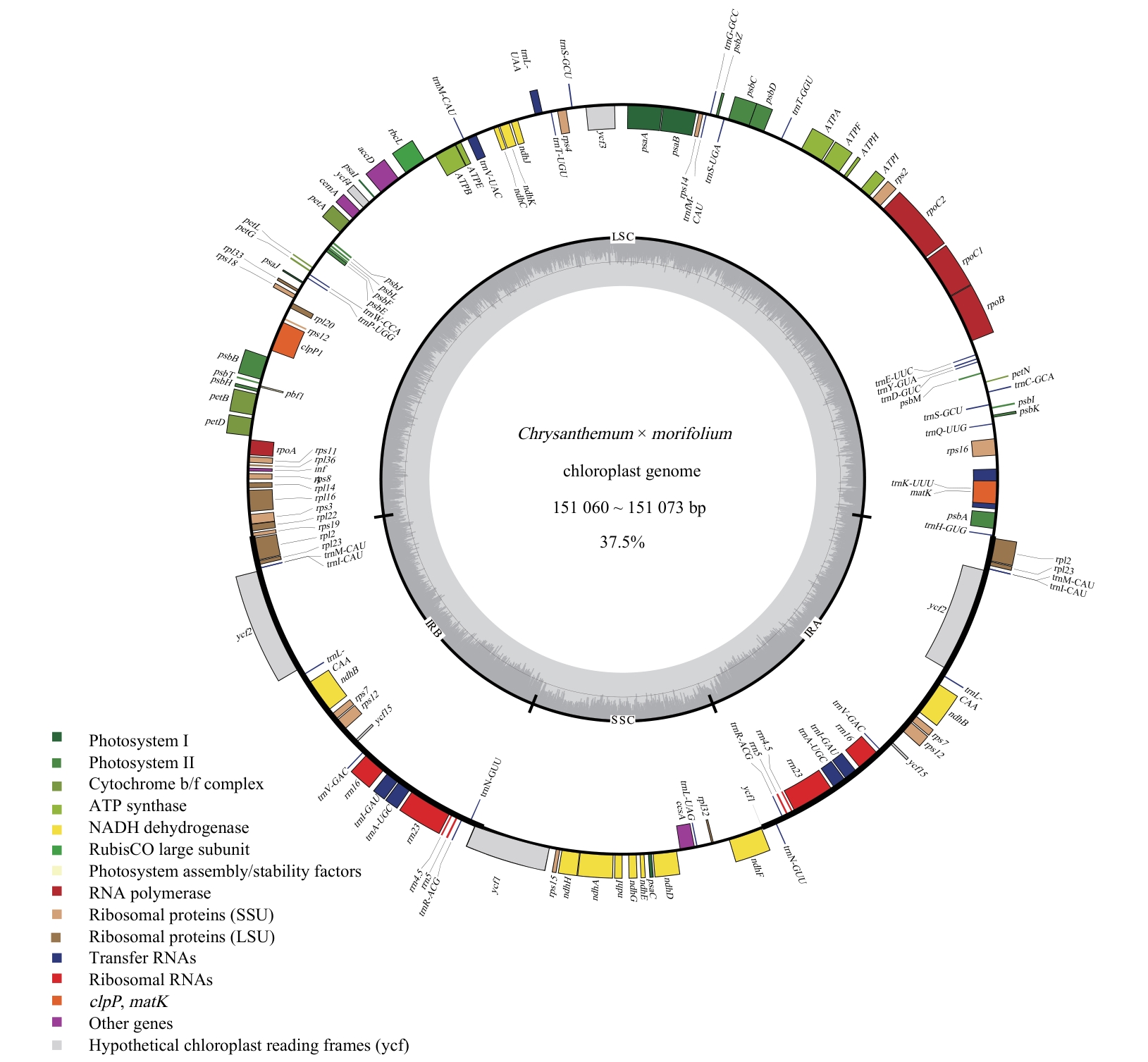
图1 三个菊花叶绿体基因组结构图
Fig. 1 Chloroplast genome structural map of three chloroplast genomes of C. morifolium
品种名 Cultivar | 栽培类型 Cultivated type | 登录号 GenBank accession No. | 碱基长度 Base length (bp) | LSC length (bp) | SSC length (bp) | IR length (bp) | GC含量 GC content (%) | tRNA | rRNA | 蛋白编码 基因 PCGs | 基因数 No. of genes |
|---|---|---|---|---|---|---|---|---|---|---|---|
| C. morifolium ‘Bei Lin Qiu Yun’ | 地被菊 Groundcover chrysanthemum | PX591007 | 151 073 | 82 843 | 18 324 | 49 906 | 37.5 | 37 | 8 | 86 | 131 |
| C.morifolium ‘Sheng Xue’ | 单头切花菊 Single-headed cut chrysanthemum | PX662740 | 151 060 | 82 858 | 18 294 | 49 908 | 37.5 | 37 | 8 | 86 | 131 |
| C. morifolium ‘Fen Shi Ba’ | 传统大菊 Traditional large-flowered chrysanthemum | PX635362 | 151 060 | 82 858 | 18 294 | 49 908 | 37.5 | 37 | 8 | 86 | 131 |
表1 菊花叶绿体基因组信息
Table 1 Chloroplast genome information of C. morifolium
品种名 Cultivar | 栽培类型 Cultivated type | 登录号 GenBank accession No. | 碱基长度 Base length (bp) | LSC length (bp) | SSC length (bp) | IR length (bp) | GC含量 GC content (%) | tRNA | rRNA | 蛋白编码 基因 PCGs | 基因数 No. of genes |
|---|---|---|---|---|---|---|---|---|---|---|---|
| C. morifolium ‘Bei Lin Qiu Yun’ | 地被菊 Groundcover chrysanthemum | PX591007 | 151 073 | 82 843 | 18 324 | 49 906 | 37.5 | 37 | 8 | 86 | 131 |
| C.morifolium ‘Sheng Xue’ | 单头切花菊 Single-headed cut chrysanthemum | PX662740 | 151 060 | 82 858 | 18 294 | 49 908 | 37.5 | 37 | 8 | 86 | 131 |
| C. morifolium ‘Fen Shi Ba’ | 传统大菊 Traditional large-flowered chrysanthemum | PX635362 | 151 060 | 82 858 | 18 294 | 49 908 | 37.5 | 37 | 8 | 86 | 131 |
功能 Functions | 基因分组 Gene grouping | 基因名 Gene name |
|---|---|---|
自我复制 Self-replication | 核糖体大亚基 Large ribosomal subunit | rpl32, rpl23(2), rpl2*(2), rpl22, rpl16, rpl14, rpl36, rpl20, rpl33 |
| 核糖体小亚基 Small ribosomal subunit | rps15, rps12, rps12-5end*, rps12-3end*, rps7(2), rps19, rps3, rps8, rps11, rps18, rps4, rps14, rps2, rps16* | |
| RNA聚合酶 RNA polymerase | rpoA, rpoC2, rpoC1, rpoB | |
| 核糖体RNA Ribosomal RNA | rrn5(2), rrn4.5(2), rrn23(2), rrn16(2) | |
| 转运RNA Transfer RNA | trnL-UAG, trnN-GUU(2), trnR-ACG(2), trnA-UGC*(2), trnI-GAU(2)*, trnI-CAU(2), trnV-GAC(2), trnL-CAA(2), trnM-CAU(2), trnP-UGG, trnW-CCA, trnV-UAC*, trnF-GAA, trnL-UAA*, trnT-UGU, trnS-GGA, trnG-GCC, trnS-UGA, trnT-GGU, trnG-UCC*, trnR-UCU, trnE-UUC, trnY-GUA, trnD-GUC, trnC-GCA, trnS-GCU, trnQ-UUG, trnK-UUU*, trnH-GUG | |
光合作用 Photosynthesis | 光系统I基因 Photosystem I gene | psaC, psaJ, psaI, psaA, psaB |
| 光系统II基因 Photosystem II gene | psbH,,psbT, psbB, psbE, psbF, psbL, psbJ, psbZ, psbC, psbD, psbM, psbI, psbK, psbA | |
NADH氧化还原酶 NADH dehydrogenase | ndhH, ndhA, ndhI, ndhG, ndhE, ndhD, ndhF, ndhB*(2), ndhC, ndhK, ndhJ | |
细胞色素复合物基因 Cytochrome complex gene | petB*, petG, petL, petA, petN | |
| ATP合酶 ATP synthase | atpB, atpE, atpA, atpF*, atpH, atpI | |
| Rubisco大亚基 Large subunit of Rubisco | rbcL | |
其他基因 Other gene | 成熟酶 Maturase | matK |
翻译起始因子 Translational initiation factor | infA | |
| 蛋白酶 Protease | clpP1** | |
| 被膜蛋白 Envelop membrane protein | cemA | |
乙酰辅酶A亚基 Acetyl-CoA carboxylase subunit | accD | |
C型细胞色素合成基因 C-type cytochrome synthesis gene | ccsA | |
| 功能未知基因Genes of unknown function | 保守的假定叶绿体开放阅读框ORF Conserved hypothetical chloroplast ORF | ycf1, φycf1, ycf15(2), ycf2(2), ycf3**, ycf4 |
表2 菊花叶绿体基因组基因功能注释与分类
Table 2 Functional annotation and classification of genes in the chloroplast genome of C. morifolium
功能 Functions | 基因分组 Gene grouping | 基因名 Gene name |
|---|---|---|
自我复制 Self-replication | 核糖体大亚基 Large ribosomal subunit | rpl32, rpl23(2), rpl2*(2), rpl22, rpl16, rpl14, rpl36, rpl20, rpl33 |
| 核糖体小亚基 Small ribosomal subunit | rps15, rps12, rps12-5end*, rps12-3end*, rps7(2), rps19, rps3, rps8, rps11, rps18, rps4, rps14, rps2, rps16* | |
| RNA聚合酶 RNA polymerase | rpoA, rpoC2, rpoC1, rpoB | |
| 核糖体RNA Ribosomal RNA | rrn5(2), rrn4.5(2), rrn23(2), rrn16(2) | |
| 转运RNA Transfer RNA | trnL-UAG, trnN-GUU(2), trnR-ACG(2), trnA-UGC*(2), trnI-GAU(2)*, trnI-CAU(2), trnV-GAC(2), trnL-CAA(2), trnM-CAU(2), trnP-UGG, trnW-CCA, trnV-UAC*, trnF-GAA, trnL-UAA*, trnT-UGU, trnS-GGA, trnG-GCC, trnS-UGA, trnT-GGU, trnG-UCC*, trnR-UCU, trnE-UUC, trnY-GUA, trnD-GUC, trnC-GCA, trnS-GCU, trnQ-UUG, trnK-UUU*, trnH-GUG | |
光合作用 Photosynthesis | 光系统I基因 Photosystem I gene | psaC, psaJ, psaI, psaA, psaB |
| 光系统II基因 Photosystem II gene | psbH,,psbT, psbB, psbE, psbF, psbL, psbJ, psbZ, psbC, psbD, psbM, psbI, psbK, psbA | |
NADH氧化还原酶 NADH dehydrogenase | ndhH, ndhA, ndhI, ndhG, ndhE, ndhD, ndhF, ndhB*(2), ndhC, ndhK, ndhJ | |
细胞色素复合物基因 Cytochrome complex gene | petB*, petG, petL, petA, petN | |
| ATP合酶 ATP synthase | atpB, atpE, atpA, atpF*, atpH, atpI | |
| Rubisco大亚基 Large subunit of Rubisco | rbcL | |
其他基因 Other gene | 成熟酶 Maturase | matK |
翻译起始因子 Translational initiation factor | infA | |
| 蛋白酶 Protease | clpP1** | |
| 被膜蛋白 Envelop membrane protein | cemA | |
乙酰辅酶A亚基 Acetyl-CoA carboxylase subunit | accD | |
C型细胞色素合成基因 C-type cytochrome synthesis gene | ccsA | |
| 功能未知基因Genes of unknown function | 保守的假定叶绿体开放阅读框ORF Conserved hypothetical chloroplast ORF | ycf1, φycf1, ycf15(2), ycf2(2), ycf3**, ycf4 |
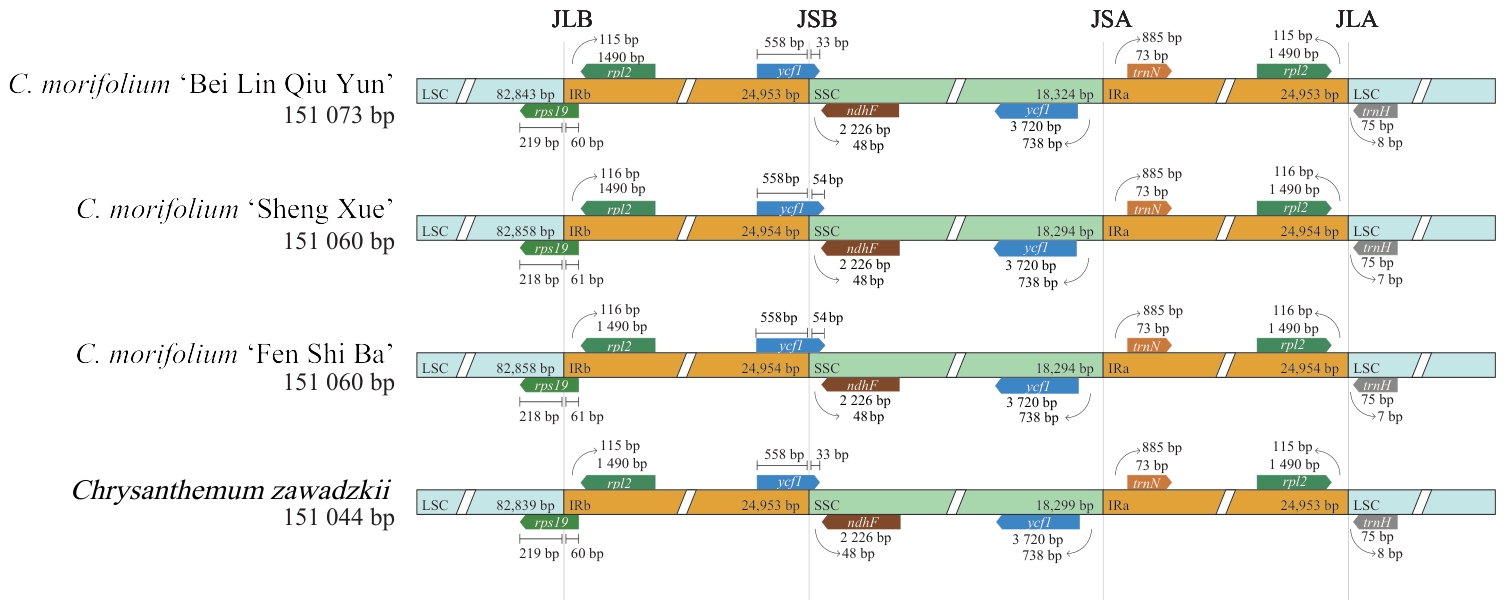
图2 菊花叶绿体基因组IR/SC边界分析
Fig. 2 IR/SC boundary analysis of the chloroplast genome of C. morifolium
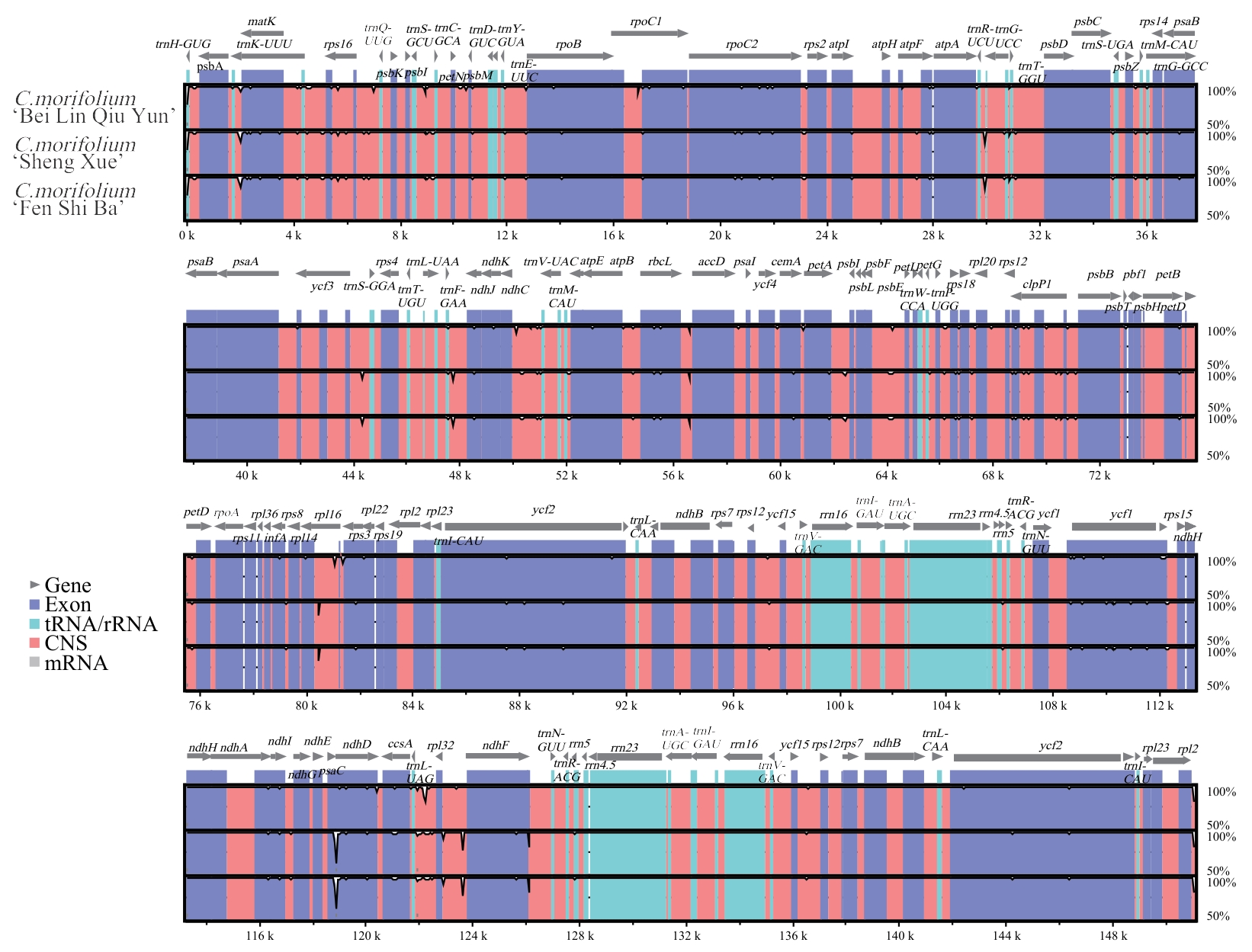
图3 菊花叶绿体基因组全局比对分析
Fig. 3 Global alignment analysis of chloroplast genomes of C. morifolium
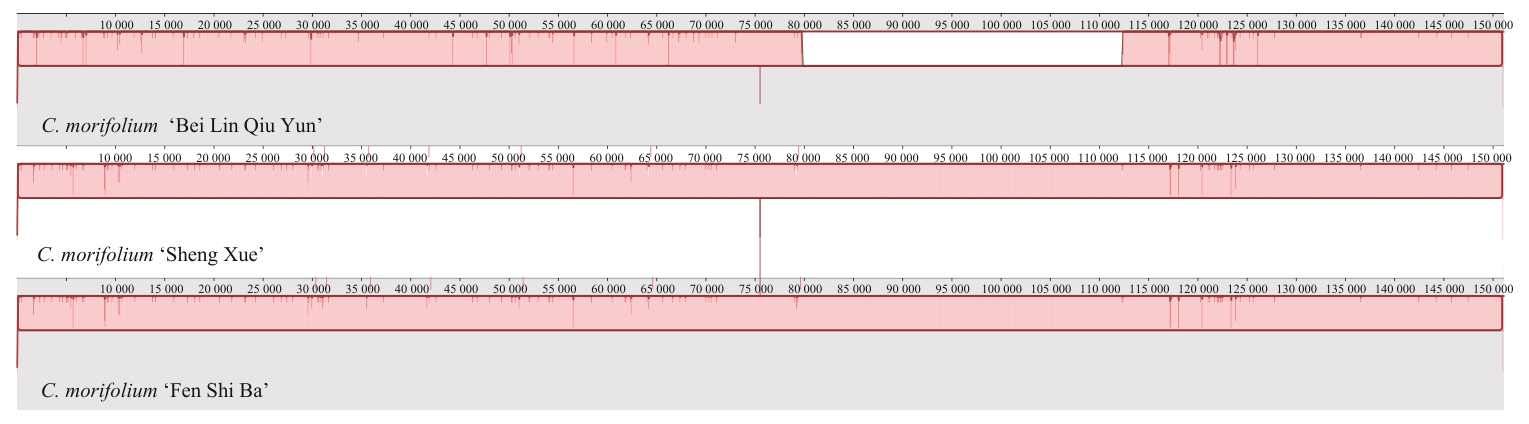
图4 菊花叶绿体基因组共线性分析
Fig. 4 Collinearity analysis of the chloroplast genome of C. morifolium
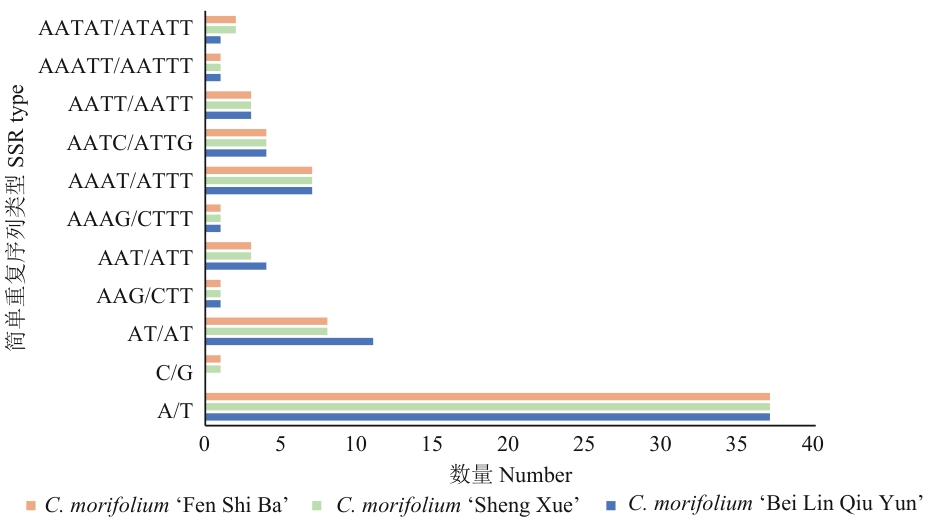
图5 菊花叶绿体基因组中的简单序列重复类型与数量
Fig. 5 Types of simple sequence repeats in the chloroplast genome of C. morifolium
| 品种名 Cultivar | 密码子适应指数CAI | 密码子偏性指数CBI | 有效密码子数ENC | GC1 (%) | GC2 (%) | GC3 (%) |
|---|---|---|---|---|---|---|
| C. morifolium ‘Bei Lin Qiu Yun’ | 0.168 | -0.107 | 49.127 | 45.95 | 38.05 | 29.08 |
| C. morifolium ‘Sheng Xue’ | 0.169 | -0.102 | 49.420 | 46.64 | 38.70 | 29.46 |
| C. morifolium ‘Fen Shi Ba’ | 0.169 | -0.103 | 49.407 | 46.89 | 38.88 | 29.44 |
表3 菊花叶绿体基因组密码子基本参数
Table 3 Basic parameters of codon in the chloroplast genome of C. morifolium
| 品种名 Cultivar | 密码子适应指数CAI | 密码子偏性指数CBI | 有效密码子数ENC | GC1 (%) | GC2 (%) | GC3 (%) |
|---|---|---|---|---|---|---|
| C. morifolium ‘Bei Lin Qiu Yun’ | 0.168 | -0.107 | 49.127 | 45.95 | 38.05 | 29.08 |
| C. morifolium ‘Sheng Xue’ | 0.169 | -0.102 | 49.420 | 46.64 | 38.70 | 29.46 |
| C. morifolium ‘Fen Shi Ba’ | 0.169 | -0.103 | 49.407 | 46.89 | 38.88 | 29.44 |
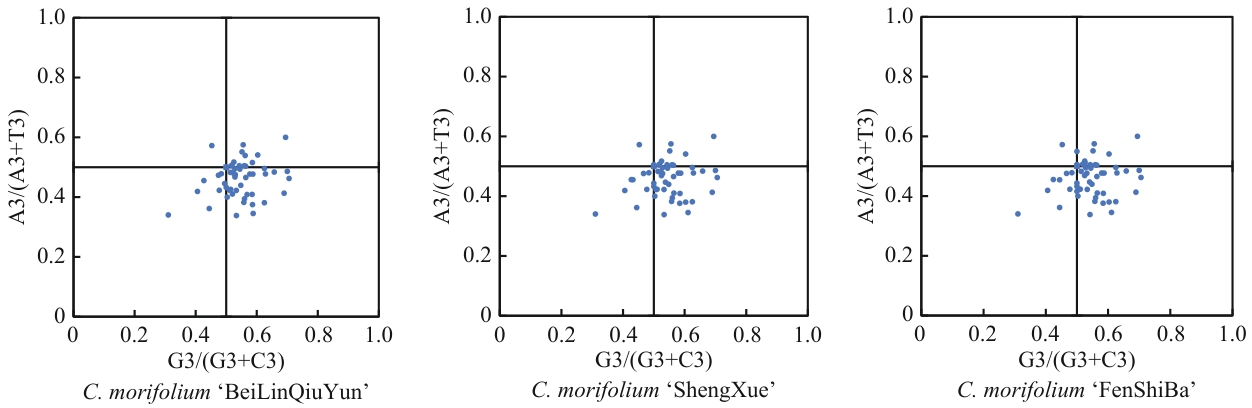
图6 PR2-plot分析
Fig. 6 Analysis of PR2-plot
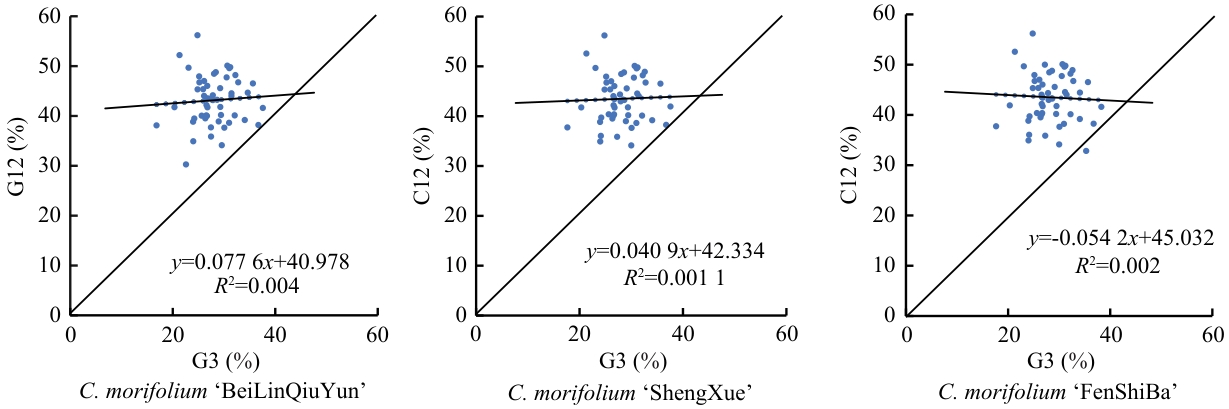
图7 中性绘图分析
Fig. 7 Analysis of neutrality plot
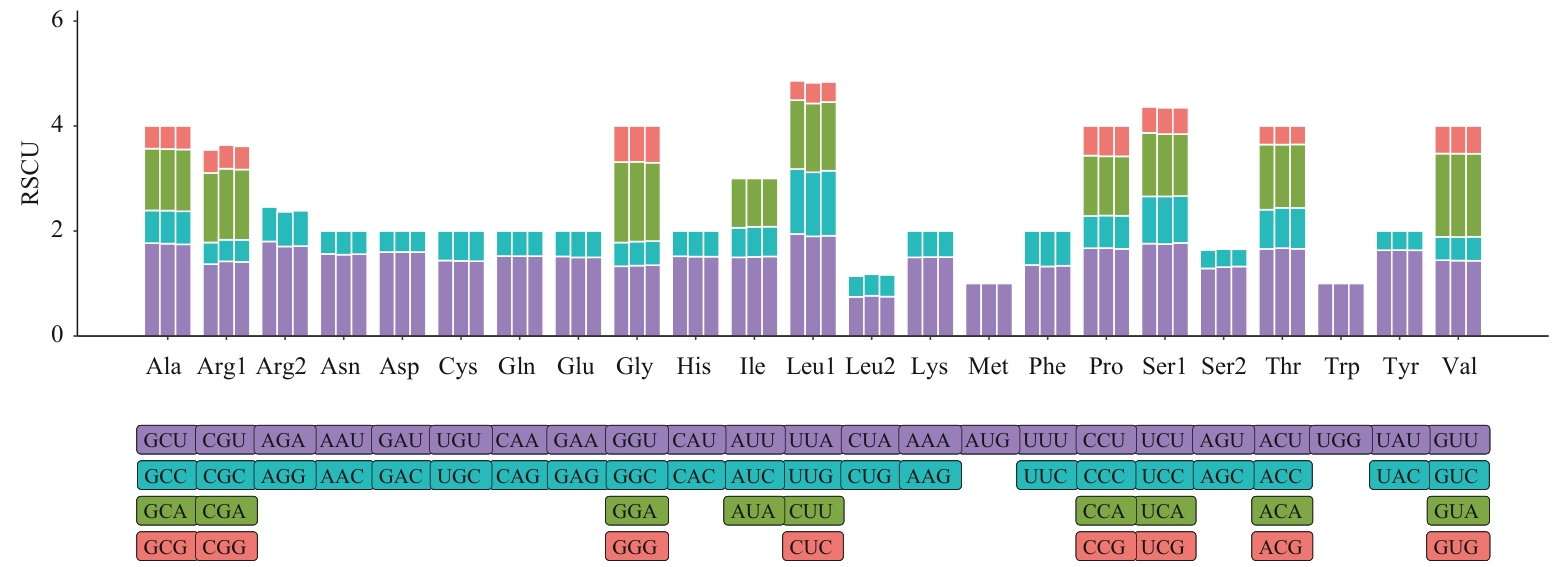
图8 相对同义密码子使用频率(RSCU)分析每种氨基酸从左到右对应的条形柱依次代表C. morifolium ‘Bei Lin Qiu Yun’、C. morifolium ‘Sheng Xue’、C. morifolium ‘Fen Shi Ba’
Fig. 8 Relative synonymous codon usage (RSCU) analysisFrom left to right, the bars for each amino acid represent C. morifolium ‘Bei Lin Qiu Yun’, C. morifolium ‘Sheng Xue’, and C. morifolium ‘Fen Shi Ba’
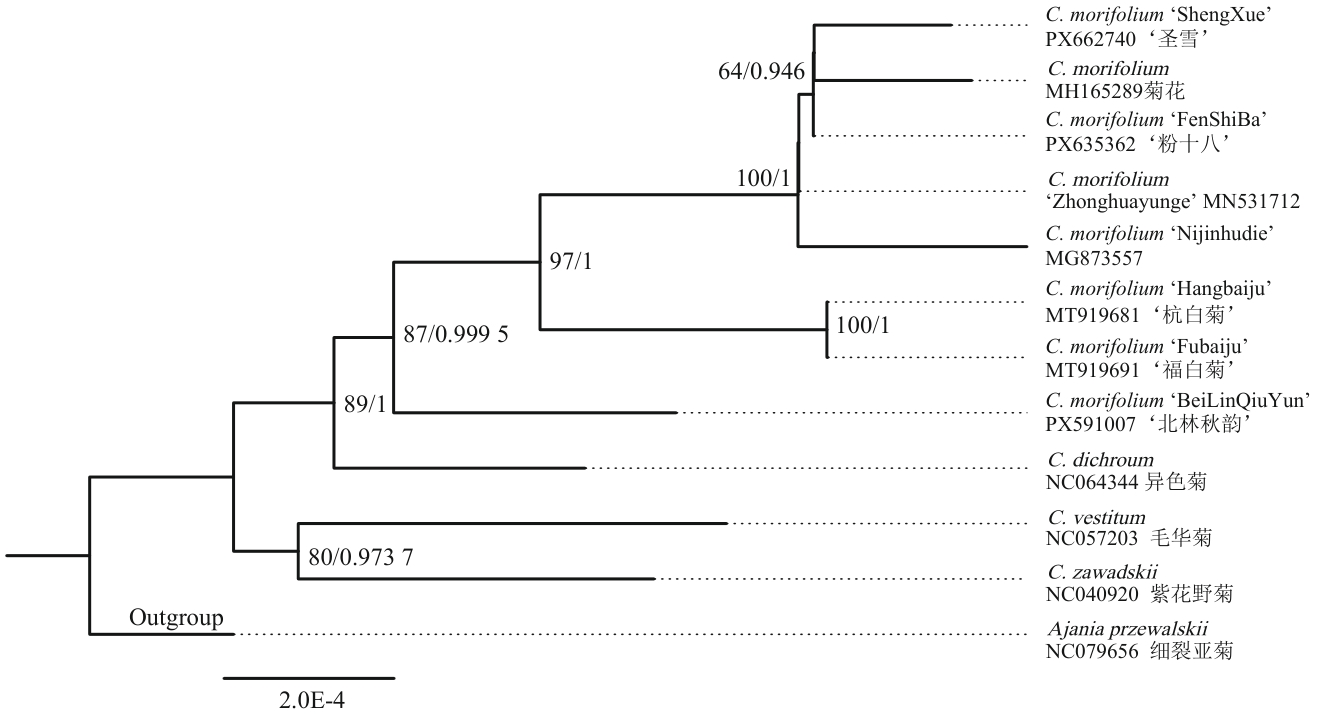
图9 最大似然法(ML)、贝叶斯法(BI)推定12个菊科植物系统发育关系分支上的数字分别为ML法和BI法的支持值(BP,PP)
Fig. 9 Phylogenetic relationships of 12 Asteraceae species inferred by maximum likelihood (ML) and Bayesian inference (BI) methodsThe numbers on the branches indicate the support values from the ML and BI methods (BP and PP), respectively
| [1] | Yuan HW, Jiang S, Liu YK, et al. The flower head of Chrysanthemum morifolium Ramat. (Juhua): a paradigm of flowers serving as Chinese dietary herbal medicine [J]. J Ethnopharmacol, 2020, 261: 113043. |
| [2] | Hu J, Ma W, Li N, et al. Antioxidant and anti-inflammatory flavonoids from the flowers of chuju, a medical cultivar of Chrysanthemum morifolim Ramat [J]. J Mex Chem Soc, 2018, 61(4): 282-289. |
| [3] | Pan B, Du YX, Chen QB, et al. China’s Chrysanthemum in the global market: evaluating the international competitiveness and influencing factors [J]. Front Sustain Food Syst, 2025, 9: 1521709. |
| [4] | Van Huylenbroeck J. Ornamental Crops [M]. Cham: Springer International Publishing, 2018. |
| [5] | 李鸿渐, 邵健文. 中国菊花品种资源的调查收集与分类 [J]. 南京农业大学学报, 1990, 13(1): 30-36. |
| Li HJ, Shao JW. Investigation, collection and classification of Chrysanthemum cultivars in China [J]. J Nanjing Agric Univ, 1990, 13(1): 30-36. | |
| [6] | Zhang Y, Luo XY, Zhu J, et al. A classification study for chrysanthemum (Chrysanthemum × grandiflorum Tzvelv.) cultivars based on multivariate statistical analyses [J]. J Sytematics Evolution, 2014, 52(5): 612-628. |
| [7] | Yang YY, Wen C, Ma N, et al. Heterosis and genetic analysis of branching in cut-flower chrysanthemums [J]. Euphytica, 2015, 205(3): 915-925. |
| [8] | 韩勇. 切花菊品质综合评价体系的构建及性状遗传分析 [D]. 南京: 南京农业大学, 2011. |
| Han Y. Study on comprehensive evaluation system of cut chrysanthemum and genetic analysis of main characters [D]. Nanjing: Nanjing Agricultural University, 2011. | |
| [9] | Sun MX, Zhang JY, Lu JS, et al. Intelligent evaluation of ornamental characteristics of garden chrysanthemums using unmanned aerial vehicle (UAV)-based RGB imagery [J]. Sci Hortic, 2025, 350: 114374. |
| [10] | Kirchhoff H. Chloroplast ultrastructure in plants [J]. New Phytol, 2019, 223(2): 565-574. |
| [11] | Li MM, Geng ML, Zhou YF, et al. Integrative chloroplast genomics unravels phylogenetic discordance in Glehnia (Apiaceae) [J]. Ind Crops Prod, 2025, 236: 121978. |
| [12] | Zhao CH, Li XY, Lan X, et al. Cytotype classification and genetic diversity of Platostoma palustre revealed by rDNA localization and chloroplast genome [J]. BMC Genom, 2025, 26: 937. |
| [13] | Yin DM, Wang Y, Zhang XG, et al. Development of chloroplast genome resources for peanut (Arachis hypogaea L.) and other species of Arachis [J]. Sci Rep, 2017, 7: 11649. |
| [14] | Zhu AD, Guo WH, Gupta S, et al. Evolutionary dynamics of the plastid inverted repeat: the effects of expansion, contraction, and loss on substitution rates [J]. New Phytol, 2016, 209(4): 1747-1756. |
| [15] | Park SK, Kwon SJ, Park J, et al. Chloroplast genome of white wild Chrysanthemum, Dendranthema sp. K247003, as genetic barcode [J]. J Species Res, 2015, 4(2): 152-158. |
| [16] | Tyagi S, Jung JA, Kim JS, et al. The complete chloroplast genome of an economic plant, Chrysanthemum morifolium ‘Baekma’ [J]. Mitochondrial DNA Part B, 2019, 4(2): 3133-3134. |
| [17] | Zeng T, Li JW, Fu Q, et al. The complete chloroplast of Chrysanthemum × morifolium ‘fubaiju’ [J]. Mitochondrial DNA Part B, 2021, 6(10): 3062-3063. |
| [18] | Xu YF, Liao BR, Ostevik KL, et al. The maternal donor of Chrysanthemum cultivars revealed by comparative analysis of the chloroplast genome [J]. Front Plant Sci, 2022, 13: 923442. |
| [19] | Parvathy ST, Udayasuriyan V, Bhadana V. Codon usage bias [J]. Mol Biol Rep, 2022, 49(1): 539-565. |
| [20] | 刘慧, 王梦醒, 岳文杰, 等. 糜子叶绿体基因组密码子使用偏性的分析 [J]. 植物科学学报, 2017, 35(3): 362-371. |
| Liu H, Wang MX, Yue WJ, et al. Analysis of codon usage in the chloroplast genome of broomcorn millet (Panicum miliaceum L.) [J]. Plant Sci J, 2017, 35(3): 362-371. | |
| [21] | Jin JJ, Yu WB, Yang JB, et al. GetOrganelle: a fast and versatile toolkit for accurate de novo assembly of organelle genomes [J]. Genome Biol, 2020, 21: 241. |
| [22] | Liu C, Shi LC, Zhu YJ, et al. CpGAVAS, an integrated web server for the annotation, visualization, analysis, and GenBank submission of completely sequenced chloroplast genome sequences [J]. BMC Genom, 2012, 13(1): 715. |
| [23] | Kearse M, Moir R, Wilson A, et al. Geneious Basic: an integrated and extendable desktop software platform for the organization and analysis of sequence data [J]. Bioinformatics, 2012, 28(12): 1647-1649. |
| [24] | Greiner S, Lehwark P, Bock R. OrganellarGenomeDRAW (OGDRAW) version 1.3.1: expanded toolkit for the graphical visualization of organellar genomes [J]. Nucleic Acids Res, 2019, 47(W1): W59-W64. |
| [25] | Li HE, Guo QQ, Xu L, et al. CPJSdraw: analysis and visualization of junction sites of chloroplast genomes [J]. PeerJ, 2023, 11: e15326. |
| [26] | Frazer KA, Pachter L, Poliakov A, et al. VISTA: computational tools for comparative genomics [J]. Nucleic Acids Res, 2004, 32(): W273-W279. |
| [27] | Darling ACE, Mau B, Blattner FR, et al. Mauve: multiple alignment of conserved genomic sequence with rearrangements [J]. Genome Res, 2004, 14(7): 1394-1403. |
| [28] | Thiel T, Michalek W, Varshney R, et al. Exploiting EST databases for the development and characterization of gene-derived SSR-markers in barley (Hordeum vulgare L.) [J]. Theor Appl Genet, 2003, 106(3): 411-422. |
| [29] | Wang ZJ, Cai QW, Wang Y, et al. Comparative analysis of codon bias in the chloroplast genomes of Theaceae species [J]. Front Genet, 2022, 13: 824610. |
| [30] | Sharp PM, Li WH. An evolutionary perspective on synonymous codon usage in unicellular organisms [J]. J Mol Evol, 1986, 24(1/2): 28-38. |
| [31] | 尚明照, 刘方, 华金平, 等. 陆地棉叶绿体基因组密码子使用偏性的分析 [J]. 中国农业科学, 2011, 44(2): 245-253. |
| Shang MZ, Liu F, Hua JP, et al. Analysis on codon usage of chloroplast genome of Gossypium hirsutum [J]. Sci Agric Sin, 2011, 44(2): 245-253. | |
| [32] | 秦政, 郑永杰, 桂丽静, 等. 樟树叶绿体基因组密码子偏好性分析 [J]. 广西植物, 2018, 38(10): 1346-1355. |
| Qin Z, Zheng YJ, Gui LJ, et al. Codon usage bias analysis of chloroplast genome of Camphora tree (Cinnamomum camphora) [J]. Guihaia, 2018, 38(10): 1346-1355. | |
| [33] | Fu LF, Xin ZB, Wen F, et al. Complete chloroplast genome sequence of Elatostema dissectum (Urticaceae) [J]. Mitochondrial DNA Part B, 2019, 4(1): 838-839. |
| [34] | Zhang D, Gao FL, Jakovlić I, et al. PhyloSuite: an integrated and scalable desktop platform for streamlined molecular sequence data management and evolutionary phylogenetics studies [J]. Mol Ecol Resour, 2020, 20(1): 348-355. |
| [35] | Ronquist F, Teslenko M, van der Mark P, et al. MrBayes 3.2: efficient Bayesian phylogenetic inference and model choice across a large model space [J]. Syst Biol, 2012, 61(3): 539-542. |
| [36] | Suchard MA, Lemey P, Baele G, et al. Bayesian phylogenetic and phylodynamic data integration using BEAST 1.10 [J]. Virus Evol, 2018, 4(1): vey016. |
| [37] | Khade YP, Mainkar P, Chandanshive A, et al. Harnessing chloroplast SSRs to decipher genetic diversity in underutilized Allium species [J]. Front Plant Sci, 2025, 16: 1645145. |
| [38] | Xia Y, Hu ZG, Li XW, et al. The complete chloroplast genome sequence of Chrysanthemum indicum [J]. Mitochondrial DNA Part A, 2016, 27(6): 4668-4669. |
| [39] | Baek J, Park S, Lee J, et al. The complete chloroplast genome of Chrysanthemum zawadskii Herbich (Asteraceae) isolated in Korea [J]. Mitochondrial DNA Part B, 2021, 6(7): 1956-1958. |
| [40] | Guo YY, Yang JX, Li HK, et al. Chloroplast genomes of two species of Cypripedium: expanded genome size and proliferation of AT-biased repeat sequences [J]. Front Plant Sci, 2021, 12: 609729. |
| [41] | Ma YP, Chen MM, Wei JX, et al. Origin of Chrysanthemum cultivars—Evidence from nuclear low-copy LFY gene sequences [J]. Biochem Syst Ecol, 2016, 65: 129-136. |
| [42] | Yang Z, Ma WX, Yang XH, et al. Plastome phylogenomics provide new perspective into the phylogeny and evolution of Betulaceae (Fagales) [J]. BMC Plant Biol, 2022, 22: 611. |
| [43] | Meng XX, Xian YF, Xiang L, et al. Complete chloroplast genomes from Sanguisorba: identity and variation among four species [J]. Molecules, 2018, 23(9): 2137. |
| [44] | Zhang L, Zhang CP, Zhang ED, et al. Hybridization of Lycium qingshuiheense and L. ningxiaense revealed using morphological, SSR markers, and chloroplast genomic data [J]. BMC Genom, 2025, 26: 965. |
| [45] | Gong YH, Qin YL, Luo T, et al. Complete chloroplast genome sequence and phylogenetic analysis of Lactuca sativa var. ramosa hort [J]. Genet Resour Crop Evol, 2025, 72(6): 7531-7546. |
| [46] | Liu X, Zhou BY, Yang HY, et al. Sequencing and analysis of Chrysanthemum carinatum schousb and Kalimeris indica. The complete chloroplast genomes reveal two inversions and rbcL as barcoding of the vegetable [J]. Molecules, 2018, 23(6): 1358. |
| [47] | Wu CW, Liu R, Li CH, et al. Comparative analysis of codon usage bias and phylogenetic relationships in chloroplast genomes across 49 Dendrobium species [J]. BMC Plant Biol, 2025, 25: 1411. |
| [48] | Xie P, Wu JR, Lu MY, et al. Assembly and comparative analysis of the complete mitochondrial genome of Fritillaria ussuriensis Maxim. (Liliales: Liliaceae), an endangered medicinal plant [J]. BMC Genom, 2024, 25: 773. |
| [49] | Yengkhom S, Uddin A, Chakraborty S. Deciphering codon usage patterns and evolutionary forces in chloroplast genes of Camellia sinensis var. assamica and Camellia sinensis var. sinensis in comparison to Camellia pubicosta [J]. J Integr Agric, 2019, 18(12): 2771-2785. |
| [50] | Li RX, Wang B, Xiao SQ, et al. Characterization of the complete chloroplast genome and comparative analysis of the phylogeny and codon usage bias of three Yunnan wild rice species [J]. Front Plant Sci, 2025, 16: 1555104. |
| [51] | Yang R, Xue Y, He XF, et al. Comprehensive analysis of chloroplast genomes in leguminous forage species: codon usage, phylogenetic relationships, and evolutionary insights [J]. Agronomy, 2025, 15(4): 765. |
| [52] | Shi NX, Yuan YW, Huang RJ, et al. Analysis of codon usage patterns in complete plastomes of four medicinal Polygonatum species (Asparagaceae) [J]. Front Genet, 2024, 15: 1401013. |
| [53] | Yao ZL, Miao JS, Xu WD, et al. The complete chloroplast genome sequence of a cultivar of Chrysanthemum, Chrysanthemum × morifolium ‘Hangbaiju’ (Asteraceae) [J]. Mitochondrial DNA Part B, 2024, 9(3): 403-407. |
| [54] | Duan YY, Wang YQ, Ding WY, et al. Comparative and phylogenetic analysis of the chloroplast genomes of four commonly used medicinal cultivars of Chrysanthemums morifolium [J]. BMC Plant Biol, 2024, 24: 992. |
| [55] | Chong XR, Zhang F, Wu YY, et al. A SNP-enabled assessment of genetic diversity, evolutionary relationships and the identification of candidate genes in Chrysanthemum [J]. Genome Biol Evol, 2016, 8(12): 3661-3671. |
| [1] | 汪志, 胡光明, 罗轩, 高磊, 叶丽霞, 黄穷, 肖涛, 张蕾. 革叶猕猴桃叶绿体基因组特征及系统发育分析[J]. 生物技术通报, 2026, 42(8): 173-187. |
| [2] | 杨东升, 牛誉驰, 卢倩倩, 樊敬镛, 刘雨雷, 刘权, 郭利平, 郝水源. 29份苏丹草种质材料的SSR指纹图谱构建及分析[J]. 生物技术通报, 2026, 42(6): 198-207. |
| [3] | 梁慧琪, 陈益存, 汪阳东, 赵耘霄, 高暝. 山苍子PAT1基因亚家族鉴定及其在嫁接愈合过程中的表达分析[J]. 生物技术通报, 2026, 42(5): 302-311. |
| [4] | 卢瑶, 袁平平, 金鑫, 毛向红, 范向斌, 白小东. 基于SSR标记的马铃薯野生种和地方种遗传多样性分析和指纹图谱构建[J]. 生物技术通报, 2025, 41(9): 94-104. |
| [5] | 裴红霞, 汪露瑶, 李生梅, 高晶霞. 基于SCoT、SRAP和SSR分子标记的220份辣椒种质资源遗传多样性分析[J]. 生物技术通报, 2025, 41(8): 165-174. |
| [6] | 魏瑶, 张晶晶, 崔云晓, 刘钰, 刘海瑞. 忍冬属忍冬组植物叶绿体基因组进化分析[J]. 生物技术通报, 2025, 41(8): 276-288. |
| [7] | 黄旭升, 周雅莉, 柴旭东, 闻婧, 王计平, 贾小云, 李润植. 紫苏质体型PfLPAT1B基因的克隆及其在油脂合成中的功能分析[J]. 生物技术通报, 2025, 41(7): 226-236. |
| [8] | 段敏杰, 李怡斐, 王春萍, 黄任中, 黄启中, 张世才. 辣椒果实颜色性状与SSR分子标记的关联分析及指纹图谱构建[J]. 生物技术通报, 2025, 41(7): 81-94. |
| [9] | 段永红, 杨欣, 于冠群, 夏俊俊, 宋陆帅, 白小东, 彭锁堂. 125份马铃薯种质资源遗传多样性及主成分分析[J]. 生物技术通报, 2025, 41(6): 130-143. |
| [10] | 安昌, 徐文波, 陆琳, 李登麟, 姚艺新, 林彦翔, 杨成梓, 秦源, 郑平. 不同产地珊瑚菜叶绿体基因组特征的差异性研究[J]. 生物技术通报, 2025, 41(6): 229-242. |
| [11] | 李斌, 苏香萍, 刘畅, 王玉兵, 张勇洪, 周超, 徐青. 玄参科植物叶绿体基因组特征及系统发育分析[J]. 生物技术通报, 2025, 41(3): 240-254. |
| [12] | 杨晨欣, 李梦秀, 姜唐, 张文娥, 潘学军. 美人蕉R2R3-MYB基因家族的鉴定及与花青素相关成员的表达分析[J]. 生物技术通报, 2025, 41(12): 201-213. |
| [13] | 杜雨晴, 蒋路园, 汪奕衡, 吴宸炜, 杨梦露, 刘旭升, 王晓君, 邱德有, 樊玮, 杨艳芳. 太行山地区南方红豆杉SSR遗传多样性分析[J]. 生物技术通报, 2025, 41(12): 214-224. |
| [14] | 司旭鹏, 崔秀文, 欧阳荔枝, 房丹丹, 裴龙英, 方贵平, 濮希蕾, 马艺沔, 张争. 新疆阿魏不同部位转录组特征分析及倍半萜合成相关基因挖掘[J]. 生物技术通报, 2025, 41(12): 280-293. |
| [15] | 秦文俊, 熊言杰, 赵冉, 马萧然, 叶霄萌, 宋江华. 甘蓝ARF基因家族的鉴定及其在非生物胁迫下的表达分析[J]. 生物技术通报, 2025, 41(10): 253-263. |
| 阅读次数 | ||||||
|
全文 |
|
|||||
|
摘要 |
|
|||||
