







生物技术通报 ›› 2025, Vol. 41 ›› Issue (4): 88-97.doi: 10.13560/j.cnki.biotech.bull.1985.2024-1178
文博霖1( ), 万敏1,2, 胡建军3,4, 王克秀3,4, 景晟林1,2, 王心悦1, 朱博1,2, 唐铭霞3,4, 李兵3,4, 何卫3,4, 曾子贤1,2()
收稿日期:2024-12-05
出版日期:2025-04-26
发布日期:2025-04-25
通讯作者:
曾子贤,男,教授,研究方向 :马铃薯功能基因组学、表观基因组学及生物信息学;E-mail: zengzixian@sicnu.edu.cn作者简介:文博霖,男,硕士研究生,研究方向 :马铃薯功能基因组学;E-mail: w1666425267@163.com
基金资助:
WEN Bo-lin1(), WAN Min1,2, HU Jian-jun3,4, WANG Ke-xiu3,4, JING Sheng-lin1,2, WANG Xin-yue1, ZHU Bo1,2, TANG Ming-xia3,4, LI Bing3,4, HE Wei3,4, ZENG Zi-xian1,2()
Received:2024-12-05
Published:2025-04-26
Online:2025-04-25
摘要:
目的 构建马铃薯川芋50的遗传转化体系和基因编辑体系。 方法 以四川省主导品种川芋50无菌脱毒组培苗茎段和叶片为外植体,用农杆菌介导法将含有植物敲除载体质粒pJCV55-StU6-200-StUBI10-T#01转化马铃薯外植体,分析4种不同植物激素配比的培养基体系对马铃薯愈伤组织诱导和分化的影响,探究川芋50的基因编辑、阳性植株鉴定方法。 结果 1)最适马铃薯川芋50遗传转化的培养基体系为B体系。茎段和叶片预培养及愈伤组织诱导的培养基配方分别为:MS 基础盐+20 g/L蔗糖+1 mL/L 1 000× N&N维生素(1 000× Nitsch & Nitsch Vitamin Solution, 1 000× N&N维生素)+1.0 mg/L TZR(trans-zeatin-riboside, TZR)+0.027 8 mg/L GA3(gibberellin A3, GA3)+0.02 mg/L NAA(1-naphthaleneacetic acid, NAA)+2.0 g/L Phytagel和MS基础盐+20 g/L蔗糖+1 mL/L 1 000× N&N维生素+0.5 mg/L TZR+2.5 mg/L IAA(indole acetic acid, IAA)+2.0 g/L Phytagel,愈伤诱导率分别为93%和88%。愈伤组织分化的培养基为:MS基础盐+20 g/L蔗糖+1 mL/L 1 000× N&N维生素+2.0 mg/L TZR+10 mg/L GA3+2.0 g/L Phytagel;2)证明了二次生根筛选法可准确鉴定马铃薯转基因阳性植株,准确率100%;3)建立了针对川芋50的农杆菌介导CRISPR/Cas9基因编辑体系,编辑率63%。 结论 通过对愈伤再生过程中各个影响因素进行试验以及利用农杆菌介导的CRISPR/Cas9技术进行编辑,建立了马铃薯川芋50的遗传转化体系和基因编辑体系。
文博霖, 万敏, 胡建军, 王克秀, 景晟林, 王心悦, 朱博, 唐铭霞, 李兵, 何卫, 曾子贤. 马铃薯川芋50遗传转化及基因编辑体系的建立[J]. 生物技术通报, 2025, 41(4): 88-97.
WEN Bo-lin, WAN Min, HU Jian-jun, WANG Ke-xiu, JING Sheng-lin, WANG Xin-yue, ZHU Bo, TANG Ming-xia, LI Bing, HE Wei, ZENG Zi-xian. Establishment of Genetic Transformation and Gene Editing System for a Potato Cultivar Chuanyu 50[J]. Biotechnology Bulletin, 2025, 41(4): 88-97.
培养基体系 Medium system | 培养基 Medium | 培养基成分 Medium composition | pH |
|---|---|---|---|
| A | A1 | MS基础盐+20 g/L 蔗糖+1 mL/L 1 000× N&N维生素+2.49 mg/L TZR+0.027 8 mg/L GA3+0.2 mg/L NAA+2 g/L Phytagel | 5.7 |
| A2 | MS基础盐+20 g/L 蔗糖+1 mL/L 1 000× N&N维生素+2.49 mg/L TZR+1.0 mg/L NAA+2.0 g/L Phytagel | 5.7 | |
| B | BS(茎段) | MS基础盐+20 g/L 蔗糖+1 mL/L 1 000× N&N维生素+1.0 mg/L TZR+0.027 8 mg/L GA3+0.02 mg/L NAA+2.0 g/L Phytagel | 5.7 |
| BL(叶片) | MS基础盐+20 g/L 蔗糖+1 mL/L 1 000× N&N 维生素+0.5 mg/L TZR+2.5 mg/L IAA+2.0 g/L Phytagel | 5.7 | |
| B2 | MS基础盐+20 g/L 蔗糖+1 mL/L 1 000× N&N维生素+2.0 mg/L TZR+10 mg/L GA3 +2.0 g/L Phytagel | 5.7 | |
| C | C1 | MS基础盐+20 g/L 蔗糖+1 mL/L 1 000× N&N维生素+1.0 mg/L TZR+2.0 mg/L NAA+2.0 g/L Phytagel | 5.7 |
| C2 | MS基础盐+20 g/L 蔗糖+1 mL/L 1 000× N&N维生素+0.5 mg/L GA3+2.0 mg/L 6-BA +0.02 mg/L NAA+2.0 g/L Phytagel | 5.7 | |
| D | D | MS基础盐+20 g/L 蔗糖+1 mL/L 1 000× N&N维生素+4.78 mg/L TZR+0.2 mg/L GA3 +0.01 mg/L IAA+2.0 g/L Phytagel | 5.7 |
MS 液体 Liquid MS | 4.33 g/L MS基础盐(Phyto NO.524)+ 30 g/L蔗糖 | 5.8 | |
生根培养基 Rooting medium | 4.74 g/L MS培养基(不含琼脂和蔗糖)+30 g/L蔗糖+2.0 g/L植物凝胶(Phytagel) | 5.6 |
表1 试验用培养基
Table 1 Media used in the study
培养基体系 Medium system | 培养基 Medium | 培养基成分 Medium composition | pH |
|---|---|---|---|
| A | A1 | MS基础盐+20 g/L 蔗糖+1 mL/L 1 000× N&N维生素+2.49 mg/L TZR+0.027 8 mg/L GA3+0.2 mg/L NAA+2 g/L Phytagel | 5.7 |
| A2 | MS基础盐+20 g/L 蔗糖+1 mL/L 1 000× N&N维生素+2.49 mg/L TZR+1.0 mg/L NAA+2.0 g/L Phytagel | 5.7 | |
| B | BS(茎段) | MS基础盐+20 g/L 蔗糖+1 mL/L 1 000× N&N维生素+1.0 mg/L TZR+0.027 8 mg/L GA3+0.02 mg/L NAA+2.0 g/L Phytagel | 5.7 |
| BL(叶片) | MS基础盐+20 g/L 蔗糖+1 mL/L 1 000× N&N 维生素+0.5 mg/L TZR+2.5 mg/L IAA+2.0 g/L Phytagel | 5.7 | |
| B2 | MS基础盐+20 g/L 蔗糖+1 mL/L 1 000× N&N维生素+2.0 mg/L TZR+10 mg/L GA3 +2.0 g/L Phytagel | 5.7 | |
| C | C1 | MS基础盐+20 g/L 蔗糖+1 mL/L 1 000× N&N维生素+1.0 mg/L TZR+2.0 mg/L NAA+2.0 g/L Phytagel | 5.7 |
| C2 | MS基础盐+20 g/L 蔗糖+1 mL/L 1 000× N&N维生素+0.5 mg/L GA3+2.0 mg/L 6-BA +0.02 mg/L NAA+2.0 g/L Phytagel | 5.7 | |
| D | D | MS基础盐+20 g/L 蔗糖+1 mL/L 1 000× N&N维生素+4.78 mg/L TZR+0.2 mg/L GA3 +0.01 mg/L IAA+2.0 g/L Phytagel | 5.7 |
MS 液体 Liquid MS | 4.33 g/L MS基础盐(Phyto NO.524)+ 30 g/L蔗糖 | 5.8 | |
生根培养基 Rooting medium | 4.74 g/L MS培养基(不含琼脂和蔗糖)+30 g/L蔗糖+2.0 g/L植物凝胶(Phytagel) | 5.6 |
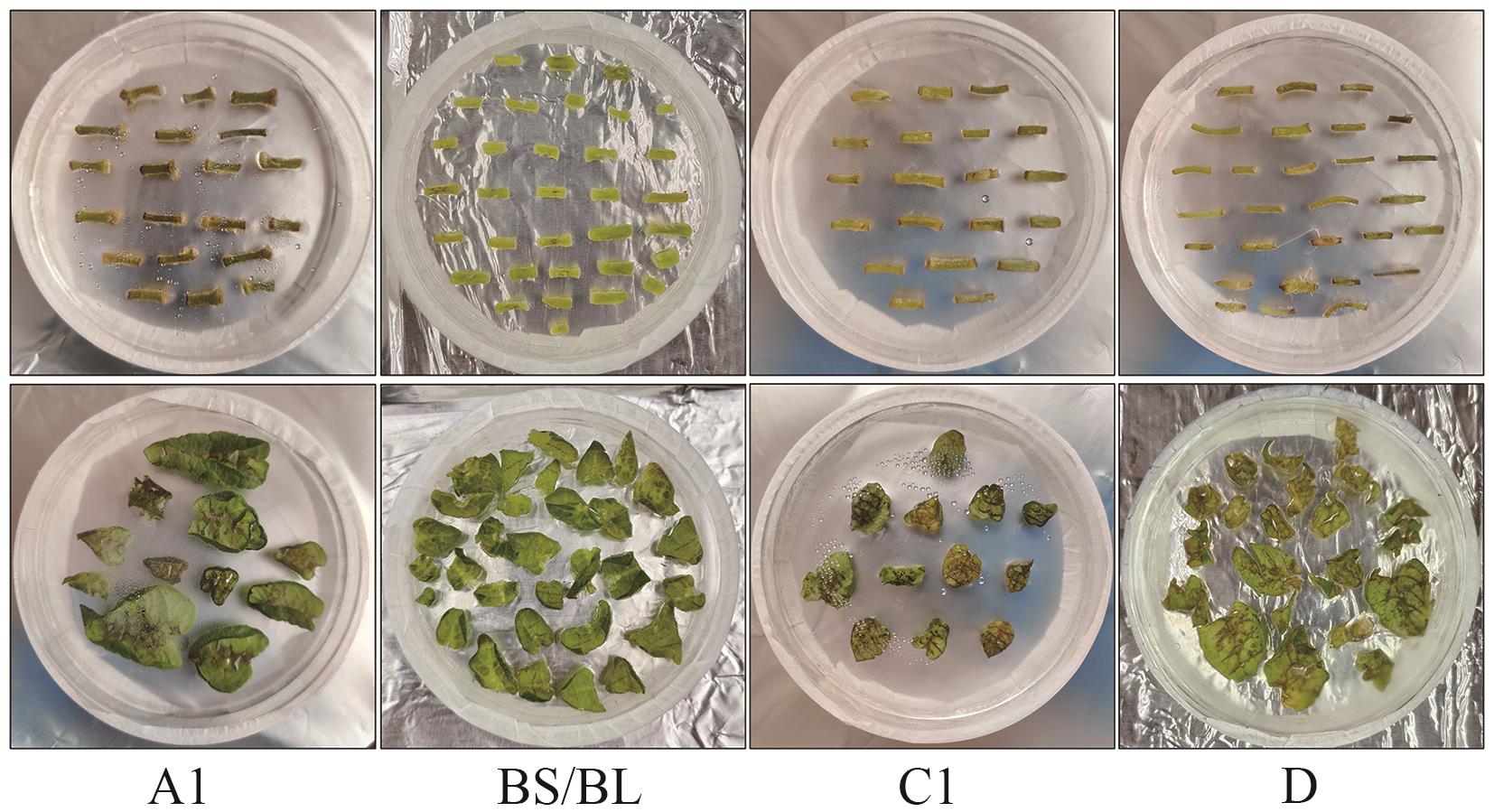
图1 川芋50茎段和叶片的预培养
Fig. 1 Preculture of Chuanyu 50 stem segments and leaves

图2 川芋50茎段和叶片的愈伤诱导情况
Fig. 2 Callus induction of Chuanyu 50 stem segments and leaves
外植体类型 Explant type | 培养基体系 Media system | 外植体数 Number of explants | 愈伤数 Number of calluses | 诱导率 Induction rate/% | 分化率 Differentiation rate/% |
|---|---|---|---|---|---|
| 茎段 Stem | A | 100 | 90 | 90 | 9 |
| B | 100 | 93 | 93 | 25 | |
| C | 100 | 65 | 65 | 0 | |
| D | 100 | 43 | 43 | 0 | |
| 叶片 Leaf | A | 50 | 40 | 80 | 0 |
| B | 50 | 44 | 88 | 22 | |
| C | 50 | 29 | 58 | 0 | |
| D | 50 | 31 | 62 | 0 |
表2 不同培养基对茎段和叶片愈伤组织形成和分化的影响
Table 2 Effects of different media on the callus formation and differentiation of stem segments and leaves
外植体类型 Explant type | 培养基体系 Media system | 外植体数 Number of explants | 愈伤数 Number of calluses | 诱导率 Induction rate/% | 分化率 Differentiation rate/% |
|---|---|---|---|---|---|
| 茎段 Stem | A | 100 | 90 | 90 | 9 |
| B | 100 | 93 | 93 | 25 | |
| C | 100 | 65 | 65 | 0 | |
| D | 100 | 43 | 43 | 0 | |
| 叶片 Leaf | A | 50 | 40 | 80 | 0 |
| B | 50 | 44 | 88 | 22 | |
| C | 50 | 29 | 58 | 0 | |
| D | 50 | 31 | 62 | 0 |

图3 川芋50茎段和叶片培养50 d后的愈伤分化情况
Fig. 3 Callus differentiation of Chuanyu 50 stem segments and leaves upon 50-day treatment

图4 gRNA位置与基因编辑载体结构A:gRNA在T#01上的位置及测序验证;B:pJCV55-StU6-200-StUBI10-T#01载体示意图。KanR :卡那霉素抗性基因;StUBI10:马铃薯泛素10启动子;StU6:马铃薯 U6 snoRNA启动子;NosT:胭脂碱合酶终止子;LB:T-DNA左边界;RB:T-DNA右边界
Fig. 4 gRNA location and structure of gene editing vectorA: Position of the gRNAs on T#01 and sequencing validation. B: Schematic diagram of pJCV55-StU6-200-StUBI10-T#01. KanR : Kanamycin resistance gene; StUBI10: potato ubiquitin 10 promoter; StU6: potato U6snoRNA promoter; NosT: nopaline synthase terminator; LB: T-DNA left border; RB: T-DNA right border

图5 转基因马铃薯株系的PCR检测M:100 bp plus DNA marker;#1-#40:转基因马铃薯株系;WT:阴性对照(野生型);CK:空白对照(ddH2O);P:阳性对照(质粒pJCV55-StU6-200-StUBI10-T#01)
Fig. 5 PCR detection of transgenic potato linesM: 100 bp plus DNA marker; #1-#40: transgenic potato lines; WT: negative control (wild type); C: blank control (ddH2O);P: positive control (plasmid pJCV55-StU6-200-StUBI10-T#01)

图6 T#01突变体PCR产物的序列分析
Fig. 6 Sequence analysis of PCR products from the T#01 mutants

图7 转基因马铃薯株系突变位点和类型#1、#12、#19的突变序列与野生型序列进行了比对。gRNA1区域突变类型/gRNA2区域突变类型,插入(+)或缺失(-)用红色表示。PAM位点用蓝色表示。gRNA 位置用紫色表示
Fig. 7 Mutated sites and types in transgenic potato linesMutant sequences of #1, #12, and #19 were aligned with wild-type sequences. gRNA1 region mutation type/gRNA2 region mutation type with insertion (+) or deletion (-) in red. PAM sites are indicated in blue. The gRNA positions are indicated in purple
| 4 | Zhou Q, Tang D, Huang W, et al. Haplotype-resolved genome analyses of a heterozygous diploid potato [J]. Nat Genet, 2020, 52(10): 1018-1023. |
| 5 | Bánfalvi Z, Csákvári E, Villányi V, et al. Generation of transgene-free PDS mutants in potato by Agrobacterium-mediated transformation [J]. BMC Biotechnol, 2020, 20: 25. |
| 6 | Zhang SJ, Zhang RZ, Song GQ, et al. Targeted mutagenesis using the Agrobacterium tumefaciens-mediated CRISPR-Cas9 system in common wheat [J]. BMC Plant Biol, 2018, 18(1): 302. |
| 7 | Char SN, Neelakandan AK, Nahampun H, et al. An Agrobacterium-delivered CRISPR/Cas9 system for high-frequency targeted mutagenesis in maize [J]. Plant Biotechnol J, 2017, 15(2): 257-268. |
| 8 | Yu QH, Wang BK, Li N, et al. CRISPR/Cas9-induced targeted mutagenesis and gene replacement to generate long-shelf life tomato lines [J]. Sci Rep, 2017, 7(1): 11874. |
| 9 | Benjamin C, Zhang F, Daniel FV. Potatoes with reduced granule-bound starch synthase [J]. Patent WO, 2015,193(858):A1. |
| 10 | Veillet F, Chauvin L, Kermarrec MP, et al. The Solanum tuberosum GBSSI gene: a target for assessing gene and base editing in tetraploid potato [J]. Plant Cell Rep, 2019, 38(9): 1065-1080. |
| 11 | Johansen IE, Liu Y, Jørgensen B, et al. High efficacy full allelic CRISPR/Cas9 gene editing in tetraploid potato [J]. Sci Rep, 2019, 9(1): 17715. |
| 12 | Tuncel A, Corbin KR, Ahn-Jarvis J, et al. Cas9-mediated mutagenesis of potato starch-branching enzymes generates a range of Tuber starch phenotypes [J]. Plant Biotechnol J, 2019, 17(12): 2259-2271. |
| 13 | 朱雪瑞, 季静, 王罡, 等. 马铃薯不同组织的诱导分化及其对遗传转化效率的影响 [J]. 中国生物工程杂志, 2016, 36(10): 53-59. |
| Zhu XR, Ji J, Wang G, et al. Influence on the conversion efficiency of induced differentiation of various potato tissues [J]. China Biotechnol, 2016, 36(10): 53-59. | |
| 14 | 司怀军, 谢从华, 柳俊. 农杆菌介导的马铃薯试管薯遗传转化体系的优化及反义class Ⅰ patatin基因的导入 [J]. 作物学报, 2003, 29(6): 801-805. |
| 1 | Birch PRJ, Bryan G, Fenton B, et al. Crops that feed the world 8: potato: are the trends of increased global production sustainable? [J]. Food Secur, 2012, 4(4): 477-508. |
| 2 | Grossi CEM, Santin F, Quintana SA, et al. Calcium-dependent protein kinase 2 plays a positive role in the salt stress response in potato [J]. Plant Cell Rep, 2022, 41(3): 535-548. |
| 3 | 包山敏, 王崇进, 向成轶, 等. 马铃薯育种现状及发展对策 [J]. 安徽农学通报, 2024, 30(21): 8-12. |
| Bao SM, Wang CJ, Xiang CY, et al. Current situation and development strategies of potato breeding [J]. Anhui Agric Sci Bull, 2024, 30(21): 8-12. | |
| 14 | Si HJ, Xie CH, Liu J. An efficient protocol for Agrobacterium-mediated transformation with microtuber and the introduction of an antisense class Ⅰ patatin gene into potato [J]. Acta Agron Sin, 2003, 29(6): 801-805. |
| 15 | 武小娟, 吴娟, 王沛捷, 等. 马铃薯'华颂66号'遗传转化体系的建立 [J]. 中国农业大学学报, 2024, 29(1): 21-30. |
| Wu XJ, Wu J, Wang PJ, et al. Establishment of genetic transformation system for 'huasong 66' [J]. J China Agric Univ, 2024, 29(1): 21-30. | |
| 16 | 蒋敏华. 农杆菌介导hrap基因的马铃薯遗传转化及抗病性鉴定 [D]. 南京: 南京农业大学, 2007. |
| Jiang MH. Agrobacterium-mediated genetic transformation and disease resistance identification of potato with hrap gene [D]. Nanjing: Nanjing Agricultural University, 2007. | |
| 17 | Bakhsh A. Development of efficient, reproducible and stable Agrobacterium-mediated genetic transformation of five potato cultivars [J]. Food Technol Biotechnol, 2020, 58(1): 57-63. |
| 18 | Bruce MA, Shoup Rupp JL. Agrobacterium-mediated transformation of Solanum tuberosum L., potato [J]. Methods Mol Biol, 2019, 1864: 203-223. |
| 19 | 闫建俊, 白云凤, 张忠梁, 等. 根癌农杆菌介导的马铃薯遗传转化的一些影响因素 [J]. 山西农业科学, 2013, 41(6): 532-534. |
| Yan JJ, Bai YF, Zhang ZL, et al. Influencing factors to potato transformation mediated by Agrobacterium [J]. J Shanxi Agric Sci, 2013, 41(6): 532-534. | |
| 20 | 杨永智. 农杆菌介导法马铃薯遗传转化体系的优化 [J]. 江苏农业学报, 2013, 29(4): 738-742. |
| Yang YZ. Optimization of Agrobacterium tumerfaciens mediated potato transformation system [J]. Jiangsu J Agric Sci, 2013, 29(4): 738-742. | |
| 21 | 刘可心, 王克秀, 唐铭霞, 等. 马铃薯新品种川芋50的选育 [J]. 四川农业科技, 2021(6): 18-19, 22. |
| Liu KX, Wang KX, Tang MX, et al. Breeding of a new potato variety Chuanyu 50 [J]. Sichuan Agric Sci Technol, 2021(6): 18-19, 22. | |
| 22 | Wan M, Xie HD, Guo HW, et al. Developing a pipeline for identification, characterization and molecular editing of cis-regulatory elements: a case study in potato [J]. aBIOTECH, 2024, 6(1): 91-96. |
| 23 | Xie XR, Ma XL, Zhu QL, et al. CRISPR-GE: a convenient software toolkit for CRISPR-based genome editing [J]. Mol Plant, 2017, 10(9): 1246-1249. |
| 24 | Marillonnet S, Grützner R. Synthetic DNA assembly using golden gate cloning and the hierarchical modular cloning pipeline [J]. Curr Protoc Mol Biol, 2020, 130(1): e115. |
| 25 | Jing SL, Jiang P, Sun XM, et al. Long-distance control of potato storage organ formation by SELF PRUNING 3D and FLOWERING LOCUS T-like 1[J]. Plant Communications, 2023, 4(3): 100547. |
| 26 | 陈兆贵, 向雪梅, 李希陶, 等. 马铃薯"费乌瑞它"愈伤组织诱导及分化技术 [J]. 黑龙江农业科学, 2023(7): 20-24. |
| Chen ZG, Xiang XM, Li XT, et al. Callus induction and differentiation technology of potato "favorita" [J]. Heilongjiang Agric Sci, 2023(7): 20-24. | |
| 27 | Gustafson V, Mallubhotla S, MacDonnell J, et al. Transformation and plant regeneration from leaf explants of Solanum tuberosum L. cv. 'shepody' [J]. Plant Cell Tissue Organ Cult, 2006, 85(3): 361-366. |
| 28 | 蒋继滨, 高冬丽, 朱曦鉴, 等. 二倍体马铃薯基因编辑载体快速验证体系的建立 [J]. 种子, 2019, 38(10): 29-33. |
| Jiang JB, Gao DL, Zhu XJ, et al. Establishment of a rapid verification system for diploid potato gene editing vector [J]. Seed, 2019, 38(10): 29-33. | |
| 29 | 宋倩娜, 梅超, 霍利光, 等. 马铃薯品种'并薯6号'遗传转化体系的建立 [J]. 中国马铃薯, 2021, 35(5): 385-396. |
| Song QN, Mei C, Huo LG, et al. Establishment of genetic transformation system for potato variety 'bingshu 6' [J]. Chin Potato J, 2021, 35(5): 385-396. | |
| 30 | 潘映雪. 农杆菌介导BDN1基因转化马铃薯抗旱性研究 [D]. 哈尔滨: 东北农业大学, 2013. |
| Pan YX. Study on drought resistance of potato transformed by BDN1 gene mediated by Agrobacterium tumefaciens [D]. Harbin: Northeast Agricultural University, 2013. | |
| 31 | 刘耀光, 李构思, 张雅玲, 等. CRISPR/Cas植物基因组编辑技术研究进展 [J]. 华南农业大学学报, 2019, 40(5): 38-49. |
| Liu YG, Li GS, Zhang YL, et al. Current advances on CRISPR/Cas genome editing technologies in plants [J]. J South China Agric Univ, 2019, 40(5): 38-49. | |
| 32 | Yin KQ, Gao CX, Qiu JL. Progress and prospects in plant genome editing [J]. Nat Plants, 2017, 3: 17107. |
| 33 | Soyars CL, Peterson BA, Burr CA, et al. Cutting edge genetics: CRISPR/Cas9 editing of plant genomes [J]. Plant Cell Physiol, 2018, 59(8): 1608-1620. |
| 34 | Song GY, Jia ML, Chen K, et al. CRISPR/Cas9: a powerful tool for crop genome editing [J]. Crop J, 2016, 4(2): 75-82. |
| 35 | Schaeffer SM, Nakata PA. CRISPR/Cas9-mediated genome editing and gene replacement in plants: Transitioning from lab to field [J]. Plant Sci, 2015, 240: 130-142. |
| 36 | Liu XJ, Xie CX, Si HJ, et al. CRISPR/Cas9-mediated genome editing in plants [J]. Methods, 2017, 121/122: 94-102. |
| [1] | 刘涛, 王志淇, 吴文博, 石文婷, 王超楠, 杜崇, 杨中敏. 马铃薯GRAM基因家族鉴定与表达分析[J]. 生物技术通报, 2025, 41(4): 145-155. |
| [2] | 陈晓军, 惠建, 马洪文, 白海波, 钟楠, 李稼润, 樊云芳. 利用单碱基基因编辑技术创制OsALS抗除草剂水稻种质资源[J]. 生物技术通报, 2025, 41(4): 106-114. |
| [3] | 杨朝结, 张兰, 陈红, 黄娟, 石桃雄, 朱丽伟, 陈庆富, 李洪有, 邓娇. 苦荞转录因子基因FtbHLH3调控类黄酮生物合成的功能鉴定[J]. 生物技术通报, 2025, 41(4): 134-144. |
| [4] | 卢勇杰, 夏海乾, 李永铃, 张文建, 余婧, 赵会纳, 王兵, 许本波, 雷波. 烟草AP2/ERF转录因子NtESR2的克隆及功能分析[J]. 生物技术通报, 2025, 41(4): 266-277. |
| [5] | 张益瑄, 马宇, 王童童, 盛苏奥, 宋家凤, 吕钊彦, 朱晓彪, 侯华兰. 马铃薯DIR家族全基因组鉴定及表达模式分析[J]. 生物技术通报, 2025, 41(3): 123-136. |
| [6] | 俞婷, 黄丹丹, 朱炎辉, 杨梅宏, 艾菊, 高冬丽. 马铃薯Stpatatin 05基因转录调控因子筛选及互作验证[J]. 生物技术通报, 2025, 41(3): 137-145. |
| [7] | 覃悦, 杨妍, 张磊, 卢丽丽, 李先平, 蒋伟. 二倍体和四倍体马铃薯StGAox基因鉴定与比较分析[J]. 生物技术通报, 2025, 41(3): 146-160. |
| [8] | 张文斐, 杨菲, 刘旭霞. 基因编辑食品标识制度的理论证成、国际比较及中国方案[J]. 生物技术通报, 2025, 41(3): 25-34. |
| [9] | 梁丽存, 王克芬, 宋祖洹, 刘梦婷, 李佳玉, 罗会颖, 姚斌, 杨浩萌. 优化sgRNA提高塔宾曲霉基因编辑效率[J]. 生物技术通报, 2025, 41(3): 62-70. |
| [10] | 薛瑞莹, 刘永菊, 姜燕燕, 彭欣雅, 曹东, 李云, 刘宝龙, 包雪梅. 5′UTR区的编辑降低大麦GBSSI基因表达[J]. 生物技术通报, 2025, 41(3): 83-89. |
| [11] | 申鹏, 高雅彬, 丁红. 马铃薯SAT基因家族的鉴定和表达分析[J]. 生物技术通报, 2024, 40(9): 64-73. |
| [12] | 宋兵芳, 柳宁, 程新艳, 徐晓斌, 田文茂, 高悦, 毕阳, 王毅. 马铃薯G6PDH基因家族鉴定及其在损伤块茎的表达分析[J]. 生物技术通报, 2024, 40(9): 104-112. |
| [13] | 王超, 白如仟, 管俊梅, 罗稷林, 何雪姣, 迟绍轶, 马玲. 马铃薯块茎变绿中StHY5对龙葵素合成的促进作用[J]. 生物技术通报, 2024, 40(9): 113-122. |
| [14] | 童玮婧, 罗数, 陆新露, 沈建福, 陆柏益, 李开绵, 马秋香, 张鹏. CRISPR/Cas9编辑MeHNL基因创制低生氰糖苷木薯[J]. 生物技术通报, 2024, 40(9): 11-19. |
| [15] | 夏士轩, 耿泽栋, 祝光涛, 张春芝, 李大伟. 基于深度学习的马铃薯花粉活力快速检测[J]. 生物技术通报, 2024, 40(9): 123-130. |
| 阅读次数 | ||||||
|
全文 |
|
|||||
|
摘要 |
|
|||||
