







生物技术通报 ›› 2025, Vol. 41 ›› Issue (5): 208-217.doi: 10.13560/j.cnki.biotech.bull.1985.2024-1127
• 研究报告 • 上一篇
昝舒雯( ), 谢欢欢, 张宇琴, 王文娟, 张鹏飞, 梁晋军(), 温鹏飞()
收稿日期:2024-11-21
出版日期:2025-05-26
发布日期:2025-06-05
通讯作者:
温鹏飞,男,博士,教授,研究方向 :葡萄逆境生理与分子生物学和果实品质形成与调控;E-mail: wenpengfei@126.com作者简介:昝舒雯,女,硕士研究生,研究方向 :葡萄果实品质形成与调控;E-mail: zsw15534249628@163.com
基金资助:
ZAN Shu-wen(), XIE Huan-huan, ZHANG Yu-qin, WANG Wen-Juan, ZHANG Peng-fei, LIANG Jin-jun(), WEN Peng-fei()
Received:2024-11-21
Published:2025-05-26
Online:2025-06-05
摘要:
目的 分析葡萄心皮发育相关基因VvAGAMOUS(VvAG)和VvCRABS CLAW(VvCRC)的表达特性,旨在探究VvAG通过VvCRC基因调控葡萄心皮发育的分子机制,为解析葡萄果实形成分子机制提供理论依据。 方法 以‘玫瑰香’葡萄不同长度的花序为材料,用石蜡切片法观察心皮的发育过程,并通过RT-qPCR检测VvAG和VvCRC在不同发育时期的表达情况。克隆VvAG和VvCRC基因,并进行同源性序列比对和系统进化关系等生物信息学分析。通过瞬时注射烟草叶片对2个基因编码的蛋白进行亚细胞定位。利用酵母单杂交试验和双荧光素酶试验验证VvAG与VvCRC之间的关系。 结果 解剖学观察显示,‘玫瑰香’葡萄花序长度为1‒2 cm时,雄蕊原基基本发育完全,心皮原基准备形成;当花序发育至2‒3 cm和3‒4 cm两个时期,心皮继续发育,胚珠原基开始形成。RT-qPCR结果表明,在花序长度为1‒2 cm时,VvAG和VvCRC表达量较低,而在花序长度为2‒3 cm和3‒4 cm两个时期,VvCRC基因的表达量则随着VvAG基因表达量的增加而迅速增加。系统发育分析结果表明,VvAG与AtAG,VvCRC与MdCRC聚为一小分支,亲缘关系较近。亚细胞定位结果表明,VvAG和VvCRC蛋白均定位于细胞核中。酵母单杂交和双荧光素酶试验结果显示,VvAG可以直接与VvCRC启动子结合并激活其转录活性。 结论 VvAG转录因子可能通过激活VvCRC基因的表达,进一步调控心皮的发育,从而影响葡萄子房的发育。
昝舒雯, 谢欢欢, 张宇琴, 王文娟, 张鹏飞, 梁晋军, 温鹏飞. VvAGAMOUS通过VvCRABS CLAW调控葡萄心皮发育[J]. 生物技术通报, 2025, 41(5): 208-217.
ZAN Shu-wen, XIE Huan-huan, ZHANG Yu-qin, WANG Wen-Juan, ZHANG Peng-fei, LIANG Jin-jun, WEN Peng-fei. VvAGAMOUS Regulates Carpel Development through VvCRABS CLAW in Grape[J]. Biotechnology Bulletin, 2025, 41(5): 208-217.

图1 ‘玫瑰香’葡萄在不同发育阶段的解剖结构A:0‒1 cm;B:1‒2 cm;C:2‒3 cm;D:3‒4 cm;E:4‒5 cm。s:隔原基;f:花帽原基;st:雄蕊原基;c:心皮原基;o:胚珠原基。标尺=100 μm
Fig. 1 Anatomical structure of grape ‘Musct Hambourg’ at different developmental stagesA: 0‒1 cm; B: 1-2 cm; C: 2-3 cm; D: 3-4 cm; E: 4‒5 cm. s: Sepals; f: flower caps; st: stamens; c: carpels; o: ovules. Scale bar=100 μm

图2 VvAG和VvCRC在不同花序发育阶段的表达情况不同小写字母表示各基因在花序发育的5个时期间在0.05水平差异显著
Fig. 2 Expressions of VvAG and VvCRC in different inflorescence development stagesDifferent lowercase letters indicate significant differences of each gene at the 0.05 level during the five periods of inflorescence development

图3 VvAG(A)和VvCRC(B)基因扩增结果A:1-2:VvAG基因PCR扩增条带;B:1-2:VvCRC基因PCR扩增条带;M:DL2000 marker
Fig. 3 Amplified results of VvAG (A)and VvCRC (B)A: 1-2: PCR amplification bands of VvAG gene; B: 1-2: PCR amplification bands of VvCRC gene. M: DL2000 marker

图4 VvAG和VvCRC同源氨基酸序列多重比对A:VvAG同源氨基酸序列多重比对;B:VvCRC同源氨基酸序列多重比对;黑色:同源性100%;紫色:同源性≥75%;蓝色:同源性≥50%
Fig. 4 A Multiple alignment of homologous amino acid sequences of VvAG and VvCRCA: Multiple alignment of homologous amino acid sequences of VvAG.B: Multiple alignment of homologous amino acid sequences of VvCRC. Black: 100% homology. Purple: Homology≥75%. Blue: Homology≥50%

图5 不同物种中VvAG(A)和VvCRC(B)同源蛋白的系统进化树
Fig. 5 Phylogenetic tree of VvAG (A) and VvCRC (B) homologous proteins from different specie

图6 VvAG和VvCRC的亚细胞定位结果
Fig. 6 Subcellular localization results of VvAG and VvCRC
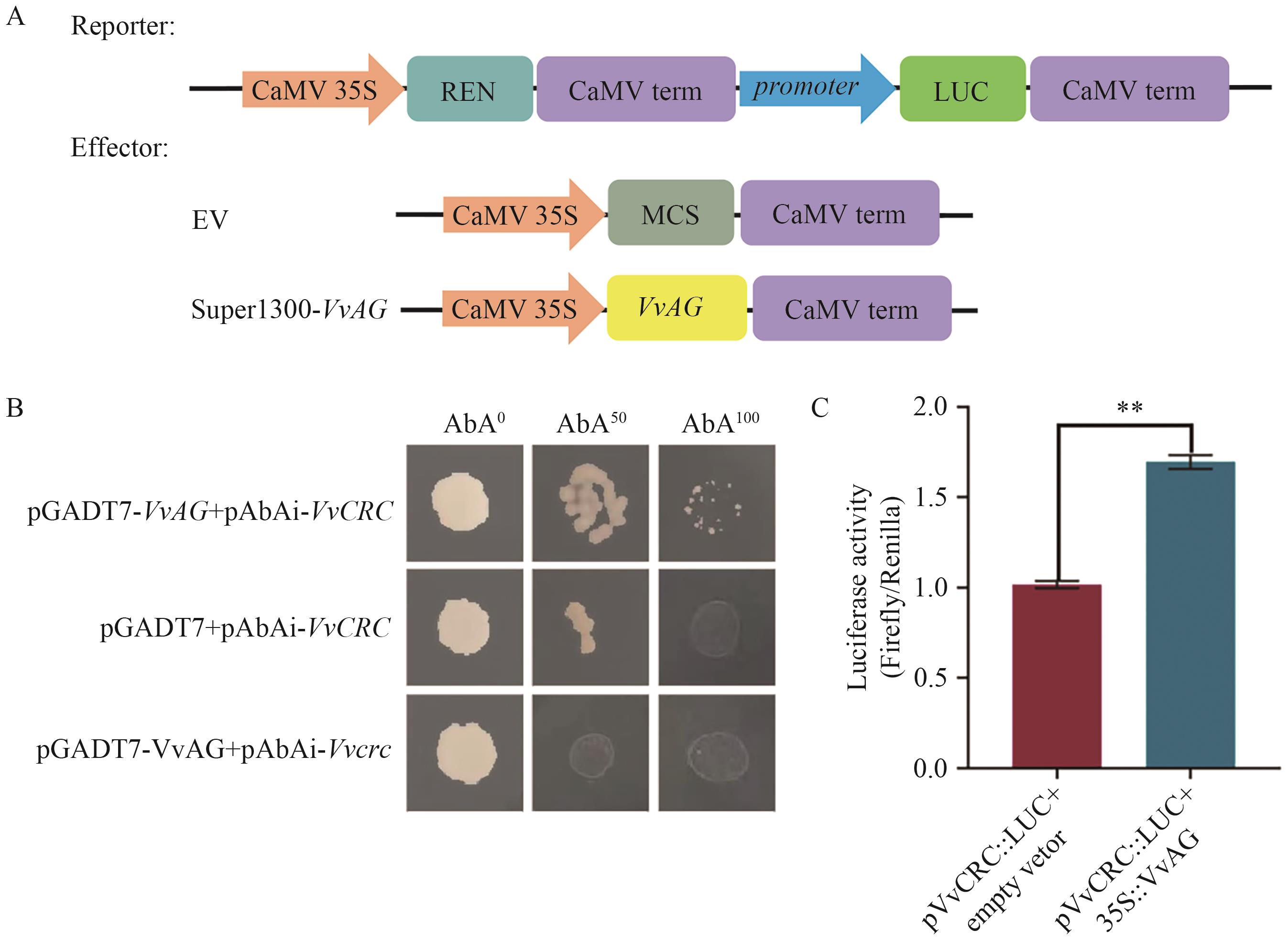
图7 VvAG对VvCRC启动子的调控作用分析A:双荧光素酶试验的载体示意图;B:Y1H验证VvAG与VvCRC启动子之间的相互作用;C:LUC试验验证VvAG对VvCRC启动子活性的影响。星号代表显著差异(* P<0.05,** P<0.01,采用t检验)
Fig. 7 Analysis of the regulatory role of VvAG on the VvCRC promoterA: Schematic diagram of the vector for the dual luciferase assay. B: Y1H validation of the interaction between VvAG and the VvCRC promoter. C: LUC assay to validate the effect of VvAG on VvCRC promoter activity. Asterisks indicate significant differences (* P<0.05, ** P<0.01, t-test used)

图8 VvAG通过VvCRC调控葡萄心皮发育模式图
Fig. 8 Model diagram of VvAG regulation of grape carpel development through VvCRC
| 1 | 任晓琴, 文昊, 薛晓琦, 等. 基于主成分分析的10个葡萄品种果实营养元素比较 [J]. 天津农学院学报, 2022, 29(4): 13-16. |
| Ren XQ, Wen H, Xue XQ, et al. Comparison of nutrient elements in 10 different varieties of grape fruits based on principal component analysis [J]. J Tianjin Agric Univ, 2022, 29(4): 13-16. | |
| 2 | Wang L, Sun XL, Weiszmann J, et al. System-level and granger network analysis of integrated proteomic and metabolomic dynamics identifies key points of grape berry development at the interface of primary and secondary metabolism [J]. Front Plant Sci, 2017, 8: 1066. |
| 3 | Dilcher D. Toward a new synthesis: major evolutionary trends in the angiosperm fossil record [J]. Proc Natl Acad Sci U S A, 2000, 97(13): 7030-7036. |
| 4 | Pfannebecker KC, Lange M, Rupp O, et al. An evolutionary framework for carpel developmental control genes [J]. Mol Biol Evol, 2017, 34(2): 330-348. |
| 5 | 王慧玲, 闫爱玲, 王晓玥, 等. 葡萄果粒质量相关性状全基因组关联分析 [J]. 中国农业科学, 2023, 56(8): 1561-1573. |
| Wang HL, Yan AL, Wang XY, et al. Genome-wide association studies for grape berry weight related traits [J]. Sci Agric Sin, 2023, 56(8): 1561-1573. | |
| 6 | 邢佳毅. '香妃'葡萄2心皮和3心皮子房发育过程中VvYABBY5基因表达的研究 [D]. 北京: 中国农业大学, 2016. |
| Xing JY. Study on the expression of VvYABBY5 gene during the development of 2-carpel and 3-carpel ovaries of 'Xiangfei' grape [D]. Beijing: China Agricultural University, 2016. | |
| 7 | Ferrándiz C, Fourquin C, Prunet N, et al. Carpel development [M]//Advances in Botanical Research. Amsterdam: Elsevier, 2010: 1-73. |
| 8 | Coen ES, Meyerowitz EM. The war of the whorls: genetic interactions controlling flower development [J]. Nature, 1991, 353(6339): 31-37. |
| 9 | Pelaz S, Ditta GS, Baumann E, et al. B and C floral organ identity functions require SEPALLATA MADS-box genes [J]. Nature, 2000, 405(6783): 200-203. |
| 10 | Yanofsky MF, Ma H, Bowman JL, et al. The protein encoded by the Arabidopsis homeotic gene agamous resembles transcription factors [J]. Nature, 1990, 346(6279): 35-39. |
| 11 | Wang HH, Lu YN, Zhang TX, et al. The double flower variant of yellowhorn is due to a LINE1 transposon-mediated insertion [J]. Plant Physiol, 2023, 191(2): 1122-1137. |
| 12 | Lan JQ, Wang N, Wang YT, et al. Arabidopsis TCP4 transcription factor inhibits high temperature-induced homeotic conversion of ovules [J]. Nat Commun, 2023, 14(1): 5673. |
| 13 | Yao JL, Kang CY, Gu C, et al. The roles of floral organ genes in regulating Rosaceae fruit development [J]. Front Plant Sci, 2022, 12: 644424. |
| 14 | Pelayo MA, Morishita F, Sawada H, et al. AGAMOUS regulates various target genes via cell cycle-coupled H3K27me3 dilution in floral meristems and stamens [J]. Plant Cell, 2023, 35(8): 2821-2847. |
| 15 | Pnueli L, Hareven D, Rounsley SD, et al. Isolation of the tomato AGAMOUS gene TAG1 and analysis of its homeotic role in transgenic plants [J]. Plant Cell, 1994, 6(2): 163-173. |
| 16 | Liang JJ, Guan PY, Liu ZH, et al. The VvSUPERMAN-like gene is differentially expressed between bicarpellate and tricarpellate florets of Vitis vinifera L. cv. 'Xiangfei' and its heterologous expression reduces carpel number in tomato [J]. Plant Cell Physiol, 2020, 61(10): 1760-1774. |
| 17 | Wang Y, Liu ZH, Wu J, et al. MADS-Box protein complex VvAG2, VvSEP3 and VvAGL11 regulates the formation of ovules in Vitis vinifera L. cv. 'Xiangfei' [J]. Genes, 2021, 12(5): 647. |
| 18 | Gross T, Broholm S, Becker A. CRABS CLAW acts as a bifunctional transcription factor in flower development [J]. Front Plant Sci, 2018, 9: 835. |
| 19 | Gómez-Mena C, de Folter S, Costa MMR, et al. Transcriptional program controlled by the floral homeotic gene AGAMOUS during early organogenesis [J]. Development, 2005, 132(3): 429-438. |
| 20 | Ng KH, Yu H, Ito T. AGAMOUS controls GIANT KILLER, a multifunctional chromatin modifier in reproductive organ patterning and differentiation [J]. PLoS Biol, 2009, 7(11): e1000251. |
| 21 | Alvarez J, Smyth DR. CRABS CLAW and SPATULA two Arabidopsis genes that control carpel development in parallel with AGAMOUS [J]. Development, 1999, 126(11): 2377-2386. |
| 22 | Breuil-Broyer S, Trehin C, Morel P, et al. Analysis of the Arabidopsis superman allelic series and the interactions with other genes demonstrate developmental robustness and joint specification of male-female boundary, flower meristem termination and carpel compartmentalization [J]. Ann Bot, 2016, 117(5): 905-923. |
| 23 | Wang YT, Wang N, Lan JQ, et al. Arabidopsis transcription factor TCP4 controls the identity of the apical gynoecium [J]. Plant Cell, 2024, 36(7): 2668-2688. |
| 24 | Castañeda L, Giménez E, Pineda B, et al. Tomato CRABS CLAW paralogues interact with chromatin remodelling factors to mediate carpel development and floral determinacy [J]. New Phytol, 2022, 234(3): 1059-1074. |
| 25 | Yamaguchi T, Nagasawa N, Kawasaki S, et al. The YABBY gene DROOPING LEAF regulates carpel specification and midrib development in Oryza sativa [J]. Plant Cell, 2004, 16(2): 500-509. |
| 26 | Ohmori Y, Toriba T, Nakamura H, et al. Temporal and spatial regulation of DROOPING LEAF gene expression that promotes midrib formation in rice [J]. Plant J, 2011, 65(1): 77-86. |
| 27 | Strable J, Vollbrecht E. Maize YABBY genes drooping leaf1 and drooping leaf2 regulate floret development and floral meristem determinacy [J]. Development, 2019, 146(6): dev171181. |
| 28 | Che G, Pan YP, Liu XF, et al. Natural variation in CRABS CLAW contributes to fruit length divergence in cucumber [J]. Plant Cell, 2023, 35(2): 738-755. |
| 29 | Che G, Song WY, Zhang XL. Gene network associates with CsCRC regulating fruit elongation in cucumber [J]. Veg Res, 2023, 3(1): 1-4. |
| 30 | 卢龙. 赤霉素诱导葡萄单性结实与促进坐果分子机制的研究 [D]. 北京: 中国农业大学, 2016. |
| Lu L. Study on molecular mechanism of gibberellin inducing parthenocarpy and promoting fruit setting of grape [D]. Beijing: China Agricultural University, 2016. | |
| 31 | 牛铁泉, 董燕梅, 刘海霞, 等. 葡萄果实MYBA1与UFGT、DFR的作用机制 [J]. 中国农业科学, 2018, 51(12): 2368-2377. |
| Niu TQ, Dong YM, Liu HX, et al. The regulations of the MYBA1 in UFGT and DFR from the grape berries [J]. Sci Agric Sin, 2018, 51(12): 2368-2377. | |
| 32 | 高志红, 张玉明, 王珊, 等. 植物花发育调控基因AGAMOUS的研究进展 [J]. 西北植物学报, 2008, 28(3): 638-644. |
| Gao ZH, Zhang YM, Wang S, et al. Research progress in floral organ identity gene AGAMOUS [J]. Acta Bot Boreali Occidentalia Sin, 2008, 28(3): 638-644. | |
| 33 | Mouradov A, Glassick TV, Hamdorf BA, et al. Family of MADS-box genes expressed early in male and female reproductive structures of Monterey pine [J]. Plant Physiol, 1998, 117(1): 55-62. |
| 34 | Lee JY, Baum SF, Oh SH, et al. Recruitment of CRABS CLAW to promote nectary development within the eudicot clade [J]. Development, 2005, 132(22): 5021-5032. |
| 35 | 夏胜应. 春兰AGAMOUS同源基因的克隆及表达分析 [J]. 分子植物育种, 2020, 18(7): 2146-2151. |
| Xia SY. Cloning and expression analysis of AGAMOUS homologous genes from Cymbidium goeringii [J]. Mol Plant Breed, 2020, 18(7): 2146-2151. | |
| 36 | 张志国, 丁寒雪, 蒋成娣, 等. 重瓣萱草AGAMOUS基因的克隆与表达分析 [J]. 江苏农业科学, 2022, 50(23): 40-48. |
| Zhang ZG, Ding HX, Jiang CD, et al. Cloning and expression analysis of AGAMOUS homologous genes from double-flower daylily [J]. Jiangsu Agric Sci, 2022, 50(23): 40-48. | |
| 37 | 周晓婴, 付三雄, 陈松, 等. 甘蓝型油菜 CRABS CLAW 基因克隆及其 RNA 干扰载体的构建 [J]. 江苏农业学报, 2015, 31(4): 737-742. |
| Zhou XY, Fu SX, Chen S, et al. Cloning of CRABS CLAW gene from Brassica napus and construction of its RNA interference vector [J]. Jiangsu J Agric Sci, 2015, 31(4): 737-742. | |
| 38 | Gong PC, Song CJ, Liu HY, et al. Physalis floridana CRABS CLAW mediates neofunctionalization of GLOBOSA genes in carpel development [J]. J Exp Bot, 2021, 72(20): 6882-6903. |
| 39 | Gross T, Becker A. Transcription factor action orchestrates the complex expression pattern of CRABS CLAW in Arabidopsis [J]. Genes, 2021, 12(11): 1663. |
| [1] | 樊玥妮, 仙保山, 师艺萍, 任梦圆, 徐佳慧, 魏绍巍, 许晓敬, 罗晓峰, 舒凯. SPINDLY和SECRET AGENT介导的蛋白糖基化调控植物发育与逆境响应[J]. 生物技术通报, 2025, 41(4): 1-8. |
| [2] | 刘彤彤, 李肖慧, 杨骏龙, 陈旺, 玉猛, 王超凡, 王凤茹, 客绍英. ZmSTART1调控玉米维管束建成的功能研究[J]. 生物技术通报, 2025, 41(4): 115-122. |
| [3] | 刘丽, 王辉, 关天舒, 李柏宏, 于舒怡. 葡萄脱落酸受体VvPYL4互作蛋白的筛选及互作蛋白基因表达[J]. 生物技术通报, 2025, 41(4): 188-197. |
| [4] | 俞婷, 黄丹丹, 朱炎辉, 杨梅宏, 艾菊, 高冬丽. 马铃薯Stpatatin 05基因转录调控因子筛选及互作验证[J]. 生物技术通报, 2025, 41(3): 137-145. |
| [5] | 王斌, 林薇, 肖艳辉, 袁晓. 植物富含甘氨酸蛋白家族功能研究进展[J]. 生物技术通报, 2025, 41(2): 1-17. |
| [6] | 颜伟, 陈慧婷, 叶青, 刘广超, 刘新, 侯丽霞. 葡萄HCT基因家族鉴定及其对低温胁迫的响应[J]. 生物技术通报, 2025, 41(2): 175-186. |
| [7] | 文静, 李倩倩, 张明达, 谭茗月, 金博阳, 沈秀丽, 杜志强. Duox 2调控克氏原螯虾肠组织抗细菌先天免疫的分子机制[J]. 生物技术通报, 2025, 41(1): 324-332. |
| [8] | 车建美, 赖恭梯, 李思雨, 郭奥琳, 陈冰星, 陈杏, 刘波, 赖呈纯. 复合微生物菌剂对葡萄生长、品质及根际土壤环境的影响[J]. 生物技术通报, 2024, 40(8): 264-274. |
| [9] | 周冉, 王兴平, 李彦霞, 罗仍卓么. 金黄色葡萄球菌型乳房炎奶牛乳腺组织的lncRNA差异表达分析[J]. 生物技术通报, 2024, 40(8): 320-328. |
| [10] | 吴丁洁, 陈盈盈, 徐静, 刘源, 张航, 李瑞丽. 植物赤霉素氧化酶及其功能研究进展[J]. 生物技术通报, 2024, 40(7): 43-54. |
| [11] | 金博阳, 秦仕宇, 张明达, 李倩倩, 文静, 沈秀丽, 杜志强. 小龙虾prx 6基因在对抗金黄色葡萄球菌感染中的分子作用机制研究[J]. 生物技术通报, 2024, 40(7): 314-322. |
| [12] | 胡雅丹, 伍国强, 刘晨, 魏明. MYB转录因子在调控植物响应逆境胁迫中的作用[J]. 生物技术通报, 2024, 40(6): 5-22. |
| [13] | 杨代毅, 樊杨, 屠焰, 徐志宇, 薛颖昊, 孙元丰, 王进, 郝小燕, 马涛. 不同处理对油菜秸秆养分、纤维结构和硫苷含量的影响[J]. 生物技术通报, 2024, 40(6): 172-179. |
| [14] | 陈盈盈, 吴丁洁, 刘源, 张航, 刘艳娇, 王晶宇, 李瑞丽. 14-3-3蛋白及其在植物中的功能研究进展[J]. 生物技术通报, 2024, 40(4): 12-22. |
| [15] | 龚丽丽, 余花, 杨杰, 陈天池, 赵双滢, 吴月燕. 葡萄CYP707A基因家族的鉴定及对果实成熟的功能验证[J]. 生物技术通报, 2024, 40(2): 160-171. |
| 阅读次数 | ||||||
|
全文 |
|
|||||
|
摘要 |
|
|||||
