







生物技术通报 ›› 2026, Vol. 42 ›› Issue (8): 173-187.doi: 10.13560/j.cnki.biotech.bull.1985.2025-1160
• 研究报告 • 上一篇
汪志1, 胡光明2, 罗轩1, 高磊1, 叶丽霞1, 黄穷1, 肖涛2, 张蕾1( )
)
收稿日期:2025-10-30
出版日期:2026-08-26
发布日期:2026-08-17
通讯作者:
张蕾zhanglei@hbaas.com作者简介:第一联系人:同等贡献
基金资助:
WANG Zhi1, HU Guang-ming2, LUO Xuan1, GAO Lei1, YE Li-xia1, HUANG Qiong1, XIAO Tao2, ZHANG Lei1()
Received:2025-10-30
Published:2026-08-26
Online:2026-08-17
摘要:
目的 解析革叶猕猴桃(Actinidia rubricaulis var. coriacea)的叶绿体基因组特征,研究其在猕猴桃属中的系统发育关系,为猕猴桃属物种鉴定、遗传多样性分析和资源保护提供遗传学基础。 方法 基于Illumina NovaSeq平台对革叶猕猴桃叶绿体全基因组进行测序,通过软件进一步组装注释得到其完整的叶绿体全基因组序列,并从GenBank下载猕猴桃属代表性物种的叶绿体基因组序列进行比较分析。 结果 革叶猕猴桃叶绿体基因组全长156 547 bp,GC含量37.24%,由1个长度为88 649 bp的大单拷贝区、1个长度为20 484 bp的小单拷贝区以及1对长度为23 707 bp的反向重复区组成,是典型的四分体结构。该物种的叶绿体基因组共注释到133个功能基因,涵盖了85个参与蛋白质合成的编码基因、39个转运RNA基因以及8个核糖体RNA基因,同时还包含21个具有内含子的注释基因。密码子使用分析表明,同义密码子的相对使用度值大于1的30个优选密码子中,28个以A或U结尾。重复序列分析显示,共检测到312个长重复序列和207个简单重复序列位点,其中单核苷酸重复有128个,占61.84%。系统发育分析表明,革叶猕猴桃与湖北猕猴桃(Actinidia hubeiensis)亲缘关系最近,自展支持率为100%。 结论 革叶猕猴桃叶绿体基因组在结构特征和基因组成上较为保守,但与同属其他物种相比,其在基因组边界以及核苷酸多态性等方面存在一定变异,对以A或U结尾的密码子有更高的偏好性。革叶猕猴桃与湖北猕猴桃亲缘关系最近,猕猴桃属分类系统有待于进一步完善。
汪志, 胡光明, 罗轩, 高磊, 叶丽霞, 黄穷, 肖涛, 张蕾. 革叶猕猴桃叶绿体基因组特征及系统发育分析[J]. 生物技术通报, 2026, 42(8): 173-187.
WANG Zhi, HU Guang-ming, LUO Xuan, GAO Lei, YE Li-xia, HUANG Qiong, XIAO Tao, ZHANG Lei. Chloroplast Genome Characteristics and Phylogenetic Analysis of Actinidia rubricaulis var. coriacea[J]. Biotechnology Bulletin, 2026, 42(8): 173-187.
| 区域 Region | T (%) | A (%) | C (%) | G (%) | 长度 Length (bp) | GC (%) |
|---|---|---|---|---|---|---|
| LSC | 33.02 | 31.48 | 18.18 | 17.33 | 88 649 | 35.50 |
| SSC | 34.93 | 33.89 | 16.70 | 14.47 | 20 484 | 31.18 |
| IRa | 28.73 | 28.15 | 22.43 | 20.69 | 23 707 | 43.12 |
| IRb | 28.15 | 28.73 | 20.69 | 22.43 | 23 707 | 43.12 |
| 合计 Total | 31.88 | 30.87 | 19.01 | 18.24 | 156 547 | 37.24 |
表1 革叶猕猴桃叶绿体基因组碱基组成
Table 1 Base composition of the A. rubricaulis var. coriacea chloroplast genome
| 区域 Region | T (%) | A (%) | C (%) | G (%) | 长度 Length (bp) | GC (%) |
|---|---|---|---|---|---|---|
| LSC | 33.02 | 31.48 | 18.18 | 17.33 | 88 649 | 35.50 |
| SSC | 34.93 | 33.89 | 16.70 | 14.47 | 20 484 | 31.18 |
| IRa | 28.73 | 28.15 | 22.43 | 20.69 | 23 707 | 43.12 |
| IRb | 28.15 | 28.73 | 20.69 | 22.43 | 23 707 | 43.12 |
| 合计 Total | 31.88 | 30.87 | 19.01 | 18.24 | 156 547 | 37.24 |
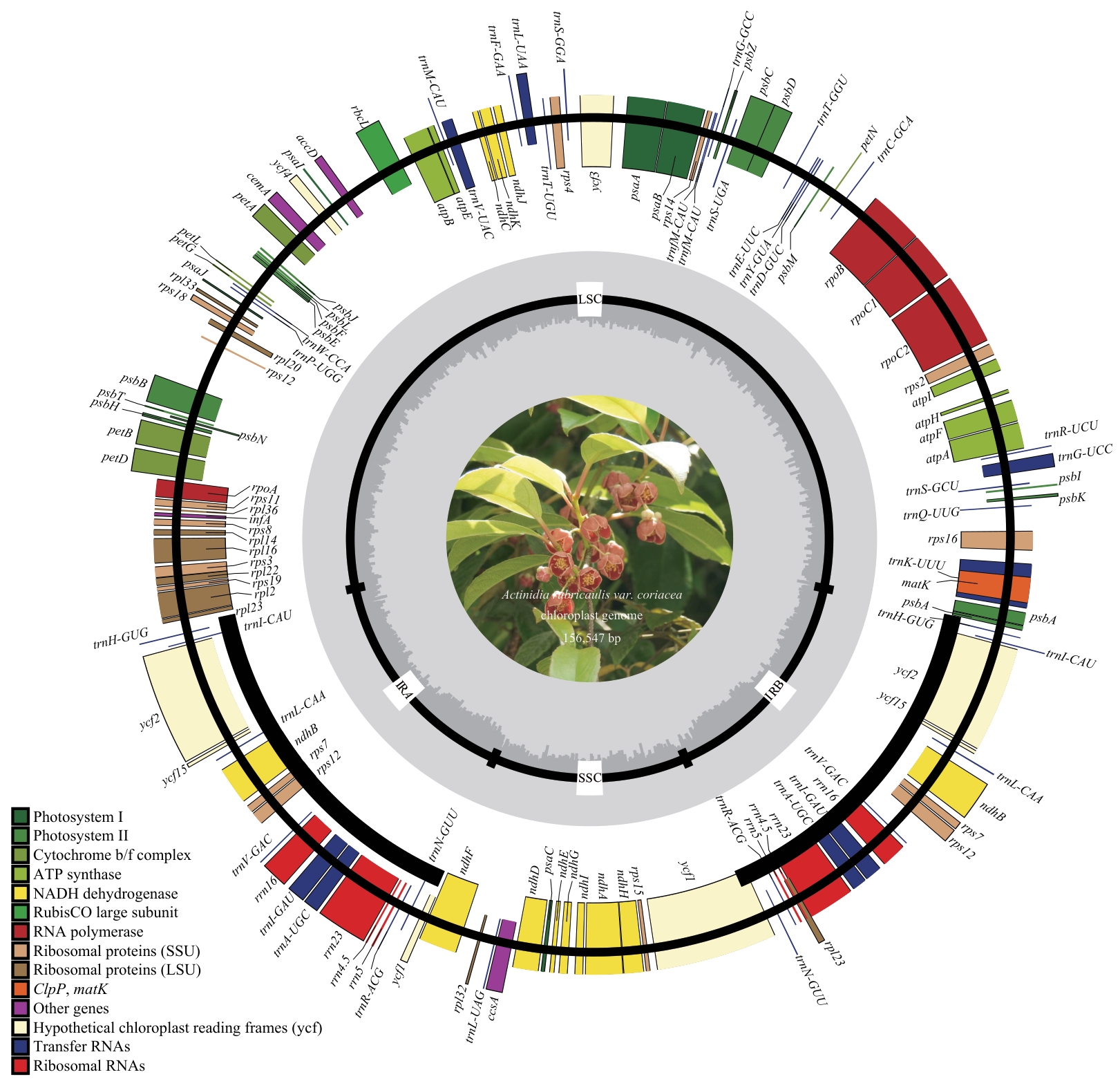
图1 革叶猕猴桃叶绿体基因组图谱
Fig. 1 Circular map of the A. rubricaulis var. coriacea chloroplast genome
基因类别 Gene category | 基因功能 Gene function | 基因名称 Gene name | 数量 Number |
|---|---|---|---|
光合作用基因 Photosynthesis genes | 光系统Ⅰ亚基 Subunits of photosystem I | psaA, psaB, psaC, psaI, psaJ | 5 |
光系统Ⅱ亚基 Subunits of photosystem II | psbA, psbB, psbC, psbD, psbE, psbF, psbH, psbI, psbJ, psbK, psbL, psbM, psbN, psbT, psbZ | 15 | |
NADH-脱氢酶亚基 Subunits of NADH dehydrogenase | ndhA*, ndhB*(2), ndhC, ndhD, ndhE, ndhF, ndhG, ndhH, ndhI, ndhJ, ndhK | 12 | |
细胞色素复合物b/f亚基 Subunits of cytochrome b/f complex | petA, petB*, petD*, petG, petL, petN | 6 | |
ATP合成酶亚基 Subunits of ATP synthase | atpA, atpB, atpE, atpF*, atpH, atpI | 6 | |
二磷酸核酮糖羧化酶大亚基 Large subunit of Rubisco | rbcL | 1 | |
自我复制基因 Self-replication genes | 核糖体大亚基 Proteins of the large ribosomal subunit | rpl14, rpl16*, rpl2*, rpl20, rpl22, rpl23(2), rpl32, rpl33, rpl36 | 10 |
核糖体小亚基 Proteins of the small ribosomal subunit | rps11, rps12**(2), rps14, rps15, rps16*, rps18, rps19, rps2, rps3, rps4, rps7(2), rps8 | 14 | |
RNA聚合酶亚基 Subunits of RNA polymerase | rpoA, rpoB, rpoC1*, rpoC2 | 4 | |
核糖体RNA Ribosomal RNAs | rrn16(2), rrn23(2), rrn4.5(2), rrn5(2) | 8 | |
转运RNA Transfer RNAs | trnA-UGC*(2), trnC-GCA, trnD-GUC, trnE-UUC, trnF-GAA, trnG-GCC, trnG-UCC*, trnH-GUG(2), trnI-CAU(2), trnI-GAU*(2), trnK-UUU*, trnL-CAA(2), trnL-UAA*, trnL-UAG, trnM-CAU, trnN-GUU(2), trnP-UGG, trnQ-UUG, trnR-ACG(2), trnR-UCU, trnS-GCU, trnS-GGA, trnS-UGA, trnT-GGU, trnT-UGU, trnV-GAC(2), trnV-UAC*, trnW-CCA, trnY-GUA, trnfM-CAU(2) | 39 | |
其他基因 Other genes | 成熟酶 Maturase | matK | 1 |
包裹膜蛋白 Envelope membrane protein | cemA | 1 | |
乙酰辅酶A羧化酶 Acetyl-CoA carboxylase | accD | 1 | |
c型细胞色素合成基因 c-type cytochrome synthesis gene | ccsA | 1 | |
转录起始因子 Translation initiation factor | infA | 1 | |
功能未知基因 Genes of unknown function | 保守假想叶绿体开放阅读框 Conserved hypothetical chloroplast ORF | #ycf1, ycf1, ycf15(2), ycf2(2), ycf3**, ycf4 | 8 |
表2 革叶猕猴桃叶绿体基因功能注释分类统计
Table 2 Classification statistics of functional annotation of chloroplast genes in A. rubricaulis var. coriacea
基因类别 Gene category | 基因功能 Gene function | 基因名称 Gene name | 数量 Number |
|---|---|---|---|
光合作用基因 Photosynthesis genes | 光系统Ⅰ亚基 Subunits of photosystem I | psaA, psaB, psaC, psaI, psaJ | 5 |
光系统Ⅱ亚基 Subunits of photosystem II | psbA, psbB, psbC, psbD, psbE, psbF, psbH, psbI, psbJ, psbK, psbL, psbM, psbN, psbT, psbZ | 15 | |
NADH-脱氢酶亚基 Subunits of NADH dehydrogenase | ndhA*, ndhB*(2), ndhC, ndhD, ndhE, ndhF, ndhG, ndhH, ndhI, ndhJ, ndhK | 12 | |
细胞色素复合物b/f亚基 Subunits of cytochrome b/f complex | petA, petB*, petD*, petG, petL, petN | 6 | |
ATP合成酶亚基 Subunits of ATP synthase | atpA, atpB, atpE, atpF*, atpH, atpI | 6 | |
二磷酸核酮糖羧化酶大亚基 Large subunit of Rubisco | rbcL | 1 | |
自我复制基因 Self-replication genes | 核糖体大亚基 Proteins of the large ribosomal subunit | rpl14, rpl16*, rpl2*, rpl20, rpl22, rpl23(2), rpl32, rpl33, rpl36 | 10 |
核糖体小亚基 Proteins of the small ribosomal subunit | rps11, rps12**(2), rps14, rps15, rps16*, rps18, rps19, rps2, rps3, rps4, rps7(2), rps8 | 14 | |
RNA聚合酶亚基 Subunits of RNA polymerase | rpoA, rpoB, rpoC1*, rpoC2 | 4 | |
核糖体RNA Ribosomal RNAs | rrn16(2), rrn23(2), rrn4.5(2), rrn5(2) | 8 | |
转运RNA Transfer RNAs | trnA-UGC*(2), trnC-GCA, trnD-GUC, trnE-UUC, trnF-GAA, trnG-GCC, trnG-UCC*, trnH-GUG(2), trnI-CAU(2), trnI-GAU*(2), trnK-UUU*, trnL-CAA(2), trnL-UAA*, trnL-UAG, trnM-CAU, trnN-GUU(2), trnP-UGG, trnQ-UUG, trnR-ACG(2), trnR-UCU, trnS-GCU, trnS-GGA, trnS-UGA, trnT-GGU, trnT-UGU, trnV-GAC(2), trnV-UAC*, trnW-CCA, trnY-GUA, trnfM-CAU(2) | 39 | |
其他基因 Other genes | 成熟酶 Maturase | matK | 1 |
包裹膜蛋白 Envelope membrane protein | cemA | 1 | |
乙酰辅酶A羧化酶 Acetyl-CoA carboxylase | accD | 1 | |
c型细胞色素合成基因 c-type cytochrome synthesis gene | ccsA | 1 | |
转录起始因子 Translation initiation factor | infA | 1 | |
功能未知基因 Genes of unknown function | 保守假想叶绿体开放阅读框 Conserved hypothetical chloroplast ORF | #ycf1, ycf1, ycf15(2), ycf2(2), ycf3**, ycf4 | 8 |
基因 Gene | 位置 Location | 序列长度Length of sequence (bp) | |||||
|---|---|---|---|---|---|---|---|
外显子Ⅰ Exon I | 内含子Ⅰ Intron I | 外显子Ⅱ Exon II | 内含子Ⅱ Intron II | 外显子Ⅲ Exon III | |||
| trnK-UUU | LSC | 37 | 2 492 | 39 | |||
| rps16 | LSC | 42 | 872 | 225 | |||
| trnG-UCC | LSC | 23 | 689 | 48 | |||
| atpF | LSC | 144 | 723 | 411 | |||
| rpoC1 | LSC | 435 | 736 | 1 614 | |||
| ycf3 | LSC | 126 | 743 | 228 | 718 | 153 | |
| trnL-UAA | LSC | 37 | 504 | 50 | |||
| trnV-UAC | LSC | 38 | 589 | 37 | |||
| rps12 | IRa+LSC | 114 | * | 232 | * | ||
| petB | LSC | 6 | 711 | 642 | |||
| petD | LSC | 6 | 799 | 477 | |||
| rpl16 | LSC | 9 | 1 037 | 402 | |||
| rpl2 | LSC | 405 | 664 | 441 | |||
| ndhB | IRb | 777 | 679 | 756 | |||
| rps12 | IRb+LSC | 232 | * | 26 | * | ||
| trnI-GAU | IRb | 42 | 942 | 35 | |||
| trnA-UGC | IRb | 38 | 798 | 35 | |||
| ndhA | SSC | 552 | 1 095 | 540 | |||
| trnA-UGC | IRa | 38 | 798 | 35 | |||
| trnI-GAU | IRa | 42 | 942 | 35 | |||
| ndhB | IRa | 777 | 679 | 756 | |||
表3 革叶猕猴桃叶绿体基因组中具有内含子的基因信息
Table 3 Genes containing introns in the A. rubricaulis var. coriacea chloroplast genome
基因 Gene | 位置 Location | 序列长度Length of sequence (bp) | |||||
|---|---|---|---|---|---|---|---|
外显子Ⅰ Exon I | 内含子Ⅰ Intron I | 外显子Ⅱ Exon II | 内含子Ⅱ Intron II | 外显子Ⅲ Exon III | |||
| trnK-UUU | LSC | 37 | 2 492 | 39 | |||
| rps16 | LSC | 42 | 872 | 225 | |||
| trnG-UCC | LSC | 23 | 689 | 48 | |||
| atpF | LSC | 144 | 723 | 411 | |||
| rpoC1 | LSC | 435 | 736 | 1 614 | |||
| ycf3 | LSC | 126 | 743 | 228 | 718 | 153 | |
| trnL-UAA | LSC | 37 | 504 | 50 | |||
| trnV-UAC | LSC | 38 | 589 | 37 | |||
| rps12 | IRa+LSC | 114 | * | 232 | * | ||
| petB | LSC | 6 | 711 | 642 | |||
| petD | LSC | 6 | 799 | 477 | |||
| rpl16 | LSC | 9 | 1 037 | 402 | |||
| rpl2 | LSC | 405 | 664 | 441 | |||
| ndhB | IRb | 777 | 679 | 756 | |||
| rps12 | IRb+LSC | 232 | * | 26 | * | ||
| trnI-GAU | IRb | 42 | 942 | 35 | |||
| trnA-UGC | IRb | 38 | 798 | 35 | |||
| ndhA | SSC | 552 | 1 095 | 540 | |||
| trnA-UGC | IRa | 38 | 798 | 35 | |||
| trnI-GAU | IRa | 42 | 942 | 35 | |||
| ndhB | IRa | 777 | 679 | 756 | |||
氨基酸缩写 Symbol | 密码子 Codon | 数量 No. | 密码子偏好性 RSCU | 氨基酸 Symbol | 密码子 Codon | 数量 No. | 密码子偏好性 RSCU | |
|---|---|---|---|---|---|---|---|---|
| * | UAA | 43 | 1.63 | 蛋氨酸 Met | AUG | 507 | 6.97 | |
| UAG | 18 | 0.68 | GUG | 2 | 0.03 | |||
| UGA | 18 | 0.68 | 天冬酰胺 Asn | AAC | 249 | 0.48 | ||
| 丙氨酸 Ala | GCA | 379 | 1.18 | AAU | 794 | 1.52 | ||
| GCC | 186 | 0.58 | 脯氨酸 Pro | CCA | 274 | 1.13 | ||
| GCG | 151 | 0.47 | CCC | 168 | 0.69 | |||
| GCU | 574 | 1.78 | CCG | 131 | 0.54 | |||
| 半胱氨酸 Cys | UGC | 52 | 0.44 | CCU | 394 | 1.63 | ||
| UGU | 186 | 1.56 | 谷氨酰胺 Gln | CAA | 632 | 1.56 | ||
| 天冬氨酸 Asp | GAC | 177 | 0.40 | CAG | 178 | 0.44 | ||
| GAU | 702 | 1.60 | 精氨酸 Arg | AGA | 409 | 1.81 | ||
| 谷氨酸 Glu | GAA | 870 | 1.50 | AGG | 132 | 0.58 | ||
| GAG | 292 | 0.50 | CGA | 328 | 1.45 | |||
| 苯丙氨酸 Phe | UUC | 453 | 0.68 | CGC | 86 | 0.38 | ||
| UUU | 875 | 1.32 | CGG | 99 | 0.44 | |||
| 甘氨酸 Gly | GGA | 601 | 1.56 | CGU | 304 | 1.34 | ||
| GGC | 163 | 0.42 | 丝氨酸 Ser | AGC | 100 | 0.37 | ||
| GGG | 247 | 0.64 | AGU | 327 | 1.21 | |||
| GGU | 528 | 1.37 | UCA | 308 | 1.14 | |||
| 组氨酸 His | CAC | 119 | 0.46 | UCC | 251 | 0.93 | ||
| CAU | 401 | 1.54 | UCG | 151 | 0.56 | |||
| 异亮氨酸 Ile | AUA | 622 | 0.97 | UCU | 489 | 1.80 | ||
| AUC | 383 | 0.59 | 苏氨酸 Thr | ACA | 356 | 1.24 | ||
| AUU | 926 | 1.44 | ACC | 211 | 0.74 | |||
| 赖氨酸 Lys | AAA | 985 | 1.49 | ACG | 102 | 0.36 | ||
| AAG | 339 | 0.51 | ACU | 477 | 1.66 | |||
| 亮氨酸 Leu | CUA | 315 | 0.77 | 缬氨酸 Val | GUA | 477 | 1.51 | |
| CUC | 160 | 0.39 | GUC | 135 | 0.43 | |||
| CUG | 146 | 0.36 | GUG | 178 | 0.56 | |||
| CUU | 502 | 1.23 | GUU | 472 | 1.50 | |||
| UUA | 799 | 1.96 | 酪氨酸 Tyr | UAC | 171 | 0.40 | ||
| UUG | 520 | 1.28 | UAU | 685 | 1.60 | |||
| 色氨酸 Trp | UGG | 408 | 1.00 |
表4 革叶猕猴桃叶绿体基因组密码子偏好性分析统计表
Table 4 Statistical analysis of codon usage bias in the A. rubricaulis var. coriacea chloroplast genome
氨基酸缩写 Symbol | 密码子 Codon | 数量 No. | 密码子偏好性 RSCU | 氨基酸 Symbol | 密码子 Codon | 数量 No. | 密码子偏好性 RSCU | |
|---|---|---|---|---|---|---|---|---|
| * | UAA | 43 | 1.63 | 蛋氨酸 Met | AUG | 507 | 6.97 | |
| UAG | 18 | 0.68 | GUG | 2 | 0.03 | |||
| UGA | 18 | 0.68 | 天冬酰胺 Asn | AAC | 249 | 0.48 | ||
| 丙氨酸 Ala | GCA | 379 | 1.18 | AAU | 794 | 1.52 | ||
| GCC | 186 | 0.58 | 脯氨酸 Pro | CCA | 274 | 1.13 | ||
| GCG | 151 | 0.47 | CCC | 168 | 0.69 | |||
| GCU | 574 | 1.78 | CCG | 131 | 0.54 | |||
| 半胱氨酸 Cys | UGC | 52 | 0.44 | CCU | 394 | 1.63 | ||
| UGU | 186 | 1.56 | 谷氨酰胺 Gln | CAA | 632 | 1.56 | ||
| 天冬氨酸 Asp | GAC | 177 | 0.40 | CAG | 178 | 0.44 | ||
| GAU | 702 | 1.60 | 精氨酸 Arg | AGA | 409 | 1.81 | ||
| 谷氨酸 Glu | GAA | 870 | 1.50 | AGG | 132 | 0.58 | ||
| GAG | 292 | 0.50 | CGA | 328 | 1.45 | |||
| 苯丙氨酸 Phe | UUC | 453 | 0.68 | CGC | 86 | 0.38 | ||
| UUU | 875 | 1.32 | CGG | 99 | 0.44 | |||
| 甘氨酸 Gly | GGA | 601 | 1.56 | CGU | 304 | 1.34 | ||
| GGC | 163 | 0.42 | 丝氨酸 Ser | AGC | 100 | 0.37 | ||
| GGG | 247 | 0.64 | AGU | 327 | 1.21 | |||
| GGU | 528 | 1.37 | UCA | 308 | 1.14 | |||
| 组氨酸 His | CAC | 119 | 0.46 | UCC | 251 | 0.93 | ||
| CAU | 401 | 1.54 | UCG | 151 | 0.56 | |||
| 异亮氨酸 Ile | AUA | 622 | 0.97 | UCU | 489 | 1.80 | ||
| AUC | 383 | 0.59 | 苏氨酸 Thr | ACA | 356 | 1.24 | ||
| AUU | 926 | 1.44 | ACC | 211 | 0.74 | |||
| 赖氨酸 Lys | AAA | 985 | 1.49 | ACG | 102 | 0.36 | ||
| AAG | 339 | 0.51 | ACU | 477 | 1.66 | |||
| 亮氨酸 Leu | CUA | 315 | 0.77 | 缬氨酸 Val | GUA | 477 | 1.51 | |
| CUC | 160 | 0.39 | GUC | 135 | 0.43 | |||
| CUG | 146 | 0.36 | GUG | 178 | 0.56 | |||
| CUU | 502 | 1.23 | GUU | 472 | 1.50 | |||
| UUA | 799 | 1.96 | 酪氨酸 Tyr | UAC | 171 | 0.40 | ||
| UUG | 520 | 1.28 | UAU | 685 | 1.60 | |||
| 色氨酸 Trp | UGG | 408 | 1.00 |
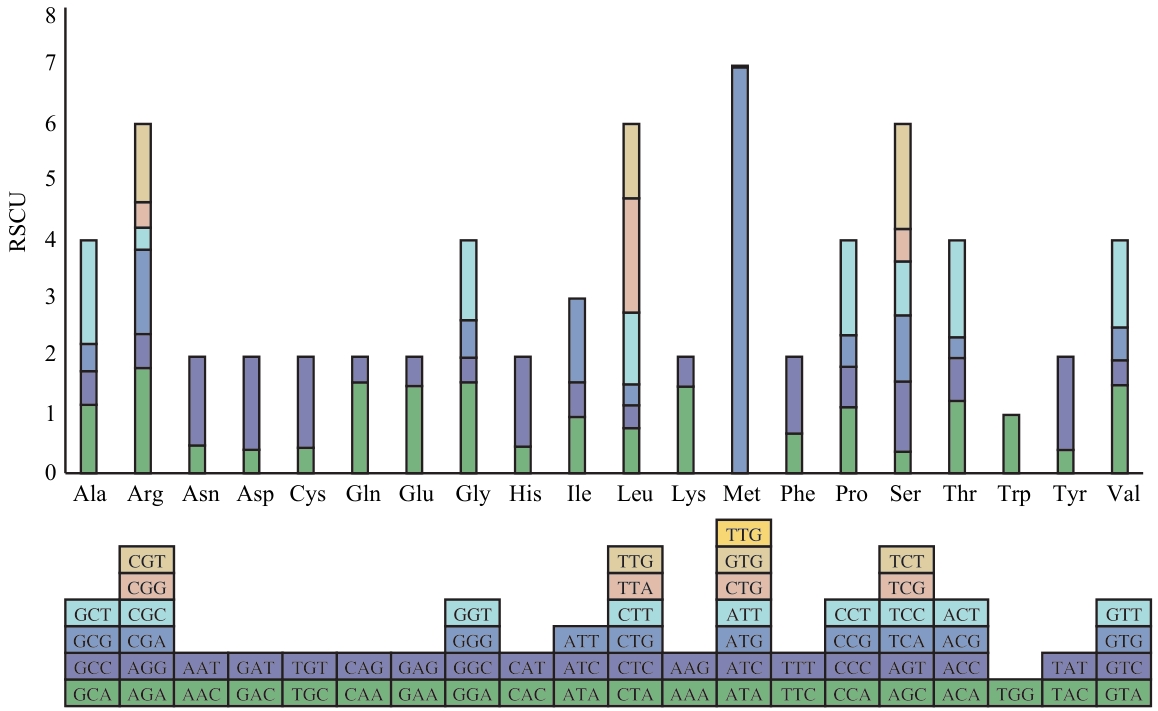
图2 革叶猕猴桃叶绿体基因组相对同义密码子使用度下面方块代表编码各个氨基酸的全部密码子,而上方柱状图的高度则表示这些密码子RSCU值的总和
Fig. 2 Relative synonymous codon usage in the A. rubricaulis var. coriacea chloroplast genomeThe following grids show all the codons that code for each amino acid, and the vertical extent of the columns above indicates the total of the RSCU values for each codon
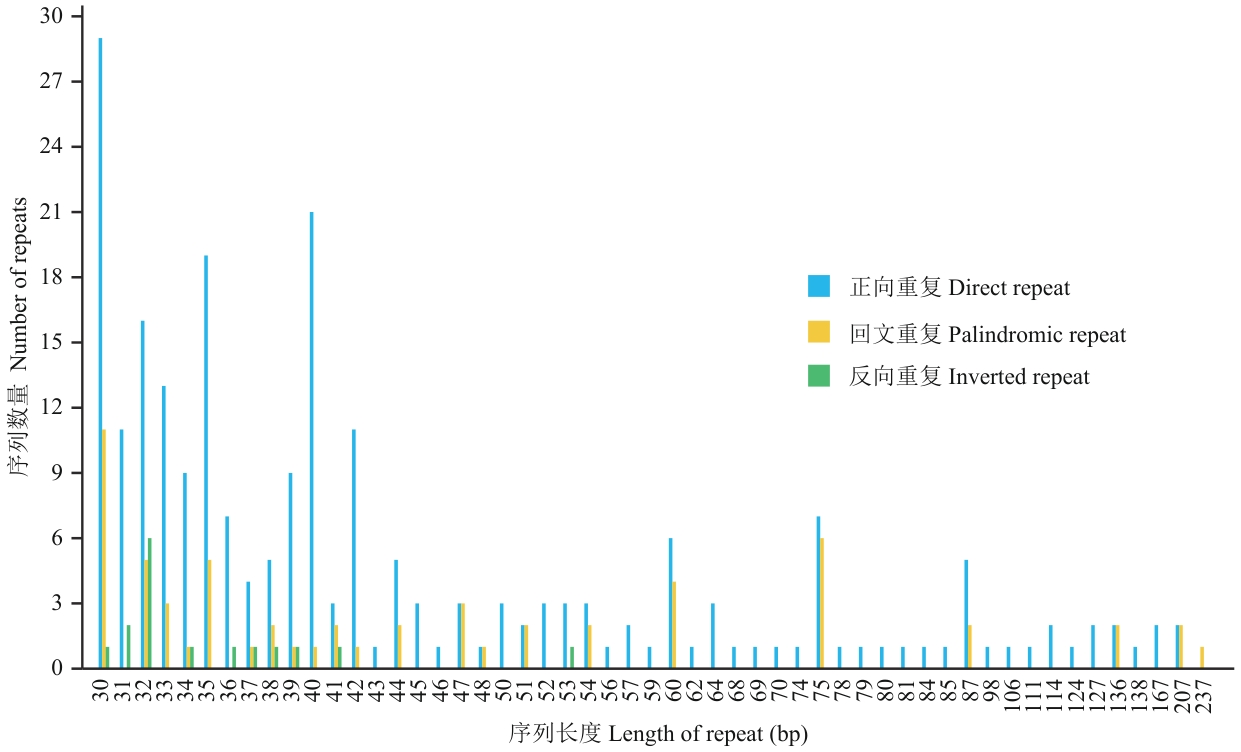
图3 革叶猕猴桃叶绿体基因组散在重复序列统计图
Fig. 3 Statistical analysis of interspersed repeats in the A. rubricaulis var. coriacea chloroplast genome
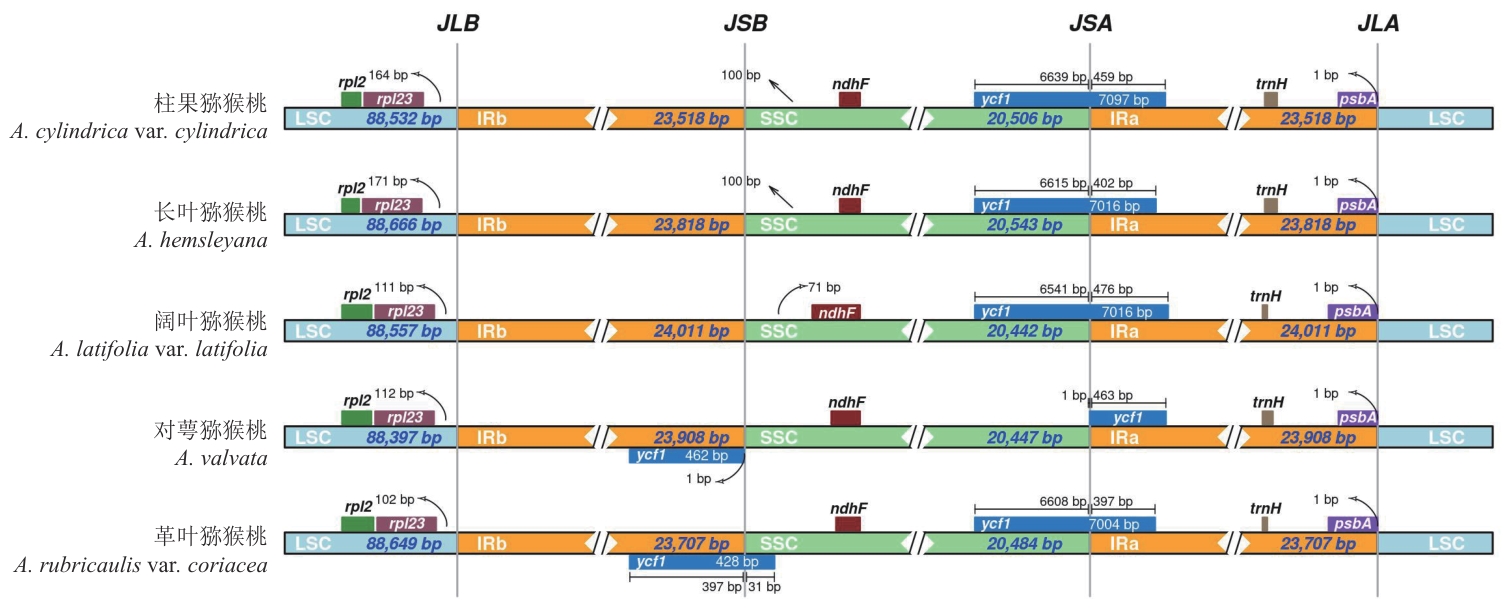
图4 叶绿体基因组的IR/SC边界分析
Fig. 4 Analysis of IR/SC boundary in the chloroplast genome
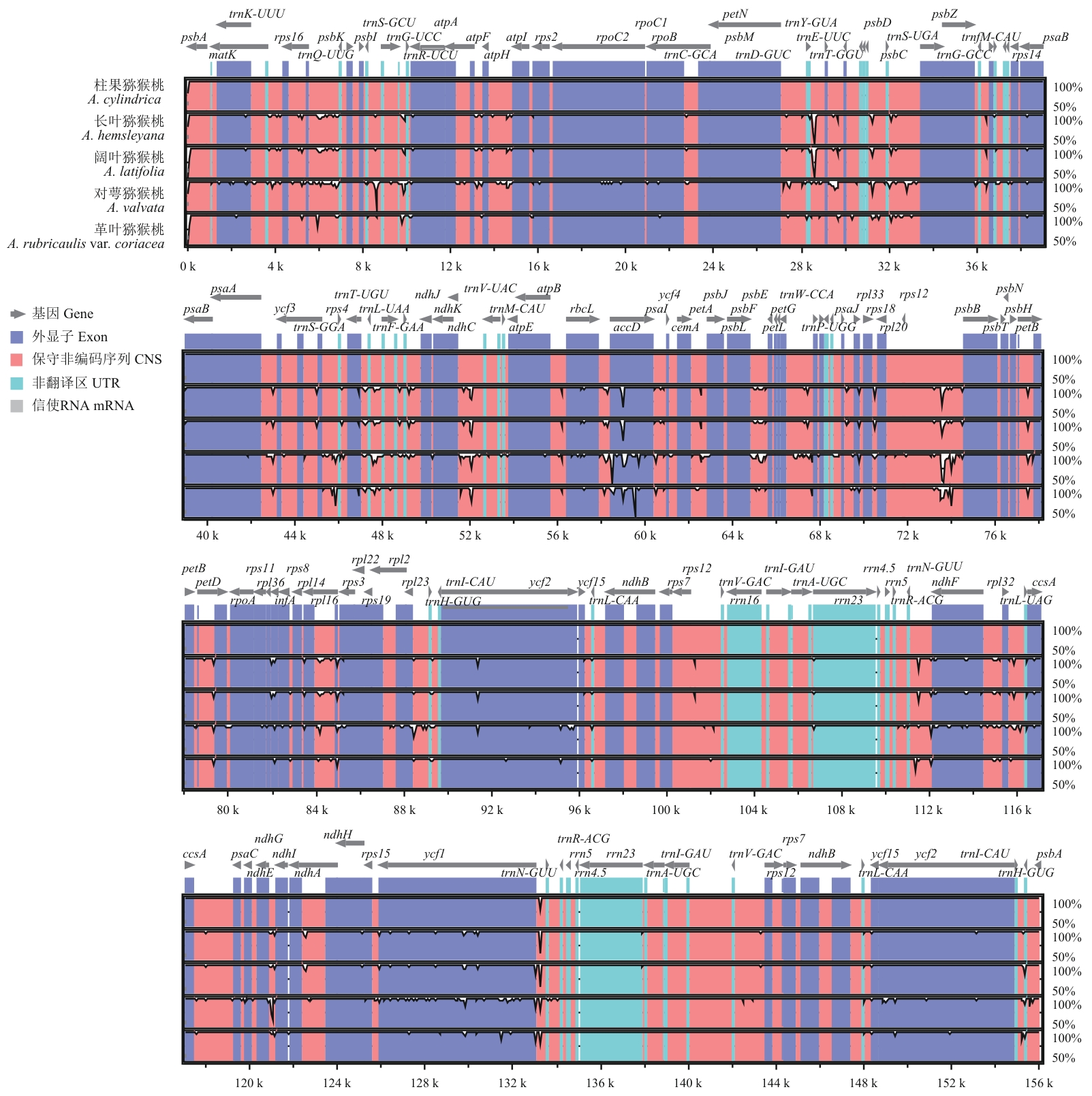
图5 叶绿体基因组序列比对
Fig. 5 Alignment of chloroplast genome sequences
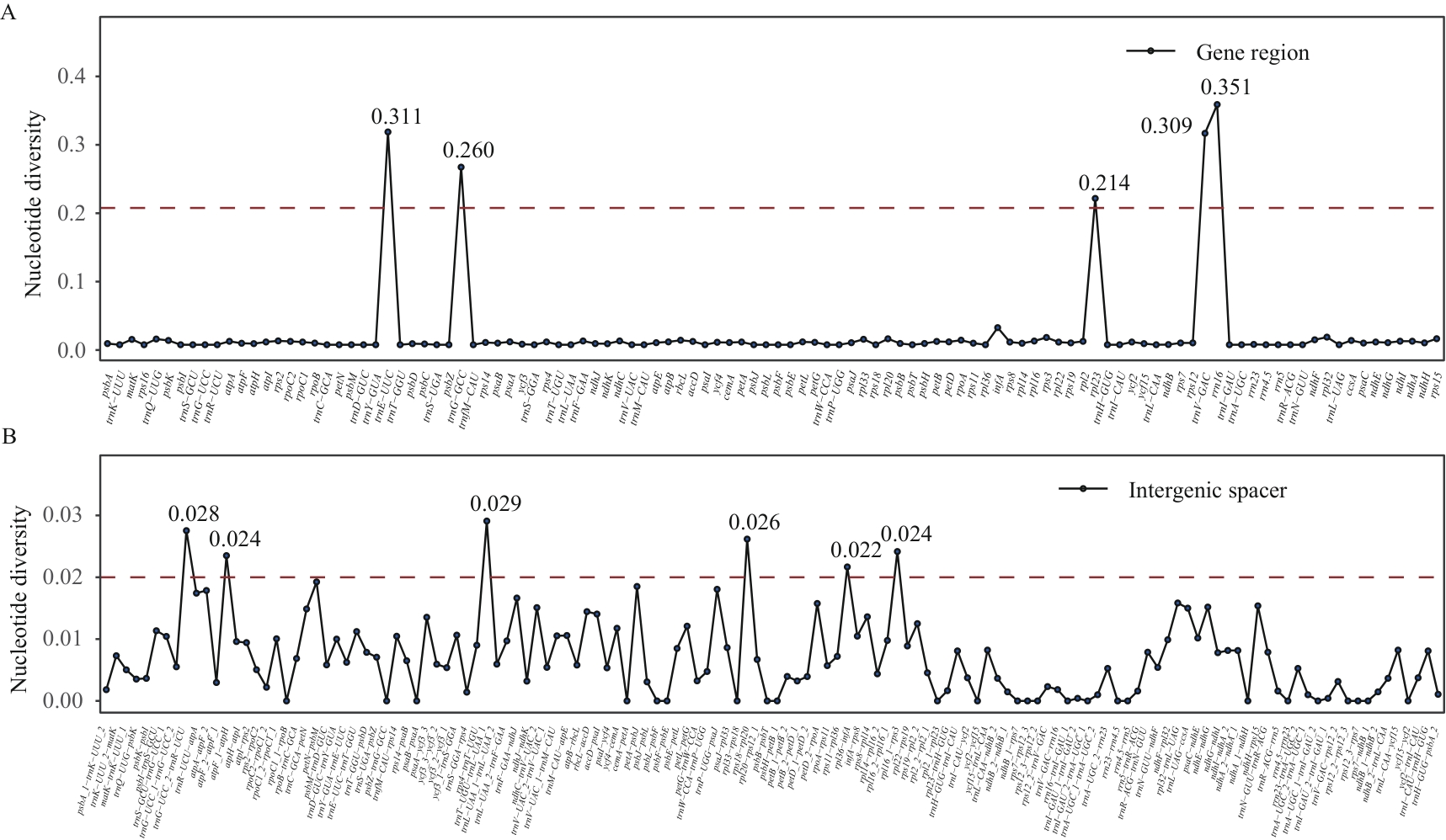
图6 革叶猕猴桃叶绿体基因组核苷酸多态性
Fig. 6 Nucleotide diversity of the A. rubricaulis var. coriacea chloroplast genome sequences
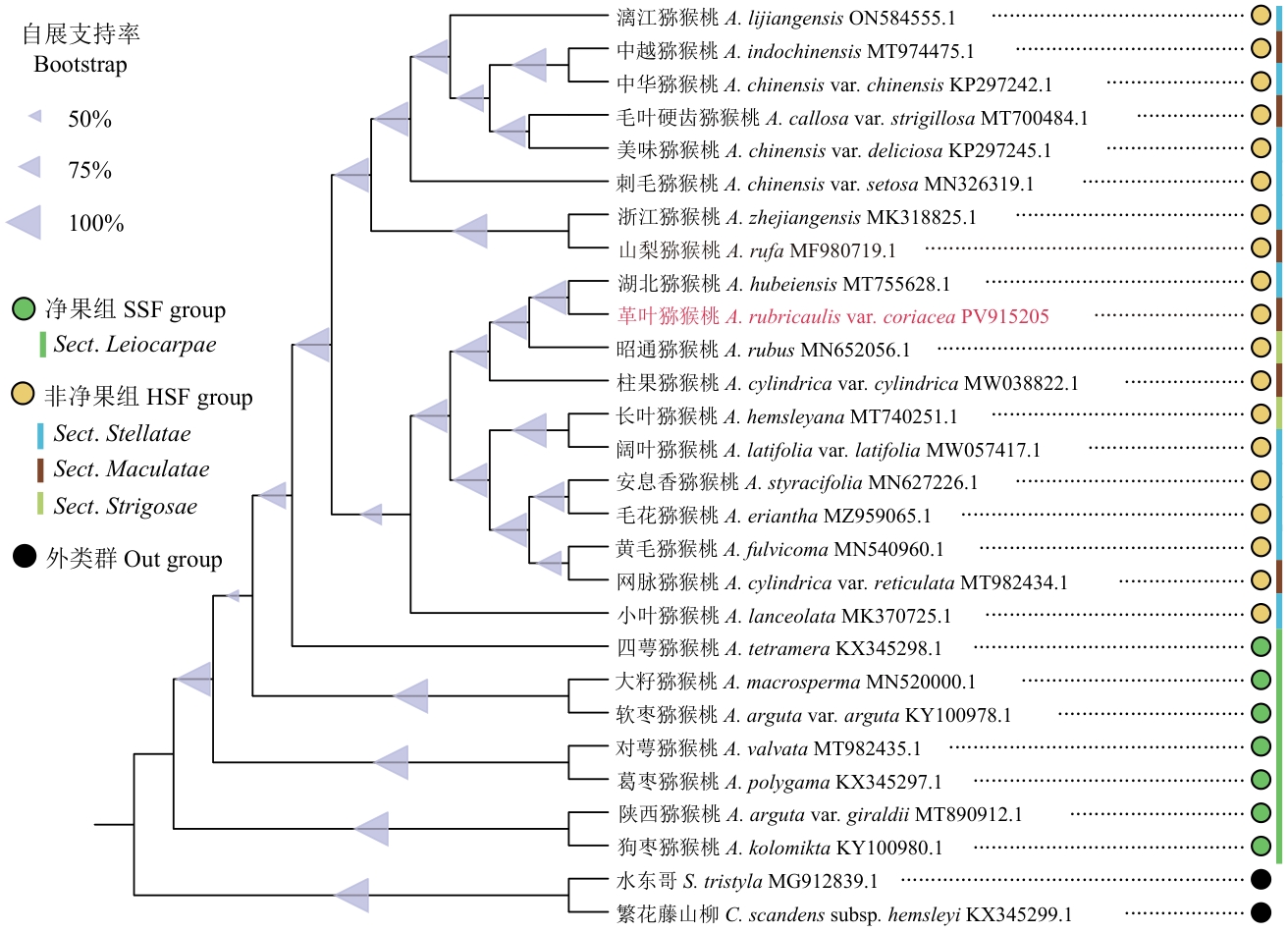
图7 猕猴桃属物种系统发育分析
Fig. 7 Phylogenetic analysis of Actinidia species
| [1] | Daniell H, Lin CS, Yu M, et al. Chloroplast genomes: diversity, evolution, and applications in genetic engineering [J]. Genome Biol, 2016, 17: 134. |
| [2] | 吕金莲, 马娜娜, 孟庆伟. 叶绿体蛋白酶的生物学功能研究进展 [J]. 植物生理学报, 2018, 54(12): 1774-1782. |
| Lü JL, Ma NN, Meng QW. Research progress of biological function of chloroplast proteases [J]. Plant Physiol J, 2018, 54(12): 1774-1782. | |
| [3] | Chung KP. Cytoplasmic inheritance: The transmission of plastid and mitochondrial genomes across cells and generations [J]. Plant Physiol, 2025, 198: kiaf168. |
| [4] | Li DW, Qi XQ, Li XW, et al. Maternal inheritance of mitochondrial genomes and complex inheritance of chloroplast genomes in Actinidia Lind.: evidences from interspecific crosses [J]. Mol Genet Genomics, 2013, 288(3/4): 101-110. |
| [5] | 陈超南, 陆嘉惠, 李学禹, 等. 甘草属种间杂交种叶绿体DNA父系遗传的发现及分析 [J]. 广西植物, 2017, 37(2): 162-168, 138. |
| Chen CN, Lu JH, Li XY, et al. Inheritance analysis and discovery of chloroplast paternal inheritance in interspecific crossing of Glycyrrhiza [J]. Guihaia, 2017, 37(2): 162-168, 138. | |
| [6] | 王杰, 贺文闯, 向坤莉, 等. 基因组时代的植物系统发育研究进展 [J]. 浙江农林大学学报, 2023, 40(1): 227-236. |
| Wang J, He WC, Xiang KL, et al. Advances in plant phylogeny in the genome era [J]. J Zhejiang A&F Univ, 2023, 40(1): 227-236. | |
| [7] | Wang YF, Wen F, Hong X, et al. Comparative chloroplast genome analyses of Paraboea (Gesneriaceae): Insights into adaptive evolution and phylogenetic analysis [J]. Front Plant Sci, 2022, 13: 1019831. |
| [8] | Cauz-Santos LA. Beyond conservation: the landscape of chloroplast genome rearrangements in angiosperms [J]. New Phytol, 2025, 247(6): 2571-2580. |
| [9] | 陈梓媛, 华中一, 袁媛. 全球物种数量最多的叶绿体基因组数据库的建立及应用进展 [J]. 中国中药杂志, 2024, 49(23): 6257-6263. |
| Chen ZY, Hua ZY, Yuan Y. Establishment and application of chloroplast genome database with the largest number of species in world [J]. China J Chin Mater Med, 2024, 49(23): 6257-6263. | |
| [10] | 黄宏文. 猕猴桃驯化改良百年启示及天然居群遗传渐渗的基因发掘 [J]. 植物学报, 2009, 44(2): 127-142. |
| Huang HW. History of 100 years of domestication and improvement of kiwifruit and gene discovery from genetic introgressed populations in the wild [J]. Bull Bot, 2009, 44(2): 127-142. | |
| [11] | 黄宏文. 猕猴桃属 分类 资源 驯化 栽培 [M]. 北京: 科学出版社, 2013. |
| Huang HW. Actinidia taxonomy germplasm domestication cultivation [M]. Beijing: Science Press, 2013. | |
| [12] | Li JQ, Li XW, Djaja SD. Actinidiaceae[M]// Flora of China. Beijing: Science Press; St. Louis: Missouri Botanical Garden Press, 2007: 334-360. |
| [13] | 李作洲. 猕猴桃属植物的分子系统学研究 [D]. 武汉: 中国科学院(武汉植物园), 2006. |
| Li ZZ. Molecular phylogeny of the genus Actinidia based on nuclear DNA genetic markers and cytoplasm DNA sequence analysis [D]. Wuhan: Wuhan Botanical Garden, Chinese Academy of Sciences, 2006. | |
| [14] | 唐萍. 猕猴桃属叶绿体基因组进化及其系统发育关系重建 [D]. 武汉: 中国科学院武汉植物园, 2017. |
| Tang P. Evolution of chloroplast genome and re-construction of phylogenetic relationships among the Actinidia [D]. Wuhan: Wuhan Botanical Garden, Chinese Academy of Sciences, 2017. | |
| [15] | Lin QH, Hu SQ, Wu ZH, et al. Comparative chloroplast genomics provides insights into the phylogenetic relationships and evolutionary history for Actinidia species [J]. Sci Rep, 2025, 15: 13291. |
| [16] | Liu YF, Li DW, Zhang Q, et al. Rapid radiations of both kiwifruit hybrid lineages and their parents shed light on a two-layer mode of species diversification [J]. New Phytol, 2017, 215(2): 877-890. |
| [17] | Yu XF, Qu MH, Wu P, et al. Super pan-genome reveals extensive genomic variations associated with phenotypic divergence in Actinidia [J]. Mol Horticulture, 2025, 5: 4. |
| [18] | 胡光明, 张琼, 韩飞, 等. 猕猴桃属植物通用型SSR分子标记引物的筛选及应用 [J]. 中国农业科学, 2022, 55(17): 3411-3425. |
| Hu GM, Zhang Q, Han F, et al. Screening and application of universal SSR molecular marker primers in Actinidia [J]. Sci Agric Sin, 2022, 55(17): 3411-3425. | |
| [19] | 胡光明, 肖涛, 周志虎, 等. 湖北秭归野生猕猴桃资源及其倍性分析 [J]. 种子, 2024, 43(3): 67-72, 81. |
| Hu GM, Xiao T, Zhou ZH, et al. Analysis on ploidy and wild Actinidia chinensis resources in Zigui County, Hubei Province [J]. Seed, 2024, 43(3): 67-72, 81. | |
| [20] | 吴欣静, 陈金锋, 崔国发. 《国家重点保护野生植物名录》更新建议——基于对现有保护名录的分析 [J]. 生物多样性, 2023, 31(7): 182-193. |
| Wu XJ, Chen JF, Cui GF. Proposals for updating the List of National Key Protected Wild Plants—Based on an analysis of existing conservation lists [J]. Biodivers Sci, 2023, 31(7): 182-193. | |
| [21] | 祝晨蔯, 刘中秋, 刘良. 革叶猕猴桃果实不同提取部位抗心肌缺血作用的比较研究 [J]. 中药药理与临床, 2001, 17(1): 20-21. |
| , Liu ZQ, Liu L. Comparative studies on pharmacological effects of anti-myocardial infraction of different extraction from fruits of Actinidia rubricaulis var. coriacea [J]. Pharmacol Clin Chin Mater Med, 2001, 17(1): 20-21. | |
| [22] | Liao JC, Lin KH, Cheng HY, et al. Actinidia rubricaulis attenuates hepatic fibrosis induced by carbon tetrachloride in rats [J]. Am J Chin Med, 2007, 35(1): 81-88. |
| [23] | Yao XH, Tang P, Li ZZ, et al. The first complete chloroplast genome sequences in Actinidiaceae: genome structure and comparative analysis [J]. PLoS One, 2015, 10(6): e0129347. |
| [24] | Liu X, Sun C, Li MZ, et al. The complete chloroplast genome sequence of Actinidia chinensis Planch. ‘Hongyang’, a typical red core pulp in China [J]. Mitochondrial DNA Part B, 2022, 7(4): 593-595. |
| [25] | Ding FB, Zhang L, Wang YL, et al. The complete chloroplast genome sequence of Actinidia arguta var. giraldii [J]. Mitochondrial DNA Part B, 2021, 6(2): 413-414. |
| [26] | Tang P, Xu Q, Shen RN, et al. Phylogenetic relationship in Actinidia (Actinidiaceae) based on four noncoding chloroplast DNA sequences [J]. Plant Syst Evol, 2019, 305(9): 787-796. |
| [27] | Wang LC, Liu B, Yang YR, et al. The comparative studies of complete chloroplast genomes in Actinidia (Actinidiaceae): novel insights into heterogenous variation, clpP gene annotation and phylogenetic relationships [J]. Mol Genet Genomics, 2022, 297(2): 535-551. |
| [28] | Wang Z, Zhong CH, Li DW, et al. Cytotype distribution and chloroplast phylogeography of the Actinidia chinensis complex [J]. BMC Plant Biol, 2021, 21: 325. |
| [29] | Gladysheva-Azgari M, Sharko F, Slobodova N, et al. Comparative analysis revealed intrageneric and intraspecific genomic variation in chloroplast genomes of Actinidia spp. (Actinidiaceae, Viridiplantae) [J]. Horticulturae, 2023, 9(11): 1175. |
| [30] | Jin JJ, Yu WB, Yang JB, et al. GetOrganelle: a fast and versatile toolkit for accurate de novo assembly of organelle genomes [J]. Genome Biol, 2020, 21: 241. |
| [31] | Greiner S, Lehwark P, Bock R. OrganellarGenomeDRAW (OGDRAW) version 1.3.1: expanded toolkit for the graphical visualization of organellar genomes [J]. Nucleic Acids Res, 2019, 47(W1): W59-W64. |
| [32] | 丁锐, 胡兵, 宗小雁, 等. 杓兰叶绿体基因组密码子偏好性分析 [J]. 林业科学研究, 2021, 34(5): 177-185. |
| Ding R, Hu B, Zong XY, et al. Analysis of codon usage in the chloroplast genome of Cypripedium calceolus [J]. For Res, 2021, 34(5): 177-185. | |
| [33] | 马录花, 宁佳奇, 王永杰, 等. 桃儿七叶绿体比较基因组学分析 [J]. 生物工程学报, 2022, 38(10): 3695-3712. |
| Ma LH, Ning JQ, Wang YJ, et al. Comparative genomics on chloroplasts of Sinopodophyllum hexandrum [J]. Chin J Biotechnol, 2022, 38(10): 3695-3712. | |
| [34] | Amiryousefi A, Hyvönen J, Poczai P. IRscope: an online program to visualize the junction sites of chloroplast genomes [J]. Bioinformatics, 2018, 34(17): 3030-3031. |
| [35] | Huang LJ, Yu HX, Wang Z, et al. CPStools: a package for analyzing chloroplast genome sequences [J]. iMetaOmics, 2024, 1(2): e25. |
| [36] | Stamatakis A. RAxML version 8: a tool for phylogenetic analysis and post-analysis of large phylogenies [J]. Bioinformatics, 2014, 30(9): 1312-1313. |
| [37] | Letunic I, Bork P. Interactive Tree of Life (iTOL) v6: recent updates to the phylogenetic tree display and annotation tool [J]. Nucleic Acids Res, 2024, 52(W1): W78-W82. |
| [38] | 朱婷婷, 张磊, 陈万生, 等. 1342个植物叶绿体基因组分析 [J]. 基因组学与应用生物学, 2017, 36(10): 4323-4333. |
| Zhu TT, Zhang L, Chen WS, et al. Analysis of chloroplast genomes in 1342 plants [J]. Genom Appl Biol, 2017, 36(10): 4323-4333. | |
| [39] | 魏瑶, 张晶晶, 崔云晓, 等. 忍冬属忍冬组植物叶绿体基因组进化分析 [J]. 生物技术通报, 2025, 41(8): 276-288. |
| Wei Y, Zhang JJ, Cui YX, et al. Phylogenetic analysis of Lonicera Sect. Nintooa based on chloroplast genomes data [J]. Biotechnol Bull, 2025, 41(8): 276-288. | |
| [40] | 尹明华, 余锾媛, 肖心怡, 等. 江西铅山红芽芋叶绿体基因组特征及系统发育分析 [J]. 生物技术通报, 2023, 39(6): 233-247. |
| Yin MH, Yu HY, Xiao XY, et al. Chloroplast genomic characterization and phylogenetic analysis of Colocasia esculenta L. Schoot var. cormosus cv. ‘Hongyayu’ from Jiangxi Yanshan [J]. Biotechnol Bull, 2023, 39(6): 233-247. | |
| [41] | Liu H, Liu X, Sun C, et al. Chloroplast genome comparison and phylogenetic analysis of the commercial variety Actinidia chinensis ‘Hongyang’ [J]. Genes, 2023, 14(12): 2136. |
| [42] | 胡悦, 刘兵兵. 心叶毛蕊茶叶绿体基因组特征及系统发育分析 [J]. 植物资源与环境学报, 2024, 33(3): 1-13. |
| Hu Y, Liu BB. Analyses on chloroplast genome characteristics and phylogeny of Camellia cordifolia [J]. J Plant Resour Environ, 2024, 33(3): 1-13. | |
| [43] | Parvathy ST, Udayasuriyan V, Bhadana V. Codon usage bias [J]. Mol Biol Rep, 2022, 49(1): 539-565. |
| [44] | 郭松, 梁湘兰, 彭姿, 等. 莓叶委陵菜叶绿体基因组特征及其系统发育分析 [J]. 草地学报, 2024, 32(11): 3383-3390. |
| Guo S, Liang XL, Peng Z, et al. Chloroplast genome characteristics and phylogenetic analysis of Potentilla fragarioides [J]. Acta Agrestia Sin, 2024, 32(11): 3383-3390. | |
| [45] | Wang Z, Hu GM, Li ZZ, et al. Characterizing tetraploid populations of Actinidia chinensis for kiwifruit genetic improvement [J]. Plants, 2022, 11(9): 1154. |
| [46] | Hu GM, Jiang Q, Wang Z, et al. Genetic diversity analysis and core collection construction of the Actinidia chinensis complex (kiwifruit) based on SSR markers [J]. Agronomy, 2022, 12(12): 3078. |
| [47] | 王宇, 周俊良, 唐冬梅, 等. 阔叶猕猴桃叶绿体基因组特征及密码子偏好性分析 [J]. 种子, 2020, 39(5): 13-19. |
| Wang Y, Zhou JL, Tang DM, et al. Analysis of chloroplast genome characteristics and codon preference in broad-leaf kiwifruit [J]. Seed, 2020, 39(5): 13-19. | |
| [48] | He XJ, Yang Y, Zhang XY, et al. Comparative chloroplast genomics of Actinidia deliciosa cultivars: insights into positive selection and population evolution [J]. Int J Mol Sci, 2025, 26(9): 4387. |
| [1] | 梁慧琪, 陈益存, 汪阳东, 赵耘霄, 高暝. 山苍子PAT1基因亚家族鉴定及其在嫁接愈合过程中的表达分析[J]. 生物技术通报, 2026, 42(5): 302-311. |
| [2] | 刘林娅, 刘欢艳, 梁鑫钰, 宋姝熠, 何斌, 王绪英, 黄亚成. ‘红阳’猕猴桃BGAL基因家族的全基因组鉴定与表达分析[J]. 生物技术通报, 2026, 42(3): 312-323. |
| [3] | 庄娜, 贺红利, 张兴政. 蒺藜苜蓿SMXL基因家族全基因组鉴定及表达分析[J]. 生物技术通报, 2026, 42(2): 250-266. |
| [4] | 魏瑶, 张晶晶, 崔云晓, 刘钰, 刘海瑞. 忍冬属忍冬组植物叶绿体基因组进化分析[J]. 生物技术通报, 2025, 41(8): 276-288. |
| [5] | 安昌, 徐文波, 陆琳, 李登麟, 姚艺新, 林彦翔, 杨成梓, 秦源, 郑平. 不同产地珊瑚菜叶绿体基因组特征的差异性研究[J]. 生物技术通报, 2025, 41(6): 229-242. |
| [6] | 宋姝熠, 蒋开秀, 刘欢艳, 黄亚成, 刘林娅. ‘红阳’猕猴桃TCP基因家族鉴定及其在果实中的表达分析[J]. 生物技术通报, 2025, 41(3): 190-201. |
| [7] | 李斌, 苏香萍, 刘畅, 王玉兵, 张勇洪, 周超, 徐青. 玄参科植物叶绿体基因组特征及系统发育分析[J]. 生物技术通报, 2025, 41(3): 240-254. |
| [8] | 岳园园, 胡哲源, 何琪, 黄晨阳, 郑素月, 赵梦然. 基于全基因组SNP位点和性状特征解析我国野生肺形侧耳的遗传多样性[J]. 生物技术通报, 2025, 41(3): 282-293. |
| [9] | 杨晨欣, 李梦秀, 姜唐, 张文娥, 潘学军. 美人蕉R2R3-MYB基因家族的鉴定及与花青素相关成员的表达分析[J]. 生物技术通报, 2025, 41(12): 201-213. |
| [10] | 秦文俊, 熊言杰, 赵冉, 马萧然, 叶霄萌, 宋江华. 甘蓝ARF基因家族的鉴定及其在非生物胁迫下的表达分析[J]. 生物技术通报, 2025, 41(10): 253-263. |
| [11] | 江宏燕, 陈世春, 廖姝然, 陈亭旭, 王晓庆. 曙厉蝽和益蝽线粒体基因组全序列特征及系统发育分析[J]. 生物技术通报, 2025, 41(1): 312-323. |
| [12] | 侯雅琼, 郎红珊, 闻蒙蒙, 谷易云, 朱润洁, 汤晓丽. 猕猴桃AcHSP20基因家族的鉴定及表达分析[J]. 生物技术通报, 2024, 40(5): 167-178. |
| [13] | 路喻丹, 刘晓驰, 冯新, 陈桂信, 陈义挺. 猕猴桃BBX基因家族成员鉴定与转录特征分析[J]. 生物技术通报, 2024, 40(2): 172-182. |
| [14] | 苑馨予, 钟彩虹, 张龙, 郑浩, 李吉涛, 张琼. 猕猴桃AcMYB88的鉴定及功能研究[J]. 生物技术通报, 2024, 40(2): 183-196. |
| [15] | 杨雨青, 谭娟, 汪芳, 彭顺利, 陈婕, 谭明燕, 吕美艳, 周富裕, 刘声传. 茶树叶绿体基因组的研究与应用进展[J]. 生物技术通报, 2024, 40(2): 20-30. |
| 阅读次数 | ||||||
|
全文 |
|
|||||
|
摘要 |
|
|||||
