






生物技术通报 ›› 2026, Vol. 42 ›› Issue (10): 13-26.doi: 10.13560/j.cnki.biotech.bull.1985.2025-1235
• 综述与专论 •
李富伟, 李宏宇( )
收稿日期:2025-11-15
出版日期:2026-10-26
发布日期:2026-10-15
通讯作者:
李宏宇43064@syu.edu.cn基金资助:
LI Fu-wei, LI Hong-yu()
Received:2025-11-15
Published:2026-10-26
Online:2026-10-15
摘要:
类胡萝卜素是形成园艺植物花器官和果实色泽的重要色素,直接影响产品的观赏和经济价值。与叶片等光合器官不同,植物花、果发育着色过程中,类胡萝卜素的积累常伴随叶绿素降解及类黄酮等次生代谢物的显著变化,该过程受多层级调控网络协同调控。近年来,类胡萝卜素介导园艺植物花果着色的分子调控机制的研究发展迅速。本文全面总结该领域研究进展,明确PSY等类胡萝卜素合成关键酶基因和有色体分化与色素储存在代谢通路多样性中的核心作用。该代谢过程受到转录、转录后及表观遗传层面协同调控。在转录调控水平,MYB、bHLH、NAC、WRKY、AP2/ERF等转录因子构成复杂调控网络,通过靶向PSY、LCYB、CCD4等关键基因精准维持类胡萝卜素合成与降解的动态平衡。转录后调控层面,ORANGE蛋白对PSY的稳定作用、泛素化介导的蛋白降解、PPR蛋白调控以及miRNA介导的转录后沉默等多种机制,协同实现代谢通量的精细微调。表观遗传方面,DNA甲基化与组蛋白修饰动态调控关键基因染色质状态,影响色素积累的时空模式。同时,光照、温度等环境因子与乙烯、脱落酸等植物激素信号可整合至上述调控网络,共同决定花果颜色。本文全面梳理该多层面协同互作调控体系,深入揭示类胡萝卜素在花果着色中的合成与降解平衡机制,并基于此分析园艺产品色泽改良与分子育种实践中的关键问题及发展路径,为园艺产品色泽性状的精准调控与品质提升提供理论支撑和技术指导。
李富伟, 李宏宇. 类胡萝卜素调控植物花色和果色机制研究进展[J]. 生物技术通报, 2026, 42(10): 13-26.
LI Fu-wei, LI Hong-yu. Research Progress in the Mechanism of Carotenoids Regulating Plant Flower Color and Fruit Color[J]. Biotechnology Bulletin, 2026, 42(10): 13-26.
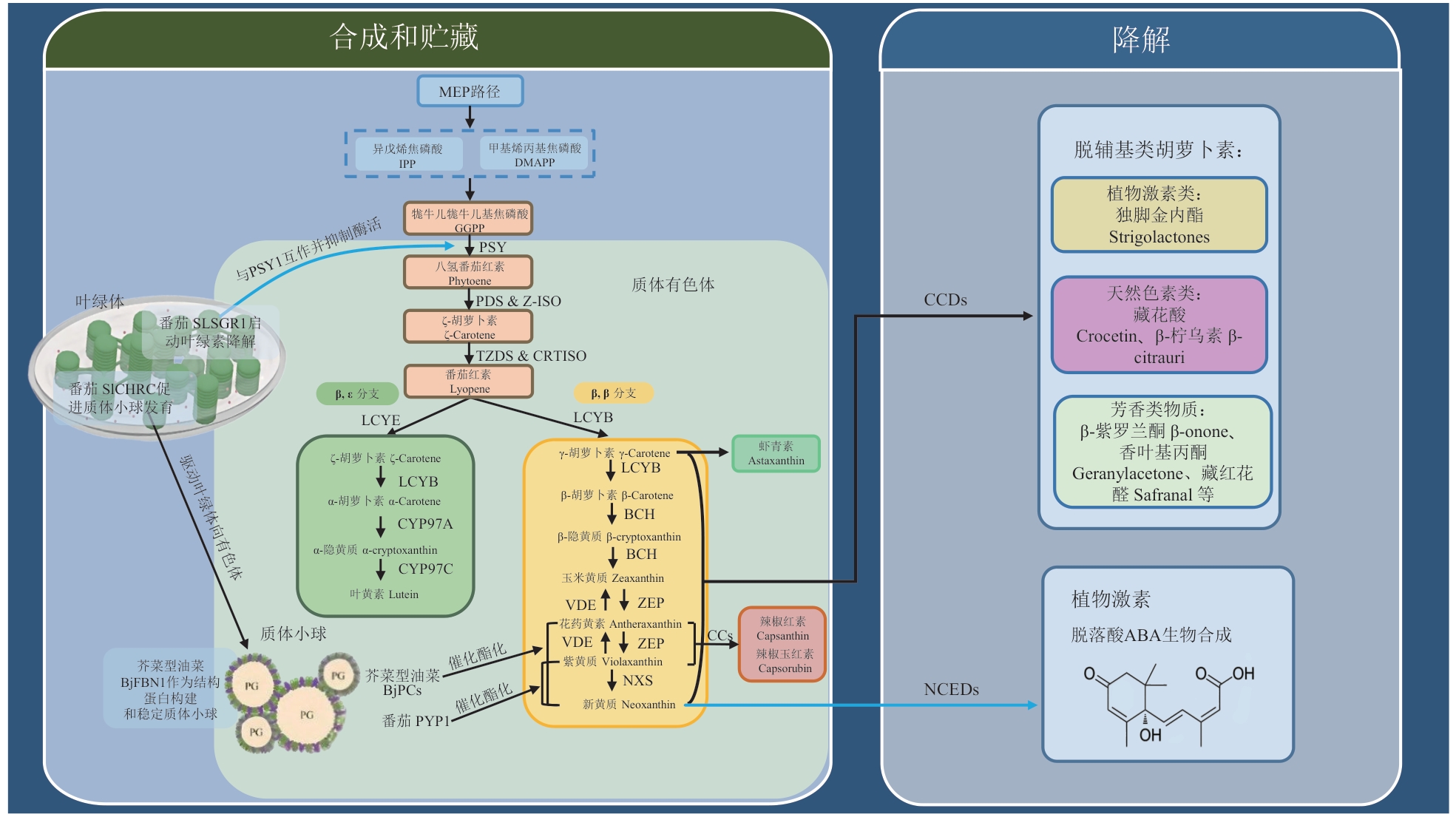
图1 类胡萝卜素生物合成途径类胡萝卜素在质体中合成,经GGPPS催化生成前体GGPP,再经PSY缩合及多步脱氢异构反应生成番茄红素,随后分为β,β和β,ε两个分支。β,β分支中,LCYB催化生成β-胡萝卜素,进一步衍生出玉米黄质、紫黄质、新黄质及脱落酸等;β,ε分支中,LCYE与LCYB协同催化生成α-胡萝卜素并最终形成叶黄素。箭头代表酶促代谢反应方向,黑色箭头代表直接调控,蓝色箭头代表间接调控。PSY:八氢番茄红素合酶;PDS:八氢番茄红素脱氢酶;Z-ISO:ζ-胡萝卜素异构酶;ZDS:ζ-胡萝卜素脱氢酶;CRTISO:类胡萝卜素异构酶;LCYE:番茄红素ε-环化酶;LCYB:番茄红素β-环化酶;CYP97A/C:细胞色素P450羟化酶;BCH:β-胡萝卜素羟化酶;CCS:辣椒红素/辣椒玉红素合酶;VDE:紫黄质脱环氧化酶;ZEP:玉米黄质环氧化酶;NXS:新黄质合酶;CCD:类胡萝卜素裂解双加氧酶;NCED:9-顺式环氧类胡萝卜素双加氧酶。蓝色为前体MEP途径,橘红色为上游主干路径,绿色为β,ε‑支路,黄色为β,β‑支路,右侧为β,β‑分支衍生物合成通路
Fig. 1 Carotenoid biosynthesis pathwaysCarotenoids are synthesized in plastids, where GGPPS catalyzes the formation of the precursor GGPP, which is subsequently converted to lycopene via PSY-mediated condensation and multi-step desaturation and isomerization reactions. The pathway then diverges into two branches: in the β,β-branch, LCYB catalyzes the cyclization of lycopene to β-carotene, which is further hydroxylated and epoxidized to yield zeaxanthin, violaxanthin, neoxanthin, and abscisic acid; in the β,ε-branch, LCYE and LCYB act cooperatively to produce α-carotene, which is ultimately converted to lutein. Arrows indicate the direction of enzymatic metabolic reactions; black arrows represent direct regulation, and blue arrows represent indirect regulation. PSY: phytoene synthase; PDS: phytoene desaturase; Z-ISO: ζ-carotene isomerase; ZDS: ζ-carotene desaturase; CRTISO: carotenoid isomerase; LCYE: lycopene ε-cyclase; LCYB: lycopene β-cyclase; CYP97A/C: cytochrome P450 hydroxylase; BCH: β-carotene hydroxylase; CCS: capsanthin/capsorubin synthase; VDE: violaxanthin de-epoxidase; ZEP: zeaxanthin epoxidase; NXS: neoxanthin synthase; CCD: carotenoid cleavage dioxygenase; NCED: 9-cis-epoxycarotenoid dioxygenase. Blue represents the MEP pathway for carotenoid precursor synthesis; orange indicates the upstream core backbone pathway; green indicates the β,ε-branch; yellow indicates the β,β-branch; the right side shows derivative synthesis from the β,β-branch
转录因子 Transcription factors | 物种 Species | 作用机制 Regulatory mechanism | 对色泽的作用 Impact on color | 参考文献 Reference | |
|---|---|---|---|---|---|
| 正向 Positive | 负向 Negative | ||||
| MYB | 桂花、辣椒、猴面花、鹅掌楸、柑橘、蒺藜苜蓿 | 直接结合启动子激活结构基因;少数成员抑制结构基因或招募抑制复合物 | 促进黄、橙、红色素积累 | 改变色素组成,导致留绿或褪色 | [ |
| NAC | 番茄、木瓜、柑橘、辣椒 | 部分成员直接激活合成基因,部分成员抑制限速步骤,部分成员调控叶绿素降解间接促进着色 | 促进果实转红或黄色积累 | 抑制番茄红素合成,导致黄/橙色果 | [ |
| bHLH | 番茄、木瓜、柑橘、芒果 | 响应光照调控代谢流分支,部分成员直接激活/抑制结构基因,部分成员通过负反馈精确控制着色 | 促进类胡萝卜素合成与着色 | 淡绿色未成熟果实和黄化成熟果实 | [ |
| AP2/ERF | 番茄、柑橘、津巴多橘 | 受乙烯诱导,广泛激活类胡萝卜素合成途径上游前体到下游修饰环节多个关键基因 | 上调柑橘类胡萝卜素,增强果皮橙红色泽与着色 | 下调番茄总类胡萝卜素和番茄红素含量,果色偏橙 | [ |
| WRKY | 番茄、柑橘 | 激活MEP途径;激活合成基因;协同调控叶绿素降解 | 上调类胡萝卜素积累,驱动果实由绿色转为黄色或红色 | — | [ |
| BBX | 辣椒、番茄、芒果 | 光形态建成调控因子,直接激活合成基因;部分成员协同调控花青素与类胡萝卜素通路 | 上调类胡萝卜素/花青素,促进辣椒、番茄、芒果着色 | — | [ |
| MADS | 辣椒、柑橘、榴莲 | 直接激活合成结构基因启动子;部分成员同时激活叶绿素降解基因,协同调控色素代谢 | 促进类胡萝卜素积累,调控辣椒、柑橘、榴莲果实着色 | — | [ |
表1 影响类胡萝卜素生物合成的关键转录因子
Table 1 Key transcription factors affecting carotenoid biosynthesis
转录因子 Transcription factors | 物种 Species | 作用机制 Regulatory mechanism | 对色泽的作用 Impact on color | 参考文献 Reference | |
|---|---|---|---|---|---|
| 正向 Positive | 负向 Negative | ||||
| MYB | 桂花、辣椒、猴面花、鹅掌楸、柑橘、蒺藜苜蓿 | 直接结合启动子激活结构基因;少数成员抑制结构基因或招募抑制复合物 | 促进黄、橙、红色素积累 | 改变色素组成,导致留绿或褪色 | [ |
| NAC | 番茄、木瓜、柑橘、辣椒 | 部分成员直接激活合成基因,部分成员抑制限速步骤,部分成员调控叶绿素降解间接促进着色 | 促进果实转红或黄色积累 | 抑制番茄红素合成,导致黄/橙色果 | [ |
| bHLH | 番茄、木瓜、柑橘、芒果 | 响应光照调控代谢流分支,部分成员直接激活/抑制结构基因,部分成员通过负反馈精确控制着色 | 促进类胡萝卜素合成与着色 | 淡绿色未成熟果实和黄化成熟果实 | [ |
| AP2/ERF | 番茄、柑橘、津巴多橘 | 受乙烯诱导,广泛激活类胡萝卜素合成途径上游前体到下游修饰环节多个关键基因 | 上调柑橘类胡萝卜素,增强果皮橙红色泽与着色 | 下调番茄总类胡萝卜素和番茄红素含量,果色偏橙 | [ |
| WRKY | 番茄、柑橘 | 激活MEP途径;激活合成基因;协同调控叶绿素降解 | 上调类胡萝卜素积累,驱动果实由绿色转为黄色或红色 | — | [ |
| BBX | 辣椒、番茄、芒果 | 光形态建成调控因子,直接激活合成基因;部分成员协同调控花青素与类胡萝卜素通路 | 上调类胡萝卜素/花青素,促进辣椒、番茄、芒果着色 | — | [ |
| MADS | 辣椒、柑橘、榴莲 | 直接激活合成结构基因启动子;部分成员同时激活叶绿素降解基因,协同调控色素代谢 | 促进类胡萝卜素积累,调控辣椒、柑橘、榴莲果实着色 | — | [ |
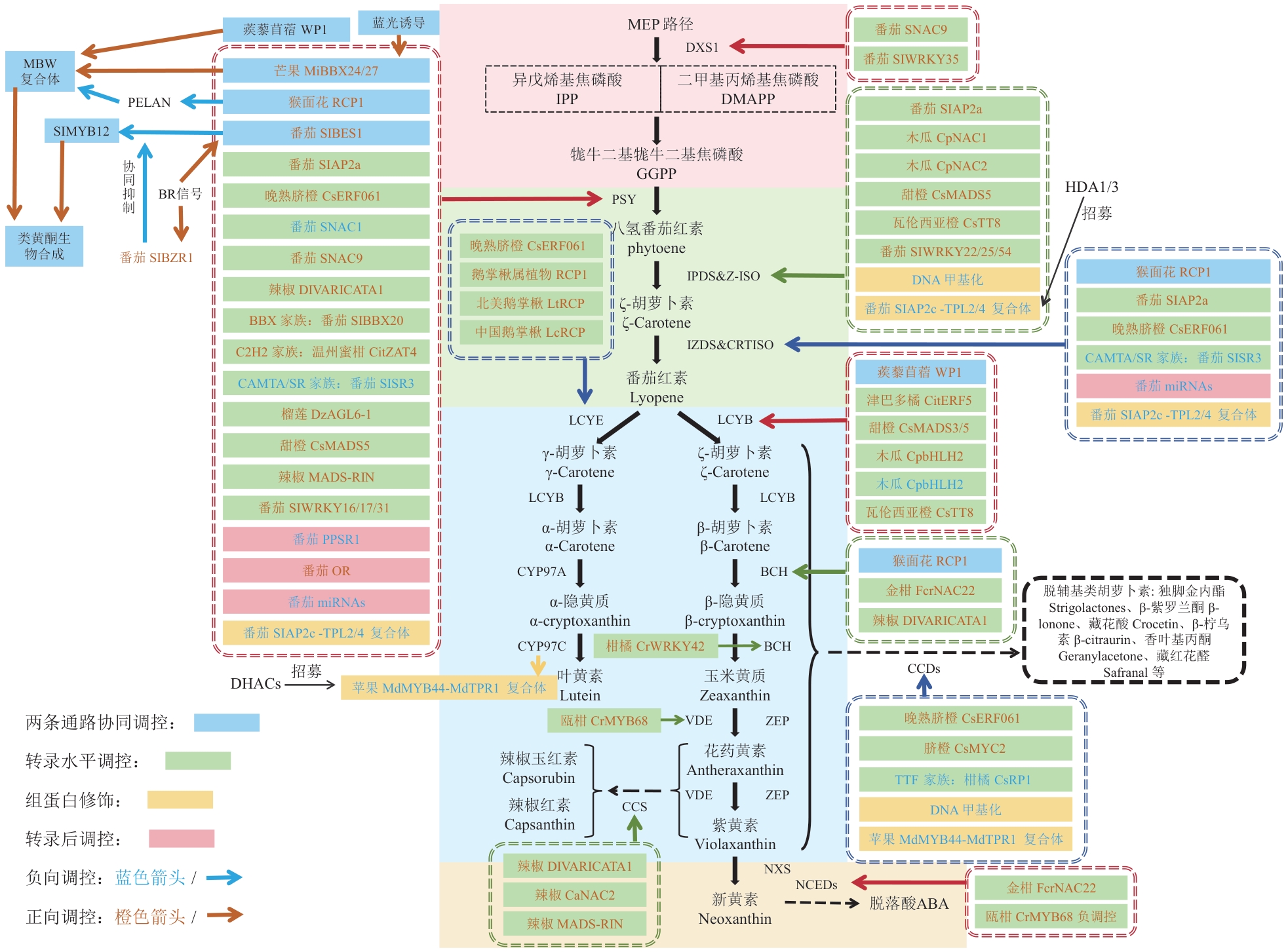
图2 植物花果色泽形成中的类胡萝卜素代谢多层次调控机制类胡萝卜素代谢受转录、转录后、翻译后及表观遗传水平的协同调控。在转录水平,MYB、NAC、bHLH、WRKY、AP2/ERF、MADS等转录因子发挥关键作用;其中,MYB、BBX和bHLH可协同调控类胡萝卜素与类黄酮代谢。PSY作为关键限速酶,LCYE/LCYB作为代谢分支点,均受到多层次调控。在转录后水平,ORANGE蛋白对PSY的稳定作用与PPSR1介导的降解作用形成互补的双向调控网络。在表观遗传层面,类胡萝卜素代谢受DNA甲基化与组蛋白乙酰化的动态变化的共同调控。橙色箭头和字体表示正向调控/促进作用;蓝色箭头和字体表示负向调控/抑制作用。浅绿色模块为转录因子家族;深粉色模块为转录后/翻译后调控;黄色模块为表观遗传修饰;蓝色模块为类黄酮与类胡萝卜素合成协同调控
Fig. 2 Multi-level regulatory mechanism of carotenoid metabolism on color formation in plant flowers and fruitsCarotenoid metabolism is coordinately regulated at the transcriptional, post-transcriptional, post-translational, and epigenetic levels. At the transcriptional level, transcription factors such as MYB, NAC, bHLH, WRKY, AP2/ERF, and MADS play key roles; among them, MYB, BBX, and bHLH cooperatively regulate the biosynthesis of both carotenoids and flavonoids. PSY, as the key rate-limiting enzyme, and LCYE/LCYB, as metabolic branch points, are subject to multi-level regulation. At the post-transcriptional level, the stabilizing effect of ORANGE protein on PSY and the degradation mediated by PPSR1 form a complementary bidirectional regulatory network. At the epigenetic level, dynamic changes in DNA methylation and histone acetylation co-regulate the expression of key genes involved in carotenoid metabolism. Orange arrows and fonts indicate positive regulation/promotion; blue arrows and fonts indicate negative regulation/inhibition. Light green module is the transcription factor family; the dark pink module is post-transcriptional/post-translational regulation; the yellow module is epigenetic modification; the blue module is the synergistic regulation of flavonoid and carotenoid synthesis
| [1] | Gupta P, Hirschberg J. The genetic components of a natural color palette: a comprehensive list of carotenoid pathway mutations in plants [J]. Front Plant Sci, 2022, 12: 806184. |
| [2] | Sun TH, Zhu QL, Wei ZQ, et al. Multi-strategy engineering greatly enhances provitamin A carotenoid accumulation and stability in Arabidopsis seeds [J]. aBIOTECH, 2021, 2(3): 191-214. |
| [3] | Mariutti LRB, Mercadante AZ. Carotenoid esters analysis and occurrence: What do we know so far [J]. Arch Biochem Biophys, 2018, 648: 36-43. |
| [4] | Lewis ER, Nogueira M, Enfissi EMA, et al. The esterification of xanthophylls in Solanum lycopersicum (tomato) chromoplasts; the role of a non-specific acyltransferase [J]. Phytochemistry, 2021, 191: 112912. |
| [5] | Cruz AB, Bianchetti RE, Alves FRR, et al. Light, ethylene and auxin signaling interaction regulates carotenoid biosynthesis during tomato fruit ripening [J]. Front Plant Sci, 2018, 9: 1370. |
| [6] | Song JL, Sun BM, Chen CM, et al. An R-R-type MYB transcription factor promotes non-climacteric pepper fruit carotenoid pigment biosynthesis [J]. Plant J, 2023, 115(3): 724-741. |
| [7] | Zhu QL, Zeng DC, Yu SZ, et al. From golden rice to aSTARice: bioengineering astaxanthin biosynthesis in rice endosperm [J]. Mol Plant, 2018, 11(12): 1440-1448. |
| [8] | Guan ZL, Li XW, Yang JS, et al. The mechanism of white flower formation in Brassica rapa is distinct from that in other Brassica species [J]. Theor Appl Genet, 2023, 136(6): 133. |
| [9] | 毕蒙蒙, 曹雨薇, 宋蒙, 等. 百合花色研究进展 [J]. 园艺学报, 2021, 48(10): 2073-2086. |
| Bi MM, Cao YW, Song M, et al. Advances in flower color research of Lilium [J]. Acta Hortic Sin, 2021, 48(10): 2073-2086. | |
| [10] | Luan YT, Wang SS, Wang RQ, et al. Accumulation of red apocarotenoid β-citraurin in peel of a spontaneous mutant of Huyou (Citrus changshanensis) and the effects of storage temperature and ethylene application [J]. Food Chem, 2020, 309: 125705. |
| [11] | Wang X, Yamagishi M. Mechanisms suppressing carotenoid accumulation in flowers differ depending on the hybrid groups of lilies (Lilium spp.) [J]. Sci Hortic, 2019, 243: 159-168. |
| [12] | Burbano-Erazo E, Ezquerro M, Sanchez-Bel P, et al. Specific sets of geranylgeranyl diphosphate synthases and phytoene synthases control the production of carotenoids and ABA in different tomato tissues [J]. Physiol Plant, 2025, 177: e70052. |
| [13] | Zhou XS, Rao S, Wrightstone E, et al. Phytoene synthase: the key rate-limiting enzyme of carotenoid biosynthesis in plants [J]. Front Plant Sci, 2022, 13: 884720. |
| [14] | Xiao Y, Kang BS, Li M, et al. Transcription of lncRNA ACoS-AS1 is essential to trans-splicing between SlPsy1 and ACoS-AS1 that causes yellow fruit in tomato [J]. RNA Biol, 2020, 17(4): 596-607. |
| [15] | Zhao CJ, Bin Safdar L, Xie ML, et al. Mutation of the PHYTOENE DESATURASE 3 gene causes yellowish-white petals in Brassica napus [J]. Crop J, 2021, 9(5): 1124-1134. |
| [16] | Kishimoto S, Ohmiya A. Carotenoid isomerase is key determinant of petal color of Calendula officinalis [J]. J Biol Chem, 2012, 287(1): 276-285. |
| [17] | Zhao XJ, Yu F, Li X, et al. Identification and functional characterization of lycopene β-cyclase gene from Iris germanica and its relation to carotenoid accumulation [J]. J Plant Physiol, 2025, 315: 154620. |
| [18] | Liu YJ, Ye SH, Yuan GG, et al. Gene silencing of BnaA09.ZEP and BnaC09.ZEP confers orange color in Brassica napus flowers [J]. Plant J, 2020, 104(4): 932-949. |
| [19] | Wang ZZ, Wang XH, Li XY, et al. Genetic characterization and mechanistic insights into high seed oil content and orange petal trait in the rapeseed mutant opm1 [J]. Plant Physiol Biochem, 2026, 230: 110727. |
| [20] | Ma LQ, Zeng N, Cheng K, et al. Changes in fruit pigment accumulation, chloroplast development, and transcriptome analysis in the CRISPR/Cas9-mediated knockout of Stay-green 1 (slsgr1) mutant [J]. Food Qual Saf, 2022, 6: fyab029. |
| [21] | Wang Y, Tian C, Na QT, et al. The role of SlCHRC in carotenoid biosynthesis and plastid development in tomato fruit [J]. Int J Biol Macromol, 2024, 281: 136354. |
| [22] | Lu PJ, Wang RQ, Zhu CQ, et al. Microscopic analyses of fruit cell plastid development in loquat (Eriobotrya japonica) during fruit ripening [J]. Molecules, 2019, 24(3): 448. |
| [23] | Wen X, Heller A, Wang KL, et al. Carotenogenesis and chromoplast development during ripening of yellow, orange and red colored Physalis fruit [J]. Planta, 2020, 251(5): 95. |
| [24] | Egea I, Barsan C, Bian WP, et al. Chromoplast differentiation: current status and perspectives [J]. Plant Cell Physiol, 2010, 51(10): 1601-1611. |
| [25] | Ariizumi T, Kishimoto S, Kakami R, et al. Identification of the carotenoid modifying gene PALE YELLOW PETAL 1 as an essential factor in xanthophyll esterification and yellow flower pigmentation in tomato (Solanum lycopersicum) [J]. Plant J, 2014, 79(3): 453-465. |
| [26] | Li RH, Zeng QY, Zhang XX, et al. Xanthophyll esterases in association with fibrillins control the stable storage of carotenoids in yellow flowers of rapeseed (Brassica juncea) [J]. New Phytol, 2023, 240(1): 285-301. |
| [27] | Zeng XL, Tan YF, Wen X, et al. Delayed starch degradation triggers chromoplast structural aberration to inhibit carotenoid cleavage: a novel mechanism for flower color deepening in Osmanthus fragrans [J]. Horticulturae, 2025, 11(7): 864. |
| [28] | Dhar MK, Mishra S, Bhat A, et al. Plant carotenoid cleavage oxygenases: structure-function relationships and role in development and metabolism [J]. Brief Funct Genom, 2020, 19(1): 1-9. |
| [29] | Li WN, Che JH, Lian QL, et al. Identification and expression pattern of the carotenoid cleavage oxygenase gene family in Lycium suggest CCOs respond to abiotic stress and promote carotenoids degradation [J]. Forests, 2023, 14(5): 983. |
| [30] | Zhang CL, Zhu K, Huang CJ, et al. Identification of a carotenoid cleavage dioxygenase gene TeCCD4a regulating flower color and carotenoid content of marigold [J]. Gene, 2025, 969: 149760. |
| [31] | Watanabe K, Oda-Yamamizo C, Sage-Ono K, et al. Alteration of flower colour in Ipomoea nil through CRISPR/Cas9-mediated mutagenesis of carotenoid cleavage dioxygenase 4 [J]. Transgenic Res, 2018, 27(1): 25-38. |
| [32] | Luan YT, Wang SJ, Wang P, et al. Accumulation of β-citraurin and other carotenoids in relation to the expression of PSY1 and CCD4b1 in peel of twelve red-peeled citrus cultivars [J]. Sci Hortic, 2024, 330: 113094. |
| [33] | Liu XY, Qing HS, Xu MH, et al. Light-responsive transcription factor ZeMYB32 negatively regulates ZeCCD4-2 to affect carotenoid accumulation in Zinnia elegans petals [J]. Plant Physiol Biochem, 2025, 228: 110315. |
| [34] | Lado J, Alós E, Manzi M, et al. Light regulation of carotenoid biosynthesis in the peel of mandarin and sweet orange fruits [J]. Front Plant Sci, 2019, 10: 1288. |
| [35] | Gong JL, Shen XC, Xu YN, et al. Differential regulation of red and blue LED light-induced carotenoid and anthocyanin biosynthesis in fruit peel [J]. Food Bioprocess Technol, 2025, 18(10): 8468-8481. |
| [36] | Pola W, Sugaya S, Photchanachai S. Color development and phytochemical changes in mature green chili (Capsicum annuum L.) exposed to red and blue light-emitting diodes [J]. J Agric Food Chem, 2020, 68(1): 59-66. |
| [37] | Mao PP, Yang Q, Yang T, et al. Red LED light accelerates capsanthin accumulation and fruit ripening in pre-harvest pepper (Capsicum annuum L.) [J]. Front Plant Sci, 2025, 16: 1680730. |
| [38] | Ma XJ, Hou Y, Yang S, et al. Effect of different photoperiods on the period of maturity of hot peppers (Capsicum annuum L.) and their changes in color [J]. Sci Hortic, 2024, 334: 113337. |
| [39] | ElShamey E, Zeng YW, Ding YM, et al. Functional phytochemicals in tomatoes: biosynthesis, gene regulation, and human health implications [J]. Front Plant Sci, 2025, 16: 1662388. |
| [40] | Mesejo C, Gambetta G, Gravina A, et al. Relationship between soil temperature and fruit colour development of ‘Clemenpons’ Clementine mandarin (Citrus clementina Hort ex. Tan) [J]. J Sci Food Agric, 2012, 92(3): 520-525. |
| [41] | Wang YG, Zhang C, Xu B, et al. Temperature regulation of carotenoid accumulation in the petals of sweet osmanthus via modulating expression of carotenoid biosynthesis and degradation genes [J]. BMC Genom, 2022, 23: 418. |
| [42] | Liu YC, Dong B, Zhang C, et al. Effects of exogenous abscisic acid (ABA) on carotenoids and petal color in Osmanthus fragrans ‘yanhonggui’ [J]. Plants, 2020, 9(4): 454. |
| [43] | Xi W, He YH, Zhu LL, et al. CPTA treatment reveals potential transcription factors associated with carotenoid metabolism in flowers of Osmanthus fragrans [J]. Hortic Plant J, 2021, 7(5): 479-487. |
| [44] | Ma X, Yu YN, Jia JH, et al. The pepper MYB transcription factor CaMYB306 accelerates fruit coloration and negatively regulates cold resistance [J]. Sci Hortic, 2022, 295: 110892. |
| [45] | Yang LC, Wu HN, Bu ML, et al. Two indel variations in the regulated carotenoid pigment gene hold the key to the interspecies flower colour differentiation in Liriodendron plants [J]. Plant Biotechnol J, 2025: pbi.70488. |
| [46] | Zhu F, Luo T, Liu CY, et al. An R2R3-MYB transcription factor represses the transformation of α- and β-branch carotenoids by negatively regulating expression of CrBCH2 and CrNCED5 in flavedo of Citrus reticulate [J]. New Phytol, 2017, 216(1): 178-192. |
| [47] | Zhu MK, Chen GP, Zhou S, et al. A new tomato NAC (NAM/ATAF1/2/CUC2) transcription factor, SlNAC4, functions as a positive regulator of fruit ripening and carotenoid accumulation [J]. Plant Cell Physiol, 2014, 55(1): 119-135. |
| [48] | Feng Y, Kou XH, Yuan S, et al. CRISPR/Cas9-mediated SNAC9 mutants reveal the positive regulation of tomato ripening by SNAC9 and the mechanism of carotenoid metabolism regulation [J]. Hortic Res, 2023, 10(4): uhad019. |
| [49] | Ma NN, Feng HL, Meng X, et al. Overexpression of tomato SlNAC1 transcription factor alters fruit pigmentation and softening [J]. BMC Plant Biol, 2014, 14: 351. |
| [50] | Meng C, Yang DY, Ma XC, et al. Suppression of tomato SlNAC1 transcription factor delays fruit ripening [J]. J Plant Physiol, 2016, 193: 88-96. |
| [51] | Fu CC, Han YC, Fan ZQ, et al. The papaya transcription factor CpNAC1 modulates carotenoid biosynthesis through activating phytoene desaturase genes CpPDS2/4 during fruit ripening [J]. J Agric Food Chem, 2016, 64(27): 5454-5463. |
| [52] | Fu CC, Han YC, Kuang JF, et al. Papaya CpEIN3a and CpNAC2 co-operatively regulate carotenoid biosynthesis-related genes CpPDS2/4, CpLCY-e and CpCHY-b during fruit ripening [J]. Plant Cell Physiol, 2017, 58(12): 2155-2165. |
| [53] | Gong JL, Zeng YL, Meng QN, et al. Red light-induced kumquat fruit coloration is attributable to increased carotenoid metabolism regulated by FcrNAC22 [J]. J Exp Bot, 2021, 72(18): 6274-6290. |
| [54] | Song YY, Li XZ, Gao Y, et al. CaNAC2 orchestrates Capsicum annuum fruit ripening by coordinated carotenoid and ABA metabolism under epigenetic control [J]. Plant Physiol, 2025, 199(3): kiaf524. |
| [55] | Yu SJ, Jeong ES, Lee S, et al. Regulatory link of CaSGR-CaNOR controls fruit shelf-life in pepper [J]. Postharvest Biol Technol, 2026, 234: 114107. |
| [56] | Zhu ZG, Chen GP, Guo XH, et al. Overexpression of SlPRE2, an atypical bHLH transcription factor, affects plant morphology and fruit pigment accumulation in tomato [J]. Sci Rep, 2017, 7: 5786. |
| [57] | Meng FL, Liu HR, Hu SS, et al. The brassinosteroid signaling component SlBZR1 promotes tomato fruit ripening and carotenoid accumulation [J]. J Integr Plant Biol, 2023, 65(7): 1794-1813. |
| [58] | Zhou D, Shen YH, Zhou P, et al. Papaya CpbHLH1/2 regulate carotenoid biosynthesis-related genes during papaya fruit ripening [J]. Hortic Res, 2019, 6: 80. |
| [59] | Liu RJ, Song JL, Liu SQ, et al. Genome-wide identification of the capsicum bHLH transcription factor family: discovery of a candidate regulator involved in the regulation of species-specific bioactive metabolites [J]. BMC Plant Biol, 2021, 21: 262. |
| [60] | Shen LF, Zhang CF, Xia YH, et al. Transcript analysis reveals positive regulation of CA12g04950 on carotenoids of pigment pepper fruit under nitrogen reduction [J]. Agriculture, 2024, 14(4): 521. |
| [61] | Sun Q, He ZC, Wei RR, et al. Transcription factor CsTT8 promotes fruit coloration by positively regulating the methylerythritol 4-phosphate pathway and carotenoid biosynthesis pathway in citrus (Citrus spp.) [J]. Hortic Res, 2023, 10(11): uhad199. |
| [62] | Yue PT, Jiang ZH, Sun Q, et al. Jasmonate activates a CsMPK6-CsMYC2 module that regulates the expression of β-citraurin biosynthetic genes and fruit coloration in orange (Citrus sinensis) [J]. Plant Cell, 2023, 35(4): 1167-1185. |
| [63] | Wang XP, You YQ, Wang JM, et al. Metabolomic and transcriptomic analyses provide insights into the role of MiMYB114 and MiMYC2 in the MeJA-induced regulatory network for mango pericarp coloration [J]. Int J Biol Macromol, 2025, 311: 143713. |
| [64] | Chung MY, Vrebalov J, Alba R, et al. A tomato (Solanum lycopersicum) APETALA2/ERF gene, SlAP2a, is a negative regulator of fruit ripening [J]. Plant J, 2010, 64(6): 936-947. |
| [65] | Lee JM, Joung JG, McQuinn R, et al. Combined transcriptome, genetic diversity and metabolite profiling in tomato fruit reveals that the ethylene response factor SlERF6 plays an important role in ripening and carotenoid accumulation [J]. Plant J, 2012, 70(2): 191-204. |
| [66] | Zhu KJ, Sun Q, Chen HY, et al. Ethylene activation of carotenoid biosynthesis by a novel transcription factor CsERF061 [J]. J Exp Bot, 2021, 72(8): 3137-3154. |
| [67] | Wang X, Wang YP, Hao WH, et al. The molecular and metabolic mechanisms underlying the citrine/yellow coloration in the peels of the shiranui mandarin Citrus mutant [J]. Horticulturae, 2025, 11(11): 1333. |
| [68] | Yuan Y, Ren SY, Liu XF, et al. SlWRKY35 positively regulates carotenoid biosynthesis by activating the MEP pathway in tomato fruit [J]. New Phytol, 2022, 234(1): 164-178. |
| [69] | Wang L, Zhang XL, Wang L, et al. Regulation of ethylene-responsive SlWRKYs involved in color change during tomato fruit ripening [J]. Sci Rep, 2017, 7: 16674. |
| [70] | Chen HY, Ji HY, Huang WK, et al. Transcription factor CrWRKY42 coregulates chlorophyll degradation and carotenoid biosynthesis in citrus [J]. Plant Physiol, 2024, 195(1): 728-744. |
| [71] | Ding WQ, Luo YS, Li WL, et al. Fine mapping and transcriptome profiling reveal CpAPRR2 to modulate immature fruit rind color formation in zucchini (Cucurbita pepo) [J]. Theor Appl Genet, 2024, 137(7): 167. |
| [72] | Jeong HB, Jang SJ, Kang MY, et al. Candidate gene analysis reveals that the fruit color locus C1 corresponds to PRR2 in pepper (Capsicum frutescens) [J]. Front Plant Sci, 2020, 11: 399. |
| [73] | Lee SB, Kim JE, Kim HT, et al. Genetic mapping of the c1 locus by GBS-based BSA-seq revealed Pseudo-Response Regulator 2 as a candidate gene controlling pepper fruit color [J]. Theor Appl Genet, 2020, 133(6): 1897-1910. |
| [74] | Ma J, Dai JX, Liu XW, et al. The transcription factor CaBBX20 regulates capsanthin accumulation in pepper (Capsicum annuum L.) [J]. Sci Hortic, 2023, 314: 111907. |
| [75] | Xiong C, Luo D, Lin AH, et al. A tomato B-box protein SlBBX20 modulates carotenoid biosynthesis by directly activating PHYTOENE SYNTHASE 1, and is targeted for 26S proteasome-mediated degradation [J]. New Phytol, 2019, 221(1): 279-294. |
| [76] | Pan C, Liao YF, Shi BJ, et al. Blue light-induced MiBBX24 and MiBBX27 simultaneously promote peel anthocyanin and flesh carotenoid biosynthesis in mango [J]. Plant Physiol Biochem, 2025, 219: 109315. |
| [77] | Wang YG, Li XH, Qiu HX, et al. The MADS-RIPENING INHIBITOR-DIVARICATA1 module regulates carotenoid biosynthesis in nonclimacteric Capsicum fruits [J]. Plant Physiol, 2025, 197(2): kiaf013. |
| [78] | Tantisuwanichkul K, Komaki S, Watanabe M, et al. Unveiling the regulatory role of DzAGL6-1 in carotenoid biosynthesis during durian (Durio zibethinus) fruit development [J]. Plant Cell Rep, 2024, 43(9): 217. |
| [79] | Lu SW, Ye JL, Zhu KJ, et al. A fruit ripening-associated transcription factor CsMADS5 positively regulates carotenoid biosynthesis in citrus [J]. J Exp Bot, 2021, 72(8): 3028-3043. |
| [80] | Zhu KJ, Chen HY, Mei XH, et al. Transcription factor CsMADS3 coordinately regulates chlorophyll and carotenoid pools in Citrus hesperidium [J]. Plant Physiol, 2023, 193(1): 519-536. |
| [81] | Sun Q, He ZC, Ye JL, et al. A novel C2H2-type zinc-finger transcription factor, CitZAT4, regulates ethylene-induced orange coloration in Satsuma mandarin flavedo (Citrus unshiu Marc.) [J]. J Integr Plant Biol, 2025, 67(2): 294-310. |
| [82] | Sun Q, He ZC, Wei RR, et al. Red peel regulator 1 links ethylene response factor 25 and β-citraurin biosynthetic genes to regulate ethylene-induced peel reddening in citrus [J]. Plant Cell, 2025, 37(1): koaf010. |
| [83] | Hou XM, Wang T, Li YH, et al. NaCl promotes tomato fruit coloring by relieving SlSR3-induced transcriptional inhibition of lycopene synthesis-related genes [J]. Plant J, 2025, 123(5): e70450. |
| [84] | Sagawa JM, Stanley LE, LaFountain AM, et al. An R2R3-MYB transcription factor regulates carotenoid pigmentation in Mimulus lewisii flowers [J]. New Phytol, 2016, 209(3): 1049-1057. |
| [85] | Meng YY, Wang ZY, Wang YQ, et al. The MYB activator WHITE PETAL1 associates with MtTT8 and MtWD40-1 to regulate carotenoid-derived flower pigmentation in Medicago truncatula [J]. Plant Cell, 2019, 31(11): 2751-2767. |
| [86] | Li YQ, Bao TT, Zhang J, et al. The coordinated interaction or regulation between floral pigments and volatile organic compounds [J]. Hortic Plant J, 2025, 11(2): 463-485. |
| [87] | Jian Y, Li YN, Liu HR, et al. SlBES1-mediated brassinosteroid signaling suppresses flavonoid biosynthesis in tomato fruit [J]. Plant Commun, 2025, 6(11): 101523. |
| [88] | Yazdani M, Sun ZX, Yuan H, et al. Ectopic expression of ORANGE promotes carotenoid accumulation and fruit development in tomato [J]. Plant Biotechnol J, 2019, 17(1): 33-49. |
| [89] | Gao YF, Zhou X, Huang HT, et al. ORANGE proteins mediate adaptation to high light and resistance to Pseudomonas syringae in tomato by regulating chlorophylls and carotenoids accumulation [J]. Int J Biol Macromol, 2025, 306: 141739. |
| [90] | Wang PW, Wang YY, Wang WH, et al. Ubiquitination of phytoene synthase 1 precursor modulates carotenoid biosynthesis in tomato [J]. Commun Biol, 2020, 3: 730. |
| [91] | Stanley LE, Ding BQ, Sun W, et al. A tetratricopeptide repeat protein regulates carotenoid biosynthesis and chromoplast development in monkeyflowers (Mimulus) [J]. Plant Cell, 2020, 32(5): 1536-1555. |
| [92] | Reddy UK, Karnatam KS, Talavera-Caro A, et al. Uncovering the genetic architecture of pungency, carotenoids, and flavor in Capsicum chinense via TWAS-mGWAS integration and spatial transcriptomics [J]. Hortic Res, 2025, 12(12): uhaf243. |
| [93] | Sarwar S, Sami A, Haider MZ, et al. Genome-wide identification and in silico expression analysis of CCO gene family in Citrus clementina (Citrus) in response to abiotic stress [J]. Plants, 2025, 14(2): 249. |
| [94] | Koul A, Yogindran S, Sharma D, et al. Carotenoid profiling, in silico analysis and transcript profiling of miRNAs targeting carotenoid biosynthetic pathway genes in different developmental tissues of tomato [J]. Plant Physiol Biochem, 2016, 108: 412-421. |
| [95] | Wang RF, de Maagd RA. Transcriptional control of tomato fruit development and ripening [J]. J Exp Bot, 2025, 76(21): 6311-6326. |
| [96] | Zhong SL, Fei ZJ, Chen YR, et al. Single-base resolution methylomes of tomato fruit development reveal epigenome modifications associated with ripening [J]. Nat Biotechnol, 2013, 31(2): 154-159. |
| [97] | Chiou CY, Pan HA, Chuang YN, et al. Differential expression of carotenoid-related genes determines diversified carotenoid coloration in floral tissues of Oncidium cultivars [J]. Planta, 2010, 232(4): 937-948. |
| [98] | Zou JJ, Cai X, Yang J, et al. DNA hypomethylation mediates flower opening and senescence in sweet osmanthus through auxin and ethylene responsive pathways [J]. Postharvest Biol Technol, 2023, 198: 112250. |
| [99] | Guo JE, Hu ZL, Li FF, et al. Silencing of histone deacetylase SlHDT3 delays fruit ripening and suppresses carotenoid accumulation in tomato [J]. Plant Sci, 2017, 265: 29-38. |
| [100] | He XQ, Liu KD, Wu Y, et al. A transcriptional cascade mediated by two APETALA2 family members orchestrates carotenoid biosynthesis in tomato [J]. J Integr Plant Biol, 2024, 66(6): 1227-1241. |
| [101] | Huang BC, Li YC, Jia K, et al. The MdMYB44-MdTPR1 repressive complex inhibits MdCCD4 and MdCYP97A3 expression through histone deacetylation to regulate carotenoid biosynthesis in apple [J]. Plant J, 2024, 119(1): 540-556. |
| [102] | Yang TX, Ali M, Lin LH, et al. Recoloring tomato fruit by CRISPR/Cas9-mediated multiplex gene editing [J]. Hortic Res, 2023, 10(1): uhac214. |
| [1] | 刘佳, 孟宇, 荆晓艳. 单细胞拉曼光谱揭示聚球藻PCC7942对无机碳源的利用偏好性[J]. 生物技术通报, 2026, 42(8): 331-340. |
| [2] | 倪飞飞, 陈益存, 高暝, 张盛剿, 彭方有, 陈涛梅, 赵耘霄, 汪阳东. 山苍子TCP基因鉴定及其调控萜类合成的研究[J]. 生物技术通报, 2026, 42(4): 227-238. |
| [3] | 马莹莹, 游惠婉, 郑积荣, 汪俏梅, 刘丽红. 基于PSY多层级调控的园艺作物品质形成机制研究进展[J]. 生物技术通报, 2026, 42(3): 96-110. |
| [4] | 刘娜, 曾宝珍, 贾兆星, 祝英方. 表观遗传调控番茄果实发育及成熟的研究进展[J]. 生物技术通报, 2026, 42(3): 37-47. |
| [5] | 彭楚, 孙娟利, 郑蓓蓓, 张若西, 韩月彭, 赵云. 果实花色苷酶促降解机制研究进展[J]. 生物技术通报, 2026, 42(3): 133-144. |
| [6] | 殷诗情, 田泰, 黄凤庭, 冯珑强, 王浩, 张静, 何文, 陈清, 王小蓉, 王燕. 果树果实硬度的调控机制研究进展[J]. 生物技术通报, 2026, 42(3): 213-229. |
| [7] | 姜喆卉, 王小龙, 王守创, 周科. 番茄风味物质代谢途径解析与分子育种研究进展[J]. 生物技术通报, 2026, 42(3): 60-78. |
| [8] | 赵艳侠, 李倩, 孙家波, 梁红敏, 李冰冰. 草莓果实品质形成的关键调控基因及分子网络解析[J]. 生物技术通报, 2026, 42(3): 111-132. |
| [9] | 刘淼, 林涛, 贾乐松, 胡丰, 李涛, 李志万, 刘美芳, 郑方燕, 崔龙. 从野生到栽培:番茄果实色泽的演化与调控机制[J]. 生物技术通报, 2026, 42(3): 187-202. |
| [10] | 尹跃, 秦小雅, 米佳, 安巍, 何军, 张锋锋. 枸杞FBN基因家族鉴定及与类胡萝卜素代谢的相关性分析[J]. 生物技术通报, 2026, 42(3): 338-348. |
| [11] | 龙林茜, 曾银萍, 王茜, 邓玉萍, 葛敏茜, 陈彦灼, 李鑫娟, 杨军, 邹建. 向日葵GH3基因家族鉴定及其在花发育中的功能分析[J]. 生物技术通报, 2026, 42(1): 125-138. |
| [12] | 杨娟, 冯慧, 吉乃喆, 孙丽萍, 王赟, 张佳楠, 赵世伟. 月季AP2/ERF转录因子RcERF4和RcRAP2-12的克隆及功能分析[J]. 生物技术通报, 2026, 42(1): 150-160. |
| [13] | 陈强, 于璎霏, 张颖, 张冲. 茉莉酸甲酯对薄皮甜瓜‘绿宝石’采后冷害的调控[J]. 生物技术通报, 2025, 41(9): 105-114. |
| [14] | 高婧, 陈益存, 高暝, 赵耘霄, 汪阳东. 植物单宁合成调控及其对环境的响应机制[J]. 生物技术通报, 2025, 41(7): 49-59. |
| [15] | 胡若群, 曾菁菁, 梁婉凤, 曹佳玉, 黄小苇, 梁晓英, 仇明月, 陈莹. 转录组和代谢组联合分析探究不同遮光条件下金线莲类胡萝卜素合成代谢机制[J]. 生物技术通报, 2025, 41(5): 231-243. |
| 阅读次数 | ||||||
|
全文 |
|
|||||
|
摘要 |
|
|||||
