







Biotechnology Bulletin ›› 2026, Vol. 42 ›› Issue (8): 8-21.doi: 10.13560/j.cnki.biotech.bull.1985.2025-1321
Previous Articles Next Articles
JIN Man1, GONG Yi-hang2, PAN Wen-bo2, LUO Pei-run1, GAO Wei2, LI Ping-dong1( ), TANG Xiao-yan2,3()
Received:2025-12-05
Online:2026-08-26
Published:2026-08-17
Contact:
LI Ping-dong, TANG Xiao-yan
E-mail:371470755@qq.com;txy@frontier-ag.com
JIN Man, GONG Yi-hang, PAN Wen-bo, LUO Pei-run, GAO Wei, LI Ping-dong, TANG Xiao-yan. Research Progress in Herbicide-resistant Rice Created by Gene Editing[J]. Biotechnology Bulletin, 2026, 42(8): 8-21.
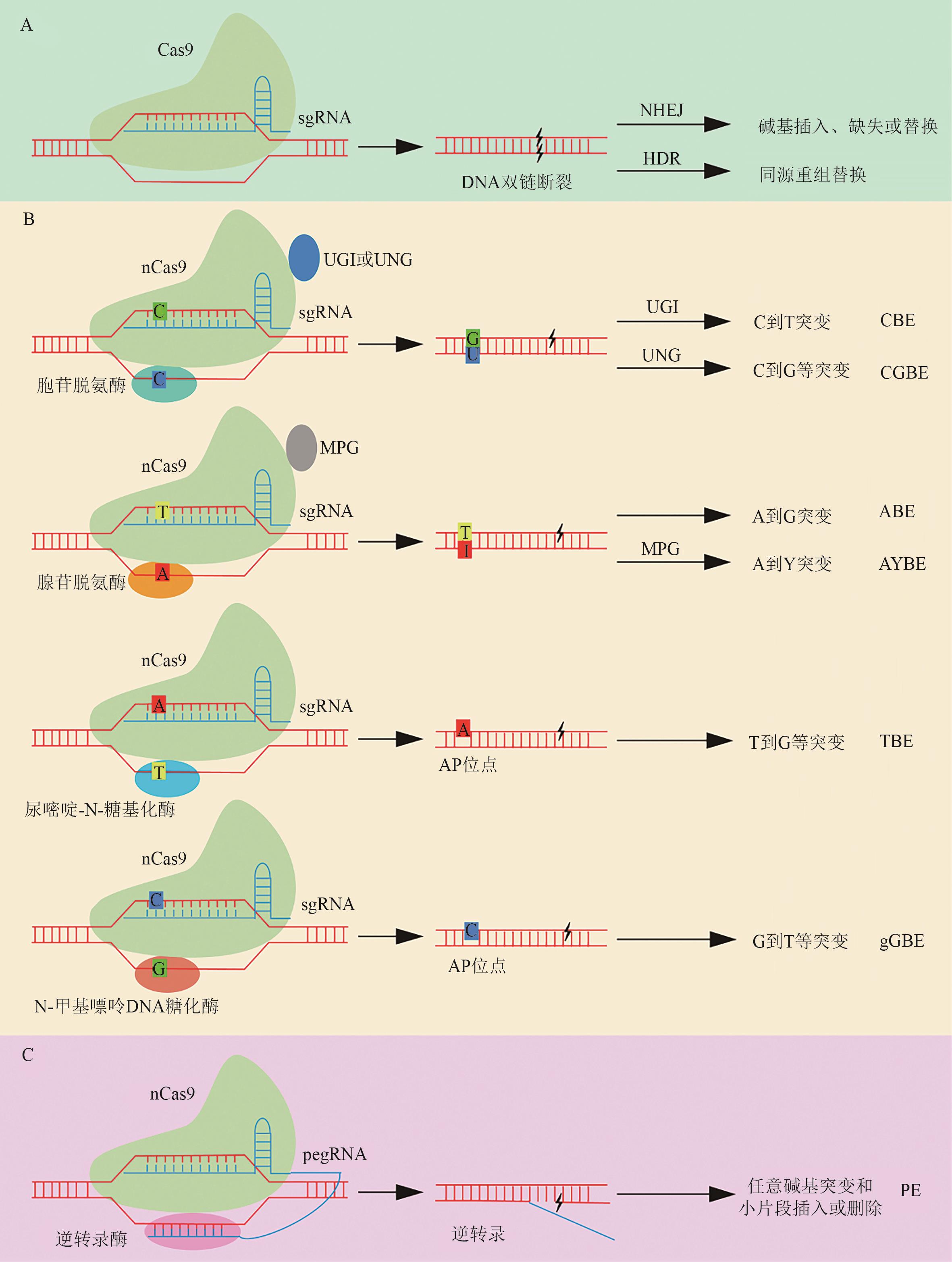
Fig. 1 Schematic diagram of gene editing systemsA: Diagram of the CRISPR/Cas9 genome editing system. B: Diagram of base editors. C: Diagram of prime editors. gRNA: Single guide RNA. NHEJ: Non-homologous end joining. HDR: Homologous-directed repair. UGI: Uracil glycosylase inhibitor. UNG: Uracil N-glycosylase. CBE: Cytosine base editors. CGBE: Cytosine transversion base editors. MPG: N-methylpurine DNA glycosylase. ABE: Adenine base editors. AYBE: Adenine transversion base editors. AP: Apurinic/apyrimidinic. TBE: Glycosylase-based thymine base editors. gGBE: Glycosylase-based guanine base editors. pegRNA: Prime editing guide RNA. PE: Prime editing
编辑器类型 Editing class | 编辑载体 Editing tools | 突变位点 Mutation sites | 除草剂抗性 Herbicide resistance | 参考文献 Reference |
|---|---|---|---|---|
| NHEJ | pYLsgRNA-OsU3 | Gly628Trp | 甲咪唑烟酸,咪唑乙烟酸 | [ |
| HDR | pCXUN-Cas9, DNA donor | Trp548Leu, Ser627Ile | 双草醚 | [ |
| HDR | pZH-MMCas9, pPZ-mALS | Trp548Leu, Ser627Ile | 双草醚 | [ |
| HDR | Cas9-VirD2, DNAdonor | Trp548Leu | 双草醚 | [ |
| HDR | pCXUN-LbCpf1,RNA donor | Trp548Leu, Ser627Ile | 双草醚 | [ |
| HDR | LbCas12a, crRNA | Trp548Leu, Ser627Ile | 双草醚 | [ |
| CBE | pHUE411-BE3-sgRNA-nCas9 | Pro171Ser, Pro171Ala, Pro171Try, Pro171Phe | 烟嘧磺隆 | [ |
| Pro171Phe/Gly628Glu/Gly629Ser | 甲咪唑烟酸 | |||
| GBE | OsGTBE: nCas9-gMPGv6.3 | Pro171Thr/Asn/His/Arg | 氟唑磺隆 | [ |
| Gly628Trp/Val/Leu | 咪唑乙烟酸 | |||
| ABE | rBE49b (TadA9) | Ser627Gly | 咪唑啉酮 | [ |
| TadDE | TadDE | Arg190His, Gly628Glu, Gly629Ser, Gly628Glu/Gly629Ser | 双草醚 | [ |
| BEMGE | pUbi:rBE9, pUbi:rBE14 | Ala152Thr, Ala154Thr, Pro171Phe/Leu/Ser, Arg190His | 双草醚 | [ |
| PE | PE2, PE3 | Trp548Leu | 双草醚 | [ |
| PE | ePPE: nCas9-NC-RT pegRNA | Trp542Leu, Ser621Ile, Pro165Ser | 甲咪唑烟酸,烟嘧磺隆 | [ |
| PE | PE-P1,PE-P2 | Thr548Leu, Pro171Ser | 咪唑啉酮 | [ |
| PE | PE3-HS, PE3-AS, PE3-DS | Ser627Ile | 双草醚 | [ |
| PE | Sp-PE2, Sp-PE3, Sa-PE3 | Ser627Asn | 咪唑啉酮 | [ |
Table 1 Acetolactate synthase (ALS)-inhibiting herbicide-resistant rice generated by gene editing
编辑器类型 Editing class | 编辑载体 Editing tools | 突变位点 Mutation sites | 除草剂抗性 Herbicide resistance | 参考文献 Reference |
|---|---|---|---|---|
| NHEJ | pYLsgRNA-OsU3 | Gly628Trp | 甲咪唑烟酸,咪唑乙烟酸 | [ |
| HDR | pCXUN-Cas9, DNA donor | Trp548Leu, Ser627Ile | 双草醚 | [ |
| HDR | pZH-MMCas9, pPZ-mALS | Trp548Leu, Ser627Ile | 双草醚 | [ |
| HDR | Cas9-VirD2, DNAdonor | Trp548Leu | 双草醚 | [ |
| HDR | pCXUN-LbCpf1,RNA donor | Trp548Leu, Ser627Ile | 双草醚 | [ |
| HDR | LbCas12a, crRNA | Trp548Leu, Ser627Ile | 双草醚 | [ |
| CBE | pHUE411-BE3-sgRNA-nCas9 | Pro171Ser, Pro171Ala, Pro171Try, Pro171Phe | 烟嘧磺隆 | [ |
| Pro171Phe/Gly628Glu/Gly629Ser | 甲咪唑烟酸 | |||
| GBE | OsGTBE: nCas9-gMPGv6.3 | Pro171Thr/Asn/His/Arg | 氟唑磺隆 | [ |
| Gly628Trp/Val/Leu | 咪唑乙烟酸 | |||
| ABE | rBE49b (TadA9) | Ser627Gly | 咪唑啉酮 | [ |
| TadDE | TadDE | Arg190His, Gly628Glu, Gly629Ser, Gly628Glu/Gly629Ser | 双草醚 | [ |
| BEMGE | pUbi:rBE9, pUbi:rBE14 | Ala152Thr, Ala154Thr, Pro171Phe/Leu/Ser, Arg190His | 双草醚 | [ |
| PE | PE2, PE3 | Trp548Leu | 双草醚 | [ |
| PE | ePPE: nCas9-NC-RT pegRNA | Trp542Leu, Ser621Ile, Pro165Ser | 甲咪唑烟酸,烟嘧磺隆 | [ |
| PE | PE-P1,PE-P2 | Thr548Leu, Pro171Ser | 咪唑啉酮 | [ |
| PE | PE3-HS, PE3-AS, PE3-DS | Ser627Ile | 双草醚 | [ |
| PE | Sp-PE2, Sp-PE3, Sa-PE3 | Ser627Asn | 咪唑啉酮 | [ |
编辑器类型 Editing class | 编辑载体 Editing tools | 突变位点 Mutation sites | 除草剂抗性 Herbicide resistance | 参考文献 Reference |
|---|---|---|---|---|
| ABE | pHUE411-PABE-7-esgRNA | Cys2186Arg | 氟吡甲禾灵 | [ |
| ABE | rBE49b (TadA9) | Cys2186Lys | 氟吡甲禾灵 | [ |
| A/CBE | pHUC411-derived eBE3/eABE | Trp2125Ser, Ile1879Val, Cys2186Arg | 氟吡甲禾灵 | [ |
| A/C/DBE | (STEME-NG), APOBEC3A-ecTadA ecTadA7.10-pOsU3 | Trp2125Cys, Pro1927Phe, Ser1866Phe, Ala1884Pro | 氟吡甲禾灵 | [ |
| A/C/DBE | ACE5-nSpCas9 | Ile1879Leu, Ile1879Val, Trp2125Leu, Trp2125Gln, Trp2125Cys, Trp2125Cys/Arg2126Lys, Trp2125Ser, Trp2125Ser/Arg, Trp2125Ser/Gln, Trp2125Ser/2126Lys, Trp2125Cys/2126Lys/Gly2127Ser Cys2186His, Cys2186Arg, Gly2194Ser | 氟吡甲禾灵 | [ |
| A/C/DBE | (pH-MoBE), PlantBE-CODE-TadA9 CDA1 | Trp2125Cys, Ile2139Asn, Cys2186Arg | 氟吡甲禾灵 | [ |
| PE | (pPE2), SpCas9 derived eBE3 and eABE | Trp2125Cys | 氟吡甲禾灵 | [ |
| PE | PE-P1, PE-P2 | Asp2176Gly, Gly2201Ala | 氟吡甲禾灵 | [ |
| PE | (pPE2), SpCas9 derived eBE3 and eABE | Pro1927Tyr/Phe, Ile1879Ser/Thr/Leu/Val, Trp2097Leu/Gly, Ile2139Ser/Val/Asn, Asp2176Gly, Gly2194Ser | 氟吡甲禾灵 | [ |
Table 2 Acetyl-CoA carboxylase (ACCase)-inhibiting herbicide-resistant rice generated by gene editing
编辑器类型 Editing class | 编辑载体 Editing tools | 突变位点 Mutation sites | 除草剂抗性 Herbicide resistance | 参考文献 Reference |
|---|---|---|---|---|
| ABE | pHUE411-PABE-7-esgRNA | Cys2186Arg | 氟吡甲禾灵 | [ |
| ABE | rBE49b (TadA9) | Cys2186Lys | 氟吡甲禾灵 | [ |
| A/CBE | pHUC411-derived eBE3/eABE | Trp2125Ser, Ile1879Val, Cys2186Arg | 氟吡甲禾灵 | [ |
| A/C/DBE | (STEME-NG), APOBEC3A-ecTadA ecTadA7.10-pOsU3 | Trp2125Cys, Pro1927Phe, Ser1866Phe, Ala1884Pro | 氟吡甲禾灵 | [ |
| A/C/DBE | ACE5-nSpCas9 | Ile1879Leu, Ile1879Val, Trp2125Leu, Trp2125Gln, Trp2125Cys, Trp2125Cys/Arg2126Lys, Trp2125Ser, Trp2125Ser/Arg, Trp2125Ser/Gln, Trp2125Ser/2126Lys, Trp2125Cys/2126Lys/Gly2127Ser Cys2186His, Cys2186Arg, Gly2194Ser | 氟吡甲禾灵 | [ |
| A/C/DBE | (pH-MoBE), PlantBE-CODE-TadA9 CDA1 | Trp2125Cys, Ile2139Asn, Cys2186Arg | 氟吡甲禾灵 | [ |
| PE | (pPE2), SpCas9 derived eBE3 and eABE | Trp2125Cys | 氟吡甲禾灵 | [ |
| PE | PE-P1, PE-P2 | Asp2176Gly, Gly2201Ala | 氟吡甲禾灵 | [ |
| PE | (pPE2), SpCas9 derived eBE3 and eABE | Pro1927Tyr/Phe, Ile1879Ser/Thr/Leu/Val, Trp2097Leu/Gly, Ile2139Ser/Val/Asn, Asp2176Gly, Gly2194Ser | 氟吡甲禾灵 | [ |
编辑器类型 Editing class | 编辑载体 Editing tools | 突变位点 Mutation sites | 参考文献 Reference |
|---|---|---|---|
| NHEJ-Crispr/Cas9 | pHUN411 | Thr173Ile, Pro177Ser | [ |
| HDR-Crispr/Cas9 | SpCas9: NICTK-1 pCRISPR-Cas9, HDR OsEPSPS template | Gly172Ala, Thr173Ile, Pro177Ser | [ |
| BE | STCBE-2: nCas9(D10A)-NG | Asp213Asn | [ |
| PE | pCXUN-Ubi-nCas9 NLS-PolyA E9 vector | Thr169Ile, Ala170Val, Pro173Ser | [ |
| PE | ePE5max | Thr173Ile, Ala174Val, Pro177Ser | [ |
| PE | PE3max | Thr173Ile, Ala174Val, Pro177Ser | [ |
Table 3 Glyphosate-resistant rice generated by gene editing
编辑器类型 Editing class | 编辑载体 Editing tools | 突变位点 Mutation sites | 参考文献 Reference |
|---|---|---|---|
| NHEJ-Crispr/Cas9 | pHUN411 | Thr173Ile, Pro177Ser | [ |
| HDR-Crispr/Cas9 | SpCas9: NICTK-1 pCRISPR-Cas9, HDR OsEPSPS template | Gly172Ala, Thr173Ile, Pro177Ser | [ |
| BE | STCBE-2: nCas9(D10A)-NG | Asp213Asn | [ |
| PE | pCXUN-Ubi-nCas9 NLS-PolyA E9 vector | Thr169Ile, Ala170Val, Pro173Ser | [ |
| PE | ePE5max | Thr173Ile, Ala174Val, Pro177Ser | [ |
| PE | PE3max | Thr173Ile, Ala174Val, Pro177Ser | [ |
靶标基因 Target genes | 编辑器类型 Editing class | 编辑载体 Editing tools | 突变位点 Mutation sites | 除草剂抗性 Herbicide resistance | 参考文献 References |
|---|---|---|---|---|---|
| OsGS1 | A/C/DBE | CRISPR/Sc++rBE73b | Glu131Gly | 草铵膦 | [ |
| A/C/DBE | (BEMGE), rBE5/22/49b/53 102sgRNAs | Ala63Val Pro64Ser,+Ala Phe,S59GT60A | 草铵膦 | [ | |
| ABE | rBE49b (TadA9) | His249Arg | 草铵膦 | [ | |
| OsARF18 | NHEJ | CRISPR-Cas9 | LOC_Os06g47150 | 草铵膦 | [ |
| OsSPL10 | NHEJ | CRISPR-Cas9 | LOC_Os06g44860 | 草铵膦 | [ |
| OsHPPD | NHEJ | CRISPR-Cas9 | Promoter replacement by 338 kb chromosome inversion | 硝磺草酮 | [ |
| OsHPPD | NHEJ | CRISPR-Cas9 and Cas12a | 3’ UTR, +1/-1 bp at position 2304 | 硝磺草酮 | [ |
| OsHIS | PE | twinPE/GRAND | OsHIS1 (+28 bp), | 硝磺草酮 | [ |
| OsDNR1 | NHEJ | CRISPR-Cas9 | LOC_Os01g08270 | 苯唑草酮、异噁唑草酮 | [ |
| OsTubA2 | ABE | rBE14/sgRNA | Met268Thr | 二甲戊灵、氟乐灵 | [ |
| ABE | rBE49b (TadA9) | Met268Thr | 二甲戊灵 | [ |
Table 4 Other herbicides-resistant rice generated by gene editing
靶标基因 Target genes | 编辑器类型 Editing class | 编辑载体 Editing tools | 突变位点 Mutation sites | 除草剂抗性 Herbicide resistance | 参考文献 References |
|---|---|---|---|---|---|
| OsGS1 | A/C/DBE | CRISPR/Sc++rBE73b | Glu131Gly | 草铵膦 | [ |
| A/C/DBE | (BEMGE), rBE5/22/49b/53 102sgRNAs | Ala63Val Pro64Ser,+Ala Phe,S59GT60A | 草铵膦 | [ | |
| ABE | rBE49b (TadA9) | His249Arg | 草铵膦 | [ | |
| OsARF18 | NHEJ | CRISPR-Cas9 | LOC_Os06g47150 | 草铵膦 | [ |
| OsSPL10 | NHEJ | CRISPR-Cas9 | LOC_Os06g44860 | 草铵膦 | [ |
| OsHPPD | NHEJ | CRISPR-Cas9 | Promoter replacement by 338 kb chromosome inversion | 硝磺草酮 | [ |
| OsHPPD | NHEJ | CRISPR-Cas9 and Cas12a | 3’ UTR, +1/-1 bp at position 2304 | 硝磺草酮 | [ |
| OsHIS | PE | twinPE/GRAND | OsHIS1 (+28 bp), | 硝磺草酮 | [ |
| OsDNR1 | NHEJ | CRISPR-Cas9 | LOC_Os01g08270 | 苯唑草酮、异噁唑草酮 | [ |
| OsTubA2 | ABE | rBE14/sgRNA | Met268Thr | 二甲戊灵、氟乐灵 | [ |
| ABE | rBE49b (TadA9) | Met268Thr | 二甲戊灵 | [ |
| [1] | Wenefrida I, Utomo HS, Meche MM, et al. Inheritance of herbicide resistance in two germplasm lines of Clearfield* rice (Oryza sativa L.) [J]. Can J Plant Sci, 2007, 87(3): 659-669. |
| [2] | Chen L, Gu G, Wang CX, et al. Trp548Met mutation of acetolactate synthase in rice confers resistance to a broad spectrum of ALS-inhibiting herbicides [J]. Crop J, 2021, 9(4): 750-758. |
| [3] | Gaj T, Gersbach CA, Barbas CF. ZFN, TALEN, and CRISPR/Cas-based methods for genome engineering [J]. Trends Biotechnol, 2013, 31(7): 397-405. |
| [4] | Shan QW, Wang YP, Li J, et al. Targeted genome modification of crop plants using a CRISPR-Cas system [J]. Nat Biotechnol, 2013, 31(8): 686-688. |
| [5] | Mali P, Yang LH, Esvelt KM, et al. RNA-guided human genome engineering via Cas9 [J]. Science, 2013, 339(6121): 823-826. |
| [6] | Cong L, Ran FA, Cox D, et al. Multiplex genome engineering using CRISPR/cas systems [J]. Science, 2013, 339(6121): 819-823. |
| [7] | Wiedenheft B, Lander GC, Zhou KH, et al. Structures of the RNA-guided surveillance complex from a bacterial immune system [J]. Nature, 2011, 477(7365): 486-489. |
| [8] | Fichtner F, Urrea Castellanos R, Ülker B. Precision genetic modifications: a new era in molecular biology and crop improvement [J]. Planta, 2014, 239(4): 921-939. |
| [9] | Mladenov E, Iliakis G. Induction and repair of DNA double strand breaks: The increasing spectrum of non-homologous end joining pathways [J]. Mutat Res Fundam Mol Mech Mutagen, 2011, 711(1-2): 61-72. |
| [10] | Siebert R, Puchta H. Efficient repair of genomic double-strand breaks by homologous recombination between directly repeated sequences in the plant genome [J]. Plant Cell, 2002, 14(5): 1121-1131. |
| [11] | 宗媛, 高彩霞. 碱基编辑系统研究进展 [J]. 遗传, 2019, 41(9): 777-800. |
| Zong Y, Gao CX. Progress on base editing systems [J]. Hereditas, 2019, 41(9): 777-800. | |
| [12] | Kurt IC, Zhou RH, Iyer S, et al. CRISPR C-to-G base editors for inducing targeted DNA transversions in human cells [J]. Nat Biotechnol, 2021, 39(1): 41-46. |
| [13] | Tong HW, Wang XC, Liu YH, et al. Programmable A-to-Y base editing by fusing an adenine base editor with an N-methylpurine DNA glycosylase [J]. Nat Biotechnol, 2023, 41(8): 1080-1084. |
| [14] | Kuang YJ, Wu XM, Liu MJ, et al. Developing glycosylase-based T-to-G and C-to-K base editors in rice [J]. Plant Biotechnol J, 2025, 23(6): 2358-2360. |
| [15] | Liu L, Zhang ZM, Wang CY, et al. Developing guanine base editors for G-to-T editing in rice [J]. J Integr Plant Biol, 2024, 66(8): 1557-1560. |
| [16] | Li C, Zong Y, Jin S, et al. SWISS: multiplexed orthogonal genome editing in plants with a Cas9 nickase and engineered CRISPR RNA scaffolds [J]. Genome Biol, 2020, 21: 141. |
| [17] | Xie JK, Huang XY, Wang X, et al. ACBE, a new base editor for simultaneous C-to-T and A-to-G substitutions in mammalian systems [J]. BMC Biol, 2020, 18: 131. |
| [18] | Li C, Zhang R, Meng XB, et al. Targeted, random mutagenesis of plant genes with dual cytosine and adenine base editors [J]. Nat Biotechnol, 2020, 38(7): 875-882. |
| [19] | Zhang XH, Zhu BY, Chen L, et al. Dual base editor catalyzes both cytosine and adenine base conversions in human cells [J]. Nat Biotechnol, 2020, 38(7): 856-860. |
| [20] | Sakata RC, Ishiguro S, Mori H, et al. Base editors for simultaneous introduction of C-to-T and A-to-G mutations [J]. Nat Biotechnol, 2020, 38(7): 865-869. |
| [21] | Grünewald J, Zhou RH, Lareau CA, et al. A dual-deaminase CRISPR base editor enables concurrent adenine and cytosine editing [J]. Nat Biotechnol, 2020, 38(7): 861-864. |
| [22] | Fan TT, Cheng YH, Wu YC, et al. High performance TadA-8e derived cytosine and dual base editors with undetectable off-target effects in plants [J]. Nat Commun, 2024, 15: 5103. |
| [23] | 周苏淮, 李芳, 李娟, 等. 植物基因组精准编辑技术——引导编辑 [J]. 科学通报, 2025, 70(16): 2414-2422. |
| Zhou SH, Li F, Li J, et al. Plant genome precise editing technology-prime editing [J]. Chin Sci Bull, 2025, 70(16): 2414-2422. | |
| [24] | Chen PJ, Hussmann JA, Yan J, et al. Enhanced prime editing systems by manipulating cellular determinants of editing outcomes [J]. Cell, 2021, 184(22): 5635-5652.e29. |
| [25] | Ferreira da Silva J, Oliveira GP, Arasa-Verge EA, et al. Prime editing efficiency and fidelity are enhanced in the absence of mismatch repair [J]. Nat Commun, 2022, 13: 760. |
| [26] | Lin QP, Zong Y, Xue CX, et al. Prime genome editing in rice and wheat [J]. Nat Biotechnol, 2020, 38(5): 582-585. |
| [27] | Lu Y, Qiao DX, Wang JY, et al. Two highly efficient prime editing systems based on the Csy4 CRISPR Endonuclease [J]. Plant Biotechnol J, 2026, 24(2): 828-830. |
| [28] | Heap I. The international survey of herbicide resistant weeds [EB/OL]. . |
| [29] | Wang FQ, Xu Y, Li WQ, et al. Creating a novel herbicide-tolerance OsALS allele using CRISPR/Cas9-mediated gene editing [J]. Crop J, 2021, 9(2): 305-312. |
| [30] | Sun YW, Zhang X, Wu CY, et al. Engineering herbicide-resistant rice plants through CRISPR/Cas9-mediated homologous recombination of acetolactate synthase [J]. Mol Plant, 2016, 9(4): 628-631. |
| [31] | Endo M, Mikami M, Toki S. Biallelic gene targeting in rice [J]. Plant Physiol, 2016, 170(2): 667-677. |
| [32] | Ali Z, Shami A, Sedeek K, et al. Fusion of the Cas9 endonuclease and the VirD2 relaxase facilitates homology-directed repair for precise genome engineering in rice [J]. Commun Biol, 2020, 3: 44. |
| [33] | Li SY, Li JY, He YB, et al. Precise gene replacement in rice by RNA transcript-templated homologous recombination [J]. Nat Biotechnol, 2019, 37(4): 445-450. |
| [34] | Li SY, Li JY, Zhang JH, et al. Synthesis-dependent repair of Cpf1-induced double strand DNA breaks enables targeted gene replacement in rice [J]. J Exp Bot, 2018, 69(20): 4715-4721. |
| [35] | Li SY, Zhang YX, Xia LQ, et al. CRISPR-Cas12a enables efficient biallelic gene targeting in rice [J]. Plant Biotechnol J, 2020, 18(6): 1351-1353. |
| [36] | Zhang R, Chen S, Meng XB, et al. Generating broad-spectrum tolerance to ALS-inhibiting herbicides in rice by base editing [J]. Sci China Life Sci, 2021, 64(10): 1624-1633. |
| [37] | Tian YF, Li XB, Xie JY, et al. Targeted G-to-T base editing for generation of novel herbicide-resistance gene alleles in rice [J]. J Integr Plant Biol, 2024, 66(6): 1048-1051. |
| [38] | Yan DQ, Ren B, Liu L, et al. High-efficiency and multiplex adenine base editing in plants using new TadA variants [J]. Mol Plant, 2021, 14(5): 722-731. |
| [39] | Kuang YJ, Li SF, Ren B, et al. Base-editing-mediated artificial evolution of OsALS1 in planta to develop novel herbicide-tolerant rice germplasms [J]. Mol Plant, 2020, 13(4): 565-572. |
| [40] | Butt H, Rao GS, Sedeek K, et al. Engineering herbicide resistance via prime editing in rice [J]. Plant Biotechnol J, 2020, 18(12): 2370-2372. |
| [41] | Zong Y, Liu YJ, Xue CX, et al. An engineered prime editor with enhanced editing efficiency in plants [J]. Nat Biotechnol, 2022, 40(9): 1394-1402. |
| [42] | Xu W, Zhang CW, Yang YX, et al. Versatile nucleotides substitution in plant using an improved prime editing system [J]. Mol Plant, 2020, 13(5): 675-678. |
| [43] | Li HY, Zhu ZW, Li SY, et al. Multiplex precision gene editing by a surrogate prime editor in rice [J]. Mol Plant, 2022, 15(7): 1077-1080. |
| [44] | Hua K, Jiang YW, Tao XP, et al. Precision genome engineering in rice using prime editing system [J]. Plant Biotechnol J, 2020, 18(11): 2167-2169. |
| [45] | Jang S, Marjanovic J, Gornicki P. Resistance to herbicides caused by single amino acid mutations in acetyl-CoA carboxylase in resistant populations of grassy weeds [J]. New Phytol, 2013, 197(4): 1110-1116. |
| [46] | 王瑶, 王荣焕, 冯铃洋, 等. 作物抗ACCase抑制剂类除草剂研究进展 [J]. 生物技术通报, 2024, 40(8): 13-23. |
| Wang Y, Wang RH, Feng LY, et al. Research progress of crop resistance to ACCase-inhibitor-like herbicides [J]. Biotechnol Bull, 2024, 40(8): 13-23. | |
| [47] | Li C, Zong Y, Wang YP, et al. Expanded base editing in rice and wheat using a Cas9-adenosine deaminase fusion [J]. Genome Biol, 2018, 19: 59. |
| [48] | Liu XS, Qin RY, Li J, et al. A CRISPR-Cas9-mediated domain-specific base-editing screen enables functional assessment of ACCase variants in rice [J]. Plant Biotechnol J, 2020, 18(9): 1845-1847. |
| [49] | Wang HZ, He YX, Wang YY, et al. Base editing-mediated targeted evolution of ACCase for herbicide-resistant rice mutants [J]. J Integr Plant Biol, 2022, 64(11): 2029-2032. |
| [50] | Zhang A, Shan TF, Sun Y, et al. Directed evolution rice genes with randomly multiplexed sgRNAs assembly of base editors [J]. Plant Biotechnol J, 2023, 21(12): 2597-2610. |
| [51] | Xu RF, Li J, Liu XS, et al. Development of plant prime-editing systems for precise genome editing [J]. Plant Commun, 2020, 1(3): 100043. |
| [52] | Xu RF, Liu XS, Li J, et al. Identification of herbicide resistance OsACC1 mutations via in planta prime-editing-library screening in rice [J]. Nat Plants, 2021, 7(7): 888-892. |
| [53] | Duke SO, Powles SB. Glyphosate: a once-in-a-century herbicide [J]. Pest Manag Sci, 2008, 64(4): 319-325. |
| [54] | Dill GM. Glyphosate-resistant crops: history, status and future [J]. Pest Manag Sci, 2005, 61(3): 219-224. |
| [55] | Li J, Meng XB, Zong Y, et al. Gene replacements and insertions in rice by intron targeting using CRISPR-Cas9 [J]. Nat Plants, 2016, 2(10): 16139. |
| [56] | Sony SK, Kaul T, Abdel Motelb KF, et al. CRISPR/Cas9-mediated homology donor repair base editing confers glyphosate resistance to rice (Oryza sativa L.) [J]. Front Plant Sci, 2023, 14: 1122926. |
| [57] | Zhang C, Zhong X, Li SY, et al. Artificial evolution of OsEPSPS through an improved dual cytosine and adenine base editor generated a novel allele conferring rice glyphosate tolerance [J]. J Integr Plant Biol, 2023, 65(9): 2194-2203. |
| [58] | Perotti VE, Larran AS, Palmieri VE, et al. A novel triple amino acid substitution in the EPSPS found in a high-level glyphosate-resistant Amaranthus hybridus population from Argentina [J]. Pest Manag Sci, 2019, 75(5): 1242-1251. |
| [59] | Li HY, Li JY, Chen JL, et al. Precise modifications of both exogenous and endogenous genes in rice by prime editing [J]. Mol Plant, 2020, 13(5): 671-674. |
| [60] | Jiang YY, Chai YP, Qiao DX, et al. Optimized prime editing efficiently generates glyphosate-resistant rice plants carrying homozygous TAP-IVS mutation in EPSPS [J]. Mol Plant, 2022, 15(11): 1646-1649. |
| [61] | Gupta A, Liu B, Raza S, et al. Modularly assembled multiplex prime editors for simultaneous editing of agronomically important genes in rice [J]. Plant Commun, 2024, 5(2): 100741. |
| [62] | James D, Borphukan B, Fartyal D, et al. Concurrent overexpression of OsGS1;1 and OsGS2 genes in transgenic rice (Oryza sativa L.): impact on tolerance to abiotic stresses [J]. Front Plant Sci, 2018, 9: 786. |
| [63] | Avila-Garcia WV, Sanchez-Olguin E, Hulting AG, et al. Target-site mutation associated with glufosinate resistance in Italian ryegrass (Lolium perenne L. ssp. multiflorum) [J]. Pest Manag Sci, 2012, 68(9): 1248-1254. |
| [64] | Goodman H, DasSarma S, Tischer E, et al. Expression of wild type and mutant glutamine synthetase in foreign hosts: US5098838A [P].1992-03-24. |
| [65] | Ma GG, Kuang YJ, Lu ZW, et al. CRISPR/Sc++-mediated genome editing in rice [J]. J Integr Plant Biol, 2021, 63(9): 1606-1610. |
| [66] | Pornprom T, Prodmatee N, Chatchawankanphanich O. Glutamine synthetase mutation conferring target-site-based resistance to glufosinate in soybean cell selections [J]. Pest Manag Sci, 2009, 65(2): 216-222. |
| [67] | Ren B, Kuang YJ, Xu ZY, et al. Three novel alleles of OsGS1 developed by base-editing-mediated artificial evolution confer glufosinate tolerance in rice [J]. Crop J, 2023, 11(2): 661-665. |
| [68] | Ren Y, Liu BM, Jiang HR, et al. Precision editing of GLR1 confers glufosinate resistance without yield penalty in rice [J]. Plant Biotechnol J, 2023, 21(12): 2417-2419. |
| [69] | Xia JQ, He DY, Liang QY, et al. Loss of OsARF18 function confers glufosinate resistance in rice [J]. Mol Plant, 2023, 16(9): 1355-1358. |
| [70] | Xia JQ, Liang QY, He DY, et al. Knockout of OsSPL10 confers enhanced glufosinate resistance in rice [J]. Plant Commun, 2024, 5(2): 100731. |
| [71] | Moran GR. 4-hydroxyphenylpyruvate dioxygenase [J]. Arch Biochem Biophys, 2005, 433(1): 117-128. |
| [72] | Ndikuryayo F, Moosavi B, Yang WC, et al. 4-hydroxyphenylpyruvate dioxygenase inhibitors: from chemical biology to agrochemicals [J]. J Agric Food Chem, 2017, 65(39): 8523-8537. |
| [73] | Küpper A, Peter F, Zöllner P, et al. Tembotrione detoxification in 4-hydroxyphenylpyruvate dioxygenase (HPPD) inhibitor-resistant Palmer amaranth (Amaranthus palmeri S. Wats.) [J]. Pest Manag Sci, 2018, 74(10): 2325-2334. |
| [74] | Nakka S, Godar AS, Wani PS, et al. Physiological and molecular characterization of hydroxyphenylpyruvate dioxygenase (HPPD)-inhibitor resistance in palmer amaranth (Amaranthus palmeri S.Wats.) [J]. Front Plant Sci, 2017, 8: 555. |
| [75] | Lu Y, Wang JY, Chen B, et al. A donor-DNA-free CRISPR/Cas-based approach to gene knock-up in rice [J]. Nat Plants, 2021, 7(11): 1445-1452. |
| [76] | Wu YY, Xiao N, Cai Y, et al. CRISPR-Cas9-mediated editing of the OsHPPD 3′UTR confers enhanced resistance to HPPD-inhibiting herbicides in rice [J]. Plant Commun, 2023, 4(5): 100605. |
| [77] | Maeda H, Murata K, Sakuma N, et al. A rice gene that confers broad-spectrum resistance to β-triketone herbicides [J]. Science, 2019, 365(6451): 393-396. |
| [78] | Liu XX, Wang YY, Wang HZ, et al. Generating herbicide resistant and dwarf rice germplasms through precise sequence insertion or replacement [J]. Plant Biotechnol J, 2024, 22(2): 293-295. |
| [79] | Li Y, Ling XT, Zhang WT, et al. OsDNR1 as a key regulator of rice resistance to 4-hydroxyphenylpyruvate dioxygenase-inhibiting herbicides [J]. J Integr Plant Biol, 2025, 67(9): 2262-2264. |
| [80] | Chu ZZ, Chen JY, Nyporko A, et al. Novel α-tubulin mutations conferring resistance to dinitroaniline herbicides in Lolium rigidum [J]. Front Plant Sci, 2018, 9: 97. |
| [81] | Anthony RG, Hussey PJ. Double mutation in Eleusine indica α-tubulin increases the resistance of transgenic maize calli to dinitroaniline and phosphorothioamidate herbicides [J]. Plant J, 1999, 18(6): 669-674. |
| [82] | Yamamoto E, Zeng LH, Baird WV. A-tubulin missense mutations correlate with antimicrotubule drug resistance in Eleusine indica [J]. Plant Cell, 1998, 10(2): 297. |
| [83] | Délye C, Menchari Y, Michel S, et al. Molecular bases for sensitivity to tubulin-binding herbicides in green foxtail [J]. Plant Physiol, 2004, 136(4): 3920-3932. |
| [84] | Hashim S, Jan A, Sunohara Y, et al. Mutation of alpha-tubulin genes in trifluralin-resistant water foxtail (Alopecurus aequalis) [J]. Pest Manag Sci, 2012, 68(3): 422-429. |
| [85] | Chen JY, Yu Q, Owen M, et al. Dinitroaniline herbicide resistance in a multiple-resistant Lolium rigidum population [J]. Pest Manag Sci, 2018, 74(4): 925-932. |
| [86] | Fleet B, Malone J, Preston C, et al. Target-site point mutation conferring resistance to trifluralin in rigid ryegrass (Lolium rigidum) [J]. Weed Sci, 2018, 66(2): 246-253. |
| [87] | Liu L, Kuang YJ, Yan F, et al. Developing a novel artificial rice germplasm for dinitroaniline herbicide resistance by base editing of OsTubA2 [J]. Plant Biotechnol J, 2021, 19(1): 5-7. |
| [88] | Wang X, Pan WB, Sun C, et al. Creating large-scale genetic diversity in Arabidopsis via base editing-mediated deep artificial evolution [J]. Genome Biol, 2024, 25: 215. |
| [89] | Butt H, Ramirez JLM, Mahfouz M. Synthetic evolution of herbicide resistance using a T7 RNAP-based random DNA base editor [J]. Life Sci Alliance, 2022, 5(12): e202201538. |
| [90] | Yu Q, Powles S. Metabolism-based herbicide resistance and cross-resistance in crop weeds: a threat to herbicide sustainability and global crop production [J]. Plant Physiol, 2014, 166(3): 1106-1118. |
| [91] | Su XN, Li CY, Liu XS, et al. The role of OsBZR4 as a brassinosteroid-signaling component in mediating atrazine and isoproturon degradation in rice [J]. J Hazard Mater, 2024, 473: 134625. |
| [1] | GAO Guo-liang, ZHANG Qiao-ling, FENG Wen-jie, GAO Fa-rui, GAO Bo, ZONG Ke-dong, GE Lin, LI Shang-xian, WANG Qiu-yun, HUANG Xin-cheng. Whole-genome Analysis and Precision Breeding Strategies for a Novel Japonica Rice Variety Jiru Dao 1 [J]. Biotechnology Bulletin, 2026, 42(8): 106-112. |
| [2] | YANG Qun, LI Jing, FU De-bao, XU Ting-ting. OsbHLH069 Negatively Regulates Rice Panicle Development by Competitively Interfering with the LAX1-LAX2 Complex [J]. Biotechnology Bulletin, 2026, 42(8): 113-122. |
| [3] | CHEN Yi-yan, ZHANG Dong-er, ZHANG Tao, LIU Yu-hao, TANG Jie, SHENG Xia-bing, HU Yuan-yi, AI Zhi-yong, LI Ying-jiang, LIU Xiao-lin. Analysis on Function of Rice OsSULTR2;2 and Regulation of Seedling Tolerance to Salt [J]. Biotechnology Bulletin, 2026, 42(7): 116-125. |
| [4] | PENG Yan, AN Chen, SHAO Ye, MAO Bi-gang, ZHANG Xue-wen, ZHAO Bing-ran. Construction and Validation of a Visualization System for Plants Heavy Metal Response [J]. Biotechnology Bulletin, 2026, 42(7): 105-115. |
| [5] | YIN Ya-long, ZHANG Ming-yang, WANG Jie-min, MIAO Xue-xue, CHEN Jin, WANG Wei-ping. Advances in Coordinated Tolerance Mechanisms to Abiotic Stresses in Rice [J]. Biotechnology Bulletin, 2026, 42(4): 26-37. |
| [6] | MA Shi-jie, LI Zheng, LI Wei, GUO Yang-dong, ZHANG Na. Research Progress in Light Signaling Regulation of Fruit Development in Horticultural Crops [J]. Biotechnology Bulletin, 2026, 42(3): 5-18. |
| [7] | YUAN Meng-bo, ZHAO Guang-wei, HE Yu-hua, HUANG Xiang, XU Yong-yang, ZHANG Jian, KONG Wei-hu, TIAN Xiao-qin, HU Ke-yun, TANG Ling-li. Functional Study of CmCRC Gene Influencing Sex Differentiation in Melon [J]. Biotechnology Bulletin, 2026, 42(3): 294-301. |
| [8] | WANG Cheng-cheng, HUANG Tian-yu, ZHANG Qing, SHI Lai-quan, FANG Hui-min, ZHANG Long. Phenotypic Analysis and Genetic Mapping of a Rice Floury Endosperm Mutant [J]. Biotechnology Bulletin, 2026, 42(2): 169-177. |
| [9] | YANG Yue-qin, XING Ying, ZHONG Zi-he, TIAN Wei-jun, YANG Xue-qing, WANG Jian-xu. Expression and Functional Analysis of OsMATE34 in Rice under Mercury Stress [J]. Biotechnology Bulletin, 2026, 42(1): 86-94. |
| [10] | FEI Si-tian, HOU Ying-xiang, LI Lan, ZHANG Chao. Biological Functions and Regulatory Network of SLR1, a Negative Regulator of Gibberellin Signaling in Rice [J]. Biotechnology Bulletin, 2026, 42(1): 13-30. |
| [11] | DENG Mei-bi, YAN Lang, ZHAN Zhi-tian, ZHU Min, HE Yu-bing. Efficient CRISPR Gene Editing in Rice Assisted by RUBY [J]. Biotechnology Bulletin, 2025, 41(8): 65-73. |
| [12] | HOU Ying-xiang, FEI Si-tian, LI Ni, LI Lan, SONG Song-quan, WANG Wei-ping, ZHANG Chao. Research Progress in Response of Rice miRNAs to Biotic Stress [J]. Biotechnology Bulletin, 2025, 41(7): 69-80. |
| [13] | WU Hao, DONG Wei-feng, HE Zi-tian, LI Yan-xiao, XIE Hui, SUN Ming-zhe, SHEN Yang, SUN Xiao-li. Genome-wide Identification and Expression Analysis of the Rice BXL Gene Family [J]. Biotechnology Bulletin, 2025, 41(6): 87-98. |
| [14] | HUO Guan-zhong, ZHANG Xin-ru, TIAN Shi-jun, LI Jun. Current Progress and Applications of CRISPR/Cas12a Gene Editing Technology in Plants [J]. Biotechnology Bulletin, 2025, 41(6): 1-11. |
| [15] | DU Liang-heng, TANG Huang-lei, ZHANG Zhi-guo. Map-based Cloning of Light-responsive Gene ELM1 in Rice [J]. Biotechnology Bulletin, 2025, 41(5): 82-89. |
| Viewed | ||||||
|
Full text |
|
|||||
|
Abstract |
|
|||||
