






Biotechnology Bulletin ›› 2026, Vol. 42 ›› Issue (11): 134-144.doi: 10.13560/j.cnki.biotech.bull.1985.2025-1404
LIU Si-wen1, WANG Bo-wei1, XING Jin-jie1, WANG Jing2, LI Ya-dong1, SUN Hai-yue1( )
Received:2025-12-23
Online:2026-11-26
Published:2026-11-03
Contact:
SUN Hai-yue
E-mail:haiyuesun@jlau.edu.cn
LIU Si-wen, WANG Bo-wei, XING Jin-jie, WANG Jing, LI Ya-dong, SUN Hai-yue. Genome-wide Development of SSR Primers and Genetic Diversity Analysis in Blueberry[J]. Biotechnology Bulletin, 2026, 42(11): 134-144.
编号 Code | 品种名 Cultivar name | 编号 Code | 品种名 Cultivar name | 编号 Code | 品种名 Cultivar name | 编号 Code | 品种名 Cultivar name |
|---|---|---|---|---|---|---|---|
| 1 | Draper | 17 | 蓝塔 | 33 | 努伊 | 49 | Emil |
| 2 | 利宝 | 18 | 泽西 | 34 | 伯灵顿 | 50 | L25 |
| 3 | 甜心 | 19 | 雷格西 | 35 | 艾玛 | 51 | 1502 |
| 4 | Biloxi | 20 | 博尼法西 | 36 | AF1 | 52 | H5 |
| 5 | X13 | 21 | 赫伯特 | 37 | AF2 | 53 | Y42 |
| 6 | 北春 | 22 | 布里吉塔 | 38 | AF3 | 54 | F6 |
| 7 | North sky | 23 | 托柔 | 39 | Small fruit | 55 | L29 |
| 8 | North blue | 24 | 日升 | 40 | Jgdrzej | 56 | 122 |
| 9 | 北陆 | 25 | 奥林匹克 | 41 | HL2 | 57 | L11 |
| 10 | 慧蓝 | 26 | 早蓝 | 42 | HL3 | 58 | 49 |
| 11 | 圣云 | 27 | 都克 | 43 | HL4 | 59 | O2 |
| 12 | 蓝金 | 28 | 晚蓝 | 44 | HL5 | 60 | L45 |
| 13 | 普特 | 29 | 艾玛蓝 | 45 | HL9 | 61 | YOU |
| 14 | 蓝丰 | 30 | 瑞卡 | 46 | 贝尔 | 62 | DS01 |
| 15 | H7 | 31 | 考林 | 47 | 格瑞萨 | 63 | DS04 |
| 16 | 齐伯瓦 | 32 | Record | 48 | 北卫 | 64 | D15 |
Table 1 Experimental materials for blueberry testing
编号 Code | 品种名 Cultivar name | 编号 Code | 品种名 Cultivar name | 编号 Code | 品种名 Cultivar name | 编号 Code | 品种名 Cultivar name |
|---|---|---|---|---|---|---|---|
| 1 | Draper | 17 | 蓝塔 | 33 | 努伊 | 49 | Emil |
| 2 | 利宝 | 18 | 泽西 | 34 | 伯灵顿 | 50 | L25 |
| 3 | 甜心 | 19 | 雷格西 | 35 | 艾玛 | 51 | 1502 |
| 4 | Biloxi | 20 | 博尼法西 | 36 | AF1 | 52 | H5 |
| 5 | X13 | 21 | 赫伯特 | 37 | AF2 | 53 | Y42 |
| 6 | 北春 | 22 | 布里吉塔 | 38 | AF3 | 54 | F6 |
| 7 | North sky | 23 | 托柔 | 39 | Small fruit | 55 | L29 |
| 8 | North blue | 24 | 日升 | 40 | Jgdrzej | 56 | 122 |
| 9 | 北陆 | 25 | 奥林匹克 | 41 | HL2 | 57 | L11 |
| 10 | 慧蓝 | 26 | 早蓝 | 42 | HL3 | 58 | 49 |
| 11 | 圣云 | 27 | 都克 | 43 | HL4 | 59 | O2 |
| 12 | 蓝金 | 28 | 晚蓝 | 44 | HL5 | 60 | L45 |
| 13 | 普特 | 29 | 艾玛蓝 | 45 | HL9 | 61 | YOU |
| 14 | 蓝丰 | 30 | 瑞卡 | 46 | 贝尔 | 62 | DS01 |
| 15 | H7 | 31 | 考林 | 47 | 格瑞萨 | 63 | DS04 |
| 16 | 齐伯瓦 | 32 | Record | 48 | 北卫 | 64 | D15 |
类型 Type | 数量 Number | 百分比 Percentage (%) | 平均长度 Average length (bp) | 相对密度 Relative density (bp/Mb) |
|---|---|---|---|---|
二核苷酸 SSR Di-nucleotide 三核苷酸 SSR Tri-nucleotide 四核苷酸 SSR Tetra-nucleotide 五核苷酸 SSR Penta-nucleotide 六核苷酸 SSR Hexa-nucleotide 合计 Total | 780 503 56 384 28 183 16 840 6 996 888 906 | 87.80 6.34 3.17 1.89 0.79 99.99 | 18.96 20.98 17.93 21.84 26.94 106.65 | 8 215.99 656.87 280.49 204.22 104.64 9 462.21 |
Table 2 Distribution characteristics of SSR loci in the blueberry genome
类型 Type | 数量 Number | 百分比 Percentage (%) | 平均长度 Average length (bp) | 相对密度 Relative density (bp/Mb) |
|---|---|---|---|---|
二核苷酸 SSR Di-nucleotide 三核苷酸 SSR Tri-nucleotide 四核苷酸 SSR Tetra-nucleotide 五核苷酸 SSR Penta-nucleotide 六核苷酸 SSR Hexa-nucleotide 合计 Total | 780 503 56 384 28 183 16 840 6 996 888 906 | 87.80 6.34 3.17 1.89 0.79 99.99 | 18.96 20.98 17.93 21.84 26.94 106.65 | 8 215.99 656.87 280.49 204.22 104.64 9 462.21 |
类型 Type | 重复基元 Repeat motif | 数量 Number | 百分比 Percentage (%) |
|---|---|---|---|
二核苷酸 SSR Di-nucleotide 二核苷酸 SSR Di-nucleotide 二核苷酸 SSR Di-nucleotide 二核苷酸 SSR Di-nucleotide 二核苷酸 SSR Di-nucleotide 三核苷酸 SSR Tri-nucleotide 三核苷酸 SSR Tri-nucleotide 四核苷酸 SSR Tetra-nucleotide | AA AG AT AC CC AAG AAT AAAT | 386 502 260 068 67 003 51 501 13 530 18 827 13 205 14 039 | 43.48 29.26 7.54 5.79 1.52 2.12 1.49 1.58 |
Table 3 Types of SSR repeat motifs in the blueberry genome
类型 Type | 重复基元 Repeat motif | 数量 Number | 百分比 Percentage (%) |
|---|---|---|---|
二核苷酸 SSR Di-nucleotide 二核苷酸 SSR Di-nucleotide 二核苷酸 SSR Di-nucleotide 二核苷酸 SSR Di-nucleotide 二核苷酸 SSR Di-nucleotide 三核苷酸 SSR Tri-nucleotide 三核苷酸 SSR Tri-nucleotide 四核苷酸 SSR Tetra-nucleotide | AA AG AT AC CC AAG AAT AAAT | 386 502 260 068 67 003 51 501 13 530 18 827 13 205 14 039 | 43.48 29.26 7.54 5.79 1.52 2.12 1.49 1.58 |
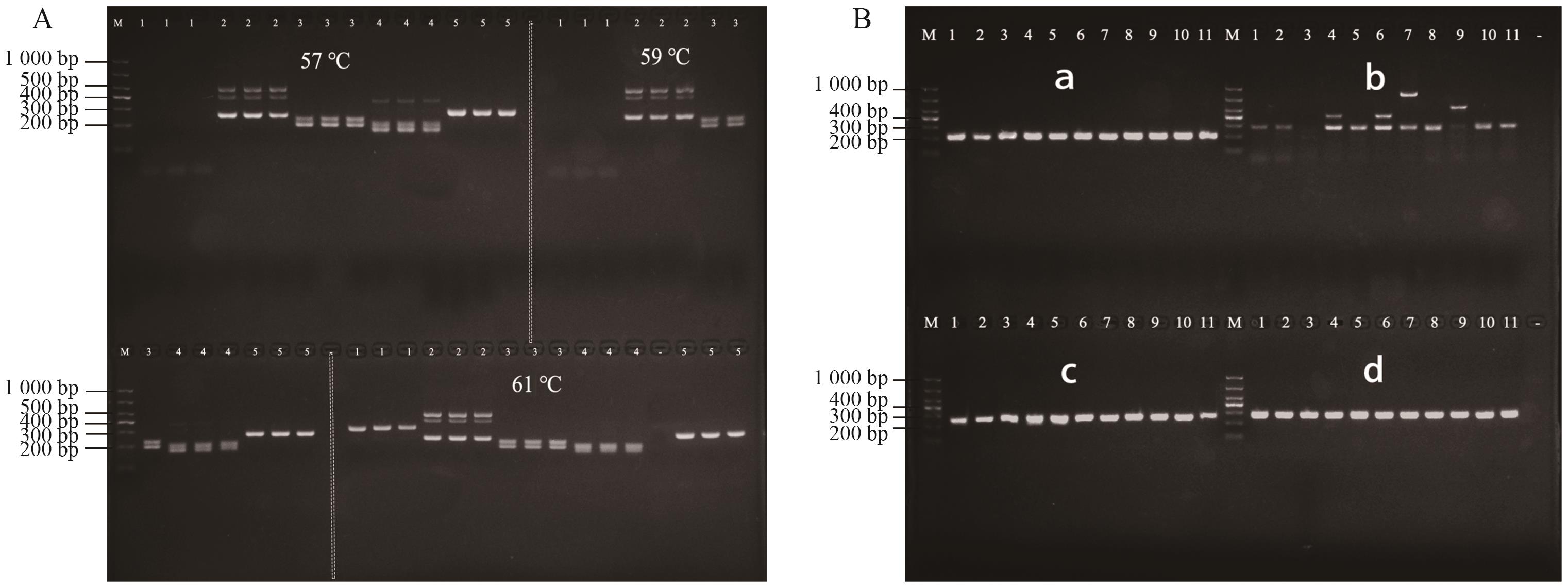
Fig. 1 Effectiveness screening and specificity detection of a subset of primersA: Primer validity screening (1‒5: Different primer pairs, each with three replicates). B: Primer specificity detection (1‒11: Eleven tested samples; a‒d represent 4 pairs of distinct primers). M: Marker
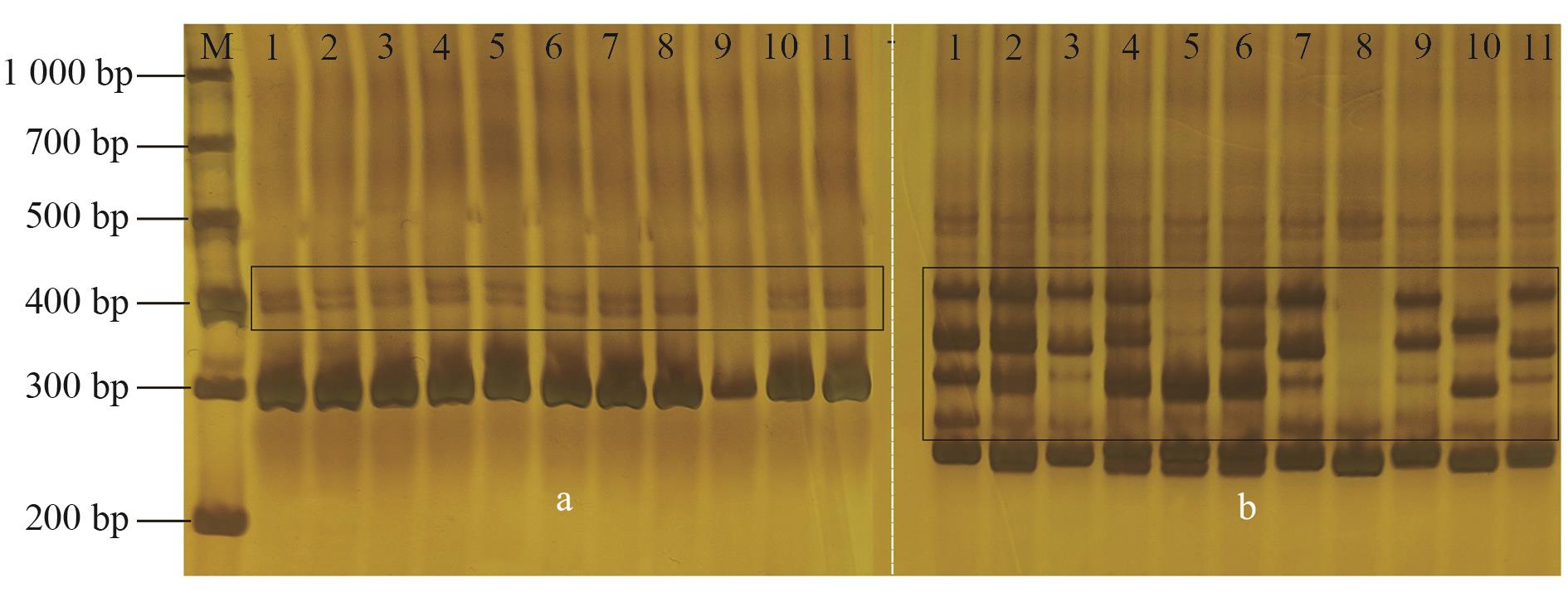
Fig. 2 Detection of potential polymorphism in partial primersM: Marker. a‒b: Represent different primers. 1‒11: 11 test samples
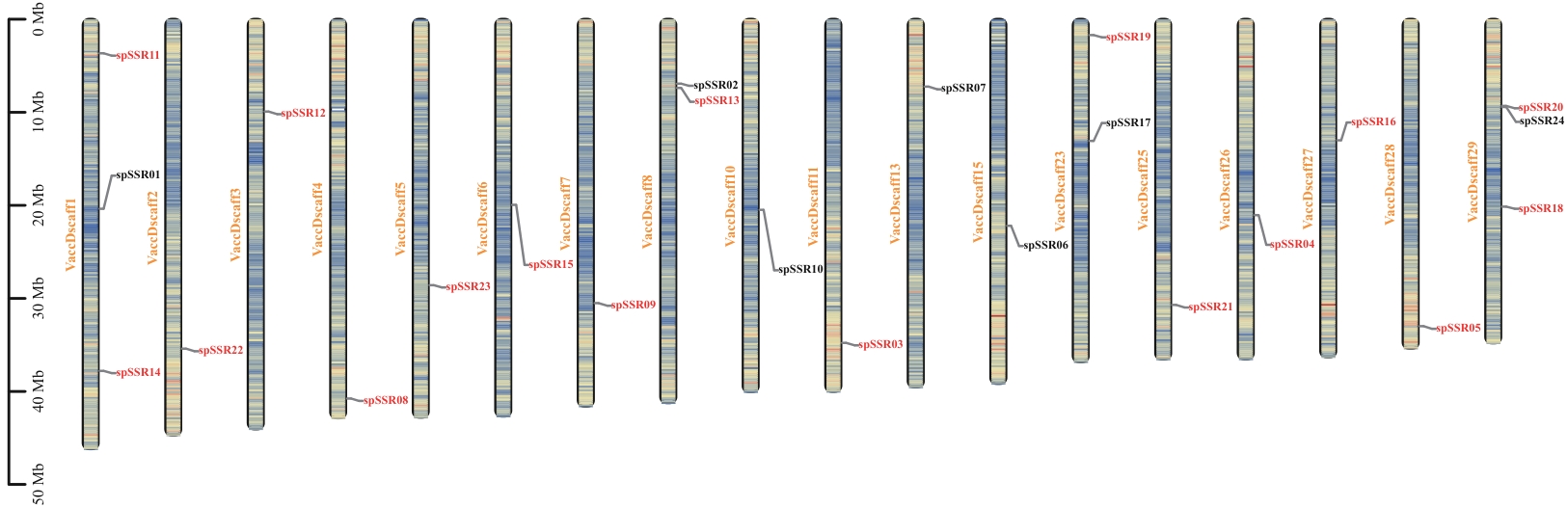
Fig. 3 Chromosomal distribution of 24 putatively polymorphic SSR markersRed: 17 pairs of polymorphic primers
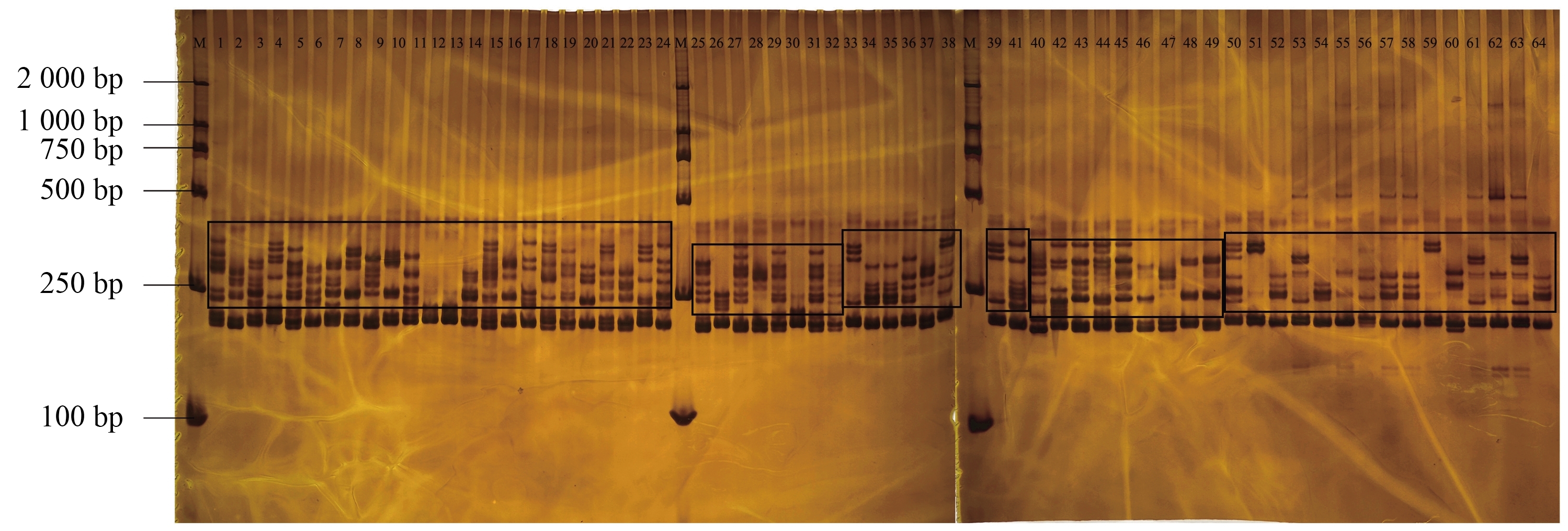
Fig. 4 Polymorphism of primer spSSR16 in 64 blueberry germplasm resources
名称 Name | 正向引物序列 Forward primer sequences (5′‒3′) | 反向引物序列 Reverse primer sequence (5′‒3′) | 退火温度 Tm (℃) | 预期产物 Expected size (bp) | 荧光类型 Fluorescent types |
|---|---|---|---|---|---|
| spSSR03 | CTGTGTCGACCTCTCCAACG | TGAGATCGGTGGCTTTCTCG | 57 | 242 | FAM |
| spSSR04 | CTTGGCGATCTCCTCCTTCC | TCAAGGAACAACAGGCCTCC | 55 | 320 | HEX |
| spSSR05 | GCTTCCGGTACCTCTCTTCG | TCATCCCGCACAAGAGTTCC | 57 | 283 | HEX |
| spSSR08 | ATCTGAAGTCTCCAACGGCG | GCTAACCCGAGTCTGGTTCC | 55 | 262 | HEX |
| spSSR09 | TGTGGCTGGAGATGTTGACG | CAAAATGCGATTCCTCCTCCC | 57 | 236 | FAM |
| spSSR11 | AAAGGGGACAAGCAACTCCC | CACCACTTCCGGGATAGTGC | 57 | 252 | FAM |
| spSSR12 | ACGACGTGAGAAACCACTCC | CTATCCCTCAACCGCGATGG | 57 | 262 | HEX |
| spSSR13 | GAGAGAGAGCCAGTCCTTGC | ACGACGAACCAGACGAAACC | 57 | 194 | FAM |
| spSSR14 | ACGACGAACCAGACGAAACC | GAGAGAGAGCCAGTCCTTGC | 59 | 209 | FAM |
| spSSR15 | TGAACCAGACGAAACCCACC | GAGAGAGAGCCAGTCCTTGC | 59 | 178 | FAM |
| spSSR16 | CAAGTCGACAACATGCTCCG | TTTACAAGCACATACGCGCG | 59 | 218 | FAM |
| spSSR18 | CTTGGCGATCTCCTCCTTCC | TCAAGGAACAACAGGCCTCC | 59 | 332 | HEX |
| spSSR19 | TTCCAAAACCACCAAACGCC | AGAGCAATGTGGTAGCCAGG | 55 | 326 | HEX |
| spSSR20 | GGCTTACAGCTCCTCCATGG | GGTGATGAGAGAGAGCCAGG | 59 | 175 | FAM |
| spSSR21 | CTATCCCTCAACCGCGATGG | ACGACGTGAGAAACCACTCC | 59 | 268 | HEX |
| spSSR22 | TGTGCATCCAAACCTTGAGC | TGTGGTGGTGGTTATGGAGG | 59 | 238 | FAM |
| spSSR23 | GAGGCGGTAGTACATGTGGG | CTCTCAACTCCCCTTCAGCC | 57 | 340 | HEX |
Table 4 Information of 17 polymorphic SSR primer pairs
名称 Name | 正向引物序列 Forward primer sequences (5′‒3′) | 反向引物序列 Reverse primer sequence (5′‒3′) | 退火温度 Tm (℃) | 预期产物 Expected size (bp) | 荧光类型 Fluorescent types |
|---|---|---|---|---|---|
| spSSR03 | CTGTGTCGACCTCTCCAACG | TGAGATCGGTGGCTTTCTCG | 57 | 242 | FAM |
| spSSR04 | CTTGGCGATCTCCTCCTTCC | TCAAGGAACAACAGGCCTCC | 55 | 320 | HEX |
| spSSR05 | GCTTCCGGTACCTCTCTTCG | TCATCCCGCACAAGAGTTCC | 57 | 283 | HEX |
| spSSR08 | ATCTGAAGTCTCCAACGGCG | GCTAACCCGAGTCTGGTTCC | 55 | 262 | HEX |
| spSSR09 | TGTGGCTGGAGATGTTGACG | CAAAATGCGATTCCTCCTCCC | 57 | 236 | FAM |
| spSSR11 | AAAGGGGACAAGCAACTCCC | CACCACTTCCGGGATAGTGC | 57 | 252 | FAM |
| spSSR12 | ACGACGTGAGAAACCACTCC | CTATCCCTCAACCGCGATGG | 57 | 262 | HEX |
| spSSR13 | GAGAGAGAGCCAGTCCTTGC | ACGACGAACCAGACGAAACC | 57 | 194 | FAM |
| spSSR14 | ACGACGAACCAGACGAAACC | GAGAGAGAGCCAGTCCTTGC | 59 | 209 | FAM |
| spSSR15 | TGAACCAGACGAAACCCACC | GAGAGAGAGCCAGTCCTTGC | 59 | 178 | FAM |
| spSSR16 | CAAGTCGACAACATGCTCCG | TTTACAAGCACATACGCGCG | 59 | 218 | FAM |
| spSSR18 | CTTGGCGATCTCCTCCTTCC | TCAAGGAACAACAGGCCTCC | 59 | 332 | HEX |
| spSSR19 | TTCCAAAACCACCAAACGCC | AGAGCAATGTGGTAGCCAGG | 55 | 326 | HEX |
| spSSR20 | GGCTTACAGCTCCTCCATGG | GGTGATGAGAGAGAGCCAGG | 59 | 175 | FAM |
| spSSR21 | CTATCCCTCAACCGCGATGG | ACGACGTGAGAAACCACTCC | 59 | 268 | HEX |
| spSSR22 | TGTGCATCCAAACCTTGAGC | TGTGGTGGTGGTTATGGAGG | 59 | 238 | FAM |
| spSSR23 | GAGGCGGTAGTACATGTGGG | CTCTCAACTCCCCTTCAGCC | 57 | 340 | HEX |
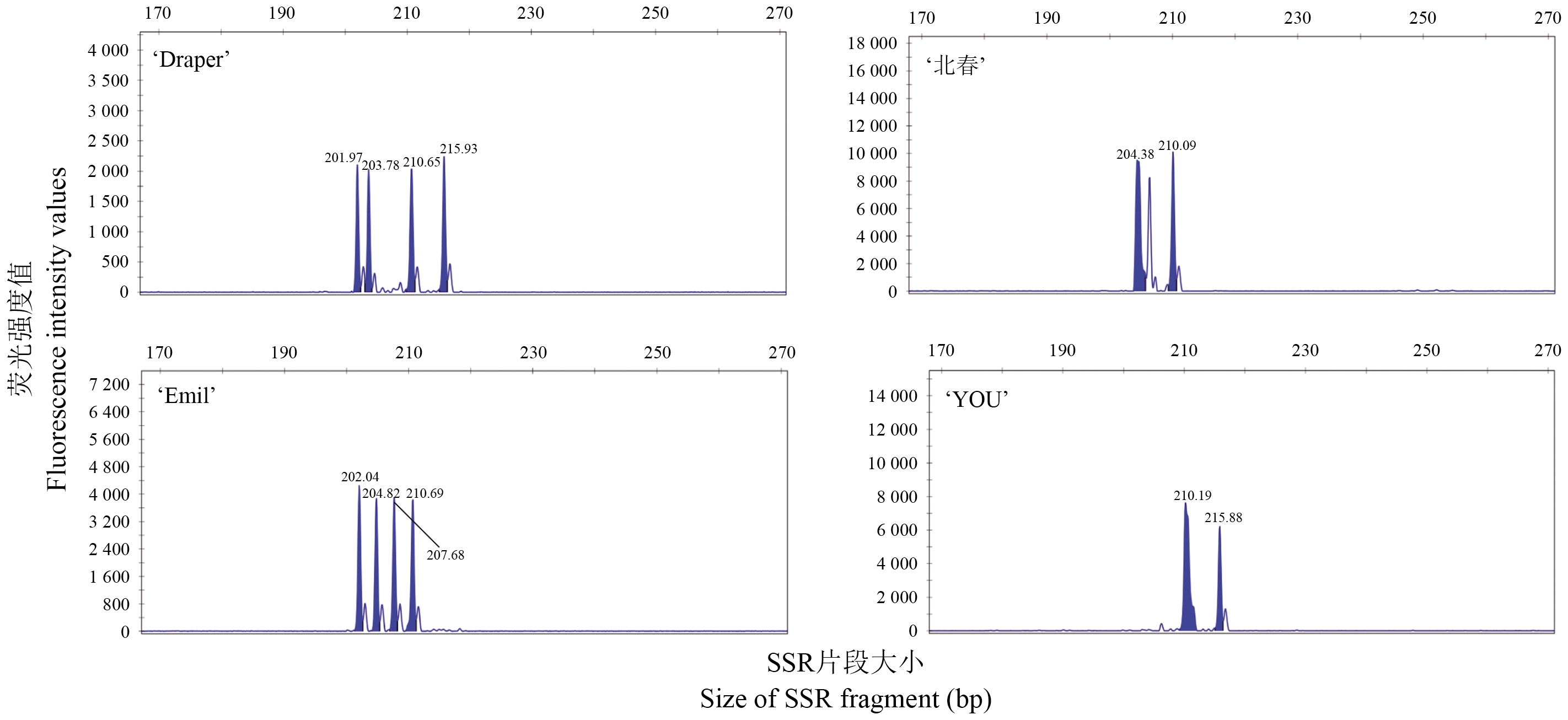
Fig. 5 Capillary electrophoresis profile of spSSR16 in four blueberry germplasm resources
| 名称 Name | 等位基因数Na | 有效等位基因数Ne | Shannon’s信息指数I | 观测杂合度Ho | 期望杂合度He | 无偏期望杂合度uHe | 多态性信息量PIC |
|---|---|---|---|---|---|---|---|
| spSSR03 | 6 | 3.626 | 1.405 | 0.714 | 0.724 | 0.730 | 0.983 |
| spSSR04 | 16 | 10.431 | 2.520 | 0.750 | 0.904 | 0.911 | 0.990 |
| spSSR05 | 5 | 2.602 | 1.083 | 0.500 | 0.616 | 0.623 | 0.978 |
| spSSR08 | 9 | 4.958 | 1.786 | 0.583 | 0.798 | 0.807 | 0.986 |
| spSSR09 | 9 | 3.292 | 1.475 | 1.000 | 0.696 | 0.702 | 0.973 |
| spSSR11 | 10 | 4.698 | 1.789 | 1.000 | 0.787 | 0.794 | 0.982 |
| spSSR12 | 9 | 4.898 | 1.735 | 1.000 | 0.796 | 0.803 | 0.984 |
| spSSR13 | 17 | 5.737 | 2.154 | 1.000 | 0.826 | 0.832 | 0.988 |
| spSSR14 | 15 | 7.008 | 2.188 | 1.000 | 0.857 | 0.864 | 0.990 |
| spSSR15 | 19 | 10.139 | 2.558 | 0.800 | 0.901 | 0.908 | 0.990 |
| spSSR16 | 14 | 9.806 | 2.383 | 0.667 | 0.898 | 0.905 | 0.989 |
| spSSR18 | 16 | 10.711 | 2.542 | 0.200 | 0.907 | 0.914 | 0.990 |
| spSSR19 | 13 | 6.122 | 2.099 | 1.000 | 0.837 | 0.844 | 0.985 |
| spSSR20 | 13 | 5.306 | 1.993 | 1.000 | 0.812 | 0.818 | 0.980 |
| spSSR21 | 11 | 3.924 | 1.631 | 1.000 | 0.745 | 0.751 | 0.981 |
| spSSR22 | 10 | 5.760 | 1.913 | 1.000 | 0.826 | 0.833 | 0.983 |
| spSSR23 | 12 | 5.796 | 1.992 | 1.000 | 0.827 | 0.834 | 0.983 |
| 平均Mean | 12 | 6.165 | 1.956 | 0.836 | 0.809 | 0.816 | 0.985 |
Table 5 Genetic diversity of 17 SSR primer pairs in 64 blueberry germplasms
| 名称 Name | 等位基因数Na | 有效等位基因数Ne | Shannon’s信息指数I | 观测杂合度Ho | 期望杂合度He | 无偏期望杂合度uHe | 多态性信息量PIC |
|---|---|---|---|---|---|---|---|
| spSSR03 | 6 | 3.626 | 1.405 | 0.714 | 0.724 | 0.730 | 0.983 |
| spSSR04 | 16 | 10.431 | 2.520 | 0.750 | 0.904 | 0.911 | 0.990 |
| spSSR05 | 5 | 2.602 | 1.083 | 0.500 | 0.616 | 0.623 | 0.978 |
| spSSR08 | 9 | 4.958 | 1.786 | 0.583 | 0.798 | 0.807 | 0.986 |
| spSSR09 | 9 | 3.292 | 1.475 | 1.000 | 0.696 | 0.702 | 0.973 |
| spSSR11 | 10 | 4.698 | 1.789 | 1.000 | 0.787 | 0.794 | 0.982 |
| spSSR12 | 9 | 4.898 | 1.735 | 1.000 | 0.796 | 0.803 | 0.984 |
| spSSR13 | 17 | 5.737 | 2.154 | 1.000 | 0.826 | 0.832 | 0.988 |
| spSSR14 | 15 | 7.008 | 2.188 | 1.000 | 0.857 | 0.864 | 0.990 |
| spSSR15 | 19 | 10.139 | 2.558 | 0.800 | 0.901 | 0.908 | 0.990 |
| spSSR16 | 14 | 9.806 | 2.383 | 0.667 | 0.898 | 0.905 | 0.989 |
| spSSR18 | 16 | 10.711 | 2.542 | 0.200 | 0.907 | 0.914 | 0.990 |
| spSSR19 | 13 | 6.122 | 2.099 | 1.000 | 0.837 | 0.844 | 0.985 |
| spSSR20 | 13 | 5.306 | 1.993 | 1.000 | 0.812 | 0.818 | 0.980 |
| spSSR21 | 11 | 3.924 | 1.631 | 1.000 | 0.745 | 0.751 | 0.981 |
| spSSR22 | 10 | 5.760 | 1.913 | 1.000 | 0.826 | 0.833 | 0.983 |
| spSSR23 | 12 | 5.796 | 1.992 | 1.000 | 0.827 | 0.834 | 0.983 |
| 平均Mean | 12 | 6.165 | 1.956 | 0.836 | 0.809 | 0.816 | 0.985 |
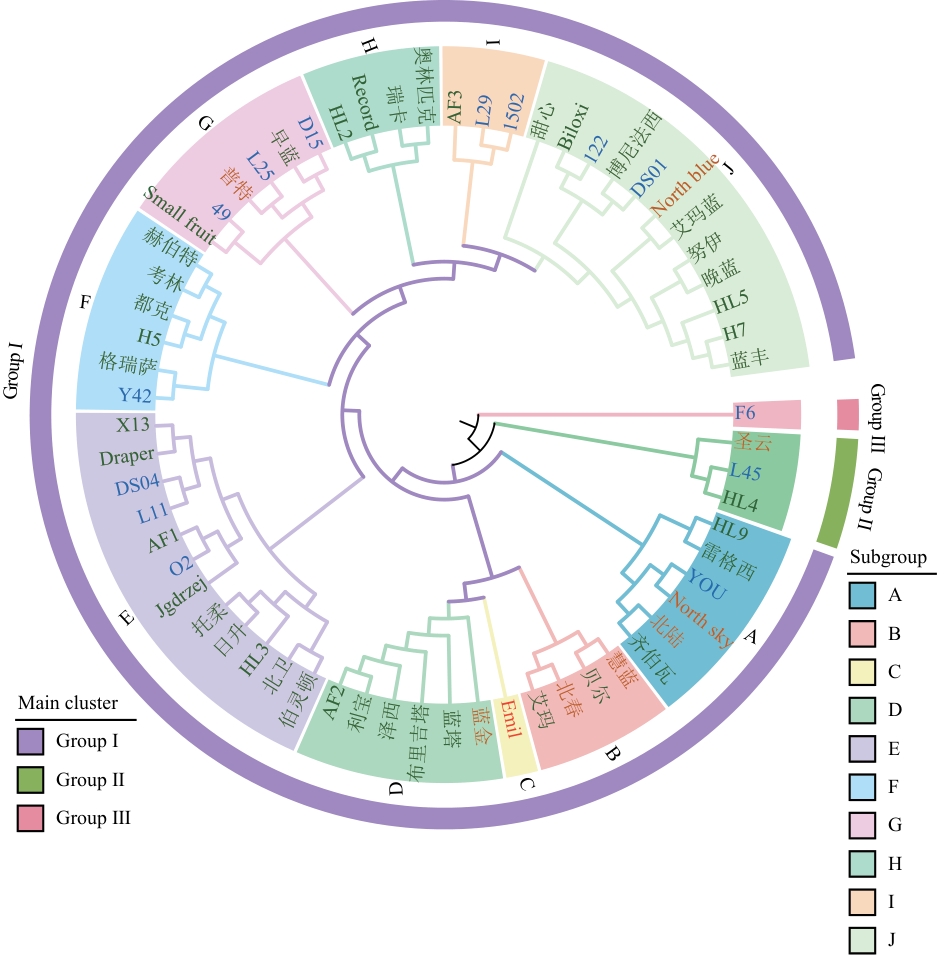
Fig. 6 UPGMA cluster diagram of 64 blueberry germplasm resourcesGreen text: Northern highbush blueberry group. Blue text: Southern highbush blueberry group. Brown text: Half-highbush blueberry group. Red text: Lowbush blueberry group
| [1] | Duan YM, Tarafdar A, Chaurasia D, et al. Blueberry fruit valorization and valuable constituents: a review [J]. Int J Food Microbiol, 2022, 381: 109890. |
| [2] | Jin ZW, Huang HZ, Huang HH, et al. The delayed senescence in harvested blueberry by hydrogen-based irrigation is functionally linked to metabolic reprogramming and antioxidant machinery [J]. Food Chem, 2024, 453: 139563. |
| [3] | Yu YY, Xu JD, Huang TX, et al. Combination of beneficial bacteria improves blueberry production and soil quality [J]. Food Sci Nutr, 2020, 8(11): 5776-5784. |
| [4] | 李亚东, 刘成, 魏鑫, 等. 2024年中国蓝莓产业发展报告 [J]. 吉林农业大学学报, 2025, 47(1): 1-14. |
| Li YD, Liu C, Wei X, et al. Development report of 2024 China blueberry industry [J]. J Jilin Agric Univ, 2025, 47(1): 1-14. | |
| [5] | 雷艳珍. 杂交种授权亲本品种权保护问题研究‒‒兼评新《植物新品种保护条例》第7条第3款第3项 [J]. 法治研究, 2025(6): 131-142. |
| Lei YZ. Research on the protection of parental variety rights for hybrid varieties [J]. Res Rule Law, 2025(6): 131-142. | |
| [6] | Cipriani G, Marrazzo M, Di Gaspero G, et al. A set of microsatellite markers with long core repeat optimized for grape (Vitis spp.) genotyping [J]. BMC Plant Biol, 2008, 8(1): 127. |
| [7] | Daudi H, Shimelis H, Mathew I, et al. Genetic diversity and population structure of groundnut (Arachis hypogaea L.) accessions using phenotypic traits and SSR markers: implications for rust resistance breeding [J]. Genet Resour Crop Evol, 2021, 68(2): 581-604. |
| [8] | Baruca Arbeiter A, Hladnik M, Jakše J, et al. First set of microsatellite markers for immortelle (Helichrysum italicum (Roth) G. Don): a step towards the selection of the most promising genotypes for cultivation [J]. Ind Crops Prod, 2021, 162: 113298. |
| [9] | Boutsika A, Sarrou E, Cook CM, et al. Evaluation of parsley (Petroselinum crispum) germplasm diversity from the Greek Gene Bank using morphological, molecular and metabolic markers [J]. Ind Crops Prod, 2021, 170: 113767. |
| [10] | Savadi S, Muralidhara BM, Venkataravanappa V, et al. De novo transcriptome assembly and its utility in development and characterization of the first set of genic SSR markers in cashew [J]. Ind Crops Prod, 2022, 189: 115734. |
| [11] | 岳林清, 吴怡超, 何星星, 等. 李资源果实主要性状的SSR标记关联分析及指纹图谱构建 [J]. 园艺学报, 2024, 51(11): 2495-2509. |
| Yue LQ, Wu YC, He XX, et al. SSR marker association analysis and fingerprint construction of main traits of plum fruit [J]. Acta Hortic Sin, 2024, 51(11): 2495-2509. | |
| [12] | 牛锐敏, 黄小晶, 沈甜, 等. 基于SSR标记的葡萄种质指纹图谱构建和遗传多样性分析 [J]. 种子, 2025, 44(4): 106-114. |
| Niu RM, Huang XJ, Shen T, et al. Fingerprints construction and genetic diversity analysis of Vitis vinifera germplasm resources based on SSR markers [J]. Seed, 2025, 44(4): 106-114. | |
| [13] | 闫锦源, 郑斌, 王松标, 等. 基于荧光SSR标记的杧果控制授粉实生后代父本鉴定 [J]. 果树学报, 2025, 42(6): 1190-1199. |
| Yan JY, Zheng B, Wang SB, et al. Paternal identification of mango controlled-pollination seedling proge-nies based on fluorescent SSR markers [J]. J Fruit Sci, 2025, 42(6): 1190-1199. | |
| [14] | 董清华, 王西成, 赵密珍, 等. 草莓EST-SSR标记开发及在品种遗传多样性分析中的应用 [J]. 中国农业科学, 2011, 44(17): 3603-3612. |
| Dong QH, Wang XC, Zhao MZ, et al. Development of EST-derived SSR markers and their application in strawberry genetic diversity analysis [J]. Sci Agric Sin, 2011, 44(17): 3603-3612. | |
| [15] | 王静, 赵密珍, 于红梅, 等. 草莓EST-SSR标记的开发与应用 [J]. 果树学报, 2011, 28(4): 721-726. |
| Wang J, Zhao MZ, Yu HM, et al. Development and utilization of EST-SSR marker in strawberry [J]. J Fruit Sci, 2011, 28(4): 721-726. | |
| [16] | Song YP, Jiang XB, Zhang M, et al. Differences of EST-SSR and genomic-SSR markers in assessing genetic diversity in poplar [J]. For Stud China, 2012, 14(1): 106. |
| [17] | 苗立祥, 杨肖芳, 张豫超, 等. 基于草莓全基因组SSR标记的开发和应用 [J]. 分子植物育种, 2021, 19(4): 1210-1222. |
| Miao LX, Yang XF, Zhang YC, et al. Development of genome-wide SSR marker and application in strawberry [J]. Mol Plant Breed, 2021, 19(4): 1210-1222. | |
| [18] | 刘嘉艺, 岳俊阳, 刘永胜. 基于毛花猕猴桃基因组的性别相关SSR分子标记的开发 [J]. 合肥工业大学学报: 自然科学版, 2022, 45(8): 1135-1138, 1146. |
| Liu JY, Yue JY, Liu YS. Development of sex-related SSR molecular markers based on the genome of Actinidia eriantha [J]. J Hefei Univ Technol Nat Sci, 2022, 45(8): 1135-1138, 1146. | |
| [19] | Liu YC, Liu S, Liu DC, et al. Exploiting EST databases for the development and characterization of EST-SSR markers in blueberry (Vaccinium) and their cross-species transferability in Vaccinium spp [J]. Sci Hortic, 2014, 176: 319-329. |
| [20] | 王利平, 沈颖, 陈荣锋, 等. 蓝莓基因组SSR分子标记开发 [J]. 浙江农业科学, 2023, 64(6): 1503-1506. |
| Wang LP, Shen Y, Chen RF, et al. Development of SSR molecular markers of blueberry genome [J]. J Zhejiang Agric Sci, 2023, 64(6): 1503-1506. | |
| [21] | Zeng T, He ZJ, He JF, et al. The telomere-to-telomere gap-free reference genome of wild blueberry (Vaccinium duclouxii) provides its high soluble sugar and anthocyanin accumulation [J]. Hortic Res, 2023, 10(11): uhad209. |
| [22] | Wang ZJ, Zhang WC, Zhou YY, et al. Genetic and epigenetic signatures for improved breeding of cultivated blueberry [J]. Hortic Res, 2024, 11(7): uhae138. |
| [23] | Gill K, Negi S, Kumar P, et al. Improved genomic DNA extraction from citrus species using a modified CTAB method[J]. Mol Biol Rep, 2025, 52(1): 638. |
| [24] | Du LM, Zhang C, Liu Q, et al. Krait: An ultrafast tool for genome-wide survey of microsatellites and primer design [J]. Bioinformatics, 2018, 34(4): 681-683. |
| [25] | 樊文强, 盖红梅, 孙鑫, 等. SSR数据格式转换软件DataFormater [J]. 分子植物育种, 2016, 14(1): 265-270. |
| Fan WQ, Gai HM, Sun X, et al. DataFormater, a software for SSR data formatting to develop population genetics analysis [J]. Mol Plant Breed, 2016, 14(1): 265-270. | |
| [26] | Zhao MQ, Shu GP, Hu YH, et al. Pattern and variation in simple sequence repeat (SSR) at different genomic regions and its implications to maize evolution and breeding [J]. BMC Genom, 2023, 24: 136. |
| [27] | 孙海悦, 郭瑞雪, 徐鉴, 等. 越橘属植物EST-SSR分子标记开发及遗传多样性分析 [J]. 植物生理学报, 2018, 54(3): 429-440. |
| Sun HY, Guo RX, Xu J, et al. Development of EST-SSR molecular markers for Vaccinium and genetic diversity analysis [J]. Plant Physiol J, 2018, 54(3): 429-440. | |
| [28] | 范佳妮, 蒋丽娟, 李培旺, 等. 无患子全基因组SSR标记开发及遗传多样性分析[J]. 分子植物育种, 2025. . |
| Fan JN, Jiang LJ, Li PW, et al. Development of SSR markers and genetic diversity analysis of Sapindus saponaria genome [J]. Mol Plant Breed, 2025. . | |
| [29] | 朱跃, 张敏, 张成, 等. 桂花全基因组SSR特征分析与引物开发 [J]. 南京林业大学学报: 自然科学版, 2025, 49(5): 174-182. |
| Zhu Y, Zhang M, Zhang C, et al. Genome wide SSR analysis and primer development of Osmanthus fragrans [J]. J Nanjing For Univ Nat Sci Ed, 2025, 49(5): 174-182. | |
| [30] | 张咏琦, 王超, 许林林, 等. 野生二倍体草莓的SSR分子标记开发及核心种质的构建 [J]. 园艺学报, 2023, 50(11): 2365-2375. |
| Zhang YQ, Wang C, Xu LL, et al. Development of SSR molecular markers and construction of core collection of wild diploid strawberry [J]. Acta Hortic Sin, 2023, 50(11): 2365-2375. | |
| [31] | Zhang CC, Lin P, Yao XH, et al. Genome-wide development of genomic SSR markers, polymorphism analysis, and dosage-aware SSR fingerprinting in hexaploid Camellia Oleifera [J]. BMC Plant Biol, 2025, 25: 1627. |
| [32] | 蒋爽, 张学英, 安海山, 等. 枇杷全基因组SSR标记开发及其多态性研究 [J]. 园艺学报, 2021, 48(5): 1013-1022. |
| Jiang S, Zhang XY, An HS, et al. Development and analysis of polymorphism of SSR markers in the whole genome of loquat [J]. Acta Hortic Sin, 2021, 48(5): 1013-1022. | |
| [33] | 郭瑞雪. 越橘EST-SSR分子标记的开发及遗传多样性分析 [D]. 长春: 吉林农业大学, 2014. |
| Guo RX. Development of EST-derived SSR markers and genetic diversity analysis in Vaccinium [D]. Changchun: Jilin Agricultural University, 2014. | |
| [34] | 方茜, 张园园, 杨钰婷, 等. 越橘叶片转录组SSR发掘及其多态性研究 [J]. 园艺学报, 2018, 45(7): 1359-1370. |
| Fang Q, Zhang YY, Yang YT, et al. SSR mining and polymorphism analysis in leaf transcriptome of blueberry [J]. Acta Hortic Sin, 2018, 45(7): 1359-1370. | |
| [35] | 俞新华, 李超, 哈雪姣, 等. 西瓜品种SSR指纹库构建及应用 [J]. 蔬菜, 2025(12): 37-46. |
| Yu XH, Li C, Ha XJ, et al. Construction and application of SSR fingerprint database for watermelon varieties [J]. Vegetables, 2025(12): 37-46. | |
| [36] | 吴仕蔓, 娄兵海, 陈传武, 等. 应用SSR荧光标记法构建22个柚类品种的分子身份证 [J]. 果树学报, 2023, 40(4): 605-614. |
| Wu SM, Lou BH, Chen CW, et al. Establishment of molecular identity of 22 pomelo varieties using fluores-cent labeled SSR markers [J]. J Fruit Sci, 2023, 40(4): 605-614. | |
| [37] | 崔建民, 刘红霞, 邹荣仟, 等. 越橘种质资源遗传多样性和亲缘关系研究 [J]. 果树学报, 2010, 27(3): 373-378. |
| Cui JM, Liu HX, Zou RQ, et al. Study on genetic diversity and phylogenetic relationship of germplasm resources about Vaccinium spp [J]. J Fruit Sci, 2010, 27(3): 373-378. | |
| [38] | 郭照东, 夏秀英, 安利佳, 等. 基于SSR标记的越橘亲缘关系分析及品种鉴定 [J]. 植物遗传资源学报, 2015, 16(5): 1020-1026. |
| Guo ZD, Xia XY, An LJ, et al. Genetic relationship analysis and cultivar identification of blueberry based on SSR markers [J]. J Plant Genet Resour, 2015, 16(5): 1020-1026. | |
| [39] | Haque MS, Saha NR, Islam MT, et al. Screening for drought tolerance in wheat genotypes by morphological and SSR markers [J]. J Crop Sci Biotechnol, 2021, 24(1): 27-39. |
| [40] | Tailor S, Bykova NV, Igamberdiev AU, et al. Structural pattern and genetic diversity in blueberry (Vaccinium) clones and cultivars using EST-PCR and microsatellite markers [J]. Genet Resour Crop Evol, 2017, 64(8): 2071-2082. |
| [1] | TAN Shu, SHEN Hong-jian, GAO Xiao-lei, YIN Qian, ZOU Feng. Genome-wide Identification of the MYB Transcription Factor Family in Camellia oleifera and Functional Analysis of CoMYB107 in Stamen Development [J]. Biotechnology Bulletin, 2026, 42(9): 196-209. |
| [2] | TUERXUN Di-li-bai-er, YAKUPU Zu-li-hu-ma-er, BAO Hui-fang, ZHAN Fa-qiang, YANG Rong, SHI Ying-wu, YANG Hong-mei, CHU Min, FANG Shi-jie, WANG Ning. Biological Function and Whole-genome Analysis of Actinobacteria Strain GNLJ-7 Isolated from Tomato Rhizosphere [J]. Biotechnology Bulletin, 2026, 42(8): 276-286. |
| [3] | GAO Guo-liang, ZHANG Qiao-ling, FENG Wen-jie, GAO Fa-rui, GAO Bo, ZONG Ke-dong, GE Lin, LI Shang-xian, WANG Qiu-yun, HUANG Xin-cheng. Whole-genome Analysis and Precision Breeding Strategies for a Novel Japonica Rice Variety Jiru Dao 1 [J]. Biotechnology Bulletin, 2026, 42(8): 106-112. |
| [4] | GAO Fei, ZHANG Yu-xi, MU Di, CHEN Zheng, CHEN Hong-yan. Isolation, Identification, and Whole-genome Sequencing Analysis of Murine-Derived Limosilactobacillus reuteri [J]. Biotechnology Bulletin, 2026, 42(7): 315-327. |
| [5] | GUO Jia-xin, WANG Meng-xia, MA Yao-wu, ZHANG Qi-yu, ZHANG Zhen-yu, LIU Hai-tao, PEI Jiu-bo, JIANG Ying. Screening, Identification, and Whole-genome Analysis of a Cadmium-tolerant Plant Growth-promoting Bacterium [J]. Biotechnology Bulletin, 2026, 42(7): 257-268. |
| [6] | JIANG Jing, LYU Shi-peng, CHEN Hao-lin, XIONG Ting, SUN Xiao-yan, LI Jie, CHEN Can-can, WANG Gao-fu, REN Hang-xing. Genome-Wide Association Analysis of Litter Size Trait in Four Goat Breeds in Southwest China [J]. Biotechnology Bulletin, 2026, 42(7): 341-350. |
| [7] | DING Hong-xia, GAO Gui-wen, HUANG Yu-lan, ZHAO Rui, HUANG Yi-bo, FENG He-xin, LONG Sha. Whole-genome Analysis and Functional Verification of a Phosphate-solubilizing Bacterium Isolated from Traditional Chinese Medicine Residues [J]. Biotechnology Bulletin, 2026, 42(7): 304-314. |
| [8] | YANG Dong-sheng, NIU Yu-chi, LU Qian-qian, FAN Jing-yong, LIU Yu-lei, LIU Quan, GUO Li-ping, HAO Shui-yuan. Construction and Analysis of SSR Fingerprint for 29Sorghum sudanense Germplasm Materials [J]. Biotechnology Bulletin, 2026, 42(6): 198-207. |
| [9] | LIU Jia-huan, CAO De-fa, YU Wen-yao, DENG Hong-hong, TAN Lun-dong, GUO Hai, HUANG Guang-hui, WANG Jun, WANG Xun, WANG Zhi-hui. Xenia Effects in Late-maturing Citrus and Identification Using SCoT Molecular Markers [J]. Biotechnology Bulletin, 2026, 42(6): 227-236. |
| [10] | WEI Li-na, JIANG Jing-long, DENG Xi-xi, LI Yan, LI Li, DENG Jia-rui, DING De-kuan. Genetic Diversity Analysis of Citri Fructus Germplasm Resources Based on Phenotypic Traits and SSR Markers [J]. Biotechnology Bulletin, 2026, 42(4): 202-215. |
| [11] | SU Xiao-mei, LIU Shu-mei, LYU Hong-jun, YANG Zong-hui, HOU Li-xia. Development and Application of Insertion-deletion (InDel) Markers in Tomato Based on Whole-genome Re-sequencing Data [J]. Biotechnology Bulletin, 2026, 42(10): 27-36. |
| [12] | LYU Zhen, GAN Tian, HUO Si-yu, ZHAO Chen-di, ZHAO Meng-yao, LI Ya-tao, MA Yu-chao, GENG Yu-qing. Identification of Surfactin-producing Bacillus Velezensis C5A-1 and Evaluation of the Plant Growth-promoting Effects of Its Surfactin [J]. Biotechnology Bulletin, 2025, 41(9): 265-276. |
| [13] | LU Yao, YUAN Ping-ping, JIN Xin, MAO Xiang-hong, FAN Xiang-bin, BAI Xiao-dong. Genetic Diversity Analysis and Fingerprinting of Wild Potato and Landraces Based on SSR Markers [J]. Biotechnology Bulletin, 2025, 41(9): 94-104. |
| [14] | PEI Hong-xia, WANG Lu-yao, LI Sheng-mei, GAO Jing-xia. Genetic Diversity of 220 Pepper Germplasm Resources Using SCoT, SRAP, and SSR Molecular Markers [J]. Biotechnology Bulletin, 2025, 41(8): 165-174. |
| [15] | DUAN Min-jie, LI Yi-fei, WANG Chun-ping, HUANG Ren-zhong, HUANG Qi-zhong, ZHANG Shi-cai. Association Analysis and Fingerprint Map Construction of Fruit Color Traits in Pepper via SSR Markers [J]. Biotechnology Bulletin, 2025, 41(7): 81-94. |
| Viewed | ||||||
|
Full text |
|
|||||
|
Abstract |
|
|||||
