







Biotechnology Bulletin ›› 2025, Vol. 41 ›› Issue (1): 252-262.doi: 10.13560/j.cnki.biotech.bull.1985.2024-0564
Previous Articles Next Articles
LIU Ke-han1( ), YANG Sheng-hui2, HUANG Qiao-yun3(), CUI Wen-jing4()
Received:2024-06-13
Online:2025-01-26
Published:2025-01-22
Contact:
HUANG Qiao-yun, CUI Wen-jing
E-mail:liukehan@sinochem.com;qyhuang@mail.hzau.edu.cn;wjcui@agreenbio.com
LIU Ke-han, YANG Sheng-hui, HUANG Qiao-yun, CUI Wen-jing. Isolation and Application of Soybean Rhizobia and Symbiosis-promoting Rhizobacteria from Heilongjiang Province[J]. Biotechnology Bulletin, 2025, 41(1): 252-262.
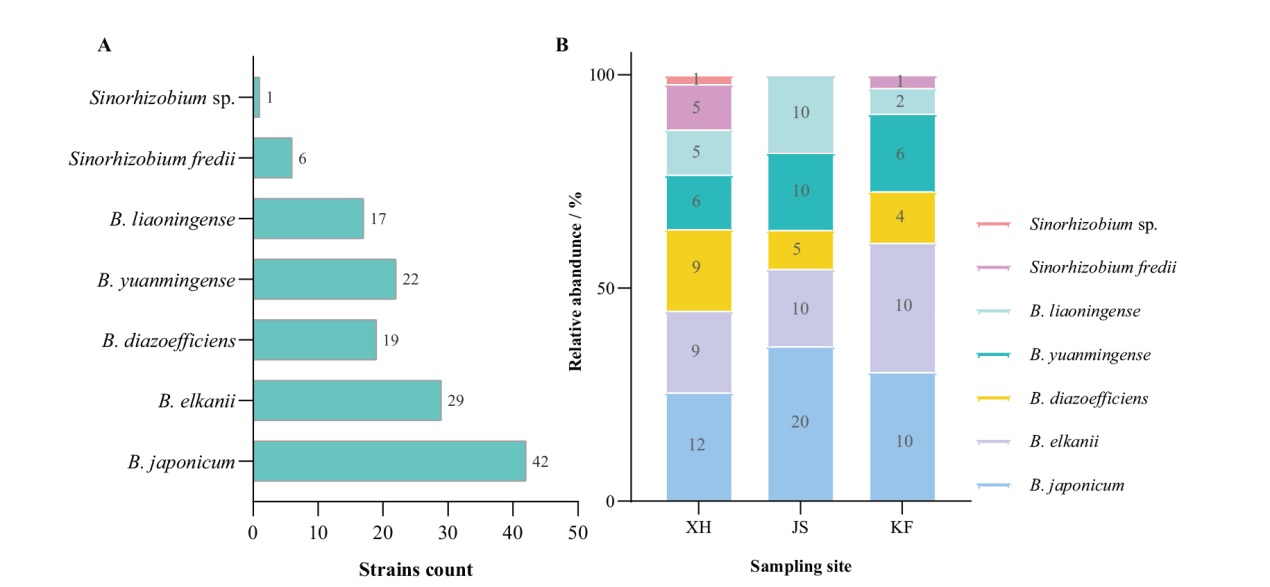
Fig. 1 Species number and relative abundance of isolated soybean-nodulating rhizobia A: Statistics of the species number of isolated soybean-nodulating rhizobia, the number in the Figure indicate the number of a strain. B: The relative abundance of isolates in different sampling sites
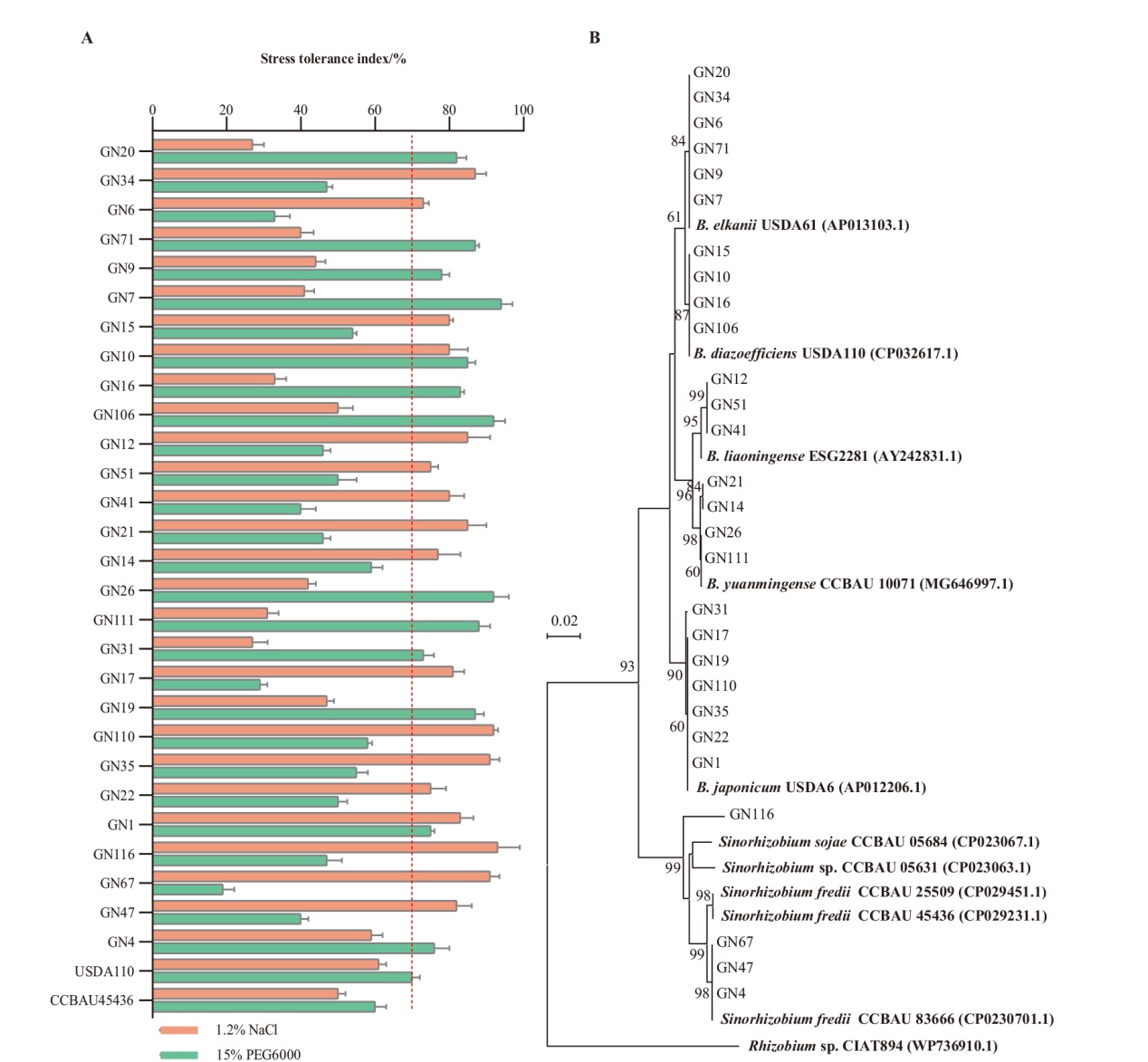
Fig. 2 Tolerances of isolated rhizobia strains to salt and drought and its rpoB phylogenetic tree A: Tolerances of isolated strains to simulated salt and drought. The index threshold(70%)of tolerance to stress is indicated by red dotted line. B: Phylogenetic tree was constructed based on rpoB genes of different rhizobia, totally 39 rpoB sequences((28 candidates, 11 reference strains).)by Mega X maximum likelihood software. Bootstrap values above 60% are shown at the branch points. Accession numbers of the reference sequences from GenBank are given in brackets. GN is the abbreviation of Green Nitrogen
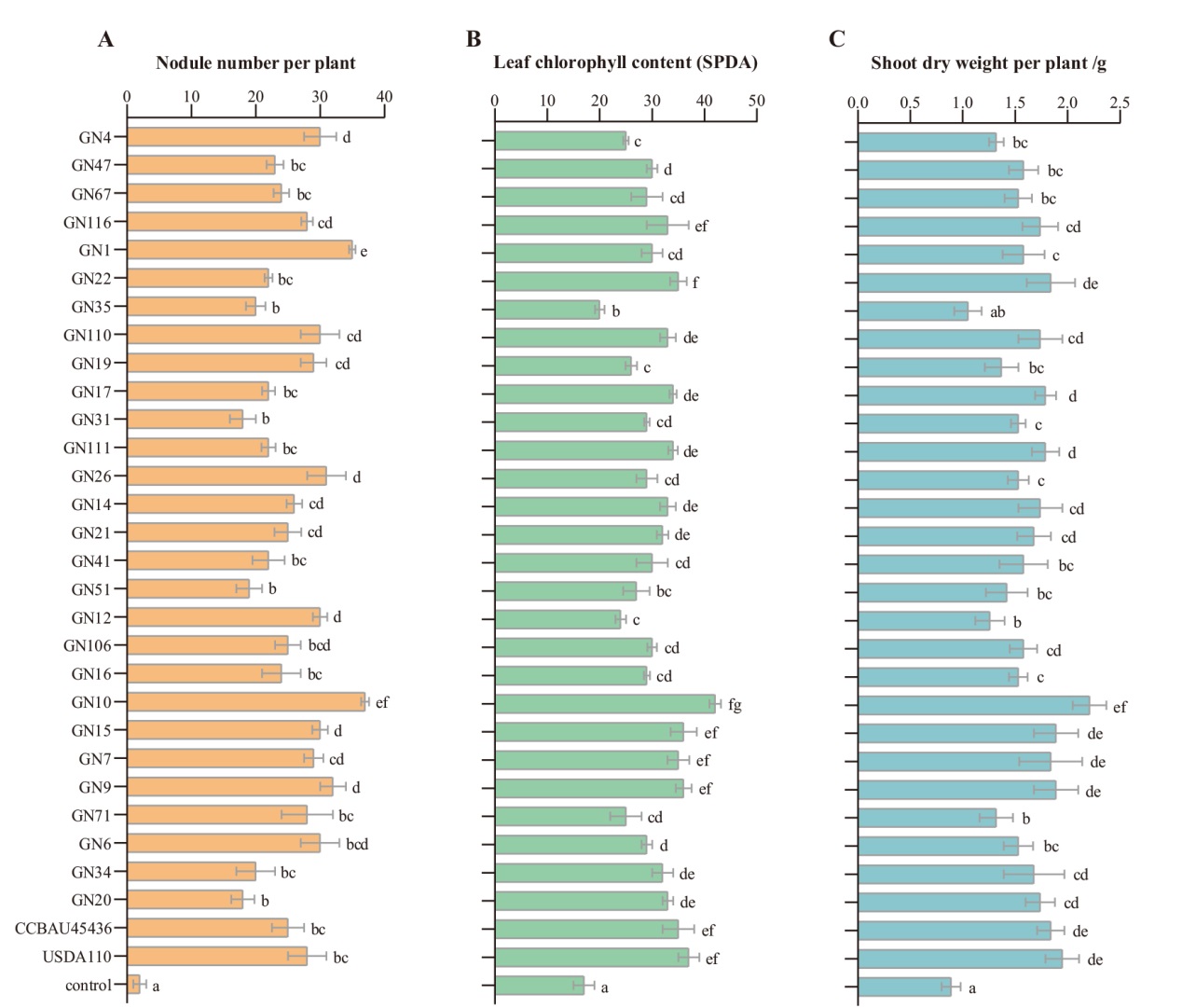
Fig. 3 Screening of highly efficient symbiotic rhizobial strains Nodule number(A), leaf chlorophyll content(B), shoot dry weight(C)are measured to evaluate the effects of the symbiotic performance of individual rhizobia on soybean. Error bars are for SD. Significant differences among means are indicated by different letters based on ANOVA followed by Tukey's test(α = 0.05)

Fig. 4 Disease-resistant and growth-promoting rhizobacteria and its phylogenetic tree of 16S rDNA A: Six bacillus strains antagonizing soybean root rot pathogen and producing IAA test. Fusarium oxysporum was a selected soybean root rot pathogen, IAA production was measured by color intensity. B: Construction of phylogenetic tree based on 16S rRNA genes of different Bacillus strains. Maximum likelihood phylogenetic trees of 25(6 candidates, 19 reference strains)16S rDNA sequences was constructed by Mega X maximum likelihood software
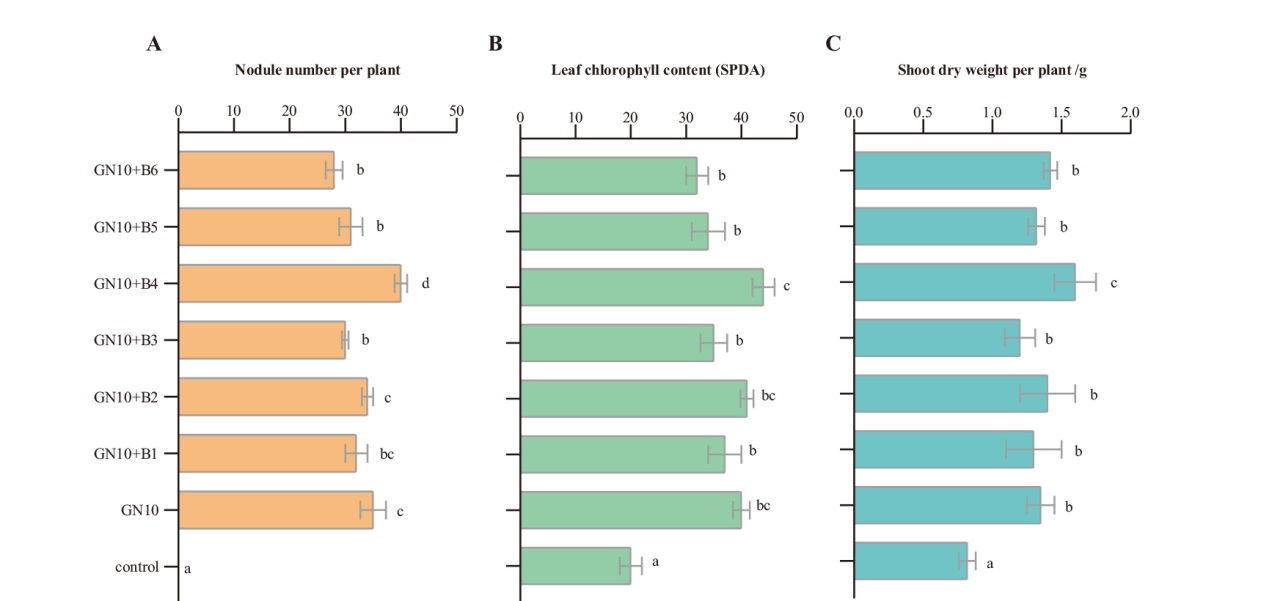
Fig. 5 Performance of co-inoculation of symbiosis-promoting rhizobacteria and soybean-nodulating rhizobia Nodule number(A), leaf chlorophyll content(B)and shoot dry weight(C)were measured to evaluate the effect of the symbiotic performance of individual rhizobia on soybean. Error bars are for SD. Significant differences among means are indicated by different letters based on ANOVA followed by Tukey's test(α = 0.05)
| [1] | Martin FM, Uroz S, Barker DG. Ancestral alliances: Plant mutualistic symbioses with fungi and bacteria[J]. Science, 2017, 356(6340): eaad4501. |
| [2] |
Poole P, Ramachandran V, Terpolilli J. Rhizobia: from saprophytes to endosymbionts[J]. Nat Rev Microbiol, 2018, 16(5): 291-303.
doi: 10.1038/nrmicro.2017.171 pmid: 29379215 |
| [3] | 王亚君, 于寒松, 舒坤良. 中国大豆产业发展特点、趋势及对策[J]. 社会科学战线, 2024(4): 253-258. |
| Wang YJ, Yu HS, Shu KL. Characteristics, trends, and countermeasures of the development of China's soybean industry[J]. Soc Sci FRONT, 2024(4): 253-258. | |
| [4] | Wu YS, Wang EL, Gong WZ, et al. Soybean yield variations and the potential of intercropping to increase production in China[J]. Field Crops Res, 2023, 291: 108771. |
| [5] | 朱梓菲, 刘鑫磊, 薛永国, 等. 黑龙江省大豆生产现状与发展建议[J]. 中国种业, 2020(8): 18-23. |
| Zhu ZF, Liu XL, Xue YG, et al. Current status and development suggestions of soybean production in Heilongjiang province[J]. China Seed Ind, 2020(8): 18-23. | |
| [6] | 伍惠, 钟喆栋, 王学路, 等. 与黑龙江大豆主栽品种匹配的优良根瘤菌筛选与鉴定[J]. 应用与环境生物学报, 2018, 24(1): 39-46. |
| Wu H, Zhong ZD, Wang XL, et al. Screening and identification of elite rhizobia matched with main cultivars of soybean in Heilongjiang Province[J]. Chin J Appl Environ Biol, 2018, 24(1): 39-46. | |
| [7] |
Tian CF, Zhou YJ, Zhang YM, et al. Comparative genomics of rhizobia nodulating soybean suggests extensive recruitment of lineage-specific genes in adaptations[J]. Proc Natl Acad Sci USA, 2012, 109(22): 8629-8634.
doi: 10.1073/pnas.1120436109 pmid: 22586130 |
| [8] | 王卫卫, 关大伟, 马鸣超, 等. 东北地区大豆根瘤菌遗传多样性与系统发育研究[J]. 大豆科学, 2013, 32(4): 433-437. |
| Wang WW, Guan DW, Ma MC, et al. Genetic diversity and phylogeny of soybean rhizobia isolated from Northeast China[J]. Soybean Sci, 2013, 32(4): 433-437. | |
| [9] |
王晓丽, 秦杰, 王敏, 等. 山西大豆根瘤菌的分离、鉴定及共生匹配性筛选[J]. 生物技术通报, 2022, 38(3): 59-68.
doi: 10.13560/j.cnki.biotech.bull.1985.2021-1315 |
| Wang XL, Qin J, Wang M, et al. Isolation, identification and symbiotic matching of soybean rhizobia from Shanxi Province[J]. Biotechnol Bull, 2022, 38(3): 59-68. | |
| [10] | 李彦连, 王传雷, 徐保民, 等. 徐豆24大豆根瘤菌共生匹配性筛选及应用[J]. 大豆科学, 2020, 39(4): 612-620. |
| Li YL, Wang CL, Xu BM, et al. Screening and application of suitable symbiotic combination between rhizobia and soybean cultivar xudou 24[J]. Soybean Sci, 2020, 39(4): 612-620. | |
| [11] | 秦杰, 高振峰, 岳爱琴, 等. 一株晋大53号大豆中慢生根瘤菌的分离鉴定及抗逆分析[J]. 大豆科学, 2020, 39(6): 898-905. |
| Qin J, Gao ZF, Yue AQ, et al. Isolation, identification and stress resistance analysis of A Mesorhizobium isolated from soybean variety jinda 53[J]. Soybean Sci, 2020, 39(6): 898-905. | |
| [12] | 吴萍, 何庆元, 李正鹏, 等. 皖北地区大豆根瘤菌优良抗逆性菌株的筛选[J]. 安徽科技学院学报, 2012, 26(2): 15-22. |
| Wu P, He QY, Li ZP, et al. Screening of Rhizobium from soybean in North Anhui for strong resistance to stresses[J]. J Anhui Sci Technol Univ, 2012, 26(2): 15-22. | |
| [13] | 张大安. 黑龙江省土地盐碱化形成原因及治理措施[J]. 科技创业家, 2014(1): 188. |
| Zhang DA. Causes and management measures of land salinization in Heilongjiang province[J]. Technol Pioneers, 2014(1): 188. | |
| [14] | 赵杨, 赵心清. 生物对逆境环境的适应和抗逆分子育种[J]. 生物技术通报, 2023, 39(11): 1-5. |
| Zhao Y, Zhao XQ. How organisms adapt to stressful environments and molecular breeding of stress tolerance[J]. Biotechnol Bull, 2023, 39(11): 1-5. | |
| [15] | Fox SL, O’Hara GW, Bräu L. Enhanced nodulation and symbiotic effectiveness of Medicago truncatula when co-inoculated with Pseudomonas fluorescens WSM3457 and Ensifer(Sinorhizobium)medicae WSM419[J]. Plant Soil, 2011, 348(1): 245-254. |
| [16] |
Chen WF, Wang ET, Ji ZJ, et al. Recent development and new insight of diversification and symbiosis specificity of legume rhizobia: mechanism and application[J]. J Appl Microbiol, 2021, 131(2): 553-563.
doi: 10.1111/jam.14960 pmid: 33300250 |
| [17] | Younesi O, Baghbani A, Namdari A. The effects of Pseudomonas fluorescence and Rhizobium meliloti co-inoculation on nodulation and mineral nutrient contents in alfalfa Medicago sativa under salinity stress[J]. Int J Agri Crop Sci, 2013, 5(14), 1500-1507. |
| [18] | Alemneh AA, Zhou Y, Ryder MH, et al. Mechanisms in plant growth-promoting rhizobacteria that enhance legume-rhizobial symbioses[J]. J Appl Microbiol, 2020, 129(5): 1133-1156. |
| [19] | Wang ET, Tian CF, Chen WF, et al. Ecology and Evolution of Rhizobia: Principles and Applications[M]. S pringer Nature:2019. |
| [20] | Ali S, Hameed S, Shahid M, et al. Functional characterization of potential PGPR exhibiting broad-spectrum antifungal activity[J]. Microbiol Res, 2020, 232: 126389. |
| [21] | 曹轶, 崔文靖, 马瑞强. 大豆根瘤菌定向微生态研究与应用[J]. 中国农业科技导报, 2024, 26(4): 215-224. |
| Cao Y, Cui WJ, Ma RQ. Research and application of directed micro-ecology in soybean-nodulating rhizobia[J]. J Agric Sci Technol, 2024, 26(4): 215-224. | |
| [22] | 田艺心, 高凤菊, 曹鹏鹏, 等. 减氮接种根瘤菌剂对黄淮海地区高蛋白夏大豆生长发育产量和经济效益的影响[J]. 河北农业科学, 2022, 26(6): 72-77, 82. |
| Tian YX, Gao FJ, Cao PP, et al. Effects of nitrogen reducing and inoculation with Rhizobium agents on the growth, yield and economic benefit of high protein summer soybean in Huang-Huai-Hai Region[J]. J Hebei Agric Sci, 2022, 26(6): 72-77, 82. | |
| [23] | 乔李锦, 姚莉, 徐冲, 等. 皖豫高效抗逆大豆根瘤菌Y2-4的选育[J]. 大豆科学, 2024, 43(1): 45-53. |
| Qiao LJ, Yao L, Xu C, et al. Screening of highly efficient and stress-tolerant soybean Rhizobium Y2-4 used in Anhui and Henan Provinces[J]. Soybean Sci, 2024, 43(1): 45-53. | |
| [24] |
邹兰, 王茜, 李慕仪, 等. 乌头内生细菌JY-3-1R的鉴定及其生防和促生能力研究[J]. 生物技术通报, 2023, 39(10): 246-255.
doi: 10.13560/j.cnki.biotech.bull.1985.2023-0590 |
| Zou L, Wang Q, Li MY, et al. Identification, biocontrol and plant growth-promoting potential of endophytic bacterial strain JY-3-1R from Aconitum carmichaelii debx[J]. Biotechnol Bull, 2023, 39(10): 246-255. | |
| [25] | 裴晓峰, 关大伟, 李俊, 等. 耐旱大豆根瘤菌的筛选及其接种效应[J]. 大豆科学, 2012, 31(3): 420-424. |
| Pei XF, Guan DW, Li J, et al. Screening of drought-tolerance Rhizobium and its influence on soybean[J]. Soybean Sci, 2012, 31(3): 420-424. | |
| [26] | Cui WJ, Zhang BL, Zhao R, et al. Lineage-specific rewiring of core pathways predating innovation of legume nodules shapes symbiotic efficiency[J]. mSystems, 2021, 6(2): e01299-20. |
| [27] | 陈文新, 汪恩涛. 中国根瘤菌[M]. 北京: 科学出版社, 2011. |
| Chen WX, Wang ET. China rhizobia[M]. Beijing: Science Press, 2011. | |
| [28] | 张伟涛, 杨江科, 袁天英, 等. 我国南北大豆产区慢生大豆根瘤菌的遗传多样性和系统发育研究[J]. 微生物学报, 2006, 46(1): 127-131. |
| Zhang WT, Yang JK, Yuan TY, et al. Genetic diversity and phylogeny of soybean bradyrhizobia isolated from south and north region of China[J]. Acta Microbiol Sin, 2006, 46(1): 127-131. | |
| [29] | Yan J, Chen WF, Han XZ, et al. Genetic diversity of indigenous soybean-nodulating rhizobia in response to locally-based long term fertilization in a Mollisol of Northeast China[J]. World J Microbiol Biotechnol, 2016, 33(1): 6. |
| [30] | 山仑. 我国旱地农业发展中的几个问题[J]. 干旱地区农业研究, 2023, 41(3): 2-4. |
| Shan L. Issues in dryland agricultural research in China[J]. Agric Res Arid Areas, 2023, 41(3): 2-4. | |
| [31] | 陆宝金, 田生昌, 左忠, 等. 盐渍化土地可持续利用研究综述及展望[J]. 宁夏大学学报: 自然科学版, 2023, 44(1): 79-88. |
| Lu BJ, Tian SC, Zuo Z, et al. Review and prospect on sustainable utilization of salinized land[J]. J Ningxia Univ Nat Sci Ed, 2023, 44(1): 79-88. | |
| [32] |
代重阳, 孙继鑫, 王聪. 不同耐盐性菜用大豆与大豆根瘤菌的共生匹配性研究[J]. 北方农业学报, 2019, 47(6): 90-95.
doi: 10.3969/j.issn.2096-1197.2019.06.16 |
| Dai CY, Sun JX, Wang C. Symbiotic matching between soybean Rhizobium and vegetable soybean with different salt tolerance[J]. J North Agric, 2019, 47(6): 90-95. | |
| [33] | 王庆玲, 霍雪雪, 张豪, 等. 黄河口盐碱地大豆根瘤菌分离鉴定及田间应用[J]. 山东农业科学, 2023, 55(6): 143-151. |
| Wang QL, Huo XX, Zhang H, et al. Isolation, identification and field application of soybean rhizobia in saline-alkali land of the Yellow River Delta[J]. Shandong Agric Sci, 2023, 55(6): 143-151. | |
| [34] | Kibido T, Kunert K, Makgopa M, et al. Improvement of Rhizobium-soybean symbiosis and nitrogen fixation under drought[J]. Food Energy Secur, 2020, 9(1): e177. |
| [35] | Yuan K, Reckling M, Ramirez MDA, et al. Characterization of rhizobia for the improvement of soybean cultivation at cold conditions in central Europe[J]. Microbes Environ, 2020, 35(1): ME19124. |
| [36] | 朱治佳, 袁明, 韩冬伟. 浅析黑龙江省大豆根腐病研究现状[J]. 大豆科技, 2024(2): 29-34. |
| Zhu ZJ, Yuan M, Han DW. Analysis on the current research status of soybean root rot in Heilongjiang province[J]. Soybean Sci Technol, 2024(2): 29-34. | |
| [37] | 陈爽, 王继华, 张必弦, 等. 贝莱斯芽孢杆菌对大豆根腐病盆栽防效及防御酶活性检测[J]. 分子植物育种, 2022, 20(19): 6492-6500. |
| Chen S, Wang JH, Zhang BX, et al. Control effect of Bacillus ve-lezensis on soybean root rot in pot and detection of defensive enzyme activity[J]. Molecular Plant Breeding, 2022, 20(19): 6492-6500. | |
| [38] | 余水, 丁海霞, 罗玉英, 等. 贝莱斯芽孢杆菌MT310生防机制初探[J]. 山地农业生物学报, 2020, 39(5): 23-28. |
| Yu S, Ding HX, Luo YY, et al. Primary research on bio-control mechanism of Bacillus velezensis MT310[J]. J Mt Agric Biol, 2020, 39(5): 23-28. | |
| [39] | 方园, 彭勇政, 廖长贵, 等. 一株具有防病促生功能的贝莱斯芽孢杆菌SF327[J]. 微生物学报, 2022, 62(10): 4071-4088. |
| Fang Y, Peng YZ, Liao CG, et al. Bacillus velezensis SF327, a potential biocontrol agent with the functions of preventing plant diseases and promoting plant growth[J]. Acta Microbiol Sin, 2022, 62(10): 4071-4088. | |
| [40] | Sibponkrung S, Kondo T, Tanaka K, et al. Co-inoculation of Bacillus velezensis strain S141 and Bradyrhizobium strains promotes nodule growth and nitrogen fixation[J]. Microorganisms, 2020, 8(5): 678. |
| [41] | Adedayo AA, Babalola OO. Genomic mechanisms of plant growth-promoting bacteria in the production of leguminous crops[J]. Front Genet, 2023, 14: 1276003. |
| [42] | Wang TQ, Chen QQ, Liang Q, et al. Bacillus suppresses nitrogen efficiency of soybean-Rhizobium symbiosis through regulation of nitrogen-related transcriptional and microbial patterns[J]. Plant Cell Environ, 2024. DOI: 10.1111/pce.1502. |
| [43] | 徐杰飞, 郭泰, 王世通, 等. 大豆根腐病发病原因及防治措施[J]. 大豆科技, 2022(6): 20-23. |
| Xu JF, Guo T, Wang ST, et al. Causes and control measures of soybean root rot[J]. Soybean Sci Technol, 2022(6): 20-23. |
| [1] | HAN Zhong-rao, HUO Yi-xin, GUO Shu-yuan. Mechanism and Industrial Application of Bacillus Tolerance to Stress Conditions [J]. Biotechnology Bulletin, 2024, 40(8): 24-38. |
| [2] | SUN Ya-nan, WANG Chun-xue, WANG Xin, DU Bing-hai, LIU Kai, WANG Cheng-qiang. Biocontrol Characteristics of Bacillus atrophaeus CNY01 and Its Salt-resistant and Growth-promoting Effect on Maize Seedling [J]. Biotechnology Bulletin, 2024, 40(5): 248-260. |
| [3] | LI Xi, BIAN Zi-jun, NING Zhou-shen, LIU Hong-yu, ZENG Bing, DONG Wei. Studies on the Growth-promoting Effect of Bacillus Strain from Rhizosphere in Ionic Rare Earth Ores [J]. Biotechnology Bulletin, 2024, 40(11): 259-268. |
| [4] | CHANG Lu-yin, WANG Zhong-hua, LI Feng-min, GAO Zi-yuan, ZHANG Hui-hong, WANG Yi, LI Fang, HAN Yan-lai, JIANG Ying. Screening Multi-functional Rhizobacteria from Maize Rhizosphere and Their Ehancing Effects on Winter Wheat-Summer Maize Rotation System [J]. Biotechnology Bulletin, 2024, 40(1): 231-242. |
| [5] | GAO Ya-hui, JIANG Ming-guo, FENG Jing, ZHOU Gui. Screening of Potential PGPR Strains Producting Growth-promoting Volatile Compounds and Study on Their Growth-promoting Characteristics [J]. Biotechnology Bulletin, 2022, 38(3): 103-112. |
| [6] | WANG Qi-yuan, WANG Jia-chen, YE Lei, JIANG Fan. Research Advances on Enhancement of Plant Resistance to Salinity Stress by Rhizobacteria Containing ACC Deaminase [J]. Biotechnology Bulletin, 2021, 37(2): 174-186. |
| [7] | FU Yan-song, LI Yu-cong, XU Zhi-hui, SHAO Jia-hui, LIU Yun-peng, XUAN Wei, ZHANG Rui-fu. Research Progressing in Signals and Molecular Mechanisms of Plant Growth-Promoting Rhizobacteria to Regulate Plant Root Development [J]. Biotechnology Bulletin, 2020, 36(9): 42-48. |
| [8] | PAN Jing, HUANG Cui-hua, PENG Fei, YOU Quan-gang, LIU Fei-yao, XUE Xian. Mechanisms of Salt Tolerance and Growth Promotion in Plant Induced by Plant Growth-Promoting Rhizobacteria [J]. Biotechnology Bulletin, 2020, 36(9): 75-87. |
| [9] | LIANG Ye, HE Chu-ting, YANG Yue, ZHANG Yu-fen, JIANG Fan. Effects of Inoculation of Rhizobacteria Containing ACC Deaminase on Soybean Growth Under Alkaline Stress [J]. Biotechnology Bulletin, 2020, 36(9): 100-108. |
| [10] | LEI Hai-ying, ZHAO Qing-song, YANG Xiao, WANG Mao-mao, BAI Jie, SUN Yong-qi, WANG Zhi-jun. Isolation of Efficient Nitrogen-fixing Bacteria from the Rhizosphere of Sophora flavescens and the Growth-promoting Effect of Compound Microbial Fertilizer on Seedlings [J]. Biotechnology Bulletin, 2020, 36(9): 157-166. |
| [11] | WAN Shui-xia, WANG Jing, LI Fan, JIANG Guang-yue, XU Wen-jing, LIU Zuo-jun. Screening and Identification of Phosphate Solubilizing Bacteria from Maize Rhizosphere Soil and Its Growth Promoting Effect [J]. Biotechnology Bulletin, 2020, 36(5): 98-103. |
| [12] | YANG Mo, GAO Ting, LI Yan-jing, WEI Chong-yao, GAO Miao, MA Lian-ju. Isolation and Screening of Plant Growth-promoting Rhizobacteria in Pepper and Their Disease-resistant Growth-promoting Characteristics [J]. Biotechnology Bulletin, 2020, 36(5): 104-109. |
| [13] | WAN Bing-bing, LIU Ye, WU Yue, ZHANG Dong-yan, WANG Guo-wen, JIANG Ying. Screening and Identification of Maize Growth-promoting Rhizobacteria and Its Promoting Effects on Maize [J]. Biotechnology Bulletin, 2016, 32(8): 169-176. |
| Viewed | ||||||
|
Full text |
|
|||||
|
Abstract |
|
|||||
