







Biotechnology Bulletin ›› 2026, Vol. 42 ›› Issue (5): 222-233.doi: 10.13560/j.cnki.biotech.bull.1985.2025-1451
YUE Yuan-yi1( ), HUANG Shi-xiong1, LIU Kun-ping2,3, FENG Shu-zhen1,2,3()
Received:2025-12-30
Online:2026-05-26
Published:2026-06-10
Contact:
FENG Shu-zhen
E-mail:15238616107@163.com;fengshuzhen@gxust.edu.cn
YUE Yuan-yi, HUANG Shi-xiong, LIU Kun-ping, FENG Shu-zhen. Effect of Organic-inorganic Combined Fertilization on Sulfur-cycling Microbial Communities in Karst Dryland Soils[J]. Biotechnology Bulletin, 2026, 42(5): 222-233.
| 项目 Item | CK | CF | 30% MF | 60% MF |
|---|---|---|---|---|
| pH | 6.72±0.02a | 7.16±0.11a | 6.64±0.01a | 6.93±0.04a |
| 有机碳SOC(g/kg) | 21.07±0.47a | 20.64±0.46a | 22.81±0.55a | 26.86±0.52b |
| 全氮TN(g/kg) | 2.02±0.04a | 2.03±0.07a | 2.18±0.02a | 2.54±0.04b |
| 全磷TP(g/kg) | 1.85±0.01a | 0.94±0.03b | 0.58±0.01c | 0.52±0.04c |
| 全钾TK(g/kg) | 3.10±0.02a | 2.92±0.07a | 3.10±0.07a | 3.18±0.05a |
| 全硫TS(g/kg) | 0.52±0.01c | 0.54±0.02bc | 0.62±0.03a | 0.60±0.01ab |
| 碱解氮AN(mg/kg) | 110.79±4.69a | 100.62±7.08a | 124.99±6.28ab | 134.69±2.81b |
| 速效磷AP(mg/kg) | 23.66±1.83b | 7.97±0.77c | 24.52±0.14a | 31.53±2.01b |
| 速效钾AK(mg/kg) | 302.63±9.36a | 60.80±0.69c | 265.83±2.64b | 310.85±4.65a |
| 有效硫AS(mg/kg) | 5.22±0.52c | 6.00±0.91bc | 9.91±1.31a | 8.87±0.53ab |
| 含水率SWC(%) | 3.902 ± 0.313a | 3.180 ± 0.083a | 3.208 ± 0.365a | 2.748 ± 0.074a |
Table 1 Soil physicochemical properties in karst dryland under organic-inorganic combined fertilization
| 项目 Item | CK | CF | 30% MF | 60% MF |
|---|---|---|---|---|
| pH | 6.72±0.02a | 7.16±0.11a | 6.64±0.01a | 6.93±0.04a |
| 有机碳SOC(g/kg) | 21.07±0.47a | 20.64±0.46a | 22.81±0.55a | 26.86±0.52b |
| 全氮TN(g/kg) | 2.02±0.04a | 2.03±0.07a | 2.18±0.02a | 2.54±0.04b |
| 全磷TP(g/kg) | 1.85±0.01a | 0.94±0.03b | 0.58±0.01c | 0.52±0.04c |
| 全钾TK(g/kg) | 3.10±0.02a | 2.92±0.07a | 3.10±0.07a | 3.18±0.05a |
| 全硫TS(g/kg) | 0.52±0.01c | 0.54±0.02bc | 0.62±0.03a | 0.60±0.01ab |
| 碱解氮AN(mg/kg) | 110.79±4.69a | 100.62±7.08a | 124.99±6.28ab | 134.69±2.81b |
| 速效磷AP(mg/kg) | 23.66±1.83b | 7.97±0.77c | 24.52±0.14a | 31.53±2.01b |
| 速效钾AK(mg/kg) | 302.63±9.36a | 60.80±0.69c | 265.83±2.64b | 310.85±4.65a |
| 有效硫AS(mg/kg) | 5.22±0.52c | 6.00±0.91bc | 9.91±1.31a | 8.87±0.53ab |
| 含水率SWC(%) | 3.902 ± 0.313a | 3.180 ± 0.083a | 3.208 ± 0.365a | 2.748 ± 0.074a |
处理 Treatment | 原始数据 Raw data | 清除后数据 Clean data | 比例 Percentage (%) | ||
|---|---|---|---|---|---|
原始序列条数 Raw reads | 原始总长度(碱基对) Raw total length (bp) | 清除后序列条数 Clean reads | 清除后总长度(碱基对) Clean total length (bp) | ||
| CK | 69 368 338 | 10 474 619 038 | 68 198 170 | 10 259 379 377 | 98.31 |
| 73 160 698 | 11 047 265 398 | 71 871 992 | 10 809 932 382 | 98.24 | |
| 71 108 096 | 10 737 322 496 | 70 004 272 | 10 530 770 856 | 98.45 | |
| 66 933 406 | 10 106 944 306 | 65 969 148 | 9 928 087 529 | 98.56 | |
| CF | 74 394 464 | 11 233 564 064 | 73 193 682 | 11 010 958 103 | 98.39 |
| 73 464 634 | 11 093 159 734 | 72 232 630 | 10 864 136 939 | 98.32 | |
| 72 022 608 | 10 875 413 808 | 70 890 576 | 10 656 228 389 | 98.43 | |
| 74 793 672 | 11 293 844 472 | 73 515 758 | 11 057 358 499 | 98.29 | |
| 30% MF | 73 751 614 | 11 136 493 714 | 72 530 788 | 10 908 722 230 | 98.34 |
| 71 971 366 | 10 867 676 266 | 70 829 750 | 10 655 528 925 | 98.41 | |
| 72 361 960 | 10 926 655 960 | 71 130 528 | 10 697 479 080 | 98.30 | |
| 78 549 904 | 11 861 035 504 | 77 175 014 | 11 608 945 637 | 98.25 | |
| 60% MF | 69 313 388 | 10 466 321 588 | 68 258 190 | 10 270 223 217 | 98.48 |
| 70 273 496 | 10 611 297 896 | 69 233 192 | 10 417 451 166 | 98.52 | |
| 70 990 218 | 10 719 522 918 | 69 927 030 | 10 521 520 756 | 98.50 | |
| 66 020 820 | 9 969 143 820 | 64 929 700 | 9 769 923 406 | 98.35 | |
Table 2 Statistics of soil genome DNA sequencing data under organic-inorganic combined fertilization
处理 Treatment | 原始数据 Raw data | 清除后数据 Clean data | 比例 Percentage (%) | ||
|---|---|---|---|---|---|
原始序列条数 Raw reads | 原始总长度(碱基对) Raw total length (bp) | 清除后序列条数 Clean reads | 清除后总长度(碱基对) Clean total length (bp) | ||
| CK | 69 368 338 | 10 474 619 038 | 68 198 170 | 10 259 379 377 | 98.31 |
| 73 160 698 | 11 047 265 398 | 71 871 992 | 10 809 932 382 | 98.24 | |
| 71 108 096 | 10 737 322 496 | 70 004 272 | 10 530 770 856 | 98.45 | |
| 66 933 406 | 10 106 944 306 | 65 969 148 | 9 928 087 529 | 98.56 | |
| CF | 74 394 464 | 11 233 564 064 | 73 193 682 | 11 010 958 103 | 98.39 |
| 73 464 634 | 11 093 159 734 | 72 232 630 | 10 864 136 939 | 98.32 | |
| 72 022 608 | 10 875 413 808 | 70 890 576 | 10 656 228 389 | 98.43 | |
| 74 793 672 | 11 293 844 472 | 73 515 758 | 11 057 358 499 | 98.29 | |
| 30% MF | 73 751 614 | 11 136 493 714 | 72 530 788 | 10 908 722 230 | 98.34 |
| 71 971 366 | 10 867 676 266 | 70 829 750 | 10 655 528 925 | 98.41 | |
| 72 361 960 | 10 926 655 960 | 71 130 528 | 10 697 479 080 | 98.30 | |
| 78 549 904 | 11 861 035 504 | 77 175 014 | 11 608 945 637 | 98.25 | |
| 60% MF | 69 313 388 | 10 466 321 588 | 68 258 190 | 10 270 223 217 | 98.48 |
| 70 273 496 | 10 611 297 896 | 69 233 192 | 10 417 451 166 | 98.52 | |
| 70 990 218 | 10 719 522 918 | 69 927 030 | 10 521 520 756 | 98.50 | |
| 66 020 820 | 9 969 143 820 | 64 929 700 | 9 769 923 406 | 98.35 | |
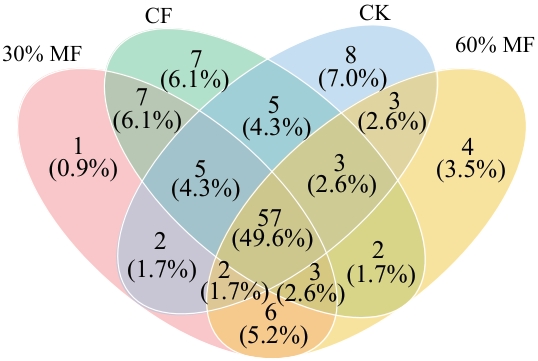
Fig. 1 OTUs of soil microbial community in karst dryland under organic-inorganic combined fertilization
门类 Phylum | OTU数量 Number of OTUs | 相对丰度 Relative abundance (%) |
|---|---|---|
| Pseudomonadota | 10 963 | 31.70 |
| Actinomycetota | 9 932 | 28.71 |
| Candidatus Rokubacteria | 38 39 | 11.10 |
| Acidobacteriota | 1 643 | 4.75 |
| Chloroflexota | 1 184 | 3.42 |
Table 3 Composition analysis of dominant phyla among common species in soils under four fertilization treatments
门类 Phylum | OTU数量 Number of OTUs | 相对丰度 Relative abundance (%) |
|---|---|---|
| Pseudomonadota | 10 963 | 31.70 |
| Actinomycetota | 9 932 | 28.71 |
| Candidatus Rokubacteria | 38 39 | 11.10 |
| Acidobacteriota | 1 643 | 4.75 |
| Chloroflexota | 1 184 | 3.42 |
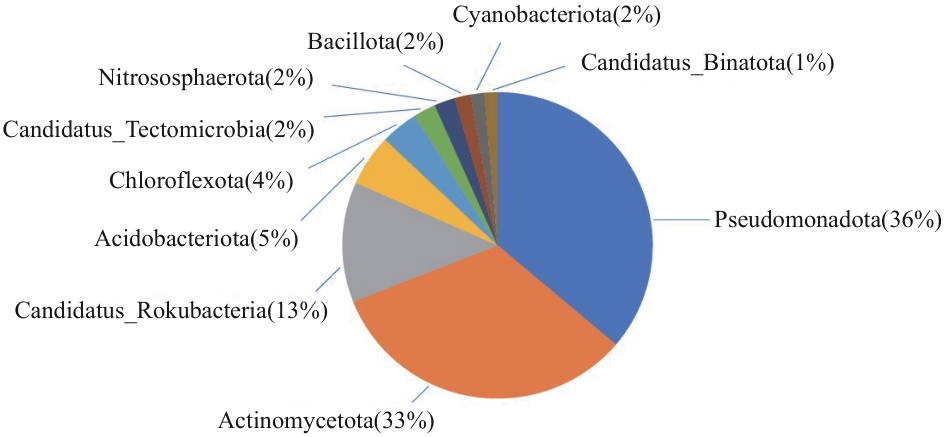
Fig. 2 Distribution of common microbial species between 30% MF and 60% MF treatments under organic-inorganic combined fertilization in karst dryland soils
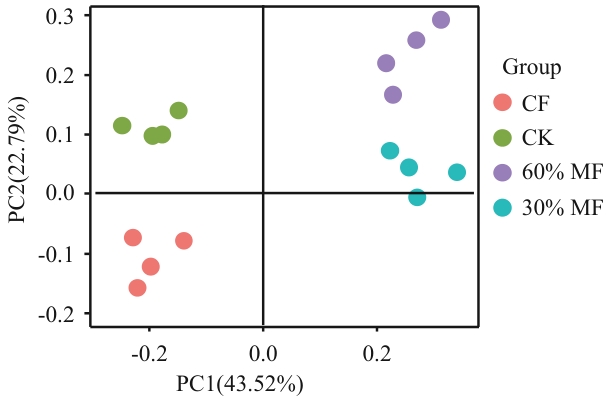
Fig. 3 PCA analysis of soil microbial communities in karst dryland soils under organic-inorganic fertilization
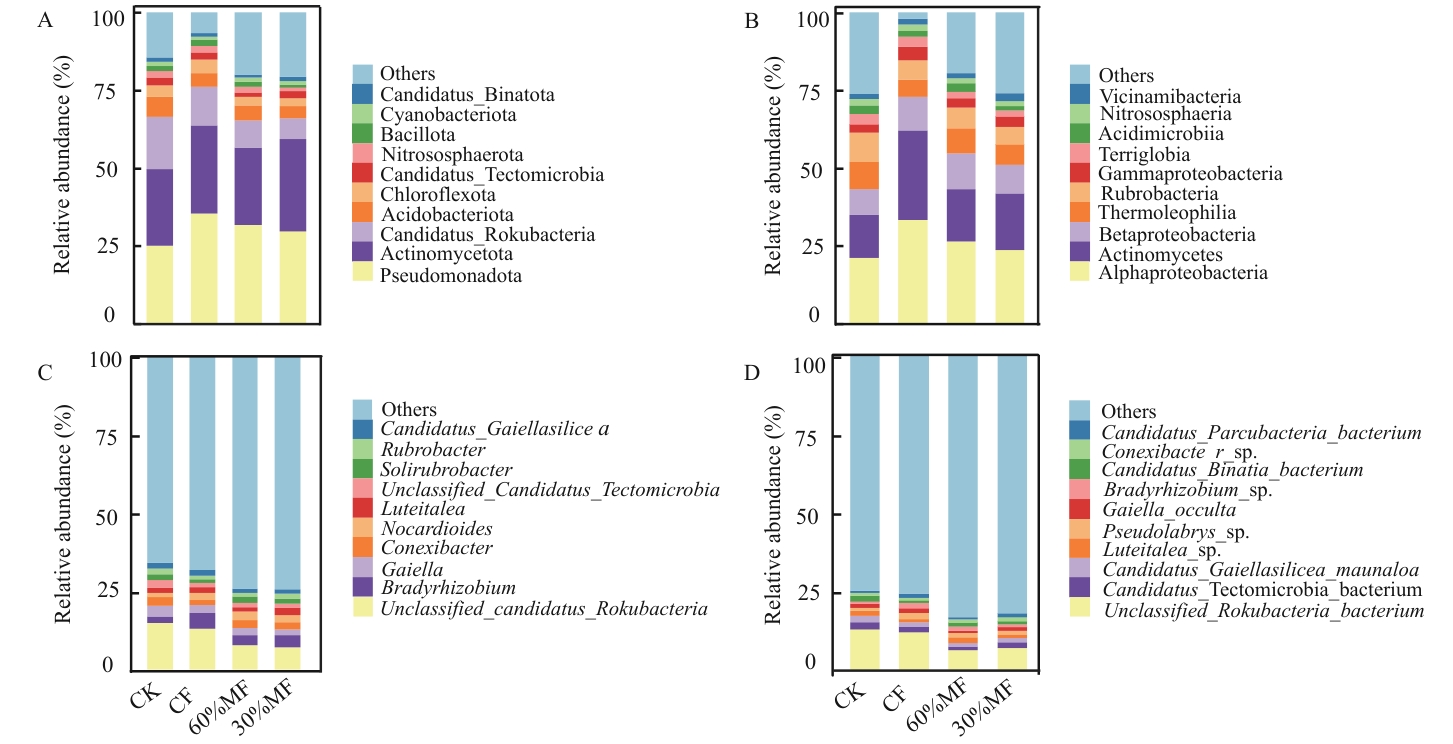
Fig. 4 Relative abundance of soil sulfur-cycling microbial communities in karst dryland under organic-inorganic fertilizationA: Phylum level; B: class level; C: genus level; D: species level
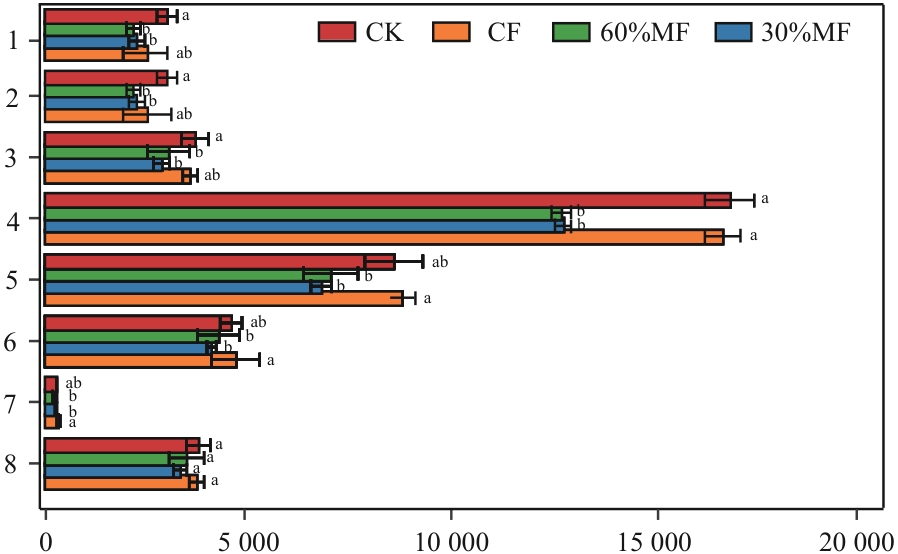
Fig. 5 Relative expression of soil sulfur-cycling functional genes in karst dryland under organic-inorganic fertilization1: Sulfur reduction; 2: sulfur disproportionation; 3: SOX systems; 4: others; 5: organic sulfur transformation; 6: correlation between inorganic and organic sulfur transformation; 7: dissimilatory sulfur reduction and oxidation; 8:assimilatory sulfate reduction. Different lowercase letters indicate significant differences among each treatment (P<0.05)
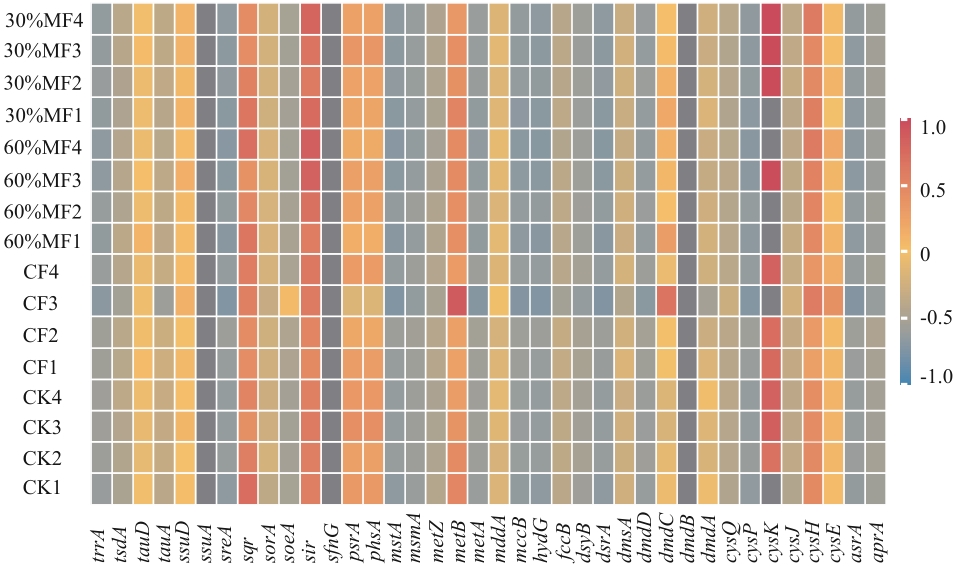
Fig. 6 Relative abundance of soil sulfur-cycling functional genes in karst dryland under organic-inorganic fertilization
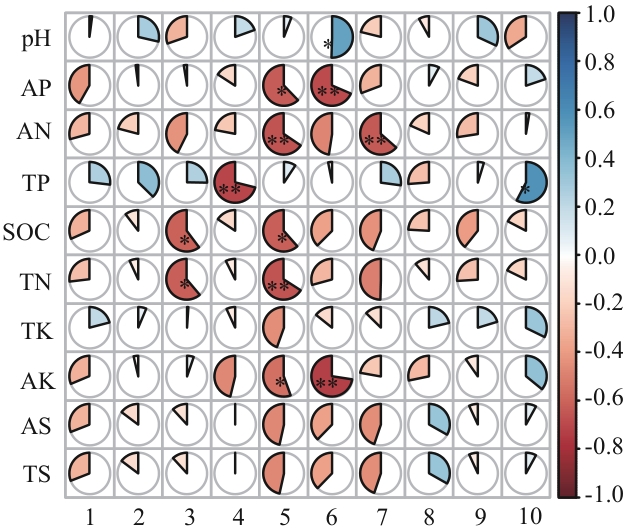
Fig. 7 Correlation analysis between the top ten microorganisms and environmental factors at the phylum level
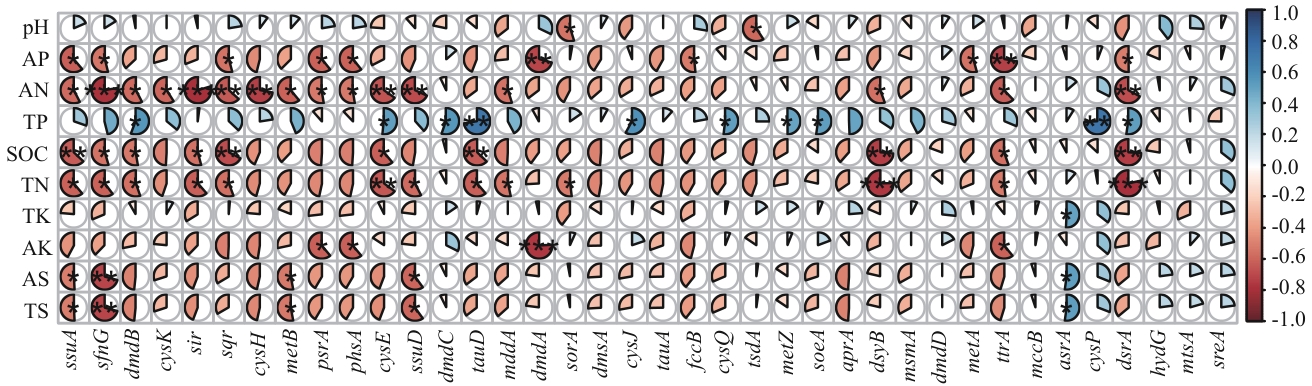
Fig. 8 Correlation analysis between soil sulfur-cycling functional genes and environmental factors
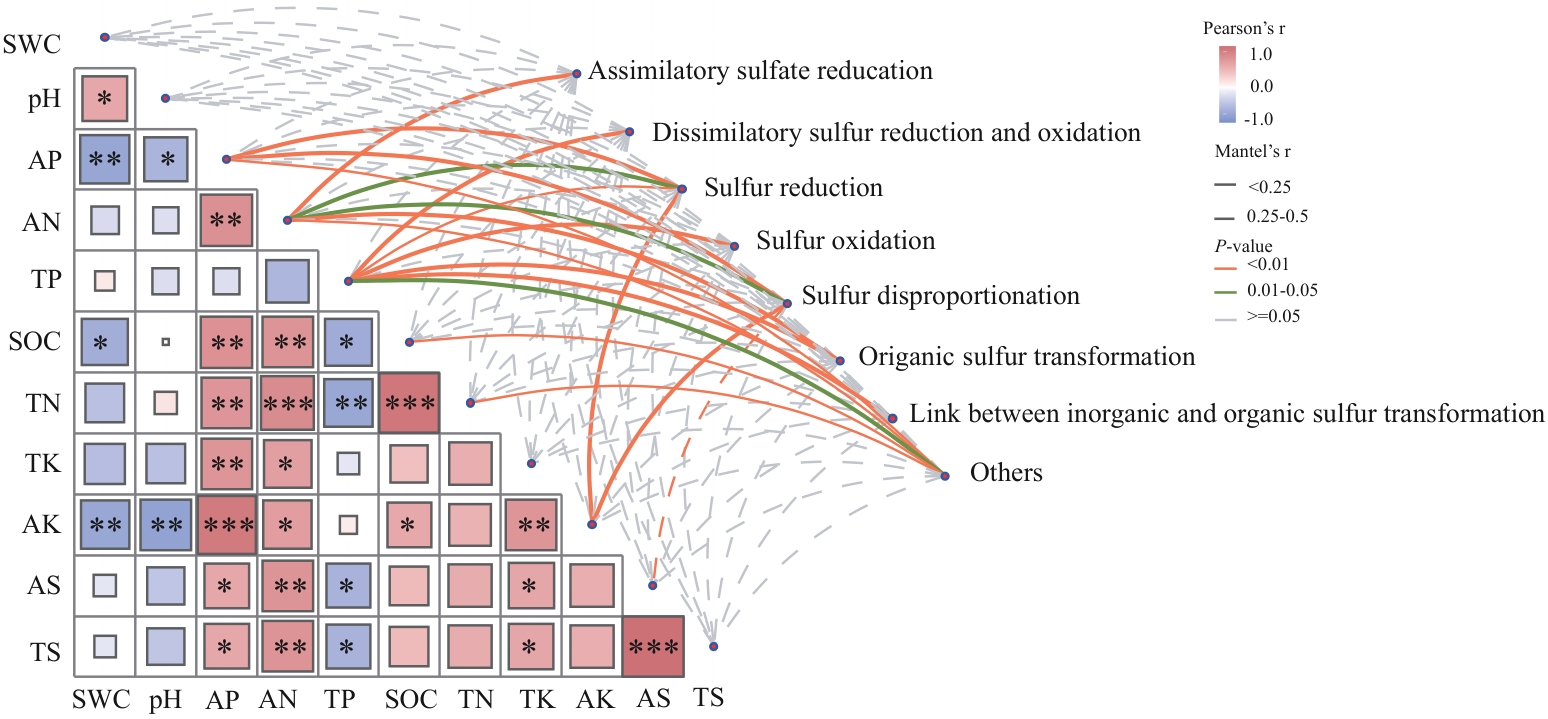
Fig. 9 Correlation analysis between soil sulfur-cycling pathways and environmental factors
| [1] | Zheng CY, Li CL, Tian LB, et al. Mixture of controlled-release and normal urea to improve maize root development, post-silking plant growth, and grain filling [J]. Eur J Agron, 2023, 151: 126994. |
| [2] | 刘传和, 贺涵, 邵雪花, 等. 不同覆盖处理对菠萝园土壤代谢物和细菌群落结构的影响 [J]. 生物技术通报, 2024, 40(7): 247-258. |
| Liu CH, He H, Shao XH, et al. Analysis of differential metabolites and bacterial community structure in the soils of a pineapple orchard under different mulching treatments [J]. Biotechnol Bull, 2024, 40(7): 247-258. | |
| [3] | Guo JH, Liu XJ, Zhang Y, et al. Significant acidification in major Chinese croplands [J]. Science, 2010, 327(5968): 1008-1010. |
| [4] | Xing YY, Xie YX, Wang XK. Enhancing soil health through balanced fertilization: a pathway to sustainable agriculture and food security [J]. Front Microbiol, 2025, 16: 1536524. |
| [5] | 傅伟, 刘坤平, 陈洪松, 等. 等氮配施有机肥对喀斯特峰丛洼地农田作物产量与养分平衡的影响 [J]. 中国生态农业学报, 2017, 25(6): 812-820. |
| Fu W, Liu KP, Chen HS, et al. Effect of partial replacement of inorganic N with organic manure on crop yield and soil nutrient balance in arable ecosystem in karst peak-cluster depression [J]. Chin J Eco Agric, 2017, 25(6): 812-820. | |
| [6] | 赵娜, 王小利, 何进, 等. 有机肥替代化学氮肥对黄壤活性有机碳组分、酶活性及作物产量的影响 [J]. 环境科学, 2024, 45(7): 4196-4205. |
| Zhao N, Wang XL, He J, et al. Effects of replacing chemical nitrogen fertilizer with organic fertilizer on active organic carbon fractions, enzyme activities, and crop yield in yellow soil [J]. Environ Sci, 2024, 45(7): 4196-4205. | |
| [7] | Zhang JJ, Huang JQ, Wen J, et al. Phosphorus fractions and their transformation in coupling with organic carbon cycling after seven-year manure application in subtropical soil [J]. Soil Tillage Res, 2025, 251: 106535. |
| [8] | 路慧英, 周怀平, 杨振兴, 等. 长期氮磷化肥和有机肥配施对褐土钾素平衡及不同形态的影响 [J]. 山西农业科学, 2013, 41(1): 60-65. |
| Lu HY, Zhou HP, Yang ZX, et al. Influence of long-term nitrogen, phosphorus fertilizers and organic complex fertilizations on cinnamon potassium balance and forms [J]. J Shanxi Agric Sci, 2013, 41(1): 60-65. | |
| [9] | 张伟. 西南喀斯特坡地土壤硫的生物地球化学循环研究 [D]. 贵阳: 中国科学院地球化学研究所, 2009. |
| Zhang W. Study on biogeochemical cycle of soil sulfur in karst sloping land in southwest China [D]. Guiyang: Institute of Geochemistry, Chinese Academy of Sciences, 2009. | |
| [10] | 张伟, 张丽丽. 喀斯特小流域石灰土硫形态和硫酸盐还原菌分布特征 [J]. 生态与农村环境学报, 2017, 33(7): 645-652. |
| Zhang W, Zhang LL. Forms of sulfur and distribution of sulfate-reducing bacteria in limestone soil of small karst catchment [J]. J Ecol Rural Environ, 2017, 33(7): 645-652. | |
| [11] | 鲍士旦. 土壤农化分析 [M]. 3版. 北京: 中国农业出版社, 2000. |
| Bao SD. Soil and agricultural chemistry analysis [M]. 3rd ed. Beijing: China Agriculture Press, 2000. | |
| [12] | Li DH, Liu CM, Luo RB, et al. MEGAHIT: an ultra-fast single-node solution for large and complex metagenomics assembly via succinct de Bruijn graph [J]. Bioinformatics, 2015, 31(10): 1674-1676. |
| [13] | Hyatt D, Chen GL, LoCascio PF, et al. Prodigal: prokaryotic gene recognition and translation initiation site identification [J]. BMC Bioinform, 2010, 11: 119. |
| [14] | Li WZ, Godzik A. Cd-hit: a fast program for clustering and comparing large sets of protein or nucleotide sequences [J]. Bioinformatics, 2006, 22(13): 1658-1659. |
| [15] | Kanehisa M, Goto S. KEGG Kyoto encyclopedia of genes and genomes [J]. Nucleic Acids Res, 2000, 28(1): 27-30. |
| [16] | Li JN, Zhao J, Liao XH, et al. Pathways of soil organic carbon accumulation are related to microbial life history strategies in fertilized agroecosystems [J]. Sci Total Environ, 2024, 927: 172191. |
| [17] | Zhang F, Chen MR, Xing YY, et al. Reduction of nitrogen fertilizer and simultaneously application of organic fertilizer optimizes yield, water productivity and nitrogen metabolism of spring maize by improving soil properties in the Loess Plateau of China [J]. J Agric Food Res, 2025, 19: 101634. |
| [18] | 李青林. 喀斯特不同生境土壤理化性质差异及其空间分异特征 [D]. 贵阳: 贵州大学, 2021. |
| Li QL. Differences of soil physical and chemical properties and their spatial differentiation characteristics in different karst habitats [D]. Guiyang: Guizhou University, 2021. | |
| [19] | Geisseler D, Scow KM. Long-term effects of mineral fertilizers on soil microorganisms-A review [J]. Soil Biol Biochem, 2014, 75: 54-63. |
| [20] | Cui XW, Zhang YZ, Gao JS, et al. Long-term combined application of manure and chemical fertilizer sustained higher nutrient status and rhizospheric bacterial diversity in reddish paddy soil of Central South China [J]. Sci Rep, 2018, 8: 16554. |
| [21] | Li Y, Liu XM, Zhang L, et al. Effects of short-term application of chemical and organic fertilizers on bacterial diversity of cornfield soil in a karst area [J]. J Soil Sci Plant Nutr, 2020, 20(4): 2048-2058. |
| [22] | Leff JW, Jones SE, Prober SM, et al. Consistent responses of soil microbial communities to elevated nutrient inputs in grasslands across the globe [J]. Proc Natl Acad Sci USA, 2015, 112(35): 10967-10972. |
| [23] | Fontaine S, Mariotti A, Abbadie L. The priming effect of organic matter: a question of microbial competition? [J]. Soil Biol Biochem, 2003, 35(6): 837-843. |
| [24] | Niu GX, Zhong BQ, Wang RZ, et al. Effects of nitrogen and water addition on soil carbon, nitrogen, phosphorus, sulfur, and their stoichiometry along soil profile in a semi-arid steppe [J]. J Soils Sediments, 2023, 23(9): 3298-3309. |
| [25] | 俞月凤, 韦建华, 张俊辉, 等. 喀斯特地区不同碳酸盐岩发育耕地土壤团聚体稳定性及有机碳剖面分布特征 [J]. 土壤通报, 2024, 55(5): 1292-1301. |
| Yu YF, Wei JH, Zhang JH, et al. Stability of soil aggregates and profile distribution characteristics of organic carbon in farmland of different carbonate rocks [J]. Chin J Soil Sci, 2024, 55(5): 1292-1301. | |
| [26] | 陈运霜, 沈育伊, 曹杨, 等. 喀斯特湿地转变为农用地对土壤有机硫形态及芳基硫酸酯酶活性的影响 [J]. 植物营养与肥料学报, 2023, 29(12): 2232-2246. |
| Chen YS, Shen YY, Cao Y, et al. Effects of natural wetland conversion to farmland on soil organic sulfur forms and arylsulphatase activities in karst areas [J]. Plant Nutr Fert Sci, 2023, 29(12): 2232-2246. | |
| [27] | Liu HY, Dai ZC, Wang YJ, et al. Interacting effects of water and nitrogen addition on soil-plant sulfur dynamics in a semi-arid grassland [J]. Geoderma, 2024, 442: 116796. |
| [28] | Mitsuta A, Lourenço KS, de Oliveira BG, et al. Soil pH determines the shift of key microbial energy metabolic pathways associated with soil nutrient cycle [J]. Appl Soil Ecol, 2025, 208: 105992. |
| [29] | Xiao D, Xiao LM, Che RX, et al. Phosphorus but not nitrogen addition significantly changes diazotroph diversity and community composition in typical karst grassland soil [J]. Agric Ecosyst Environ, 2020, 301: 106987. |
| [30] | Zhang W, Zhao J, Pan FJ, et al. Changes in nitrogen and phosphorus limitation during secondary succession in a karst region in southwest China [J]. Plant Soil, 2015, 391(1/2): 77-91. |
| [31] | Zhang H, Dou ZX, Bi WH, et al. Multi-omics study of sulfur metabolism affecting functional microbial community succession during aerobic solid-state fermentation [J]. Bioresour Technol, 2023, 387: 129664. |
| [1] | CHEN Zi-long, ZHANG Chao, HAO Wan-ting, SONG Xian-wei, CHEN Xin-yi, LU Lu, LI Peng-fei, ZHU Yi-chun. Study on the Influence and Mechanism of Reflux Ratio on Anaerobic Ammonia Oxidation System [J]. Biotechnology Bulletin, 2026, 42(2): 102-112. |
| [2] | XIAO Liang, WU Zheng-dan, LU Liu-ying, SHI Ping-li, SHANG Xiao-hong, CAO Sheng, ZENG Wen-dan, YAN Hua-bing. Research Progress of Important Traits Genes in Cassava [J]. Biotechnology Bulletin, 2023, 39(6): 31-48. |
| [3] | DONG Yi-hua, WANG Ling-xiao, REN Han-xue, CHEN Feng. Isolation and Identification of a Psychrotolerant Heterotrophic Nitrification-aerobic Denitrification Bacterium and Its Nitrogen-removing Characteristics [J]. Biotechnology Bulletin, 2023, 39(12): 237-249. |
| [4] | TIAN Li, LI Jun-jiao, DAI Xiao-feng, ZHANG Dan-dan, CHEN Jie-yin. From Functional Genes to Biological Characteristics:The Molecular Basis of Pathogenicity in Verticillium dahliae [J]. Biotechnology Bulletin, 2022, 38(1): 51-69. |
| [5] | WU Qi-man, ZHANG Jin-mei, LI Yue-ying, ZHANG Ying. Recent Advances on the Mechanism of Beneficial Microbial Fertilizers in Crops [J]. Biotechnology Bulletin, 2021, 37(5): 221-230. |
| [6] | CHEN Yi-dan, ZHANG Yu, YANG Jie, ZHANG Qin, JIANG Li. Exploration of Key Functional Genes Affecting Milk Production Traits in Dairy Cattle Based on RNA-seq [J]. Biotechnology Bulletin, 2020, 36(9): 244-252. |
| [7] | ZHANG Hai-miao, LI Yang, LIU Hai-feng, KONG Ling-guang, DING Xin-hua. Research Progress on Regulatory Genes of Important Agronomic Traits and Breeding Utilization in Rice [J]. Biotechnology Bulletin, 2020, 36(12): 155-169. |
| [8] | LI Hui ZHA, Jian-jun, SUN Qing-ye. Effects of Acid Mine Drainage on the Abundance of Functional Genes Involved in Nitrogen Cycle in Soil Profiles [J]. Biotechnology Bulletin, 2019, 35(9): 249-256. |
| [9] | ZHU Rong-gui, GUAN Tong-wei, JIANG Xiu-juan. Isolation of Rare Actinobacteria in 5 Ecodistricts of Tarim Basin and Distribution of the Genes Synthesizing Antibiotics [J]. Biotechnology Bulletin, 2018, 34(9): 230-236. |
| [10] | LI Xiao-kai ,WANG Gui ,QIAO Xian ,FAN Yi-xing ,ZHANG Lei ,MA Yu-hao ,NIE Rui-xue ,WANG Rui-jun ,HE Li-bing ,SU Rui. Research Progress on Whole-genome Sequencing on Important Domesticated Animals [J]. Biotechnology Bulletin, 2018, 34(6): 11-21. |
| [11] | WANG Zhu-jun, WANG Shang, LIU Yang-ying, FENG Kai, DENG Ye. The Applications of Metagenomics in the Detection of Environmental Microbes Involving in Nitrogen Cycle [J]. Biotechnology Bulletin, 2018, 34(1): 1-14. |
| [12] | WANG Yu-xuan, WEI Wei, LI Ping-ping, ZHAO Yun, FU Wei-guo. Study Progress on Microorganism in Constructed Wetlands [J]. Biotechnology Bulletin, 2017, 33(10): 74-79. |
| [13] | LIANG Jin-gang, ZHANG Xiu-jie. Strategies for Evaluating the Effects of Transgenic Crops on Soil Microbial Diversity [J]. Biotechnology Bulletin, 2017, 33(10): 111-116. |
| [14] | LIU Guo-sheng, ZHANG Da-le. The Application of the Functional Molecular Marker in Wheat Breeding [J]. Biotechnology Bulletin, 2016, 32(11): 18-29. |
| [15] | Cao Jianbin, Yu Huiying, Li Xin. Identification of Bacillus sp. LAY and Its Antimicrobial Activity Against Candida albicans [J]. Biotechnology Bulletin, 2015, 31(9): 163-169. |
| Viewed | ||||||
|
Full text |
|
|||||
|
Abstract |
|
|||||
