







生物技术通报 ›› 2025, Vol. 41 ›› Issue (5): 23-31.doi: 10.13560/j.cnki.biotech.bull.1985.2024-1057
刘源( ), 赵冉, 卢振芳, 李瑞丽()
收稿日期:2024-10-28
出版日期:2025-05-26
发布日期:2025-06-05
通讯作者:
李瑞丽,女,博士,教授,研究方向:植物分子细胞生物学;E-mail: liruili@bjfu.edu.cn作者简介:刘源,男,硕士研究生,研究方向:植物分子细胞生物学;E-mail: liuyuan@bjfu.edu.cn
基金资助:
LIU Yuan(), ZHAO Ran, LU Zhen-fang, LI Rui-li()
Received:2024-10-28
Published:2025-05-26
Online:2025-06-05
摘要:
类胡萝卜素(carotenoids)是一类在动物、植物和微生物中广泛存在的重要次生代谢物质,由链状或环状的亲脂性类异戊二烯构成,主要包括α-胡萝卜素、β-胡萝卜素、叶黄素等。植物类胡萝卜素作为天然色素,对于植物观赏品质的形成具有重要作用。同时,它也是植物光合辅助色素,可以帮助植物吸收太阳光能并转化为化学能,从而维持植物正常生长发育。此外,类胡萝卜素还是合成维生素A的前体,对人类营养健康有重要意义。植物类胡萝卜素生物代谢途径包含前体合成途径、类胡萝卜素合成途径和类胡萝卜素降解途径,对其中关键基因的功能解析有助于进一步理解植物类胡萝卜素代谢调控机制。本文全面梳理了植物类胡萝卜素生物代谢途径,系统总结了植物类胡萝卜素生物学功能的研究进展,特别是在植物光保护、园艺和农艺性状改良、抵抗非生物胁迫和参与植物激素信号调控中的重要功能。该综述为深入探究植物类胡萝卜素功能及其生物代谢调控机制提供理论基础,为加速分子设计育种提供了有价值的资源。
刘源, 赵冉, 卢振芳, 李瑞丽. 植物类胡萝卜素生物代谢途径及其功能研究进展[J]. 生物技术通报, 2025, 41(5): 23-31.
LIU Yuan, ZHAO Ran, LU Zhen-fang, LI Rui-li. Research Progress in the Biological Metabolic Pathway and Functions of Plant Carotenoids[J]. Biotechnology Bulletin, 2025, 41(5): 23-31.
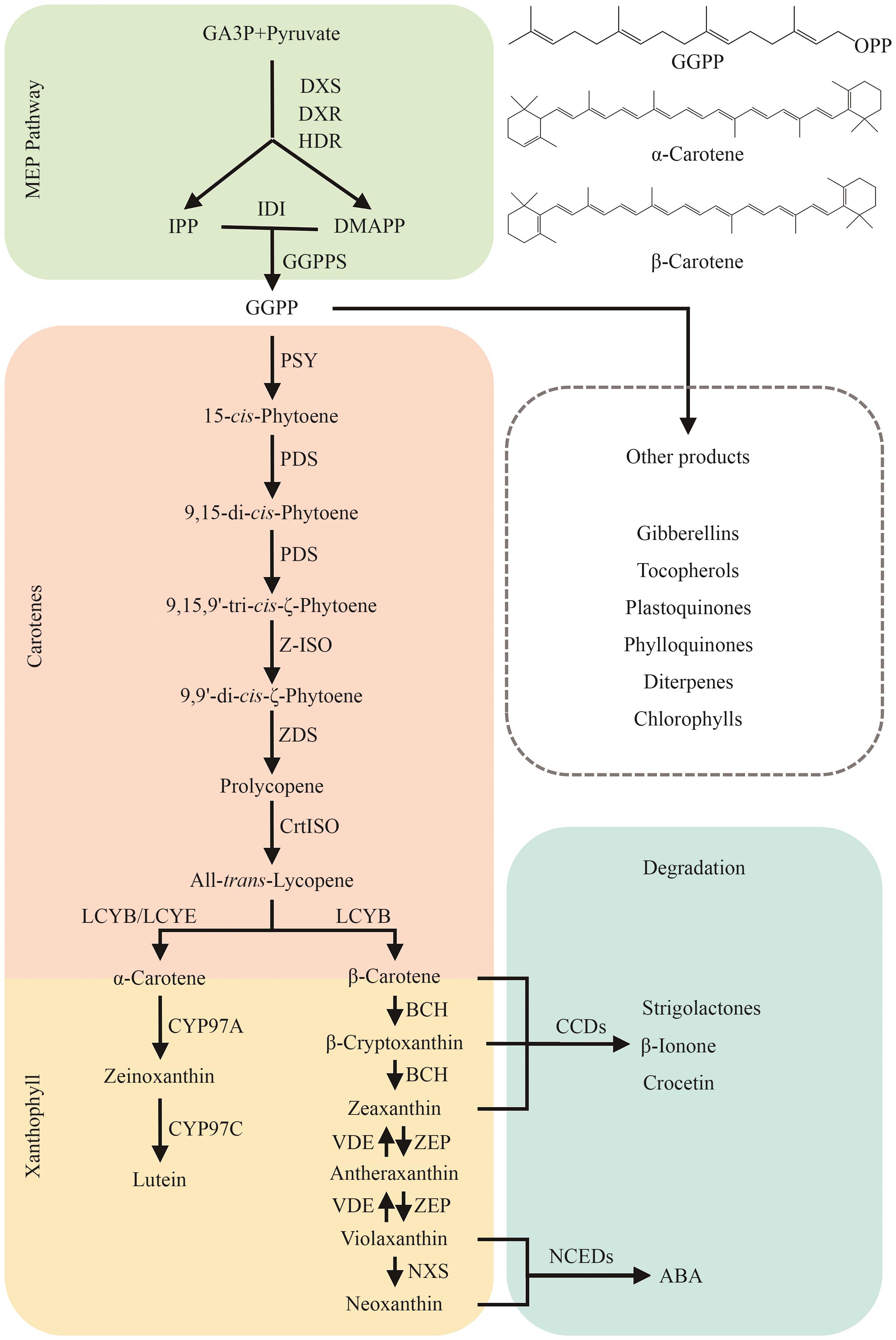
图1 植物类胡萝卜素生物代谢途径DXS:脱氧木酮糖-5-磷酸合成酶;DXR:脱氧木酮糖磷酸还原异构酶;HDR:(E)-4-羟基-3-甲丁-2-烯基二磷酸还原酶;IDI:异戊烯基焦磷酸/二甲基烯丙基二磷酸异构酶;GGPPS:牻牛儿牻牛儿基焦磷酸合酶;PSY:八氢番茄红素合成酶;PDS:八氢番茄红素去饱和酶;Z-ISO:15-顺式-ζ-胡萝卜素异构酶;ZDS:ζ-胡萝卜素去饱和酶;CrtISO:类胡萝卜素异构酶;LCYB:番茄红素β-环化酶;LCYE:番茄红素ε-环化酶;CYP97A:细胞色素P450胡萝卜素羟化酶A;CYP97C:细胞色素P450胡萝卜素羟化酶C;BCH:β-胡萝卜素羟化酶;ZEP: 玉米黄质环氧酶;VDE:紫黄质脱环氧化酶;NXS:新黄质合酶;NCED:9-顺式-环氧类胡萝卜素双加氧酶;CCD:类胡萝卜素裂解双加氧酶
Fig. 1 Biological metabolic pathway of plant carotenoidsDXS: Deoxyoxylulose-5-phosphate synthase; DXR: deoxy-D-xylulose 5-phosphate reductoisomerase; HDR: 4-hydroxy-3-methylbut-2-enyl diphosphate reductase; IDI: isopentenyl-diphosphate δ-isomerase; GGPPS: geranylgeranyl diphosphate synthase; PSY: phytoene synthase; PDS: phytoene desaturase; Z-ISO: 15-cis-ζ-carotene isomerase; ZDS: ζ-carotene desaturase; CrtISO: carotene isomerase; LCYB: lycopene β-cyclase; LCYE: lycopene ε-cyclase; CYP: cytochrome P450 carotene; BCH: β-carotene hydrolase; ZEP: zeaxanthin epoxidase; VDE: violaxanthin deepoxidase; NXS: neoxanthin synthase; NCED: 9-cis-epoxycarotenoid dioxygenase; CCD: carotenoid cleavage dioxygenases
基因 Gene | 物种 Scientific | 功能 Function | 调控因子 | 参考文献 |
|---|---|---|---|---|
| DXR | 柑橘 Citrus spp. | 提升类胡萝卜素含量 | 受HB5-ZIP44正调控; 受ABA水平影响 | [ |
| GGPPS | 烟草 Nicotiana tabacum | 提升光合效率 | [ | |
| 柑橘 Citrus spp. | 提升类胡萝卜素含量 | 受HB5-ZIP44正调控; 受ABA水平影响 | [ | |
| PSY | 拟南芥 Arabidopsis thaliana | 抵抗光照损伤;提升耐热性;延迟种子萌发 | 受OR蛋白家族翻译后修饰; 受ABA调控 | [ |
| 烟草 Nicotiana tabacum | 提升类胡萝卜素含量;抵抗干旱胁迫 | 受FBN蛋白翻译后修饰; 受DREB-1BL1正调控 | [ | |
| 番茄 Solanum lycopersicum | 调控花色变化;调控果实颜色 | [ | ||
| 辣椒 Capsicum annuum | 增加辣椒素水平;促进辣椒成熟;调控果实颜色 | 受DIVARICATA1正调控; 受ABA调控 | [ | |
| 葡萄 Vitis vinifera | 提升类胡萝卜素含量 | 受PIF负调控 | [ | |
| 棉花 Gossypium hirsutum | 调控叶片颜色变化 | [ | ||
| 油菜 Brassica oleracea | 提升类胡萝卜素含量 | 受BZR1.1正调控 | [ | |
| 鸢尾 Iris germanica | 调控花色变化 | [ | ||
| 兰花 Oncidium Gower Ramsey | 调控花色变化 | [ | ||
| 猕猴桃 Actinidia deliciosa | 抵抗盐胁迫 | 受DcAL4/7正调控 | [ | |
| 禾本科植物 Poaceae | 提升类胡萝卜素含量;抵抗盐胁迫;抵抗干旱胁迫 | 受ABA调控 | [ | |
| PDS | 番茄 Solanum lycopersicum | 调控果实颜色 | [ | |
| 柑橘 Citrus spp. | 调控果实颜色 | 受TT8正调控 | [ | |
| LCYE | 芹菜 Apium graveolens | 抵抗盐胁迫 | [ | |
| LCYB | 烟草 Nicotiana tabacum | 抵抗非生物胁迫 | [ | |
| 山茶 Camellia sinensis | 调控香气变化 | [ | ||
| 番薯 Ipomoea batatas | 抵抗盐胁迫;抵抗干旱胁迫;抵抗氧化胁迫 | [ | ||
| BCH | 柑橘 Citrus spp. | 提升类胡萝卜素含量 | 受HB5-ZIP44正调控; 受ABA水平影响 | [ |
| CCD | 番茄 Solanum lycopersicum | 调控果实颜色 | [ | |
| 百日草 Zinnia elegans | 调控花色变化 | [ | ||
| 水稻 Oryza sativa | 调控水稻分檗 | [ | ||
| 藏红花 Crocus sativus | 调控香气变化 | [ | ||
| 枸杞 Lycium barbarum | 提升类胡萝卜素含量 | 受ERF调控 | [ |
表1 植物类胡萝卜素代谢通路相关基因功能研究进展
Table 1 Research progress in the functions of genes related to plant carotenoid metabolic pathways
基因 Gene | 物种 Scientific | 功能 Function | 调控因子 | 参考文献 |
|---|---|---|---|---|
| DXR | 柑橘 Citrus spp. | 提升类胡萝卜素含量 | 受HB5-ZIP44正调控; 受ABA水平影响 | [ |
| GGPPS | 烟草 Nicotiana tabacum | 提升光合效率 | [ | |
| 柑橘 Citrus spp. | 提升类胡萝卜素含量 | 受HB5-ZIP44正调控; 受ABA水平影响 | [ | |
| PSY | 拟南芥 Arabidopsis thaliana | 抵抗光照损伤;提升耐热性;延迟种子萌发 | 受OR蛋白家族翻译后修饰; 受ABA调控 | [ |
| 烟草 Nicotiana tabacum | 提升类胡萝卜素含量;抵抗干旱胁迫 | 受FBN蛋白翻译后修饰; 受DREB-1BL1正调控 | [ | |
| 番茄 Solanum lycopersicum | 调控花色变化;调控果实颜色 | [ | ||
| 辣椒 Capsicum annuum | 增加辣椒素水平;促进辣椒成熟;调控果实颜色 | 受DIVARICATA1正调控; 受ABA调控 | [ | |
| 葡萄 Vitis vinifera | 提升类胡萝卜素含量 | 受PIF负调控 | [ | |
| 棉花 Gossypium hirsutum | 调控叶片颜色变化 | [ | ||
| 油菜 Brassica oleracea | 提升类胡萝卜素含量 | 受BZR1.1正调控 | [ | |
| 鸢尾 Iris germanica | 调控花色变化 | [ | ||
| 兰花 Oncidium Gower Ramsey | 调控花色变化 | [ | ||
| 猕猴桃 Actinidia deliciosa | 抵抗盐胁迫 | 受DcAL4/7正调控 | [ | |
| 禾本科植物 Poaceae | 提升类胡萝卜素含量;抵抗盐胁迫;抵抗干旱胁迫 | 受ABA调控 | [ | |
| PDS | 番茄 Solanum lycopersicum | 调控果实颜色 | [ | |
| 柑橘 Citrus spp. | 调控果实颜色 | 受TT8正调控 | [ | |
| LCYE | 芹菜 Apium graveolens | 抵抗盐胁迫 | [ | |
| LCYB | 烟草 Nicotiana tabacum | 抵抗非生物胁迫 | [ | |
| 山茶 Camellia sinensis | 调控香气变化 | [ | ||
| 番薯 Ipomoea batatas | 抵抗盐胁迫;抵抗干旱胁迫;抵抗氧化胁迫 | [ | ||
| BCH | 柑橘 Citrus spp. | 提升类胡萝卜素含量 | 受HB5-ZIP44正调控; 受ABA水平影响 | [ |
| CCD | 番茄 Solanum lycopersicum | 调控果实颜色 | [ | |
| 百日草 Zinnia elegans | 调控花色变化 | [ | ||
| 水稻 Oryza sativa | 调控水稻分檗 | [ | ||
| 藏红花 Crocus sativus | 调控香气变化 | [ | ||
| 枸杞 Lycium barbarum | 提升类胡萝卜素含量 | 受ERF调控 | [ |
| 1 | Nisar N, Li L, Lu S, et al. Carotenoid metabolism in plants [J]. Mol Plant, 2015, 8(1): 68-82. |
| 2 | Iglesias-Sanchez A, Navarro-Carcelen J, Morelli L, et al. Arabidopsis FIBRILLIN6 influences carotenoid biosynthesis by directly promoting phytoene synthase activity [J]. Plant Physiol, 2024, 194(3): 1662-1673. |
| 3 | Esteban R, Barrutia O, Artetxe U, et al. Internal and external factors affecting photosynthetic pigment composition in plants: a meta-analytical approach [J]. New Phytol, 2015, 206(1): 268-280. |
| 4 | Coe K, Bostan H, Rolling W, et al. Population genomics identifies genetic signatures of carrot domestication and improvement and uncovers the origin of high-carotenoid orange carrots [J]. Nat Plants, 2023, 9(10): 1643-1658. |
| 5 | Cai CP, Zhang XY, Niu EL, et al. GhPSY, a phytoene synthase gene, is related to the red plant phenotype in upland cotton (Gossypium hirsutum L.) [J]. Mol Biol Rep, 2014, 41(8): 4941-4952. |
| 6 | Liu LH, Wei J, Zhang M, et al. Ethylene independent induction of lycopene biosynthesis in tomato fruits by jasmonates [J]. J Exp Bot, 2012, 63(16): 5751-5761. |
| 7 | Rodriguez-Concepcion M, Avalos J, Luisa Bonet M, et al. A global perspective on carotenoids: metabolism, biotechnology, and benefits for nutrition and health [J]. Prog Lipid Res, 2018, 70: 62-93. |
| 8 | Dong C, Qu G, Guo JG, et al. Rational design of geranylgeranyl diphosphate synthase enhances carotenoid production and improves photosynthetic efficiency in Nicotiana tabacum [J]. Sci Bull, 2022, 67(3): 315-327. |
| 9 | Domonkos I, Kis M, Gombos Z, et al. Carotenoids, versatile components of oxygenic photosynthesis [J]. Prog Lipid Res, 2013, 52(4): 539-561. |
| 10 | Frusciante S, Diretto G, Bruno M, et al. Novel carotenoid cleavage dioxygenase catalyzes the first dedicated step in saffron crocin biosynthesis [J]. Proc Natl Acad Sci USA, 2014, 111(33): 12246-12251. |
| 11 | Eggersdorfer M, Wyss A. Carotenoids in human nutrition and health [J]. Arch Biochem Biophys, 2018, 652: 18-26. |
| 12 | Meléndez-Martínez AJ. An overview of carotenoids, apocarotenoids, and vitamin A in agro-food, nutrition, health, and disease [J]. Mol Nutr Food Res, 2019, 63(15): e1801045. |
| 13 | Pu XD, Li Z, Tian Y, et al. The honeysuckle genome provides insight into the molecular mechanism of carotenoid metabolism underlying dynamic flower coloration [J]. New Phytol, 2020, 227(3): 930-943. |
| 14 | Lu SW, Zhang Y, Zheng XJ, et al. Molecular characterization, critical amino acid identification, and promoter analysis of a lycopene β-cyclase gene from Citrus [J]. Tree Genet Genomes, 2016, 12(6): 106. |
| 15 | Yin L, Liu JX, Tao JP, et al. The gene encoding lycopene Epsilon cyclase of celery enhanced lutein and β-carotene contents and confers increased salt tolerance in Arabidopsis [J]. Plant Physiol Biochem, 2020, 157: 339-347. |
| 16 | Arnoux P, Morosinotto T, Saga G, et al. A structural basis for the pH-dependent xanthophyll cycle in Arabidopsis thaliana [J]. Plant Cell, 2009, 21(7): 2036-2044. |
| 17 | Guzman I, Hamby S, Romero J, et al. Variability of carotenoid biosynthesis in orange colored Capsicum spp [J]. Plant Sci, 2010, 179(1/2): 49-59. |
| 18 | Jeknić Z, Morré JT, Jeknić S, et al. Cloning and functional characterization of a gene for capsanthin-capsorubin synthase from tiger lily (Lilium lancifolium Thunb. ‘Splendens’) [J]. Plant Cell Physiol, 2012, 53(11): 1899-1912. |
| 19 | Xia Y, Chen WW, Xiang WB, et al. Integrated metabolic profiling and transcriptome analysis of pigment accumulation in Lonicera Japonica flower petals during colour-transition [J]. BMC Plant Biol, 2021, 21(1): 98. |
| 20 | Shumskaya M, Bradbury LMT, Monaco RR, et al. Plastid localization of the key carotenoid enzyme phytoene synthase is altered by isozyme, allelic variation, and activity [J]. Plant Cell, 2012, 24(9): 3725-3741. |
| 21 | Maass D, Arango J, Wüst F, et al. Carotenoid crystal formation in Arabidopsis and carrot roots caused by increased phytoene synthase protein levels [J]. PLoS One, 2009, 4(7): e6373. |
| 22 | Sun TH, Wang P, Rao S, et al. Co-chaperoning of chlorophyll and carotenoid biosynthesis by ORANGE family proteins in plants [J]. Mol Plant, 2023, 16(6): 1048-1065. |
| 23 | Rao S, Cao HB, O'Hanna FJ, et al. Nudix hydrolase 23 post-translationally regulates carotenoid biosynthesis in plants [J]. Plant Cell, 2024, 36(5): 1868-1891. |
| 24 | Dong C, Zhang M, Song SS, et al. A small subunit of geranylgeranyl diphosphate synthase functions as an active regulator of carotenoid synthesis in Nicotiana tabacum [J]. Int J Mol Sci, 2023, 24(2): 992. |
| 25 | Young PR, Lashbrooke JG, Alexandersson E, et al. The genes and enzymes of the carotenoid metabolic pathway in Vitis vinifera L [J]. BMC Genomics, 2012, 13: 243. |
| 26 | Ramel F, Mialoundama AS, Havaux M. Nonenzymic carotenoid oxidation and photooxidative stress signalling in plants [J]. J Exp Bot, 2013, 64(3): 799-805. |
| 27 | Johnson MP, Havaux M, Triantaphylidès C, et al. Elevated Zeaxanthin bound to oligomeric LHCII enhances the resistance of Arabidopsis to photooxidative stress by a lipid-protective, antioxidant mechanism [J]. J Biol Chem, 2007, 282(31): 22605-22618. |
| 28 | Álvarez D, Voß B, Maass D, et al. Carotenogenesis is regulated by 5'UTR-mediated translation of phytoene synthase splice variants [J]. Plant Physiol, 2016, 172(4): 2314-2326. |
| 29 | Ezquerro M, Burbano-Erazo E, Rodriguez-Concepcion M. Overlapping and specialized roles of tomato phytoene synthases in carotenoid and abscisic acid production [J]. Plant Physiol, 2023, 193(3): 2021-2036. |
| 30 | Zhuge YX, Sheng HJ, Zhang MW, et al. Grape phytochrome-interacting factor VvPIF1 negatively regulates carotenoid biosynthesis by repressing VvPSY expression [J]. Plant Sci, 2023, 331: 111693. |
| 31 | Xiao QZ, Zhu YY, Cui GX, et al. A comparative study of flavonoids and carotenoids revealed metabolite responses for various flower colorations between Nicotiana tabacum L. and Nicotiana rustica L [J]. Front Plant Sci, 2022, 13: 828042. |
| 32 | Zhou NZ, Yan YJ, Wen YF, et al. Integrated transcriptome and metabolome analysis unveils the mechanism of color-transition in Edgeworthia chrysantha tepals [J]. BMC Plant Biol, 2023, 23(1): 567. |
| 33 | Qing HS, Liu XY, Chen JH, et al. Carotenoid cleavage dioxygenase catalyzes carotenoid degradation and regulates carotenoid accumulation and petal coloration in Zinnia elegans [J]. Ornam Plant Res, 2024, 4(1). |
| 34 | Liu YC, Yeh CW, Chung JD, et al. Petal-specific RNAi-mediated silencing of the phytoene synthase gene reduces xanthophyll levels to generate new Oncidium orchid varieties with white-colour blooms [J]. Plant Biotechnol J, 2019, 17(11): 2035-2037. |
| 35 | Chen LL, Li WZ, Li YP, et al. Identified trans-splicing of yellow-fruited tomato 2 encoding the phytoene synthase 1 protein alters fruit color by map-based cloning, functional complementation and race [J]. Plant Mol Biol, 2019, 100(6): 647-658. |
| 36 | Naing AH, Kyu SY, Pe PPW, et al. Silencing of the phytoene desaturase (PDS) gene affects the expression of fruit-ripening genes in tomatoes [J]. Plant Methods, 2019, 15: 110. |
| 37 | Kim JY, Kim DH, Kim MS, et al. Physicochemical properties and antioxidant activity of CRISPR/Cas9-edited tomato SGR1 knockout (KO) line [J]. Int J Mol Sci, 2024, 25(10): 5111. |
| 38 | Pereira L. The mystery behind dark-orange tomatoes: how can an exotic cleavage dioxygenase alter carotenoid flux? [J]. Plant Physiol, 2023, 192(2): 697-699. |
| 39 | Yoo HJ, Chung MY, Lee HA, et al. Natural overexpression of carotenoid cleavage dioxygenase 4 in tomato alters carotenoid flux [J]. Plant Physiol, 2023, 192(2): 1289-1306. |
| 40 | Ding CQ, Shao ZJ, Yan YP, et al. Carotenoid isomerase regulates rice tillering and grain productivity by its biosynthesis pathway [J]. J Integr Plant Biol, 2024, 66(2): 172-175. |
| 41 | Llorente B, Torres-Montilla S, Morelli L, et al. Synthetic conversion of leaf chloroplasts into carotenoid-rich plastids reveals mechanistic basis of natural chromoplast development [J]. Proc Natl Acad Sci USA, 2020, 117(35): 21796-21803. |
| 42 | Lv JH, Zhang RH, Mo YR, et al. Integrative metabolome and transcriptome analyses provide insights into carotenoid variation in different-colored peppers [J]. Int J Mol Sci, 2023, 24(23): 16563. |
| 43 | Song JL, Sun BM, Chen CM, et al. An R-R-type MYB transcription factor promotes non-climacteric pepper fruit carotenoid pigment biosynthesis [J]. Plant J, 2023, 115(3): 724-741. |
| 44 | Bhargava N, Ampomah-Dwamena C, Voogd C, et al. Comparative transcriptomic and plastid development analysis sheds light on the differential carotenoid accumulation in kiwifruit flesh [J]. Front Plant Sci, 2023, 14: 1213086. |
| 45 | Sun Q, He ZC, Wei RR, et al. Transcription factor CsTT8 promotes fruit coloration by positively regulating the methylerythritol 4-phosphate pathway and carotenoid biosynthesis pathway in citrus (Citrus spp.) [J]. Hortic Res, 2023, 10(11): uhad199. |
| 46 | Gianoglio S, Comino C, Moglia A, et al. In-depth characterization of greenflesh tomato mutants obtained by CRISPR/Cas9 editing: a case study with implications for breeding and regulation [J]. Front Plant Sci, 2022, 13: 936089. |
| 47 | Xu ZC, Chen SS, Wang YL, et al. Crocus genome reveals the evolutionary origin of crocin biosynthesis [J]. Acta Pharm Sin B, 2024, 14(4): 1878-1891. |
| 48 | Peng AQ, Tang XY, Feng YY, et al. Molecular mechanism of lycopene cyclases regulating carotenoids ratio in different branches during tea leaf and flower development [J]. Hortic Plant J, 2023, 9(6): 1177-1192. |
| 49 | Swapnil P, Meena M, Singh SK, et al. Vital roles of carotenoids in plants and humans to deteriorate stress with its structure, biosynthesis, metabolic engineering and functional aspects [J]. Curr Plant Biol, 2021, 26: 100203. |
| 50 | Li FQ, Vallabhaneni R, Wurtzel ET. PSY3 a new member of the phytoene synthase gene family conserved in the Poaceae and regulator of abiotic stress-induced root carotenogenesis [J]. Plant Physiol, 2008, 146(3): 1333-1345. |
| 51 | Quiroz-Iturra LF, Simpson K, Arias D, et al. Carrot DcALFIN4 and DcALFIN7 transcription factors boost carotenoid levels and participate differentially in salt stress tolerance when expressed in Arabidopsis thaliana and Actinidia deliciosa [J]. Int J Mol Sci, 2022, 23(20): 12157. |
| 52 | Dong C, Wang QD, Wang YB, et al. NtDREB-1BL1 enhances carotenoid biosynthesis by regulating phytoene synthase in Nicotiana tabacum [J]. Genes, 2022, 13(7): 1134. |
| 53 | Moreno JC, Mi JN, Alagoz Y, et al. Plant apocarotenoids: from retrograde signaling to interspecific communication [J]. Plant J, 2021, 105(2): 351-375. |
| 54 | Kang C, Zhai H, Xue LY, et al. A lycopene β-cyclase gene, IbLCYB2, enhances carotenoid contents and abiotic stress tolerance in transgenic sweetpotato [J]. Plant Sci, 2018, 272: 243-254. |
| 55 | Kim Y, Hwang I, Jung HJ, et al. Genome-wide classification and abiotic stress-responsive expression profiling of carotenoid oxygenase genes in Brassica rapa and Brassica oleracea [J]. J Plant Growth Regul, 2016, 35(1): 202-214. |
| 56 | Sun TH, Rao S, Zhou XS, et al. Plant carotenoids: recent advances and future perspectives [J]. Mol Hortic, 2022, 2(1): 3. |
| 57 | Ove Lindgren L, Stålberg KG, Höglund AS. Seed-specific overexpression of an endogenous Arabidopsis phytoene synthase gene results in delayed germination and increased levels of carotenoids, chlorophyll, and abscisic acid [J]. Plant Physiol, 2003, 132(2): 779-785. |
| 58 | Sun Q, He ZC, Wei RR, et al. The transcriptional regulatory module CsHB5-CsbZIP44 positively regulates abscisic acid-mediated carotenoid biosynthesis in citrus (Citrus spp.) [J]. Plant Biotechnol J, 2024, 22(3): 722-737. |
| 59 | Meng FL, Liu HR, Hu SS, et al. The brassinosteroid signaling component SlBZR1 promotes tomato fruit ripening and carotenoid accumulation [J]. J Integr Plant Biol, 2023, 65(7): 1794-1813. |
| 60 | Zhang CL, Liang QN, Wang YL, et al. BoaBZR1.1 mediates brassinosteroid-induced carotenoid biosynthesis in Chinese kale [J]. Hortic Res, 2024, 11(6): uhae104. |
| 61 | Zhao JH, Xu YH, Li HX, et al. ERF5.1 modulates carotenoid accumulation by interacting with CCD4.1 in Lycium [J]. Hortic Res, 2023, 10(12): uhad230. |
| 62 | Chiou CY, Wu KQ, Yeh KW. Characterization and promoter activity of chromoplast specific carotenoid associated gene (CHRC) from Oncidium Gower Ramsey [J]. Biotechnol Lett, 2008, 30(10): 1861-1866. |
| 63 | Kaur N, Alok A, Shivani, et al. CRISPR/Cas9 directed editing of lycopene Epsilon-cyclase modulates metabolic flux for β-carotene biosynthesis in banana fruit [J]. Metab Eng, 2020, 59: 76-86. |
| 64 | Requena-Ramírez MD, Rodríguez-Suárez C, Hornero-Méndez D, et al. Lutein esterification increases carotenoid retention in durum wheat grain. A step further in breeding and improving the commercial and nutritional quality during grain storage [J]. Food Chem, 2024, 435: 137660. |
| 65 | Gomes MM, Saunders C, Ramalho A, et al. Serum vitamin A in mothers and newborns in the city of Rio de Janeiro [J]. Int J Food Sci Nutr, 2009, 60(4): 282-292. |
| 66 | Tanumihardjo SA, Russell RM, Stephensen CB, et al. Biomarkers of nutrition for development (BOND)—vitamin A review [J]. J Nutr, 2016, 146(9): 1816S-1848S. |
| 67 | Giuliano G. Provitamin A biofortification of crop plants: a gold rush with many miners [J]. Curr Opin Biotechnol, 2017, 44: 169-180. |
| 68 | Zheng XJ, Giuliano G, Al-Babili S. Carotenoid biofortification in crop plants: citius, altius, fortius [J]. Biochim Biophys Acta BBA Mol Cell Biol Lipds, 2020, 1865(11): 158664. |
| 69 | Welsch R, Li L. Golden Rice-Lessons learned for inspiring future metabolic engineering strategies and synthetic biology solutions [J]. Methods Enzymol, 2022, 671: 1-29. |
| 70 | Nie YX, Wang H, Zhang G, et al. The maize plastid terminal oxidase (Ptox) locus controls the carotenoid content of kernels [J]. Plant J, 2024, 118(2): 457-468. |
| 71 | Kurniawan R, Nurkolis F, Taslim NA, et al. Carotenoids composition of green algae Caulerpa racemosa and their antidiabetic, anti-obesity, antioxidant, and anti-inflammatory properties [J]. Molecules, 2023, 28(7): 3267. |
| [1] | 刘红利, 马一丹, 王婉茹, 杨娅茹, 贺丹, 刘艺平, 孔德政. 荷花NnCYP707A1的克隆及功能分析[J]. 生物技术通报, 2025, 41(5): 197-207. |
| [2] | 彭绍智, 王登科, 张祥, 戴雄泽, 徐昊, 邹学校. 辣椒CaFD1基因克隆、表达特征及功能验证[J]. 生物技术通报, 2025, 41(5): 153-164. |
| [3] | 田琴, 刘奎, 吴翔纬, 纪媛媛, 曹一博, 张凌云. 转录因子VcMYB17调控蓝莓抗旱性的功能研究[J]. 生物技术通报, 2025, 41(4): 198-210. |
| [4] | 张益瑄, 马宇, 王童童, 盛苏奥, 宋家凤, 吕钊彦, 朱晓彪, 侯华兰. 马铃薯DIR家族全基因组鉴定及表达模式分析[J]. 生物技术通报, 2025, 41(3): 123-136. |
| [5] | 韩江涛, 张帅博, 秦雅蕊, 韩硕洋, 张雅康, 王吉庆, 杜清洁, 肖怀娟, 李猛. 甜瓜β-淀粉酶基因家族的鉴定及对非生物胁迫的响应[J]. 生物技术通报, 2025, 41(3): 171-180. |
| [6] | 匡健华, 程志鹏, 赵永晶, 杨洁, 陈润乔, 陈龙清, 胡慧贞. 激素和非生物胁迫下荷花GH3基因家族的表达分析[J]. 生物技术通报, 2025, 41(2): 221-233. |
| [7] | 葛仕杰, 刘怡德, 张华东, 宁强, 朱展望, 王书平, 刘易科. 小麦蛋白质二硫键异构酶基因家族的鉴定与表达[J]. 生物技术通报, 2025, 41(2): 85-96. |
| [8] | 殷缘, 程爽, 刘定豪, 邓晓霞, 李凯月, 王竞红, 蔺吉祥. 外源过氧化氢(H2O2)影响非生物胁迫下植物生长与生理代谢机制的研究进展[J]. 生物技术通报, 2025, 41(1): 1-13. |
| [9] | 武志健, 刘广洋, 林志豪, 盛彬, 陈鸽, 许晓敏, 王军伟, 徐东辉. 蔬菜种子萌发的纳米调控及其机制研究进展[J]. 生物技术通报, 2025, 41(1): 14-24. |
| [10] | 李禹欣, 李苗, 杜晓芬, 韩康妮, 连世超, 王军. 谷子SiSAP基因家族的鉴定与表达分析[J]. 生物技术通报, 2025, 41(1): 143-156. |
| [11] | 马博涛, 伍国强, 魏明. bZIP转录因子在植物逆境胁迫响应和生长发育中的作用[J]. 生物技术通报, 2024, 40(9): 148-160. |
| [12] | 满全财, 孟姿诺, 李伟, 蔡心汝, 苏润东, 付长青, 高顺娟, 崔江慧. 马铃薯AQP基因家族鉴定及表达分析[J]. 生物技术通报, 2024, 40(9): 51-63. |
| [13] | 申鹏, 高雅彬, 丁红. 马铃薯SAT基因家族的鉴定和表达分析[J]. 生物技术通报, 2024, 40(9): 64-73. |
| [14] | 李勇慧, 鲍星星, 段一珂, 赵运霞, 于相丽, 陈尧, 张延召. 灵宝杜鹃bZIP家族全基因组鉴定及表达特征分析[J]. 生物技术通报, 2024, 40(8): 186-198. |
| [15] | 崔原瑗, 王昭懿, 白双宇, 任毓昭, 豆飞飞, 刘彩霞, 刘凤楼, 王掌军, 李清峰. 大麦非特异性磷脂酶C基因家族全基因组鉴定及苗期胁迫表达分析[J]. 生物技术通报, 2024, 40(8): 74-82. |
| 阅读次数 | ||||||
|
全文 |
|
|||||
|
摘要 |
|
|||||
