







生物技术通报 ›› 2025, Vol. 41 ›› Issue (6): 297-306.doi: 10.13560/j.cnki.biotech.bull.1985.2024-1143
• 研究报告 • 上一篇
刘晓天1( ), 何毓琦1,2, 刘畅1, 薛华1()
收稿日期:2024-10-29
出版日期:2025-06-26
发布日期:2025-06-30
通讯作者:
薛华,女,教授,博士生导师,研究方向 :种子生物学与细胞信号转导;E-mail: xuehua2013@bjfu.edu.cn作者简介:刘晓天,女,硕士研究生,研究方向 :种子生物学与细胞信号转导;E-mail: liuxiaotian521@163.com
基金资助:
LIU Xiao-tian1(), HE Yu-qi1,2, LIU Chang1, XUE Hua1()
Received:2024-10-29
Published:2025-06-26
Online:2025-06-30
摘要:
目的 一氧化氮相关蛋白NOA1与植物体内NO水平有关,可能参与植物多种生理活动。克隆UpNOA1,分析其在家榆各组织中的表达情况,筛选与UpNOA1互作的蛋白,为研究家榆UpNOA1的功能提供依据。 方法 以家榆(Ulmus pumila L.)为试验材料,克隆UpNOA1基因,运用生物信息学分析其结构域、进化树等,采用RT-qPCR分析UpNOA1的组织特异性表达情况。构建载体进行原核表达分析,获得纯化UpNOA1蛋白。利用His-PULL DOWN筛选并初步分析UpNOA1的互作蛋白。 结果 家榆UpNOA1编码区全长1 698 bp,共编码565个氨基酸,包含1个保守的GTP/Mg2+结合位点。经预测,UpNOA1蛋白定位于叶绿体。UpNOA1蛋白与美国榆UaNOA1蛋白序列同源性最高。RT-qPCR分析发现,UpNOA1在叶片中表达量最高,种子次之。经His-PULL DOWN筛选,共获得131个UpNOA1互作蛋白,且与遗传信息处理相关的核糖体蛋白最多。经比对,有25个蛋白与抗逆和GTP相关。 结论 克隆获得UpNOA1,在叶片中表达量最高,种子次之。鉴定到131个UpNOA1互作蛋白,其中有25个蛋白与抗逆和GTP相关。
刘晓天, 何毓琦, 刘畅, 薛华. 家榆UpNOA1的克隆及其互作蛋白的筛选[J]. 生物技术通报, 2025, 41(6): 297-306.
LIU Xiao-tian, HE Yu-qi, LIU Chang, XUE Hua. Cloning of UpNOA1 Gene from Ulmus pumila L. and Screening of Its Interacting Proteins[J]. Biotechnology Bulletin, 2025, 41(6): 297-306.
| 引物Primer | 序列Sequence (5′‒3′) |
|---|---|
| UpNOA1 PCR F | ATGGCGTCCAAAACCCTCTC |
| UpNOA1 PCR R | TCAAAAATACCATCTTGGTCTTGTT |
| UpNOA1 pMAL F | TCCATGGGCGATATCGGATCCATGGCGTCCAAAACCCTCTCAAC |
| UpNOA1 pMAL R | TTAATTACCTGCAGGGAATTCGTGATGGTGATGGTGATGGTGATGAAAATACCATCTT |
| qUpActin F | TATAATGAATTGCGTGTAGCCC |
| qUpActin R | CATAGCAGGAGTGTTGAAGGTC |
| qUpNOA1 F | CATCTTGAAGGCTCTACCGG |
| qUpNOA1 R | TTGTAACCCTTTCCACTCCTG |
表1 引物信息
Table 1 Primer information
| 引物Primer | 序列Sequence (5′‒3′) |
|---|---|
| UpNOA1 PCR F | ATGGCGTCCAAAACCCTCTC |
| UpNOA1 PCR R | TCAAAAATACCATCTTGGTCTTGTT |
| UpNOA1 pMAL F | TCCATGGGCGATATCGGATCCATGGCGTCCAAAACCCTCTCAAC |
| UpNOA1 pMAL R | TTAATTACCTGCAGGGAATTCGTGATGGTGATGGTGATGGTGATGAAAATACCATCTT |
| qUpActin F | TATAATGAATTGCGTGTAGCCC |
| qUpActin R | CATAGCAGGAGTGTTGAAGGTC |
| qUpNOA1 F | CATCTTGAAGGCTCTACCGG |
| qUpNOA1 R | TTGTAACCCTTTCCACTCCTG |

图1 UpNOA1蛋白的理化性质及结构分析A:UpNOA1蛋白保守结构域分析;B:UpNOA1蛋白二级结构分析(蓝色线条:α-螺旋;紫色线条:延伸链;绿色线条:β-转角;黄色线条:无规卷曲);C:UpNOA1蛋白三级结构(a)及活性中心(b)预测
Fig. 1 Physicochemical properties and structural analysis of UpNOA1 proteinA: Analysis of conserved domains of UpNOA1 protein. B: Secondary structure analysis of UpNOA1 protein (Blue line: α-helix. Purple line: Extended strand. Green line: β-sheet. Yellow line: Random coil). C: Prediction of tertiary structure (a) and active center (b) of UpNOA1 protein
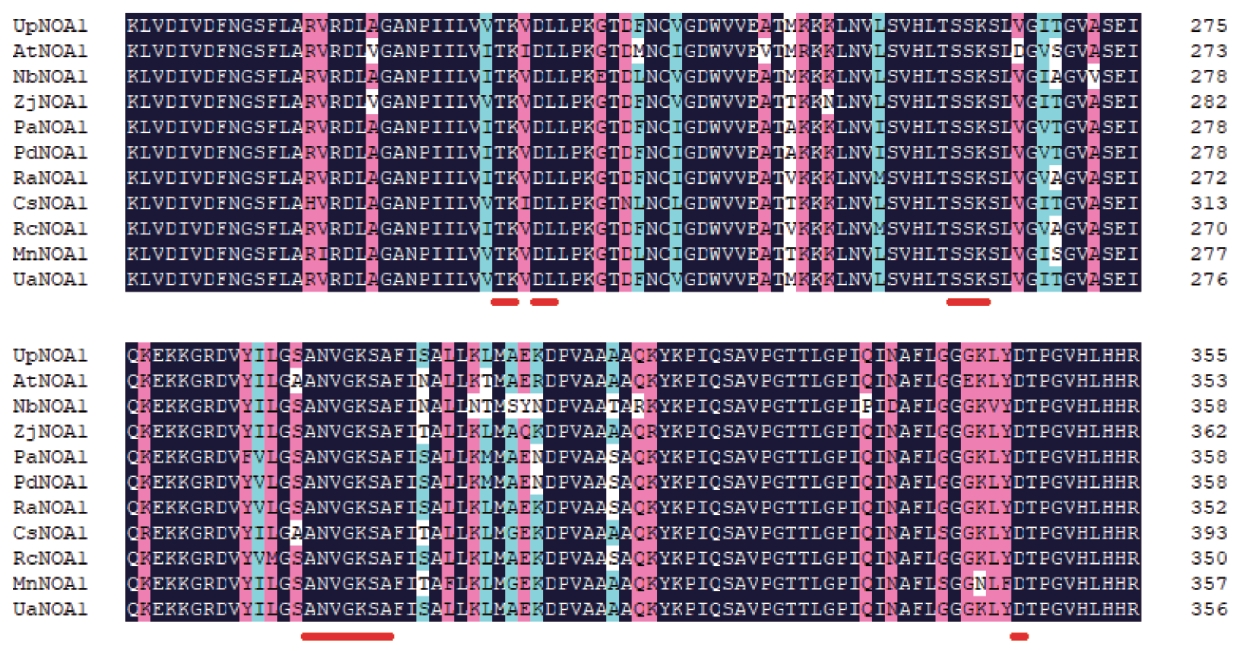
图2 家榆与其他物种NOA1氨基酸的序列比对红线标出氨基酸为GTP结合位点。At:拟南芥;Nb:本氏烟草;Zj:枣;Pa:杏;Pd:扁桃;Ra:黑莓;Cs:大麻;Rc:月季;Mn:桑;Ua:美国榆
Fig. 2 Amino acid sequence alignment of NOA1 from Ulmus pumila and other speciesThe red lines indicate amino acids as GTP-binding sites. At: Arabidopsis thaliana; Nb: Nicotiana benthamiana; Zj: Ziziphus jujuba; Pa: Prunus armeniaca; Pd: Prunus dulcis; Ra: Rubus argutus; Cs: Cannabis sativa; Rc: Rosa chinensis; Mn: Morus notabilis; Ua: Ulmus americana
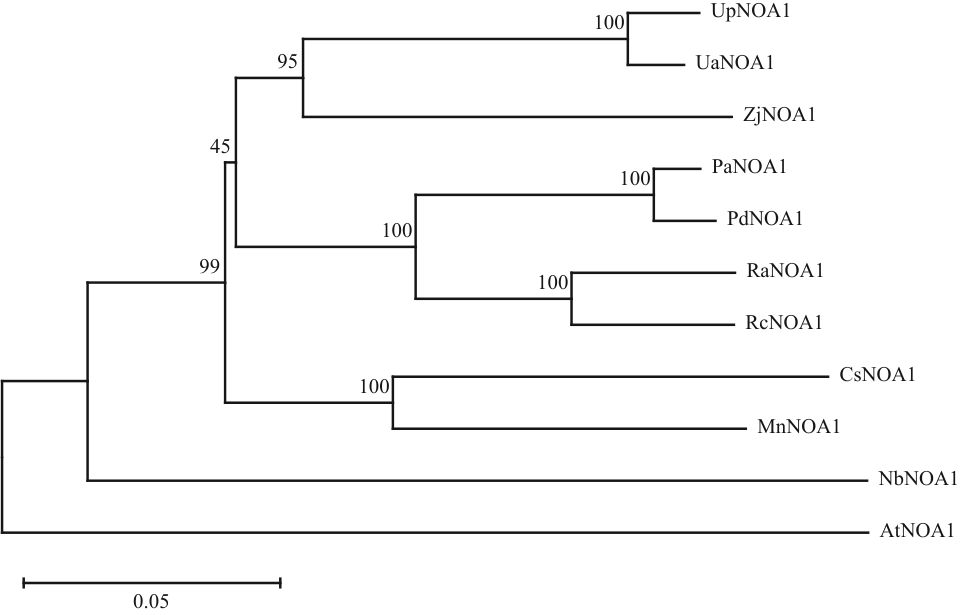
图3 家榆与其他物种NOA1的系统进化树
Fig. 3 Phylogenetic tree of NOA1 from U. pumila and other species
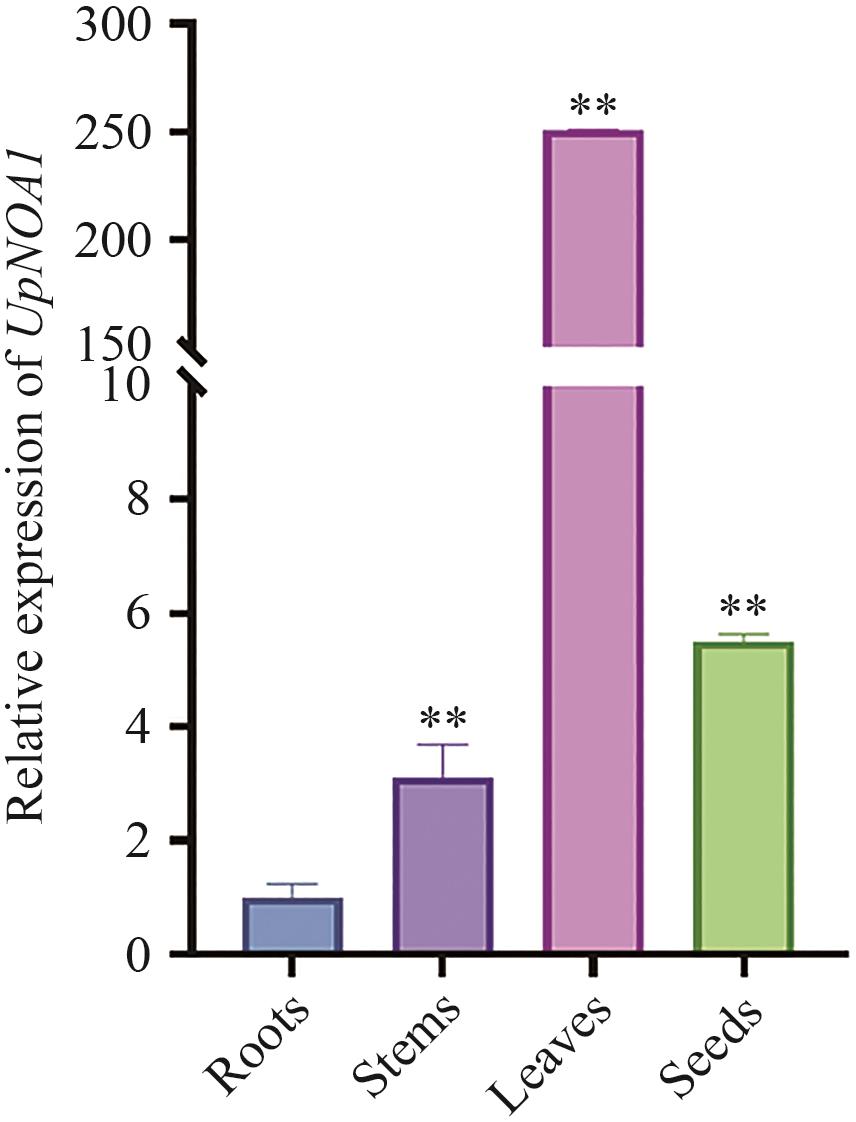
图4 UpNOA1在家榆不同组织中的表达分析** P<0.01
Fig. 4 Gene expressions of UpNOA1 in different tissues of U. pumila

图5 UpNOA1的克隆与原核表达A:UpNOA1的PCR产物电泳图(M:Marker DL2000);B:UpNOA1-His蛋白纯化SDS-PAGE分析图(1:阴性对照;2:原核表达UpNOA1-His蛋白;3:纯化后的UpNOA1-His蛋白);C:家榆UpNOA1的核苷酸及氨基酸序列;D:pMAL-c5x-UpNOA1菌落PCR产物电泳图(M:Marker DL2000;1-10:pMAL-c5x-UpNOA1菌落PCR产物)
Fig. 5 Cloning and prokaryotic expression of UpNOA1A: Electrophoresis analysis of UpNOA1 PCR products (M: Marker DL2000). B: Purification and SDS-PAGE analysis of UpNOA1-His protein (1: negative control; 2: protein sample from prokaryotic expression of UpNOA1-His; 3: the purified UpNOA1-His protein). C: Nucleotide sequence and amino acid sequence of UpNOA1 in U. pumila. D: Electrophoresis analysis of pMAL-c5x-UpNOA1 PCR products from bacterial colony (M: Marker DL2000. 1-10: PCR identification of different colonies of pMAL-c5x-UpNOA1)

图6 His-PULL DOWN筛选互作蛋白SDS-PAGE分析图M:Marker;1:原核表达蛋白;2:原核表达蛋白过Ni-NTA柱流穿液;3:家榆种子总蛋白过UpNOA1-Ni-NTA柱流穿液;4:纯化的UpNOA1诱饵蛋白与其互作蛋白洗脱液;5:家榆种子总蛋白。箭头指示位置为诱饵蛋白条带,红框内为下拉蛋白条带
Fig. 6 SDS-PAGE analysis of interacting proteins screened by His-PULL DOWNM: Marker; 1: protein sample from prokaryotic expression; 2: the prokaryotic expressed protein in lane 1 flowed through the Ni-NTA Agarose; 3: the seed proteins flow through the UpNOA1-Ni-NTA Agarose; 4: purified UpNOA1 bait protein and its interacting protein elutes; 5: total seed protein of U. pumila. The arrow indicates the location of the bait protein strip, and the red box shows the PULL-DOWN protein strip

图7 UpNOA1互作蛋白GO通路(A)及KEGG通路(B)分析
Fig. 7 GO (A) and KEGG (B) pathway analysis of UpNOA1 interacting proteins
序号 Serial number | 蛋白名称 Protein name | 功能注释 Function annotation | 分子量 Molecular weight (kD) | 等电点 Isoelectric point | 蛋白特征性肽段数量 Number of characteristic peptides |
|---|---|---|---|---|---|
| 1 | TRINITY_DN4364_c1_g2 | 预测:热休克70 kD蛋白,线粒体 [葡萄 (Vitis vinifera)] | 30.1 | 9.47 | 1 |
| 2 | TRINITY_DN3442_c0_g1 | 18.1 kD I类热休克蛋白样蛋白 [开心果 (Pistacia vera)] | 17.9 | 5.77 | 1 |
| 3 | TRINITY_DN3511_c0_g1 | 16.9 kD 热休克蛋白 [白桦 (Betula platyphylla)] | 17.5 | 5.71 | 4 |
| 4 | TRINITY_DN4927_c0_g1 | 11S球蛋白前体同工型1A [爱玉子 (Ficus pumila var. awkeotsang)] | 63.2 | 7.02 | 24 |
| 5 | TRINITY_DN1797_c0_g1 | 11-S种子储藏蛋白 [安德森寄生木 (Parasponia andersonii)] | 67.4 | 6.83 | 25 |
| 6 | TRINITY_DN7461_c0_g1 | 类似球蛋白的种子储藏蛋白 At2g28490 [显著桑 (Morus notabilis)] | 63.1 | 6.01 | 14 |
| 7 | TRINITY_DN14490_c0_g1 | 晚期胚胎发生丰富蛋白,第3类 [显著桑 (Morus notabilis)] | 14.1 | 4.92 | 5 |
| 8 | TRINITY_DN17317_c0_g1 | 2-Cys过氧化物还原酶BAS1,叶绿体 [普通山羊草 (Aegilops tauschii subsp. tauschii)] | 26.9 | 6.35 | 1 |
| 9 | TRINITY_DN28842_c0_g1 | 甘油醛-3-磷酸脱氢酶,胞质型 [向日葵 (Helianthus annuus)] | 21.7 | 5.95 | 2 |
| 10 | TRINITY_DN1098_c0_g5 | 超氧化物歧化酶,部分序列 [欧洲山毛榉 (Fagus sylvatica)] | 18.5 | 7.09 | 2 |
| 11 | TRINITY_DN4794_c0_g1 | 种子生物素结合蛋白SBP65类似蛋白 [石榴 (Punica granatum)] | 34.1 | 6.61 | 1 |
| 12 | TRINITY_DN6469_c0_g1 | 抗渗蛋白类似蛋白 [加州栎 (Quercus lobata)] | 27.0 | 7.61 | 4 |
| 13 | TRINITY_DN5650_c0_g3 | 假定蛋白 EUGRSUZ_I01938 [巨桉 (Eucalyptus grandis)] | 21.5 | 9.72 | 3 |
| 14 | TRINITY_DN17167_c0_g1 | 光合作用NDH复合体类囊体腔定位亚基5 (PNSL5),叶绿体 [向日葵 (Helianthus annuus)] | 20.5 | 8.68 | 1 |
| 15 | TRINITY_DN12443_c0_g1 | 未注释蛋白 LOC115700795 同工型 X2 [大麻 (Cannabis sativa)] | 19.9 | 7.88 | 5 |
| 16 | TRINITY_DN10189_c0_g1 | 富甘氨酸蛋白2类似蛋白 [枣 (Ziziphus jujuba)] | 18.9 | 6.74 | 2 |
| 17 | TRINITY_DN18240_c0_g1 | 富甘氨酸RNA结合蛋白 [番茄 (Solanum lycopersicum)] | 17.3 | 5.71 | 1 |
| 18 | TRINITY_DN4384_c0_g1 | 预测:有丝分裂检查点蛋白BUB3.3类似蛋白 [欧洲野草莓 (Fragaria vesca subsp. vesca)] | 17.4 | 5.99 | 5 |
| 19 | TRINITY_DN175_c4_g1 | 预测:UPF0098蛋白 CPn_0877/CP_0992/CPj0877/CpB0906 [梅花 (Prunus mume)] | 18.4 | 5.59 | 5 |
| 20 | TRINITY_DN43339_c0_g1 | 假定蛋白 EW026_g2737 [Phlebia centrifuga] | 24.0 | 6.05 | 1 |
| 21 | TRINITY_DN12101_c0_g2 | GTP结合蛋白SAR1A类似蛋白 [Rhodamnia argentea] | 22.1 | 7.47 | 5 |
| 22 | TRINITY_DN17498_c0_g5 | 推定小GTP酶超家族,Rab类型 [牛樟 (Cinnamomum micranthum f. kanehirae)] | 11.7 | 9.41 | 1 |
| 23 | TRINITY_DN6469_c0_g1 | 类渗透蛋白 [加州栎 (Quercus lobata)] | 27.0 | 7.61 | 4 |
| 24 | TRINITY_DN12488_c0_g1 | 生长素结合蛋白ABP19a类似蛋白 [月季 (Rosa chinensis)] | 21.5 | 9.06 | 1 |
| 25 | TRINITY_DN1250_c0_g1 | 推定4-羟基-4-甲基-2-氧代戊二酸醛缩酶2 [桑树 (Morus notabilis)] | 17.7 | 5.99 | 3 |
表2 UpNOA1互作候选蛋白
Table 2 Candidates of UpNOA1 interacting proteins
序号 Serial number | 蛋白名称 Protein name | 功能注释 Function annotation | 分子量 Molecular weight (kD) | 等电点 Isoelectric point | 蛋白特征性肽段数量 Number of characteristic peptides |
|---|---|---|---|---|---|
| 1 | TRINITY_DN4364_c1_g2 | 预测:热休克70 kD蛋白,线粒体 [葡萄 (Vitis vinifera)] | 30.1 | 9.47 | 1 |
| 2 | TRINITY_DN3442_c0_g1 | 18.1 kD I类热休克蛋白样蛋白 [开心果 (Pistacia vera)] | 17.9 | 5.77 | 1 |
| 3 | TRINITY_DN3511_c0_g1 | 16.9 kD 热休克蛋白 [白桦 (Betula platyphylla)] | 17.5 | 5.71 | 4 |
| 4 | TRINITY_DN4927_c0_g1 | 11S球蛋白前体同工型1A [爱玉子 (Ficus pumila var. awkeotsang)] | 63.2 | 7.02 | 24 |
| 5 | TRINITY_DN1797_c0_g1 | 11-S种子储藏蛋白 [安德森寄生木 (Parasponia andersonii)] | 67.4 | 6.83 | 25 |
| 6 | TRINITY_DN7461_c0_g1 | 类似球蛋白的种子储藏蛋白 At2g28490 [显著桑 (Morus notabilis)] | 63.1 | 6.01 | 14 |
| 7 | TRINITY_DN14490_c0_g1 | 晚期胚胎发生丰富蛋白,第3类 [显著桑 (Morus notabilis)] | 14.1 | 4.92 | 5 |
| 8 | TRINITY_DN17317_c0_g1 | 2-Cys过氧化物还原酶BAS1,叶绿体 [普通山羊草 (Aegilops tauschii subsp. tauschii)] | 26.9 | 6.35 | 1 |
| 9 | TRINITY_DN28842_c0_g1 | 甘油醛-3-磷酸脱氢酶,胞质型 [向日葵 (Helianthus annuus)] | 21.7 | 5.95 | 2 |
| 10 | TRINITY_DN1098_c0_g5 | 超氧化物歧化酶,部分序列 [欧洲山毛榉 (Fagus sylvatica)] | 18.5 | 7.09 | 2 |
| 11 | TRINITY_DN4794_c0_g1 | 种子生物素结合蛋白SBP65类似蛋白 [石榴 (Punica granatum)] | 34.1 | 6.61 | 1 |
| 12 | TRINITY_DN6469_c0_g1 | 抗渗蛋白类似蛋白 [加州栎 (Quercus lobata)] | 27.0 | 7.61 | 4 |
| 13 | TRINITY_DN5650_c0_g3 | 假定蛋白 EUGRSUZ_I01938 [巨桉 (Eucalyptus grandis)] | 21.5 | 9.72 | 3 |
| 14 | TRINITY_DN17167_c0_g1 | 光合作用NDH复合体类囊体腔定位亚基5 (PNSL5),叶绿体 [向日葵 (Helianthus annuus)] | 20.5 | 8.68 | 1 |
| 15 | TRINITY_DN12443_c0_g1 | 未注释蛋白 LOC115700795 同工型 X2 [大麻 (Cannabis sativa)] | 19.9 | 7.88 | 5 |
| 16 | TRINITY_DN10189_c0_g1 | 富甘氨酸蛋白2类似蛋白 [枣 (Ziziphus jujuba)] | 18.9 | 6.74 | 2 |
| 17 | TRINITY_DN18240_c0_g1 | 富甘氨酸RNA结合蛋白 [番茄 (Solanum lycopersicum)] | 17.3 | 5.71 | 1 |
| 18 | TRINITY_DN4384_c0_g1 | 预测:有丝分裂检查点蛋白BUB3.3类似蛋白 [欧洲野草莓 (Fragaria vesca subsp. vesca)] | 17.4 | 5.99 | 5 |
| 19 | TRINITY_DN175_c4_g1 | 预测:UPF0098蛋白 CPn_0877/CP_0992/CPj0877/CpB0906 [梅花 (Prunus mume)] | 18.4 | 5.59 | 5 |
| 20 | TRINITY_DN43339_c0_g1 | 假定蛋白 EW026_g2737 [Phlebia centrifuga] | 24.0 | 6.05 | 1 |
| 21 | TRINITY_DN12101_c0_g2 | GTP结合蛋白SAR1A类似蛋白 [Rhodamnia argentea] | 22.1 | 7.47 | 5 |
| 22 | TRINITY_DN17498_c0_g5 | 推定小GTP酶超家族,Rab类型 [牛樟 (Cinnamomum micranthum f. kanehirae)] | 11.7 | 9.41 | 1 |
| 23 | TRINITY_DN6469_c0_g1 | 类渗透蛋白 [加州栎 (Quercus lobata)] | 27.0 | 7.61 | 4 |
| 24 | TRINITY_DN12488_c0_g1 | 生长素结合蛋白ABP19a类似蛋白 [月季 (Rosa chinensis)] | 21.5 | 9.06 | 1 |
| 25 | TRINITY_DN1250_c0_g1 | 推定4-羟基-4-甲基-2-氧代戊二酸醛缩酶2 [桑树 (Morus notabilis)] | 17.7 | 5.99 | 3 |
| 1 | 王亚骋. 木本食材活性成分研究 [D]. 郑州: 河南农业大学, 2022. |
| Wang YC. Study on active components of woody food materials [D]. Zhengzhou: Henan Agricultural University, 2022. | |
| 2 | Jeong C, Lee CH, Seo J, et al. Catechin and flavonoid glycosides from the Ulmus genus: exploring their nutritional pharmacology and therapeutic potential in osteoporosis and inflammatory conditions [J]. Fitoterapia, 2024, 178: 106188. |
| 3 | Kim I, Seo J, Lee DH, et al. Ulmus davidiana 60% edible ethanolic extract for prevention of pericyte apoptosis in diabetic retinopathy [J]. Front Endocrinol, 2023, 14: 1138676. |
| 4 | Kim K, Veerappan K, Woo N, et al. Ulmus macrocarpa Hance extract modulates intestinal microbiota in healthy adults: a randomized, placebo-controlled clinical trial [J]. J Microbiol, 2021, 59(12): 1150-1156. |
| 5 | 张畅, 姜卫兵, 韩健. 论榆树及其在园林绿化中的应用 [J]. 中国农学通报, 2010, 26(10): 202-206. |
| Zhang C, Jiang WB, Han J. On Ulmus pumila Linn. and its application in landscape architecture [J]. Chin Agric Sci Bull, 2010, 26(10): 202-206. | |
| 6 | 陈昂, 杨秀春, 徐斌, 等. 基于面向对象与深度学习的榆树疏林识别方法研究 [J]. 地球信息科学学报, 2020, 22(9): 1897-1909. |
| Chen A, Yang XC, Xu B, et al. Research on recognition methods of elm sparse forest based on object-based image analysis and deep learning [J]. J Geo Inf Sci, 2020, 22(9): 1897-1909. | |
| 7 | Corpas FJ, González-Gordo S, Cañas A, et al. Nitric oxide and hydrogen sulfide in plants: which comes first? [J]. J Exp Bot, 2019, 70(17): 4391-4404. |
| 8 | Ciacka K, Staszek P, Sobczynska K, et al. Nitric oxide in seed biology [J]. Int J Mol Sci, 2022, 23(23): 14951. |
| 9 | Zhang Y, Wang RR, Wang XD, et al. Nitric oxide regulates seed germination by integrating multiple signalling pathways [J]. Int J Mol Sci, 2023, 24(10): 9052. |
| 10 | Corpas FJ, González-Gordo S, Palma JM. NO source in higher plants: present and future of an unresolved question [J]. Trends Plant Sci, 2022, 27(2): 116-119. |
| 11 | Allagulova CR, Lubyanova AR, Avalbaev AM. Multiple ways of nitric oxide production in plants and its functional activity under abiotic stress conditions [J]. Int J Mol Sci, 2023, 24(14): 11637. |
| 12 | Moreau M, Lee GI, Wang YZ, et al. AtNOS/AtNOA1 is a functional Arabidopsis thaliana cGTPase and not a nitric-oxide synthase [J]. J Biol Chem, 2008, 283(47): 32957-32967. |
| 13 | Xie YJ, Mao Y, Lai DW, et al. Roles of NIA/NR/NOA1-dependent nitric oxide production and HY1 expression in the modulation of Arabidopsis salt tolerance [J]. J Exp Bot, 2013, 64(10): 3045-3060. |
| 14 | Wiśniewski JR, Zougman A, Nagaraj N, et al. Universal sample preparation method for proteome analysis [J]. Nat Meth, 2009, 6: 359-362. |
| 15 | Astier J, Gross I, Durner J. Nitric oxide production in plants: an update [J]. J Exp Bot, 2018, 69(14): 3401-3411. |
| 16 | 石武良. 拟南芥一氧化氮合成相关蛋白(AtNOA1)的生物学功能研究 [D]. 厦门: 厦门大学, 2009. |
| Shi WL. Study on biological function of nitric oxide associated protein 1 (AtNOA1) in Arabidopsis thaliana [D]. Xiamen: Xiamen University, 2009. | |
| 17 | Wang JY, Chitsaz F, Derbyshire MK, et al. The conserved domain database in 2023 [J]. Nucleic Acids Res, 2023, 51(D1): D384-D388. |
| 18 | Liu XW, Liu B, Xue SD, et al. Cucumber (Cucumis sativus L.) nitric oxide synthase associated Gene1 (CsNOA1) plays a role in chilling stress [J]. Front Plant Sci, 2016, 7: 1652. |
| 19 | Du ST, Zhang RR, Zhang P, et al. Elevated CO2-induced production of nitric oxide (NO) by NO synthase differentially affects nitrate reductase activity in Arabidopsis plants under different nitrate supplies [J]. J Exp Bot, 2016, 67(3): 893-904. |
| 20 | Zhao G, Zhao YY, Yu XL, et al. Nitric oxide is required for melatonin-enhanced tolerance against salinity stress in rapeseed (Brassica napus L.) seedlings [J]. Int J Mol Sci, 2018, 19(7): 1912. |
| 21 | Santisree P, Sanivarapu H, Gundavarapu S, et al. Nitric oxide as a signal in inducing secondary metabolites during plant stress [M]//Co-Evolution of Secondary Metabolites. Cham: Springer International Publishing, 2020: 593-621. |
| 22 | Lozano-Juste J, León J. Enhanced abscisic acid-mediated responses in nia1nia2noa1-2 triple mutant impaired in NIA/NR- and AtNOA1-dependent nitric oxide biosynthesis in Arabidopsis [J]. Plant Physiol, 2010, 152(2): 891-903. |
| 23 | Heidler J, Al-Furoukh N, Kukat C, et al. Nitric oxide-associated protein 1 (NOA1) is necessary for oxygen-dependent regulation of mitochondrial respiratory complexes [J]. J Biol Chem, 2011, 286(37): 32086-32093. |
| 24 | Kolanczyk M, Pech M, Zemojtel T, et al. NOA1 is an essential GTPase required for mitochondrial protein synthesis [J]. Mol Biol Cell, 2011, 22(1): 1-11. |
| 25 | Al-Furoukh N, Kardon JR, Krüger M, et al. NOA1, a novel ClpXP substrate, takes an unexpected nuclear detour prior to mitochondrial import [J]. PLoS One, 2014, 9(7): e103141. |
| 26 | 王进. AtNOAl响应SA调节拟南芥根波动性生长机制研究 [D]. 开封: 河南大学, 2013. |
| Wang J. Mechanism of AtNOA1 in regulation of SA induced root waving in Arabidopsis thaliana [D]. Kaifeng: Henan University, 2013. | |
| 27 | Li CL, Shen Y, Meeley R, et al. Embryo defective 14 encodes a plastid-targeted cGTPase essential for embryogenesis in maize [J]. Plant J, 2015, 84(4): 785-799. |
| 28 | Hillen HS, Lavdovskaia E, Nadler F, et al. Structural basis of GTPase-mediated mitochondrial ribosome biogenesis and recycling [J]. Nat Commun, 2021, 12(1): 3672. |
| 29 | Kondadi AK, Anand R, Reichert AS. Cristae membrane dynamics-A paradigm change [J]. Trends Cell Biol, 2020, 30(12): 923-936. |
| 30 | Gruffaz C, Smirnov A. GTPase Era at the heart of ribosome assembly [J]. Front Mol Biosci, 2023, 10: 1263433. |
| 31 | Loh PC, Morimoto T, Matsuo Y, et al. The GTP-binding protein YqeH participates in biogenesis of the 30S ribosome subunit in Bacillus subtilis [J]. Genes Genet Syst, 2007, 82(4): 281-289. |
| 32 | Hwang J, Inouye M. The tandem GTPase, Der, is essential for the biogenesis of 50S ribosomal subunits in Escherichia coli [J]. Mol Microbiol, 2006, 61(6): 1660-1672. |
| 33 | Qi YF, Zhao J, An R, et al. Mutations in circularly permuted GTPase family genes AtNOA1/RIF1/SVR10 and BPG2 suppress var2-mediated leaf variegation in Arabidopsis thaliana [J]. Photosynth Res, 2016, 127(3): 355-367. |
| 34 | Yang QS, He H, Li HY, et al. NOA1 functions in a temperature-dependent manner to regulate chlorophyll biosynthesis and Rubisco formation in rice [J]. PLoS One, 2011, 6(5): e20015. |
| 35 | 张玲玲, 吴丹, 赵子捷, 等. 植物一氧化氮信号分子的研究进展 [J]. 植物学报, 2017, 52(3): 337-345. |
| Zhang LL, Wu D, Zhao ZJ, et al. Research progress in nitric oxide signaling molecule in plants [J]. Chin Bull Bot, 2017, 52(3): 337-345. | |
| 36 | Chen LT, Shiotani K, Togashi T, et al. Analysis of the Rac/Rop small GTPase family in rice: expression, subcellular localization and role in disease resistance [J]. Plant Cell Physiol, 2010, 51(4): 585-595. |
| 37 | 高媛, 薛艳红, 刘士平. 植物抗氧化动态平衡研究进展 [J]. 生物资源, 2019, 41(1): 14-21. |
| Gao Y, Xue YH, Liu SP. Advances in antioxidative stress metabolism in plants [J]. Biotic Resour, 2019, 41(1): 14-21. | |
| 38 | Ahmad B, Mukarram M, Choudhary S, et al. Adaptive responses of nitric oxide (NO) and its intricate dialogue with phytohormones during salinity stress [J]. Plant Physiol Biochem, 2024, 208: 108504. |
| 39 | Sánchez-Vicente I, Lechón T, Fernández-Marcos M, et al. Nitric oxide alters the pattern of auxin maxima and PIN-FORMED1 during shoot development [J]. Front Plant Sci, 2021, 12: 630792. |
| 40 | Liu M, Zhang HH, Fang XZ, et al. Auxin acts downstream of ethylene and nitric oxide to regulate magnesium deficiency-induced root hair development in Arabidopsis thaliana [J]. Plant Cell Physiol, 2018, 59(7): 1452-1465. |
| 41 | Yu YQ, Tang WX, Lin WW, et al. ABLs and TMKs are co-receptors for extracellular auxin [J]. Cell, 2023, 186(25): 5457-5471. |
| [1] | 曲珊, 赵月, 李雅华, 郑桂玲, 咸洪泉. 调控棘孢木霉几丁质酶Tachi2基因的转录因子和蛋白的互作研究[J]. 生物技术通报, 2025, 41(5): 310-319. |
| [2] | 刘丽, 王辉, 关天舒, 李柏宏, 于舒怡. 葡萄脱落酸受体VvPYL4互作蛋白的筛选及互作蛋白基因表达[J]. 生物技术通报, 2025, 41(4): 188-197. |
| [3] | 沈川, 李夏, 覃剑锋, 段龙飞, 刘佳. 基于软腐病菌诱导的魔芋酵母双杂交文库筛选WRKY72互作蛋白[J]. 生物技术通报, 2025, 41(1): 85-94. |
| [4] | 邢丽南, 张艳芳, 葛明然, 赵令敏, 陈妍, 霍秀文. 山药DoWRKY40基因表达特征分析及互作蛋白筛选[J]. 生物技术通报, 2024, 40(8): 118-128. |
| [5] | 王秋月, 段鹏亮, 李海笑, 刘宁, 曹志艳, 董金皋. 玉米大斑病菌cDNA文库的构建及转录因子StMR1互作蛋白的筛选[J]. 生物技术通报, 2024, 40(6): 281-289. |
| [6] | 阿丽亚·外力, 陈永坤, 克拉热木·克里木江, 王宝庆, 陈凌娜. 核桃SPL基因家族的系统进化和表达分析[J]. 生物技术通报, 2024, 40(6): 180-189. |
| [7] | 任延靖, 张鲁刚, 赵孟良, 李江, 邵登魁. 白菜种子cDNA酵母文库的构建及BrTTG1互作蛋白的筛选及分析[J]. 生物技术通报, 2024, 40(2): 223-232. |
| [8] | 温晓蕾, 李建嫄, 李娜, 张娜, 杨文香. 小麦叶锈菌与小麦互作的酵母双杂交cDNA文库构建与应用[J]. 生物技术通报, 2023, 39(9): 136-146. |
| [9] | 王艺清, 王涛, 韦朝领, 戴浩民, 曹士先, 孙威江, 曾雯. 茶树SMAS基因家族的鉴定及互作分析[J]. 生物技术通报, 2023, 39(4): 246-258. |
| [10] | 王涛, 漆思雨, 韦朝领, 王艺清, 戴浩民, 周喆, 曹士先, 曾雯, 孙威江. CsPPR和CsCPN60-like在茶树白化叶片中的表达分析及互作蛋白验证[J]. 生物技术通报, 2023, 39(3): 218-231. |
| [11] | 蔡佳, 梁振宇, 黄瑜, 鲁义善, 施钢, 简纪常. 利用酵母双杂交系统筛选与鉴定石斑鱼EcBAG3互作因子[J]. 生物技术通报, 2022, 38(8): 77-83. |
| [12] | 刘娟, 朱春晓, 肖雪琼, 莫陈汨, 王高峰, 肖炎农. 淡紫紫孢菌亲环蛋白PlCYP6 互作蛋白的筛选[J]. 生物技术通报, 2021, 37(7): 137-145. |
| [13] | 杨华杰, 周玉萍, 范甜, 吕天晓, 谢楚萍, 田长恩. 拟南芥IQM4互作蛋白的筛选和鉴定[J]. 生物技术通报, 2021, 37(11): 190-196. |
| [14] | 郝小花, 戴佳利, 暨文劲, 黄丹, 李东屏, 田连福. 水稻籽粒低镉蛋白LCD互作蛋白的筛选与鉴定[J]. 生物技术通报, 2020, 36(11): 21-29. |
| [15] | 钟李婷, 陈秀珍, 唐云, 李俊仁, 王小兵, 刘彦婷, 周璇璇, 詹若挺, 陈立凯. 广藿香FPPS重组蛋白表达及互作蛋白筛选分析[J]. 生物技术通报, 2019, 35(12): 10-15. |
| 阅读次数 | ||||||
|
全文 |
|
|||||
|
摘要 |
|
|||||
