







生物技术通报 ›› 2026, Vol. 42 ›› Issue (4): 287-296.doi: 10.13560/j.cnki.biotech.bull.1985.2025-0755
张建霞( ), 姜成英(), 吴文俊, 金高明, 张聪聪, 姚玉芳, 张荣, 戚建莉
收稿日期:2025-07-10
出版日期:2026-04-26
发布日期:2026-04-30
通讯作者:
姜成英,女,研究员,研究方向 :经济林;E-mail: jcytxb@126.com作者简介:张建霞,女,硕士,助理研究员,研究方向 :经济林;E-mail: 3457010090@qq.com
基金资助:
ZHANG Jian-xia(), JIANG Cheng-ying(), WU Wen-jun, JIN Gao-ming, ZHANG Cong-cong, YAO Yu-fang, ZHANG Rong, QI Jian-li
Received:2025-07-10
Published:2026-04-26
Online:2026-04-30
摘要:
目的 探究非传统油橄榄种植区甘肃陇南不同土壤条件(黄土、片岩土、泥石流冲积扇土)对油橄榄根际微生物的影响,为优化栽培技术提供依据。 方法 以陇南市武都区种植的15年生‘莱星’油橄榄为对象,测定根际土壤理化性质,通过宏基因组测序分析细菌群落结构与功能。 结果 3种土壤pH均呈弱碱性(7.87-7.93),泥石流冲积扇土(Cs)的速效氮(186.03 mg/kg)、全磷(2.23 g/kg)、有机质(64.58 g/kg)等养分含量显著高于黄土(As)和片岩土(Bs)。根际与根内微生物均以放线菌门和变形菌门为优势菌群,Cs土壤中放线菌门丰度显著。PCA分析显示根内微生物群落结构相似,而根际微生物中Bs与Cs聚为一类,与As差异显著,LEfSe分析进一步明确了不同分组的差异物种。冗余分析表明土壤pH、全氮、全磷、有机质是驱动微生物群落变异的主因,解释量达99.28%,其中放线菌门与全氮、全磷、有机质呈显著正相关。KEGG功能注释显示以代谢功能为主,且Cs土壤的氮循环相关基因丰度较高。 结论 土壤类型通过改变养分有效性及pH显著调控微生物群落结构与功能,泥石流冲积扇土因高养分含量及适宜pH更利于富集菌群,可作为油橄榄园选址的优先参考,为提升油橄榄种植效益提供了科学依据。
张建霞, 姜成英, 吴文俊, 金高明, 张聪聪, 姚玉芳, 张荣, 戚建莉. 不同土壤条件下油橄榄园根际土壤理化性质及细菌群落特征[J]. 生物技术通报, 2026, 42(4): 287-296.
ZHANG Jian-xia, JIANG Cheng-ying, WU Wen-jun, JIN Gao-ming, ZHANG Cong-cong, YAO Yu-fang, ZHANG Rong, QI Jian-li. Physicochemical Properties and Bacterial Community Characteristics of Rhizosphere Soil in Olive Orchards under Different Soil Conditions[J]. Biotechnology Bulletin, 2026, 42(4): 287-296.
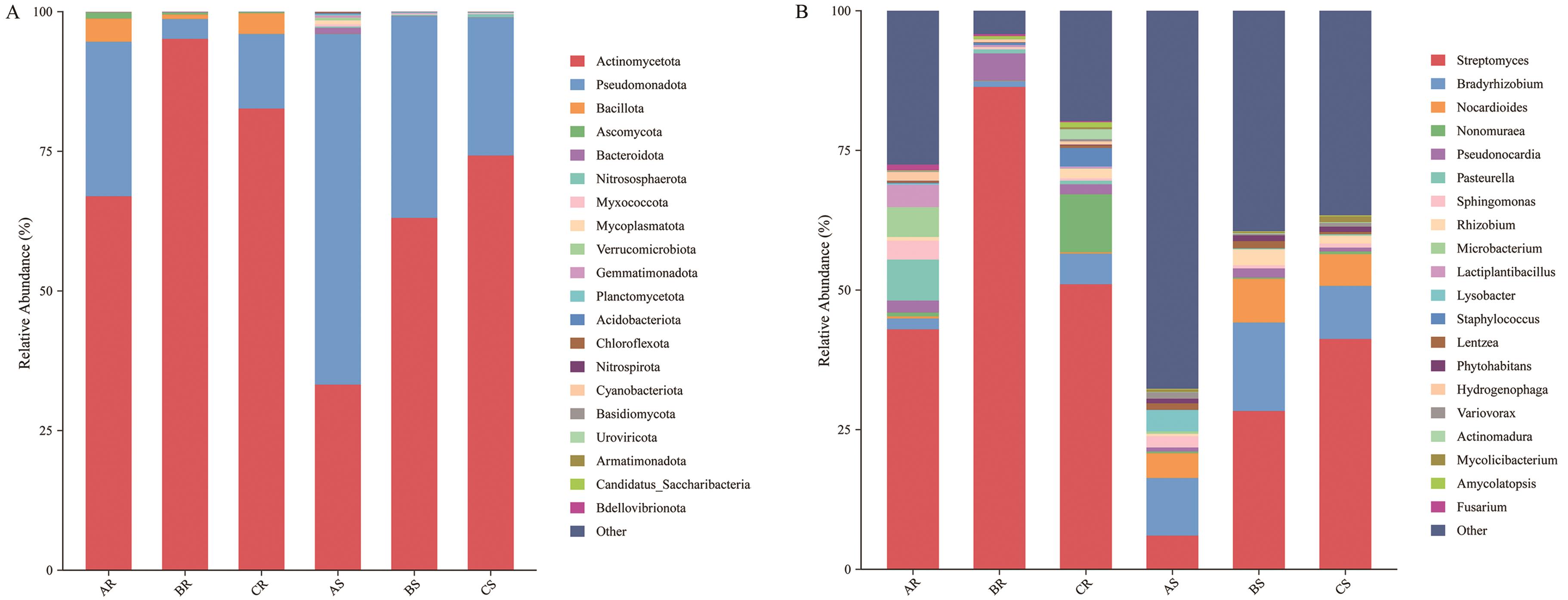
图1 不同土壤条件橄榄园根际土壤微生物门级(A)和属级(B)水平上的物种组成
Fig. 1 Microbial community composition at the phylum (a) and genus (b) levels in the rhizosphere soil of olive orchards under different soil conditions
| 类型Type | pH | 速效氮 AN(mg/kg) | 全氮 TN(mg/g) | 速效磷 AP(mg/kg) | 全磷 TP(g/kg) | 全钾 TK(g/kg) | 速效钾 AK(mg/kg) | 有机质 OM(g/kg) |
|---|---|---|---|---|---|---|---|---|
| As | 7.93±0.03a | 40.83±0.74b | 0.81±0.00a | 11.62±0.22b | 0.72±0.02a | 11.47±0.20b | 86.86±2.86b | 10.48±0.52a |
| Bs | 7.90±0.04a | 19.98±0.89a | 1.65±0.05b | 10.89±0.10a | 0.9±0.01b | 21.28±0.28c | 42.08±0.56a | 22.15±0.66b |
| Cs | 7.87±0.05a | 186.03±0.82c | 3.47±0.06c | 33.81±0.21c | 2.23±0.03c | 10.95±0.12a | 124.87±0.30c | 64.58±1.41c |
表1 油橄榄土壤理化性质统计
Table 1 Statistical summary of soil physicochemical properties for olive trees
| 类型Type | pH | 速效氮 AN(mg/kg) | 全氮 TN(mg/g) | 速效磷 AP(mg/kg) | 全磷 TP(g/kg) | 全钾 TK(g/kg) | 速效钾 AK(mg/kg) | 有机质 OM(g/kg) |
|---|---|---|---|---|---|---|---|---|
| As | 7.93±0.03a | 40.83±0.74b | 0.81±0.00a | 11.62±0.22b | 0.72±0.02a | 11.47±0.20b | 86.86±2.86b | 10.48±0.52a |
| Bs | 7.90±0.04a | 19.98±0.89a | 1.65±0.05b | 10.89±0.10a | 0.9±0.01b | 21.28±0.28c | 42.08±0.56a | 22.15±0.66b |
| Cs | 7.87±0.05a | 186.03±0.82c | 3.47±0.06c | 33.81±0.21c | 2.23±0.03c | 10.95±0.12a | 124.87±0.30c | 64.58±1.41c |
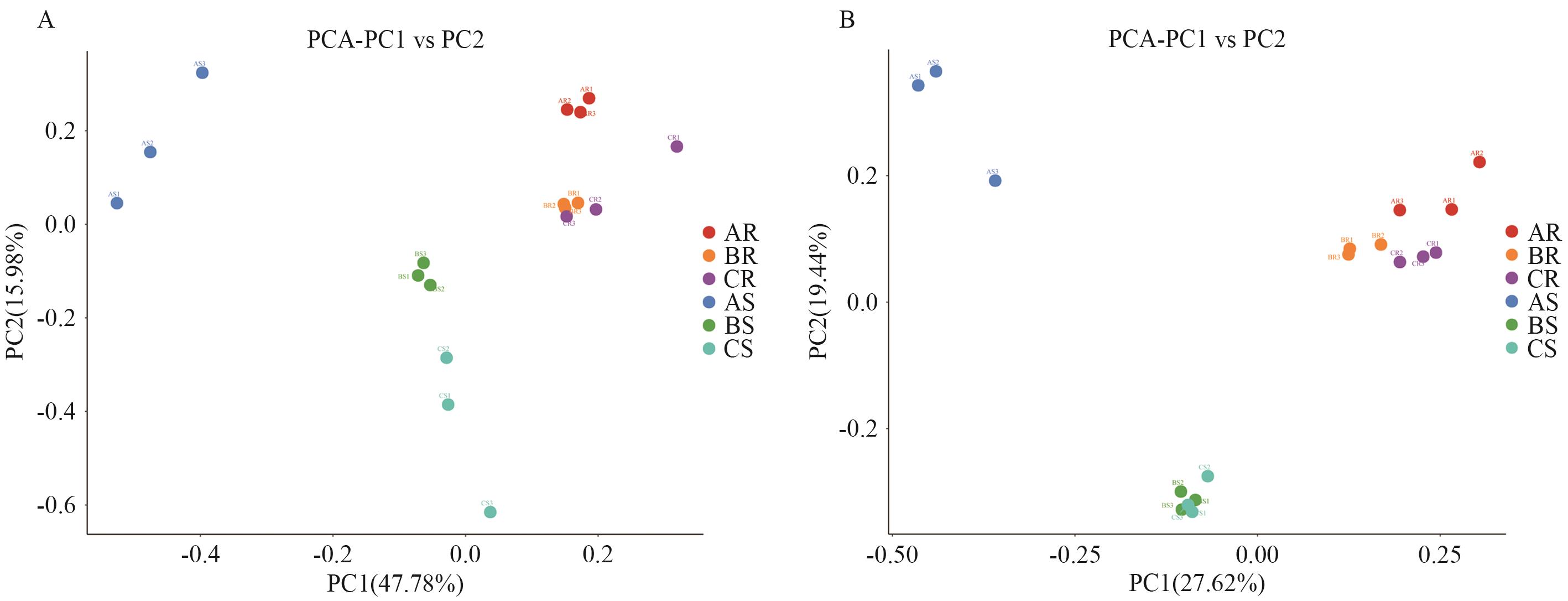
图2 不同土壤条件橄榄园根际土壤微生物门(A)和属(B)水平上的主成分分析
Fig. 2 Principal component analysis (PCA) of microbial communities at the phylum (A) and genus (B) levels in the rhizosphere soil of olive orchards under different soil conditions
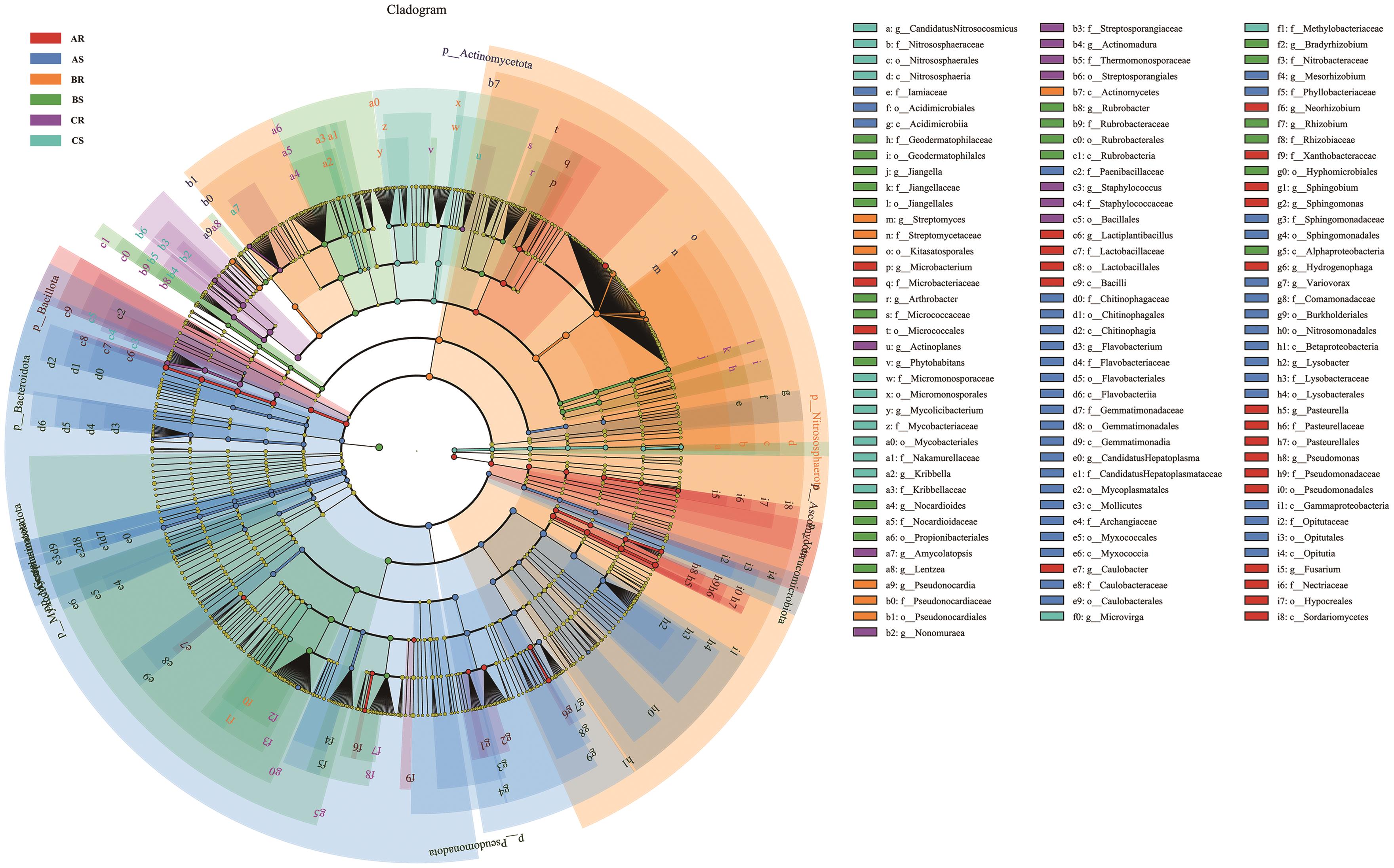
图3 不同油橄榄园土壤细菌LEfSe分析圈从外到里的分类水平依次为门、纲、目、科、属。各颜色的点表示在其组别中重要的真菌类群,黄色的点表示在各组中丰度差异不显著的真菌类群
Fig. 3 LEfSe analysis of soil bacteria in different olive orchardsThe circles from the outermost to the innermost refer tothe taxonomic levels of phylum, class, order, family, and genus, respectively. The colored dots indicate important fungal groups within each category, while the yellow dots denotefungal groups that do not show significant differences in abundance across the groups
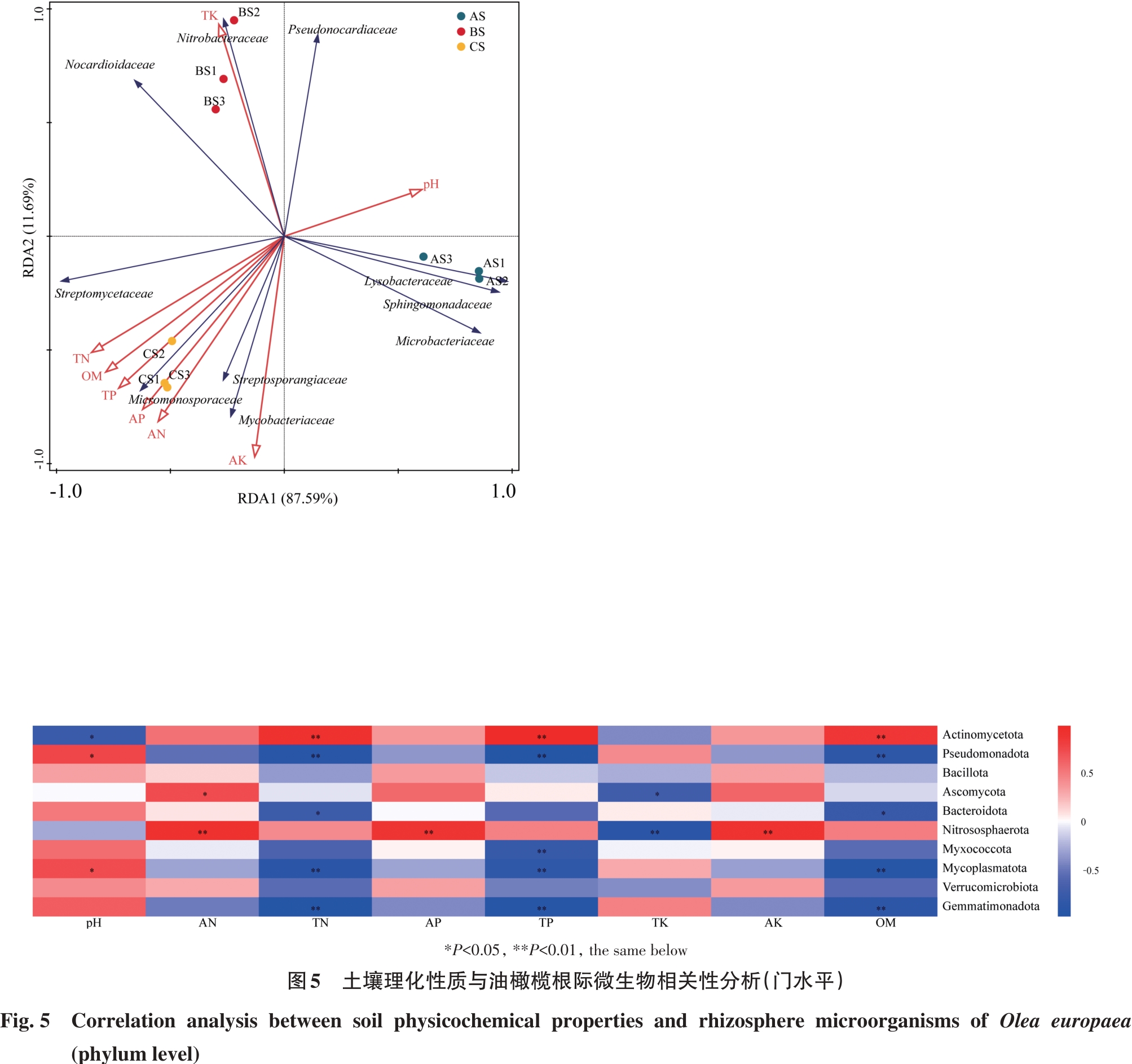
图4 油橄榄根际土壤细菌群落丰度前10物种(属水平)与环境因子的冗余分析
Fig. 4 Redundancy analysis of the top 10 most abundant bacterial genera in the rhizosphere soil of olive trees and environmental factors
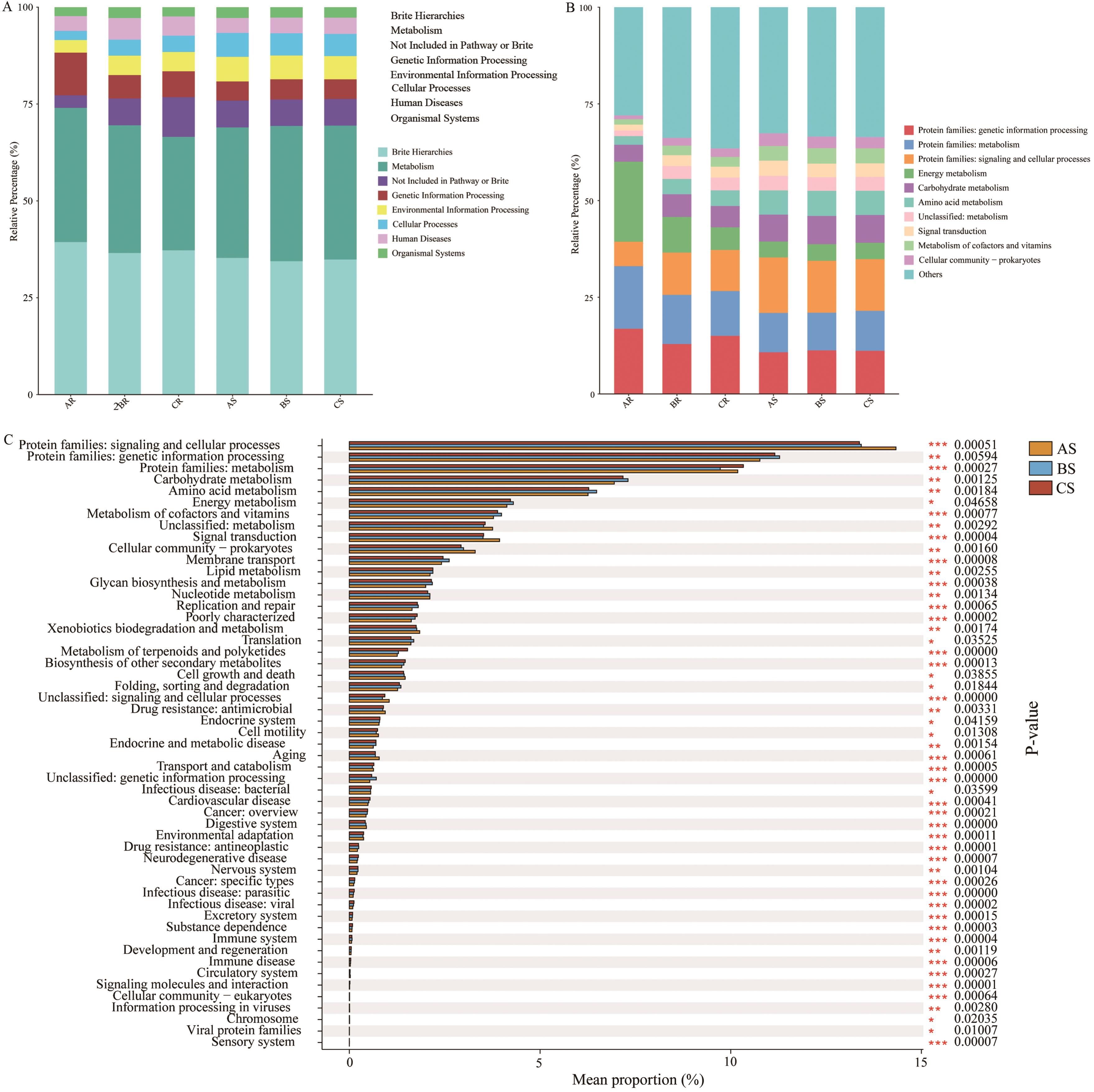
图6 不同土壤条件橄榄园根际土壤微生物在level 1 (A)、 level 2 (B)和 level 3 (C)上的功能组成
Fig. 6 Functional composition of rhizosphere soil microorganisms in olive orchards under different soil conditions at level 1 (A), level 2 (B) and level 3(C) functional categories

图7 土壤环境因子与油橄榄根际微生物主要功能的相关性(KEGG)
Fig. 7 Correlation between soil environmental factors and key microbial functions in the rhizosphere of olive trees (KEGG)
| [1] | Pereira AP, Ferreira IC, Marcelino F, et al. Phenolic compounds and antimicrobial activity of olive (Olea europaea L. cv. cobrançosa) leaves [J]. Molecules, 2007, 12(5): 1153-1162. |
| [2] | Schwingshackl L, Hoffmann G. Monounsaturated fatty acids, olive oil and health status: a systematic review and meta-analysis of cohort studies [J]. Lipds Health Dis, 2014, 13(1): 154. |
| [3] | 龙伟, 曾燕如, 盛建喜. 我国油橄榄产业发展的挑战与对策 [J]. 中国油脂, 2023, 48(12): 20-25. |
| Long W, Zeng YR, Sheng JX. Challenges and countermeasures in the development of olive industry in China [J]. China Oils Fats, 2023, 48(12): 20-25. | |
| [4] | 中国扶贫志愿服务促进会. 中国油橄榄产业发展蓝皮书 2024 [M]. 北京:研究出版社, 2025. |
| China Association of Poverty Alleviation and Development Volunteers Service. China Olive Industry Development Blue Book 2024 [M]. Beijing: Research Publishing House, 2025. | |
| [5] | 李宝军, 刘志恬, 赵敏, 等. 陇南不同种植区油橄榄果实生长期的经济性状比较 [J]. 寒旱农业科学, 2024(3): 256-265. |
| Li BJ, Liu ZT, Zhao M, et al. Comparison of economic traits during fruit ripening of olive fruits grown in different cultivation sites in Longnan [J]. J Cold Arid Agric Sci, 2024(3): 256-265. | |
| [6] | Arafat SM, Basuniy A, Elsayed ME, et al. Effect of pedological, cultivar and climatic condition on sterols and quality indices of olive oil [J]. Scientia Agric, 2016, 13(1): 23-9. |
| [7] | 王刚. 白桦树幼苗在不同土壤类型中的肥料利用效率研究 [J]. 中国林副特产, 2024(5): 42-44. |
| Wang G. Study on fertilizer use efficiency of Betula platyphylla seedling in different soil types [J]. For Prod Speciality China, 2024(5): 42-44. | |
| [8] | Rillig MC, Mummey DL. Mycorrhizas and soil structure [J]. New Phytol, 2006, 171(1): 41-53. |
| [9] | Rai S, Omar AF, Rehan M, et al. Crop microbiome: their role and advances in molecular and omic techniques for the sustenance of agriculture [J]. Planta, 2022, 257(2): 27. |
| [10] | Trivedi P, Leach JE, Tringe SG, et al. Plant-microbiome interactions: from community assembly to plant health [J]. Nat Rev Microbiol, 2020, 18(11): 607-621. |
| [11] | Adamczyk B, Sietiö OM, Straková P, et al. Plant roots increase both decomposition and stable organic matter formation in boreal forest soil [J]. Nat Commun, 2019, 10: 3982. |
| [12] | Wu DY, He XM, Jiang LM, et al. Root exudates facilitate the regulation of soil microbial community function in the genus Haloxylon [J]. Front Plant Sci, 2024, 15: 1461893. |
| [13] | Das D, Kafle A, Ho-Plágaro T, et al. Editorial: Importance of root symbiomes for plant nutrition: new insights, perspectives and future challenges, volume Ⅱ [J]. Front Plant Sci, 2023, 14: 1296604. |
| [14] | Khoso MA, Wagan S, Alam I, et al. Impact of plant growth-promoting rhizobacteria (PGPR) on plant nutrition and root characteristics: Current perspective [J]. Plant Stress, 2024, 11: 100341. |
| [15] | Coonan EC, Kirkby CA, Kirkegaard JA, et al. Microorganisms and nutrient stoichiometry as mediators of soil organic matter dynamics [J]. Nutr Cycl Agroecosyst, 2020, 117(3): 273-298. |
| [16] | Chen QX, Song YJ, An YX, et al. Soil microorganisms: their role in enhancing crop nutrition and health [J]. Diversity, 2024, 16(12): 734. |
| [17] | Vannier N, Agler M, Hacquard S. Microbiota-mediated disease resistance in plants [J]. PLoS Pathog, 2019, 15(6): e1007740. |
| [18] | Choi K, Choi J, et al. Alteration of bacterial wilt resistance in tomato plant by microbiota transplant [J]. Front Plant Sci, 2020, 11: 1186. |
| [19] | Compant S, Cassan F, Kostić T, et al. Harnessing the plant microbiome for sustainable crop production [J]. Nat Rev Microbiol, 2025, 23(1): 9-23. |
| [20] | Garbeva P, van Veen JA, van Elsas JD. MICROBIAL DIVERSITY IN SOIL: selection of microbial populations by plant and soil type and implications for disease suppressiveness [J]. Annu Rev Phytopathol, 2004, 42: 243-270. |
| [21] | Bronick CJ, Lal R. Soil structure and management: a review [J]. Geoderma, 2005, 124(1/2): 3-22. |
| [22] | Beheiry HR, Awad AAM, Hussein HAZ. Response of multi-stressed Olea europaea trees to the adjustment of soil pH by acidifying agents: impacts on nutrient uptake and productivity [J]. Agronomy, 2023, 13(2): 539. |
| [23] | Chatzistathis T, Therios I, Alifragis D, et al. Effect of sampling time and soil type on Mn, Fe, Zn, Ca, Mg, K and P concentrations of olive (Olea europaea L., cv. ‘Koroneiki’) leaves [J]. Sci Hortic, 2010, 126(2): 291-296. |
| [24] | Caravaca F, Barea JM, Figueroa D, et al. Assessing the effectiveness of mycorrhizal inoculation and soil compost addition for enhancing reafforestation with Olea europaea subsp. sylvestris through changes in soil biological and physical parameters [J]. Appl Soil Ecol, 2002, 20(2): 107-118. |
| [25] | de Oliveira AA, de Oliveira Ramalho M, Moreau CS, et al. Exploring the diversity and potential interactions of bacterial and fungal endophytes associated with different cultivars of olive (Olea europaea) in Brazil [J]. Microbiol Res, 2022, 263: 127128. |
| [26] | Fernández-González AJ, Cardoni M, Gómez-Lama Cabanás C, et al. Linking belowground microbial network changes to different tolerance level towards Verticillium wilt of olive [J]. Microbiome, 2020, 8(1): 11. |
| [27] | Fernández-González AJ, Villadas PJ, Gómez-Lama Cabanás C, et al. Defining the root endosphere and rhizosphere microbiomes from the World Olive Germplasm Collection [J]. Sci Rep, 2019, 9: 20423. |
| [28] | 戴雅婷, 闫志坚, 解继红, 等. 基于高通量测序的两种植被恢复类型根际土壤细菌多样性研究 [J]. 土壤学报, 2017, 54(3): 735-748. |
| Dai YT, Yan ZJ, Xie JH, et al. Soil bacteria diversity in rhizosphere under two types of vegetation restoration based on high throughput sequencing [J]. Acta Pedol Sin, 2017, 54(3): 735-748. | |
| [29] | 王瑞文, 郑京津, 黄颖, 等. 油橄榄育种及栽培技术研究进展 [J]. 生物资源, 2024, 46(2): 103-111. |
| Wang RW, Zheng JJ, Huang Y, et al. Research advances on breeding and cultivation techniques of olive [J]. Biotic Resour, 2024, 46(2): 103-111. | |
| [30] | Berendsen RL, Pieterse CMJ, Bakker PAHM. The rhizosphere microbiome and plant health [J]. Trends Plant Sci, 2012, 17(8): 478-486. |
| [31] | Zhang XF, Xu SJ, Li CM, et al. The soil carbon/nitrogen ratio and moisture affect microbial community structures in alkaline permafrost-affected soils with different vegetation types on the Tibetan Plateau [J]. Res Microbiol, 2014, 165(2): 128-139. |
| [32] | Thenappan DP, Thompson D, Joshi M, et al. Unraveling the spatio-temporal dynamics of soil and root-associated microbiomes in Texas olive orchards [J]. Sci Rep, 2024, 14: 18214. |
| [33] | Nalini MS, Prakash HS. Actinobacteria: diversity, plant interactions and biotechnology applications [M]//Plant Microbiomes for Sustainable Agriculture. Cham: Springer International Publishing, 2020: 199-244. |
| [34] | Mehmood N, Saeed M, et al. Multifaceted impacts of plant-beneficial Pseudomonas spp. in managing various plant diseases and crop yield improvement [J]. ACS Omega, 2023, 8(25): 22296-22315. |
| [35] | Zhao GZ, Li J, et al. Pseudonocardia bannaensis sp. nov., a novel actinomycete isolated from the surface-sterilized roots of Artemisia annua L [J]. Antonie Van Leeuwenhoek, 2011, 100(1): 35-42. |
| [36] | Wen Z, Zheng H, Zhao H, et al. Land-use intensity indirectly affects soil multifunctionality via a cascade effect of plant diversity on soil bacterial diversity [J]. Glob Ecol Conserv, 2020, 23: e01061. |
| [37] | Caliz J, Montes-Borrego M, Triadó-Margarit X, et al. Influence of edaphic, climatic, and agronomic factors on the composition and abundance of nitrifying microorganisms in the rhizosphere of commercial olive crops [J]. PLoS One, 2015, 10(5): e0125787. |
| [38] | Zarraonaindia I, Owens SM, et al. The soil microbiome influences grapevine-associated microbiota [J]. mBio, 2015, 6(2): e02527-14. |
| [39] | Melloni R, Cardoso EJBN. Microbiome associated with olive cultivation: a review [J]. Plants, 2023, 12(4): 897. |
| [1] | 张津浩, 邓辉, 张清壮, 陶禹, 周池, 李鑫. 贝莱斯芽胞杆菌XY40-1对百合球茎生长、品质及镉含量的调控作用[J]. 生物技术通报, 2025, 41(7): 281-291. |
| [2] | 赵强, 陈思宇, 彭方丽, 汪灿, 高杰, 周棱波, 张国兵, 姜昱雯, 邵明波. 间作与施氮对高粱根际土壤细菌多样性及功能的影响[J]. 生物技术通报, 2025, 41(6): 307-316. |
| [3] | 李晨莹, 孔大帅, 李若楠, 张玉波, 阎萍, 李奎, 孔思远. 前沿组学技术创新助力畜禽生物育种[J]. 生物技术通报, 2025, 41(6): 71-86. |
| [4] | 夏馨媛, 薛道晟, 李鑫静, 龙俊杰, 陆开形, 丁沃娜, 李梦莎. 稻油轮作土壤多功能促生菌的鉴定及其对油菜生长和根际细菌群落的影响[J]. 生物技术通报, 2025, 41(4): 289-301. |
| [5] | 潘忠飞, 尹倩, 马容, 熊欢, 董文统, 邹锋. 外源溶磷菌促进油茶养分吸收的机制[J]. 生物技术通报, 2025, 41(10): 292-302. |
| [6] | 王静, 常雪瑞, 贾旭, 黄嘉欣, 王田田, 梁燕平. 辣椒CaUBC38基因的克隆及功能分析[J]. 生物技术通报, 2025, 41(10): 242-252. |
| [7] | 李彩霞, 李艺, 穆宏秀, 林俊轩, 白龙强, 孙美华, 苗妍秀. 中国南瓜bHLH转录因子家族的鉴定与生物信息学分析[J]. 生物技术通报, 2025, 41(1): 186-197. |
| [8] | 慕雪男, 吴桐, 郑子薇, 张越, 王志刚, 徐伟慧. 一株番茄青枯病生防细菌的筛选、鉴定及其生防潜力分析[J]. 生物技术通报, 2025, 41(1): 276-286. |
| [9] | 刘传和, 贺涵, 邵雪花, 何秀古. 不同覆盖处理对菠萝园土壤代谢物和细菌群落结构的影响[J]. 生物技术通报, 2024, 40(7): 247-258. |
| [10] | 刘佳宁, 李梦, 杨新森, 吴伟, 裴新梧, 袁潜华. 不同水分管理栽培方式对山栏稻根际土壤细菌群落的影响[J]. 生物技术通报, 2024, 40(3): 242-250. |
| [11] | 李雪, 李容欧, 孔美懿, 黄磊. 解淀粉芽孢杆菌SQ-2对水稻的促生作用[J]. 生物技术通报, 2024, 40(2): 109-119. |
| [12] | 雷美玲, 饶文华, 胡进锋, 岳琪, 吴祖建, 范国成. 黄龙病发病芦柑根际土壤细菌群落组成与多样性特征[J]. 生物技术通报, 2024, 40(2): 266-276. |
| [13] | 叶柳健, 贺愉岚, 王小虎, 韦圣博, 何双, 朱绮霞, 卢洁, 周礼芹. 解淀粉芽孢杆菌YK3对沃柑溃疡病的防效及叶际细菌群落相关性的影响[J]. 生物技术通报, 2024, 40(11): 248-258. |
| [14] | 高云云, 杨海飞, 吕虎杰, 刘永鑫. 微生物组分析方法与功能挖掘[J]. 生物技术通报, 2024, 40(10): 98-107. |
| [15] | 冯路遥, 赵江源, 施竹凤, 莫艳芳, 杨童雨, 申云鑫, 何飞飞, 李铭刚, 杨佩文. 森林根际土壤细菌的分离、鉴定及生物活性筛选[J]. 生物技术通报, 2024, 40(1): 294-307. |
| 阅读次数 | ||||||
|
全文 |
|
|||||
|
摘要 |
|
|||||
