







生物技术通报 ›› 2026, Vol. 42 ›› Issue (4): 263-271.doi: 10.13560/j.cnki.biotech.bull.1985.2025-0832
王振泉1( ), 钟毅1, 马波1,2, 吴静1,2(), 胡增辉1,2()
收稿日期:2025-08-02
出版日期:2026-04-26
发布日期:2026-04-30
通讯作者:
吴静,女,博士,副教授,研究方向 :园林植物与观赏园艺;E-mail: wjmxy1988@126.com作者简介:王振泉,男,硕士,研究方向 :园林植物与观赏园艺;E-mail: wang17667846990@163.com
基金资助:
WANG Zhen-quan1(), ZHONG Yi1, MA Bo1,2, WU Jing1,2(), HU Zeng-hui1,2()
Received:2025-08-02
Published:2026-04-26
Online:2026-04-30
摘要:
目的 单萜物质芳樟醇是牡丹‘黄冠’花香的重要组分,MYB类转录因子在单萜物质合成中发挥着重要作用。探究PsMYB43在牡丹芳樟醇合成中的作用,为牡丹花香的遗传改良提供基因储备与理论依据。 方法 以牡丹‘黄冠’为试材,首先克隆PsMYB43基因的CDS序列,利用生物信息学软件对其理化性质、保守结构域及系统进化关系进行分析;其次,通过RT-qPCR分析其在不同花发育时期和器官组织中的表达模式;利用烟草进行亚细胞定位,最后通过瞬时过表达和瞬时沉默PsMYB43进行功能验证,以明确PsMYB43在单萜物质芳樟醇合成中的作用。 结果 PsMYB43的CDS序列长1 140 bp,编码379个氨基酸,PsMYB43为不稳定的亲水蛋白,具有2个不完全重复的HTH结构,属于R2R3型MYB转录因子。系统进化分析显示,牡丹PsMYB43蛋白与滇牡丹PdMYB12L蛋白的亲缘关系最近。随着花发育,PsMYB43的表达水平先升高后降低,在半开期达到顶峰,与芳樟醇释放规律一致;PsMYB43在盛开期外瓣中表达量最高,而在心皮和雄蕊中表达水平相对较低。亚细胞定位表明PsMYB43定位于细胞核。金鱼草花瓣中瞬时过表达PsMYB43后,单萜物质罗勒烯、月桂烯和芳樟醇含量明显升高,分别升高了2.0、1.67和3.4倍;牡丹花瓣中瞬时沉默PsMYB43后,芳樟醇释放量显著降低,下降了38%。 结论 PsMYB43对牡丹花瓣中单萜物质芳樟醇的合成具有正调控作用。
王振泉, 钟毅, 马波, 吴静, 胡增辉. 牡丹PsMYB43调控芳樟醇合成的功能解析[J]. 生物技术通报, 2026, 42(4): 263-271.
WANG Zhen-quan, ZHONG Yi, MA Bo, WU Jing, HU Zeng-hui. Functional Analysis of PsMYB43 Regulating Linalool Synthesis in Tree Peony[J]. Biotechnology Bulletin, 2026, 42(4): 263-271.
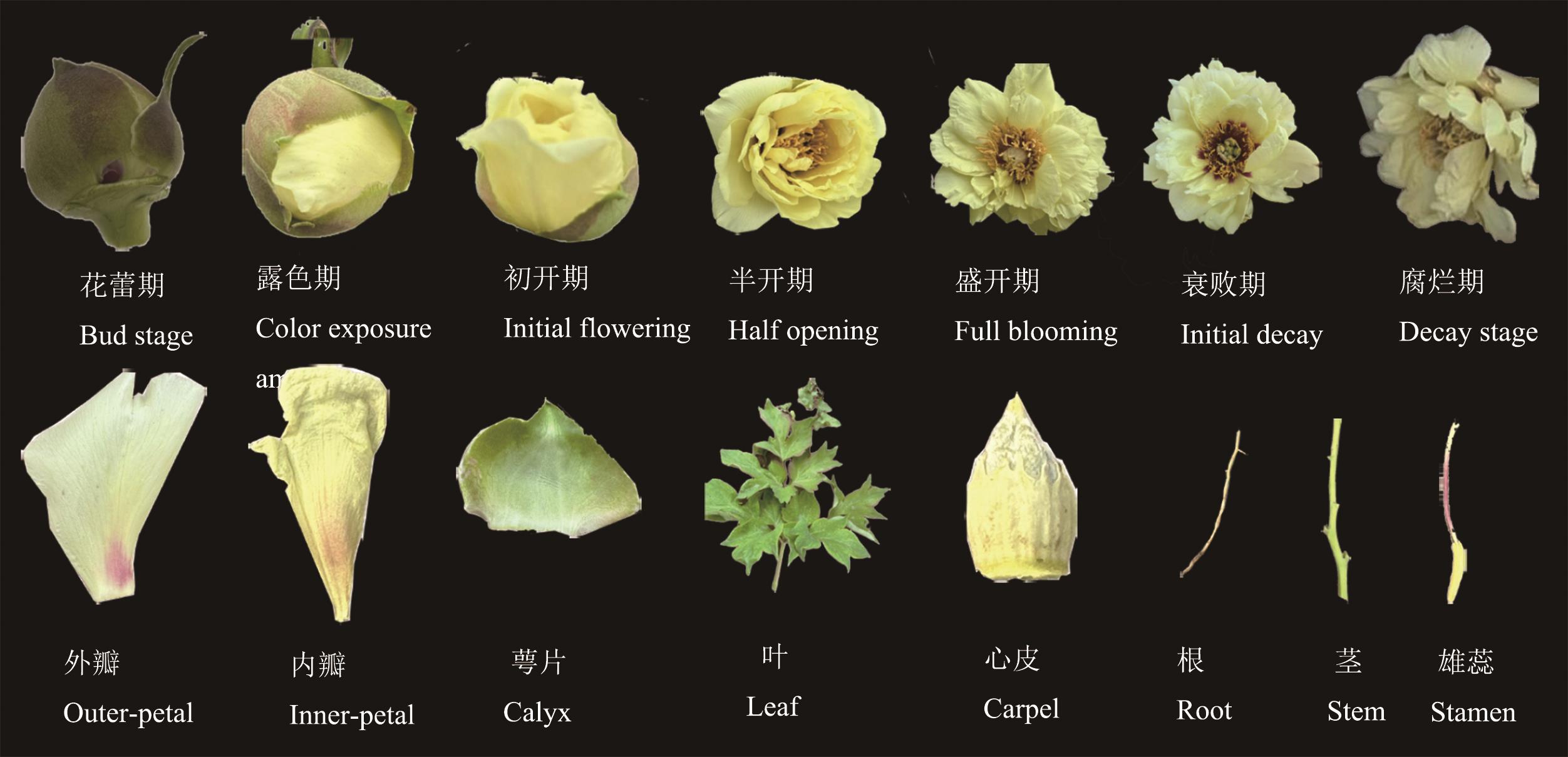
图1 ‘黄冠’牡丹7个不同花发育时期及盛开期的不同器官组织
Fig. 1 Seven different flower developmental stages and different organ tissues at full blooming in P. suffruticosa 'QuKan'
引物名称 Primer name | 引物序列 Primer sequence (5′‒3′) | 作用 Function |
|---|---|---|
| PsMYB43-F | ATGGACTCTGTTCCGTCCAAG | 基因克隆 Gene clone |
| PsMYB43-R | TCAAGAAAGAAGCCAAGCAAC | |
| qPsMYB43-F | TTGACGGTGACTGGTAATG | 实时荧光定量 RT-qPCR |
| qPsMYB43-R | CCAATCAATCCTTCCATCATC | |
| yPsMYB43-F | ACCTCGACTCTAGAAATGGACTCTGTTCCGTCCAAGA | 亚细胞定位 Subcellular localization |
| yPsMYB43-R | TTTTTCTACCGGTACAGAAAGAAGCCAAGCAACCATAG | |
| gPsMYB43-F | ATGCCCGTCGACCCCATGGACTCTGTTCCGTCCAAGA | 瞬时过表达 Transient overexpression |
| gPsMYB43-R | CCATGGATCCGGTACAGAAAGAAGCCAAGCAACCATAG | |
| vPsMYB43-F | TGAGTAAGGTTACCGGAAGAGCTGGAAAATGGGATGTTAT | 瞬时沉默 Transient silencing |
| vPsMYB43-R | GTGAGCTCGGTACCGCTTCCAAATCCCAATCAATCCTTC | |
| PsACTIN-F | GCGTTGACGACTTTCTCATCCT | 牡丹荧光定量内参 Internal reference gene of tree peony |
| PsACTIN-R | CGCACATCCTTGACAAACCCTA | |
| AmUBI-F | GACCTATACCAAGCCGAAG | 金鱼草荧光定量内参 Internal reference gene of snapdragon |
| AmUBI-R | CGTTCCAGCACCACAATC |
表1 本研究中所用引物序列
Table 1 Sequences of primers used in this study
引物名称 Primer name | 引物序列 Primer sequence (5′‒3′) | 作用 Function |
|---|---|---|
| PsMYB43-F | ATGGACTCTGTTCCGTCCAAG | 基因克隆 Gene clone |
| PsMYB43-R | TCAAGAAAGAAGCCAAGCAAC | |
| qPsMYB43-F | TTGACGGTGACTGGTAATG | 实时荧光定量 RT-qPCR |
| qPsMYB43-R | CCAATCAATCCTTCCATCATC | |
| yPsMYB43-F | ACCTCGACTCTAGAAATGGACTCTGTTCCGTCCAAGA | 亚细胞定位 Subcellular localization |
| yPsMYB43-R | TTTTTCTACCGGTACAGAAAGAAGCCAAGCAACCATAG | |
| gPsMYB43-F | ATGCCCGTCGACCCCATGGACTCTGTTCCGTCCAAGA | 瞬时过表达 Transient overexpression |
| gPsMYB43-R | CCATGGATCCGGTACAGAAAGAAGCCAAGCAACCATAG | |
| vPsMYB43-F | TGAGTAAGGTTACCGGAAGAGCTGGAAAATGGGATGTTAT | 瞬时沉默 Transient silencing |
| vPsMYB43-R | GTGAGCTCGGTACCGCTTCCAAATCCCAATCAATCCTTC | |
| PsACTIN-F | GCGTTGACGACTTTCTCATCCT | 牡丹荧光定量内参 Internal reference gene of tree peony |
| PsACTIN-R | CGCACATCCTTGACAAACCCTA | |
| AmUBI-F | GACCTATACCAAGCCGAAG | 金鱼草荧光定量内参 Internal reference gene of snapdragon |
| AmUBI-R | CGTTCCAGCACCACAATC |
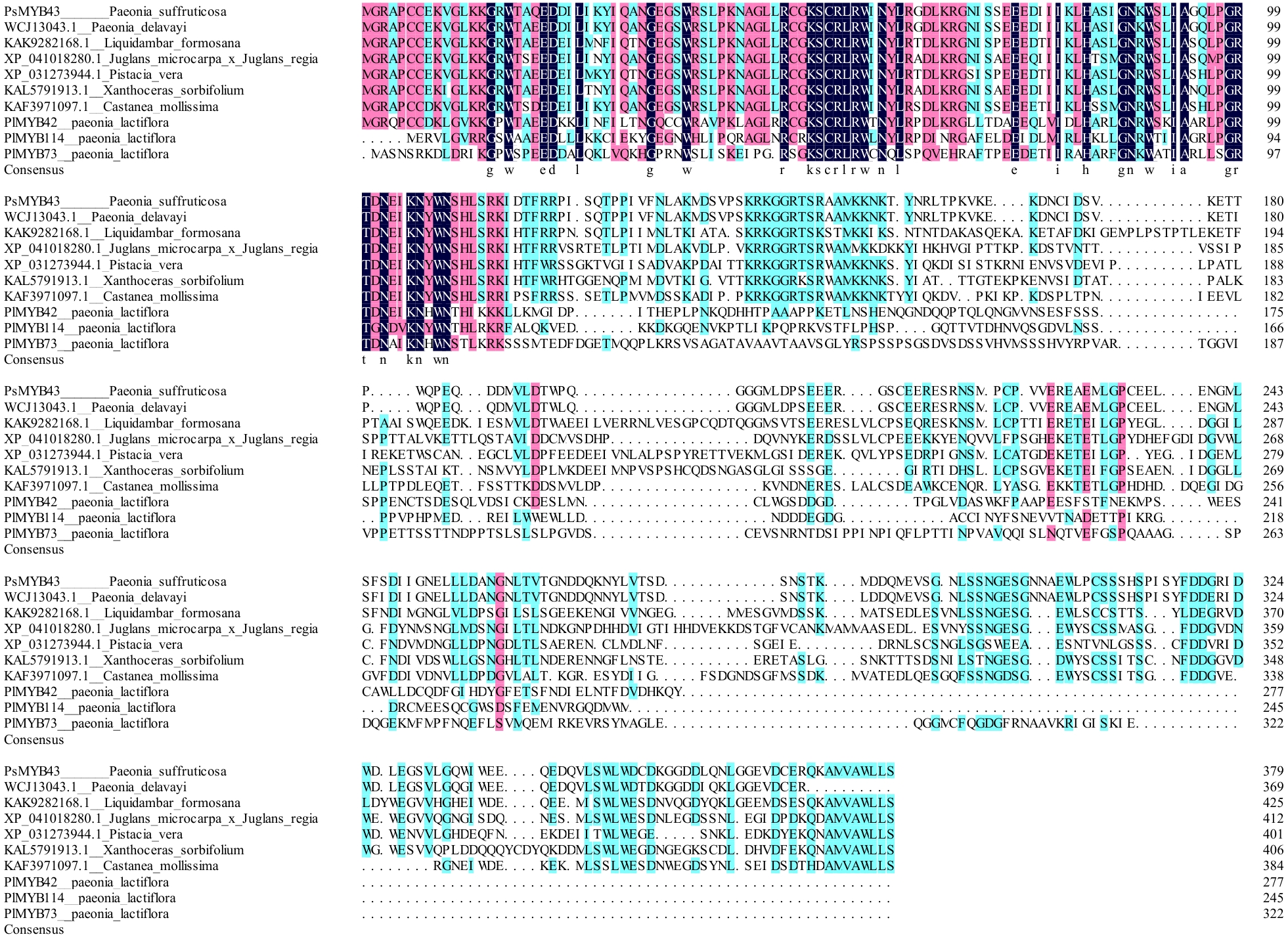
图2 PsMYB43与同源蛋白序列比对分析深蓝:同源性100%;红色:同源性≥75%;蓝色:同源性≥50%
Fig. 2 Sequence alignment analysis of PsMYB43 with homologous proteinsDark blue: Homology 100%. Red: Homology≥75%. Blue: Homology≥50%
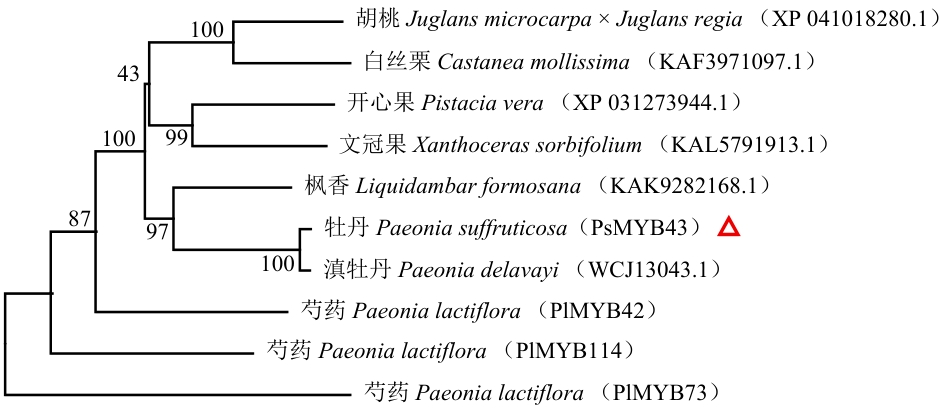
图3 PsMYB43的系统发育树分支上数字代表bootstrap值
Fig. 3 Phylogenetic analysis of PsMYB43The number on the branch are the bootstrap value (%)
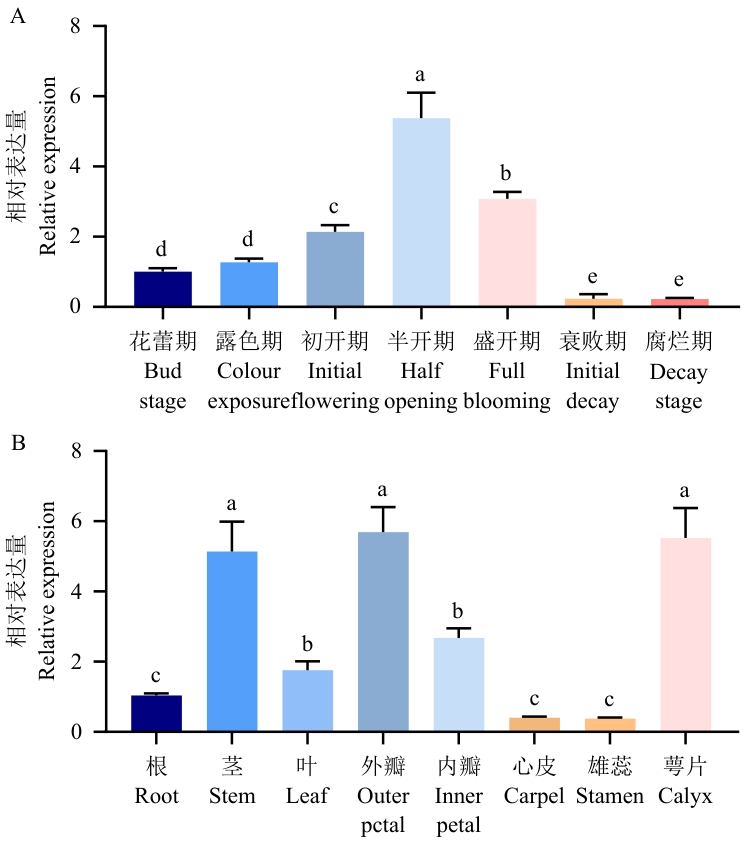
图4 PsMYB43表达模式A:PsMYB43在7个不同花发育时期的相对表达水平;B:PsMYB43在盛开期8个不同器官组织中的表达水平。不同小写字母表示在P<0.05水平差异显著
Fig. 4 Expression patterns of PsMYB43 geneA: Relative expressions of PsMYB43 during seven flower development stages. B: Relative expressions of PsMYB43 in eight different organs and tissues during full blooming stage. Different lowercase letters indicate significant differences at P<0.05 level
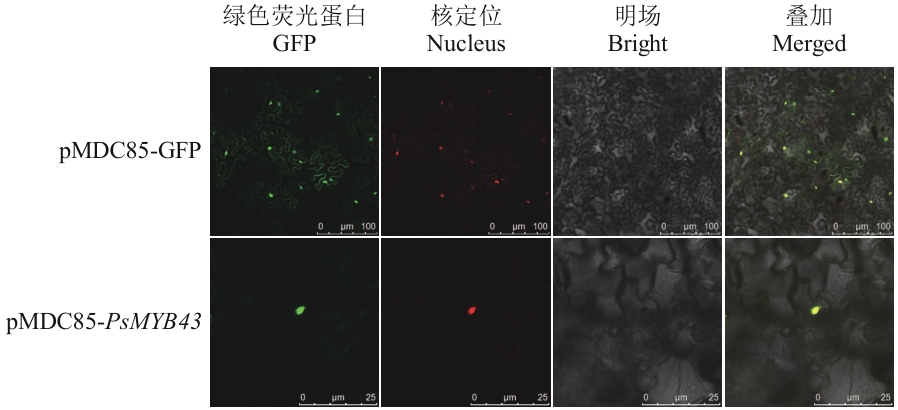
图5 牡丹PsMYB43的亚细胞定位
Fig. 5 Subcellular localization of PsMYB43 in P. suffruticosa
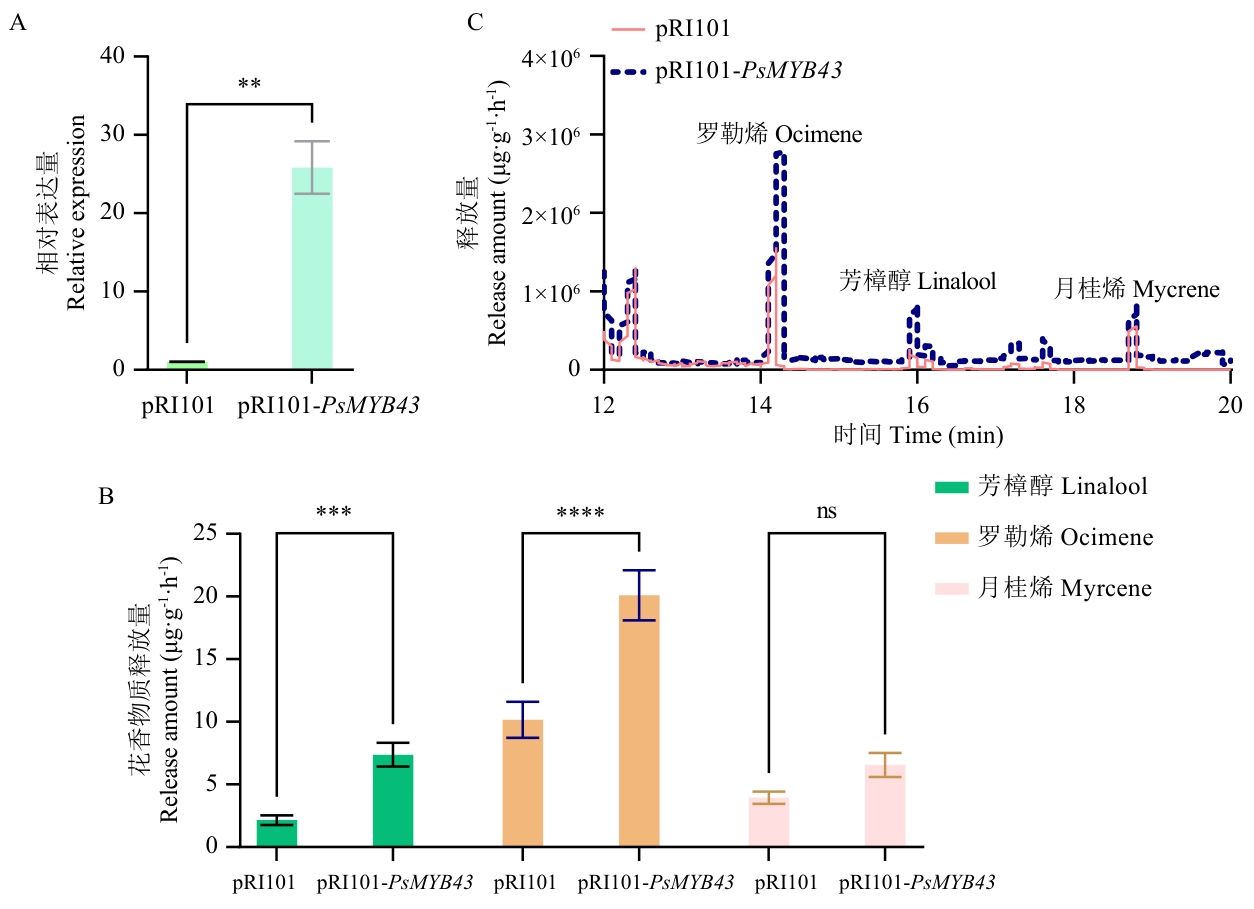
图6 过表达PsMYB43基因表达量检测、对不同单萜物质的影响及GC-MS分析A:PsMYB43基因表达量;B:单萜物质释放量;C:GC-MS分析挥发性物质;ns P>0.5;** P<0.01;*** P<0.001;**** P<0.000 1,下同
Fig. 6 Detection of the expression of overexpressed PsMYB43, its effect on different monoterpene substances, and GC-MS analysisA: PsMYB43 gene expression. B: Release of monoterpenoid substances. C: GC-MS analysis of VOCS. ns P>0.5, ** P<0.01, *** P<0.001, and **** P<0.000 1, the same below
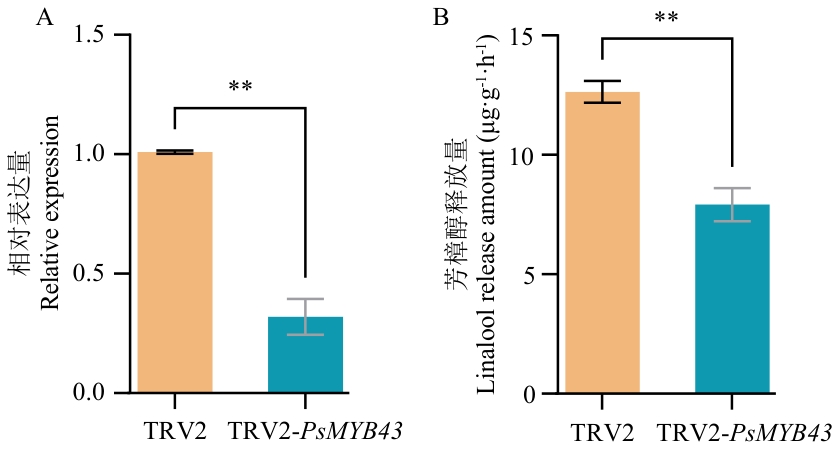
图7 沉默PsMYB43表达量检测(A)及对芳樟醇的影响(B)
Fig. 7 Detection of silencing PsMYB43 expression (A) and its effect on linalool (B)
| [1] | 李海梅, 范燕萍. 花朵萜类花香主要成分、代谢通路和关键功能基因 [J].分子植物育种, 2023. . |
| Li HM, Fan YP. Research progress on the main components, metabolic pathways and key functional genes of floral terpenes [J]. Mol Plant Breed, 2023. . | |
| [2] | El Hadi MAM, Zhang FJ, Wu FF, et al. Advances in fruit aroma volatile research [J]. Molecules, 2013, 18(7): 8200-8229. |
| [3] | Muhlemann JK, Klempien A, Dudareva N. Floral volatiles: from biosynthesis to function [J]. Plant Cell Environ, 2014, 37(8): 1936-1949. |
| [4] | Yang YY, Ma B, Li YY, et al. Transcriptome analysis identifies key gene LiMYB305 involved in monoterpene biosynthesis in Lilium ‘Siberia’ [J]. Front Plant Sci, 2022, 13: 1021576. |
| [5] | Kong Y, Bai JR, Lang LX, et al. Variation in floral scent compositions of different lily hybrid groups [J]. J Amer Soc Hort Sci, 2017, 142(3): 175-183. |
| [6] | 欧文, 张海燕, 汪镇朝, 等. 薰衣草挥发油的化学成分及药理作用研究进展 [J]. 中成药, 2022, 44(1): 170-176. |
| Ou W, Zhang HY, Wang ZZ, et al. Research progress on chemical constituents and pharmacological effects of volatile oil from lavender [J]. Chin Tradit Pat Med, 2022, 44(1): 170-176. | |
| [7] | Guo XY, Wang P. Aroma characteristics of lavender extract and essential oil from Lavandula angustifolia Mill [J]. Molecules, 2020, 25(23): 5541. |
| [8] | Zhou YW, Abbas F, Wang ZD, et al. HS-SPME-GC-MS and electronic nose reveal differences in the volatile profiles of Hedychium flowers [J]. Molecules, 2021, 26(17): 5425. |
| [9] | Ding WJ, Ouyang QX, Li YL, et al. Genome-wide investigation of WRKY transcription factors in sweet osmanthus and their potential regulation of aroma synthesis [J]. Tree Physiol, 2020, 40(4): 557-572. |
| [10] | Li SS, Zhang L, Sun M, et al. Biogenesis of flavor-related linalool is diverged and genetically conserved in tree peony (Paeonia × suffruticosa) [J]. Hortic Res, 2023, 10(2): uhac253. |
| [11] | Picazo-Aragonés J, Terrab A, Balao F. Plant volatile organic compounds evolution: transcriptional regulation, epigenetics and polyploidy [J]. Int J Mol Sci, 2020, 21(23): 8956. |
| [12] | Ramya M, Kwon OK, An HR, et al. Floral scent: Regulation and role of MYB transcription factors [J]. Phytochem Lett, 2017, 19: 114-120. |
| [13] | Lan YG, Zhang KM, Wang LN, et al. The R2R3-MYB transcription factor OfMYB21 positively regulates linalool biosynthesis in Osmanthus fragrans flowers [J]. Int J Biol Macromol, 2023, 249: 126099. |
| [14] | Guo YH, Guo ZY, Zhong J, et al. Positive regulatory role of R2R3 MYBs in terpene biosynthesis in Lilium ‘Siberia’ [J]. Hortic Plant J, 2023, 9(5): 1024-1038. |
| [15] | Zhao YX, Chen YC, Gao M, et al. LcMYB106 suppresses monoterpene biosynthesis by negatively regulating LcTPS32 expression in Litsea cubeba [J]. Tree Physiol, 2023, 43(12): 2150-2161. |
| [16] | Ni FF, Zhao YX, Gao M, et al. LcMYB43 enhances monoterpene biosynthesis by activating 1-deoxy-D-xylulose-5-phosphate synthase gene expression in Litsea cubeba [J]. Int J Biol Macromol, 2025, 304(Pt 1): 140860. |
| [17] | Zhao Q, Li YQ, Gu LN, et al. The PlMYB73-PlMYB70-PlMYB108 complex regulates PlTPS1 to promote geraniol biosynthesis in Paeonia lactiflora [J]. Hortic Res, 2025, 12(8): uhaf141. |
| [18] | 高亚辉, 张少文, 张淑霞, 等. 牡丹花的成分及应用研究进展 [J]. 河南工业大学学报: 自然科学版, 2011, 32(6): 93-96, 75. |
| Gao YH, Zhang SW, Zhang SX, et al. Research progress on composition and application of peony [J]. J Henan Univ Technol Nat Sci Ed, 2011, 32(6): 93-96, 75. | |
| [19] | 周畅, 李玉红, 姚雷. 不同条件下提取牡丹花的成分及分析 [J]. 上海交通大学学报: 农业科学版, 2015, 33(5): 28-33. |
| Zhou C, Li YH, Yao L. Analysis of the peony flower’s volatile component in different extraction conditions [J]. J Shanghai Jiao Tong Univ Agric Sci, 2015, 33(5): 28-33. | |
| [20] | 徐慧, 姚霞珍, 佟珂珂, 等. 3种牡丹花器官不同部位挥发性成分分析 [J]. 南京林业大学学报: 自然科学版, 2023, 47(3): 63-69. |
| Xu H, Yao XZ, Tong KK, et al. Analysis of volatile components in different parts of flower organs of three species of tree peony [J]. J Nanjing For Univ Nat Sci Ed, 2023, 47(3): 63-69. | |
| [21] | 李瑞雅, 宋程威, 牛童非, 等. ‘海黄’牡丹花挥发性物质释放规律及PsGDS的克隆与表达分析 [J]. 园艺学报, 2023, 50(2): 331-344. |
| Li RY, Song CW, Niu TF, et al. The emitted pattern analysis of flower volatiles and cloning of PsGDS gene in tree peony cultivar ‘high noon’ [J]. Acta Hortic Sin, 2023, 50(2): 331-344. | |
| [22] | 王佩云, 李子昂, 白杨, 等. ‘海黄’牡丹芳樟醇合酶基因PsTPS14的克隆及功能验证 [J]. 园艺学报, 2024, 51(6): 1273-1283. |
| Wang PY, Li ZA, Bai Y, et al. Cloning and functional verification of linalool synthase gene PsTPS14 in tree peony ‘High Noon’ [J]. Acta Hortic Sin, 2024, 51(6): 1273-1283. | |
| [23] | Niu TF, Chen LF, Wang EQ, et al. HMGR regulates floral fragrance through terpene synthesis pathway in Paeonia suffruticosa [J]. Ind Crops Prod, 2025, 224: 120418. |
| [24] | Ma HL, Zhang CJ, Niu TF, et al. Identification of floral volatile components and expression analysis of controlling gene in Paeonia ostii ‘Fengdan’ under different cultivation conditions [J]. Plants, 2023, 12(13): 2453. |
| [25] | Li J, Han JG, Hu YH, et al. Selection of reference genes for quantitative real-time PCR during flower development in tree peony (Paeonia suffruticosa Andr.) [J]. Front Plant Sci, 2016, 7: 516. |
| [26] | 李彤, 邵慧慧, 韩嘉宁, 等. 金鱼草AmPIF4基因克隆及调控花香物质合成释放功能分析 [J]. 西北植物学报, 2021, 41(12): 1994-2001. |
| Li T, Shao HH, Han JN, et al. Isolation and characterization of AmPIF4 gene in the regulating floral scent synthesis and release in snapdragon [J]. Acta Bot Boreali Occidentalia Sin, 2021, 41(12): 1994-2001. | |
| [27] | Ma B, Li ZY, Li RC, et al. Functional analysis of PsHMGR1 and PsTPS1 related to floral terpenoids biosynthesis in tree peony [J]. Int J Mol Sci, 2024, 25(22): 12247. |
| [28] | Han JN, Li T, Wang XL, et al. AmMYB24 regulates floral terpenoid biosynthesis induced by blue light in snapdragon flowers [J]. Front Plant Sci, 2022, 13: 885168. |
| [29] | Li HY, Yue YZ, Ding WJ, et al. Genome-wide identification, classification, and expression profiling reveals R2R3-MYB transcription factors related to monoterpenoid biosynthesis in Osmanthus fragrans [J]. Genes, 2020, 11(4): 353. |
| [30] | Reddy VA, Wang Q, Dhar N, et al. Spearmint R2R3-MYB transcription factor MsMYB negatively regulates monoterpene production and suppresses the expression of geranyl diphosphate synthase large subunit (MsGPPS.LSU) [J]. Plant Biotechnol J, 2017, 15(9): 1105-1119. |
| [31] | Song CW, Ma HL, Li RY, et al. Analysis of the emitted pattern of floral volatiles and cloning and functional analysis of the PsuLIS gene in tree peony cultivar ‘High Noon’ [J]. Sci Hortic, 2024, 326: 112750. |
| [32] | Geng P, Zhang S, Liu JY, et al. MYB20, MYB42, MYB43, and MYB85 regulate phenylalanine and lignin biosynthesis during secondary cell wall formation [J]. Plant Physiol, 2020, 182(3): 1272-1283. |
| [33] | An X, Liao YZ, Yu YF, et al. Effects of MhMYB1 and MhMYB2 transcription factors on the monoterpenoid biosynthesis pathway in l-menthol chemotype of Mentha haplocalyx Briq [J]. Planta, 2024, 260(1): 3. |
| [34] | Yang ZZ, Jin W, Luo Q, et al. FhMYB108 regulates the expression of linalool synthase gene in Freesia hybrida and Arabidopsis [J]. Biology, 2024, 13(8): 556. |
| [1] | 孙婷, 张艳, 刘玉珊, 冯媛媛, 秦恒山, 张军, 何小岗, 张景荣. 黄秋葵AeF3H基因的克隆与功能分析[J]. 生物技术通报, 2026, 42(4): 153-160. |
| [2] | 倪莹, 李雷, 汪进萱, 马波, 孟昕, 冷平生, 吴静, 胡增辉. 紫丁香So4CL的克隆及功能分析[J]. 生物技术通报, 2026, 42(1): 139-149. |
| [3] | 樊荣辉, 罗远华, 陈艺荃, 方能炎, 陈燕, 钟淮钦, 叶秀仙. 文心兰‘金辉’和‘香水文心’花香形成比较分析[J]. 生物技术通报, 2026, 42(1): 105-113. |
| [4] | 魏雨佳, 李岩, 康语涵, 弓晓楠, 杜敏, 涂岚, 石鹏, 于子涵, 孙彦, 张昆. 白颖苔草CrMYB4基因的克隆和表达分析[J]. 生物技术通报, 2025, 41(7): 248-260. |
| [5] | 李锐, 胡婷, 陈树溦, 王尧, 王计平. 紫苏PfMYB80转录因子正向调控花青素的生物合成[J]. 生物技术通报, 2025, 41(6): 243-255. |
| [6] | 程珊, 王会伟, 陈晨, 朱雅婧, 李春鑫, 别海, 王树峰, 陈献功, 张向歌. 油莎豆MYB转录因子基因CeMYB154克隆及耐盐功能分析[J]. 生物技术通报, 2025, 41(6): 218-228. |
| [7] | 彭绍智, 王登科, 张祥, 戴雄泽, 徐昊, 邹学校. 辣椒CaFD1基因克隆、表达特征及功能验证[J]. 生物技术通报, 2025, 41(5): 153-164. |
| [8] | 焦小雨, 吴琼, 刘丹丹, 孙明慧, 阮旭, 王雷刚, 王文杰. 茶树CsWAK8克隆及其在响应冷胁迫过程中的功能分析[J]. 生物技术通报, 2025, 41(2): 210-220. |
| [9] | 杨晨欣, 李梦秀, 姜唐, 张文娥, 潘学军. 美人蕉R2R3-MYB基因家族的鉴定及与花青素相关成员的表达分析[J]. 生物技术通报, 2025, 41(12): 201-213. |
| [10] | 韩昱, 袁青云, 章青平, 吴春来, 贺巍, 张芬. 茶树CsNPF家族6个基因的克隆与表达分析及CsNPF7.3功能验证[J]. 生物技术通报, 2025, 41(10): 264-276. |
| [11] | 李雨晴, 吴楠, 罗建让. 卵叶牡丹花色苷合成相关基因bHLH的克隆与功能分析[J]. 生物技术通报, 2024, 40(8): 174-185. |
| [12] | 任晓敏, 云岚, 艾芊, 赵乔. 新麦草异戊烯基转移酶PjIPT基因的功能验证[J]. 生物技术通报, 2024, 40(7): 207-215. |
| [13] | 胡雅丹, 伍国强, 刘晨, 魏明. MYB转录因子在调控植物响应逆境胁迫中的作用[J]. 生物技术通报, 2024, 40(6): 5-22. |
| [14] | 杜泽光, 任少文, 张凤勤, 李梅兰, 李改珍, 齐仙惠. 大白菜BrMLP328的克隆、表达及功能验证[J]. 生物技术通报, 2024, 40(4): 122-129. |
| [15] | 杨伟成, 孙岩, 杨倩, 王壮琳, 马菊花, 薛金爱, 李润植. 陆地棉FAX家族的全基因组鉴定及GhFAX1的功能分析[J]. 生物技术通报, 2024, 40(3): 155-169. |
| 阅读次数 | ||||||
|
全文 |
|
|||||
|
摘要 |
|
|||||
