







生物技术通报 ›› 2026, Vol. 42 ›› Issue (1): 105-113.doi: 10.13560/j.cnki.biotech.bull.1985.2025-0833
樊荣辉( ), 罗远华, 陈艺荃, 方能炎, 陈燕, 钟淮钦, 叶秀仙()
收稿日期:2025-08-02
出版日期:2026-01-26
发布日期:2026-02-04
通讯作者:
叶秀仙,女,研究员,研究方向 :花卉组织培养;E-mail: yxx7861@163.com作者简介:樊荣辉,女,副研究员,研究方向 :花卉分子育种;E-mail: rhfan1012@163.com
基金资助:
FAN Rong-hui(), LUO Yuan-hua, CHEN Yi-quan, FANG Neng-yan, CHEN Yan, ZHONG Huai-qin, YE Xiu-xian()
Received:2025-08-02
Published:2026-01-26
Online:2026-02-04
摘要:
目的 从南茜组培苗中选育出新株系‘金辉’,株型高大,花枝挺立,但无香气。通过解析无香‘金辉’和浓香‘香水文心’花香形成的分子机制,探索‘金辉’无香气制约因素,以期通过分子技术使‘金辉’释放香气。 方法 通过顶空-固相微萃取气相色谱法(HS-SPME)/GC-MS测定文心兰2个品种香气成分及含量。以‘金辉’和‘香水文心’不同发育时期花为材料,通过转录组测序和荧光定量PCR验证,筛选花香形成关键基因。 结果 气相色谱-质谱分析表明,‘香水文心’盛花期花香挥发物总含量显著高于‘金辉’,是‘金辉’的6.1倍,‘香水文心’花香挥发物以单萜为主,‘金辉’花香挥发物以倍半萜为主。转录组测序结果表明,共获得55 277个unigenes,大约81.64%的unigenes被公共数据库注释。单萜形成的上游途径,MEP途径中,多数基因,如CMK、HDR、HDS、GPPS等在‘香水文心’中表达高于‘金辉’,使生成单萜的前体物质GPP在‘香水文心’中积累。倍半萜形成的上游途径,MVA途径中,约一半基因在‘香水文心’中略高表达,一半基因在‘金辉’中略高表达。转录组数据中共筛选出3个显著差异表达的萜类合成酶基因(TPS)。其中,OhTPS1和OhTPS2属于TPS-b家族,主要由单萜合成酶(mono-TPSs)基因组成。OhTPS1 和OhTPS2在‘香水文兰’中表达显著高于‘金辉’中,且在‘香水文心’中随着花的发育逐渐升高,表明这2个基因在‘香水文心’单萜生物合成中起关键作用。OhTPS3属于TPS-a家族,主要由倍半萜合成酶(sesqui-TPSs)基因组成。OhTPS3 在‘金辉’中表达显著高于‘香水文心’中,且在‘金辉’中随着花的发育逐渐升高,表明这个基因在‘金辉’倍半萜生物合成中起关键作用。 结论 ‘金辉’花香挥发物总量低的主要原因是MEP途径多数关键基因低表达,一定程度限制代谢流向单萜前体物质GPP积累,同时单萜合成酶基因的低表达,也一定程度阻碍单帖挥发物的生成。
樊荣辉, 罗远华, 陈艺荃, 方能炎, 陈燕, 钟淮钦, 叶秀仙. 文心兰‘金辉’和‘香水文心’花香形成比较分析[J]. 生物技术通报, 2026, 42(1): 105-113.
FAN Rong-hui, LUO Yuan-hua, CHEN Yi-quan, FANG Neng-yan, CHEN Yan, ZHONG Huai-qin, YE Xiu-xian. Comparative Analysis of Floral Scent Formation between ‘Jinhui’ and Onc. ‘Sharry Baby’ of Oncidium hybridum[J]. Biotechnology Bulletin, 2026, 42(1): 105-113.
基因 Gene | 正向引物 Forward primer sequence (5′-3′) | 反向引物 Reverse primer sequence (5′-3′) |
|---|---|---|
| OhTPS1 | ATGATGACTACATACAATCGCTAC | TCAAGTCCAAGTTGGCATAG |
| OhTPS2 | ACCTCGTCTACATCATCAGC | CCTTCAATTTATTCCTTTCG |
| OhTPS3 | TTATTGATGCGCTACAACG | CAATCCACGTACATTTCCA |
| Actin | AATGTGCCTGCTATGTATGTTGCT | GGGCATATCCTTCGTAGATTG |
表1 RT-qPCR所用引物序列
Table 1 Primer sequences for RT-qPCR
基因 Gene | 正向引物 Forward primer sequence (5′-3′) | 反向引物 Reverse primer sequence (5′-3′) |
|---|---|---|
| OhTPS1 | ATGATGACTACATACAATCGCTAC | TCAAGTCCAAGTTGGCATAG |
| OhTPS2 | ACCTCGTCTACATCATCAGC | CCTTCAATTTATTCCTTTCG |
| OhTPS3 | TTATTGATGCGCTACAACG | CAATCCACGTACATTTCCA |
| Actin | AATGTGCCTGCTATGTATGTTGCT | GGGCATATCCTTCGTAGATTG |
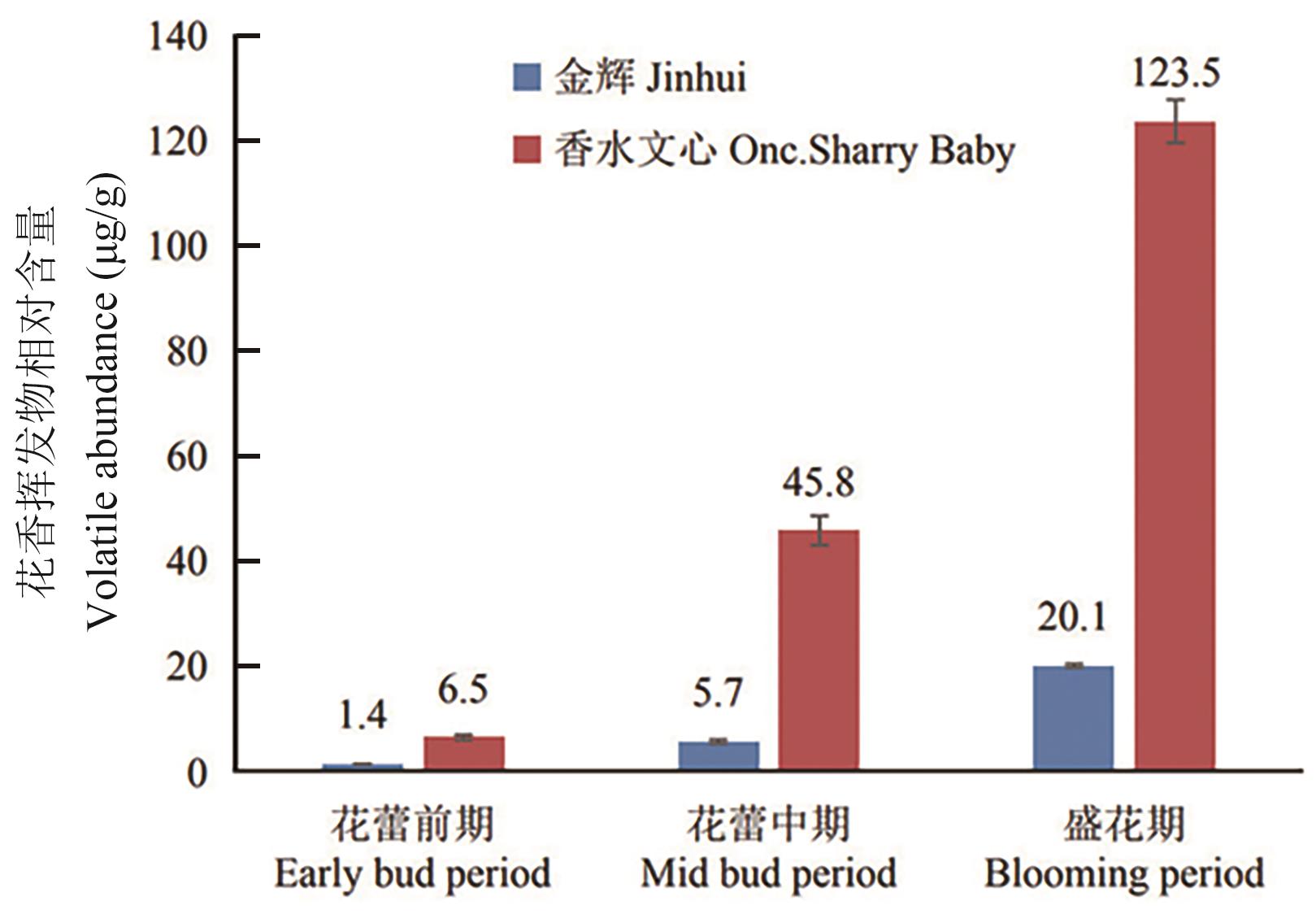
图1 ‘金辉’与‘香水文心’兰花香挥发物总含量
Fig. 1 Total floral volatile contents of ‘Jinhui’ and Onc. ‘Sharry Baby’
| 序号No. | 保留时间Retention time (min) | 挥发化合物 Volatile component | 分子式 Molecular formula | 含量 Volatile abundance (μg/g) | |||||||
|---|---|---|---|---|---|---|---|---|---|---|---|
| 金辉 Jinhui | 香水文心Onc. Sharry baby | ||||||||||
| 花蕾前期Early bud period | 花蕾中期Mid bud period | 盛花期Blooming period | 花蕾前期Early bud period | 花蕾中期Mid bud period | 盛花期Blooming period | ||||||
| 1 | 1.931 | 丙酮 2-Propanone | C3H6O | 0.11±0.02 | 0.17±0.02 | 0.01±0.01 | - | - | - | ||
| 2 | 2.833 | 3-戊酮 3-Pentanone | C5H10O | 0.27±0.05 | 0.29±0.03 | 0.11±0.03 | - | - | - | ||
| 3 | 2.921 | 叶醇 Leaf alconol | C6H12O | - | - | - | 0.32±0.07 | 0.62±0.07 | 0.65±0.07 | ||
| 4 | 3.933 | 正己醛 Hexanal | C6H12O | 0.35±0.04 | 0.23±0.03 | 0.05±0.02 | 0.64± 0.33 | 0.74±0.38 | - | ||
| 5 | 4.427 | 正己醇 Hexyl alconol | C6H14O | - | - | - | 0.33±0.05 | 0.58±0.05 | 1.08±0.07 | ||
| 6 | 5.233 | 丙烯醛 2-Propenal | C7H6O2 | - | - | - | 0.56±0.43 | 0.43±0.23 | - | ||
| 7 | 5.876 | α-派烯 α-Pinene | C10H16 | - | - | - | - | 1.56±0.54 | 6.47±0.45 | ||
| 8 | 6.746 | 1-戊烯-3-醇 Ethyl vinyl carbinol | C7H9ClO | 0.15±0.03 | 0.30±0.03 | 0.05±0.02 | - | - | - | ||
| 9 | 7.500 | 香桧烯(+)-Sabinene | C10H16 | - | - | - | - | 0.12±0.01 | 0.55±0.09 | ||
| 10 | 7.672 | β-派烯 β-Pinene | C10H16 | - | - | - | - | 0.20±0.02 | 0.44±0.12 | ||
| 11 | 8.245 | β-月桂烯 β-Myrcene | C10H16 | - | - | - | 1.83±0.13 | 6.59±0.30 | 6.50±0.63 | ||
| 12 | 9.834 | D-柠檬烯 D-Limonene | C10H16 | - | - | - | - | 0.62±0.12 | 2.74±0.22 | ||
| 13 | 9.928 | 1,8-桉叶素 1,8-Cineole | C10H16 | - | - | - | - | 6.27±0.63 | 15.34±0.79 | ||
| 14 | 10.080 | 苯甲醇 Benzyl alcohol | C7H8O | - | - | - | - | 0.62±0.16 | 2.37±0.83 | ||
| 15 | 10.616 | β-罗勒烯 β-Ocimene | C10H16 | - | 0.44±0.02 | 1.83±0.13 | - | 10.39±0.51 | 31.84±1.47 | ||
| 16 | 12.784 | 芳樟醇 Linalool | C10H16 | - | - | - | - | 2.34±0.23 | 10.63±0.56 | ||
| 17 | 14.912 | 异辛醇 Isooctanol | C8H18O | - | - | - | 0.51±0.23 | 0.52±0.15 | - | ||
| 18 | 15.567 | 顺-3-壬烯醇 cis-3-Nonenol | C9H18O | - | - | - | - | - | 0.30±0.05 | ||
| 19 | 15.953 | γ-木糖烯 γ-Muurolene | C15H24 | - | 0.20±0.01 | 0.10±0.04 | - | - | - | ||
| 20 | 16.383 | α-萜品烯 α-Terpineol | C10H18O | - | - | - | 1.92±0.25 | 7.08±2.88 | |||
| 21 | 16.425 | α-古巴烯 α-Copaene | C15H24 | 0.12±0.02 | 1.54±0.23 | 8.49±0.41 | - | - | - | ||
| 22 | 17.155 | β-波旁烯 β-Bourbonene | C15H24 | - | 0.07±0.02 | 0.25±0.04 | - | 0.41±0.10 | 1.30±0.17 | ||
| 23 | 20.807 | γ-榄香烯 γ-Elemene | C15H24 | - | 0.04±0.01 | 0.14±0.03 | - | - | - | ||
| 24 | 21.029 | 1-十六炔 1-Hexadecyne | C15H24 | - | - | - | - | - | 0.50±0.10 | ||
| 25 | 21.447 | α-古芸烯 α-Gurjunene | C15H24 | - | 0.02±0.01 | 0.16±0.02 | - | - | - | ||
| 26 | 23.121 | β-瑟林烯 β-Selinene | C15H24 | - | - | 0.12±0.03 | - | - | - | ||
| 27 | 23.220 | β-橄榄烯 γ-Maaliene | C15H24 | - | 0.10±0.02 | 0.30±0.05 | - | - | - | ||
| 28 | 24.179 | β-石竹烯 β-Caryophyllene | C15H24 | - | 0.72±0.05 | 2.94±0.15 | - | 0.10±0.06 | 2.03±0.08 | ||
| 29 | 25.955 | γ-杜松烯 γ-Cadinene | C15H24 | - | - | - | - | 0.12±0.03 | 0.66±0.06 | ||
| 30 | 26.140 | 大根香叶烯 Germacrene D | C15H24 | - | 0.03±0.01 | 0.11±0.07 | - | 0.55± 0.04 | 4.58±1.61 | ||
| 31 | 26.611 | 惕各酸苄酯 Benzyl tiglate | C12H14O2 | - | - | - | - | 0.31±0.06 | 0.89±0.30 | ||
| 32 | 26.846 | α-法呢烯 α-Farnesene | C15H24 | - | 0.09±0.01 | 0.05±0.05 | - | 2.06±0.51 | 10.30±1.09 | ||
| 33 | 28.573 | 反式-橙花叔醇 Nerolidol | C15H24 | - | - | - | - | 0.37± 0.06 | 1.60±0.20 | ||
| 34 | 28.921 | 鲨烯 Squalene | C30H50 | - | - | - | - | 1.28±0.36 | 4.98±0.42 | ||
表2 不同文心兰品种主要花香成分
Table 2 Main floral components of different varieties in O. hybridum
| 序号No. | 保留时间Retention time (min) | 挥发化合物 Volatile component | 分子式 Molecular formula | 含量 Volatile abundance (μg/g) | |||||||
|---|---|---|---|---|---|---|---|---|---|---|---|
| 金辉 Jinhui | 香水文心Onc. Sharry baby | ||||||||||
| 花蕾前期Early bud period | 花蕾中期Mid bud period | 盛花期Blooming period | 花蕾前期Early bud period | 花蕾中期Mid bud period | 盛花期Blooming period | ||||||
| 1 | 1.931 | 丙酮 2-Propanone | C3H6O | 0.11±0.02 | 0.17±0.02 | 0.01±0.01 | - | - | - | ||
| 2 | 2.833 | 3-戊酮 3-Pentanone | C5H10O | 0.27±0.05 | 0.29±0.03 | 0.11±0.03 | - | - | - | ||
| 3 | 2.921 | 叶醇 Leaf alconol | C6H12O | - | - | - | 0.32±0.07 | 0.62±0.07 | 0.65±0.07 | ||
| 4 | 3.933 | 正己醛 Hexanal | C6H12O | 0.35±0.04 | 0.23±0.03 | 0.05±0.02 | 0.64± 0.33 | 0.74±0.38 | - | ||
| 5 | 4.427 | 正己醇 Hexyl alconol | C6H14O | - | - | - | 0.33±0.05 | 0.58±0.05 | 1.08±0.07 | ||
| 6 | 5.233 | 丙烯醛 2-Propenal | C7H6O2 | - | - | - | 0.56±0.43 | 0.43±0.23 | - | ||
| 7 | 5.876 | α-派烯 α-Pinene | C10H16 | - | - | - | - | 1.56±0.54 | 6.47±0.45 | ||
| 8 | 6.746 | 1-戊烯-3-醇 Ethyl vinyl carbinol | C7H9ClO | 0.15±0.03 | 0.30±0.03 | 0.05±0.02 | - | - | - | ||
| 9 | 7.500 | 香桧烯(+)-Sabinene | C10H16 | - | - | - | - | 0.12±0.01 | 0.55±0.09 | ||
| 10 | 7.672 | β-派烯 β-Pinene | C10H16 | - | - | - | - | 0.20±0.02 | 0.44±0.12 | ||
| 11 | 8.245 | β-月桂烯 β-Myrcene | C10H16 | - | - | - | 1.83±0.13 | 6.59±0.30 | 6.50±0.63 | ||
| 12 | 9.834 | D-柠檬烯 D-Limonene | C10H16 | - | - | - | - | 0.62±0.12 | 2.74±0.22 | ||
| 13 | 9.928 | 1,8-桉叶素 1,8-Cineole | C10H16 | - | - | - | - | 6.27±0.63 | 15.34±0.79 | ||
| 14 | 10.080 | 苯甲醇 Benzyl alcohol | C7H8O | - | - | - | - | 0.62±0.16 | 2.37±0.83 | ||
| 15 | 10.616 | β-罗勒烯 β-Ocimene | C10H16 | - | 0.44±0.02 | 1.83±0.13 | - | 10.39±0.51 | 31.84±1.47 | ||
| 16 | 12.784 | 芳樟醇 Linalool | C10H16 | - | - | - | - | 2.34±0.23 | 10.63±0.56 | ||
| 17 | 14.912 | 异辛醇 Isooctanol | C8H18O | - | - | - | 0.51±0.23 | 0.52±0.15 | - | ||
| 18 | 15.567 | 顺-3-壬烯醇 cis-3-Nonenol | C9H18O | - | - | - | - | - | 0.30±0.05 | ||
| 19 | 15.953 | γ-木糖烯 γ-Muurolene | C15H24 | - | 0.20±0.01 | 0.10±0.04 | - | - | - | ||
| 20 | 16.383 | α-萜品烯 α-Terpineol | C10H18O | - | - | - | 1.92±0.25 | 7.08±2.88 | |||
| 21 | 16.425 | α-古巴烯 α-Copaene | C15H24 | 0.12±0.02 | 1.54±0.23 | 8.49±0.41 | - | - | - | ||
| 22 | 17.155 | β-波旁烯 β-Bourbonene | C15H24 | - | 0.07±0.02 | 0.25±0.04 | - | 0.41±0.10 | 1.30±0.17 | ||
| 23 | 20.807 | γ-榄香烯 γ-Elemene | C15H24 | - | 0.04±0.01 | 0.14±0.03 | - | - | - | ||
| 24 | 21.029 | 1-十六炔 1-Hexadecyne | C15H24 | - | - | - | - | - | 0.50±0.10 | ||
| 25 | 21.447 | α-古芸烯 α-Gurjunene | C15H24 | - | 0.02±0.01 | 0.16±0.02 | - | - | - | ||
| 26 | 23.121 | β-瑟林烯 β-Selinene | C15H24 | - | - | 0.12±0.03 | - | - | - | ||
| 27 | 23.220 | β-橄榄烯 γ-Maaliene | C15H24 | - | 0.10±0.02 | 0.30±0.05 | - | - | - | ||
| 28 | 24.179 | β-石竹烯 β-Caryophyllene | C15H24 | - | 0.72±0.05 | 2.94±0.15 | - | 0.10±0.06 | 2.03±0.08 | ||
| 29 | 25.955 | γ-杜松烯 γ-Cadinene | C15H24 | - | - | - | - | 0.12±0.03 | 0.66±0.06 | ||
| 30 | 26.140 | 大根香叶烯 Germacrene D | C15H24 | - | 0.03±0.01 | 0.11±0.07 | - | 0.55± 0.04 | 4.58±1.61 | ||
| 31 | 26.611 | 惕各酸苄酯 Benzyl tiglate | C12H14O2 | - | - | - | - | 0.31±0.06 | 0.89±0.30 | ||
| 32 | 26.846 | α-法呢烯 α-Farnesene | C15H24 | - | 0.09±0.01 | 0.05±0.05 | - | 2.06±0.51 | 10.30±1.09 | ||
| 33 | 28.573 | 反式-橙花叔醇 Nerolidol | C15H24 | - | - | - | - | 0.37± 0.06 | 1.60±0.20 | ||
| 34 | 28.921 | 鲨烯 Squalene | C30H50 | - | - | - | - | 1.28±0.36 | 4.98±0.42 | ||
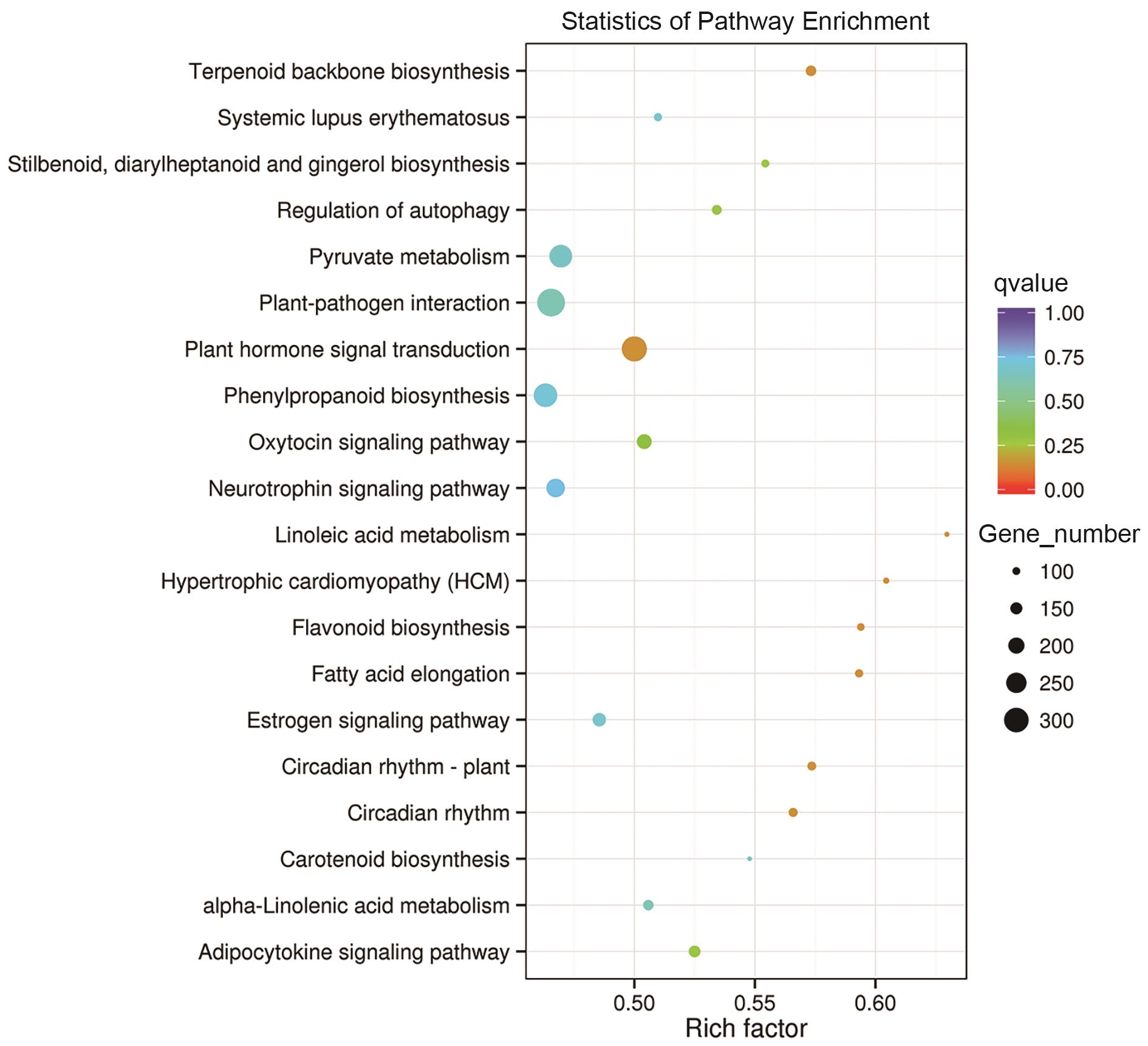
图2 KEGG pathway富集散点图
Fig. 2 Enriched scatter plot of KEGG pathway
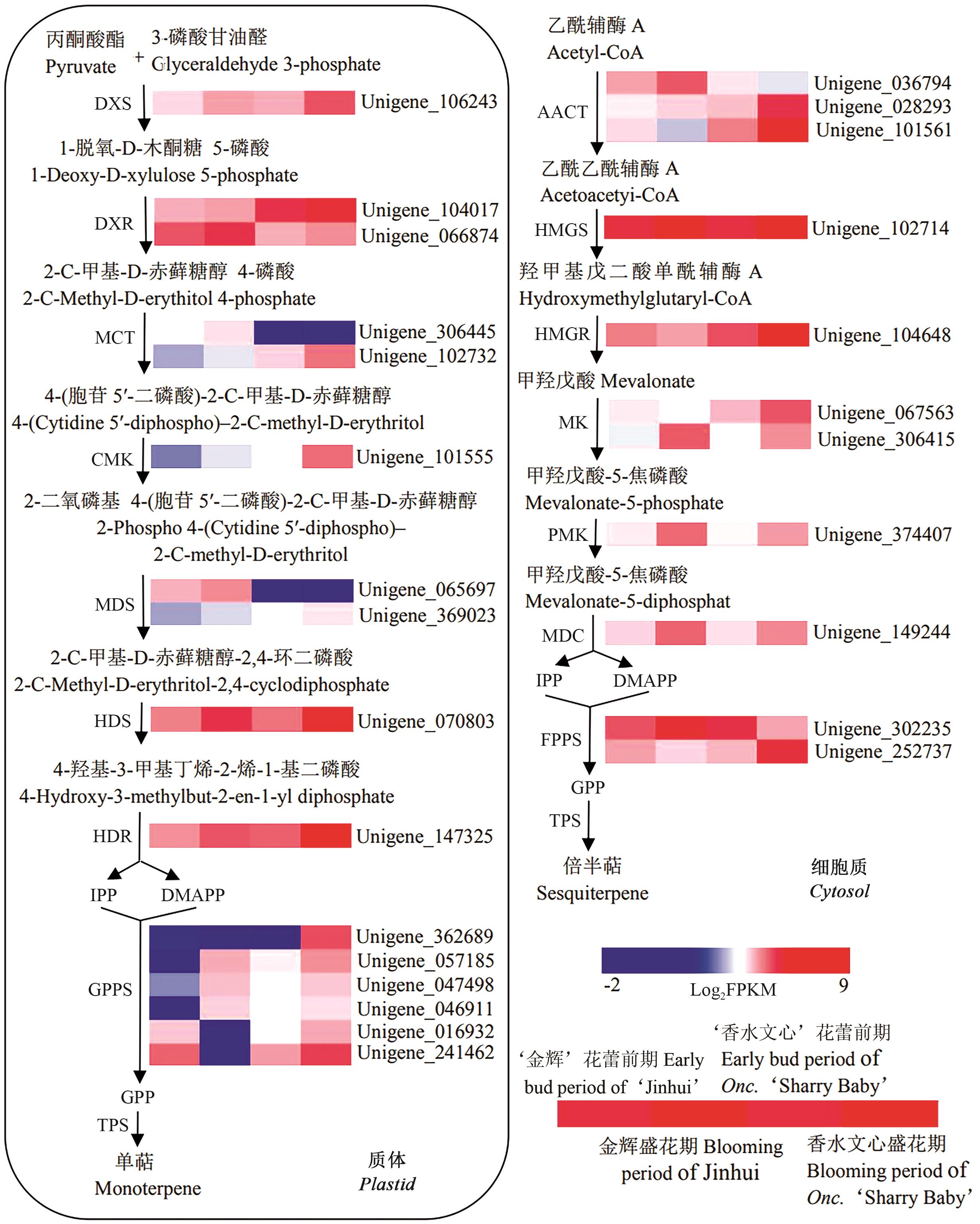
图3 单萜和倍半萜合成途径相关基因表达谱
Fig. 3 Expression profiles of the genes involved in the monoterpene and sesquiterpene biosynthesis
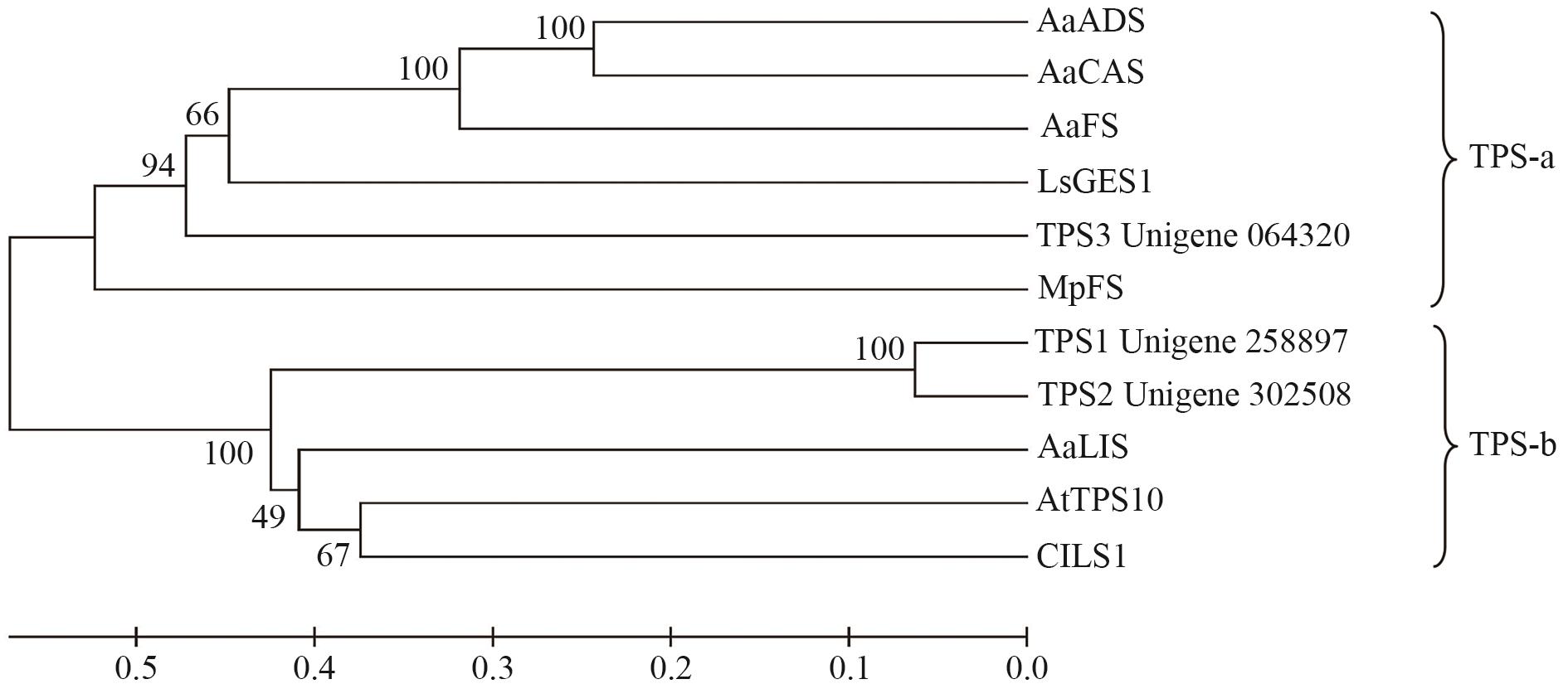
图4 文心兰TPS基因进化树分析AaADS, 黄蒿紫穗槐-4,11-二烯合酶(AFA34434); AaCAS, 黄蒿β-石竹烯合酶(AAL79181); AaFS, 黄蒿β-法呢烯合酶(Q9FXY7); LsGES1, 莴苣大根香叶烯合酶(AAM11626); MpFS, 胡椒薄荷β-法呢烯合酶(AAB95209); AaLIS, 黄蒿芳樟醇合酶(AAF13356); AtTPS10, 拟南芥月桂烯/罗勒烯合酶(AAG09310); ClLS1, 柠檬柠檬烯合酶1(AAM53944)
Fig. 4 Phylogenetic analysis of the TPS in Oncidium hybridumAaADS, Artemisia annua amorpha-4,11-dienesynthase (AFA34434); AaCAS, Artemisia annua β-caryophyllene synthase (AAL79181); AaFS, Artemisia annua β-farnesene synthase (Q9FXY7); LsGES1, Lactuca sativus germacrene A synthase (AAM11626); MpFS, Mentha piperita β-farnesene synthase (AAB95209); AaLIS, Artemisia annua linalool synthase (AAF13356); AtTPS10, Arabidopsis thaliana myrcene/ocimene synthase (AAG09310); ClLS1, Citrus limon limonene synthase 1 (AAM53944)
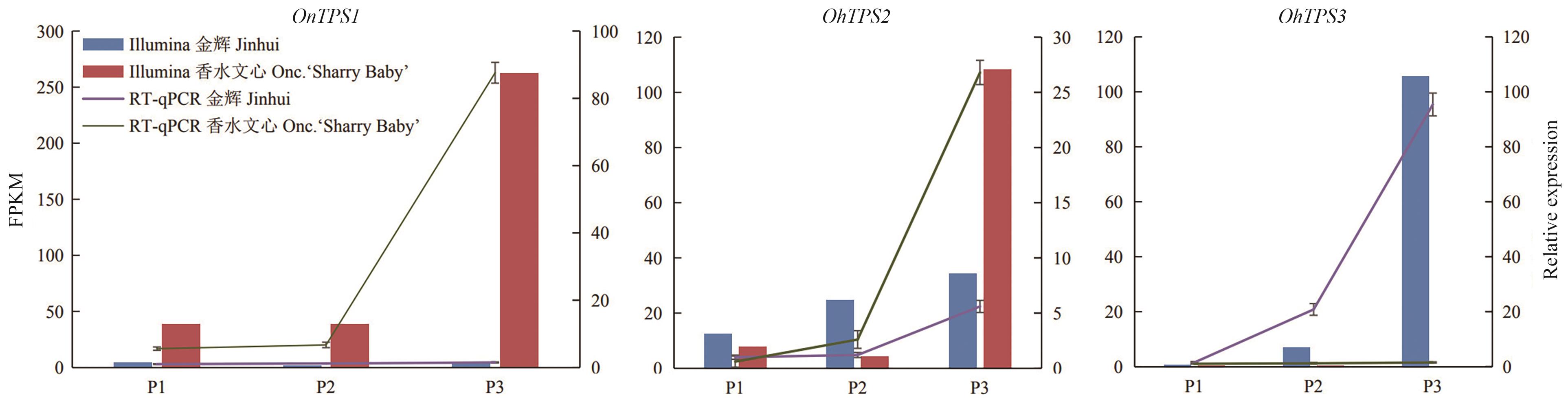
图5 萜类途径关键基因表达分析
Fig. 5 Expression analysis of key genes in terpene pathways
| [1] | Pichersky E, Dudareva N. Scent engineering: toward the goal of controlling how flowers smell [J]. Trends Biotechnol, 2007, 25(3): 105-110. |
| [2] | Muhlemann JK, Klempien A, Dudareva N. Floral volatiles: from biosynthesis to function [J]. Plant Cell Environ, 2014, 37(8): 1936-1949. |
| [3] | Dudareva N, Klempien A, Muhlemann JK, et al. Biosynthesis, function and metabolic engineering of plant volatile organic compounds [J]. New Phytol, 2013, 198(1): 16-32. |
| [4] | McGarvey DJ, Croteau R. Terpenoid metabolism [J]. Plant Cell, 1995, 7(7): 1015. |
| [5] | Dudareva N, Negre F, Nagegowda DA, et al. Plant volatiles: recent advances and future perspectives [J]. Crit Rev Plant Sci, 2006, 25(5): 417-440. |
| [6] | Vranová E, Coman D, Gruissem W. Network analysis of the MVA and MEP pathways for isoprenoid synthesis [J]. Annu Rev Plant Biol, 2013, 64: 665-700. |
| [7] | Tholl D. Terpene synthases and the regulation, diversity and biological roles of terpene metabolism [J]. Curr Opin Plant Biol, 2006, 9(3): 297-304. |
| [8] | Plant terpenoid synthases: molecular biology and phylogenetic analysis [J]. Proc Natl Acad Sci U S A, 1998, 95(8): 4126-4133. |
| [9] | Sungbeom Lee JC. Biochemical and genomic characterization of terpene synthases in Magnolia grandiflora . [J]. Plant Physiol, 2008, 147(3): 1017-1033. |
| [10] | Martin DM, Aubourg S, Schouwey MB, et al. Functional annotation, genome organization and phylogeny of the grapevine (Vitis vinifera) terpene synthase gene family based on genome assembly, FLcDNA cloning, and enzyme assays [J]. BMC Plant Biol, 2010, 10(1): 226. |
| [11] | Inna Guterman MS. Rose scent: genomics approach to discovering novel floral fragrance-related genes [J]. Plant Cell, 2002, 14(10): 2325-2338. |
| [12] | Nagegowda DA, Gutensohn M, Wilkerson CG, et al. Two nearly identical terpene synthases catalyze the formation of nerolidol and linalool in snapdragon flowers [J]. Plant J, 2008, 55(2): 224-239. |
| [13] | Hao RJ, Zhang Q, Yang WR, et al. Emitted and endogenous floral scent compounds of Prunus mume and hybrids [J]. Biochem Syst Ecol, 2014, 54: 23-30. |
| [14] | Zheng J, Hu ZH, Guan XL, et al. Transcriptome analysis of Syringa oblata lindl. inflorescence identifies genes associated with pigment biosynthesis and scent metabolism [J]. PLoS One, 2015, 10(11): e0142542. |
| [15] | 张辉秀, 胡增辉, 冷平生, 等. 不同品种百合花挥发性成分定性与定量分析 [J]. 中国农业科学, 2013, 46(4): 790-799. |
| Zhang HX, Hu ZH, Leng PS, et al. Qualitative and quantitative analysis of floral volatile components from different varieties of Lilium spp [J]. Sci Agric Sin, 2013, 46(4): 790-799. | |
| [16] | Jin JJ, Kim MJ, Dhandapani S, et al. The floral transcriptome of ylang ylang (Cananga odorata var. fruticosa) uncovers biosynthetic pathways for volatile organic compounds and a multifunctional and novel sesquiterpene synthase [J]. J Exp Bot, 2015, 66(13): 3959-3975. |
| [17] | Li H, Li JR, Dong YM, et al. Time-series transcriptome provides insights into the gene regulation network involved in the volatile terpenoid metabolism during the flower development of lavender [J]. BMC Plant Biol, 2019, 19(1): 313. |
| [18] | 刘晓荣, 王碧青, 朱根发. 文心兰研究进展 [J]. 亚热带植物科学, 2007, 36(3): 85-90. |
| Liu XR, Wang BQ, Zhu GF. Research advances of Oncidium [J]. Subtrop Plant Sci, 2007, 36(3): 85-90. | |
| [19] | 陈华, 范燕萍. 文心兰花香成分的分析 [J]. 江西农业大学学报, 2012, 34(4): 692-698. |
| Chen H, Fan YP. Analysis of aroma components of Oncidium [J]. Acta Agric Univ Jiangxiensis, 2012, 34(4): 692-698. | |
| [20] | 张莹, 李辛雷, 王雁, 等. 文心兰不同花期及花朵不同部位香气成分的变化 [J]. 中国农业科学, 2011, 44(1): 110-117. |
| Zhang Y, Li XL, Wang Y, et al. Changes of aroma components in Oncidium sharry baby in different florescence and flower parts [J]. Sci Agric Sin, 2011, 44(1): 110-117. | |
| [21] | 张莹, 李辛雷, 陈胜, 等. 三种文心兰挥发性成分的比较 [J]. 植物生理学通讯, 2010, 46(2): 178-180. |
| Zhang Y, Li XL, Chen S, et al. Comparison of volatile components in three Oncidium species [J]. Plant Physiol Commun, 2010, 46(2): 178-180. | |
| [22] | Chen Y, Zhong SY, Kong L, et al. Emission and transcriptional regulation of aroma variation in Oncidium Twinkle ‘red fantasy’ under diel rhythm [J]. Plants, 2024, 13(22): 3232. |
| [23] | 钟淮钦, 孔兰, 樊荣辉, 等. 红梦香文心兰萜类合成酶基因OnTPS的克隆与表达分析 [J]. 核农学报, 2022, 36(2): 313-321. |
| Zhong HQ, Kong L, Fan RH, et al. Cloning and expression analysis of terpene synthase gene OnTPS from Oncidium twinkle red fantasy [J]. J Nucl Agric Sci, 2022, 36(2): 313-321. | |
| [24] | 陈艺荃, 方能炎, 叶秀仙, 等. 基于转录组测序的文心兰花香形成分析 [J]. 核农学报, 2022, 36(3): 578-588. |
| Chen YQ, Fang NY, Ye XX, et al. Analysis of floral scent formation in Oncidium orchid based on transcriptome sequencing [J]. J Nucl Agric Sci, 2022, 36(3): 578-588. | |
| [25] | Grabherr MG, Haas BJ, Yassour M, et al. Full-length transcriptome assembly from RNA-Seq data without a reference genome [J]. Nat Biotechnol, 2011, 29(7): 644-652. |
| [26] | Langmead B, Trapnell C, Pop M, et al. Ultrafast and memory-efficient alignment of short DNA sequences to the human genome [J]. Genome Biol, 2009, 10(3): R25. |
| [27] | Li B, Dewey CN. RSEM: accurate transcript quantification from RNA-Seq data with or without a reference genome [J]. BMC Bioinform, 2011, 12(1): 323. |
| [28] | Trapnell C, Williams BA, Pertea G, et al. Transcript assembly and quantification by RNA-Seq reveals unannotated transcripts and isoform switching during cell differentiation [J]. Nat Biotechnol, 2010, 28(5): 511-515. |
| [29] | Anders S, Huber W. Differential expression analysis for sequence count data [J]. Nat Preced, 2010: 1. |
| [30] | Yue YC, Yu RC, Fan YP. Transcriptome profiling provides new insights into the formation of floral scent in Hedychium coronarium [J]. BMC Genom, 2015, 16(1): 470. |
| [31] | Hu ZH, Tang B, Wu Q, et al. Transcriptome sequencing analysis reveals a difference in monoterpene biosynthesis between scented Lilium ‘Siberia’ and unscented Lilium ‘novano’ [J]. Front Plant Sci, 2017, 8: 1351. |
| [32] | Huang ML, Fan RH, Ye XX, et al. The transcriptome of flower development provides insight into floral scent formation in Freesia hybrida [J]. Plant Growth Regul, 2018, 86(1): 93-104. |
| [33] | Chen F, Tholl D, Bohlmann J, et al. The family of terpene synthases in plants: a mid-size family of genes for specialized metabolism that is highly diversified throughout the Kingdom [J]. Plant J, 2011, 66(1): 212-229. |
| [34] | Estévez JM, Cantero A, Reindl A, et al. 1-deoxy-d-xylulose-5-phosphate synthase, a limiting enzyme for plastidic isoprenoid biosynthesis in plants [J]. J Biol Chem, 2001, 276(25): 22901-22909. |
| [1] | 刘建国, 刘格儿, 郭颖欣, 王斌, 王玉昆, 卢金凤, 黄文庭, 朱云娜. 转录组和代谢组联合解析‘桂柚1号’和‘沙田柚’果实品质差异[J]. 生物技术通报, 2025, 41(9): 168-181. |
| [2] | 刘泽洲, 段乃彬, 岳丽昕, 王清华, 姚行浩, 高莉敏, 孔素萍. 大蒜叶片蜡质成分分析及蜡质缺失基因Ggl-1筛选[J]. 生物技术通报, 2025, 41(9): 219-231. |
| [3] | 闫梦阳, 梁晓阳, 戴君昂, 张妍, 关团, 张辉, 刘良波, 孙志华. 阿莫西林降解菌的筛选及降解机制研究[J]. 生物技术通报, 2025, 41(9): 314-325. |
| [4] | 白雨果, 李婉迪, 梁建萍, 石志勇, 卢庚龙, 刘红军, 牛景萍. 哈茨木霉T9131对黄芪幼苗的促生机理[J]. 生物技术通报, 2025, 41(8): 175-185. |
| [5] | 柴军发, 洪波, 贾彦霞. 转录组和代谢组联合分析三株蜡蚧轮枝菌菌株毒力差异[J]. 生物技术通报, 2025, 41(8): 311-321. |
| [6] | 王月琛, 韩鑫骐, 魏文敏, 崔兆兰, 罗阳美, 陈鹏如, 王海岗, 刘龙龙, 张莉, 王纶. 黍稷落粒的生物学基础研究及落粒调控基因的鉴定[J]. 生物技术通报, 2025, 41(7): 164-171. |
| [7] | 张越, 毕钰, 慕雪男, 郑子薇, 王志刚, 徐伟慧. 小麦赤霉病拮抗菌JB7的生防特性[J]. 生物技术通报, 2025, 41(7): 261-271. |
| [8] | 李成花, 豆飞飞, 任毓昭, 刘彩霞, 刘凤楼, 王掌军, 李清峰. 外施水杨酸对白粉菌侵染小麦的影响及白粉菌转录组分析[J]. 生物技术通报, 2025, 41(7): 272-280. |
| [9] | 郭秀娟, 冯宇, 吴瑞香, 王利琴, 杨建春. Ca2+处理对胡麻种子萌发影响的转录组分析[J]. 生物技术通报, 2025, 41(7): 139-149. |
| [10] | 胡若群, 曾菁菁, 梁婉凤, 曹佳玉, 黄小苇, 梁晓英, 仇明月, 陈莹. 转录组和代谢组联合分析探究不同遮光条件下金线莲类胡萝卜素合成代谢机制[J]. 生物技术通报, 2025, 41(5): 231-243. |
| [11] | 李旭娟, 李纯佳, 刘洪博, 徐超华, 林秀琴, 陆鑫, 刘新龙. 甘蔗腋芽形成发育过程的转录组分析[J]. 生物技术通报, 2025, 41(3): 202-218. |
| [12] | 赵长延, 柳延涛, 贾秀苹, 刘胜利, 雷中华, 王鹏, 朱志锋, 董红业, 吕增帅, 段维, 万素梅. 盐碱胁迫下褪黑素对作物生理机制影响的研究进展[J]. 生物技术通报, 2025, 41(2): 18-29. |
| [13] | 李艳伟, 杨妍妍, 孙亚玲, 霍雨猛, 王振宝, 刘冰江. 基于转录组分析植物激素对洋葱鳞茎膨大发育的调控机制[J]. 生物技术通报, 2025, 41(2): 187-201. |
| [14] | 张晓丹, 尹铮, 刘清晨, 李雪梅, 刘晓华, 梁美霞. 基于代谢组和转录组联合解析山桃响应冻害机制[J]. 生物技术通报, 2025, 41(12): 225-239. |
| [15] | 杨涛, 李琳, 莫小连, 陈晓龙, 王健, 黄园, 赵杰宏, 邹颉. 铁皮石斛DoDELLA2的功能研究[J]. 生物技术通报, 2025, 41(12): 240-253. |
| 阅读次数 | ||||||
|
全文 |
|
|||||
|
摘要 |
|
|||||
