







生物技术通报 ›› 2025, Vol. 41 ›› Issue (12): 40-49.doi: 10.13560/j.cnki.biotech.bull.1985.2025-1011
朱姗姗( ), 徐军, 潘兴鲁, 董丰收, 郑永权, 吴小虎()
收稿日期:2025-09-22
出版日期:2025-12-26
发布日期:2026-01-06
通讯作者:
吴小虎,男,博士,研究员,研究方向 :农药学;E-mail: xhwu@ippcaas.cn作者简介:朱姗姗,女,硕士研究生,研究方向 :资源利用与植物保护;E-mail: 18338157428@163.com
基金资助:
ZHU Shan-shan(), XU Jun, PAN Xing-lu, DONG Feng-shou, ZHENG Yong-quan, WU Xiao-hu()
Received:2025-09-22
Published:2025-12-26
Online:2026-01-06
摘要:
农药残留是当前威胁土壤生态环境与农产品安全的重大挑战。微生物降解因其高效性与环境友好性,已成为农田污染修复领域的研究热点,并展现出广阔的应用前景。本文系统阐述了农药降解菌的研究与应用进展,主要内容包括以下方面:在降解菌筛选方面,总结了从传统富集培养到微流控单细胞筛选等多种策略,提升了高效降解菌株的获取效率与多样性;在降解机理层面,深入解析了关键降解基因功能、胞内/外酶的催化机制以及共代谢途径的增效作用;在生态过程方面,重点探讨了降解菌通过趋化感应与生物膜形成在根际与叶际的定殖机制及其后续响应,并进一步解析了降解菌依靠鞭毛运动的主动迁移和借助水力等环境因素的被动迁移途径;在降解菌剂应用技术方面,综述了液体与固体菌剂的制备工艺及其优缺点,分析了菌剂在实际应用中面临的环境适应性、定殖效率及生态互作等挑战。文章最后指出,未来应通过剂型创新和植物-微生物互作机制的深化研究,提升菌剂的田间稳定性与降解效能,推动该技术的规模化应用与农业绿色发展。
朱姗姗, 徐军, 潘兴鲁, 董丰收, 郑永权, 吴小虎. 土壤农药残留物的微生物修复研究进展[J]. 生物技术通报, 2025, 41(12): 40-49.
ZHU Shan-shan, XU Jun, PAN Xing-lu, DONG Feng-shou, ZHENG Yong-quan, WU Xiao-hu. Research Advances in Microbial Remediation of Soil Pesticide Residues[J]. Biotechnology Bulletin, 2025, 41(12): 40-49.
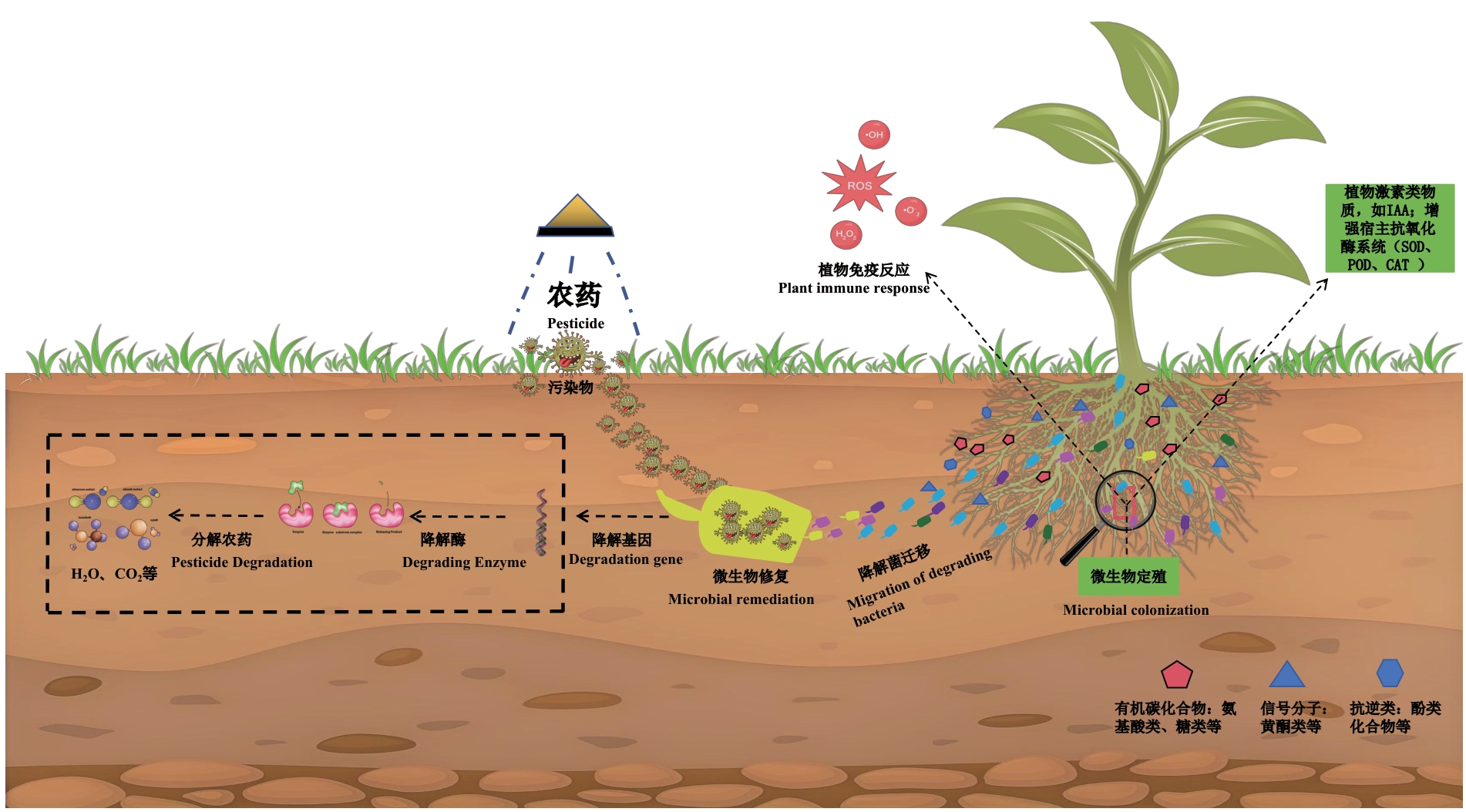
图1 植物-微生物协同降解土壤农药机制图
Fig. 1 Plant-microbe synergistic degradation of pesticides in soil
| [1] | Wang K, Ren YS, Pan XL, et al. Insights on persistent herbicides in cropland soils in northern China: Occurrence, ecological risks, and phytotoxicity to subsequent crops [J]. J Hazard Mater, 2025, 490: 137794. |
| [2] | Navarro I, Royano S, Alonso C, et al. Environmental exposure and risk assessment of pesticide mixtures in aquatic organisms from the Tagus River Basin [J]. Ecotoxicol Environ Saf, 2025, 305: 119221. |
| [3] | Sun MJ, Li H, Jaisi DP. Degradation of glyphosate and bioavailability of phosphorus derived from glyphosate in a soil-water system [J]. Water Res, 2019, 163: 114840. |
| [4] | Zhou Y, Wang LP, Sui JY, et al. Pathway elucidation and key enzymatic processes in the biodegradation of difenoconazole by Pseudomonas putida A-3 [J]. J Agric Food Chem, 2025, 73(8): 4770-4786. |
| [5] | Yang XY, Wei HY, Zhu CX, et al. Biodegradation of atrazine by the novel Citricoccus sp. strain TT3 [J]. Ecotoxicol Environ Saf, 2018, 147: 144-150. |
| [6] | Khatoon H, Rai JPN. Optimization studies on biodegradation of atrazine by Bacillus badius ABP6 strain using response surface methodology [J]. Biotechnol Rep, 2020, 26: e00459. |
| [7] | Li MR, Zhan FD, Chen JJ, et al. Atrazine degradation pathway and genes of Arthrobacter sp. FM326 [J]. Pol J Environ Stud, 2020, 29(5): 3683-3689. |
| [8] | Chen SM, Li YY, Fan ZW, et al. Soil bacterial community dynamics following bioaugmentation with Paenarthrobacter sp. W11 in atrazine-contaminated soil [J]. Chemosphere, 2021, 282: 130976. |
| [9] | Cao DT, He SH, Li X, et al. Characterization, genome functional analysis, and detoxification of atrazine by Arthrobacter sp. C2 [J]. Chemosphere, 2021, 264: 128514. |
| [10] | Zhao WS, Wang C, Xu L, et al. Biodegradation of nicosulfuron by a novel Alcaligenes faecalis strain ZWS11 [J]. J Environ Sci, 2015, 35: 151-162. |
| [11] | Wang L, Zhang XL, Li YM. Degradation of nicosulfuron by a novel isolated bacterial strain Klebsiella sp. Y1: condition optimization, kinetics and degradation pathway [J]. Water Sci Technol, 2016, 73(12): 2896-2903. |
| [12] | Zhao HY, Zhu JY, Liu SN, et al. Kinetics study of nicosulfuron degradation by a Pseudomonas nitroreducens strain NSA02 [J]. Biodegradation, 2018, 29(3): 271-283. |
| [13] | Ma QY, Kong DL, Zhang Q, et al. Microbacterium sulfonylureivorans sp. nov., isolated from sulfonylurea herbicides degrading consortium [J]. Arch Microbiol, 2022, 204(2): 136. |
| [14] | Chen W, Gao Y, Shi GL, et al. Enhanced degradation of fomesafen by a rhizobial strain Sinorhizobium sp. W16 in symbiotic association with soybean [J]. Appl Soil Ecol, 2023, 187:104847. |
| [15] | Hao ZY, Zhang S, Shao YX, et al. Preparation and inoculation of Bacillus spp. and Sinorhizobium meliloti strains immobilized on biochar-humic acid improve potted soybean traits and soil parameters [J]. Environ Technol Innov, 2025, 38: 104210. |
| [16] | Feng ZZ, Li QF, Zhang J, et al. Microbial degradation of fomesafen by a newly isolated strain Pseudomonas zeshuii BY-1 and the biochemical degradation pathway [J]. J Agric Food Chem, 2012, 60(29): 7104-7110. |
| [17] | Ma LY, Wan Q, Ge J, et al. Growth-promoting bacterium Enterobacter sp. CS8-gfp triggers jasmonate signaling pathway for atrazine and thiamethoxam degradation in rice (Oryza sativa L.) [J]. J Clean Prod, 2025, 522: 146373. |
| [18] | Ni H, Hu L, Jiang CYZ, et al. Effect of Phanerochaete chrysosporium induced phosphate precipitation on bacterial diversity during the soil remediation process [J]. Environmental Science and Pollution Research, 2024, 31(9): 13523-13534. |
| [19] | Yin R, Chang MD, Ma R, et al. Insights into the imidaclothiz biodegradation by the white-rot fungus Phanerochaete sordida YK-624 under ligninolytic conditions [J]. J Agric Food Chem, 2025, 73(21): 12877-12886. |
| [20] | Gupta M, Mathur S, Sharma TK, et al. A study on metabolic prowess of Pseudomonas sp. RPT 52 to degrade imidacloprid, endosulfan and coragen [J]. J Hazard Mater, 2016, 301: 250-258. |
| [21] | 徐丰俊, 刘泽钒, 彭睿琪, 等. 单细胞水平微流体技术筛选北极沉积物中的联苯降解菌 [J]. 环境科学学报, 2022, 42(9): 1-8. |
| Xu FJ, Liu ZF, Peng RQ, et al. Isolation of biphenyl-degrading bacteria in Arctic sediments by single-cell level isolation of microfluidics (SLIM) technology [J]. Acta Sci Circumstantiae, 2022, 42(9): 1-8. | |
| [22] | Yu X, Zhou H, Tang J, et al. Degradation kinetics and mechanism of β-cypermethrin and 3-phenoxybenzoic acid by Lysinibacillus pakistanensis VF-2 in soil remediation [J]. J Agric Food Chem, 2025, 73(1): 202-215. |
| [23] | Gong T, Xu XQ, Dang YL, et al. An engineered Pseudomonas putida can simultaneously degrade organophosphates, pyrethroids and carbamates [J]. Sci Total Environ, 2018, 628/629: 1258-1265. |
| [24] | Zhao MH, Xiao YF, Yang BB, et al. Enhanced biodegradation potential of Klebsiella michiganensis ES15 for acetochlor: Gene knockout, heterologous expression, molecular docking, and bioremediation [J]. Pestic Biochem Physiol, 2025, 214: 106530. |
| [25] | Xiao YF, Dong MQ, Wu X, et al. Enrichment, domestication, degradation, adaptive mechanism, and nicosulfuron bioremediation of bacteria consortium YM21 [J]. J Integr Agric, 2025, 24(9): 3529-3545. |
| [26] | Jiang HY, Yuan PP, Ding JJ, et al. Novel biodegradation pathway of insecticide flonicamid mediated by an amidase and its unusual substrate spectrum [J]. J Hazard Mater, 2023, 441: 129952. |
| [27] | Zhu SY, Zhang JL, Chen AW, et al. Newly discovered cyanobacteria Nostoc sp. PCC7120 for high efficiency biodegradation of thiamethoxam: Photosynthesis response, enzyme strategies, and molecular mechanisms [J]. Bioresour Technol, 2025, 436: 132979. |
| [28] | Aswathi A, Pandey A, Madhavan A, et al. Chlorpyrifos induced proteome remodelling of Pseudomonas nitroreducens AR-3 potentially aid efficient degradation of the pesticide [J]. Environ Technol Innov, 2021, 21: 101307. |
| [29] | Wang BJ, Chen J, Wu S, et al. Reusable carboxylesterase immobilized in ZIF for efficient degradation of chlorpyrifos in enviromental water [J]. Pestic Biochem Physiol, 2023, 194: 105519. |
| [30] | An TC, Zu L, Li GY, et al. One-step process for debromination and aerobic mineralization of tetrabromobisphenol-a by a novel Ochrobactrum sp. T isolated from an e-waste recycling site [J]. Bioresour Technol, 2011, 102(19): 9148-9154. |
| [31] | Zhang JJ, Chen YF, Fang T, et al. Co-metabolic degradation of tribenuron methyl, a sulfonylurea herbicide, by Pseudomonas sp. strain NyZ42 [J]. Int Biodeterior Biodegrad, 2013, 76: 36-40. |
| [32] | Rentz, JA, Alvarez, PJJ, Schnoor, JL. Benzo[α]pyrene co-metabolism in the presence of plant root extracts and exudates: Implications for phytoremediation [J]. Environ Pollut, 2005, 136(3): 477-484. |
| [33] | Zhao JY, Jia DY, Du J, et al. Substrate regulation on co-metabolic degradation of β-cypermethrin by Bacillus licheniformis B-1 [J]. AMB Express, 2019, 9(1): 83. |
| [34] | 王镔, 蔡凯, 邵汝英, 等. 苯胺高效降解菌的筛选及共代谢机制 [J]. 环境保护科学, 2020, 46(4): 117-121. |
| Wang B, Cai K, Shao RY, et al. Study on the screening of aniline-degrading strain and its co-metabolism mechanism [J]. Environ Prot Sci, 2020, 46(4): 117-121. | |
| [35] | Lin ZQ, Pang SM, Zhou Z, et al. Novel pathway of acephate degradation by the microbial consortium ZQ01 and its potential for environmental bioremediation [J]. J Hazard Mater, 2022, 426: 127841. |
| [36] | Castilla-Alcantara JC, Posada-Baquero R, Ortega-Calvo JJ. Taxis-mediated bacterial transport and its implication for the cometabolism of pyrene in a model aquifer [J]. Water Res, 2024, 248: 120850. |
| [37] | Perera M, Wijayarathna D, Wijesundera S, et al. Biofilm mediated synergistic degradation of hexadecane by a naturally formed community comprising Aspergillus flavus complex and Bacillus cereus group [J]. BMC Microbiol, 2019, 19(1): 84. |
| [38] | Li Y, Feng FY, Mu QE, et al. Foliar spraying of chlorpyrifos triggers plant production of linolenic acid recruiting rhizosphere bacterial Sphingomonas sp [J]. Environ Sci Technol, 2023, 57(45): 17312-17323. |
| [39] | Liu XJ, Sun L, Wang SB, et al. Genomic analysis and phytoprobiotic characteristics of Acinetobacter pittii P09: a p-hydroxybenzoic acid-degrading plant-growth promoting rhizobacteria [J]. Environ Technol Innov, 2025, 38: 104113. |
| [40] | 周慧, 冯红丽, 董彤彤, 等. 胁迫条件下DEHP降解菌的分离及特性研究 [J]. 环境科学与技术, 2022, 45(2): 16-24. |
| Zhou H, Feng HL, Dong TT, et al. DEHP degradation bacteria under stress condition: isolation and characterization [J]. Environ Sci Technol, 2022, 45(2): 16-24. | |
| [41] | Wang JL, Liu ZY, Wang XY, et al. Combatting glufosinate-induced pepper toxicity: jasmonic acid recruiting rhizosphere bacterial strain Rhodococcus gordoniae [J]. Microbiome, 2025, 13(1): 158. |
| [42] | Zhang HH, Liu YP, Wu GW, et al. Bacillus velezensis tolerance to the induced oxidative stress in root colonization contributed by the two-component regulatory system sensor ResE [J]. Plant Cell Environ, 2021, 44(9): 3094-3102. |
| [43] | Ma KW, Niu YL, Jia Y, et al. Coordination of microbe-host homeostasis by crosstalk with plant innate immunity [J]. Nat Plants, 2021, 7(6): 814-825. |
| [44] | Liu Y, Tang SK, Wang X, et al. A novel thermostable and salt-tolerant carboxylesterase involved in the initial aerobic degradation pathway for pyrethroids in Glycomyces salinus [J]. J Hazard Mater, 2023, 451: 131128. |
| [45] | Feng RC, Wang HC, Liu TT, et al. Response of microbial communities in the phyllosphere ecosystem of tobacco exposed to the broad-spectrum copper hydroxide [J]. Front Microbiol, 2023, 14: 1229294. |
| [46] | Chen XYL, Wicaksono WA, Berg G, et al. Bacterial communities in the plant phyllosphere harbour distinct responders to a broad-spectrum pesticide [J]. Sci Total Environ, 2021, 751: 141799. |
| [47] | Schulz-Bohm K, Gerards S, Hundscheid M, et al. Calling from distance: attraction of soil bacteria by plant root volatiles [J]. ISME J, 2018, 12(5): 1252-1262. |
| [48] | Liao QH, Liu H, Lu C, et al. Root exudates enhance the PAH degradation and degrading gene abundance in soils [J]. Sci Total Environ, 2021, 764: 144436. |
| [49] | Li JL, Hong M, Tang R, et al. Isolation of Diaphorobacter sp. LW2 capable of degrading Phenanthrene and its migration mediated by Pythium ultimum [J]. Environ Technol, 2024, 45(8): 1497-1507. |
| [50] | Ma YP, Deng YL, Hua HJ, et al. Distinct bacterial population dynamics and disease dissemination after biofilm dispersal and disassembly [J]. ISME J, 2023, 17(8): 1290-1302. |
| [51] | Li JL, Hong M, Lv J, et al. Enhancement on migration and biodegradation of Diaphorobacter sp. LW2 mediated by Pythium ultimum in soil with different particle sizes [J]. Front Microbiol, 2024, 15: 1391553. |
| [52] | Elyamine AM, Hu CX. Earthworms and rice straw enhanced soil bacterial diversity and promoted the degradation of phenanthrene [J]. Environ Sci Eur, 2020, 32(1): 124. |
| [53] | Zhane C, Pan XL, Wu XM, et al. Removal of dimethachlon from soils using immobilized cells and enzymes of a novel potential degrader Providencia stuartii JD [J]. J Hazard Mater, 2019, 378: 120606. |
| [54] | 滕晓, 沈心怡, 张步瑶, 等. 二苯醚类除草剂降解菌Bacillus sp. za微生物制剂的研发与初步应用 [J]. 土壤, 2023, 55(3): 682-688. |
| Teng X, Shen XY, Zhang BY, et al. Development and preliminary application of microbial preparation of diphenyl ether herbicede degrading strain Bacillus sp. za [J]. Soils, 2023, 55(3): 682-688. | |
| [55] | Copeland C, Schulze-Lefert P, Ma KW. Potential and challenges for application of microbiomes in agriculture [J]. Plant Cell, 2025, 37(8): koaf185. |
| [56] | 伊国云, 李娟, 程亮, 等. 纤维素降解菌产酶条件优化及其堆肥效果研究 [J]. 福建农业学报, 2025, 40(2): 208-218. |
| Yi GY, Li J, Cheng L, et al. Enzyme generation and effect in composting of cellulolytic bacteria [J]. Fujian J Agric Sci, 2025, 40(2): 208-218. | |
| [57] | Sun JQ, Feng YM, Zheng R, et al. Solar-enhanced low-temperature biological wastewater treatment [J]. Nat Sustain, 2025, 8(9): 1048-1057. |
| [58] | Aluffi ME, Magnoli K, Carranza CS, et al. Ability of mixed fungal cultures to remove glyphosate from soil microcosms under stressful conditions [J]. Biodegradation, 2025, 36(3): 31. |
| [1] | 李冲, 杨亚楠, 王翠霞, 郑海鑫. 微生物-生物炭协同修复农业环境中的多元污染物[J]. 生物技术通报, 2024, 40(10): 86-97. |
| [2] | 张林林, 沈虎生, 杨冰, 何梦菡, 朴凤植, 申顺善. 生防细菌HK11-9对黄瓜棒孢叶斑病的防病能力及其鉴定[J]. 生物技术通报, 2023, 39(12): 209-218. |
| [3] | 李颖, 龙长梅, 蒋标, 韩丽珍. 两株PGPR菌株的花生定殖及对根际细菌群落结构的影响[J]. 生物技术通报, 2022, 38(9): 237-247. |
| [4] | 马青云, 江旭, 李情情, 宋金龙, 周义清, 阮志勇. 烟嘧磺隆降解菌Chryseobacterium sp. LAM-M5的分离、鉴定及其降解机理研究[J]. 生物技术通报, 2022, 38(2): 113-122. |
| [5] | 李思思, 张博源, 符运会, 周佳, 屈建航. 一株高效溶磷细菌的条件优化及其溶磷特性研究[J]. 生物技术通报, 2022, 38(12): 274-286. |
| [6] | 牛鸿宇, 舒倩, 杨海君, 颜智勇, 谭菊. 一株十二烷基硫酸钠高效降解菌的分离鉴定、降解特性及代谢途径研究[J]. 生物技术通报, 2022, 38(12): 287-299. |
| [7] | 张雅涵, 朱丽霞, 胡静, 朱亚静, 张雪婧, 曹叶中. 草甘膦在我国生物育种产业化应用中的机遇与挑战[J]. 生物技术通报, 2022, 38(11): 1-9. |
| [8] | 朱永安, 王淼, 曹静, 喻鹤, 曹振, 金茂俊, 王静, 佘永新. 农药残留检测关键用酶固定化研究进展[J]. 生物技术通报, 2022, 38(1): 258-268. |
| [9] | 肖小双, 安雪姣, 叶晗媛, 王林平, 钟斌, 张庆华. 废水中硫氰酸盐的微生物降解研究进展[J]. 生物技术通报, 2021, 37(2): 224-235. |
| [10] | 王卫雄, 沈博, 贾洪柏, 乔俊卿, 牛犇. 根际生防菌群的应用及其防病增效的潜在机制[J]. 生物技术通报, 2020, 36(9): 31-41. |
| [11] | 王亚妮, 宋金龙, 韩刚, 穆迎春, 江旭, 王金耀, 阮志勇, 李乐. 孔雀石绿降解菌群多样性及高效降解菌的降解特性分析[J]. 生物技术通报, 2019, 35(9): 150-155. |
| [12] | 刘娜, 刘志敏, 宋东辉. 石油烃降解菌对邻苯二酚、苯甲酸钠降解特性的研究[J]. 生物技术通报, 2019, 35(9): 156-164. |
| [13] | 陈楠, 于飞, 何艳柳, 卜宁. 一株水稻促生长内生真菌的绿色荧光蛋白基因标记与示踪[J]. 生物技术通报, 2017, 33(3): 100-105. |
| [14] | 孙真, 郑亮, 邱浩斌. 植物根际促生细菌定殖研究进展[J]. 生物技术通报, 2017, 33(2): 8-15. |
| [15] | 刘晓瑜, 马玉超. 生防链霉菌SSD49的绿色荧光蛋白标记及其在毛白杨组培苗中的定殖[J]. 生物技术通报, 2016, 32(9): 197-202. |
| 阅读次数 | ||||||
|
全文 |
|
|||||
|
摘要 |
|
|||||
