







生物技术通报 ›› 2026, Vol. 42 ›› Issue (8): 229-238.doi: 10.13560/j.cnki.biotech.bull.1985.2025-1056
• 研究报告 • 上一篇
马天意, 孙铭钰, 梁舒婷, 鲍薇, 秦旭洋, 张梅娟, 沙伟, 彭疑芳( )
)
收稿日期:2025-10-02
出版日期:2026-08-26
发布日期:2026-08-17
通讯作者:
彭疑芳02951@qqhru.edu.cn基金资助:
MA Tian-yi, SUN Ming-yu, LIANG Shu-ting, BAO Wei, QIN Xu-yang, ZHANG Mei-juan, SHA Wei, PENG Yi-fang()
Received:2025-10-02
Published:2026-08-26
Online:2026-08-17
摘要:
目的 探究砂藓(Racomitrium canescens)中甲酸脱氢酶(formate dehydrogenase, FDH)基因RcFDH2是否具有耐旱和耐高温功能,为揭示砂藓耐旱、耐高温机制以及培育抗性作物提供理论支撑。 方法 通过实时荧光定量PCR技术,对RcFDH2在干燥砂藓复水处理过程中的表达变化进行检测;对RcFDH2的编码序列进行克隆;获取RcFDH2过表达转基因拟南芥(Arabidopsis thaliana),并对其进行干旱和高温处理,观察植株表型并进行生理生化指标测定。 结果 RcFDH2在砂藓复水过程中呈现差异表达;成功克隆获得RcFDH2的编码序列,并获取了多个RcFDH2过表达转基因拟南芥株系。在干旱及高温处理下,相比于野生型拟南芥,RcFDH2转基因株系具有更强的耐旱和耐高温能力。测定生理生化指标发现,在干旱和高温胁迫下,RcFDH2过表达转基因植株中3种渗透调节物质含量、总叶绿素含量及3种抗氧化酶活性均显著高于野生型植株,丙二醛含量低于野生型植株。 结论 RcFDH2能够响应砂藓的脱水及高温胁迫处理,其过表达可能通过调节渗透调节物质和抗氧化酶活性增强拟南芥的耐旱和耐高温能力。
马天意, 孙铭钰, 梁舒婷, 鲍薇, 秦旭洋, 张梅娟, 沙伟, 彭疑芳. 过表达砂藓RcFDH2基因提高拟南芥的耐旱性和耐高温性[J]. 生物技术通报, 2026, 42(8): 229-238.
MA Tian-yi, SUN Ming-yu, LIANG Shu-ting, BAO Wei, QIN Xu-yang, ZHANG Mei-juan, SHA Wei, PENG Yi-fang. Overexpression of RcFDH2 from Racomitrium canescens Enhances the Tolerance of Arabidopsis thaliana to Drought and High-temperature[J]. Biotechnology Bulletin, 2026, 42(8): 229-238.
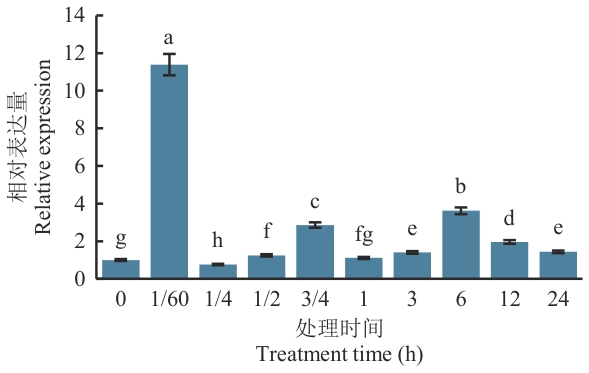
图1 RcFDH2在干燥砂藓复水处理过程中的表达变化误差线表示标准偏差,误差线上不同字母表示差异显著(P<0.05),下同
Fig. 1 Expression changes of RcFDH2 in desiccated R. canescens under rehydration treatmentThe error bars indicate the standard deviation, and the different letters on the error bars indicate the difference is significant (P<0.05), the same below
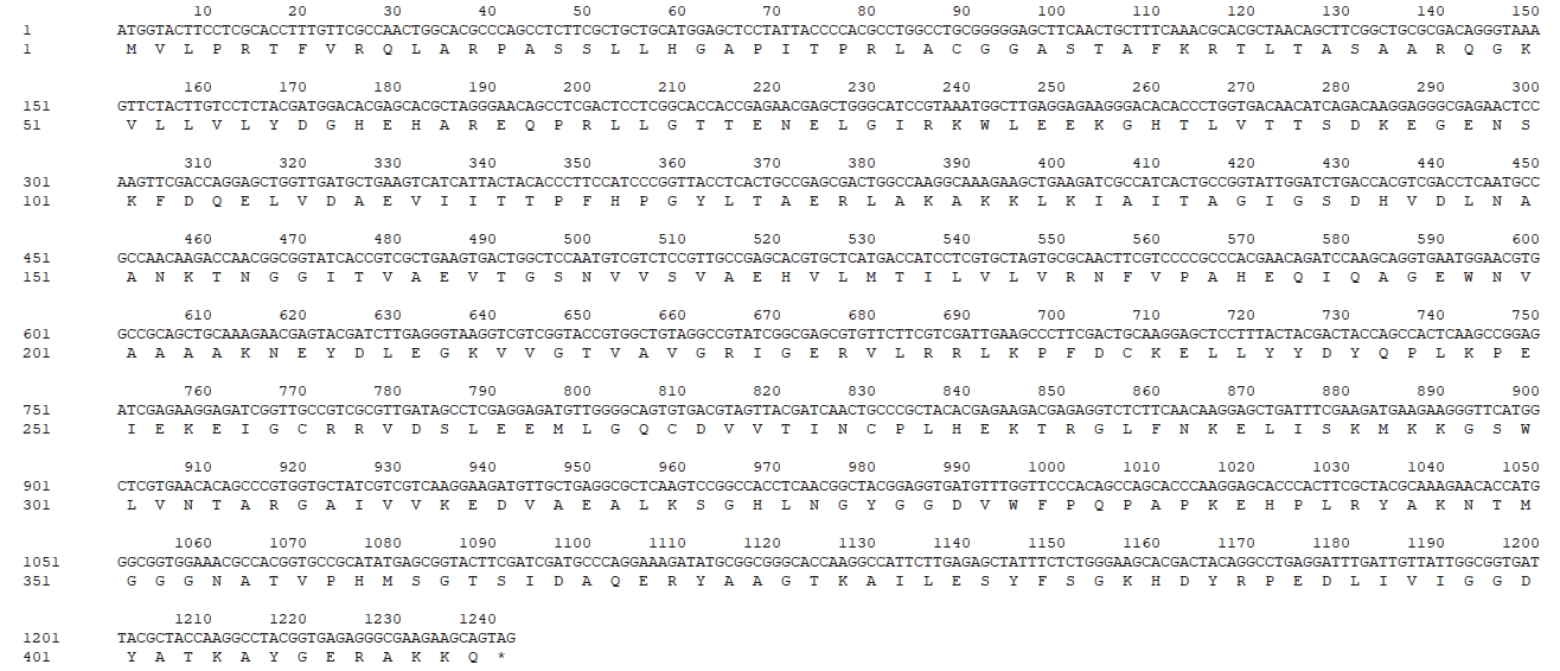
图2 RcFDH2的编码序列及氨基酸序列
Fig. 2 Coding sequence of RcFDH2 and its amino acid sequences
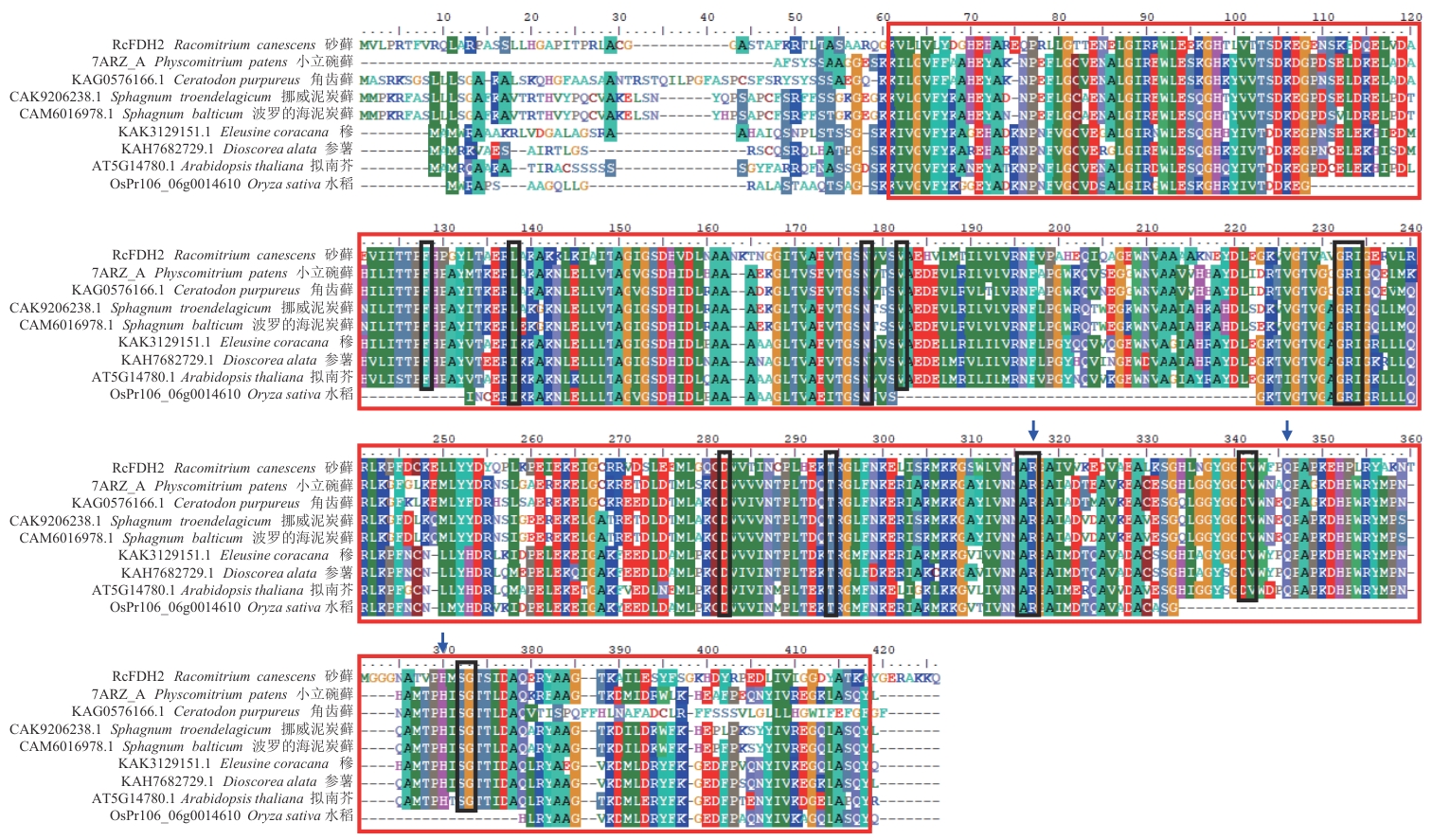
图3 RcFDH2与近缘蛋白质的序列比对红框内为FDH保守结构域,黑框内为NAD⁺结合位点,蓝色箭头处为催化位点
Fig. 3 Sequence alignment of RcFDH2 with homologous proteinsRed box indicates the conserved domains of FDH, black box indicates NAD⁺ binding sites, and blue arrow indicates the catalytic sites
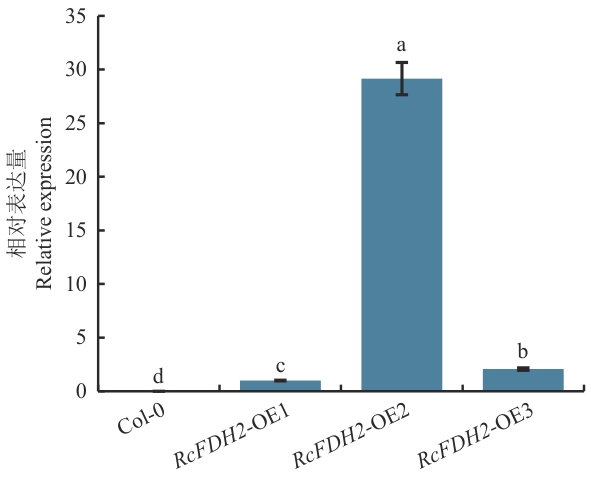
图4 T2代RcFDH2过表达转基因拟南芥株系中RcFDH2的表达量分析
Fig. 4 Analysis of RcFDH2 expression in T2 generation lines of RcFDH2-overexpressed transgenic A. thaliana
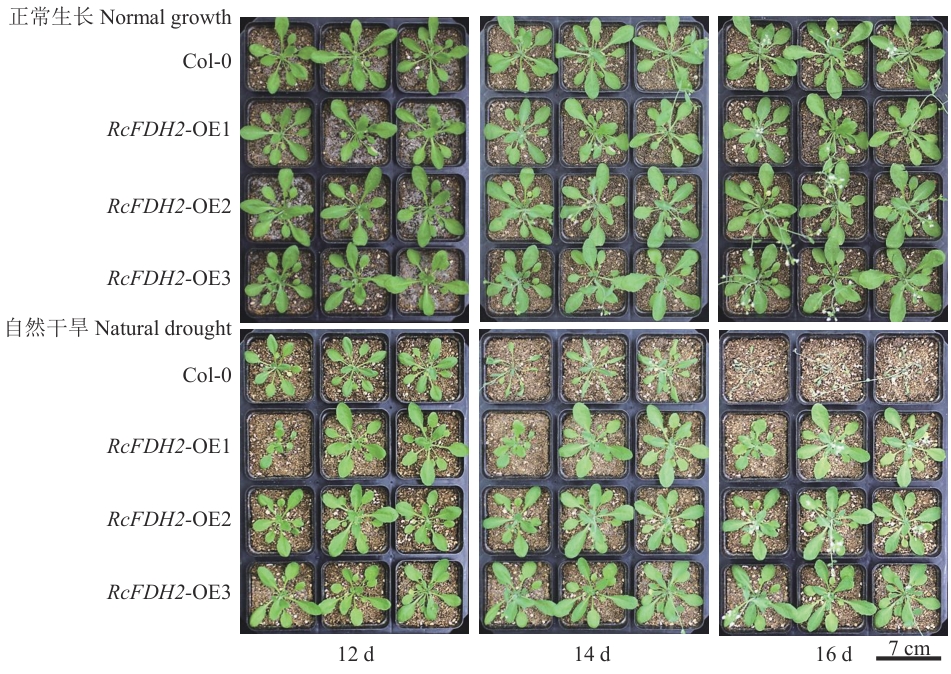
图5 干旱胁迫下RcFDH2过表达转基因拟南芥的表型
Fig. 5 Phenotypesof RcFDH2-overexpressed transgenic A. thaliana under drought stress
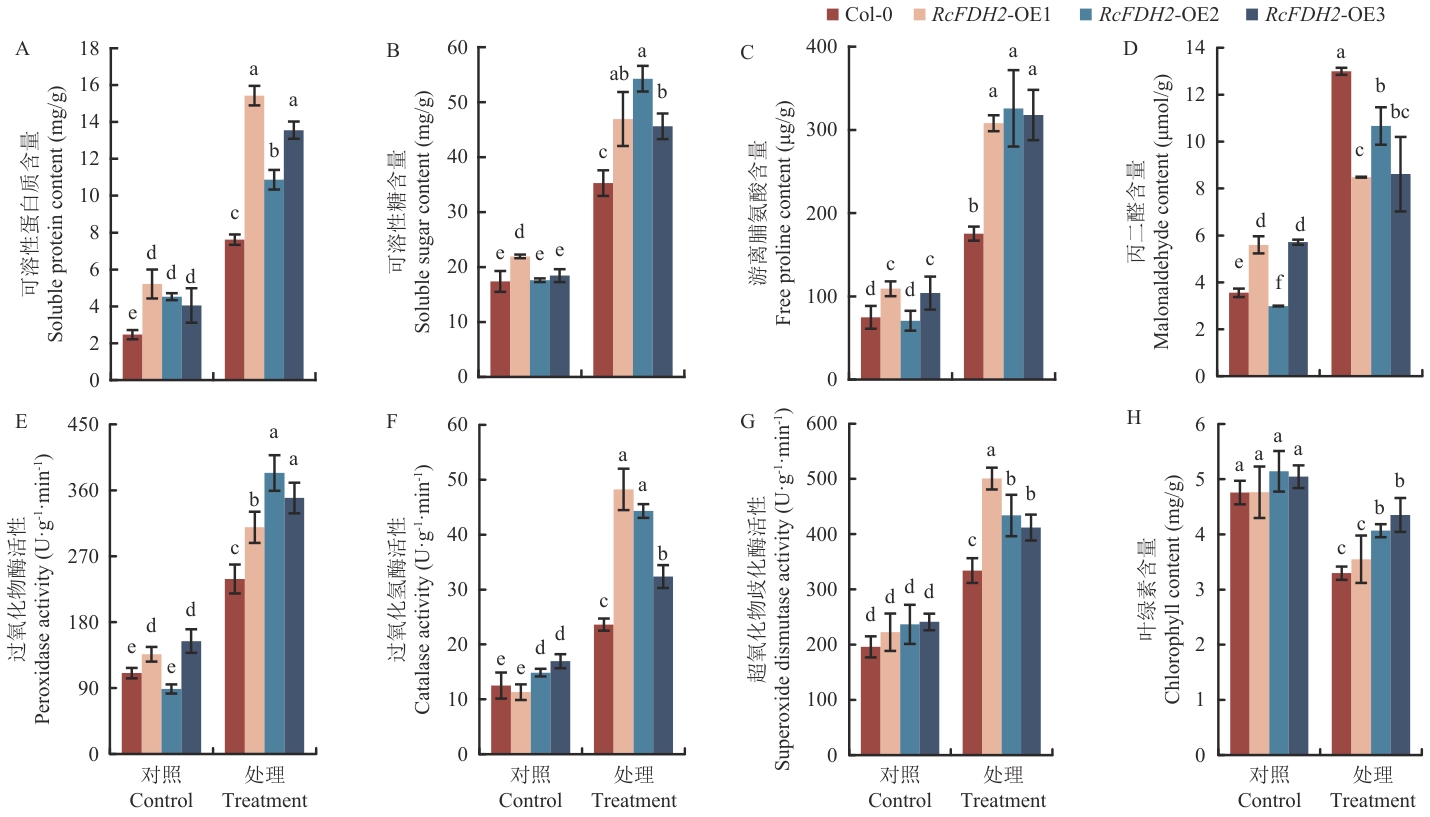
图6 干旱胁迫下野生型及RcFDH2过表达转基因拟南芥植株的生理生化指标变化
Fig. 6 Variation in physiological and biochemical indexes of wild-type and RcFDH2-overexpressed transgenic A. thaliana under drought stress
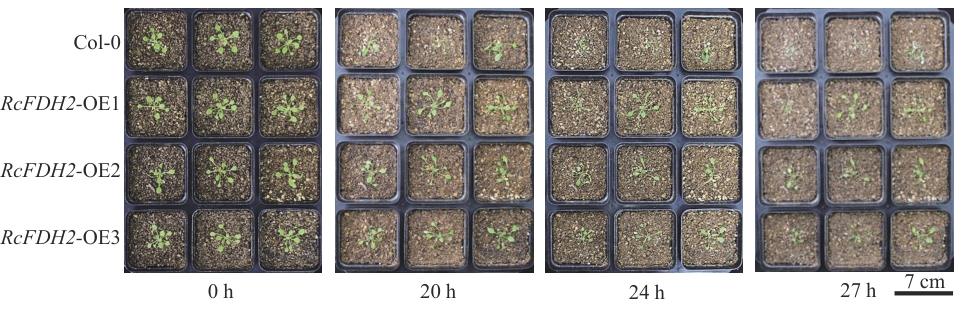
图7 RcFDH2过表达转基因拟南芥在45 ℃高温处理下的表型
Fig. 7 Phenotypes of RcFDH2-overexpressed transgenic A. thaliana under 45 ℃ high-temperature treatments
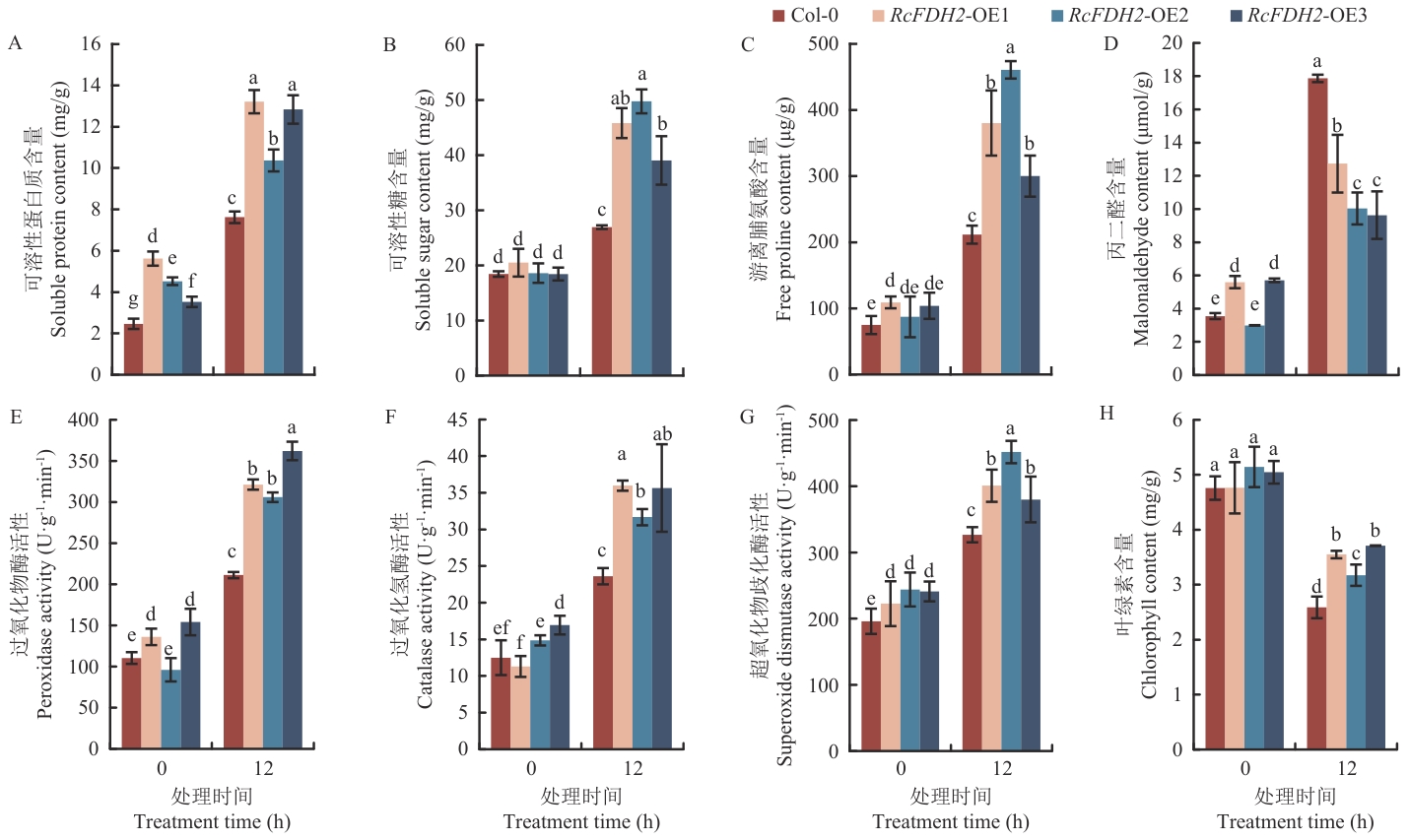
图8 45 ℃高温处理下野生型及RcFDH2过表达转基因拟南芥的生理生化指标变化
Fig. 8 Variation in physiological and biochemical indexes of wild-type and RcFDH2-overexpressed transgenic A. thaliana under 45 ℃ high-temperature treatments
| [1] | 葛全胜, 陈泮勤, 张雪芹. 全球变化的集成研究 [J]. 地球科学进展, 2000, 15(4): 461-466. |
| Ge QS, Chen PQ, Zhang XQ. Synthesis study on global environmental change [J]. Adv Earth Sci, 2000, 15(4): 461-466. | |
| [2] | Flores-Saavedra M, Plazas M, Vilanova S, et al. Induction of water stress in major Solanum crops: a review on methodologies and their application for identifying drought tolerant materials [J]. Sci Hortic, 2023, 318: 112105. |
| [3] | 段娅敏, 王后苗, 杨泽峰, 等. 基于转录组解析玉米苗期根系对非生物胁迫的响应 [J]. 江苏农业学报, 2025, 41(5): 848-857. |
| Duan YM, Wang HM, Yang ZF, et al. Transcriptome-based analysis of the response of maize root to abiotic stress at seedling stage [J]. Jiangsu J Agric Sci, 2025, 41(5): 848-857. | |
| [4] | 高旭. 生态恢复先锋植物苔藓的耐旱性评价及应用 [J]. 防护林科技, 2019(5): 65-67, 77. |
| Gao X. Evaluation and application of drought tolerance of ecological restoration pioneer plants-bryophytes [J]. Prot For Sci Technol, 2019(5): 65-67, 77. | |
| [5] | Niu QQ, Zhao LY, Dang YX, et al. Bryophyte ELIPs as evolutionary guardians: engineering chloroplast resilience and ABA-enhanced drought tolerance in crops [J]. Plant Cell Environ, 2025, 48(11): 7948-7960. |
| [6] | Cao T, Haxim Y, Liu XJ, et al. ScATG8 gene cloned from desert moss Syntrichia caninervis exhibits multiple stress tolerance [J]. Plants, 2023, 13(1): 59. |
| [7] | Yin FL, Liu XC, Hawar A, et al. Phosphoproteomics analysis provides novel insight into the mechanisms of extreme desiccation tolerance of the desert moss Syntrichia caninervis [J]. Plant J, 2025, 123(3): e70373. |
| [8] | 卓露, 林晓华, 薛山, 等. 植物耐干机制研究进展 [J]. 华中农业大学学报, 2023, 42(5): 28-34. |
| Zhuo L, Lin XH, Xue S, et al. Progress on studying mechanism of plant drought tolerance [J]. J Huazhong Agric Univ, 2023, 42(5): 28-34. | |
| [9] | 孙天国, 谷新颖, 衣兰, 等. 砂藓耐脱水相关类钙调蛋白基因RcCML1的克隆与表达分析 [J]. 齐齐哈尔大学学报: 自然科学版, 2025, 41(3): 68-74, 94. |
| Sun TG, Gu XY, Yi L, et al. Cloning and expression analysis of dehydration tolerance related calmodulin-like protein gene RcCML1 in Racomitrium canescens [J]. J Qiqihar Univ Nat Sci Ed, 2025, 41(3): 68-74, 94. | |
| [10] | 朱瑞良, 马晓英, 曹畅, 等. 中国苔藓植物多样性研究进展 [J]. 生物多样性, 2022, 30(7): 86-97. |
| Zhu RL, Ma XY, Cao C, et al. Advances in research on bryophyte diversity in China [J]. Biodivers Sci, 2022, 30(7): 86-97. | |
| [11] | 陈倩, 车丽萍, 娄玉霞. 6种藓类植物保水性能的研究 [J]. 上海师范大学学报: 自然科学版, 2019, 48(5): 521-525. |
| Chen Q, Che LP, Lou YX. Study on water retention capacities of six moss species [J]. J Shanghai Norm Univ Nat Sci, 2019, 48(5): 521-525. | |
| [12] | 王晶晶, 白玉, 蔡璨, 等. 砂藓属植物抗逆特性及相关功能基因研究进展 [J]. 高师理科学刊, 2024, 44(5): 87-92. |
| Wang JJ, Bai Y, Cai C, et al. Advances in studies on stress resistance characteristics and the related functional genes of Racomitrium plants [J]. J Sci Teach Coll Univ, 2024, 44(5): 87-92. | |
| [13] | 沙伟, 秦瑞峰, 孟灵军, 等. 砂藓(Racomitrium canescens)抗旱相关基因RcAOS2的克隆及表达分析 [J]. 分子植物育种, 2020, 18(4): 1131-1137. |
| Sha W, Qin RF, Meng LJ, et al. Cloning and expression analysis of drought-resistance related gene RcAOS2 in Racomitrium canescens [J]. Mol Plant Breed, 2020, 18(4): 1131-1137. | |
| [14] | 沙伟, 张时通, 朱巍巍, 等. 砂藓抗旱相关基因磷脂酶D的克隆和表达分析 [J]. 分子植物育种, 2021, 19(1): 123-129. |
| Sha W, Zhang ST, Zhu WW, et al. Cloning and expression analysis of drought-resistant related phospholipase D gene from Racomitrium canescens [J]. Mol Plant Breed, 2021, 19(1): 123-129. | |
| [15] | 沙伟, 孙玉斌, 马天意, 等. 砂藓(Racomitrium canescens)RcADH基因的克隆及生物信息学分析 [J]. 基因组学与应用生物学, 2021, 40(5): 2270-2275. |
| Sha W, Sun YB, Ma TY, et al. Cloning and bioinformatics analysis of RcADH in Racomitrium canescens [J]. Genom Appl Biol, 2021, 40(5): 2270-2275. | |
| [16] | 沙伟, 卫杰, 张梅娟, 等. 砂藓干旱胁迫相关转录因子基因RcTIFY1的克隆及表达分析 [J]. 分子植物育种, 2023, 21(9): 2925-2932. |
| Sha W, Wei J, Zhang MJ, et al. Cloning and expression analysis of the drought stress related transcription factor gene RcTIFY1 of Racomitrium canescens [J]. Mol Plant Breed, 2023, 21(9): 2925-2932. | |
| [17] | Suzuki K, Itai R, Suzuki K, et al. Formate dehydrogenase, an enzyme of anaerobic metabolism, is induced by iron deficiency in barley roots [J]. Plant Physiol, 1998, 116(2): 725-732. |
| [18] | 梁舒婷, 韩艺, 闫恩典, 等. 甲酸脱氢酶及其编码基因在植物胁迫响应中的功能研究进展 [J]. 高师理科学刊, 2025, 45(2): 57-62. |
| Liang ST, Han Y, Yan ED, et al. Research progress on the functions of formate dehydrogenases and the encoding genes in plant stress responses [J]. J Sci Teach Coll Univ, 2025, 45(2): 57-62. | |
| [19] | Alekseeva AA, Savin SS, Tishkov VI. NAD+-dependent formate dehydrogenase from plants [J]. Acta Naturae, 2011, 3(4): 38-54. |
| [20] | 余黎明. 甲酸脱氢酶的克隆表达和酶学性质研究及发酵条件的优化 [D]. 合肥: 安徽农业大学, 2018. |
| Yu LM. Cloning and expression and enzymatic properties of formate dehydrogenase and optimization of fermentation conditions [D]. Hefei: Anhui Agricultural University, 2018. | |
| [21] | 陆峰, 黄玉红, 林燕娜, 等. CO2还原用甲酸脱氢酶分子改造的研究进展 [J]. 生物技术通报, 2025, 41(3): 14-24. |
| Lu F, Huang YH, Lin YN, et al. Advances on molecular modifications of formate dehydrogenase for CO2 reduction [J]. Biotechnol Bull, 2025, 41(3): 14-24. | |
| [22] | Hourton-Cabassa C, Ambard-Bretteville F, Moreau F, et al. Stress induction of mitochondrial formate dehydrogenase in potato leaves [J]. Plant Physiol, 1998, 116(2): 627-635. |
| [23] | Li R, Bonham-Smith PC, King J. Molecular characterization and regulation of formate dehydrogenase in Arabidopsis thaliana [J]. Can J Bot, 2001, 79(7): 796-804. |
| [24] | Zribi K, Ciciani M, Carreira ASA, et al. Characterization of a novel thermostable NAD+-dependent formate dehydrogenase from Methylacidiphilum kamchatkense Kam1 (MkaFDH) [J]. Curr Res Biotechnol, 2025, 10: 100306. |
| [25] | Peng YF, Ma TY, Wang X, et al. Proteomic and transcriptomic responses of the desiccation-tolerant moss Racomitrium canescens in the rapid rehydration processes [J]. Genes, 2023, 14(2): 390. |
| [26] | 马天意, 赵继发, 沙伟, 等. 砂藓耐脱水胁迫响应基因RcCHS2的克隆及表达分析 [J/OL]. 分子植物育种, 2022. . |
| Ma TY, Zhao JF, Sha W, et al. Cloning and expression analysis of desiccation stress responding gene RcCHS2 in Racomitrium canescens [J/OL]. Mol Plant Breed, 2022. . | |
| [27] | 鲍薇, 王晶晶, 沙伟, 等. 砂藓SMPD基因的克隆及对干旱和高温胁迫响应分析 [J]. 广西植物, 2025, 45(8): 1530-1542. |
| Bao W, Wang JJ, Sha W, et al. Cloning of SMPD in Racomitrium canescens and analysis of its responses to drought and high-temperature stresses [J]. Guihaia, 2025, 45(8): 1530-1542. | |
| [28] | 马天意, 张时通, 朱巍巍, 等. 砂藓RcPLD基因的抗旱功能分析 [J]. 西北植物学报, 2021, 41(7): 1091-1100. |
| Ma TY, Zhang ST, Zhu WW, et al. Analysis of drought-resistance function of RcPLD gene from Racomitrium canescens [J]. Acta Bot Boreali Occidentalia Sin, 2021, 41(7): 1091-1100. | |
| [29] | 信雨萌. 砂藓抗旱相关转录因子基因RcWRKY、RcbZIP的克隆和特性分析 [D]. 齐齐哈尔: 齐齐哈尔大学, 2017. |
| Xin YM. Cloning and characteristic analysis of drought-resistant related transcription factor genes RcWRKY and RcbZIP from Racomitrium canescens [D]. Qiqihar: Qiqihar University, 2017. | |
| [30] | 马天意, 许家佳, 路文婧, 等.‘金小童’大白菜BrcGASA3基因在盐碱胁迫下的表达分析及抗性鉴定 [J]. 生物技术通报, 2025, 41(2): 127-138. |
| Ma TY, Xu JJ, Lu WJ, et al. Expression analysis and resistance identification of BrcGASA3 in Chinese cabbage ‘Jinxiaotong’ cultivar under saline-alkali stress [J]. Biotechnol Bull, 2025, 41(2): 127-138. | |
| [31] | 杨悦, 李昌宁, 孙晓露, 等. 大豆转录因子GmMYB069的克隆与耐盐功能鉴定 [J/OL]. 生物技术通报, 2025. . |
| Yang Y, Li CN, Sun XL, et al. Cloning and identification of salt tolerance function of Soybean transcription factor GmMYB069 [J/OL]. Biotechnol Bull, 2025. . | |
| [32] | 魏晶晶, 马丽丽, 张宁, 等. 马铃薯StDHN-2基因的克隆与表达分析 [J]. 农业生物技术学报, 2025, 33(4): 731-742. |
| Wei JJ, Ma LL, Zhang N, et al. Cloning and expression analysis of the StDHN-2 gene in potato (Solanum tuberosum) [J]. J Agric Biotechnol, 2025, 33(4): 731-742. | |
| [33] | 臧巧路, 柳璐, 刘涵, 等. 辣椒CaPEX3基因克隆及表达分析 [J]. 西北植物学报, 2024, 44(10): 1597-1605. |
| Zang QL, Liu L, Liu H, et al. Cloning and expression analysis of CaPEX3 in pepper [J]. Acta Bot Boreali Occidentalia Sin, 2024, 44(10): 1597-1605. | |
| [34] | Zheng YM, Qi C, Qiao YY, et al. From formate oxidation to CO₂ reduction: The role of formate dehydrogenase in sustainable carbon utilization [J]. Biotechnol Adv, 2025, 82: 108600. |
| [35] | Slusarczyk H, Felber S, Kula MR, et al. Stabilization of NAD-dependent formate dehydrogenase from Candida boidinii by site-directed mutagenesis of cysteine residues [J]. Eur J Biochem, 2000, 267(5): 1280-1289. |
| [36] | Cordas CM, Campaniço M, Baptista R, et al. Direct electrochemical reduction of carbon dioxide by a molybdenum-containing formate dehydrogenase [J]. J Inorg Biochem, 2019, 196: 110694. |
| [37] | Li MH, Meng XM, Sun ZY, et al. Effects of NADH availability on 3-phenyllactic acid production by Lactobacillus plantarum expressing formate dehydrogenase [J]. Curr Microbiol, 2019, 76(6): 706-712. |
| [38] | 王鹏, 叶济宇, 沈允钢, 等. 烟草叶绿体NAD(P)H脱氢酶在抵御高温胁迫中的作用 [J]. 中国科学: 生命科学, 2006, 36(2): 109-117. |
| Wang P, Ye JY, Shen YG, et al. Role of NAD(P)H dehydrogenase in tobacco chloroplast in resisting high temperature stress [J]. Sci China Ser C Life Sci, 2006, 36(2): 109-117. | |
| [39] | Wang X, Li BB, Ma TT, et al. The NAD kinase OsNADK1 affects the intracellular redox balance and enhances the tolerance of rice to drought [J]. BMC Plant Biol, 2020, 20(1): 11. |
| [40] | Serov AE, Popova AS, Fedorchuk VV, et al. Engineering of coenzyme specificity of formate dehydrogenase from Saccharomyces cerevisiae [J]. Biochem J, 2002, 367(Pt 3): 841-847. |
| [41] | 匡艺, 李廷轩, 余海英. 氮素对不同氮效率小黑麦基因型叶片保护酶活性和膜脂过氧化的影响 [J]. 草业学报, 2011, 20(6): 93-100. |
| Kuang Y, Li TX, Yu HY. Effect of nitrogen on protective enzyme activities and lipid peroxidation in Triticale genotypes with different N use efficiency [J]. Acta Prataculturae Sin, 2011, 20(6): 93-100. | |
| [42] | 蒋明义, 郭绍川. 水分亏缺诱导的氧化胁迫和植物的抗氧化作用 [J]. 植物生理学通讯, 1996, 32(2): 144-150. |
| Jiang MY, Guo SC. Oxidative stress induced by water deficiency and antioxidant effect of plants [J]. Plant Physiol Commun, 1996, 32(2): 144-150. |
| [1] | 黄旭升, 周雅莉, 贾峥嵘, 沈珊, 陈锦钗, 周广立, 李鑫鑫, 王计平, 李润植, 贾小云. 紫苏ARF转录因子家族全基因组鉴定及其在非生物胁迫响应中的功能分析[J]. 生物技术通报, 2026, 42(7): 148-162. |
| [2] | 曹婉笛, 鲍薇, 孙天国, 梁舒婷, 秦旭洋, 张梅娟, 沙伟, 彭疑芳, 马天意. 过表达砂藓RcELIP1提高转基因拟南芥耐旱性及耐高温性[J]. 生物技术通报, 2026, 42(7): 246-256. |
| [3] | 赵静玮, 常娜, 金宵溦, 张立全. 黄花苜蓿MfWRKY22的克隆及抗逆性功能分析[J]. 生物技术通报, 2026, 42(7): 236-245. |
| [4] | 杨洁, 王玉婷, 冯成天, 何其光, 张明亮, 袁坤, 王真辉, 刘辉. 橡胶树HbTRXh2的克隆、表达及功能分析[J]. 生物技术通报, 2026, 42(6): 250-257. |
| [5] | 张艾岑, 闫会, 马居奎, 张允刚, 李强. 甘薯DNA甲基转移酶和去甲基化酶基因家族的全基因组鉴定与表达分析[J]. 生物技术通报, 2026, 42(6): 1-12. |
| [6] | 郭苗, 许家佳, 孙天国, 蔡璨, 曹婉笛, 包纪星, 沙伟, 张梅娟, 彭疑芳, 马天意. 过表达砂藓RcOLEO1基因增强拟南芥的耐旱性及耐高温性[J]. 生物技术通报, 2026, 42(5): 312-322. |
| [7] | 李琼瑶, 鲍瑞, 雷海涛, 杨苑姁, 韩丽珍. 抗逆促生菌恶臭假单胞菌对辣椒种子萌发及幼苗生长的影响[J]. 生物技术通报, 2026, 42(5): 257-271. |
| [8] | 殷亚龙, 张明洋, 王洁敏, 苗雪雪, 陈劲, 王伟平. 水稻非生物胁迫协同耐受机制研究进展[J]. 生物技术通报, 2026, 42(4): 26-37. |
| [9] | 陈登科, 兰刚, 夏芝, 侯保国, 杨六六, 曹彩荣, 李朋波, 吴翠翠. 花生ZF-HD基因家族的鉴定和非生物胁迫响应分析[J]. 生物技术通报, 2026, 42(4): 114-128. |
| [10] | 李迎辉, 王杨博涵, 周浩博, 卢心如, 张珂欣, 于洋, 李传友, 孙传龙. 番茄VPE基因家族鉴定和抗逆功能分析[J]. 生物技术通报, 2026, 42(3): 263-274. |
| [11] | 程婷婷, 刘俊, 王利丽, 练从龙, 魏文君, 郭辉, 吴尧琳, 杨晶凡, 兰金旭, 陈随清. 杜仲查尔酮异构酶基因家族全基因组鉴定及其表达模式分析[J]. 生物技术通报, 2025, 41(9): 242-255. |
| [12] | 程雪, 付颖, 柴晓娇, 王红艳, 邓欣. 谷子LHC基因家族鉴定及非生物胁迫表达分析[J]. 生物技术通报, 2025, 41(8): 102-114. |
| [13] | 张学琼, 潘素君, 李魏, 戴良英. 植物磷酸盐转运蛋白在胁迫响应中的研究进展[J]. 生物技术通报, 2025, 41(7): 28-36. |
| [14] | 韩燚, 侯昌林, 唐露, 孙璐, 谢晓东, 梁晨, 陈小强. 大麦HvERECTA基因的克隆及功能分析[J]. 生物技术通报, 2025, 41(7): 106-116. |
| [15] | 李霞, 张泽伟, 刘泽军, 王楠, 郭江波, 辛翠花, 张彤, 简磊. 马铃薯转录因子StMYB96的克隆及功能研究[J]. 生物技术通报, 2025, 41(7): 181-192. |
| 阅读次数 | ||||||
|
全文 |
|
|||||
|
摘要 |
|
|||||
