







生物技术通报 ›› 2026, Vol. 42 ›› Issue (8): 188-196.doi: 10.13560/j.cnki.biotech.bull.1985.2025-1248
• 研究报告 • 上一篇
王建波, 李诗雅, 邢鹤炫, 周瑞金, 李桂荣( ), 王玲()
收稿日期:2025-11-18
出版日期:2026-08-26
发布日期:2026-08-17
通讯作者:
王玲wangling@hist.edu.cn基金资助:
WANG Jian-bo, LI Shi-ya, XING He-xuan, ZHOU Rui-jin, LI Gui-rong(), WANG Ling()
Received:2025-11-18
Published:2026-08-26
Online:2026-08-17
摘要:
目的 探究VvTPS10基因在葡萄中对盐胁迫的响应,为葡萄耐盐机制研究提供理论依据。 方法 葡萄盆栽苗经盐胁迫处理后,利用实时荧光定量PCR(RT-qPCR)对VvTPS10的表达模式进行检测。盐胁迫处理后观察VvTPS10过表达拟南芥和葡萄愈伤组织表型,并进行生理生化指标测定和抗性基因表达分析。 结果 葡萄VvTPS10基因表达量在盐胁迫处理下显著增加。在150和200 mmol/L NaCl处理下,VvTPS10过表达拟南芥发芽率比野生型分别高18.04%和50.57%。盐胁迫下,VvTPS10过表达拟南芥的电导率、MDA和超氧阴离子含量均显著低于野生型,而叶绿素含量、SOD、POD和CAT活性均显著高于野生型。RT-qPCR检测发现,VvTPS10过表达植株中,COR15A、COR47、RD29B、SOS1、NHX1和DREB2A抗性基因在盐胁迫下被诱导表达,表达量显著高于野生型。同时,过表达VvTPS10不仅导致拟南芥提早抽薹开花,同时植株响应外源蔗糖处理,表现为花色苷积累显著增加。盐胁迫下,VvTPS10过表达葡萄愈伤组织的生长状态更好,鲜重更高,相对电导率更低。 结论 VvTPS10基因被盐胁迫诱导表达,并通过维持细胞膜稳定性、增强抗氧化酶活性和抗性基因表达等提高拟南芥耐盐性。VvTPS10基因促使拟南芥提前开花,并在蔗糖处理下增加花色苷的积累。在葡萄愈伤组织中,过表达VvTPS10同样能够增强其耐盐性。
王建波, 李诗雅, 邢鹤炫, 周瑞金, 李桂荣, 王玲. 海藻糖-6-磷酸合成酶基因VvTPS10在葡萄耐盐和生长发育中的功能分析[J]. 生物技术通报, 2026, 42(8): 188-196.
WANG Jian-bo, LI Shi-ya, XING He-xuan, ZHOU Rui-jin, LI Gui-rong, WANG Ling. Functional Analysis of the Trehalose-6-phosphate Synthase Gene VvTPS10 in Salt Tolerance and Growth and Development of Grapevine[J]. Biotechnology Bulletin, 2026, 42(8): 188-196.
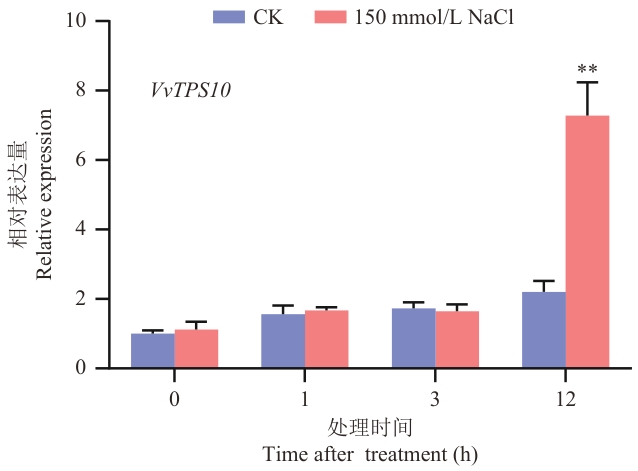
图1 葡萄VvTPS10在NaCl处理后的表达量分析数值来自3个生物学重复的平均值±SD,*和**表示差异显著(* P<0.05,** P<0.01)。下同
Fig. 1 Analysis of VvTPS10 gene expression after NaCl treatment in grapevineThe values represent the mean ±SD of three biological replicates. The asterisk (*) and double asterisk (**) indicate significant differences (*P<0.05, **P<0.01). The same below
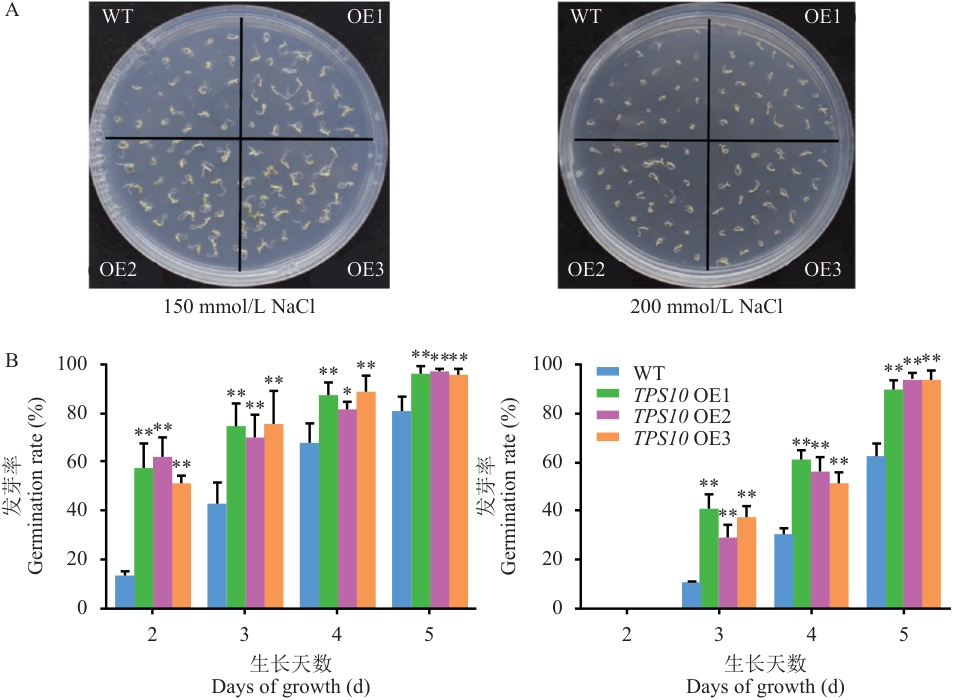
图2 野生型(WT)和VvTPS10过表达拟南芥(OE)在盐胁迫下的表型(A)及发芽率(B)
Fig. 2 Phenotypic characterization (A) and germination rate analysis (B) of wild-type (WT) and VvTPS10-overexpressing Arabidopsis thaliana (OE) under salt stress
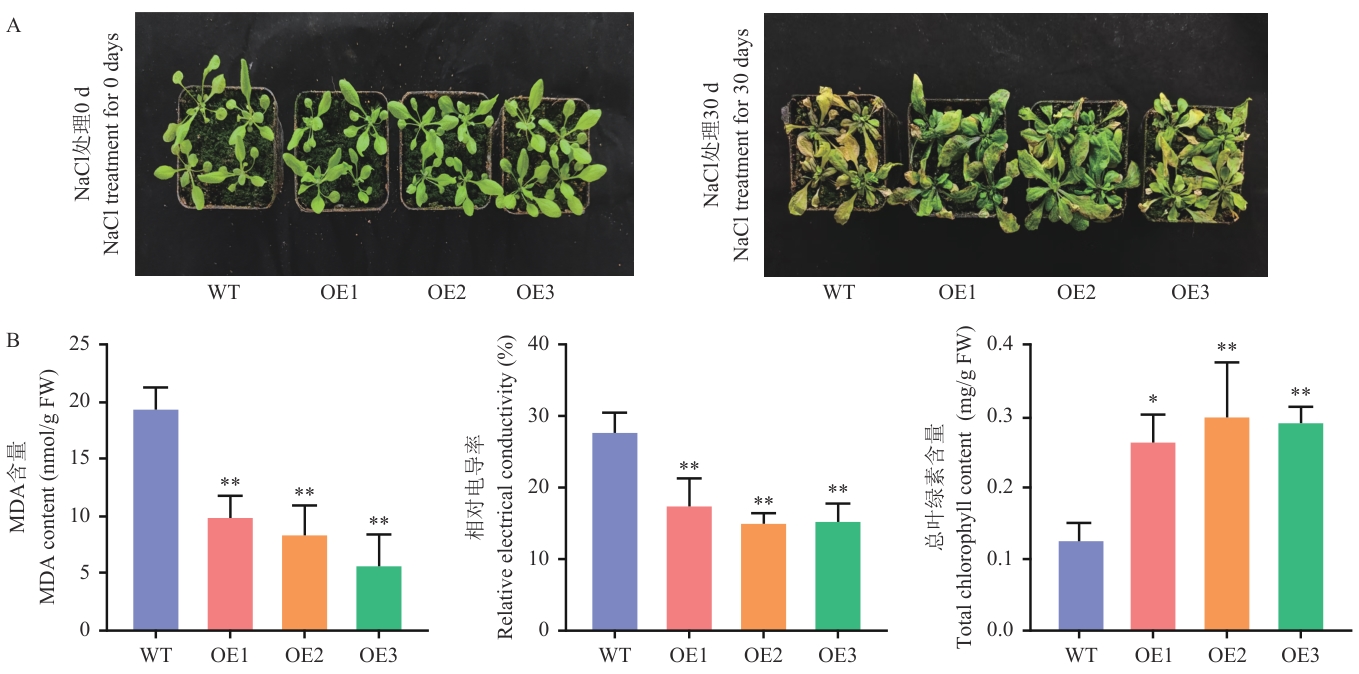
图3 野生型和VvTPS10过表达拟南芥株系在盐胁迫下的表型(A)及抗逆生理指标(B)
Fig. 3 Phenotypic changes (A) and stress physiological indexes (B) of wild-type and VvTPS10-overexpressing A. thaliana lines under salt stress
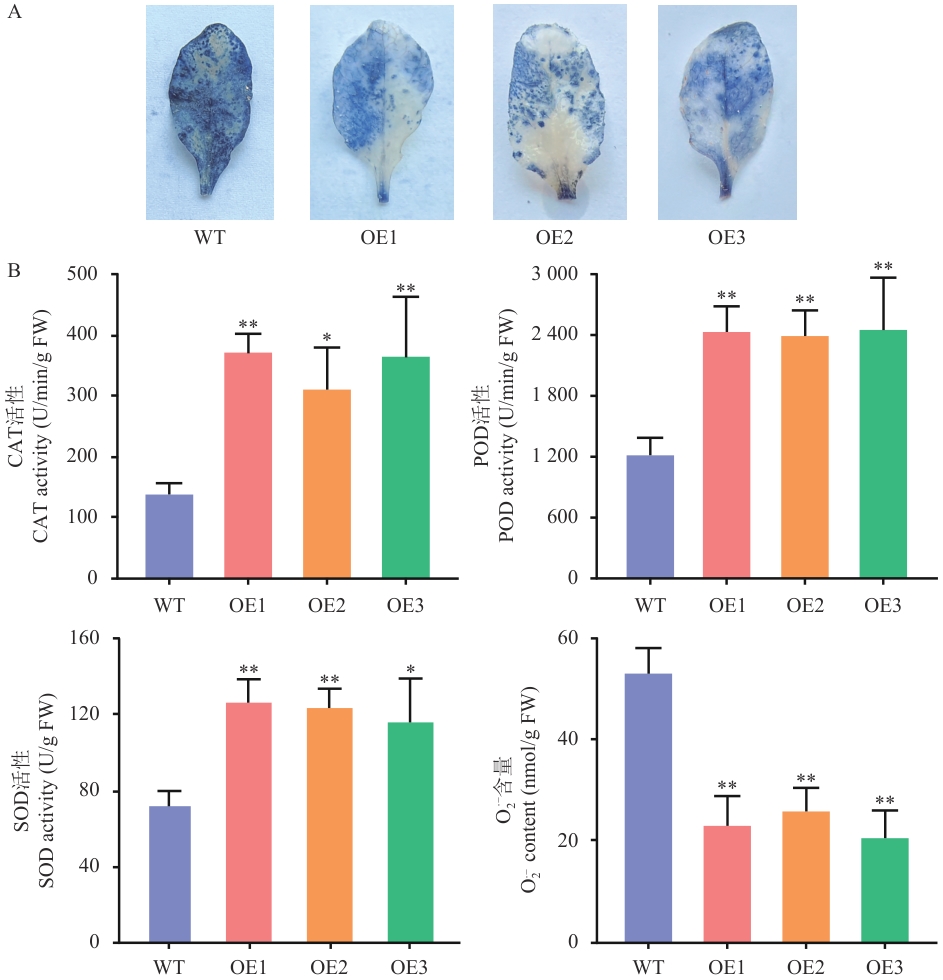
图4 野生型和VvTPS10过表达拟南芥在盐胁迫下的NBT染色(A)及O2·-含量和SOD、POD、CAT活性(B)分析
Fig. 4 Analysis of NBT staining (A) and O2·- content, SOD, POD, and CAT activities (B) of wild-type and VvTPS10-overexpressing A. thaliana lines under salt stress
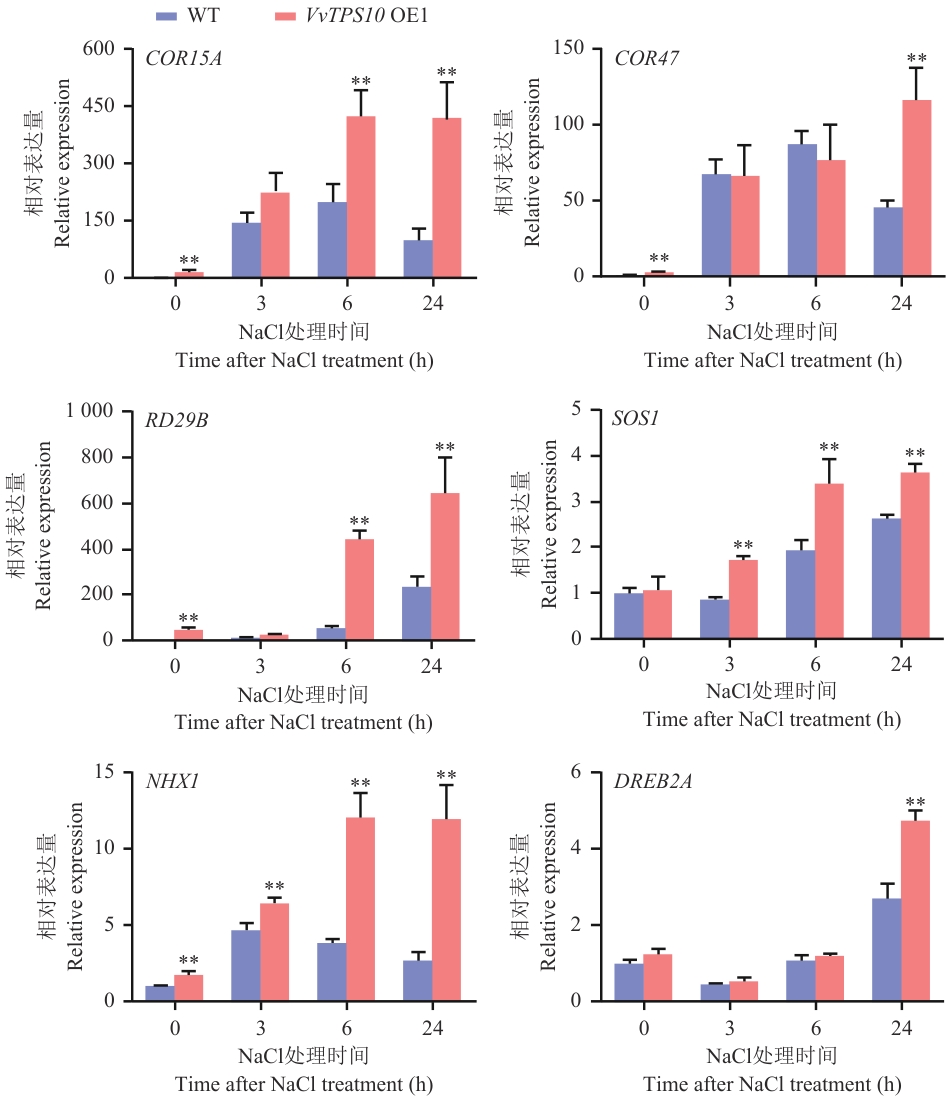
图5 野生型和VvTPS10过表达拟南芥株系在盐胁迫下的抗性基因表达分析
Fig. 5 Expression analysis of stress-responsive genes in wild-type and VvTPS10-overexpressing A. thaliana lines under salt stress
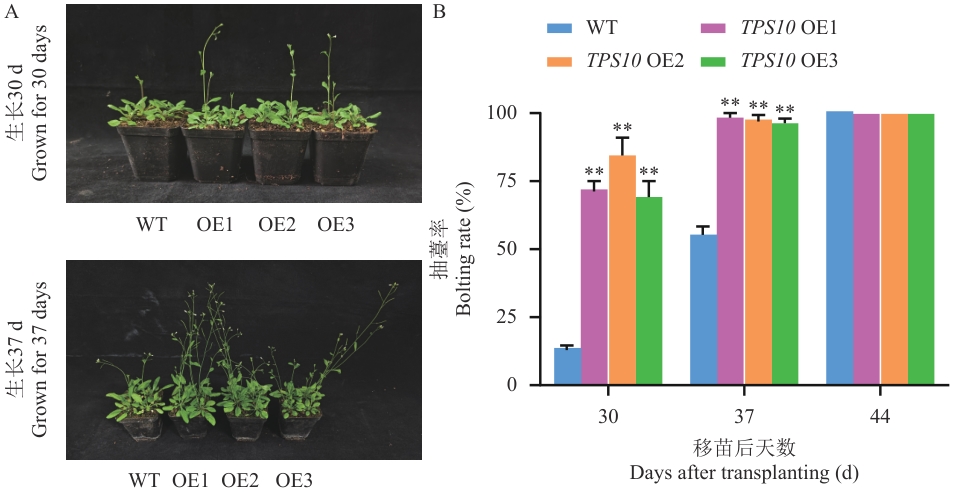
图6 野生型和VvTPS10过表达拟南芥的表型(A)及抽薹率(B)
Fig. 6 Phenotypes (A) and bolting rate (B) of wild-type and VvTPS10-overexpressing A. thaliana
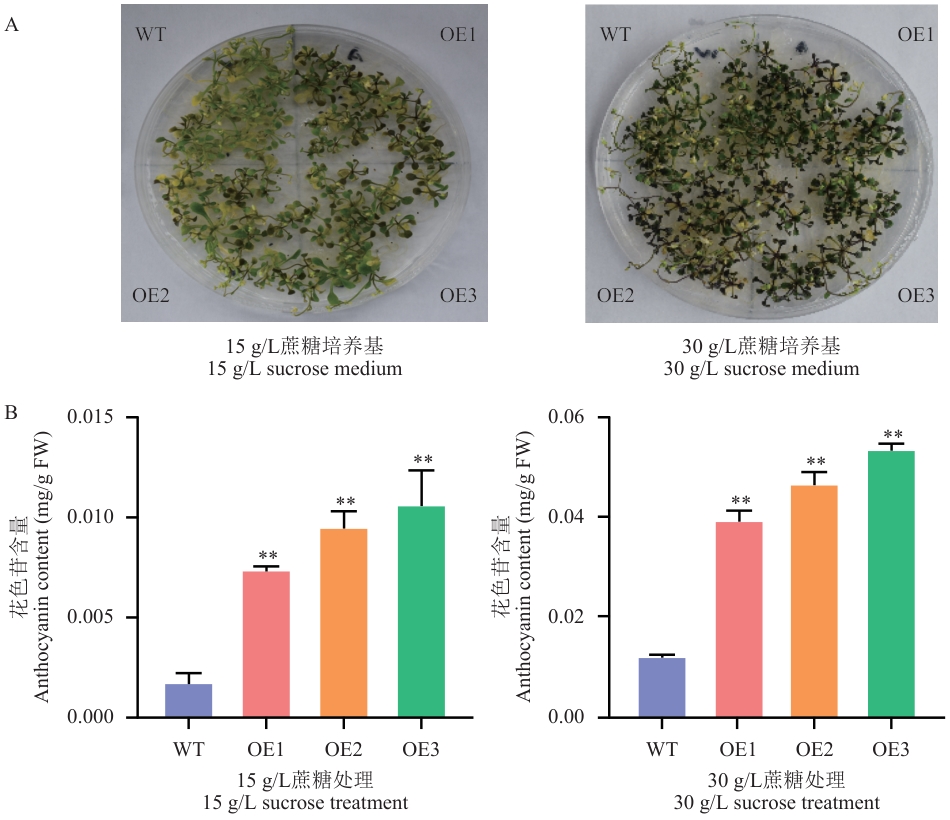
图7 野生型和VvTPS10过表达拟南芥对蔗糖响应的表型(A)及花色苷含量(B)
Fig. 7 Phenotypic (A) and anthocyanin content (B) of wild-type and VvTPS10-overexpressing A. thaliana under sucrose treatment
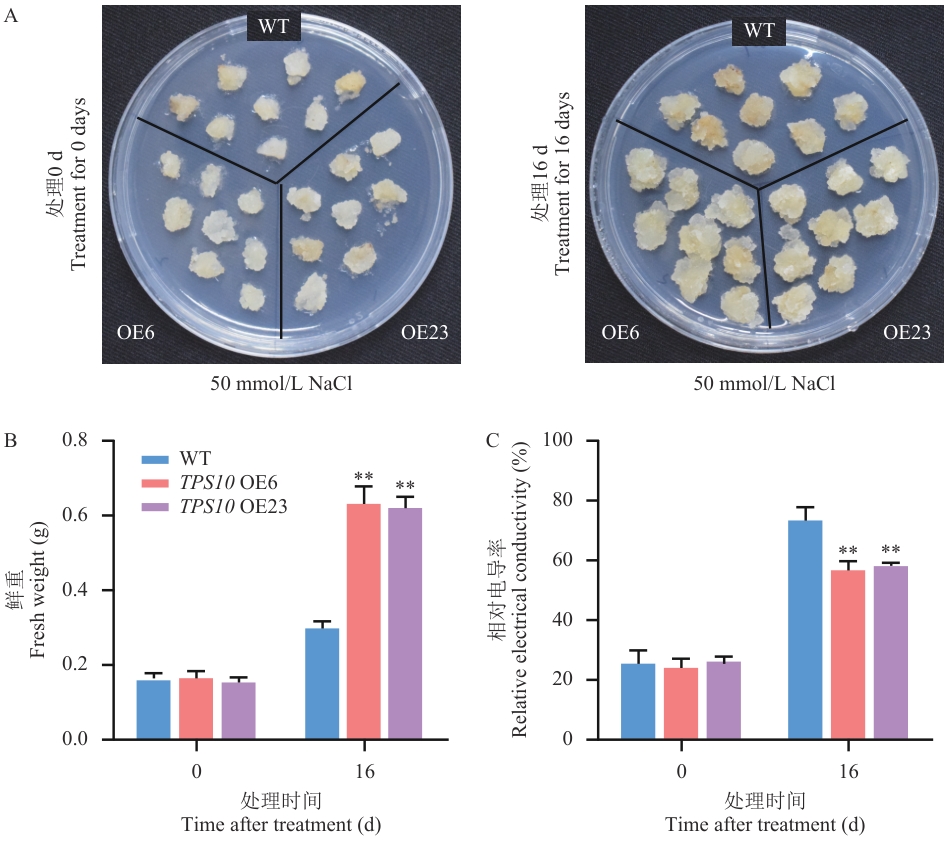
图8 野生型和VvTPS10过表达葡萄愈伤组织在盐胁迫下的表型(A)、鲜重(B)和相对电导率(C)
Fig. 8 Phenotypic (A), fresh weight (B), and relative electrical conductivity (C) analyses of wild-type and VvTPS10-overexpressing grape calli under salt stress
| [1] | Han Y, Li XJ. Current progress in research focused on salt tolerance in Vitis vinifera L. [J]. Front Plant Sci, 2024, 15: 1353436. |
| [2] | Elbein AD, Pan YT, Pastuszak I, et al. New insights on trehalose: a multifunctional molecule [J]. Glycobiology, 2003, 13(4): 17R-27R. |
| [3] | Nawaz M, Hassan MU, Chattha MU, et al. Trehalose: a promising osmo-protectant against salinity stress-physiological and molecular mechanisms and future prospective [J]. Mol Biol Rep, 2022, 49(12): 11255-11271. |
| [4] | Cabib E, Leloir LF. The biosynthesis of trehalose phosphate [J]. J Biol Chem, 1958, 231(1): 259-275. |
| [5] | Mu M, Lu XK, Wang JJ, et al. Genome-wide identification and analysis of the stress-resistance function of the TPS (Trehalose-6-Phosphate Synthase) gene family in cotton [J]. BMC Genet, 2016, 17: 54. |
| [6] | Hu X, Wu ZD, Luo ZY, et al. Genome-wide analysis of the trehalose-6-phosphate synthase (TPS) gene family and expression profiling of ScTPS genes in sugarcane [J]. Agronomy, 2020, 10(7): 969. |
| [7] | Song JB, Mao HY, Cheng J, et al. Identification of the trehalose-6-phosphate synthase gene family in Medicago truncatula and expression analysis under abiotic stresses [J]. Gene, 2021, 787: 145641. |
| [8] | Guo WL, Sun YQ, Chai JQ, et al. Genome-wide identification of the trehalose-6-phosphate synthase gene family in alfalfa (Medicago sativa L.) reveals involvement of MsTPS16 in tolerance to saline-alkali stress [J]. Gene, 2025, 963: 149609. |
| [9] | 刘丹丹, 王雷刚, 孙明慧, 等. 茶树海藻糖-6-磷酸合成酶(TPS)基因家族鉴定与表达分析 [J]. 生物技术通报, 2024, 40(8): 152-163. |
| Liu DD, Wang LG, Sun MH, et al. Genome-wide identification and expression pattern profiling of the trehalose-6-phosphate synthase (TPS) gene family in tea plant (Camellia sinensis) [J]. Biotechnol Bull, 2024, 40(8): 152-163. | |
| [10] | 陈天池, 吴月燕, 沈乐意, 等. 葡萄TPS基因家族的鉴定与表达分析 [J]. 分子植物育种, 2024, 22(11): 3533-3544. |
| Chen TC, Wu YY, Shen LY, et al. Identification and expression analysis of TPS genes family in grape [J]. Mol Plant Breed, 2024, 22(11): 3533-3544. | |
| [11] | Almeida AM, Villalobos E, Araújo SS, et al. Transformation of tobacco with an Arabidopsis thaliana gene involved in trehalose biosynthesis increases tolerance to several abiotic stresses [J]. Euphytica, 2005, 146(1/2): 165-176. |
| [12] | Jiang T, Zhai H, Wang FB, et al. Cloning and characterization of a salt tolerance-associated gene encoding trehalose-6-phosphate synthase in sweetpotato [J]. J Integr Agric, 2014, 13(8): 1651-1661. |
| [13] | Vishal B, Krishnamurthy P, Ramamoorthy R, et al. OsTPS8 controls yield-related traits and confers salt stress tolerance in rice by enhancing suberin deposition [J]. New Phytol, 2019, 221(3): 1369-1386. |
| [14] | Yuan GP, Liu JP, An GL, et al. Genome-wide identification and characterization of the trehalose-6-phosphate synthetase (TPS) gene family in watermelon (Citrullus lanatus) and their transcriptional responses to salt stress [J]. Int J Mol Sci, 2022, 23(1): 276. |
| [15] | Wang PL, Lei XJ, Lü JX, et al. Overexpression of the ThTPS gene enhanced salt and osmotic stress tolerance in Tamarix hispida [J]. J For Res, 2022, 33(1): 299-308. |
| [16] | 郭蓓, 胡磊, 何欣, 等. 海藻糖-6-磷酸合成酶转基因烟草提高耐盐性的研究 [J]. 植物学通报, 2008(1): 41-49. |
| Guo B, Hu L, He X, et al. Trehalose-6-phosphate synthase transgenic tobacco enhanced tolerance to salt stress [J]. Chin Bull Bot, 2008(1): 41-49. | |
| [17] | Wang L, Zhang X, Qu ZY, et al. Grapevine VviERF105 promotes tolerance to abiotic stress and is degraded by the E3 ubiquitin ligase VviPUB19 [J]. Environ Exp Bot, 2022, 201: 105001. |
| [18] | Zhao MY, Wang L, Feng MJ, et al. Trehalose-6-phosphate synthase VvTPS10 regulates cold tolerance by participating in the CBF pathway and VvPUB19-mediated ubiquitination in grapevine [J]. Plant Cell Environ, 2025, 48(11): 8086-8102. |
| [19] | 高俊凤. 植物生理学实验指导 [M]. 北京: 高等教育出版社, 2006. |
| Gao JF. Experimental guidance for plant physiology [M]. Beijing: Higher Education Press, 2006. | |
| [20] | 靳容, 刘明, 赵鹏, 等. 甘薯丝裂原活化蛋白激酶MPK6对低温胁迫的响应 [J]. 中国农业科学, 2021, 54(20): 4265-4273. |
| Jin R, Liu M, Zhao P, et al. IbMKP6, a mitogen-activated protein kinase, confers low temperature tolerance in sweetpotato [J]. Sci Agric Sin, 2021, 54(20): 4265-4273. | |
| [21] | 杜姣林, 蔺新兰, 马豫皖, 等. 植物海藻糖-6-磷酸合成酶基因研究进展 [J]. 植物科学学报, 2023, 41(3): 411-420. |
| Du JL, Lin XL, Ma YW, et al. Research progress in plant trehalose-6-phosphate synthase genes [J]. Plant Sci J, 2023, 41(3): 411-420. | |
| [22] | 张莹莹, 吕燕, 宣雯燕, 等. 龙须菜(Gracilariopsis lemaneiformis)海藻糖-6-磷酸合成酶(TPS)对逆境胁迫的响应 [J]. 海洋与湖沼, 2021, 52(3): 777-785. |
| Zhang YY, Lyu Y, Xuan WY, et al. Response of trehalose-6-phosphate synthase (TPS) to abiotic stress in Gracilariopsis lemaneiformis [J]. Oceanol Limnol Sin, 2021, 52(3): 777-785. | |
| [23] | Zhou WY, Sheng C, Koffi Dossou SS, et al. Genome-wide identification of TPS genes in sesame and analysis of their expression in response to abiotic stresses [J]. Oil Crop Sci, 2023, 8(2): 81-88. |
| [24] | 曹婕, 卢秋连, 翟健平, 等. 大豆TPS基因家族在盐胁迫下的表达变化及单倍型选择规律分析 [J]. 植物学报, 2025, 60(2): 172-185. |
| Cao J, Lu QL, Zhai JP, et al. Changes in the expression of the soybean TPS gene family under salt stress and haplotype selection analysis [J]. Bull Bot, 2025, 60(2): 172-185. | |
| [25] | Li HW, Zang BS, Deng XW, et al. Overexpression of the trehalose-6-phosphate synthase gene OsTPS1 enhances abiotic stress tolerance in rice [J]. Planta, 2011, 234(5): 1007-1018. |
| [26] | 张桂华, 岳春雷, 李贺鹏, 等. 木麻黄海藻糖-6-磷酸合酶家族鉴定及表达分析 [J]. 农业生物技术学报, 2025, 33(3): 581-593. |
| Zhang GH, Yue CL, Li HP, et al. Identification and expression analysis of trehalose-6-phosphate synthase family in Casuarina equisetifolia [J]. J Agric Biotechnol, 2025, 33(3): 581-593. | |
| [27] | 杨永超, 张海斐, 杨小振, 等. 甜瓜海藻糖-6-磷酸合成酶基因鉴定及表达 [J]. 西北植物学报, 2017, 37(6): 1066-1072. |
| Yang YC, Zhang HF, Yang XZ, et al. Expression analysis and genome-wide identification of trehalose-6-phosphate synthase gene family in melon (Cucumis melo L.) [J]. Acta Bot Boreali Occidentalia Sin, 2017, 37(6): 1066-1072. | |
| [28] | Cortina C, Culiáñez-Macià FA. Tomato abiotic stress enhanced tolerance by trehalose biosynthesis [J]. Plant Sci, 2005, 169(1): 75-82. |
| [29] | Zhang XT, Zhang YX, Yan ML, et al. Trehalose metabolism contributed to abiotic stress tolerance of Larix gmelinii seedlings [J]. Plant Physiol Biochem, 2025, 229: 110654. |
| [30] | Wahl V, Ponnu J, Schlereth A, et al. Regulation of flowering by trehalose-6-phosphate signaling in Arabidopsis thaliana [J]. Science, 2013, 339(6120): 704-707. |
| [31] | Lin MF, Ma SY, Quan KH, et al. Comparative transcriptome analysis provides insight into the molecular mechanisms of long-day photoperiod in Moringa oleifera [J]. Physiol Mol Biol Plants, 2022, 28(5): 935-946. |
| [32] | 赵美丽, 倪军, 陈茂盛, 等. 超量表达小桐子JcTPS1促进拟南芥开花并增加叶片花青素含量 [J]. 分子植物育种, 2018, 16(1): 255-261. |
| Zhao ML, Ni J, Chen MS, et al. Over-expression of JcTPS1 from Jatropha curcas induces early flowering of Arabidopsis and improves anthocyanin accumulation in leaves [J]. Mol Plant Breed, 2018, 16(1): 255-261. | |
| [33] | 吴新亮, 吴慧玲, 张绥林, 等. 蓝莓VcTPS/VcTPP基因家族鉴定及VcTPS24对花诱导的功能分析 [J]. 中国农业科学, 2025, 58(13): 2663-2681. |
| Wu XL, Wu HL, Zhang SL, et al. Identification of the VcTPS/VcTPP gene family in blueberries and functional analysis of VcTPS24 in floral induction [J]. Sci Agric Sin, 2025, 58(13): 2663-2681. | |
| [34] | Van Leene J, Eeckhout D, Gadeyne A, et al. Mapping of the plant SnRK1 kinase signalling network reveals a key regulatory role for the class II T6P synthase-like proteins [J]. Nat Plants, 2022, 8(11): 1245-1261. |
| [35] | Wingler A, Delatte TL, O’Hara LE, et al. Trehalose 6-phosphate is required for the onset of leaf senescence associated with high carbon availability [J]. Plant Physiol, 2012, 158(3): 1241-1251. |
| [1] | 黄旭升, 周雅莉, 贾峥嵘, 沈珊, 陈锦钗, 周广立, 李鑫鑫, 王计平, 李润植, 贾小云. 紫苏ARF转录因子家族全基因组鉴定及其在非生物胁迫响应中的功能分析[J]. 生物技术通报, 2026, 42(7): 148-162. |
| [2] | 陈义焰, 张冬儿, 张涛, 刘育灏, 唐杰, 盛夏冰, 胡远艺, 艾治勇, 李应将, 刘小林. 水稻OsSULTR2;2基因功能及调控苗期耐盐性分析[J]. 生物技术通报, 2026, 42(7): 116-125. |
| [3] | 董亚茹, 修妤, 赵东晓, 朱红, 朱琳, 刘惠芬. 基于转录组的桑树GRAS基因家族鉴定及MnGRAS22盐胁迫响应分析[J]. 生物技术通报, 2026, 42(7): 193-203. |
| [4] | 赵文娟, 李辉, 杨雪莹, 王朝露, 祝建波. 马铃薯‘新疆2号’遗传转化体系的建立[J]. 生物技术通报, 2026, 42(6): 87-97. |
| [5] | 翟莹, 高双, 计俊杰, 于海伟, 赵艳, 马天意, 张梅娟, 李珊珊. 工业大麻转录因子CsMYB12抗旱功能的研究[J]. 生物技术通报, 2026, 42(6): 294-303. |
| [6] | 郭威, 耿越, 梁晓, 刘迎, 伍春玲, 陈青. 抗、感木薯品种对木薯绵粉蚧蜡质合成基因表达的影响[J]. 生物技术通报, 2026, 42(6): 128-138. |
| [7] | 郭苗, 许家佳, 孙天国, 蔡璨, 曹婉笛, 包纪星, 沙伟, 张梅娟, 彭疑芳, 马天意. 过表达砂藓RcOLEO1基因增强拟南芥的耐旱性及耐高温性[J]. 生物技术通报, 2026, 42(5): 312-322. |
| [8] | 江昕桦, 方天宇, 张晶晶, 李相媛, 张邦跃, 廖晓珊, 荣朵艳. 地钱MpPP2A-C基因的鉴定及功能分析[J]. 生物技术通报, 2026, 42(4): 216-226. |
| [9] | 闫琪琪, 卜芋芬, 张小欣, 马晓岑, 荆艳萍. 植物C2结构域脱落酸相关蛋白的研究进展[J]. 生物技术通报, 2026, 42(4): 17-25. |
| [10] | 王羽, 何昀珈, 殷海欣, 马悦, 郭海勇. 金黄色葡萄球菌耐药机制与新型治疗策略研究进展[J]. 生物技术通报, 2026, 42(4): 53-64. |
| [11] | 徐玉娇, 孙玉帅, 刘道奇, 张丽, 张志昌, 姚玉新. VvHSP18.2过表达调节葡萄盐碱抗性的功能分析[J]. 生物技术通报, 2026, 42(4): 161-169. |
| [12] | 李天源, 亓新亮, 刘珊, 张建成, 王鹏飞, 张帅, 贾璐婷, 穆霄鹏. 欧李SPL基因家族的鉴定及在果实发育过程中的表达分析[J]. 生物技术通报, 2026, 42(3): 362-373. |
| [13] | 李亚妮, 韩鸿宇, 耿梦爽, 米若兰, 王韦琪, 于文静, 孟宪文, 李传友. ChiC基因调控番茄灰霉病抗性的机制研究[J]. 生物技术通报, 2026, 42(3): 255-262. |
| [14] | 陈常璐, 杨志芳, 曹嵩晓, 李杨青, 叶靖烽, 吕海艳, 陈姗姗, 陈昊. 脱落酸与乙烯协同调控薄皮甜瓜果实软化的机制[J]. 生物技术通报, 2026, 42(3): 302-311. |
| [15] | 马莹莹, 游惠婉, 郑积荣, 汪俏梅, 刘丽红. 基于PSY多层级调控的园艺作物品质形成机制研究进展[J]. 生物技术通报, 2026, 42(3): 96-110. |
| 阅读次数 | ||||||
|
全文 |
|
|||||
|
摘要 |
|
|||||
