







生物技术通报 ›› 2026, Vol. 42 ›› Issue (9): 327-341.doi: 10.13560/j.cnki.biotech.bull.1985.2025-1271
• 研究报告 • 上一篇
张文静1, 马馨蕊1, 徐紫璐1, 吕红1, 秦楠1, 殷辉1, 赵晓军1,2,3( ), 任璐1,2,3()
收稿日期:2025-11-20
出版日期:2026-09-26
发布日期:2026-09-16
通讯作者:
赵晓军zhaoxiaojun0218@163.com基金资助:
ZHANG Wen-jing1, MA Xin-rui1, XU Zi-lu1, LYU Hong1, QIN Nan1, YIN Hui1, ZHAO Xiao-jun1,2,3(), REN Lu1,2,3()
Received:2025-11-20
Published:2026-09-26
Online:2026-09-16
摘要:
目的 探究非洲哈茨木霉Trichoderma afroharzianum LMNS-M9可湿性粉剂与贝莱斯芽胞杆菌Bacillus velezensis YPTJ-1可湿性粉剂复配施用对藜麦茎基腐病的防治效果及其对根际微生物群落结构的调控作用。 方法 采用盆栽试验比较单一菌剂与复配菌剂对藜麦茎基腐病的防治效果;进一步通过大田试验评估不同浓度复配菌剂的防效,并结合高通量测序分析各处理对藜麦根际微生物群落的影响。 结果 复配菌剂对藜麦茎基腐病的盆栽防效达73.55%,显著优于2种单菌剂处理;田间试验中,复配菌剂稀释300倍时防效最佳,为67.92%,其防治效果在盆栽与田间条件下均与化学农药咯菌腈相当。2种菌剂联用显著提高了土壤中细菌和真菌的OTU数目及Alpha多样性指数,增加了放线菌门Actinomycetota、绿弯菌门Chloroflexota等有益菌群的相对丰度,并降低了致病菌的相对丰度。同时,复配处理增强了藜麦根际微生物网络结构的稳定性和复杂度。群落功能预测结果显示,复配处理下细菌氨基酸转运与代谢功能表达量与藜麦发病率呈负相关;真菌群落中共生型与内生菌等功能类群相对丰度显著上升,植物病原类群显著降低。 结论 复配菌剂可通过优化根际微生物群落结构有效抑制藜麦茎基腐病发生,为该病的绿色防控提供了理论依据与新途径。
张文静, 马馨蕊, 徐紫璐, 吕红, 秦楠, 殷辉, 赵晓军, 任璐. 非洲哈茨木霉与贝莱斯芽胞杆菌联用对藜麦茎基腐病防效及根际微生态的影响[J]. 生物技术通报, 2026, 42(9): 327-341.
ZHANG Wen-jing, MA Xin-rui, XU Zi-lu, LYU Hong, QIN Nan, YIN Hui, ZHAO Xiao-jun, REN Lu. Effects of Combined Application of Trichoderma afroharzianum and Bacillus velezensis on Quinoa Basal Stem Rot and Rhizosphere Microecology[J]. Biotechnology Bulletin, 2026, 42(9): 327-341.
处理 Treatment | 发病率 Incidence (%) | 防治效果 Control effect (%) |
|---|---|---|
| T1 | 27.92±1.10b | 57.86±1.66c |
| T2 | 24.17±0.42c | 63.52±0.63b |
| T3 | 21.25±0.72cd | 67.92±1.09ab |
| T4 | 30.42±0.83b | 54.09±1.26c |
| T5 | 19.17±1.82d | 71.07±2.74a |
| T6 | 66.25±1.44a | - |
表1 不同处理对藜麦茎基腐病的田间防治效果
Table 1 Field control efficacy of different treatments against quinoa basal stem rot
处理 Treatment | 发病率 Incidence (%) | 防治效果 Control effect (%) |
|---|---|---|
| T1 | 27.92±1.10b | 57.86±1.66c |
| T2 | 24.17±0.42c | 63.52±0.63b |
| T3 | 21.25±0.72cd | 67.92±1.09ab |
| T4 | 30.42±0.83b | 54.09±1.26c |
| T5 | 19.17±1.82d | 71.07±2.74a |
| T6 | 66.25±1.44a | - |
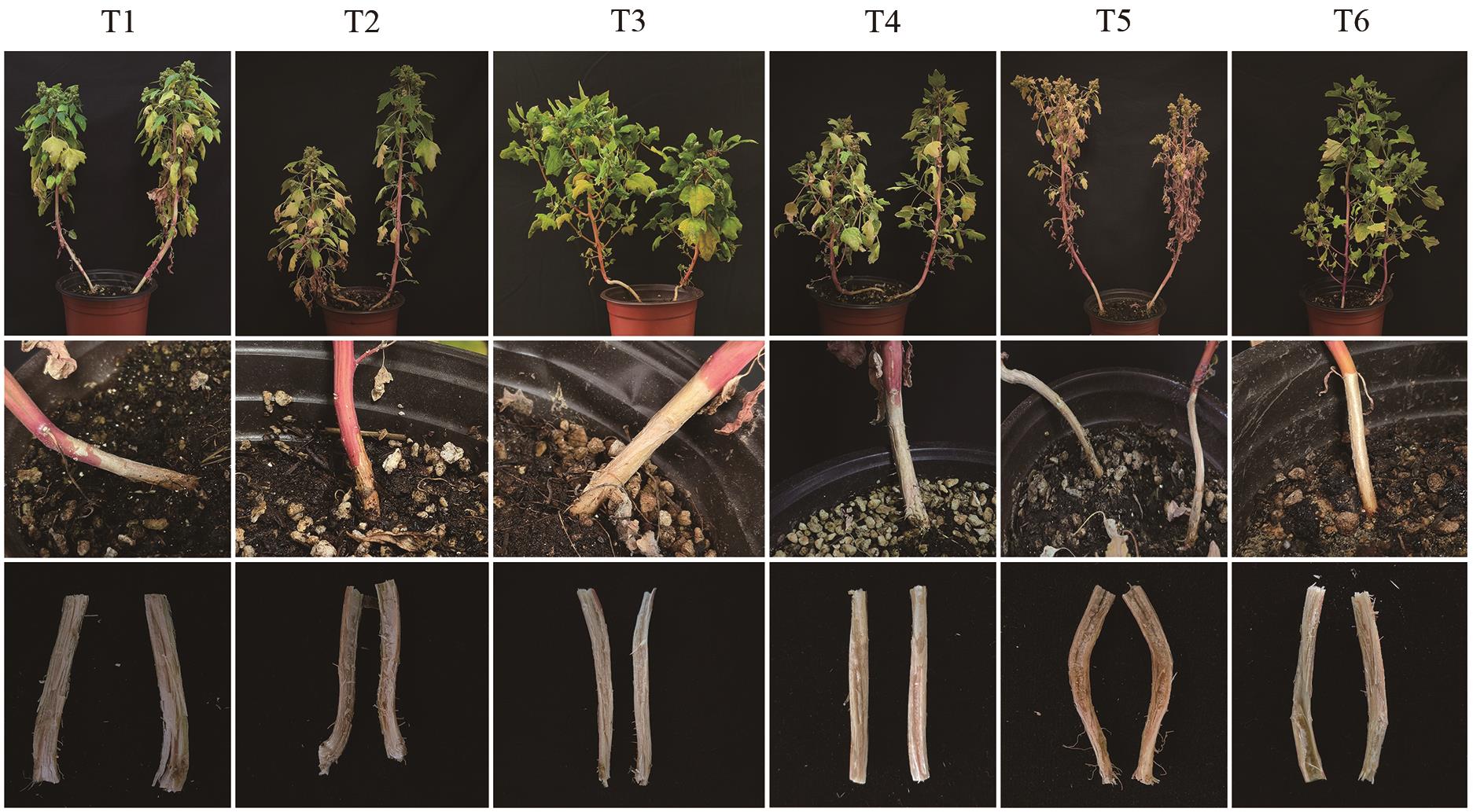
图1 不同处理下藜麦茎基腐病的发病情况T1:YPTJ-1 WP 500倍稀释,T2:LMNS-M9 WP 500倍稀释,T3:复配菌剂WP 500倍稀释(YPTJ-1 WP:LMNS-M9 WP的比例为7∶3),T4:50%咯菌腈WP 5 000倍稀释(阳性化学药剂对照),T5:仅接种F. solani孢子液(阴性对照),T6:仅浇灌清水(空白对照),下同
Fig. 1 Disease occurrence of quinoa basal stem rot under different treatmentsT1: YPTJ-1 WP 500-fold dilution, T2: LMNS-M9 WP 500-fold dilution. T3: Mixed microbial agent WP 500-fold dilution (The ratio of YPTJ-1 WP to LMNS-M9 WP is 7∶3). T4: 50% fludioxonil WP 5 000-fold dilution (positive chemical control). T5: Only F. solani spore suspension (negative control). T6: Only watering water (blank control). The same below
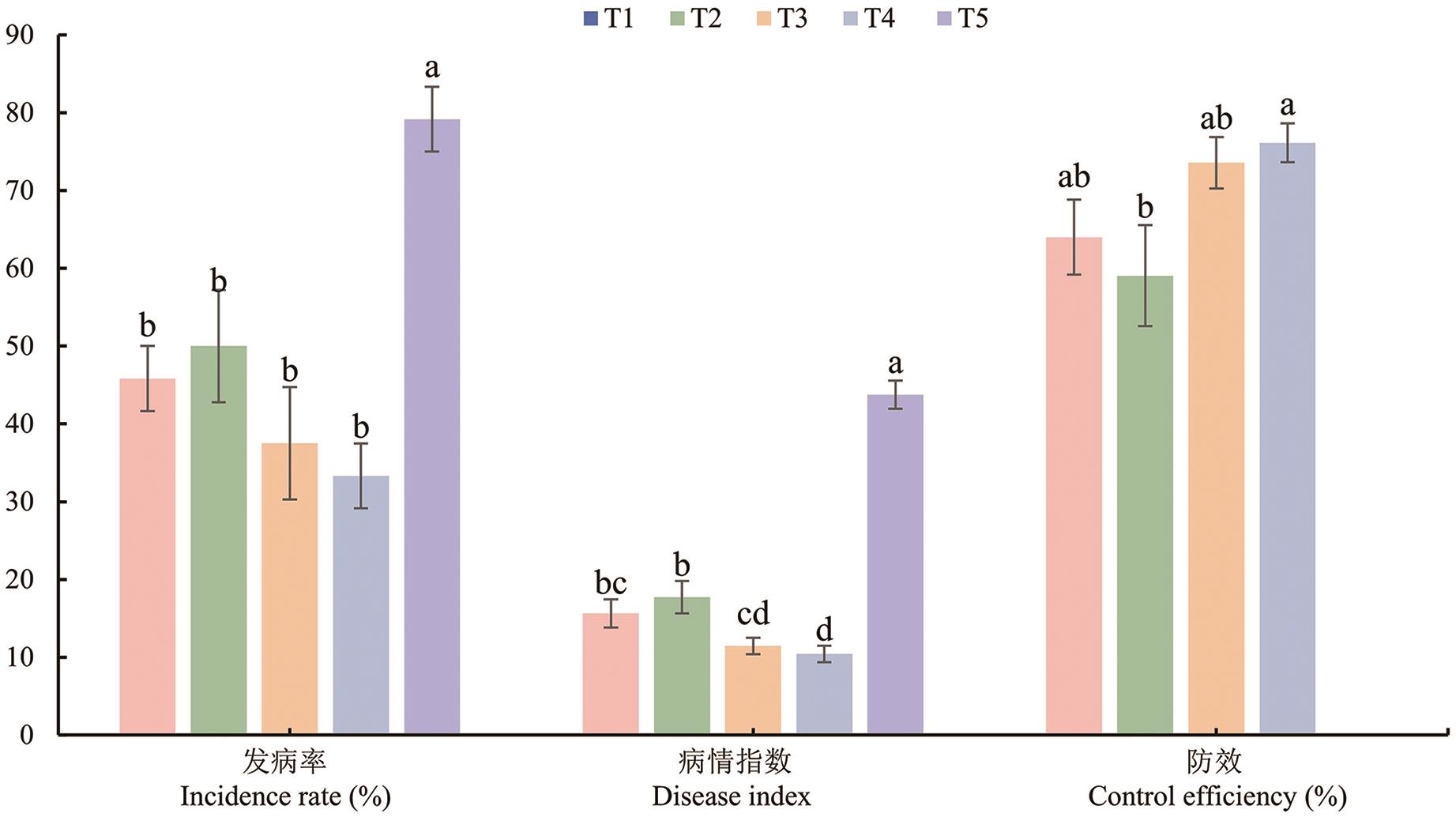
图2 不同处理对藜麦茎基腐病的盆栽防效不同小写字母表示差异显著(P<0.05)。下同
Fig. 2 Pot culture control efficacy of different treatments on quinoa basal stem rotDifferent lowercase letters indicate significant difference (P<0.05), the same below
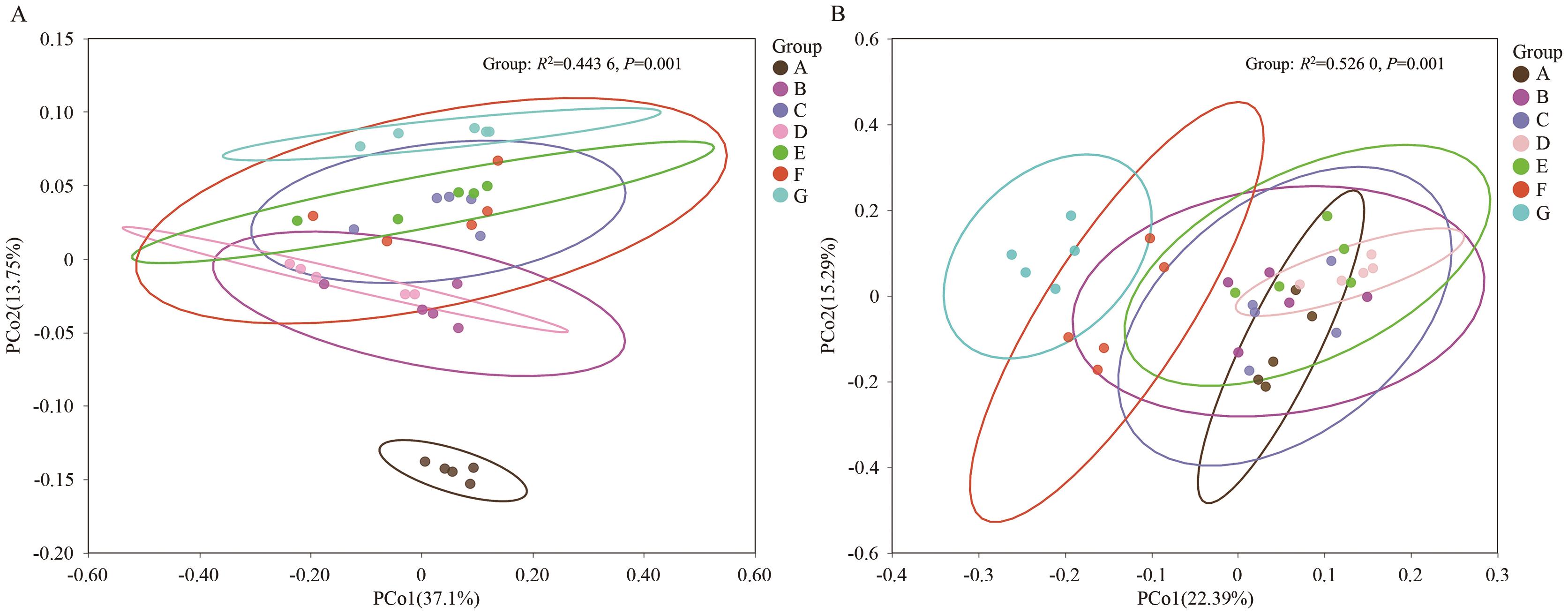
图3 不同处理下藜麦根际细菌(A)和真菌(B)的主坐标分析(PCoA)
Fig. 3 Principal coordinate analysis (PCoA) of bacteria (A) and fungi (B) in the quinoa rhizosphere under different treatments
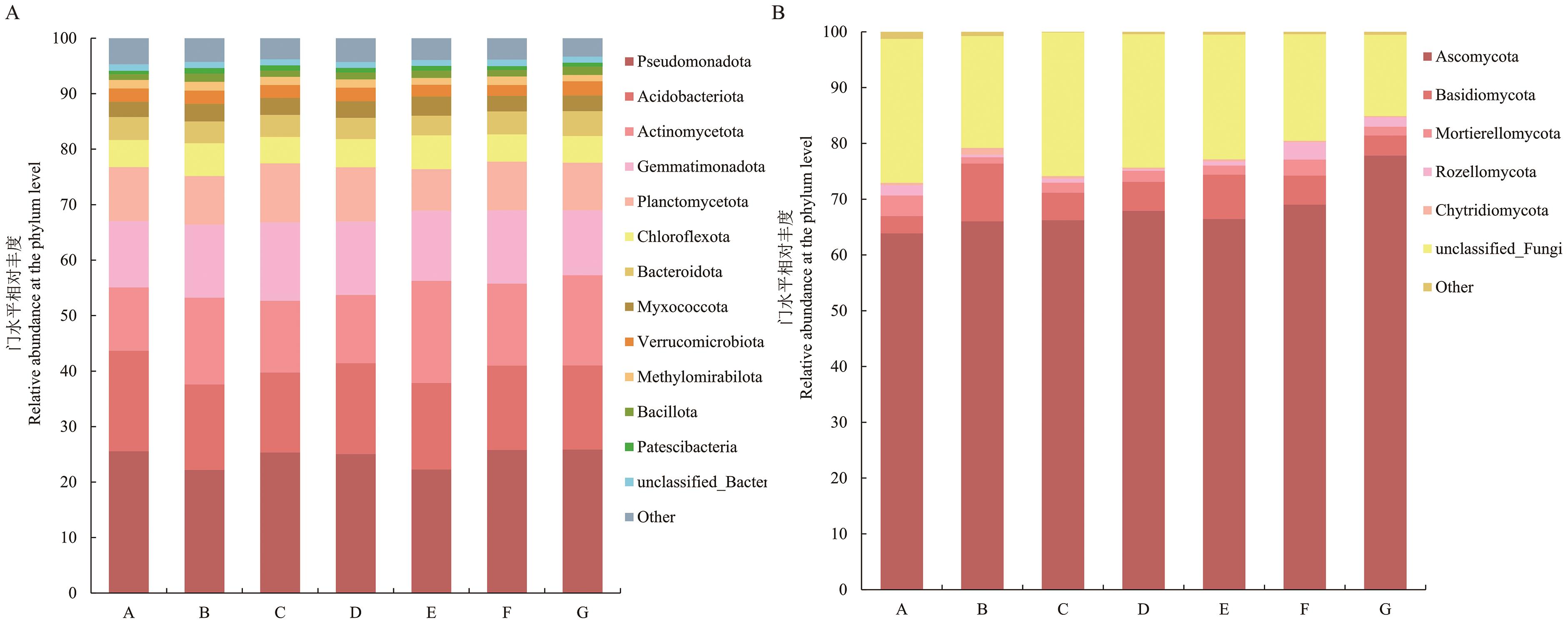
图4 不同处理下藜麦根际土壤细菌(A)和真菌(B)在门水平上的相对丰度Other为相对丰度低于1%的类群,下同
Fig. 4 Relative abundance of bacteria (A) and fungi (B) in the rhizosphere soil of quinoa under different treatments at the phylum levelMicrobial groups with a relative abundance of less than 1% are classified as other, the same below
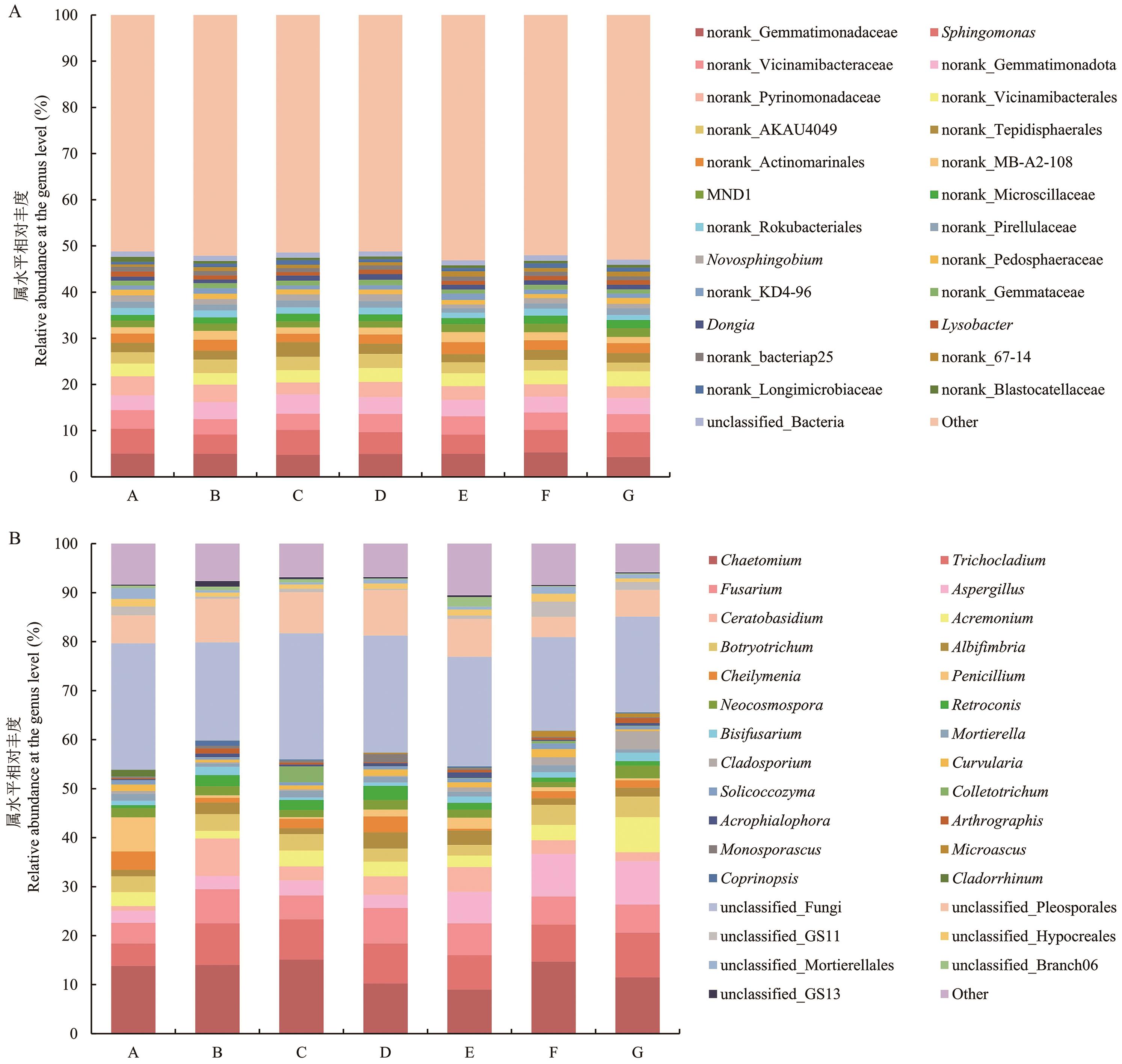
图5 不同处理下藜麦根际土壤细菌(A)和真菌(B)在属水平上的相对丰度
Fig. 5 Relative abundance of bacteria (A) and fungi (B) in the rhizosphere soil of quinoa under different treatments at the genus level
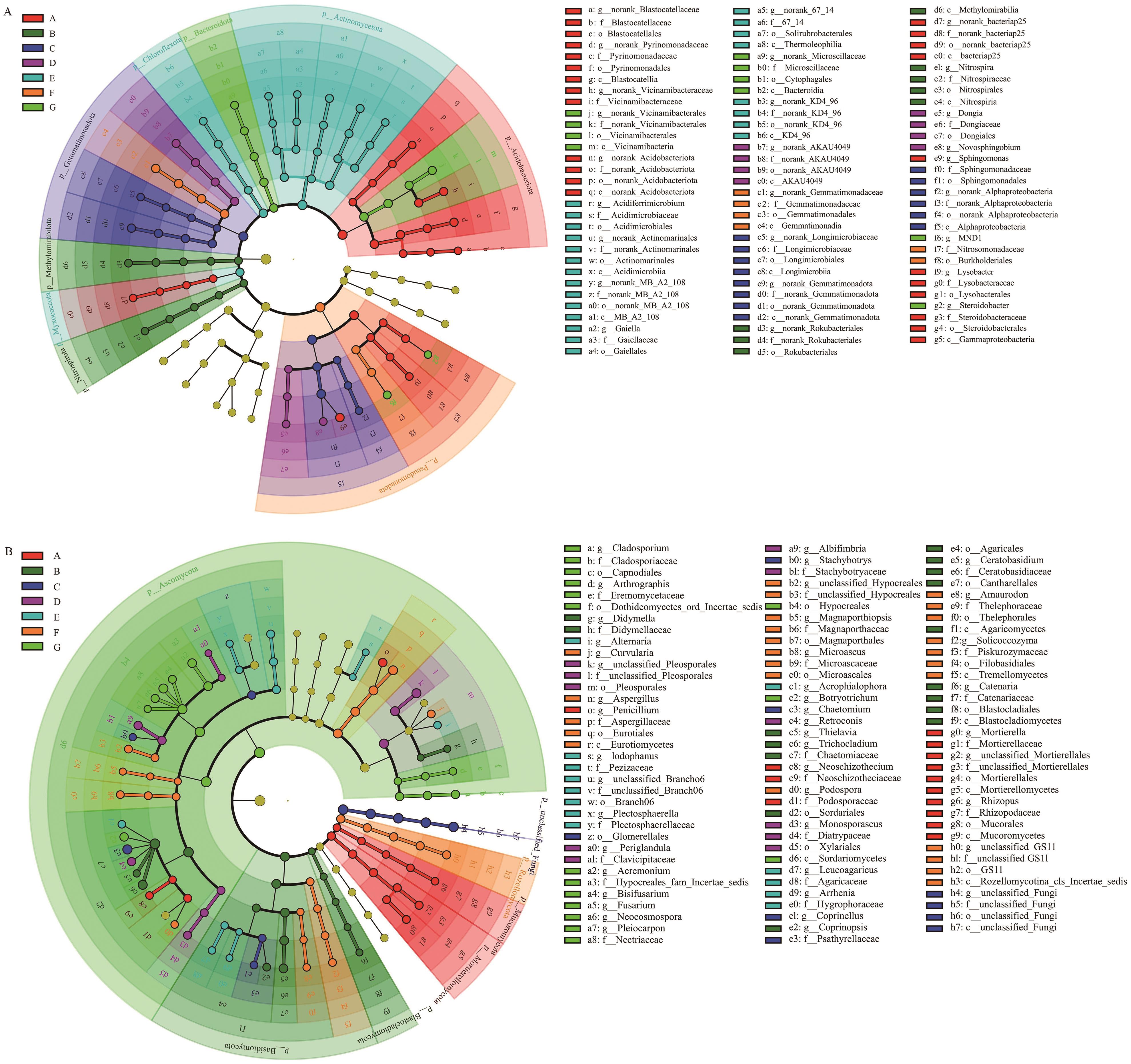
图6 藜麦根际土壤微生物群落差异物种进化分支图图中由内至外辐射的圆圈表示由属至门的分类级别,不同颜色节点表示在对应组别中显著富集,淡黄色节点表示对组间差异无显著影响的微生物类群
Fig. 6 Evolutionary branch diagram of differentially abundant microbial species in the quinoa rhizosphere soilThe circles radiated from the inside out in the figures represent the classification levels from genus to phylum. Different color nodes indicate significant enrichment in the corresponding groups, and light yellow nodes indicate microbial groups that have no significant effect on the differences between groups
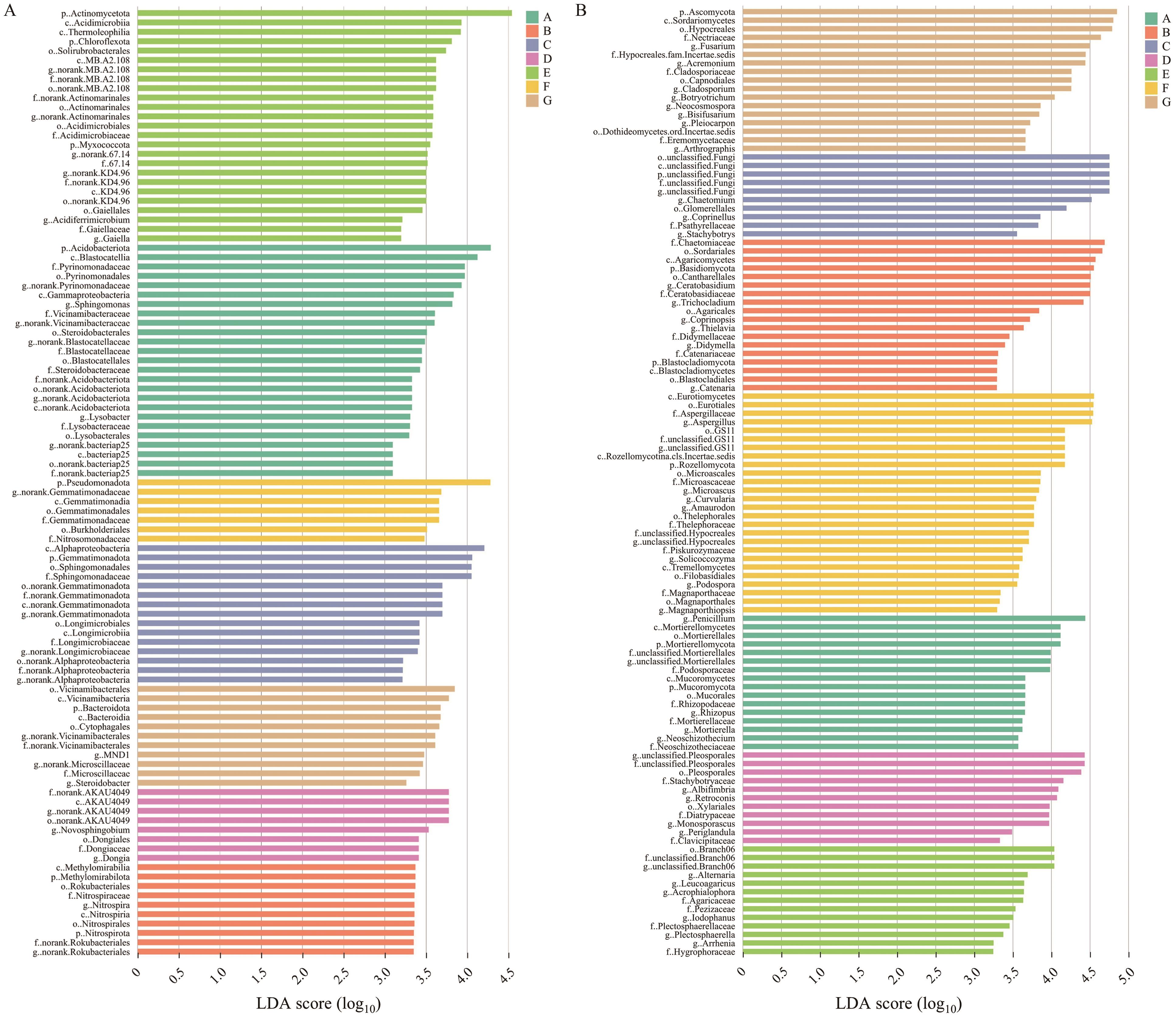
图7 藜麦根际土壤中细菌(A)和真菌(B)的LEfSe分析
Fig. 7 LEfSe analysis of bacteria (A) and fungi (B) in quinoa rhizosphere soil
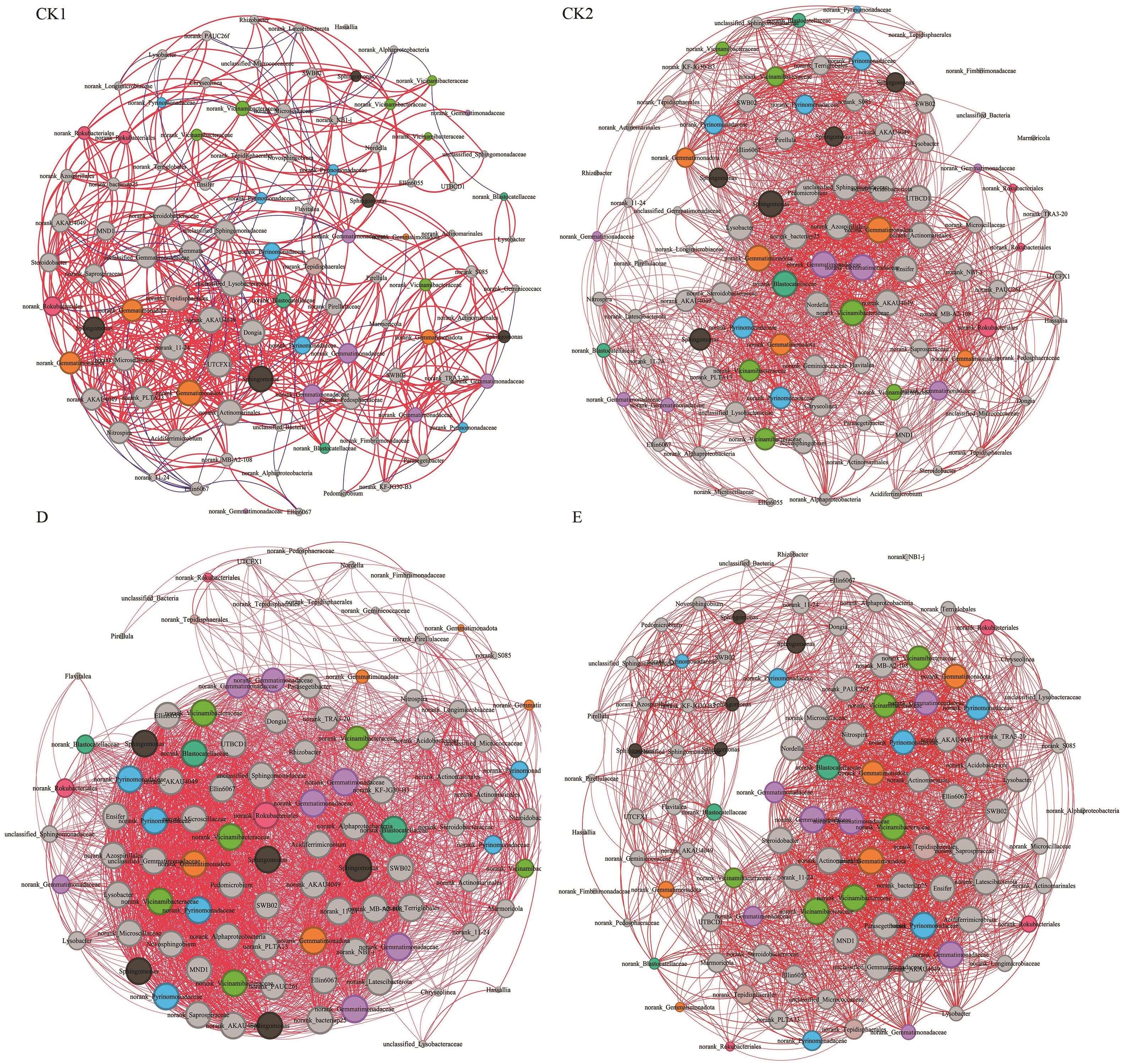
图8 不同处理下的土壤细菌共现网络分析CK1:空白对照,只浇灌清水;CK2:阴性对照,只接种茄病镰孢菌;D:菌剂对照,枯草芽胞杆菌处理;E:复配菌剂处理(稀释300倍),下同
Fig. 8 Co-occurrence network analysis of soil bacteria under different treatmentsCK1: blank control, water only; CK2: negative control, inoculated with F.solani only; D: microbial agent control, B. subtilis treatment; E: compound microbial agent treatment (diluted 300-fold). The same below
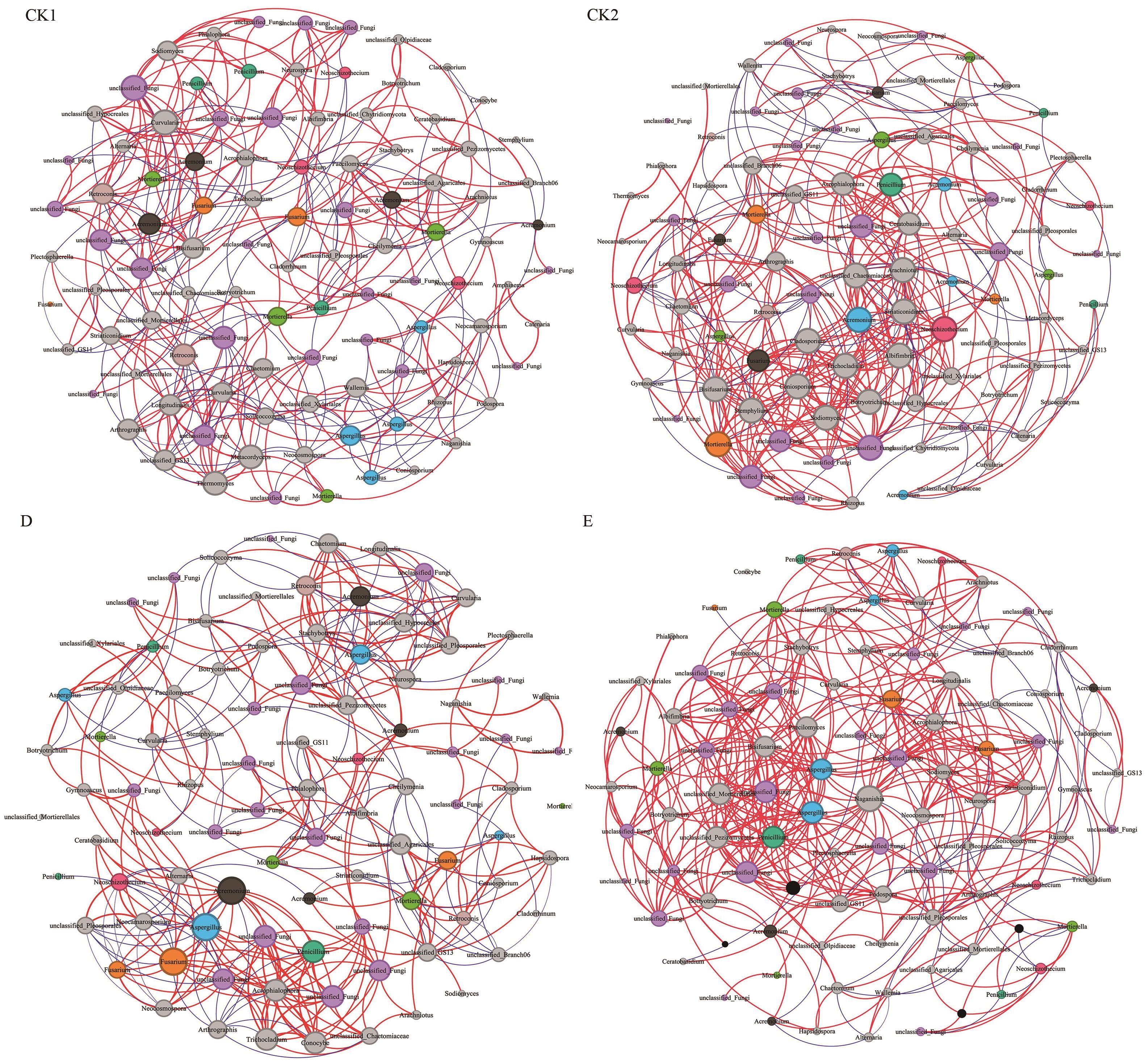
图9 不同处理下的土壤真菌共现网络分析
Fig. 9 Co-occurrence network analysis of soil fungi under different treatments
微生物 Microorganism | 处理 Treatment | 节点数 Node number | 边数 Edge number | 平均度 Average degree | 平均聚类系数 Average cluster coefficient | 平均路径长度 Average path distance | 模块化 Modularity |
|---|---|---|---|---|---|---|---|
细菌 Bacteria | CK1 | 100 | 616 | 12.32 | 0.572 | 3.404 | 0.558 |
| CK2 | 100 | 1 579 | 31.58 | 0.768 | 2.183 | 0.384 | |
| D | 100 | 2 464 | 49.28 | 0.765 | 1.843 | 0.260 | |
| E | 100 | 1 923 | 38.46 | 0.764 | 1.914 | 0.375 | |
真菌 Fungi | CK1 | 100 | 365 | 7.300 | 0.516 | 3.565 | 1.665 |
| CK2 | 97 | 407 | 8.392 | 0.521 | 3.499 | 0.710 | |
| D | 93 | 335 | 7.204 | 0.572 | 4.078 | 1.689 | |
| E | 97 | 430 | 8.866 | 0.589 | 3.790 | 0.624 |
表2 不同处理下土壤细菌和真菌群落共现网络拓扑性质
Table 2 Topological properties of the co-occurrence network of soil bacterial and fungal communities under different treatments
微生物 Microorganism | 处理 Treatment | 节点数 Node number | 边数 Edge number | 平均度 Average degree | 平均聚类系数 Average cluster coefficient | 平均路径长度 Average path distance | 模块化 Modularity |
|---|---|---|---|---|---|---|---|
细菌 Bacteria | CK1 | 100 | 616 | 12.32 | 0.572 | 3.404 | 0.558 |
| CK2 | 100 | 1 579 | 31.58 | 0.768 | 2.183 | 0.384 | |
| D | 100 | 2 464 | 49.28 | 0.765 | 1.843 | 0.260 | |
| E | 100 | 1 923 | 38.46 | 0.764 | 1.914 | 0.375 | |
真菌 Fungi | CK1 | 100 | 365 | 7.300 | 0.516 | 3.565 | 1.665 |
| CK2 | 97 | 407 | 8.392 | 0.521 | 3.499 | 0.710 | |
| D | 93 | 335 | 7.204 | 0.572 | 4.078 | 1.689 | |
| E | 97 | 430 | 8.866 | 0.589 | 3.790 | 0.624 |
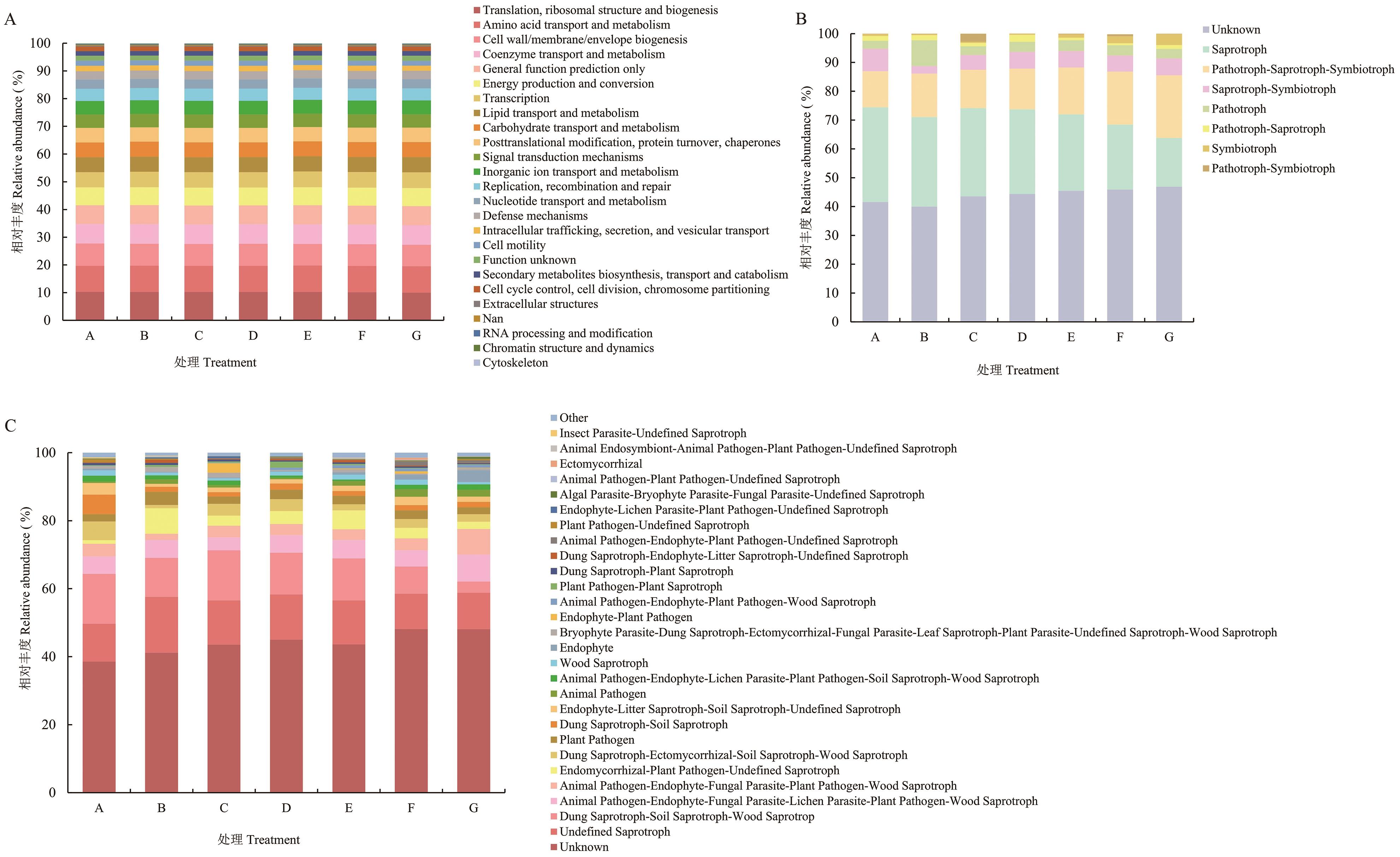
图10 不同处理组的藜麦根际土壤细菌(A)和真菌(B、C)功能预测
Fig. 10 Functional prediction of bacteria (A) and fungi (B, C) in quinoa rhizosphere soil of different treatment groups
| [1] | Wu LM, Wu HJ, Qiao JQ, et al. Novel routes for improving biocontrol activity of Bacillus based bioinoculants [J]. Front Microbiol, 2015, 6: 1395. |
| [2] | El-Beltagi HS, Osman A, Sitohy M, et al. Biocontrol effect of ginger glycoprotein and essential oil against Vicia faba damping-off caused by Fusarium solani and Rhizoctonia solani [J]. Kuwait J Sci, 2025, 52(3): 100437. |
| [3] | Pan C, Ye Y, Ma YC, et al. Cinnamaldehyde triggers fungal apoptosis in Fusarium solani by impairing cell structures and antioxidant defense through restricting glucose availability [J]. Food Biosci, 2025, 69: 106889. |
| [4] | Wang YZ, Bai JM, Zhou JQ, et al. First report of tobacco root rot caused by Fusarium oxysporum and Fusarium solani infection in Northeast China [J]. Plant Dis, 2025, 109(8): 1782. |
| [5] | Yin H, Tian M, Peng YF, et al. Characterization, phylogeny and pathogenicity of Fusarium solanicausing quinoa basal stem rot in Shanxi Province, China [J]. Plant Pathol, 2024, 73(2): 272-291. |
| [6] | He YQ, Han Q, Ayaz M, et al. Identification, characterization, and novel combination of fungicides against Fusarium pseudograminearum causing wheat crown rot in Anhui Province, China [J]. Plant Dis, 2025, 109(9): 1922-1929. |
| [7] | Heena Kaushal S, Hunjan MS, et al. Utilization of dropped Citrus reticulata Blanco fruit as a botanical fungicide to control foot rot disease in rice caused by Fusarium fujikuroi [J]. Eur J Plant Pathol, 2024, 170(4): 997-1012. |
| [8] | Liu H, Qu LX, Hu ZH, et al. Trichoderma guizhouense COTG-19 act as a potential biocontrol agent against Camellia oleifera anthracnose [J]. Pestic Biochem Physiol, 2025, 215: 106644. |
| [9] | Luo X, Sun K, Li HR, et al. Depletion of protective microbiota promotes the incidence of fruit disease [J]. ISME J, 2024, 18(1): wrae071. |
| [10] | Berendsen RL, Vismans G, Yu K, et al. Disease-induced assemblage of a plant-beneficial bacterial consortium [J]. ISME J, 2018, 12(6): 1496-1507. |
| [11] | 余春芳, 王展鹏, 谭宇航, 等. 白芨根腐病菌腐皮镰孢(Fusarium solani)拮抗菌筛选及抑菌机制 [J]. 微生物学通报, 2025, 52(6): 2666-2678. |
| Yu CF, Wang ZP, Tan YH, et al. Screening of antagonistic bacteria against Fusarium solani in Bletilla striata and investigation of their inhibitory mechanisms [J]. Microbiol China, 2025, 52(6): 2666-2678. | |
| [12] | 张文静, 徐紫璐, 吕红, 等. 藜麦茎基腐病拮抗菌LMNS-M9的发酵条件优化及可湿性粉剂研制 [J]. 中国生物防治学报, 2025, 41(4): 862-876. |
| Zhang WJ, Xu ZL, Lü H, et al. Optimization of fermentation conditions of antagonistic fungus LMNS-M9 against quinoa basal stem rot and development of wettable powder [J]. Chin J Biol Control, 2025, 41(4): 862-876. | |
| [13] | Abdelrhim AS, Abdellatif YMR, Hossain MA, et al. Comparative study of three biological control agents and two conventional fungicides against coriander damping-off and root rot caused by Rhizoctonia solani [J]. Plants, 2023, 12(8): 1694. |
| [14] | Li T, Shi XT, Wang JG, et al. Turning antagonists into allies: Bacterial-fungal interactions enhance the efficacy of controlling Fusariumwilt disease [J]. Sci Adv, 2025, 11(7): eads5089. |
| [15] | 李铮, 王艳, 晋玲, 等. 生防菌剂对当归麻口病防治效果及其根际土壤微生态调节 [J]. 农药, 2025, 64(4): 300-306, 312. |
| Li Z, Wang Y, Jin L, et al. Control of Angelica nematode and regulation of Angelica sinensis rhizosphere soil microecology by biocontrol agents [J]. Agrochemicals, 2025, 64(4): 300-306, 312. | |
| [16] | Li JY, Zhao QQ, Wuriyanghan H, et al. Biocontrol bacteria strains Y4 and Y8 alleviate tobacco bacterial wilt disease by altering their rhizosphere soil bacteria community [J]. Rhizosphere, 2021, 19: 100390. |
| [17] | Paasch BC, He SY. Toward understanding microbiota homeostasis in the plant Kingdom [J]. PLoS Pathog, 2021, 17(4): e1009472. |
| [18] | 方中达. 植病研究方法 [M]. 3版. 北京: 中国农业出版社, 1998. |
| Fang ZD. Research methods of plant diseases [M]. 3rd ed. Beijing: China Agriculture Press, 1998. | |
| [19] | 郭成瑾, 杨波, 王喜刚, 等. 种薯/土壤带菌对马铃薯生长及其干腐病发生的影响 [J]. 新疆农业科学, 2020, 57(12): 2310-2317. |
| Guo CJ, Yang B, Wang XG, et al. Effects of seed Tuber and soil borne inoculum on potato growth and its dry rot occurrence [J]. Xinjiang Agric Sci, 2020, 57(12): 2310-2317. | |
| [20] | Wang Q, Garrity GM, Tiedje JM, et al. Naïve Bayesian classifier for rapid assignment of rRNA sequences into the new bacterial taxonomy [J]. Appl Environ Microbiol, 2007, 73(16): 5261-5267. |
| [21] | Shao YT, Yin CY, Wu GJ, et al. Ketoacylsynthase-driven screening of antifungal Streptomyces sp. XH2 and its biocontrol efficacy against Botrytis cinerea in table grapes [J]. Postharvest Biol Technol, 2026, 232: 113936. |
| [22] | Ayyandurai M, Madhu GS, Manonmani K, et al. Coffee husk waste as a carrier for bioagents: development of Trichoderma-Bacillus consortia and their antimicrobials against soil borne Phytophthora cinnamomi Rands. in avocado [J]. Physiol Mol Plant Pathol, 2025, 139: 102755. |
| [23] | 李婷, 任萍, 马锐, 等. 木霉复合菌剂与拮抗性腐熟堆肥对水稻生长及稻瘟病的防控研究 [J]. 中国土壤与肥料, 2023(6): 219-224. |
| Li T, Ren P, Ma R, et al. Study on rice growth and biocontrol of rice blast by Trichoderma-containing microbial complex inoculants and compost with antagonistic effects [J]. Soils Fertil Sci China, 2023(6): 219-224. | |
| [24] | 胡展, 付祖姣, 郭照辉, 等. 复合微生物菌剂对水稻稻瘟病的生防效应 [J]. 微生物学通报, 2024, 51(2): 483-493. |
| Hu Z, Fu ZJ, Guo ZH, et al. Biocontrol effect of a composite microbial agent on rice blast [J]. Microbiol China, 2024, 51(2): 483-493. | |
| [25] | Moreno-Velandia CA, Izquierdo-García LF, Ongena M, et al. Soil sterilization, pathogen and antagonist concentration affect biological control of Fusarium wilt of cape gooseberry by Bacillus velezensis Bs006 [J]. Plant Soil, 2019, 435(1-2): 39-55. |
| [26] | Contreras-Cornejo HA, Macías-Rodríguez L, del-Val E, et al. Ecological functions of Trichoderma spp. and their secondary metabolites in the rhizosphere: interactions with plants [J]. FEMS Microbiol Ecol, 2016, 92(4): fiw036. |
| [27] | 李进. 娄彻氏链霉菌D74对草莓根腐病的防效及作用机制 [D]. 杨凌: 西北农林科技大学, 2022. |
| Li J. Control effect and mechanism of Streptomyces rochei D74 on strawberry root rot [D]. Yangling: Northwest A & F University, 2022. | |
| [28] | Li XY, Liu Q, Gao YG, et al. Effects of a co-bacterial agent on the growth, disease control, and quality of ginseng based on rhizosphere microbial diversity [J]. BMC Plant Biol, 2024, 24: 647. |
| [29] | Gu SH, Yang TJ, Shao ZY, et al. Siderophore-mediated interactions determine the disease suppressiveness of microbial consortia [J]. mSystems, 2020, 5(3): 10.1128/msystems.00811-00819. |
| [30] | Rashid TS, Awla HK, Sharifi R. Biocontrol potential of metabolites from Streptomyces sp., non-toxic Aspergillus fumigatus, and their co-cultures against tomato anthracnose [J]. Biochem Syst Ecol, 2025, 123: 105067. |
| [31] | Hui C, Jiang H, Liu B, et al. Chitin degradation and the temporary response of bacterial chitinolytic communities to chitin amendment in soil under different fertilization regimes [J]. Sci Total Environ, 2020, 705: 136003. |
| [32] | Wang FY, Zhang HQ, Liu HW, et al. Combating wheat yellow mosaic virus through microbial interactions and hormone pathway modulations [J]. Microbiome, 2024, 12: 200. |
| [33] | Ke Y, Ding BB, Zhang MM, et al. Study on inhibitory activity and mechanism of chitosan oligosaccharides on Aspergillus Flavus and Aspergillus Fumigatus [J]. Carbohydr Polym, 2022, 275: 118673. |
| [34] | Hassani MA, Durán P, Hacquard S. Microbial interactions within the plant holobiont [J]. Microbiome, 2018, 6: 58. |
| [35] | Ding LL, Tian LL, Li JY, et al. Grazing lowers soil multifunctionality but boosts soil microbial network complexity and stability in a subtropical grassland of China [J]. Front Microbiol, 2023, 13: 1027097. |
| [36] | Wu ZX, Hao ZP, Sun YQ, et al. Comparison on the structure and function of the rhizosphere microbial community between healthy and root-rot Panax notoginseng [J]. Appl Soil Ecol, 2016, 107: 99-107. |
| [37] | 潘美清, 唐莉娜, 吴长征, 等. 生物炭用量对烟草青枯病及土壤细菌群落的影响 [J]. 核农学报, 2024, 38(6): 1186-1195. |
| Pan MQ, Tang LN, Wu CZ, et al. Effects of biochar dosage on tobacco bacterial wilt and soil bacterial community [J]. J Nucl Agric Sci, 2024, 38(6): 1186-1195. | |
| [38] | 王亚月, 贾方方, 常栋, 等. 4种生防菌对烟草黑胫病的防治效果及对根际土壤微生物群落结构的影响 [J]. 烟草科技, 2022, 55(11): 23-31. |
| Wang YY, Jia FF, Chang D, et al. Effects of four biocontrol strains on tobacco black shank control and microorganism community structure of rhizosphere soil [J]. Tob Sci Technol, 2022, 55(11): 23-31. | |
| [39] | Toole DR, Zhao J, Martens-Habbena W, et al. Bacterial functional prediction tools detect but underestimate metabolic diversity compared to shotgun metagenomics in southwest Florida soils [J]. Appl Soil Ecol, 2021, 168: 104129. |
| [1] | 唐昕锐, 徐茁航旭, 郭琳娜, 关二旗, 江迪. 发酵TMR中微生物群落演替及其对发酵品质调控的研究进展[J]. 生物技术通报, 2026, 42(7): 22-33. |
| [2] | 苏艳艳, 左强, 宋志双, 穆琳英, 吕佳音, 肖自敏, 卢志军, 谢华. 贝莱斯芽胞杆菌BPC37的鉴定与防病促生效果分析[J]. 生物技术通报, 2026, 42(7): 269-279. |
| [3] | 王宇, 廖永琴, 贾健鹏, 刘鑫, 施竹丽, 施竹凤, 普特, 何飞飞, 杨佩文. 酚酸降解菌耐盐芽胞杆菌YNK-FB0022对番茄枯萎病罹病土壤微生物多样性的影响[J]. 生物技术通报, 2026, 42(5): 101-112. |
| [4] | 张蔓, 党静波, 蒋媛, 位杰, 邢杰, 王哲, 孙黎. 梨火疫病生防菌的筛选、鉴定及防效测定[J]. 生物技术通报, 2026, 42(1): 279-293. |
| [5] | 吕镇, 甘恬, 霍思羽, 赵晨笛, 赵梦瑶, 李亚涛, 马玉超, 耿玉清. 产Surfactin贝莱斯芽胞杆菌C5A-1的鉴定和所产Surfactin对植物的促生效果[J]. 生物技术通报, 2025, 41(9): 265-276. |
| [6] | 石艳华, 李朔, 高玉珠, 郑保坤, 朱杰华, 张岱, 杨志辉. 贝莱斯芽胞杆菌NZ-4挥发性有机物的促生作用及其活性成分分析[J]. 生物技术通报, 2025, 41(8): 300-310. |
| [7] | 张津浩, 邓辉, 张清壮, 陶禹, 周池, 李鑫. 贝莱斯芽胞杆菌XY40-1对百合球茎生长、品质及镉含量的调控作用[J]. 生物技术通报, 2025, 41(7): 281-291. |
| [8] | 罗明凯, 张豪杰, 石晖琴, 李亚楠, 封瑞超, 沈硕. 三株马铃薯炭疽病生防菌的分离鉴定及其高抑菌活性培养物发酵参数优化[J]. 生物技术通报, 2025, 41(12): 313-327. |
| [9] | 吕济敏, 刘巍, 孙敏, 李洪顺, 彭振兴, 邱鹏飞, 朱其立. 马铃薯早疫病拮抗菌的筛选鉴定和发酵条件优化[J]. 生物技术通报, 2025, 41(10): 175-185. |
| [10] | 刘倩, 马连杰, 张慧, 王冬, 范茂, 廖敦秀, 赵正武, 卢文才. 辣椒炭疽病生防菌株TN2的筛选鉴定与抑菌效果[J]. 生物技术通报, 2025, 41(1): 287-297. |
| [11] | 吴永娜, 滕文龙, 张磊, 王德富, 牛颜冰. 连翘叶茶对大鼠肝硬化的影响及其机理研究[J]. 生物技术通报, 2024, 40(11): 285-295. |
| [12] | 颜珲璘, 芦光新, 邓晔, 顾松松, 颜程良, 马坤, 赵阳安, 张海娟, 王英成, 周学丽, 窦声云. 高寒地区根瘤菌拌种对禾/豆混播土壤微生物群落的影响[J]. 生物技术通报, 2022, 38(10): 204-215. |
| [13] | 辛亚芬, 陈晨, 曾泰儒, 杜昭昌, 倪浩然, 钟怡豪, 谭小平, 闫艳红. 青贮添加剂对微生物多样性影响的研究进展[J]. 生物技术通报, 2021, 37(9): 24-30. |
| [14] | 王婷, 杨阳, 李金萍, 杜坤. 转基因作物对土壤微生物群落影响的研究进展[J]. 生物技术通报, 2021, 37(9): 255-265. |
| [15] | 张颖超, 尹守亮, 王一炜, 王学凯, 杨富裕. 木本饲料青贮研究进展[J]. 生物技术通报, 2021, 37(9): 48-57. |
| 阅读次数 | ||||||
|
全文 |
|
|||||
|
摘要 |
|
|||||
