







生物技术通报 ›› 2026, Vol. 42 ›› Issue (3): 145-155.doi: 10.13560/j.cnki.biotech.bull.1985.2025-1294
程云霞1,2( ), 张俊红1,2, 叶杰1()
收稿日期:2025-11-27
出版日期:2026-03-26
发布日期:2026-04-23
通讯作者:
叶杰,男,博士,副教授,研究方向 :蔬菜遗传育种;E-mail: yejie@mail.hzau.edu.cn作者简介:程云霞,女,硕士,讲师,研究方向 :蔬菜栽培与生理生态;E-mail: chengyunxia2018@163.com
基金资助:
CHENG Yun-xia1,2(), ZHANG Jun-hong1,2, YE Jie1()
Received:2025-11-27
Published:2026-03-26
Online:2026-04-23
摘要:
可溶性固形物是衡量番茄果实风味品质的关键指标之一,其主要由可溶性糖、有机酸、氨基酸及部分次生代谢物构成。其中,可溶性糖含量对果实的甜度感知及加工品质具有决定性影响。随着消费市场对兼具优良风味品质和营养价值的番茄产品需求持续增长,提升番茄果实可溶性固形物水平已然演变为现代育种和产业升级过程中亟待突破的重要研究热点。番茄可溶性固形物的积累涉及光合产物合成与供应、糖类物质的生物合成与代谢、同化物从“源”到“库”的运输、果实内糖分转换与储存、转录调控因子以及环境因子等多层级过程。尤其是LIN5、SWEET10、SlSUT1、Brix9-2-5等关键基因与数量性状位点在调控糖度方面发挥关键作用。糖的合成、淀粉‒糖相互转化、蔗糖水解以及液泡中六碳糖储存等代谢环节,共同构成了可溶性固形物形成的基础通路。此外,激素信号、转录调控网络、源‒库关系以及栽培管理措施也进一步影响这一复杂过程。本文综述了番茄可溶性固形物的化学组成、代谢通路、转运机制、转录调控及相关主效数量性状位点,总结了高糖育种的关键策略及其分子调控机制,并在此基础上构建了番茄可溶性固形物的综合调控网络模型;结合多组学技术的快速发展,进一步展望了未来番茄高糖育种的研究方向,以期为高品质番茄的定向培育及果实风味品质改良机制的解析提供理论依据与科学参考。
程云霞, 张俊红, 叶杰. 番茄果实可溶性固形物积累的遗传调控研究进展[J]. 生物技术通报, 2026, 42(3): 145-155.
CHENG Yun-xia, ZHANG Jun-hong, YE Jie. Advances in the Genetic Regulation of Soluble Solid Accumulation in Tomato Fruits[J]. Biotechnology Bulletin, 2026, 42(3): 145-155.
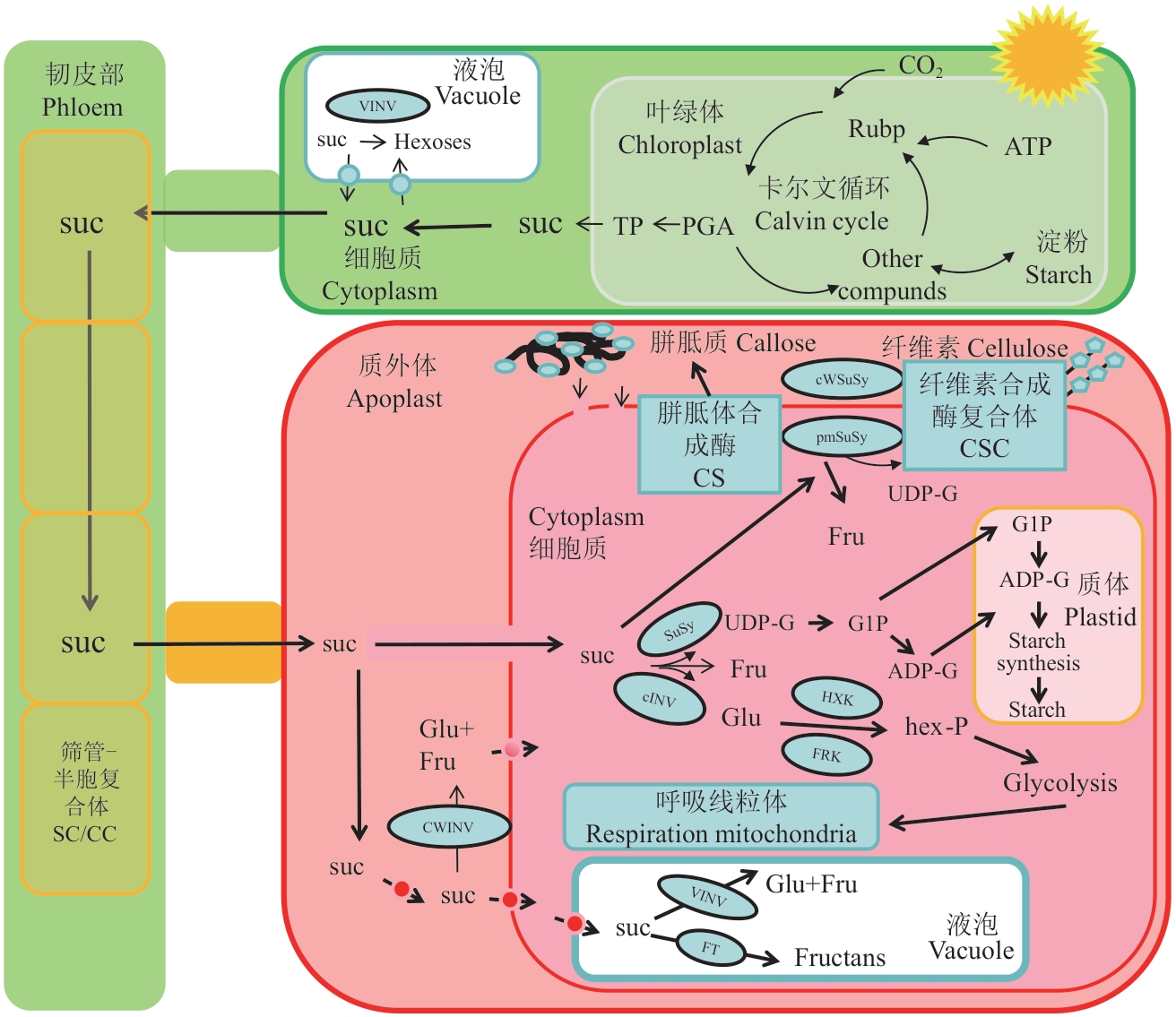
图1 番茄可溶性固形物的代谢途径为蔗糖转运蛋白;为单糖转运蛋白;为胞间连丝;SC/CC:筛管‒伴胞复合体;CS:胼胝体合成酶;CSC:纤维素合成酶复合体;suc:蔗糖;Fru:果糖;Glu:葡萄糖;Starch:淀粉;TP:磷酸丙糖;UDP-G:尿苷二磷酸葡萄糖。图片改自Stein等[23]
Fig. 1 Metabolic pathway of tomato soluble solidsrefers to sucrose transporter; refers to monosaccharide transporter; refers to intercellular filaments; SC/CC: sieve element/companion cell complex; CS: callose synthase; CSC: cellulose synthase complex; suc: sucrose; Fru: fructose; Glu: glucose; Starch: starch; TP: triose phosphate; UDP-G: uridine diphosphate glucose. Figure modified from Stein, et al.[23]
基因类别 Gene category | 代表基因 Representative gene | 主要功能 Major function | 与TSS的关系 Relationship to TSS | 关键特点 Key features | 参考文献 Reference |
|---|---|---|---|---|---|
糖代谢基因 Glucose metabolism genes | SPS | 蔗糖合成限速酶 | 增强叶片向果实的蔗糖输出 | 高糖材料中SPS活性更高;受光照和胁迫调控 | [ |
| SuSy | 蔗糖→UDP-葡萄糖+果糖 | 促进果实膨大;维持库活性 | 并非直接决定甜度,但影响糖流能力 | [ | |
| SlVI | 水解蔗糖 | 敲除SlVI叶片增大;促进蔗糖含量积累 | 敲除SlVI会导致果实蔗糖含量增加,果实硬度增强 | [ | |
| INV(cwINV)/LIN5 | 水解蔗糖 | 决定糖积累的核心基因 | LIN5自然变异可提高Brix;乙烯诱导;高糖育种核心靶标 | [ | |
糖转运基因 Sugar transporter gene | SlSUT1 | 蔗糖跨膜装载 | SlSUT1抑制使糖含量下降 | 高糖材料中表达强;决定源装载能力 | [ |
| SWEET10 | 蔗糖外排蛋白 | SWEET10抑制降低Brix | 与LIN5协同糖运输 | [ | |
| STP2 | 糖分转运蛋白 | STP2提高阿拉伯糖水平 | 敲除STP2会降低CLV3阿拉伯糖基化水平 | [ | |
| TST3a | 液泡膜糖转运蛋白 | TST3a增加己糖转运活性 | 突变体材料提高番茄果实大小和糖含量 | [ | |
| LeHT1 | 葡萄糖/果糖吸收 | 影响六碳糖的吸收速率 | 高表达材料果实更甜;受乙烯与ABA调控 | [ | |
有机酸调控 Organic acid regulation | TMT | 六碳糖向液泡转运 | 决定液泡储存糖能力 | 樱桃番茄中高表达常见 | [ |
| ALMT9 | 液泡柠檬酸通道 | 减少柠檬酸,提高糖酸比 | 自然突变可改善风味 | [ | |
| PEPC | 有机酸合成关键酶 | 影响糖酸平衡 | 与乙烯成熟过程耦合 | [ | |
| NAD-MDH | 苹果酸代谢 | 调控酸含量 | 影响风味与TSS协同积累 | [ | |
调控糖积累的转录因子 Transcription factors regulating carbohydrate accumulation | MADS | 调控成熟及糖代谢的基因 | 影响LIN5、SWEET等 | 成熟-代谢交叉调控核心 | [ |
| NAC | 果实膨大及后熟 | 上调HT、INV | 调控库能力 | [ | |
| bZIP | 糖信号调控 | 直接调控 SPS/SuSy | 参与干旱提升糖度机制 | [ | |
| WRKY | 逆境调控;ABA通路 | 调控SWEET、INV、HT | 干旱诱导糖积累 | [ | |
| ERF | 乙烯响应 | 调控LIN5、SWEET | 成熟诱导糖代谢关键因子 | [ | |
源-库相关QTL Source-reservoir associated QTL | Brix9-2-5 | 调控果梗维管束数量 | 水分输入减少,同化物浓度上升 | 提高Brix | [ |
| fw2.2 | 控制果实大小 | 小果品种糖度更高 | 与库容量负相关 | [ |
表1 番茄可溶性固形物代谢关键基因
Table 1 Key genes for soluble solids metabolism in tomato
基因类别 Gene category | 代表基因 Representative gene | 主要功能 Major function | 与TSS的关系 Relationship to TSS | 关键特点 Key features | 参考文献 Reference |
|---|---|---|---|---|---|
糖代谢基因 Glucose metabolism genes | SPS | 蔗糖合成限速酶 | 增强叶片向果实的蔗糖输出 | 高糖材料中SPS活性更高;受光照和胁迫调控 | [ |
| SuSy | 蔗糖→UDP-葡萄糖+果糖 | 促进果实膨大;维持库活性 | 并非直接决定甜度,但影响糖流能力 | [ | |
| SlVI | 水解蔗糖 | 敲除SlVI叶片增大;促进蔗糖含量积累 | 敲除SlVI会导致果实蔗糖含量增加,果实硬度增强 | [ | |
| INV(cwINV)/LIN5 | 水解蔗糖 | 决定糖积累的核心基因 | LIN5自然变异可提高Brix;乙烯诱导;高糖育种核心靶标 | [ | |
糖转运基因 Sugar transporter gene | SlSUT1 | 蔗糖跨膜装载 | SlSUT1抑制使糖含量下降 | 高糖材料中表达强;决定源装载能力 | [ |
| SWEET10 | 蔗糖外排蛋白 | SWEET10抑制降低Brix | 与LIN5协同糖运输 | [ | |
| STP2 | 糖分转运蛋白 | STP2提高阿拉伯糖水平 | 敲除STP2会降低CLV3阿拉伯糖基化水平 | [ | |
| TST3a | 液泡膜糖转运蛋白 | TST3a增加己糖转运活性 | 突变体材料提高番茄果实大小和糖含量 | [ | |
| LeHT1 | 葡萄糖/果糖吸收 | 影响六碳糖的吸收速率 | 高表达材料果实更甜;受乙烯与ABA调控 | [ | |
有机酸调控 Organic acid regulation | TMT | 六碳糖向液泡转运 | 决定液泡储存糖能力 | 樱桃番茄中高表达常见 | [ |
| ALMT9 | 液泡柠檬酸通道 | 减少柠檬酸,提高糖酸比 | 自然突变可改善风味 | [ | |
| PEPC | 有机酸合成关键酶 | 影响糖酸平衡 | 与乙烯成熟过程耦合 | [ | |
| NAD-MDH | 苹果酸代谢 | 调控酸含量 | 影响风味与TSS协同积累 | [ | |
调控糖积累的转录因子 Transcription factors regulating carbohydrate accumulation | MADS | 调控成熟及糖代谢的基因 | 影响LIN5、SWEET等 | 成熟-代谢交叉调控核心 | [ |
| NAC | 果实膨大及后熟 | 上调HT、INV | 调控库能力 | [ | |
| bZIP | 糖信号调控 | 直接调控 SPS/SuSy | 参与干旱提升糖度机制 | [ | |
| WRKY | 逆境调控;ABA通路 | 调控SWEET、INV、HT | 干旱诱导糖积累 | [ | |
| ERF | 乙烯响应 | 调控LIN5、SWEET | 成熟诱导糖代谢关键因子 | [ | |
源-库相关QTL Source-reservoir associated QTL | Brix9-2-5 | 调控果梗维管束数量 | 水分输入减少,同化物浓度上升 | 提高Brix | [ |
| fw2.2 | 控制果实大小 | 小果品种糖度更高 | 与库容量负相关 | [ |
| [1] | 尚乐乐, 宋建文, 王嘉颖, 等. 番茄果实品质形成及其分子机理研究进展 [J]. 中国蔬菜, 2019(4): 21-28. |
| Shang LL, Song JW, Wang JY, et al. Research progress on quality formation and molecular mechanism of tomato fruit [J]. China Veg, 2019(4): 21-28. | |
| [2] | 卢琦. 番茄品质性状多样性分析与农艺性状鉴定 [D]. 杨凌: 西北农林科技大学, 2021. |
| Lu Q. Tomato quality traits diversity analysis and agronomic characters identification [D]. Yangling: Northwest A & F University, 2021. | |
| [3] | Zhou Y, Zhang ZY, Bao ZG, et al. Graph pangenome captures missing heritability and empowers tomato breeding [J]. Nature, 2022, 606(7914): 527-534. |
| [4] | Ye J, Li WF, Ai G, et al. Genome-wide association analysis identifies a natural variation in basic helix-loop-helix transcription factor regulating ascorbate biosynthesis via D-mannose/L-galactose pathway in tomato [J]. PLoS Genet, 2019, 15(5): e1008149. |
| [5] | Zhang JZ, Lyu HJ, Chen J, et al. Releasing a sugar brake generates sweeter tomato without yield penalty [J]. Nature, 2024, 635(8039): 647-656. |
| [6] | Wang ZQ, Zhao YR, Zheng MM, et al. A natural variation contributes to sugar accumulation in fruit during tomato domestication [J]. Plant Biotechnol J, 2024, 22(12): 3520-3522. |
| [7] | Xu MH, Ji SJ, Pang SQ, et al. Regulatory mechanisms of total soluble solids in tomato: from QTL mapping to gene editing [J]. Foods, 2025, 14(21): 3692. |
| [8] | 赵永红, 李宪利. 果实中糖酸积累机理研究进展 [J]. 农业科技通讯, 2009(8): 110-112. |
| Zhao YH, Li XL. Advances in the mechanism of sugar and acid accumulation in fruits [J]. Bull Agric Sci Technol, 2009(8): 110-112. | |
| [9] | Yang CP, Ying SY, Tang BB, et al. The mechanistic insights into fruit ripening: integrating phytohormones, transcription factors, and epigenetic modification [J]. J Genet Genom, 2025, 52(12): 1475-1489. |
| [10] | Zanor MI, Osorio S, Nunes-Nesi A, et al. RNA interference of LIN5 in tomato confirms its role in controlling Brix content, uncovers the influence of sugars on the levels of fruit hormones, and demonstrates the importance of sucrose cleavage for normal fruit development and fertility [J]. Plant Physiol, 2009, 150(3): 1204-1218. |
| [11] | Fridman E, Carrari F, Liu YS, et al. Zooming in on a quantitative trait for tomato yield using interspecific introgressions [J]. Science, 2004, 305(5691): 1786-1789. |
| [12] | 王洁, 吴叶蝶, 杨亚军, 等. 植物SWEET家族糖转运蛋白及其上游调控因子 [J]. 植物生理学报, 2024, 60(4): 597-605. |
| Wang J, Wu YD, Yang YJ, et al. SWEET family sugar transporters and their upstream regulatory factors in plant [J]. Plant Physiol Commun, 2024, 60(4): 597-605. | |
| [13] | 王天奎. 番茄高可溶性固形物代谢途径中相关基因的克隆和分析 [D]. 杨凌: 西北农林科技大学, 2007. |
| Wang TK. Cloning and analysis of relatived gene in tomato high SSC metabolic pathway [D]. Yangling: Northwest A & F University, 2007. | |
| [14] | 张旭伟, 徐明磊, 李红艳, 等. 番茄果实可溶性固形物的作用及研究概况 [J]. 科技资讯, 2011, 9(15): 160-161. |
| Zhang XW, Xu ML, Li HY, et al. The role and research overview of soluble solids in tomato fruit [J]. Sci Technol Inf, 2011, 9(15): 160-161. | |
| [15] | Colantonio V, Ferrão LFV, Tieman DM, et al. Metabolomic selection for enhanced fruit flavor [J]. Proc Natl Acad Sci U S A, 2022, 119(7): e2115865119. |
| [16] | Davies JN, Hobson GE. The constituents of tomato fruit—the influence of environment, nutrition, and genotype [J]. Crit Rev Food Sci Nutr, 1981, 15(3): 205-280. |
| [17] | Wang Y, Shi CM, Ge PF, et al. A 21-bp InDel in the promoter of STP1 selected during tomato improvement accounts for soluble solid content in fruits [J]. Hortic Res, 2023, 10(3): uhad009. |
| [18] | Wu Y, Chen HN, Wu MB, et al. Correction to: a vacuolar invertase gene SlVI modulates sugar metabolism and postharvest fruit quality and stress resistance in tomato [J]. Hortic Res, 2025, 12(8): uhaf180. |
| [19] | Umer MJ, Bin Safdar L, Gebremeskel H, et al. Identification of key gene networks controlling organic acid and sugar metabolism during watermelon fruit development by integrating metabolic phenotypes and gene expression profiles [J]. Hortic Res, 2020, 7(1): 193. |
| [20] | 张斌浩, 李方曼, 葛平飞, 等. 番茄可溶性固形物遗传基础与改良 [J]. 中国蔬菜, 2025(2): 25-33. |
| Zhang BH, Li FM, Ge PF, et al. Genetic basis and improvement of soluble solids in tomato [J]. China Veg, 2025(2): 25-33. | |
| [21] | Miao SX, Wei XY, Zhu LC, et al. The art of tartness: the genetics of organic acid content in fresh fruits [J]. Hortic Res, 2024, 11(10): uhae225. |
| [22] | 李松文, 孟凡亮, 刘丽红, 等. 番茄SlPSY1基因转录调控因子筛选及互作验证 [J]. 核农学报, 2023, 37(1): 8-16. |
| Li SW, Meng FL, Liu LH, et al. Screening and verification of transcription regulators interacted with SlPSY1 in tomato [J]. J Nucl Agric Sci, 2023, 37(1): 8-16. | |
| [23] | Stein O, Granot D. An overview of sucrose synthases in plants [J]. Front Plant Sci, 2019, 10: 95. |
| [24] | Marschner P. Marschner’s mineral nutrition of higher plants [M]. New York: Academic Press, 2012. |
| [25] | Lal MK, Sharma N, Adavi SB, et al. From source to sink: mechanistic insight of photoassimilates synthesis and partitioning under high temperature and elevated [CO2] [J]. Plant Mol Biol, 2022, 110(4/5): 305-324. |
| [26] | Bavnhøj L, Driller JH, Zuzic L, et al. Structure and sucrose binding mechanism of the plant SUC1 sucrose transporter [J]. Nat Plants, 2023, 9(6): 938-950. |
| [27] | Braun DM, Wang L, Ruan YL. Understanding and manipulating sucrose phloem loading, unloading, metabolism, and signalling to enhance crop yield and food security [J]. J Exp Bot, 2014, 65(7): 1713-1735. |
| [28] | Pei YG, He XQ, Xue QH, et al. The bifunctional transcription factor DEAR1 oppositely regulates chlorophyll biosynthesis and degradation in tomato fruits [J]. Plant Cell, 2025, 37(7): koaf167. |
| [29] | Huang XY, Wang CK, Zhao YW, et al. Mechanisms and regulation of organic acid accumulation in plant vacuoles [J]. Hortic Res, 2021, 8(1): 227. |
| [30] | Ye J, Wang X, Hu TX, et al. An InDel in the promoter of Al-ACTIVATED MALATE TRANSPORTER9 selected during tomato domestication determines fruit malate contents and aluminum tolerance [J]. Plant Cell, 2017, 29(9): 2249-2268. |
| [31] | Kanayama Y. Sugar metabolism and fruit development in the tomato [J]. The Hortic J, 2017, 86(4): 417-425. |
| [32] | Julius BT, Leach KA, Tran TM, et al. Sugar transporters in plants: new insights and discoveries [J]. Plant Cell Physiol, 2017, 58(9): 1442-1460. |
| [33] | 袁磊. 番茄果实可溶性固形物基因SlSTP1的鉴定及功能分析 [D]. 武汉: 华中农业大学, 2020. |
| Yuan L. Identification and functional analysis of soluble solids content gene SlSTP1 in tomato [D]. Wuhan: Huazhong Agricultural University, 2020. | |
| [34] | 鲁亚辉, 杜永臣, 王孝宣, 等. 契斯曼尼番茄果实中可溶性固形物和β-胡萝卜素含量相关基因QTL分析 [J]. 园艺学报, 2012, 39(11): 2151-2158. |
| Lu YH, Du YC, Wang XX, et al. QTL mapping of soluble solids content and beta-carotene in Solanum cheesmanii [J]. Acta Hortic Sin, 2012, 39(11): 2151-2158. | |
| [35] | 贾俊忠, 田丽萍, 薛琳, 等. 番茄可溶性固形物的动态QTL及相关性状 [J]. 遗传, 2010, 32(10): 1077-1083. |
| Jia JZ, Tian LP, Xue L, et al. Dynamic QTL and correlated characters of tomato soluble solid content [J]. Hereditas, 2010, 32(10): 1077-1083. | |
| [36] | 张敏, 李鑫, 张勇, 等. 加工番茄高可溶性固形物含量位点的遗传与互作效应分析 [J]. 中国农业科学, 2025, 58(9): 1816-1829. |
| Zhang M, Li X, Zhang Y, et al. Genetic and interaction analysis of high soluble solid content loci in processing tomato [J]. Sci Agric Sin, 2025, 58(9): 1816-1829. | |
| [37] | Yin ZY, Liu JZ, Zhao HP, et al. SlMYB1 regulates the accumulation of lycopene, fruit shape, and resistance to Botrytis cinerea in tomato [J]. Hortic Res, 2022, 10(2): uhac282. |
| [38] | 秦翠鲜, 桂意云, 陈忠良, 等. 植物蔗糖合成酶基因研究进展 [J]. 分子植物育种, 2018, 16(12): 3907-3914. |
| Qin CX, Gui YY, Chen ZL, et al. The progress of studies on sucrose synthase genes in plants [J]. Mol Plant Breed, 2018, 16(12): 3907-3914. | |
| [39] | Li YM, Wang J, Liang X, et al. STP2-mediated sugar transport in tomato shoot apices is critical for CLV3 arabinosylation and fruit locule development under low temperatures [J]. Mol Plant, 2025, 18(6): 1014-1028. |
| [40] | Cai HX, Liang MY, Qin X, et al. Tonoplast sugar transporters coordinately regulate tomato fruit development and quality [J]. Plant Commun, 2025, 6(5): 101314. |
| [41] | McCurdy DW, Dibley S, Cahyanegara R, et al. Functional characterization and RNAi-mediated suppression reveals roles for hexose transporters in sugar accumulation by tomato fruit [J]. Mol Plant, 2010, 3(6): 1049-1063. |
| [42] | Zhu LC, Li BY, Wu LM, et al. MdERDL6-mediated glucose efflux to the cytosol promotes sugar accumulation in the vacuole through up-regulating TSTs in apple and tomato [J]. Proc Natl Acad Sci USA, 2021, 118(1): e2022788118. |
| [43] | Sun YM, Jia XY, Yang ZR, et al. Genome-wide identification of PEBP gene family in Solanum lycopersicum [J]. Int J Mol Sci, 2023, 24(11): 9185. |
| [44] | Zhang LH, Ma BQ, Wang CZ, et al. MdWRKY126 modulates malate accumulation in apple fruit by regulating cytosolic malate dehydrogenase (MdMDH5) [J]. Plant Physiol, 2022, 188(4): 2059-2072. |
| [45] | Lu LZ, Delrot S, Fan PG, et al. The transcription factors ERF105 and NAC72 regulate expression of a sugar transporter gene and hexose accumulation in grape [J]. Plant Cell, 2024, 37(1): koae326. |
| [46] | Du MM, Sun CL, Deng L, et al. Molecular breeding of tomato: Advances and challenges [J]. J Integr Plant Biol, 2025, 67(3): 669-721. |
| [47] | Lou HC, Li SJ, Shi ZH, et al. Engineering source-sink relations by prime editing confers heat-stress resilience in tomato and rice [J]. Cell, 2025, 188(2): 530-549.e20. |
| [48] | Liu H, Zhang JQ, Zhang RR, et al. SlMYB1R1-SlSWEET12c module synergistically promotes sugar accumulation in tomato fruits [J]. Plant J, 2025, 121(4): e70062. |
| [49] | Wang JC, Li XM, Li JJ, et al. Manipulating the light systemic signal HY5 greatly improve fruit quality in tomato [J]. Adv Sci, 2025, 12(23): 2500110. |
| [50] | 刘晓奇, 肖雪梅, 王俊文, 等. 水分亏缺对日光温室基质栽培番茄果实营养和风味品质的影响 [J]. 江苏农业学报, 2021, 37(2): 443-453. |
| Liu XQ, Xiao XM, Wang JW, et al. Effects of water deficit on nutrition and flavor qualities of tomato fruits cultivated by substrate in solar greenhouse [J]. Jiangsu J Agric Sci, 2021, 37(2): 443-453. | |
| [51] | 赵玉萍, 邹志荣, 杨振超, 等. 不同温度和光照对温室番茄光合作用及果实品质的影响 [J]. 西北农林科技大学学报: 自然科学版, 2010, 38(5): 125-130. |
| Zhao YP, Zou ZR, Yang ZC, et al. Effect of temperature and light to tomato photosynthesis and quality in greenhouse [J]. J Northwest A&f Univ Nat Sci Ed, 2010, 38(5): 125-130. |
| [1] | 刘淼, 林涛, 贾乐松, 胡丰, 李涛, 李志万, 刘美芳, 郑方燕, 崔龙. 从野生到栽培:番茄果实色泽的演化与调控机制[J]. 生物技术通报, 2026, 42(3): 187-202. |
| [2] | 李亚妮, 韩鸿宇, 耿梦爽, 米若兰, 王韦琪, 于文静, 孟宪文, 李传友. ChiC基因调控番茄灰霉病抗性的机制研究[J]. 生物技术通报, 2026, 42(3): 255-262. |
| [3] | 王鹤瑶, 孙红梅. 园艺植物表皮毛功能及其形成机制研究进展[J]. 生物技术通报, 2026, 42(3): 242-254. |
| [4] | 颜晨琳, 李凡, 闫春婷, 程蛟文, 胡开林, 叶志彪, 宋建文. 番茄果实形态发育相关基因研究进展[J]. 生物技术通报, 2026, 42(3): 172-186. |
| [5] | 刘娜, 曾宝珍, 贾兆星, 祝英方. 表观遗传调控番茄果实发育及成熟的研究进展[J]. 生物技术通报, 2026, 42(3): 37-47. |
| [6] | 杜丹, 郭翔, 胡鑫, 潘宇. 质体发育调控果实成熟与品质的研究进展[J]. 生物技术通报, 2026, 42(3): 48-59. |
| [7] | 姜喆卉, 王小龙, 王守创, 周科. 番茄风味物质代谢途径解析与分子育种研究进展[J]. 生物技术通报, 2026, 42(3): 60-78. |
| [8] | 李成泉, 史庆华, 杨晓玉. 园艺作物果实发育的miRNA调控网络:从分子机制到种质创新[J]. 生物技术通报, 2026, 42(3): 19-36. |
| [9] | 王潇奕, 李金焱, 邢醒, 朱鸿亮. 基于乙烯响应筛选调控番茄成熟且影响呼吸的基因及其功能分析[J]. 生物技术通报, 2026, 42(3): 275-282. |
| [10] | 李迎辉, 王杨博涵, 周浩博, 卢心如, 张珂欣, 于洋, 李传友, 孙传龙. 番茄VPE基因家族鉴定和抗逆功能分析[J]. 生物技术通报, 2026, 42(3): 263-274. |
| [11] | 费思恬, 侯鹰翔, 李兰, 张超. 水稻赤霉素信号负调控因子SLR1的生物学功能及其调控网络[J]. 生物技术通报, 2026, 42(1): 13-30. |
| [12] | 苏秀敏, 韩文清, 王佼, 李鹏, 王秋兰, 李万星, 曹晋军. 哈茨木霉M408的分离鉴定、生物学特性及对番茄早疫病的生防效果[J]. 生物技术通报, 2025, 41(9): 277-288. |
| [13] | 侯亚涛, 李迎辉, 邓磊, 李常保, 李传友, 孙传龙. 番茄果重基因功能型分子标记的开发及群体基因型分析[J]. 生物技术通报, 2025, 41(4): 98-105. |
| [14] | 刘洁, 王飞, 陶婷, 张玉静, 陈浩婷, 张瑞星, 石玉, 张毅. 过表达SlWRKY41提高番茄幼苗抗旱性[J]. 生物技术通报, 2025, 41(2): 107-118. |
| [15] | 陈慧婷, 夏一楠, 颜伟, 张梦菲, 陈周梅, 侯丽霞, 刘新. 外源绿原酸处理对设施番茄果实品质的影响[J]. 生物技术通报, 2025, 41(2): 119-126. |
| 阅读次数 | ||||||
|
全文 |
|
|||||
|
摘要 |
|
|||||
