







生物技术通报 ›› 2026, Vol. 42 ›› Issue (3): 156-171.doi: 10.13560/j.cnki.biotech.bull.1985.2026-0069
罗龙鑫1( ), 李智1, 李彤1, 冯资权1, 翟欣悦1,2, 梁成林3, 张亚丽1, 吴上1, 李媛媛1, 姜翰1()
收稿日期:2026-01-15
出版日期:2026-03-26
发布日期:2026-04-23
通讯作者:
姜翰,男,博士,副教授,研究方向 :园艺学;E-mail: jianghan3284@sdau.edu.cn作者简介:罗龙鑫,女,硕士研究生,研究方向 :园艺学;E-mail: fuluobei0601@163.com
基金资助:
LUO Long-xin1(), LI Zhi1, LI Tong1, FENG Zi-quan1, ZHAI Xin-yue1,2, LIANG Cheng-lin3, ZHANG Ya-li1, WU Shang1, LI Yuan-yuan1, JIANG Han1()
Received:2026-01-15
Published:2026-03-26
Online:2026-04-23
摘要:
苹果作为全球广泛栽培的重要水果,果实可溶性糖含量是决定其风味品质与市场竞争力的核心指标,其积累过程涉及复杂的遗传分子调控网络。本文系统综述苹果果实糖分积累的生理基础、分子机制及调控因素。生理层面,糖分积累依赖光合产物(主要为山梨醇和蔗糖)的合成、运输、卸载、代谢与液泡储存等多环节协同作用,且受蔗糖转运蛋白(SUT)、液泡糖转运蛋白(TST)、SWEET转运蛋白等关键载体介导。分子机制上,山梨醇代谢相关基因(MdS6PDH、MdSDH)、蔗糖代谢相关基因(MdSuSy、MdSPS)、己糖代谢相关基因(MdHXK、MdFRK)分别调控不同糖组分的合成与转化;MYB、bZIP、ERF、NAC、WRKY等转录因子通过形成复杂调控网络,精准调控糖代谢与转运相关基因的表达。此外,生长素、脱落酸、乙烯等植物激素通过与糖信号交叉互作,共同参与糖分积累调控;光照、温度、水分、营养元素等环境因素则通过特异性分子通路影响相关基因表达与酶活性,进而塑造果实糖分特征。目前,苹果糖分积累的核心调控因子互作、糖组分转化机制、环境与内源基因互作等问题仍需深入探索。本综述为解析苹果果实糖分积累的分子机制提供全面参考,对推动苹果品质改良的分子育种进程具有重要意义。
罗龙鑫, 李智, 李彤, 冯资权, 翟欣悦, 梁成林, 张亚丽, 吴上, 李媛媛, 姜翰. 苹果果实糖分形成的分子基础[J]. 生物技术通报, 2026, 42(3): 156-171.
LUO Long-xin, LI Zhi, LI Tong, FENG Zi-quan, ZHAI Xin-yue, LIANG Cheng-lin, ZHANG Ya-li, WU Shang, LI Yuan-yuan, JIANG Han. Molecular Basis of Sugar Accumulation in Apple Fruits[J]. Biotechnology Bulletin, 2026, 42(3): 156-171.
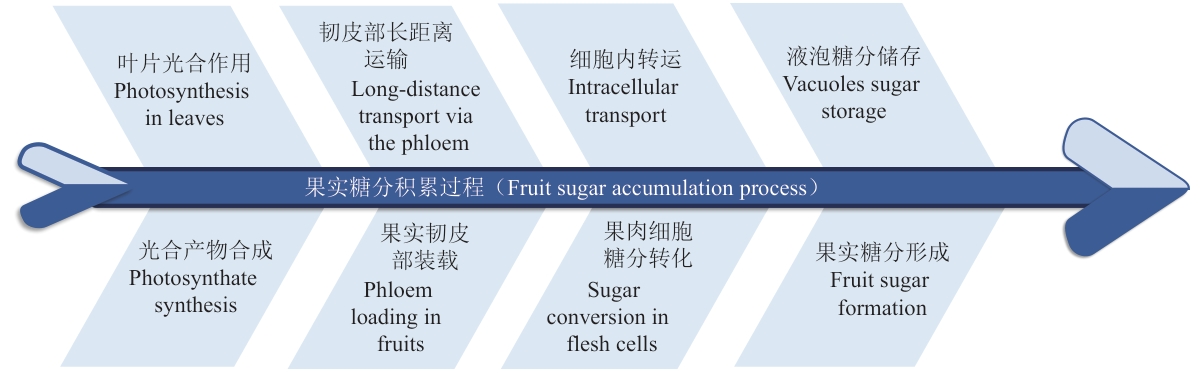
图1 苹果果实糖分积累过程糖分从叶片光合产物合成、经韧皮部长距离运输与果实韧皮部装载,再到果肉细胞内转运、糖分转化与形成,最终在液泡中储存
Fig. 1 Sugar accumulation process in apple fruitSugars are synthesized as photosynthate in leaves, transported over long distances via the phloem and loaded into the fruit phloem, then undergo intracellular transport, conversion and formation within the flesh cells, and are finally stored in the vacuoles
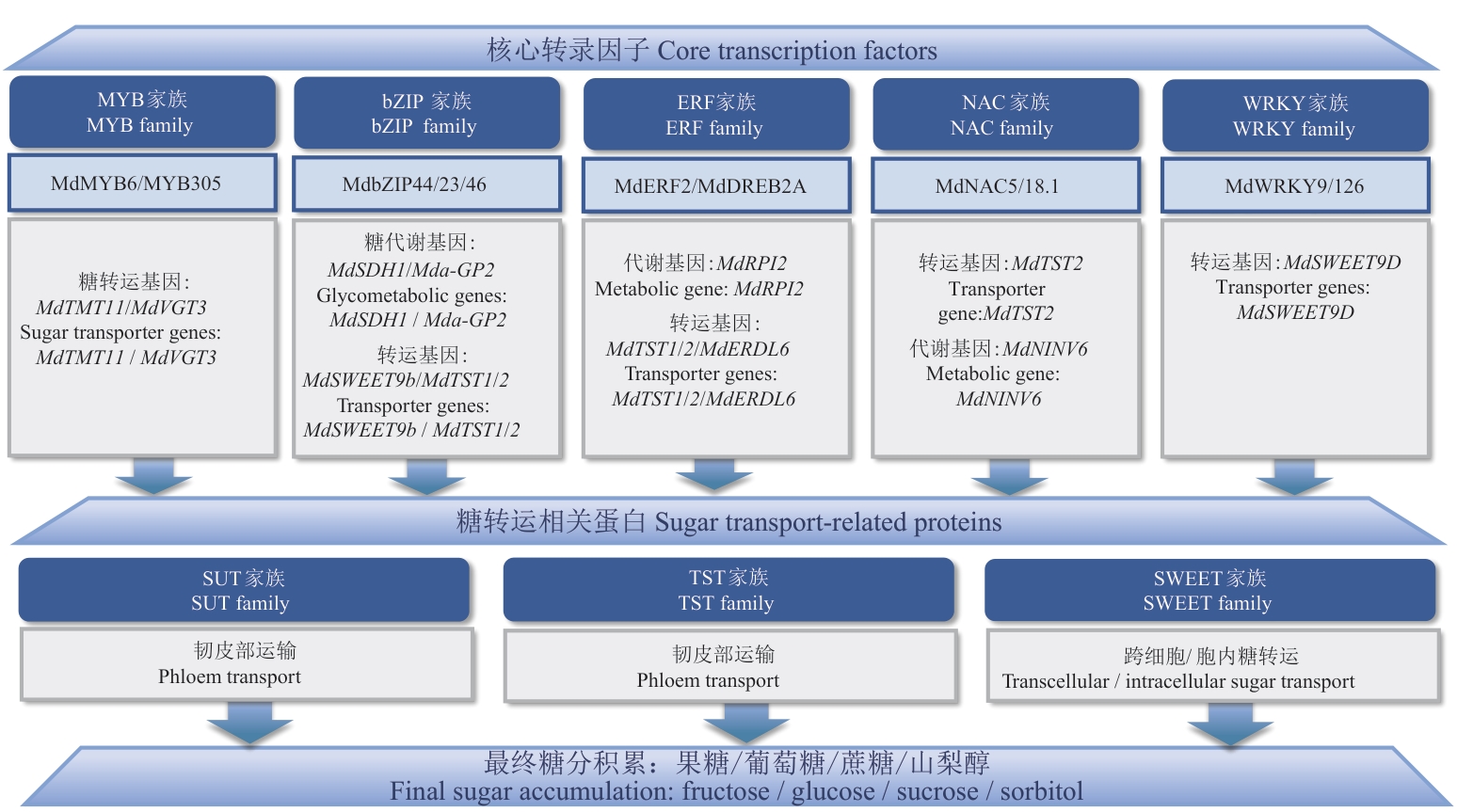
图2 苹果果实糖分形成分子机制核心转录因子家族(MYB、bZIP、ERF、NAC、WRKY)通过调控糖转运相关蛋白家族(SUT、TST、SWEET),分别介导韧皮部运输、液泡糖富集及跨细胞/胞内糖转运过程,最终调控果糖、葡萄糖、蔗糖、山梨醇等糖分在果实中的积累
Fig. 2 Molecular mechanism of sugar formation in apple fruitCore transcription factor families (MYB, bZIP, ERF, NAC, and WRKY) orchestrate the expression of sugar transport-related protein families (SUT, TST, and SWEET). These transporters mediate key processes including phloem transport, vacuolar sugar sequestration, and intercellular/intracellular sugar partitioning, ultimately governing the accumulation of fructose, glucose, sucrose, and sorbitol in the fruit
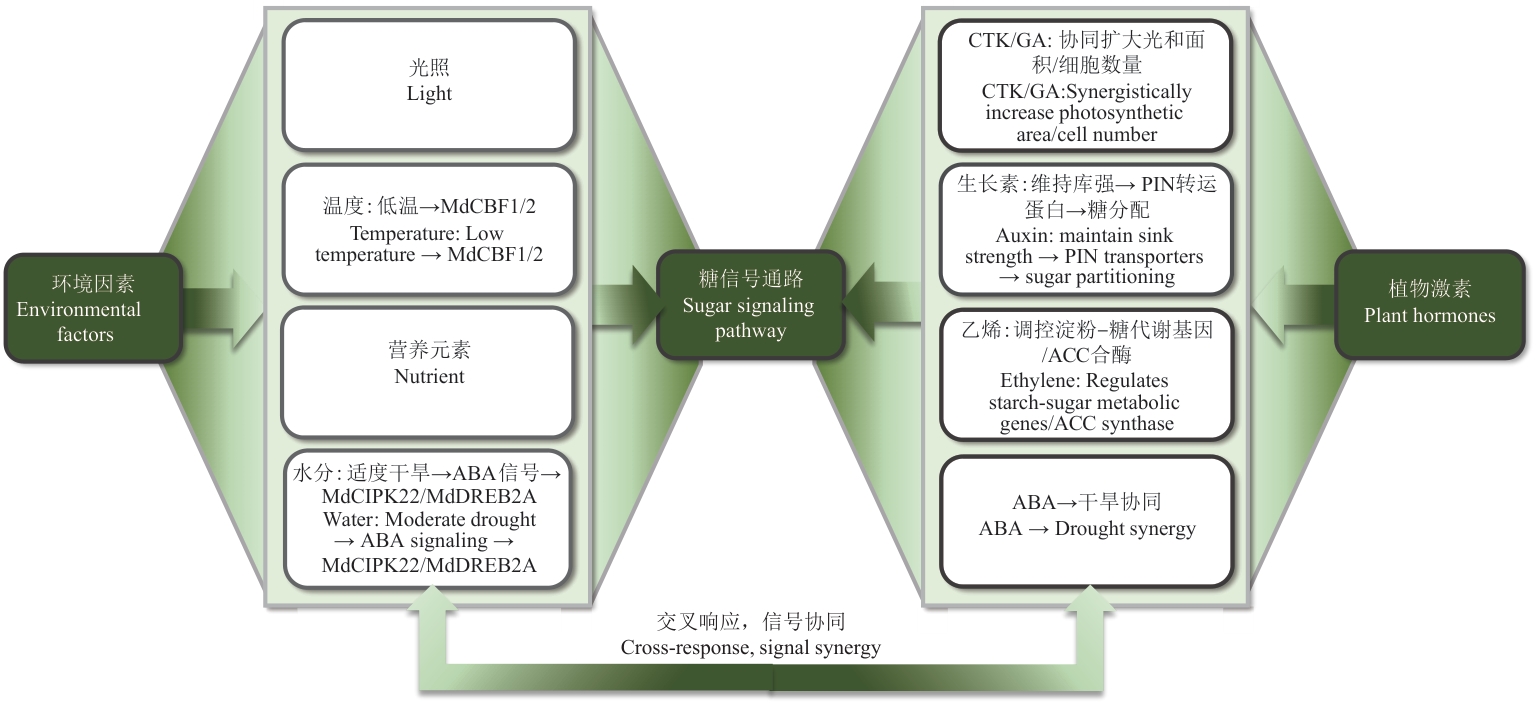
图3 环境因素与植物激素通过糖信号通路协同调控苹果果实发育的分子网络环境因素(光照、低温、营养元素、适度干旱等)通过激活特定信号分子(如MdCBF1/2、MdCIPK22、MdDREB2A)调控糖信号通路;植物激素(CTK/GA、生长素、乙烯、ABA等)则通过调控光合面积、库强、糖代谢及干旱响应,与糖信号通路形成交叉响应与信号协同,共同影响果实发育过程
Fig. 3 Molecular network of environmental factors and plant hormones synergistically regulating apple fruit development via the sugar signaling pathwayEnvironmental factors (light, low temperature, nutrients, moderate drought, etc.) regulate the sugar signaling pathway by activating specific signaling molecules (e.g., MdCBF1/2, MdCIPK22, MdDREB2A). Plant hormones (CTK/GA, auxin, ethylene, ABA, etc.) form cross-response and signal synergy with the sugar signaling pathway by regulating photosynthetic area, sink strength, sugar metabolism, and drought response, thereby collectively influencing fruit development
| [1] | 陈学森, 王楠, 彭福田, 等. 中国重要落叶果树果实品质和熟期育种研究进展 [J]. 园艺学报, 2024, 51(1): 8-26. |
| Chen XS, Wang N, Peng FT, et al. Advances in quality and maturity breeding of important deciduous fruit trees in China [J]. Acta Hortic Sin, 2024, 51(1): 8-26. | |
| [2] | Migicovsky Z, Gardner KM, Richards C, et al. Genomic consequences of apple improvement [J]. Hortic Res, 2021, 8: 9. |
| [3] | 陈学森, 王楠, 张宗营, 等. 中国苹果品种结构优化的思考与实践Ⅱ: 富营养强风味苹果品种助力健康中国 [J]. 中国果树, 2025(6): 1-3. |
| Chen XS, Wang N, Zhang ZY, et al. Thoughts and practices on the optimization of apple variety structure in China Ⅱ: high-nutrition and strong-flavored apple varieties contribute to the Healthy China [J]. China Fruits, 2025(6): 1-3. | |
| [4] | Wang ZJ, Song SY, Zhao MQ, et al. New insights into the relationship between optical response and physicochemical properties in apple flesh: Hyperspectral microscope imaging technology [J]. Food Res Int, 2024, 194: 114940. |
| [5] | 李娅楠, 闫雷玉, 张波, 等. 不同苹果品种果实糖酸组分特征研究 [J]. 果树学报, 2021, 38(11): 1877-1889. |
| Li YN, Yan LY, Zhang B, et al. A study on sugar and organic acid components in different apple cultivars [J]. J Fruit Sci, 2021, 38(11): 1877-1889. | |
| [6] | 赵德英, 张彦昌, 闫帅, 等. 提升苹果果实品质之增加糖度 [J]. 果树实用技术与信息, 2025(11): 3-4. |
| Zhao DY, Zhang YC, Yan S, et al. Improve apple fruit quality and increase sugar content [J]. Guoshu Shiyong Jishu Yu Xinxi, 2025(11): 3-4. | |
| [7] | Bieleski RL. Sugar alcohols [M]// Loewus FA, Tanner W. Plant Carbohydrates I: Inrtacellular Carbohydrates. New York: Springer, 1982: 158-192. |
| [8] | Loescher WH. Physiology and metabolism of sugar alcohols in higher plants [J]. Physiol Plant, 1987, 70(3): 553-557. |
| [9] | Zhou R, Cheng LL, Wayne R. Purification and characterization of sorbitol-6-phosphate phosphatase from apple leaves [J]. Plant Sci, 2003, 165(1): 227-232. |
| [10] | Velasco R, Zharkikh A, Affourtit J, et al. The genome of the domesticated apple (Malus × domestica Borkh.) [J]. Nat Genet, 2010, 42(10): 833-839. |
| [11] | Ren Y, Liao SJ, Xu Y. An update on sugar allocation and accumulation in fruits [J]. Plant Physiol, 2023, 193(2): 888-899. |
| [12] | Braun DM. Phloem loading and unloading of sucrose: what a long, strange trip from source to sink [J]. Annu Rev Plant Biol, 2022, 73: 553-584. |
| [13] | Jia BL, Zhu XF, Pu ZJ, et al. Integrative view of the diversity and evolution of SWEET and SemiSWEET sugar transporters [J]. Front Plant Sci, 2017, 8: 2178. |
| [14] | Ruan YL. Sucrose metabolism: gateway to diverse carbon use and sugar signaling [J]. Annu Rev Plant Biol, 2014, 65: 33-67. |
| [15] | Anjali A, Fatima U, Manu MS, et al. Structure and regulation of SWEET transporters in plants: an update [J]. Plant Physiol Biochem, 2020, 156: 1-6. |
| [16] | Eom JS, Chen LQ, Sosso D, et al. SWEETs, transporters for intracellular and intercellular sugar translocation [J]. Curr Opin Plant Biol, 2015, 25: 53-62. |
| [17] | Chen LQ, Cheung LS, Feng L, et al. Transport of sugars [J]. Annu Rev Biochem, 2015, 84: 865-894. |
| [18] | White AC, Rogers A, Rees M, et al. How can we make plants grow faster A source-sink perspective on growth rate [J]. J Exp Bot, 2016, 67(1): 31-45. |
| [19] | Durán-Soria S, Pott DM, Osorio S, et al. Sugar signaling during fruit ripening [J]. Front Plant Sci, 2020, 11: 564917. |
| [20] | Li YM, Forney C, Bondada B, et al. The molecular regulation of carbon sink strength in grapevine (Vitis vinifera L.) [J]. Front Plant Sci, 2021, 11: 606918. |
| [21] | Kanayama Y. Sugar metabolism and fruit development in the tomato [J]. The Hortic J, 2017, 86(4): 417-425. |
| [22] | 祝令成, 苏静, 彭云静, 等. 糖转运蛋白与果实糖积累的关系研究进展 [J]. 园艺学报, 2022, 49(12): 2529-2542. |
| Zhu LC, Su J, Peng YJ, et al. Research progress on the relationship between sugar transporters and fruits sugar accumulation [J]. Acta Hortic Sin, 2022, 49(12): 2529-2542. | |
| [23] | Kühn C, Grof CP. Sucrose transporters of higher plants [J]. Curr Opin Plant Biol, 2010, 13(3): 287-297. |
| [24] | Cheng LL, Zhou R, Reidel EJ, et al. Antisense inhibition of sorbitol synthesis leads to up-regulation of starch synthesis without altering CO2 assimilation in apple leaves [J]. Planta, 2005, 220(5): 767-776. |
| [25] | He XW, Meng H, Wang HB, et al. Quantitative proteomic sequencing of F1 hybrid populations reveals the function of sorbitol in apple resistance to Botryosphaeria dothidea [J]. Hortic Res, 2022, 9: uhac115. |
| [26] | 胡欢欢, 曹雪璟, 杜成龙, 等. 苹果SDH基因家族的鉴定及对非生物胁迫的响应 [J/OL]. 西北农林科技大学学报: 自然科学版, 2025. . |
| Hu HH, Cao XJ, Du CL, et al. Identification of SDH gene family in apple and its response to abiotic stress [J/OL]. J Northwest A F Univ Nat Sci Ed, 2025. . | |
| [27] | Li MJ, Feng FJ, Cheng LL. Expression patterns of genes involved in sugar metabolism and accumulation during apple fruit development [J]. PLoS One, 2012, 7(3): e33055. |
| [28] | Yuan RM, Mao LL, Min T, et al. Salicylic acid treatment inhibits ethylene synthesis and starch-sugar conversion to maintain apple fruit quality during shelf life [J]. Sci Hortic, 2023, 308: 111586. |
| [29] | 李会霞, 祝令成, 张钊, 等. 苹果中磷酸蔗糖合酶家族基因的表达特性及其与蔗糖含量的关系 [J]. 西北植物学报, 2017, 37(5): 872-878. |
| Li HX, Zhu LC, Zhang Z, et al. Expression analysis of apple sucrose phosphate synthase gene families and their relationship with sucrose accumulation in apple [J]. Acta Bot Boreali Occidentalia Sin, 2017, 37(5): 872-878. | |
| [30] | Granot D, Kelly G, Stein O, et al. Substantial roles of hexokinase and fructokinase in the effects of sugars on plant physiology and development [J]. J Exp Bot, 2014, 65(3): 809-819. |
| [31] | Zhang ZY, Huang ZY, Wu B, et al. Epistasis between genetic variations on MdMYB109 and MdHXK1 exerts a large effect on sugar content in apple fruit [J]. Plant J, 2025, 121: e17187. |
| [32] | Yang JJ, Zhu LC, Cui WF, et al. Increased activity of MdFRK2, a high-affinity fructokinase, leads to upregulation of sorbitol metabolism and downregulation of sucrose metabolism in apple leaves [J]. Hortic Res, 2018, 5: 71. |
| [33] | 张计育, 王刚, 王涛, 等. SWEET蛋白在植物生长发育中的功能作用研究进展 [J]. 植物资源与环境学报, 2023, 32(5): 1-15. |
| Zhang JY, Wang G, Wang T, et al. Research progress on functional roles of SWEET proteins in plant growth and development [J]. J Plant Resour Environ, 2023, 32(5): 1-15. | |
| [34] | Zhen QL, Fang T, Peng Q, et al. Developing gene-tagged molecular markers for evaluation of genetic association of apple SWEET genes with fruit sugar accumulation [J]. Hortic Res, 2018, 5: 14. |
| [35] | Riesmeier JW, Willmitzer L, Frommer WB. Isolation and characterization of a sucrose carrier cDNA from spinach by functional expression in yeast [J]. EMBO J, 1992, 11(13): 4705-4713. |
| [36] | Reddy VS, Shlykov MA, Castillo R, et al. The major facilitator superfamily (MFS) revisited [J]. FEBS J, 2012, 279(11): 2022-2035. |
| [37] | Yan NE. Structural advances for the major facilitator superfamily (MFS) transporters [J]. Trends Biochem Sci, 2013, 38(3): 151-159. |
| [38] | 彭昌操, 肖文芳, 李文燕, 等. 苹果蔗糖载体蛋白MdSUT1多克隆抗体的制备及MdSUT1蛋白表达特异性分析 [J]. 植物生理学报, 2011, 47(3): 256-262. |
| Peng CC, Xiao WF, Li WY, et al. Polyclonal antibody preparing and specific expression analyzing of sucrose transporter MdSUT1 in apple [J]. Plant Physiol J, 2011, 47(3): 256-262. | |
| [39] | Peng Q, Cai YM, Lai EH, et al. The sucrose transporter MdSUT4.1 participates in the regulation of fruit sugar accumulation in apple [J]. BMC Plant Biol, 2020, 20(1): 191. |
| [40] | Zhang B, Fan WM, Zhu ZZ, et al. Functional analysis of MdSUT2.1, a plasma membrane sucrose transporter from apple [J]. J Integr Agric, 2023, 22(3): 762-775. |
| [41] | 许海峰, 曲常志, 刘静轩, 等. 苹果液泡膜蔗糖转运蛋白基因MdSUT4的表达分析与功能鉴定 [J]. 园艺学报, 2017, 44(7): 1235-1243. |
| Xu HF, Qu CZ, Liu JX, et al. Expression analysis and functional identification of a vacuolar sucrose transporter gene MdSUT4 in apple [J]. Acta Hortic Sin, 2017, 44(7): 1235-1243. | |
| [42] | Jung B, Ludewig F, Schulz A, et al. Identification of the transporter responsible for sucrose accumulation in sugar beet taproots [J]. Nat Plants, 2015, 1: 14001. |
| [43] | Huang WF, Hu B, Liu JL, et al. Identification and characterization of tonoplast sugar transporter (TST) gene family in cucumber [J]. Hortic Plant J, 2020, 6(3): 145-157. |
| [44] | Wang L, Chen J, Zhang Y, Li X. Molecular classification and functional divergence of tonoplast sugar transporters in plants [J]. Plant Physiology, 2020, 183(2): 456-470. |
| [45] | Ma QJ, Sun MH, Lu J, et al. Transcription factor AREB2 is involved in soluble sugar accumulation by activating sugar transporter and amylase genes [J]. Plant Physiol, 2017, 174(4): 2348-2362. |
| [46] | Zhu LC, Li BY, Wu LM, et al. MdERDL6-mediated glucose efflux to the cytosol promotes sugar accumulation in the vacuole through up-regulating TSTs in apple and tomato [J]. Proc Natl Acad Sci U S A, 2021, 118: e2022788118. |
| [47] | Jia L, Clegg MT, Jiang T. Evolutionary dynamics of the DNA-binding domains in putative R2R3-MYB genes identified from rice subspecies indica and japonica genomes [J]. Plant Physiol, 2004, 134(2): 575-585. |
| [48] | Paz-Ares J, Ghosal D, Wienand U, et al. The regulatory c1 locus of Zea mays encodes a protein with homology to myb proto-oncogene products and with structural similarities to transcriptional activators [J]. EMBO J, 1987, 6(12): 3553-3558. |
| [49] | Jiang CZ, Gu JY, Chopra S, et al. Ordered origin of the typical two- and three-repeat Myb genes [J]. Gene, 2004, 326: 13-22. |
| [50] | Kranz HD, Denekamp M, Greco R, et al. Towards functional characterisation of the members of the R2R3-MYB gene family from Arabidopsis thaliana [J]. Plant J, 1998, 16(2): 263-276. |
| [51] | Stracke R, Werber M, Weisshaar B. The R2R3-MYB gene family in Arabidopsis thaliana [J]. Curr Opin Plant Biol, 2001, 4(5): 447-456. |
| [52] | Xu HF, Zou Q, Yang GX, et al. MdMYB6 regulates anthocyanin formation in apple both through direct inhibition of the biosynthesis pathway and through substrate removal [J]. Hortic Res, 2020, 7: 72. |
| [53] | Zhang SH, Wang H, Wang T, et al. MdMYB305-MdbHLH33-MdMYB10 regulates sugar and anthocyanin balance in red-fleshed apple fruits [J]. Plant J, 2023, 113(5): 1062-1079. |
| [54] | Zhang SH, Wang H, Wang T, et al. Abscisic acid and regulation of the sugar transporter gene MdSWEET9b promote apple sugar accumulation [J]. Plant Physiol, 2023, 192(3): 2081-2101. |
| [55] | 曹雪璟. 苹果MdbZIP44转录因子响应氮素水平调控糖代谢的机理研究 [D]. 兰州: 甘肃农业大学, 2023. |
| Cao XJ. Mechanism study of apple MdbZIP44 transcription factor regulates sugar metabolism in response to nitrogen levels [D]. Lanzhou: Gansu Agricultural University, 2023. | |
| [56] | Feng Y, Wang Y, Zhang GF, et al. Group-C/S1 bZIP heterodimers regulate MdIPT5b to negatively modulate drought tolerance in apple species [J]. Plant J, 2021, 107(2): 399-417. |
| [57] | 张淑辉. MdWRKY9-MdSWEET9b响应ABA信号调控苹果果实糖积累的机理研究 [D]. 泰安: 山东农业大学, 2023. |
| Zhang SH. Mechanisms of MdWRKY9-MdSWEET9b regulating sugar accumulation in apple fruits in response to ABA signal [D]. Tai’an: Shandong Agricultural University, 2023. | |
| [58] | Zhu LC, Li YZ, Wang CC, et al. The SnRK2.3-AREB1-TST1/2 cascade activated by cytosolic glucose regulates sugar accumulation across tonoplasts in apple and tomato [J]. Nat Plants, 2023, 9(6): 951-964. |
| [59] | Li BY, Zhu LC, Yang NX, et al. Transcriptional landscape and dynamics involved in sugar and acid accumulation during apple fruit development [J]. Plant Physiol, 2024, 195(4): 2772-2786. |
| [60] | Zhu LC, Zhang CX, Yang NX, et al. Apple vacuolar sugar transporters regulated by MdDREB2A enhance drought resistance by promoting accumulation of soluble sugars and activating ABA signaling [J]. Hortic Res, 2024, 11(12): uhae251. |
| [61] | Zhang B, Yang HJ, Li YN, et al. MdNAC5: a key regulator of fructose accumulation in apple fruit [J]. New Phytol, 2024, 244(6): 2458-2473. |
| [62] | Liu PP, Shao CX, Ren H, et al. Transcription factor MdNAC18.1 regulates malic acid accumulation in apple fruits [J]. Int J Biol Macromol, 2025, 308: 142332. |
| [63] | Li A, Chen J, Lin Q, et al. Transcription factor MdWRKY32 participates in starch-sugar metabolism by binding to the MdBam5 promoter in apples during postharvest storage [J]. J Agric Food Chem, 2021, 69(49): 14906-14914. |
| [64] | Wang L, Ruan YL. Regulation of cell division and expansion by sugar and auxin signaling [J]. Front Plant Sci, 2013, 4: 163. |
| [65] | 王利斌, 牛军鹏, 王国栋, 等. 果实发育和成熟过程中糖信号的研究进展 [J]. 广东农业科学, 2024, 51(10): 1-16. |
| Wang LB, Niu JP, Wang GD, et al. Research progress on sugar signaling during fruit development and ripening [J]. Guangdong Agric Sci, 2024, 51(10): 1-16. | |
| [66] | Jeandet P, Formela-Luboińska M, Labudda M, et al. The role of sugars in plant responses to stress and their regulatory function during development [J]. Int J Mol Sci, 2022, 23(9): 5161. |
| [67] | Yu JQ, Li ZT, Chen S, et al. Analysis of ethylene signal regulating sucrose metabolism in strawberry fruits based on RNA-seq [J]. Plants, 2024, 13(8): 1121. |
| [68] | Song LL, Hu WH, Wang CB, et al. 6-benzylaminopurine and gibberellic acid mitigate the yellowing of pak choi (Brassica rapa subsp. Chinensis) during storage by regulating sugar scarcity-induced chlorophagy [J]. J Agric Food Chem, 2025, 73(13): 7584-7595. |
| [69] | Tyagi K, Maoz I, Kochanek B, et al. Cytokinin but not gibberellin application had major impact on the phenylpropanoid pathway in grape [J]. Hortic Res, 2021, 8: 51. |
| [70] | 王竞, 唐雪东, 程存刚, 等. 不同光质补光对富士苹果果实品质的影响 [J]. 果树学报, 2024, 41(3): 459-469. |
| Wang J, Tang XD, Cheng CG, et al. Effects of light quality on Fuji apple fruit quality [J]. J Fruit Sci, 2024, 41(3): 459-469. | |
| [71] | Li BY, Qu ST, Kang JY, et al. The MdCBF1/2-MdTST1/2 module regulates sugar accumulation in response to low temperature in apple [J]. Plant J, 2024, 118(3): 787-801. |
| [72] | Ma WF, Li YB, Nai GJ, et al. Changes and response mechanism of sugar and organic acids in fruits under water deficit stress [J]. PeerJ, 2022, 10: e13691. |
| [73] | 马齐军. 苹果蔗糖转运蛋白MdSUT2.2应答干旱和盐胁迫调控糖含量的分子机制 [D]. 泰安: 山东农业大学, 2018. |
| Ma QJ. Molecular mechanism by which apple sucrose transporter MdSUT2.2 involves in regulating sugar content in response to drought and salt stresses [D]. Tai’an: Shandong Agricultural University, 2018. | |
| [74] | Li BY, Zhu LC, Jin YR, et al. Effects of two apple tonoplast sugar transporters, MdTST1 and MdTST2, on the accumulation of sugar [J]. Sci Hortic, 2022, 293: 110719. |
| [75] | Cao XJ, Guo ZG, Wang P, et al. MdbZIP44-MdCPRF2-like-Mdα- GP2 regulate starch and sugar metabolism in apple under nitrogen supply [J]. Hortic Res, 2024, 11(5): uhae072. |
| [76] | Zhang W, Zhang X, Wang YF, et al. Potassium fertilization arrests malate accumulation and alters soluble sugar metabolism in apple fruit [J]. Biol Open, 2018: bio.024745. |
| [77] | Sun TT, Zhang JK, Zhang Q, et al. Transcriptome and metabolome analyses revealed the response mechanism of apple to different phosphorus stresses [J]. Plant Physiol Biochem, 2021, 167: 639-650. |
| [1] | 秦子璐, 孙海燕, 陈赢男. 植物表皮毛发育分子调控机制研究进展[J]. 生物技术通报, 2026, 42(9): 1-13. |
| [2] | 刘青媛, 吴洪启, 陈秀娥, 陈剑, 姜远泽, 何燕子, 喻奇伟, 刘仁祥. 转录因子NtMYB96a调控烟草耐旱性的功能研究[J]. 生物技术通报, 2026, 42(4): 239-250. |
| [3] | 马世杰, 李铮, 李蔚, 郭仰东, 张娜. 光信号调控园艺作物果实发育的研究进展[J]. 生物技术通报, 2026, 42(3): 5-18. |
| [4] | 赵艳侠, 李倩, 孙家波, 梁红敏, 李冰冰. 草莓果实品质形成的关键调控基因及分子网络解析[J]. 生物技术通报, 2026, 42(3): 111-132. |
| [5] | 王鹤瑶, 孙红梅. 园艺植物表皮毛功能及其形成机制研究进展[J]. 生物技术通报, 2026, 42(3): 242-254. |
| [6] | 付万祥, 王涛, 谭澍, 余思远, 熊欢, 邹锋. 外源糖对锥栗果实品质、淀粉酶活性及其基因表达的影响[J]. 生物技术通报, 2026, 42(3): 374-382. |
| [7] | 杜连达, 魏萌萌, 陈泽, 郭伟, 赵婷婷, 胡大刚. 环境因子对苹果果实糖酸品质的影响:多因子交互作用与环境适应性育种[J]. 生物技术通报, 2026, 42(3): 79-95. |
| [8] | 董亚茹, 朱红, 王照红, 赵东晓, 刘惠芬. 桑树MnDREB6E的克隆及耐盐抗旱性分析[J]. 生物技术通报, 2026, 42(2): 306-316. |
| [9] | 张冬岭, 张寅生, 王建军, 叶飞宇, 卢子涵, 马晨晨, 柳华峰, 胡德升, 邓亚洲, 曹丽茹. 玉米HSFs转录因子家族在干旱胁迫下的表达特性及功能[J]. 生物技术通报, 2026, 42(2): 178-187. |
| [10] | 孙焱森, 魏立翔, 李若冰, 张程志, 聂宇航, 李杰, 才学鹏, 乔军, 孟庆玲. AOL-113转录因子对少孢节丛孢菌菌丝生长、胁迫响应及捕食能力的调控作用[J]. 生物技术通报, 2026, 42(2): 338-350. |
| [11] | 张驰昊, 刘晋囡, 晁跃辉. 蒺藜苜蓿bZIP转录因子MtbZIP29的克隆及功能分析[J]. 生物技术通报, 2026, 42(1): 241-250. |
| [12] | 吴翠翠, 陈登科, 兰刚, 夏芝, 李朋波. 花生转录因子AhHDZ70的生物信息学分析及耐盐耐旱性研究[J]. 生物技术通报, 2026, 42(1): 198-207. |
| [13] | 吕呈聪, 衡蒙, 陈思琪, 金雪花. 彩色马蹄莲花青素苷转运相关ZhGSTF的克隆及功能分析[J]. 生物技术通报, 2026, 42(1): 161-169. |
| [14] | 龙林茜, 曾银萍, 王茜, 邓玉萍, 葛敏茜, 陈彦灼, 李鑫娟, 杨军, 邹建. 向日葵GH3基因家族鉴定及其在花发育中的功能分析[J]. 生物技术通报, 2026, 42(1): 125-138. |
| [15] | 曾厅, 张兰, 罗睿. 转录因子MpR2R3-MYB17调控地钱胞芽发育的功能研究[J]. 生物技术通报, 2026, 42(1): 208-217. |
| 阅读次数 | ||||||
|
全文 |
|
|||||
|
摘要 |
|
|||||
