







• 研究报告 • 下一篇
姚博1,2, 朱瑞芬1,2, 刘畅1,2, 周盛辉3, 夏玉先4, 王敬龙5, 陈积山1,2( )
)
收稿日期:2025-12-04
出版日期:2026-09-09
通讯作者:
陈积山cjshlj@163.com基金资助:
YAO Bo1,2, ZHU Rui-fen1,2, LIU Chang1,2, ZHOU Sheng-hui3, XIA Yu-xian4, WANG Jing-long5, CHEN Ji-shan1,2()
Received:2025-12-04
Published:2026-09-09
摘要:
目的 分离筛选高拮抗燕麦内脐蠕孢菌(Drechslera avenae)的菌株,为开发燕麦叶斑病生防制剂提供资源。 方法 从健康燕麦叶际分离细菌,结合平板对峙、离体叶片防效、盆栽试验筛选拮抗作用最强的菌株,通过表型、全基因组序列分析对其鉴定,并通过生理生化特性和基因组分析研究其生防特性。 结果 筛选到一株对燕麦叶斑病菌拮抗作用最强的菌株BY10,鉴定为贝莱斯芽胞杆菌(Bacillus velezensis)。盆栽试验表明,BY10对燕麦叶斑病7 d和14 d的防效分别达72.28%和65.19%,灌根处理下株高提高25.10%,地下部鲜重和干重分别增加50.37%和41.94%,地上部鲜重和干重分别增加19.86%和35.29%。该菌株具有产蛋白酶、纤维素酶、β-1,3-葡聚糖酶以及产铁载体和形成生物膜的能力。菌株BY10基因组全长3.98 Mb,由1条环状双链染色体组成,GC含量46.62%,包含3 863个编码基因。antiSMASH揭示BY10基因组包含13个次生代谢产物合成基因簇,其中8个与bacilysin、fengycin、macrolactin H在内的抑菌物质合成相关。与近缘种相比,BY10特有生防因子数量最多,在环境适应、定殖相关功能方面更具优势。此外,BY10菌株还拥有1个特殊的碳水化合物活性酶,功能分析揭示其为糖苷水解酶家族的GH13_5。 结论 贝莱斯芽胞杆菌BY10具有生物膜形成、铁载体合成与分泌多种胞外酶的能力,在抑菌物质产生、环境适应与定殖等生防环节具有优势,对燕麦叶斑病防治具有重要应用潜力。
姚博, 朱瑞芬, 刘畅, 周盛辉, 夏玉先, 王敬龙, 陈积山. 燕麦叶斑病生防细菌的筛选鉴定及生防机制分析[J]. 生物技术通报, doi: 10.13560/j.cnki.biotech.bull.1985.2025-1318.
YAO Bo, ZHU Rui-fen, LIU Chang, ZHOU Sheng-hui, XIA Yu-xian, WANG Jing-long, CHEN Ji-shan. Screening, Identification, and Biocontrol Mechanism Analysis of Biocontrol Bacteria Against Oat Leaf Spot Disease[J]. Biotechnology Bulletin, doi: 10.13560/j.cnki.biotech.bull.1985.2025-1318.
| 处理组 Treatments | 7 d | 14 d | ||
|---|---|---|---|---|
| 病情指数 Disease index | 防治效果 Biocontrol efficacy (%) | 病情指数 Disease index | 防治效果 Biocontrol efficacy (%) | |
| P | 58.45±3.12 a | - | 85.60±4.25 a | – |
| B+P | 16.20±1.85 b | 72.28±2.14 | 29.80±2.60 b | 65.19±3.05 |
表1 菌株BY10对燕麦叶斑病的盆栽防治效果
Table 1 Pot control efficacy of strain BY10 against oat leaf spot disease
| 处理组 Treatments | 7 d | 14 d | ||
|---|---|---|---|---|
| 病情指数 Disease index | 防治效果 Biocontrol efficacy (%) | 病情指数 Disease index | 防治效果 Biocontrol efficacy (%) | |
| P | 58.45±3.12 a | - | 85.60±4.25 a | – |
| B+P | 16.20±1.85 b | 72.28±2.14 | 29.80±2.60 b | 65.19±3.05 |
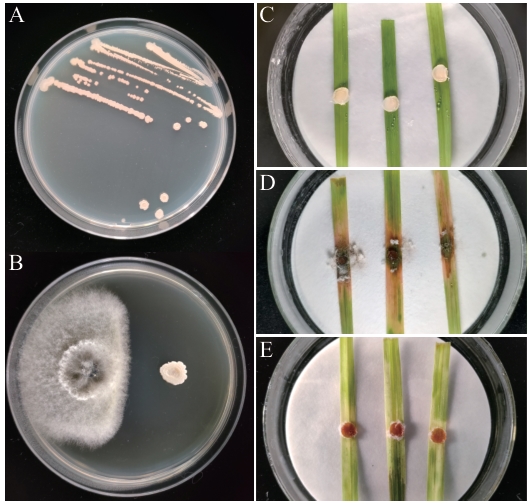
图1 燕麦叶斑病生防细菌BY10分离筛选情况A:菌株BY10纯培养;B:菌株BY10对燕麦内脐孺孢菌的拮抗作用;C,D,E:离体叶片防治效果,分别为对照组、病原菌处理组、病原菌与菌株BY10共同处理组
Fig. 1 Isolation and screening of biocontrol strain BY10 for oat leaf spotA: Pure culture of strain BY10. B: Antagonistic activity of strain BY10 against Drechslera avenae. C, D, E: Bioassay of protective efficacy against Drechslera avenae on detached leaves, showing the control group, pathogen‑inoculated group, and group co‑treated with the pathogen and strain BY10, respectively
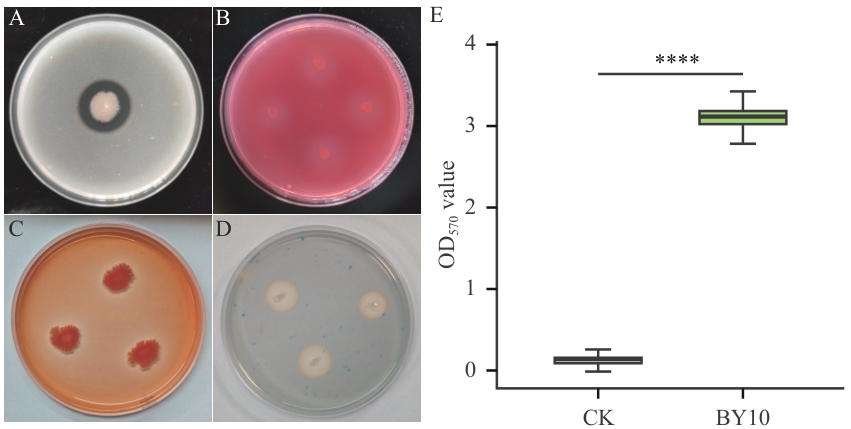
图2 菌株BY10的生防特性A:蛋白酶;B:纤维素酶;C:β-1,3-葡聚糖酶;D:产铁载体能力;E:生物膜形成能力
Fig. 2 Biocontrol characteristics of strain BY10A: Protease; B: cellulose; C: β-1,3-glucanase; D: siderophore production ability; E: biofilm-forming ability. ****P<0.0001
处理 Treatment | 株高 Plant height (cm) | 地上鲜重 Shoot fresh weight (g) | 地上干重 Shoot dry weight (g) | 地下鲜重 Root fresh weight (g) | 地下干重 Root dry weight (g) |
|---|---|---|---|---|---|
| CK | 25.50±1.20 b | 4.43±0.35 b | 1.02±0.08 b | 1.35±0.12 b | 0.31±0.03 b |
| BY10 | 31.90±1.50 a | 5.31±0.42 a | 1.38±0.11 a | 2.03±0.18 a | 0.44±0.04 a |
表2 菌株BY10对燕麦幼苗生长指标及生物量的影响
Table 2 Effects of BY10 on growth indices and biomass of oat seedlings
处理 Treatment | 株高 Plant height (cm) | 地上鲜重 Shoot fresh weight (g) | 地上干重 Shoot dry weight (g) | 地下鲜重 Root fresh weight (g) | 地下干重 Root dry weight (g) |
|---|---|---|---|---|---|
| CK | 25.50±1.20 b | 4.43±0.35 b | 1.02±0.08 b | 1.35±0.12 b | 0.31±0.03 b |
| BY10 | 31.90±1.50 a | 5.31±0.42 a | 1.38±0.11 a | 2.03±0.18 a | 0.44±0.04 a |
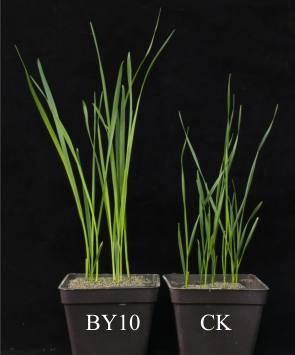
图3 菌株BY10的促生作用
Fig. 3 Plant growth-promoting effect of strain BY10
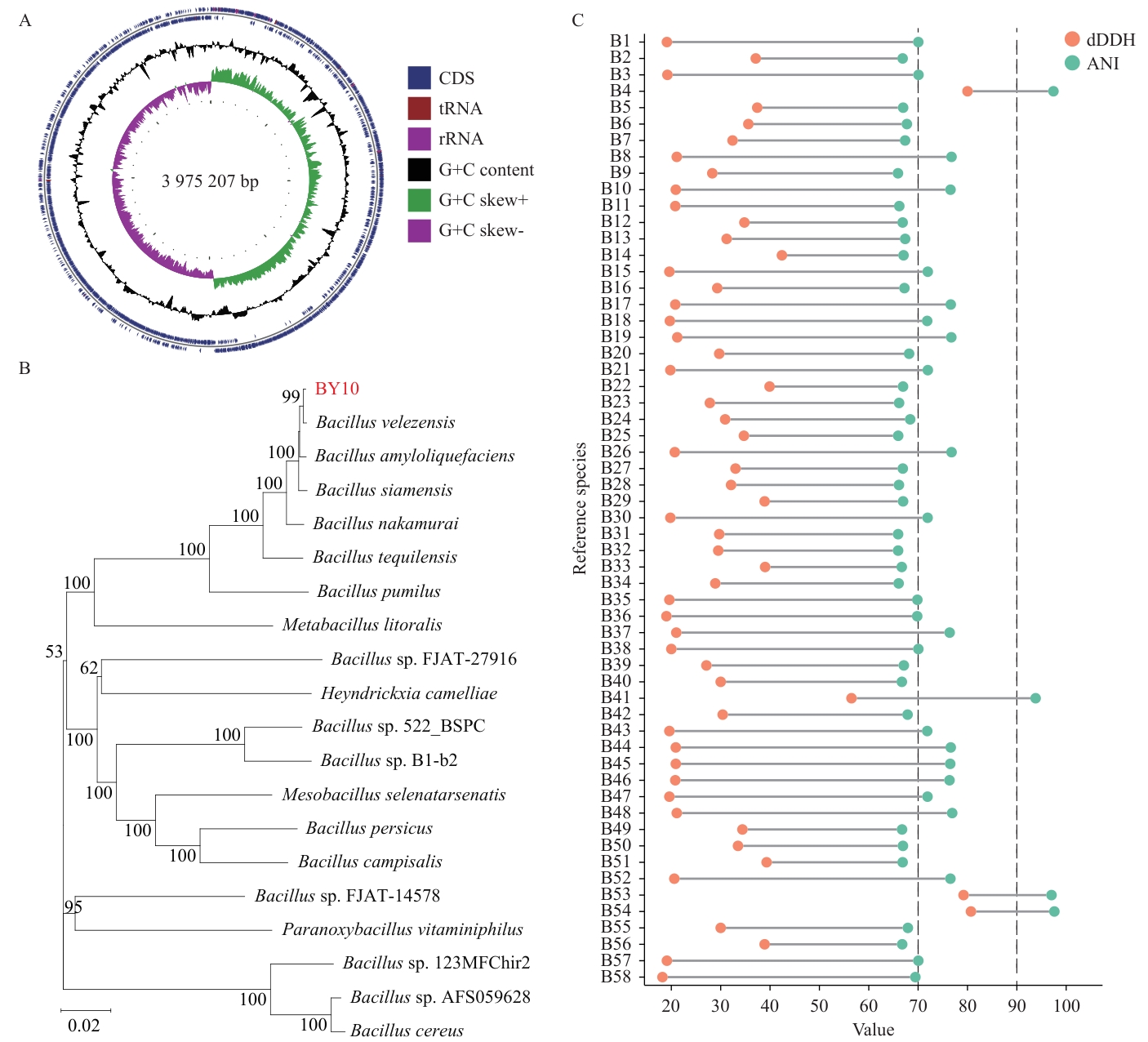
图4 菌株BY10的基因组序列及分类地位鉴定A:基因组圈图,从外到内第一圈和第二圈分别为正链、负链上的CDS、tRNA、rRNA,第三圈为G+C含量,第四圈为G+C Skew值,最内一圈为基因组大小标识;B:系统发育树;C:ANI和dDDH分析
Fig. 4 Genome sequencing of strain BY10 combined with its taxonomic classificationA: Genome circle map, from outer to inner, circles 1 and 2 display CDS, tRNA, and rRNA on the positive strand and negative strand, respectively; circle 3 indicates G+C content, circle 4 shows G+C skew, and the innermost circle marks the genome size scale; B: phylogenetic tree; C: ANI and dDDH analysis
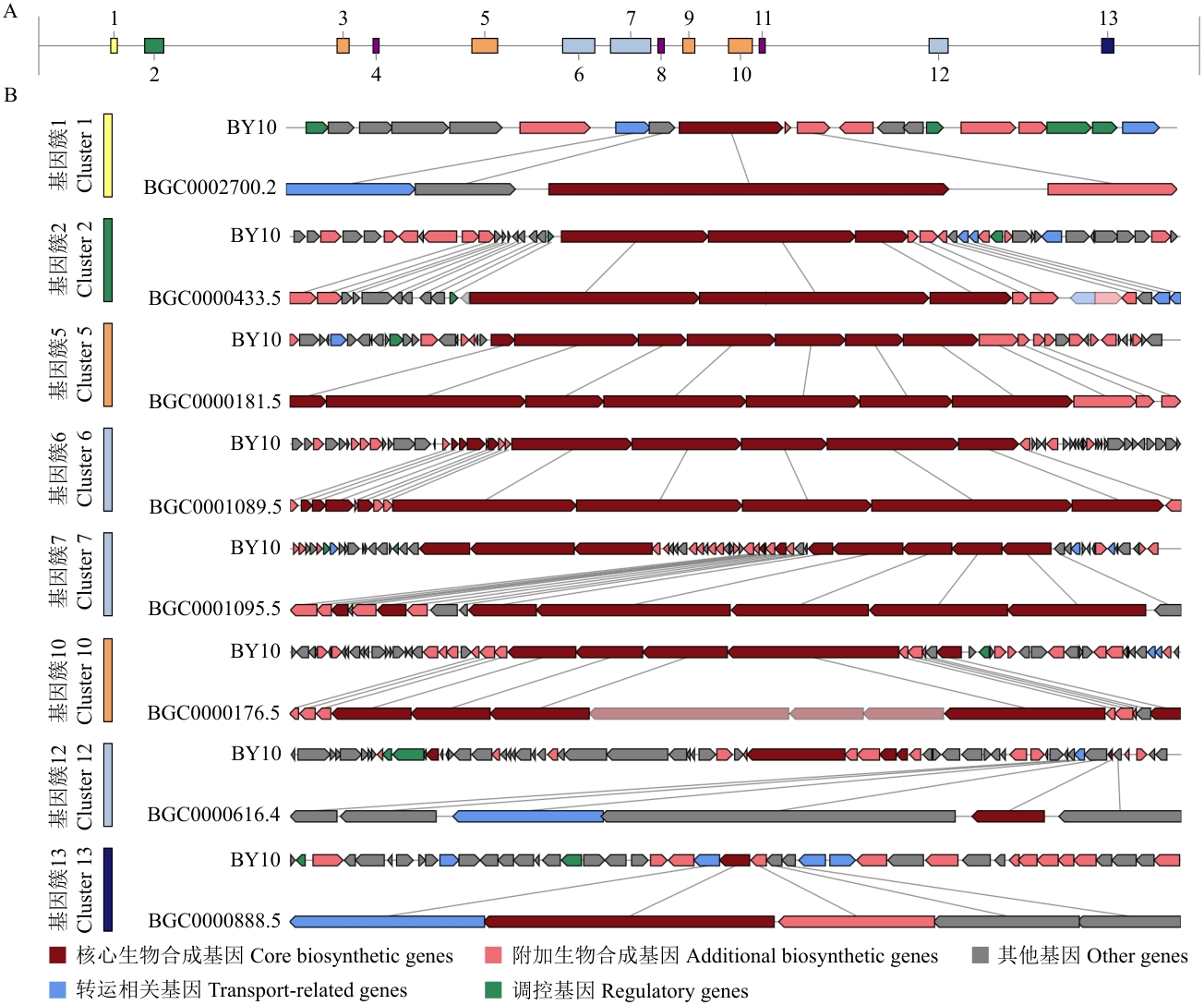
图5 菌株BY10次生代谢产物生物合成基因簇示意图A:菌株BY10次生代谢产物生物合成基因簇在基因组中的位置;B:菌株BY10与已知化合物生物合成基因簇的共线性分析
Fig. 5 Schematic diagram of the biosynthetic gene cluster for secondary metabolites in strain BY10A: Genomic localization of secondary metabolite biosynthetic gene clusters (BGCs) in strain BY10. B: Synteny analysis of the biosynthetic gene cluster in strain BY10 with known compound BGCs
基因簇 Gene cluster | 类型 Type | 起始位点 Initiation site (nt) | 结束位点 Termination site (nt) | 最相似基因簇 The most similar gene cluster | 相似性得分 Similarity score |
|---|---|---|---|---|---|
| Cluster 1 | Ribosomal | 246 443 | 269 058 | Bacinapeptin | 0.82 |
| Cluster 2 | NRPS | 362 691 | 428 098 | Surfactin | 0.83 |
| Cluster 3 | PKS | 1 021 655 | 1 062 899 | - | 0.55 |
| Cluster 4 | Terpene | 1 144 839 | 1 165 579 | - | 0.49 |
| Cluster 5 | TransAT-PKS | 1 483 252 | 1 571 473 | Macrolactin H | 0.93 |
| Cluster 6 | NRPS, PKS | 1 794 101 | 1 904 221 | Bacillaene | 0.93 |
| Cluster 7 | NRPS | 1 958 088 | 2 095 930 | Fengycin | 0.94 |
| Cluster 8 | Terpene | 2 120 316 | 2 142 199 | - | 0.47 |
| Cluster 9 | T3PKS | 2 205 687 | 2 246 787 | - | 0.55 |
| Cluster 10 | TransAT-PKS | 2 362 237 | 2 443 728 | Difficidin | 0.73 |
| Cluster 11 | Terpene-precursor | 2 467 053 | 2 487 943 | - | 0.49 |
| Cluster 12 | Ribosomal | 3 048 910 | 3 114 270 | Amylocyclicin | 0.95 |
| Cluster 13 | Other | 3 640 013 | 3 681 431 | Bacilysin | 1.00 |
表3 菌株BY10次级代谢产物生物合成基因簇分析结果
Table 3 Analysis results of secondary metabolite biosynthetic gene clusters in strain BY10
基因簇 Gene cluster | 类型 Type | 起始位点 Initiation site (nt) | 结束位点 Termination site (nt) | 最相似基因簇 The most similar gene cluster | 相似性得分 Similarity score |
|---|---|---|---|---|---|
| Cluster 1 | Ribosomal | 246 443 | 269 058 | Bacinapeptin | 0.82 |
| Cluster 2 | NRPS | 362 691 | 428 098 | Surfactin | 0.83 |
| Cluster 3 | PKS | 1 021 655 | 1 062 899 | - | 0.55 |
| Cluster 4 | Terpene | 1 144 839 | 1 165 579 | - | 0.49 |
| Cluster 5 | TransAT-PKS | 1 483 252 | 1 571 473 | Macrolactin H | 0.93 |
| Cluster 6 | NRPS, PKS | 1 794 101 | 1 904 221 | Bacillaene | 0.93 |
| Cluster 7 | NRPS | 1 958 088 | 2 095 930 | Fengycin | 0.94 |
| Cluster 8 | Terpene | 2 120 316 | 2 142 199 | - | 0.47 |
| Cluster 9 | T3PKS | 2 205 687 | 2 246 787 | - | 0.55 |
| Cluster 10 | TransAT-PKS | 2 362 237 | 2 443 728 | Difficidin | 0.73 |
| Cluster 11 | Terpene-precursor | 2 467 053 | 2 487 943 | - | 0.49 |
| Cluster 12 | Ribosomal | 3 048 910 | 3 114 270 | Amylocyclicin | 0.95 |
| Cluster 13 | Other | 3 640 013 | 3 681 431 | Bacilysin | 1.00 |
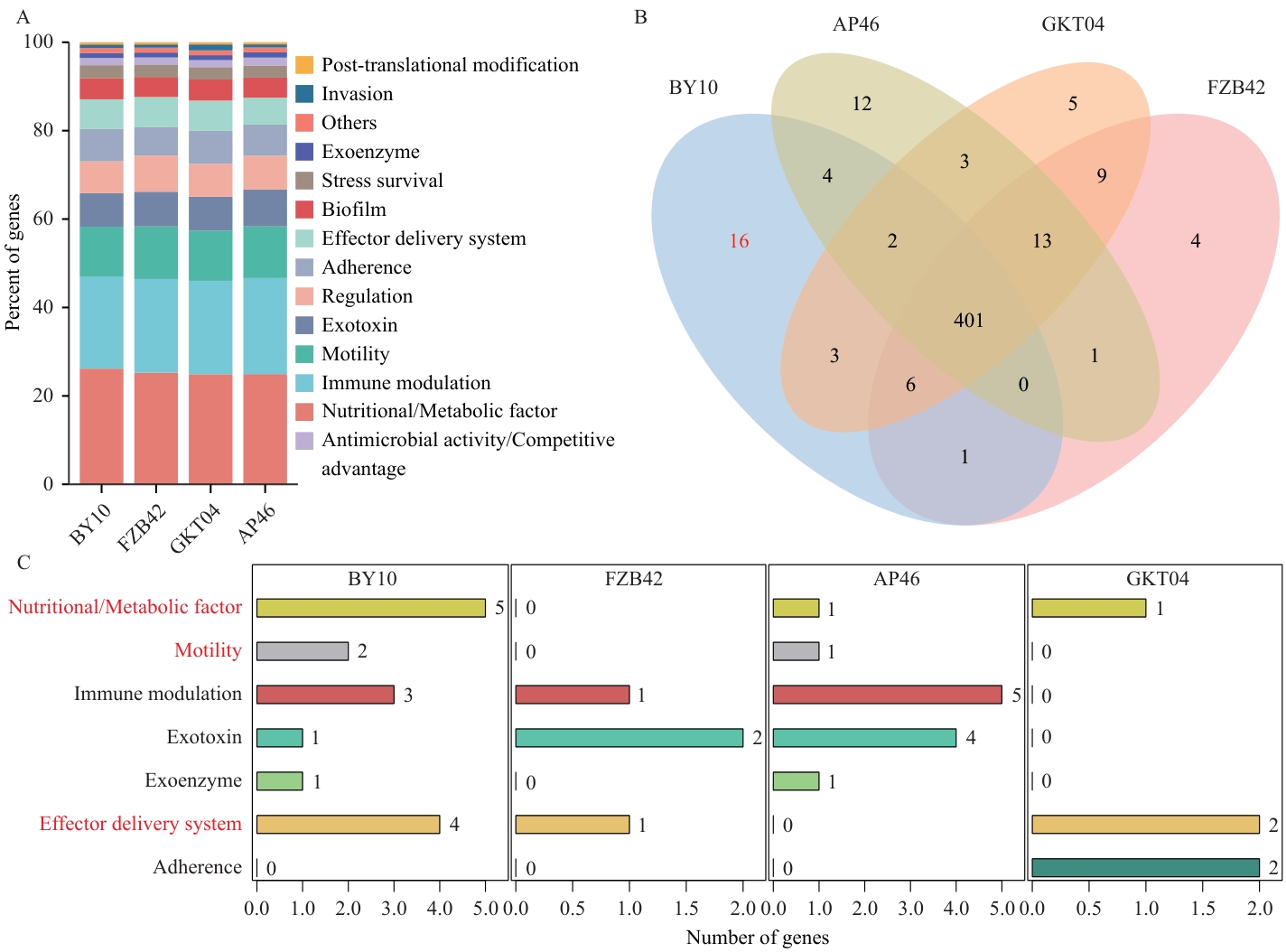
图6 BY10菌株及其近缘种生防因子比较分析A:菌株BY10及其近缘种中不同功能类别生防因子基因的注释占比;B:菌株BY10及其近缘种生防因子Venn分析;C:菌株BY10及其近缘种所特有的生防因子功能类别
Fig. 6 Comparative analysis of biocontrol agents in strain BY10 and its closely related speciesA: Annotated percentage of biocontrol agent genes in different functional categories in strain BY10 and its closely related species. B: Venn analysis of biocontrol agents in strain BY10 and its closely related species. C: Unique functional categories of biocontrol agents in strain BY10 and its closely related species
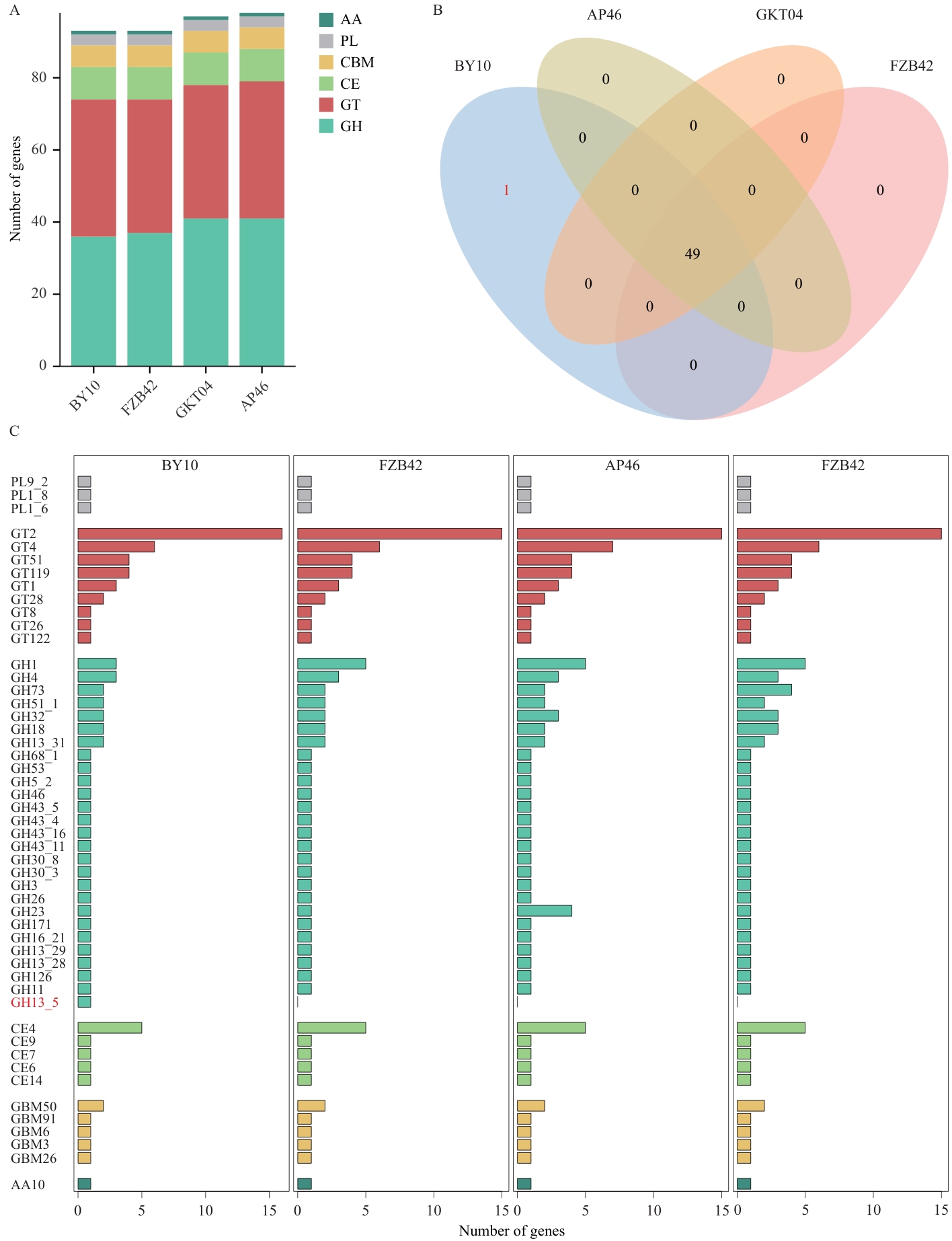
图7 BY10菌株及其近缘种CAZy比较分析A:菌株BY10及其近缘种中不同功能类别CAZy基因的注释数量;B:菌株BY10及其近缘种CAZy的Venn分析;C:菌株BY10及其近缘种CAZy注释分类统计图
Fig. 7 Comparative analysis of CAZy in BY10 strain and its closely related species.A: Number of annotated CAZy genes in different functional categories in strain BY10 and its closely related species. B: Venn analysis of CAZy in strain BY10 and its closely related species. C: Statistical chart of CAZy annotation categories for strain BY10 and its closely related species
| [1] | 周青平, 胡晓炜, 汪辉, 等. 燕麦在维护国家粮食安全中的重要作用 [J]. 草业学报, 2024, 33(10): 171-182. |
| Zhou QP, Hu XW, Wang H, et al. The important role of oat in reinforcing the foundation of food security [J]. Acta Prataculturae Sin, 2024, 33(10): 171-182. | |
| [2] | 马甲强. 饲用燕麦对内脐蠕孢菌侵染响应及抗病分子机理研究 [D]. 西宁: 青海大学, 2024. |
| Ma JQ. Study on the response of oat varieties to infection by Drechslera avenae and the molecular mechanism of disease resistance [D]. Xining: Qinghai University, 2024. | |
| [3] | 聂秀美, 赵桂琴, 孙浩洋, 等. 甘肃省燕麦主产区叶斑病调查及病原鉴定 [J]. 草业学报, 2020, 29(4): 157-167. |
| Nie XM, Zhao GQ, Sun HY, et al. Incidence of oat leaf spot and pathogen identification in the main oat production areas of Gansu Province [J]. Acta Prataculturae Sin, 2020, 29(4): 157-167. | |
| [4] | 张婷, 张金凤, 赵弋锐, 等. 不同杀菌剂对饲用燕麦炭疽病和叶斑病复合病害的田间防效评价 [J]. 草地学报, 2024, 32(11): 3619-3627. |
| Zhang T, Zhang JF, Zhao YR, et al. Evaluation of field control efficacies against anthracnose and leaf spot on oat [J]. Acta Agrestia Sin, 2024, 32(11): 3619-3627. | |
| [5] | 冶福春, 马文林, 杨晓龙. 枯草芽胞杆菌Qh-618对燕麦叶斑病防治效果研究 [J]. 中国生物防治学报, 2021, 37(4): 785-795. |
| Ye FC, Ma WL, Yang XL. Control effect of Bacillus subtilis qh-618 on oat leaf spot [J]. Chin J Biol Control, 2021, 37(4): 785-795. | |
| [6] | 王海霞. 燕麦内生细菌的分离鉴定及其功能研究 [D]. 呼和浩特: 内蒙古农业大学, 2022. |
| Wang HX. Isolation, identification and functional study of endophytic bacteria in oat [D]. Hohhot: Inner Mongolia Agricultural University, 2022. | |
| [7] | 张睿芳, 赵桂琴, 曾亮, 等. 不同生防药剂对燕麦叶斑病的防治效果 [J]. 草业科学, 2022, 39(11): 2393-2402. |
| Zhang RF, Zhao GQ, Zeng L, et al. A study on the effectiveness of bio-medicaments in controlling oat leaf spot [J]. Pratacultural Sci, 2022, 39(11): 2393-2402. | |
| [8] | 朱攀, 薛文凯, 李小燕, 等. 青藏高原垫状点地梅叶际及内生可培养微生物多样性 [J]. 微生物学通报, 2023, 50(1): 13-34. |
| Zhu P, Xue WK, Li XY, et al. Diversity of phyllospheric and endophytic culturable microorganisms in Androsace tapete of the Qinghai-Tibetan Plateau [J]. Microbiol China, 2023, 50(1): 13-34. | |
| [9] | 刘倩, 马连杰, 张慧, 等. 辣椒炭疽病生防菌株TN2的筛选鉴定与抑菌效果 [J]. 生物技术通报, 2025, 41(1): 287-297. |
| Liu Q, Ma LJ, Zhang H, et al. Screening, identification and control effects of biocontrol strain TN2 against pepper anthracnose [J]. Biotechnol Bull, 2025, 41(1): 287-297. | |
| [10] | 徐文, 谢夏, 李盼, 等. 贝莱斯芽胞杆菌YB-1465生防特性分析及对小麦茎基腐病的生防作用 [J]. 中国生物防治学报, 2025, 41(4): 877-886. |
| Xu W, Xie X, Li P, et al. Biocontrol Characteristics of Bacillus velezensis YB-1465 and its biocontrol effects on wheat crown rot [J]. Chin J Biol Control, 2025, 41(4): 877-886. | |
| [11] | D'Ercole S, De Angelis F, Biferi V, et al. Antibacterial and antibiofilm properties of three resin-based dental composites against Streptococcus mutans [J]. Materials, 2022, 15(5): 1891. |
| [12] | Richter M, Rosselló-Móra R. Shifting the genomic gold standard for the prokaryotic species definition [J]. Proc Natl Acad Sci U S A, 2009, 106(45): 19126-19131. |
| [13] | Auch AF, von Jan M, Klenk HP, et al. Digital DNA-DNA hybridization for microbial species delineation by means of genome-to-genome sequence comparison [J]. Stand Genomic Sci, 2010, 2(1): 117-134. |
| [14] | Zhou SY, Liu B, Zheng DD, et al. VFDB 2025: an integrated resource for exploring anti-virulence compounds [J]. Nucleic Acids Res, 2025, 53(D1): D871-D877. |
| [15] | Zheng JF, Ge QW, Yan YC, et al. dbCAN3: automated carbohydrate-active enzyme and substrate annotation [J]. Nucleic Acids Res, 2023, 51(W1): W115-W121. |
| [16] | Soni R, Keharia H. Phytostimulation and biocontrol potential of Gram-positive endospore-forming Bacilli [J]. Planta, 2021, 254(3): 49. |
| [17] | 喻星宇, 付菲, 林剑浩, 等. 水稻细菌性叶枯病病原菌鉴定、耐药性测定及生防菌防效评估 [J]. 华南农业大学学报, 2025, 46(6): 883-894. |
| Yu XY, Fu F, Lin JH, et al. Pathogen identification, bactericide-resistance determination, and control efficacy evaluation of the biocontrol bacteria for rice bacterial leaf wilt [J]. J South China Agric Univ, 2025, 46(6): 883-894. | |
| [18] | 禄蓉, 张秀, 田光祥, 等. 三七叶际微生物的分离鉴定及生防功能研究 [J]. 南方农业学报, 2024, 55(4): 1035-1045. |
| Lu R, Zhang X, Tian GX, et al. Isolation and identification of phyllosphere microbiome of Panax notoginseng (Burk.) F. H. Chen and its biocontrol functions [J]. J South Agric, 2024, 55(4): 1035-1045. | |
| [19] | Khan AR, Mustafa A, Hyder S, et al. Bacillus spp. as bioagents: uses and application for sustainable agriculture [J]. Biology, 2022, 11(12): 1763. |
| [20] | Lim SM, Yoon MY, Choi GJ, et al. Diffusible and volatile antifungal compounds produced by an antagonistic Bacillus velezensis G341 against various phytopathogenic fungi [J]. Plant Pathol J, 2017, 33(5): 488-498. |
| [21] | Wu GW, Liu YP, Xu Y, et al. Exploring elicitors of the beneficial rhizobacterium Bacillus amyloliquefaciens SQR9 to induce plant systemic resistance and their interactions with plant signaling pathways [J]. Mol Plant Microbe Inter, 2018, 31(5): 560-567. |
| [22] | Rahman A, Uddin W, Wenner NG. Induced systemic resistance responses in perennial ryegrass against Magnaporthe oryzae elicited by semi-purified surfactin lipopeptides and live cells of Bacillus amyloliquefaciens [J]. Mol Plant Pathol, 2015, 16(6): 546-558. |
| [23] | Gu Q, Yang Y, Yuan QM, et al. Bacillomycin D produced by Bacillus amyloliquefaciens is involved in the antagonistic interaction with the plant-pathogenic fungus Fusarium graminearum [J]. Appl Environ Microbiol, 2017, 83(19): e01075-e01017. |
| [24] | Rabbee MF, Ali MS, Choi J, et al. Bacillus velezensis: a valuable member of bioactive molecules within plant microbiomes [J]. Molecules, 2019, 24(6): 1046. |
| [25] | 娄向弟, 周强, 贺江, 等. 贝莱斯芽胞杆菌PJP10的抑菌物质稳定性及活性代谢产物挖掘 [J]. 微生物学通报, 2024, 51(3): 935-949. |
| Lou XD, Zhou Q, He J, et al. Stability evaluation and genome mining of antimicrobial metabolites of Bacillus velezensis PJP10 [J]. Microbiol China, 2024, 51(3): 935-949. | |
| [26] | 谢海鹏, 林樱桃, 吴小燕, 等. 豇豆枯萎病生防细菌的筛选鉴定及抗病机理初探 [J]. 热带作物学报, 2023, 44(6): 1224-1236. |
| Xie HP, Lin YT, Wu XY, et al. Screening and identification of biocontrol bacteria of cowpea fusa-rium wilt and preliminary exploration of disease resistance mecha-nism [J]. Chin J Trop Crops, 2023, 44(6): 1224-1236. | |
| [27] | Jiang CH, Liao MJ, Wang HK, et al. Bacillus velezensis, a potential and efficient biocontrol agent in control of pepper gray mold caused by Botrytis cinerea [J]. Biol Control, 2018, 126: 147-157. |
| [28] | Wu LM, Wu HJ, Chen LN, et al. Bacilysin from Bacillus amyloliquefaciens FZB42 has specific bactericidal activity against harmful algal bloom species [J]. Appl Environ Microbiol, 2014, 80(24): 7512-7520. |
| [29] | Dimkić I, Janakiev T, Petrović M, et al. Plant-associated Bacillus and Pseudomonas antimicrobial activities in plant disease suppression via biological control mechanisms - A review [J]. Physiol Mol Plant Pathol, 2022, 117: 101754. |
| [30] | 范田田, 王傲雪, 刘禹彤, 等. 芽胞杆菌抗菌物质研究进展 [J]. 生物工程学报, 2025, 41(10): 3667-3682. |
| Fan TT, Wang AX, Liu YT, et al. Advances in the antimicrobial substances in Bacillus [J]. Chin J Biotechnol, 2025, 41(10): 3667-3682. | |
| [31] | 王麒, 许婧霞, 张亚妮, 等. 贝莱斯芽胞杆菌(Bacillus velezensis)JJYY防控土传病害效果评价及其全基因组测序分析和抗菌成分鉴定 [J]. 微生物学通报, 2024, 51(1): 155-171. |
| Wang Q, Xu JX, Zhang YN, et al. Bacillus velezensis JJYY against soil-borne diseases: biocontrol effect, whole genome sequencing, and antimicrobial components [J]. Microbiol China, 2024, 51(1): 155-171. | |
| [32] | Scholz R, Vater J, Budiharjo A, et al. Amylocyclicin, a novel circular bacteriocin produced by Bacillus amyloliquefaciens FZB42 [J]. J Bacteriol, 2014, 196(10): 1842-1852. |
| [33] | Xue D, Older EA, Zhong Z, et al. Correlational networking guides the discovery of unclustered lanthipeptide protease-encoding genes [J]. Nat Commun, 2022, 13: 1647. |
| [34] | Wang JK, Wang WJ, Liang YQ, et al. Characteristics of a novel probiotic of Bacillus velezensis isolated in Xinjiang [J]. Anim Dis, 2025, 5: 36. |
| [35] | Cheng C, Su SF, Bo SL, et al. A Bacillus velezensis strain isolated from oats with disease-preventing and growth-promoting properties [J]. Sci Rep, 2024, 14: 12950. |
| [36] | Yang XM, Zhang F, Wang JY, et al. Characterization of Bacillus velezensis YTQ3 as a potential biocontrol agent against Botrytis cinerea [J]. Postharvest Biol Technol, 2025, 223: 113443. |
| [37] | Liu CW, Wang TC, Zhang YX, et al. Biocontrol effect and antibacterial mechanism of Bacillus velezensis TRMB57782 against Alternaria gaisen blotch in Korla pears [J]. Biology, 2025, 14(7): 793. |
| [38] | Jacobs JL, Carroll TL, Sundin GW. The role of pigmentation, ultraviolet radiation tolerance, and leaf colonization strategies in the epiphytic survival of phyllosphere bacteria [J]. Microb Ecol, 2005, 49(1): 104-113. |
| [39] | Fessia A, Barra P, Barros G, et al. Could Bacillus biofilms enhance the effectivity of biocontrol strategies in the phyllosphere? [J]. J Appl Microbiol, 2022, 133(4): 2148-2166. |
| [40] | Wu CH, Krasileva KV, Banfield MJ, et al. The “sensor domains” of plant NLR proteins: more than decoys? [J]. Front Plant Sci, 2015, 6: 134. |
| [41] | 彭钿钿, 马云龙, 许沛冬, 等. 芽胞杆菌防治植物病害作用机制与应用 [J]. 生物技术通报, 2025, 41(8): 42-52. |
| Peng TT, Ma YL, Xu PD, et al. Mechanisms and applications of Bacillus in controlling plant diseases [J]. Biotechnol Bull, 2025, 41(8): 42-52. | |
| [42] | Li PD, Zhu ZR, Zhang YZ, et al. The phyllosphere microbiome shifts toward combating melanose pathogen [J]. Microbiome, 2022, 10: 56. |
| [43] | Thapa S, Prasanna R, Ranjan K, et al. Nutrients and host attributes modulate the abundance and functional traits of phyllosphere microbiome in rice [J]. Microbiol Res, 2017, 204: 55-64. |
| [44] | 申云鑫, 施竹凤, 周旭东, 等. 三株具生防功能芽胞杆菌的分离鉴定及其生物活性研究 [J]. 生物技术通报, 2023, 39(3): 267-277. |
| Shen YX, Shi ZF, Zhou XD, et al. Isolation, identification and bio-activity of three Bacillus strains with biocontrol function [J]. Biotechnol Bull, 2023, 39(3): 267-277. | |
| [45] | Xi SX, Ban XF, Kong HC, et al. Conserved residues at the family and subfamily levels determine enzyme activity and substrate binding in glycoside hydrolase family 13 [J]. Int J Biol Macromol, 2023, 253: 126980. |
| [1] | 迪丽拜尔·吐尔逊, 祖丽胡玛尔·亚库普, 包慧芳, 詹发强, 杨蓉, 史应武, 杨红梅, 楚敏, 房世杰, 王宁. 番茄根际放线菌GNLJ-7菌株的生物功能及全基因组分析[J]. 生物技术通报, 2026, 42(8): 276-286. |
| [2] | 邱宇洁, 王茜, 曾琳, 侯虹吉, 苟玉梅, 邹兰, 黄晶. 枯草芽胞杆菌JY-7-2L对乌头根腐病的生防能力及其潜在作用机制解析[J]. 生物技术通报, 2026, 42(8): 298-311. |
| [3] | 苏艳艳, 左强, 宋志双, 穆琳英, 吕佳音, 肖自敏, 卢志军, 谢华. 贝莱斯芽胞杆菌BPC37的鉴定与防病促生效果分析[J]. 生物技术通报, 2026, 42(7): 269-279. |
| [4] | 朱志炎, 宋芷薇, 何珊, 张德清, 何勇, 田志宏. 烟草靶斑病拮抗菌的鉴定及其防治特性[J]. 生物技术通报, 2026, 42(4): 310-320. |
| [5] | 张蔓, 党静波, 蒋媛, 位杰, 邢杰, 王哲, 孙黎. 梨火疫病生防菌的筛选、鉴定及防效测定[J]. 生物技术通报, 2026, 42(1): 279-293. |
| [6] | 吕镇, 甘恬, 霍思羽, 赵晨笛, 赵梦瑶, 李亚涛, 马玉超, 耿玉清. 产Surfactin贝莱斯芽胞杆菌C5A-1的鉴定和所产Surfactin对植物的促生效果[J]. 生物技术通报, 2025, 41(9): 265-276. |
| [7] | 石艳华, 李朔, 高玉珠, 郑保坤, 朱杰华, 张岱, 杨志辉. 贝莱斯芽胞杆菌NZ-4挥发性有机物的促生作用及其活性成分分析[J]. 生物技术通报, 2025, 41(8): 300-310. |
| [8] | 张津浩, 邓辉, 张清壮, 陶禹, 周池, 李鑫. 贝莱斯芽胞杆菌XY40-1对百合球茎生长、品质及镉含量的调控作用[J]. 生物技术通报, 2025, 41(7): 281-291. |
| [9] | 贾雪, 隋丽, 邹晓威, 路杨, 张正坤, 李启云. 真菌病毒BbOCuV1对寄主球孢白僵菌生长发育和亚洲玉米螟致病力的影响[J]. 生物技术通报, 2025, 41(7): 312-325. |
| [10] | 叶柳健, 蒙健宗, 覃福方, 何双, 朱绮霞, 王小虎, 韦圣博, 周礼芹. 古茶树林菌株D2的鉴定、酶学特性及基因组学分析[J]. 生物技术通报, 2025, 41(5): 267-279. |
| [11] | 张吉昌, 许云凤, 蒋凌雁. 柱花草内生细菌ZW21发酵条件优化及其抑菌物质稳定性测定[J]. 生物技术通报, 2025, 41(5): 280-289. |
| [12] | 罗明凯, 张豪杰, 石晖琴, 李亚楠, 封瑞超, 沈硕. 三株马铃薯炭疽病生防菌的分离鉴定及其高抑菌活性培养物发酵参数优化[J]. 生物技术通报, 2025, 41(12): 313-327. |
| [13] | 吴琼, 陈德勇, 朱鹤, 王丹, 张晓军, 陈捷胤. 洋葱伯克霍尔德氏菌KRS634对棉花红腐病的生防效果[J]. 生物技术通报, 2025, 41(12): 294-303. |
| [14] | 苗昊翔, 张颖, 郭世鹏, 张健. 一株高产γ-氨基丁酸短乳杆菌TCCC13007全基因组测序及比较基因组分析[J]. 生物技术通报, 2025, 41(11): 166-176. |
| [15] | 胡衍铵, 代鑫吕, 钟娇艳, 李瑞民, 黄桂艳. 基于比较基因组学的柑橘耐黄龙病关键基因鉴定与功能解析[J]. 生物技术通报, 2025, 41(11): 282-292. |
| 阅读次数 | ||||||
|
全文 |
|
|||||
|
摘要 |
|
|||||
