







生物技术通报 ›› 2026, Vol. 42 ›› Issue (7): 292-303.doi: 10.13560/j.cnki.biotech.bull.1985.2026-0026
• 研究报告 • 上一篇
李博宇1, 蹇春晨1, 侯佳俊1, 钱明岩1, 杨文钦2, 章圣龙3, 藏传刚2, 马福开2, 郑龙2( ), 关宏1,2()
收稿日期:2026-01-08
出版日期:2026-07-26
发布日期:2026-07-20
通讯作者:
郑龙zhenglong@qmu.edu.cn基金资助:
LI Bo-yu1, JIAN Chun-chen1, HOU Jia-jun1, QIAN Ming-yan1, YANG Wen-qin2, ZHANG Sheng-long3, ZANG Chuan-gang2, MA Fu-kai2, ZHENG Long2(), GUAN Hong1,2()
Received:2026-01-08
Published:2026-07-26
Online:2026-07-20
摘要:
目的 为实现玉米秸秆可再生高效利用及其木质素增值化应用,探索玉米秸秆有效利用策略,挖掘具有抗氧化活性的木质素。 方法 采用固态发酵法高温传代培养,构建玉米秸秆降解的复合菌剂;采用16S rRNA高通量测序技术分析复合菌剂的稳定性及其微生物菌群的多样性;通过固态发酵(SSF)的发酵失重率测定和成分分析评价复合菌剂的玉米秸秆降解能力;采用碱提酸沉法提取SSF中的木质素(SSF-A);采用D101大孔吸附树脂柱层析和Sephadex G-50凝胶过滤柱层析对SSF-A进行分离纯化。 结果 以玉米秸秆为底物,通过高温传代驯化培养,获得耐高温复合菌剂QY12-A4。QY12-A4在属水平趋于稳定,优势菌属为野野村氏菌属(Nonomuraea)、热杆菌属(Thermobacillus)、热芽胞杆菌属(Caldibacillus)和科恩氏菌属(Cohnella)。QY12-A4的玉米秸秆固态发酵的发酵失重率为25.26%±1.49%(w/w)。SSF-A的提取率为12.56%±0.90%(w/w),SSF-A中总酚含量为18.94%±0.41%(w/w),ABTS阳离子自由基清除能力的IC50值为(158.00±4.24) μg/mL。SSF-A经柱层析分离,得到分子量分布依次减小的组分GL2-1、GL2-2和GL2-3。其中GL2-3的总酚含量最高,为19.65%±0.16%(w/w),在200-320 nm区域紫外线透射率<5.0%,抗氧化活性最大,即ABTS阳离子自由基清除能力IC50值为(90.50±3.54) μg/mL;总还原力IC50值为(1.38±0.02) mg/mL;相对氧自由基清除能力(ORAC)值为(3.14±0.03) mmol TE/g。 结论 复合菌剂QY12-A4可有效降解玉米秸秆木质纤维素,柱层析技术是一种获得高抗氧化活性的低分子量木质素类化合物的有效方法,为玉米秸秆木质素增值化应用提供有价值的参考。
李博宇, 蹇春晨, 侯佳俊, 钱明岩, 杨文钦, 章圣龙, 藏传刚, 马福开, 郑龙, 关宏. 复合菌剂QY12-A4对玉米秸秆的降解及其产物中抗氧化木质素的分离与纯化[J]. 生物技术通报, 2026, 42(7): 292-303.
LI Bo-yu, JIAN Chun-chen, HOU Jia-jun, QIAN Ming-yan, YANG Wen-qin, ZHANG Sheng-long, ZANG Chuan-gang, MA Fu-kai, ZHENG Long, GUAN Hong. Degradation of Corn Stover by Composite Microbial Consortia QY12-A4 and Purification of Antioxidant Lignin from Its Products[J]. Biotechnology Bulletin, 2026, 42(7): 292-303.
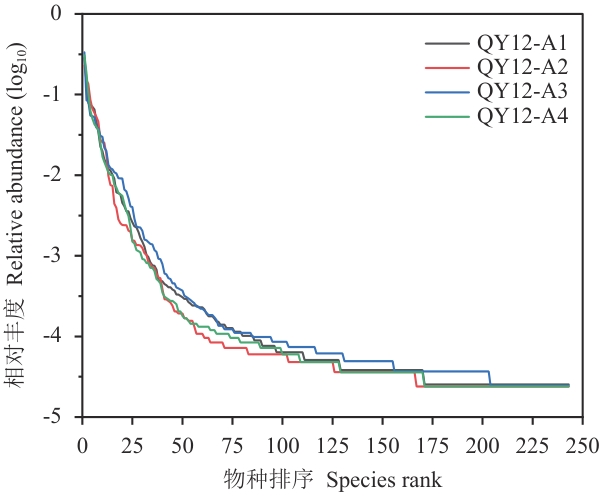
图1 OTU分类水平的Rank-abundance曲线
Fig. 1 Rank-abundance curves at the OTU level
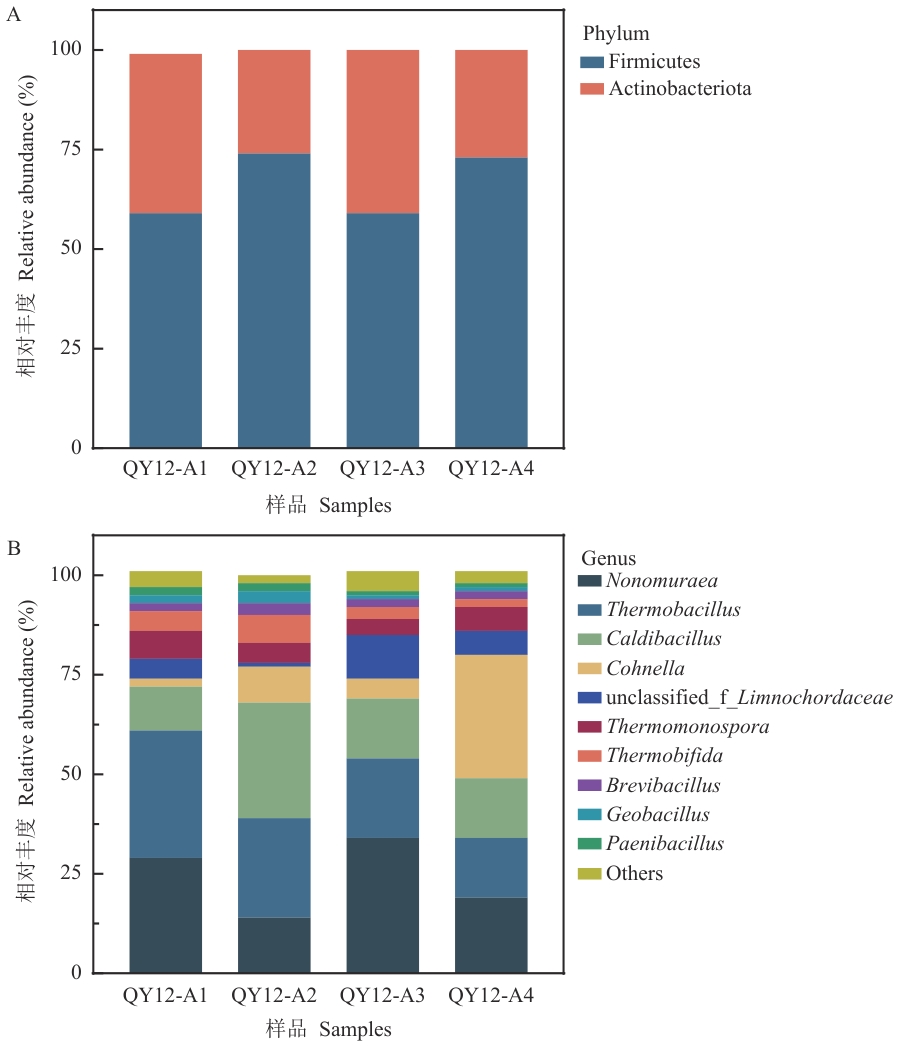
图2 驯化过程中微生物菌群分类学概况A:门水平物种相对丰度;B:属水平物种相对丰度
Fig. 2 Taxonomic overview of microbial communities during the domestication processA: Relative abundance of species at the phylum level. B: Relative abundance of species at the genus level
样品 Sample | 覆盖率 Good’s coverage (%) | 香农指数 Shannon index | 辛普森指数 Simpson index |
|---|---|---|---|
| QY12-A1 | 100 | 2.620 | 0.132 |
| QY12-A2 | 100 | 2.590 | 0.117 |
| QY12-A3 | 100 | 2.730 | 0.142 |
| QY12-A4 | 100 | 2.490 | 0.153 |
表1 种子培养物α多样性分析
Table 1 Analysis of the α-diversity of the microbial consortium
样品 Sample | 覆盖率 Good’s coverage (%) | 香农指数 Shannon index | 辛普森指数 Simpson index |
|---|---|---|---|
| QY12-A1 | 100 | 2.620 | 0.132 |
| QY12-A2 | 100 | 2.590 | 0.117 |
| QY12-A3 | 100 | 2.730 | 0.142 |
| QY12-A4 | 100 | 2.490 | 0.153 |
| 样品Sample | 提取率Extraction rate (%, w/w) | 木质素 Lignin (%, w/w) | 总酚 Total phenols (%,w/w) | 总糖 Total sugars (%,w/w) | 糖醛酸 Uronic acids (%,w/w) | ||
|---|---|---|---|---|---|---|---|
酸可溶木质素 Acid-soluble lignin | 酸不溶木质素 Acid-insoluble lignin | 总木质素Total lignin | |||||
| SSF-A | 12.56±0.90 | 0.68±0.02 | 76.21±1.83 | 76.89±1.81 | 18.94±0.41 | 15.09±0.20 | 2.32±0.08 |
表2 SSF-A成分分析
Table 2 Analysis of components in SSF-A
| 样品Sample | 提取率Extraction rate (%, w/w) | 木质素 Lignin (%, w/w) | 总酚 Total phenols (%,w/w) | 总糖 Total sugars (%,w/w) | 糖醛酸 Uronic acids (%,w/w) | ||
|---|---|---|---|---|---|---|---|
酸可溶木质素 Acid-soluble lignin | 酸不溶木质素 Acid-insoluble lignin | 总木质素Total lignin | |||||
| SSF-A | 12.56±0.90 | 0.68±0.02 | 76.21±1.83 | 76.89±1.81 | 18.94±0.41 | 15.09±0.20 | 2.32±0.08 |
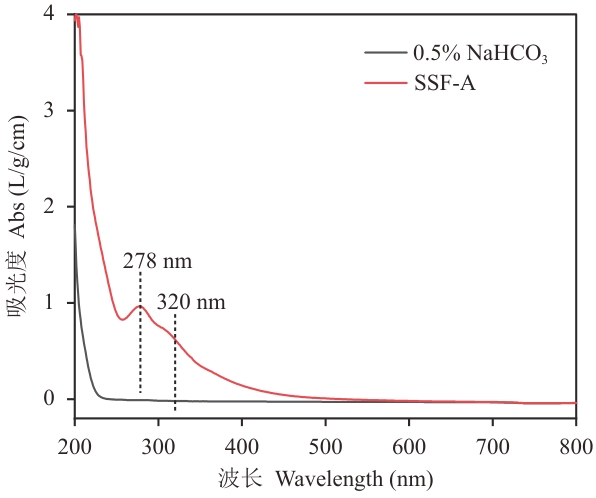
图3 SSF-A紫外可见光谱图
Fig. 3 UV-Vis spectra of SSF-A
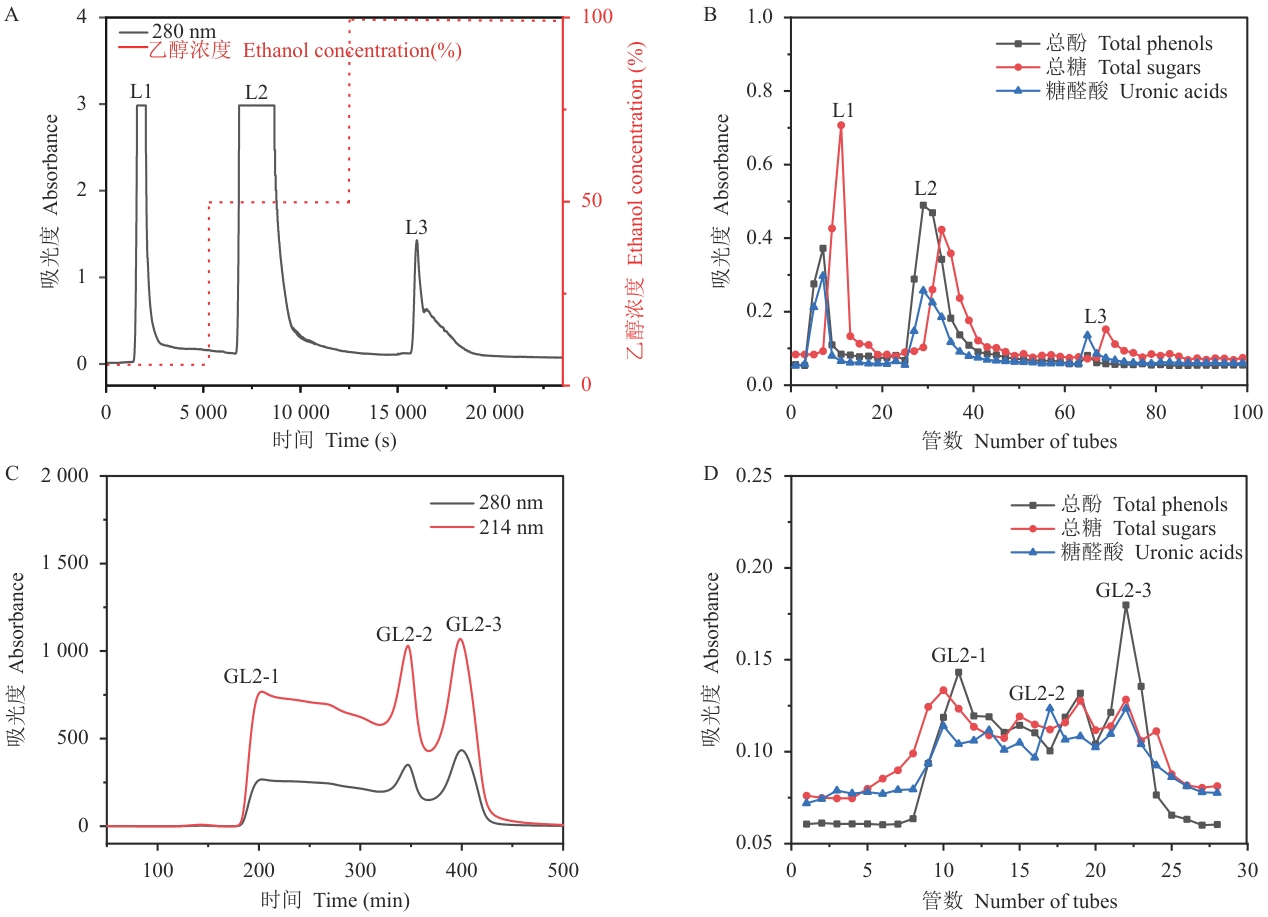
图4 SSF-A的分离纯化谱图A:D101大孔吸附树脂柱层析图谱;B:D101大孔吸附树脂柱层析中总酚、总糖及糖醛酸分布曲线;C:Sephadex G-50凝胶过滤柱层析图谱;D:Sephadex G-50凝胶过滤柱层析中酚类化合物、总糖和糖醛酸分布曲线
Fig. 4 Separation and purification profile of SSF-AA: Chromatogram profile of D101 macroporous resin column. B: Distribution curves of total phenols, total sugars, and uronic acids on D101 macroporous resin column. C: Chromatogram profile of Sephadex G-50 gel filtration column. D: Distribution curves of total phenols, total sugars, and uronic acids on Sephadex G-50 gel filtration
组分 Fraction | 总酚 Total phenols (%, w/w) | 总糖 Total sugars (%, w/w) | 糖醛酸 Uronic acids (%, w/w) |
|---|---|---|---|
| L1 | 10.30±0.86e | 19.30±1.10b | 3.56±0.21a |
| L2 | 17.37±0.18b | 15.09±0.20c | 2.07±0.22c |
| GL2-1 | 12.75±0.02d | 21.59±0.27a | 2.73±0.06b |
| GL2-2 | 15.85±0.51c | 14.63±0.81c | 1.47±0.30c |
| GL2-3 | 19.65±0.16a | 12.68±0.61d | 2.32±0.08d |
表3 SSF-A经分离后不同组分的成分分析
Table 3 Component analysis of fractions separated from SSF-A
组分 Fraction | 总酚 Total phenols (%, w/w) | 总糖 Total sugars (%, w/w) | 糖醛酸 Uronic acids (%, w/w) |
|---|---|---|---|
| L1 | 10.30±0.86e | 19.30±1.10b | 3.56±0.21a |
| L2 | 17.37±0.18b | 15.09±0.20c | 2.07±0.22c |
| GL2-1 | 12.75±0.02d | 21.59±0.27a | 2.73±0.06b |
| GL2-2 | 15.85±0.51c | 14.63±0.81c | 1.47±0.30c |
| GL2-3 | 19.65±0.16a | 12.68±0.61d | 2.32±0.08d |
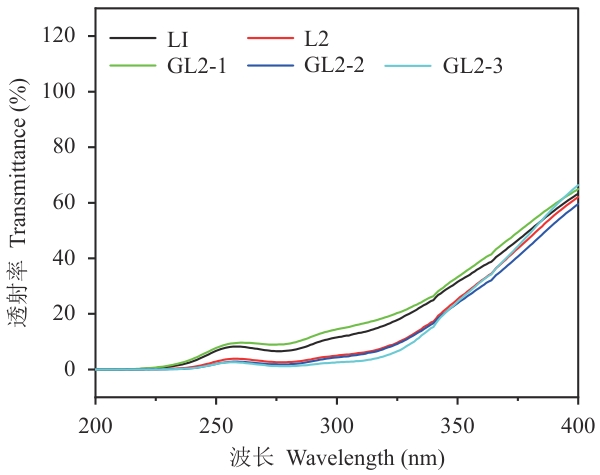
图5 SSF-A经分离后各个组分紫外线透射率光谱
Fig. 5 UV transmittance spectra of fractions separated from SSF-A
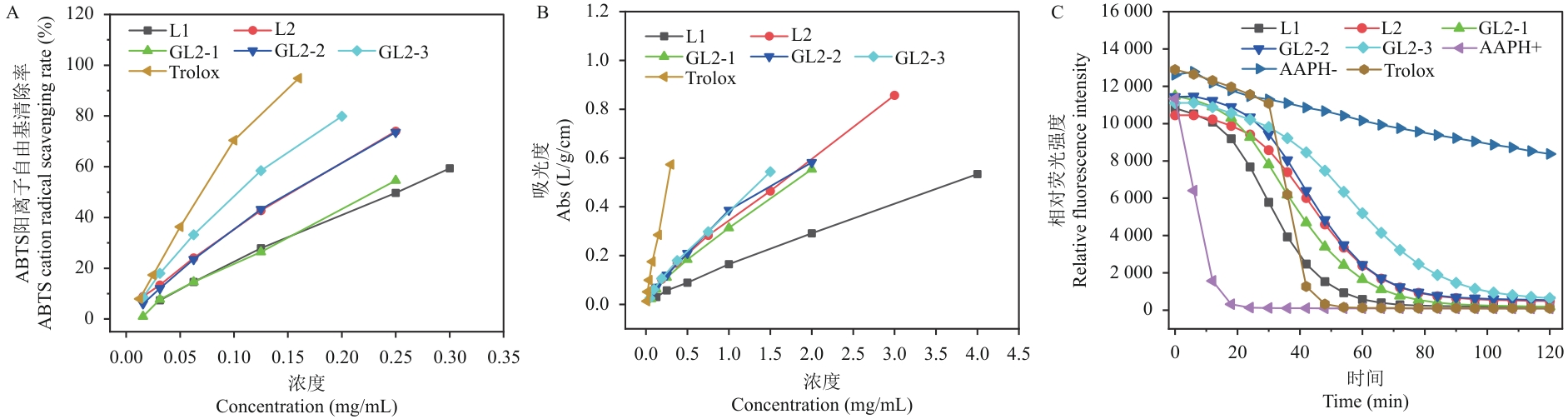
图6 SSF-A经分离后不同组分的抗氧化活性评价A:ABTS阳离子自由基清除率;B:总还原能力;C:荧光衰退曲线分析
Fig. 6 Evaluation of antioxidant activity in fractions separated from SSF-AA: ABTS⁺· radical scavenging rate. B: Total reducing capacity. C: Fluorescence decay curve analysis
组分 Fraction | ABTS ABTS (IC50 μg/mL) | 总还原力 Reducing power (mg/mL) | 相对ORAC值 Relative ORAC value (mmol TE/g) |
|---|---|---|---|
| L1 | 241.60±10.75a | 3.38±0.04a | 1.50±0.07d |
| L2 | 120.50±3.54c | 1.33±0.01d | 2.44±0.08c |
| GL2-1 | 218.00±11.31b | 2.65±0.07b | 1.95±0.07b |
| GL2-2 | 127.50±0.71c | 1.51±0.04c | 2.41±0.02b |
| GL2-3 | 90.50±3.54b | 1.38±0.02d | 3.14±0.03a |
| Trolox | 58.00±5.66e | 0.26±0.01e | - |
表4 SSF-A经分离后不同组分的抗氧化活性评价
Table 4 Evaluation of antioxidant activity of different fractions separated from SSF-A
组分 Fraction | ABTS ABTS (IC50 μg/mL) | 总还原力 Reducing power (mg/mL) | 相对ORAC值 Relative ORAC value (mmol TE/g) |
|---|---|---|---|
| L1 | 241.60±10.75a | 3.38±0.04a | 1.50±0.07d |
| L2 | 120.50±3.54c | 1.33±0.01d | 2.44±0.08c |
| GL2-1 | 218.00±11.31b | 2.65±0.07b | 1.95±0.07b |
| GL2-2 | 127.50±0.71c | 1.51±0.04c | 2.41±0.02b |
| GL2-3 | 90.50±3.54b | 1.38±0.02d | 3.14±0.03a |
| Trolox | 58.00±5.66e | 0.26±0.01e | - |
| [1] | Lizundia E, Armentano I, Luzi F, et al. Synergic effect of nanolignin and metal oxide nanoparticles into poly (l-lactide) bionanocomposites: material properties, antioxidant activity, and antibacterial performance [J]. ACS Appl Bio Mater, 2020, 3(8): 5263-5274. |
| [2] | Ragauskas AJ, Beckham GT, Biddy MJ, et al. Lignin valorization: improving lignin processing in the biorefinery [J]. Science, 2014, 344(6185): 1246843. |
| [3] | Zhu GZ, Ye DW, Chen XT, et al. Lignin-derived polyphenols with enhanced antioxidant activities by chemical demethylation and their structure-activity relationship [J]. Int J Biol Macromol, 2023, 237: 124030. |
| [4] | Nivedha M, Manisha M, Gopinath M, et al. Fractionation, characterization, and economic evaluation of alkali lignin from saw industry waste [J]. Bioresour Technol, 2021, 335: 125260. |
| [5] | Li KY, Zhong W, Li PH, et al. Recent advances in lignin antioxidant: Antioxidant mechanism, evaluation methods, influence factors and various applications [J]. Int J Biol Macromol, 2023, 251: 125992. |
| [6] | Mounguengui S, Saha Tchinda JB, Ndikontar MK, et al. Total phenolic and lignin contents, phytochemical screening, antioxidant and fungal inhibition properties of the heartwood extractives of ten Congo Basin tree species [J]. Ann For Sci, 2016, 73(2): 287-296. |
| [7] | Boarino A, Klok HA. Opportunities and challenges for lignin valorization in food packaging, antimicrobial, and agricultural applications [J]. Biomacromolecules, 2023, 24(3): 1065-1077. |
| [8] | Zhang Y, Naebe M. Lignin: a review on structure, properties, and applications as a light-colored UV absorber [J]. ACS Sustainable Chem Eng, 2021, 9(4): 1427-1442. |
| [9] | Barapatre A, Meena AS, Mekala S, et al. In vitro evaluation of antioxidant and cytotoxic activities of lignin fractions extracted from Acacia nilotica [J]. Int J Biol Macromol, 2016, 86: 443-453. |
| [10] | An LL, Wang GH, Jia HY, et al. Fractionation of enzymatic hydrolysis lignin by sequential extraction for enhancing antioxidant performance [J]. Int J Biol Macromol, 2017, 99: 674-681. |
| [11] | Costa CAE, Casimiro FM, Vega-Aguilar C, et al. Lignin valorization for added-value chemicals: kraft lignin versus lignin fractions [J]. ChemEngineering, 2023, 7(3): 42. |
| [12] | Chio C, Sain M, Qin WS. Lignin utilization: a review of lignin depolymerization from various aspects [J]. Renew Sustain Energy Rev, 2019, 107: 232-249. |
| [13] | Yao K, Wu QF, An R, et al. Hydrothermal pretreatment for deconstruction of plant cell wall: Part I. Effect on lignin-carbohydrate complex [J]. AlChE J, 2018, 64(6): 1938-1953. |
| [14] | Pang TR, Wang GH, Sun H, et al. Lignin fractionation: Effective strategy to reduce molecule weight dependent heterogeneity for upgraded lignin valorization [J]. Ind Crops Prod, 2021, 165: 113442. |
| [15] | 青格尔, 张必周, 王莉杰, 等. 玉米秸秆降解复配菌的构建及其协同效果评价 [J]. 玉米科学, 2024, 32(6): 46-54. |
| Qing GE, Zhang BZ, Wang LJ, et al. Construction and evaluation synergistic effect of corn straw degradation microbial compound [J]. J Maize Sci, 2024, 32(6): 46-54. | |
| [16] | 王新光, 田磊, 王恩泽, 等. 玉米秸秆高效降解微生物复合菌系的构建及降解效果评价 [J]. 生物技术通报, 2022, 38(4): 217-229. |
| Wang XG, Tian L, Wang EZ, et al. Construction of microbial consortium for efficient degradation of corn straw and evaluation of its degradation effect [J]. Biotechnol Bull, 2022, 38(4): 217-229. | |
| [17] | Gigli M, Crestini C. Fractionation of industrial lignins: opportunities and challenges [J]. Green Chem, 2020, 22(15): 4722-4746. |
| [18] | Yuan S, Li BY, Chang LY, et al. Characterization and antioxidant activity of differentiated fractionation lignin from corn stover [J]. Int J Biol Macromol, 2025, 303: 140538. |
| [19] | Zhang L, Peng WB, Wang F, et al. Fractionation and quantitative structural analysis of lignin from a lignocellulosic biorefinery process by gradient acid precipitation [J]. Fuel, 2022, 309: 122153. |
| [20] | Li YR, Zhao SY, Li YH, et al. Revealing the relationship between molecular weight of lignin and its color, UV-protecting property [J]. Int J Biol Macromol, 2022, 223: 1287-1296. |
| [21] | Crawford DL, Pometto AL III, Crawford RL. Lignin degradation by Streptomyces viridosporus: isolation and characterization of a new polymeric lignin degradation intermediate [J]. Appl Environ Microbiol, 1983, 45(3): 898-904. |
| [22] | Sluiter A, Hames B, Ruiz R, et al. Determination of structural carbohydrates and lignin in biomass, in: Laboratory Analytical Procedure (LAP) [R]. America 2008. |
| [23] | DuBois M, Gilles KA, Hamilton JK, et al. Colorimetric method for determination of sugars and related substances [J]. Anal Chem, 1956, 28(3): 350-356. |
| [24] | Bitter T, Muir HM. A modified uronic acid carbazole reaction [J]. Anal Biochem, 1962, 4(4): 330-334. |
| [25] | Masuko T, Minami A, Iwasaki N, et al. Carbohydrate analysis by a phenol-sulfuric acid method in microplate format [J]. Anal Biochem, 2005, 339(1): 69-72. |
| [26] | Cesaretti M, Luppi E, Maccari F, et al. A 96-well assay for uronic acid carbazole reaction [J]. Carbohydr Polym, 2003, 54(1): 59-61. |
| [27] | Magalhães LM, Santos F, Segundo MA, et al. Rapid microplate high-throughput methodology for assessment of Folin-Ciocalteu reducing capacity [J]. Talanta, 2010, 83(2): 441-447. |
| [28] | Guo H, Zang CG, Zheng L, et al. Novel antioxidant peptides from fermented whey protein by Lactobacillus rhamnosus B2-1: separation and identification by in vitro and in silico approaches [J]. J Agric Food Chem, 2024, 72(42): 23306-23319. |
| [29] | Chang CY, Wu KC, Chiang SH. Antioxidant properties and protein compositions of porcine haemoglobin hydrolysates [J]. Food Chem, 2007, 100(4): 1537-1543. |
| [30] | 周桐同, 郭皓, 欧艳曦, 等. 乳清蛋白源铜螯合肽抗氧化活性评价 [J]. 食品与发酵工业, 2022, 48(12): 220-225. |
| Zhou TT, Guo H, Ou YX, et al. Antioxidant activity of whey protein derived copper chelating peptide [J]. Food Ferment Ind, 2022, 48(12): 220-225. | |
| [31] | Yu CW, Reddy AP, Simmons CW, et al. Preservation of microbial communities enriched on lignocellulose under thermophilic and high-solid conditions [J]. Biotechnol Biofuels, 2015, 8: 206. |
| [32] | Fang XX, Li QM, Lin YQ, et al. Screening of a microbial consortium for selective degradation of lignin from tree trimmings [J]. Bioresour Technol, 2018, 254: 247-255. |
| [33] | Casciello C, Tonin F, Berini F, et al. A valuable peroxidase activity from the novel species Nonomuraea gerenzanensis growing on alkali lignin [J]. Biotechnol Rep, 2017, 13: 49-57. |
| [34] | Rakotoarivonina H, Revol PV, Aubry N, et al. The use of thermostable bacterial hemicellulases improves the conversion of lignocellulosic biomass to valuable molecules [J]. Appl Microbiol Biotechnol, 2016, 100(17): 7577-7590. |
| [35] | Fall I, Czerwiec Q, Abdellaoui S, et al. A thermostable bacterial catalase-peroxidase oxidizes phenolic compounds derived from lignins [J]. Appl Microbiol Biotechnol, 2023, 107(1): 201-217. |
| [36] | Lemos LN, Pereira RV, Quaggio RB, et al. Genome-centric analysis of a thermophilic and cellulolytic bacterial consortium derived from composting [J]. Front Microbiol, 2017, 8: 644. |
| [37] | Wushke S, Levin DB, Cicek N, et al. Facultative anaerobe Caldibacillus debilis GB1: characterization and use in a designed aerotolerant, cellulose-degrading coculture with Clostridium thermocellum [J]. Appl Environ Microbiol, 2015, 81(16): 5567-5573. |
| [38] | Arneodo JD, Etcheverry C, Thebe T, et al. Molecular evidence that cellulolytic bacterial genus Cohnella is widespread among Neotropical Nasutitermitinae from NE Argentina [J]. Rev Argent De Microbiol, 2019, 51(1): 77-80. |
| [39] | Gu JM, Qiu Q, Yu Y, et al. Bacterial transformation of lignin: key enzymes and high-value products [J]. Biotechnol Biofuels, 2024, 17: 2. |
| [40] | Yao WK, Cai DM, Huang FL, et al. Promoting lignin exploitability in compost: a cooperative microbial depolymerization mechanism [J]. Process Saf Environ Prot, 2023, 174: 856-868. |
| [41] | Vazquez-Olivo G, López-Martínez LX, Contreras-Angulo L, et al. Antioxidant capacity of lignin and phenolic compounds from corn stover [J]. Waste Biomass Valor, 2019, 10(1): 95-102. |
| [42] | Mensah M, Tia R, Adei E, et al. A DFT mechanistic study on base-catalyzed cleavage of the β-O-4 ether linkage in lignin: implications for selective lignin depolymerization [J]. Front Chem, 2022, 10: 793759. |
| [43] | Wang R, Wang GH, Xia Y, et al. Functionality study of lignin as a tyrosinase inhibitor: Influence of lignin heterogeneity on anti-tyrosinase activity [J]. Int J Biol Macromol, 2019, 128: 107-113. |
| [1] | 魏雨佳, 李岩, 康语涵, 弓晓楠, 杜敏, 涂岚, 石鹏, 于子涵, 孙彦, 张昆. 白颖苔草CrMYB4基因的克隆和表达分析[J]. 生物技术通报, 2025, 41(7): 248-260. |
| [2] | 任鑫茹, 赵宏璐, 李雅静, 刘荣军, 曾凡力, 王钦宏, 王震. 混菌低温发酵对玉米秸秆黄贮饲料品质的影响[J]. 生物技术通报, 2025, 41(3): 330-342. |
| [3] | 杨秉乾, 恽辰珂, 常思源, 郭盛, 张森. 丹参药渣木质素降解菌的分离及酶学特性[J]. 生物技术通报, 2024, 40(11): 269-276. |
| [4] | 张鑫, 邬柯奕, 祝嗣臣, 李玉, 李兰洲. 栽培条件对松杉灵芝多糖含量的影响及其抗氧化活性分析[J]. 生物技术通报, 2024, 40(11): 47-57. |
| [5] | 毛馨艺, 兰芸, 张准, 张叶卓, 金琪, 赵美棋, 曾子柽, 李晔. 木质素单体跨膜转运的技术研究进展[J]. 生物技术通报, 2024, 40(10): 198-207. |
| [6] | 王艺清, 王涛, 韦朝领, 戴浩民, 曹士先, 孙威江, 曾雯. 茶树SMAS基因家族的鉴定及互作分析[J]. 生物技术通报, 2023, 39(4): 246-258. |
| [7] | 姚晓文, 梁晓, 陈青, 伍春玲, 刘迎, 刘小强, 税军, 乔阳, 毛奕茗, 陈银华, 张银东. 二斑叶螨抗性木薯木质素合成途径基因表达特性研究[J]. 生物技术通报, 2023, 39(2): 161-171. |
| [8] | 赵佳, 赵飞燕, 沈馨, 高广琦, 孙志宏. 乳酸菌抗氧化活性及其应用研究进展[J]. 生物技术通报, 2023, 39(11): 182-190. |
| [9] | 王宇蕴, 赵兵, 马丽婷, 李兰, 邓亚琴, 徐智. 堆肥腐殖化过程及微生物驱动机制[J]. 生物技术通报, 2022, 38(5): 22-28. |
| [10] | 王新光, 田磊, 王恩泽, 钟成, 田春杰. 玉米秸秆高效降解微生物复合菌系的构建及降解效果评价[J]. 生物技术通报, 2022, 38(4): 217-229. |
| [11] | 韩东晶, 王志花, 周宁, 刘国庆, 杨少华, 汪文君. 白蚁菌圃中木质素降解菌的筛选及降解效果[J]. 生物技术通报, 2022, 38(3): 113-120. |
| [12] | 张倩, 徐春燕, 张铎, 王亚会, 梁新盈, 李慧. 黄褐土玉米秸秆腐解菌株筛选及其促腐能力研究[J]. 生物技术通报, 2022, 38(12): 233-243. |
| [13] | 孙淑芳, 骆永丽, 李春辉, 金敏, 胥倩. UPLC-MS/MS测定小麦茎秆木质素单体交联结构的方法[J]. 生物技术通报, 2022, 38(10): 66-72. |
| [14] | 王惠, 张顺斌, 金贺, 王晗, 张耕华, 夏诗宁, 陈井生, 段玉玺. 4-香豆酸辅酶A连接酶响应大豆孢囊线虫胁迫的潜在功能[J]. 生物技术通报, 2021, 37(7): 71-80. |
| [15] | 周静, 黄文茂, 秦利军, 韩丽珍. 四株PGPR菌株混菌发酵体系的构建及促生效应评价[J]. 生物技术通报, 2021, 37(4): 116-126. |
| 阅读次数 | ||||||
|
全文 |
|
|||||
|
摘要 |
|
|||||
