






生物技术通报 ›› 2026, Vol. 42 ›› Issue (11): 1-10.doi: 10.13560/j.cnki.biotech.bull.1985.2026-0194
• 综述与专论 • 下一篇
侯坤鹏1, 徐莉萍1, 王邢斌1, 张雨晴1, 王文强1, 霍子函1, 赵晨阳1, 徐硕1, 张智强2( ), 苟明月1()
收稿日期:2026-02-08
出版日期:2026-11-26
发布日期:2026-11-03
通讯作者:
张智强xiao_qiang8866@163.com基金资助:
HOU Kun-peng1, XU Li-ping1, WANG Xing-bin1, ZHANG Yu-qing1, WANG Wen-qiang1, HUO Zi-han1, ZHAO Chen-yang1, XU Shuo1, ZHANG Zhi-qiang2(), GOU Ming-yue1()
Received:2026-02-08
Published:2026-11-26
Online:2026-11-03
摘要:
水杨酸甲酯酶属于α/β水解酶超家族,在植物免疫中发挥重要作用。本文系统综述了水杨酸甲酯酶在植物抗病领域的研究进展。首先,阐述了水杨酸甲酯酶的发现和生化功能,分析了该酶在不同植物中的进化与抗病性的关系。其次,重点综述了水杨酸甲酯酶抵御病毒、真菌、细菌、原生生物和寄生生物多类病原体的抗病功能和机制,阐释了其在植物局部防御和系统获得性抗性的作用机制,总结了该酶在参与植物间气传性免疫中发挥的重要作用。进一步从转录水平调控和翻译后修饰两个层面,介绍了转录因子对水杨酸甲酯酶基因的表达调控,以及去乙酰化修饰对酶活性的影响。此外,本文基于现代生物信息学技术和测序技术的发展,探讨了水杨酸甲酯酶基因资源的挖掘策略,并展望了其在抗病育种中的潜在应用价值,提出其在目前研究中有待解决的问题。本文为深入理解水杨酸甲酯酶介导的植物免疫调控机制及其未来研究方向提供理论参考,并为植物抗病品种的选育提供理论支撑。
侯坤鹏, 徐莉萍, 王邢斌, 张雨晴, 王文强, 霍子函, 赵晨阳, 徐硕, 张智强, 苟明月. 水杨酸甲酯酶及其介导的植物抗病性研究进展[J]. 生物技术通报, 2026, 42(11): 1-10.
HOU Kun-peng, XU Li-ping, WANG Xing-bin, ZHANG Yu-qing, WANG Wen-qiang, HUO Zi-han, ZHAO Chen-yang, XU Shuo, ZHANG Zhi-qiang, GOU Ming-yue. Research Progress on Methyl Salicylate Esterase and Its Mediated Plant Disease Resistance[J]. Biotechnology Bulletin, 2026, 42(11): 1-10.
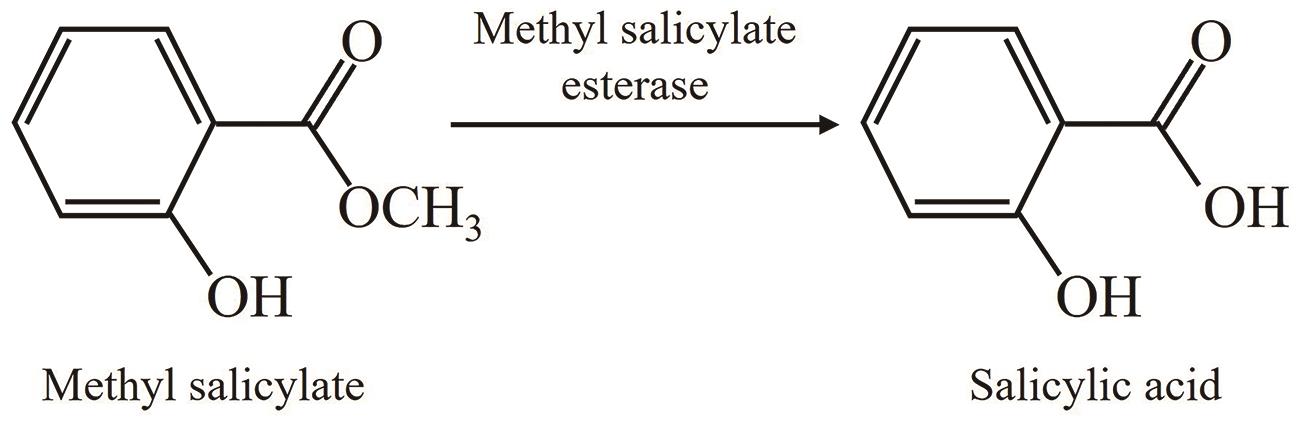
图1 水杨酸甲酯酶催化反应
Fig. 1 Methyl salicylate esterase-catalyzed reaction
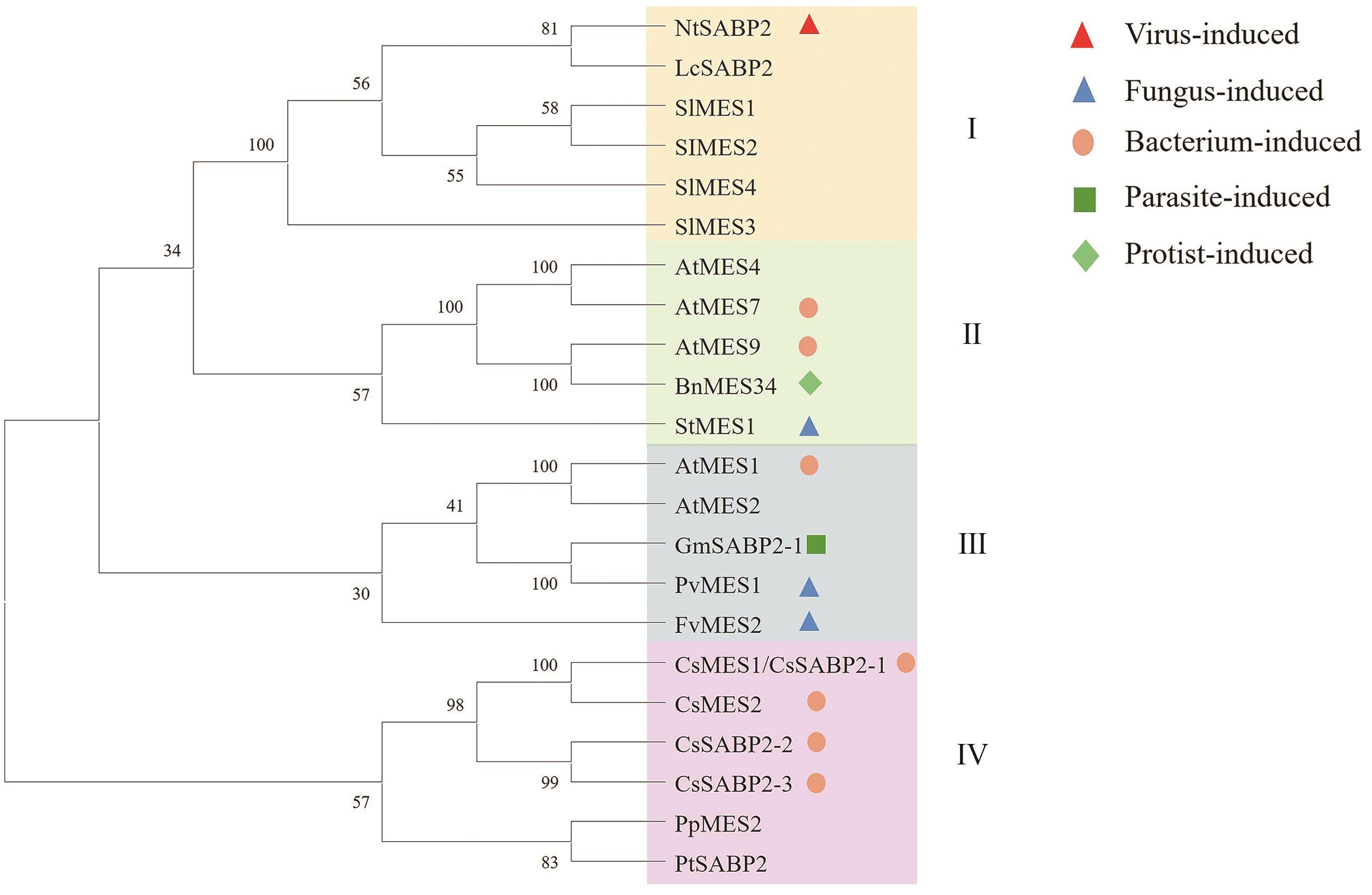
图2 已被研究报道具有水杨酸甲酯酶活性的水杨酸甲酯酶系统进化分析
Fig. 2 Phylogenetic analysis of the reported methyl salicylate esterase with methyl salicylate esterase activity
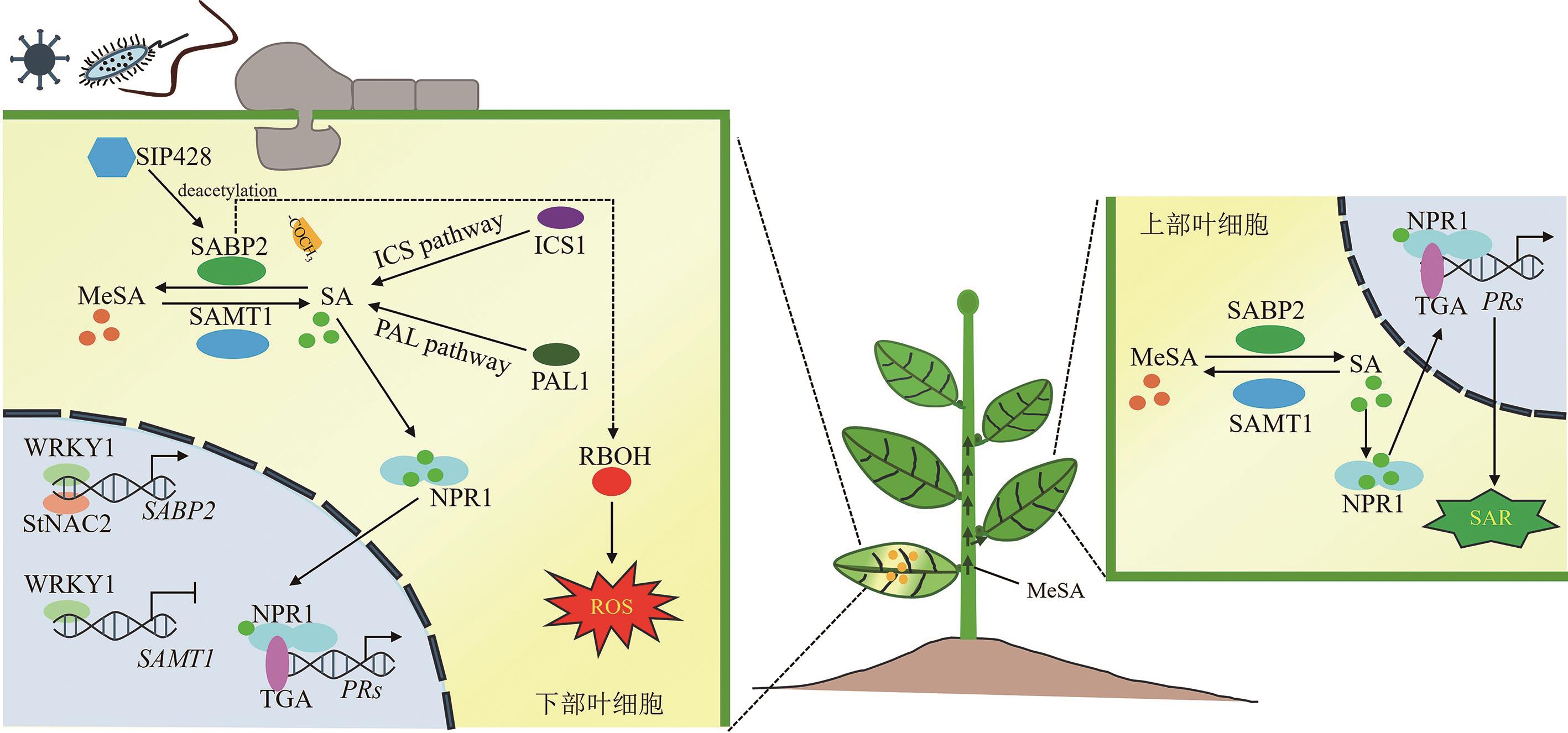
图3 水杨酸甲酯酶基因调节植物抗病性当病原物(真菌、细菌、病毒等)侵染植物下部叶片时,植物感知信号,激活SAMT1,将叶片中的SA转化为MeSA,SABP2受WRKY1和NAC2调控,同时SIP428对SABP2进行去乙酰化修饰,增强SABP2的水杨酸甲酯酶活性,促进MeSA向SA的转化,同时激活ICS途径和PAL途径,共同促进SA的积累,促进转录因子TGA与受体NPR1结合,激活PRs基因表达,且SABP2间接调控RBOH活性,刺激ROS爆发,使下部叶产生局部抗性,而WRKY1适当抑制SAMT1基因表达,调控MeSA和SA之间的动态平衡;当MeSA通过韧皮部运输至上部叶片时,随着上部叶片MeSA水平上升,SABP2被激活,重新将MeSA转化为SA,再次促进上部叶的转录因子TGA与NPR1结合,激活PRs基因表达,引发SAR。实线箭头表示直接调控,虚线箭头表示间接调控,T型线表示抑制作用
Fig. 3 Methyl salicylate esterase gene regulates plant disease resistanceWhen pathogens (such as fungi, bacteria, viruses, etc.) infect the lower leaves of a plant, the plant perceives the signal and activates SAMT1, which converts SA in the leaves into MeSA. SABP2 is regulated by WRKY1 and NAC2. Meanwhile, SIP428 deacetylates SABP2, enhancing its methyl salicylate esterase activity, which promotes the conversion of MeSA back to SA. This simultaneously activates the ICS pathway and the PAL pathway, collectively promoting the accumulation of SA. The accumulation of SA facilitates the binding of the transcription factor TGA with its receptor NPR1, activating the expression of PRs genes. Additionally, SABP2 indirectly regulates RBOH activity, stimulating the ROS, which induces local resistance in the lower leaves. Furthermore, WRKY1 moderately inhibits the expression of SAMT1 gene, thereby regulating the dynamic balance between MeSA and SA. When MeSA is transported to the upper leaves via the phloem, the increased MeSA level in the upper leaves activates SABP2, which reconverts MeSA into SA. This again promotes the binding of TGA with NPR1 in the upper leaves, activates the expression of PRs genes, and triggers SAR. Solid arrows indicate direct regulation, dashed arrows indicate indirect regulation, T-shaped lines indicate inhibition
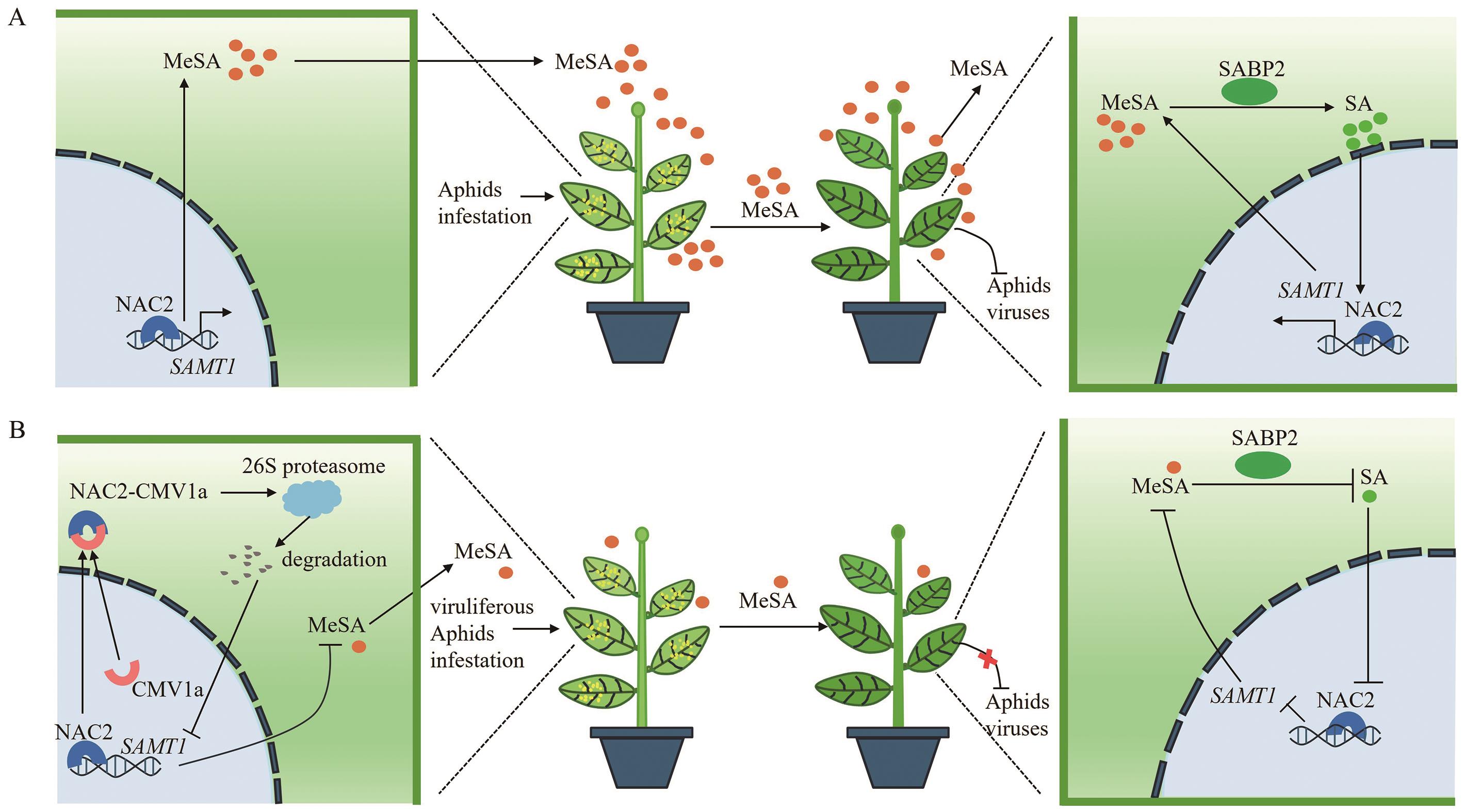
图4 水杨酸甲酯酶参与MeSA介导的植物气传性免疫A:当无病毒蚜虫侵染植物时,NAC2转录因子被激活,使SAMT1表达水平上升,激活SAMT1,强烈诱导MeSA的生成,随着MeSA大量释放到空气中,邻近植物捕获MeSA,激活SABP2,将MeSA转化为SA,激活NAC2-SAMT1模块,进一步促进MeSA的生成,使邻近植物产生气传性免疫(AD),抵御蚜虫的侵染。B:当携带病毒的蚜虫侵染植物时,NAC2与CMV1a结合,被26S蛋白酶体降解,抑制SAMT1,从而抑制MeSA的生成,邻近植物捕获到的MeSA减少,抑制SABP2活性,使SA生成减少,抑制NAC2-SAMT1模块,从而抑制MeSA的合成和释放,降低对蚜虫的抗性。实线箭头表示直接调控,T型线表示抑制作用
Fig. 4 Methyl salicylate esterase plays a key role in MeSA-mediated airborne defense in plantsA: When non-virulent aphids infest a plant, the NAC2 transcription factor is activated, leading to increased expression of SAMT1 and activation of SAMT1, which strongly induces MeSA production. As substantial amounts of MeSA are released into the air, neighboring plants capture MeSA, activate SABP2, and convert MeSA into SA, thereby activating the NAC2-SAMT1 module and further promoting MeSA generation. This induces airborne defense (AD) in neighboring plants, protecting them against aphid infestation. B: When viruliferous aphids infest a plant, NAC2 binds to CMV1a and is degraded by the 26S proteasome, leading to inhibition of SAMT1 and subsequent suppression of MeSA production. Consequently, less MeSA is captured by neighboring plants, SABP2 activity is inhibited, and SA production is reduced. This suppresses the NAC2-SAMT1 module, inhibiting MeSA synthesis and release, thereby reducing resistance to aphids. Solid arrows indicate direct regulation, T-shaped lines indicate inhibition
基因 Genes | 物种 Species | 是否受病原物诱导 Whether induced by pathogens or not | 病原物种类 Types of pathogens | 遗传材料的表型 The phenotype of genetic material | 参考文献 References |
|---|---|---|---|---|---|
| NtSABP2 | 烟草 Nicotiana tabacum | 是 | 病毒 | NtSABP2沉默株系相较于野生型更易感烟草花叶病毒 | [ |
| AtMES1 | 拟南芥 Arabidopsis thaliana | 是 | 细菌 | SABP2沉默系更易感丁香假单胞菌,AtMES1、AtMES7 和 AtMES9 这3个基因能完全恢复SABP2沉默系的SAR缺陷 | [ |
| AtMES7 | |||||
| AtMES9 | |||||
| AtMES2 | 否 | ||||
| AtMES4 | 否 | ||||
| CsMES1 | 柑橘 Citrus sinensis | 是 | 细菌 | 外施MeSA和SA后,野生型叶片的柑橘溃疡病菌明显减少 | [ |
| CsMES2 | |||||
| CsSABP2-1 | 是 | 细菌 | CsSABP2过表达株系相对于野生型,对柑橘溃疡病和黄龙病的抗性提高 | [ | |
| CsSABP2-2 | |||||
| CsSABP2-3 | |||||
| StMES1 | 马铃薯 Solanum tuberosum | 是 | 真菌 | StMES1沉默株系对致病疫霉的抗性相对于野生型减弱 | [ |
| PvMES1 | 普通菜豆 Phaseolus vulgaris | 是 | 真菌 | PvMES1的过表达株系提高了对尖孢镰刀菌的抗性,PvMES1的沉默株系更加易感病 | [ |
| FvMES2 | 草莓 Fragaria vesca | 是 | 真菌 | FvMES2的过表达株系增加对灰霉病的抗性 | [ |
| BnMES34 | 甘蓝型油菜 Brassica napus | 是 | 原生动物 | BnMES34过表达株系有效抵御芸苔疟原虫的侵袭 | [ |
| GmSABP2-1 | 大豆 Glycine max | 是 | 动物 | GmSABP2-1的过表达株系能有效抵抗大豆胞囊线虫 | [ |
| SlMES1 | 番茄 Solanum lycopersicum | 未知 | |||
| SlMES2 | |||||
| SlMES3 | [ | ||||
| SlMES4 | |||||
| PtSABP2 | 毛果杨 Populus trichocarpa | 未知 | [ | ||
| PpMES2 | 桃子 Prunus persica | 未知 | [ | ||
| LcSABP2 | 枸杞 Lycium chinense | 未知 | [ |
表1 水杨酸甲酯酶基因受病原物诱导及其抗病功能
Table 1 Pathogen-induced expression and disease resistance function of methyl salicylate esterase genes
基因 Genes | 物种 Species | 是否受病原物诱导 Whether induced by pathogens or not | 病原物种类 Types of pathogens | 遗传材料的表型 The phenotype of genetic material | 参考文献 References |
|---|---|---|---|---|---|
| NtSABP2 | 烟草 Nicotiana tabacum | 是 | 病毒 | NtSABP2沉默株系相较于野生型更易感烟草花叶病毒 | [ |
| AtMES1 | 拟南芥 Arabidopsis thaliana | 是 | 细菌 | SABP2沉默系更易感丁香假单胞菌,AtMES1、AtMES7 和 AtMES9 这3个基因能完全恢复SABP2沉默系的SAR缺陷 | [ |
| AtMES7 | |||||
| AtMES9 | |||||
| AtMES2 | 否 | ||||
| AtMES4 | 否 | ||||
| CsMES1 | 柑橘 Citrus sinensis | 是 | 细菌 | 外施MeSA和SA后,野生型叶片的柑橘溃疡病菌明显减少 | [ |
| CsMES2 | |||||
| CsSABP2-1 | 是 | 细菌 | CsSABP2过表达株系相对于野生型,对柑橘溃疡病和黄龙病的抗性提高 | [ | |
| CsSABP2-2 | |||||
| CsSABP2-3 | |||||
| StMES1 | 马铃薯 Solanum tuberosum | 是 | 真菌 | StMES1沉默株系对致病疫霉的抗性相对于野生型减弱 | [ |
| PvMES1 | 普通菜豆 Phaseolus vulgaris | 是 | 真菌 | PvMES1的过表达株系提高了对尖孢镰刀菌的抗性,PvMES1的沉默株系更加易感病 | [ |
| FvMES2 | 草莓 Fragaria vesca | 是 | 真菌 | FvMES2的过表达株系增加对灰霉病的抗性 | [ |
| BnMES34 | 甘蓝型油菜 Brassica napus | 是 | 原生动物 | BnMES34过表达株系有效抵御芸苔疟原虫的侵袭 | [ |
| GmSABP2-1 | 大豆 Glycine max | 是 | 动物 | GmSABP2-1的过表达株系能有效抵抗大豆胞囊线虫 | [ |
| SlMES1 | 番茄 Solanum lycopersicum | 未知 | |||
| SlMES2 | |||||
| SlMES3 | [ | ||||
| SlMES4 | |||||
| PtSABP2 | 毛果杨 Populus trichocarpa | 未知 | [ | ||
| PpMES2 | 桃子 Prunus persica | 未知 | [ | ||
| LcSABP2 | 枸杞 Lycium chinense | 未知 | [ |
| [1] | Kumar D, Klessig DF. High-affinity salicylic acid-binding protein 2 is required for plant innate immunity and has salicylic acid-stimulated lipase activity [J]. Proc Natl Acad Sci U S A, 2003, 100(26): 16101-16106. |
| [2] | Vlot AC, Dempsey DA, Klessig DF. Salicylic acid, a multifaceted hormone to combat disease [J]. Annu Rev Phytopathol, 2009, 47: 177-206. |
| [3] | Sharma S, Prasad M. Diverse roles of phytohormonal signaling in modulating plant-virus interactions [J]. J Exp Bot, 2025, 76(7): 1921-1940. |
| [4] | Park SW, Kaimoyo E, Kumar D, et al. Methyl salicylate is a critical mobile signal for plant systemic acquired resistance [J]. Science, 2007, 318(5847): 113-116. |
| [5] | Dong LT, Chen S, Shang LY, et al. Overexpressing CsSABP2 enhances tolerance to Huanglongbing and Citrus canker in C. sinensis [J]. Front Plant Sci, 2024, 15: 1472155. |
| [6] | Lin JY, Wang WJ, Mazarei M, et al. GmSABP2-1 encodes methyl salicylate esterase and functions in soybean defense against soybean cyst nematode [J]. Plant Cell Rep, 2024, 43(6): 138. |
| [7] | Soares JM, Weber KC, Qiu WM, et al. Overexpression of the salicylic acid binding protein 2 (SABP2) from tobacco enhances tolerance against Huanglongbing in transgenic Citrus [J]. Plant Cell Rep, 2022, 41(12): 2305-2320. |
| [8] | Jia RM, Yu LG, Chen J, et al. Molecular evolution of methylesterase family genes and the BnMES34 is a positive regulator of Plasmodiophora brassicae stress response in Arabidopsis [J]. Int J Biol Macromol, 2024, 260: 129333. |
| [9] | Manosalva PM, Park SW, Forouhar F, et al. Methyl esterase 1 (StMES1) is required for systemic acquired resistance in potato [J]. Mol Plant Microbe Interac, 2010, 23(9): 1151-1163. |
| [10] | Xue RF, Feng M, Chen J, et al. A methyl esterase 1 (PvMES1) promotes the salicylic acid pathway and enhances Fusarium wilt resistance in common beans [J]. Theor Appl Genet, 2021, 134(8): 2379-2398. |
| [11] | Gong Q, Wang YJ, He LF, et al. Molecular basis of methyl-salicylate-mediated plant airborne defence [J]. Nature, 2023, 622(7981): 139-148. |
| [12] | Nardini M, Dijkstra BW. α/β Hydrolase fold enzymes: the family keeps growing [J]. Curr Opin Struct Biol, 1999, 9(6): 732-737. |
| [13] | Forouhar F, Yang Y, Kumar D, et al. Structural and biochemical studies identify tobacco SABP2 as a methyl salicylate esterase and implicate it in plant innate immunity [J]. Proc Natl Acad Sci U S A, 2005, 102(5): 1773-1778. |
| [14] | Frick EM, Sapkota M, Pereira L, et al. A family of methyl esterases converts methyl salicylate to salicylic acid in ripening tomato fruit [J]. Plant Physiol, 2023, 191(1): 110-124. |
| [15] | Li Q, Wang G, Guan CF, et al. Overexpression of LcSABP, an orthologous gene for salicylic acid binding protein 2, enhances drought stress tolerance in transgenic tobacco [J]. Front Plant Sci, 2019, 10: 200. |
| [16] | Vlot AC, Liu PP, Cameron RK, et al. Identification of likely orthologs of tobacco salicylic acid-binding protein 2 and their role in systemic acquired resistance in Arabidopsis thaliana [J]. Plant J, 2008, 56(3): 445-456. |
| [17] | de Lima Silva CC, Shimo HM, de Felício R, et al. Structure-function relationship of a Citrus salicylate methylesterase and role of salicylic acid in Citrus canker resistance [J]. Sci Rep, 2019, 9: 3901. |
| [18] | Zhao N, Guan J, Forouhar F, et al. Two poplar methyl salicylate esterases display comparable biochemical properties but divergent expression patterns [J]. Phytochemistry, 2009, 70(1): 32-39. |
| [19] | Cao XM, Duan WY, Wei CY, et al. Genome-wide identification and functional analysis of carboxylesterase and methylesterase gene families in peach (Prunus persica L. batsch) [J]. Front Plant Sci, 2019, 10: 1511. |
| [20] | Jia RM, Xing KY, Tian L, et al. Analysis of methylesterase gene family in Fragaria vesca unveils novel insights into the role of FvMES2 in methyl salicylate-mediated resistance against strawberry gray mold [J]. J Agric Food Chem, 2024, 72(20): 11392-11404. |
| [21] | Kopertekh L. Improving transient expression in N. benthamiana by suppression of the Nb-SABP2 and Nb-COI1 plant defence response related genes [J]. Front Plant Sci, 2024, 15: 1453930. |
| [22] | Delaney TP, Friedrich L, Ryals JA. Arabidopsis signal transduction mutant defective in chemically and biologically induced disease resistance [J]. Proc Natl Acad Sci U S A, 1995, 92(14): 6602-6606. |
| [23] | Glazebrook J, Rogers EE, Ausubel FM. Isolation of Arabidopsis mutants with enhanced disease susceptibility by direct screening [J]. Genetics, 1996, 143(2): 973-982. |
| [24] | Cao H, Bowling SA, Gordon AS, et al. Characterization of an Arabidopsis mutant that is nonresponsive to inducers of systemic acquired resistance [J]. Plant Cell, 1994: 1583-1592. |
| [25] | Yan J, Li Q, Geng DY, et al. The potato StNAC2-StSABP2 module enhanced resistance to Phytophthora infestans through activating the salicylic acid pathway [J]. Mol Plant Pathol, 2025, 26(5): e70081. |
| [26] | Lefevere H, Bauters L, Gheysen G. Salicylic acid biosynthesis in plants [J]. Front Plant Sci, 2020, 11: 338. |
| [27] | Wildermuth MC, Dewdney J, Wu G, et al. Isochorismate synthase is required to synthesize salicylic acid for plant defence [J]. Nature, 2001, 414(6863): 562-565. |
| [28] | Mauch-Mani B, Slusarenko AJ. Production of salicylic acid precursors is a major function of phenylalanine ammonia-lyase in the resistance of Arabidopsis to Peronospora parasitica [J]. Plant Cell, 1996: 203-212. |
| [29] | Zou XP, Zhao K, Liu YN, et al. Overexpression of salicylic acid carboxyl methyltransferase (CsSAMT1) enhances tolerance to Huanglongbing disease in wanjincheng orange (Citrus sinensis (L.) osbeck) [J]. Int J Mol Sci, 2021, 22(6): 2803. |
| [30] | Li YX, Zhang W, Dong HX, et al. Salicylic acid in Populus tomentosa is a remote signalling molecule induced by Botryosphaeria dothidea infection [J]. Sci Rep, 2018, 8: 14059. |
| [31] | Dong HX, Zhang W, Li YX, et al. Overexpression of salicylic acid methyltransferase reduces salicylic acid-mediated pathogen resistance in poplar [J]. Front Plant Sci, 2022, 13: 973305. |
| [32] | 袁亮, 郭慧娟, 孙玉诚, 等. 蚜虫诱导的植物免疫反应 [J]. 应用昆虫学报, 2015, 52(1): 23-31. |
| Yuan L, Guo HJ, Sun YC, et al. Plant immunity responses to aphid [J]. Chin J Appl Entomol, 2015, 52(1): 23-31. | |
| [33] | Baldwin IT, Halitschke R, Paschold A, et al. Volatile signaling in plant-plant interactions: “talking trees” in the genomics era [J]. Science, 2006, 311(5762): 812-815. |
| [34] | Shulaev V, Silverman P, Raskin I. Airborne signalling by methyl salicylate in plant pathogen resistance [J]. Nature, 1997, 385(6618): 718-721. |
| [35] | Mahmood MA, Awan MJA, Naqvi RZ, et al. Methyl-salicylate (MeSA)-mediated airborne defence [J]. Trends Plant Sci, 2024, 29(4): 391-393. |
| [36] | 袁民航, 辛秀芳. 烽火狼烟: 水杨酸甲酯介导的植物间通讯和气传性免疫的机制解析 [J]. 植物学报, 2023, 58(5): 682-686. |
| Yuan MH, Xin XF. Study uncovers a new signaling circuit mediating airborne defense of plants against aphids and viruses [J]. Chin Bull Bot, 2023, 58(5): 682-686. | |
| [37] | Ooka H. Comprehensive analysis of NAC family genes in Oryza sativa and Arabidopsis thaliana [J]. DNA Res, 2003, 10(6): 239-247. |
| [38] | Yang PZ, Chen ZX. A family of dispersed repetitive DNA sequences in tobacco contain clusters of W-box elements recognized by pathogen-induced WRKY DNA-binding proteins [J]. Plant Sci, 2001, 161(4): 655-664. |
| [39] | Lan LM, Zhang LL, Cao LF, et al. WRKY1-mediated interconversion of MeSA and SA in neighbouring apple plants enhances defence against powdery mildew [J]. Plant Cell Environ, 2025, 48(5): 3105-3117. |
| [40] | Haq MI, Thakuri BKC, Hobbs T, et al. Tobacco SABP2-interacting protein SIP428 is a SIR2 type deacetylase [J]. Plant Physiol Biochem, 2020, 152: 72-80. |
| [41] | Nicolas-Francès V, Grandperret V, Liegard B, et al. Evolutionary diversification of type-2 HDAC structure, function and regulation in Nicotiana tabacum [J]. Plant Sci, 2018, 269: 66-74. |
| [1] | 王鑫, 陈炜, 孙博. 植物花分生组织活性的调控机制[J]. 生物技术通报, 2026, 42(9): 1-13. |
| [2] | 朱云涛, 杜一帆, 左示敏, 熊叶辉. 小肽激素EPFs/EPFLs调控植物生长发育和胁迫应答的研究进展[J]. 生物技术通报, 2026, 42(9): 82-92. |
| [3] | 黄润环, 陈沄毅, 陈会芳, 尹丽丽, 于超. 观赏植物毛状体的功能与应用[J]. 生物技术通报, 2026, 42(9): 42-56. |
| [4] | 秦子璐, 孙海燕, 陈赢男. 植物表皮毛发育分子调控机制研究进展[J]. 生物技术通报, 2026, 42(9): 57-69. |
| [5] | 龙俊杰, 何瑞茜, 倪子富, 张敏, 齐艳利, 李成伟. 植物内生真菌产紫杉醇:研究进展与发展前景[J]. 生物技术通报, 2026, 42(8): 22-34. |
| [6] | 徐焱, 陈玲, 黄灵琳, 常小丽. 大豆转录因子GmWRKY23a对有益绿针假单胞菌根系定殖的调控[J]. 生物技术通报, 2026, 42(8): 287-297. |
| [7] | 何浩迪, 梁振普, 张国只, 房世杰, 张小霞. 一株耐盐碱卡氏芽胞杆菌的分离及其促生功能鉴定[J]. 生物技术通报, 2026, 42(8): 312-322. |
| [8] | 李灿妮, 潘炜松, 吴泰茹, 吴川, 曾宝强, 李伟展. 胚乳生物反应器表达重组蛋白的研究进展[J]. 生物技术通报, 2026, 42(7): 67-80. |
| [9] | 范帆, 李梦娇, 杨贤鹏, 崔莉莉. 拟南芥耐受磷酸三苯酯毒性突变体的筛选及相关基因的功能分析[J]. 生物技术通报, 2026, 42(7): 226-235. |
| [10] | 冯丽琼, 郭焜, 陈梓倩, 葛晓瑾, 陈沛涵, 李艺晶, 詹若挺, 陈立凯. 药用植物胞外囊泡的功能分析与应用研究进展[J]. 生物技术通报, 2026, 42(6): 186-197. |
| [11] | 吴夏明, 刘传和, 贺涵, 周陈平, 杨敏, 邝瑞彬, 徐泽, 魏岳荣. 草莓耐高温分子响应机制的研究进展[J]. 生物技术通报, 2026, 42(6): 175-185. |
| [12] | 赵文娟, 李辉, 杨雪莹, 王朝露, 祝建波. 马铃薯‘新疆2号’遗传转化体系的建立[J]. 生物技术通报, 2026, 42(6): 87-97. |
| [13] | 王冰冰, 朱迪, 杨生龙, 李艺林, 杨琪, 贺苗苗. 外源褪黑素对晚疫病胁迫下马铃薯抗病性的影响[J]. 生物技术通报, 2026, 42(6): 107-115. |
| [14] | 王雁萍, 孙品天, 顾松松, 汤晓雪, 孟晨阳, 韩修菊, 简媛, 王恩召. 植物乳植杆菌对紫花苜蓿青贮温室气体排放的影响[J]. 生物技术通报, 2026, 42(5): 185-192. |
| [15] | 何莛莛, 李玲娟. 合成微生物群落增强植物抗旱性的研究进展[J]. 生物技术通报, 2026, 42(5): 51-62. |
| 阅读次数 | ||||||
|
全文 |
|
|||||
|
摘要 |
|
|||||
