







生物技术通报 ›› 2026, Vol. 42 ›› Issue (6): 175-185.doi: 10.13560/j.cnki.biotech.bull.1985.2025-0913
• 综述与专论 • 上一篇
吴夏明( ), 刘传和, 贺涵, 周陈平, 杨敏, 邝瑞彬, 徐泽, 魏岳荣()
收稿日期:2025-08-23
出版日期:2026-06-26
发布日期:2026-07-11
通讯作者:
魏岳荣,男,博士,研究员,研究方向 :亚热带作物种质资源收集评价、细胞工程和分子育种;E-mail: weid18@163.com作者简介:吴夏明,男,博士,助理研究员,研究方向 :草莓、番木瓜的遗传育种及生物技术;E-mail: wuxiaming625@126.com
基金资助:
WU Xia-ming(), LIU Chuan-he, HE Han, ZHOU Chen-ping, YANG Min, KUANG Rui-bin, XU Ze, WEI Yue-rong()
Received:2025-08-23
Published:2026-06-26
Online:2026-07-11
摘要:
高温胁迫是导致华南地区草莓生长受阻、产量骤降,果实品质劣变的主要非生物胁迫之一。了解草莓耐高温分子响应机制的研究现状,不仅能为耐高温草莓新品种选育提供精准的基因靶点与理论支撑,还可指导制定遮阳降温、抗逆调节剂喷施等针对性栽培管理措施,有效增强草莓植株抗高温能力,保障华南地区草莓产业年产量稳定与优质果率提升。本文综述了草莓耐高温分子响应机制的最新研究进展,从高温胁迫对草莓的生理影响入手,系统阐述了热激蛋白、抗氧化系统、渗透调节物质、激素信号转导等关键分子响应途径,其中热激蛋白家族在高温诱导下可通过维持蛋白质稳态保护细胞结构;抗氧化系统中,超氧化物歧化酶(SOD)、过氧化氢酶(CAT)等酶活性显著升高,协同清除过量活性氧(ROS),减少细胞膜脂质过氧化损伤;渗透调节物质通过提高细胞渗透压增强保水能力;激素信号转导中,脱落酸(ABA)、水杨酸(SA)通过调控下游抗逆基因表达,构建多层级耐热调控网络。此外,还介绍了转录组学、蛋白质组学、代谢组学在植物耐高温研究中的应用,为草莓耐热机制解析提供技术支撑。这些研究成果为深入理解草莓耐热分子机制和抗逆栽培提供了理论依据,同时为加速草莓耐高温分子设计育种提供资源。
吴夏明, 刘传和, 贺涵, 周陈平, 杨敏, 邝瑞彬, 徐泽, 魏岳荣. 草莓耐高温分子响应机制的研究进展[J]. 生物技术通报, 2026, 42(6): 175-185.
WU Xia-ming, LIU Chuan-he, HE Han, ZHOU Chen-ping, YANG Min, KUANG Rui-bin, XU Ze, WEI Yue-rong. Research Progress in Molecular Response Mechanisms of Strawberry to High-Temperature Stress[J]. Biotechnology Bulletin, 2026, 42(6): 175-185.
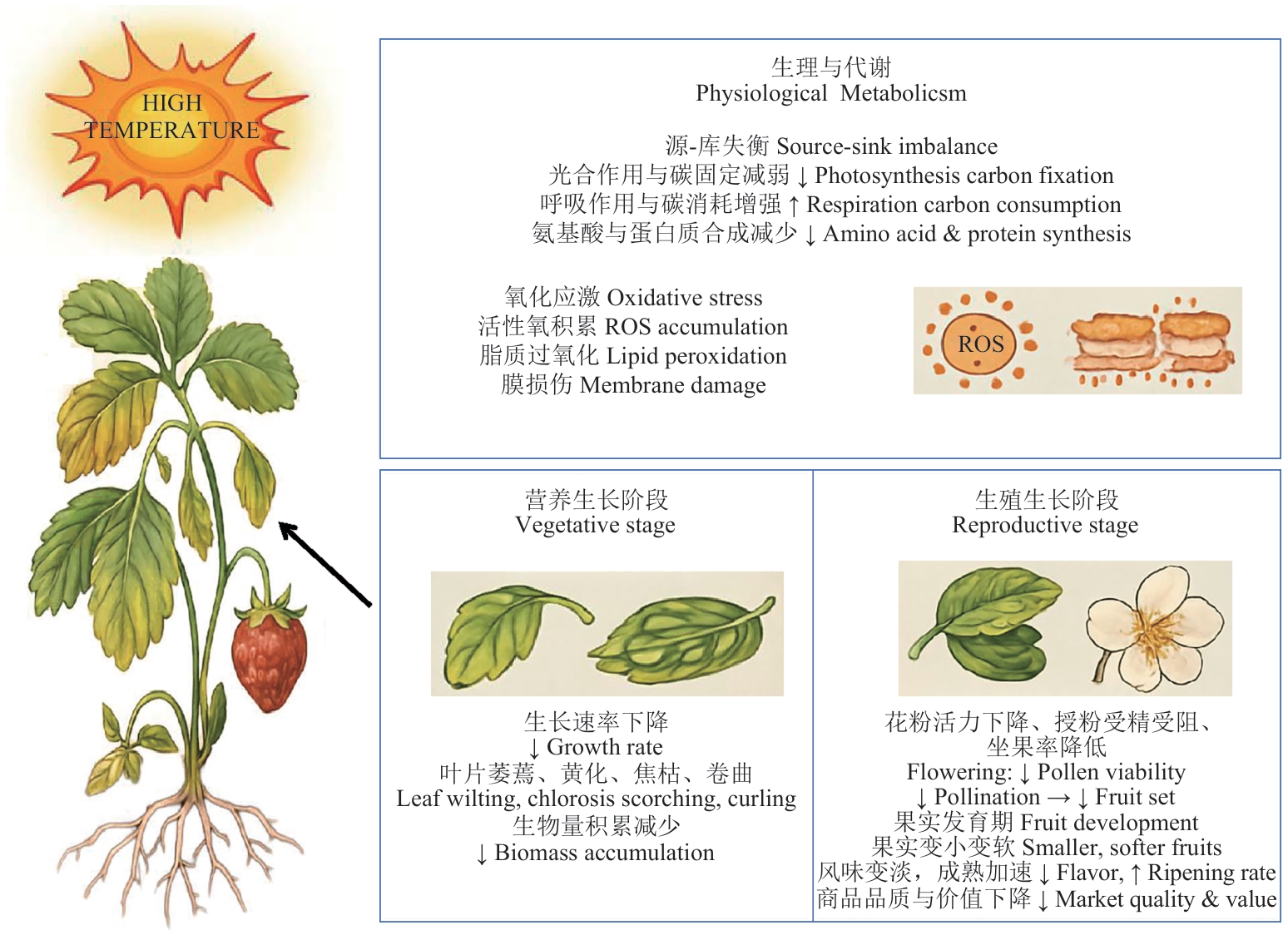
图1 高温胁迫对草莓生长发育的影响ROS:活性氧;↓:降低;↑:升高;→:促进
Fig. 1 Effects of high-temperature stress on strawberry growth and developmentROS: Reactive oxygen species. ↓: Decrease. ↑: Increase. →: Promote
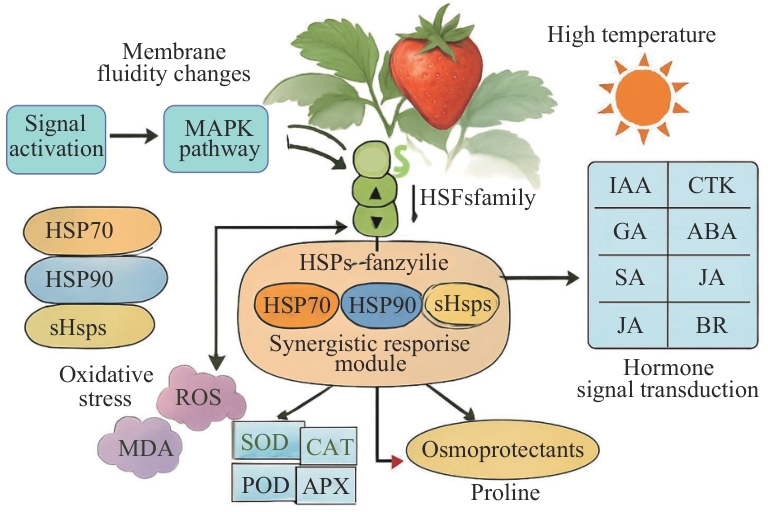
图2 高温胁迫下草莓体内的分子响应机制高温通过细胞膜流动性变化触发信号激活,一方面诱导HSFs家族转录因子活化,启动HSP70、HSP90、sHsps等热激蛋白协同表达,维持蛋白质稳定与光合系统功能;另一方面激活MAPK信号通路,联动IAA、CTK、GA、ABA、SA、JA、BR等激素参与信号转导,调控下游应激反应;同时,通过SOD、CAT、POD、APX等抗氧化酶与ROS模块协同清除活性氧,减少MDA积累造成的氧化损伤,并积累脯氨酸等渗透调节物质维持细胞渗透平衡,多途径协同抵御高温伤害,保障植株正常生长发育
Fig. 2 Molecular response mechanisms in strawberries under high temperature stressHigh temperature first triggers signal activation through changes in membrane fluidity. On one hand, it induces the activation of HSFs family transcription factors, initiating the synergistic expression of heat shock proteins (HSPs) such as HSP70, HSP90, and sHsps to maintain protein stability and photosynthetic system function. On the other hand, it activates the MAPK signaling pathway, which interacts with hormones including IAA, CTK, GA, ABA, SA, JA, and BR to participate in signal transduction and regulate downstream stress responses. Meanwhile, antioxidant enzymes such as SOD, CAT, POD, and APX cooperate with the ROS module to scavenge reactive oxygen species, reducing oxidative damage caused by MDA accumulation. Additionally, it accumulates osmoprotectants such as proline to maintain cellular osmotic balance. These multiple pathways work synergistically to resist high-temperature damage and ensure the normal growth and development of the plant
| [1] | Langer SE, Oviedo NC, Marina M, et al. Effects of heat treatment on enzyme activity and expression of key genes controlling cell wall remodeling in strawberry fruit [J]. Plant Physiol Biochem, 2018, 130: 334-344. |
| [2] | Fan Z, Whitaker VM. Genomic signatures of strawberry domestication and diversification [J]. Plant Cell, 2024, 36(5): 1622-1636. |
| [3] | 高清山. 我国草莓产业的现状分析及发展趋势研究 [J]. 果树资源学报, 2024, 5(5): 79-82, 87. |
| Gao QS. Status analysis and development trend research of strawberry industry in China [J]. J Fruit Resour, 2024, 5(5): 79-82, 87. | |
| [4] | 武冲, 姜莉莉, 宗晓娟, 等. 中国草莓育种研究进展 [J]. 落叶果树, 2022, 54(2): 28-30. |
| Wu C, Jiang LL, Zong XJ, et al. Advances in strawberry breeding in China [J]. Deciduous Fruits, 2022, 54(2): 28-30. | |
| [5] | 李薇, 王哲, 刘妍, 等. 我国草莓产业发展新形势、存在的问题及建议 [J]. 中国南方果树, 2025, 54(2): 240-248. |
| Li W, Wang Z, Liu Y, et al. New situation, problems and recommendations of the development of strawberry industry in China [J]. South China Fruits, 2025, 54(2): 240-248. | |
| [6] | Matthews HD, Wynes S. Current global efforts are insufficient to limit warming to 1.5 ℃[J]. Science, 2022, 376(6600): 1404-1409. |
| [7] | Wang SY, Camp MJ. Temperatures after bloom affect plant growth and fruit quality of strawberry [J]. Sci Hortic, 2000, 85(3): 183-199. |
| [8] | Himali NB, Kithsiri BD, BruceTomkins, et al. Impacts of elevated carbon dioxide and temperature on physicochemical and nutrient properties in strawberries [J]. J Hortic Sci Res, 2017, 1(1): 19-29. |
| [9] | Bacelar E, Pinto T, Anjos R, et al. Impacts of climate change and mitigation strategies for some abiotic and biotic constraints influencing fruit growth and quality [J]. Plants, 2024, 13(14): 1942. |
| [10] | 万群. 芸薹素内酯对高温胁迫下草莓幼苗生化物质的影响 [J]. 中国南方果树, 2016, 45(3): 117-121, 125. |
| Wan Q. Effects of brassinolide on biochemical substances of strawberry seedlings under high temperature stress[J]. South China Fruits, 2016, 45(3): 117-121, 125. | |
| [11] | 王朋. 高温处理对结果期草莓叶片衰老特征的影响 [J]. 农业与技术, 2018, 38(6): 44. |
| Wang P. Effect of high temperature treatment on senescence characteristics of strawberry leaves at fruiting stage[J]. Agric Technol, 2018, 38(6): 44. | |
| [12] | López ME, Denoyes B, Bucher E. Epigenomic and transcriptomic persistence of heat stress memory in strawberry (Fragaria vesca) [J]. BMC Plant Biol, 2024, 24(1): 405. |
| [13] | Wang H, Zhang SH, Wang ZD, et al. Resistance index and browning mechanism of apple peel under high temperature stress [J]. Hortic Plant J, 2024, 10(2): 305-317. |
| [14] | 孙永江, 王琪, 邵琪雯, 等. 高温胁迫对植物光合作用的影响研究进展 [J]. 植物学报, 2023, 58(3): 486-498. |
| Sun YJ, Wang Q, Shao QW, et al. Research advances on the effect of high temperature stress on plant photosynthesis[J]. Bull Bot, 2023, 58(3): 486-498. | |
| [15] | Arief MAA, Kim H, Kurniawan H, et al. Chlorophyll fluorescence imaging for early detection of drought and heat stress in strawberry plants [J]. Plants, 2023, 12(6): 1387. |
| [16] | 鲁雪利, 于海业, 赵红星, 等. 高、低温胁迫对雾培嫁接苗根系生长发育的影响 [J]. 北方园艺, 2016(8): 6-10. |
| Lu XL, Yu HY, Zhao HX, et al. Effect of high and low temperature stress on root growth and development of fog grafted seedling [J]. North Hortic, 2016(8): 6-10. | |
| [17] | Arndal AT M F. Fine root growth and vertical distribution in response to elevated CO₂, warming and drought in a mixed heathland-grassland [J]. Ecosystems, 2018, 21(1): 15-30. |
| [18] | Amin I, Rasool S, Mir MA, et al. Ion homeostasis for salinity tolerance in plants: a molecular approach [J]. Physiol Plant, 2021, 171(4): 578-594. |
| [19] | Osman M, Qaryouti M, Alharbi S, et al. Impact of CO2 enrichment on growth, yield and fruit quality of F1 hybrid strawberry grown under controlled greenhouse condition [J]. Horticulturae, 2024, 10(9): 941. |
| [20] | Ledesma NA, Nakata M, Sugiyama N. Effect of high temperature stress on the reproductive growth of strawberry cvs. 'Nyoho' and 'Toyonoka' [J]. Sci Hortic, 2008, 116(2): 186-193. |
| [21] | Karapatzak EK, Wagstaffe A, Hadley P, et al. High‐temperature‐induced reductions in cropping in everbearing strawberries (Fragaria × ananassa) are associated with reduced pollen performance[J]. Ann Appl Biol, 2012, 161(3): 255-265. |
| [22] | Kadir S, Sidhu G, Al-Khatib K. Strawberry (Fragaria × Ananassa duch.) growth and productivity as affected by temperature [J]. HortScience, 2006, 41(6): 1423-1430. |
| [23] | Menzel CM. Temperature has a greater effect on fruit growth than defoliation or fruit thinning in strawberries in the subtropics [J]. Agriculture, 2019, 9(6): 127. |
| [24] | Manafi H, Baninasab B, Gholami M, et al. Nitric oxide induced thermotolerance in strawberry plants by activation of antioxidant systems and transcriptional regulation of heat shock proteins [J]. J Hortic Sci Biotechnol, 2021, 96(6): 783-796. |
| [25] | Ergİn S, Gülen H, Kesİcİ M, et al. Effects of high temperature stress on enzymatic and nonenzymaticantioxidants and proteins in strawberry plants [J]. Turk J Agric For, 2016, 40: 908-917. |
| [26] | Lu HF, Hu YY, Wang CY, et al. Effects of high temperature and drought stress on the expression of gene encoding enzymes and the activity of key enzymes involved in starch biosynthesis in wheat grains [J]. Front Plant Sci, 2019, 10: 1414. |
| [27] | Wang WX, Vinocur B, Shoseyov O, et al. Role of plant heat-shock proteins and molecular chaperones in the abiotic stress response [J]. Trends Plant Sci, 2004, 9(5): 244-252. |
| [28] | Hasanuzzaman M, Nahar K, Alam MM, et al. Physiological, biochemical, and molecular mechanisms of heat stress tolerance in plants [J]. Int J Mol Sci, 2013, 14(5): 9643-9684. |
| [29] | Liao WY, Lin LF, Jheng JL, et al. Identification of heat shock transcription factor genes involved in thermotolerance of octoploid cultivated strawberry [J]. Int J Mol Sci, 2016, 17(12): 2130. |
| [30] | Zhao P, Wang DD, Wang RQ, et al. Genome-wide analysis of the potato Hsp20 gene family: identification, genomic organization and expression profiles in response to heat stress [J]. BMC Genomics, 2018, 19(1): 61. |
| [31] | Hahn A, Bublak D, Schleiff E, et al. Crosstalk between Hsp90 and Hsp70 chaperones and heat stress transcription factors in tomato[J]. Plant Cell, 2011, 23(2): 741-755. |
| [32] | Kesici M, Ipek A, Ersoy F, et al. Genotype-dependent gene expression in strawberry (Fragaria × Ananassa) plants under high temperature stress [J]. Biochem Genet, 2020, 58(6): 848-866. |
| [33] | Medina-Escobar N, Cárdenas J, Muñoz-Blanco J, et al. Cloning and molecular characterization of a strawberry fruit ripening-related cDNA corresponding a mRNA for a low-molecular-weight heat-shock protein [J]. Plant Mol Biol, 1998, 36(1): 33-42. |
| [34] | Ullah I, Toor MD, Ali Yerlikaya B, et al. High-temperature stress in strawberry: understanding physiological, biochemical and molecular responses [J]. Planta, 2024, 260(5): 118. |
| [35] | Manafi H, Baninasab B, Gholami M, et al. Exogenous melatonin alleviates heat‐induced oxidative damage in strawberry (Fragaria × ananassa duch. cv. ventana) plant [J]. J Plant Growth Regul, 2022, 41(1): 52-64. |
| [36] | 吴夏明, 杨敏, 周陈平, 等. 不同浓度褪黑素处理对高温胁迫下草莓苗生理特性的影响 [J]. 生物技术通报, 2025, 41(3): 181-189. |
| Wu XM, Yang M, Zhou CP, et al. Effects of different concentrations of melatonin on the physiological characteristics of strawberry seedlings under high-temperature stress [J]. Biotechnol Bull, 2025, 41(3): 181-189. | |
| [37] | Menzel CM. Temperatures above 30 ℃ decrease leaf growth in strawberry under global warming [J]. J Hortic Sci Biotechnol, 2024, 99(5): 507-530. |
| [38] | Lv JH, Zheng T, Song ZL, et al. Strawberry proteome responses to controlled hot and cold stress partly mimic post-harvest storage temperature effects on fruit quality [J]. Front Nutr, 2021, 8: 812666. |
| [39] | Fu ET, Zhang YZ, Li HL, et al. Chitosan reduces damages of strawberry seedlings under high-temperature and high-light stress [J]. Agronomy, 2023, 13(2): 517. |
| [40] | Hayat S, Hayat Q, Alyemeni MN, et al. Role of proline under changing environments: a review [J]. Plant Signal Behav, 2012, 7(11): 1456-1466. |
| [41] | Paliwal A, Verma A, Tiwari H, et al. Effect and importance of compatible solutes in plant growth promotion under different stress conditions [M]//Compatible Solutes Engineering for Crop Plants Facing Climate Change. Cham: Springer International Publishing, 2021: 223-239. |
| [42] | Bolen DW, Baskakov IV. The osmophobic effect: natural selection of a thermodynamic force in protein folding [J]. J Mol Biol, 2001, 310(5): 955-963. |
| [43] | Hoque MA, Okuma E, Nasrin Akhter Banu M, et al. Exogenous proline mitigates the detrimental effects of salt stress more than exogenous betaine by increasing antioxidant enzyme activities [J]. J Plant Physiol, 2007, 164(5): 553-561. |
| [44] | Liu YH, Offler CE, Ruan YL. Regulation of fruit and seed response to heat and drought by sugars as nutrients and signals [J]. Front Plant Sci, 2013, 4: 282. |
| [45] | Wang YH, Yan ZM, Tang WH, et al. Impact of chitosan, sucrose, glucose, and fructose on the postharvest decay, quality, enzyme activity, and defense-related gene expression of strawberries [J]. Horticulturae, 2021, 7(12): 518. |
| [46] | Sehar Z, Gautam H, Masood A, et al. Ethylene- and proline-dependent regulation of antioxidant enzymes to mitigate heat stress and boost photosynthetic efficacy in wheat plants [J]. J Plant Growth Regul, 2023, 42(5): 2683-2697. |
| [47] | Ahmad P, Abdel Latef AA, Hashem A, et al. Nitric oxide mitigates salt stress by regulating levels of osmolytes and antioxidant enzymes in chickpea [J]. Front Plant Sci, 2016, 7: 347. |
| [48] | Angon PB, Das A, Roy AR, et al. Plant development and heat stress: role of exogenous nutrients and phytohormones in thermotolerance [J]. Discov Plants, 2024, 1(1): 17. |
| [49] | Chen Q, Long Y, Yang M, et al. FaPKc2.2 negatively modulates strawberry fruit ripening by reprograming the carbon metabolic pathway [J]. Sci Hortic, 2022, 301: 111114. |
| [50] | Guo LL, Lu SX, Liu T, et al. Genome-wide identification and abiotic stress response analysis of PP2C gene family in woodland and pineapple strawberries [J]. Int J Mol Sci, 2023, 24(4): 4049. |
| [51] | Li DD, Mou WS, Luo ZS, et al. Developmental and stress regulation on expression of a novel miRNA, Fan-miR73, and its target ABI5 in strawberry [J]. Sci Rep, 2016, 6: 28385. |
| [52] | Han Y, Dang RH, Li JX, et al. Sucrose nonfermenting1-related protein kinase2.6, an ortholog of open stomata1, is a negative regulator of strawberry fruit development and ripening [J]. Plant Physiol, 2015, 167(3): 915-930. |
| [53] | 苏建波. 水杨酸对草莓幼苗抗热性的影响 [J]. 安徽农业科学, 2015, 43(12): 64-65. |
| Su JB. Effects of salicylic acid(SA) on heat resistance of strawberry seedlings [J]. J Anhui Agric Sci, 2015, 43(12): 64-65. | |
| [54] | Coltro S, Broetto L, Rotilli MCC, et al. Heat shock and salicylic acid on postharvest preservation of organic strawberries [J]. Rev Ceres, 2014, 61(3): 306-312. |
| [55] | Niazi AR, Ghanbari F, Erfani-Moghadam J. Simultaneous effects of hot water treatment with calcium and salicylic acid on shelf life and qualitative characteristics of strawberry during refrigerated storage [J]. J Food Process Preserv, 2021, 45(1): e15005. |
| [56] | Snyman M, Cronjé MJ. Modulation of heat shock factors accompanies salicylic acid-mediated potentiation of Hsp70 in tomato seedlings [J]. J Exp Bot, 2008, 59(8): 2125-2132. |
| [57] | Samakovli D, Roka L, Dimopoulou A, et al. HSP90 affects root growth in Arabidopsis by regulating the polar distribution of PIN1 [J]. New Phytol, 2021, 231(5): 1814-1831. |
| [58] | Zheng T, Lv JH, Sadeghnezhad E, et al. Transcriptomic and metabolomic profiling of strawberry during postharvest cooling and heat storage [J]. Front Plant Sci, 2022, 13: 1009747. |
| [59] | Hogan JD, Murray EE, Harrison MA. Ethylene production as an indicator of stress conditions in hydroponically-grown strawberries [J]. Sci Hortic, 2006, 110(4): 311-318. |
| [60] | Yosefi A, Mozafari AA, Javadi T. Jasmonic acid improved in vitro strawberry (Fragaria × ananassa Duch.) resistance to PEG-induced water stress [J]. Plant Cell Tissue Organ Cult 2020, 142(3): 549-558. |
| [61] | 忻雅, 张青, 裘劼人, 等. 油菜素内酯对夏季草莓育苗素质及耐逆性的影响 [J]. 浙江农业学报, 2015, 27(10): 1735-1738. |
| Xin Y, Zhang Q, Qiu JR, et al. Effects of brassinolide on quality and stress tolerance of summer strawberry seedlings [J]. Acta Agric Zhejiangensis, 2015, 27(10): 1735-1738. | |
| [62] | Aghdam O A, Hajilou J, Bolandnazar S, et al. Effect of 24-Epi brassinolide on some biochemical characteristics of parus and gaviota strawberry cultivars under heat stress conditions[J]. YYU J Agr Sci, 2020, 30(2): 429-437. |
| [63] | Shi HT, Tan DX, Reiter RJ, et al. Melatonin induces class A1 heat-shock factors (HSFA1s) and their possible involvement of thermotolerance in Arabidopsis [J]. J Pineal Res, 2015, 58(3): 335-342. |
| [64] | Xia H, Zhou YJ, Deng HH, et al. Melatonin improves heat tolerance in Actinidia deliciosa via carotenoid biosynthesis and heat shock proteins expression [J]. Physiol Plant, 2021, 172(3): 1582-1593. |
| [65] | Li Z, Li ZR, Ji YL, et al. The heat shock factor 20-HSF4-cellulose synthase A2 module regulates heat stress tolerance in maize [J]. Plant Cell, 2024, 36(7): 2652-2667. |
| [66] | 张圣美, 裘波音, 徐谦, 等. 外源钙离子对高温胁迫下草莓幼苗影响的转录组分析[J]. 分子植物育种, 2024, 22(11): 3525-3532. |
| Zhang SM, Qiu BY, Xu Q, et al. Transcriptome analysis of the effect of exogenous calcium ions on strawberry seedlings under high temperature stress[J]. Mol Plant Breeding, 2024, 22(11): 3525-3532. | |
| [67] | Zhang L, Wang L, Zeng X, et al. Comparative transcriptome analysis reveals fruit discoloration mechanisms in postharvest strawberries in response to high ambient temperature[J]. Food Chem X, 2019, 2: 100025. |
| [68] | Zhang H, Kang H, Su C, et al. Genome-wide identification and expression profile analysis of the NAC transcription factor family during abiotic and biotic stress in woodland strawberry[J]. PLoS One, 2018, 13(6): e0197892. |
| [69] | Garrido-Gala J, Higuera J J, Rodríguez-Franco A, et al. A comprehensive study of the WRKY transcription factor family in strawberry[J]. Plants, 2022, 11(12): 1585. |
| [70] | Jiang CH, Bi YK, Mo JB, et al. Proteome and transcriptome reveal the involvement of heat shock proteins and antioxidant system in thermotolerance of Clematis florida [J]. Sci Rep, 2020, 10(1): 8883. |
| [71] | Luo D, Ding Q, Ma XX, et al. Proteomic and physiological responses of contrasting two different heat-resistant orchardgrass genotypes to heat stress [J]. Int J Biol Macromol, 2023, 245: 125463. |
| [72] | Wang BF, Xue P, Zhang YX, et al. OsCPK12 phosphorylates OsCATA and OsCATC to regulate H2O2 homeostasis and improve oxidative stress tolerance in rice [J]. Plant Commun, 2024, 5(3): 100780. |
| [73] | Hu Z, Li J, Ding S, et al. The protein kinase CPK28 phosphorylates ascorbate peroxidase and enhances thermotolerance in tomato[J]. Plant Physiol, 2021, 186(2): 1302-1317. |
| [74] | Song J, CampbellPalmer L, Vinqvist-Tymchuk M, et al. Proteomic changes in antioxidant system in strawberry during ripening [J]. Front Plant Sci, 2020, 11: 594156. |
| [75] | Muneer S, Park YG, Kim S, et al. Foliar or subirrigation silicon supply mitigates high temperature stress in strawberry by maintaining photosynthetic and stress-responsive proteins [J]. J Plant Growth Regul, 2017, 36(4): 836-845. |
| [76] | Zhang HN, Meng XZ, Liu R, et al. Heat shock factor ZmHsf17 positively regulates phosphatidic acid phosphohydrolase ZmPAH1 and enhances maize thermotolerance [J]. J Exp Bot, 2025, 76(2): 493-512. |
| [77] | Balasooriya B, Dassanayake K, Ajlouni S. High temperature effects on strawberry fruit quality and antioxidant contents[C]//International Conference on Postharvest and Quality Management of Horticultural Products of Interest for Tropical Regions 1278, 2017: 225-234. |
| [78] | Cordenunsi BR, Genovese MI, Oliveira do Nascimento JR, et al. Effects of temperature on the chemical composition and antioxidant activity of three strawberry cultivars [J]. Food Chem, 2005, 91(1): 113-121. |
| [1] | 张初署, 曹世宁, 王发明, 周海翔, 胡晓君, 唐月异, 周晓燕, 王冕, 陈静, 张建成. 乳酸菌发酵花生衣提取物过程中的代谢物特征分析[J]. 生物技术通报, 2026, 42(5): 340-352. |
| [2] | 郭苗, 许家佳, 孙天国, 蔡璨, 曹婉笛, 包纪星, 沙伟, 张梅娟, 彭疑芳, 马天意. 过表达砂藓RcOLEO1基因增强拟南芥的耐旱性及耐高温性[J]. 生物技术通报, 2026, 42(5): 312-322. |
| [3] | 闫琪琪, 卜芋芬, 张小欣, 马晓岑, 荆艳萍. 植物C2结构域脱落酸相关蛋白的研究进展[J]. 生物技术通报, 2026, 42(4): 17-25. |
| [4] | 殷亚龙, 张明洋, 王洁敏, 苗雪雪, 陈劲, 王伟平. 水稻非生物胁迫协同耐受机制研究进展[J]. 生物技术通报, 2026, 42(4): 26-37. |
| [5] | 殷诗情, 田泰, 黄凤庭, 冯珑强, 王浩, 张静, 何文, 陈清, 王小蓉, 王燕. 果树果实硬度的调控机制研究进展[J]. 生物技术通报, 2026, 42(3): 213-229. |
| [6] | 杜丹, 郭翔, 胡鑫, 潘宇. 质体发育调控果实成熟与品质的研究进展[J]. 生物技术通报, 2026, 42(3): 48-59. |
| [7] | 姜喆卉, 王小龙, 王守创, 周科. 番茄风味物质代谢途径解析与分子育种研究进展[J]. 生物技术通报, 2026, 42(3): 60-78. |
| [8] | 赵艳侠, 李倩, 孙家波, 梁红敏, 李冰冰. 草莓果实品质形成的关键调控基因及分子网络解析[J]. 生物技术通报, 2026, 42(3): 111-132. |
| [9] | 王亚乐, 李雪君, 孙计平, 孙焕. 烟草豫浓香201对低温胁迫的生理响应及转录组分析[J]. 生物技术通报, 2026, 42(2): 228-238. |
| [10] | 付涵, 孙书豪, 张思晴, 艾妞, 于杨, 于连伟, 王琼琼, 韩晓玉, 施艳, 韩卫丽, 杨雪. 本氏烟BOI家族基因的全基因组鉴定与表达分析[J]. 生物技术通报, 2026, 42(2): 207-217. |
| [11] | 王雅南, 魏立民, 王峰, 晁哲, 任钰为, 刘海隆, 黄丽丽, 孙瑞萍. 基于代谢组学筛选五指山猪与杜长大猪脂肪沉积差异代谢物的比较研究[J]. 生物技术通报, 2026, 42(2): 325-337. |
| [12] | 刘语诗, 李镇, 邹宇琛, 汤维维, 李彬. 药用植物空间代谢组学研究进展[J]. 生物技术通报, 2025, 41(9): 22-31. |
| [13] | 董向向, 缪百灵, 许贺娟, 陈娟娟, 李亮杰, 龚守富, 朱庆松. 森林草莓FveBBX20基因的生物信息学分析及开花调控功能[J]. 生物技术通报, 2025, 41(9): 115-123. |
| [14] | 张雅祺, 王芹芹, 沈夏, 李旭苗, 高敏, 李军, 李辰, 王慧. 食管鳞状细胞癌早期进展风险的代谢物预警模型[J]. 生物技术通报, 2025, 41(9): 335-344. |
| [15] | 张越, 毕钰, 慕雪男, 郑子薇, 王志刚, 徐伟慧. 小麦赤霉病拮抗菌JB7的生防特性[J]. 生物技术通报, 2025, 41(7): 261-271. |
| 阅读次数 | ||||||
|
全文 |
|
|||||
|
摘要 |
|
|||||
