







• 研究报告 • 下一篇
于好强( ), 张鑫, 段华明, 万涛, 鄢腊梅, 曹博, 杨青青, 付凤玲, 李晚忱()
收稿日期:2026-04-03
出版日期:2026-08-28
通讯作者:
于好强yhq1801@sicau.edu.cn基金资助:
YU Hao-qiang(), ZHANG Xin, DUAN Hua-ming, WAN Tao, YAN La-mei, CAO Bo, YANG Qing-qing, FU Feng-ling, LI Wan-chen()
Received:2026-04-03
Published:2026-08-28
摘要:
目的 针对商业化转基因玉米品种不足和干旱造成的减产问题,利用嗜盐芽胞杆菌(Halobacillus halophilus, H. halophilus)冷激蛋白(Cold shock protein, Csp)基因创制耐旱转基因株系,为培育耐旱玉米种质奠定基础。 方法 利用生物信息学方法对HhCsp序列进行分析,经密码子优化并合成,构建HhCsp双子叶植物表达载体转化拟南芥进行耐旱性初步鉴定。构建HhCsp单子叶植物表达载体,经农杆菌介导法转化玉米,并鉴定耐旱性。 结果 序列分析表明,HhCsp序列长198 bp,编码65个氨基酸,分子量为7.3 kD,等电点为4.47,包含Csp家族典型且高度保守的RNA结合基序RNP1和RNP2。密码子优化后,HhCsp序列GC含量由37.4%提升至50%,转化拟南芥后可增强转基因株系的耐旱性。进一步将优化的HhCsp转化玉米。PCR、反转录PCR(reverse transcript PCR, RT-PCR)、实时荧光定量PCR(real-time quantitative PCR, RT-qPCR)及蛋白免疫印迹杂交(Western Blot, WB)检测结果表明,在4个转基因玉米株系中HhCsp成功插入玉米基因组,且正常转录和翻译。表型鉴定结果证实,干旱胁迫后,与野生型(wild type, WT)相比,所有转基因玉米株系均萎蔫程度更轻。而且转基因株系主根长、生物量、根冠比及相对含水量均显著大于WT;相反,干旱后,转基因株系叶片相对电导率与丙二醛含量均显著低于WT。 结论 异源表达HhCsp基因可增强转基因玉米苗期的耐旱性。
于好强, 张鑫, 段华明, 万涛, 鄢腊梅, 曹博, 杨青青, 付凤玲, 李晚忱. 嗜盐芽胞杆菌冷激蛋白基因HhCsp提高玉米苗期耐旱性[J]. 生物技术通报, doi: 10.13560/j.cnki.biotech.bull.1985.2026-0371.
YU Hao-qiang, ZHANG Xin, DUAN Hua-ming, WAN Tao, YAN La-mei, CAO Bo, YANG Qing-qing, FU Feng-ling, LI Wan-chen. Heterologous Expression of Cold Shock Protein Gene HhCsp from Halobacillus Halophilus Enhances Drought Tolerance of Maize Seedling[J]. Biotechnology Bulletin, doi: 10.13560/j.cnki.biotech.bull.1985.2026-0371.
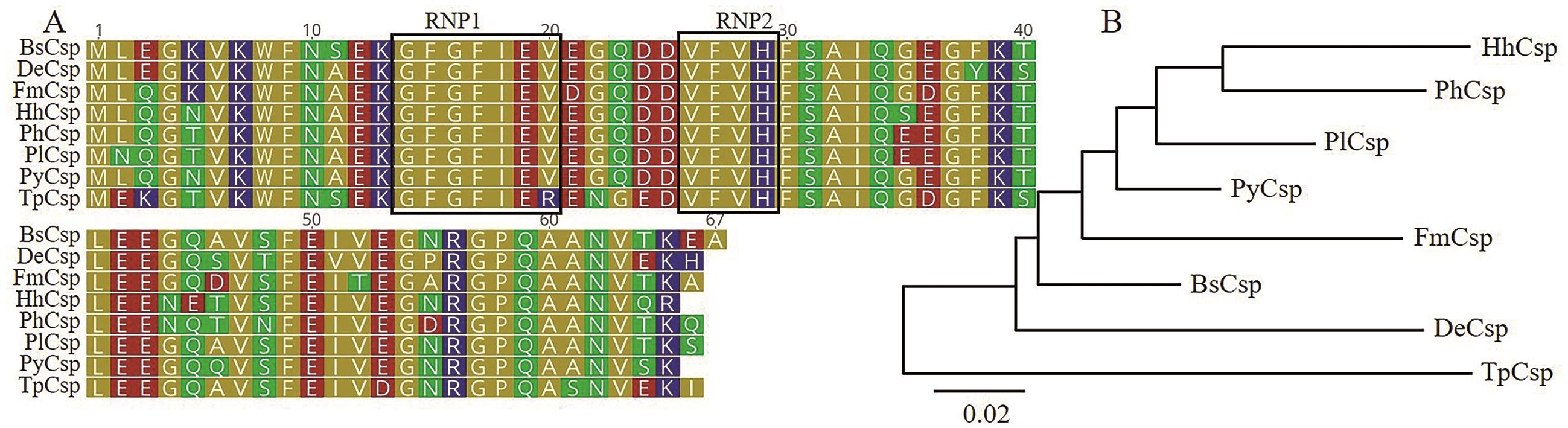
图1 不同来源的Csp氨基酸序列分析A: 多序列比对;B: 系统进化树分析。BsCsp,枯草芽胞杆菌冷激蛋白(GenBank号:NP_388791.1);DeCsp,恩克莱恩屋芽胞杆菌冷激蛋白(GenBank号:WP_045851116.1);FmCsp,澳门假芽胞杆菌(GenBank号:WP_007201157.1);HhCsp嗜盐芽胞杆菌(GenBank号:CCG43925.1);PhCsp,嗜盐海芽胞杆菌(GenBank号:WP_026800953.1); PlCsp,海滨海芽胞杆菌(GenBank号:WP_036833629.1);PyCsp,盐城海芽胞杆菌(GenBank号:WP_036818395.1);TpCsp,沼泽毛球菌(GenBank号:CZQ94952.1)
Fig. 1 Amino acid sequence analysis of different Csp proteinsA: Multiple-sequence alignment; B: phylogenetic tree analysis; BsCsp, cold shock protein from Bacillus subtilis (GenBank No. NP_388791.1); DeCsp, cold shock protein from Domibacillus enclensis (GenBank No. WP_045851116.1); FmCsp, cold shock protein from Fictibacillus macauensis (WP_007201157.1); HhCsp, cold shock protein from Halobacillus halophilus (GenBank No. CCG43925.1); PhCsp, cold shock protein from Pontibacillus halophilus (GenBank No. WP_026800953.1); PlCsp, cold shock protein from Pontibacillus litoralis (GenBank No. WP_036833629.1); PyCsp, cold shock protein from Pontibacillus yanchengensis (GenBank No. WP_036818395.1); TpCsp, cold shock protein from Trichococcus palustris (GenBank No. CZQ94952.1)
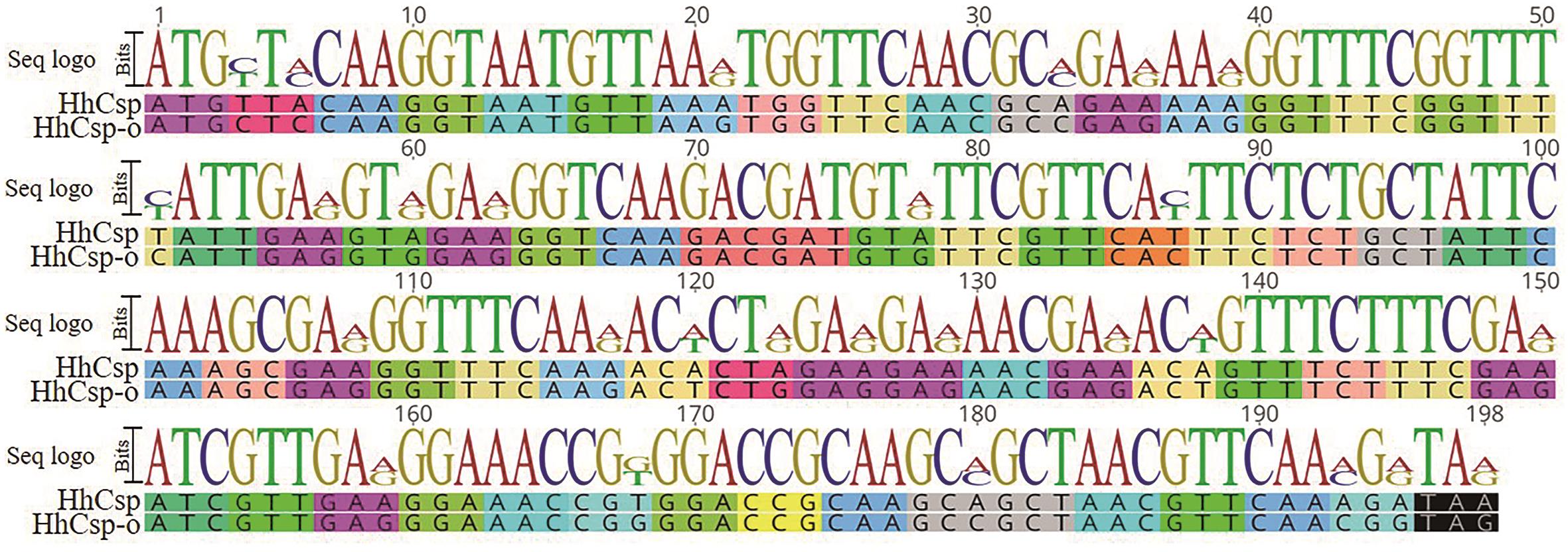
图2 密码子优化前后HhCsp序列比对HhCsp:优化前的序列;HhCsp-o:优化后的序列
Fig. 2 Sequence alignment of HhCsp before and after codon optimizationHhCsp: sequence before codon optimization. HhCsp-o: codon optimized sequence
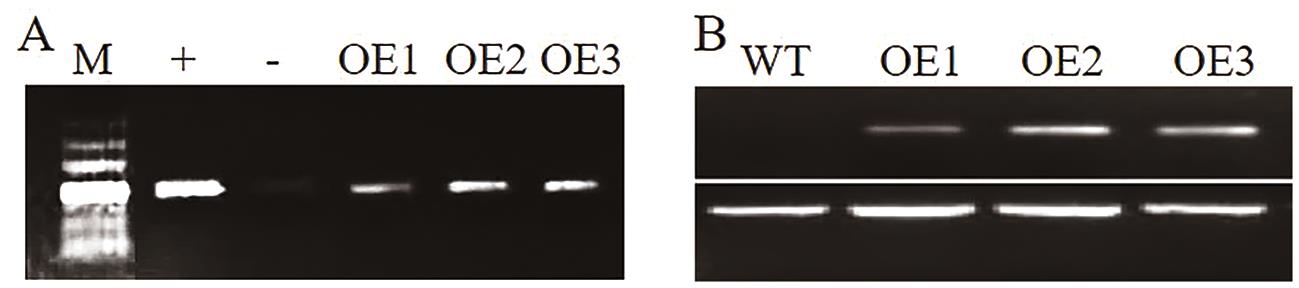
图3 转HhCsp拟南芥株系鉴定A:PCR检测;B:RT-PCR检测。+阳性对照(35S-HhCsp质粒作模板);-阴性对照(WT的DNA和cDNA分别作模板);WT,野生型;OE1、OE2、OE3分别表示转HhCsp基因拟南芥株系
Fig. 3 Identification of transgenic Arabidopsis line expressing HhCspA: PCR detection of transgenic lines; B: RT-PCR detection of transgenic lines. +positive control (35S-HhCsp plasmid served as template); -negative control (DNA and cDNA from WT used as template, respectively); WT, wild type; OE1, OE2, and OE3 represent transgenic Arabidopsis lines with HhCsp, respectively
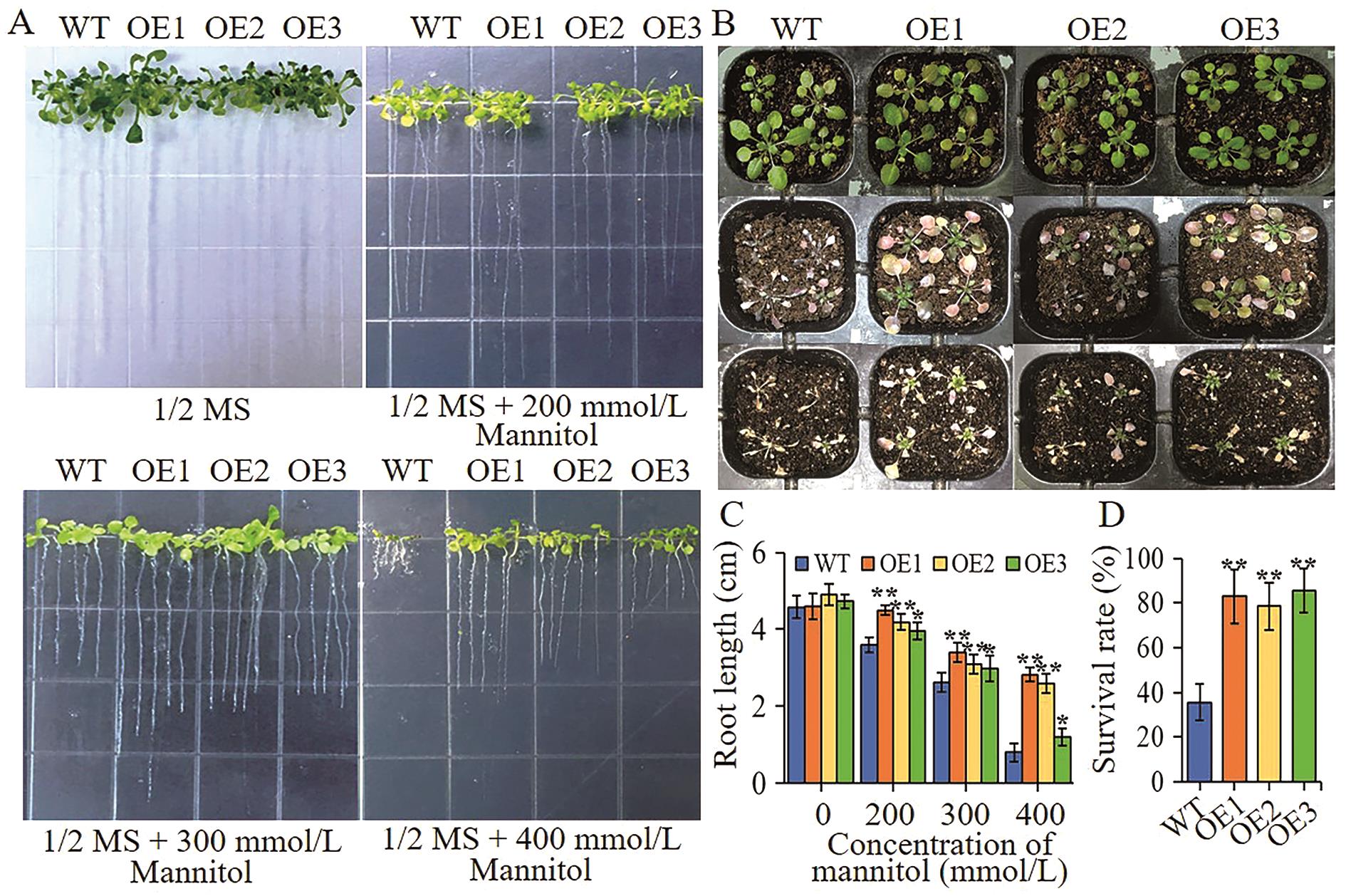
图4 转HhCsp基因增强拟南芥株系耐旱性A:转基因株系在渗透胁迫培养基上的表型;B:转基因株系自然干旱后表型;C:根长统计结果;D:自然干旱后各株系存活率。WT,野生型;OE1、OE2与OE3,分别表示转HhCsp基因拟南芥株系。*和**,分别表示在P<0.05和P<0.01水平差异显著。n=36,误差线代表标准差,下同
Fig. 4 Expression of the HhCsp gene enhances drought tolerance in transgenic Arabidopsis linesA: Phenotype of transgenic lines on the medium with mannitol. B: Drought phenotype of transgenic lines after natural drought stress. C: Statistical data of root length. D: Survival rate of each line after drought stress. WT, wild type; OE1, OE2, and OE3 represent transgenic Arabidopsis lines carrying HhCsp, respectively. * and ** indicate significance at P<0.05 and P<0.01, respectively. n=36. Error bars indicate standard derivation (SD), the same below

图5 转HhCsp基因玉米株系鉴定A:喷施草铵膦后的表型,左侧为阴性苗,右侧为阳性苗;B:PCR检测结果;C:RT-qPCR检测结果;D:RT-PCR结果;E:WB检测结果。WT:野生型;L1、L2、L3与L4分别表示转HhCsp基因玉米株系。+阳性对照(Ubi-HhCsp质粒作模板)
Fig. 5 Identification of transgenic maize lines expressing the HhCsp geneA: Phenotype of transgenic maize after spraying glufosinate; Negative (left) and positive (right) transgenic seedlings were shown; B: PCR detection result; C: RT-qPCR detection result; D: RT-PCR detection result; E: WB result. WT: wild type; L1, L2, L3, and L4 represent transgenic maizelines carrying the HhCsp gene, respectively. + positive control (35S-HhCsp plasmid served as template)
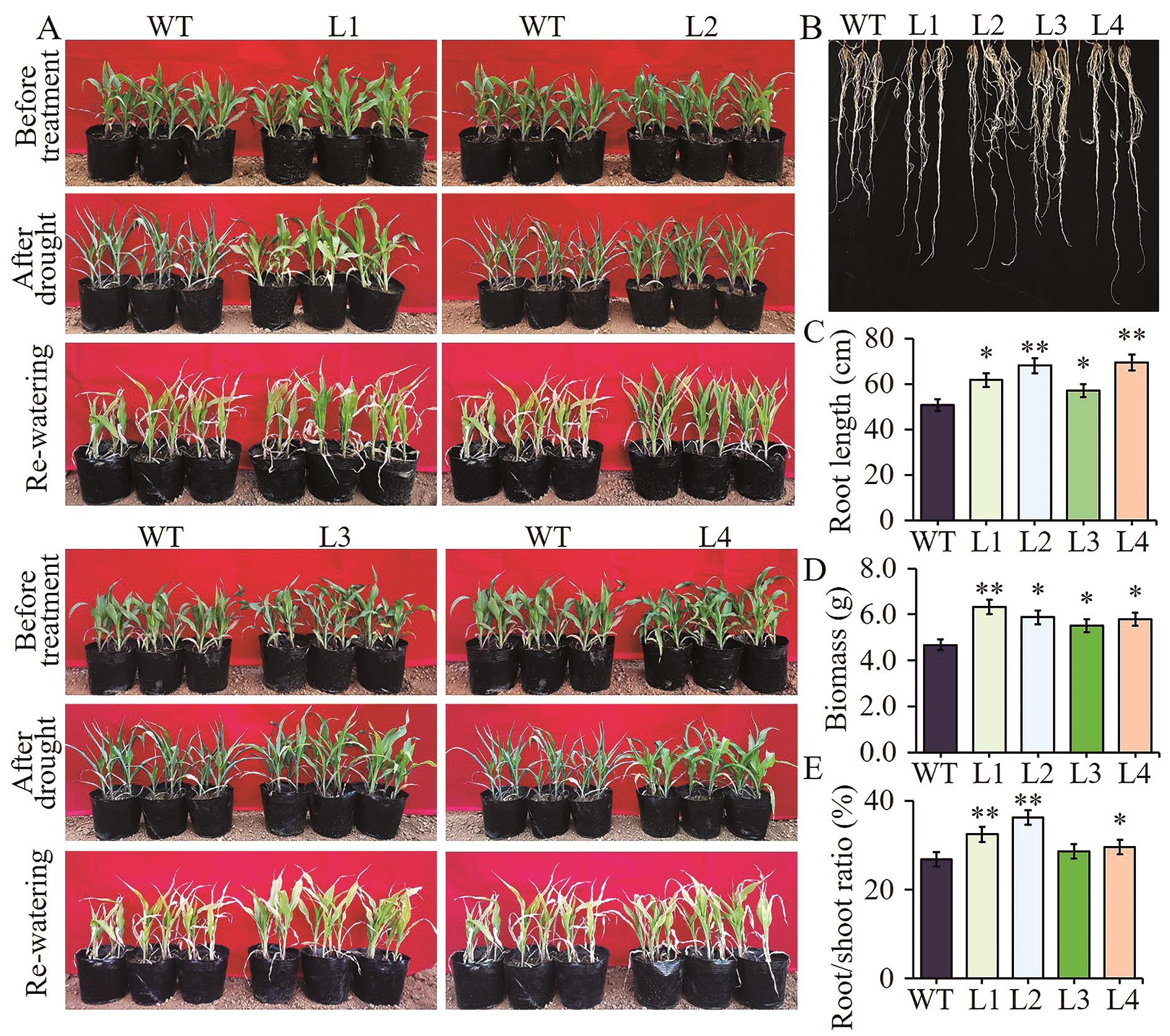
图6 转HhCsp基因增强玉米耐旱性A:转基因株系自然干旱后表型;B:转基因株系自然干旱后根系表型;C:根长统计结果;D:各株系生物量;E:各株系的根冠比。WT,野生型;L1、L2、L3与L4,分别表示转HhCsp基因玉米株系
Fig. 6 Expression of the HhCsp gene enhances drought tolerance in maizeA: Phenotype of transgenic lines after natural drought stress. B: Root phenotype of transgenic lines after natural drought stress. C: Statistical data of root length. D: Biomass of each line. E: Root/shoot ratio of every line. WT, wild type; L1, L2, L3, and L4 represent transgenic maizelines with the HhCsp gene, respectively
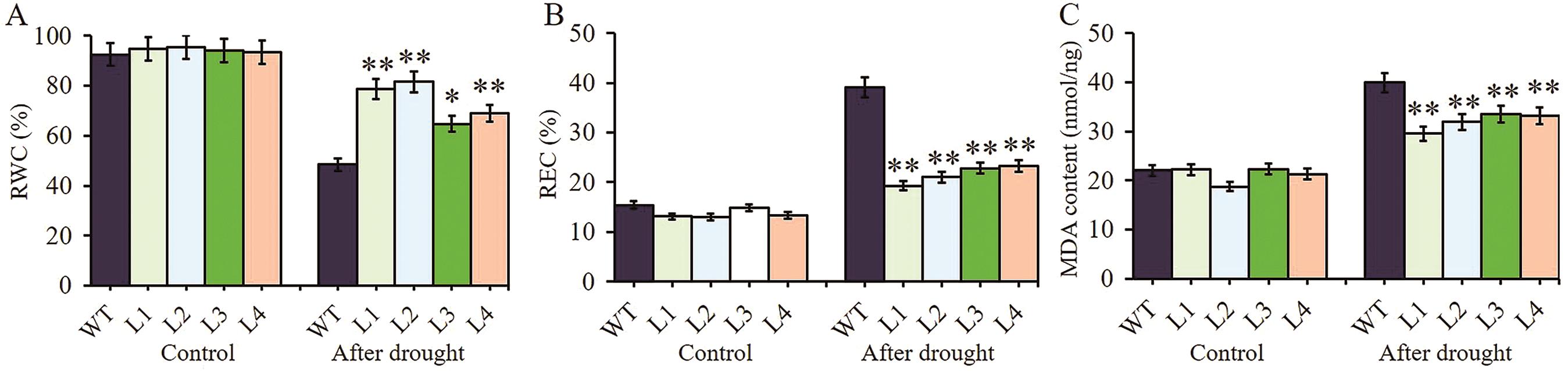
图7 各株系生理指标A:相对含水量;B:相对电导率;C:丙二醛含量。WT,野生型;L1、L2、L3与L4,分别表示转HhCsp基因玉米株系
Fig. 7 Physiological indicators of each lineA: Relative water content (RWC). B: Relative electrical conductivity (REC). C: Malondialdehyde (MDA) content. WT, wild type; L1, L2, L3, and L4 represent transgenic maizelines carrying the HhCsp gene, respectively
| [1] | Yang ZR, Cao YB, Shi YT, et al. Genetic and molecular exploration of maize environmental stress resilience: Toward sustainable agriculture [J]. Mol Plant, 2023, 16(10): 1496-1517. |
| [2] | Kim KH, Lee BM. Effects of climate change and drought tolerance on maize growth [J]. Plants, 2023, 12(20): 3548. |
| [3] | Gupta A, Rico-Medina A, Caño-Delgado AI. The physiology of plant responses to drought [J]. Science, 2020, 368(6488): 266-269. |
| [4] | Abdul Aziz M, Brini F, Rouached H, et al. Genetically engineered crops for sustainably enhanced food production systems [J]. Front Plant Sci, 2022, 13: 1027828. |
| [5] | Klee HJ. Ripening physiology of fruit from transgenic tomato (Lycopersicon esculentum) plants with reduced ethylene synthesis [J]. Plant Physiol, 1993, 102(3): 911-916. |
| [6] | Cheng XR, Li HH, Tang QL, et al. Trends in the global commercialization of genetically modified crops in 2023 [J]. J Integr Agric, 2024, 23(12): 3943-3952. |
| [7] | Yu HQ, Wang YG, Fu FL, et al. Transgenic improvement for biotic resistance of crops [J]. Int J Mol Sci, 2022, 23(22): 14370. |
| [8] | Li ZX, Zhang JR, Song XY. Breeding maize hybrids with improved drought tolerance using genetic transformation [J]. Int J Mol Sci, 2024, 25(19): 10630. |
| [9] | Yang XX, Cheng JK, Wang FE, et al. ZmMPK5-mediated ZmOCL1 phosphorylation positively regulates drought tolerance by promoting the induction of ZmDHN2 in maize [J]. New Phytol, 2026, 250(1): 347-365. |
| [10] | Yang SP, Wang YJ, Huang Q, et al. A pangenome of maize provides genetic insights into drought resistance [J]. Nat Genet, 2025, 57(11): 2831-2841. |
| [11] | Castiglioni P, Warner D, Bensen RJ, et al. Bacterial RNA chaperones confer abiotic stress tolerance in plants and improved grain yield in maize under water-limited conditions [J]. Plant Physiol, 2008, 147(2): 446-455. |
| [12] | Tollefson J. Drought-tolerant maize gets US debut [J]. Nature, 2011, 469(7329): 144. |
| [13] | 丁风鹅. 海洋微生物CSP基因提高转基因玉米的抗旱和耐寒性 [D]. 大连: 大连理工大学, 2018. |
| Ding FE. The cold shock protein gene CSP from marine microorganism improves drought and cold tolerance of the transgenic maize [D]. Dalian: Dalian University of Technology, 2018. | |
| [14] | Kim SY, Kim JS, Cho W, et al. A cold-shock protein from the south pole-dwelling soil bacterium Arthrobacter sp. confers cold tolerance to rice [J]. Genes, 2021, 12(10): 1589. |
| [15] | 王梦姣, 曹钰雪, 徐永盛, 等. 过表达海洋微生物宏基因组MbCSP提高转基因拟南芥的抗旱和耐寒性 [J]. 植物研究, 2022, 42(2): 243-251. |
| Wang MJ, Cao YX, Xu YS, et al. Overexpression of marine microbial metagenomic MbCSP enhanced drought and cold tolerance of transgenic Arabidopsis thaliana [J]. Bull Bot Res, 2022, 42(2): 243-251. | |
| [16] | Yu TF, Xu ZS, Guo JK, et al. Improved drought tolerance in wheat plants overexpressing a synthetic bacterial cold shock protein gene SeCspA [J]. Sci Rep, 2017, 7: 44050. |
| [17] | Jones PG, VanBogelen RA, Neidhardt FC. Induction of proteins in response to low temperature in Escherichia coli [J]. J Bacteriol, 1987, 169(5): 2092-2095. |
| [18] | Li HX, Giuliodori AM, Wang X, et al. Cold shock proteins mediate transcription of ribosomal RNA in Escherichia coli under cold-stress conditions [J]. Biomolecules, 2025, 15(10): 1387. |
| [19] | Nakamura Y, Gojobori T, Ikemura T. Codon usage tabulated from the international DNA sequence databases [J]. Nucleic Acids Res, 1997, 25(1): 244-245. |
| [20] | Daniel E, Onwukwe GU, Wierenga RK, et al. ATGme: Open-source web application for rare codon identification and custom DNA sequence optimization [J]. BMC Bioinform, 2015, 16: 303. |
| [21] | Clough SJ, Bent AF. Floral dip: a simplified method for Agrobacterium-mediated transformation of Arabidopsis thaliana [J]. Plant J, 1998, 16(6): 735-743. |
| [22] | Springer NM. Isolation of plant DNA for PCR and genotyping using organic extraction and CTAB [J]. Cold Spring Harb Protoc, 2010, 2010(11): pdb.prot5515. |
| [23] | Mishra M, Tiwari S, Gomes AV. Protein purification and analysis: next generation Western blotting techniques [J]. Expert Rev Proteom, 2017, 14(11): 1037-1053. |
| [24] | Gaxiola RA, Li JS, Undurraga S, et al. Drought- and salt-tolerant plants result from overexpression of the AVP1 H+-pump [J]. Proc Natl Acad Sci U S A, 2001, 98(20): 11444-11449. |
| [25] | 魏湜, 张翯, 顾万荣, 等. DCPTA对盐胁迫下玉米叶片渗透调节生理生化特征影响 [J]. 东北农业大学学报, 2015, 46(9): 1-8. |
| Wei S, Zhang H, Gu WR, et al. Effect of DCPTA on the physiological and biochemical characteristics of osmotic adjustment in maize seedling leaves under salt stress [J]. J Northeast Agric Univ, 2015, 46(9): 1-8. | |
| [26] | 邹琦. 植物生理学实验指导 [M]. 北京: 中国农业出版社, 2000. |
| Zou Q. Experimental instruction of plant physiology [M]. Beijing: China Agriculture Press, 2000. | |
| [27] | Desale P, Patel B, Singh S, et al. Plant growth promoting properties of Halobacillus sp. and Halomonas sp. in presence of salinity and heavy metals [J]. J Basic Microbiol, 2014, 54(8): 781-791. |
| [28] | Köcher S, Müller V. The nature and function of carotenoids in the moderately halophilic bacterium Halobacillus halophilus [M]//Ventosa A, Oren A, Ma YH. Halophiles and Hypersaline Environments: Current Research and Future Trends. Berlin, Heidelberg: Springer, 2011: 303-317. |
| [29] | 刘庆坡, 冯英, 董辉. 20个物种同义密码子偏性的比较分析 [J]. 西北农林科技大学学报: 自然科学版, 2004, 32(7): 67-71. |
| Liu QP, Feng Y, Dong H. Comparative studies on synonymous codon usage bias in twenty species [J]. J Northwest Sci Tech Univ Agric For Nat Sci Ed, 2004, 32(7): 67-71. | |
| [30] | Chen H, Tang W, Xu CG, et al. Transgenic indica rice plants harboring a synthetic cry2A* gene of Bacillus thuringiensis exhibit enhanced resistance against lepidopteran rice pests [J]. Theor Appl Genet, 2005, 111(7): 1330-1337. |
| [31] | Jabeen R, Khan MS, Zafar Y, et al. Codon optimization of cry1Ab gene for hyper expression in plant organelles [J]. Mol Biol Rep, 2010, 37(2): 1011-1017. |
| [32] | Meyer P. Variation of transgene expression in plants [J]. Euphytica, 1995, 85(1-3): 359-366. |
| [33] | Vaucheret H, Béclin C, Elmayan T, et al. Transgene-induced gene silencing in plants [J]. Plant J, 1998, 16(6): 651-659. |
| [34] | Bae W, Xia B, Inouye M, et al. Escherichia coli CspA-family RNA chaperones are transcription antiterminators [J]. Proc Natl Acad Sci U S A, 2000, 97(14): 7784-7789. |
| [35] | Graumann PL, Marahiel MA. Cold shock proteins CspB and CspC are major stationary-phase-induced proteins in Bacillus subtilis [J]. Arch Microbiol, 1999, 171(2): 135-138. |
| [36] | Yu HQ, Lv H, Lu FZ, et al. Expression evaluation of exogenous and endogenous alcohol dehydrogenase genes in transgenic Arabidopsis [J]. Front Plant Sci, 2025, 15: 1476754. |
| [1] | 何婧婧, 朋毛拉专, 姚晓华, 姚有华, 吴昆仑, 崔永梅. 青稞HvNAC53的克隆及功能分析[J]. 生物技术通报, 2026, 42(8): 142-152. |
| [2] | 王鸿睿, 赵怡如, 饶书培, 陈金焕. 黑果枸杞 LrCYP78A5 基因在干旱与盐胁迫响应中的功能研究[J]. 生物技术通报, 2026, 42(7): 182-192. |
| [3] | 阎晓光, 杜艳伟, 马志远, 王彬, 王国梁, 胡丹珠. 玉米ZmDIR基因家族的全基因组鉴定与表达模式分析[J]. 生物技术通报, 2026, 42(7): 126-137. |
| [4] | 李博宇, 蹇春晨, 侯佳俊, 钱明岩, 杨文钦, 章圣龙, 藏传刚, 马福开, 郑龙, 关宏. 复合菌剂QY12-A4对玉米秸秆的降解及其产物中抗氧化木质素的分离与纯化[J]. 生物技术通报, 2026, 42(7): 292-303. |
| [5] | 李万, 武亚倩, 吴芳, 赵永平. 马铃薯StDREB4基因响应盐和干旱胁迫的功能研究[J]. 生物技术通报, 2026, 42(6): 53-63. |
| [6] | 万瑞恒, 李晓艳, 李莹莹, 郭扬, 刘应红, 张军杰, 胡育峰, 李炀平, 黄玉碧, 刘汉梅. 基于YOLOv10的玉米籽粒淀粉粒识别与粒径分析系统的开发[J]. 生物技术通报, 2026, 42(6): 208-217. |
| [7] | 郭苗, 许家佳, 孙天国, 蔡璨, 曹婉笛, 包纪星, 沙伟, 张梅娟, 彭疑芳, 马天意. 过表达砂藓RcOLEO1基因增强拟南芥的耐旱性及耐高温性[J]. 生物技术通报, 2026, 42(5): 312-322. |
| [8] | 彭善麟, 廖卓诚, 王涛, 刘志宇, 刘海忆, 王婷婷, 杨琴, 王哲, 邰欢欢. 不同玉米茎腐病抗性品种根际微生物群落多样性及功能差异[J]. 生物技术通报, 2026, 42(5): 76-88. |
| [9] | 刘青媛, 吴洪启, 陈秀娥, 陈剑, 姜远泽, 何燕子, 喻奇伟, 刘仁祥. 转录因子NtMYB96a调控烟草耐旱性的功能研究[J]. 生物技术通报, 2026, 42(4): 239-250. |
| [10] | 殷亚龙, 张明洋, 王洁敏, 苗雪雪, 陈劲, 王伟平. 水稻非生物胁迫协同耐受机制研究进展[J]. 生物技术通报, 2026, 42(4): 26-37. |
| [11] | 王晶, 刘卓艳, 张晓磊, 刘宝海, 关海涛, 温洪涛. 基于LAMP-CRISPR/Cas12a技术快速检测转基因玉米DBN9501转化体特异性[J]. 生物技术通报, 2026, 42(2): 149-157. |
| [12] | 董亚茹, 朱红, 王照红, 赵东晓, 刘惠芬. 桑树MnDREB6E的克隆及耐盐抗旱性分析[J]. 生物技术通报, 2026, 42(2): 306-316. |
| [13] | 张冬岭, 张寅生, 王建军, 叶飞宇, 卢子涵, 马晨晨, 柳华峰, 胡德升, 邓亚洲, 曹丽茹. 玉米HSFs转录因子家族在干旱胁迫下的表达特性及功能[J]. 生物技术通报, 2026, 42(2): 178-187. |
| [14] | 张月, 戴月华, 张莹莹, 李奥辉, 李楚慧, 薛金爱, 秦慧彬, 陈妍, 聂萌恩, 张海平. 大豆烯酰辅酶A还原酶ECR14基因的克隆与功能分析[J]. 生物技术通报, 2026, 42(1): 95-104. |
| [15] | 胡璐, 王凯, 徐婧仪, 叶丽慧, 王永飞, 王丽华, 李杰勤. 玉米和高粱遗传转化技术研究进展[J]. 生物技术通报, 2025, 41(9): 32-43. |
| 阅读次数 | ||||||
|
全文 |
|
|||||
|
摘要 |
|
|||||
