







生物技术通报 ›› 2025, Vol. 41 ›› Issue (7): 150-163.doi: 10.13560/j.cnki.biotech.bull.1985.2025-0018
李新妮1,2( ), 李俊怡1,2, 马雪华2, 何卫1,2, 李佳丽1,2, 于佳1,2, 曹晓宁1,2, 乔治军1,2(), 刘思辰1,2()
收稿日期:2025-01-08
出版日期:2025-07-26
发布日期:2025-07-22
通讯作者:
:刘思辰,女,博士,副研究员,研究方向 :谷子种质资源评价利用;E-mail: lsch209@126.com作者简介:李新妮,女,硕士,研究方向 :作物遗传育种;E-mail: tangerine7423@163.com
基金资助:
LI Xin-ni1,2(), LI Jun-yi1,2, MA Xue-hua2, HE Wei1,2, LI Jia-li1,2, YU Jia1,2, CAO Xiao-ning1,2, QIAO Zhi-jun1,2(), LIU Si-chen1,2()
Received:2025-01-08
Published:2025-07-26
Online:2025-07-22
摘要:
目的 PMEI(pectin methylesterase inhibitor)是控制细胞壁结构与特性的重要组成部分,在植物逆境胁迫响应方面发挥重要作用。探究谷子PMEI基因在非生物胁迫下的响应机制,为谷子的抗逆机理研究提供理论基础。 方法 运用生物信息学方法对谷子PMEI基因家族进行鉴定,采用实时荧光定量PCR技术对其家族成员在低温、干旱、MeJA、ABA胁迫下的表达模式进行分析。 结果 谷子基因组中共鉴定出68个SiPMEI基因家族成员,不均匀地分布在9条染色体上,大多数成员定位于细胞壁或叶绿体上。SiPMEI家族成员主要有2种结构域,PMEI结构域和pectinesteras+PMEI结构域,含有同一结构域的成员间理化性质、亚细胞定位和基因结构均较相似。启动子顺式作用元件分析表明SiPMEI基因家族成员含有多种非生物胁迫和激素响应元件。本研究选择了8个含有2种以上胁迫响应元件且含数量较多的SiPMEI家族成员进行实时荧光定量表达分析。结果表明,SiPMEI在谷子的根、茎、叶和穗中差异表达;非生物胁迫(低温、干旱)和激素胁迫(MeJA、ABA)处理下,SiPMEI基因的表达量在0‒24 h内整体呈现上升趋势,含PMEI结构域且定位于细胞壁上的成员SiPMEI30、SiPMEI32、SiPMEI36、SiPMEI63在胁迫下响应的最高表达量集中于8‒24 h。亚细胞定位于叶绿体上的成员SiPMEI22、SiPMEI31、SiPMEI38、SiPMEI47最高表达量分布较为分散,且上调位点较多。 结论 SiPMEI在低温、ABA和MeJA的胁迫下均具有正向响应,并在干旱和MeJA胁迫下具有类似的表达趋势。这些差异表达表明SiPMEI可能通过不同的分子机制响应非生物胁迫。
李新妮, 李俊怡, 马雪华, 何卫, 李佳丽, 于佳, 曹晓宁, 乔治军, 刘思辰. 谷子果胶甲酯酶抑制子PMEI基因家族鉴定及其对非生物胁迫的响应分析[J]. 生物技术通报, 2025, 41(7): 150-163.
LI Xin-ni, LI Jun-yi, MA Xue-hua, HE Wei, LI Jia-li, YU Jia, CAO Xiao-ning, QIAO Zhi-jun, LIU Si-chen. Identification of the PMEI Gene Family of Pectin Methylesterase Inhibitor in Foxtail Millet and Analysis of Its Response to Abiotic Stress[J]. Biotechnology Bulletin, 2025, 41(7): 150-163.
基因名称 Gene name | 基因序列 Gene sequence (5′‒3′) |
|---|---|
| 25S-F | AGGCAACAGAAACTCCATACG |
| 25S-R | ATGGCATAGCATTCATCACG |
| SiPMEI22-F | TGTTCTCGGGACAGGTTTCG |
| SiPMEI22-R | GTACAGCGTGTCCTGGTACG |
| SiPMEI30-F | GACCTCGGCTACGACTACTG |
| SiPMEI30-R | GGTTGTGCTCTTGGAGGCTA |
| SiPMEI31-F | TCTTCAGAGAGAGGGGGATCG |
| SiPMEI31-R | TAGCGCGACAAGCGAACAAT |
| SiPMEI32-F | TTTTCCGCGAACGTGTCCA |
| SiPMEI32-R | ACACCACCCCATATCGCTTG |
| SiPMEI36-F | CTCGGTACAGTCTTGCACCA |
| SiPMEI36-R | ATCCAGTGCAATGTCTCCGT |
| SiPMEI38-F | CCGAGTACATGAACCGTGGA |
| SiPMEI38-R | GTGGAGTTGAGCCAGAGGTC |
| SiPMEI47-F | CAGCCTTCGTGTTCCCTGTT |
| SiPMEI47-R | TCTTATTGATGACCGCCCTCG |
| SiPMEI63-F | AGCTTCGTTCGCTCATGCAA |
| SiPMEI63-R | AGTAATGAAGGCTGCAACACAC |
表1 用于RT-qPCR引物序列
Table 1 Primer sequences used for RT-qPCR
基因名称 Gene name | 基因序列 Gene sequence (5′‒3′) |
|---|---|
| 25S-F | AGGCAACAGAAACTCCATACG |
| 25S-R | ATGGCATAGCATTCATCACG |
| SiPMEI22-F | TGTTCTCGGGACAGGTTTCG |
| SiPMEI22-R | GTACAGCGTGTCCTGGTACG |
| SiPMEI30-F | GACCTCGGCTACGACTACTG |
| SiPMEI30-R | GGTTGTGCTCTTGGAGGCTA |
| SiPMEI31-F | TCTTCAGAGAGAGGGGGATCG |
| SiPMEI31-R | TAGCGCGACAAGCGAACAAT |
| SiPMEI32-F | TTTTCCGCGAACGTGTCCA |
| SiPMEI32-R | ACACCACCCCATATCGCTTG |
| SiPMEI36-F | CTCGGTACAGTCTTGCACCA |
| SiPMEI36-R | ATCCAGTGCAATGTCTCCGT |
| SiPMEI38-F | CCGAGTACATGAACCGTGGA |
| SiPMEI38-R | GTGGAGTTGAGCCAGAGGTC |
| SiPMEI47-F | CAGCCTTCGTGTTCCCTGTT |
| SiPMEI47-R | TCTTATTGATGACCGCCCTCG |
| SiPMEI63-F | AGCTTCGTTCGCTCATGCAA |
| SiPMEI63-R | AGTAATGAAGGCTGCAACACAC |

图1 SiPMEI序列特征分析A:SiPMEI基因家族成员进化树,B:保守基序分布;C:基因结构域分布;D:内含子与外显子结构
Fig. 1 Analysis of SiPMEI sequence characterizationA: SiPMEI evolutionary tree of gene family members; B: conserved motif distribution; C: gene domain distribution; D: intron and exon structure
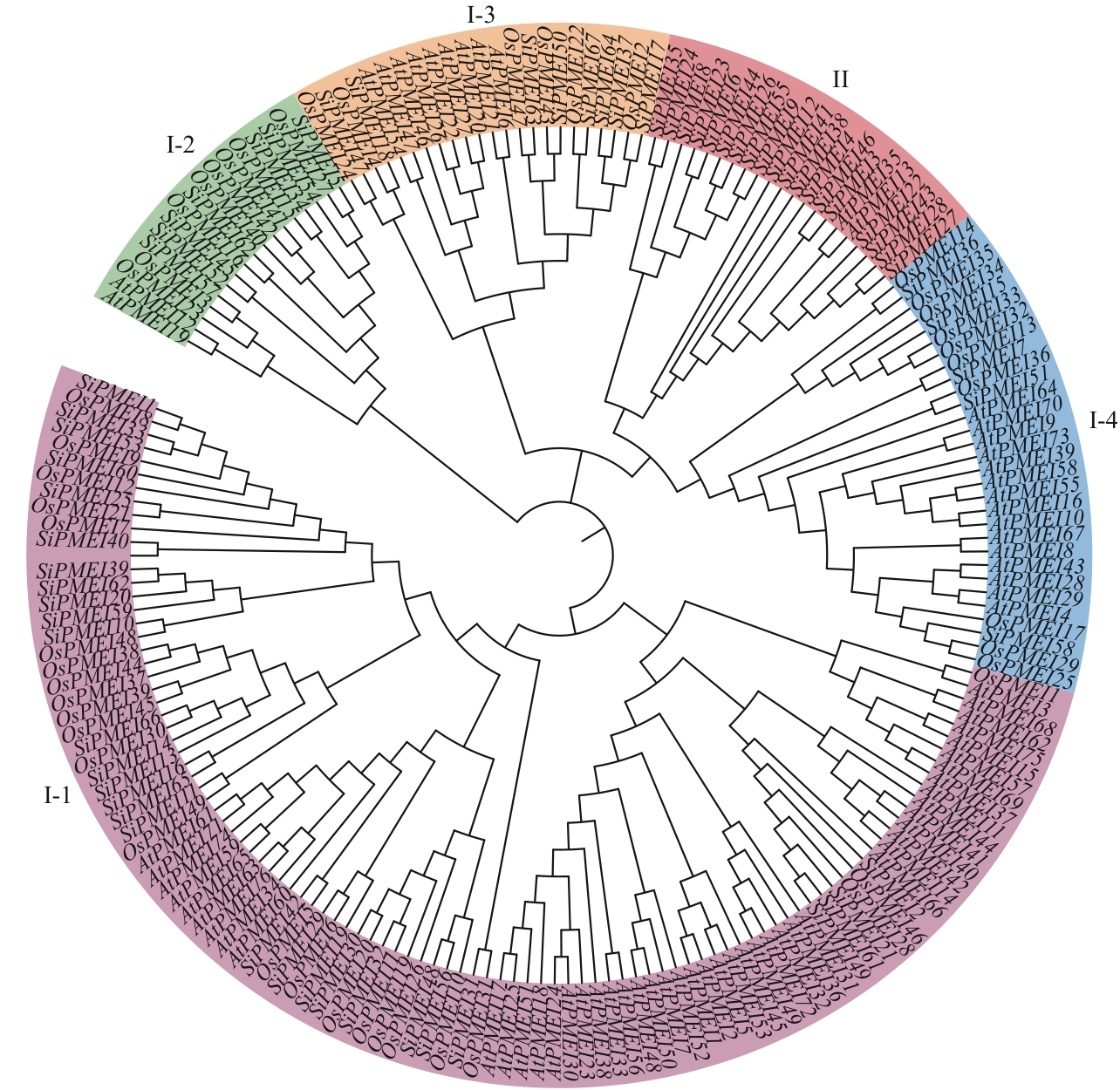
图2 谷子(Si)、水稻(Os)、拟南芥(At)PMEI基因家族系统发育进化树
Fig. 2 Phylogenetic evolutionary tree of the PMEI gene family in Setaria italica (Si), Oryza sativa (Os), and Arabidopsis (At)
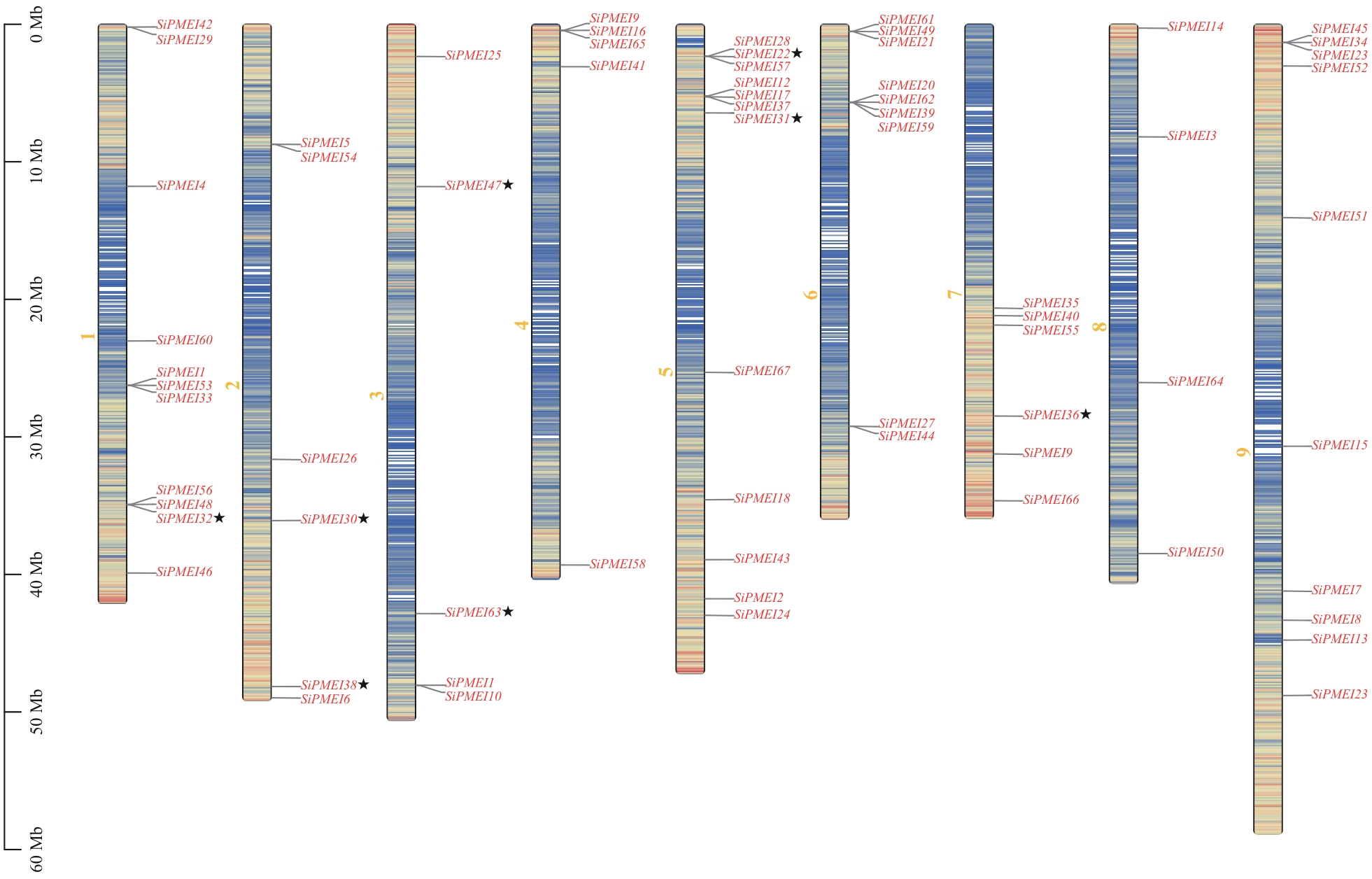
图3 SiPMEI基因家族在谷子染色体上的分布
Fig. 3 Distribution of the SiPMEI gene family on the foxtail millet chromosome
重复基因1 Duplicated gene l | 重复基因2 Duplicated gene 2 | 非同义替换率 Ka | 同义替换率 Ks | 比值 Ka/Ks |
|---|---|---|---|---|
| SiPMEI46 | SiPMEI41 | 0.586 044 760 | 0.756 527 598 | 0.774 650 867 |
| SiPMEI29 | SiPMEI19 | 0.310 390 814 | 0.409 962 679 | 0.757 119 686 |
| SiPMEI46 | SiPMEI27 | 0.484 690 326 | 0.680 501 629 | 0.712 254 469 |
| SiPMEI32 | SiPMEI30 | 0.404 813 285 | 0.573 874 330 | 0.705 404 065 |
| SiPMEI26 | SiPMEI27 | 0.591 358 520 | 0.538 368 419 | 1.098 427 208 |
| SiPMEI6 | SiPMEI23 | 0.202 922 616 | 0.397 601 411 | 0.510 366 941 |
| SiPMEI5 | SiPMEI34 | 0.660 998 002 | 0.498 090 476 | 1.327 064 124 |
| SiPMEI63 | SiPMEI50 | 0.617 173 087 | 0.439 225 359 | 1.405 139 924 |
表2 SiPMEI基因进化中复制事件的选择压力参数
Table 2 Selection pressure parameters for replication events in the evolution of SiPMEI genes
重复基因1 Duplicated gene l | 重复基因2 Duplicated gene 2 | 非同义替换率 Ka | 同义替换率 Ks | 比值 Ka/Ks |
|---|---|---|---|---|
| SiPMEI46 | SiPMEI41 | 0.586 044 760 | 0.756 527 598 | 0.774 650 867 |
| SiPMEI29 | SiPMEI19 | 0.310 390 814 | 0.409 962 679 | 0.757 119 686 |
| SiPMEI46 | SiPMEI27 | 0.484 690 326 | 0.680 501 629 | 0.712 254 469 |
| SiPMEI32 | SiPMEI30 | 0.404 813 285 | 0.573 874 330 | 0.705 404 065 |
| SiPMEI26 | SiPMEI27 | 0.591 358 520 | 0.538 368 419 | 1.098 427 208 |
| SiPMEI6 | SiPMEI23 | 0.202 922 616 | 0.397 601 411 | 0.510 366 941 |
| SiPMEI5 | SiPMEI34 | 0.660 998 002 | 0.498 090 476 | 1.327 064 124 |
| SiPMEI63 | SiPMEI50 | 0.617 173 087 | 0.439 225 359 | 1.405 139 924 |

图4 谷子种内PMEI基因家族共线性分析1-9 代表谷子第1-9染色体;染色体内部以基因密度填充,颜色由蓝到红代表基因密度由小到大
Fig. 4 Collinearity analysis of intra-specific PMEI gene families in foxtail millet1-9 indicates chromosome 1-9 in foxtail millet respectively. The interior of the chromosome is filled with gene density, with colors ranging from blue to red indicating a gradual increase in gene density
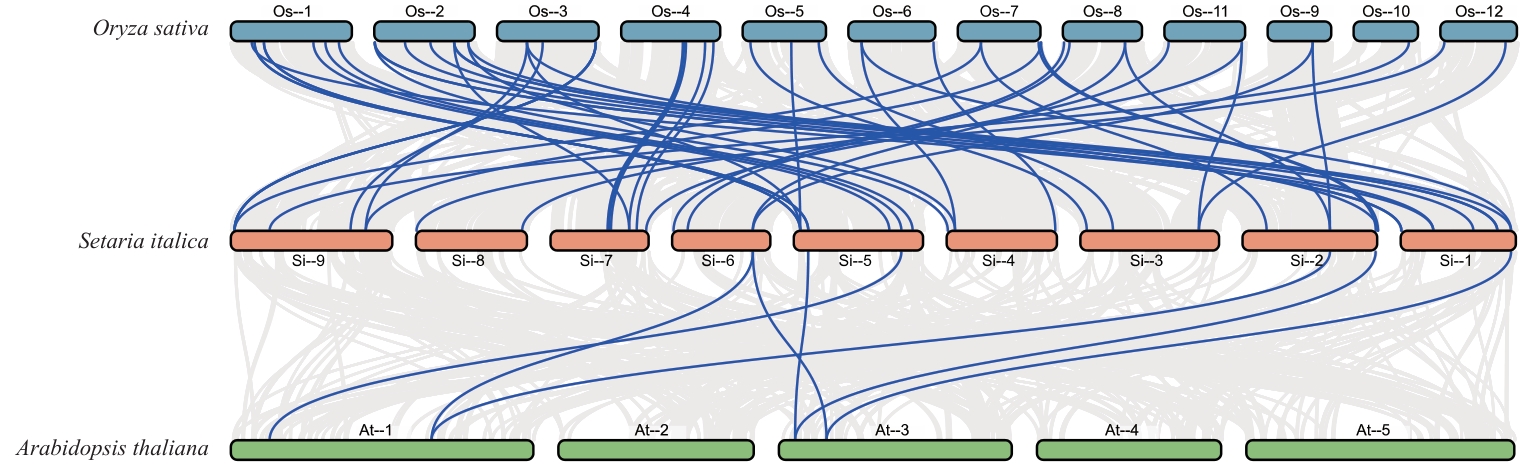
图5 SiPMEI基因家族成员与水稻和拟南芥PMEI基因家族种间共线性分析
Fig. 5 Analysis of inter-specific collinearity between SiPMEI gene family members and PMEI gene families of rice and Arabidopsis
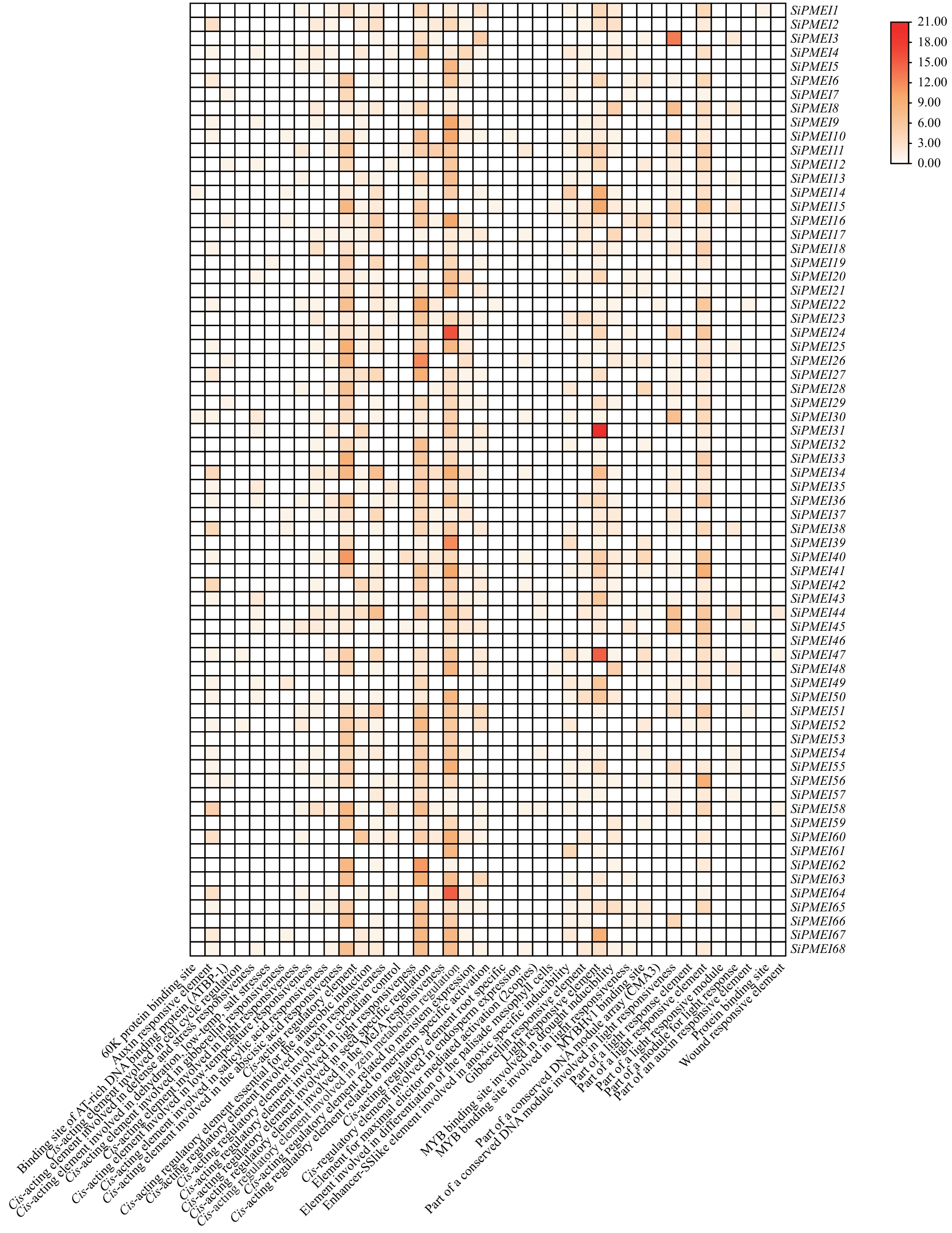
图6 SiPMEI基因家族启动子顺式元件分析
Fig. 6 Analysis of cis-element promoters of the SiPMEI gene family
基因名称 Gene name | 低温响应元件 Low-temperature responsive element | 脱落酸响应元件 ABA responsive element | 茉莉酸甲酯响应元件 MeJA responsive element | 干旱响应元件 Drought responsive element | 亚细胞定位 Subcellular location | 结构域 Structural domain |
|---|---|---|---|---|---|---|
| SiPMEI22 | 1 | 8 | 6 | 0 | Chloroplast | Pectinesteras + PMEI |
| SiPMEI30 | 0 | 6 | 10 | 0 | Cell wall | PMEI |
| SiPMEI31 | 0 | 4 | 12 | 0 | Chloroplast | PMEI |
| SiPMEI32 | 2 | 0 | 0 | 4 | Cell wall | PMEI |
| SiPMEI36 | 1 | 4 | 10 | 0 | Cell wall | PMEI |
| SiPMEI38 | 0 | 1 | 4 | 2 | Chloroplast | Pectinesteras + PMEI |
| SiPMEI47 | 1 | 10 | 16 | 1 | Chloroplast | Pectinesteras + PMEI |
| SiPMEI63 | 0 | 7 | 0 | 2 | Cell wall | PMEI |
表3 所选引物及胁迫响应元件的数目
Table 3 Number of selected primers and stress-responsive elements
基因名称 Gene name | 低温响应元件 Low-temperature responsive element | 脱落酸响应元件 ABA responsive element | 茉莉酸甲酯响应元件 MeJA responsive element | 干旱响应元件 Drought responsive element | 亚细胞定位 Subcellular location | 结构域 Structural domain |
|---|---|---|---|---|---|---|
| SiPMEI22 | 1 | 8 | 6 | 0 | Chloroplast | Pectinesteras + PMEI |
| SiPMEI30 | 0 | 6 | 10 | 0 | Cell wall | PMEI |
| SiPMEI31 | 0 | 4 | 12 | 0 | Chloroplast | PMEI |
| SiPMEI32 | 2 | 0 | 0 | 4 | Cell wall | PMEI |
| SiPMEI36 | 1 | 4 | 10 | 0 | Cell wall | PMEI |
| SiPMEI38 | 0 | 1 | 4 | 2 | Chloroplast | Pectinesteras + PMEI |
| SiPMEI47 | 1 | 10 | 16 | 1 | Chloroplast | Pectinesteras + PMEI |
| SiPMEI63 | 0 | 7 | 0 | 2 | Cell wall | PMEI |
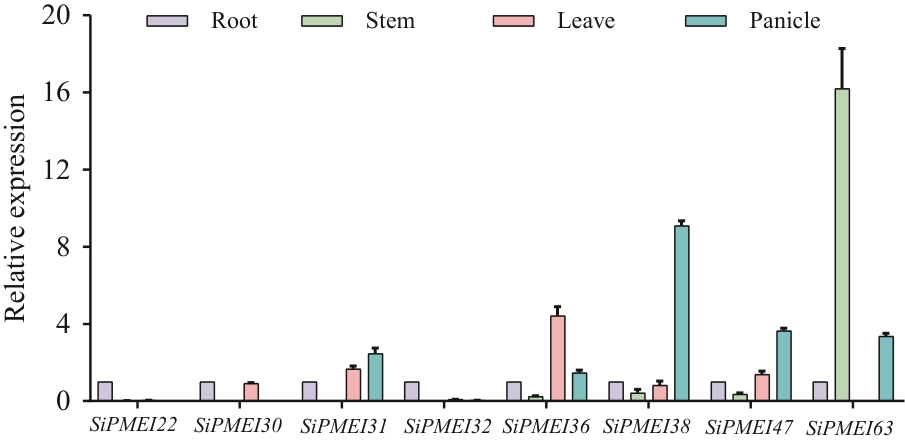
图7 SiPMEI基因家族在不同组织部位中的表达分析
Fig. 7 Expression analysis of the SiPMEI gene family in different tissue sites
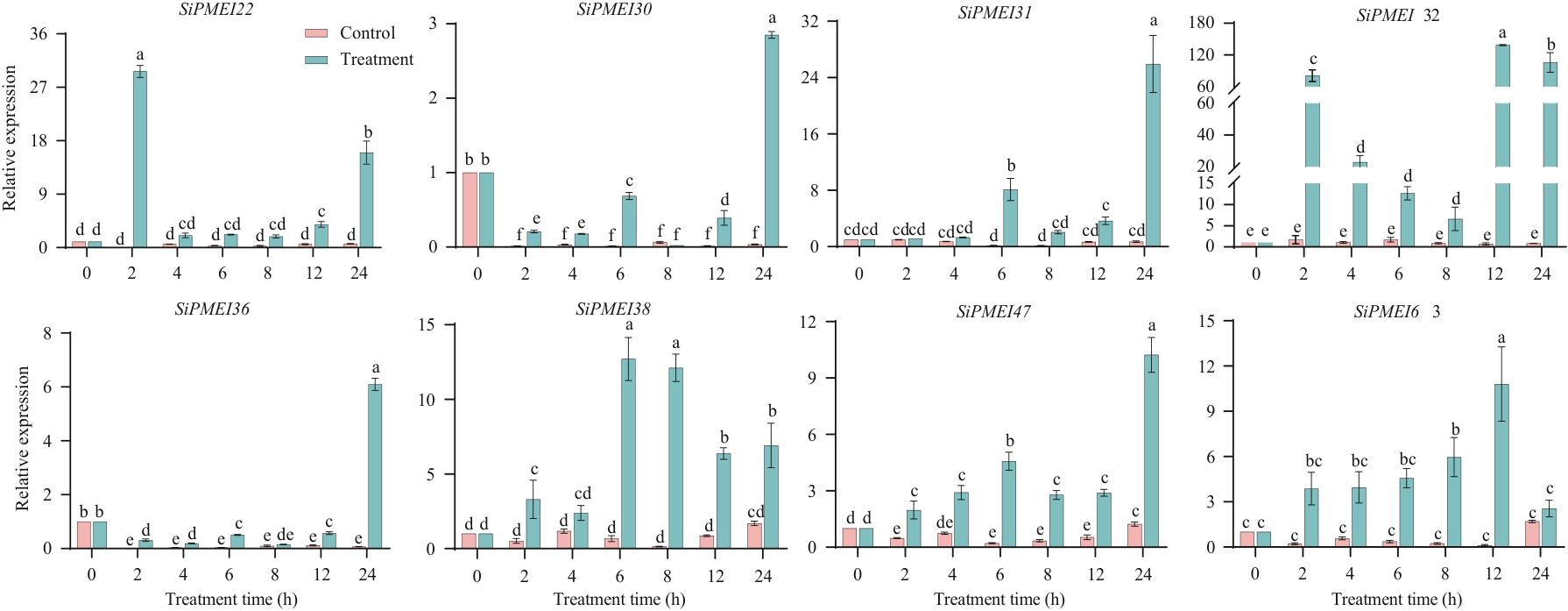
图8 低温胁迫下不同基因的表达水平误差线为标准误,图中不同字母表示差异水平显著(P < 0.05),下同
Fig. 8 Expressions of different genes under low-temperature stressThe error line is the standard error, and the different letters in the figure indicate significant difference levels (P <0.05), the same below
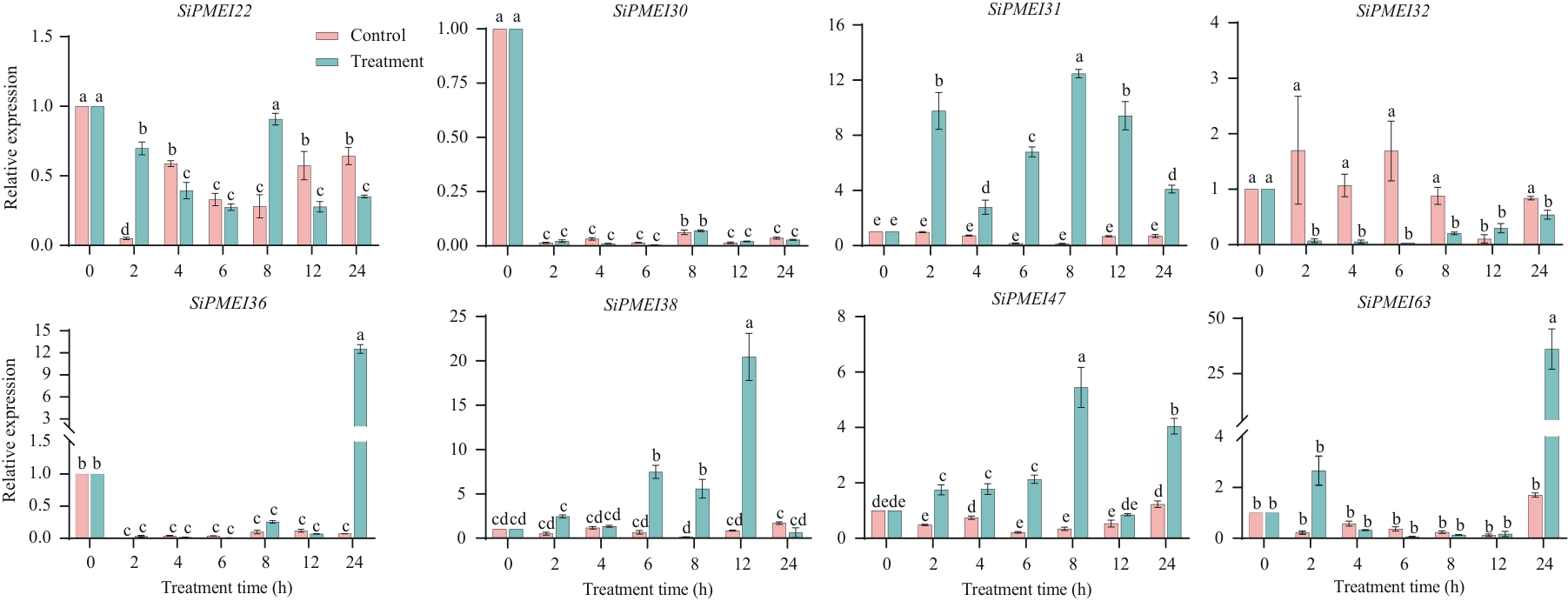
图9 干旱胁迫下不同基因的表达水平
Fig. 9 Expressions of different genes under drought stress
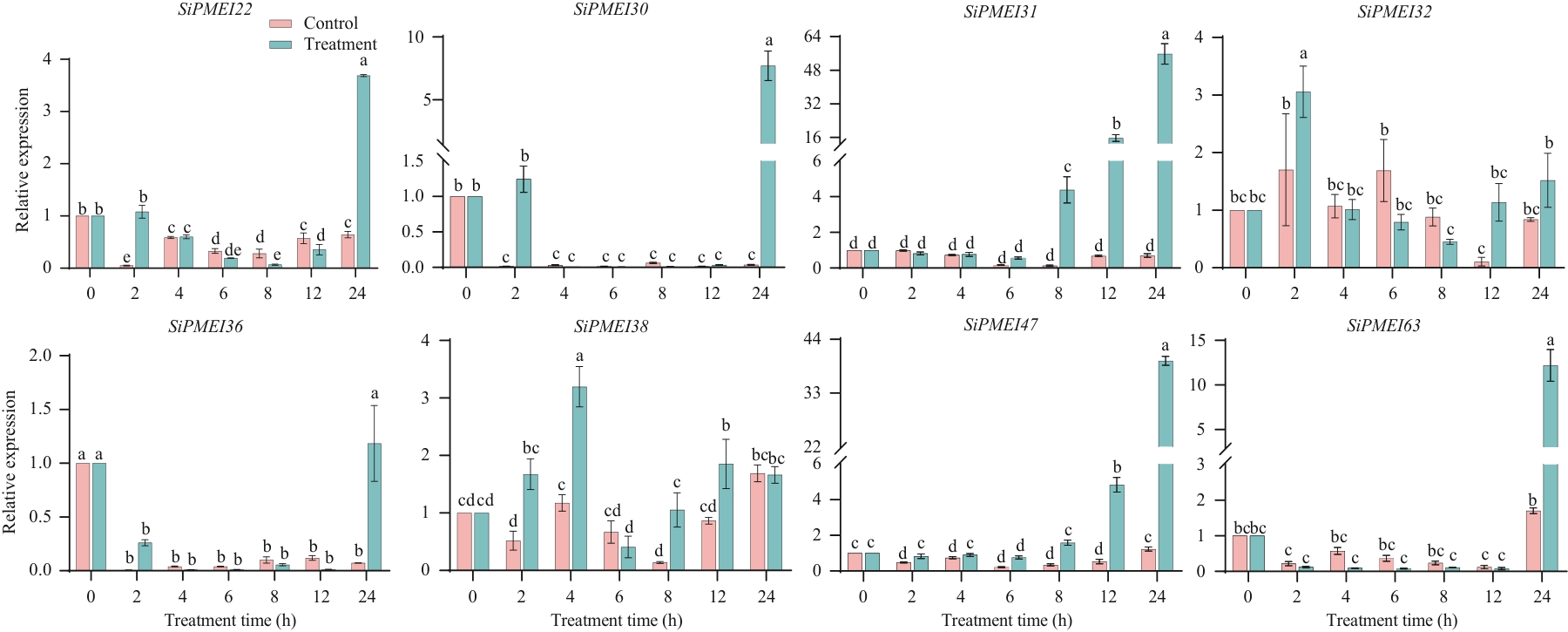
图10 茉莉酸甲酯胁迫下不同基因的表达水平
Fig. 10 Expressions of different genes under methyl jasmonate stress
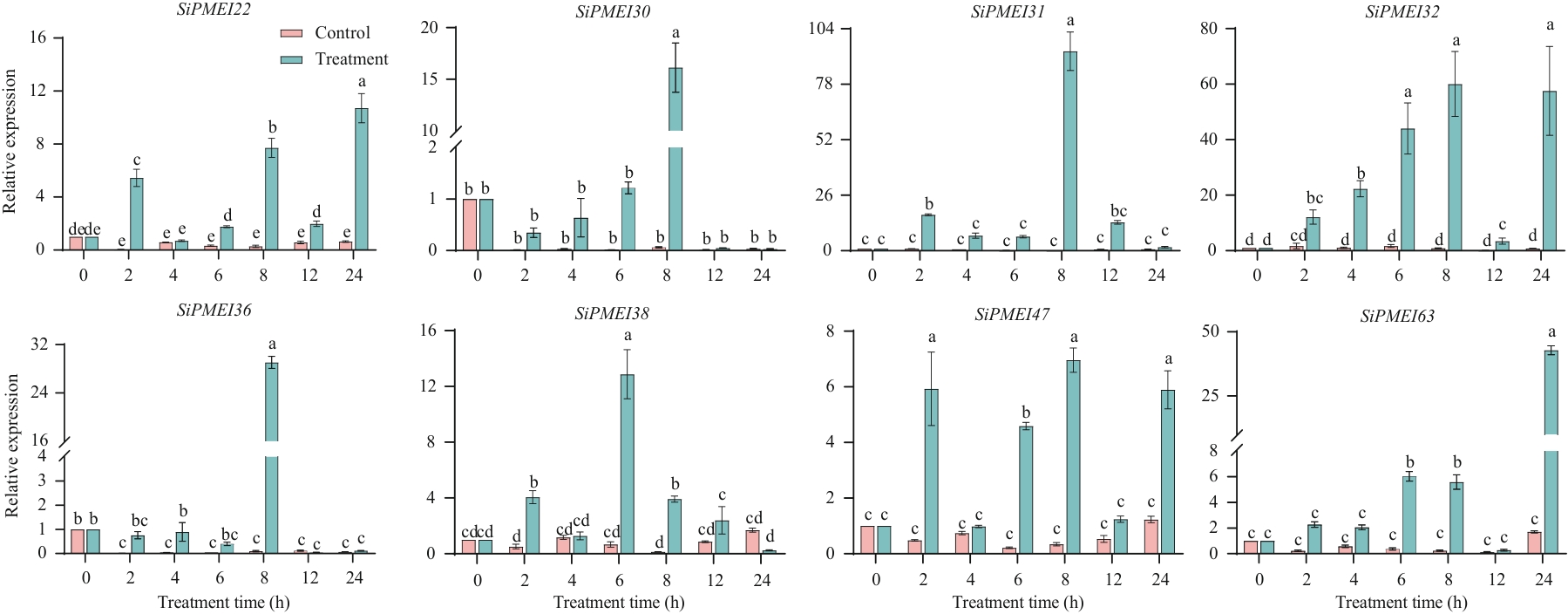
图11 脱落酸胁迫下不同基因的表达水平
Fig. 11 Expressions of different genes under abscisic acid stress
| [1] | 刁现民. 育种创新造就谷子种业新发展 [J]. 中国种业, 2022(4): 4-7. |
| Diao XM. Breeding innovation creates new development of millet seed industry [J]. China Seed Ind, 2022(4): 4-7. | |
| [2] | 周雪, 苏乐平, 李星星, 等. 25个谷子品种(系)主要农艺性状分析及评价 [J]. 中国种业, 2025(2): 95-100, 108. |
| Zhou X, Su LP, Li XX, et al. Analysis and evaluation of main agronomic traits of 25 millet varieties(lines) [J]. China Seed Ind, 2025(2): 95-100, 108. | |
| [3] | 侯保俊, 何太, 杨红霞. 晋北高寒冷凉区谷子地膜覆盖栽培技术 [J]. 农业技术与装备, 2009(5): 34-35. |
| Hou BJ, He T, Yang HX. Cultivation technology of millet in cold area of northern Shanxi [J]. Agric Technol Equip, 2009(5): 34-35. | |
| [4] | 张晓霞. 三种非生物胁迫下谷子qRT-PCR内参基因的筛选与鉴定 [D]. 太谷: 山西农业大学, 2023. |
| Zhang XX. Screening and identification of qRT-PCR reference genes in foxtail millet under threeabiotic stresses [D]. Taigu: Shanxi Agricultural University, 2023. | |
| [5] | 汪明滔, 刘建伟, 赵春钊. 植物调控盐胁迫下细胞壁完整性的分子机制 [J]. 生物技术通报, 2023, 39(11): 18-27. |
| Wang MT, Liu JW, Zhao CZ. Molecular mechanisms of cell wall integrity in plants under salt stress [J]. Biotechnol Bull, 2023, 39(11): 18-27. | |
| [6] | 关月, 费雅婷, 朱祝军, 茹磊. 果胶甲酯酶抑制子在植物生长发育和逆境胁迫中的作用 [J/OL]. 分子植物育种, 2024. . |
| Guan Y, Fei YT, Zhu ZJ, Ru L. The role of pectin methylesterase inhibitors in plant growth, development, and stress response [J/OL]. Mol Plant Breed, 2024. . | |
| [35] | Du XF, Wang ZL, Han KN, et al. Identification and analysis of RNA editing sites of chloroplast genes in foxtail millet [Setaria italica(L.) P.Beauv [J]. Acta Agron Sin, 2022, 48(4): 873-885. |
| [7] | Hothorn M, Wolf S, Aloy P, et al. Structural insights into the target specificity of plant invertase and pectin methylesterase inhibitory proteins [J]. Plant Cell, 2004, 16(12): 3437-3447. |
| [8] | 熊媛. 毛果杨PMEI家族分子特征和功能性评估 [D]. 南京: 南京林业大学, 2023. |
| Xiong Y. Molecular characteristics and functional evaluation of PMEI family of Populus tomentosa [D]. Nanjing: Nanjing Forestry University, 2023. | |
| [9] | Balestrieri C, Castaldo D, Giovane A, et al. A glycoprotein inhibitor of pectin methylesterase in kiwi fruit (Actinidia chinensis) [J]. Eur J Biochem, 1990, 193(1): 183-187. |
| [10] | Wang JJ, Ling L, Cai H, et al. Gene-wide identification and expression analysis of the PMEI family genes in soybean (Glycine max) [J]. 3 Biotech, 2020, 10(8): 335. |
| [11] | Liu TT, Yu H, Xiong XP, et al. Genome-wide identification and characterization of pectin methylesterase inhibitor genes in Brassica oleracea [J]. Int J Mol Sci, 2018, 19(11): 3338. |
| [12] | 王文玉, 施旭, 施琪, 等. 水稻PMEI基因家族的全基因组鉴定与生物信息学分析 [J]. 分子植物育种, 2023, 21(23): 7657-7666. |
| Wang WY, Shi X, Shi Q, et al. Genome-wide identification and bioinformatics analysis of PMEI gene family in rice [J]. Mol Plant Breed, 2023, 21(23): 7657-7666. | |
| [13] | Pinzón-Latorre D, Deyholos MK. Characterization and transcript profiling of the pectin methylesterase (PME) and pectin methylesterase inhibitor (PMEI) gene families in flax (Linum usitatissimum) [J]. BMC Genomics, 2013, 14: 742. |
| [14] | Liu NN, Sun Y, Pei YK, et al. A pectin methylesterase inhibitor enhances resistance to Verticillium wilt [J]. Plant Physiol, 2018, 176(3): 2202-2220. |
| [15] | 杨帅, 高尚珠, 卢晗, 等. 植物细胞壁形成及在非生物胁迫中的作用 [J]. 植物生理学报, 2023, 59(7): 1251-1264. |
| Yang S, Gao SZ, Lu H, et al. Plant cell wall development and its function in abiotic stress [J]. Plant Physiol J, 2023, 59(7): 1251-1264. | |
| [16] | 仇婷婷. 木薯果胶甲基酯酶抑制因子MePMEI1功能分析及其互作蛋白的筛选 [D]. 海口: 海南大学, 2020. |
| Qiu TT. Functional analysis of cassava pectin methyl esterase inhibitor MePMEI1 and screening of its interacting proteins [D]. Haikou: Hainan University, 2020. | |
| [17] | 王跃腾. PMEI抑制PME的机理及食品应用型PMEI的改造研究 [D]. 成都: 成都大学, 2023. |
| Wang YT. Mechanism of PMEI inhibiting PME and modification of food application PMEI [D]. Chengdu: Chengdu University, 2023. | |
| [18] | 楚刘阳. 甘蓝型油菜PMEI和XTH基因家族的鉴定与转录谱分析 [D]. 武汉: 华中农业大学, 2021. |
| Chu LY. Identification and transcription analysis of PMEI and XTH gene families in Brassica napus L [D]. Wuhan: Huazhong Agricultural University, 2021. | |
| [19] | Bosch M, Hepler PK. Pectin methylesterases and pectin dynamics in pollen tubes [J]. Plant Cell, 2005, 17(12): 3219-3226. |
| [20] | 盖芸芸, 何婵, 李娜, 等. 超声波预处理对贮藏过程中猕猴桃质构、果胶特性及果胶酶活性的影响 [J]. 食品科技, 2024, 49(5): 26-34. |
| Gai YY, He C, Li N, et al. Effects of ultrasonic pretreatment on texture, pectin properties, and pectinase activity of kiwifruit during storage [J]. Food Sci Technol, 2024, 49(5): 26-34. | |
| [21] | Wachsman G, Zhang JY, Moreno-Risueno MA, et al. Cell wall remodeling and vesicle trafficking mediate the root clock in Arabidopsis [J]. Science, 2020, 370(6518): 819-823. |
| [22] | Zhang GY, Feng J, Wu J, et al. BoPMEI1, a pollen-specific pectin methylesterase inhibitor, has an essential role in pollen tube growth [J]. Planta, 2010, 231(6): 1323-1334. |
| [23] | Coculo D, Lionetti V. The plant invertase/pectin methylesterase inhibitor superfamily [J]. Front Plant Sci, 2022, 13: 863892. |
| [24] | Nguyen HP, Jeong HY, Jeon SH, et al. Rice pectin methylesterase inhibitor28 (OsPMEI28) encodes a functional PMEI and its overexpression results in a dwarf phenotype through increased pectin methylesterification levels [J]. J Plant Physiol, 2017, 208: 17-25. |
| [25] | Müller K, Levesque-Tremblay G, Fernandes A, et al. Overexpression of a pectin methylesterase inhibitor in Arabidopsis thaliana leads to altered growth morphology of the stem and defective organ separation [J]. Plant Signal Behav, 2013, 8(12): e26464. |
| [26] | Peaucelle A, Louvet R, Johansen JN, et al. Arabidopsis phyllotaxis is controlled by the methyl-esterification status of cell-wall pectins [J]. Curr Biol, 2008, 18(24): 1943-1948. |
| [27] | An SH, Sohn KH, Choi HW, et al. Pepper pectin methylesterase inhibitor protein CaPMEI1 is required for antifungal activity, basal disease resistance and abiotic stress tolerance [J]. Planta, 2008, 228(1): 61-78. |
| [28] | Tan C, Liu ZY, Huang SN, et al. Pectin methylesterase inhibitor (PMEI) family can be related to male sterility in Chinese cabbage (Brassica rapa ssp. pekinensis) [J]. Mol Genet Genomics, 2018, 293(2): 343-357. |
| [29] | Vierstra RD. The ubiquitin-26S proteasome system at the nexus of plant biology [J]. Nat Rev Mol Cell Biol, 2009, 10(6): 385-397. |
| [30] | Zhang JZ. Evolution by gene duplication: an update [J]. Trends Ecol Evol, 2003, 18(6): 292-298. |
| [31] | Jeong HY, Nguyen HP, Eom SH, et al. Integrative analysis of pectin methylesterase (PME) and PME inhibitors in tomato (Solanum lycopersicum): Identification, tissue-specific expression, and biochemical characterization [J]. Plant Physiol Biochem, 2018, 132: 557-565. |
| [32] | 廉雪菲. 柑橘果实囊衣发育形成规律研究 [D]. 长沙: 湖南农业大学, 2022. |
| Lian XF. Study on the development and formation law of citrus fruit capsule [D]. Changsha: Hunan Agricultural University, 2022. | |
| [33] | Hong MJ, Kim DY, Lee TG, et al. Functional characterization of pectin methylesterase inhibitor (PMEI) in wheat [J]. Genes Genet Syst, 2010, 85(2): 97-106. |
| [34] | 陈逸飞, 王文博, 王赛赛, 祝建波. 甜瓜PMEI基因家族的鉴定和表达分析 [J/OL]. 分子植物育种, 2023. . |
| Chen YF, Wang WB, Wang SS, Zhu JB. Identification and expression analysis of PMEI gene family in melon [J/OL]. Mol Plant Breed, 2023. . | |
| [35] | 杜晓芬, 王智兰, 韩康妮, 等. 谷子叶绿体基因RNA编辑位点的鉴定与分析 [J]. 作物学报, 2022, 48(4): 873-885. |
| [1] | 林佳怡, 陈强, 张磊, 刘宏鑫, 郑晓明, 逄洪波. 褪黑素在植物低温胁迫中的研究进展[J]. 生物技术通报, 2025, 41(7): 37-48. |
| [2] | 张泽, 杨秀丽, 宁东贤. 花生4CL基因家族鉴定及对干旱与盐胁迫响应分析[J]. 生物技术通报, 2025, 41(7): 117-127. |
| [3] | 程珊, 王会伟, 陈晨, 朱雅婧, 李春鑫, 别海, 王树峰, 陈献功, 张向歌. 油莎豆MYB转录因子基因CeMYB154克隆及耐盐功能分析[J]. 生物技术通报, 2025, 41(6): 218-228. |
| [4] | 王苗苗, 赵相龙, 王召明, 刘志鹏, 闫龙凤. 花苜蓿TCP基因家族的鉴定及其在干旱胁迫下的表达模式分析[J]. 生物技术通报, 2025, 41(6): 179-190. |
| [5] | 许慧珍, SHANTWANA Ghimire, RAJU Kharel, 岳云, 司怀军, 唐勋. 马铃薯SUMO E3连接酶基因家族分析及StSIZ1基因的克隆与表达模式分析[J]. 生物技术通报, 2025, 41(6): 119-129. |
| [6] | 宗建伟, 邓海芳, 蔡沅原, 常雅雯, 朱雅琦, 杨雨华. AM真菌对干旱胁迫下文冠果根系形态和叶片结构耦合的影响[J]. 生物技术通报, 2025, 41(6): 167-178. |
| [7] | 何卫, 李俊怡, 李新妮, 马雪华, 邢媛, 曹晓宁, 乔治军, 刘思辰. 谷子泛素连接酶U-box E3基因家族的鉴定及响应非生物胁迫分析[J]. 生物技术通报, 2025, 41(5): 104-118. |
| [8] | 杨春, 王晓倩, 王红军, 晁跃辉. 蒺藜苜蓿MtZHD4基因克隆、亚细胞定位及表达分析[J]. 生物技术通报, 2025, 41(5): 244-254. |
| [9] | 田琴, 刘奎, 吴翔纬, 纪媛媛, 曹一博, 张凌云. 转录因子VcMYB17调控蓝莓抗旱性的功能研究[J]. 生物技术通报, 2025, 41(4): 198-210. |
| [10] | 班秋艳, 赵鑫月, 迟文静, 黎俊生, 王琼, 夏瑶, 梁丽云, 贺巍, 李叶云, 赵广山. 茶树光敏色素互作因子CsPIF3a的克隆及其与光温逆境的响应[J]. 生物技术通报, 2025, 41(4): 256-265. |
| [11] | 卢勇杰, 夏海乾, 李永铃, 张文建, 余婧, 赵会纳, 王兵, 许本波, 雷波. 烟草AP2/ERF转录因子NtESR2的克隆及功能分析[J]. 生物技术通报, 2025, 41(4): 266-277. |
| [12] | 钱祺, 王增辉, 孙荣华, 罗英智, 苏良辰. 花生蛋白磷酸酶AhPDCP37的抗旱性功能研究[J]. 生物技术通报, 2025, 41(3): 98-103. |
| [13] | 刘洁, 王飞, 陶婷, 张玉静, 陈浩婷, 张瑞星, 石玉, 张毅. 过表达SlWRKY41提高番茄幼苗抗旱性[J]. 生物技术通报, 2025, 41(2): 107-118. |
| [14] | 李禹欣, 李苗, 杜晓芬, 韩康妮, 连世超, 王军. 谷子SiSAP基因家族的鉴定与表达分析[J]. 生物技术通报, 2025, 41(1): 143-156. |
| [15] | 孔青洋, 张晓龙, 李娜, 张晨洁, 张雪云, 于超, 张启翔, 罗乐. 单叶蔷薇GRAS转录因子家族鉴定及表达分析[J]. 生物技术通报, 2025, 41(1): 210-220. |
| 阅读次数 | ||||||
|
全文 |
|
|||||
|
摘要 |
|
|||||
