







生物技术通报 ›› 2025, Vol. 41 ›› Issue (8): 115-123.doi: 10.13560/j.cnki.biotech.bull.1985.2025-0114
• 研究报告 • 上一篇
李雅琼( ), 格桑拉毛, 陈启迪, 杨宇环, 何花转, 赵耀飞()
收稿日期:2025-01-27
出版日期:2025-08-26
发布日期:2025-08-14
通讯作者:
赵耀飞,男,博士,副教授,研究方向 :杂粮基因功能研究与分子育种;E-mail: zhao_yf@163.com作者简介:李雅琼,女,博士,讲师,研究方向 :杂粮基因功能研究与分子育种;E-mail: li_yaqiong@126.com;李雅琼同为本文
基金资助:
LI Ya-qiong(), GESANG La-mao, CHEN Qi-di, YANG Yu-huan, HE Hua-zhuan, ZHAO Yao-fei()
Received:2025-01-27
Published:2025-08-26
Online:2025-08-14
摘要:
目的 从高粱基因组中发掘调控植物响应盐胁迫的SNF1 RELATED KINASE 2(SnRK2s)基因,为高粱抗盐机制研究提供理论依据。 方法 运用生物信息学技术对高粱SnRK2基因家族成员(SbSnRK2s)进行鉴定和序列分析,利用定量PCR技术分析SbSnRK2s在盐胁迫处理12 h内表达量的动态变化,将盐胁迫诱导显著高表达的基因在拟南芥中异源过表达,检测转基因拟南芥对盐胁迫抗性的变化。 结果 在高粱基因组中共鉴定到11个SbSnRK2s基因,不均匀地分布在7条染色体上,蛋白序列进化树结果表明,SbSnRK2s与同为C4植物的玉米SnRK2亲缘关系较近;启动子分析发现,SbSnRK2s基因启动子含有激素响应、应激响应等元件。盐胁迫处理后,11个SbSnRK2s均上调表达,其中,SbSnRK2.1的上调幅度最大,在盐胁迫处理9 h后上调幅度超过150倍,在拟南芥中异源过表达SbSnRK2.1,经盐胁迫处理,转基因植株的存活率、主根长度和鲜重均显著高于野生型。 结论 SbSnRK2.1在盐处理下的表达量显著升高,异源过表达SbSnRK2.1显著提高了拟南芥对盐胁迫的抗性,表明该基因在植物响应盐胁迫中具有重要作用。
李雅琼, 格桑拉毛, 陈启迪, 杨宇环, 何花转, 赵耀飞. 异源过表达高粱SbSnRK2.1增强拟南芥对盐胁迫的抗性[J]. 生物技术通报, 2025, 41(8): 115-123.
LI Ya-qiong, GESANG La-mao, CHEN Qi-di, YANG Yu-huan, HE Hua-zhuan, ZHAO Yao-fei. Heterologous Overexpression of Sorghum SbSnRK2.1 Enhances the Resistance to Salt Stress in Arabidopsis[J]. Biotechnology Bulletin, 2025, 41(8): 115-123.
| 引物名称 Primer name | 序列 Sequence (5′‒3′) |
|---|---|
| SbSnRK2.1-F | GCCTTCTTACTCAGACCAAT |
| SbSnRK2.1-R | TCCTTCTCTTCTTCTTCATCC |
| SbSnRK2.2-F | CGGCTATTCCAAGTCATCT |
| SbSnRK2.2-R | GCACCAACAACCATTACATA |
| SbSnRK2.3-F | TCATCAGTTCTACACTCTCAG |
| SbSnRK2.3-R | ACCGACCAGCATCACATA |
| SbSnRK2.4-F | AGGACGAGGCAAGGTATT |
| SbSnRK2.4-R | CAGCAGCGATGACTTAGA |
| SbSnRK2.5-F | TCAGGCTATGGCTACAGT |
| SbSnRK2.5-R | CACACTCATCTTCTTCTTCC |
| SbSnRK2.6-F | CACTCTGCTGGATGGAAG |
| SbSnRK2.6-R | CAATCTTGCCGTCGTATTC |
| SbSnRK2.7-F | TTCGCCGTCAAGTTCATC |
| SbSnRK2.7-R | GCCAGCAGCATATTCCATA |
| SbSnRK2.8-F | GTGAGAATGAGGCAAGGTT |
| SbSnRK2.8-F | TGAGAGTGAAGAACAGAAGAC |
| SbSnRK2.9-R | CATGAGGATCGTTCAGGAG |
| SbSnRK2.9-F | TGTCGTAGTCGTCTTCTTC |
| SbSnRK2.10-R | ACTTACTCCGTCCAGTCC |
| SbSnRK2.10-F | CCATCCTCTTCCTCCTCAT |
| SbSnRK2.11-R | GGCAAGAAGATTGATGAGAA |
| SbSnRK2.11-R | TCCACCAGCAGCATATTC |
表1 本研究所用的引物序列
Table 1 Primers used in this study
| 引物名称 Primer name | 序列 Sequence (5′‒3′) |
|---|---|
| SbSnRK2.1-F | GCCTTCTTACTCAGACCAAT |
| SbSnRK2.1-R | TCCTTCTCTTCTTCTTCATCC |
| SbSnRK2.2-F | CGGCTATTCCAAGTCATCT |
| SbSnRK2.2-R | GCACCAACAACCATTACATA |
| SbSnRK2.3-F | TCATCAGTTCTACACTCTCAG |
| SbSnRK2.3-R | ACCGACCAGCATCACATA |
| SbSnRK2.4-F | AGGACGAGGCAAGGTATT |
| SbSnRK2.4-R | CAGCAGCGATGACTTAGA |
| SbSnRK2.5-F | TCAGGCTATGGCTACAGT |
| SbSnRK2.5-R | CACACTCATCTTCTTCTTCC |
| SbSnRK2.6-F | CACTCTGCTGGATGGAAG |
| SbSnRK2.6-R | CAATCTTGCCGTCGTATTC |
| SbSnRK2.7-F | TTCGCCGTCAAGTTCATC |
| SbSnRK2.7-R | GCCAGCAGCATATTCCATA |
| SbSnRK2.8-F | GTGAGAATGAGGCAAGGTT |
| SbSnRK2.8-F | TGAGAGTGAAGAACAGAAGAC |
| SbSnRK2.9-R | CATGAGGATCGTTCAGGAG |
| SbSnRK2.9-F | TGTCGTAGTCGTCTTCTTC |
| SbSnRK2.10-R | ACTTACTCCGTCCAGTCC |
| SbSnRK2.10-F | CCATCCTCTTCCTCCTCAT |
| SbSnRK2.11-R | GGCAAGAAGATTGATGAGAA |
| SbSnRK2.11-R | TCCACCAGCAGCATATTC |
基因 Gene | 基因ID Gene ID | 基因长度 Gene length (bp) | CDS长度 CDS length (bp) |
|---|---|---|---|
| SbSnRK2.1 | Sobic.003G370100 | 5 130 | 1 086 |
| SbSnRK2.2 | Sobic.001G078800 | 7 044 | 1 101 |
| SbSnRK2.3 | Sobic.001G168400 | 3 201 | 1 089 |
| SbSnRK2.4 | Sobic.004G173500 | 5 029 | 1 095 |
| SbSnRK2.5 | Sobic.009G149900 | 4 945 | 1 080 |
| SbSnRK2.6 | Sobic.008G147000 | 2 691 | 1 095 |
| SbSnRK2.7 | Sobic.002G379400 | 4 989 | 1 020 |
| SbSnRK2.8 | Sobic.001G350700 | 4 525 | 1 035 |
| SbSnRK2.9 | Sobic.006G279100 | 6 401 | 1 140 |
| SbSnRK2.10 | Sobic.006G083000 | 5 786 | 1 134 |
| SbSnRK2.11 | Sobic.001G294400 | 3 307 | 1 002 |
表2 高粱SnRK2基因(SbSnRK2s)基本信息
Table 2 Information of SnRK2 genes in sorghum (SbSnRK2s)
基因 Gene | 基因ID Gene ID | 基因长度 Gene length (bp) | CDS长度 CDS length (bp) |
|---|---|---|---|
| SbSnRK2.1 | Sobic.003G370100 | 5 130 | 1 086 |
| SbSnRK2.2 | Sobic.001G078800 | 7 044 | 1 101 |
| SbSnRK2.3 | Sobic.001G168400 | 3 201 | 1 089 |
| SbSnRK2.4 | Sobic.004G173500 | 5 029 | 1 095 |
| SbSnRK2.5 | Sobic.009G149900 | 4 945 | 1 080 |
| SbSnRK2.6 | Sobic.008G147000 | 2 691 | 1 095 |
| SbSnRK2.7 | Sobic.002G379400 | 4 989 | 1 020 |
| SbSnRK2.8 | Sobic.001G350700 | 4 525 | 1 035 |
| SbSnRK2.9 | Sobic.006G279100 | 6 401 | 1 140 |
| SbSnRK2.10 | Sobic.006G083000 | 5 786 | 1 134 |
| SbSnRK2.11 | Sobic.001G294400 | 3 307 | 1 002 |
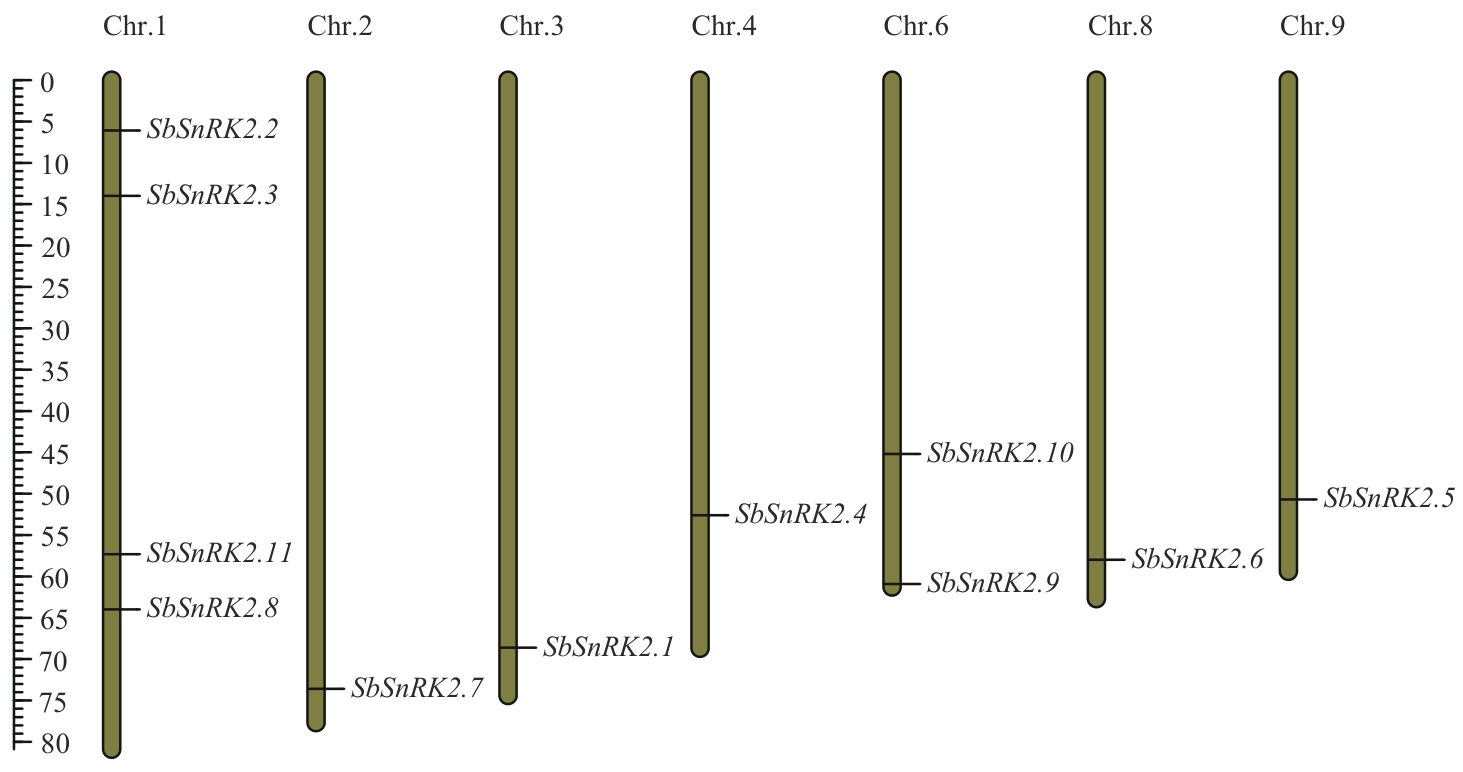
图1 SbSnRK2s在高粱基因组中的分布染色体上位置距离用Mb表示
Fig. 1 Distribution of SbSnRK2s in the genome of sorghumChromosomal distances are given in Mb

图2 SbSnRK2s的基因结构分析黄色部分表示外显子,黑色实线表示内含子,蓝色部分为基因上下游非编码区序列
Fig. 2 Gene structure analysis of SbSnRK2sThe yellow part indicates the exon, the black solid line indicates the intron, and the blue part indicates the sequence of the upstream and downstream non-coding regions of the SbSnRK2 genes
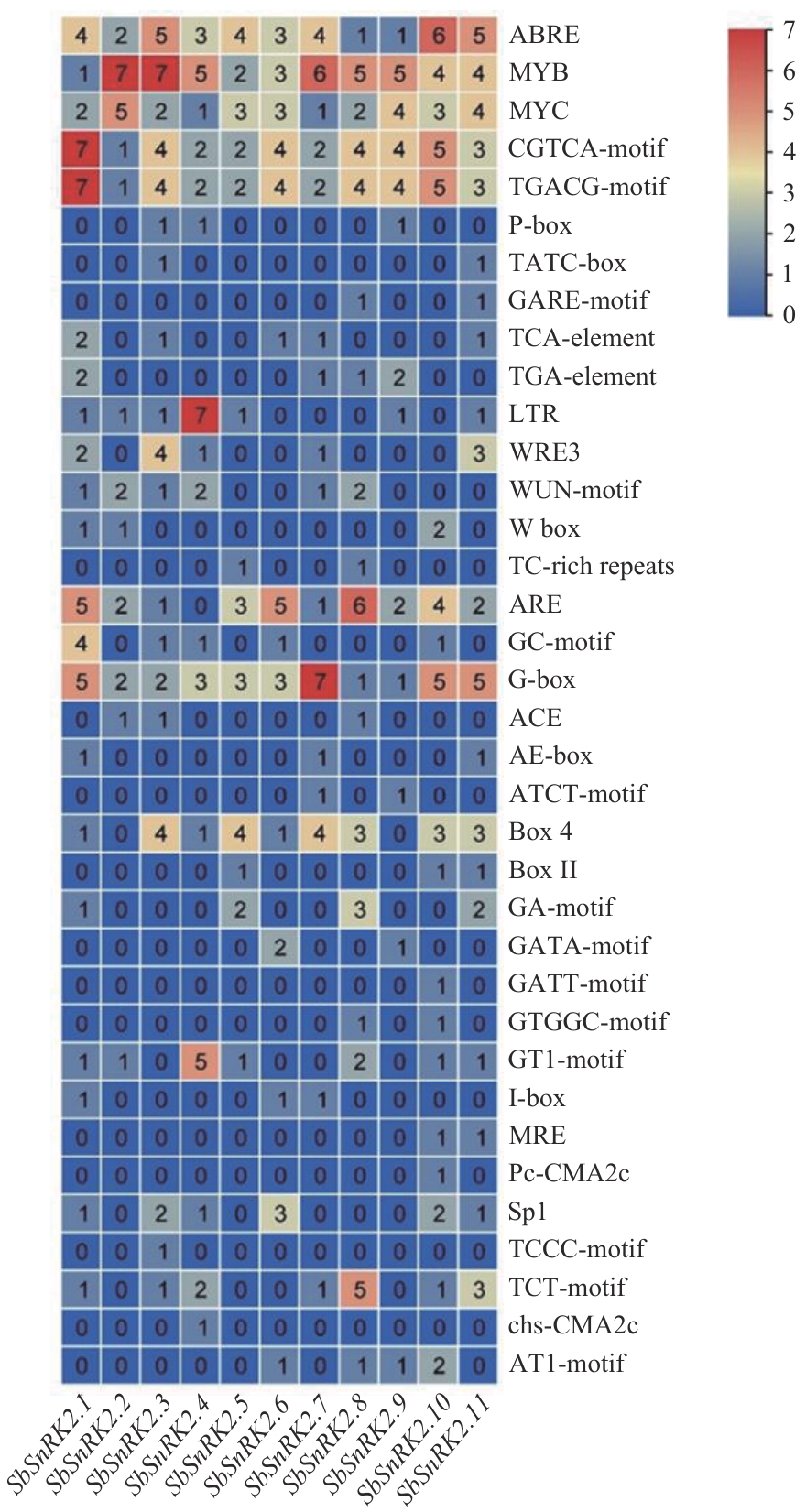
图3 SbSnRK2基因启动子特征分析
Fig. 3 Promoter characteristics analysis of SbSnRK2 genes

图4 SnRK2s的进化树分析Sb:高粱;At:拟南芥;Os:水稻;Zm:玉米
Fig. 4 Phylogenetic analysis of SnRK2Sb: Sorghum bicolor; At: Arabidopsis thaliana; Os: Oryza sativa; Zm: Zea mays

图5 盐胁迫下SbSnRK2s的表达模式不同小写字母表示统计学显著差异(P<0.05)
Fig. 5 Expression patterns of the SbSnRK2s under salt stressDifferent letters above the bar chart indicate significant differences at P<0.05

图6 盐胁迫下异源过表达SbSnRK2.1植株的表型(A)和存活率(B)* P<0.05. ** P<0.01. ns: No significant. Bar = 1 cm. The same below
Fig. 6 Phenotype (A) and the survival rates (B) of plants overexpressing SbSnRK2.1 under salt stress

图7 异源过表达SbSnRK2.1促进了拟南芥在盐胁迫下的主根生长A:正常生长和盐胁迫下的主根生长情况,标尺=1 cm;B:主根长度统计;C:相对根长(盐胁迫下主根长与正常生长平均根长的比值)
Fig. 7 Heterologous overexpression of SbSnRK2.1 promotes the primary root growth of A. thaliana under salt stressA: Growth of primary roots under normal and salt stress conditions, bar = 1 cm. B: Statistics of primary root length. C: Relative root length (ratio of root length under salt stress to average root length under normal growth conditions)

图8 异源过表达SbSnRK2.1和野生型拟南芥在盐胁迫下的鲜重变化
Fig. 8 Variation in fresh weights of heterologously-overexpressed SbSnRK2.1 and wild A. thaliana under salt stress
| [1] | Munns R, Tester M. Mechanisms of salinity tolerance [J]. Annu Rev Plant Biol, 2008, 59: 651-681. |
| [2] | Ismail A, Takeda S, Nick P. Life and death under salt stress: same players, different timing? [J]. J Exp Bot, 2014, 65(12): 2963-2979. |
| [3] | Yang YQ, Guo Y. Elucidating the molecular mechanisms mediating plant salt-stress responses [J]. New Phytol, 2018, 217(2): 523-539. |
| [4] | Jamra G, Agarwal A, Singh N, et al. Ectopic expression of finger millet calmodulin confers drought and salinity tolerance in Arabidopsis thaliana [J]. Plant Cell Rep, 2021, 40(11): 2205-2223. |
| [5] | Nakashima K, Ito Y, Yamaguchi-Shinozaki K. Transcriptional regulatory networks in response to abiotic stresses in Arabidopsis and grasses [J]. Plant Physiol, 2009, 149(1): 88-95. |
| [6] | Munns R, Gilliham M. Salinity tolerance of crops-what is the cost? [J]. New Phytol, 2015, 208(3): 668-673. |
| [7] | Liang XY, Li JF, Yang YQ, et al. Designing salt stress-resilient crops: current progress and future challenges [J]. J Integr Plant Biol, 2024, 66(3): 303-329. |
| [8] | Hrabak EM, Chan CWM, Gribskov M, et al. The Arabidopsis CDPK-SnRK superfamily of protein kinases [J]. Plant Physiol, 2003, 132(2): 666-680. |
| [9] | Halford NG, Hey SJ. Snf1-related protein kinases (SnRKs) act within an intricate network that links metabolic and stress signalling in plants [J]. Biochem J, 2009, 419(2): 247-259. |
| [10] | Jossier M, Bouly JP, Meimoun P, et al. SnRK1 (SNF1-related kinase 1) has a central role in sugar and ABA signalling in Arabidopsis thaliana [J]. Plant J, 2009, 59(2): 316-328. |
| [11] | Guo Y, Xiong LM, Song CP, et al. A calcium sensor and its interacting protein kinase are global regulators of abscisic acid signaling in Arabidopsis [J]. Dev Cell, 2002, 3(2): 233-244. |
| [12] | Kim KN, Cheong YH, Grant JJ, et al. CIPK3, a calcium sensor-associated protein kinase that regulates abscisic acid and cold signal transduction in Arabidopsis [J]. Plant Cell, 2003, 15(2): 411-423. |
| [13] | Boudsocq M, Barbier-Brygoo H, Laurière C. Identification of nine sucrose nonfermenting 1-related protein kinases 2 activated by hyperosmotic and saline stresses in Arabidopsis thaliana [J]. J Biol Chem, 2004, 279(40): 41758-41766. |
| [14] | Yoshida R, Umezawa T, Mizoguchi T, et al. The regulatory domain of SRK2E/OST1/SnRK2.6 interacts with ABI1 and integrates abscisic acid (ABA) and osmotic stress signals controlling stomatal closure in Arabidopsis [J]. J Biol Chem, 2006, 281(8): 5310-5318. |
| [15] | Fujii H, Verslues PE, Zhu JK. Arabidopsis decuple mutant reveals the importance of SnRK2 kinases in osmotic stress responses in vivo [J]. Proc Natl Acad Sci USA, 2011, 108(4): 1717-1722. |
| [16] | Kulik A, Wawer I, Krzywińska E, et al. SnRK2 protein kinases‒key regulators of plant response to abiotic stresses [J]. OMICS, 2011, 15(12): 859-872. |
| [17] | Fujii H, Zhu JK. Arabidopsis mutant deficient in 3 abscisic acid-activated protein kinases reveals critical roles in growth, reproduction, and stress [J]. Proc Natl Acad Sci USA, 2009, 106(20): 8380-8385. |
| [18] | Fujita Y, Nakashima K, Yoshida T, et al. Three SnRK2 protein kinases are the main positive regulators of abscisic acid signaling in response to water stress in Arabidopsis [J]. Plant Cell Physiol, 2009, 50(12): 2123-2132. |
| [19] | Nakashima K, Fujita Y, Kanamori N, et al. Three Arabidopsis SnRK2 protein kinases, SRK2D/SnRK2.2, SRK2E/SnRK2.6/OST1 and SRK2I/SnRK2.3, involved in ABA signaling are essential for the control of seed development and dormancy [J]. Plant Cell Physiol, 2009, 50(7): 1345-1363. |
| [20] | Umezawa T, Yoshida R, Maruyama K, et al. SRK2C a SNF1-related protein kinase 2, improves drought tolerance by controlling stress-responsive gene expression in Arabidopsis thaliana [J]. Proc Natl Acad Sci USA, 2004, 101(49): 17306-17311. |
| [21] | Mizoguchi M, Umezawa T, Nakashima K, et al. Two closely related subclass II SnRK2 protein kinases cooperatively regulate drought-inducible gene expression [J]. Plant Cell Physiol, 2010, 51(5): 842-847. |
| [22] | Anderberg RJ, Walker-Simmons MK. Isolation of a wheat cDNA clone for an abscisic acid-inducible transcript with homology to protein kinases [J]. Proc Natl Acad Sci USA, 1992, 89(21): 10183-10187. |
| [23] | Mao XG, Zhang HY, Tian SJ, et al. TaSnRK2.4, an SNF1-type serine/threonine protein kinase of wheat (Triticum aestivum L.), confers enhanced multistress tolerance in Arabidopsis [J]. J Exp Bot, 2010, 61(3): 683-696. |
| [24] | Diédhiou CJ, Popova OV, Dietz KJ, et al. The SNF1-type serine-threonine protein kinase SAPK4 regulates stress-responsive gene expression in rice [J]. BMC Plant Biol, 2008, 8: 49. |
| [25] | Lou DJ, Wang HP, Liang G, et al. OsSAPK2 confers abscisic acid sensitivity and tolerance to drought stress in rice [J]. Front Plant Sci, 2017, 8: 993. |
| [26] | Lou DJ, Lu SP, Chen Z, et al. Molecular characterization reveals that OsSAPK3 improves drought tolerance and grain yield in rice [J]. BMC Plant Biol, 2023, 23(1): 53. |
| [27] | Zhao MC, Zhang Q, Liu H, et al. The osmotic stress-activated receptor-like kinase DPY1 mediates SnRK2 kinase activation and drought tolerance in Setaria [J]. Plant Cell, 2023, 35(10): 3782-3808. |
| [28] | 张春兰, 满丽莉, 向殿军, 等. 菘蓝ItSnRK2.1基因的克隆及其序列特性分析 [J]. 生物技术通报, 2018, 34(1): 119-128. |
| Zhang CL, Man LL, Xiang DJ, et al. Cloning and characteristics analysis of gene ItSnRK2.1 from Isatis tinctoria [J]. Biotechnol Bull, 2018, 34(1): 119-128. | |
| [29] | Mullet J, Morishige D, McCormick R, et al. Energy sorghum‒a genetic model for the design of C4 grass bioenergy crops [J]. J Exp Bot, 2014, 65(13): 3479-3489. |
| [30] | Xie Q, Xu ZH. Sustainable agriculture: from sweet sorghum planting and ensiling to ruminant feeding [J]. Mol Plant, 2019, 12(5): 603-606. |
| [31] | Wei CZ, Gao L, Xiao RX, et al. Complete telomere-to-telomere assemblies of two sorghum genomes to guide biological discovery [J]. iMeta, 2024, 3(2): e193. |
| [32] | Kobayashi Y, Yamamoto S, Minami H, et al. Differential activation of the rice sucrose nonfermenting1-related protein kinase2 family by hyperosmotic stress and abscisic acid [J]. Plant Cell, 2004, 16(5): 1163-1177. |
| [33] | Long TD, Xu BJ, Hu YF, et al. Genome-wide identification of ZmSnRK2 genes and functional analysis of ZmSnRK2.10 in ABA signaling pathway in maize (Zea mays L) [J]. BMC Plant Biol, 2021, 21(1): 309. |
| [34] | Varoquaux N, Cole B, Gao C, et al. Transcriptomic analysis of field-droughted sorghum from seedling to maturity reveals biotic and metabolic responses [J]. Proc Natl Acad Sci USA, 2019, 116(52): 27124-27132. |
| [35] | Chen CX, Shang XL, Sun MY, et al. Comparative transcriptome analysis of two sweet sorghum genotypes with different salt tolerance abilities to reveal the mechanism of salt tolerance [J]. Int J Mol Sci, 2022, 23(4): 2272. |
| [36] | 山仑, 徐炳成. 论高粱的抗旱性及在旱区农业中的地位 [J]. 中国农业科学, 2009, 42(7): 2342-2348. |
| Shan L, Xu BC. Discussion on drought resistance of sorghum and its status in agriculture in arid and semiarid regions [J]. Sci Agric Sin, 2009, 42(7): 2342-2348. | |
| [37] | Zhang HL, Yu FF, Xie P, et al. A Gγ protein regulates alkaline sensitivity in crops [J]. Science, 2023, 379(6638): eade8416. |
| [38] | Lou DJ, Wang HP, Yu DQ. The sucrose non-fermenting-1-related protein kinases SAPK1 and SAPK2 function collaboratively as positive regulators of salt stress tolerance in rice [J]. BMC Plant Biol, 2018, 18(1): 203. |
| [39] | Song XQ, Yu X, Hori C, et al. Heterologous overexpression of poplar SnRK2 genes enhanced salt stress tolerance in Arabidopsis thaliana [J]. Front Plant Sci, 2016, 7: 612. |
| [40] | Feng JL, Wang LZ, Wu YN, et al. TaSnRK2.9, a sucrose non-fermenting 1-related protein kinase gene, positively regulates plant response to drought and salt stress in transgenic tobacco [J]. Front Plant Sci, 2019, 9: 2003. |
| [1] | 程雪, 付颖, 柴晓娇, 王红艳, 邓欣. 谷子LHC基因家族鉴定及非生物胁迫表达分析[J]. 生物技术通报, 2025, 41(8): 102-114. |
| [2] | 张泽, 杨秀丽, 宁东贤. 花生4CL基因家族鉴定及对干旱与盐胁迫响应分析[J]. 生物技术通报, 2025, 41(7): 117-127. |
| [3] | 付博晗, 毛华, 赵薪程, 陆虹, 欧庸彬, 姚银安. 不同杨树SOS1基因启动子的克隆及盐胁迫响应分析[J]. 生物技术通报, 2025, 41(7): 205-213. |
| [4] | 王芳, 乔帅, 宋伟, 崔鹏娟, 廖安忠, 谭文芳, 杨松涛. 甘薯IbNRT2基因家族全基因组鉴定和表达分析[J]. 生物技术通报, 2025, 41(7): 193-204. |
| [5] | 魏雨佳, 李岩, 康语涵, 弓晓楠, 杜敏, 涂岚, 石鹏, 于子涵, 孙彦, 张昆. 白颖苔草CrMYB4基因的克隆和表达分析[J]. 生物技术通报, 2025, 41(7): 248-260. |
| [6] | 赵强, 陈思宇, 彭方丽, 汪灿, 高杰, 周棱波, 张国兵, 姜昱雯, 邵明波. 间作与施氮对高粱根际土壤细菌多样性及功能的影响[J]. 生物技术通报, 2025, 41(6): 307-316. |
| [7] | 程珊, 王会伟, 陈晨, 朱雅婧, 李春鑫, 别海, 王树峰, 陈献功, 张向歌. 油莎豆MYB转录因子基因CeMYB154克隆及耐盐功能分析[J]. 生物技术通报, 2025, 41(6): 218-228. |
| [8] | 李志强, 罗正乾, 徐琳黎, 周国慧, 屈丝雨, 刘恩良, 顼东婷. 基于T2T基因组鉴定大豆R2R3-MYB基因家族及干旱和盐胁迫下的表达分析[J]. 生物技术通报, 2025, 41(5): 141-152. |
| [9] | 杨春, 王晓倩, 王红军, 晁跃辉. 蒺藜苜蓿MtZHD4基因克隆、亚细胞定位及表达分析[J]. 生物技术通报, 2025, 41(5): 244-254. |
| [10] | 刘卓君, 柴文婷, 任毅乐, 王新宇, 朱立勋, 赵珊珊, 杨博慧, 范佳利, 李新凤, 赵威军, 吕晋慧, 张春来. 高粱TGA基因响应孢堆黑粉菌(Sporisorium reilianum)侵染表达和DNA变异分析[J]. 生物技术通报, 2025, 41(5): 90-103. |
| [11] | 宋慧洋, 苏宝杰, 李京昊, 梅超, 宋倩娜, 崔福柱, 冯瑞云. 马铃薯StAS2-15基因的克隆及盐胁迫下功能分析[J]. 生物技术通报, 2025, 41(5): 119-128. |
| [12] | 刘彤彤, 李肖慧, 杨骏龙, 陈旺, 玉猛, 王超凡, 王凤茹, 客绍英. ZmSTART1调控玉米维管束建成的功能研究[J]. 生物技术通报, 2025, 41(4): 115-122. |
| [13] | 刘涛, 王志淇, 吴文博, 石文婷, 王超楠, 杜崇, 杨中敏. 马铃薯GRAM基因家族鉴定与表达分析[J]. 生物技术通报, 2025, 41(4): 145-155. |
| [14] | 杜品廷, 吴国江, 王振国, 李岩, 周伟, 周亚星. 高粱CPP基因家族鉴定及表达分析[J]. 生物技术通报, 2025, 41(1): 132-142. |
| [15] | 李彩霞, 李艺, 穆宏秀, 林俊轩, 白龙强, 孙美华, 苗妍秀. 中国南瓜bHLH转录因子家族的鉴定与生物信息学分析[J]. 生物技术通报, 2025, 41(1): 186-197. |
| 阅读次数 | ||||||
|
全文 |
|
|||||
|
摘要 |
|
|||||
