







生物技术通报 ›› 2025, Vol. 41 ›› Issue (8): 289-299.doi: 10.13560/j.cnki.biotech.bull.1985.2025-0107
• 研究报告 • 上一篇
李德海1,2( ), 殷丽1,2, 周才雪1,2, 王泽童1,2, 孙常雁3
收稿日期:2025-01-26
出版日期:2025-08-26
发布日期:2025-08-14
通讯作者:
李德海,男,博士,副教授,研究方向 :东北特色浆果贮藏与保鲜;E-mail: lidehaineau@163.com作者简介:第一联系人:共同第一作者
基金资助:
LI De-hai1,2(), YIN Li1,2, ZHOU Cai-xue1,2, WANG Ze-tong1,2, SUN Chang-yan3
Received:2025-01-26
Published:2025-08-26
Online:2025-08-14
摘要:
目的 筛选并鉴定一株具有抑制蓝靛果采后致腐真菌功能的乳酸菌,并研究其对蓝靛果采后保鲜效果的影响,为解决蓝靛果采后腐烂问题提供新的技术手段。 方法 从泡菜与发酵浆果中分离纯化乳酸菌后,筛选能抑制蓝靛果采后致腐真菌(链格孢霉与小孢根霉)的乳酸菌P-2,通过16S rRNA基因序列分析鉴定菌株。评估P-2的抗生素敏感性以及不同条件下无细胞上清液(cell-free supernatant, CFS)对致腐真菌抑制效果。最后以P-2的CFS作为保鲜剂对蓝靛果进行保鲜实验。 结果 在分离并纯化出的22株乳酸菌中,P-2菌株展现出最佳的抑菌效果,经鉴定为乳酸片球菌(Pediococcus acidilactici)。乳酸片球菌P-2对卡那霉素、庆大霉素与链霉素耐受,对其他抗生素敏感或中性敏感,其CFS在酸性条件下的抑菌活性较强,对蛋白酶敏感。P-2 CFS对链格孢霉和小孢根霉的MIC分别为12.8 mg/mL、25.6 mg/mL。与对照组相比,乳酸片球菌P-2的CFS可以降低蓝靛果的失重率和腐烂率,减缓蓝靛果在贮藏期间硬度、总酚、类黄酮以及维生素C含量的下降,同时可以使蓝靛果的货架期至少延长7 d。 结论 乳酸片球菌P-2的CFS具有抑制蓝靛果致腐真菌的作用,可作为一种绿色保鲜剂应用于浆果的采后保鲜中。
李德海, 殷丽, 周才雪, 王泽童, 孙常雁. 具有抑制蓝靛果致腐真菌生长的乳酸菌筛选、鉴定及保鲜研究[J]. 生物技术通报, 2025, 41(8): 289-299.
LI De-hai, YIN Li, ZHOU Cai-xue, WANG Ze-tong, SUN Chang-yan. Screening, Identification and Preservation of Lactic Acid Bacteria Inhibiting the Growth of Rot-causing Fungus Lonicera caerulea L.[J]. Biotechnology Bulletin, 2025, 41(8): 289-299.
乳酸菌 Lactic acid bacteria | 链格孢霉 A. alternata | 小孢根霉 R. microspora |
|---|---|---|
| P-1 | - | - |
| P-2 | +++ | ++ |
| P-3 | - | - |
| P-4 | ++ | ++ |
| P-5 | ++ | +++ |
| P-6 | +++ | - |
| P-7 | - | + |
| P-8 | - | - |
| P-9 | ++ | + |
| P-10 | + | - |
| P-11 | + | - |
| J-12 | +++ | ++ |
| J-13 | ++ | +++ |
| J-14 | - | - |
| J-15 | - | ++ |
| J-16 | ++ | - |
| J-17 | + | - |
| J-18 | - | - |
| J-19 | ++ | ++ |
| J-20 | + | - |
| J-21 | ++ | ++ |
| J-22 | - | - |
表1 乳酸菌对链格孢霉和小孢根霉的抗真菌活性
Table 1 Antifungal activities of lactic acid bacteria against Alternaria alternata and Rhizoctonia microspora
乳酸菌 Lactic acid bacteria | 链格孢霉 A. alternata | 小孢根霉 R. microspora |
|---|---|---|
| P-1 | - | - |
| P-2 | +++ | ++ |
| P-3 | - | - |
| P-4 | ++ | ++ |
| P-5 | ++ | +++ |
| P-6 | +++ | - |
| P-7 | - | + |
| P-8 | - | - |
| P-9 | ++ | + |
| P-10 | + | - |
| P-11 | + | - |
| J-12 | +++ | ++ |
| J-13 | ++ | +++ |
| J-14 | - | - |
| J-15 | - | ++ |
| J-16 | ++ | - |
| J-17 | + | - |
| J-18 | - | - |
| J-19 | ++ | ++ |
| J-20 | + | - |
| J-21 | ++ | ++ |
| J-22 | - | - |

图1 不同乳酸菌CFS对小孢根霉(A)与链格孢霉(B)的抗真菌活性筛选
Fig. 1 Screening of antifungal activities of cell-free supernatants from different lactic acid bacteria against R. microspora (A) and A. alternata (B)

图2 菌株P-2的16S rRNA PCR扩增产物琼脂糖凝胶电泳图(A)和系统发育树(B)
Fig. 2 Agarose gel electrophoresis of 16S rRNA PCR products of strain P-2 (A) and phylogenetic tree (B)
| 抗生素 Antibiotic | 抑菌直径 Inhibitory diameter (mm) | P-2抑菌直径 P-2 inhibitory diameter (mm) | 结果 Result | ||
|---|---|---|---|---|---|
| 敏感 Susceptible (S) | 中介 Intermediary (I) | 耐受 Resistance (R) | |||
| 四环素 Tetracycline | ≥19 | 15-18 | ≤14 | 24.43±1.39e | S |
| 氯霉素 Chloramphenicol | ≥18 | 13-17 | ≤12 | 40.83±0.67b | S |
| 氨苄西林 Ampicillin | ≥17 | 14-16 | ≤13 | 32.97±0.73c | S |
| 万古霉素 Vancomycin | ≥17 | 15-16 | ≤14 | 15.50±0.12f | I |
| 庆大霉素 Gentamicin | ≥15 | 13-14 | ≤12 | 0.00±0.00g | R |
| 卡那霉素 Kanamycin | ≥18 | 14-17 | ≤13 | 0.00±0.00g | R |
| 链霉素 Streptomycin | ≥15 | 12-14 | ≤11 | 0.00±0.00g | R |
| 红霉素 Erythromycin | ≥23 | 14-22 | ≤13 | 29.50±0.70d | S |
| 克林霉素 Clindamycin | ≥21 | 15-20 | ≤14 | 42.97±0.58a | S |
表2 乳酸片球菌P-2抗生素敏感性判断标准与结果
Table 2 Judgment criteria and results of antibiotic sensitivity of Pediococcus acidilactici P-2
| 抗生素 Antibiotic | 抑菌直径 Inhibitory diameter (mm) | P-2抑菌直径 P-2 inhibitory diameter (mm) | 结果 Result | ||
|---|---|---|---|---|---|
| 敏感 Susceptible (S) | 中介 Intermediary (I) | 耐受 Resistance (R) | |||
| 四环素 Tetracycline | ≥19 | 15-18 | ≤14 | 24.43±1.39e | S |
| 氯霉素 Chloramphenicol | ≥18 | 13-17 | ≤12 | 40.83±0.67b | S |
| 氨苄西林 Ampicillin | ≥17 | 14-16 | ≤13 | 32.97±0.73c | S |
| 万古霉素 Vancomycin | ≥17 | 15-16 | ≤14 | 15.50±0.12f | I |
| 庆大霉素 Gentamicin | ≥15 | 13-14 | ≤12 | 0.00±0.00g | R |
| 卡那霉素 Kanamycin | ≥18 | 14-17 | ≤13 | 0.00±0.00g | R |
| 链霉素 Streptomycin | ≥15 | 12-14 | ≤11 | 0.00±0.00g | R |
| 红霉素 Erythromycin | ≥23 | 14-22 | ≤13 | 29.50±0.70d | S |
| 克林霉素 Clindamycin | ≥21 | 15-20 | ≤14 | 42.97±0.58a | S |

图3 不同温度处理乳酸片球菌P-2 CFS对小孢根霉(A)、链格孢霉(B)的抑制效果
Fig. 3 Inhibition effects of CFS of Pediococcus acidilactici P-2 treated at different temperatures on R. microsporus (A) and A. alternata (B)

图4 不同酶处理对乳酸片球菌P-2 CFS对小孢根霉(A)、链格孢霉(B)的抑制效果
Fig. 4 Inhibitory effect of CFS of Pediococcus acidilactici P-2 treated with different enzymes on R. microsporus (A) and A. alternata (B)

图5 不同pH条件下乳酸片球菌P-2 CFS对小孢根霉(A)、链格孢霉(B)的抑制效果
Fig. 5 Inhibition effect of CFS of P. acidilactici P-2 under different pH conditions on R. microsporus (A) and A. alternata (B)

图6 乳酸片球菌P-2 CFS对小孢根霉(A)和链格孢霉(B)最小抑菌浓度(MIC)
Fig. 6 Minimum inhibitory concentration (MIC) of CFS from P. acidilactici P-2 against R. microsporus (A) and A. alternata (B)
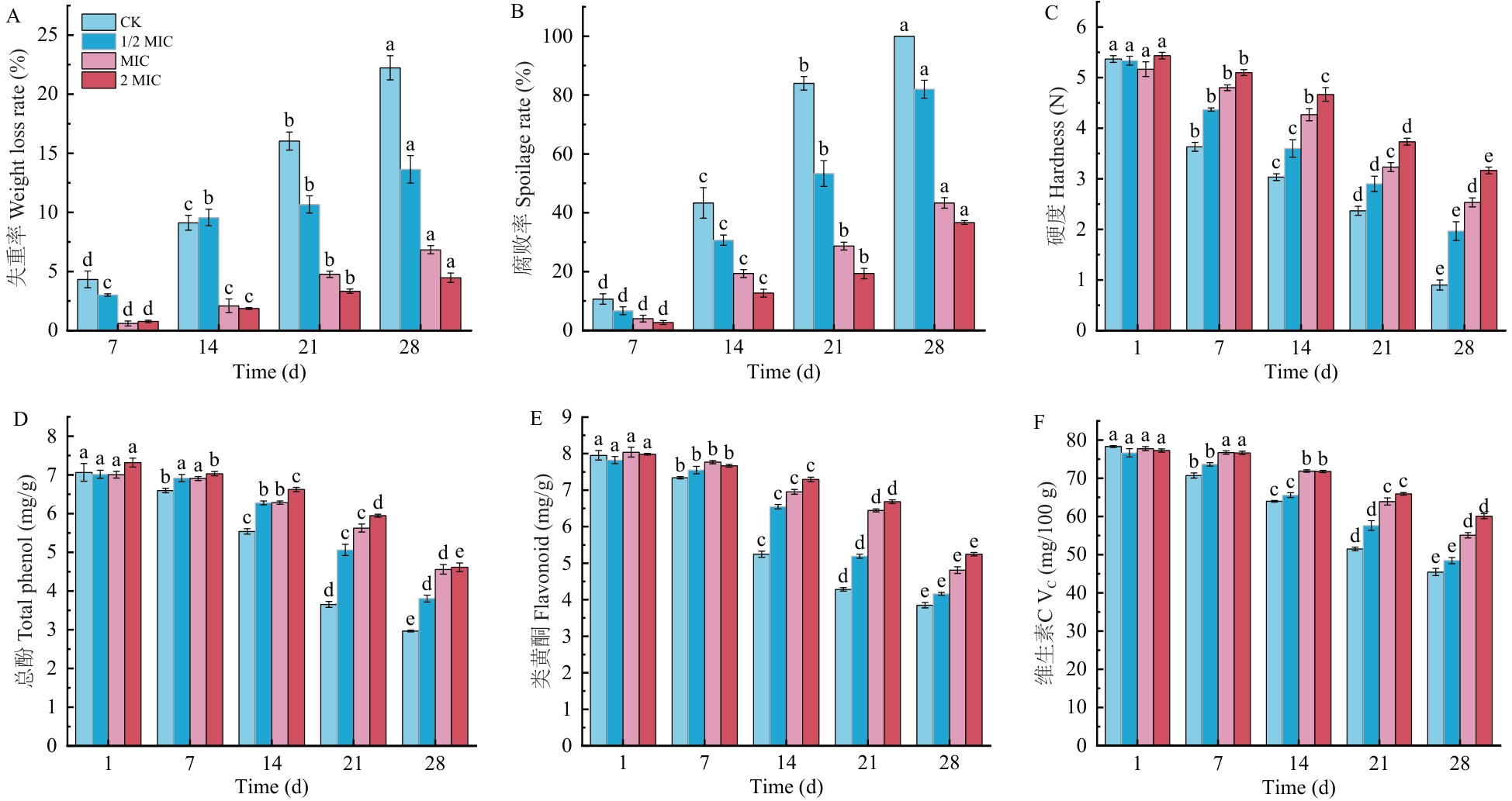
图7 不同浓度乳酸菌P-2 CFS处理对蓝靛果失重率、腐败率、硬度、总酚含量、类黄酮含量与VC含量的影响不同字母表示不同处理差异显著(P<0.05)。下同
Fig. 7 Influences of different concentrations of Pediococcus acidilactici P-2 CFS on the weight loss rate, spoilage rate, hardness, total phenolic content, flavonoid content and vitamin C content of Lonicera caerulea L.Different letters indicate significant differences in different treatment methods (P<0.05). The same below
处理组 Processing group | 时间 Time (d) | 外观 Appearance (Scores) | 质地 Texture (Scores) | 味道 Taste (Scores) | 整体可接受性 Overall acceptability (Scores) |
|---|---|---|---|---|---|
| CK | 1 | 4.20±0.00a | 4.80±0.45a | 4.60±0.55a | 5.00±0.00a |
| 7 | 4.00±0.00a | 1.80±0.84b | 1.60±0.55b | 2.20±0.45b | |
| 14 | - | 1.20±0.45b | - | - | |
| 21 | - | 0.20±0.45c | - | - | |
| 28 | - | - | - | - | |
| 1/2 MIC | 1 | 4.60±0.55a | 5.00±0.00a | 4.80±0.45a | 4.60±0.55a |
| 7 | 4.20±0.84a | 4.00±0.71b | 3.20±1.64a | 4.40±0.89a | |
| 14 | 3.20±1.30ab | 2.40±0.55c | 1.20±0.84b | 2.80±0.84b | |
| 21 | 1.60±1.14bc | 0.80±0.45d | 0.20±0.45b | 1.20±0.84c | |
| 28 | 0.2±0.45c | 0.20±0.45d | - | 0.40±0.89c | |
| MIC | 1 | 4.60±0.55a | 4.80±0.45a | 4.60±0.55a | 4.80±0.45a |
| 7 | 4.20±0.45ab | 3.60±0.55a | 3.20±0.45b | 3.80±0.45a | |
| 14 | 3.40±0.55b | 2.00±1.00b | 1.20±0.84c | 2.40±0.55b | |
| 21 | 2.20±0.84c | 1.40±1.14b | 0.40±0.55cd | 1.00±1.00c | |
| 28 | 0.40±0.55d | 0.60±0.55b | - | 0.20±0.45c | |
| 2 MIC | 1 | 4.60±0.55a | 4.8±0.45a | 4.60±0.55a | 5.00±0a |
| 7 | 4.40±0.55a | 4.00±0.71a | 3.80±0.45a | 4.20±0.45a | |
| 14 | 3.60±0.55a | 2.00±1.00b | 1.80±0.84b | 2.80±0.45b | |
| 21 | 2.20±0.84b | 1.40±1.14b | 1.00±0.71bc | 1.40±0.89c | |
| 28 | 0.60±0.5c | 0.80±0.45b | - | 1.00±0.71c |
表3 对蓝靛果保鲜过程中的感官评价
Table 3 Sensory evaluation of L. caerulea L. during storage
处理组 Processing group | 时间 Time (d) | 外观 Appearance (Scores) | 质地 Texture (Scores) | 味道 Taste (Scores) | 整体可接受性 Overall acceptability (Scores) |
|---|---|---|---|---|---|
| CK | 1 | 4.20±0.00a | 4.80±0.45a | 4.60±0.55a | 5.00±0.00a |
| 7 | 4.00±0.00a | 1.80±0.84b | 1.60±0.55b | 2.20±0.45b | |
| 14 | - | 1.20±0.45b | - | - | |
| 21 | - | 0.20±0.45c | - | - | |
| 28 | - | - | - | - | |
| 1/2 MIC | 1 | 4.60±0.55a | 5.00±0.00a | 4.80±0.45a | 4.60±0.55a |
| 7 | 4.20±0.84a | 4.00±0.71b | 3.20±1.64a | 4.40±0.89a | |
| 14 | 3.20±1.30ab | 2.40±0.55c | 1.20±0.84b | 2.80±0.84b | |
| 21 | 1.60±1.14bc | 0.80±0.45d | 0.20±0.45b | 1.20±0.84c | |
| 28 | 0.2±0.45c | 0.20±0.45d | - | 0.40±0.89c | |
| MIC | 1 | 4.60±0.55a | 4.80±0.45a | 4.60±0.55a | 4.80±0.45a |
| 7 | 4.20±0.45ab | 3.60±0.55a | 3.20±0.45b | 3.80±0.45a | |
| 14 | 3.40±0.55b | 2.00±1.00b | 1.20±0.84c | 2.40±0.55b | |
| 21 | 2.20±0.84c | 1.40±1.14b | 0.40±0.55cd | 1.00±1.00c | |
| 28 | 0.40±0.55d | 0.60±0.55b | - | 0.20±0.45c | |
| 2 MIC | 1 | 4.60±0.55a | 4.8±0.45a | 4.60±0.55a | 5.00±0a |
| 7 | 4.40±0.55a | 4.00±0.71a | 3.80±0.45a | 4.20±0.45a | |
| 14 | 3.60±0.55a | 2.00±1.00b | 1.80±0.84b | 2.80±0.45b | |
| 21 | 2.20±0.84b | 1.40±1.14b | 1.00±0.71bc | 1.40±0.89c | |
| 28 | 0.60±0.5c | 0.80±0.45b | - | 1.00±0.71c |
| [1] | Auzanneau N, Weber P, Kosińska-Cagnazzo A, et al. Bioactive compounds and antioxidant capacity of Lonicera caerulea berries: Comparison of seven cultivars over three harvesting years [J]. J Food Compos Anal, 2018, 66: 81-89. |
| [2] | Dong HY, Xu Y, Zhang QQ, et al. Activity and safety evaluation of natural preservatives [J]. Food Res Int, 2024, 190: 114548. |
| [3] | Fan LL, Lin L, Zhang Y, et al. Component characteristics and reactive oxygen species scavenging activity of anthocyanins from fruits of Lonicera caerulea L [J]. Food Chem, 2023, 403: 134391. |
| [4] | 李山, 张彦龙, 曾伟民, 等. 蓝靛果果渣花色苷胶束的制备及其稳定性研究 [J]. 食品工业科技, 2024, 45(2): 21-29. |
| Li S, Zhang YL, Zeng WM, et al. Study on preparation and stability of anthocyanin micelles from Lonicera edulis pomace [J]. Sci Technol Food Ind, 2024, 45(2): 21-29. | |
| [5] | 周静. 寒地浆果 香飘四季 [N]. 黑龙江日报, 2024-10-15(5). |
| Zhou J. The sweet flavor of berries in cold land [N]. Heilongjiang Daily, 2024-10-15(5). | |
| [6] | 张星, 毕金峰, 陈芹芹, 等. 蓝莓-蓝靛果复合冻干粉贮藏期品质及加工特性 [J]. 食品科学, 2022, 43(17): 240-247. |
| Zhang X, Bi JF, Chen QQ, et al. Quality and processing characteristics of a mixed freeze-dried powder of blueberry and blue honeysuckle berries during storage [J]. Food Sci, 2022, 43(17): 240-247. | |
| [7] | Chen J, Fu CL, Wang HY, et al. Combination transcriptomic and metabolomic reveal deterioration of the blue honeysuckle (Lonicera caerulea L.) fruit and candidate genes regulating metabolism in the post-harvest stage [J]. Int J Biol Macromol, 2025, 284: 138074. |
| [8] | 李次力. 蓝靛果的壳聚糖涂膜保鲜研究 [J]. 食品科学, 2008, 29(7): 457-461. |
| Li CL. Study on chitosan coating preservation of Lonicera edulis [J]. Food Sci, 2008, 29(7): 457-461. | |
| [9] | 赵倩, 张鹏, 贾晓昱, 等. 不同采收期对1-MCP处理后蓝靛果贮藏品质的影响 [J]. 包装工程, 2023, 44(11): 78-86. |
| Zhao Q, Zhang P, Jia XY, et al. Effects of different harvest periods on the storage quality of Lonicera caerulea L. after 1-MCP treatment [J]. Packag Eng, 2023, 44(11): 78-86. | |
| [10] | Adithi G, Divyashree S, Shruthi B, et al. Evaluation of Limosilactobacillus fermentum MYSAGAM1 isolated from herbal Amla juice as a probiotic candidate with antifungal characteristics against Fusarium equiseti [J]. Food Biosci, 2024, 58: 103843. |
| [11] | 陈思宇, 金建, 赵世琳. 物理技术在果蔬保鲜中的应用研究进展 [J]. 食品研究与开发, 2023, 44(21): 167-172. |
| Chen SY, Jin J, Zhao SL. Progress in application of physical technology in preservation of fruits and vegetables [J]. Food Res Dev, 2023, 44(21): 167-172. | |
| [12] | 李江阔, 高静, 张鹏, 等. 微环境气调对蓝果忍冬贮藏品质和抗氧化酶的影响 [J]. 食品与发酵工业, 2021, 47(6): 152-159. |
| Li JK, Gao J, Zhang P, et al. Micro-environmental modified atmosphere on storage quality and antioxidant enzymes of blue honeysuckle fruits [J]. Food Ferment Ind, 2021, 47(6): 152-159. | |
| [13] | Deng XZ, Wei YY, Jiang S, et al. Recent advances in the application of tea tree oil in the storage of fruit and vegetables [J]. Postharvest Biol Technol, 2025, 219: 113260. |
| [14] | Abouloifa H, Gaamouche S, Ghabbour N, et al. Lactic acid bacteria from Moroccan traditional foods: Techno-functional, health-promoting, nutraceutical value and application as a starter and bio-preservative agent in the food products [J]. Bioresour Technol Rep, 2024, 27: 101941. |
| [15] | Hernández Figueroa RH, López-Malo A, Mani-López E. Antimicrobial activity and applications of fermentates from lactic acid bacteria-a review [J]. Sustainable Food Technol, 2024, 2(2): 292-306. |
| [16] | Wang Q, Zhang F, Zhang YH, et al. A novel strain Lactiplantibacillus plantarum LPP95 isolated from Chinese pickles: Antifungal effect, mechanism, and potential application in yogurt [J]. Food Biosci, 2024, 58: 103640. |
| [17] | Wang L, Jiang SS, Zhou CX, et al. Exploring novel preservation strategies for blue honeysuckle through high-throughput sequencing and bioinformatics analysis [J]. Postharvest Biol Technol, 2025, 219: 113251. |
| [18] | Jiang SS, Wang L, Li DH, et al. The purification of dominant spoilage fungi on Lonicera Caeruleum and the inhibitory effects of composite essential oils against these fungi [J]. Food Biosci, 2023, 53: 102839. |
| [19] | Souza LV, Rodrigues da Silva R, Falqueto A, et al. Evaluation of antifungal activity of lactic acid bacteria against fungi in simulated cheese matrix [J]. LWT, 2023, 182: 114773. |
| [20] | Riolo M, Luz C, Santilli E, et al. Antifungal activity of selected lactic acid bacteria from olive drupes [J]. Food Biosci, 2023, 52: 102422. |
| [21] | de Vasconcelos Medeiros GKV, Martins ACS, Vasconcelos MG, et al. Cereus jamacaru DC. (mandacaru) fruit as a source of lactic acid bacteria with in vitro probiotic-related characteristics and its protective effects on Pediococcus pentosaceus during lyophilization and refrigeration storage [J]. Int J Food Microbiol, 2024, 417: 110695. |
| [22] | 訾静, 王琰, 李亮亮, 等. 林麝肠道中乳酸菌的分离筛选及益生特性 [J]. 食品科学, 2024, 45(8): 79-86. |
| Zi J, Wang Y, Li LL, et al. Isolation and screening of lactic acid bacteria from the gut of forest musk deer for probiotic properties [J]. Food Sci, 2024, 45(8): 79-86. | |
| [23] | 王晓宇, 吴梦娜, 于巧如, 等. 植物乳杆菌ST3.5的分离鉴定及其对霉菌的抑制作用 [J]. 食品工业科技, 2023, 44(13): 141-149. |
| Wang XY, Wu MN, Yu QR, et al. Isolation and identification of lactiplantibacillus plantarum ST3.5 and its inhibitory effect on mold [J]. Sci Technol Food Ind, 2023, 44(13): 141-149. | |
| [24] | Ma MG, Li A, Feng J, et al. Antifungal mechanism of Lactiplantibacillus plantarum P10 against Aspergillus niger and its in situ biopreservative application in Chinese steamed bread [J]. Food Chem, 2024, 449: 139181. |
| [25] | Shu C, Sun XX, Cao JK, et al. Antifungal efficiency and mechanisms of ethyl ferulate against postharvest pathogens [J]. Int J Food Microbiol, 2024, 417: 110710. |
| [26] | 刘艺璇, 岳红, 司欣雨, 等. 拮抗菌复合保鲜纸的制备及其对苹果保鲜中的应用 [J]. 食品工业科技, 2025, 46(6): 342-351. |
| Liu YX, Yue H, Si XY, et al. Preparation of composite preservation paper containing antagonistic fungi and its application on apple preservation [J]. Sci Technol Food Ind, 2025, 46(6): 342-351. | |
| [27] | 王成炜, 袁宇尧, 张政, 等. 基于计算流体动力学的二氧化硫压差熏蒸模型在鲜食葡萄保鲜中的应用研究 [J]. 食品与发酵工业, 2025, 51(2): 118-125. |
| Wang CW, Yuan YY, Zhang Z, et al. Application research of sulfur dioxide differential pressure fumigation model based on computational fluid dynamics in table grape preservation [J]. Food Ferment Ind, 2025, 51(2): 118-125. | |
| [28] | 曹建康, 姜微波, 赵玉梅. 果蔬采后生理生化实验指导 [M]. 北京: 中国轻工业出版社, 2007: 176. |
| Cao JK, Jiang WB, Zhao YM. Guidance on postharvest physiological and biochemical experiments of fruits and vegetables [M]. Beijing: China Light Industry Press, 2007: 176. | |
| [29] | 李军. 钼蓝比色法测定还原型维生素C [J]. 食品科学, 2000, 21(8): 42-45. |
| Li J. Study on molybdenum blue method of L-VC test by spectrometry [J]. Food Sci, 2000, 21(8): 42-45. | |
| [30] | 史洁莹, 牟燕萍, 陆周欣, 等. 壳聚糖-植物精油纳米乳液保鲜垫的制备及其在蓝莓保鲜中的应用 [J/OL]. 食品工业科技, 2024. . |
| Shi JY, Mou YP, Lu ZX, et al. Preparation and application of chitosan-essential oil nanoemulsion preservation pads for blueberry preservation [J/OL]. Sci Technol Food Ind, 2024. . | |
| [31] | Sharma AK, Sati DM, Murti Y, et al. A comprehensive review on Chinese honeysuckle (Qusqualis indica): a Traditional Chinese plant [J]. Toxicol Rep, 2024, 13: 101768. |
| [32] | Islam S, Biswas S, Jabin T, et al. Probiotic potential of Lactobacillus plantarum DMR14 for preserving and extending shelf life of fruits and fruit juice [J]. Heliyon, 2023, 9(6): e17382. |
| [33] | Liang NY, Zhao Z, Curtis JM, et al. Antifungal cultures and metabolites of lactic acid bacteria for use in dairy fermentations [J]. Int J Food Microbiol, 2022, 383: 109938. |
| [34] | Liu AP, Xu RX, Zhang S, et al. Antifungal mechanisms and application of lactic acid bacteria in bakery products: a review [J]. Front Microbiol, 2022, 13: 924398. |
| [35] | Abouloifa H, Rokni Y, Hasnaoui I, et al. Characterization of antimicrobial compounds obtained from the potential probiotic Lactiplantibacillus plantarum S61 and their application as a biopreservative agent [J]. Braz J Microbiol, 2022, 53(3): 1501-1513. |
| [36] | Chen X, Wei ZR, Feng ZQ, et al. Large-scale fermentation of Lactiplantibacillus pentosus 292 for the production of lactic acid and the storage strategy based on molasses as a preservative [J]. BMC Microbiol, 2025, 25(1): 125. |
| [37] | Li NY, Cheng YF, Li Z, et al. An alginate-based edible coating containing lactic acid bacteria extends the shelf life of fresh strawberry (Fragaria × Ananassa Duch.) [J]. Int J Biol Macromol, 2024, 274: 133273. |
| [38] | 王璐. 采后蓝靛果菌群分析及乳酸菌无细胞上清液对其致腐菌抑制作用 [D]. 哈尔滨: 东北林业大学, 2024. |
| Wang L. Analysis of the flora of postharvest Lonicera edulis and the inhibitory effect of cell-free supernatant of lactic acid bacteria on its rot-causing bacteria [D]. Harbin: Northeast Forestry University, 2024. |
| [1] | 刘佳, 任义尚, 荆晓艳, 许拉. 基于拉曼光谱“先筛后养”策略在功能微生物资源挖掘中的应用与展望[J]. 生物技术通报, 2026, 42(5): 1-13. |
| [2] | 陈永旗, 李志文, 李鑫, 原若曦, 王春旭, 韩毅强, 高亚梅. 黑土区大豆根际土壤放线菌的分离与功能研究[J]. 生物技术通报, 2025, 41(5): 255-266. |
| [3] | 刘丽, 王辉, 关天舒, 李柏宏, 于舒怡. 葡萄脱落酸受体VvPYL4互作蛋白的筛选及互作蛋白基因表达[J]. 生物技术通报, 2025, 41(4): 188-197. |
| [4] | 宋佳怡, 苏芸丽, 郑兴艳, 夏文念, 杨冬梅, 胡慧贞. 金鱼草Expansin基因家族鉴定及其抗核盘菌相关基因筛选[J]. 生物技术通报, 2025, 41(4): 227-242. |
| [5] | 刘爽, 江洲, 赵帅, 赵雷真, 黄峰, 周佳, 屈建航. 一株产蛋白酶细菌的筛选、鉴定及发酵工艺优化[J]. 生物技术通报, 2025, 41(4): 335-344. |
| [6] | 杜薇, 李志敏, 邢晏铭, 刘蒲临, 缪礼鸿. 一株易转化、高生物量地衣芽孢杆菌的筛选与鉴定[J]. 生物技术通报, 2024, 40(9): 181-189. |
| [7] | 陈琳, 陈莉莉, 陈琳琳, 章敏, 陈炳智, 江玉姬. L-抗坏血酸联合超声处理鲜切芋艿的最佳条件[J]. 生物技术通报, 2024, 40(8): 232-243. |
| [8] | 邢丽南, 张艳芳, 葛明然, 赵令敏, 陈妍, 霍秀文. 山药DoWRKY40基因表达特征分析及互作蛋白筛选[J]. 生物技术通报, 2024, 40(8): 118-128. |
| [9] | 邵长轩, 张少华, 邓浩然, 于伟康, 朱永杰, 单安山. 抗菌肽的数据库辅助设计[J]. 生物技术通报, 2024, 40(12): 12-19. |
| [10] | 皮一飞, 宋新辉, 王淅琳, 李谨谨, 孙长斌, 徐炜. 基于R-loop靶向编辑技术的R-loop功能位点高通量筛选系统[J]. 生物技术通报, 2024, 40(10): 181-190. |
| [11] | 刘星雨, 李洁, 朱龙佼, 李相阳, 许文涛. 铜绿假单胞菌适配体的获得及应用[J]. 生物技术通报, 2024, 40(1): 186-193. |
| [12] | 温晓蕾, 李建嫄, 李娜, 张娜, 杨文香. 小麦叶锈菌与小麦互作的酵母双杂交cDNA文库构建与应用[J]. 生物技术通报, 2023, 39(9): 136-146. |
| [13] | 吴巧茵, 施友志, 李林林, 彭政, 谭再钰, 刘利平, 张娟, 潘勇. 类胡萝卜素降解菌株的原位筛选及其在雪茄提质增香中的应用[J]. 生物技术通报, 2023, 39(9): 192-201. |
| [14] | 江海溶, 崔若琪, 王玥, 白淼, 张明露, 任连海. NH3和H2S降解功能菌的分离鉴定及降解特性研究[J]. 生物技术通报, 2023, 39(9): 246-254. |
| [15] | 薛宁, 王瑾, 李世新, 刘叶, 程海娇, 张玥, 毛雨丰, 王猛. 多基因同步调控结合高通量筛选构建高产L-苯丙氨酸的谷氨酸棒杆菌工程菌株[J]. 生物技术通报, 2023, 39(9): 268-280. |
| 阅读次数 | ||||||
|
全文 |
|
|||||
|
摘要 |
|
|||||
