







生物技术通报 ›› 2026, Vol. 42 ›› Issue (11): 11-23.doi: 10.13560/j.cnki.biotech.bull.1985.2026-0123
• 综述与专论 •
常宇晴, 杜佳, 郭杭, 徐静, 王一帆, 汪尚, 杜立群, 曾后清( )
收稿日期:2026-01-27
出版日期:2026-11-26
发布日期:2026-11-03
通讯作者:
曾后清zenghq@hznu.edu.cn基金资助:
CHANG Yu-qing, DU Jia, GUO Hang, XU Jing, WANG Yi-fan, WANG Shang, DU Li-qun, ZENG Hou-qing()
Received:2026-01-27
Published:2026-11-26
Online:2026-11-03
摘要:
植物整个生长周期遭受干旱、盐碱、高低温、金属毒害等非生物胁迫,严重限制作物生长发育与产量形成。为适应各种逆境,植物进化出精密的钙信号转导网络,通过动态调控逆境应答基因表达提高对逆境的适应性。钙调素(CaM)与类钙调蛋白(CML)是植物核心钙信号解码器,通过结合并调控下游靶蛋白活性,在非生物胁迫应答中发挥核心调控作用。逆境刺激触发胞质特异性Ca2+信号,CaM/CML感知信号后通过与CAMTA、CBP60、WRKYⅡd、MYB、NAC、bZIP等多类转录因子结合,介导全基因组转录重编程,进而调控抗氧化系统、离子稳态、激素信号等通路,赋予植物逆境耐受性。本文系统总结了CaM/CML结合型转录因子的结构特征与功能特性,阐述CaM/CML介导的转录调控在通用胁迫、低温、高温、盐胁迫、干旱及金属离子等胁迫中的分子机制,归纳不同胁迫下CaM/CML信号通路的保守性与物种特异性,解析其与脱落酸、水杨酸、茉莉酸等植物激素信号的交叉互作网络。此外,提出了该研究领域在CaM/CML与转录因子结合特异性、液-液相分离功能、多重胁迫交叉应答等方面的关键科学问题,展望了单细胞测序、多组学整合、CRISPR/Cas9基因编辑等技术在解析调控网络与作物抗逆改良中的应用前景。深入阐明CaM/CML介导的转录调控机制,为作物抗逆分子育种提供理论依据与核心基因靶点,对培育气候智能型作物、推动农业绿色可持续发展具有重要科学价值与实践意义。
常宇晴, 杜佳, 郭杭, 徐静, 王一帆, 汪尚, 杜立群, 曾后清. 钙调蛋白介导的转录调控机制在植物非生物胁迫中的研究进展[J]. 生物技术通报, 2026, 42(11): 11-23.
CHANG Yu-qing, DU Jia, GUO Hang, XU Jing, WANG Yi-fan, WANG Shang, DU Li-qun, ZENG Hou-qing. Research Progress on Calmodulin-mediated Transcriptional Regulation Mechanisms in Plant Abiotic Stress Responses[J]. Biotechnology Bulletin, 2026, 42(11): 11-23.
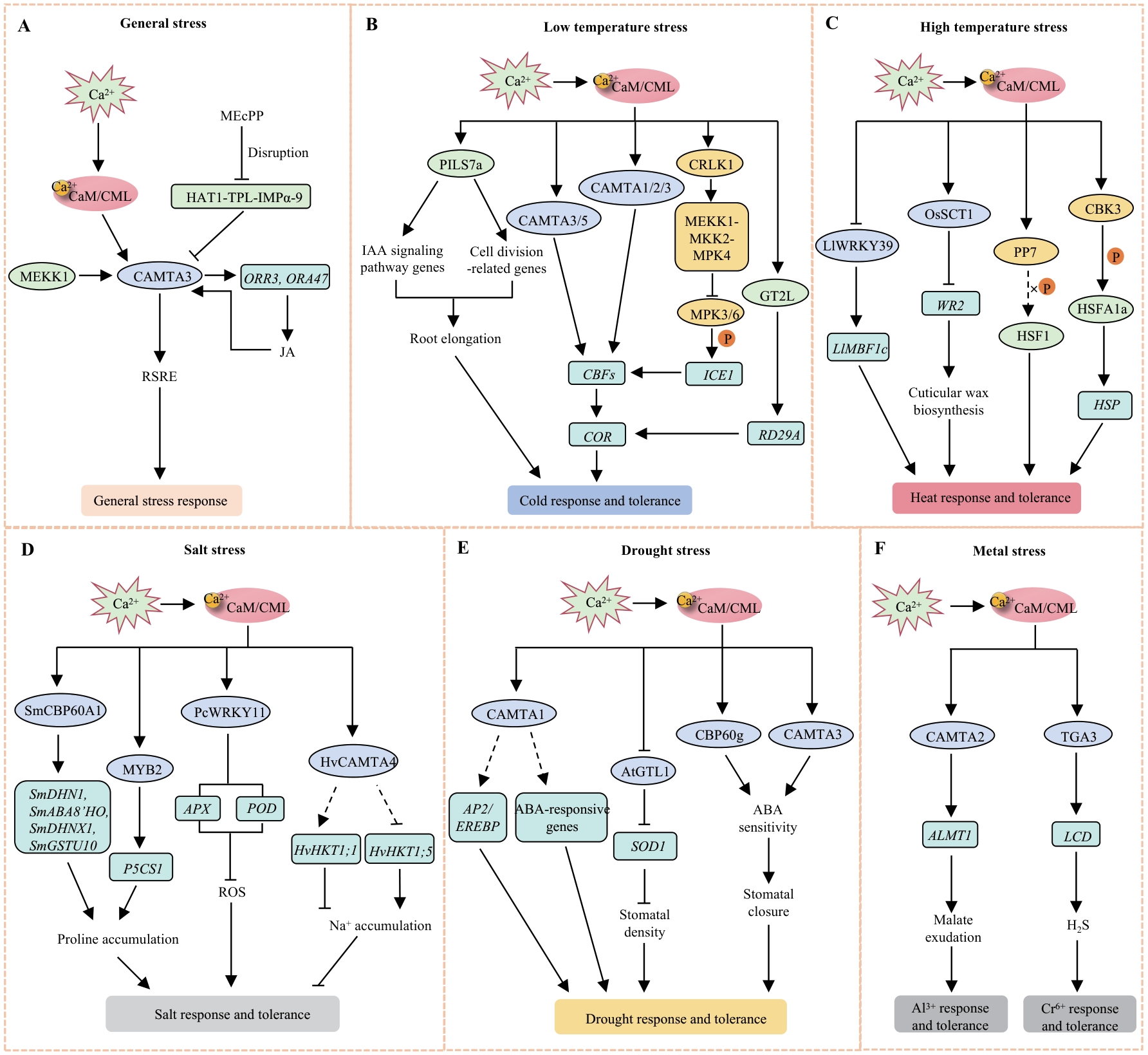
图1 CaM/CML介导的转录调控在各种非生物胁迫反应中的作用机制Ca2+:钙离子,CaM:钙调蛋白,CML:类钙调蛋白,P:磷酸化修饰,RSRE:快速应激响应元件,CBF:C-重复结合因子,HSP:热休克蛋白,ABA:脱落酸,ROS:活性氧,H2S:硫化氢。A:通用胁迫反应;B:低温胁迫反应;C:高温胁迫反应;D:盐胁迫反应;E:干旱胁迫反应;F:金属离子胁迫反应
Fig. 1 Schematic diagram of CaM/CML-mediated transcriptional regulation in plant responses to various abiotic stressesCa2+: calcium ion; CaM: calmodulin; CML: calmodulin-like protein; P: phosphorylation modification; RSRE: rapid stress response element; CBF: C-repeat binding factor; HSP: heat shock protein; ABA: abscisic acid; ROS: reactive oxygen species; H2S: hydrogen sulfide. A: General stress response; B: cold stress response; C: heat stress response; D: salt stress response; E: drought stress response; F: metal ion stress response
| [58] | Dubos C, Stracke R, Grotewold E, et al. MYB transcription factors in Arabidopsis [J]. Trends Plant Sci, 2010, 15(10): 573-581. |
| [59] | Yoo JH, Park CY, Kim JC, et al. Direct interaction of a divergent CaM isoform and the transcription factor, MYB2, enhances salt tolerance in Arabidopsis [J]. J Biol Chem, 2005, 280(5): 3697-3706. |
| [60] | Zhang YY, Ma CY, Li XQ, et al. Wheat tae-MIR1118 constitutes a functional module with calmodulin TaCaM2-1 and MYB member TaMYB44 to modulate plant low-N stress response [J]. Plant Cell Environ, 2025, 48(3): 2178-2199. |
| [61] | Kim HS, Park BO, Yoo JH, et al. Identification of a calmodulin-binding NAC protein as a transcriptional repressor in Arabidopsis [J]. J Biol Chem, 2007, 282(50): 36292-36302. |
| [62] | Duan Y, Xu ZS, Liu H, et al. Genome-wide identification of the TGA gene family and expression analysis under drought stress in Brassica napus L. [J]. Int J Mol Sci, 2024, 25(12): 6355. |
| [63] | Szymanski DB, Liao BR, Zielinski RE. Calmodulin isoforms differentially enhance the binding of cauliflower nuclear proteins and recombinant TGA3 to a region derived from the Arabidopsis Cam-3 promoter [J]. Plant Cell, 1996, 8(6): 1069. |
| [64] | Fang HH, Liu ZQ, Long YP, et al. The Ca2+/calmodulin2-binding transcription factor TGA3 elevates LCD expression and H2S production to bolster Cr6+ tolerance in Arabidopsis [J]. Plant J, 2017, 91(6): 1038-1050. |
| [65] | Popescu SC, Popescu GV, Bachan S, et al. Differential binding of calmodulin-related proteins to their targets revealed through high-density Arabidopsis protein microarrays [J]. Proc Natl Acad Sci U S A, 2007, 104(11): 4730-4735. |
| [66] | Bjornson M, Dandekar A, Dehesh K. Determinants of timing and amplitude in the plant general stress response [J]. J Integr Plant Biol, 2016, 58(2): 119-126. |
| [67] | Walley JW, Coughlan S, Hudson ME, et al. Mechanical stress induces biotic and abiotic stress responses via a novel cis-element [J]. PLoS Genet, 2007, 3(10): e172. |
| [68] | Benn G, Wang CQ, Hicks DR, et al. A key general stress response motif is regulated non-uniformly by CAMTA transcription factors [J]. Plant J, 2014, 80(1): 82-92. |
| [69] | Bjornson M, Benn G, Song XS, et al. Distinct roles for mitogen-activated protein kinase signaling and CALMODULIN-BINDING TRANSCRIPTIONAL ACTIVATOR3 in regulating the peak time and amplitude of the plant general stress response [J]. Plant Physiol, 2014, 166(2): 988-996. |
| [70] | Benn G, Bjornson M, Ke HY, et al. Plastidial metabolite MEcPP induces a transcriptionally centered stress-response hub via the transcription factor CAMTA3 [J]. Proc Natl Acad Sci U S A, 2016, 113(31): 8855-8860. |
| [71] | 张晓燕, 杨淑华, 丁杨林. 植物感知和传递低温信号的分子机制 [J]. 生物技术通报, 2023, 39(11): 28-35. |
| Zhang XY, Yang SH, Ding YL. Molecular mechanism of cold signal perception and transduction in plants [J]. Biotechnol Bull, 2023, 39(11): 28-35. | |
| [72] | Doherty CJ, Van Buskirk HA, Myers SJ, et al. Roles for Arabidopsis CAMTA transcription factors in cold-regulated gene expression and freezing tolerance [J]. Plant Cell, 2009, 21(3): 972-984. |
| [73] | Kidokoro S, Yoneda K, Takasaki H, et al. Different cold-signaling pathways function in the responses to rapid and gradual decreases in temperature [J]. Plant Cell, 2017, 29(4): 760-774. |
| [74] | Cai P, Lan YH, Gong FY, et al. Identification and molecular characterization of the CAMTA gene family in Solanaceae with a focus on the expression analysis of eggplant genes under cold stress [J]. Int J Mol Sci, 2024, 25(4): 2064. |
| [75] | Xi J, Qiu YJ, Du LQ, et al. Plant-specific trihelix transcription factor AtGT2L interacts with calcium/calmodulin and responds to cold and salt stresses [J]. Plant Sci, 2012, 185: 274-280. |
| [76] | Chu MX, Li JJ, Zhang JY, et al. AtCaM4 interacts with a Sec14-like protein, PATL1, to regulate freezing tolerance in Arabidopsis in a CBF-independent manner [J]. J Exp Bot, 2018, 69(21): 5241-5253. |
| [77] | Yang TB, Chaudhuri S, Yang LH, et al. A calcium/calmodulin-regulated member of the receptor-like kinase family confers cold tolerance in plants [J]. J Biol Chem, 2010, 285(10): 7119-7126. |
| [78] | Li H, Ding YL, Shi YT, et al. MPK3- and MPK6-mediated ICE1 phosphorylation negatively regulates ICE1 stability and freezing tolerance in Arabidopsis [J]. Dev Cell, 2017, 43(5): 630-642.e4. |
| [79] | Lin R, Song JN, Tang MJ, et al. CALMODULIN6 negatively regulates cold tolerance by attenuating ICE1-dependent stress responses in tomato [J]. Plant Physiol, 2023, 193(3): 2105-2121. |
| [80] | Zhang W, Zhou RG, Gao YJ, et al. Molecular and genetic evidence for the key role of AtCaM3 in heat-shock signal transduction in Arabidopsis [J]. Plant Physiol, 2009, 149(4): 1773-1784. |
| [81] | Xuan Y, Zhou S, Wang L, et al. Nitric oxide functions as a signal and acts upstream of AtCaM3 in thermotolerance in Arabidopsis seedlings [J]. Plant Physiol, 2010, 153(4): 1895-1906. |
| [82] | Wu HC, Luo DL, Vignols F, et al. Heat shock-induced biphasic Ca2+ signature and OsCaM1-1 nuclear localization mediate downstream signalling in acquisition of thermotolerance in rice (Oryza sativa L.) [J]. Plant Cell Environ, 2012, 35(9): 1543-1557. |
| [83] | Kutuzov MA, Bennett N, Andreeva AV. Interaction of plant protein Ser/thr phosphatase PP7 with calmodulin [J]. Biochem Biophys Res Commun, 2001, 289(2): 634-640. |
| [84] | Liu HT, Li GL, Chang H, et al. Calmodulin-binding protein phosphatase PP7 is involved in thermotolerance in Arabidopsis [J]. Plant Cell Environ, 2007, 30(2): 156-164. |
| [85] | Liu HT, Gao F, Li GL, et al. The calmodulin-binding protein kinase 3 is part of heat-shock signal transduction in Arabidopsis thaliana [J]. Plant J, 2008, 55(5): 760-773. |
| [86] | Kan Y, Mu XR, Zhang H, et al. TT2 controls rice thermotolerance through SCT1-dependent alteration of wax biosynthesis [J]. Nat Plants, 2022, 8(1): 53-67. |
| [87] | Prasad KVSK, Abdel-Hameed AAE, Jiang QY, et al. DNA-binding activity of CAMTA3 is essential for its function: identification of critical amino acids for its transcriptional activity [J]. Cells, 2023, 12(15): 1986. |
| [88] | Abdel-Hameed AAE, Prasad KVSK, Jiang QY, et al. Salt-induced stability of SR1/CAMTA3 mRNA is mediated by reactive oxygen species and requires the 3' end of its open reading frame [J]. Plant Cell Physiol, 2020, 61(4): 748-760. |
| [89] | Shkolnik D, Finkler A, Pasmanik-Chor M, et al. Calmodulin-binding transcription activator 6: a key regulator of Na+ homeostasis during germination [J]. Plant Physiol, 2019, 180(2): 1101-1118. |
| [90] | Shen QF, Fu LB, Su TT, et al. Calmodulin HvCaM1 negatively regulates salt tolerance via modulation of HvHKT1s and HvCAMTA4 [J]. Plant Physiol, 2020, 183(4): 1650-1662. |
| [91] | Wang DZ, Wu X, Gao SQ, et al. Systematic analysis and identification of drought-responsive genes of the CAMTA gene family in wheat (Triticum aestivum L.) [J]. Int J Mol Sci, 2022, 23(9): 4542. |
| [92] | Pandey N, Ranjan A, Pant P, et al. CAMTA 1 regulates drought responses in Arabidopsis thaliana [J]. BMC Genom, 2013, 14: 216. |
| [93] | Zeng HQ, Wu HC, Wang GP, et al. Arabidopsis CAMTA3/SR1 is involved in drought stress tolerance and ABA signaling [J]. Plant Sci, 2022, 319: 111250. |
| [94] | Noman M, Jameel A, Qiang WD, et al. Overexpression of GmCAMTA12 enhanced drought tolerance in Arabidopsis and soybean [J]. Int J Mol Sci, 2019, 20(19): 4849. |
| [95] | Baek D, Cho HM, Cha YJ, et al. Soybean calmodulin-binding transcription activators, GmCAMTA2 and GmCAMTA8, coordinate the circadian regulation of developmental processes and drought stress responses [J]. Int J Mol Sci, 2023, 24(14): 11477. |
| [96] | Wang S, Ge SQ, Liu XF, et al. A regulatory network involving calmodulin controls phytosulfokine peptide processing during drought-induced flower abscission [J]. Plant Cell, 2024, 37(1): koaf013. |
| [97] | Wei M, Xu XM, Li CH. Identification and expression of CAMTA genes in Populus trichocarpa under biotic and abiotic stress [J]. Sci Rep, 2017, 7: 17910. |
| [98] | Yang LY, Zhao Y, Zhang GZ, et al. Identification of CAMTA gene family in Heimia myrtifolia and expression analysis under drought stress [J]. Plants, 2022, 11(22): 3031. |
| [99] | Zhu XL, Wang BQ, Wei XH, et al. Characterization of the CqCAMTA gene family reveals the role of CqCAMTA03 in drought tolerance [J]. BMC Plant Biol, 2022, 22: 428. |
| [100] | Yoo CY, Mano N, Finkler A, et al. A Ca2+/CaM-regulated transcriptional switch modulates stomatal development in response to water deficit [J]. Sci Rep, 2019, 9: 12282. |
| [101] | Yoo CY, Pence HE, Jin JB, et al. The Arabidopsis GTL1 transcription factor regulates water use efficiency and drought tolerance by modulating stomatal density via transrepression of SDD1 [J]. Plant Cell, 2011, 22(12): 4128-4141. |
| [102] | Weng H, Yoo CY, Gosney MJ, et al. Poplar GTL1 is a Ca2+/calmodulin-binding transcription factor that functions in plant water use efficiency and drought tolerance [J]. PLoS One, 2012, 7(3): e32925. |
| [103] | Wan DL, Li RL, Zou B, et al. Calmodulin-binding protein CBP60g is a positive regulator of both disease resistance and drought tolerance in Arabidopsis [J]. Plant Cell Rep, 2012, 31(7): 1269-1281. |
| [104] | Ali MA, Azeem F, Nawaz MA, et al. Transcription factors WRKY11 and WRKY17 are involved in abiotic stress responses in Arabidopsis [J]. J Plant Physiol, 2018, 226: 12-21. |
| [1] | Zhang HM, Zhu JH, Gong ZZ, et al. Abiotic stress responses in plants [J]. Nat Rev Genet, 2022, 23(2): 104-119. |
| [2] | Leisner CP, Potnis N, Sanz-Saez A. Crosstalk and trade-offs: Plant responses to climate change-associated abiotic and biotic stresses [J]. Plant Cell Environ, 2023, 46(10): 2946-2963. |
| [3] | Luan S, Wang C. Calcium signaling mechanisms across Kingdoms [J]. Annu Rev Cell Dev Biol, 2021, 37: 311-340. |
| [4] | Sanders D, Pelloux J, Brownlee C, et al. Calcium at the crossroads of signaling [J]. Plant Cell, 2002, 14(): S401-S417. |
| [5] | Zeng HQ, Zhu QQ, Yuan PG, et al. Calmodulin and calmodulin-like protein-mediated plant responses to biotic stresses [J]. Plant Cell Environ, 2023, 46(12): 3680-3703. |
| [6] | La Verde V, Dominici P, Astegno A. Towards understanding plant calcium signaling through calmodulin-like proteins: a biochemical and structural perspective [J]. Int J Mol Sci, 2018, 19(5): 1331. |
| [7] | Kim MC, Chung WS, Yun DJ, et al. Calcium and calmodulin-mediated regulation of gene expression in plants [J]. Mol Plant, 2009, 2(1): 13-21. |
| [8] | Zhu XY, Dunand C, Snedden W, et al. CaM and CML emergence in the green lineage [J]. Trends Plant Sci, 2015, 20(8): 483-489. |
| [9] | Bongkoj B, Teerapong B. Genome-wide identification and analyses of the rice calmodulin and related potential calcium sensor proteins [J]. BMC Plant Biol, 2007, 7(1): 4. |
| [10] | Munir S, Khan MRG, Song JW, et al. Genome-wide identification, characterization and expression analysis of calmodulin-like (CML) proteins in tomato (Solanum lycopersicum) [J]. Plant Physiol Biochem, 2016, 102: 167-179. |
| [11] | Gifford JL, Walsh MP, Vogel HJ. Structures and metal-ion-binding properties of the Ca2+-binding helix-loop-helix EF-hand motifs [J]. Biochem J, 2007, 405(2): 199-221. |
| [12] | Dobney S, Chiasson D, Lam P, et al. The calmodulin-related calcium sensor CML42 plays a role in trichome branching [J]. J Biol Chem, 2009, 284(46): 31647-31657. |
| [105] | Inostroza-Blancheteau C, Aquea F, Loyola R, et al. Molecular characterisation of a calmodulin gene, VcCaM1, that is differentially expressed under aluminium stress in highbush blueberry [J]. Plant Biol J, 2013, 15(6): 1013-1018. |
| [106] | Tokizawa M, Kobayashi Y, Saito T, et al. Sensitive to proton rhizotoxicity1, calmodulin binding transcription activator2, and other transcription factors are involved in ALUMINUM-activated malate TRANSPORTER1 expression [J]. Plant Physiol, 2015, 167(3): 991-1003. |
| [107] | Zhu X, Wang P, Bai ZM, et al. Calmodulin-like protein CML24 interacts with CAMTA2 and WRKY46 to regulate ALMT1-dependent Al resistance in Arabidopsis thaliana [J]. New Phytol, 2022, 233(6): 2471-2487. |
| [13] | 曾后清, 张亚仙, 汪尚, 等. 植物钙/钙调素介导的信号转导系统 [J]. 植物学报, 2016, 51(5): 705-723. |
| Zeng HQ, Zhang YX, Wang S, et al. Calcium/calmodulin-mediated signal transduction system in plants [J]. Chin Bull Bot, 2016, 51(5): 705-723. | |
| [14] | Hau B, Symonds K, Teresinski H, et al. Arabidopsis calmodulin-like proteins CML13 and CML14 interact with calmodulin-binding transcriptional activators and function in salinity stress response [J]. Plant Cell Physiol, 2024, 65(2): 282-300. |
| [15] | Scholz SS, Vadassery J, Heyer M, et al. Mutation of the Arabidopsis calmodulin-like protein CML37 deregulates the jasmonate pathway and enhances susceptibility to herbivory [J]. Mol Plant, 2014, 7(12): 1712-1726. |
| [16] | Leba LJ, Cheval C, Ortiz-Martín I, et al. CML9, an Arabidopsis calmodulin-like protein, contributes to plant innate immunity through a flagellin-dependent signalling pathway [J]. Plant J, 2012, 71(6): 976-989. |
| [17] | Tsai YC, Koo Y, Delk NA, et al. Calmodulin-related CML24 interacts with ATG4b and affects autophagy progression in Arabidopsis [J]. Plant J, 2013, 73(2): 325-335. |
| [18] | Nakahara KS, Masuta C, Yamada S, et al. Tobacco calmodulin-like protein provides secondary defense by binding to and directing degradation of virus RNA silencing suppressors [J]. Proc Natl Acad Sci U S A, 2012, 109(25): 10113-10118. |
| [19] | Yamaguchi T, Aharon GS, Sottosanto JB, et al. Vacuolar Na+/H+ antiporter cation selectivity is regulated by calmodulin from within the vacuole in a Ca2+- and pH-dependent manner [J]. Proc Natl Acad Sci U S A, 2005, 102(44): 16107-16112. |
| [20] | Wu XM, Qiao Z, Liu HP, et al. CML20, an Arabidopsis Calmodulin-like protein, negatively regulates guard cell ABA signaling and drought stress tolerance [J]. Front Plant Sci, 2017, 8: 824. |
| [21] | Xu GY, Rocha PSCF, Wang ML, et al. A novel rice calmodulin-like gene, OsMSR2, enhances drought and salt tolerance and increases ABA sensitivity in Arabidopsis [J]. Planta, 2011, 234(1): 47-59. |
| [22] | Munir S, Liu H, Xing YL, et al. Overexpression of calmodulin-like (ShCML44) stress-responsive gene from Solanum habrochaites enhances tolerance to multiple abiotic stresses [J]. Sci Rep, 2016, 6: 31772. |
| [23] | Kalaipandian S, Xue GP, Rae AL, et al. Overexpression of TaCML20, a calmodulin-like gene, enhances water soluble carbohydrate accumulation and yield in wheat [J]. Physiol Plant, 2019, 165(4): 790-799. |
| [24] | Song XY, Li JF, Lyu ML, et al. CALMODULIN-LIKE-38 and PEP1 RECEPTOR 2 integrate nitrate and brassinosteroid signals to regulate root growth [J]. Plant Physiol, 2021, 187(3): 1779-1794. |
| [25] | Liu S, Zheng YY, Zhao LY, et al. CALMODULIN-LIKE16 and PIN-LIKES7a cooperatively regulate rice seedling primary root elongation under chilling [J]. Plant Physiol, 2024, 195(2): 1660-1680. |
| [26] | Zhu QN, Tan QQ, Gao QY, et al. Calmodulin-like protein CML15 interacts with PP2C46/65 to regulate Papaya fruit ripening via integrating calcium, ABA and ethylene signals [J]. Plant Biotechnol J, 2024, 22(6): 1703-1723. |
| [27] | 胡雅丹, 伍国强, 刘晨, 等. MYB转录因子在调控植物响应逆境胁迫中的作用 [J]. 生物技术通报, 2024, 40(6): 5-22. |
| Hu YD, Wu GQ, Liu C, et al. Roles of MYB transcription factor in regulating the responses of plants to stress [J]. Biotechnol Bull, 2024, 40(6): 5-22. | |
| [28] | Kim J, Kim HY. Functional analysis of a calcium-binding transcription factor involved in plant salt stress signaling [J]. FEBS Lett, 2006, 580(22): 5251-5256. |
| [29] | Kushwaha R, Singh A, Chattopadhyay S. Calmodulin7 plays an important role as transcriptional regulator in Arabidopsis seedling development [J]. Plant Cell, 2008, 20(7): 1747-1759. |
| [30] | Abbas N, Maurya JP, Senapati D, et al. Arabidopsis CAM7 and HY5 physically interact and directly bind to the HY5 promoter to regulate its expression and thereby promote photomorphogenesis [J]. Plant Cell, 2014, 26(3): 1036-1052. |
| [31] | Kumar S, Mazumder M, Gupta N, et al. Crystal structure of Arabidopsis thaliana calmodulin7 and insight into its mode of DNA binding [J]. FEBS Lett, 2016, 590(17): 3029-3039. |
| [32] | Senapati D, Kushwaha R, Dutta S, et al. COP1 regulates the stability of CAM7 to promote photomorphogenic growth [J]. Plant Direct, 2019, 3(6): e00144. |
| [33] | Truman W, Sreekanta S, Lu Y, et al. The CALMODULIN-BINDING PROTEIN60 family includes both negative and positive regulators of plant immunity [J]. Plant Physiol, 2013, 163(4): 1741-1751. |
| [34] | Wang YM, Shen CB, Jiang QC, et al. Seed priming with calcium chloride enhances stress tolerance in rice seedlings [J]. Plant Sci, 2022, 323: 111381. |
| [35] | Yu Q, Liu YL, Sun GZ, et al. Genome-wide analysis of the soybean calmodulin-binding protein 60 family and identification of GmCBP60A-1 responses to drought and salt stresses [J]. Int J Mol Sci, 2021, 22(24): 13501. |
| [36] | Shen L, He J, Yang X. Genome-wide identification of calmodulin-binding protein 60 gene family and function of SmCBP60A1 in eggplant response to salt stress [J]. Sci Hortic, 2023, 322: 112448. |
| [37] | Zhang YX, Xu SH, Ding PT, et al. Control of salicylic acid synthesis and systemic acquired resistance by two members of a plant-specific family of transcription factors [J]. Proc Natl Acad Sci U S A, 2010, 107(42): 18220-18225. |
| [38] | Wang L, Tsuda K, Sato M, et al. Arabidopsis CaM binding protein CBP60g contributes to MAMP-induced SA accumulation and is involved in disease resistance against Pseudomonas syringae [J]. PLoS Pathog, 2009, 5(2): e1000301. |
| [39] | Takagi K, Tasaki K, Komori H, et al. Hypersensitivity-related genes HSR201 and HSR203J are regulated by calmodulin-binding protein 60-type transcription factors and required for pathogen signal-induced salicylic acid synthesis [J]. Plant Cell Physiol, 2022, 63(7): 1008-1022. |
| [40] | Yang TB, Poovaiah BW. A calmodulin-binding/CGCG box DNA-binding protein family involved in multiple signaling pathways in plants [J]. J Biol Chem, 2002, 277(47): 45049-45058. |
| [41] | Xiao PX, Feng JW, Zhu XT, et al. Evolution analyses of CAMTA transcription factor in plants and its enhancing effect on cold-tolerance [J]. Front Plant Sci, 2021, 12: 758187. |
| [42] | Choi MS, Kim MC, Yoo JH, et al. Isolation of a calmodulin-binding transcription factor from rice (Oryza sativa L.) [J]. J Biol Chem, 2005, 280(49): 40820-40831. |
| [43] | Kim Y, Park S, Gilmour SJ, et al. Roles of CAMTA transcription factors and salicylic acid in configuring the low-temperature transcriptome and freezing tolerance of Arabidopsis [J]. Plant J, 2013, 75(3): 364-376. |
| [44] | Li XH, Huang L, Zhang YF, et al. Tomato SR/CAMTA transcription factors SlSR1 and SlSR3L negatively regulate disease resistance response and SlSR1L positively modulates drought stress tolerance [J]. BMC Plant Biol, 2014, 14: 286. |
| [45] | Pant P, Iqbal Z, Pandey BK, et al. Genome-wide comparative and evolutionary analysis of Calmodulin-binding Transcription Activator (CAMTA) family in Gossypium species [J]. Sci Rep, 2018, 8: 5573. |
| [46] | Wang GP, Zeng HQ, Hu XY, et al. Identification and expression analyses of calmodulin-binding transcription activator genes in soybean [J]. Plant Soil, 2015, 386(1/2): 205-221. |
| [47] | Li J, Guo HF, Lou QJ, et al. Natural variation of indels in the CTB3 promoter confers cold tolerance in Japonica rice [J]. Nat Commun, 2025, 16: 1613. |
| [48] | Chao LM, Kim Y, Gilmour SJ, et al. Temperature modulation of CAMTA3 gene induction activity is mediated through the DNA binding domain [J]. Plant J, 2022, 112(1): 235-248. |
| [49] | Du LQ, Ali GS, Simons KA, et al. Ca2+/calmodulin regulates salicylic-acid-mediated plant immunity [J]. Nature, 2009, 457(7233): 1154-1158. |
| [50] | Rushton PJ, Somssich IE, Ringler P, et al. WRKY transcription factors [J]. Trends Plant Sci, 2010, 15(5): 247-258. |
| [51] | Park CY, Lee JH, Yoo JH, et al. WRKY group IId transcription factors interact with calmodulin [J]. FEBS Lett, 2005, 579(6): 1545-1550. |
| [52] | Ding LP, Wu Z, Teng RD, et al. LlWRKY39 is involved in thermotolerance by activating LlMBF1c and interacting with LlCaM3 in lily (Lilium longiflorum) [J]. Hortic Res, 2021, 8: 36. |
| [53] | Wang GW, Wang XW, Ma HP, et al. PcWRKY11, an II-d WRKY transcription factor from Polygonum cuspidatum, enhances salt tolerance in transgenic Arabidopsis thaliana [J]. Int J Mol Sci, 2022, 23(8): 4357. |
| [54] | Chen W, Hao WJ, Xu YX, et al. Isolation and characterization of CsWRKY7, a subgroup IId WRKY transcription factor from Camellia sinensis, linked to development in Arabidopsis [J]. Int J Mol Sci, 2019, 20(11): 2815. |
| [55] | Mo WP, Liu Z, Zhang XY, et al. Calmodulin-like protein condensates decode PAMP-induced nuclear calcium to activate plant immunity [J]. Cell Rep, 2026, 45(4): 117092. |
| [56] | Sun YD, Yu DQ. Activated expression of AtWRKY53 negatively regulates drought tolerance by mediating stomatal movement [J]. Plant Cell Rep, 2015, 34(8): 1295-1306. |
| [57] | Jiao CY, Li KX, Zuo YX, et al. CALMODULIN1 and WRKY53 function in plant defense by negatively regulating the jasmonic acid biosynthesis pathway in Arabidopsis [J]. Int J Mol Sci, 2022, 23(14): 7718. |
| [1] | 郑淑雅, 苏玉婷, 何玉美, 赵盼, 周心怡, 刘冉, 刘平丽, 郭惠红. 杨树PagRAX2_16G及其启动子的克隆与功能分析[J]. 生物技术通报, 2026, 42(9): 186-195. |
| [2] | 宋文清, 陈智翔, 李雨倩, 王海龙, 邢国芳, 张杰伟. TIFY转录因子在植物生长发育和逆境胁迫响应中的作用[J]. 生物技术通报, 2026, 42(9): 70-81. |
| [3] | 陈宁一, 吴文彤, 赵国春, 贾黎明, 陈仲. 无患子SmHD-ZIP25和SmHD-ZIP29基因在花发育中的功能研究[J]. 生物技术通报, 2026, 42(9): 210-220. |
| [4] | 任文斌, 陈登科, 吴翠翠. 花生转录因子AhZHD9的生物信息学分析及耐盐性研究[J]. 生物技术通报, 2026, 42(9): 297-305. |
| [5] | 秦子璐, 孙海燕, 陈赢男. 植物表皮毛发育分子调控机制研究进展[J]. 生物技术通报, 2026, 42(9): 57-69. |
| [6] | 吕正, 连如赢, 刘怡德, 刘易科, 宁强, 王书平. 小麦HD-Zip基因家族的鉴定及对禾谷镰刀菌的响应[J]. 生物技术通报, 2026, 42(8): 123-132. |
| [7] | 李梦茹, 钱超楠, 阚思蔚, 刘国元, 张健, 陈艳红. 旱柳SmERF B2-8基因在响应淹水胁迫中的功能研究[J]. 生物技术通报, 2026, 42(7): 204-213. |
| [8] | 辛晴, 郑永杰, 李雨华, 涂白连, 刘新亮, 张月婷, 伍艳芳. 樟树MYC转录因子的全基因组鉴定与表达分析[J]. 生物技术通报, 2026, 42(7): 214-225. |
| [9] | 张雅宁, 毛春力, 胡志勇, 杨丹, 吴佳海, 王碧娴, 黄琳凯. 象草Dof转录因子的全基因组分析及其对低温胁迫的响应[J]. 生物技术通报, 2026, 42(6): 267-278. |
| [10] | 安飞飞, 罗秀芹, 蔡杰, 薛晶晶, 朱文丽. 木薯MeMYB106基因克隆及其在叶片花青素合成中的功能[J]. 生物技术通报, 2026, 42(6): 13-21. |
| [11] | 王江清, 张蝶, 王荟洁, 袁柱东, 付艳鸿, 黄娅楠, 王洪洋. 马铃薯AP2/ERF基因家族鉴定及响应致病疫霉胁迫的表达分析[J]. 生物技术通报, 2026, 42(6): 116-127. |
| [12] | 武小娟, 赵雪雯, 王沛捷, 聂虎帅, 李楠, 马宇, 杨恩泽, 马杰茹, 马艳红. 马铃薯GARP转录因子家族分析及StARR14-X1基因功能验证[J]. 生物技术通报, 2026, 42(6): 22-30. |
| [13] | 董亚瑞, 栗锦烨, 崔庆晗, 贾玉鑫. 马铃薯核心MADS-box转录因子进化特性与功能预测[J]. 生物技术通报, 2026, 42(6): 64-76. |
| [14] | 翟莹, 高双, 计俊杰, 于海伟, 赵艳, 马天意, 张梅娟, 李珊珊. 工业大麻转录因子CsMYB12抗旱功能的研究[J]. 生物技术通报, 2026, 42(6): 294-303. |
| [15] | 孟洪玉, 刘亚楠, 武峻新, 申琼. 南瓜NAC转录因子基因家族鉴定及生物信息学分析[J]. 生物技术通报, 2026, 42(6): 237-249. |
| 阅读次数 | ||||||
|
全文 |
|
|||||
|
摘要 |
|
|||||
