







生物技术通报 ›› 2026, Vol. 42 ›› Issue (11): 35-44.doi: 10.13560/j.cnki.biotech.bull.1985.2026-0157
• 综述与专论 • 上一篇
刘妮, 李陈万里, 牛迎凤, 毛常丽( ), 柳觐()
收稿日期:2026-01-31
出版日期:2026-11-26
发布日期:2026-11-03
通讯作者:
毛常丽maokangwan@163.com基金资助:
LIU Ni, LI Chen-wan-li, NIU Ying-feng, MAO Chang-li(), LIU Jin()
Received:2026-01-31
Published:2026-11-26
Online:2026-11-03
摘要:
橡胶树(Hevea brasiliensis)是天然橡胶的核心来源,其抗寒能力的提升对打破种植区域限制、保障产业长期发展具有至关重要的战略意义。近年来,随着橡胶树的全基因组测序和多组学技术的突破性进展,其响应低温胁迫的分子调控机制已迈入系统整合的阶段,其中以转录因子为核心的级联调控网络成为关键突破点。本文系统总结了ICE、CBF和AP2/ERF等转录因子通过识别MYC、DRE/CRT等顺式作用元件激活下游冷响应基因的分子机制,明确了ICE-CBF级联信号通路在低温信号转导中的枢纽地位。在此基础上,进一步整合了脱落酸、乙烯、茉莉酸等激素信号通路,以及DNA甲基化、组蛋白修饰等表观遗传修饰机制,逐步构建起以转录因子主导、多维度协同作用的调控框架。最后,针对未来研究提出了增加其他关键转录因子功能验证、多组学联合分析、非编码RNA调控等方向,以期为橡胶树抗寒种质的分子设计提供理论支撑。
刘妮, 李陈万里, 牛迎凤, 毛常丽, 柳觐. 橡胶树抗寒相关转录因子研究进展[J]. 生物技术通报, 2026, 42(11): 35-44.
LIU Ni, LI Chen-wan-li, NIU Ying-feng, MAO Chang-li, LIU Jin. Research Progress in Cold-resistant Transcription Factors of Hevea brasiliensis[J]. Biotechnology Bulletin, 2026, 42(11): 35-44.
家族 Family | 基因 Gene | 表达模式 Expression pattern | 功能验证方法 Functional validation method | 已知/预测功能 Known/Predicted function | 参考文献 References |
|---|---|---|---|---|---|
| bHLH | HbICE1 | 树皮中丰度最高;叶片中受低温(4-10 ℃)快速诱导;在耐寒品种中表达量更高 | RT-qPCR;拟南芥/烟草异源过表达(增强抗寒性);酵母单杂交实验(与MYC序列结合);酵母双杂交实验(与HbBIN2互作) | 低温信号转导的上游正调控因子,激活CBF表达;介导BR信号与低温信号的互作网络 | [ |
| HbICE2 | 受低温与ABA协同诱导 | RT-qPCR;拟南芥/烟草异源过表达(增强抗寒性);酵母单杂交(结合HbDREB1启动子);酵母双杂交与BiFC(与HbJAZ1/HbJAZ12、HbSnRK2.6互作) | 激活HbCBF1表达;介导ABA和JA信号与低温信号的互作网络 | [ | |
| HbICE3 | 在部分耐寒种质中受低温诱导 | RT-qPCR;拟南芥异源过表达(效果不显著);酵母单杂交(结合HbDREB1启动子) | 激活HbDREB1表达;功能可能存在种质特异性 | [ | |
| HbICE4 | 在部分耐寒种质中受低温诱导 | RT-qPCR;拟南芥/烟草异源过表达(增强抗寒性) | 激活HbDREB21表达 | [ | |
| HbICE5 | 品种间基础表达存在差异,对低温诱导不敏感 | RT-qPCR;拟南芥/烟草异源过表达(增强抗寒性) | 具有正向抗寒功能 | [ | |
| EIN3/EIL | HbEIN3-1/2 | 乙烯通路诱导表达 | 橡胶树原生质体验证;酵母单杂;EMSA;双荧光素酶活检测;酵母双杂;BiFC;拟南芥异源表达(减弱抗寒性) | 具有负向抗寒功能,与HbCBF1基因启动子结合和ICE2蛋白互作 | [ |
| AP2/ERF | HbCBF1 | 受HbICE诱导,低温下强烈上调表达 | RT-qPCR;酵母单杂交/EMSA;拟南芥异源过表达(增强抗寒性) | 核心调控枢纽,直接结合COR基因启动子DRE/CRT元件 | [ |
| HbCBF2 | 受低温诱导表达 | RT-qPCR | 推测为核心正调控因子 | [ | |
| HbCBF3 | 耐寒品种低温诱导表达更显著 | RT-qPCR | 正调控因子,其表达差异可能与品种抗性相关 | [ | |
| HbERF-IXc5 | 受低温、乙烯诱导 | RT-qPCR;橡胶树愈伤组织过表达(增强对低温、干旱等多重非生物胁迫的抗性) | 介导乙烯信号与胁迫信号的互作网络,正调控抗寒性 | [ | |
| HbERF1 | 受低温、干燥、激素诱导 | RT-qPCR;拟南芥异源过表达(增强抗寒性) | 激活COR15α表达 | [ | |
| HbERF109 | 受生物和非生物胁迫诱导 | 酵母双杂交;BiFC(与HbSOD、HbAPX互作) | 可能通过调节抗氧化防御系统,参与低温应答 | [ | |
| WRKY | WRKY7 | 受低温诱导表达 | RT-qPCR;拟南芥异源过表达(增强抗寒性) | 激活COR15α表达 | [ |
| WRKY11 | 受低温诱导表达 | RT-qPCR;拟南芥异源过表达(增强抗寒性) | 激活COR15α表达 | [ | |
| HSF | HbHsfA4a | 存在种质差异,耐寒品种低温诱导表达更显著 | RT-qPCR | 推测参与热激及低温胁迫调控 | [ |
| NAC | HbNAC11 | 受低温诱导上调表达 | RT-qPCR;缺陷型酵母异源过表达(增强抗寒性) | 推测为橡胶树低温应答的正向调控因子 | [ |
表1 橡胶树中已验证功能的抗寒相关转录因子
Table 1 Functionally validated cold-resistant transcription factors in rubber trees
家族 Family | 基因 Gene | 表达模式 Expression pattern | 功能验证方法 Functional validation method | 已知/预测功能 Known/Predicted function | 参考文献 References |
|---|---|---|---|---|---|
| bHLH | HbICE1 | 树皮中丰度最高;叶片中受低温(4-10 ℃)快速诱导;在耐寒品种中表达量更高 | RT-qPCR;拟南芥/烟草异源过表达(增强抗寒性);酵母单杂交实验(与MYC序列结合);酵母双杂交实验(与HbBIN2互作) | 低温信号转导的上游正调控因子,激活CBF表达;介导BR信号与低温信号的互作网络 | [ |
| HbICE2 | 受低温与ABA协同诱导 | RT-qPCR;拟南芥/烟草异源过表达(增强抗寒性);酵母单杂交(结合HbDREB1启动子);酵母双杂交与BiFC(与HbJAZ1/HbJAZ12、HbSnRK2.6互作) | 激活HbCBF1表达;介导ABA和JA信号与低温信号的互作网络 | [ | |
| HbICE3 | 在部分耐寒种质中受低温诱导 | RT-qPCR;拟南芥异源过表达(效果不显著);酵母单杂交(结合HbDREB1启动子) | 激活HbDREB1表达;功能可能存在种质特异性 | [ | |
| HbICE4 | 在部分耐寒种质中受低温诱导 | RT-qPCR;拟南芥/烟草异源过表达(增强抗寒性) | 激活HbDREB21表达 | [ | |
| HbICE5 | 品种间基础表达存在差异,对低温诱导不敏感 | RT-qPCR;拟南芥/烟草异源过表达(增强抗寒性) | 具有正向抗寒功能 | [ | |
| EIN3/EIL | HbEIN3-1/2 | 乙烯通路诱导表达 | 橡胶树原生质体验证;酵母单杂;EMSA;双荧光素酶活检测;酵母双杂;BiFC;拟南芥异源表达(减弱抗寒性) | 具有负向抗寒功能,与HbCBF1基因启动子结合和ICE2蛋白互作 | [ |
| AP2/ERF | HbCBF1 | 受HbICE诱导,低温下强烈上调表达 | RT-qPCR;酵母单杂交/EMSA;拟南芥异源过表达(增强抗寒性) | 核心调控枢纽,直接结合COR基因启动子DRE/CRT元件 | [ |
| HbCBF2 | 受低温诱导表达 | RT-qPCR | 推测为核心正调控因子 | [ | |
| HbCBF3 | 耐寒品种低温诱导表达更显著 | RT-qPCR | 正调控因子,其表达差异可能与品种抗性相关 | [ | |
| HbERF-IXc5 | 受低温、乙烯诱导 | RT-qPCR;橡胶树愈伤组织过表达(增强对低温、干旱等多重非生物胁迫的抗性) | 介导乙烯信号与胁迫信号的互作网络,正调控抗寒性 | [ | |
| HbERF1 | 受低温、干燥、激素诱导 | RT-qPCR;拟南芥异源过表达(增强抗寒性) | 激活COR15α表达 | [ | |
| HbERF109 | 受生物和非生物胁迫诱导 | 酵母双杂交;BiFC(与HbSOD、HbAPX互作) | 可能通过调节抗氧化防御系统,参与低温应答 | [ | |
| WRKY | WRKY7 | 受低温诱导表达 | RT-qPCR;拟南芥异源过表达(增强抗寒性) | 激活COR15α表达 | [ |
| WRKY11 | 受低温诱导表达 | RT-qPCR;拟南芥异源过表达(增强抗寒性) | 激活COR15α表达 | [ | |
| HSF | HbHsfA4a | 存在种质差异,耐寒品种低温诱导表达更显著 | RT-qPCR | 推测参与热激及低温胁迫调控 | [ |
| NAC | HbNAC11 | 受低温诱导上调表达 | RT-qPCR;缺陷型酵母异源过表达(增强抗寒性) | 推测为橡胶树低温应答的正向调控因子 | [ |
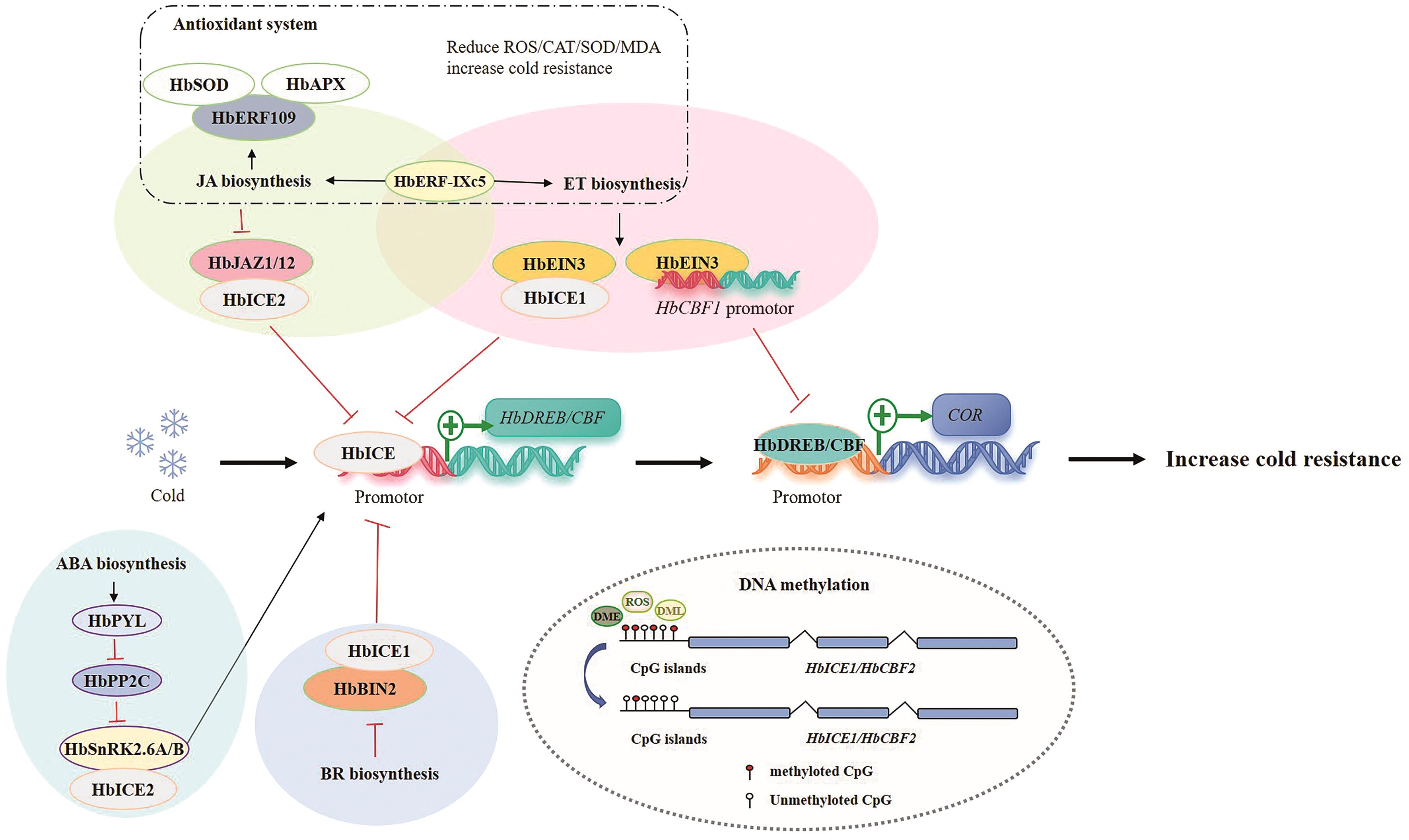
图1 橡胶树转录因子对低温胁迫的响应椭圆形代表调节蛋白,→ 代表促进,┫代表抑制
Fig. 1 Response of rubber tree transcription factors to cold stressEllipses indicate regulatory proteins, “→” indicates promotion, “┫” indicates inhibition
| [1] | 刘金河. 巴西橡胶树的水分状况与生长和产胶量的关系 [J]. 生态学报, 1982, 2(3): 217-224. |
| Liu JH. Relationship between water status and growth and rubber yield of Hevea brasiliensis [J]. Acta Ecol Sin, 1982, 2(3): 217-224. | |
| [2] | 佟金鹤, 张卫红, 刘少军, 等. 中国橡胶树大风、寒害的时空分布分析 [J]. 生态科学, 2023, 42(2): 43-48. |
| Tong JH, Zhang WH, Liu SJ, et al. Temporal and spatial distribution analysis of gale damage and chilling injure of Hevea Brasiliensis in China [J]. Ecol Sci, 2023, 42(2): 43-48. | |
| [3] | 安锋, 王立丰, 王纪坤, 等. 海南西部2015/2016年度橡胶树寒害情况及处理建议 [J]. 中国热带农业, 2016(6): 28-32, 39. |
| An F, Wang LF, Wang JK, et al. Cold damage of rubber trees in western Hainan in 2015/2016 and its treatment suggestions [J]. China Trop Agric, 2016(6): 28-32, 39. | |
| [4] | 王立丰, 吴绍华, 田维敏. 巴西橡胶树抗寒机制研究进展 [J]. 热带作物学报, 2012, 33(7): 1320-1325. |
| Wang LF, Wu SH, Tian WM. Advances on the mechanism for chilling tolerance of rubber tree Hevea brasiliensis muell. arg [J]. Chin J Trop Crops, 2012, 33(7): 1320-1325. | |
| [5] | Xu Y, Hu W, Song S, et al. MaDREB1F confers cold and drought stress resistance through common regulation of hormone synthesis and protectant metabolite contents in banana [J]. Hortic Res, 2023, 10(2): uhac275. |
| [6] | Guo WL, Sun YQ, Chai JQ, et al. MsAREB1 enhances combined cold and saline-alkali stress tolerance by promoting ascorbic acid biosynthesis in alfalfa [J]. Plant Biotechnol J, 2025, 23(8): 3349-3362. |
| [7] | Si J, Fan ZQ, Wu CJ, et al. MaHsf24, a novel negative modulator, regulates cold tolerance in banana fruits by repressing the expression of HSPs and antioxidant enzyme genes [J]. Plant Biotechnol J, 2024, 22(10): 2873-2886. |
| [8] | Gong XX, Yan BY, Hu J, et al. Transcriptome profiling of rubber tree (Hevea brasiliensis) discovers candidate regulators of the cold stress response [J]. Genes Genom, 2018, 40(11): 1181-1197. |
| [9] | 杨汉金, 林梅馨. 巴西橡胶树生物膜的冷害 [J]. 福建热作科技, 1991, 16(2): 1-5. |
| Yang HJ, Lin MX. The chilling injury of biomembrances in Hevea brasiliensis [J]. Fujian Sci Technol Trop Crops, 1991, 16(2): 1-5. | |
| [10] | Kamal MM, Ishikawa S, Takahashi F, et al. Large-scale phosphoproteomic study of Arabidopsis membrane proteins reveals early signaling events in response to cold [J]. Int J Mol Sci, 2020, 21(22): 8631. |
| [11] | Zhao CZ, Wang PC, Si T, et al. MAP kinase cascades regulate the cold response by modulating ICE1 protein stability [J]. Dev Cell, 2017, 43(5): 618-629.e5. |
| [12] | Chinnusamy V, Ohta M, Kanrar S, et al. ICE1: a regulator of cold-induced transcriptome and freezing tolerance in Arabidopsis [J]. Genes Dev, 2003, 17(8): 1043-1054. |
| [13] | Cheng H, Cai HB, Fu HT, et al. Functional characterization of Hevea brasiliensis CRT/DRE binding factor 1 gene revealed regulation potential in the CBF pathway of tropical perennial tree [J]. PLoS One, 2015, 10(9): e0137634. |
| [14] | Chinnusamy V, Zhu JH, Zhu JK. Cold stress regulation of gene expression in plants [J]. Trends Plant Sci, 2007, 12(10): 444-451. |
| [15] | Weeramange MV, Gu CR, Xin SC, et al. Transcriptomic analysis of differential gene expression in Hevea brasiliensis under short-term cold stress [J]. Plants, 2025, 14(18): 2900. |
| [16] | Cheng H, Chen X, Fang JL, et al. Comparative transcriptome analysis reveals an early gene expression profile that contributes to cold resistance in Hevea brasiliensis (the Para rubber tree) [J]. Tree Physiol, 2018, 38(9): 1409-1423. |
| [17] | Mao CL, Li L, Yang T, et al. Transcriptomics integrated with widely targeted metabolomics reveals the cold resistance mechanism in Hevea brasiliensis [J]. Front Plant Sci, 2023, 13: 1092411. |
| [18] | Yuan HM, Sheng Y, Chen WJ, et al. Overexpression of Hevea brasiliensis HbICE1 enhances cold tolerance in Arabidopsis [J]. Front Plant Sci, 2017, 8: 1462. |
| [19] | 李言. 橡胶树低温胁迫抗性相关激素信号途径解析 [D]. 海口: 海南大学, 2021. |
| Li Y. Dissection of hormone signaling pathway in the regulation of cold stress resistance in rubber tree (Hevea brasiliensis muell.arg) [D]. Haikou: Hainan University, 2021. | |
| [20] | Jofuku KD, den Boer BG, Van Montagu M, et al. Control of Arabidopsis flower and seed development by the homeotic gene APETALA2 [J]. Plant Cell, 1994, 6(9): 1211-1225. |
| [21] | Okamuro JK, Caster B, Villarroel R, et al. The AP2 domain of APETALA2 defines a large new family of DNA binding proteins in Arabidopsis [J]. Proc Natl Acad Sci U S A, 1997, 94(13): 7076-7081. |
| [22] | 张永磊, 黄惜, 王洪星. 不同耐寒品种橡胶树ICE与CBF基因对低温胁迫的表达差异 [J]. 分子植物育种, 2022, 20(23): 7796-7803. |
| Zhang YL, Huang X, Wang HX. Expression differences of ICE and CBF genes in different cold-tolerant rubber tree varieties under low temperature stress [J]. Mol Plant Breed, 2022, 20(23): 7796-7803. | |
| [23] | Doherty CJ, Van Buskirk HA, Myers SJ, et al. Roles for Arabidopsis CAMTA transcription factors in cold-regulated gene expression and freezing tolerance [J]. Plant Cell, 2009, 21(3): 972-984. |
| [24] | Zeng XW, Jiang WZ, Zhang JL, et al. Ethylene negatively regulates cold tolerance through HbEIN3-HbICE2 regulatory module in Hevea brasiliensis [J]. Plant Physiol Biochem, 2025, 219: 109397. |
| [25] | Shi YT, Tian SW, Hou LY, et al. Ethylene signaling negatively regulates freezing tolerance by repressing expression of CBF and type-A ARR genes in Arabidopsis [J]. Plant Cell, 2012, 24(6): 2578-2595. |
| [26] | Agarwal M, Hao YJ, Kapoor A, et al. A R2R3 type MYB transcription factor is involved in the cold regulation of CBF genes and in acquired freezing tolerance [J]. J Biol Chem, 2006, 281(49): 37636-37645. |
| [27] | Wang X, Liu WC, Zeng XW, et al. HbSnRK2.6 functions in ABA-regulated cold stress response by promoting HbICE2 transcriptional activity in Hevea brasiliensis [J]. Int J Mol Sci, 2021, 22(23): 12707. |
| [28] | Fowler S, Thomashow MF. Arabidopsis transcriptome profiling indicates that multiple regulatory pathways are activated during cold acclimation in addition to the CBF cold response pathway [W [J]. Plant Cell, 2002, 14(8): 1675-1690. |
| [29] | Ahmad M, Li JZ, Yang QS, et al. Phylogenetic, molecular, and functional characterization of PpyCBF proteins in Asian pears (Pyrus pyrifolia) [J]. Int J Mol Sci, 2019, 20(9): 2074. |
| [30] | Ding YL, Shi YT, Yang SH. Regulatory networks underlying plant responses and adaptation to cold stress [J]. Annu Rev Genet, 2024, 58: 43-65. |
| [31] | Deng XM, Wang JX, Li Y, et al. Comparative transcriptome analysis reveals phytohormone signalings, heat shock module and ROS scavenger mediate the cold-tolerance of rubber tree [J]. Sci Rep, 2018, 8: 4931. |
| [32] | Ohme-Takagi M, Shinshi H. Ethylene-inducible DNA binding proteins that interact with an ethylene-responsive element [J]. Plant Cell, 1995, 7(2): 173-182. |
| [33] | Cheng H, Chen X, Zhu JS, et al. Overexpression of a Hevea brasiliensis ErbB-3 binding protein 1 gene increases drought tolerance and organ size in Arabidopsis [J]. Front Plant Sci, 2016, 7: 1703. |
| [34] | Duan CF, Argout X, Gébelin V, et al. Identification of the Hevea brasiliensis AP2/ERF superfamily by RNA sequencing [J]. BMC Genom, 2013, 14: 30. |
| [35] | Putranto RA, Duan CF, Kuswanhadi, et al. Ethylene response factors are controlled by multiple harvesting stresses in Hevea brasiliensis [J]. PLoS One, 2015, 10(4): e0123618. |
| [36] | Lestari R, Rio M, Martin F, et al. Overexpression of Hevea brasiliensis ethylene response factor HbERF-IXc5 enhances growth and tolerance to abiotic stress and affects laticifer differentiation [J]. Plant Biotechnol J, 2018, 16(1): 322-336. |
| [37] | 王其同. 橡胶树低温相关ERF转录因子的克隆及功能研究 [D]. 海口: 海南大学, 2012. |
| Wang QT. Cloning and functional analysis of ERF transeription factor genes related to low temperature in rubber tree (Hevea brasiliensis) [D]. Haikou: Hainan University, 2012. | |
| [38] | 文维, 江威增, 袁红梅. 橡胶树HbERF109互作蛋白筛选 [J]. 热带作物学报, 2026, 47(4): 825-836. |
| Wen W, Jiang WZ, Yuan HM. Screening of interacting proteins for HbERF109 in rubber tree (Hevea brasiliensis) [J]. Chin J Trop Crops, 2026, 47(4): 825-836. | |
| [39] | 翟琪麟. 橡胶树HbWRKY7和HbWRKY11的克隆及功能研究 [D]. 海口: 海南大学, 2013. |
| Zhai QL. Cloning and functional analysis of HbWRKY7 and HbWRKY11 in Hevea brasiliensis [D]. Haikou: Hainan University, 2013. | |
| [40] | Kang GJ, Yan D, Chen XL, et al. HbWRKY82, a novel IIc WRKY transcription factor from Hevea brasiliensis associated with abiotic stress tolerance and leaf senescence in Arabidopsis [J]. Physiol Plant, 2021, 171(1): 151-160. |
| [41] | 余文才, 李言, 吴绍华, 等. 巴西橡胶树HbHsfA4a的克隆及其对低温胁迫的响应 [J]. 热带作物学报, 2019, 40(5): 898-904. |
| Yu WC, Li Y, Wu SH, et al. Cloning of HbHsfA4a and its transcriptional responses to cold stress in Hevea brasiliensis [J]. Chin J Trop Crops, 2019, 40(5): 898-904. | |
| [42] | 李言, 余文才, 陆庆志, 等. 非生物胁迫对橡胶树热激转录因子家族成员表达的影响 [J]. 热带作物学报, 2021, 42(8): 2119-2125. |
| Li Y, Yu WC, Lu QZ, et al. Effects of abiotic stresses on the expression of heat shock transcrip-tion factor (HSF) family members in rubber tree (Hevea brasilien-sis Muell. Arg.) [J]. Chin J Trop Crops, 2021, 42(8): 2119-2125. | |
| [43] | Yang BS, Zhang C, Yang JJ, et al. Genome-wide investigation of NAC transcription factors and their response to cold stress in rubber tree (Hevea brasiliensis) [J]. J Plant Growth Regul, 2024, 43(11): 4085-4098. |
| [44] | Abdullah SNA, Azzeme AM, Yousefi K. Fine-tuning cold stress response through regulated cellular abundance and mechanistic actions of transcription factors [J]. Front Plant Sci, 2022, 13: 850216. |
| [45] | Wang Y, Mostafa S, Zeng W, et al. Function and mechanism of jasmonic acid in plant responses to abiotic and biotic stresses [J]. Int J Mol Sci, 2021, 22(16): 8568. |
| [46] | 刘云飞, 李言, 田维敏. 橡胶树蛋白激酶基因SnRK2.7的克隆及表达 [J]. 热带生物学报, 2024, 15(1): 1-9. |
| Liu YF, Li Y, Tian WM. Cloning and expression analysis of sucrose non-fermenting 1-related protein kinase 2.7(SnRK2.7) gene in Hevea brasiliensis [J]. J Trop Biol, 2024, 15(1): 1-9. | |
| [47] | Zhang ZL, Zhu JH, Zhang QQ, et al. Molecular characterization of an ethephon-induced Hsp70 involved in high and low-temperature responses in Hevea brasiliensis [J]. Plant Physiol Biochem, 2009, 47(10): 954-959. |
| [48] | Chen WJ, Wang X, Yan S, et al. The ICE-like transcription factor HbICE2 is involved in jasmonate-regulated cold tolerance in the rubber tree (Hevea brasiliensis) [J]. Plant Cell Rep, 2019, 38(6): 699-714. |
| [49] | Qiu YM, Guo J, Jiang WZ, et al. HbBIN2 functions in plant cold stress resistance through modulation of HbICE1 transcriptional activity and ROS homeostasis in Hevea brasiliensis [J]. Int J Mol Sci, 2023, 24(21): 15778. |
| [50] | Campos Mantello C, Boatwright L, da Silva CC, et al. Deep expression analysis reveals distinct cold-response strategies in rubber tree (Hevea brasiliensis) [J]. BMC Genom, 2019, 20: 455. |
| [51] | Casali C, Galgano L, Zannino L, et al. Impact of heat and cold shock on epigenetics and chromatin structure [J]. Eur J Cell Biol, 2024, 103(1): 151373. |
| [52] | 冉莉萍, 孔月琴, 方婷婷, 等. 逆境胁迫下植物表观遗传机制的研究进展 [J]. 生物技术通报, 2014, 30(8): 8-15. |
| Ran LP, Kong YQ, Fang TT, et al. Research progresses of stress-induced epigenetic regulation mechanism in plant [J]. Biotechnol Bull, 2014, 30(8): 8-15. | |
| [53] | Uthup TK, Ravindran M, Bini K, et al. Divergent DNA methylation patterns associated with abiotic stress in Hevea brasiliensis [J]. Mol Plant, 2011, 4(6): 996-1013. |
| [54] | Tang X, Wang QC, Yuan HM, et al. Chilling-induced DNA Demethylation is associated with the cold tolerance of Hevea brasiliensis [J]. BMC Plant Biol, 2018, 18: 70. |
| [55] | 张永磊. 巴西橡胶树冷胁迫应答相关基因的组蛋白修饰研究 [D]. 海口: 海南大学, 2022. |
| Zhang YL. Histone modification of cold responsive genes in Hevea brasiliensis [D]. Haikou: Hainan University, 2022. | |
| [56] | Ye KY, Li H, Ding YL, et al. BRASSINOSTEROID-INSENSITIVE2 negatively regulates the stability of transcription factor ICE1 in response to cold stress in Arabidopsis [J]. Plant Cell, 2019: tpc.00058.2019. |
| [57] | Ren HM, Zhong Y, Guo LY, et al. Molecular mechanisms of low-temperature sensitivity in tropical/subtropical plants: a case study of Casuarina equisetifolia [J]. For Res, 2023, 3: 20. |
| [58] | 吴双, 逯锐琳, 冯成天, 等. 橡胶树HbTRXh5基因在酵母中的表达及抗逆性分析 [J]. 生物技术通报, 2024, 40(12): 136-144. |
| Wu S, Lu RL, Feng CT, et al. Expression of HbTRXh5 gene of Hevea brasiliensis in yeast and analysis on its resistance to stress [J]. Biotechnol Bull, 2024, 40(12): 136-144. | |
| [59] | Fan YT, Xin SC, Dai XM, et al. Efficient genome editing of rubber tree (Hevea brasiliensis) protoplasts using CRISPR/Cas9 ribonucleoproteins [J]. Ind Crops Prod, 2020, 146: 112146. |
| [60] | Dai XM, Yang XF, Wang C, et al. CRISPR/Cas9-mediated genome editing in Hevea brasiliensis [J]. Ind Crops Prod, 2021, 164: 113418. |
| [61] | Megha S, Basu U, Kav NNV. Regulation of low temperature stress in plants by microRNAs [J]. Plant Cell Environ, 2018, 41(1): 1-15. |
| [62] | Kindgren P, Ard R, Ivanov M, et al. Transcriptional read-through of the long non-coding RNA SVALKA governs plant cold acclimation [J]. Nat Commun, 2018, 9: 4561. |
| [63] | Zheng L, Zhao YW, Gan YF, et al. Full-length transcriptome sequencing reveals the impact of cold stress on alternative splicing in quinoa [J]. Int J Mol Sci, 2022, 23(10): 5724. |
| [64] | 钱萧然, 张靖, 牛迎凤, 等. 橡胶树基因组测序及组装研究进展 [J]. 热带农业科技, 2025, 48(3): 93-100. |
| Qian XR, Zhang J, Niu YF, et al. Research progress on genome sequencing and assembly of rubber tree [J]. Trop Agric Sci Technol, 2025, 48(3): 93-100. | |
| [65] | Li CC, Yuan Y, Nie ZY, et al. The haplotype-resolved telomere-to-telomere genome and OMICS analyses reveal genetic responses to tapping in rubber tree [J]. Nat Commun, 2025, 16: 6255. |
| [66] | Fang YJ, Xiao XH, Lin JS, et al. Pan-genome and phylogenomic analyses highlight Hevea species delineation and rubber trait evolution [J]. Nat Commun, 2024, 15: 7232. |
| [67] | Silva CC, Mantello CC, Campos T, et al. Leaf-, panel- and latex-expressed sequenced tags from the rubber tree (Hevea brasiliensis) under cold-stressed and suboptimal growing conditions: the development of gene-targeted functional markers for stress response [J]. Mol Breeding, 2014, 34(3): 1035-1053. |
| [68] | Tian MJ, Li WX, Luo P, et al. Genetic diversity analysis and core germplasm bank construction in cold resistant germplasm of rubber trees (Hevea brasiliensis) [J]. Sci Rep, 2024, 14(1): 14533. |
| [1] | 王鑫, 陈炜, 孙博. 植物花分生组织活性的调控机制[J]. 生物技术通报, 2026, 42(9): 1-13. |
| [2] | 宋文清, 陈智翔, 李雨倩, 王海龙, 邢国芳, 张杰伟. TIFY转录因子在植物生长发育和逆境胁迫响应中的作用[J]. 生物技术通报, 2026, 42(9): 70-81. |
| [3] | 郑淑雅, 苏玉婷, 何玉美, 赵盼, 周心怡, 刘冉, 刘平丽, 郭惠红. 杨树PagRAX2_16G及其启动子的克隆与功能分析[J]. 生物技术通报, 2026, 42(9): 186-195. |
| [4] | 陈宁一, 吴文彤, 赵国春, 贾黎明, 陈仲. 无患子SmHD-ZIP25和SmHD-ZIP29基因在花发育中的功能研究[J]. 生物技术通报, 2026, 42(9): 210-220. |
| [5] | 任文斌, 陈登科, 吴翠翠. 花生转录因子AhZHD9的生物信息学分析及耐盐性研究[J]. 生物技术通报, 2026, 42(9): 297-305. |
| [6] | 秦子璐, 孙海燕, 陈赢男. 植物表皮毛发育分子调控机制研究进展[J]. 生物技术通报, 2026, 42(9): 57-69. |
| [7] | 李梦茹, 钱超楠, 阚思蔚, 刘国元, 张健, 陈艳红. 旱柳SmERF B2-8基因在响应淹水胁迫中的功能研究[J]. 生物技术通报, 2026, 42(7): 204-213. |
| [8] | 辛晴, 郑永杰, 李雨华, 涂白连, 刘新亮, 张月婷, 伍艳芳. 樟树MYC转录因子的全基因组鉴定与表达分析[J]. 生物技术通报, 2026, 42(7): 214-225. |
| [9] | 张雅宁, 毛春力, 胡志勇, 杨丹, 吴佳海, 王碧娴, 黄琳凯. 象草Dof转录因子的全基因组分析及其对低温胁迫的响应[J]. 生物技术通报, 2026, 42(6): 267-278. |
| [10] | 杨洁, 王玉婷, 冯成天, 何其光, 张明亮, 袁坤, 王真辉, 刘辉. 橡胶树HbTRXh2的克隆、表达及功能分析[J]. 生物技术通报, 2026, 42(6): 250-257. |
| [11] | 翟莹, 高双, 计俊杰, 于海伟, 赵艳, 马天意, 张梅娟, 李珊珊. 工业大麻转录因子CsMYB12抗旱功能的研究[J]. 生物技术通报, 2026, 42(6): 294-303. |
| [12] | 吴夏明, 刘传和, 贺涵, 周陈平, 杨敏, 邝瑞彬, 徐泽, 魏岳荣. 草莓耐高温分子响应机制的研究进展[J]. 生物技术通报, 2026, 42(6): 175-185. |
| [13] | 安飞飞, 罗秀芹, 蔡杰, 薛晶晶, 朱文丽. 木薯MeMYB106基因克隆及其在叶片花青素合成中的功能[J]. 生物技术通报, 2026, 42(6): 13-21. |
| [14] | 董亚瑞, 栗锦烨, 崔庆晗, 贾玉鑫. 马铃薯核心MADS-box转录因子进化特性与功能预测[J]. 生物技术通报, 2026, 42(6): 64-76. |
| [15] | 赵文娟, 李辉, 杨雪莹, 王朝露, 祝建波. 马铃薯‘新疆2号’遗传转化体系的建立[J]. 生物技术通报, 2026, 42(6): 87-97. |
| 阅读次数 | ||||||
|
全文 |
|
|||||
|
摘要 |
|
|||||
