







生物技术通报 ›› 2026, Vol. 42 ›› Issue (8): 251-262.doi: 10.13560/j.cnki.biotech.bull.1985.2025-1038
• 研究报告 • 上一篇
申瑞雪1, 郭子卿1, 庞星辰2, 李志远3, 丁炜4, 董琦5, 李森1, 宋红霞1( )
)
收稿日期:2025-09-26
出版日期:2026-08-26
发布日期:2026-08-17
通讯作者:
宋红霞13834836584@sxau.edu.cn基金资助:
SHEN Rui-xue1, GUO Zi-qing1, PANG Xing-chen2, LI Zhi-yuan3, DING Wei4, DONG Qi5, Li Sen1, SONG Hong-xia1()
Received:2025-09-26
Published:2026-08-26
Online:2026-08-17
摘要:
目的 解析‘泽州芹菜’露地越冬的分子调控机制,为珍贵种质资源利用与作物抗寒分子育种提供理论支撑。 方法 以幼苗期‘多利王芹菜’(CRY)为对照,分析不同品种以及‘泽州芹菜’幼苗期(ZRY)和开花期(ZR)不同时期根部的差异代谢物和差异表达基因。 结果 代谢组学分析发现,ZRY vs CRY差异显著代谢物有57种;ZR vs ZRY差异显著代谢物有187种,进一步筛选抗寒差异代谢物,共发现9种,包括苯丙素类和聚酮类、脂质和类脂分子、有机含氧化合物等,且均上调。转录组学分析发现,ZRY vs CRY筛选到2 988个差异表达基因,其中1 001个上调表达,1 987个下调表达;ZR vs ZRY共筛选到8 869个差异表达基因,其中有4 153个上调表达,4 716个下调表达,这些差异表达基因主要富集在植物激素信号转导等通路。‘泽州芹菜’露地越冬后,差异代谢物水杨酸含量增加,分析水杨酸合成路径,发现Ag2G02930在水杨酸的合成中发挥重要作用。 结论 ‘泽州芹菜’通过积累水杨酸等关键代谢物,并激活植物激素信号转导通路抵御低温胁迫,水杨酸合成相关基因Ag2G02930对其露地越冬抗寒性起核心调控作用。
申瑞雪, 郭子卿, 庞星辰, 李志远, 丁炜, 董琦, 李森, 宋红霞. 转录组和代谢组联合解析‘泽州芹菜’露地越冬的机制[J]. 生物技术通报, 2026, 42(8): 251-262.
SHEN Rui-xue, GUO Zi-qing, PANG Xing-chen, LI Zhi-yuan, DING Wei, DONG Qi, Li Sen, SONG Hong-xia. Combined Transcriptome and Metabolome Analysis Elucidates the Mechanism of Open-field Overwintering in ‘Zezhou’ Celery[J]. Biotechnology Bulletin, 2026, 42(8): 251-262.
比较的样品对 The sample pairs for comparison | 代谢物名称 Metabolite name | 类型 Class | Up/down |
|---|---|---|---|
| ZRY vs CRY | 5-乙酰水杨酸 5-Acetylsalicylic acid | 苯丙素类和聚酮类 Phenylpropanoids and polyketides | Up |
矢车菊-3-芸香苷 Cyanidin-3-rutinoside | 苯丙素类和聚酮类 Phenylpropanoids and polyketides | Up | |
γ-亚麻酸 Gamma-linolenic acid | 脂质和类脂分子 Lipids and lipid-like molecules | Up | |
| ZR vs ZRY | 水杨酸 Salicylic acid | 苯环型化合物 Benzenoids | Up |
| 酪醇 Tyrosol | 苯环型化合物 Benzenoids | Up | |
| 反式玉米素9-O-葡萄糖苷 trans-zeatin 9-O-glucoside | / | Up | |
| 景天庚酮糖-7-磷酸 s7p | 有机含氧化合物 Organic oxygen compounds | Up | |
| D-(-)-甘露醇 D-(-)-Mannitol | 有机含氧化合物 Organic oxygen compounds | Up | |
| D-脯氨酸 D-Proline | 有机酸及其衍生物 Organic acids and derivatives | Up |
表1 ZRY vs CRY、ZR vs ZRY抗寒差异代谢物
Table 1 ZRY vs CRY, ZR vs ZRY cold resistance differential metabolites
比较的样品对 The sample pairs for comparison | 代谢物名称 Metabolite name | 类型 Class | Up/down |
|---|---|---|---|
| ZRY vs CRY | 5-乙酰水杨酸 5-Acetylsalicylic acid | 苯丙素类和聚酮类 Phenylpropanoids and polyketides | Up |
矢车菊-3-芸香苷 Cyanidin-3-rutinoside | 苯丙素类和聚酮类 Phenylpropanoids and polyketides | Up | |
γ-亚麻酸 Gamma-linolenic acid | 脂质和类脂分子 Lipids and lipid-like molecules | Up | |
| ZR vs ZRY | 水杨酸 Salicylic acid | 苯环型化合物 Benzenoids | Up |
| 酪醇 Tyrosol | 苯环型化合物 Benzenoids | Up | |
| 反式玉米素9-O-葡萄糖苷 trans-zeatin 9-O-glucoside | / | Up | |
| 景天庚酮糖-7-磷酸 s7p | 有机含氧化合物 Organic oxygen compounds | Up | |
| D-(-)-甘露醇 D-(-)-Mannitol | 有机含氧化合物 Organic oxygen compounds | Up | |
| D-脯氨酸 D-Proline | 有机酸及其衍生物 Organic acids and derivatives | Up |
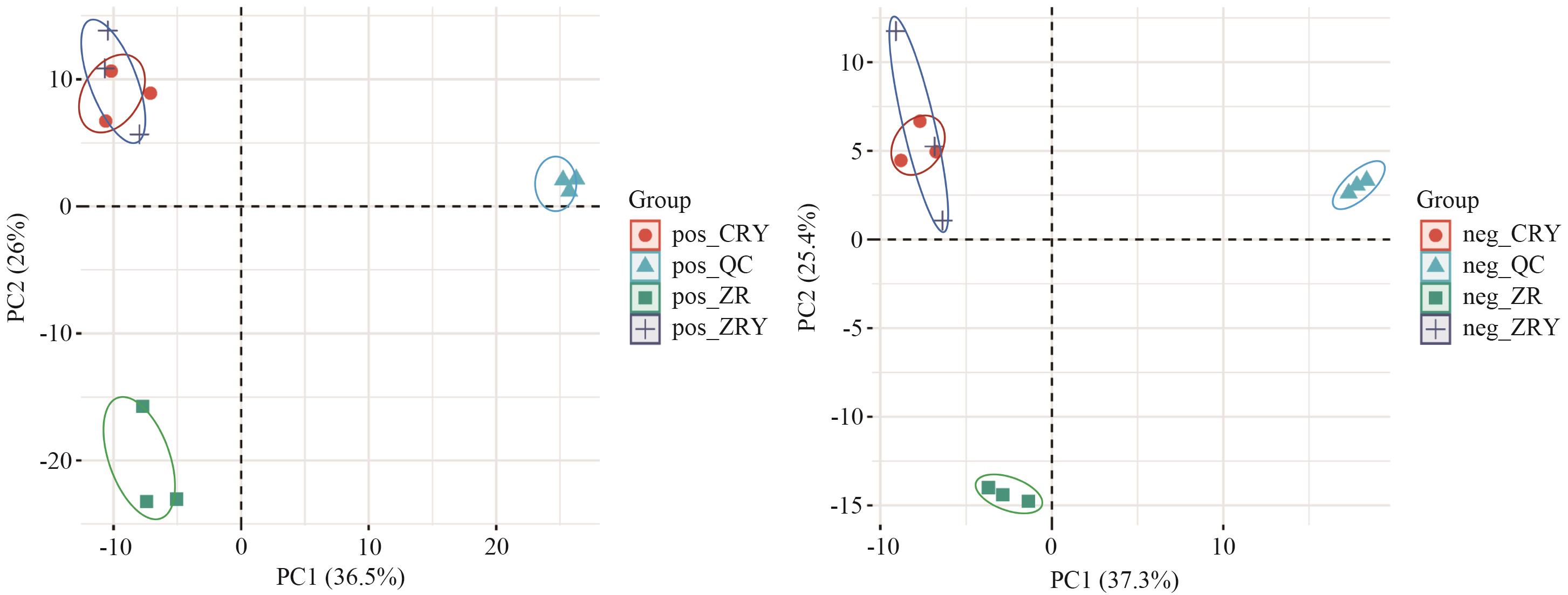
图1 正离子(pos)和负离子(neg)模式下样本的PCA分析
Fig. 1 PCA analysis of samples in positive ion (pos) and negative ion (neg) modes
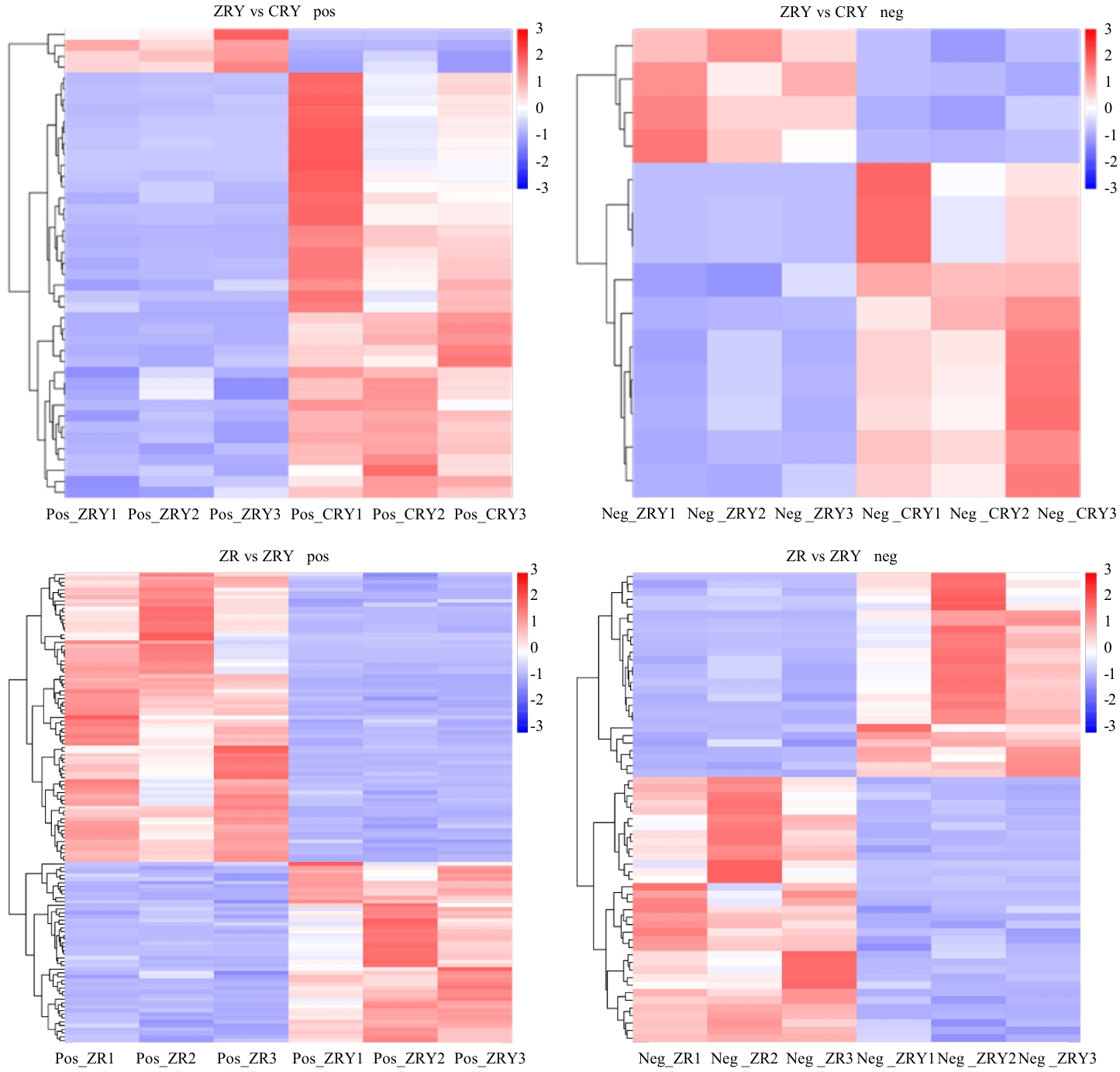
图2 正离子(pos)和负离子(neg)模式下样本差异代谢物聚类热图
Fig. 2 Cluster heat map of differential metabolites in positive ion (pos) and negative ion (neg) modes
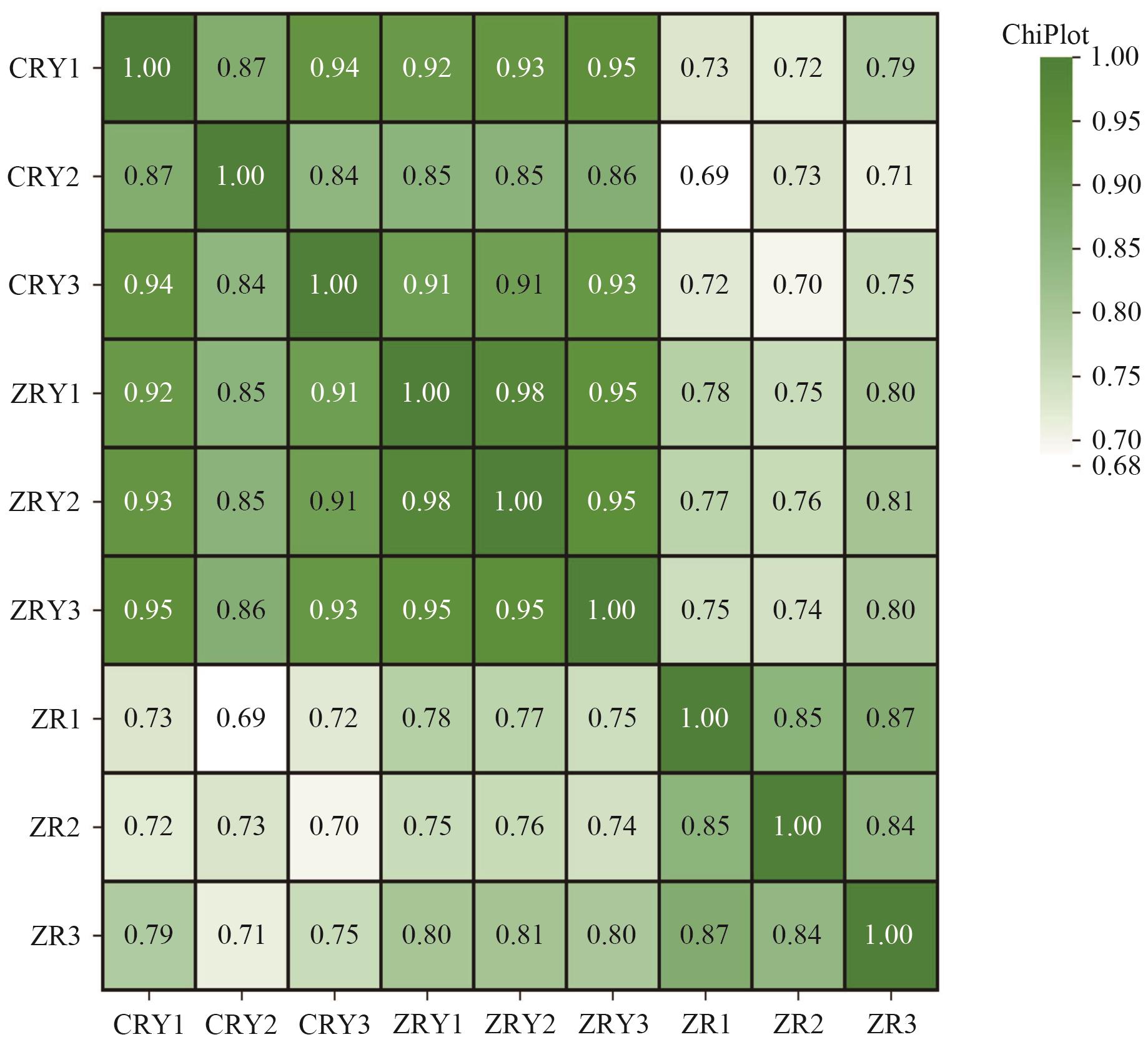
图3 样本间相关性热图
Fig. 3 Correlation heat map between samples
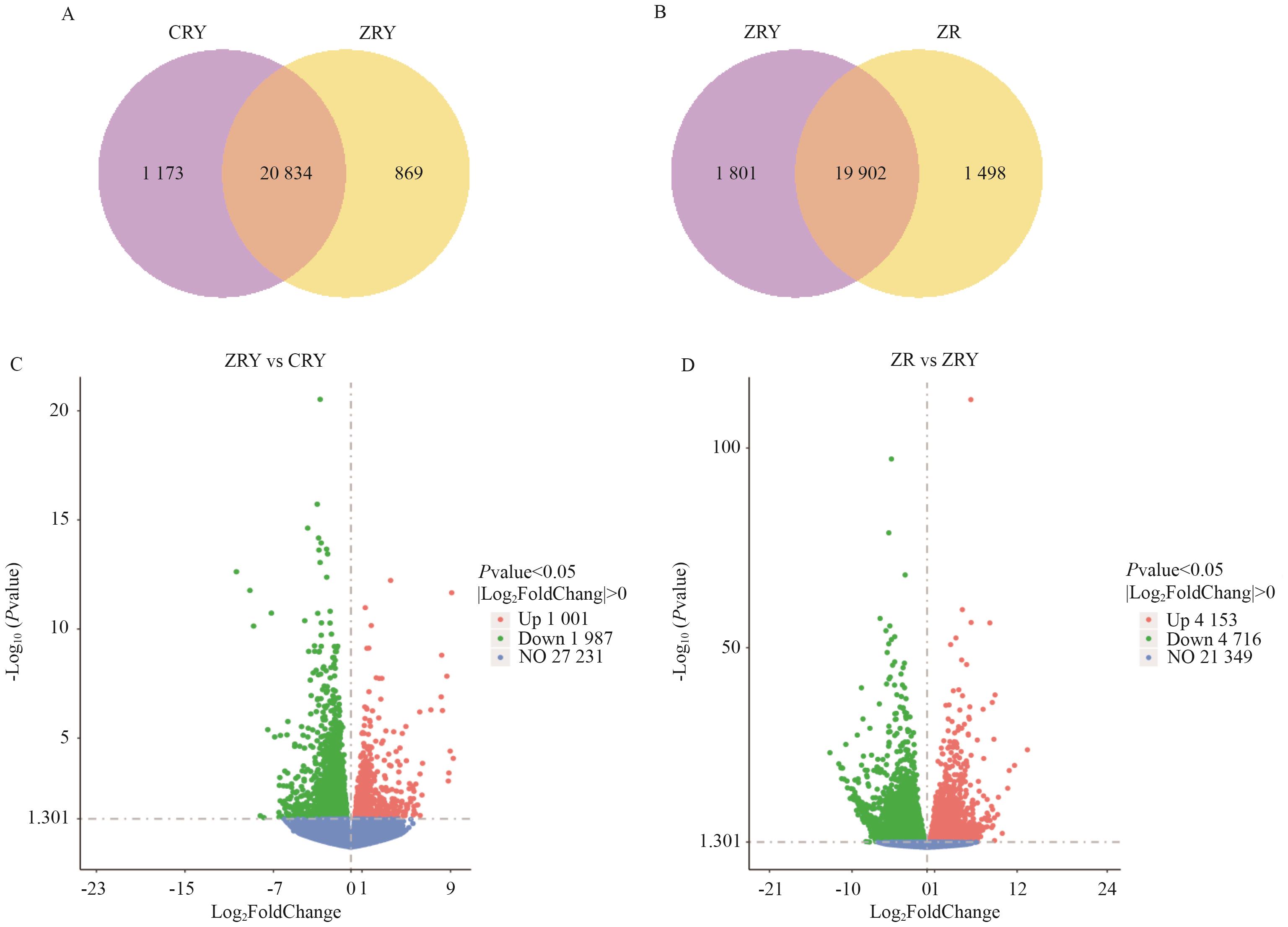
图4 ZRY vs CRY和ZR vs ZRY差异表达基因维恩图(A、B)以及火山图(C、D)
Fig. 4 Differential expression gene Venn diagram (A, B) and volcano map (C, D) of ZRY vs CRY and ZR vs ZRY
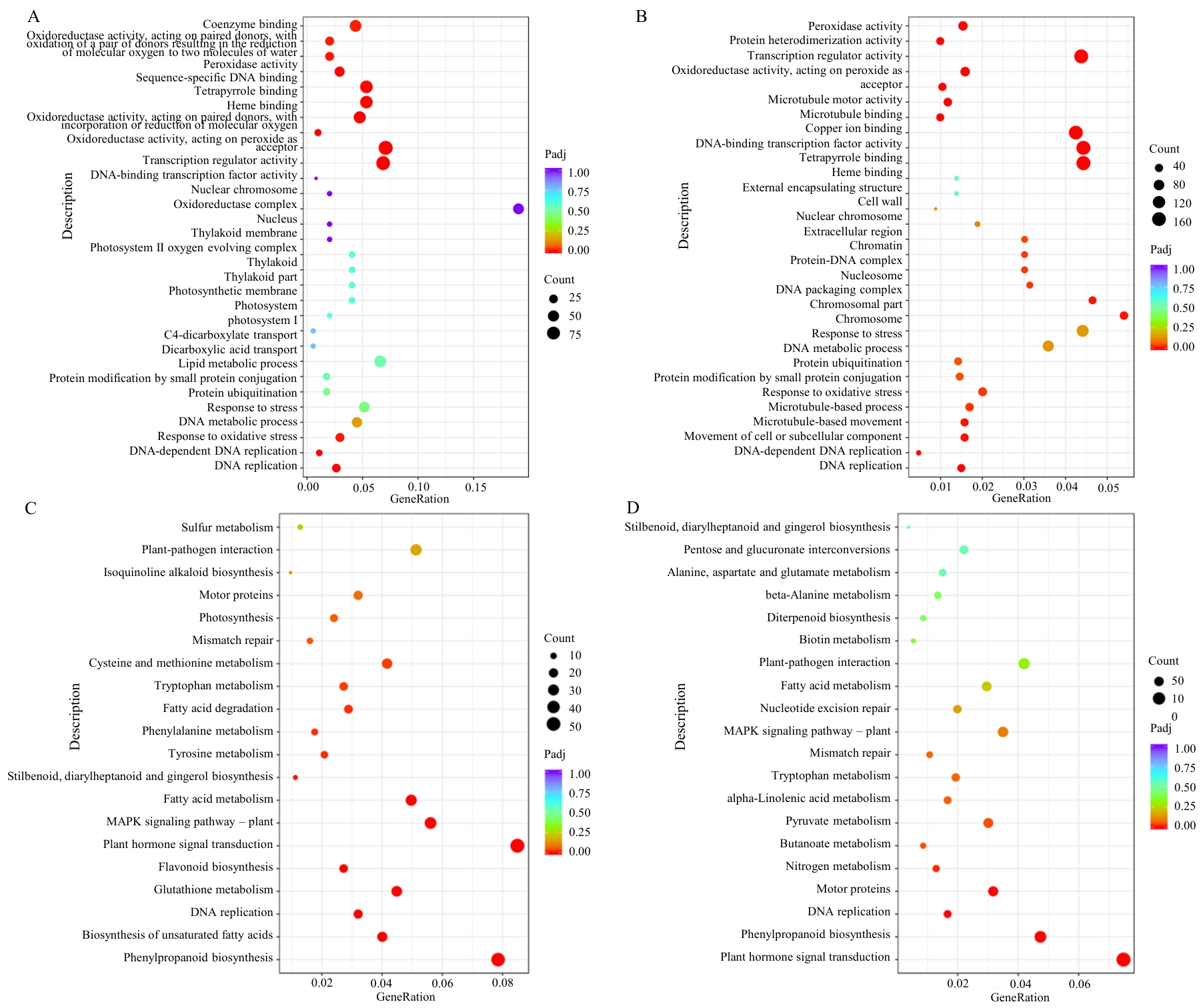
图5 ZRY vs CRY(A、C)、ZR vs ZRY(B、D)差异表达基因的GO富集分析和KEGG通路分析横坐标为注释到KEGG通路上的差异基因数与差异基因总数的比值,纵坐标为KEGG通路,点的大小代表注释到KEGG通路上基因数的多少,颜色从红到紫代表富集显著性逐渐增加
Fig. 5 GO enrichment analysis and KEGG pathway analysis of differentially expressed genes in ZRY vs CRY (A, C) and ZR vs ZRY (B, D)The horizontal axis indicates the ratio of the number of differentially expressed genes annotated to the KEGG pathway to the total number of differentially expressed genes. The vertical axis indicates the KEGG pathways. The size of the points indicates the number of genes annotated to the corresponding KEGG pathway, while the color gradient from red to purple reflects increasingly significant enrichment
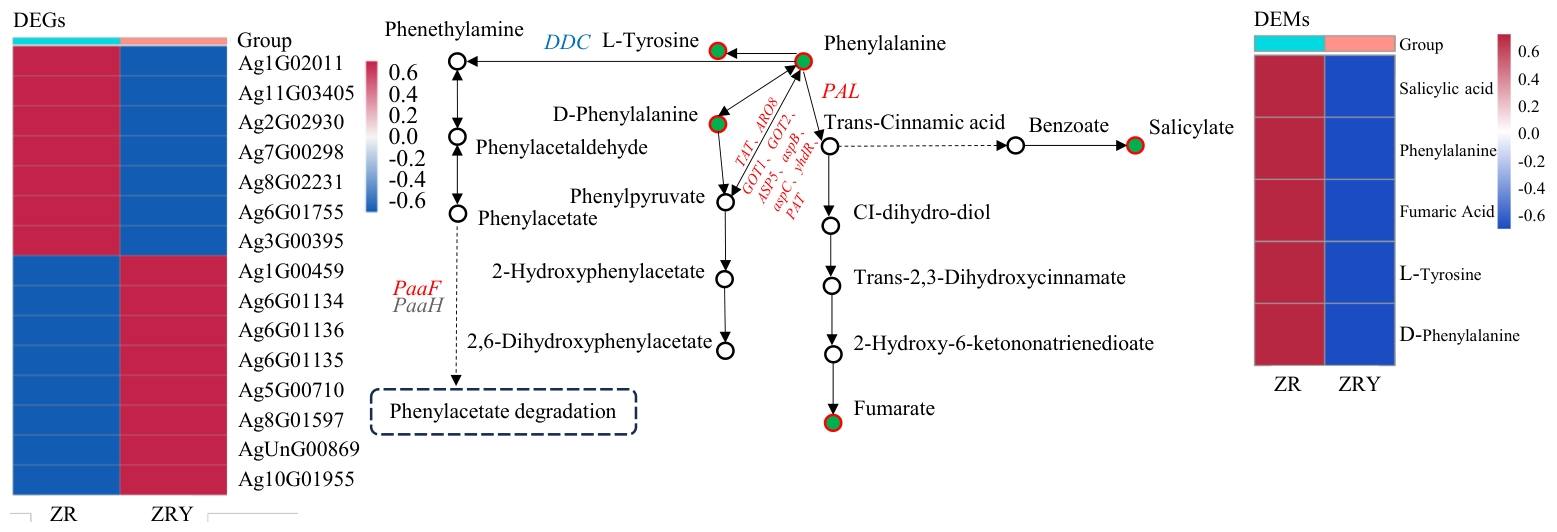
图6 ZR vs ZRY苯丙氨酸代谢途径中差异表达基因与差异代谢物苯丙氨酸代谢途径中蓝色代表下调,红色代表上调。转录组热图表示基因在不同样品中的表达水平(FPKM),代谢组热图表示代谢物在不同样品中的积累量
Fig. 6 Differentially expressed genes and differentially accumulated metabolites in the phenylpropanoid biosynthesis pathway in ZR vs ZRYIn the phenylalanine metabolic pathway, blue indicates down-regulated and red indicates up-regulated. The transcriptome heat map indicates the expressions of the gene in different samples (FPKM), and the metabolome heat map indicates the accumulation of metabolites in different samples
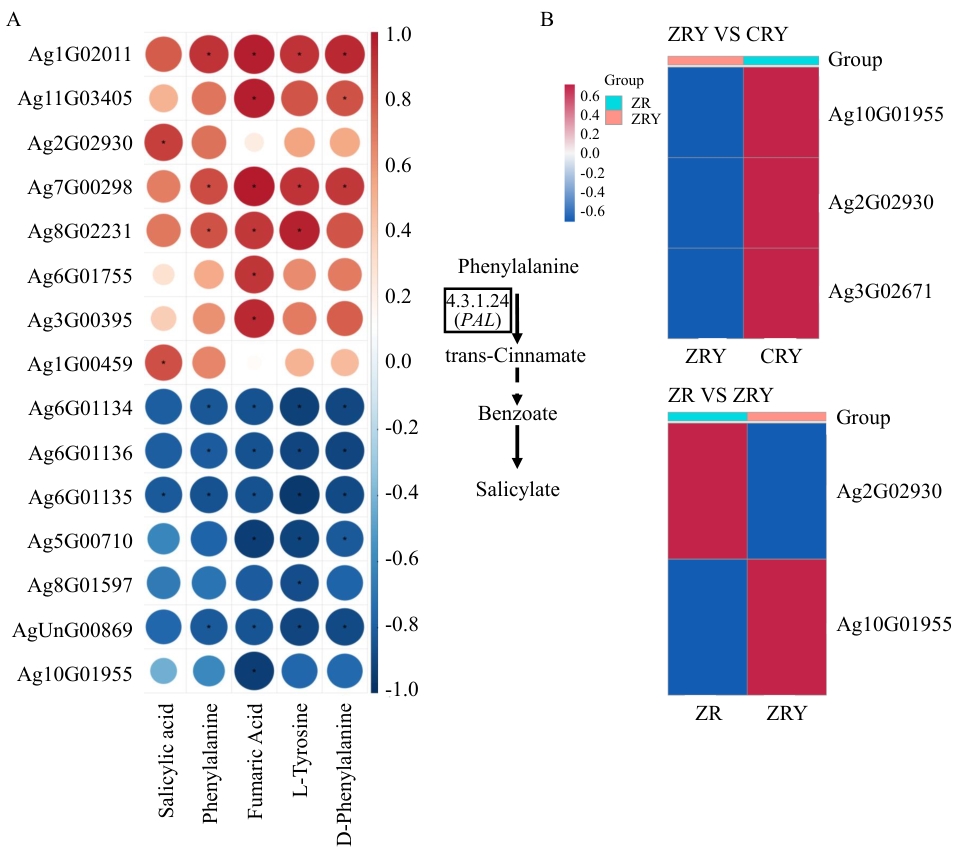
图7 苯丙氨酸代谢途径中差异表达基因与差异代谢物的相关性分析(A)以及水杨酸合成路径和相关差异表达基因热图(B)在相关性分析中,红色表示正相关,蓝色表示负相关;在热图中,红色表示上调表达,蓝色表示下调表达
Fig. 7 Correlation analysis between differentially expressed genes and differentially accumulated metabolites in the phenylpropanoid biosynthesis pathway in (A), and salicylic acid synthesis pathway and related differentially expressed gene heat map (B)In correlation analysis, red indicates positive correlation and blue indicates negative correlation. In the heat map, red indicates up-regulated expression and blue indicates down-regulated expression. A: ZR vs ZRY; B: ZRY vs CRY, ZR vs ZRY
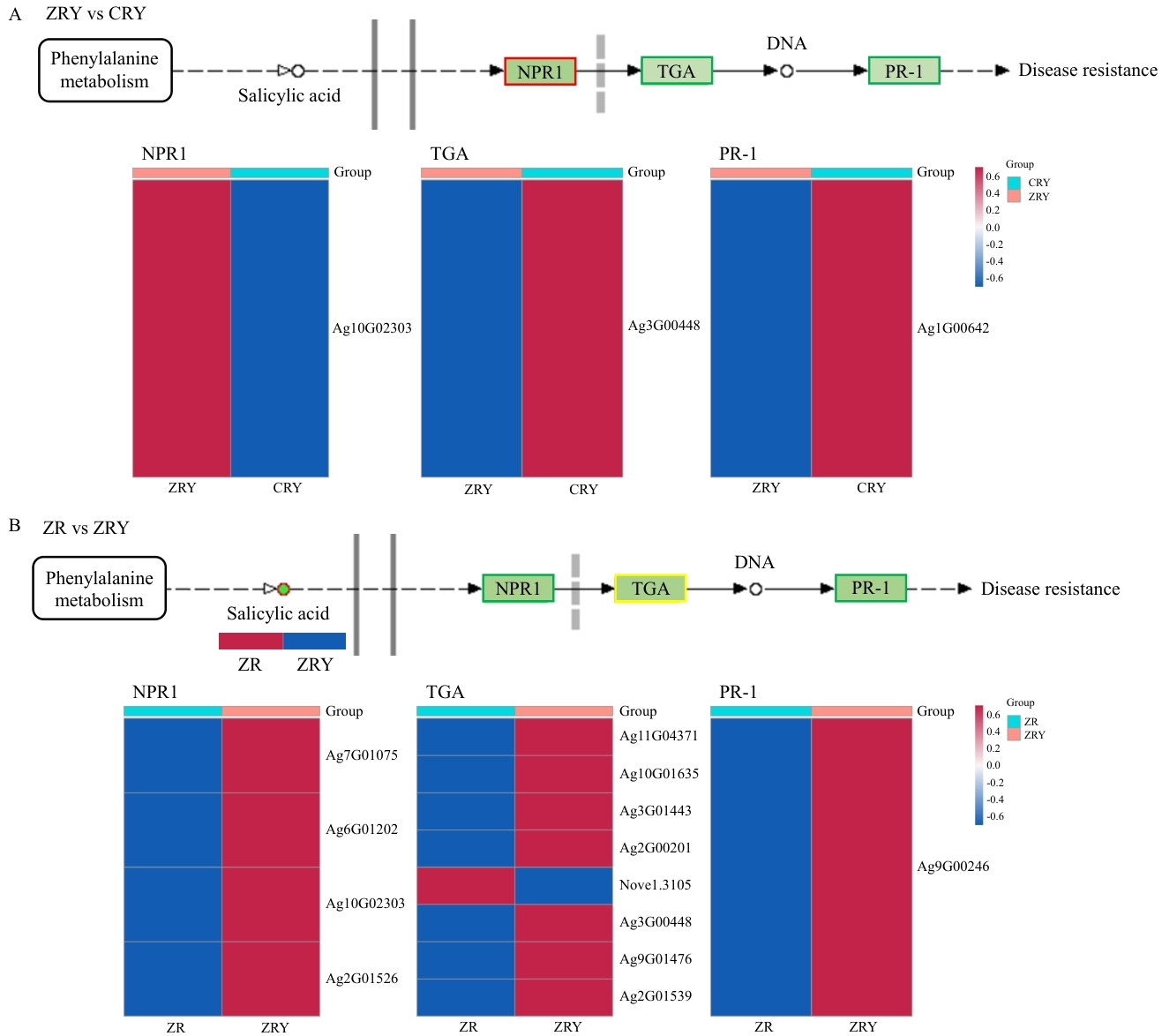
图8 水杨酸信号转导途径及相关差异基因表达热图在水杨酸信号转导途径中方框表示酶,圆表示代谢物,红色代表上调,绿色代表下调,黄色代表上调和下调;在差异基因表达热图中,蓝色代表下调,红色代表上调
Fig. 8 Salicylic acid signal transduction pathway and related differential gene expression heat mapIn the salicylic acid signaling pathway, boxes indicate enzymes, circles indicate metabolites, red indicates up-regulation, green indicates down-regulation, and yellow indicates both up- and down-regulation. In the heatmap of differentially expressed genes, blue indicates down-regulation, and red indicates up-regulation
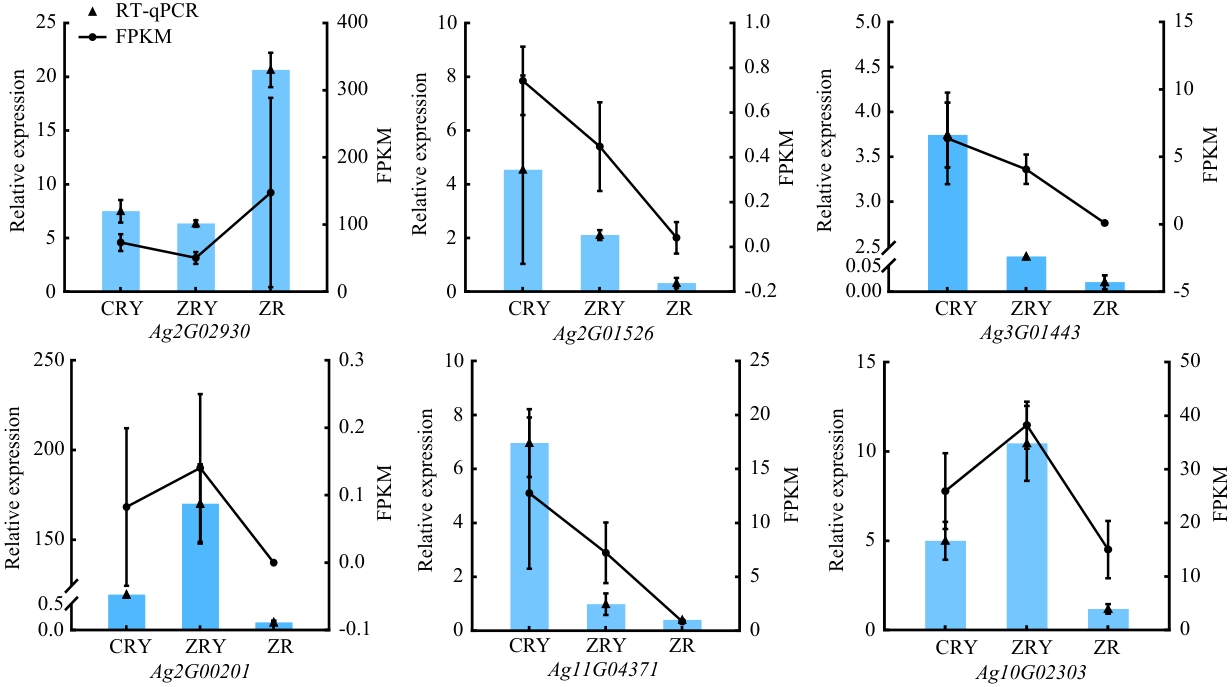
图9 芹菜根系中差异表达基因RT-qPCR验证
Fig. 9 RT-qPCR validation of differentially expressed genes in celery (Apium graveolens L.) roots
| [1] | 宋中喜, 刘少军, 焦健. 芹菜秋露地栽培技术研究 [J]. 种子科技, 2022, 40(8): 64-66. |
| Song ZX, Liu SJ, Jiao J. Study on cultivation techniques of celery in autumn open field [J]. Seed Sci Technol, 2022, 40(8): 64-66. | |
| [2] | 贾湘璐, 粟智勇, 赵文军, 等. 低温对植物生理的影响及生长调节剂的缓解作用研究进展 [J]. 热带农业科学, 2025, 45(4): 177-188. |
| Jia XL, Su ZY, Zhao WJ, et al. Research progress on the effects of low temperature on plant physiology and the alleviation effects of plant growth regulators [J]. Chin J Trop Agric, 2025, 45(4): 177-188. | |
| [3] | 王俊峰, 孔维国, 张煜, 等. 植物抗寒基因表达调控研究进展 [J]. 西北植物学报, 2012, 32(4): 852-858. |
| Wang JF, Kong WG, Zhang Y, et al. Advance in expression and regulation of cold-resistant genes of plants [J]. Acta Bot Boreali Occidentalia Sin, 2012, 32(4): 852-858. | |
| [4] | 赖铭, 陈佳, 张军, 等. 植物低温胁迫响应机制及提高抗冷性研究进展 [J/OL]. 分子植物育种, 2023: 1-11. . |
| Lai M, Chen J, Zhang J, et al. Research progress in plant response mechanism to low temperature stress and improvement of cold resistance [J/OL]. Mol Plant Breed, 2023: 1-11. . | |
| [5] | 张晓丹, 尹铮, 刘清晨, 等. 基于代谢组和转录组联合解析山桃响应冻害机制 [J]. 生物技术通报, 2025, 41(12): 225-239. |
| Zhang XD, Yin Z, Liu QC, et al. Integrated metabolomic and transcriptomic analysis reveals the mechanism of Prunus davidiana response to freezing stress [J]. Biotechnol Bull, 2025, 41(12): 225-239. | |
| [6] | 王芳, 李峪曦, 蒋路平, 等. 低温胁迫下植物分子响应机制研究进展 [J]. 世界林业研究, 2020, 33(6): 15-21. |
| Wang F, Li YX, Jiang LP, et al. Research advances in molecular response mechanisms of plants under low temperature stress [J]. World For Res, 2020, 33(6): 15-21. | |
| [7] | Verma V, Ravindran P, Kumar PP. Plant hormone-mediated regulation of stress responses [J]. BMC Plant Biol, 2016, 16: 86. |
| [8] | 张思懿, 崔博文, 王佳玲, 等. 非生物胁迫下植物根系的生理与分子响应研究进展 [J]. 浙江农业学报, 2024, 36(10): 2391-2401. |
| Zhang SY, Cui BW, Wang JL, et al. Research progress on physiological and molecular responses of plant roots under abiotic stress [J]. Acta Agric Zhejiangensis, 2024, 36(10): 2391-2401. | |
| [9] | Vlot AC, Dempsey DA, Klessig DF. Salicylic acid, a multifaceted hormone to combat disease [J]. Annu Rev Phytopathol, 2009, 47: 177-206. |
| [10] | Shin H, Min K, Arora R. Exogenous salicylic acid improves freezing tolerance of spinach (Spinacia oleracea L.) leaves [J]. Cryobiology, 2018, 81: 192-200. |
| [11] | 原永兵, 曹宗巽. 水杨酸在植物体内的作用 [J]. 植物学通报, 1994, 29(3): 1-9. |
| Yuan YB, Cao ZX. The role of salicylic acid in plants [J]. Chin Bull Bot, 1994, 29(3): 1-9. | |
| [12] | 张阳, 姜晶. 乙酰水杨酸对夜间亚低温番茄幼苗抗寒性的影响 [J]. 中国农学通报, 2012, 28(25): 239-242. |
| Zhang Y, Jiang J. Effects of acetyl salicylic acid on cold resistance of tomato seedlings under sub-low nighttime temperature [J]. Chin Agric Sci Bull, 2012, 28(25): 239-242. | |
| [13] | 王文霞, 李曙光, 白雪芳, 等. 不饱和脂肪酸及其衍生物在植物抗逆反应中的作用 [J]. 植物生理学通讯, 2004(6): 741-748. |
| Wang WX, Li SG, Bai XF, et al. Functions of unsaturated fatty acid and derivates in plant defense reactions [J]. Plant Physiol Commun, 2004(6): 741-748. | |
| [14] | Howe GA, Schilmiller AL. Oxylipin metabolism in response to stress [J]. Curr Opin Plant Biol, 2002, 5(3): 230-236. |
| [15] | 周同永, 任飞, 邓黎, 等. γ-亚麻酸及其生理生化功能研究进展 [J]. 贵州农业科学, 2011, 39(3): 53-58. |
| Zhou TY, Ren F, Deng L, et al. Research progress in physiological and biochemical function of γ-linolenic acid [J]. Guizhou Agric Sci, 2011, 39(3): 53-58. | |
| [16] | 吴淑娟. 微孔草γ-亚麻酸在逆境中的生物学功能及其调控机制 [D]. 兰州: 兰州大学, 2013. |
| Wu SJ. The biological function and the regulation mechanism of γ-linolenic acid in Microula sikkimensis under stresses [D]. Lanzhou: Lanzhou University, 2013. | |
| [17] | 钱文春, 柳丽萍, 钟石, 等. 不同品种桑椹中的矢车菊-3-芸香苷(C3Y)含量及桑椹C3Y的抗氧化作用 [J]. 蚕业科学, 2014, 40(3): 506-512. |
| Qian WC, Liu LP, Zhong S, et al. Content and anti-oxidant activity of cyanidin-3-rutinoside from mulberry fruit of different varieties [J]. Acta Sericologica Sin, 2014, 40(3): 506-512. | |
| [18] | Tulio AZ Jr, Reese RN, Wyzgoski FJ, et al. Cyanidin 3-rutinoside and cyanidin 3-xylosylrutinoside as primary phenolic antioxidants in black raspberry [J]. J Agric Food Chem, 2008, 56(6): 1880-1888. |
| [19] | 马令法. 红景天抗冻性和外源物质对其低温胁迫下生长影响的研究 [D]. 兰州: 甘肃农业大学, 2014. |
| Ma LF. Study on freezing resistance of Rhodiola and low temperature stress growing of exogenous substances [D]. Lanzhou: Gansu Agricultural University, 2014. | |
| [20] | 耿浩, 王韶丽, 郭林, 等. 甘露醇对海水胁迫下小麦种子萌发及幼苗生长的影响 [J]. 基因组学与应用生物学, 2011, 30(2): 218-223. |
| Geng H, Wang SL, Guo L, et al. Effect of mannitol on wheat germination and seedling growth under seawater stress [J]. Genom Appl Biol, 2011, 30(2): 218-223. | |
| [21] | Mechri B, Tekaya M, Attia F, et al. Drought stress improved the capacity of Rhizophagus irregularis for inducing the accumulation of oleuropein and mannitol in olive (Olea europaea) roots [J]. Plant Physiol Biochem, 2020, 156: 178-191. |
| [22] | Kitagawa Y, Yoshizaki K. Water stress-induced chilling tolerance in rice; putative relationship between chilling tolerance and Ca2+ flux [J]. Plant Sci, 1998, 137(1): 73-85. |
| [23] | 盖志佳. 低温胁迫对玉米幼苗脯氨酸积累的影响 [J]. 现代化农业, 2023(12): 2-4. |
| Gai ZJ. Effects of low temperature stress on proline accumulation in maize seedlings [J]. Mod Agric, 2023(12): 2-4. | |
| [24] | 孙梦颖, 王春雨, 郭伟珍, 等. 4个梨品种在低温胁迫下的生理响应及耐寒性评价 [J]. 江苏农业科学, 2025, 53(12): 189-194. |
| Sun MY, Wang CY, Guo WZ, et al. Physiological responses of four pear cultivars under low-temperature stress and evaluation of their cold resistance [J]. Jiangsu Agric Sci, 2025, 53(12): 189-194. | |
| [25] | Geng LF, Zhuang YY, Sui YJ, et al. Molecular mechanism of response to low-temperature during the natural overwintering period of Rosa persica [J]. Plant Cell Rep, 2025, 44(4): 88. |
| [26] | Sangwan S, Shameem N, Yashveer S, et al. Role of salicylic acid in combating heat stress in plants: insights into modulation of vital processes [J]. Front Biosci (Landmark Ed), 2022, 27(11): 310. |
| [27] | 田云. 水杨酸受体NPR1在植物低温胁迫应答中的新功能 [J]. 生物学杂志, 2018, 35(6): 9-10. |
| Tian Y. The novel function of SA receptor NPR1 in cold response in plant [J]. J Biol, 2018, 35(6): 9-10. | |
| [28] | Sun YL, Detchemendy TW, Pajerowska-Mukhtar KM, et al. NPR1 in JazzSet with pathogen effectors [J]. Trends Plant Sci, 2018, 23(6): 469-472. |
| [29] | Silva KJP, Mahna N, Mou ZL, et al. NPR1 as a transgenic crop protection strategy in horticultural species [J]. Hortic Res, 2018, 5: 15. |
| [30] | Dong CJ, Li L, Shang QM, et al. Endogenous salicylic acid accumulation is required for chilling tolerance in cucumber (Cucumis sativus L.) seedlings [J]. Planta, 2014, 240(4): 687-700. |
| [31] | Liu YN, Xu L, Wu MS, et al. Three-step biosynthesis of salicylic acid from benzoyl-CoA in plants [J]. Nature, 2025, 645(8079): 201-207. |
| [1] | 陈义焰, 张冬儿, 张涛, 刘育灏, 唐杰, 盛夏冰, 胡远艺, 艾治勇, 李应将, 刘小林. 水稻OsSULTR2;2基因功能及调控苗期耐盐性分析[J]. 生物技术通报, 2026, 42(7): 116-125. |
| [2] | 王鸿睿, 赵怡如, 饶书培, 陈金焕. 黑果枸杞 LrCYP78A5 基因在干旱与盐胁迫响应中的功能研究[J]. 生物技术通报, 2026, 42(7): 182-192. |
| [3] | 董亚茹, 修妤, 赵东晓, 朱红, 朱琳, 刘惠芬. 基于转录组的桑树GRAS基因家族鉴定及MnGRAS22盐胁迫响应分析[J]. 生物技术通报, 2026, 42(7): 193-203. |
| [4] | 游欣, 王淅, 张新妤, 魏绪英, 程华, 蔡军火. 基于非靶向代谢组解析红花石蒜叶片对高温胁迫的响应[J]. 生物技术通报, 2026, 42(7): 173-181. |
| [5] | 危潇, 黎妍妍, 袁勤峰, 姚经武, 曹春霞, 黄大野. 一株分离自烟草根际的生防菌株鉴定及其生防潜力研究[J]. 生物技术通报, 2026, 42(7): 279-291. |
| [6] | 王家彬, 胡玥, 陈嘉杰, 王蒙, 何秀云, 李之勇, 李健, 王美娜. 紫纹兜兰不同部位的代谢组和转录组联合分析[J]. 生物技术通报, 2026, 42(6): 279-293. |
| [7] | 张初署, 曹世宁, 王发明, 周海翔, 胡晓君, 唐月异, 周晓燕, 王冕, 陈静, 张建成. 乳酸菌发酵花生衣提取物过程中的代谢物特征分析[J]. 生物技术通报, 2026, 42(5): 340-352. |
| [8] | 杨兴盛, 伍绍龙, 冯凯, 王尚, 彭玺, 赵博, 刘明倩, 顾松松, 何晴, 李春格, 胡秋龙, 邓晔. 基于高分辨率质谱的微生物宏代谢组解析方法研究进展[J]. 生物技术通报, 2026, 42(5): 5-15. |
| [9] | 王玉昆, 原远, 王斌, 朱云娜, 任晓强, 任飞, 叶红. 转录组和脂质代谢组联合分析不同紫苏α-亚麻酸合成调控差异[J]. 生物技术通报, 2026, 42(4): 129-140. |
| [10] | 刘青媛, 吴洪启, 陈秀娥, 陈剑, 姜远泽, 何燕子, 喻奇伟, 刘仁祥. 转录因子NtMYB96a调控烟草耐旱性的功能研究[J]. 生物技术通报, 2026, 42(4): 239-250. |
| [11] | 杨婷, 杨宗桃, 艾静, 王禹童, 李燕烨, 邓军, 刘家勇, 赵勇, 张跃彬. 不同基因型甘蔗表型特征及根部转录组学分析[J]. 生物技术通报, 2026, 42(4): 190-201. |
| [12] | 王潇奕, 李金焱, 邢醒, 朱鸿亮. 基于乙烯响应筛选调控番茄成熟且影响呼吸的基因及其功能分析[J]. 生物技术通报, 2026, 42(3): 275-282. |
| [13] | 王尚封, 程斌, 王若若, 丁延庆, 徐建霞, 曹宁, 高旭, 李文贞, 张立异. 基于BSA-seq的高粱开花时间基因定位及候选基因预测[J]. 生物技术通报, 2026, 42(2): 197-206. |
| [14] | 王亚乐, 李雪君, 孙计平, 孙焕. 烟草豫浓香201对低温胁迫的生理响应及转录组分析[J]. 生物技术通报, 2026, 42(2): 228-238. |
| [15] | 王雅南, 魏立民, 王峰, 晁哲, 任钰为, 刘海隆, 黄丽丽, 孙瑞萍. 基于代谢组学筛选五指山猪与杜长大猪脂肪沉积差异代谢物的比较研究[J]. 生物技术通报, 2026, 42(2): 325-337. |
| 阅读次数 | ||||||
|
全文 |
|
|||||
|
摘要 |
|
|||||
