







FAN Zi-ming1, ZOU Yu1, YE Rong-tai1, BAI Zhong-hu1,2, LIU Xiu-xia1,2( )
)
Received:2026-02-09
Online:2026-07-14
Contact:
LIU Xiu-xia
E-mail:liuxiuxia@jiangnan.edu.cn
FAN Zi-ming, ZOU Yu, YE Rong-tai, BAI Zhong-hu, LIU Xiu-xia. Construction of Engineered Corynebacterium glutamicum for Heterologous Protein Expression Using Acid Hydrolysate[J]. Biotechnology Bulletin, doi: 10.13560/j.cnki.biotech.bull.1985.2026-0197.
菌株和质粒 Strains and plasmids | 特征Feature |
|---|---|
| 菌株 | |
| E. coli DH5α | 野生型,用于质粒克隆 |
| C. glutamicum ATCC13032 | 野生型 |
| Evo90 | C. glutamicum ATCC13032衍生菌株,针对乙酸钠与葡萄糖混合碳源进行适应性实验室进化得到的菌株 |
| Evo90-H36M | Evo90衍生菌株,在Evo90基因组中用H36启动子[ |
| 质粒 | |
| pXMJ19 | C. glutamicum/E. coli穿梭载体,氯霉素 |
| pXMJ19-Control | pXMJ19,含有Ptac-RBS-T1-T2表达盒 |
| pXMJ19-ino-1 | pXMJ19-Control,含有ino-1 |
| pXMJ19-msrA | pXMJ19-Control,含有msrA |
| pEC-XK99E | 大肠杆菌-谷氨酸棒杆菌穿梭质粒,卡那霉素 |
| pEC-Control | pEC-XK99E,含有H36-RBS-T1-T2表达盒 |
| pEC-G1 | pEC-Control,含有ack-pta基因序列 |
| pEC-G2 | pEC-Control,含有ADY2基因序列 |
| pEC-G3 | pEC-Control,含有ATO2基因序列 |
| pEC-G4 | pEC-G1,含有RBS-ADY2基因序列 |
| pEC-G5 | pEC-G1,含有RBS-ATO2基因序列 |
| pEC-G2-mCherry | pEC-G2,含有RBS、CspB信号肽和mCherry基因序列 |
| pEC-G2-amyE | pEC-G2,含有RBS、CspB信号肽和amyE基因序列 |
| pEC-G2-VHH | pEC-G2,含有RBS、CspB信号肽和VHH基因序列 |
| pK18mobsacB | C. glutamicum/E. coli穿梭载体(oriV E. coli, sacB, lacZα, KanR) |
| pK18-H36M | pK18mobsacB包含H36启动子插入同源臂序列 |
Table 1 Strains and plasmids used in this study
菌株和质粒 Strains and plasmids | 特征Feature |
|---|---|
| 菌株 | |
| E. coli DH5α | 野生型,用于质粒克隆 |
| C. glutamicum ATCC13032 | 野生型 |
| Evo90 | C. glutamicum ATCC13032衍生菌株,针对乙酸钠与葡萄糖混合碳源进行适应性实验室进化得到的菌株 |
| Evo90-H36M | Evo90衍生菌株,在Evo90基因组中用H36启动子[ |
| 质粒 | |
| pXMJ19 | C. glutamicum/E. coli穿梭载体,氯霉素 |
| pXMJ19-Control | pXMJ19,含有Ptac-RBS-T1-T2表达盒 |
| pXMJ19-ino-1 | pXMJ19-Control,含有ino-1 |
| pXMJ19-msrA | pXMJ19-Control,含有msrA |
| pEC-XK99E | 大肠杆菌-谷氨酸棒杆菌穿梭质粒,卡那霉素 |
| pEC-Control | pEC-XK99E,含有H36-RBS-T1-T2表达盒 |
| pEC-G1 | pEC-Control,含有ack-pta基因序列 |
| pEC-G2 | pEC-Control,含有ADY2基因序列 |
| pEC-G3 | pEC-Control,含有ATO2基因序列 |
| pEC-G4 | pEC-G1,含有RBS-ADY2基因序列 |
| pEC-G5 | pEC-G1,含有RBS-ATO2基因序列 |
| pEC-G2-mCherry | pEC-G2,含有RBS、CspB信号肽和mCherry基因序列 |
| pEC-G2-amyE | pEC-G2,含有RBS、CspB信号肽和amyE基因序列 |
| pEC-G2-VHH | pEC-G2,含有RBS、CspB信号肽和VHH基因序列 |
| pK18mobsacB | C. glutamicum/E. coli穿梭载体(oriV E. coli, sacB, lacZα, KanR) |
| pK18-H36M | pK18mobsacB包含H36启动子插入同源臂序列 |
| 引物名称 Primers | 序列 Sequence (5′-3′) | 用途 Description |
|---|---|---|
| pXMJ19-F | GGATCCCCGGGTACC | pXMJ19-Control载体线性化 |
| pXMJ19-R | TCCTGGAGAGTCGACCTG | |
| ino-F | GTCGACTCTCCAGGAGGACATACAATGAGCACGTCCACCA | 构建pXMJ19-ino-1质粒 |
| ino-R | GGTACCCGGGGATCCTTACGCCTCGATGATGAATG | |
| msrA-F | GTCGACTCTCCAGGAGGACATACAATGGCATGGTTTTTCGCA | 构建pXMJ19-msrA质粒 |
| msrA-R | GGTACCCGGGGATCCTTAAGCTTCTACCCCGCAC | |
| 99k-F | CCATGCGAGAGTAGGGAACTGC | pEC-Control载体线性化 |
| 99k-R | TTTTTTTCCTCCTTTTCTCGAGG | |
| Ack-F | AAAGGAGGAAAAAAAATGAGCGCCGAACTCTTTG | 构建pEC-G1质粒 |
| Ack-R | CCTACTCTCGCATGGTTAAGCGAACTTCACCGCGTA | |
| ADY-F | AAAGGAGGAAAAAAAATGTCTGACAAGGAACAAACGAGC | 构建pEC-G2质粒 |
| ADY-R | CCTACTCTCGCATGGTTAAAAGATTACCCTTTCAGTAGATGGTAATGGG | |
| ATO-F | AAAGGAGGAAAAAAAATGTCTGACAGAGAACAAAGCAG | 构建pEC-G3质粒 |
| ATO-R | CCTACTCTCGCATGGTTAGAAGAACACCTTATCATTGCTAGGT | |
| 1229-HR-ack-F | CCATGCGAGAGTAGGGAACTG | pEC-G1载体线性化 |
| 1229-HR-ack-R | TTAAGCGAACTTCACCGCGTACC | |
| 1229-ADY-F | GTGAAGTTCGCTTAACCAGGAGGACATACACTAATGTCTGACAAGGAACAAACG | 构建pEC-G4质粒 |
| 1229-ADY-R | CCTACTCTCGCATGGTTAAAAGATTACCCTTTCAGTAGATGGTAATGGG | |
| 1229-ATO-F | GTGAAGTTCGCTTAACCAGGAGGACATACACTAATGTCTGACAGAGAACAAAG | 构建pEC-G5质粒 |
| 1229-ATO-R | CCTACTCTCGCATGGTTAGAAGAACACCTTATCATTGCTAGGTAATGC | |
| HR-99k-ADY-F | CCATGCGAGAGTAGGGAACTGC | pEC-G2载体线性化 |
| HR-99k-ADY-R | TGTATGTCCTCCTGGTAAAAGATTACCCTTTCAGTAGATGGTAATGGG | |
| CspB-F | CCAGGAGGACATACAATGTTTAACAATCGTATCCGC | 扩增CspB片段 |
| CspB-R | TTCCTGAGCGAATGCTG | |
| 1115-mChe-F | GCATTCGCTCAGGAAGTGAGCAAGGGCGAGGAG | 构建pEC-G2-mCherry质粒 |
| 1115-mChe-R | CCTACTCTCGCATGGTTACTTGTACAGCTCGTCCATGCC | |
| 1115-AL-F | GCATTCGCTCAGGAAGAAACGGCGAACAAATCGA | 构建pEC-G2-amyE质粒 |
| 1115-AL-R | CCTACTCTCGCATGGTTAATGGGGAAGAGAACCGC | |
| 1115-VHH-F | GCATTCGCTCAGGAACAGGTCCAACTGCAAGAAAGC | 构建pEC-G2-VHH质粒 |
| 1115-VHH-R | CCTACTCTCGCATGGTTATGAAGAGACGGTCACCTGGG | |
| Mrp1-1-F | CATGATTACGAATTCCGTAGTTGATCGAGTTGGTC | 构建pK18-H36M质粒,Mrp1启动子替换的上游同源臂 |
| Mrp1-1-R | CTGGGCCCGTTAATAGCTAAACCTCGAAACAATAAC | |
| Mrp1-2-F | GTAGCATGGGATCCAAGGAGGAAAAAAAATGAGTTTGCTATTTGTTGTGGCGCTTGC | 构建pK18-H36M质粒,Mrp1启动子替换的下游同源臂 |
| Mrp1-2-R | GTGCCAAGCTTGCATTACCCATGCCGACGATAATCAGC | |
| H36-F | TATTAACGGGCCCAGGGTGG | 构建pK18-H36M质粒,扩增H36片段 |
| H36-R | TTTTTTTCCTCCTTGGATCCCATGCTACTCCTACC |
Table 2 Primers used in this study
| 引物名称 Primers | 序列 Sequence (5′-3′) | 用途 Description |
|---|---|---|
| pXMJ19-F | GGATCCCCGGGTACC | pXMJ19-Control载体线性化 |
| pXMJ19-R | TCCTGGAGAGTCGACCTG | |
| ino-F | GTCGACTCTCCAGGAGGACATACAATGAGCACGTCCACCA | 构建pXMJ19-ino-1质粒 |
| ino-R | GGTACCCGGGGATCCTTACGCCTCGATGATGAATG | |
| msrA-F | GTCGACTCTCCAGGAGGACATACAATGGCATGGTTTTTCGCA | 构建pXMJ19-msrA质粒 |
| msrA-R | GGTACCCGGGGATCCTTAAGCTTCTACCCCGCAC | |
| 99k-F | CCATGCGAGAGTAGGGAACTGC | pEC-Control载体线性化 |
| 99k-R | TTTTTTTCCTCCTTTTCTCGAGG | |
| Ack-F | AAAGGAGGAAAAAAAATGAGCGCCGAACTCTTTG | 构建pEC-G1质粒 |
| Ack-R | CCTACTCTCGCATGGTTAAGCGAACTTCACCGCGTA | |
| ADY-F | AAAGGAGGAAAAAAAATGTCTGACAAGGAACAAACGAGC | 构建pEC-G2质粒 |
| ADY-R | CCTACTCTCGCATGGTTAAAAGATTACCCTTTCAGTAGATGGTAATGGG | |
| ATO-F | AAAGGAGGAAAAAAAATGTCTGACAGAGAACAAAGCAG | 构建pEC-G3质粒 |
| ATO-R | CCTACTCTCGCATGGTTAGAAGAACACCTTATCATTGCTAGGT | |
| 1229-HR-ack-F | CCATGCGAGAGTAGGGAACTG | pEC-G1载体线性化 |
| 1229-HR-ack-R | TTAAGCGAACTTCACCGCGTACC | |
| 1229-ADY-F | GTGAAGTTCGCTTAACCAGGAGGACATACACTAATGTCTGACAAGGAACAAACG | 构建pEC-G4质粒 |
| 1229-ADY-R | CCTACTCTCGCATGGTTAAAAGATTACCCTTTCAGTAGATGGTAATGGG | |
| 1229-ATO-F | GTGAAGTTCGCTTAACCAGGAGGACATACACTAATGTCTGACAGAGAACAAAG | 构建pEC-G5质粒 |
| 1229-ATO-R | CCTACTCTCGCATGGTTAGAAGAACACCTTATCATTGCTAGGTAATGC | |
| HR-99k-ADY-F | CCATGCGAGAGTAGGGAACTGC | pEC-G2载体线性化 |
| HR-99k-ADY-R | TGTATGTCCTCCTGGTAAAAGATTACCCTTTCAGTAGATGGTAATGGG | |
| CspB-F | CCAGGAGGACATACAATGTTTAACAATCGTATCCGC | 扩增CspB片段 |
| CspB-R | TTCCTGAGCGAATGCTG | |
| 1115-mChe-F | GCATTCGCTCAGGAAGTGAGCAAGGGCGAGGAG | 构建pEC-G2-mCherry质粒 |
| 1115-mChe-R | CCTACTCTCGCATGGTTACTTGTACAGCTCGTCCATGCC | |
| 1115-AL-F | GCATTCGCTCAGGAAGAAACGGCGAACAAATCGA | 构建pEC-G2-amyE质粒 |
| 1115-AL-R | CCTACTCTCGCATGGTTAATGGGGAAGAGAACCGC | |
| 1115-VHH-F | GCATTCGCTCAGGAACAGGTCCAACTGCAAGAAAGC | 构建pEC-G2-VHH质粒 |
| 1115-VHH-R | CCTACTCTCGCATGGTTATGAAGAGACGGTCACCTGGG | |
| Mrp1-1-F | CATGATTACGAATTCCGTAGTTGATCGAGTTGGTC | 构建pK18-H36M质粒,Mrp1启动子替换的上游同源臂 |
| Mrp1-1-R | CTGGGCCCGTTAATAGCTAAACCTCGAAACAATAAC | |
| Mrp1-2-F | GTAGCATGGGATCCAAGGAGGAAAAAAAATGAGTTTGCTATTTGTTGTGGCGCTTGC | 构建pK18-H36M质粒,Mrp1启动子替换的下游同源臂 |
| Mrp1-2-R | GTGCCAAGCTTGCATTACCCATGCCGACGATAATCAGC | |
| H36-F | TATTAACGGGCCCAGGGTGG | 构建pK18-H36M质粒,扩增H36片段 |
| H36-R | TTTTTTTCCTCCTTGGATCCCATGCTACTCCTACC |
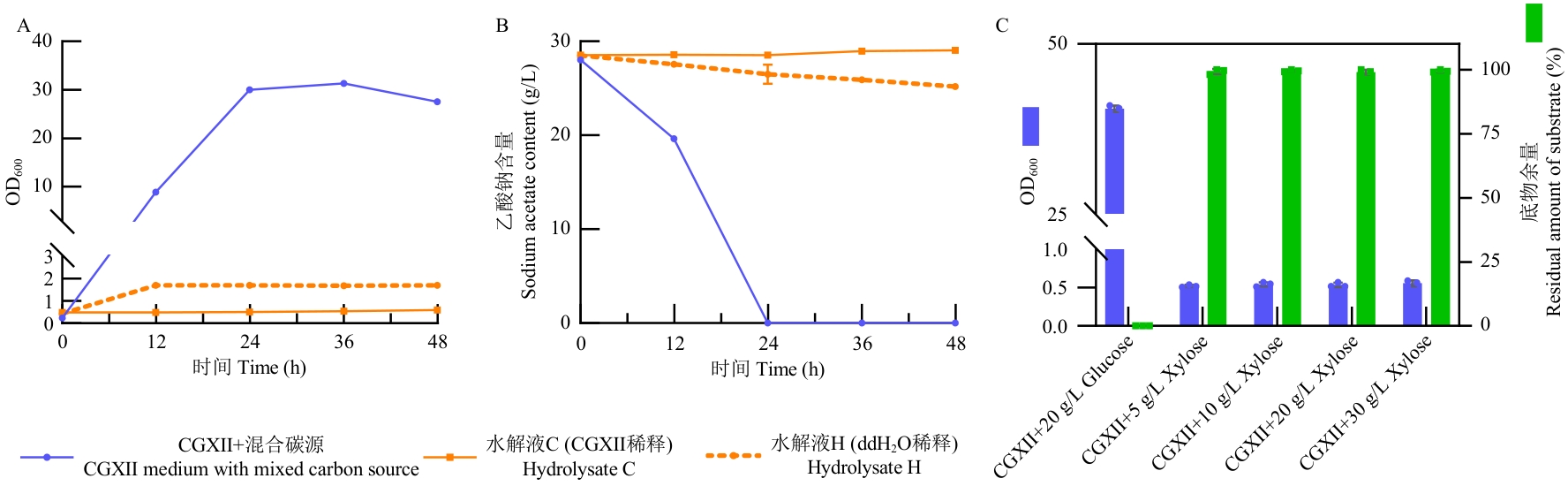
Fig. 1 Growth of the wild-type strain WT in hydrolysateA, B: Growth and substrate consumption of the wild‑type (WT) strain in different medium. C: Cell density and residual substrate of the WT strain cultivated in CGXII medium containing different carbon sources for varied durations (samples were taken at 24 h for the glucose group and at 120 h for the xylose group)
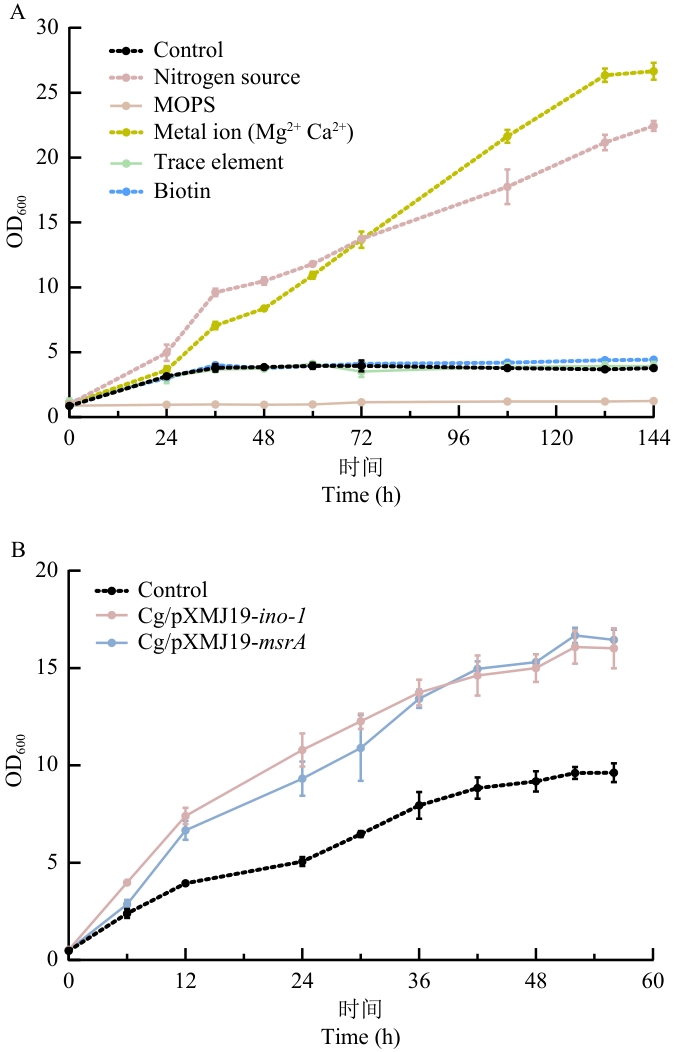
Fig. 2 Screening of key ingredients and antioxidant genesA: Growth of the wild-type (WT) strain in hydrolysate H supplemented with different components. B: Growth of engineered strains Cg/pXMJ19-ino-1 and Cg/pXMJ19-msrA in hydrolysate H+
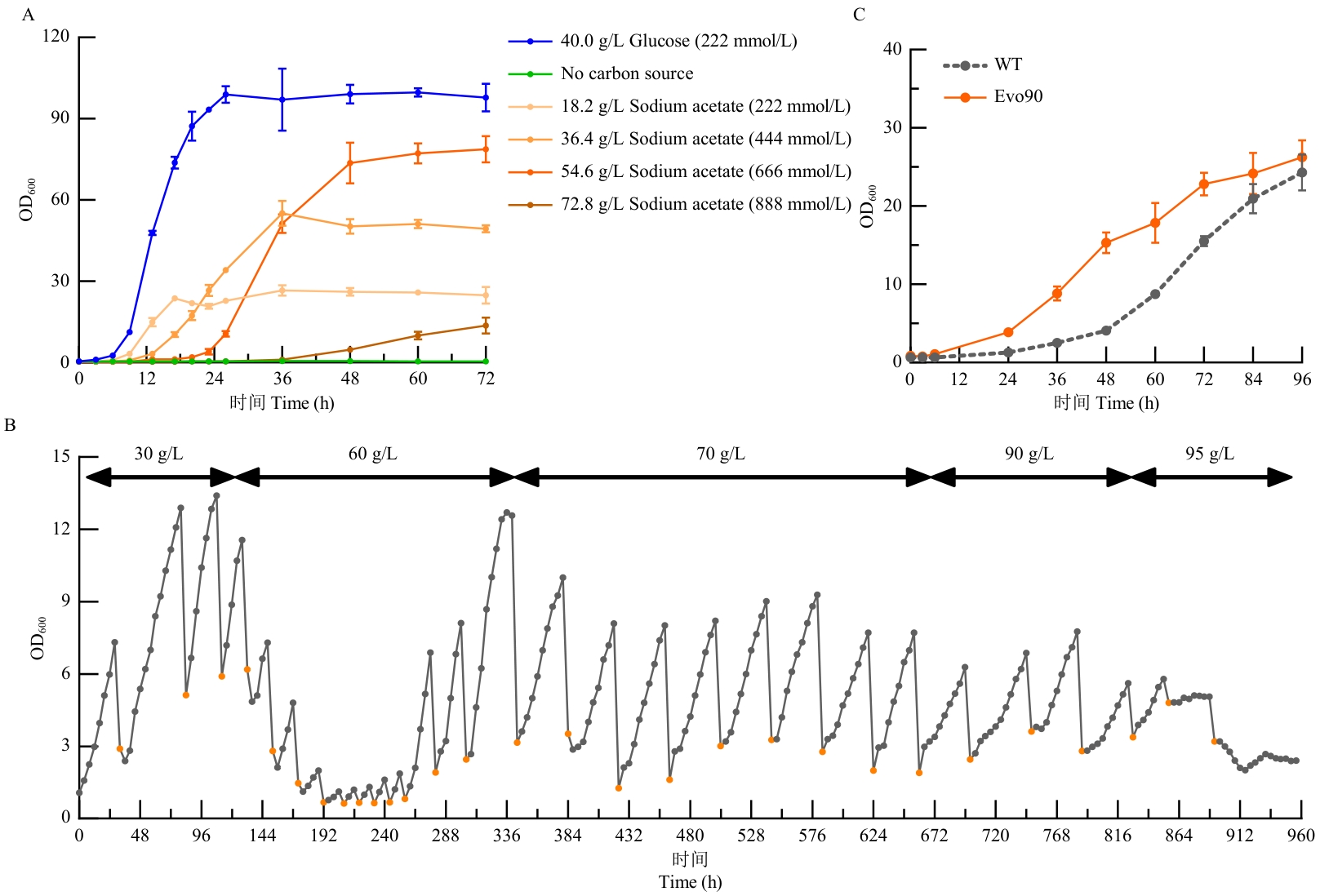
Fig. 3 Adaptive laboratory evolution and performance validation of the evolved strain Evo90A: Growth of the wild‑type (WT) strain in CGXII medium supplemented with different carbon sources. B: Cell growth during serial subculturing. C: Growth comparison between Evo90 and the WT strain
| 类型 Type | 位点 Site | 突变 Mutation | 氨基酸变化 Change of amino acid | 基因 Gene | 蛋白名称 Protein |
|---|---|---|---|---|---|
| 单碱基突变 | 32141 | C→T | - | Cgl0031 | ABC-type transporter, permease components |
| 274977 | T→C | - | Cgl0255 | Catalase | |
| 364652 | A→G | K→E | Cgl0344 | ATPases involved in chromosome partitioning | |
| 364912 | A→C | E→D | Cgl0344 | ATPases involved in chromosome partitioning | |
| 387460 | T→C | - | Cgl0365 | Hypothetical protein | |
| 736480 | T→C | V→A | Cgl0716 | Hypothetical protein | |
| 770809 | G→A | L→F | Cgl0738 | Type II restriction enzyme, methylase subunits | |
| 1279070 | T→G | D→E | Cgl1212 | F0F1-type ATP synthase beta subunit | |
| 1751737 | G→A | V→I | Cgl1651 | Hypothetical protein | |
| 2036724 | A→C | - | Cgl1928 | Predicted transcriptional regulator, consists of a Zn-ribbon and ATP-cone domains | |
| 2041951 | G→T | G→V | Cgl1934 | Transcriptional regulators of sugar metabolism | |
| 2058943 | A→G | S→P | Cgl1949 | 2-methylthioadenine synthetase | |
| 2060507 | C→T | - | Cgl1951 | ABC-type transporter, periplasmic component (glutamate) | |
| 2083859 | T→A | - | Cgl1975 | Polyribonucleotide nucleotidyltransferase (polynucleotide phosphorylase) | |
| 2160737 | C→T | P→L | Cgl2047 | Hypothetical protein | |
| 2425773 | G→A | - | Cgl2457 | Alkaline phosphatase | |
| 2602951 | C→T | - | Cgl2460 | ABC-type transporter, permease components | |
| 2605561 | C→T | - | Cgl2505 | Hypothetical membrane protein | |
| 2655586 | C→T | A→T | Cgl2575 | ABC-type transporter, periplasmic component | |
| 2737632 | T→C | - | Cgl2587 | Predicted membrane proteins, hemolysin III homologs | |
| 3156189 | T→G | - | Cgl3077 | Hypothetical membrane protein | |
| 3286754 | G→A | - | Cgl0344 | ATPases involved in chromosome partitioning | |
| 碱基缺失 | 364006 | G→- | - | Cgl0657 | Uncharacterized protein involved in propionate catabolism |
| 671706 | A→- | - | Cgl1992 | ABC-type transporter, permease components | |
| 2296630 | C→- | - | Cgl2457 | Alkaline phosphatase | |
| 碱基插入 | 2103241 | GGCCCTTCCGGTTTTGGGGTACATCACAGAACCTGGGCTAGCGGTGTAGACCCGAAAATAAACGAGCCTT | - | Cgl2168 | Hypothetical membrane protein |
Table 3 Whole-genome resequencing results of Evo90 and WT
| 类型 Type | 位点 Site | 突变 Mutation | 氨基酸变化 Change of amino acid | 基因 Gene | 蛋白名称 Protein |
|---|---|---|---|---|---|
| 单碱基突变 | 32141 | C→T | - | Cgl0031 | ABC-type transporter, permease components |
| 274977 | T→C | - | Cgl0255 | Catalase | |
| 364652 | A→G | K→E | Cgl0344 | ATPases involved in chromosome partitioning | |
| 364912 | A→C | E→D | Cgl0344 | ATPases involved in chromosome partitioning | |
| 387460 | T→C | - | Cgl0365 | Hypothetical protein | |
| 736480 | T→C | V→A | Cgl0716 | Hypothetical protein | |
| 770809 | G→A | L→F | Cgl0738 | Type II restriction enzyme, methylase subunits | |
| 1279070 | T→G | D→E | Cgl1212 | F0F1-type ATP synthase beta subunit | |
| 1751737 | G→A | V→I | Cgl1651 | Hypothetical protein | |
| 2036724 | A→C | - | Cgl1928 | Predicted transcriptional regulator, consists of a Zn-ribbon and ATP-cone domains | |
| 2041951 | G→T | G→V | Cgl1934 | Transcriptional regulators of sugar metabolism | |
| 2058943 | A→G | S→P | Cgl1949 | 2-methylthioadenine synthetase | |
| 2060507 | C→T | - | Cgl1951 | ABC-type transporter, periplasmic component (glutamate) | |
| 2083859 | T→A | - | Cgl1975 | Polyribonucleotide nucleotidyltransferase (polynucleotide phosphorylase) | |
| 2160737 | C→T | P→L | Cgl2047 | Hypothetical protein | |
| 2425773 | G→A | - | Cgl2457 | Alkaline phosphatase | |
| 2602951 | C→T | - | Cgl2460 | ABC-type transporter, permease components | |
| 2605561 | C→T | - | Cgl2505 | Hypothetical membrane protein | |
| 2655586 | C→T | A→T | Cgl2575 | ABC-type transporter, periplasmic component | |
| 2737632 | T→C | - | Cgl2587 | Predicted membrane proteins, hemolysin III homologs | |
| 3156189 | T→G | - | Cgl3077 | Hypothetical membrane protein | |
| 3286754 | G→A | - | Cgl0344 | ATPases involved in chromosome partitioning | |
| 碱基缺失 | 364006 | G→- | - | Cgl0657 | Uncharacterized protein involved in propionate catabolism |
| 671706 | A→- | - | Cgl1992 | ABC-type transporter, permease components | |
| 2296630 | C→- | - | Cgl2457 | Alkaline phosphatase | |
| 碱基插入 | 2103241 | GGCCCTTCCGGTTTTGGGGTACATCACAGAACCTGGGCTAGCGGTGTAGACCCGAAAATAAACGAGCCTT | - | Cgl2168 | Hypothetical membrane protein |
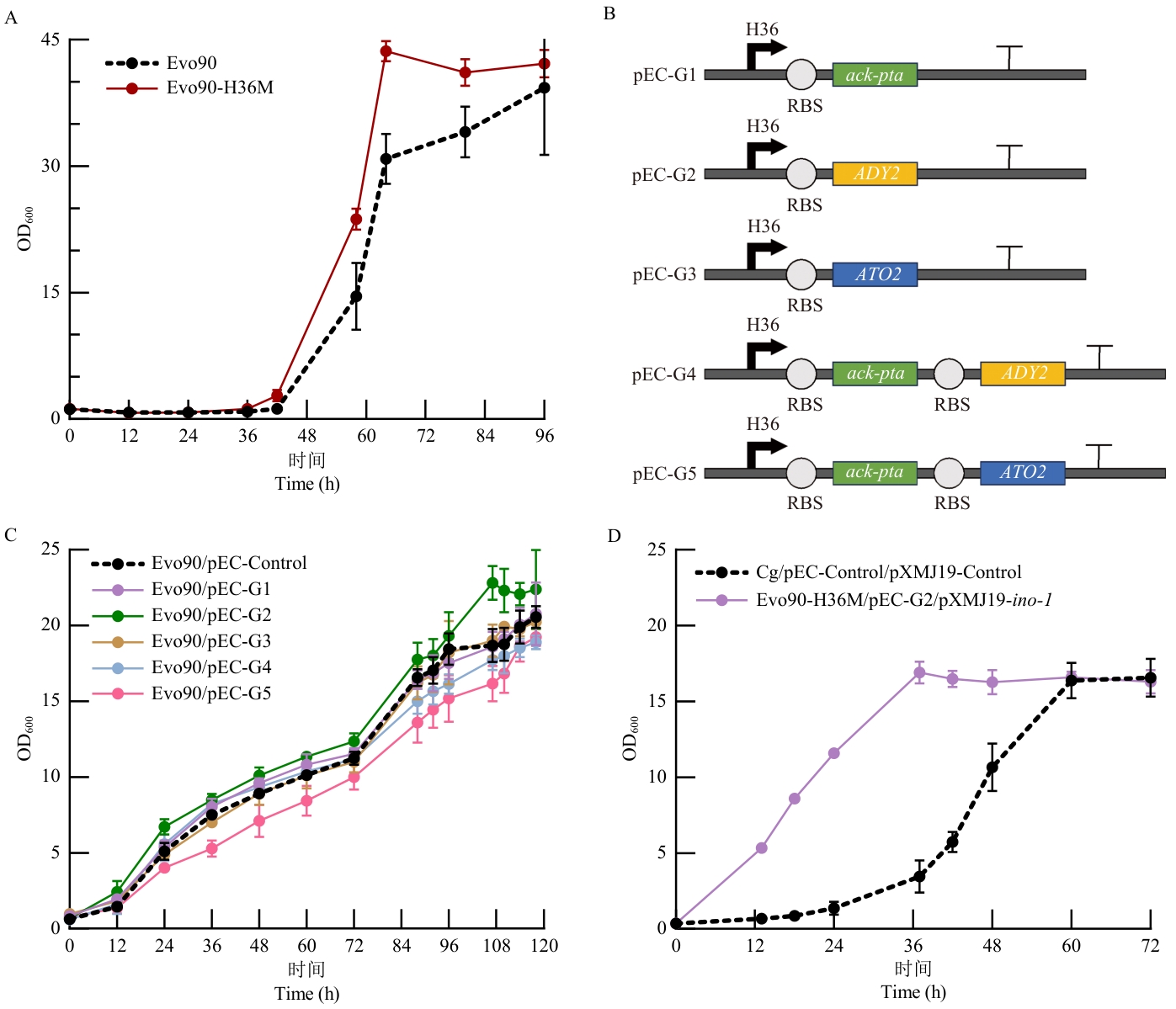
Fig. 4 Results of overexpression of acetic acid utilization-related genesA: Growth comparison between Evo90-H36M and Evo90. B: Schematic diagram of the construction of pEC-G1 to pEC-G5 plasmids. C: Growth comparison of Evo90/pEC-G1 to G5. D: Growth comparison between the superior strain and the control
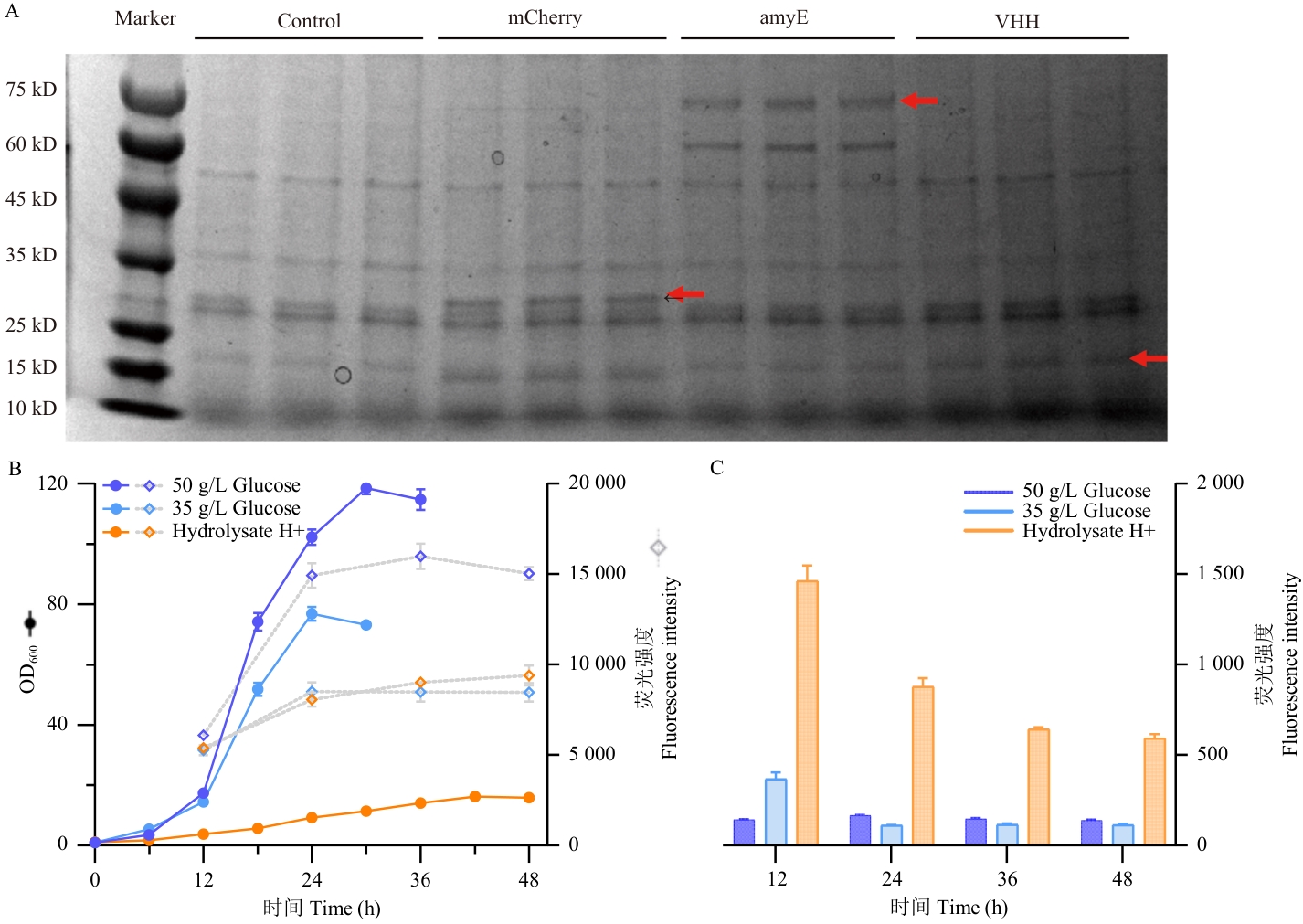
Fig. 5 SDS-PAGE (A) and the extracellular fluorescence intensity analysis (B and C) of secreted expressed proteins by the engineered strain
| [1] | Gu PF, Li FF, Huang ZS, et al. Application of acetate as a substrate for the production of value-added chemicals in Escherichia coli [J]. Microorganisms, 2024, 12(2): 309. |
| [2] | Taha M, Foda M, Shahsavari E, et al. Commercial feasibility of lignocellulose biodegradation: possibilities and challenges [J]. Curr Opin Biotechnol, 2016, 38: 190-197. |
| [3] | Yang H, Huang B, Lai NY, et al. Metabolic engineering of Escherichia coli carrying the hybrid acetone-biosynthesis pathway for efficient acetone biosynthesis from acetate [J]. Microb Cell Fact, 2019, 18: 6. |
| [4] | Woo HM, Park JB. Recent progress in development of synthetic biology platforms and metabolic engineering of Corynebacterium glutamicum [J]. J Biotechnol, 2014, 180: 43-51. |
| [5] | Filina A, Jemaa N, Saulnier-Bellemare T, et al. Techno-economic analysis (TEA) and life-cycle assessment (LCA) methodology as a tool for biorefining technology benchmarking and iterative process design [J]. Biomass Bioenergy, 2026, 204: 108390. |
| [6] | 程怡雯. 木质纤维素水解液中主要抑制物分析及Candida glycerinogenes抗性基因挖掘应用 [D]. 无锡: 江南大学, 2025. |
| Cheng YW. Analysis of main inhibitors in lignocellulose hydrolysate and application of Candida glycerinogenes resistance gene mining [D]. Wuxi: Jiangnan University, 2025. | |
| [7] | Pinhal S, Ropers D, Geiselmann J, et al. Acetate metabolism and the inhibition of bacterial growth by acetate [J]. J Bacteriol, 2019, 201(13): 1-166. |
| [8] | Zhang YW, Yang JJ, Qian FH, et al. Engineering a xylose fermenting yeast for lignocellulosic ethanol production [J]. Nat Chem Biol, 2025, 21(3): 443-450. |
| [9] | Gerstmeir R, Wendisch VF, Schnicke S, et al. Acetate metabolism and its regulation in Corynebacterium glutamicum [J]. J Biotechnol, 2003, 104(1/2/3): 99-122. |
| [10] | Kiefer D, Merkel M, Lilge L, et al. High cell density cultivation of Corynebacterium glutamicum on bio-based lignocellulosic acetate using pH-coupled online feeding control [J]. Bioresour Technol, 2021, 340: 125666. |
| [11] | Kiefer D, Tadele LR, Lilge L, et al. High-level recombinant protein production with Corynebacterium glutamicum using acetate as carbon source [J]. Microb Biotechnol, 2022, 15(11): 2744-2757. |
| [12] | Shi XY, Chang J, Kim M, et al. Isopropanol production using engineered Corynebacterium glutamicum from waste rice straw biomass [J]. Bioresour Technol, 2024, 396: 130416. |
| [13] | Schmollack M, Werner F, Huber J, et al. Metabolic engineering of Corynebacterium glutamicum for acetate-based itaconic acid production [J]. Biotechnol Biofuels, 2022, 15: 139. |
| [14] | Lee DS, Cho EJ, Nguyen DT, et al. Succinic acid production from softwood with genome-edited Corynebacterium glutamicum using the CRISPR-Cpf1 system [J]. Biotechnol J, 2024, 19: 2300309. |
| [15] | Zou Y, Fan ZM, Liu XX, et al. Engineering MtrAB two-component system enhances protein and glutamate export in Corynebacterium glutamicum through cell wall remodeling [J]. Bioresour Technol, 2025, 436: 133024. |
| [16] | 尚进, 平清伟, 盛雪茹, 等. 玉米秸秆乙酸法水解液对盐碱土的改良效果研究 [J]. 中国造纸学报, 2025, 40(2): 17-25. |
| Shang J, Ping QW, Sheng XR, et al. Study on the effect of acetic acid hydrolysate of corn stalk on the improvement of saline-sodic soil [J]. Trans China Pulp Pap, 2025, 40(2): 17-25. | |
| [17] | Chen Z, Chen XJ, Li QY, et al. Transcriptome analysis reveals potential mechanisms of L-serine production by Escherichia coli fermentation in different carbon-nitrogen ratio medium [J]. Foods, 2022, 11(14): 2092. |
| [18] | Merkel M, Kiefer D, Schmollack M, et al. Acetate-based production of itaconic acid with Corynebacterium glutamicum using an integrated pH-coupled feeding control [J]. Bioresour Technol, 2022, 351: 126994. |
| [19] | Guo TF, Herman JK. Magnesium modulates Bacillus subtilis cell division frequency [J]. J Bacteriol, 2023, 205: e00375-e00322. |
| [20] | Groisman EA. The ins and outs of virulence gene expression: Mg2+ as a regulatory signal [J]. BioEssays, 1998, 20(1): 96-101. |
| [21] | Kröse JL, de Baaij JHF. Magnesium biology [J]. Nephrol Dial Transplant, 2024, 39(12): 1965-1975. |
| [22] | Pokorzynski ND, Jones KA, Campagna SR, et al. Cytoplasmic Mg2+ supersedes carbon source preference to dictate Salmonella metabolism [J]. Proc Natl Acad Sci U S A, 2025, 122(13): e2424337122. |
| [23] | Pinton P, Romagnoli A, Rizzuto R, et al. Ca2+ signaling, mitochondria and cell death [J]. Curr Mol Med, 2008, 8(2): 119-130. |
| [24] | Chen C, Chen KQ, Su T, et al. Myo-inositol-1-phosphate synthase (Ino-1) functions as a protection mechanism in Corynebacterium glutamicum under oxidative stress [J]. MicrobiologyOpen, 2019, 8(5): e00721. |
| [25] | Si MR, Zhang L, Chaudhry MT, et al. Corynebacterium glutamicum methionine sulfoxide reductase a uses both mycoredoxin and thioredoxin for regeneration and oxidative stress resistance [J]. Appl Environ Microbiol, 2015, 81(8): 2781-2796. |
| [26] | Wang Y, Hu LT, Huang H, et al. Eliminating the capsule-like layer to promote glucose uptake for hyaluronan production by engineered Corynebacterium glutamicum [J]. Nat Commun, 2020, 11: 3120. |
| [27] | Mengi B, Ikeda S, Murayama D, et al. Factors affecting decreasing viscosity of the culture medium during the stationary growth phase of exopolysaccharide-producing Lactobacillus fermentum MTCC 25067 [J]. Biosci Microbiota Food Health, 2020, 39(3): 160-168. |
| [28] | Jiang XY, Whitehead KA, Arneborg N, et al. Understanding bacterial surface and adhesion properties and the implications for Pickering stabilization of colloidal structures [J]. Curr Opin Colloid Interface Sci, 2024, 69: 101767. |
| [29] | Xu N, Zheng YY, Wang XC, et al. The lysine 299 residue endows the multisubunit Mrp1 antiporter with dominant roles in Na+ resistance and pH homeostasis in Corynebacterium glutamicum [J]. Appl Environ Microbiol, 2018, 84(10): e00110-e00118. |
| [30] | Mutyala S, Kim JR. Recent advances and challenges in the bioconversion of acetate to value-added chemicals [J]. Bioresour Technol, 2022, 364: 128064. |
| [31] | Ribas D, Soares-Silva I, Vieira D, et al. The acetate uptake transporter family motif “NPAPLGL(M/S)” is essential for substrate uptake [J]. Fungal Genet Biol, 2019, 122: 1-10. |
| [32] | Song P, Ma N, Dong SK, et al. Enhancing acetate utilization in Phaeodactylum tricornutum through the introduction of acetate transport protein [J]. Biomolecules, 2024, 14(7): 822. |
| [33] | Liu XX, Li GY, Cui SN, et al. Combinatorial tuning of 5′UTR and N-terminal coding sequences for enhanced recombinant protein expression in Corynebacterium glutamicum [J]. ACS Synth Biol, 2025, 14(8): 3105-3115. |
| [34] | Cai WF, Wang XF, Zhu Z, et al. Synergetic effects in the co-pyrolysis of lignocellulosic biomass and plastic waste for renewable fuels and chemicals [J]. Fuel, 2023, 353: 129210. |
| [35] | Claes WA, Pühler A, Kalinowski J. Identification of two prpDBC gene clusters in Corynebacterium glutamicum and their involvement in propionate degradation via the 2-methylcitrate cycle [J]. J Bacteriol, 2002, 184(10): 2728-2739. |
| [36] | Watanabe A, Hiraga K, Suda M, et al. Functional characterization of Corynebacterium alkanolyticum β-xylosidase and xyloside ABC transporter in Corynebacterium glutamicum [J]. Appl Environ Microbiol, 2015, 81(12): 4173-4183. |
| [1] | WANG Jing, ZHU Wei-min, ZHANG Xing-ze, LI Peng, XING De-feng. Research Progress in Strategies for Enhancing Methane Production from Anaerobic Digestion of Lignocellulosic Biomass [J]. Biotechnology Bulletin, 2026, 42(2): 30-40. |
| [2] | LI Jia-yi, LI Jin-yi, BAI Xue, BAI Ying-guo, LIU Bo, ZHANG Zhi-wei. Enhancing 5-Aminolevulinic Acid Biosynthesis through Tandem Rare Codon-mediated Attenuation of HemB Expression [J]. Biotechnology Bulletin, 2025, 41(8): 74-81. |
| [3] | ZHANG Chun-hui, JI Jing-fang, CAO Jia-min, MA Xi-xi, LIU Wen-zhong, JI Chun-li, ZHANG Li-tao, LI Run-zhi. Effect of Photorespiration on Astaxanthin Accumulation in Haematococcus pluvialis Induced by Carbon Sources [J]. Biotechnology Bulletin, 2025, 41(10): 110-120. |
| [4] | WU Shu-ning, SU Yong-ping, LI Dong-xue, BAI Ying-guo, LIU Bo, ZHANG Zhi-wei. Design and Application of a Cumate-inducible Promoter for Corynebacterium glutamicum [J]. Biotechnology Bulletin, 2024, 40(7): 108-116. |
| [5] | WU Wei, MA Qiu-gang, ZHU Xuan, WANG Jian. Research Progress in the High-value Utilization of Lignocellulose Biomass by Steam Explosion [J]. Biotechnology Bulletin, 2024, 40(5): 23-37. |
| [6] | XUE Ning, WANG Jin, LI Shi-xin, LIU Ye, CHENG Hai-jiao, ZHANG Yue, MAO Yu-feng, WANG Meng. Construction of L-phenylalanine High-producing Corynebacterium glutamicum Engineered Strains via Multi-gene Simultaneous Regulation Combined with High-throughput Screening [J]. Biotechnology Bulletin, 2023, 39(9): 268-280. |
| [7] | LIU Jia-hui, LIU Ye, HUA Er-bing, WANG Meng. PAM Extension of Cytosine Base Editing Tool in Corynebacterium glutamicum [J]. Biotechnology Bulletin, 2023, 39(9): 49-57. |
| [8] | CHEN Jin-hang, ZHANG Yi, ZHANG Jun-tao, WEI Ben-mei, WANG Hong-xun, ZHENG Ming-ming. Preparation of Immobilized Lipase for the Solvent-free Synthesis of Cinnamyl Acetate [J]. Biotechnology Bulletin, 2023, 39(9): 97-104. |
| [9] | WANG Wen-tao, FENG Qi, LIU Chen-guang, BAI Feng-wu, ZHAO Xin-qing. Redox-sensitive Genetic Parts Improve the Tolerance of Yeast to Lignocellulosic Hydrolysate Inhibitors [J]. Biotechnology Bulletin, 2023, 39(11): 360-372. |
| [10] | ZHI Tian-tian, ZHOU Zhou, CHEN Ji-peng, HAN Cheng-yun. Cloning, Functional Identification and Expression Analysis of FAH, a Key Gene for Tyrosine Metabolism in Brassica napus L. [J]. Biotechnology Bulletin, 2023, 39(10): 115-127. |
| [11] | ZHAI Xu-hang, LI Xia, YUAN Ying-jin. Research Progress of Lignocellulose Pretreatment and Valorization Method [J]. Biotechnology Bulletin, 2021, 37(3): 162-174. |
| [12] | HU Fang, DONG Xu, SHI Chang-wei, WU Xue-dong. Progress in Ultrasound Intensification for Enzymatic Hydrolysis of Lignocellulose [J]. Biotechnology Bulletin, 2021, 37(10): 234-244. |
| [13] | GU Han-qi, SHAO Ling-zhi, LIU Ran, LIU Xiao-guang, LI Ling, LIU Qian, LI Jie, ZHANG Ya-li. Lipidomics Analysis of Saccharomyces cerevisiae with Tolerance to Phenolic Inhibitors [J]. Biotechnology Bulletin, 2021, 37(1): 15-23. |
| [14] | DUAN Ying-ce, HU Zi-yi, YANG Fan, LI Jin-tao, WU Xiang-li, ZHANG Rui-ying. Cloning and Expression Analysis of Oxaloacetate Hydrolase(LeOAH1)Gene from Lentinula edodes [J]. Biotechnology Bulletin, 2020, 36(9): 227-234. |
| [15] | NIE Zhi-hua, ZHU Lei-lei. Effects of Biotin on L-Glutamate Efflux Mediated by MscCG in Fermentation Process [J]. Biotechnology Bulletin, 2020, 36(10): 150-155. |
| Viewed | ||||||
|
Full text |
|
|||||
|
Abstract |
|
|||||
