







Biotechnology Bulletin ›› 2025, Vol. 41 ›› Issue (5): 1-13.doi: 10.13560/j.cnki.biotech.bull.1985.2024-1218
LIU Yuan-yuan1( ), CHEN Xi-feng1, QIAN Qian2,3, GAO Zhen-yu2()
Received:2024-12-17
Online:2025-05-26
Published:2025-06-05
Contact:
GAO Zhen-yu
E-mail:1538389544@163.com;gaozhenyu@caas.cn
LIU Yuan-yuan, CHEN Xi-feng, QIAN Qian, GAO Zhen-yu. Advances in Molecular Mechanisms Regulating Panicle Development in Rice[J]. Biotechnology Bulletin, 2025, 41(5): 1-13.

Fig. 1 Rice panicle development modelLP: Leaf primordium; AM: axillary meristem; SAM: shoot apical meristem; RM: rachis meristem; MA: main axis; PBM: primary branch meristem; PB: primary branch; SBM: secondary branch meristem; SB: secondary branch; TB: tertiary branch; TSM: terminal spikelet meristem; TS: terminal spikelet; LSM: lateral spikelet meristem; LS: lateral spikelet; RG: retrogressive glume; P: palea; L: lemma; EG: empty glume; DP: degenerate point; : positive regulation; : negative regulation
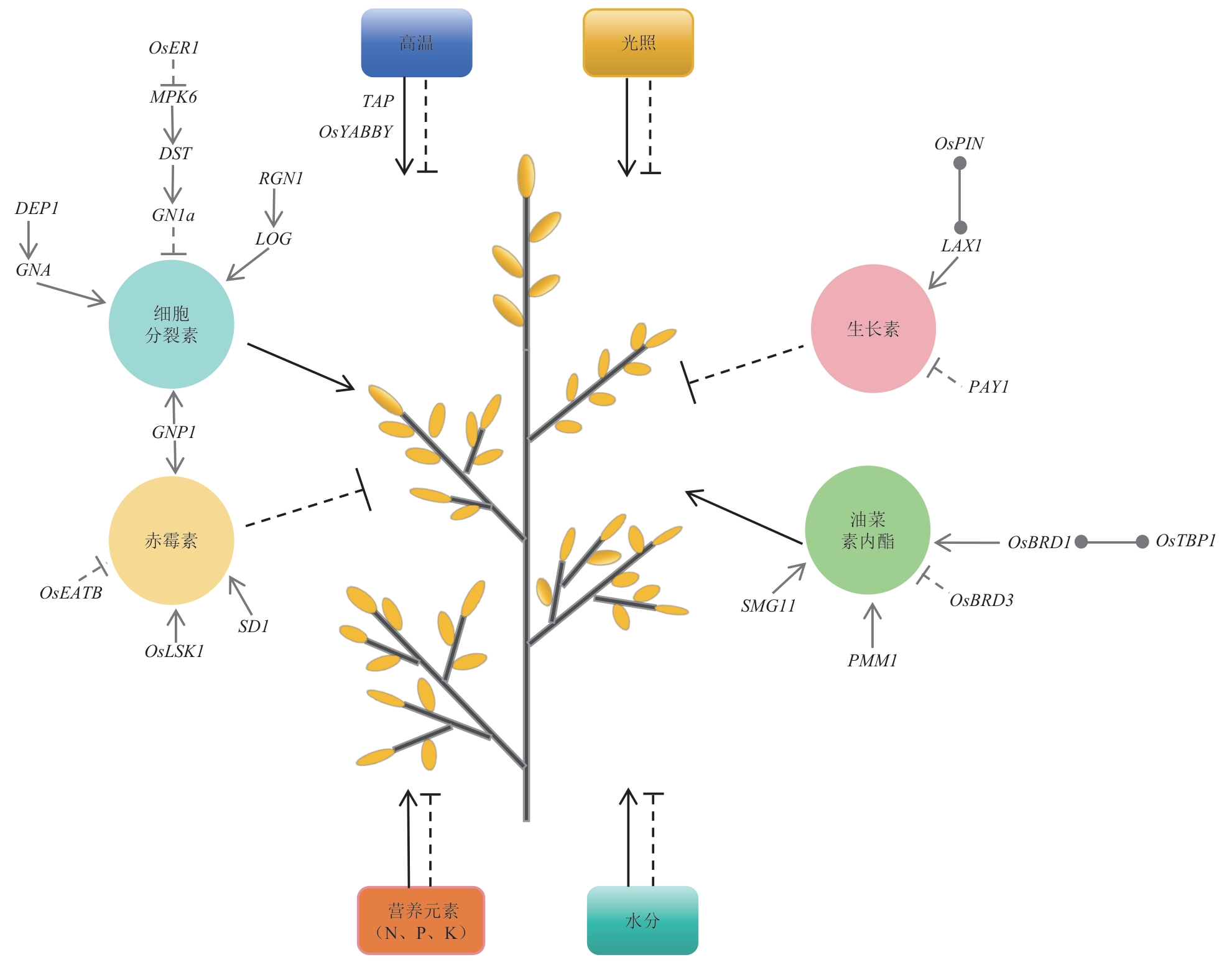
Fig. 2 Effects of phytohormone and environmental factors on panicle development of rice: Positive regulation; : negative regulation; : interaction
基因/QTL Gene/QTL | 基因登录号 Loc number | 蛋白类型 Protein type | 功能 Function | 参考文献 Reference |
|---|---|---|---|---|
| FON1 | LOC_Os06g50340 | 富亮氨酸重复受体激酶 | 调节分生组织大小来控制营养和生殖发育 | [ |
| FON4 | LOC_Os11g38270 | 含CLE功能域的分泌蛋白 | 调节水稻茎尖分生组织大小和花分生组织的确定性 | [ |
| FCP1 | LOC_Os04g39770 | 含CLE结构域的分泌蛋白 | 调节茎尖分生组织和根顶端分生组织分生活性的维持 | [ |
| FOS1 | LOC_Os02g21890 | 含CLE结构域的分泌蛋白 | 控制水稻花器官数目 | [ |
| APO1 | LOC_Os06g45460 | F-box蛋白 | 参与分生组织的调控,正调节一级枝梗数目和小穗数目 | [ |
| APO2 | LOC_Os04g51000 | 拟南芥RFL同源蛋白 | 穗分枝形成的正调控因子,参与枝梗分生组织命运维持 | [ |
| TAW1 | LOC_Os10g33780 | ALOG家族蛋白 | 编码功能未知核蛋白,参与调控枝梗分生组织 | [ |
| DEP1 | LOC_Os09g26999 | 异三聚体G蛋白γ亚基 | 参与细胞分裂调控枝梗数和穗粒数 | [ |
| LAX1 | LOC_Os01g61480 | bHLH转录因子 | 控制水稻腋芽原基形成和小穗枝梗原基的分化 | [ |
| LAX2 | LOC_Os04g32510 | 核定位蛋白 | 含植物特异保守结构域,参与调控水稻腋生分生组织的形成 | [ |
| DST | LOC_Os03g57240 | 锌指转录因子 | 参与水稻穗部形态建成,负调控穗粒数 | [ |
| FZP | LOC_Os07g47330 | ERF转录因子 | 决定穗分枝向小穗形成的转化 | [ |
| SNB | LOC_Os07g13170 | 植物特有的AP2转录因子 | 参与小穗分生组织向花分生组织转变及花器官模式形成 | [ |
| OsIDS1 | LOC_Os03g60430 | AP2/ERF型转录抑制因子 | 调控水稻小穗发育和花器官特征 | [ |
| OsMFS1 | LOC_Os09g10850 | 减数分裂螺旋蛋白 | 主要在花药中表达,与小穗原基向花原基的转化有关 | [ |
| OsMADS34 | LOC_Os03g54170 | 属于SEP亚家族转录因子 | 调控水稻从营养生长向生殖生长转化及花序分生组织建成 | [ |
| OsMADS5 | LOC_Os06g06750 | 属于SEP亚家族转录因子 | 调控水稻穗发育,限制穗分枝及促进小穗分生组织特性转变 | [ |
| OsMADS1 | LOC_Os03g11614 | 编码由257个氨基酸组成的蛋白 | 参与花器官形成并抑制小穗分生组织的逆转 | [ |
| OsMADS16 | LOC_Os06g49840 | 含MADS框225个氨基酸组成的蛋白 | 控制水稻花器官的发育,调控浆片和雄蕊的发育 | [ |
| LOG | LOC_Os01g40630 | 细胞分裂素激活酶 | 与分生组织活性维持有关 | [ |
| An-1 | LOC_Os04g28280 | bHLH蛋白 | 调控水稻芒发育、籽粒大小和籽粒数 | [ |
| Gn1a | LOC_Os01g10110 | 降解细胞分裂素的酶 | 使细胞分裂素积累在花序分生组织中影响穗粒数 | [ |
| LP | LOC_Os02g15950 | 富含Kelch的F-box蛋白 | 参与植物组织的细胞分裂素水平的调节 | [ |
| SP3 | LOC_Os03g55610 | Dof转录因子 | 通过增加细胞分裂素含量控制水稻穗型 | [ |
| OsER1 | LOC_Os06g10230 | 类受体蛋白激酶 | 负调控穗粒数 | [ |
| OsPIN5b | LOC_Os08g41720 | PIN蛋白 | 改变生长素稳态、运输和分布,调控水稻株型和产量 | [ |
| OsPID | LOC_Os12g42020 | 含有激酶结构域蛋白 | 负调控穗粒数 | [ |
| PAY1 | LOC_Os08g31470 | 包含肽酶S64结构域蛋白 | 通过影响生长素极性运输改变穗粒数和产量 | [ |
| OsGRF6 | LOC_Os03g51970 | 生长调节因子 | 正调控生长素信号通路,促进花序发育,增加穗粒数 | [ |
| OsLSK1 | LOC_Os01g47900 | 典型的Ⅲ型S-结构域类受体激酶 | 影响株高和一次枝梗数和枝梗着粒数 | [ |
| EUI1 | LOC_Os05g40384 | 577个氨基酸组成的蛋白 | 促进细胞生长和细胞增殖来调节籽粒大小和剑叶夹角 | [ |
| OsBRD1 | LOC_Os03g40540 | BR生物合成关键酶 | 通过BR合成途径调控水稻穗和籽粒发育 | [ |
| SMG11 | LOC_Os01g10040 | 参与BR的生物合成的细胞色素 | 控制水稻籽粒大小、籽粒数目和谷物产量 | [ |
| OsTBP1 | LOC_Os08g07760 | BR信号受体BRI1的激酶 | 调节株高、叶夹角、穗粒数和籽粒大小 | [ |
| OsBRD3 | LOC_Os06g39880 | 编码BR代谢酶 | 参与调控二次枝梗分生组织的转变和二次枝梗的数目 | [ |
| TAP | LOC_Os02g18370 | 水稻转座酶衍生的转录因子蛋白 | 高温条件下能够介导调控水稻的花序维持和小穗正常发育 | [ |
| Ghd7 | LOC_Os07g15770 | 含CCT结构域的转录抑制因子 | 能同时控制水稻穗粒数、株高和抽穗期3个性状的主效QTL | [ |
Table 1 Some cloned genes or QTLs associated with panicle development
基因/QTL Gene/QTL | 基因登录号 Loc number | 蛋白类型 Protein type | 功能 Function | 参考文献 Reference |
|---|---|---|---|---|
| FON1 | LOC_Os06g50340 | 富亮氨酸重复受体激酶 | 调节分生组织大小来控制营养和生殖发育 | [ |
| FON4 | LOC_Os11g38270 | 含CLE功能域的分泌蛋白 | 调节水稻茎尖分生组织大小和花分生组织的确定性 | [ |
| FCP1 | LOC_Os04g39770 | 含CLE结构域的分泌蛋白 | 调节茎尖分生组织和根顶端分生组织分生活性的维持 | [ |
| FOS1 | LOC_Os02g21890 | 含CLE结构域的分泌蛋白 | 控制水稻花器官数目 | [ |
| APO1 | LOC_Os06g45460 | F-box蛋白 | 参与分生组织的调控,正调节一级枝梗数目和小穗数目 | [ |
| APO2 | LOC_Os04g51000 | 拟南芥RFL同源蛋白 | 穗分枝形成的正调控因子,参与枝梗分生组织命运维持 | [ |
| TAW1 | LOC_Os10g33780 | ALOG家族蛋白 | 编码功能未知核蛋白,参与调控枝梗分生组织 | [ |
| DEP1 | LOC_Os09g26999 | 异三聚体G蛋白γ亚基 | 参与细胞分裂调控枝梗数和穗粒数 | [ |
| LAX1 | LOC_Os01g61480 | bHLH转录因子 | 控制水稻腋芽原基形成和小穗枝梗原基的分化 | [ |
| LAX2 | LOC_Os04g32510 | 核定位蛋白 | 含植物特异保守结构域,参与调控水稻腋生分生组织的形成 | [ |
| DST | LOC_Os03g57240 | 锌指转录因子 | 参与水稻穗部形态建成,负调控穗粒数 | [ |
| FZP | LOC_Os07g47330 | ERF转录因子 | 决定穗分枝向小穗形成的转化 | [ |
| SNB | LOC_Os07g13170 | 植物特有的AP2转录因子 | 参与小穗分生组织向花分生组织转变及花器官模式形成 | [ |
| OsIDS1 | LOC_Os03g60430 | AP2/ERF型转录抑制因子 | 调控水稻小穗发育和花器官特征 | [ |
| OsMFS1 | LOC_Os09g10850 | 减数分裂螺旋蛋白 | 主要在花药中表达,与小穗原基向花原基的转化有关 | [ |
| OsMADS34 | LOC_Os03g54170 | 属于SEP亚家族转录因子 | 调控水稻从营养生长向生殖生长转化及花序分生组织建成 | [ |
| OsMADS5 | LOC_Os06g06750 | 属于SEP亚家族转录因子 | 调控水稻穗发育,限制穗分枝及促进小穗分生组织特性转变 | [ |
| OsMADS1 | LOC_Os03g11614 | 编码由257个氨基酸组成的蛋白 | 参与花器官形成并抑制小穗分生组织的逆转 | [ |
| OsMADS16 | LOC_Os06g49840 | 含MADS框225个氨基酸组成的蛋白 | 控制水稻花器官的发育,调控浆片和雄蕊的发育 | [ |
| LOG | LOC_Os01g40630 | 细胞分裂素激活酶 | 与分生组织活性维持有关 | [ |
| An-1 | LOC_Os04g28280 | bHLH蛋白 | 调控水稻芒发育、籽粒大小和籽粒数 | [ |
| Gn1a | LOC_Os01g10110 | 降解细胞分裂素的酶 | 使细胞分裂素积累在花序分生组织中影响穗粒数 | [ |
| LP | LOC_Os02g15950 | 富含Kelch的F-box蛋白 | 参与植物组织的细胞分裂素水平的调节 | [ |
| SP3 | LOC_Os03g55610 | Dof转录因子 | 通过增加细胞分裂素含量控制水稻穗型 | [ |
| OsER1 | LOC_Os06g10230 | 类受体蛋白激酶 | 负调控穗粒数 | [ |
| OsPIN5b | LOC_Os08g41720 | PIN蛋白 | 改变生长素稳态、运输和分布,调控水稻株型和产量 | [ |
| OsPID | LOC_Os12g42020 | 含有激酶结构域蛋白 | 负调控穗粒数 | [ |
| PAY1 | LOC_Os08g31470 | 包含肽酶S64结构域蛋白 | 通过影响生长素极性运输改变穗粒数和产量 | [ |
| OsGRF6 | LOC_Os03g51970 | 生长调节因子 | 正调控生长素信号通路,促进花序发育,增加穗粒数 | [ |
| OsLSK1 | LOC_Os01g47900 | 典型的Ⅲ型S-结构域类受体激酶 | 影响株高和一次枝梗数和枝梗着粒数 | [ |
| EUI1 | LOC_Os05g40384 | 577个氨基酸组成的蛋白 | 促进细胞生长和细胞增殖来调节籽粒大小和剑叶夹角 | [ |
| OsBRD1 | LOC_Os03g40540 | BR生物合成关键酶 | 通过BR合成途径调控水稻穗和籽粒发育 | [ |
| SMG11 | LOC_Os01g10040 | 参与BR的生物合成的细胞色素 | 控制水稻籽粒大小、籽粒数目和谷物产量 | [ |
| OsTBP1 | LOC_Os08g07760 | BR信号受体BRI1的激酶 | 调节株高、叶夹角、穗粒数和籽粒大小 | [ |
| OsBRD3 | LOC_Os06g39880 | 编码BR代谢酶 | 参与调控二次枝梗分生组织的转变和二次枝梗的数目 | [ |
| TAP | LOC_Os02g18370 | 水稻转座酶衍生的转录因子蛋白 | 高温条件下能够介导调控水稻的花序维持和小穗正常发育 | [ |
| Ghd7 | LOC_Os07g15770 | 含CCT结构域的转录抑制因子 | 能同时控制水稻穗粒数、株高和抽穗期3个性状的主效QTL | [ |
| 1 | Zuo JR, Li JY. Molecular genetic dissection of quantitative trait loci regulating rice grain size [J]. Annu Rev Genet, 2014, 48: 99-118. |
| 2 | Li GL, Zhang HL, Li JJ, et al. Genetic control of panicle architecture in rice [J]. Crop J, 2021, 9(3): 590-597. |
| 3 | 卢寰, 时振英. 水稻穗发育的分子生物学研究进展 [J]. 植物生理学报, 2013, 49(2): 111-121. |
| Lu H, Shi ZY. Molecular research progress of rice panicle development [J]. Plant Physiol J, 2013, 49(2): 111-121. | |
| 4 | Ikeda K, Sunohara H, Nagato Y. Developmental course of inflorescence and spikelet in rice [J]. Breed Sci, 2004, 54(2): 147-156. |
| 5 | Itoh JI, Nonomura KI, Ikeda K, et al. Rice plant development: from zygote to spikelet [J]. Plant Cell Physiol, 2005, 46(1): 23-47. |
| 6 | Moon S, Jung KH, Lee DE, et al. The rice FON1 gene controls vegetative and reproductive development by regulating shoot apical meristem size [J]. Mol Cells, 2006, 21(1): 147-152. |
| 7 | Suzaki T, Toriba T, Fujimoto M, et al. Conservation and diversification of meristem maintenance mechanism in Oryza sativa: Function of the FLORAL ORGAN NUMBER2 gene [J]. Plant Cell Physiol, 2006, 47(12): 1591-1602. |
| 8 | Chu HW, Qian Q, Liang WQ, et al. The floral organ number4 gene encoding a putative ortholog of Arabidopsis CLAVATA3 regulates apical meristem size in rice [J]. Plant Physiol, 2006, 142(3): 1039-1052. |
| 9 | Ren DY, Xu QK, Qiu ZN, et al. FON4 prevents the multi-floret spikelet in rice [J]. Plant Biotechnol J, 2019, 17(6): 1007-1009. |
| 10 | Ohmori Y, Tanaka W, Kojima M, et al. WUSCHEL-RELATED HOMEOBOX4 is involved in meristem maintenance and is negatively regulated by the CLE gene FCP1 in rice [J]. Plant Cell, 2013, 25(1): 229-241. |
| 11 | Suzaki T, Ohneda M, Toriba T, et al. FON2 SPARE1 redundantly regulates floral meristem maintenance with FLORAL ORGAN NUMBER2 in rice [J]. PLoS Genet, 2009, 5(10): e1000693. |
| 12 | Ikeda-Kawakatsu K, Yasuno N, Oikawa T, et al. Expression level of ABERRANT PANICLE ORGANIZATION1 determines rice inflorescence form through control of cell proliferation in the meristem [J]. Plant Physiol, 2009, 150(2): 736-747. |
| 13 | Ikeda-Kawakatsu K, Maekawa M, Izawa T, et al. ABERRANT PANICLE ORGANIZATION 2/RFL, the rice ortholog of Arabidopsis LEAFY, suppresses the transition from inflorescence meristem to floral meristem through interaction with APO1 [J]. Plant J, 2012, 69(1): 168-180. |
| 14 | Huang LJ, Hua K, Xu R, et al. The LARGE2-APO1/APO2 regulatory module controls panicle size and grain number in rice [J]. Plant Cell, 2021, 33(4): 1212-1228. |
| 15 | Yoshida A, Sasao M, Yasuno N, et al. TAWAWA1, a regulator of rice inflorescence architecture, functions through the suppression of meristem phase transition [J]. Proc Natl Acad Sci USA, 2013, 110(2): 767-772. |
| 16 | Nakagawa M, Shimamoto K, Kyozuka J. Overexpression of RCN1 and RCN2, rice TERMINAL FLOWER 1/CENTRORADIALIS homologs, confers delay of phase transition and altered panicle morphology in rice [J]. Plant J, 2002, 29(6): 743-750. |
| 17 | Huang XZ, Qian Q, Liu ZB, et al. Natural variation at the DEP1 locus enhances grain yield in rice [J]. Nat Genet, 2009, 41(4): 494-497. |
| 18 | Li F, Liu WB, Tang JY, et al. Rice dense and erect panicle 2 is essential for determining panicle outgrowth and elongation [J]. Cell Res, 2010, 20(7): 838-849. |
| 19 | Matin MN, Kang SG. Genetic and phenotypic analysis of lax1-6, a mutant allele of LAX PANICLE1 in rice [J]. J Plant Biol, 2012, 55(1): 50-63. |
| 20 | Tabuchi H, Zhang Y, Hattori S, et al. LAX PANICLE2 of rice encodes a novel nuclear protein and regulates the formation of axillary meristems [J]. Plant Cell, 2011, 23(9): 3276-3287. |
| 21 | Wu HM, Xie DJ, Tang ZS, et al. PINOID regulates floral organ development by modulating auxin transport and interacts with MADS16 in rice [J]. Plant Biotechnol J, 2020, 18(8): 1778-1795. |
| 22 | Han ML, Lv QY, Zhang J, et al. Decreasing nitrogen assimilation under drought stress by suppressing DST-mediated activation of Nitrate Reductase 1.2 in rice [J]. Mol Plant, 2022, 15(1): 167-178. |
| 23 | Bai XF, Huang Y, Mao DH, et al. Regulatory role of FZP in the determination of panicle branching and spikelet formation in rice [J]. Sci Rep, 2016, 6: 19022. |
| 24 | Bai XF, Huang Y, Hu Y, et al. Duplication of an upstream silencer of FZP increases grain yield in rice [J]. Nat Plants, 2017, 3(11): 885-893. |
| 25 | Jiang LY, Ma X, Zhao SS, et al. The APETALA2-like transcription factor SUPERNUMERARY BRACT controls rice seed shattering and seed size [J]. Plant Cell, 2019, 31(1): 17-36. |
| 26 | Lee DY, An G. Two AP2 family genes, supernumerary bract (SNB) and Osindeterminate spikelet 1 (OsIDS1), synergistically control inflorescence architecture and floral meristem establishment in rice [J]. Plant J, 2012, 69(3): 445-461. |
| 27 | Lu JY, Wang CL, Wang HY, et al. OsMFS1/OsHOP2 complex participates in rice male and female development [J]. Front Plant Sci, 2020, 11: 518. |
| 28 | Ren DY, Yu HP, Rao YC, et al. 'Two-floret spikelet' as a novel resource has the potential to increase rice yield [J]. Plant Biotechnol J, 2018, 16(2): 351-353. |
| 29 | Kobayashi K, Maekawa M, Miyao A, et al. PANICLE PHYTOMER2 (PAP2), encoding a SEPALLATA subfamily MADS-box protein, positively controls spikelet meristem identity in rice [J]. Plant Cell Physiol, 2010, 51(1): 47-57. |
| 30 | Zhu WW, Yang L, Wu D, et al. Rice SEPALLATA genes OsMADS5 and OsMADS34 cooperate to limit inflorescence branching by repressing the TERMINAL FLOWER1-like gene RCN4 [J]. New Phytol, 2022, 233(4): 1682-1700. |
| 31 | Chung YY, Kim SR, Finkel D, et al. Early flowering and reduced apical dominance result from ectopic expression of a rice MADS box gene [J]. Plant Mol Biol, 1994, 26(2): 657-665. |
| 32 | Jeon JS, Jang S, Lee S, et al. Leafy hull sterile1 is a homeotic mutation in a rice MADS box gene affecting rice flower development [J]. Plant Cell, 2000, 12(6): 871-884. |
| 33 | Agrawal GK, Abe K, Yamazaki M, et al. Conservation of the E-function for floral organ identity in rice revealed by the analysis of tissue culture-induced loss-of-function mutants of the OsMADS1 gene [J]. Plant Mol Biol, 2005, 59(1): 125-135. |
| 34 | Wang L, Zeng XQ, Zhuang H, et al. Ectopic expression of OsMADS1 caused dwarfism and spikelet alteration in rice [J]. Plant Growth Regul, 2017, 81(3): 433-442. |
| 35 | Xiao H, Wang Y, Liu DF, et al. Functional analysis of the rice AP3 homologue OsMADS16 by RNA interference [J]. Plant Mol Biol, 2003, 52(5): 957-966. |
| 36 | Dreni L, Jacchia S, Fornara F, et al. The D-lineage MADS-box gene OsMADS13 controls ovule identity in rice [J]. Plant J, 2007, 52(4): 690-699. |
| 37 | Cui RF, Han JK, Zhao SZ, et al. Functional conservation and diversification of class E floral homeotic genes in rice (Oryza sativa) [J]. Plant J, 2010, 61(5): 767-781. |
| 38 | Pelucchi N, Fornara F, Favalli C, et al. Comparative analysis of rice MADS-box genes expressed during flower development [J]. Sex Plant Reprod, 2002, 15(3): 113-122. |
| 39 | Wang KJ, Tang D, Hong LL, et al. DEP and AFO regulate reproductive habit in rice [J]. PLoS Genet, 2010, 6(1): e1000818. |
| 40 | Sang XC, Li YF, Luo ZK, et al. CHIMERIC FLORAL ORGANS1, encoding a monocot-specific MADS box protein, regulates floral organ identity in rice[J]. Plant Physiol, 2012, 160(2): 788-807. |
| 41 | Hu Y, Wang L, Jia R, et al. Rice transcription factor MADS32 regulates floral patterning through interactions with multiple floral homeotic genes [J]. J Exp Bot, 2021, 72(7): 2434-2449. |
| 42 | Rashotte AM. The evolution of cytokinin signaling and its role in development before Angiosperms [J]. Semin Cell Dev Biol, 2021, 109: 31-38. |
| 43 | Kurakawa T, Ueda N, Maekawa M, et al. Direct control of shoot meristem activity by a cytokinin-activating enzyme [J]. Nature, 2007, 445(7128): 652-655. |
| 44 | Li GL, Xu BX, Zhang YP, et al. RGN1 controls grain number and shapes panicle architecture in rice [J]. Plant Biotechnol J, 2022, 20(1): 158-167. |
| 45 | Gu BG, Zhou TY, Luo JH, et al. An-2 encodes a cytokinin synthesis enzyme that regulates awn length and grain production in rice [J]. Mol Plant, 2015, 8(11): 1635-1650. |
| 46 | Ashikari M, Sakakibara H, Lin SY, et al. Cytokinin oxidase regulates rice grain production [J]. Science, 2005, 309(5735): 741-745. |
| 47 | Li SY, Zhao BR, Yuan DY, et al. Rice zinc finger protein DST enhances grain production through controlling Gn1a/OsCKX2 expression [J]. Proc Natl Acad Sci USA, 2013, 110(8): 3167-3172. |
| 48 | Li M, Tang D, Wang KJ, et al. Mutations in the F-box gene LARGER PANICLE improve the panicle architecture and enhance the grain yield in rice [J]. Plant Biotechnol J, 2011, 9(9): 1002-1013. |
| 49 | Huang Y, Bai XF, Luo MF, et al. Short Panicle 3 controls panicle architecture by upregulating APO2/RFL and increasing cytokinin content in rice [J]. J Integr Plant Biol, 2019, 61(9): 987-999. |
| 50 | Wu Y, Wang Y, Mi XF, et al. The QTL GNP1 encodes GA20ox1, which increases grain number and yield by increasing cytokinin activity in rice panicle meristems [J]. PLoS Genet, 2016, 12(10): e1006386. |
| 51 | Rong CY, Liu YX, Chang ZY, et al. Cytokinin oxidase/dehydrogenase family genes exhibit functional divergence and overlap in rice growth and development, especially in control of tillering [J]. J Exp Bot, 2022, 73(11): 3552-3568. |
| 52 | Guo T, Lu ZQ, Shan JX, et al. ERECTA1 acts upstream of the OsMKKK10-OsMKK4-OsMPK6 cascade to control spikelet number by regulating cytokinin metabolism in rice [J]. Plant Cell, 2020, 32(9): 2763-2779. |
| 53 | Zhang JH, Lin QB, Wang X, et al. The dense and erect panicle1-grain number associated module enhances rice yield by repressing cytokinin oxidase 2 expression [J]. Plant Cell, 2024, 37(1): koae309. |
| 54 | 淳雁, 李学勇. 水稻穗型的遗传调控研究进展 [J]. 植物学报, 2017, 52(1): 19-29. |
| Chun Y, Li XY. Research progress in genetic regulation of rice panicle architecture [J]. Chin Bull Bot, 2017, 52(1): 19-29. | |
| 55 | Lu GW, Coneva V, Casaretto JA, et al. OsPIN5b modulates rice (Oryza sativa) plant architecture and yield by changing auxin homeostasis, transport and distribution [J]. Plant J, 2015, 83(5): 913-925. |
| 56 | Morita Y, Kyozuka J. Characterization of OsPID, the rice ortholog of PINOID, and its possible involvement in the control of polar auxin transport [J]. Plant Cell Physiol, 2007, 48(3): 540-549. |
| 57 | Zhao L, Tan LB, Zhu ZF, et al. PAY1 improves plant architecture and enhances grain yield in rice [J]. Plant J, 2015, 83(3): 528-536. |
| 58 | Tang YY, Liu HH, Guo SY, et al. OsmiR396d affects gibberellin and brassinosteroid signaling to regulate plant architecture in rice [J]. Plant Physiol, 2018, 176(1): 946-959. |
| 59 | Gao SP, Chu CC. Gibberellin metabolism and signaling: targets for improving agronomic performance of crops [J]. Plant Cell Physiol, 2020, 61(11): 1902-1911. |
| 60 | Agata A, Ando K, Ota S, et al. Diverse panicle architecture results from various combinations of Prl5/GA20ox4 and Pbl6/APO1 alleles [J]. Commun Biol, 2020, 3(1): 302. |
| 61 | Su S, Hong J, Chen XF, et al. Gibberellins orchestrate panicle architecture mediated by DELLA-KNOX signalling in rice [J]. Plant Biotechnol J, 2021, 19(11): 2304-2318. |
| 62 | Qi WW, Sun F, Wang QJ, et al. Rice ethylene-response AP2/ERF factor OsEATB restricts internode elongation by down-regulating a gibberellin biosynthetic gene [J]. Plant Physiol, 2011, 157(1): 216-228. |
| 63 | Zou XH, Qin ZR, Zhang CY, et al. Over-expression of an S-domain receptor-like kinase extracellular domain improves panicle architecture and grain yield in rice [J]. J Exp Bot, 2015, 66(22): 7197-7209. |
| 64 | 肖辉海. 水稻长穗颈隐性高秆突变体穗颈节间的细胞学观察 [J]. 西北农林科技大学学报: 自然科学版, 2008, 36(1): 131-136. |
| Xiao HH. Cytological studies on uppermost internode of recessive tall stalk rice with eui gene [J]. J Northwest A F Univ Nat Sci Ed, 2008, 36(1): 131-136. | |
| 65 | Hong Z, Ueguchi-Tanaka M, Shimizu-Sato S, et al. Loss-of-function of a rice brassinosteroid biosynthetic enzyme, C-6 oxidase, prevents the organized arrangement and polar elongation of cells in the leaves and stem [J]. Plant J, 2002, 32(4): 495-508. |
| 66 | Hong Z, Ueguchi-Tanaka M, Fujioka S, et al. The rice brassinosteroid-deficient dwarf2 mutant, defective in the rice homolog of Arabidopsis DIMINUTO/DWARF1, is rescued by the endogenously accumulated alternative bioactive brassinosteroid, dolichosterone [J]. Plant Cell, 2005, 17(8): 2243-2254. |
| 67 | Li Y, Li XM, Fu DB, et al. Panicle Morphology Mutant 1 (PMM1) determines the inflorescence architecture of rice by controlling brassinosteroid biosynthesis [J]. BMC Plant Biol, 2018, 18(1): 348. |
| 68 | Fang N, Xu R, Huang LJ, et al. SMALL GRAIN 11 controls grain size, grain number and grain yield in rice [J]. Rice, 2016, 9(1): 64. |
| 69 | Chen XW, Zuo SM, Schwessinger B, et al. An XA21-associated kinase (OsSERK2) regulates immunity mediated by the XA21 and XA3 immune receptors [J]. Mol Plant, 2014, 7(5): 874-892. |
| 70 | Lin Y, Zhao ZG, Zhou SR, et al. Top Bending Panicle1 is involved in brassinosteroid signaling and regulates the plant architecture in rice [J]. Plant Physiol Biochem, 2017, 121: 1-13. |
| 71 | Zhang XX, Meng WJ, Liu DP, et al. Enhancing rice panicle branching and grain yield through tissue-specific brassinosteroid inhibition [J]. Science, 2024, 383(6687): eadk8838. |
| 72 | Zhang P, Zhu WW, He Y, et al. THERMOSENSITIVE BARREN PANICLE (TAP) is required for rice panicle and spikelet development at high ambient temperature [J]. New Phytol, 2023, 237(3): 855-869. |
| 73 | 成勤勤. 关于水稻幼穗分化发育的研究 [D]. 扬州: 扬州大学, 2006. |
| Cheng QQ. Study on the differentiation and development of young panicles in rice [D]. Yangzhou: Yangzhou University, 2006. | |
| 74 | Zhang WY, Chen YJ, Wang ZQ, et al. Polyamines and ethylene in rice young panicles in response to soil drought during panicle differentiation [J]. Plant Growth Regul, 2017, 82(3): 491-503. |
| 75 | Ding CQ, You J, Chen L, et al. Nitrogen fertilizer increases spikelet number per panicle by enhancing cytokinin synthesis in rice [J]. Plant Cell Rep, 2014, 33(2): 363-371. |
| 76 | Chen Q, Tian FA, Cheng TT, et al. Translational repression of FZP mediated by CU-rich element/OsPTB interactions modulates panicle development in rice [J]. Plant J, 2022, 110(5): 1319-1331. |
| 77 | Wu LH, Hu M, Lyu SW, et al. A 48-bp deletion upstream of LIGULELESS 1 alters rice panicle architecture [J]. Crop J, 2024, 12(2): 354-363. |
| 78 | Wu XW, Liang Y, Gao HB, et al. Enhancing rice grain production by manipulating the naturally evolved cis-regulatory element-containing inverted repeat sequence of OsREM20 [J]. Mol Plant, 2021, 14(6): 997-1011. |
| 79 | Xue WY, Xing YZ, Weng XY, et al. Natural variation in Ghd7 is an important regulator of heading date and yield potential in rice [J]. Nat Genet, 2008, 40(6): 761-767. |
| 80 | Si LZ, Chen JY, Huang XH, et al. OsSPL13 controls grain size in cultivated rice [J]. Nat Genet, 2016, 48(4): 447-456. |
| 81 | Peng YL, Gao ZY, Zhang B, et al. Fine mapping and candidate gene analysis of a major QTL for panicle structure in rice [J]. Plant Cell Rep, 2014, 33(11): 1843-1850. |
| 82 | Liu EB, Liu Y, Wu GC, et al. Identification of a candidate gene for panicle length in rice (Oryza sativa L.) via association and linkage analysis [J]. Front Plant Sci, 2016, 7: 596. |
| 83 | Yang Y, Zhang Y, Li J, et al. Three QTL from Oryza meridionalis could improve panicle architecture in Asian cultivated rice [J]. Rice, 2023, 16(1): 22. |
| [1] | DU Liang-heng, TANG Huang-lei, ZHANG Zhi-guo. Map-based Cloning of Light-responsive Gene ELM1 in Rice [J]. Biotechnology Bulletin, 2025, 41(5): 82-89. |
| [2] | CHEN Xiao-jun, HUI Jian, MA Hong-wen, BAI Hai-Bo, ZHONG Nan, LI Jia-run, FAN Yun-fang. Creating Rice Gerplasm Resources OsALS Rsistant to Herbicide through Single Base Gene Editing Technology [J]. Biotechnology Bulletin, 2025, 41(4): 106-114. |
| [3] | LI Xin-peng, ZHANG Wu-han, ZHANG Li, SHU Fu, HE Qiang, GUO Yang, DENG Hua-feng, WANG Yue, SUN Ping-yong. Creation of Rice Mutant by Gamma-ray and Its Molecular Identification [J]. Biotechnology Bulletin, 2025, 41(3): 35-43. |
| [4] | KUANG Jian-hua, CHENG Zhi-peng, ZHAO Yong-jing, YANG Jie, CHEN Run-qiao, CHEN Long-qing, HU Hui-zhen. Expression Analysis of the GH3 Gene Family in Nelumbo nucifera underHormonal and Abiotic Stresses [J]. Biotechnology Bulletin, 2025, 41(2): 221-233. |
| [5] | FANG Hui-min, GU Yi-shu, ZHANG Jing, ZHANG Long. Isolation and Physicochemical Properties Analysis of Starch from Rice Leaves [J]. Biotechnology Bulletin, 2025, 41(2): 51-57. |
| [6] | JIN Su-kui, GUO Qian-qian, LIU Qiao-quan, GAO Ji-ping. A Simplified Method for Extracting Genomic DNA from Rice Leaves [J]. Biotechnology Bulletin, 2025, 41(1): 74-84. |
| [7] | LIU Wen-zhi, HE Dan, LI Peng, FU Ying-lin, ZHANG Yi-xin, WEN Hua-jie, YU Wen-qing. Paenibacillus polymyxa New Strain X-11 and Its Growth-promoting Effects on Tomato and Rice [J]. Biotechnology Bulletin, 2024, 40(9): 249-259. |
| [8] | LI Qing-mao, PENG Cong-gui, QI Xiao-han, LIU Xing-lei, LI Zhen-yuan, LI Qin-yan, HUANG Li-yu. Screening and Identification of Excellent Strains of Endophytic Bacteria Promoting Rice Iron Absorption from Wild Rice [J]. Biotechnology Bulletin, 2024, 40(8): 255-263. |
| [9] | SUN Zhi-yong, DU Huai-dong, LIU Yang, MA Jia-xin, YU Xue-ran, MA Wei, YAO Xin-jie, WANG Min, LI Pei-fu. Genome-wide Association Analysis of γ-aminobutyric Acid in Rice Grains [J]. Biotechnology Bulletin, 2024, 40(8): 53-62. |
| [10] | DU Zhong-yang, YANG Ze, LIANG Meng-jing, LIU Yi-zhen, CUI Hong-li, SHI Da-ming, XUE Jin-ai, SUN Yan, ZHANG Chun-hui, JI Chun-li, LI Run-zhi. Effect of Nano-selenium(SeNPs)in Alleviating Lead Stress and Promoting Growth of Tobacco Seedlings [J]. Biotechnology Bulletin, 2024, 40(7): 183-196. |
| [11] | PANG Meng-zhen, XU Han-qin, LIU Hai-yan, SONG Juan, WANG Jia-han, SUN Li-na, JI Pei-mei, YIN Ze-zhi, HU You-chuan, ZHAO Xiao-meng, LIANG Shan-shan, ZHANG Si-ju, LUAN Wei-jiang. Gene Identification and Functional Analysis of Yellowish and Early Heading Mutant hz1 in Rice [J]. Biotechnology Bulletin, 2024, 40(7): 125-136. |
| [12] | TIAN Sheng-ni, ZHANG Qin, DONG Yu-fei, DING Zhou, YE Ai-hua, ZHANG Ming-zhu. Effects of Acid Mine Drainage on Physicochemical Factors and Nitrogen-fixing Microorganisms in the Root Zone of Mature Rice [J]. Biotechnology Bulletin, 2024, 40(6): 271-280. |
| [13] | LIU Rong, TIAN Min-yu, LI Guang-ze, TAN Cheng-fang, RUAN Ying, LIU Chun-lin. Identification and Induced-expression Analysis of REVEILLE Family in Brassica napus L. [J]. Biotechnology Bulletin, 2024, 40(6): 161-171. |
| [14] | KONG De-ting, QI Xiao-han, LIU Xing-lei, LI Li-ping, HU Feng-yi, HUANG Li-yu, QIN Shi-wen. Comparison and Analysis of Endophytic Bacterial Communities in Different Perennial Rice Varieties [J]. Biotechnology Bulletin, 2024, 40(5): 225-236. |
| [15] | YANG Qi, WEI Zi-di, SONG Juan, TONG Kun, YANG Liu, WANG Jia-han, LIU Hai-yan, LUAN Wei-jiang, MA Xuan. Construction and Transcriptomic Analysis of Rice Histone H1 Triple Mutant [J]. Biotechnology Bulletin, 2024, 40(4): 85-96. |
| Viewed | ||||||
|
Full text |
|
|||||
|
Abstract |
|
|||||
