







Biotechnology Bulletin ›› 2025, Vol. 41 ›› Issue (2): 51-57.doi: 10.13560/j.cnki.biotech.bull.1985.2024-0628
Previous Articles Next Articles
FANG Hui-min1( ), GU Yi-shu2, ZHANG Jing2, ZHANG Long2()
Received:2024-07-01
Online:2025-02-26
Published:2025-02-28
Contact:
ZHANG Long
E-mail:hmfang@yzu.edu.cn;zhanglong@yzu.edu.cn
FANG Hui-min, GU Yi-shu, ZHANG Jing, ZHANG Long. Isolation and Physicochemical Properties Analysis of Starch from Rice Leaves[J]. Biotechnology Bulletin, 2025, 41(2): 51-57.
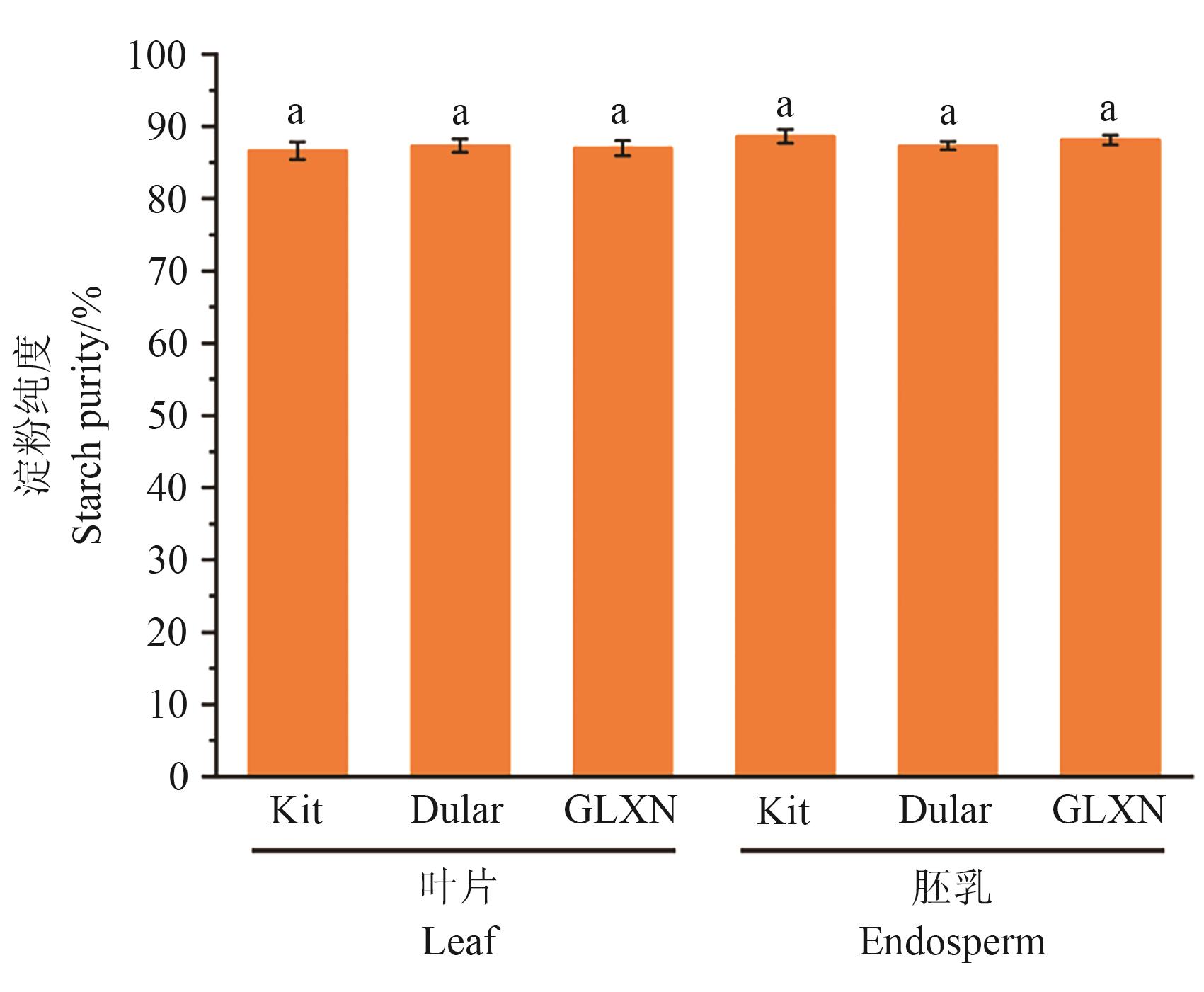
Fig. 1 Determination of starch purityKit indicates the japonicarice variety Kitaake, Dular indicates the indica rice variety Dular, and GLXN indicates the glutinous rice variety Guanglingxiangnuo, the data are of means ± standard deviations (n=3), and the same letter indicates no significant difference (P>0.05) among the data

Fig. 2 Scanning electron microscope photographs of starches from three rice varietiesA-C: The leaf starch of Kit, Dular and GLXN. D-F: The endosperm starch of Kit, Dular and GLXN. The red arrows refer to the cavity structure

Fig. 3 Granule size distribution of starches in three rice varietiesA-C: Granule size distribution of leaf starch. D-F: Granule size distribution of endosperm starch

Fig. 4 DSC thermograms of leaf starch and endosperm starch in Kit
淀粉组织 Starch tissue | 起始温度 Tonset/℃ | 峰值温度 Tpeak/℃ | 终止温度 Tcompletion/℃ | 糊化温度范围 Trange/℃ | 糊化焓值 Enthealpy/(J·g-1) |
|---|---|---|---|---|---|
叶片淀粉 Leaf starch | 70.1±0.1 | 78.0±0.0 | 86.1±0.0 | 16.0±0.1 | 8.2±0.1 |
胚乳淀粉 Endosperm starch | 60.5±0.1** | 67.9±0.1** | 74.1±0.1** | 13.7±0.2** | 9.2±0.1* |
Table 1 Thermal properties of leaf starch and endosperm starch in Kit
淀粉组织 Starch tissue | 起始温度 Tonset/℃ | 峰值温度 Tpeak/℃ | 终止温度 Tcompletion/℃ | 糊化温度范围 Trange/℃ | 糊化焓值 Enthealpy/(J·g-1) |
|---|---|---|---|---|---|
叶片淀粉 Leaf starch | 70.1±0.1 | 78.0±0.0 | 86.1±0.0 | 16.0±0.1 | 8.2±0.1 |
胚乳淀粉 Endosperm starch | 60.5±0.1** | 67.9±0.1** | 74.1±0.1** | 13.7±0.2** | 9.2±0.1* |
| 1 | Hannah LC, James M. The complexities of starch biosynthesis in cereal endosperms [J]. Curr Opin Biotechnol, 2008, 19(2): 160-165. |
| 2 | Zhang L, Zhao LL, Bian XF, et al. Characterization and comparative study of starches from seven purple sweet potatoes [J]. Food Hydrocoll, 2018, 80: 168-176. |
| 3 | Seung D, Boudet J, Monroe J, et al. Homologs of protein targeting to starch control starch granule initiation in Arabidopsis leaves [J]. Plant Cell, 2017, 29(7): 1657-1677. |
| 4 | Stitt M, Zeeman SC. Starch turnover: pathways, regulation and role in growth [J]. Curr Opin Plant Biol, 2012, 15(3): 282-292. |
| 5 | 高振楠, 郝媛媛, 李春寿, 等. 水稻调控淀粉合成基因的研究进展 [J]. 植物遗传资源学报, 2023, 24(1): 61-74. |
| Gao ZN, Hao YY, Li CS, et al. Study on genes regulating starch synthesis in rice [J]. J Plant Genet Resour, 2023, 24(1): 61-74. | |
| 6 | Leewatchararongjaroen J, Anuntagool J. Effects of dry-milling and wet-milling on chemical, physical and gelatinization properties of rice flour [J]. Rice Sci, 2016, 23(5): 274-281. |
| 7 | Ngamnikom P, Songsermpong S. The effects of freeze, dry, and wet grinding processes on rice flour properties and their energy consumption [J]. J Food Eng, 2011, 104(4): 632-638. |
| 8 | Zhang L, Li N, Zhang J, et al. The CBM48 domain-containing protein FLO6 regulates starch synthesis by interacting with SSIVb and GBSS in rice [J]. Plant Mol Biol, 2022, 108(4-5): 343-361. |
| 9 | Zhang L, Ren YL, Lu BY, et al. FLOURY ENDOSPERM7 encodes a regulator of starch synthesis and amyloplast development essential for peripheral endosperm development in rice [J]. J Exp Bot, 2016, 67(3): 633-647. |
| 10 | 王涛, 贺帆, 田斌强, 等. 烤烟烟叶淀粉的提取工艺优化 [J]. 烟草科技, 2012, (6): 80-83. |
| Wang T, He F, Tian BQ, et al. Optimization of process for extracting starch from flue-cured tobacco leaves [J]. Tob Sci Technol, 2012, (6): 80-83. | |
| 11 | 朱晓兰, 徐迎波, 周顺, 等. 烤烟烟叶淀粉的分离提取方法及分析方法: CN105928763A [P]. 2016-09-07. |
| Zhu XL, Xu YB, Zhou S, et al. Methods for separation, extraction and analysis of starch in flue - cured tobacco leaves: CN105928763A [P]. 2016-09-07. | |
| 12 | Albi T, Ortiz-Marchena M, Ruiz M, et al. Purification of starch granules from Arabidopsis leaves and determination of granule-bound starch synthase activity [J]. Bio-Protocol, 2014, 4(23): e1316. |
| 13 | Seung D, Soyk S, Coiro M, et al. Protein targeting to starch is required for localising granule-bound starch synthase to starch granules and for normal amylose synthesis in Arabidopsis [J]. PLoS Biol, 2015, 13(2): e1002080. |
| 14 | 张龙, 赵玲珑, 王婷, 等. 3个水稻不透明胚乳突变体淀粉理化性质分析 [J]. 扬州大学学报: 农业与生命科学版, 2019, 40(2): 1-8. |
| Zhang L, Zhao LL, Wang T, et al. Seed morphological and starch physicochemical properties of three opaque endosperm mutants in rice [J]. J Yangzhou Univ Agric Life Sci Ed, 2019, 40(2): 1-8. | |
| 15 | 张晶, 张梓妍, 李宁, 等. 一个水稻丙氨酸转氨酶新等位基因突变体的鉴定和籽粒特性 [J]. 扬州大学学报: 农业与生命科学版, 2021, 42(2): 10-17, 25. |
| Zhang J, Zhang ZY, Li N, et al. Identification and kernel properties of a new allelic mutant of alanine aminotransferase in rice [J]. J Yangzhou Univ Agric Life Sci Ed, 2021, 42(2): 10-17, 25. | |
| 16 | 余徐润, 周亮, 荆彦平, 等. Image-Pro Plus软件在小麦淀粉粒显微图像分析中的应用 [J]. 电子显微学报, 2013, 32(4): 344-351. |
| Yu XR, Zhou L, Jing YP, et al. Application of image-pro plus in analysis of wheat starch granule microscopic image [J]. J Chin Electron Microsc Soc, 2013, 32(4): 344-351. | |
| 17 | Lin LS, Pan T, Liu QQ, et al. Cooking, morphological, mechanical and digestion properties of cooked rice with suppression of starch branching enzymes [J]. Int J Biol Macromol, 2019, 137: 187-196. |
| 18 | 韦存虚, 张军, 周卫东, 等. 水稻胚乳淀粉体被膜的降解和复粒淀粉粒概念的探讨 [J]. 中国水稻科学, 2008, 22(4): 377-384. |
| Wei CX, Zhang J, Zhou WD, et al. Degradation of amyloplast envelope and discussion on the concept of compound starch granule in rice endosperm [J]. Chin J Rice Sci, 2008, 22(4): 377-384. | |
| 19 | Zhang L, Zhao LL, Zhang J, et al. Relationships between transparency, amylose content, starch cavity, and moisture of brown rice kernels [J]. J Cereal Sci, 2019, 90: 102854. |
| 20 | Wang W, Wei XJ, Jiao GA, et al. GBSS-BINDING PROTEIN, encoding a CBM48 domain-containing protein, affects rice quality and yield [J]. J Integr Plant Biol, 2020, 62(7): 948-966. |
| 21 | 包劲松. 稻米淀粉品质遗传与改良研究进展 [J]. 分子植物育种, 2007, 5(S1): 1-20. |
| Bao JS. Progress in studies on inheritance and improvement of rice starch quality [J]. Mol Plant Breed, 2007, 5(S1): 1-20. | |
| 22 | Cai JW, Man JM, Huang J, et al. Relationship between structure and functional properties of normal rice starches with different amylose contents [J]. Carbohydr Polym, 2015, 125: 35-44. |
| [1] | JIN Su-kui, GUO Qian-qian, LIU Qiao-quan, GAO Ji-ping. A Simplified Method for Extracting Genomic DNA from Rice Leaves [J]. Biotechnology Bulletin, 2025, 41(1): 74-84. |
| [2] | LIU Wen-zhi, HE Dan, LI Peng, FU Ying-lin, ZHANG Yi-xin, WEN Hua-jie, YU Wen-qing. Paenibacillus polymyxa New Strain X-11 and Its Growth-promoting Effects on Tomato and Rice [J]. Biotechnology Bulletin, 2024, 40(9): 249-259. |
| [3] | LI Qing-mao, PENG Cong-gui, QI Xiao-han, LIU Xing-lei, LI Zhen-yuan, LI Qin-yan, HUANG Li-yu. Screening and Identification of Excellent Strains of Endophytic Bacteria Promoting Rice Iron Absorption from Wild Rice [J]. Biotechnology Bulletin, 2024, 40(8): 255-263. |
| [4] | SUN Zhi-yong, DU Huai-dong, LIU Yang, MA Jia-xin, YU Xue-ran, MA Wei, YAO Xin-jie, WANG Min, LI Pei-fu. Genome-wide Association Analysis of γ-aminobutyric Acid in Rice Grains [J]. Biotechnology Bulletin, 2024, 40(8): 53-62. |
| [5] | PANG Meng-zhen, XU Han-qin, LIU Hai-yan, SONG Juan, WANG Jia-han, SUN Li-na, JI Pei-mei, YIN Ze-zhi, HU You-chuan, ZHAO Xiao-meng, LIANG Shan-shan, ZHANG Si-ju, LUAN Wei-jiang. Gene Identification and Functional Analysis of Yellowish and Early Heading Mutant hz1 in Rice [J]. Biotechnology Bulletin, 2024, 40(7): 125-136. |
| [6] | TIAN Sheng-ni, ZHANG Qin, DONG Yu-fei, DING Zhou, YE Ai-hua, ZHANG Ming-zhu. Effects of Acid Mine Drainage on Physicochemical Factors and Nitrogen-fixing Microorganisms in the Root Zone of Mature Rice [J]. Biotechnology Bulletin, 2024, 40(6): 271-280. |
| [7] | KONG De-ting, QI Xiao-han, LIU Xing-lei, LI Li-ping, HU Feng-yi, HUANG Li-yu, QIN Shi-wen. Comparison and Analysis of Endophytic Bacterial Communities in Different Perennial Rice Varieties [J]. Biotechnology Bulletin, 2024, 40(5): 225-236. |
| [8] | YANG Qi, WEI Zi-di, SONG Juan, TONG Kun, YANG Liu, WANG Jia-han, LIU Hai-yan, LUAN Wei-jiang, MA Xuan. Construction and Transcriptomic Analysis of Rice Histone H1 Triple Mutant [J]. Biotechnology Bulletin, 2024, 40(4): 85-96. |
| [9] | LI Xing-rong, TAN Zhi-bing, ZHAO Yan, LI Yao-kui, ZHAO Bing-ran, TANG Li. Cloning and Functional Analysis of OsLCT3, a Low-affinity Cation Transporter Gene of Rice [J]. Biotechnology Bulletin, 2024, 40(4): 97-109. |
| [10] | LIU Jia-ning, LI Meng, YANG Xin-sen, WU Wei, PEI Xin-wu, YUAN Qian-hua. Impact of Different Water Management Cultivation Methods on the Rhizosphere Bacteria Community of Shanlan Upland Rice [J]. Biotechnology Bulletin, 2024, 40(3): 242-250. |
| [11] | LI Xue, LI Rong-ou, KONG Mei-yi, HUANG Lei. The Growth Promoting Effect of Bacillus amyloliquefaciens SQ-2 on Rice [J]. Biotechnology Bulletin, 2024, 40(2): 109-119. |
| [12] | ZHANG Chao, WANG Zi-rui, SUN Ya-li, MAO Xin-chen, TANG Jia-qi, YU Heng-xiu. Functional Study of Vitamin B1 Synthesis-related Gene OsTHIC in Rice [J]. Biotechnology Bulletin, 2024, 40(2): 99-108. |
| [13] | QI Wang, BI Yi-fan, XUAN Qiang-bing, ZHANG Xin, ZHOU Hui-gang, NIE Yuan-qing, CHENG Biao-biao, ZHANG Yu-shun, WANG Jun-jie, LIANG Wei-hong. Overexpression of OsRhoGDI1 Gene Regulates Grain Shape and Seed Vigor in Rice [J]. Biotechnology Bulletin, 2024, 40(11): 152-161. |
| [14] | XIONG Xin-yi, LIU Li-ping, FENG Jie, ZHANG Jin-song, LI De-shun, LIU Peng, LIU Yan-fang. Effect and Mechanism of Cordyceps militaris Extract on Lowering Uric Acid in Hyperuricemia Rats [J]. Biotechnology Bulletin, 2024, 40(11): 34-46. |
| [15] | QIAO Cheng-bin, SONG Jia-wei, YANG Hui, DUAN Kai-rong, RAN Jie, KONG Wei-ru, FENG Pei-yuan, LUO Cheng-ke, LI Pei-fu, TIAN Lei. Advances in the Mechanism of Leaf Width Regulation and Related Genes in Rice [J]. Biotechnology Bulletin, 2024, 40(11): 88-102. |
| Viewed | ||||||
|
Full text |
|
|||||
|
Abstract |
|
|||||
