







Biotechnology Bulletin ›› 2026, Vol. 42 ›› Issue (3): 230-241.doi: 10.13560/j.cnki.biotech.bull.1985.2025-1232
Previous Articles Next Articles
CUI Zhi-han1,2( ), WEI Qing-zhen2, HU Na2, BAO Chong-lai2(), WANG Hua-sen1()
Received:2025-11-14
Online:2026-03-26
Published:2026-04-23
Contact:
BAO Chong-lai, WANG Hua-sen
E-mail:17306395131@163.com;baocl@zaas.ac.cn;wanghs@qau.edu.cn
CUI Zhi-han, WEI Qing-zhen, HU Na, BAO Chong-lai, WANG Hua-sen. Research Progress in IQD Genes in Horticultural Crops[J]. Biotechnology Bulletin, 2026, 42(3): 230-241.
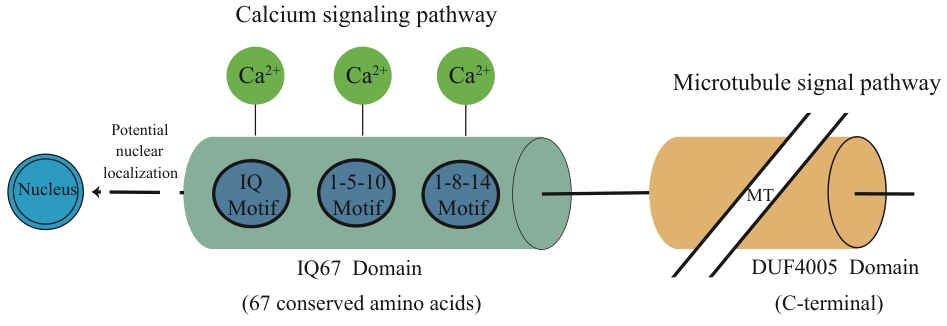
Fig. 1 Schematic diagram of the IQD protein structure
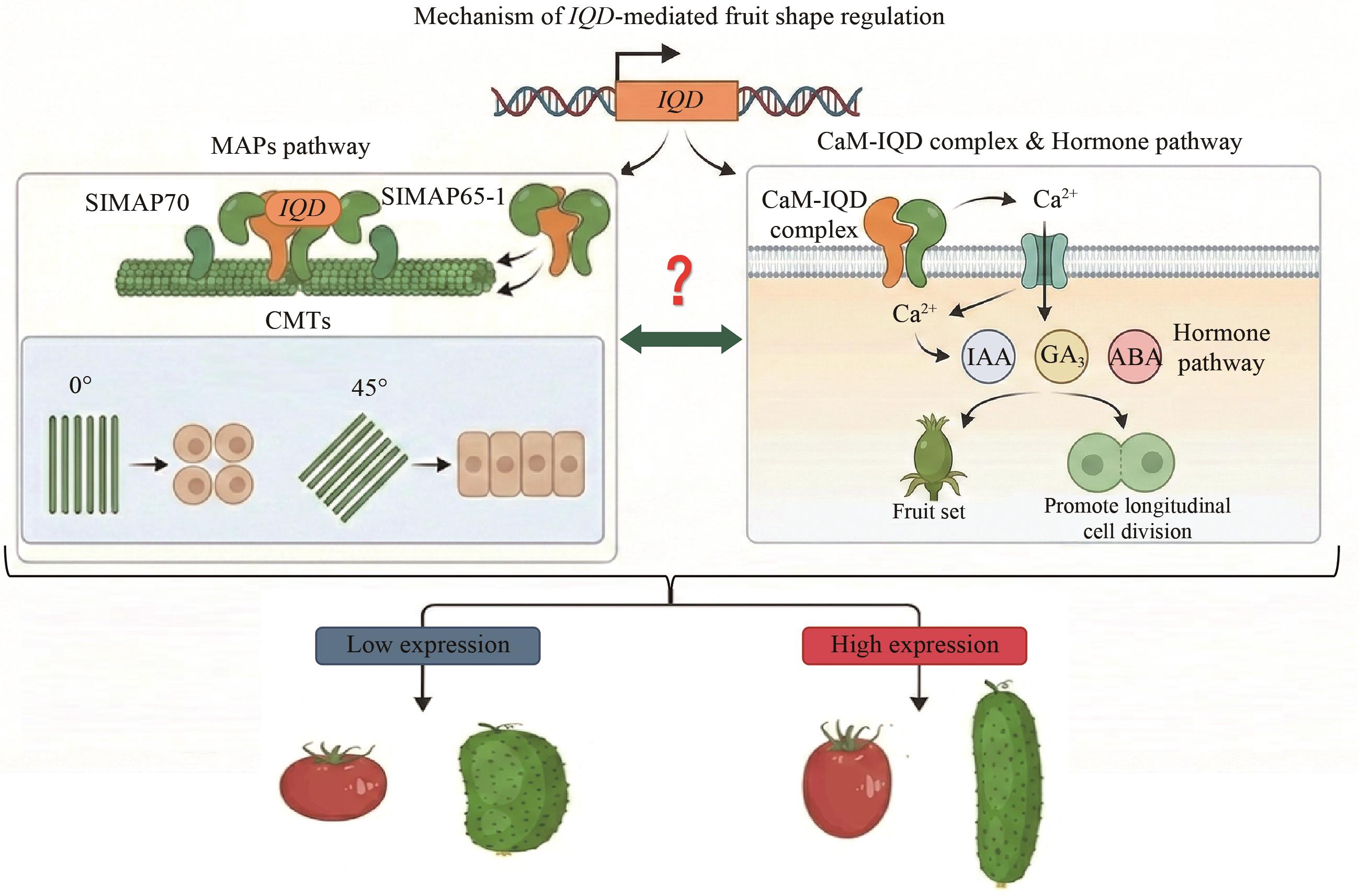
Fig. 2 Network model of the IQD gene family regulating fruit morphology in horticultural cropsThe IQD gene modulates fruit morphology via two pathways: MAPs pathway: IQD interacts with SlMAP70/SlMAP65-1 to alter cortical microtubule (CMT) orientation, directing the axis of cell expansion.Hormonal pathway: The CaM-IQD complex modulates Ca2+ signaling and IAA/GA3/ABA levels, promoting longitudinal cell division and fruit set. Phenotypic outcomes: Low IQD expression results in rounder fruits, while high expression promotes fruit elongation (e.g., in tomato and cucumber)
基因名称 Gene name | 基因ID Gene ID | 物种 Species | 基因功能 Gene function | 参考文献 Reference |
|---|---|---|---|---|
| AtIQD1 | At3g09710 | 拟南芥 Arabidopsis thaliana | 参与激素信号通路调控,调控植物防御反应; | [ |
| 参与钙信号通路调控,调控植物防御反应,连接钙信号与基因表达; | [ | |||
| 调控芥子油苷生物合成、整合钙信号与防御响应,增强抗虫与抗病性,与维管组织中高表达; | [ | |||
| 调控细胞内货物运输,与驱动蛋白轻链相关蛋白KLCR1发生互作 | [ | |||
| AtIQD20 | At3g51380 | 拟南芥 Arabidopsis thaliana | 作为钙调蛋白结合靶标 | [ |
| AtIQD13 | At3g59690 | 拟南芥 Arabidopsis thaliana | 调控木质部血管次生细胞壁形状,调节微管动力学,协同强化微管‒质膜连接 | [ |
| AtIQD2 | At5g03040 | 拟南芥 Arabidopsis thaliana | 介导细胞骨架桥接与网络协调,维持EPCS结构与ER形态,调控细胞形态 | [ |
| AtIQD5 | At3g22190 | 拟南芥 Arabidopsis thaliana | 调控皮质微管(MT)动态与组装,影响微管组织与细胞形态建成,支撑细胞生长与形状控制; | [ |
| 调控路面细胞(PC)形态,介导钙信号与微管阵列,作为植物特异性微管相关蛋白发挥作用; | [ | |||
| 微管结合的结构基础,调控植物生长发育与细胞形态 | [ | |||
| AtIQD11 | At5g13460 | 拟南芥 Arabidopsis thaliana | 对植物表型与细胞形态的调控,对MT排列方向的影响 | [ |
| AtIQD14 | At2g43680 | 拟南芥 Arabidopsis thaliana | 对植物表型与细胞形态的调控,对MT排列方向的影响 | [ |
| AtIQD16 | At4g10640 | 拟南芥 Arabidopsis thaliana | 调控皮质微管排序与细胞扩张,参与乙烯反应与差异生长调控,分子互作与募集功能; | [ |
| 作为植物特异性微管相关蛋白发挥作用\调控植物发育与细胞形态建成; | [ | |||
| 调控皮质微管的组织与方向,调控植物气生器官形态与细胞形态; | [ | |||
| 调控下胚轴伸长,与微管切断酶KTN1互作 | [ | |||
| AtIQD21 | At3g49260 | 拟南芥 Arabidopsis thaliana | 铺板细胞凹陷形成的关键调控,铺板细胞形态建成的微管介导作用 | [ |
| AtIQD26 | At3g16490 | 拟南芥 Arabidopsis thaliana | 钙调蛋白结合功能,调控逆境响应 | [ |
| AtIQD22 | At4g23060 | 拟南芥 Arabidopsis thaliana | 调控植物对缺氧的耐受性,与ADH1关联激活无氧呼吸 | [ |
| AtIQD15 | At3g49380 | 拟南芥 Arabidopsis thaliana | 增强微管稳定性并促进横向平行排列,可响应生长素诱导的钙瞬变 | [ |
| AtIQD17 | At4g00820 | 拟南芥 Arabidopsis thaliana | 受生长素‒细胞分裂素协同调控,影响铺板细胞“叶”状突起形成 | [ |
| AtIQD18 | At1g01110 | 拟南芥 Arabidopsis thaliana | 促进微管纵向排列并增强稳定性,介导生长素调控根伸长 | [ |
| SlSUN1/SlIQD12 | Solyc10g079240 | 番茄 Solanum lycopersicum | 调控果实伸长; | [ |
| 调控果实发育,参与植物激素信号通路; | [ | |||
| 调控营养器官的形态,调控种子发育,调控番茄果实形状; | [ | |||
| 调控番茄果实早期形态,调控核心代谢通路; | [ | |||
| 调控果实伸长,调控营养器官与生殖器官形态,与ovate、fs8.1存在协同作用; | [ | |||
| 调控子房与果实伸长,影响基因表达; | [ | |||
| 调控番茄果实形状 | [ | |||
| SlSUN24 | Solyc08g083240.2.1 | 番茄 Solanum lycopersicum | 激素网络调控,诱导种子萌发,钙调蛋白互作 | [ |
| SlSUN18/SlIQD26 | Solyc06g066430.2.1 | 番茄 Solanum lycopersicum | 调控细胞分裂模式,控制果实形状,调控微管动态骨架 | [ |
| SlSUN10/SlIQD21 | Solyc03g083100.2.1 | 番茄 Solanum lycopersicum | 调控细胞形态与微管动态,调控发育早期的形态,协同调控果实形状 | [ |
| CsSUN2 | Csa1G575000 | 黄瓜 Cucumis sativus | 调控果实形态 | [ |
| CsSUN5 | CsaV3_2G029380 | 黄瓜 Cucumis sativus | 对逆境的响应 | [ |
| CsSUN | Csa1G575000、Cucsa.288770 | 黄瓜 Cucumis sativus | 钙信号‒细胞骨架‒调控通路 | [ |
| CsSUN | Csa1G575000,Cucsa.288770 | 黄瓜 Cucumis sativus | 与CsLNG协同调控黄瓜果实形状,正向调控黄瓜果实纵向伸长,响应激素信号通路 | [ |
| CsSUN | CsaV3_1G039870 | 黄瓜 Cucumis sativus | 调控果实纵向伸长,调控细胞分裂方向,影响激素相关基因表达 | [ |
| CsSUN | CsaV3_1G039870 | 黄瓜 Cucumis sativus | 异源表达调控果实伸长,调控细胞分裂和大小 | [ |
| CsSUN | CsaV3_1G039870 | 黄瓜 Cucumis sativus | 蛋白稳定性受CsTON2正向调控,通过促进细胞纵向分裂,抑制横向分裂来正向调控果实伸长 | [ |
| Smechr0301963 | Smechr0301963 | 茄子 Solanum melongena L. | 潜在预测调控果实的长度 | [ |
| SmeFL | Smechr0302217 | 茄子 Solanum melongena L. | 初步定位SUN基因,预测调控茄子果实长度,调控微纤丝的取向来影响茄子细胞的扩张方向 | [ |
| CaIQD1 | 辣椒 Capsicum annuum | 调控多蛋白互作网络,激素信号的交叉调控 | [ | |
| BrIQD5 | Bra023414 | 白菜 Brassica rapa | 微管动态调控与细胞结构重塑,脱落酸信号通路的协同调控,干旱响应的分子开关 | [ |
| CmSUN23-24、CmSUN25-26-27c | MELO3C006884、MELO3C013004 | 甜瓜 Cucumis melo | 调控果实伸长,导致甜瓜果实形状变异 | [ |
| CmSUN7、CmSUN12 | MELO3C013004、MELO3C006884 | 甜瓜 Cucumis melo | 果实伸长调控,信号通路参与 | [ |
| CmIQD1、CmIQD31 | MELO3C025505、MELO3C002201 | 甜瓜 Cucumis melo | 调控果实形态、叶片形态,调控果实重量 | [ |
| MdIQD17、MdIQD18 | MD07G1178400、MD07G1265200 | 苹果 Malus domestica | 果实参与冷胁迫的适应性调控 | [ |
| PeIQD13、PeIQD9 | POPTR_0005s05310、POPTR_0003s04240 | 毛竹 Phyllostachys edulis | 调节干旱胁迫、MeJA胁迫 | [ |
| ClIQD24 | Cla021081 | 西瓜 Citrullus lanatus | 调控果实生长发育 | [ |
Table 1 Summary of research progress on the biological functions of the IQD gene family
基因名称 Gene name | 基因ID Gene ID | 物种 Species | 基因功能 Gene function | 参考文献 Reference |
|---|---|---|---|---|
| AtIQD1 | At3g09710 | 拟南芥 Arabidopsis thaliana | 参与激素信号通路调控,调控植物防御反应; | [ |
| 参与钙信号通路调控,调控植物防御反应,连接钙信号与基因表达; | [ | |||
| 调控芥子油苷生物合成、整合钙信号与防御响应,增强抗虫与抗病性,与维管组织中高表达; | [ | |||
| 调控细胞内货物运输,与驱动蛋白轻链相关蛋白KLCR1发生互作 | [ | |||
| AtIQD20 | At3g51380 | 拟南芥 Arabidopsis thaliana | 作为钙调蛋白结合靶标 | [ |
| AtIQD13 | At3g59690 | 拟南芥 Arabidopsis thaliana | 调控木质部血管次生细胞壁形状,调节微管动力学,协同强化微管‒质膜连接 | [ |
| AtIQD2 | At5g03040 | 拟南芥 Arabidopsis thaliana | 介导细胞骨架桥接与网络协调,维持EPCS结构与ER形态,调控细胞形态 | [ |
| AtIQD5 | At3g22190 | 拟南芥 Arabidopsis thaliana | 调控皮质微管(MT)动态与组装,影响微管组织与细胞形态建成,支撑细胞生长与形状控制; | [ |
| 调控路面细胞(PC)形态,介导钙信号与微管阵列,作为植物特异性微管相关蛋白发挥作用; | [ | |||
| 微管结合的结构基础,调控植物生长发育与细胞形态 | [ | |||
| AtIQD11 | At5g13460 | 拟南芥 Arabidopsis thaliana | 对植物表型与细胞形态的调控,对MT排列方向的影响 | [ |
| AtIQD14 | At2g43680 | 拟南芥 Arabidopsis thaliana | 对植物表型与细胞形态的调控,对MT排列方向的影响 | [ |
| AtIQD16 | At4g10640 | 拟南芥 Arabidopsis thaliana | 调控皮质微管排序与细胞扩张,参与乙烯反应与差异生长调控,分子互作与募集功能; | [ |
| 作为植物特异性微管相关蛋白发挥作用\调控植物发育与细胞形态建成; | [ | |||
| 调控皮质微管的组织与方向,调控植物气生器官形态与细胞形态; | [ | |||
| 调控下胚轴伸长,与微管切断酶KTN1互作 | [ | |||
| AtIQD21 | At3g49260 | 拟南芥 Arabidopsis thaliana | 铺板细胞凹陷形成的关键调控,铺板细胞形态建成的微管介导作用 | [ |
| AtIQD26 | At3g16490 | 拟南芥 Arabidopsis thaliana | 钙调蛋白结合功能,调控逆境响应 | [ |
| AtIQD22 | At4g23060 | 拟南芥 Arabidopsis thaliana | 调控植物对缺氧的耐受性,与ADH1关联激活无氧呼吸 | [ |
| AtIQD15 | At3g49380 | 拟南芥 Arabidopsis thaliana | 增强微管稳定性并促进横向平行排列,可响应生长素诱导的钙瞬变 | [ |
| AtIQD17 | At4g00820 | 拟南芥 Arabidopsis thaliana | 受生长素‒细胞分裂素协同调控,影响铺板细胞“叶”状突起形成 | [ |
| AtIQD18 | At1g01110 | 拟南芥 Arabidopsis thaliana | 促进微管纵向排列并增强稳定性,介导生长素调控根伸长 | [ |
| SlSUN1/SlIQD12 | Solyc10g079240 | 番茄 Solanum lycopersicum | 调控果实伸长; | [ |
| 调控果实发育,参与植物激素信号通路; | [ | |||
| 调控营养器官的形态,调控种子发育,调控番茄果实形状; | [ | |||
| 调控番茄果实早期形态,调控核心代谢通路; | [ | |||
| 调控果实伸长,调控营养器官与生殖器官形态,与ovate、fs8.1存在协同作用; | [ | |||
| 调控子房与果实伸长,影响基因表达; | [ | |||
| 调控番茄果实形状 | [ | |||
| SlSUN24 | Solyc08g083240.2.1 | 番茄 Solanum lycopersicum | 激素网络调控,诱导种子萌发,钙调蛋白互作 | [ |
| SlSUN18/SlIQD26 | Solyc06g066430.2.1 | 番茄 Solanum lycopersicum | 调控细胞分裂模式,控制果实形状,调控微管动态骨架 | [ |
| SlSUN10/SlIQD21 | Solyc03g083100.2.1 | 番茄 Solanum lycopersicum | 调控细胞形态与微管动态,调控发育早期的形态,协同调控果实形状 | [ |
| CsSUN2 | Csa1G575000 | 黄瓜 Cucumis sativus | 调控果实形态 | [ |
| CsSUN5 | CsaV3_2G029380 | 黄瓜 Cucumis sativus | 对逆境的响应 | [ |
| CsSUN | Csa1G575000、Cucsa.288770 | 黄瓜 Cucumis sativus | 钙信号‒细胞骨架‒调控通路 | [ |
| CsSUN | Csa1G575000,Cucsa.288770 | 黄瓜 Cucumis sativus | 与CsLNG协同调控黄瓜果实形状,正向调控黄瓜果实纵向伸长,响应激素信号通路 | [ |
| CsSUN | CsaV3_1G039870 | 黄瓜 Cucumis sativus | 调控果实纵向伸长,调控细胞分裂方向,影响激素相关基因表达 | [ |
| CsSUN | CsaV3_1G039870 | 黄瓜 Cucumis sativus | 异源表达调控果实伸长,调控细胞分裂和大小 | [ |
| CsSUN | CsaV3_1G039870 | 黄瓜 Cucumis sativus | 蛋白稳定性受CsTON2正向调控,通过促进细胞纵向分裂,抑制横向分裂来正向调控果实伸长 | [ |
| Smechr0301963 | Smechr0301963 | 茄子 Solanum melongena L. | 潜在预测调控果实的长度 | [ |
| SmeFL | Smechr0302217 | 茄子 Solanum melongena L. | 初步定位SUN基因,预测调控茄子果实长度,调控微纤丝的取向来影响茄子细胞的扩张方向 | [ |
| CaIQD1 | 辣椒 Capsicum annuum | 调控多蛋白互作网络,激素信号的交叉调控 | [ | |
| BrIQD5 | Bra023414 | 白菜 Brassica rapa | 微管动态调控与细胞结构重塑,脱落酸信号通路的协同调控,干旱响应的分子开关 | [ |
| CmSUN23-24、CmSUN25-26-27c | MELO3C006884、MELO3C013004 | 甜瓜 Cucumis melo | 调控果实伸长,导致甜瓜果实形状变异 | [ |
| CmSUN7、CmSUN12 | MELO3C013004、MELO3C006884 | 甜瓜 Cucumis melo | 果实伸长调控,信号通路参与 | [ |
| CmIQD1、CmIQD31 | MELO3C025505、MELO3C002201 | 甜瓜 Cucumis melo | 调控果实形态、叶片形态,调控果实重量 | [ |
| MdIQD17、MdIQD18 | MD07G1178400、MD07G1265200 | 苹果 Malus domestica | 果实参与冷胁迫的适应性调控 | [ |
| PeIQD13、PeIQD9 | POPTR_0005s05310、POPTR_0003s04240 | 毛竹 Phyllostachys edulis | 调节干旱胁迫、MeJA胁迫 | [ |
| ClIQD24 | Cla021081 | 西瓜 Citrullus lanatus | 调控果实生长发育 | [ |
| [1] | Hepler PK, Vidali L, Cheung AY. Polarized cell growth in higher plants [J]. Annu Rev Cell Dev Biol, 2001, 17: 159-187. |
| [2] | Ng CK, Mcainsh MR, Gray JE, et al. Calcium-based signalling systems in guard cells [J]. New Phytol, 2001, 151(1): 109-120. |
| [3] | Reddy ASN. Calcium: silver bullet in signaling [J]. Plant Sci, 2001, 160(3): 381-404. |
| [4] | Du LQ, Ali GS, Simons KA, et al. Ca2+/calmodulin regulates salicylic-acid-mediated plant immunity [J]. Nature, 2009, 457(7233): 1154-1158. |
| [5] | Harada A, Shimazaki KI. Measurement of changes in cytosolic Ca2+ in Arabidopsis guard cells and mesophyll cells in response to blue light [J]. Plant Cell Physiol, 2009, 50(2): 360-373. |
| [6] | Abel S, Savchenko T, Levy M. Genome-wide comparative analysis of the IQD gene families in Arabidopsis thaliana and Oryza sativa [J]. BMC Evol Biol, 2005, 5: 72. |
| [7] | Rehman A, Peng Z, Li HG, et al. Genome wide analysis of IQD gene family in diploid and tetraploid species of cotton (Gossypium spp.) [J]. Int J Biol Macromol, 2021, 184: 1035-1061. |
| [8] | Bürstenbinder K, Mitra D, Quegwer J. Functions of IQD proteins as hubs in cellular calcium and auxin signaling: a toolbox for shape formation and tissue-specification in plants? [J]. Plant Signal Behav, 2017, 12(6): e1331198. |
| [9] | Feng L, Chen Z, Ma H, et al. The IQD gene family in soybean: structure, phylogeny, evolution and expression [J]. PLoS One, 2014, 9(10): e110896. |
| [10] | Huang ZJ, Van Houten J, Gonzalez G, et al. Genome-wide identification, phylogeny and expression analysis of SUN, OFP and YABBY gene family in tomato [J]. Mol Genet Genomics, 2013, 288(3/4): 111-129. |
| [11] | Ma H, Feng L, Chen Z, et al. Genome-wide identification and expression analysis of the IQD gene family in Populus trichocarpa [J]. Plant Sci, 2014, 229: 96-110. |
| [12] | Wu M, Li Y, Chen DM, et al. Genome-wide identification and expression analysis of the IQD gene family in moso bamboo (Phyllostachys edulis) [J]. Sci Rep, 2016, 6: 24520. |
| [13] | Levy M, Wang QM, Kaspi R, et al. Arabidopsis IQD1, a novel calmodulin-binding nuclear protein, stimulates glucosinolate accumulation and plant defense [J]. Plant J, 2005, 43(1): 79-96. |
| [14] | Zentella R, Zhang ZL, Park M, et al. Global analysis of DELLA direct targets in early gibberellin signaling in Arabidopsis [J]. Plant Cell, 2007, 19(10): 3037-3057. |
| [15] | Xiao H, Jiang N, Schaffner E, et al. A retrotransposon-mediated gene duplication underlies morphological variation of tomato fruit [J]. Science, 2008, 319(5869): 1527-1530. |
| [16] | Li Y, Huang YJ, Wen YZ, et al. The domain of unknown function 4005 (DUF4005) in an Arabidopsis IQD protein functions in microtubule binding [J]. J Biol Chem, 2021, 297(1): 100849. |
| [17] | Abel S, Bürstenbinder K, Müller J. The emerging function of IQD proteins as scaffolds in cellular signaling and trafficking [J]. Plant Signal Behav, 2013, 8(6): e24369. |
| [18] | Zang JZ, Klemm S, Pain C, et al. A novel plant actin-microtubule bridging complex regulates cytoskeletal and ER structure at ER-PM contact sites [J]. Curr Biol, 2021, 31(6): 1251-1260.e4. |
| [19] | Liang H, Zhang Y, Martinez P, et al. The microtubule-associated protein IQ67 DOMAIN5 modulates microtubule dynamics and pavement cell shape [J]. Plant Physiol, 2018, 177(4): 1555-1568. |
| [20] | Mitra D, Klemm S, Kumari P, et al. Microtubule-associated protein IQ67 DOMAIN5 regulates morphogenesis of leaf pavement cells in Arabidopsis thaliana [J]. J Exp Bot, 2019, 70(2): 529-543. |
| [21] | Sugiyama Y, Wakazaki M, Toyooka K, et al. A novel plasma membrane-anchored protein regulates xylem cell-wall deposition through microtubule-dependent lateral inhibition of rho GTPase domains [J]. Curr Biol, 2017, 27(16): 2522-2528.e4. |
| [22] | Li YF, Deng M, Liu HF, et al. ABNORMAL SHOOT 6 interacts with KATANIN 1 and SHADE AVOIDANCE 4 to promote cortical microtubule severing and ordering in Arabidopsis [J]. J Integr Plant Biol, 2021, 63(4): 646-661. |
| [23] | Feng XH, Pan SJ, Tu HF, et al. IQ67 DOMAIN protein 21 is critical for indentation formation in pavement cell morphogenesis [J]. J Integr Plant Biol, 2023, 65(3): 721-738. |
| [24] | 韦慧彦, 郭振清, 王振杰, 等. 拟南芥钙调素结合蛋白AtIQD26的分离鉴定 [J]. 生物化学与生物物理进展, 2008, 35(6): 703-711. |
| Wei HY, Guo ZQ, Wang ZJ, et al. Isolation and characterization of calmodulin-binding protein AtIQD26 in Arabidopsis thaliana [J]. Prog Biochem Biophys, 2008, 35(6): 703-711. | |
| [25] | Li Q, Luo SX, Zhang LY, et al. Molecular and genetic regulations of fleshy fruit shape and lessons from Arabidopsis and rice [J]. Hortic Res, 2023, 10(7): uhad108. |
| [26] | Wang YP, Clevenger JP, Illa-Berenguer E, et al. A comparison of Sun, ovate, fs8.1 and auxin application on tomato fruit shape and gene expression [J]. Plant Cell Physiol, 2019, 60(5): 1067-1081. |
| [27] | Bao ZR, Guo Y, Deng YL, et al. Microtubule-associated protein SlMAP70 interacts with IQ67-domain protein SlIQD21a to regulate fruit shape in tomato [J]. Plant Cell, 2023, 35(12): 4266-4283. |
| [28] | Bao ZR, Guo Y, Meng XX, et al. Microtubule-associated proteins MAP65-1 and SUN18/IQD26 coordinately regulate tomato fruit shape by affecting cell division [J]. Plant Physiol, 2024, 194(2): 629-633. |
| [29] | Zhang ZG, Zhang HQ, Liu JY, et al. The mutation of CsSUN, an IQD family protein, is responsible for the short and fat fruit (sff) in cucumber (Cucumis sativus L.) [J]. Plant Sci, 2024, 346: 112177. |
| [30] | Jin BK, Kim J, Jung J, et al. Characterization of IQ domain gene homologs as common candidate genes for elongated fruit shape in cucurbits [J]. Hortic Sci Technol, 2018, 36(1): 85-97. |
| [31] | Li M, Li XL, He YT, et al. The microtubule-associated protein CsTON2 interacts with CsTRM5 and CsSUN to regulate fruit shape development in cucumber [J]. Plant Biotechnol J, 2025: pbi.70519. |
| [32] | Mao LZ, Shen YY, Cui QZ, et al. The IQ67-domain protein IQD1 regulates fruit shape through complex multiprotein interactions in pepper (Capsicum annuum L.) [J]. Plant Biotechnol J, 2025, 23(7): 2651-2666. |
| [33] | Bürstenbinder K, Savchenko T, Müller J, et al. Arabidopsis calmodulin-binding protein IQ67-domain 1 localizes to microtubules and interacts with kinesin light chain-related protein-1 [J]. J Biol Chem, 2013, 288(3): 1871-1882. |
| [34] | Li H, Han J, Chen LJ, et al. Ectopic expression of CsSUN in tomato results in elongated fruit shape via regulation of longitudinal cell division [J]. Int J Mol Sci, 2022, 23(17): 9973. |
| [35] | Wu S, Xiao H, Cabrera A, et al. SUN regulates vegetative and reproductive organ shape by changing cell division patterns [J]. Plant Physiol, 2011, 157(3): 1175-1186. |
| [36] | Ma M, Liu SY, Wang ZW, et al. Genome-wide identification of the SUN gene family in melon (Cucumis melo) and functional characterization of two CmSUN genes in regulating fruit shape variation [J]. Int J Mol Sci, 2022, 23(24): 16047. |
| [37] | 刘苏芽. 甜瓜CmSUN7与CmSUN12基因影响果实伸长的功能初步探究 [D]. 呼和浩特: 内蒙古大学, 2022. |
| Liu SY. Function exploration of CmSUN7 and CmSUN12 genes in fruit elongation of melon [D]. Hohhot: Inner Mongolia University, 2022. | |
| [38] | Wendrich JR, Yang BJ, Mijnhout P, et al. IQD proteins integrate auxin and calcium signaling to regulate microtubule dynamics during Arabidopsis development [J]. bioRxiv, 2018: 275560. |
| [39] | 杨羽清. CsLNG和CsSUN协同调控黄瓜果实形状建成的分子机理探究 [D]. 杨凌: 西北农林科技大学, 2025. |
| Yang YQ. Study on the molecular mechanism of synergistic regulation of cucumber fruit shape formation by CsLNG and CsSUN [D]. Yangling: Northwest A & F University, 2025. | |
| [40] | Barda O, Levy M. IQD1 involvement in hormonal signaling and general defense responses against Botrytis cinerea [J]. Front Plant Sci, 2022, 13: 845140. |
| [41] | Jiang N, Gao DY, Xiao H, et al. Genome organization of the tomato sun locus and characterization of the unusual retrotransposon Rider [J]. Plant J, 2009, 60(1): 181-193. |
| [42] | Xiao H, Radovich C, Welty N, et al. Integration of tomato reproductive developmental landmarks and expression profiles, and the effect of SUN on fruit shape [J]. BMC Plant Biol, 2009, 9: 49. |
| [43] | Wei QZ, Wang JL, Wang WH, et al. A high-quality chromosome-level genome assembly reveals genetics for important traits in eggplant [J]. Hortic Res, 2020, 7: 153. |
| [44] | Pang H, Ai J, Wang W, et al. Fine mapping of QTL-fl3.1 reveal SmeFL as the candidate gene regulating fruit length in eggplant (Solanum melongena L.) [J]. Veg Res, 2024, 4(1): 12. |
| [45] | Dou JL, Duan SX, Umer MJ, et al. Genome-wide analysis of IQD proteins and ectopic expression of watermelon ClIQD24 in tomato suggests its important role in regulating fruit shape [J]. Front Genet, 2022, 13: 993218. |
| [46] | Zhao SS, Chen QF, Chen L, et al. The plant-specific protein IQD22 interacts with calcium sensors to activate anaerobic respiration during hypoxia in Arabidopsis [J]. Mol Plant, 2025, 18(8): 1330-1350. |
| [47] | Bürstenbinder K, Möller B, Plötner R, et al. The IQD family of calmodulin-binding proteins links calcium signaling to microtubules, membrane subdomains, and the nucleus [J]. Plant Physiol, 2017, 173(3): 1692-1708. |
| [48] | Xu Q, Xu XW, Shi Y, et al. Elucidation of the molecular responses of a cucumber segment substitution line carrying Pm5.1 and its recurrent parent triggered by powdery mildew by comparative transcriptome profiling [J]. BMC Genom, 2017, 18: 21. |
| [49] | 张清霞, 陈春花, 王丽娜, 等. 黄瓜SUN家族的鉴定及其对逆境的响应 [J]. 分子植物育种, 2023, 21(9): 2823-2831. |
| Zhang QX, Chen CH, Wang LN, et al. Identification and response to adversity of cucumber SUN family [J]. Mol Plant Breed, 2023, 21(9): 2823-2831. | |
| [50] | Yuan JP, Liu TK, Yu ZH, et al. Genome-wide analysis of the Chinese cabbage IQD gene family and the response of BrIQD5 in drought resistance [J]. Plant Mol Biol, 2019, 99(6): 603-620. |
| [51] | Rodríguez GR, Muños S, Anderson C, et al. Distribution of SUN, OVATE, LC, and FAS in the tomato germplasm and the relationship to fruit shape diversity [J]. Plant Physiol, 2011, 156(1): 275-285. |
| [52] | Clevenger JP, Van Houten J, Blackwood M, et al. Network analyses reveal shifts in transcript profiles and metabolites that accompany the expression of SUN and an elongated tomato fruit [J]. Plant Physiol, 2015, 168(3): 1164-1178. |
| [53] | Wu S, Clevenger JP, Sun L, et al. The control of tomato fruit elongation orchestrated by sun, ovate and fs8.1 in a wild relative of tomato [J]. Plant Sci, 2015, 238: 95-104. |
| [54] | Bi LL, Weng L, Jiang ZY, et al. The tomato IQD gene SUN24 regulates seed germination through ABA signaling pathway [J]. Planta, 2018, 248(4): 919-931. |
| [55] | Pan YP, Liang XJ, Gao ML, et al. Round fruit shape in WI7239 cucumber is controlled by two interacting quantitative trait loci with one putatively encoding a tomato SUN homolog [J]. Theor Appl Genet, 2017, 130(3): 573-586. |
| [56] | 包博文. 甜瓜IQD基因家族鉴定及CmIQD1、CmIQD31功能的初步探究 [D]. 呼和浩特: 内蒙古大学, 2022. |
| Bao BW. Identification of melon IQD gene family and preliminary study on the functions of CmIQD1 and CmIQD31 [D]. Hohhot: Inner Mongolia University, 2022. | |
| [57] | Zhang Y, Wang SJ, Zhang CC, et al. Genome-wide characterization of IQD family proteins in apple and functional analysis of the microtubule-regulating abilities of MdIQD17 and MdIQD28 under cold stress [J]. Plants, 2024, 13(17): 2532. |
| [1] | WANG He-yao, SUN Hong-mei. Research Progress in the Function and Formation Mechanism of Trichomes in Horticultural Plants [J]. Biotechnology Bulletin, 2026, 42(3): 242-254. |
| [2] | LI Cheng-quan, SHI Qing-hua, YANG Xiao-yu. microRNA-based Regulatory Network for Fruit Development of Horticultural Crops: From Molecular Mechanism to Germplasm Innovation [J]. Biotechnology Bulletin, 2026, 42(3): 19-36. |
| [3] | GUO Xiu-juan, FENG Yu, WU Rui-xiang, WANG Li-qin, YANG Jian-chun. Transcriptome Analysis of the Effect of Ca 2+ Treatment on the Seed Germination of Flax [J]. Biotechnology Bulletin, 2025, 41(7): 139-149. |
| [4] | LI Rui, HU Ting, CHEN Shu-wei, WANG Yao, WANG Ji-ping. Positive Regulation of Anthocyanin Biosynthesis by PfMYB80 Transcription Factor in Perilla frutescens [J]. Biotechnology Bulletin, 2025, 41(6): 243-255. |
| [5] | WANG Bi-cheng, JING Hai-qing, WAN Kun, ZHANG Ying-ying, DING Jia-hao, LI Run-zhi, XUE Jin-ai, ZHANG Hai-ping. Identification of Soybean BCAT Gene Family and Functional Analysis of GmBCAT3 in Soybean Responses to Drought Stress [J]. Biotechnology Bulletin, 2025, 41(10): 196-209. |
| [6] | HAO Si-yi, ZHANG Jun-ke, WANG Bin, QU Peng-yan, LI Rui-de, CHENG Chun-zhen. Cloning and Expression Analysis of Banana EARLY FLOWERING 3(ELF3)Genes [J]. Biotechnology Bulletin, 2024, 40(5): 131-140. |
| [7] | CHEN Ying-ying, WU Ding-jie, LIU Yuan, ZHANG Hang, LIU Yan-jiao, WANG Jing-yu, LI Rui-li. Recent Advances in 14-3-3 Proteins and Their Functions in Plant [J]. Biotechnology Bulletin, 2024, 40(4): 12-22. |
| [8] | CHEN Meng-jiao, LI Yang-yang, WU Qian. Research Advances in Plant Growth and Stress Response Regulation Mediated by Glutamate Receptor-like Proteins [J]. Biotechnology Bulletin, 2024, 40(10): 62-75. |
| [9] | TANG Wei-lin, KANG Qin, WANG Xia, SHEN Ming-yang, SUN Xin-jiang, WANG Ke, HOU Kai, WU Wei, XU Dong-bei. Cloning and Expression Pattern Analysis of Jasmonic Acid Receptor Gene McCOI1a in Mentha canadensis L. [J]. Biotechnology Bulletin, 2024, 40(1): 270-280. |
| [10] | YAO Sha-sha, WANG Jing-jing, WANG Jun-jie, LIANG Wei-hong. Molecular Mechanisms of Rice Grain Size Regulation Related to Plant Hormone Signaling Pathways [J]. Biotechnology Bulletin, 2023, 39(8): 80-90. |
| [11] | LIU Kui, LI Xing-fen, YANG Pei-xin, ZHONG Zhao-chen, CAO Yi-bo, ZHANG Ling-yun. Functional Study and Validation of Transcriptional Coactivator PwMBF1c in Picea wilsonii [J]. Biotechnology Bulletin, 2023, 39(5): 205-216. |
| [12] | WEI Ming WANG Xin-yu WU Guo-qiang ZHAO Meng. The Role of NAD-dependent Deacetylase SRT in Plant Epigenetic Inheritance Regulation [J]. Biotechnology Bulletin, 2023, 39(4): 59-70. |
| [13] | GE Yan-rui, ZHAO Ran, XU Jing, LI Ruo-fan, HU Yun-tao, LI Rui-li. Advances in the Development and Regulation of Vascular Cambium [J]. Biotechnology Bulletin, 2023, 39(3): 13-25. |
| [14] | YAN Xiong-ying, WANG Zhen, WANG Xia, YANG Shi-hui. Microbial Sulfur Metabolism and Stress Resistance [J]. Biotechnology Bulletin, 2023, 39(11): 150-167. |
| [15] | ZHANG Hong-hong, FANG Xiao-feng. Advances in the Regulation of Stress Sensing and Responses by Phase Separation in Plants [J]. Biotechnology Bulletin, 2023, 39(11): 44-53. |
| Viewed | ||||||
|
Full text |
|
|||||
|
Abstract |
|
|||||
