







生物技术通报 ›› 2025, Vol. 41 ›› Issue (7): 139-149.doi: 10.13560/j.cnki.biotech.bull.1985.2024-1269
郭秀娟1( ), 冯宇2, 吴瑞香1, 王利琴1, 杨建春1()
收稿日期:2024-12-27
出版日期:2025-07-26
发布日期:2025-07-22
通讯作者:
杨建春,男,研究员,研究方向 :胡麻育种栽培技术研究及示范推广;E-mail: ghshumazhu@sina.com作者简介:郭秀娟,女,硕士,副研究员,研究方向 :胡麻育种、栽培及资源鉴定、创新;E-mail: guoxiujuan1118@163.com
基金资助:
GUO Xiu-juan1(), FENG Yu2, WU Rui-xiang1, WANG Li-qin1, YANG Jian-chun1()
Received:2024-12-27
Published:2025-07-26
Online:2025-07-22
摘要:
目的 探究Ca²⁺对胡麻种子萌发特性的影响,揭示其调控机制,为胡麻种子萌发提供理论支持,拓展对Ca²⁺作用机制的理解。 方法 用0.5%的氯化钙溶液对晋亚10号胡麻种子进行浸种处理,晾干后,进行萌发试验。利用生物信息学方法分析其在5、10和15 h的Ca2+处理前后基因的表达情况。 结果 Ca2+处理的胡麻种子露白率和出芽的时间明显地提前。通过对胡麻种子进行不同时间(5、10、15 h)的Ca²⁺处理,并结合转录组测序分析其基因表达变化,在Ca²⁺处理5 h后,与对照组相比,筛选出1 357个差异基因,其中上调基因558个,下调基因799个。随着处理时间延长,差异基因数量显著减少。在10 h时,差异基因减少至641个(上调385个,下调256个);至15 h时,仅剩168个差异基因(上调151个,下调17个)。此外,进一步通过基因共表达网络分析,筛选出各组中最相关的模块及核心基因。 结论 在Ca²⁺处理胡麻种子5 h组(H5)中,显著相关的Meblue模块包含147个基因,主要富集于碳代谢通路、植物激素信号转导通路及光合生物中的碳固定通路。而在15 h组(H15)中,显著相关的Mebrown模块包含141个基因,主要富集于碳代谢通路、类苯基丙烷生物合成通路和亚麻酸代谢通路。此外,本研究重点筛选出35个与植物激素信号转导通路相关的差异表达基因。
郭秀娟, 冯宇, 吴瑞香, 王利琴, 杨建春. Ca2+处理对胡麻种子萌发影响的转录组分析[J]. 生物技术通报, 2025, 41(7): 139-149.
GUO Xiu-juan, FENG Yu, WU Rui-xiang, WANG Li-qin, YANG Jian-chun. Transcriptome Analysis of the Effect of Ca 2+ Treatment on the Seed Germination of Flax[J]. Biotechnology Bulletin, 2025, 41(7): 139-149.
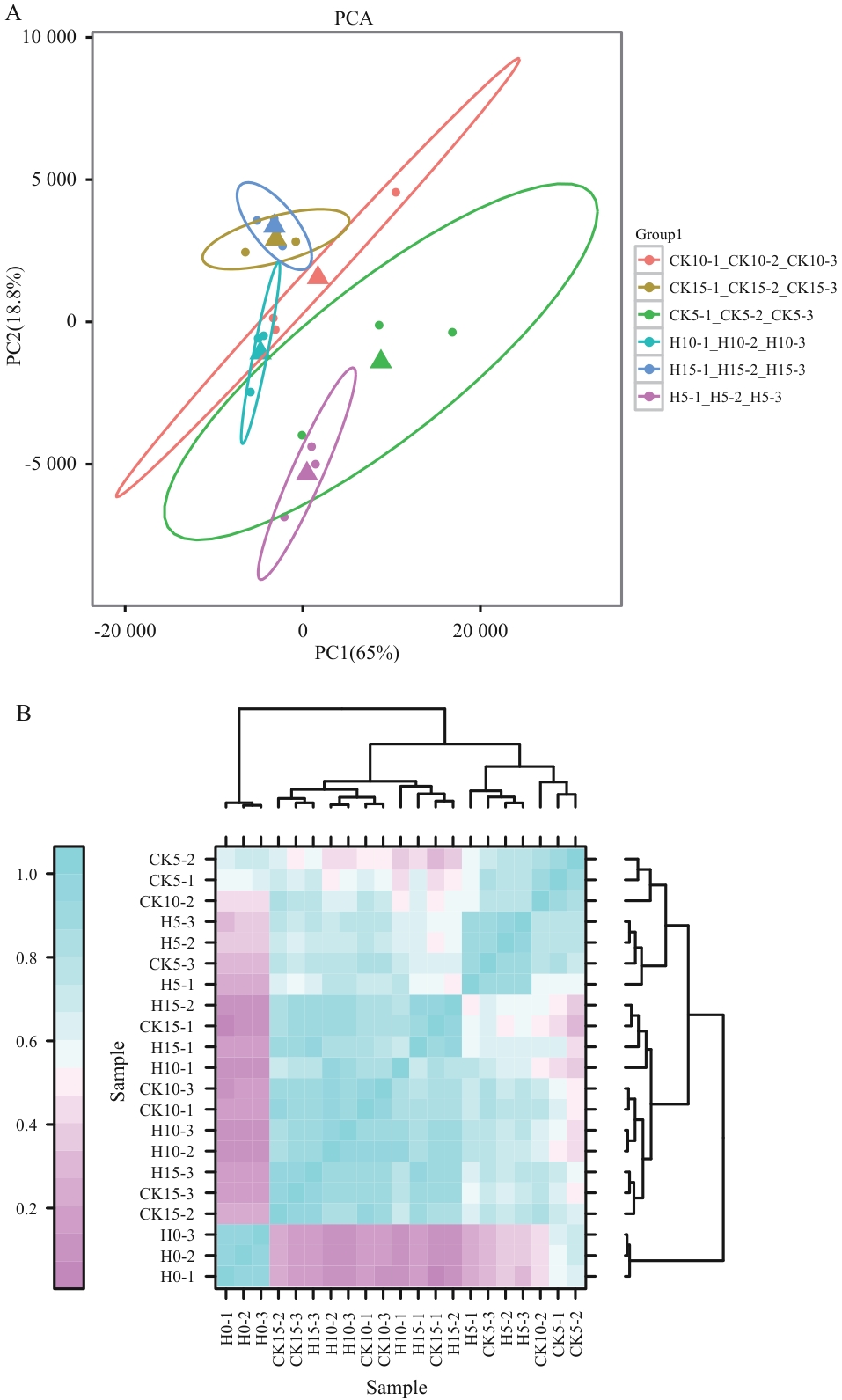
图1 二代转录组测序结果分析A:主成分分析图;B:相关性热图
Fig. 1 Analysis of second-generation transcriptome sequencing resultsA: Principal component analysis map. B: Correlation heatmap
样本名称 Sample ID | Read数Read sum | 碱基数 Base sum | GC (%) | Q20 (%) | Q30 (%) |
|---|---|---|---|---|---|
| CK10-1 | 25 609 082 | 7.66E+09 | 48.47 | 96.93 | 92.16 |
| CK10-2 | 26 966 248 | 8.07E+09 | 49.38 | 96.75 | 91.73 |
| CK10-3 | 23 927 191 | 7.15E+09 | 48.57 | 96.47 | 91.05 |
| CK15-1 | 25 423 170 | 7.6E+09 | 48.45 | 96.40 | 90.92 |
| CK15-2 | 25 449 573 | 7.61E+09 | 48.74 | 96.62 | 91.43 |
| CK15-3 | 25 043 446 | 7.5E+09 | 48.79 | 96.53 | 91.32 |
| CK5-1 | 25 901 164 | 7.75E+09 | 49.06 | 97.1 | 92.48 |
| CK5-2 | 24 208 550 | 7.25E+09 | 49.14 | 96.87 | 92.05 |
| CK5-3 | 25 252 286 | 7.55E+09 | 48.01 | 96.91 | 92.08 |
| H0-1 | 25 799 197 | 7.72E+09 | 50.66 | 97.44 | 93.21 |
| H0-2 | 21 653 940 | 6.48E+09 | 50.74 | 97.37 | 93.04 |
| H0-3 | 26 842 050 | 8.03E+09 | 50.38 | 97.38 | 93.05 |
| H10-1 | 22 298 472 | 6.64E+09 | 48.27 | 97.68 | 93.63 |
| H10-2 | 22 151 457 | 6.63E+09 | 48.51 | 97.5 | 93.33 |
| H10-3 | 22 121 723 | 6.57E+09 | 48.49 | 97.41 | 93.10 |
| H15-1 | 23 850 243 | 7.12E+09 | 48.80 | 97.07 | 92.35 |
| H15-2 | 25 366 589 | 7.56E+09 | 48.57 | 96.90 | 91.96 |
| H15-3 | 24 493 690 | 7.32E+09 | 48.69 | 96.97 | 92.17 |
| H5-1 | 24 165 140 | 7.21E+09 | 48.04 | 97.36 | 92.90 |
| H5-2 | 24 093 687 | 7.19E+09 | 48.35 | 97.43 | 93.07 |
| H5-3 | 23 498 356 | 7.02E+09 | 48.37 | 97.34 | 92.92 |
表1 测序数据统计
Table 1 Summary of sequencing data
样本名称 Sample ID | Read数Read sum | 碱基数 Base sum | GC (%) | Q20 (%) | Q30 (%) |
|---|---|---|---|---|---|
| CK10-1 | 25 609 082 | 7.66E+09 | 48.47 | 96.93 | 92.16 |
| CK10-2 | 26 966 248 | 8.07E+09 | 49.38 | 96.75 | 91.73 |
| CK10-3 | 23 927 191 | 7.15E+09 | 48.57 | 96.47 | 91.05 |
| CK15-1 | 25 423 170 | 7.6E+09 | 48.45 | 96.40 | 90.92 |
| CK15-2 | 25 449 573 | 7.61E+09 | 48.74 | 96.62 | 91.43 |
| CK15-3 | 25 043 446 | 7.5E+09 | 48.79 | 96.53 | 91.32 |
| CK5-1 | 25 901 164 | 7.75E+09 | 49.06 | 97.1 | 92.48 |
| CK5-2 | 24 208 550 | 7.25E+09 | 49.14 | 96.87 | 92.05 |
| CK5-3 | 25 252 286 | 7.55E+09 | 48.01 | 96.91 | 92.08 |
| H0-1 | 25 799 197 | 7.72E+09 | 50.66 | 97.44 | 93.21 |
| H0-2 | 21 653 940 | 6.48E+09 | 50.74 | 97.37 | 93.04 |
| H0-3 | 26 842 050 | 8.03E+09 | 50.38 | 97.38 | 93.05 |
| H10-1 | 22 298 472 | 6.64E+09 | 48.27 | 97.68 | 93.63 |
| H10-2 | 22 151 457 | 6.63E+09 | 48.51 | 97.5 | 93.33 |
| H10-3 | 22 121 723 | 6.57E+09 | 48.49 | 97.41 | 93.10 |
| H15-1 | 23 850 243 | 7.12E+09 | 48.80 | 97.07 | 92.35 |
| H15-2 | 25 366 589 | 7.56E+09 | 48.57 | 96.90 | 91.96 |
| H15-3 | 24 493 690 | 7.32E+09 | 48.69 | 96.97 | 92.17 |
| H5-1 | 24 165 140 | 7.21E+09 | 48.04 | 97.36 | 92.90 |
| H5-2 | 24 093 687 | 7.19E+09 | 48.35 | 97.43 | 93.07 |
| H5-3 | 23 498 356 | 7.02E+09 | 48.37 | 97.34 | 92.92 |
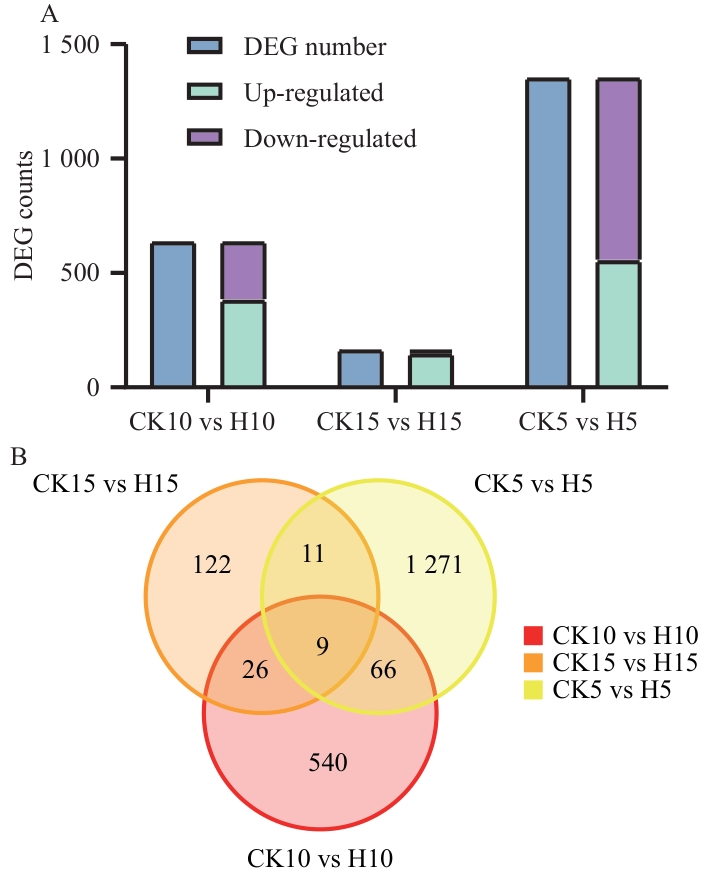
图2 差异基因统计图(A)和比较组合差异基因韦恩图(B)
Fig. 2 Statistical map of differential genes (A) and Venn diagram of comparing the combined differential genes (B)

图3 KEGG富集分析柱状图
Fig. 3 Bar diagram of KEGG enrichment analysis

图4 WGCNA分析
Fig. 4 WGCNA analysis

图5 每个模块基因的KEGG富集分析
Fig. 5 KEGG enrichment analysis of each module gene
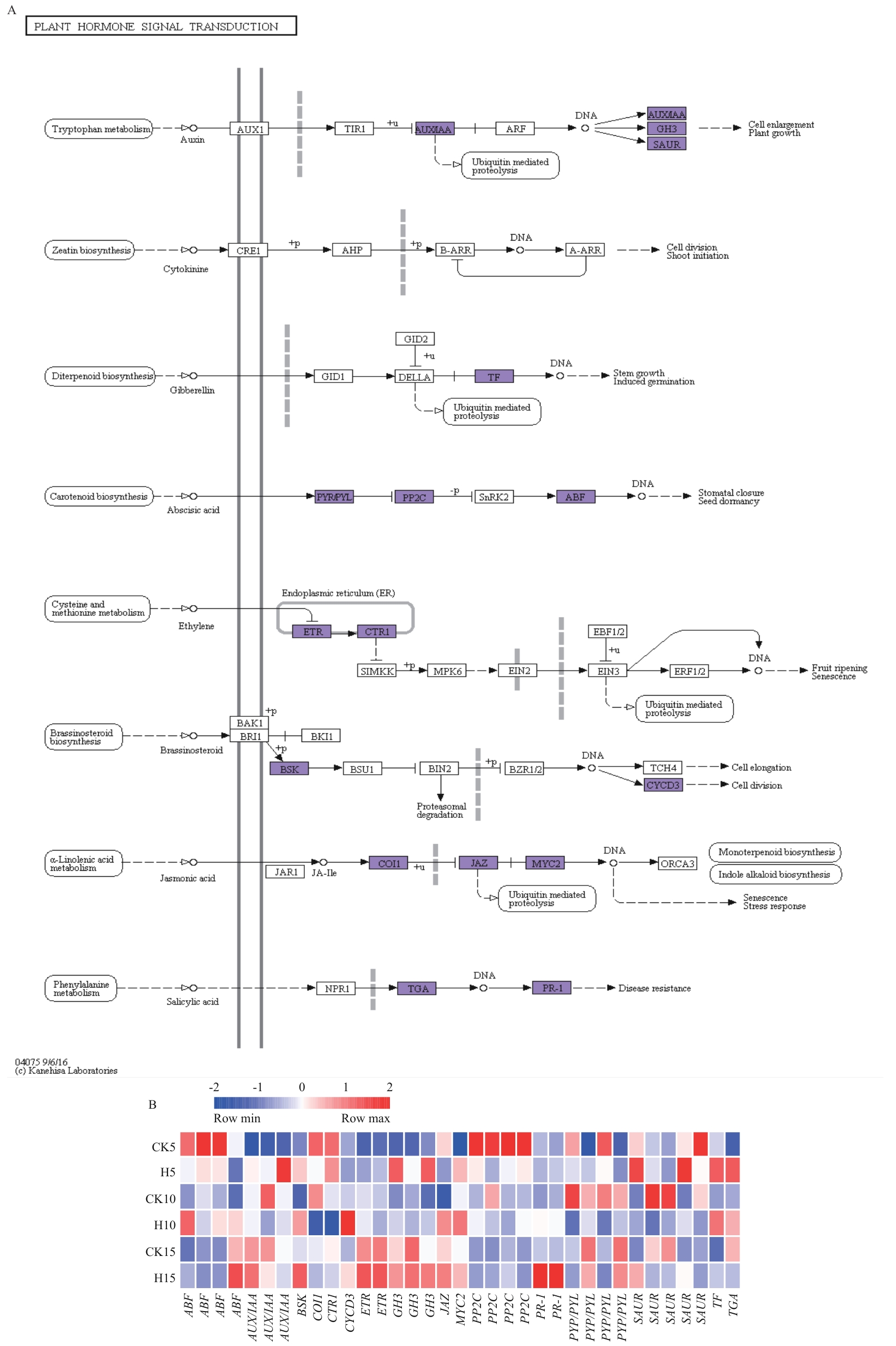
图6 植物激素信号转导通路(A)和相关基因的表达(B)
Fig. 6 Plant hormone signal transduction pathways (A) and expressions of genes related to plant hormone (B)
| [1] | 高炳德, 索全义, 白进玲, 等. 播种期对胡麻物质代谢及产量形成的影响 [J]. 内蒙古农业科技, 2001(S3): 9-11, 21. |
| Gao BD, Suo QY, Bai JL, et al. Effect of sowing date on substance metabolism and yield formation of flax [J]. Inn Mong Agric Sci Technol, 2001(S3): 9-11, 21. | |
| [2] | 张浩, 郑云普, 叶嘉, 等. 外源钙离子对盐胁迫玉米气孔特征、光合作用和生物量的影响 [J]. 应用生态学报, 2019, 30(3): 923-930. |
| Zhang H, Zheng YP, Ye J, et al. Effects of exogenous Ca2+ on stomatal traits, photosynthesis, and biomass of maize seedings under salt stress [J]. Chin J Appl Ecol, 2019, 30(3): 923-930. | |
| [3] | Edel KH, Marchadier E, Brownlee C, et al. The evolution of calcium-based signalling in plants [J]. Curr Biol, 2017, 27(13): R667-R679. |
| [4] | 刘刚, 刘娜, 王冬梅. 激发子诱发的小麦叶肉细胞原生质体[Ca2+]cyt升高主要源于胞外钙离子内流 [J]. 植物生理学报, 2015, 51(1): 57-62. |
| Liu G, Liu N, Wang DM. Elicitor-induced [Ca2+]cyt elevation mainly depends on Ca2+ influx in mesophyll protoplasts of wheat [J]. Plant Physiol J, 2015, 51(1): 57-62. | |
| [5] | 滕浪, 何腾兵, 付天岭, 等. 镉离子胁迫下钙镁离子对水稻种子萌发期耐镉性的影响 [J]. 种子, 2020, 39(1): 18-25. |
| Teng L, He TB, Fu TL, et al. Effects of calcium and magnesium ions on cadmium tolerance in rice seed germination under cadmium ion stress [J]. Seed, 2020, 39(1): 18-25. | |
| [6] | 张政委, 索琳格, 吴佩, 等. Ca2+参与外源NO增强低温胁迫下黄瓜幼苗叶片抗氧化能力 [J]. 核农学报, 2018, 32(3): 600-608. |
| Zhang ZW, Suo LG, Wu P, et al. Ca2+ involved in antioxidant enzymes activities of cucumber seedling leaves enhanced by exogenous nitric oxide under low temperature stress [J]. J Nucl Agric Sci, 2018, 32(3): 600-608. | |
| [7] | 刘丽莉, 冯涛, 向言词, 等. 外源钙对镉胁迫下芥菜型油菜幼苗生长和生理特性的影响 [J]. 农业环境科学学报, 2009, 28(5): 978-983. |
| Liu LL, Feng T, Xiang YC, et al. Effect of exogenous calcium on seedling growth and physiological characteristics of Brassica juncea under cadmium stress [J]. J Agro Environ Sci, 2009, 28(5): 978-983. | |
| [8] | 周建, 钦佩. 水涝胁迫下海滨锦葵幼苗根尖细胞内Ca2+分布与变化 [J]. 东北林业大学学报, 2016, 44(3): 61-67. |
| Zhou J, Qin P. Distribution and variation of Ca2+ in root apical cells of Kosteletzkya virginica (L.) seedlings under waterlogging [J]. J Northeast For Univ, 2016, 44(3): 61-67. | |
| [9] | 李杰, 徐倩, 杨德翠, 等. Ca2+参与GABA促进白三叶种子萌发的信号转导 [J]. 青岛农业大学学报: 自然科学版, 2007, 24(4): 283-285, 290. |
| Li J, Xu Q, Yang DC, et al. Ca2+ involved in the signal transduction of GABA-promoted seed germination of Trifolium repens [J]. J Qingdao Agric Univ Nat Sci, 2007, 24(4): 283-285, 290. | |
| [10] | 严文培, 孙霞, 邓莹莹, 等. 两种大豆籽粒萌发特性差异的比较转录组分析 [J]. 中国油料作物学报, 2024, 46(1): 28-35. |
| Yan WP, Sun X, Deng YY, et al. Comparative transcriptome analysis of differences in seed germination characteristics between two soybean varieties [J]. Chin J Oil Crop Sci, 2024, 46(1): 28-35. | |
| [11] | 杨靖祎, 周雯, 宋志平. 普通野生稻种子萌发的转录组动态研究 [J]. 复旦学报: 自然科学版, 2023, 62(3): 381-391. |
| Yang JY, Zhou W, Song ZP. Transcriptome dynamics of seed germination of Oryza rufipogon griff [J]. J Fudan Univ Nat Sci, 2023, 62(3): 381-391. | |
| [12] | Liu ZQ, Yan L, Wu Z, et al. Cooperation of three WRKY-domain transcription factors WRKY18 WRKY40 and WRKY60 in repressing two ABA-responsive genes ABI4 and ABI5 in Arabidopsis [J]. J Exp Bot, 2012, 63(18): 6371-6392. |
| [13] | Ding ZJ, Yan JY, Li GX, et al. WRKY41 controls Arabidopsis seed dormancy via direct regulation of ABI3 transcript levels not downstream of ABA [J]. Plant J, 2014, 79(5): 810-823. |
| [14] | Singh KL, Chaudhuri A, Kar RK. Role of peroxidase activity and Ca2+ in axis growth during seed germination [J]. Planta, 2015, 242(4): 997-1007. |
| [15] | Ju CL, Kong DD, Lee Y, et al. Methionine synthase 1 provides methionine for activation of the GLR3.5 Ca2+ channel and regulation of germination in Arabidopsis [J]. J Exp Bot, 2020, 71(1): 178-187. |
| [16] | 宋兆锋, 陈小姝, 李美君, 等. 低温胁迫下赤霉素对花生萌发特性的影响及转录组分析 [J]. 花生学报, 2023, 52(3): 8-19. |
| Song ZF, Chen XS, Li MJ, et al. Effect of GA on peanut germination characteristics under low temperature stress and corresponding transcriptome analysis [J]. J Peanut Sci, 2023, 52(3): 8-19. | |
| [17] | Robasky K, Lewis NE, Church GM. The role of replicates for error mitigation in next-generation sequencing [J]. Nat Rev Genet, 2014, 15(1): 56-62. |
| [18] | Love MI, Huber W, Anders S. Moderated estimation of fold change and dispersion for RNA-seq data with DESeq2 [J]. Genome Biol, 2014, 15(12): 550. |
| [19] | Altschul SF, Gish W, Miller W, et al. Basic local alignment search tool [J]. J Mol Biol, 1990, 215(3): 403-410. |
| [20] | Kim D, Langmead B, Salzberg SL. HISAT: a fast spliced aligner with low memory requirements [J]. Nat Methods, 2015, 12(4): 357-360. |
| [21] | Mao XZ, Cai T, Olyarchuk JG, et al. Automated genome annotation and pathway identification using the KEGG Orthology (KO) as a controlled vocabulary [J]. Bioinformatics, 2005, 21(19): 3787-3793. |
| [22] | 徐恒恒, 黎妮, 刘树君, 等. 种子萌发及其调控的研究进展 [J]. 作物学报, 2014, 40(7): 1141-1156. |
| Xu HH, Li N, Liu SJ, et al. Research progress in seed germination and its control [J]. Acta Agron Sin, 2014, 40(7): 1141-1156. | |
| [23] | 高云鹏. 紫荆种子休眠解除过程中生理生化变化及分子机理研究 [D]. 南京: 南京林业大学, 2020. |
| Gao YP. Study on physiological and biochemical changes and molecular mechanism of Cercis chinensis seeds during dormancy release [D]. Nanjing: Nanjing Forestry University, 2020. | |
| [24] | 李振华, 王建华. 种子活力与萌发的生理与分子机制研究进展 [J]. 中国农业科学, 2015, 48(4): 646-660. |
| Li ZH, Wang JH. Advances in research of physiological and molecular mechanism in seed vigor and germination [J]. Sci Agric Sin, 2015, 48(4): 646-660. | |
| [25] | 雷蕾, 周熙荣, 王伟荣, 等. 种子耐低温萌发生理特性及分子机制研究进展 [J]. 植物生理学报, 2024, 60(4): 617-634. |
| Lei L, Zhou XR, Wang WR, et al. Research progress on the physiology and molecular mechanism of low-temperature stress tolerance during seed germination [J]. Plant Physiol J, 2024, 60(4): 617-634. | |
| [26] | 毕宝弟. 芥子酸代谢调控拟南芥种子萌发和气孔运动的机制 [D]. 开封: 河南大学, 2017. |
| Bi BD. Mechanism of mustard acid metabolism regulating seed germination and stomatal movement of Arabidopsis thaliana [D]. Kaifeng: Henan University, 2017. | |
| [27] | Jing HW, Korasick DA, Emenecker RJ, et al. Regulation of auxin response factor condensation and nucleo-cytoplasmic partitioning [J]. Nat Commun, 2022, 13(1): 4015. |
| [28] | 司马晓娇, 郑炳松. 植物生长素原初响应基因Aux/IAA研究进展 [J]. 浙江农林大学学报, 2015, 32(2): 313-318. |
| Sima XJ, Zheng BS. Advances in primary auxin-responsive Aux/IAA gene family: a review [J]. J Zhejiang A F Univ, 2015, 32(2): 313-318. | |
| [29] | Fidler J, Graska J, Gietler M, et al. PYR/PYL/RCAR receptors play a vital role in the abscisic-acid-dependent responses of plants to external or internal stimuli [J]. Cells, 2022, 11(8): 1352. |
| [1] | 张越, 毕钰, 慕雪男, 郑子薇, 王志刚, 徐伟慧. 小麦赤霉病拮抗菌JB7的生防特性[J]. 生物技术通报, 2025, 41(7): 261-271. |
| [2] | 李成花, 豆飞飞, 任毓昭, 刘彩霞, 刘凤楼, 王掌军, 李清峰. 外施水杨酸对白粉菌侵染小麦的影响及白粉菌转录组分析[J]. 生物技术通报, 2025, 41(7): 272-280. |
| [3] | 王月琛, 韩鑫骐, 魏文敏, 崔兆兰, 罗阳美, 陈鹏如, 王海岗, 刘龙龙, 张莉, 王纶. 黍稷落粒的生物学基础研究及落粒调控基因的鉴定[J]. 生物技术通报, 2025, 41(7): 164-171. |
| [4] | 胡若群, 曾菁菁, 梁婉凤, 曹佳玉, 黄小苇, 梁晓英, 仇明月, 陈莹. 转录组和代谢组联合分析探究不同遮光条件下金线莲类胡萝卜素合成代谢机制[J]. 生物技术通报, 2025, 41(5): 231-243. |
| [5] | 李旭娟, 李纯佳, 刘洪博, 徐超华, 林秀琴, 陆鑫, 刘新龙. 甘蔗腋芽形成发育过程的转录组分析[J]. 生物技术通报, 2025, 41(3): 202-218. |
| [6] | 赵长延, 柳延涛, 贾秀苹, 刘胜利, 雷中华, 王鹏, 朱志锋, 董红业, 吕增帅, 段维, 万素梅. 盐碱胁迫下褪黑素对作物生理机制影响的研究进展[J]. 生物技术通报, 2025, 41(2): 18-29. |
| [7] | 李艳伟, 杨妍妍, 孙亚玲, 霍雨猛, 王振宝, 刘冰江. 基于转录组分析植物激素对洋葱鳞茎膨大发育的调控机制[J]. 生物技术通报, 2025, 41(2): 187-201. |
| [8] | 寇焙森, 程萌萌, 郭雪琴, 葛彬, 刘迪, 陆海, 李慧. 组蛋白去乙酰化酶抑制剂TSA处理对杨树茎生长发育的影响[J]. 生物技术通报, 2025, 41(1): 240-251. |
| [9] | 裴旭娟, 狄靖宜, 刘浩, 高伟霞. 基于转录组分析挖掘兽疫链球菌透明质酸分子量调控元件[J]. 生物技术通报, 2025, 41(1): 347-356. |
| [10] | 岳丽昕, 王清华, 刘泽洲, 孔素萍, 高莉敏. 基于转录组和WGCNA筛选大葱雄性不育相关基因[J]. 生物技术通报, 2024, 40(9): 212-224. |
| [11] | 聂祝欣, 郭瑾, 乔子洋, 李微薇, 张学燕, 刘春阳, 王静. 黑果枸杞不同发育时期果实花色苷合成的转录组分析[J]. 生物技术通报, 2024, 40(8): 106-117. |
| [12] | 周麟, 黄顺满, 苏文坤, 姚响, 屈燕. 滇山茶bHLH基因家族鉴定及花色形成相关基因筛选[J]. 生物技术通报, 2024, 40(8): 142-151. |
| [13] | 王睿, 戚继. 整合组织学图像信息增强空间转录组细胞聚类的分辨率[J]. 生物技术通报, 2024, 40(8): 39-46. |
| [14] | 廖杨梅, 赵国春, 翁学煌, 贾黎明, 陈仲. 无患子雄性不育品种‘琦蕊’不同发育时期雄花转录组分析[J]. 生物技术通报, 2024, 40(7): 197-206. |
| [15] | 高萌萌, 赵天宇, 焦馨悦, 林春晶, 关哲允, 丁孝羊, 孙妍妍, 张春宝. 大豆细胞质雄性不育系及其恢复系的比较转录组分析[J]. 生物技术通报, 2024, 40(7): 137-149. |
| 阅读次数 | ||||||
|
全文 |
|
|||||
|
摘要 |
|
|||||
