







生物技术通报 ›› 2026, Vol. 42 ›› Issue (5): 27-36.doi: 10.13560/j.cnki.biotech.bull.1985.2026-0385
• 微生物组学专题 • 上一篇
潘潜倩( ), 王蒙岑()
收稿日期:2026-04-07
出版日期:2026-05-26
发布日期:2026-06-10
通讯作者:
王蒙岑,男,博士,教授,研究方向 :植物病害防控、生物农药;E-mail: wmctz@zju.edu.cn作者简介:潘潜倩,女,博士,助理研究员,研究方向 :植物-微生物互作;E-mail: qianqianpan@zju.edu.cn
基金资助:
PAN Qian-qian(), WANG Meng-cen()
Received:2026-04-07
Published:2026-05-26
Online:2026-06-10
摘要:
在自然界中,动植物宿主绝非孤立的个体,而是与其定殖的微生物组紧密嵌合成一个高度复杂的复合生命系统。近年来,共生功能体及全基因组理论突破传统的二元共生模型,强调宿主与其相关微生物组共同构成不可分割的生态与协同进化单元。本文系统综述了共生功能体的组装与稳态维持规律:首先,阐明了宿主遗传背景、免疫调控与环境因素在群落组装中的决定性作用;其次,探讨了垂直、水平及混合传播策略在维持共生功能体代际稳态中的稳定性与可塑性平衡,并揭示了宿主-微生物在代谢功能互补与免疫博弈中的协同进化机制;最后在此基础上,讨论了共生功能体在农业病害早期预警、作物性状改良、复杂疾病干预及受损生态修复等领域的转化应用潜力及当前研究面临的问题。未来研究亟需从相关性描述转向机制解析,聚焦核心功能节点的识别与验证。通过构建基于微生物组的高灵敏度监测-干预系统,并结合合成微生物群落等技术,有望为农业可持续发展、人类健康管理与全球生态治理提供坚实的理论指导与技术框架。
潘潜倩, 王蒙岑. 共生功能体及其在农业、环境及健康领域的应用[J]. 生物技术通报, 2026, 42(5): 27-36.
PAN Qian-qian, WANG Meng-cen. Holobiont and Its Applications in Agriculture, Environment and Health[J]. Biotechnology Bulletin, 2026, 42(5): 27-36.
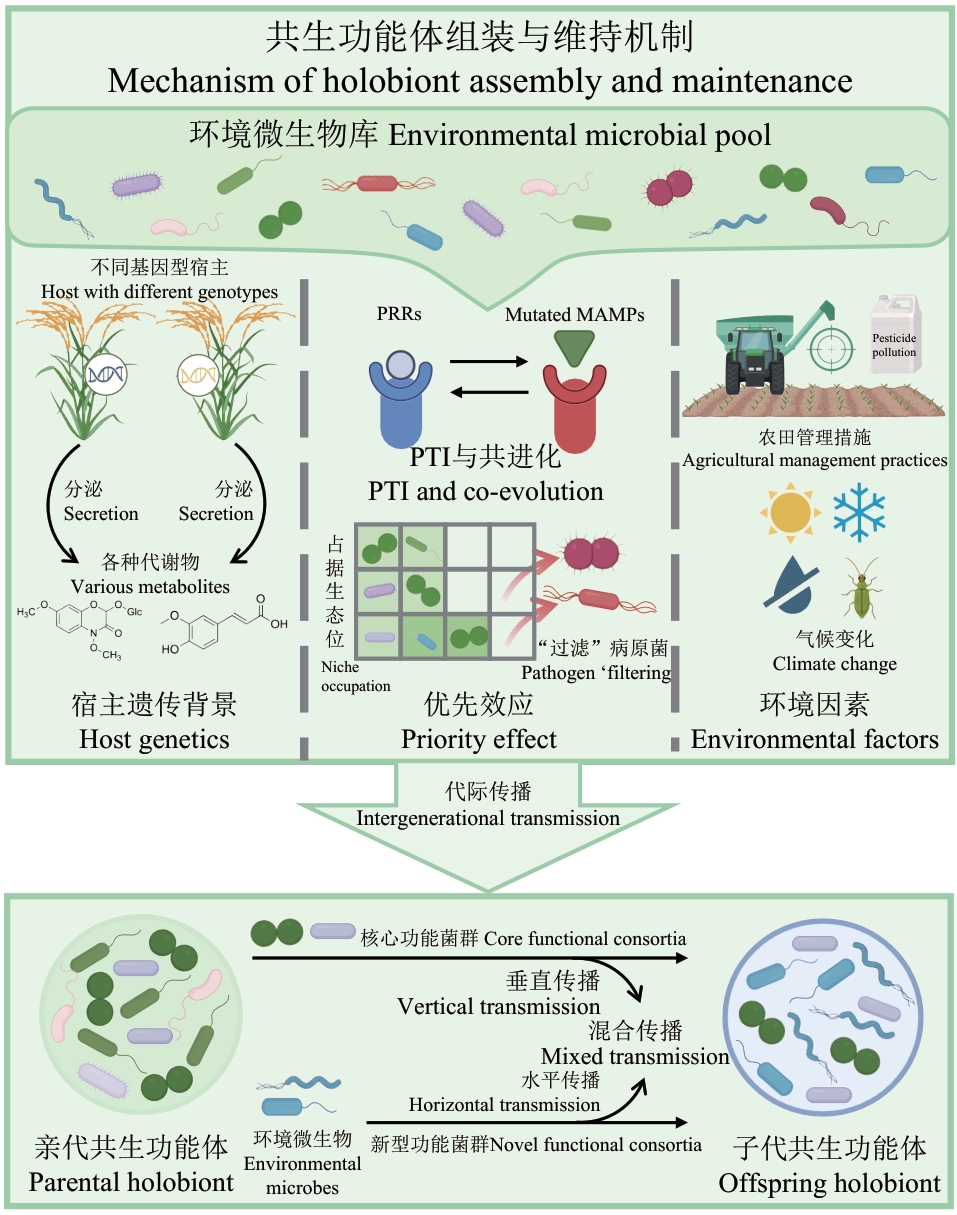
图1 共生功能体的组装与稳态维持机制共生功能体组装受多重生态过滤机制协同驱动,包括:宿主遗传背景(分泌特异代谢物定向招募)、微生态位的优先效应、分子层面的免疫博弈(宿主PRRs与微生物变异MAMPs的动态识别与进化)以及环境因素。共生功能体代际稳态:亲代共生功能体通过垂直传播(维持核心菌群功能)、水平传播(获取新型功能菌群)或混合传播将微生物组传递给子代共生功能体
Fig. 1 Assembly and homeostatic maintenance mechanisms of holobiontsThe assembly of the holobiont is driven by multiple ecological filtering mechanisms, including host genetic background (targeted recruitment via the secretion of specific metabolites), priority effects in micro-niches, molecular-level immune interplay (dynamic recognition and co-evolution between host PRRs and mutated MAMPs), and environmental factors. For intergenerational homeostasis, parental holobionts transfer their microbiomes to offspring holobionts via vertical transmission (maintaining the functions of core microbial consortia), horizontal transmission (acquiring novel functional microbial consortia), or mixed transmission strategies
| [1] | Berg G, Rybakova D, Fischer D, et al. Microbiome definition re-visited: old concepts and new challenges [J]. Microbiome, 2020, 8: 103. |
| [2] | Foster KR, Schluter J, Coyte KZ, et al. The evolution of the host microbiome as an ecosystem on a leash [J]. Nature, 2017, 548(7665): 43-51. |
| [3] | 高云云, 杨海飞, 吕虎杰, 等. 微生物组分析方法与功能挖掘 [J]. 生物技术通报, 2024, 40(10): 98-107. |
| Gao YY, Yang HF, Lyu HJ, et al. Analytical approaches and functional insights for microbiome studies [J]. Biotechnol Bull, 2024, 40(10): 98-107. | |
| [4] | Ferretti P, Martignoni MM, McManus LC, et al. Theory of host-microbe symbioses: Challenges and opportunities [J]. Cell Host Microbe, 2025, 33(7): 1052-1056. |
| [5] | 梁宗琦, 韩燕峰, 梁建东, 等. 从细胞内共生到多尺度共生: 回顾与展望 [J]. 菌物学报, 2020, 39(12): 2202-2217. |
| Liang ZQ, Han YF, Liang JD, et al. From intracellular symbiosis to multiscale symbiosis: review and prospect [J]. Mycosystema, 2020, 39(12): 2202-2217. | |
| [6] | McFall-Ngai M, Hadfield MG, Bosch TCG, et al. Animals in a bacterial world, a new imperative for the life sciences [J]. Proc Natl Acad Sci U S A, 2013, 110(9): 3229-3236. |
| [7] | Simon JC, Marchesi JR, Mougel C, et al. Host-microbiota interactions: from holobiont theory to analysis [J]. Microbiome, 2019, 7: 5. |
| [8] | Rosenberg E, Zilber-Rosenberg I. The hologenome concept of evolution after 10 years [J]. Microbiome, 2018, 6: 78. |
| [9] | Postler TS, Ghosh S. Understanding the holobiont: how microbial metabolites affect human health and shape the immune system [J]. Cell Metab, 2017, 26(1): 110-130. |
| [10] | Sgritta M, Dooling SW, Buffington SA, et al. Mechanisms underlying microbial-mediated changes in social behavior in mouse models of autism spectrum disorder [J]. Neuron, 2019, 101(2): 246-259.e6. |
| [11] | Trivedi P, Batista BD, Bazany KE, et al. Plant-microbiome interactions under a changing world: responses, consequences and perspectives [J]. New Phytol, 2022, 234(6): 1951-1959. |
| [12] | Vandenkoornhuyse P, Quaiser A, Duhamel M, et al. The importance of the microbiome of the plant holobiont [J]. New Phytol, 2015, 206(4): 1196-1206. |
| [13] | Relman DA. ‘Til death do us part’: coming to terms with symbiotic relationships [J]. Nat Rev Microbiol, 2008, 6(10): 721-724. |
| [14] | Egerton FN. History of ecological sciences, part 52: symbiosis studies [J]. Bulletin Ecologic Soc America, 2015, 96(1): 80-139. |
| [15] | Bosch TCG, McFall-Ngai MJ. Metaorganisms as the new frontier [J]. Zoology, 2011, 114(4): 185-190. |
| [16] | Selosse MA, Bessis A, Pozo MJ. Microbial priming of plant and animal immunity: symbionts as developmental signals [J]. Trends Microbiol, 2014, 22(11): 607-613. |
| [17] | Margulis E, Fester R. Symbiosis as a source of evolutionary innovation [M]. Cambridge, Mass: MIT Press, 1991. |
| [18] | Stanley GD Jr. Photosymbiosis and the evolution of modern coral reefs [J]. Science, 2006, 312(5775): 857-858. |
| [19] | Voolstra CR, Raina JB, Dörr M, et al. The coral microbiome in sickness, in health and in a changing world [J]. Nat Rev Microbiol, 2024, 22(8): 460-475. |
| [20] | Archie EA, Theis KR. Animal behaviour meets microbial ecology [J]. Anim Behav, 2011, 82(3): 425-436. |
| [21] | Ezenwa VO, Gerardo NM, Inouye DW, et al. Animal behavior and the microbiome [J]. Science, 2012, 338(6104): 198-199. |
| [22] | Cryan JF, Dinan TG. Mind-altering microorganisms: the impact of the gut microbiota on brain and behaviour [J]. Nat Rev Neurosci, 2012, 13(10): 701-712. |
| [23] | McFall-Ngai MJ. Unseen forces: the influence of bacteria on animal development [J]. Dev Biol, 2002, 242(1): 1-14. |
| [24] | Hooper LV, Littman DR, MacPherson AJ. Interactions between the microbiota and the immune system [J]. Science, 2012, 336(6086): 1268-1273. |
| [25] | Collins SM, Surette M, Bercik P. The interplay between the intestinal microbiota and the brain [J]. Nat Rev Microbiol, 2012, 10(11): 735-742. |
| [26] | Tremaroli V, Bäckhed F. Functional interactions between the gut microbiota and host metabolism [J]. Nature, 2012, 489(7415): 242-249. |
| [27] | Bordenstein SR, Theis KR. Host biology in light of the microbiome: ten principles of holobionts and hologenomes [J]. PLoS Biol, 2015, 13(8): e1002226. |
| [28] | Rosenberg E, Zilber-Rosenberg I. Microbes drive evolution of animals and plants: the hologenome concept [J]. mBio, 2016, 7(2): e01395-e01315. |
| [29] | Gilbert SF, Sapp J, Tauber AI. A symbiotic view of life: we have never been individuals [J]. Q Rev Biol, 2012, 87(4): 325-341. |
| [30] | Brucker RM, Bordenstein SR. The capacious hologenome [J]. Zoology, 2013, 116(5): 260-261. |
| [31] | Rinke C, Schwientek P, Sczyrba A, et al. Insights into the phylogeny and coding potential of microbial dark matter [J]. Nature, 2013, 499(7459): 431-437. |
| [32] | Metzker ML. Sequencing technologies—the next generation [J]. Nat Rev Genet, 2010, 11(1): 31-46. |
| [33] | Handelsman J. Metagenomics: application of genomics to uncultured microorganisms [J]. Microbiol Mol Biol Rev, 2004, 68(4): 669-685. |
| [34] | Nayfach S, Roux S, Seshadri R, et al. A genomic catalog of Earth’s microbiomes [J]. Nat Biotechnol, 2021, 39(4): 499-509. |
| [35] | Meng A, Marchet C, Corre E, et al. A de novo approach to disentangle partner identity and function in holobiont systems [J]. Microbiome, 2018, 6: 105. |
| [36] | Young E, Carey M, Meharg AA, et al. Microbiome and ecotypic adaption of Holcus lanatus (L.) to extremes of its soil pH range, investigated through transcriptome sequencing [J]. Microbiome, 2018, 6: 48. |
| [37] | Nelson EB. The seed microbiome: Origins, interactions, and impacts [J]. Plant Soil, 2018, 422(1/2): 7-34. |
| [38] | Dominguez-Bello MG, Costello EK, Contreras M, et al. Delivery mode shapes the acquisition and structure of the initial microbiota across multiple body habitats in newborns [J]. Proc Natl Acad Sci U S A, 2010, 107(26): 11971-11975. |
| [39] | Bulgarelli D, Rott M, Schlaeppi K, et al. Revealing structure and assembly cues for Arabidopsis root-inhabiting bacterial microbiota [J]. Nature, 2012, 488(7409): 91-95. |
| [40] | Trivedi P, Leach JE, Tringe SG, et al. Plant-microbiome interactions: from community assembly to plant health [J]. Nat Rev Microbiol, 2020, 18(11): 607-621. |
| [41] | Stringlis IA, Yu K, Feussner K, et al. MYB72-dependent coumarin exudation shapes root microbiome assembly to promote plant health [J]. Proc Natl Acad Sci U S A, 2018, 115(22): E5213-E5222. |
| [42] | Su P, Kang HX, Peng QZ, et al. Host metabolites explain microbiome variation between different rice genotypes [J]. Microbiome, 2025, 13: 185. |
| [43] | Su P, Kang HX, Peng QZ, et al. Microbiome homeostasis on rice leaves is regulated by a precursor molecule of lignin biosynthesis [J]. Nat Commun, 2024, 15: 23. |
| [44] | Zhan CF, Wang MC. Disease resistance through M genes [J]. Nat Plants, 2024, 10(3): 352-353. |
| [45] | Arpaia N, Rudensky AY. Microbial metabolites control gut inflammatory responses [J]. Proc Natl Acad Sci U S A, 2014, 111(6): 2058-2059. |
| [46] | Lamkanfi M, Dixit VM. Mechanisms and functions of inflammasomes [J]. Cell, 2014, 157(5): 1013-1022. |
| [47] | Franzenburg S, Fraune S, Künzel S, et al. MyD88-deficient Hydra reveal an ancient function of TLR signaling in sensing bacterial colonizers [J]. Proc Natl Acad Sci U S A, 2012, 109(47): 19374-19379. |
| [48] | Hacquard S, Spaepen S, Garrido-Oter R, et al. Interplay between innate immunity and the plant microbiota [J]. Annu Rev Phytopathol, 2017, 55: 565-589. |
| [49] | Colaianni NR, Parys K, Lee HS, et al. A complex immune response to flagellin epitope variation in commensal communities [J]. Cell Host Microbe, 2021, 29(4): 635-649.e9. |
| [50] | Carlström CI, Field CM, Bortfeld-Miller M, et al. Synthetic microbiota reveal priority effects and keystone strains in the Arabidopsis phyllosphere [J]. Nat Ecol Evol, 2019, 3(10): 1445-1454. |
| [51] | Callens M, Watanabe H, Kato Y, et al. Microbiota inoculum composition affects holobiont assembly and host growth in Daphnia [J]. Microbiome, 2018, 6: 56. |
| [52] | Pan QQ, Lv TX, Xu HR, et al. Gut pathobiome mediates behavioral and developmental disorders in biotoxin-exposed amphibians [J]. Environ Sci Ecotechnol, 2024, 21: 100415. |
| [53] | Guo DS, Liu ZL, Raaijmakers JM, et al. Linalool-triggered plant-soil feedback drives defense adaptation in dense maize plantings [J]. Science, 2025, 389(6761): eadv6675. |
| [54] | Baumann P. Genetics, physiology, and evolutionary relationships of the genus Buchnera: intracellular symbionts of aphids [J]. Annu Rev Microbiol, 1995, 49: 55-94. |
| [55] | Veneti Z, Clark ME, Karr TL, et al. Heads or tails: host-parasite interactions in the Drosophila-Wolbachia system [J]. Appl Environ Microbiol, 2004, 70(9): 5366-5372. |
| [56] | Sakwinska O, Moine D, Delley M, et al. Microbiota in breast milk of Chinese lactating mothers [J]. PLoS One, 2016, 11(8): e0160856. |
| [57] | Shen Y, Fan NR, Ma SX, et al. Gut microbiota dysbiosis: pathogenesis, diseases, prevention, and therapy [J]. MedComm, 2025, 6(5): e70168. |
| [58] | Vannier N, Agler M, Hacquard S. Microbiota-mediated disease resistance in plants [J]. PLoS Pathog, 2019, 15(6): e1007740. |
| [59] | Abdelfattah A, Tack AJM, Lobato C, et al. From seed to seed: the role of microbial inheritance in the assembly of the plant microbiome [J]. Trends Microbiol, 2023, 31(4): 346-355. |
| [60] | Matsumoto H, Fan XY, Wang Y, et al. Bacterial seed endophyte shapes disease resistance in rice [J]. Nat Plants, 2021, 7(1): 60-72. |
| [61] | Vannier N, Mony C, Bittebiere AK, et al. A microorganisms' journey between plant generations [J]. Microbiome, 2018, 6: 79. |
| [62] | Voolstra CR, Ziegler M. Adapting with microbial help: microbiome flexibility facilitates rapid responses to environmental change [J]. BioEssays, 2020, 42(7): 2000004. |
| [63] | Berendsen RL, Vismans G, Yu K, et al. Disease-induced assemblage of a plant-beneficial bacterial consortium [J]. ISME J, 2018, 12(6): 1496-1507. |
| [64] | Zimmer M, Topp W. The role of coprophagy in nutrient release from feces of phytophagous insects [J]. Soil Biol Biochem, 2002, 34(8): 1093-1099. |
| [65] | Nicholson JK, Holmes E, Kinross J, et al. Host-gut microbiota metabolic interactions [J]. Science, 2012, 336(6086): 1262-1267. |
| [66] | Jiang YN, Wang WX, Xie QJ, et al. Plants transfer lipids to sustain colonization by mutualistic mycorrhizal and parasitic fungi [J]. Science, 2017, 356(6343): 1172-1175. |
| [67] | Luginbuehl LH, Menard GN, Kurup S, et al. Fatty acids in arbuscular mycorrhizal fungi are synthesized by the host plant [J]. Science, 2017, 356(6343): 1175-1178. |
| [68] | Johansson MEV, Phillipson M, Petersson J, et al. The inner of the two Muc2 mucin-dependent mucus layers in colon is devoid of bacteria [J]. Proc Natl Acad Sci U S A, 2008, 105(39): 15064-15069. |
| [69] | Pacheco AR, Curtis MM, Ritchie JM, et al. Fucose sensing regulates bacterial intestinal colonization [J]. Nature, 2012, 492(7427): 113-117. |
| [70] | Pickard JM, Maurice CF, Kinnebrew MA, et al. Rapid fucosylation of intestinal epithelium sustains host-commensal symbiosis in sickness [J]. Nature, 2014, 514(7524): 638-641. |
| [71] | Koh A, De Vadder F, Kovatcheva-Datchary P, et al. From dietary fiber to host physiology: short-chain fatty acids as key bacterial metabolites [J]. Cell, 2016, 165(6): 1332-1345. |
| [72] | Teixeira PJPL, Colaianni NR, Law TF, et al. Specific modulation of the root immune system by a community of commensal bacteria [J]. Proc Natl Acad Sci U S A, 2021, 118(16): e2100678118. |
| [73] | Wang DC, Chen XQ, Sui KW, et al. UBE2O-mediated monoubiquitination licenses NLRP6 inflammasome activation in the intestine [J]. Cell Host Microbe, 2026, 34(1): 86-102.e8. |
| [74] | Wang DP, Jin R, Shi XB, et al. A kinase mediator of rhizobial symbiosis and immunity in Medicago [J]. Nature, 2025, 643(8072): 768-775. |
| [75] | Plett JM, Kemppainen M, Kale SD, et al. A secreted effector protein of Laccaria bicolor is required for symbiosis development [J]. Curr Biol, 2011, 21(14): 1197-1203. |
| [76] | Fierer N, Wood SA, Bueno de Mesquita CP. How microbes can, and cannot, be used to assess soil health [J]. Soil Biol Biochem, 2021, 153: 108111. |
| [77] | Zhou DB, Jing T, Chen YF, et al. Deciphering microbial diversity associated with Fusarium wilt-diseased and disease-free banana rhizosphere soil [J]. BMC Microbiol, 2019, 19: 161. |
| [78] | Gu YA, Banerjee S, Dini-Andreote F, et al. Small changes in rhizosphere microbiome composition predict disease outcomes earlier than pathogen density variations [J]. ISME J, 2022, 16(10): 2448-2456. |
| [79] | Ginnan NA, Dang T, Bodaghi S, et al. Disease-induced microbial shifts in Citrus indicate microbiome-derived responses to huanglongbing across the disease severity spectrum [J]. Phytobiomes J, 2020, 4(4): 375-387. |
| [80] | Kim H, Lee YH. The rice microbiome: a model platform for crop holobiome [J]. Phytobiomes J, 2020, 4(1): 5-18. |
| [81] | Zhan CF, Matsumoto H, Liu YF, et al. Pathways to engineering the phyllosphere microbiome for sustainable crop production [J]. Nat Food, 2022, 3(12): 997-1004. |
| [82] | Ziegler M, Seneca FO, Yum LK, et al. Bacterial community dynamics are linked to patterns of coral heat tolerance [J]. Nat Commun, 2017, 8: 14213. |
| [83] | Bourne DG, Morrow KM, Webster NS. Insights into the coral microbiome: underpinning the health and resilience of reef ecosystems [J]. Annu Rev Microbiol, 2016, 70: 317-340. |
| [84] | Mohamed HI, Ullah I, Toor MD, et al. Heavy metals toxicity in plants: understanding mechanisms and developing coping strategies for remediation: a review [J]. Bioresour Bioprocess, 2025, 12: 95. |
| [85] | Mishra J, Singh R, Arora NK. Alleviation of heavy metal stress in plants and remediation of soil by rhizosphere microorganisms [J]. Front Microbiol, 2017, 8: 1706. |
| [86] | Lü HX, Tang GX, Huang YH, et al. Response and adaptation of rhizosphere microbiome to organic pollutants with enriching pollutant-degraders and genes for bioremediation: a critical review [J]. Sci Total Environ, 2024, 912: 169425. |
| [87] | Su J, Hu C, Yan X, et al. Expression of barley SUSIBA2 transcription factor yields high-starch low-methane rice [J]. Nature, 2015, 523(7562): 602-606. |
| [88] | Kwon Y, Jin YK, Lee JH, et al. Rice rhizobiome engineering for climate change mitigation [J]. Trends Plant Sci, 2024, 29(12): 1299-1309. |
| [89] | Fierer N, Walsh CM. Can we manipulate the soil microbiome to promote carbon sequestration in croplands? [J]. PLoS Biol, 2023, 21(7): e3002207. |
| [90] | Panchal P, Preece C, Peñuelas J, et al. Soil carbon sequestration by root exudates [J]. Trends Plant Sci, 2022, 27(8): 749-757. |
| [91] | Cammarota G, Ianiro G, Tilg H, et al. European consensus conference on faecal microbiota transplantation in clinical practice [J]. Gut, 2017, 66(4): 569-580. |
| [92] | König J, Siebenhaar A, Högenauer C, et al. Consensus report: faecal microbiota transfer-clinical applications and procedures [J]. Aliment Pharmacol Ther, 2017, 45(2): 222-239. |
| [93] | Sorbara MT, Pamer EG. Microbiome-based therapeutics [J]. Nat Rev Microbiol, 2022, 20(6): 365-380. |
| [1] | 郭道祥, 苏全, 李奥婷, 王燕, 陈清, 王小蓉, 何文. 柚MYB基因家族的鉴定及其在砧穗不亲和叶片黄化中的功能分析[J]. 生物技术通报, 2026, 42(4): 170-181. |
| [2] | 区琦, 冯瑶, 韦柳婷, 庄站伟, 赵云翔, 陈富美. 全基因组关联分析(GWAS)在母猪繁殖性状研究中的应用进展[J]. 生物技术通报, 2026, 42(4): 65-71. |
| [3] | 刘林娅, 刘欢艳, 梁鑫钰, 宋姝熠, 何斌, 王绪英, 黄亚成. ‘红阳’猕猴桃BGAL基因家族的全基因组鉴定与表达分析[J]. 生物技术通报, 2026, 42(3): 312-323. |
| [4] | 庄娜, 贺红利, 张兴政. 蒺藜苜蓿SMXL基因家族全基因组鉴定及表达分析[J]. 生物技术通报, 2026, 42(2): 250-266. |
| [5] | 刘长命, 张新悦, 杨昕萌, 刘阳, 李玥涵, 汪可清. 一株新的魔芋软腐病致病菌的生物学特性及基因组分析[J]. 生物技术通报, 2026, 42(1): 294-304. |
| [6] | 吕镇, 甘恬, 霍思羽, 赵晨笛, 赵梦瑶, 李亚涛, 马玉超, 耿玉清. 产Surfactin贝莱斯芽胞杆菌C5A-1的鉴定和所产Surfactin对植物的促生效果[J]. 生物技术通报, 2025, 41(9): 265-276. |
| [7] | 程婷婷, 刘俊, 王利丽, 练从龙, 魏文君, 郭辉, 吴尧琳, 杨晶凡, 兰金旭, 陈随清. 杜仲查尔酮异构酶基因家族全基因组鉴定及其表达模式分析[J]. 生物技术通报, 2025, 41(9): 242-255. |
| [8] | 李亚涛, 张志鹏, 赵梦瑶, 吕镇, 甘恬, 魏浩, 吴书凤, 马玉超. 根瘤菌Bd1的全基因组分析及TetR3对细胞生长和结瘤的负调控功能[J]. 生物技术通报, 2025, 41(9): 289-301. |
| [9] | 李凯月, 邓晓霞, 殷缘, 杜亚彤, 徐元静, 王竞红, 于耸, 蔺吉祥. 蓖麻LEA基因家族的鉴定和铝胁迫响应分析[J]. 生物技术通报, 2025, 41(7): 128-138. |
| [10] | 龚钰涵, 陈兰, 尚方慧子, 郝灵颖, 刘硕谦. 茶树TRB基因家族鉴定及表达模式分析[J]. 生物技术通报, 2025, 41(7): 214-225. |
| [11] | 张慧, 卢文才, 王冬, 刘倩, 马连杰. 一株高产吲哚乙酸的Bacillus cereus YT2-1C的鉴定及促生作用[J]. 生物技术通报, 2025, 41(5): 300-309. |
| [12] | 吴泽银, 黄晨阳, 赵梦然, 张利姣, 姚方杰. 短柄白黄侧耳CCMSSC 04611基因组特异性分析[J]. 生物技术通报, 2025, 41(5): 320-332. |
| [13] | 孙天国, 衣兰, 秦旭洋, 乔梦雪, 谷新颖, 韩艺, 沙伟, 张梅娟, 马天意. 大白菜DABB基因家族的全基因组鉴定及盐碱胁迫下的表达分析[J]. 生物技术通报, 2025, 41(4): 156-165. |
| [14] | 宋姝熠, 蒋开秀, 刘欢艳, 黄亚成, 刘林娅. ‘红阳’猕猴桃TCP基因家族鉴定及其在果实中的表达分析[J]. 生物技术通报, 2025, 41(3): 190-201. |
| [15] | 车建美, 郑雪芳, 王阶平, 陈燕萍, 陈冰星, 刘波. 一株产纤维素酶菌株的筛选、鉴定及全基因组分析[J]. 生物技术通报, 2025, 41(3): 294-307. |
| 阅读次数 | ||||||
|
全文 |
|
|||||
|
摘要 |
|
|||||
