







• 研究报告 • 下一篇
于本帅1,2, 郑荣繁1,3, 谭桐菲1,3, 王玉斌1( )
)
收稿日期:2026-04-08
出版日期:2026-08-28
通讯作者:
王玉斌wangyb_221@163.com基金资助:
YU Ben-shuai1,2, ZHENG Rong-fan1,3, TAN Tong-fei1,3, WANG Yu-bin1()
Received:2026-04-08
Published:2026-08-28
摘要:
目的 GOLDEN2-LIKE(GLK)转录因子属于GARP转录因子家族,在植物生长发育以及非生物和生物胁迫响应过程中发挥重要作用。鉴定玉米中响应氮素的GLK基因,并分析ZmGLK4的功能,为阐明GLK转录因子调控作物生长发育和氮素吸收的分子机制提供理论依据。 方法 基于玉米转录组数据,筛选响应氮素的差异表达ZmGLK基因,并分析其保守结构域、保守基序和启动子顺式作用元件。克隆氮素响应最显著的ZmGLK4,进行表达模式分析、亚细胞定位和转录活性检测,并通过转化拟南芥进行过表达功能验证。 结果 共获得9个响应氮素的ZmGLK基因,均含有典型的MYB-DNA结合结构域,其启动子区域均包含多个植物逆境响应元件。ZmGLK4编码区长度为1 380 bp,编码460个氨基酸,与拟南芥AtNIGT1.2同源性最高。该蛋白定位于细胞核,并具有转录激活活性。实时荧光定量PCR结果表明,ZmGLK4在根、花丝、叶片和茎组织中表达量较高,低氮处理显著抑制其在根和叶片中的表达。过表达ZmGLK4抑制拟南芥的生长,导致株高降低、产量下降,同时抑制根的生长和氮素的吸收。此外,过表达ZmGLK4显著抑制了低氮和正常氮条件下拟南芥AtNRT1.1、AtNRT1.5、AtNRT2.1和AtNRT2.4基因的表达。 结论 ZmGLK4对玉米植株生长发育和氮素吸收具有负调控作用。
于本帅, 郑荣繁, 谭桐菲, 王玉斌. 玉米氮胁迫响应GLK基因的鉴定及ZmGLK4的功能验证[J]. 生物技术通报, doi: 10.13560/j.cnki.biotech.bull.1985.2026-0400.
YU Ben-shuai, ZHENG Rong-fan, TAN Tong-fei, WANG Yu-bin. Identification of Nitrogen Stress-responsive GLK Genes in Maize and Functional Characterization of ZmGLK4[J]. Biotechnology Bulletin, doi: 10.13560/j.cnki.biotech.bull.1985.2026-0400.
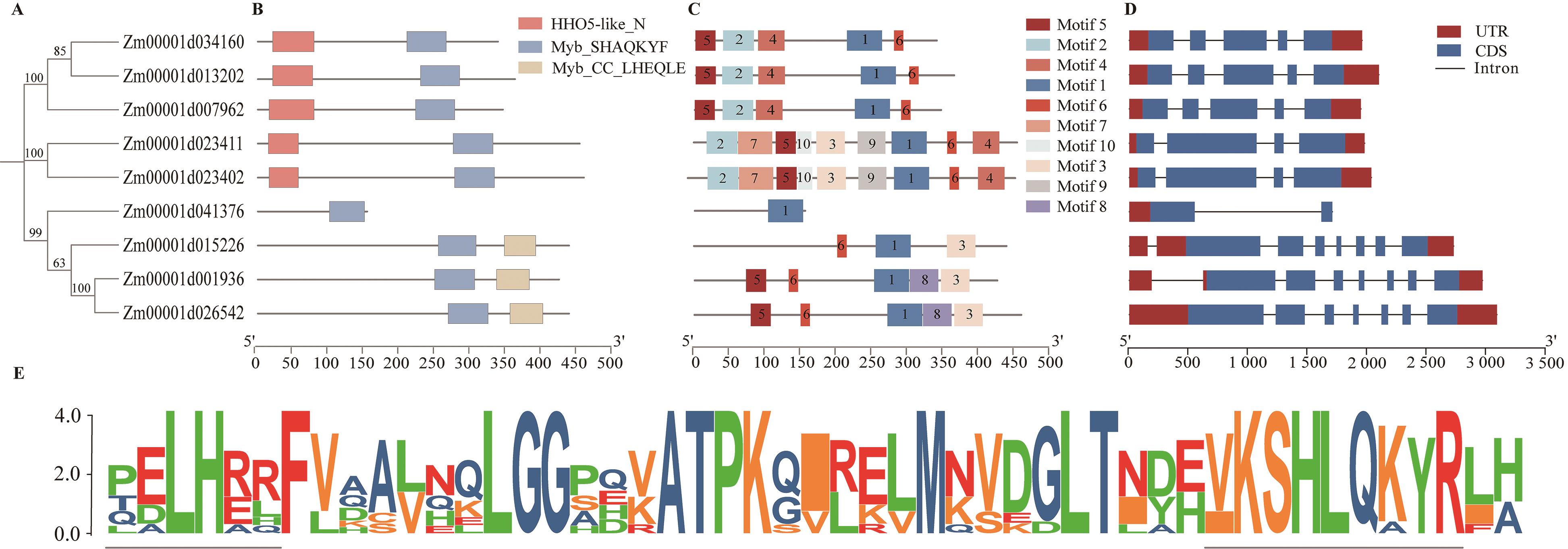
图1 ZmGLK保守序列和基因结构分析A:蛋白质系统发育树;B:保守结构域;C:保守基序;D:基因结构;E:保守结构域序列
Fig. 1 Conserved motifs and gene structure analysis of the ZmGLKA: Protein phylogeny; B: conserved motif; C: conserved domain; D: gene structure; E: conserved domain sequence
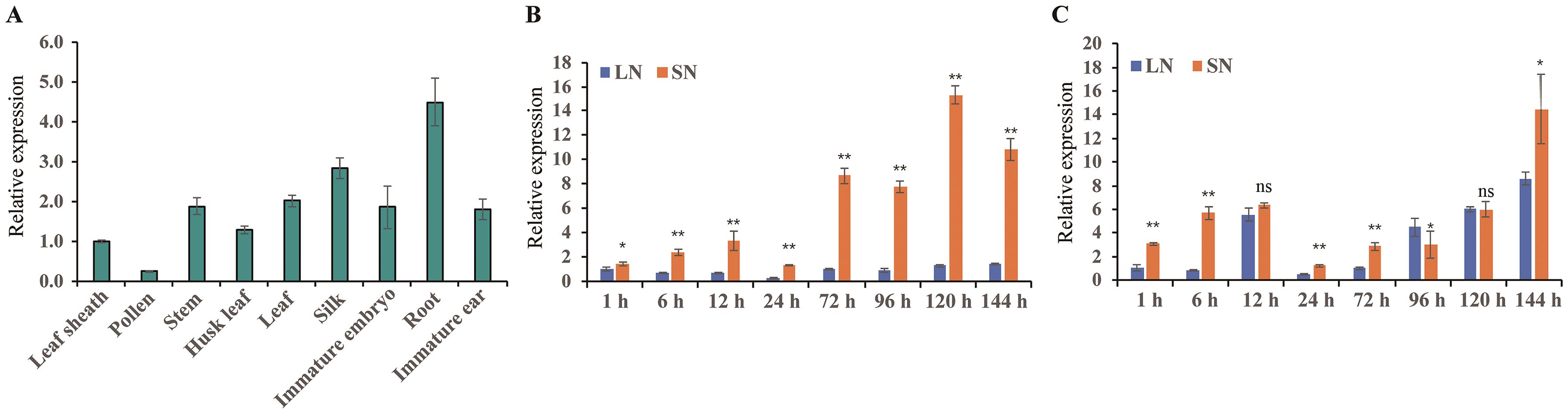
图2 ZmGLK4基因的表达模式分析A: ZmGLK4在不同组织中的表达;B: ZmGLK4在不同低氮胁迫处理时间下根中的表达;C: ZmGLK4在不同低氮胁迫处理时间下叶片中的表达
Fig. 2 Analysis of the expression pattern of ZmGLK4A: Expression of ZmGLK4 in different tissues; B: expression of ZmGLK4 in roots under different low-nitrogen stress durations; C: expression of ZmGLK4 in leaves under different low-nitrogen stress durations

图3 ZmGLK4转录活性分析
Fig. 3 Transcriptional activity analysis of ZmGLK4
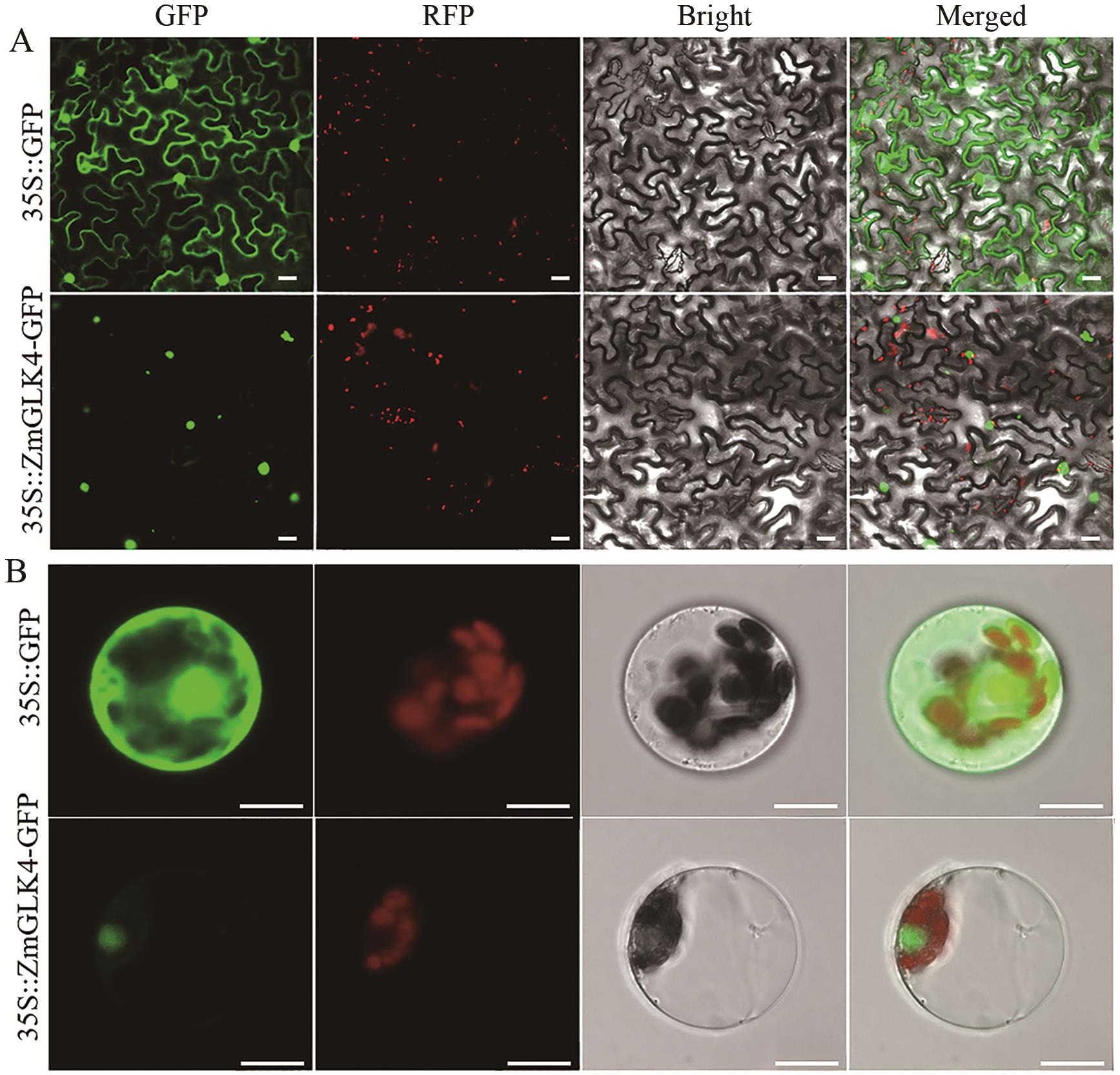
图4 烟草叶片和玉米原生质体中ZmGLK4亚细胞定位A:GFP 空载体和ZmGLK4 -GFP 融合蛋白在烟草叶片中的瞬时表达,Bar=20 µm;B:GFP 空载体和ZmGLK4-GFP 融合蛋白在玉米原生质体中的瞬时表达,Bar=10 µm。从左到右分别为 GFP 绿色荧光蛋白、RFP荧光蛋白、明场和叠加图
Fig. 4 Subcellular localization of ZmGLK4 in tobacco leaves and maize protoplastsA: Transient expression of the empty GFP vector and ZmGLK4-GFP fusion protein in tobacco leaves, bar=20 µm. B: Transient expression of the empty GFP vector and ZmGLK4-GFP fusion protein in maize protoplasts, bar=10 µm. From left leaf to right, GFP fluorescent protein, RFP fluorescent protein, bright field, and merged image
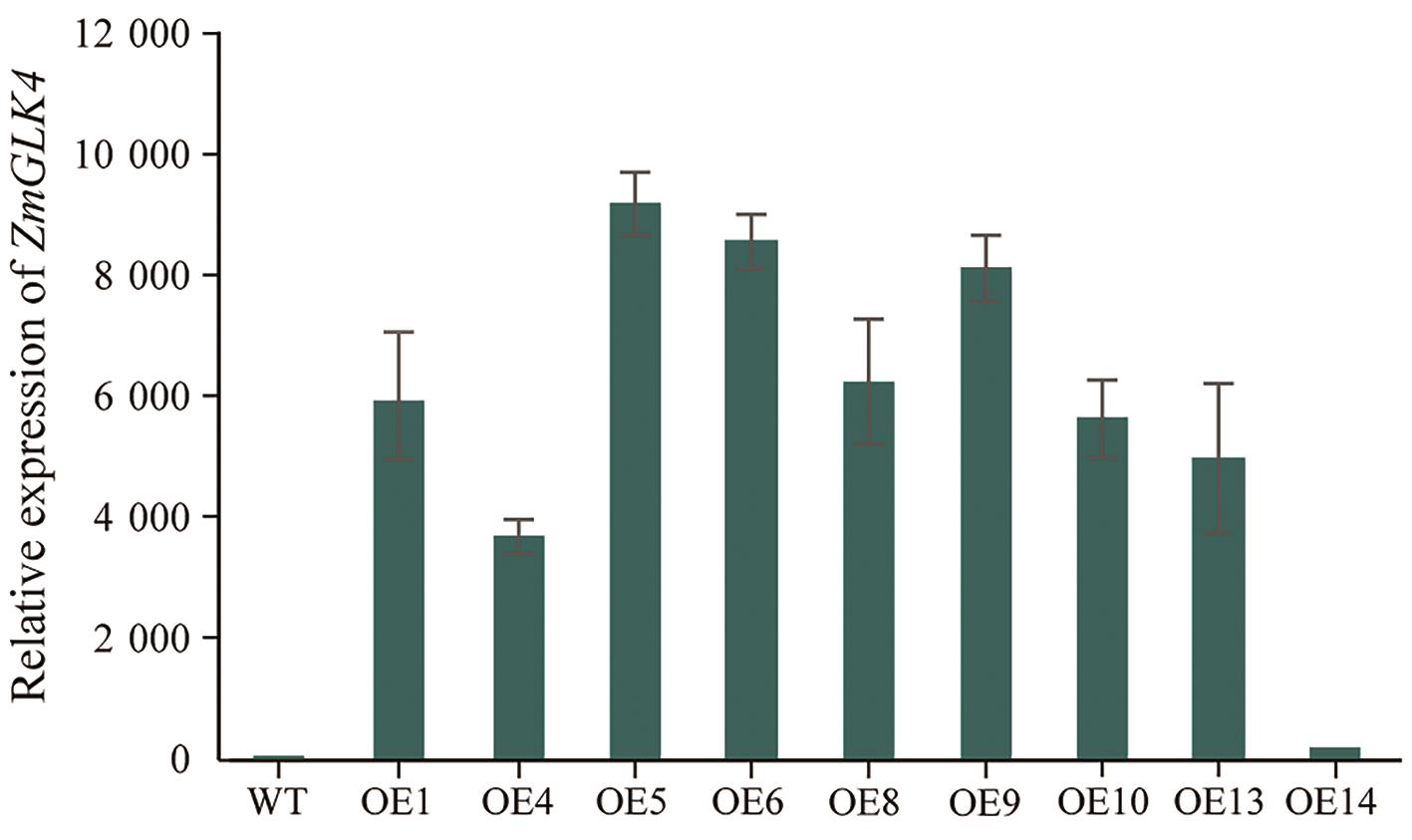
图5 ZmGLK4过表达株系的定量PCR检测WT表示野生型拟南芥,OE1-OE14分别表示独立的ZmGLK4过表达转基因拟南芥株系
Fig. 5 RT-qPCR detection of ZmGLK4-overexpressing linesWT represents wild-type Arabidopsis plants, and OE1-OE14 represents independent transgenic Arabidopsis lines overexpressing ZmGLK4
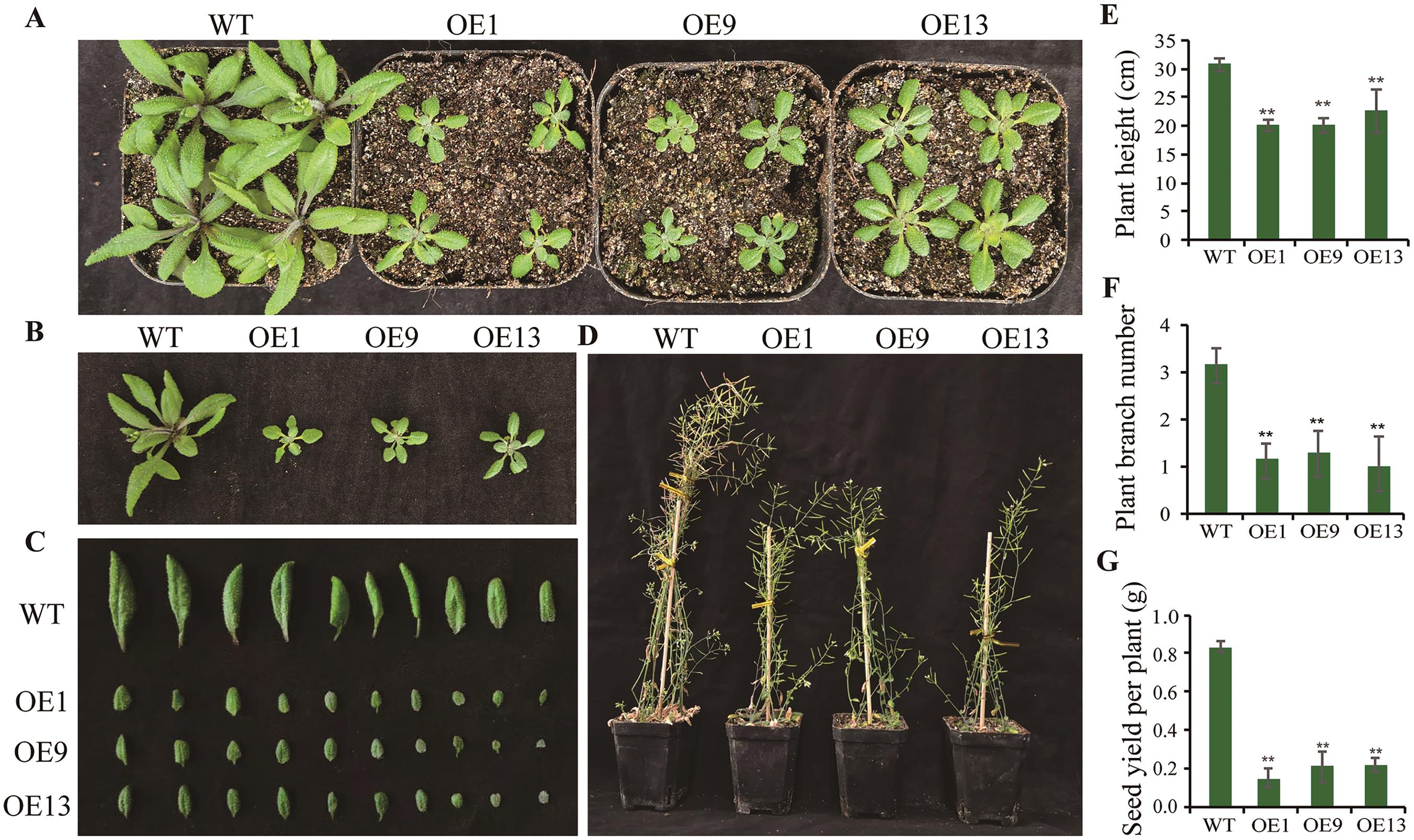
图6 ZmGLK4过表达株系的表型鉴定A-C:ZmGLK4转基因拟南芥和野生型拟南芥在正常条件下生长30 d 的表型;D:ZmGLK4转基因拟南芥和野生型拟南芥成熟期表型;E-G:ZmGLK4转基因拟南芥和野生型拟南芥成熟期株高、分枝数量和产量
Fig. 6 Phenotypic identification of ZmGLK4 transgenic ArabidopsisA-C: Phenotypes of ZmGLK4 transgenic Arabidopsis and wild-type Arabidopsis at 30 days after growth under normal conditions; D: phenotypes of ZmGLK4 transgenic Arabidopsis and wild-type Arabidopsis at maturity stage; E-G: plant height, branch number, and yield of ZmGLK4 transgenic Arabidopsis and wild-type Arabidopsis at maturity stage
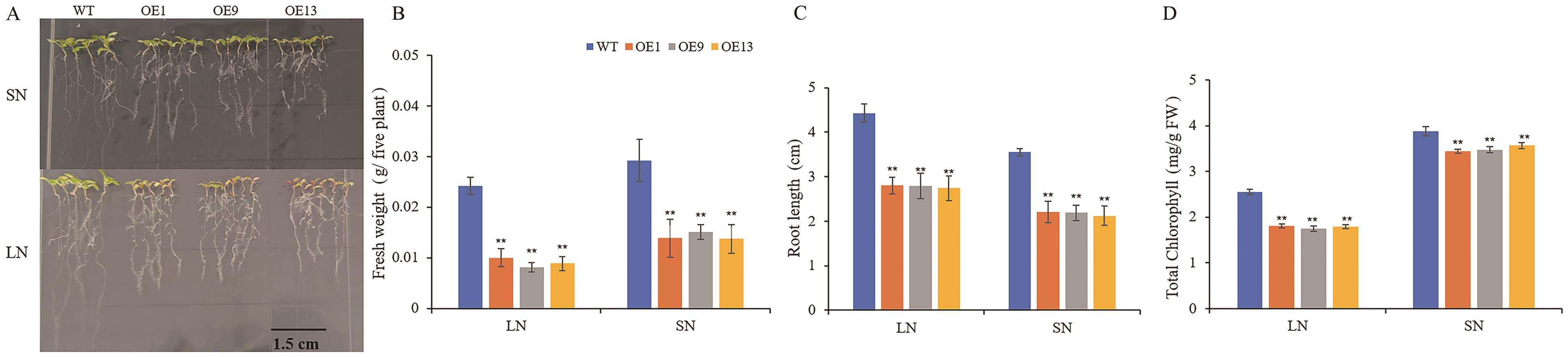
图7 低氮胁迫下ZmGLK4转基因拟南芥的生长发育情况与根长、叶绿素含量统计A:正常氮培养基生长6 d后,分别转移至低氮和正常氮培养基上4 d后ZmGLK4转基因拟南芥和野生型拟南芥的表型; B:鲜重;C:根长;D:叶绿素含量
Fig. 7 Growth and development of ZmGLK4 transgenic Arabidopsis under low nitrogen stress, along with statistics of root length and chlorophyll contentA: Phenotypes of ZmGLK4 transgenic Arabidopsis and wild-type Arabidopsis after 6 days of growth on normal nitrogen medium followed by 4 days of transfer to low nitrogen and normal nitrogen media, respectively; B: fresh weight; C: root length; D: Chlorophyll content
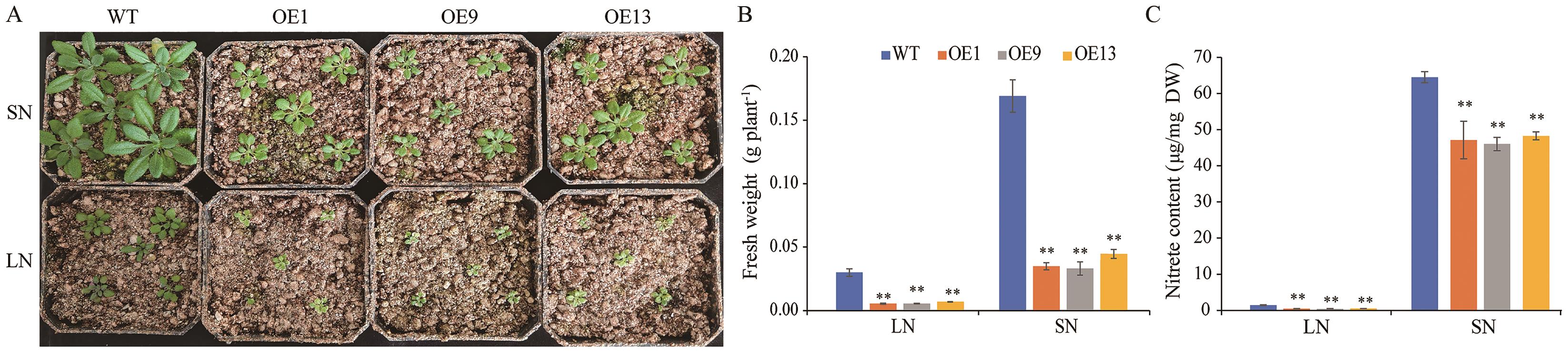
图8 低氮胁迫下ZmGLK4转基因拟南芥的表型鉴定A:低氮和正常氮处理30 d后ZmGLK4转基因拟南芥和野生型拟南芥的表型; B:鲜重;C:硝酸盐含量
Fig. 8 Phenotypic identification of ZmGLK4 transgenic Arabidopsis under low nitrogen stressA: Phenotypes of ZmGLK4 transgenic Arabidopsis and wild-type Arabidopsis after 30 d of low nitrogen and normal nitrogen treatment. B: Fresh weight. C: Nitrate content
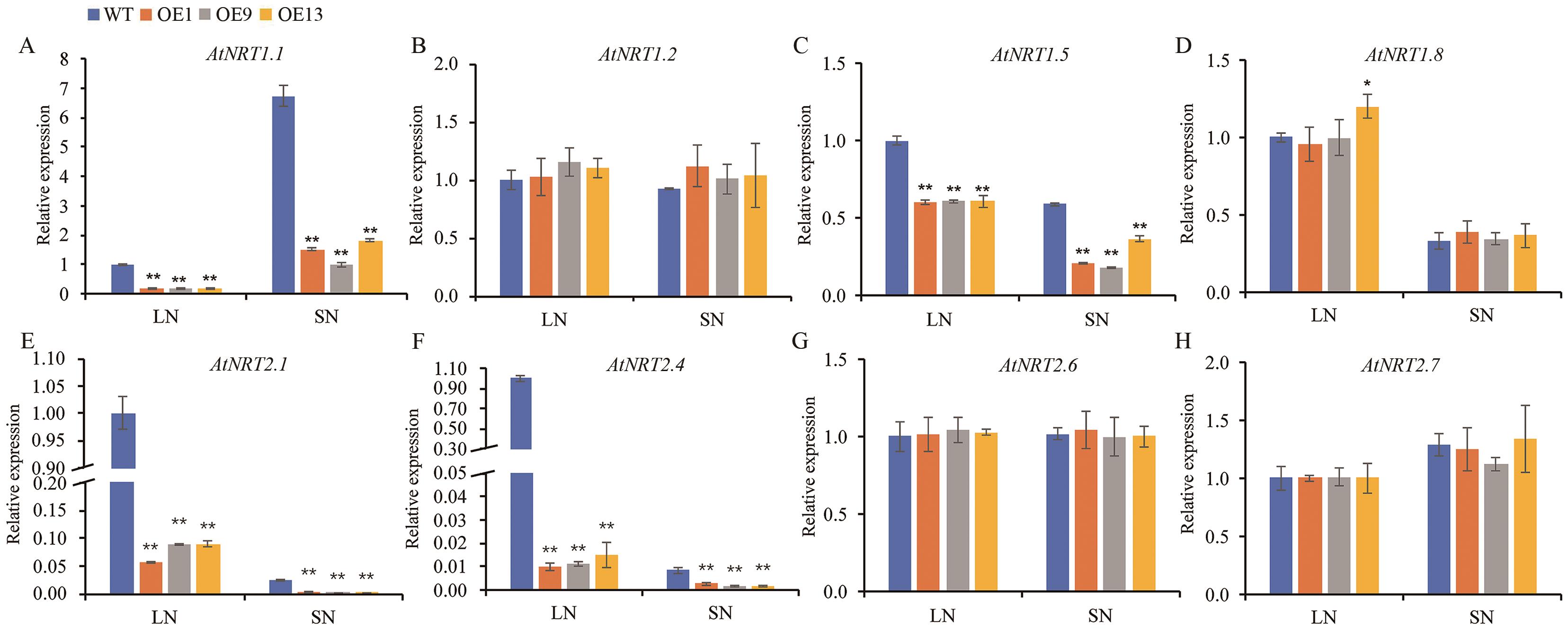
图9 ZmGLK4过表达株系中AtNRTs基因定量PCR检测正常氮培养基上生长6 d后,分别转移至低氮和正常氮培养基上4 d后ZmGLK4转基因拟南芥和野生型拟南芥根系
Fig. 9 RT-qPCR validation of AtNRTs genes in ZmGLK4-overexpressing transgenic plantsRoots of ZmGLK4 transgenic and wild-type Arabidopsis after 6-day growth on normal-N medium, then 4-day transfer to low-N and normal-N media, respectively
| [22] | Nadakuduti SS, Holdsworth WL, Klein CL, et al. KNOX genes influence a gradient of fruit chloroplast development through regulation of GOLDEN2-LIKE expression in tomato [J]. Plant J, 2014, 78(6): 1022-1033. |
| [23] | Kiba T, Inaba J, Kudo T, et al. Repression of nitrogen starvation responses by members of the Arabidopsis GARP-type transcription factor NIGT1/HRS1 subfamily [J]. Plant Cell, 2018, 30(4): 925-945. |
| [24] | Maeda Y, Konishi M, Kiba T, et al. A NIGT1-centred transcriptional cascade regulates nitrate signalling and incorporates phosphorus starvation signals in Arabidopsis [J]. Nat Commun, 2018, 9: 1376. |
| [25] | Wang X, Wang HF, Chen Y, et al. The transcription factor NIGT1.2 modulates both phosphate uptake and nitrate influx during phosphate starvation in Arabidopsis and maize [J]. Plant Cell, 2020, 32(11): 3519-3534. |
| [26] | Wang YB, Yao QQ, Zhang YS, et al. The role of gibberellins in regulation of nitrogen uptake and physiological traits in maize responding to nitrogen availability [J]. Int J Mol Sci, 2020, 21(5): 1824. |
| [27] | Liu F, Xu YJ, Han GM, et al. Molecular evolution and genetic variation of G2-like transcription factor genes in maize [J]. PLoS One, 2016, 11(8): e0161763. |
| [28] | Yoo SD, Cho YH, Sheen J. Arabidopsis mesophyll protoplasts: a versatile cell system for transient gene expression analysis [J]. Nat Protoc, 2007, 2(7): 1565-1572. |
| [29] | Fan HM, Quan SX, Ye Q, et al. A molecular framework underlying low-nitrogen-induced early leaf senescence in Arabidopsis thaliana [J]. Mol Plant, 2023, 16(4): 756-774. |
| [30] | Wang HT, Xu FF. Identification and expression analysis of the GLK gene family in tea plant (Camellia sinensis) and a functional study of CsGLK54 under low-temperature stress [J]. Sci Rep, 2024, 14: 12465. |
| [31] | Xiong B, Gong Y, Li Q, et al. Genome-wide analysis of the GLK gene family and the expression under different growth stages and dark stress in sweet orange (Citrus sinensis) [J]. Horticulturae, 2022, 8(11): 1076. |
| [32] | Frangedakis E, Yelina NE, Billakurthi K, et al. MYB-related transcription factors control chloroplast biogenesis [J]. Cell, 2024, 187(18): 4859-4876.e22. |
| [33] | Wei YF, Yang HP, Wang YJ, et al. PGA37 overexpression promotes chloroplast development in Arabidopsis roots through direct transcriptional activation of GLK2, ARR13, and ARR21 [J]. Plants, 2025, 14(9): 1270. |
| [34] | Du XQ, Wang FL, Li H, et al. The transcription factor MYB59 regulates K+/NO3 - translocation in the Arabidopsis response to low K+ stress [J]. Plant Cell, 2019, 31(3): 699-714. |
| [35] | Wang DJ, Xu TQ, Yin ZK, et al. Overexpression of OsMYB305 in rice enhances the nitrogen uptake under low-nitrogen condition [J]. Front Plant Sci, 2020, 11: 369. |
| [36] | Robatzek S, Somssich IE. Targets of AtWRKY6 regulation during plant senescence and pathogen defense [J]. Genes Dev, 2002, 16(9): 1139-1149. |
| [37] | Medici A, Marshall-Colon A, Ronzier E, et al. AtNIGT1/HRS1 integrates nitrate and phosphate signals at the Arabidopsis root tip [J]. Nat Commun, 2015, 6: 6274. |
| [1] | Vidal EA, Alvarez JM, Araus V, et al. Nitrate in 2020: thirty years from transport to signaling networks [J]. Plant Cell, 2020, 32(7): 2094-2119. |
| [2] | Wang W, Chen D, Sun HW, et al. Genetic improvement of nitrogen- and phosphorus-use efficiency in crops: Old goals with new aspirations [J]. Mol Plant, 2026, 19(3): 571-586. |
| [3] | Li JF, Cao HR, Li SX, et al. Genetic and molecular mechanisms underlying nitrogen use efficiency in maize [J]. J Genet Genom, 2025, 52(3): 276-286. |
| [4] | Sheoran S, Kumar S, Kumar P, et al. Nitrogen fixation in maize: breeding opportunities [J]. Theor Appl Genet, 2021, 134(5): 1263-1280. |
| [5] | Han M, Okamoto M, Beatty PH, et al. The genetics of nitrogen use efficiency in crop plants [J]. Annu Rev Genet, 2015, 49: 269-289. |
| [6] | Hu B, Wang W, Chen JJ, et al. Genetic improvement toward nitrogen-use efficiency in rice: Lessons and perspectives [J]. Mol Plant, 2023, 16(1): 64-74. |
| [7] | 马博涛, 伍国强, 魏明. bZIP转录因子在植物逆境胁迫响应和生长发育中的作用 [J]. 生物技术通报, 2024, 40(9): 148-160. |
| Ma BT, Wu GQ, Wei M. Roles of bZIP transcription factor in the response to stresses, and growth and development in plants [J]. Biotechnol Bull, 2024, 40(9): 148-160. | |
| [8] | Riechmann JL, Heard J, Martin G, et al. Arabidopsis transcription factors: genome-wide comparative analysis among eukaryotes [J]. Science, 2000, 290(5499): 2105-2110. |
| [9] | 刘俊芳, 张佳, 李贺, 等. 植物GOLDEN2-Like转录因子研究进展 [J]. 分子植物育种, 2017, 15(10): 3949-3956. |
| Liu JF, Zhang J, Li H, et al. Research progress of plant GOLDEN2-like transcription factor [J]. Mol Plant Breed, 2017, 15(10): 3949-3956. | |
| [10] | Waters MT, Wang P, Korkaric M, et al. GLK transcription factors coordinate expression of the photosynthetic apparatus in Arabidopsis [J]. Plant Cell, 2009, 21(4): 1109-1128. |
| [11] | Qin MY, Zhang BH, Gu G, et al. Genome-wide analysis of the G2-like transcription factor genes and their expression in different senescence stages of tobacco (Nicotiana tabacum L.) [J]. Front Genet, 2021, 12: 626352. |
| [12] | Wang ZY, Zhao S, Liu JF, et al. Genome-wide identification of Tomato Golden 2-Like transcription factors and abiotic stress related members screening [J]. BMC Plant Biol, 2022, 22: 82. |
| [13] | Zheng MY, Wang XY, Luo J, et al. The pleiotropic functions of GOLDEN2-LIKE transcription factors in plants [J]. Front Plant Sci, 2024, 15: 1445875. |
| [14] | Fitter DW, Martin DJ, Copley MJ, et al. GLK gene pairs regulate chloroplast development in diverse plant species [J]. Plant J, 2002, 31(6): 713-727. |
| [15] | 赵楚瑄, 纪晓楠, 刘梦雨, 等. OsGSK2与OsGLK1互作调控水稻叶绿素合成与叶绿体发育 [J]. 植物遗传资源学报, 2024, 25(3): 472-481. |
| Zhao CX, Ji XN, Liu MY, et al. OsGSK2 interacts with OsGLK1 to regulate chlorophyll synthesis and chloroplast development in rice [J]. J Plant Genet Resour, 2024, 25(3): 472-481. | |
| [16] | Liu D, Zhao DM, Li XW, et al. AtGLK2, an Arabidopsis GOLDEN2-LIKE transcription factor, positively regulates anthocyanin biosynthesis via AtHY5-mediated light signaling [J]. Plant Growth Regul, 2022, 96(1): 79-90. |
| [17] | Powell ALT, Nguyen CV, Hill T, et al. Uniform ripening encodes a Golden 2-like Transcription factor regulating tomato fruit chloroplast development [J]. Science, 2012, 336(6089): 1711-1715. |
| [18] | Rossini L, Cribb L, Martin DJ, et al. The maize Golden2 gene defines a novel class of transcriptional regulators in plants [J]. Plant Cell, 2001, 13(5): 1231. |
| [19] | Taketa S, Hattori M, Takami T, et al. Mutations in a Golden2-like gene cause reduced seed weight in barley albino lemma 1 mutants [J]. Plant Cell Physiol, 2021, 62(3): 447-457. |
| [20] | Liu X, Li LM, Li MJ, et al. AhGLK1 affects chlorophyll biosynthesis and photosynthesis in peanut leaves during recovery from drought [J]. Sci Rep, 2018, 8: 2250. |
| [21] | Liu JN, Mehari TG, Xu YC, et al. GhGLK1 a key candidate gene from GARP family enhances cold and drought stress tolerance in cotton [J]. Front Plant Sci, 2021, 12: 759312. |
| [1] | 李淑婷, 王影, 丁家豪, 胡荣芳, 李琛, 宋亚楠, 薛金爱. 油莎豆FAT家族全基因组鉴定及CeFATA的功能分析[J]. 生物技术通报, 2026, 42(8): 162-172. |
| [2] | 何婧婧, 朋毛拉专, 姚晓华, 姚有华, 吴昆仑, 崔永梅. 青稞HvNAC53的克隆及功能分析[J]. 生物技术通报, 2026, 42(8): 142-152. |
| [3] | 范帆, 李梦娇, 杨贤鹏, 崔莉莉. 拟南芥耐受磷酸三苯酯毒性突变体的筛选及相关基因的功能分析[J]. 生物技术通报, 2026, 42(7): 226-235. |
| [4] | 阎晓光, 杜艳伟, 马志远, 王彬, 王国梁, 胡丹珠. 玉米ZmDIR基因家族的全基因组鉴定与表达模式分析[J]. 生物技术通报, 2026, 42(7): 126-137. |
| [5] | 李博宇, 蹇春晨, 侯佳俊, 钱明岩, 杨文钦, 章圣龙, 藏传刚, 马福开, 郑龙, 关宏. 复合菌剂QY12-A4对玉米秸秆的降解及其产物中抗氧化木质素的分离与纯化[J]. 生物技术通报, 2026, 42(7): 292-303. |
| [6] | 赵静玮, 常娜, 金宵溦, 张立全. 黄花苜蓿MfWRKY22的克隆及抗逆性功能分析[J]. 生物技术通报, 2026, 42(7): 236-245. |
| [7] | 安飞飞, 罗秀芹, 蔡杰, 薛晶晶, 朱文丽. 木薯MeMYB106基因克隆及其在叶片花青素合成中的功能[J]. 生物技术通报, 2026, 42(6): 13-21. |
| [8] | 万瑞恒, 李晓艳, 李莹莹, 郭扬, 刘应红, 张军杰, 胡育峰, 李炀平, 黄玉碧, 刘汉梅. 基于YOLOv10的玉米籽粒淀粉粒识别与粒径分析系统的开发[J]. 生物技术通报, 2026, 42(6): 208-217. |
| [9] | 彭善麟, 廖卓诚, 王涛, 刘志宇, 刘海忆, 王婷婷, 杨琴, 王哲, 邰欢欢. 不同玉米茎腐病抗性品种根际微生物群落多样性及功能差异[J]. 生物技术通报, 2026, 42(5): 76-88. |
| [10] | 董亚茹, 聂玉霞, 朱红, 王照红, 刘惠芬, 郭光. 过表达桑树MnERF2增强拟南芥抗旱性[J]. 生物技术通报, 2026, 42(4): 182-189. |
| [11] | 郭道祥, 苏全, 李奥婷, 王燕, 陈清, 王小蓉, 何文. 柚MYB基因家族的鉴定及其在砧穗不亲和叶片黄化中的功能分析[J]. 生物技术通报, 2026, 42(4): 170-181. |
| [12] | 徐泽, 周陈平, 邝瑞彬, 吴夏明, 杨敏, 刘传和, 贺涵, 魏岳荣. 番木瓜PG基因家族鉴定及其在果实软化中的功能[J]. 生物技术通报, 2026, 42(3): 349-361. |
| [13] | 王晶, 刘卓艳, 张晓磊, 刘宝海, 关海涛, 温洪涛. 基于LAMP-CRISPR/Cas12a技术快速检测转基因玉米DBN9501转化体特异性[J]. 生物技术通报, 2026, 42(2): 149-157. |
| [14] | 张冬岭, 张寅生, 王建军, 叶飞宇, 卢子涵, 马晨晨, 柳华峰, 胡德升, 邓亚洲, 曹丽茹. 玉米HSFs转录因子家族在干旱胁迫下的表达特性及功能[J]. 生物技术通报, 2026, 42(2): 178-187. |
| [15] | 曾厅, 张兰, 罗睿. 转录因子MpR2R3-MYB17调控地钱胞芽发育的功能研究[J]. 生物技术通报, 2026, 42(1): 208-217. |
| 阅读次数 | ||||||
|
全文 |
|
|||||
|
摘要 |
|
|||||
