







生物技术通报 ›› 2026, Vol. 42 ›› Issue (10): 88-97.doi: 10.13560/j.cnki.biotech.bull.1985.2026-0470
• 研究报告 • 上一篇
胡荣芳1, 丁家豪1, 马菊花1, 谭辉进1, 宋亚楠2, 薛金爱1( )
)
收稿日期:2026-04-24
出版日期:2026-10-26
发布日期:2026-10-15
通讯作者:
薛金爱xuejinai@sxau.edu.cn基金资助:
HU Rong-fang1, DING Jia-hao1, MA Ju-hua1, TAN Hui-jin1, SONG Ya-nan2, XUE Jin-ai1()
Received:2026-04-24
Published:2026-10-26
Online:2026-10-15
摘要:
目的 溶血磷脂酸酰基转移酶(lysophosphatidic acid acyltransferase, LPAAT)是三酰甘油(triacylglycerol, TAG)组装途径中的关键限速酶。研究燕麦AsLPAAT5基因在油脂合成积累中的功能,为燕麦及其他作物油脂产量与品质改良提供新思路。 方法 从燕麦中克隆AsLPAAT5基因(Gene ID:AVESA.00001b.r1.1Ag0003121.1),生物信息学方法分析其结构特征,通过LPAAT缺陷型大肠杆菌突变株SM2-1、酿酒酵母INVSc1和拟南芥转化体系研究AsLPAAT5酶的活性及生物学功能。 结果 燕麦AsLPAAT5基因编码蛋白具有LPAAT的典型保守结构域。AsLPAAT5基因在燕麦根、茎、叶、穗以及开花后9、17、25 d的种子中均有表达,在开花后25 d的种子中表达量最高。大肠杆菌功能互补试验证实AsLPAAT5能够恢复突变株SM2-1的细胞膜脂生物合成功能,具备LPAAT酶活性。在酿酒酵母中过表达AsLPAAT5导致转基因酵母总脂含量相较于野生型酵母显著升高2.11%,C16:1含量增加14.25%。在拟南芥中过表达AsLPAAT5使转基因拟南芥种子千粒重增加2.2%-2.8%,总油脂含量提高1.9%-2.0%,C18:2含量显著升高25.49%-26.0%。 结论 AsLPAAT5是定位于内质网且具备典型LPAAT催化活性的酶蛋白,其异源表达能够显著促进宿主总油脂积累,并对不饱和脂肪酸(尤其是C18:2)的富集具有特异性调控作用。
胡荣芳, 丁家豪, 马菊花, 谭辉进, 宋亚楠, 薛金爱. 燕麦溶血磷脂酸酰基转移酶AsLPAAT5基因克隆与功能分析[J]. 生物技术通报, 2026, 42(10): 88-97.
HU Rong-fang, DING Jia-hao, MA Ju-hua, TAN Hui-jin, SONG Ya-nan, XUE Jin-ai. Cloning and Functional Characterization of the Lysophosphatidic Acid Acyltransferase Gene AsLPAAT5 in Avena sativa[J]. Biotechnology Bulletin, 2026, 42(10): 88-97.
引物名称 Primer name | 引物序列 Sequence(5′-3′) | 用途 Purpose |
|---|---|---|
| 1302-AsLPAAT5-F | acgggggactcttgaccatggATGTGGTTAGCCATGTTTCCATT | 载体构建 |
| 1302-AsLPAAT5-R | aagttcttctcctttactagtTCAGAGTTTCTTGGCATGTGCG | |
| pYES2.0-AsLPAAT5-F | gggaatattaagcttggtaccATGTGGTTAGCCATGTTTCCATT | 载体构建 |
| pYES2.0-AsLPAAT5-R | tacatgatgcggccctctagaTCAGAGTTTCTTGGCATGTGCG | |
| 1300-AsLPAAT5-F | gcccttgctcaccatggtaccATGTGGTTAGCCATGTTTCCATT | 载体构建 |
| 1300-AsLPAAT5-R | atacaccaaatcgactctagaGAGTTTCTTGGCATGTGCGC | |
| pET28A-AsLPAAT5-F | gcaagcttgtcgacggagctcATGTGGTTAGCCATGTTTCCATT | 载体构建 |
| pET28A-AsLPAAT5-R | ggataacaattcccctctagaTCAGAGTTTCTTGGCATGTGCG | |
| AsLPAAT5-qRT-F | ATACAAGCATCGGCTGCCAACT | qPCR |
| AsLPAAT5-qRT-R | CCTGAACCACACGGACGAGAAC | |
| AsEP-F | GCACAAGTGATGCCAGAATAGC | 内参基因 |
| AsEP-R | CGAGATGCATTAGATTCGTTGG |
表 1 本研究所用的引物
Table 1 Primers used in this study
引物名称 Primer name | 引物序列 Sequence(5′-3′) | 用途 Purpose |
|---|---|---|
| 1302-AsLPAAT5-F | acgggggactcttgaccatggATGTGGTTAGCCATGTTTCCATT | 载体构建 |
| 1302-AsLPAAT5-R | aagttcttctcctttactagtTCAGAGTTTCTTGGCATGTGCG | |
| pYES2.0-AsLPAAT5-F | gggaatattaagcttggtaccATGTGGTTAGCCATGTTTCCATT | 载体构建 |
| pYES2.0-AsLPAAT5-R | tacatgatgcggccctctagaTCAGAGTTTCTTGGCATGTGCG | |
| 1300-AsLPAAT5-F | gcccttgctcaccatggtaccATGTGGTTAGCCATGTTTCCATT | 载体构建 |
| 1300-AsLPAAT5-R | atacaccaaatcgactctagaGAGTTTCTTGGCATGTGCGC | |
| pET28A-AsLPAAT5-F | gcaagcttgtcgacggagctcATGTGGTTAGCCATGTTTCCATT | 载体构建 |
| pET28A-AsLPAAT5-R | ggataacaattcccctctagaTCAGAGTTTCTTGGCATGTGCG | |
| AsLPAAT5-qRT-F | ATACAAGCATCGGCTGCCAACT | qPCR |
| AsLPAAT5-qRT-R | CCTGAACCACACGGACGAGAAC | |
| AsEP-F | GCACAAGTGATGCCAGAATAGC | 内参基因 |
| AsEP-R | CGAGATGCATTAGATTCGTTGG |
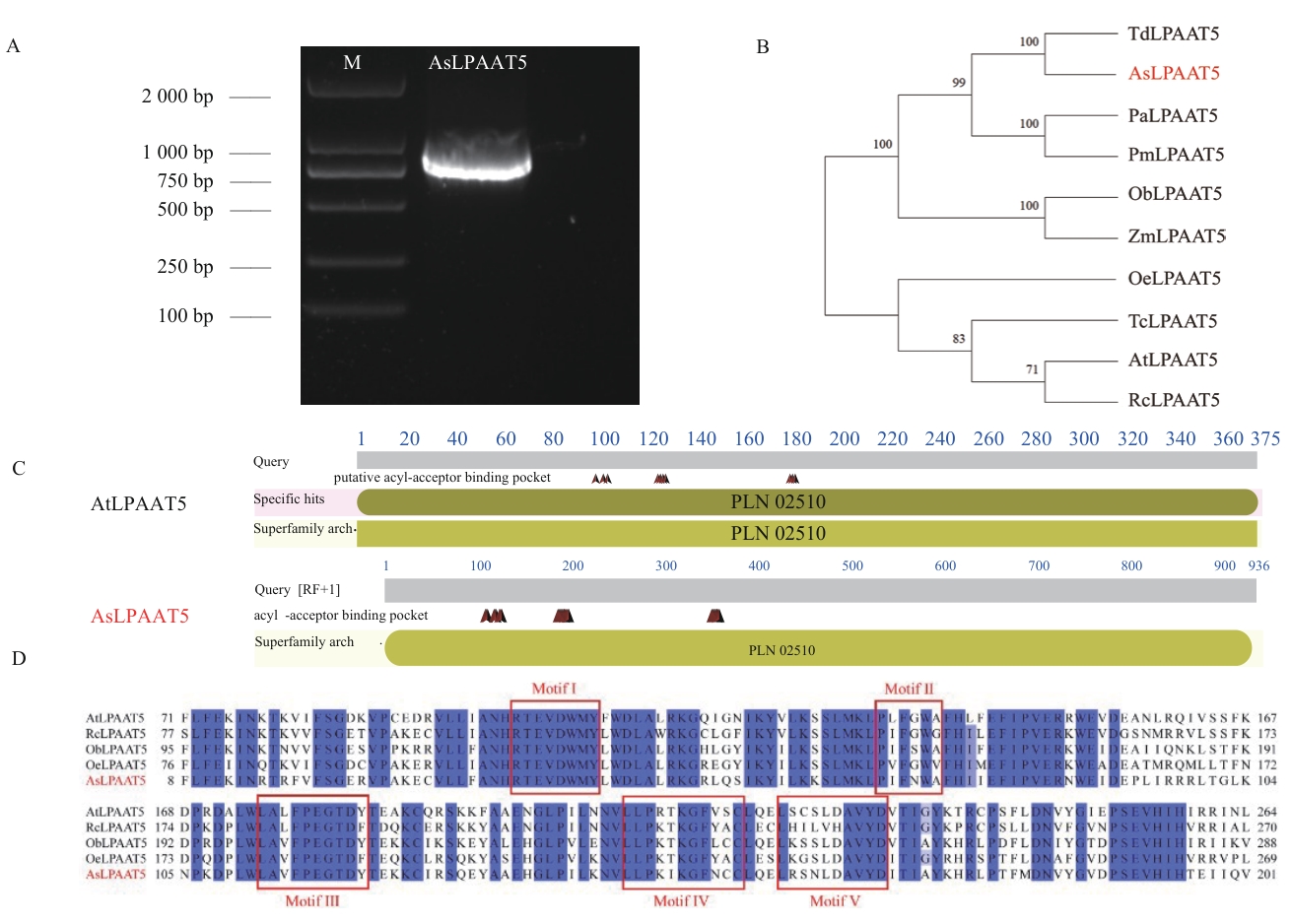
图1 AsLPAAT5基因克隆及其序列特征分析A:燕麦AsLPAAT5基因的克隆,M:DNA marker DL 2000;B:不同物种LPAATs蛋白系统进化树;C:AsLPAAT5蛋白结构域;D:LPAAT5蛋白保守氨基酸序列
Fig. 1 Cloning and sequence characterization of AsLPAAT5 geneA: Cloning of AsLPAAT5, M: DNA marker DL 2000. B: Phylogenetic tree of LPAAT proteins from different plant species. C: Protein domain of AsLPAAT5. D: Conserved amino acid sequences of LPAAT5 proteins
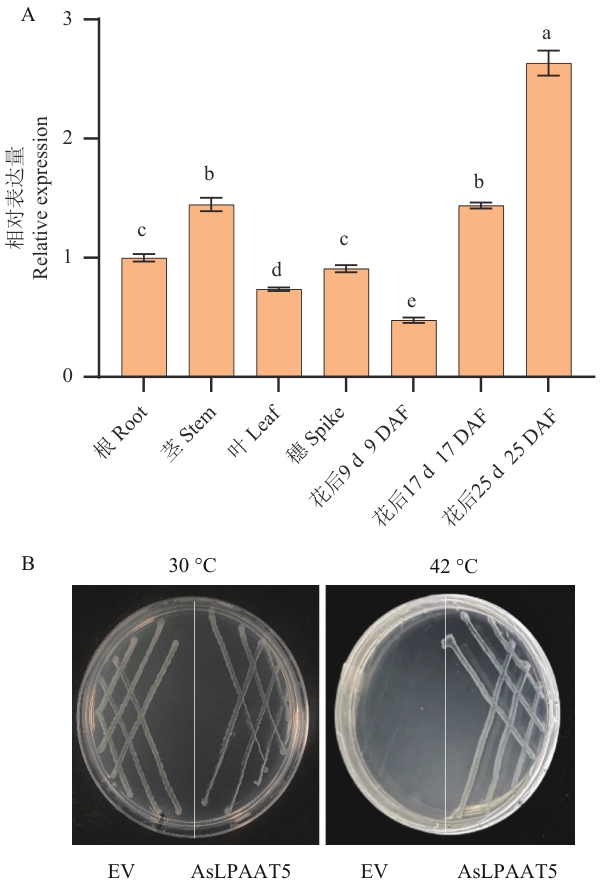
图2 AsLPAAT5蛋白酶活验证A:AsLPAAT5基因表达分析;B:AsLPAAT5在SM2-1菌株中的功能互补测试。不同小写字母表示差异显著(P<0.05),下同
Fig. 2 Enzyme activity validation of AsLPAAT5 proteinA: Expression analysis of AsLPAAT5. B: Functional complementation test of AsLPAAT5 in the SM2-1 strain. Different lowercase letters indicate significant differences (P<0.05). The same below
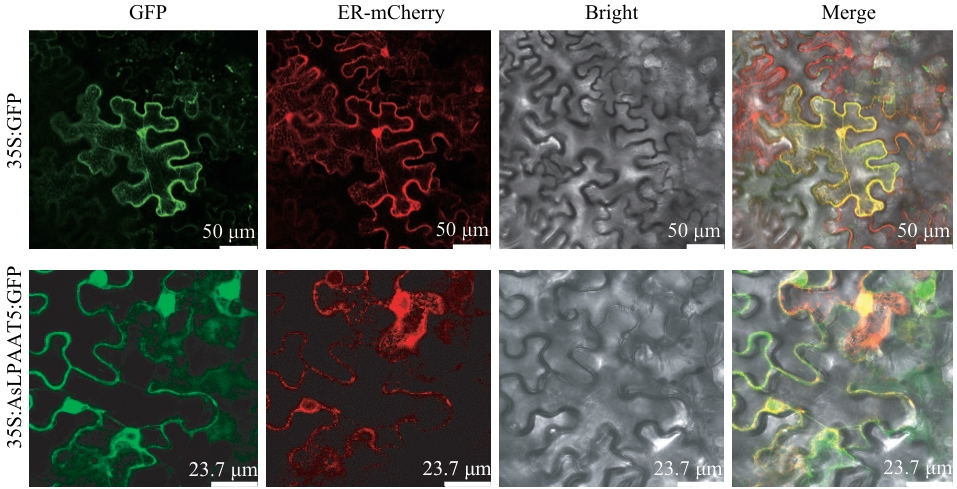
图3 AsLPAAT5蛋白的亚细胞定位
Fig. 3 Subcellular localization of AsLPAAT5 protein
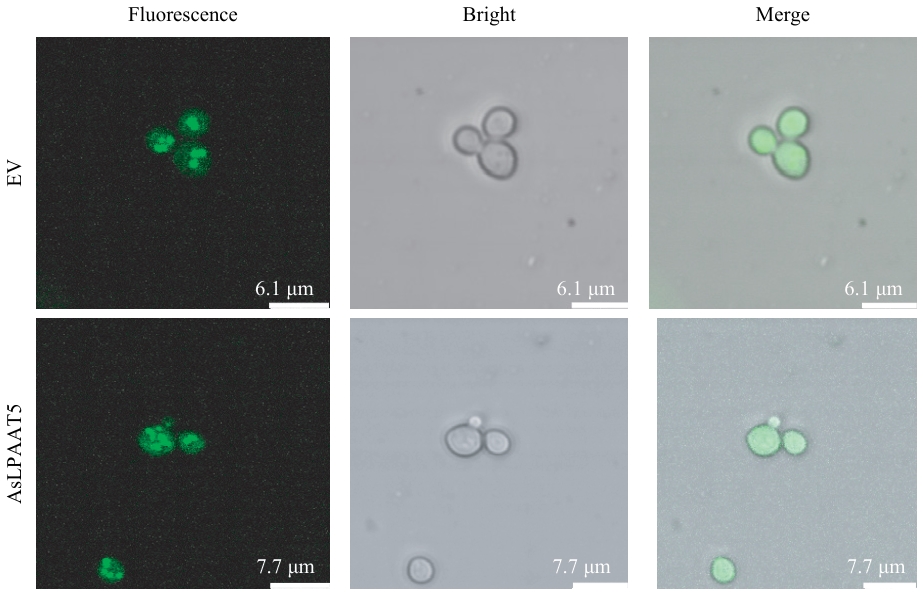
图4 转基因酵母油滴BODIPY染色
Fig. 4 Oil-bodies staining of transgenic yeast
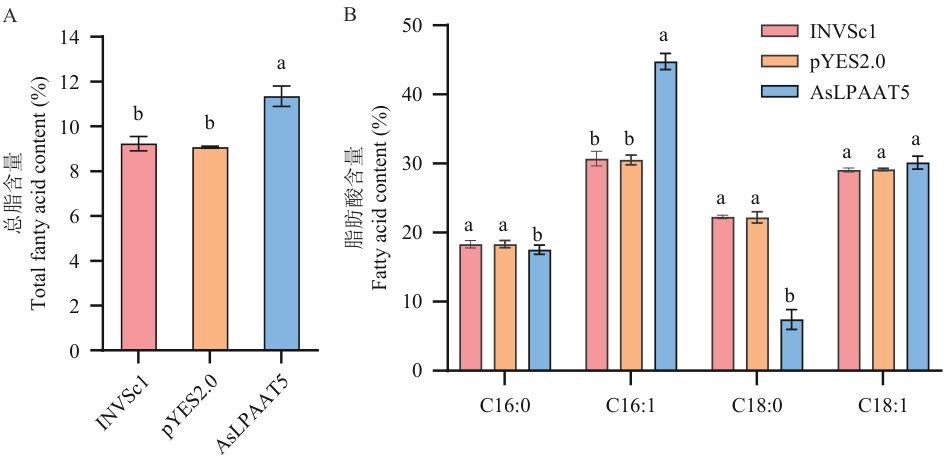
图5 AsLPAAT5转基因酵母油脂含量分析A:AsLPAAT5转基因酵母总脂含量;B:AsLPAAT5转基因酵母脂肪酸含量
Fig. 5 Analysis of lipid content in AsLPAAT5 transgenic yeastA: Total fatty acid content of AsLPAAT5 transgenic yeast. B: Fatty acid content of AsLPAAT5 transgenic yeast
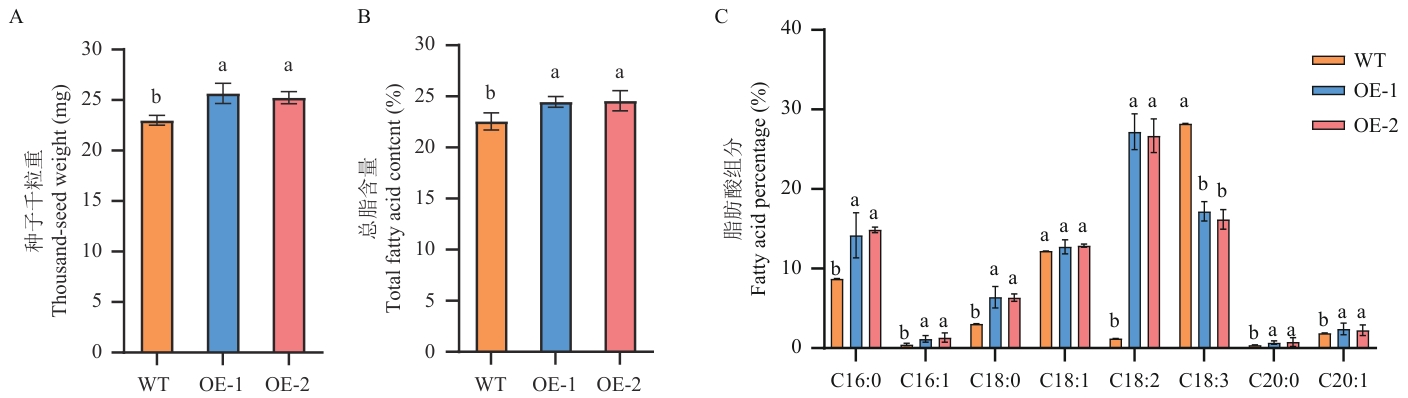
图6 转基因拟南芥表型及油脂分析A:拟南芥种子千粒重;B:总脂含量;C:脂肪酸组分
Fig. 6 Phenotypic and lipid analysis of transgenic ArabidopsisA: Thousand-seed weight of A. thaliana. B: Total fatty acid content. C: Fatty acid composition
| [1] | Banaś A, Debski H, Banaś W, et al. Lipids in grain tissues of oat (Avena sativa): differences in content, time of deposition, and fatty acid composition [J]. J Exp Bot, 2007, 58(10): 2463-2470. |
| [2] | Snell P, Wilkinson M, Taylor GJ, et al. Characterisation of grains and flour fractions from field grown transgenic oil-accumulating wheat expressing oat WRI1 [J]. Plants, 2022, 11(7): 889. |
| [3] | Heneen WK, Banaś A, Leonova S, et al. The distribution of oil in the oat grain [J]. Plant Signal Behav, 2009, 4(1): 55-56. |
| [4] | Grimberg Å, Wilkinson M, Snell P, et al. Transitions in wheat endosperm metabolism upon transcriptional induction of oil accumulation by oat endosperm WRINKLED1 [J]. BMC Plant Biol, 2020, 20: 235. |
| [5] | 陈磊. 燕麦的营养功能及综合加工利用 [J]. 食品与机械, 2012, 28(2): 236-237. |
| Chen L. Nutritional functions and process utilizations of oat [J]. Food Mach, 2012, 28(2): 236-237. | |
| [6] | 王龙龙. 花生二酰甘油酰基转移酶(DGAT)基因的克隆与分析 [D]. 济南: 山东师范大学, 2010. |
| Wang LL. Cloning and characterization of diacylglycerol acyltransferase (DGAT) gene in peanut (Arachis hypogaea L.) [D]. Jinan: Shandong Normal University, 2010. | |
| [7] | 张美莹, 莫倩, 齐秀双, 等. 牡丹PoLPAT2基因的克隆及表达分析 [J]. 浙江农业学报, 2025, 37(2): 321-328. |
| Zhang MY, Mo Q, Qi XS, et al. Cloning and expression analysis of peony PoLPAT2 gene [J]. Acta Agric Zhejiangensis, 2025, 37(2): 321-328. | |
| [8] | 吉白璐, 孙艺文, 刘万峰, 等. 烟草脂类合成关键基因NtLPAT的功能验证 [J]. 作物学报, 2025, 51(9): 2527-2537. |
| Ji BL, Sun YW, Liu WF, et al. Functional verification of the key gene NtLPAT involved in lipid biosynthesis in tobacco [J]. Acta Agron Sin, 2025, 51(9): 2527-2537. | |
| [9] | Yu B, Wakao S, Fan JL, et al. Loss of plastidic lysophosphatidic acid acyltransferase causes embryo-lethality in Arabidopsis [J]. Plant Cell Physiol, 2004, 45(5): 503-510. |
| [10] | Barroga NAM, Nguyen VC, Nakamura Y. The role of lysophosphatidic acid acyltransferase 1 in reproductive growth of Arabidopsis thaliana [J]. J Exp Bot, 2024, 75(22): 7190-7201. |
| [11] | 董芳, 迟晓元, 杨庆利, 等. 三个花生溶血磷脂酸酰基转移酶基因的克隆与序列分析 [J]. 花生学报, 2013(1): 1-11. |
| Dong F, Chi XY, Yang QL, et al. Cloning and sequence analysis of three lysophosphatidic acid acyltransferase (LPAT) encoding genes in peanut [J]. J Peanut Sci, 2013(1): 1-11. | |
| [12] | Zhang QY, Yu R, Sun DY, et al. PrLPAAT4, a putative lysophosphatidic acid acyltransferase from Paeonia rockii, plays an important role in seed fatty acid biosynthesis [J]. Molecules, 2017, 22(10): 1694. |
| [13] | 周雅莉, 黄旭升, 郝月茹, 等. 紫苏溶血磷脂酸酰基转移酶基因的克隆与功能分析 [J]. 生物工程学报, 2022, 38(8): 3014-3028. |
| Zhou YL, Huang XS, Hao YR, et al. Cloning and functional characterization of a lysophosphatidic acid acyltransferase gene from Perilla frutescens [J]. Chin J Biotechnol, 2022, 38(8): 3014-3028. | |
| [14] | 黄旭升, 周雅莉, 柴旭东, 等. 紫苏质体型PfLPAT1B基因的克隆及其在油脂合成中的功能分析 [J]. 生物技术通报, 2025, 41(7): 226-236. |
| Huang XS, Zhou YL, Chai XD, et al. Cloning of plastidial PfLPAT1B gene from Perilla frutescens and its functional analysis in oil biosynthesis [J]. Biotechnol Bull, 2025, 41(7): 226-236. | |
| [15] | Zhang K, He JJ, Yin YT, et al. Lysophosphatidic acid acyltransferase 2 and 5 commonly, but differently, promote seed oil accumulation in Brassica napus [J]. Biotechnol Biofuels, 2022, 15: 83. |
| [16] | Maisonneuve S, Guyot R, Delseny M, et al. A multigene family of lysophosphatidic acid acyltransferases of Arabidopsis thaliana [M]//Advanced Research on Plant Lipids. DordrechtSpringer Netherlands2003: 183-186. |
| [17] | Wattelet-Boyer V, Le Guédard M, Dittrich-Domergue F, et al. Lysophosphatidic acid acyltransferases: a link with intracellular protein trafficking in Arabidopsis root cells? [J]. J Exp Bot, 2022, 73(5): 1327-1343. |
| [18] | Angkawijaya AE, Nguyen VC, Nakamura Y. LYSOPHOSPHATIDIC ACID ACYLTRANSFERASES 4 and 5 are involved in glycerolipid metabolism and nitrogen starvation response in Arabidopsis [J]. New Phytol, 2019, 224(1): 336-351. |
| [19] | 尹永泰. 甘蓝型油菜溶血磷脂酰基转移酶家族基因的克隆与表达 [D]. 武汉: 华中科技大学, 2016. |
| Yin YT. Cloning and expressing of lysophosphatidic acid acyltransferases family genes from Brassica napus L. [J]. Wuhan: Huazhong University of Science and Technology, 2016. | |
| [20] | Chen G, Van Erp H, Martin-Moreno J, et al. Expression of Castor LPAT2 enhances ricinoleic acid content at the Sn-2 position of triacylglycerols in Lesquerella seed [J]. Int J Mol Sci, 2016, 17(4): 507. |
| [21] | Meesapyodsuk D, Chen Y, Ye SJ, et al. Co-expressing Eranthis hyemalis lysophosphatidic acid acyltransferase 2 and elongase improves two very long chain polyunsaturated fatty acid production in Brassica carinata [J]. Metab Eng Commun, 2021, 12: e00171. |
| [22] | 李昕儒. 油莎豆溶血磷脂酸酰基转移酶基因(CeLPATs)的鉴定及功能分析 [D]. 太谷: 山西农业大学, 2023. |
| Li XR. Identification and functional analysis of lysophosphatidic acid acyltransferase gene (CeLPATs) in Cyperus esculentus [D]. Taigu: Shanxi Agricultural University, 2023. | |
| [23] | 陈四龙, 黄家权, 雷永, 等. 花生溶血磷脂酸酰基转移酶基因的克隆与表达分析 [J]. 作物学报, 2012, 38(2): 245-255. |
| Chen SL, Huang JQ, Lei Y, et al. Cloning and expression analysis of lysophosphatidic acid acyltransferase (LPAT) encoding gene in peanut [J]. Acta Agron Sin, 2012, 38(2): 245-255. | |
| [24] | 丁检, 吴双, 蔡彩平, 等. 棉花溶血磷酸酯酰转移酶(LPAT)家族基因的发掘和表达分析 [J]. 作物学报, 2015, 41(3): 378-385. |
| Ding J, Wu S, Cai CP, et al. Genome-wide identification of lysophosphatidic acid acyltransferase gene family and their expression analysis in cotton [J]. Acta Agron Sin, 2015, 41(3): 378-385. | |
| [25] | Yang Z, Wang K, Aziz U, et al. Evaluation of duplicated reference genes for quantitative real-time PCR analysis in genome unknown hexaploid oat (Avena sativa L.) [J]. Plant Meth, 2020, 16: 138. |
| [26] | Zhou YL, Huang XS, Hu T, et al. Genome-wide analysis of glycerol-3-phosphate acyltransferase (GPAT) family in Perilla frutescens and functional characterization of PfGPAT9 crucial for biosynthesis of storage oils rich in high-value lipids [J]. Int J Mol Sci, 2023, 24(20): 15106. |
| [27] | Huang XS, Zhou YL, Shi XF, et al. PfbZIP85 transcription factor mediates ω-3 fatty acid-enriched oil biosynthesis by down-regulating PfLPAT1B gene expression in plant tissues [J]. Int J Mol Sci, 2024, 25(8): 4375. |
| [28] | 汪慧慧, 胡蓉, 岳宁燕, 等. 植物LPATs基因研究进展 [J]. 分子植物育种, 2020, 18(4): 1138-1143. |
| Wang HH, Hu R, Yue NY, et al. Research progress on lysophosphatidic acid acyltransferase (LPATs) gene in plants [J]. Mol Plant Breed, 2020, 18(4): 1138-1143. | |
| [29] | 王晓琳, 曲鹏, 甘明洋, 等. 橡胶树HbLPAT2基因的克隆与表达分析 [J]. 热带作物学报, 2024, 45(12): 2515-2523. |
| Wang XL, Qu P, Gan MY, et al. Cloning and expression analysis of HbLPAT2 gene from Hevea brasiliensis [J]. J Trop Crops, 2024, 45(12), 2515-2523. | |
| [30] | 杨琳, 徐宗乐, 崔玮桐, 等. 核桃溶血磷脂酸酰基转移酶基因家族分析 [J]. 河南农业大学学报, 2025, 59(6): 977-987. |
| Yang L, Xu ZL, Cui WT, et al. Analysis of the gene family of walnut lysophosphatidic acid acyltransferase [J]. J Henan Agric Univ, 2025, 59(6): 977-987. | |
| [31] | Maisonneuve S, Bessoule JJ, Lessire R, et al. Expression of rapeseed microsomal lysophosphatidic acid acyltransferase isozymes enhances seed oil content in Arabidopsis [J]. Plant Physiol, 2010, 152(2): 670-684. |
| [32] | Kim HJ, Silva JE, Iskandarov U, et al. Structurally divergent lysophosphatidic acid acyltransferases with high selectivity for saturated medium chain fatty acids from Cuphea seeds [J]. Plant J, 2015, 84(5): 1021-1033. |
| [33] | 张军平, 江木兰, 龚阳敏, 等. 三角褐指藻LPAAT基因在酵母中表达对脂肪酸的影响 [J]. 中国油料作物学报, 2012, 34(5): 483-488. |
| Zhang JP, Jiang ML, Gong YM, et al. Influence of expression of Phaeodactylum tricornutum LPAAT gene in yeast on oil content and fatty acid composition of TAG [J]. Chin J Oil Crop Sci, 2012, 34(5): 483-488. | |
| [34] | Wang YN, Yan JQ, Yang M, et al. EgMADS3 directly regulates EgLPAAT to mediate medium-chain fatty acids (MCFA) anabolism in the mesocarp of oil palm [J]. Plant Cell Rep, 2024, 43(4): 107. |
| [35] | Shams MR, Razvi K, Rahnama H, et al. Enhanced seed oil content by overexpressing LPAAT and WRI1 genes in tobacco plant [J]. Plant Cell Rep, 2025, 44(7): 163. |
| [1] | 郑淑雅, 苏玉婷, 何玉美, 赵盼, 周心怡, 刘冉, 刘平丽, 郭惠红. 杨树PagRAX2_16G及其启动子的克隆与功能分析[J]. 生物技术通报, 2026, 42(9): 186-195. |
| [2] | 董向向, 侯威威, 缪百灵, 陈娟娟, 李亮杰, 翟敏, 朱庆松, 刘松虎. 过表达森林草莓FvBBX22促进拟南芥花青素合成和延迟开花时间[J]. 生物技术通报, 2026, 42(9): 231-237. |
| [3] | 李淑婷, 王影, 丁家豪, 胡荣芳, 李琛, 宋亚楠, 薛金爱. 油莎豆FAT家族全基因组鉴定及CeFATA的功能分析[J]. 生物技术通报, 2026, 42(8): 162-172. |
| [4] | 赵静玮, 常娜, 金宵溦, 张立全. 黄花苜蓿MfWRKY22的克隆及抗逆性功能分析[J]. 生物技术通报, 2026, 42(7): 236-245. |
| [5] | 安飞飞, 罗秀芹, 蔡杰, 薛晶晶, 朱文丽. 木薯MeMYB106基因克隆及其在叶片花青素合成中的功能[J]. 生物技术通报, 2026, 42(6): 13-21. |
| [6] | 徐泽, 周陈平, 邝瑞彬, 吴夏明, 杨敏, 刘传和, 贺涵, 魏岳荣. 番木瓜PG基因家族鉴定及其在果实软化中的功能[J]. 生物技术通报, 2026, 42(3): 349-361. |
| [7] | 孙金梁, 李星岩, 张碧茹, 米俊珍, 刘景辉. 燕麦盐碱响应基因AsGolS2的克隆及互作蛋白的筛选[J]. 生物技术通报, 2026, 42(10): 77-87. |
| [8] | 黄旭升, 周雅莉, 柴旭东, 闻婧, 王计平, 贾小云, 李润植. 紫苏质体型PfLPAT1B基因的克隆及其在油脂合成中的功能分析[J]. 生物技术通报, 2025, 41(7): 226-236. |
| [9] | 李锐, 胡婷, 陈树溦, 王尧, 王计平. 紫苏PfMYB80转录因子正向调控花青素的生物合成[J]. 生物技术通报, 2025, 41(6): 243-255. |
| [10] | 程珊, 王会伟, 陈晨, 朱雅婧, 李春鑫, 别海, 王树峰, 陈献功, 张向歌. 油莎豆MYB转录因子基因CeMYB154克隆及耐盐功能分析[J]. 生物技术通报, 2025, 41(6): 218-228. |
| [11] | 吴娅, 姚润, 杨含婷, 刘微, 杨帅, 宋驰, 陈士林. 凤梨薄荷SDR基因家族全基因组鉴定及表达分析[J]. 生物技术通报, 2025, 41(5): 175-185. |
| [12] | 刘梓琦, 钟沛, 李琴, 郭成, 张艳梅, 张乃锋, 屠焰, 刁其玉, 毕研亮. CRISPR/Cas9技术在益生菌编辑中的应用与进展[J]. 生物技术通报, 2025, 41(11): 89-99. |
| [13] | 刘换换, 杨立春, 李火根. 北美鹅掌楸LtMYB305基因的克隆及功能分析[J]. 生物技术通报, 2024, 40(4): 179-188. |
| [14] | 陈凯凌, 武涛, 徐逸群, 高佳, 张美俊, 李欣, 贾举庆. 燕麦全基因组SSR位点鉴定及多态性标记开发[J]. 生物技术通报, 2024, 40(2): 120-129. |
| [15] | 张岳一, 兰社益, 裴海闰, 封棣. 多菌种联用发酵燕麦麸皮工艺优化及发用功效评价[J]. 生物技术通报, 2023, 39(9): 58-70. |
| 阅读次数 | ||||||
|
全文 |
|
|||||
|
摘要 |
|
|||||
