







生物技术通报 ›› 2025, Vol. 41 ›› Issue (9): 219-231.doi: 10.13560/j.cnki.biotech.bull.1985.2025-0220
• 研究报告 • 上一篇
刘泽洲1( ), 段乃彬2, 岳丽昕1, 王清华1, 姚行浩1, 高莉敏1, 孔素萍1()
收稿日期:2025-03-04
出版日期:2025-09-26
发布日期:2025-09-24
通讯作者:
孔素萍,女,博士,研究员,研究方向 :蔬菜遗传育种;E-mail: spkong1019@126.com作者简介:刘泽洲,男,博士,助理研究员,研究方向 :蔬菜遗传育种;E-mail: lzezhouay215@163.com
基金资助:
LIU Ze-zhou1(), DUAN Nai-bin2, YUE Li-xin1, WANG Qing-hua1, YAO Xing-hao1, GAO Li-min1, KONG Su-ping1()
Received:2025-03-04
Published:2025-09-26
Online:2025-09-24
摘要:
目的 分析大蒜蜡质缺失突变体8684-gl叶表蜡质缺失成分,筛选蜡质缺失基因Ggl-1,为探讨大蒜叶片表面蜡粉的分子调控机制奠定基础,也可为大蒜抗病虫害育种及其在生产实践中的应用提供理论基础。 方法 以大蒜蜡质缺失突变体8684-gl和野生型8684植株叶片为研究对象,利用气相色谱-质谱联用(gas chromatograph-mass spectrometer-computer, GC-MS)分析大蒜蜡质缺失突变体8684-gl及其野生型8684叶片表面的蜡质成分,通过转录组和实时荧光定量PCR(RT-qPCR)筛选蜡质缺失基因Ggl-1。 结果 通过GC-MS分析发现,大蒜叶片表面蜡质包含39个成分,8684-gl突变体叶片表面蜡质缺失的主要物质为16-庚烯酮(16-hentriacontanone, C31H62O)。转录组分析结果显示,蜡质缺失突变体8684-gl及其野生型8684间差异表达基因主要集中在脂质转运与代谢、脂肪酸生物合成降解过程以及次生代谢物的生物合成、运输和分解代谢等过程,蜡质缺失基因Ggl-1的候选基因为Asa8G04000和Asa4G02100,RT-qPCR结果显示,候选基因表达量在蜡质缺失突变体8684-gl及其野生型8684叶片中差异显著。 结论 蜡质缺失突变体8684-gl叶片表面蜡质缺失主要物质为16-庚烯酮,筛选到Asa8G04000和Asa4G02100为大蒜蜡质缺失基因Ggl-1的候选基因。
刘泽洲, 段乃彬, 岳丽昕, 王清华, 姚行浩, 高莉敏, 孔素萍. 大蒜叶片蜡质成分分析及蜡质缺失基因Ggl-1筛选[J]. 生物技术通报, 2025, 41(9): 219-231.
LIU Ze-zhou, DUAN Nai-bin, YUE Li-xin, WANG Qing-hua, YAO Xing-hao, GAO Li-min, KONG Su-ping. Analysis of Wax Components and Screening of Wax-deficient Gene Ggl-1 in Garlic (Allium sativum L.)[J]. Biotechnology Bulletin, 2025, 41(9): 219-231.
| 样品名Sample | 原始读段数目 Raw reads (Mb) | 过滤读段数目 Clean reads (Mb) | 过滤后数据量 Clean data (Gb) | Q30质量值比例Q30 rate (%) | 比对率Alignment rate (%) | 测序年份Sequencing batch |
|---|---|---|---|---|---|---|
| GL1A | 45.44 | 42.38 | 6.36 | 92.49 | 93.27 | 2023 |
| GL2A | 45.44 | 42.54 | 6.38 | 92.94 | 93.62 | |
| GL3A | 45.44 | 42.03 | 6.30 | 93.50 | 92.50 | |
| GY1A | 45.44 | 42.74 | 6.41 | 93.17 | 94.06 | |
| GY2A | 45.44 | 42.41 | 6.36 | 93.81 | 93.35 | |
| GY3A | 45.44 | 42.49 | 6.37 | 93.19 | 93.52 | |
| Ggl-1 | 62.61 | 61.63 | 9.25 | 94.53 | 88.86 | 2022 |
| Ggl-2 | 74.48 | 71.80 | 10.77 | 92.58 | 88.86 | |
| Ggl-3 | 73.45 | 70.40 | 10.56 | 92.52 | 88.39 | |
| Gwx-1 | 68.59 | 65.25 | 9.79 | 92.91 | 89.24 | |
| Gwx-2 | 56.61 | 55.72 | 8.36 | 93.85 | 88.93 | |
| Gwx-3 | 71.67 | 68.79 | 10.32 | 92.90 | 87.89 |
表1 转录组测序数据比对统计表
Table 1 Statisticsy of transcriptome sequencing data mapping
| 样品名Sample | 原始读段数目 Raw reads (Mb) | 过滤读段数目 Clean reads (Mb) | 过滤后数据量 Clean data (Gb) | Q30质量值比例Q30 rate (%) | 比对率Alignment rate (%) | 测序年份Sequencing batch |
|---|---|---|---|---|---|---|
| GL1A | 45.44 | 42.38 | 6.36 | 92.49 | 93.27 | 2023 |
| GL2A | 45.44 | 42.54 | 6.38 | 92.94 | 93.62 | |
| GL3A | 45.44 | 42.03 | 6.30 | 93.50 | 92.50 | |
| GY1A | 45.44 | 42.74 | 6.41 | 93.17 | 94.06 | |
| GY2A | 45.44 | 42.41 | 6.36 | 93.81 | 93.35 | |
| GY3A | 45.44 | 42.49 | 6.37 | 93.19 | 93.52 | |
| Ggl-1 | 62.61 | 61.63 | 9.25 | 94.53 | 88.86 | 2022 |
| Ggl-2 | 74.48 | 71.80 | 10.77 | 92.58 | 88.86 | |
| Ggl-3 | 73.45 | 70.40 | 10.56 | 92.52 | 88.39 | |
| Gwx-1 | 68.59 | 65.25 | 9.79 | 92.91 | 89.24 | |
| Gwx-2 | 56.61 | 55.72 | 8.36 | 93.85 | 88.93 | |
| Gwx-3 | 71.67 | 68.79 | 10.32 | 92.90 | 87.89 |
| 基因 Gene | 正向引物序列 Forward sequence (5′-3′) | 反向引物序列 Reverse sequence (5′-3′) |
|---|---|---|
| AsACTIN | TCCTAACCGAGCGAGGCTACAT | GGAAAAGCACTTCTGGGCACC |
| Asa8G04000 | CACTGCTGCTGTGCTTTCAG | ACTGGGACGATCTTCCTGGA |
| Asa4G02100 | TGAGGTGATGCCAGTGAACC | TCACCCAGTCGAAATGTGCA |
| Asa7G01089 | CGCTGGTAGTCCACACCTTT | TAACGTGTCCAAGCTCCCAC |
| Asa5G03876 | TTGGCAAGAGTAGCAGCTCC | GATCGAATAGCGACTGGCCA |
| Asa7G02324 | GTCCTCTGGAATTGCTGCCT | CGCCTTCATACGCCCATTTG |
| Asa4G04412 | AGCGCTGGAGTTGGAGTTAC | ATGTTCATCACAGCCCCTGG |
| Asa1G04660 | TGTAGGATCTCGTTCGGGGT | GACGACAGGGTTTACAGCCA |
| Asa1G03601 | CCTGAGTTCGTCGATACCGG | TCCATAAACATGCACCCGCT |
| Asa1G03571 | TGAAGCGTCGCAAAACTGTG | TTTCTCCGGGGCACTTCATC |
| Asa4G06138 | GGAAGCTTCCCATGTTCGGA | ACGGACGTTGTCAAATCCGA |
| Asa2G01695 | TTAACCGCTTGTTTGCACCG | TAGTCAACAGCCAGCATGCA |
| Asa0G03810 | AGGGCATCCTTGGGGAAATG | TGTTCGGGACTCCATTTGCA |
表2 RT-qPCR引物序列
Table 2 RT-qPCR primers
| 基因 Gene | 正向引物序列 Forward sequence (5′-3′) | 反向引物序列 Reverse sequence (5′-3′) |
|---|---|---|
| AsACTIN | TCCTAACCGAGCGAGGCTACAT | GGAAAAGCACTTCTGGGCACC |
| Asa8G04000 | CACTGCTGCTGTGCTTTCAG | ACTGGGACGATCTTCCTGGA |
| Asa4G02100 | TGAGGTGATGCCAGTGAACC | TCACCCAGTCGAAATGTGCA |
| Asa7G01089 | CGCTGGTAGTCCACACCTTT | TAACGTGTCCAAGCTCCCAC |
| Asa5G03876 | TTGGCAAGAGTAGCAGCTCC | GATCGAATAGCGACTGGCCA |
| Asa7G02324 | GTCCTCTGGAATTGCTGCCT | CGCCTTCATACGCCCATTTG |
| Asa4G04412 | AGCGCTGGAGTTGGAGTTAC | ATGTTCATCACAGCCCCTGG |
| Asa1G04660 | TGTAGGATCTCGTTCGGGGT | GACGACAGGGTTTACAGCCA |
| Asa1G03601 | CCTGAGTTCGTCGATACCGG | TCCATAAACATGCACCCGCT |
| Asa1G03571 | TGAAGCGTCGCAAAACTGTG | TTTCTCCGGGGCACTTCATC |
| Asa4G06138 | GGAAGCTTCCCATGTTCGGA | ACGGACGTTGTCAAATCCGA |
| Asa2G01695 | TTAACCGCTTGTTTGCACCG | TAGTCAACAGCCAGCATGCA |
| Asa0G03810 | AGGGCATCCTTGGGGAAATG | TGTTCGGGACTCCATTTGCA |
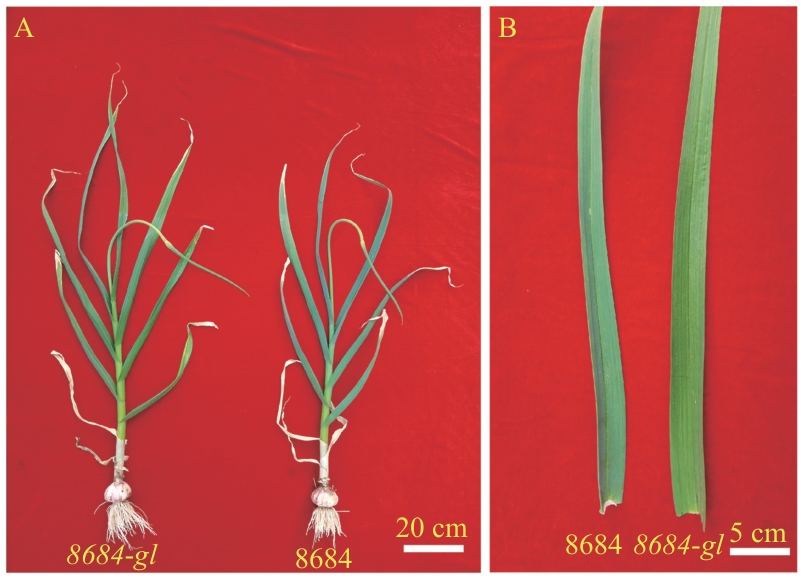
图1 蜡质缺失突变体8684-gl及其野生型8684植株表型
Fig. 1 Morphological characteristics of wax-deficient 8684-gl and the wild-type 8684 plants
| 材料Material | 株高Plant height (cm) | 假茎高Pseudostem height (cm) | 叶长Leaf length (cm) | 叶宽Leaf width (cm) | 茎粗Stem thick (cm) |
|---|---|---|---|---|---|
| 8684 | 92.40±3.78 | 36.95±1.86 | 58.70±2.70 | 3.64±0.23 | 18.08±1.59 |
| 8684-gl | 94.55±2.83 | 37.75±1.86 | 59.60±2.50 | 3.46±0.20 | 17.21±1.01 |
表3 蜡质缺失突变体8684-gl及其野生型8684植株性状
Table 3 Plant traits of wax-deficient mutant 8684-gl and its wild type 8684
| 材料Material | 株高Plant height (cm) | 假茎高Pseudostem height (cm) | 叶长Leaf length (cm) | 叶宽Leaf width (cm) | 茎粗Stem thick (cm) |
|---|---|---|---|---|---|
| 8684 | 92.40±3.78 | 36.95±1.86 | 58.70±2.70 | 3.64±0.23 | 18.08±1.59 |
| 8684-gl | 94.55±2.83 | 37.75±1.86 | 59.60±2.50 | 3.46±0.20 | 17.21±1.01 |

图2 蜡质缺失突变体8684-gl及其野生型8684叶片表面蜡粉观察A:野生型8684叶片腹面;B:野生型8684叶片背面;C:蜡质缺失突变体8684-gl叶片腹面;D:蜡质缺失突变体8684-gl叶片背面
Fig. 2 Observation of wax powder on the leaf surface of wax-deficient 8684-gl and the wild-type 8684A: Wild-type 8684's leaf ventral surface; B: wild-type 8684's leaf back surface; C: wax-deficient 8684-gl's leaf ventral surface; D: wax-deficient 8684-gl'sleaf back surface

图3 蜡质缺失突变体8684-gl及其野生型8684叶片表面蜡质成分含量*和**分别表示在P<0.05和P<0.01水平差异显著,下同
Fig. 3 Content of wax components on the leaf surface of the wax-deficient 8684-gl and the wild-type 8684* and ** indicate the difference at P<0.05 and P<0.01 level, respectively
| 分子式Molecular formula | 出峰时间Retention time (min) | 化合物Compound | CAS登记号码CAS No. | 分子量Molecular weight (Da) | 野生型8684Wild-type 8684 | 突变体8684-glWax-deficient8684-gl |
|---|---|---|---|---|---|---|
| C6H10S2 | 5.52 | Diallyl disulphide | 2179-57-9 | 146 | 0.78±0.52 Aa | 0.31±0.24 Aa |
| C6H15O4P | 6.35 | Triethyl phosphate | 78-40-0 | 182.070 796 | 0.31±0.20 Aa | 0.33±0.11 Aa |
| C6H8S2 | 21.82 | 3-Vinyl-1,2-dithiacyclohex-4-ene | 62488-52-2 | 144.006 742 5 | 0.79±0.49 Aa | 4.86±7.87 Aa |
| C9H18O2 | 12.85 | Nonanoic acid, TMS derivative | 158.170 207 | 0.33±0.30 Aa | 0.24±0.13 Aa | |
| C9H20O2 | 4.22 | Hexane, 1-(Ethoxymethoxy)-2-fluoro-3-methylbenzene | 151705-35-0 | 160.146 33 | 24.88±40.31 Aa | 23.79±39.33 Aa |
| C10H23NO | 10.85 | 8-DIMETHYLAMINO-1-OCTANOL | 29823-87-8 | 173.177 964 | 0.05±0.02 Aa | 0.08±0.02 Ab |
| C15H32 | 10.43 | Dodecane, 2,6,10-TRIMETHYLDODECANE | 3891-98-3 | 212.250 401 5 | 0.26±0.11 Aa | 0.26±0.05 Aa |
| C16H22O4 | 29.05 | Dibutyl phthalate | 84-74-2 | 278.151 81 | 4.38±5.83 Aa | 0.83±0.31 Aa |
| C16H32O2 | 31.12 | Palmitic Acid, TMS derivative | 55520-89-3 | 256.3 | 76.57±83.69 Aa | 75.87±31.28 Aa |
| C18H34O2 | 4.99 | Dodecanoic acid, 2-hexen-1-yl ester | 282.255 88 | 0.76±0.56 Aa | 0.67±0.38 Aa | |
| C18H34O4 | 9.98 | Oxalic acid, 6-ethyloct-3-yl isohexyl ester | 314.245 71 | 0.14±0.03 Aa | 0.15±0.03 Aa | |
| C19H23NO3 | 68.76 | Norrecticuline, 6,7-Dimethoxy-1-(4-methoxybenzyl)-1,2,3,4-tetrahydroisoquinoline | 41498-37-7 | 313.167 793 | 96.61±40.82 Aa | 60.69±54.58 Aa |
| C20H24N2O | 58.01 | Acetamide, N-[2-(3-Ethyl-1-methyl-9H-carbazol-2-yl)ethyl]-N- methylacetamide | 55320-31-5 | 308.188 864 | 148.15-- | 16.10±25.00-- |
| C20H40O2 | 39.49 | Arachidic acid, TMS derivative | 312.342 358 | 24.09±36.61 Aa | 1.23±0.66 Aa | |
| C22H29NO5 | 80.02 | 3,4,5-Trimethoxybenzoic acid 2-(dimethylamino)-2- phenylbutyl ester | 39133-31-8 | 387.204 573 | 168.75±42.01 Aa | 88.14±68.98 Aa |
| C22H44O | 39.15 | Docosanal | 57402-36-5 | 324.339 216 | 1.73±0.45 Aa | 0.84±0.37 Aa |
| C22H46O | 41.59 | Docosanol, TMS derivative | 326.394 392 | 3.25±0.02 Aa | 7.31±9.26 Aa | |
| C22H48O2 | 43.25 | Behenic acid, TMS derivative | 340.4 | 138.66±45.83 Aa | 48.21±25.63 Aa | |
| C23H32O2 | 38.98 | Phenol, 2,2'-methylenebis(6-tert-butyl-4-methyl-phenol) | 119-47-1 | 340.2 | 142.47±64.10 Aa | 101.45±45.23 Aa |
| C24H48O | 43.04 | Tetracosanal | 57866-08-7 | 352.4 | 210.15±39.54 Aa | 100.27±55.08 Ab |
| C24H48O2 | 46.74 | Lignoceric acid, TMS derivative | 368.4 | 221.56±62.42 Aa | 152.27±26.89 Aa | |
| C24H50O | 45.18 | Tetracosanol, O-TMS | 354.4 | 588.75±79.99 Aa | 234.66±48.10 Aa | |
| C25H52 | 40.54 | Pentacosane | 629-99-2 | 352.4 | 152.34±35.09 Aa | 77.95±13.47 Ab |
| C25H52O | 46.88 | 1-Pentacosanol, TMS derivative | 1000352-21-3 | 368.441 343 | 2.37±0.38 Aa | 7.79±10.21 Aa |
| C26H52O | 46.64 | Hexacosanal | 26627-85-0 | 380.4 | 470.09±53.89 Aa | 330.57±58.38 Aa |
| C26H54O | 48.54 | 1-Hexacosanol, TMS derivative | 382.5 | 1020.38±80.50 Aa | 569.22±86.00 Ab | |
| C27H56 | 49.33 | Heptacosane | 593-49-7 | 380.438 202 | 114.51±11.27 Aa | 55.33±8.41 Ab |
| C27H56O | 50.11 | 1-Heptacosanol,TMS derivative | 396.5 | 47.42±39.79 Aa | 25.74±25.62 Aa | |
| C28H56O2 | 53.11 | Trimethylsilyl octacosanoate | 424.5 | 488.53±251.35 Aa | 287.64±36.39 Aa | |
| C28H58 | 47.71 | Octacosane | 630-02-4 | 394.5 | 1193.60±190.50 Aa | 805.27±128.12 Bb |
| C28H58O | 51.7 | 1-Octacosanol, TMS derivative | 410.5 | 2604.22±40.82 Aa | 1668.28±296.21 Ab | |
| C29H58O | 50.01 | Nonacosanal | 72934-04-4 | 422.448 767 | 877.95±136.22 Aa | 649.96±111.23 Aa |
| C30H60O2 | 56.86 | Trimethylsilyl triacontanoate | 452.5 | 252.90±62.36 Aa | 192.39±22.27 Aa | |
| C30H62O | 54.93 | 1-Triacontanol, TMS derivative | 438.5 | 762.06±21.93 Aa | 550.66±90.21 Aa | |
| C30H62O2 | 53.18 | 1,30-Triacontanediol | 36645-68-8 | 454.474 981 | 305.32±241.24 Aa | 303.56±55.42 Aa |
| C31H62O | 53.86 | 16-Hentriacontanone | 502-73-8 | 450.480 066 | 9010.57±865.30 Aa | 33.10±5.50 Bb |
| C32H66O | 59.4 | Silane, (dotriacontyloxy)trimethyl- | 466.550 89 | 38.47±29.88 Aa | 33.69±28.58 Aa | |
| C34H70 | 50.97 | Tetratriacontane | 14167-59-0 | 478.547 752 | 1789.21±266.01 Aa | 1435.93±123.73 Aa |
| C39H80O2 | 52.45 | Octadecane,1,1'-[1,3-Propanediylbis(oxy)]bisoctadecane(1,1'-[1,3-Propanediylbis(oxy)]bisoctadecane) | 17367-38-3 | 580.615 833 | 1.20±0.78 Aa | 11.58±17.41 Aa |
表4 蜡质缺失突变体8684-gl及其野生型8684叶片表面蜡质物质及含量 (ng/cm2)
Table 4 Wax substance and content on the leaf surface of the wax-deficient 8684-gl and the wild-type 8684
| 分子式Molecular formula | 出峰时间Retention time (min) | 化合物Compound | CAS登记号码CAS No. | 分子量Molecular weight (Da) | 野生型8684Wild-type 8684 | 突变体8684-glWax-deficient8684-gl |
|---|---|---|---|---|---|---|
| C6H10S2 | 5.52 | Diallyl disulphide | 2179-57-9 | 146 | 0.78±0.52 Aa | 0.31±0.24 Aa |
| C6H15O4P | 6.35 | Triethyl phosphate | 78-40-0 | 182.070 796 | 0.31±0.20 Aa | 0.33±0.11 Aa |
| C6H8S2 | 21.82 | 3-Vinyl-1,2-dithiacyclohex-4-ene | 62488-52-2 | 144.006 742 5 | 0.79±0.49 Aa | 4.86±7.87 Aa |
| C9H18O2 | 12.85 | Nonanoic acid, TMS derivative | 158.170 207 | 0.33±0.30 Aa | 0.24±0.13 Aa | |
| C9H20O2 | 4.22 | Hexane, 1-(Ethoxymethoxy)-2-fluoro-3-methylbenzene | 151705-35-0 | 160.146 33 | 24.88±40.31 Aa | 23.79±39.33 Aa |
| C10H23NO | 10.85 | 8-DIMETHYLAMINO-1-OCTANOL | 29823-87-8 | 173.177 964 | 0.05±0.02 Aa | 0.08±0.02 Ab |
| C15H32 | 10.43 | Dodecane, 2,6,10-TRIMETHYLDODECANE | 3891-98-3 | 212.250 401 5 | 0.26±0.11 Aa | 0.26±0.05 Aa |
| C16H22O4 | 29.05 | Dibutyl phthalate | 84-74-2 | 278.151 81 | 4.38±5.83 Aa | 0.83±0.31 Aa |
| C16H32O2 | 31.12 | Palmitic Acid, TMS derivative | 55520-89-3 | 256.3 | 76.57±83.69 Aa | 75.87±31.28 Aa |
| C18H34O2 | 4.99 | Dodecanoic acid, 2-hexen-1-yl ester | 282.255 88 | 0.76±0.56 Aa | 0.67±0.38 Aa | |
| C18H34O4 | 9.98 | Oxalic acid, 6-ethyloct-3-yl isohexyl ester | 314.245 71 | 0.14±0.03 Aa | 0.15±0.03 Aa | |
| C19H23NO3 | 68.76 | Norrecticuline, 6,7-Dimethoxy-1-(4-methoxybenzyl)-1,2,3,4-tetrahydroisoquinoline | 41498-37-7 | 313.167 793 | 96.61±40.82 Aa | 60.69±54.58 Aa |
| C20H24N2O | 58.01 | Acetamide, N-[2-(3-Ethyl-1-methyl-9H-carbazol-2-yl)ethyl]-N- methylacetamide | 55320-31-5 | 308.188 864 | 148.15-- | 16.10±25.00-- |
| C20H40O2 | 39.49 | Arachidic acid, TMS derivative | 312.342 358 | 24.09±36.61 Aa | 1.23±0.66 Aa | |
| C22H29NO5 | 80.02 | 3,4,5-Trimethoxybenzoic acid 2-(dimethylamino)-2- phenylbutyl ester | 39133-31-8 | 387.204 573 | 168.75±42.01 Aa | 88.14±68.98 Aa |
| C22H44O | 39.15 | Docosanal | 57402-36-5 | 324.339 216 | 1.73±0.45 Aa | 0.84±0.37 Aa |
| C22H46O | 41.59 | Docosanol, TMS derivative | 326.394 392 | 3.25±0.02 Aa | 7.31±9.26 Aa | |
| C22H48O2 | 43.25 | Behenic acid, TMS derivative | 340.4 | 138.66±45.83 Aa | 48.21±25.63 Aa | |
| C23H32O2 | 38.98 | Phenol, 2,2'-methylenebis(6-tert-butyl-4-methyl-phenol) | 119-47-1 | 340.2 | 142.47±64.10 Aa | 101.45±45.23 Aa |
| C24H48O | 43.04 | Tetracosanal | 57866-08-7 | 352.4 | 210.15±39.54 Aa | 100.27±55.08 Ab |
| C24H48O2 | 46.74 | Lignoceric acid, TMS derivative | 368.4 | 221.56±62.42 Aa | 152.27±26.89 Aa | |
| C24H50O | 45.18 | Tetracosanol, O-TMS | 354.4 | 588.75±79.99 Aa | 234.66±48.10 Aa | |
| C25H52 | 40.54 | Pentacosane | 629-99-2 | 352.4 | 152.34±35.09 Aa | 77.95±13.47 Ab |
| C25H52O | 46.88 | 1-Pentacosanol, TMS derivative | 1000352-21-3 | 368.441 343 | 2.37±0.38 Aa | 7.79±10.21 Aa |
| C26H52O | 46.64 | Hexacosanal | 26627-85-0 | 380.4 | 470.09±53.89 Aa | 330.57±58.38 Aa |
| C26H54O | 48.54 | 1-Hexacosanol, TMS derivative | 382.5 | 1020.38±80.50 Aa | 569.22±86.00 Ab | |
| C27H56 | 49.33 | Heptacosane | 593-49-7 | 380.438 202 | 114.51±11.27 Aa | 55.33±8.41 Ab |
| C27H56O | 50.11 | 1-Heptacosanol,TMS derivative | 396.5 | 47.42±39.79 Aa | 25.74±25.62 Aa | |
| C28H56O2 | 53.11 | Trimethylsilyl octacosanoate | 424.5 | 488.53±251.35 Aa | 287.64±36.39 Aa | |
| C28H58 | 47.71 | Octacosane | 630-02-4 | 394.5 | 1193.60±190.50 Aa | 805.27±128.12 Bb |
| C28H58O | 51.7 | 1-Octacosanol, TMS derivative | 410.5 | 2604.22±40.82 Aa | 1668.28±296.21 Ab | |
| C29H58O | 50.01 | Nonacosanal | 72934-04-4 | 422.448 767 | 877.95±136.22 Aa | 649.96±111.23 Aa |
| C30H60O2 | 56.86 | Trimethylsilyl triacontanoate | 452.5 | 252.90±62.36 Aa | 192.39±22.27 Aa | |
| C30H62O | 54.93 | 1-Triacontanol, TMS derivative | 438.5 | 762.06±21.93 Aa | 550.66±90.21 Aa | |
| C30H62O2 | 53.18 | 1,30-Triacontanediol | 36645-68-8 | 454.474 981 | 305.32±241.24 Aa | 303.56±55.42 Aa |
| C31H62O | 53.86 | 16-Hentriacontanone | 502-73-8 | 450.480 066 | 9010.57±865.30 Aa | 33.10±5.50 Bb |
| C32H66O | 59.4 | Silane, (dotriacontyloxy)trimethyl- | 466.550 89 | 38.47±29.88 Aa | 33.69±28.58 Aa | |
| C34H70 | 50.97 | Tetratriacontane | 14167-59-0 | 478.547 752 | 1789.21±266.01 Aa | 1435.93±123.73 Aa |
| C39H80O2 | 52.45 | Octadecane,1,1'-[1,3-Propanediylbis(oxy)]bisoctadecane(1,1'-[1,3-Propanediylbis(oxy)]bisoctadecane) | 17367-38-3 | 580.615 833 | 1.20±0.78 Aa | 11.58±17.41 Aa |
样品分组 Sample grouping | 差异基因总数 Total number of differential genes | 上调基因数目 Up-regulated genes | 下调基因数目 Dwon-regulated genes |
|---|---|---|---|
| 2023-8684-gl vs 8684 | 414 | 131 | 283 |
| 2022-8684-gl vs 8684 | 138 | 55 | 83 |
表5 蜡质缺失突变体8684-gl及其野生型8684差异表达基因统计表
Table 5 Statistics of differentially expressed genes between the wax-deficient germplasm 8684-gl and the wild-type germplasm 8684
样品分组 Sample grouping | 差异基因总数 Total number of differential genes | 上调基因数目 Up-regulated genes | 下调基因数目 Dwon-regulated genes |
|---|---|---|---|
| 2023-8684-gl vs 8684 | 414 | 131 | 283 |
| 2022-8684-gl vs 8684 | 138 | 55 | 83 |

图4 蜡质缺失突变体8684-gl及其野生型8684差异表达基因功能富集分析A:2022年转录组测序无参考基因组分析差异基因KEGG分类;B:2022年转录组测序无参考基因组分析差异基因KOG分类;C:2023年转录组测序无参考基因组分析差异基因KEGG分类;D:2023年转录组测序无参考基因组分析差异基因KEGG富集分析;E:2023年转录组测序有参考基因组分析差异基因KEGG分类
Fig. 4 Functional enrichment analysis of differentially expressed genes between wax-deficient 8684-gl and the wild-type 8684A: KEGG classification of differentially expressed genes in transcriptome sequencing without reference genome analysis (2022); B: KOG classification of differentially expressed genes in transcriptome sequencing without reference genome analysis (2022); C: KEGG classification of differentially expressed genes in transcriptome sequencing without reference genome analysis (2023); D: KEGG enrichment analysis of differentially expressed genes in transcriptome sequencing without reference genome analysis (2023); E: KEGG classification of differentially expressed genes in transcriptome sequencing with reference genome analysis (2023)
代谢途径 Metabolic pathway | 无参转录本序列 Sequence of non-reference transcript | 大蒜基因组同源基因 Homologous genes of garlic genome | 拟南芥同源基因 Homologous genes of Arabidopsis |
|---|---|---|---|
| 脂质转运与代谢Lipid transport and metabolism | Cluster-86300.0 | Asa5G03876 | At1g64970 |
| Cluster-67138.1 | Asa7G02324 | At5g27450 | |
| Cluster-79487.0 | Asa4G04412 | At1g49670_1 | |
| Cluster-68399.0 | Asa1G04660 | At2g27690 | |
| Cluster-58373.1 | Asa1G03601 | At1g49670_1 | |
| 次生代谢物的生物合成、运输和分解代谢Secondary metabolites biosynthesis, transport and catabolism | Cluster-68386.5 | -- | At4g37310 |
| Cluster-38956.4 | Asa1G03571 | At4g37340 | |
| Cluster-68399.0 | Asa1G04660 | At2g27690 |
表6 差异表达蜡质相关转录本及其在大蒜和拟南芥中的同源基因
Table 6 Differentially expressed wax-related transcripts and their homologous genes in garlic and Arabidopsis thaliana
代谢途径 Metabolic pathway | 无参转录本序列 Sequence of non-reference transcript | 大蒜基因组同源基因 Homologous genes of garlic genome | 拟南芥同源基因 Homologous genes of Arabidopsis |
|---|---|---|---|
| 脂质转运与代谢Lipid transport and metabolism | Cluster-86300.0 | Asa5G03876 | At1g64970 |
| Cluster-67138.1 | Asa7G02324 | At5g27450 | |
| Cluster-79487.0 | Asa4G04412 | At1g49670_1 | |
| Cluster-68399.0 | Asa1G04660 | At2g27690 | |
| Cluster-58373.1 | Asa1G03601 | At1g49670_1 | |
| 次生代谢物的生物合成、运输和分解代谢Secondary metabolites biosynthesis, transport and catabolism | Cluster-68386.5 | -- | At4g37310 |
| Cluster-38956.4 | Asa1G03571 | At4g37340 | |
| Cluster-68399.0 | Asa1G04660 | At2g27690 |

图5 蜡质缺失突变体8684-gl及其野生型8684差异表达基因RT-qPCR验证
Fig. 5 RT-qPCR validation of differentially expressed genes between the wax-deficient 8684-gl and the wild-type 8684
| [1] | 王海平, 宋江萍, 张晓辉, 等. 姜蒜种质资源研究现状及发展建议 [J]. 植物遗传资源学报, 2022, 23(5): 1233-1240. |
| Wang HP, Song JP, Zhang XH, et al. Research status and development suggestions for ginger and garlic germplasm resources [J]. J Plant Genet Resour, 2022, 23(5): 1233-1240. | |
| [2] | Lopez-Bellido FJ, Lopez-Bellido RJ, Muñoz-Romero V, et al. New phenological growth stages of garlic (Allium sativum) [J]. Ann Appl Biol, 2016, 169(3): 423-439. |
| [3] | 徐培文, 杨崇良, 崔德才, 等. 大蒜有性生殖技术研究初报 [J]. 园艺学报, 2005, 32(3): 503-506. |
| Xu PW, Yang CL, Cui DC, et al. A preliminary study on techniques for sexual reproduction of garlic (Allium sativum L.) [J]. Acta Hortic Sin, 2005, 32(3): 503-506. | |
| [4] | 刘冰江, 张海燕, 孔素萍, 等. 大蒜有性生殖研究进展 [J]. 中国蔬菜, 2008(8): 41-44. |
| Liu BJ, Zhang HY, Kong SP, et al. Research progress on sexual reproduction of garlic [J]. China Veg, 2008(8): 41-44. | |
| [5] | 徐培文, 刘冰江, 孔素萍, 等. 大蒜种质创新和育种研究进展 [J]. 中国蔬菜, 2006(6): 31-33. |
| Xu PW, Liu BJ, Kong SP, et al. Research progress on garlic germplasm innovation and breeding [J]. China Veg, 2006(6): 31-33. | |
| [6] | 孔素萍, 曹齐卫, 孙敬强, 等. 秋水仙素对大蒜茎尖试管苗四倍体的诱导 [J]. 中国农业科学, 2014, 47(15): 3025-3033. |
| Kong SP, Cao QW, Sun JQ, et al. The tetraploid induction of shoot-tip plantlets with colchicine in garlic [J]. Sci Agric Sin, 2014, 47(15): 3025-3033. | |
| [7] | Lewandowska M, Keyl A, Feussner I. Wax biosynthesis in response to danger: its regulation upon abiotic and biotic stress [J]. New Phytol, 2020, 227(3): 698-713. |
| [8] | Negin B, Shachar L, Meir S, et al. Fatty alcohols, a minor component of the tree tobacco surface wax, are associated with defence against caterpillar herbivory [J]. Plant Cell Environ, 2024, 47(2): 664-681. |
| [9] | Marcell LM, Beattie GA. Effect of leaf surface waxes on leaf colonization by Pantoea agglomerans and Clavibacter michiganensis [J]. Mol Plant Microbe Interact, 2002, 15(12): 1236-1244. |
| [10] | Kuźniak E, Gajewska E. Lipids and lipid-mediated signaling in plant-pathogen interactions [J]. Int J Mol Sci, 2024, 25(13): 7255. |
| [11] | Wang XY, Kong LY, Zhi PF, et al. Update on cuticular wax biosynthesis and its roles in plant disease resistance [J]. Int J Mol Sci, 2020, 21(15): 5514. |
| [12] | Blenn B, Bandoly M, Küffner A, et al. Insect egg deposition induces indirect defense and epicuticular wax changes in Arabidopsis thaliana [J]. J Chem Ecol, 2012, 38(7): 882-892. |
| [13] | Camacho-Coronel X, Molina-Torres J, Heil M. Sequestration of exogenous volatiles by plant cuticular waxes as a mechanism of passive associational resistance: a proof of concept [J]. Front Plant Sci, 2020, 11: 121. |
| [14] | 李莉, 赵米贤, 王建华, 等. 植物表皮蜡质合成、运输及调控机制研究进展 [J]. 中国农业大学学报, 2023, 28(7): 1-19. |
| Li L, Zhao MX, Wang JH, et al. Research progress on genetic mechanisms of plant epidermal wax synthesis, transport and regulation [J]. J China Agric Univ, 2023, 28(7): 1-19. | |
| [15] | Sajeevan RS. Cuticular waxes and its application in crop improvement[M]//Translating Physiological Tools to Augment Crop Breeding, Springer Nature: Singapore, 2023: 147-176. |
| [16] | Liu ZZ, Fang ZY, Zhuang M, et al. Fine-mapping and analysis of Cgl1, a gene conferring glossy trait in cabbage (Brassica oleracea L. var. capitata) [J]. Front Plant Sci, 2017, 8: 239. |
| [17] | Li-Beisson Y, Shorrosh B, Beisson F, et al. Acyl-lipid metabolism [J]. Arabidopsis Book, 2013, 11: e0161. |
| [18] | Bernard A, Joubès J. Arabidopsis cuticular waxes: Advances in synthesis, export and regulation [J]. Prog Lipid Res, 2013, 52(1): 110-129. |
| [19] | Sun XD, Zhu SY, Li NY, et al. A chromosome-level genome assembly of garlic (Allium sativum) provides insights into genome evolution and allicin biosynthesis [J]. Mol Plant, 2020, 13(9): 1328-1339. |
| [20] | Hao F, Liu X, Zhou BT, et al. Chromosome-level genomes of three key Allium crops and their trait evolution [J]. Nat Genet, 2023, 55(11): 1976-1986. |
| [21] | Chen SF, Zhou YQ, Chen YR, et al. Fastp: an ultra-fast all-in-one FASTQ preprocessor [J]. Bioinformatics, 2018, 34(17): i884-i890. |
| [22] | Bolger AM, Lohse M, Usadel B. Trimmomatic: a flexible trimmer for Illumina sequence data [J]. Bioinformatics, 2014, 30(15): 2114-2120. |
| [23] | Grabherr MG, Haas BJ, Yassour M, et al. Full-length transcriptome assembly from RNA-Seq data without a reference genome [J]. Nat Biotechnol, 2011, 29(7): 644-652. |
| [24] | Davidson NM, Oshlack A. Corset: enabling differential gene expression analysis for de novo assembled transcriptomes [J]. Genome Biol, 2014, 15(7): 410. |
| [25] | Langmead B, Salzberg SL. Fast gapped-read alignment with bowtie 2 [J]. Nat Methods, 2012, 9(4): 357-359. |
| [26] | Dobin A, Davis CA, Schlesinger F, et al. STAR: ultrafast universal RNA-seq aligner [J]. Bioinformatics, 2013, 29(1): 15-21. |
| [27] | Li B, Dewey CN. RSEM: accurate transcript quantification from RNA-Seq data with or without a reference genome [J]. BMC Bioinformatics, 2011, 12: 323. |
| [28] | Tarazona S, Furió-Tarí P, Turrà D, et al. Data quality aware analysis of differential expression in RNA-seq with NOISeq R/Bioc package [J]. Nucleic Acids Res, 2015, 43(21): e140. |
| [29] | Chen TT, Chen X, Zhang SS, et al. The genome sequence archive family: toward explosive data growth and diverse data types [J]. Genom Proteom Bioinform, 2021, 19(4): 578-583. |
| [30] | Kõressaar T, Lepamets M, Kaplinski L, et al. Primer3_masker: integrating masking of template sequence with primer design software [J]. Bioinformatics, 2018, 34(11): 1937-1938. |
| [31] | Livak KJ, Schmittgen TD. Analysis of relative gene expression data using real-time quantitative PCR and the 2-△△CT method [J]. Methods, 2001, 25(4): 402-408. |
| [32] | González-Valenzuela L, Renard J, Depège-Fargeix N, et al. The plant cuticle [J]. Curr Biol, 2023, 33(6): R210-R214. |
| [33] | Hannoufa A, McNevin J, Lemieux B. Epicuticular waxes of eceriferum mutants of Arabidopsis thaliana [J]. Phytochemistry, 1993, 33(4): 851-855. |
| [34] | Bourdenx B, Bernard A, Domergue F, et al. Overexpression of Arabidopsis ECERIFERUM1 promotes wax very-long-chain alkane biosynthesis and influences plant response to biotic and abiotic stresses [J]. Plant Physiol, 2011, 156(1): 29-45. |
| [35] | Gozdzik J, Busta L, Jetter R. Leaf cuticular waxes of wild-type Welsh onion (Allium fistulosum L.) and a wax-deficient mutant: Compounds with terminal and mid-chain functionalities [J]. Plant Physiol Biochem, 2023, 198: 107679. |
| [36] | Zhu MZ, Xing JY, Wang YQ. Transcriptome and metabolome integrated analysis reveals the wax biosynthesis mechanism of Allium cepa L [J]. Sci Hortic, 2024, 333: 113251. |
| [37] | Munaiz ED, Townsend PA, Havey MJ. Reflectance spectroscopy for non-destructive measurement and genetic analysis of amounts and types of epicuticular waxes on onion leaves [J]. Molecules, 2020, 25(15): 3454. |
| [38] | Liu XN, Gao S, Liu Y, et al. Comparative analysis of the chemical composition and water permeability of the cuticular wax barrier in Welsh onion (Allium fistulosum L.) [J]. Protoplasma, 2020, 257(3): 833-840. |
| [39] | Chemelewski R, McKinley BA, Finlayson S, et al. Epicuticular wax accumulation and regulation of wax pathway gene expression during bioenergy sorghum stem development [J]. Front Plant Sci, 2023, 14: 1227859. |
| [40] | Wójcicka A. Effect of epicuticular waxes from Triticale on the feeding behaviour and mortality of the grain aphid, Sitobion avenae (Fabricius) (Hemiptera: Aphididae) [J]. J Plant Prot Res, 2016, 56(1): 39-44. |
| [41] | Gorb E, Haas K, Henrich A, et al. Composite structure of the crystalline epicuticular wax layer of the slippery zone in the pitchers of the carnivorous plant Nepenthes alata and its effect on insect attachment [J]. J Exp Biol, 2005, 208(Pt 24): 4651-4662. |
| [42] | Cardona JB, Grover S, Bowman MJ, et al. Sugars and cuticular waxes impact sugarcane aphid (Melanaphis sacchari) colonization on different developmental stages of sorghum [J]. Plant Sci, 2023, 330: 111646. |
| [43] | Gorb EV, Gorb SN. Anti-adhesive effects of plant wax coverage on insect attachment [J]. J Exp Bot, 2017, 68(19): 5323-5337. |
| [44] | Cardona JB, Grover S, Busta L, et al. Sorghum cuticular waxes influence host plant selection by aphids [J]. Planta, 2022, 257(1): 22. |
| [45] | Lei PZ, Pan MH, Kang SQ, et al. A premature termination codon mutation in the onion AcCER2 gene is associated with both glossy leaves and thrip resistance [J]. Hortic Res, 2025, 12(4): uhaf006. |
| [46] | Xu XD, Chen Y, Li BQ, et al. Molecular mechanisms underlying multi-level defense responses of horticultural crops to fungal pathogens [J]. Hortic Res, 2022, 9: uhac066. |
| [47] | Ma PP, Liu EP, Zhang ZR, et al. Genetic variation in ZmWAX2 confers maize resistance to Fusarium verticillioides [J]. Plant Biotechnol J, 2023, 21(9): 1812-1826. |
| [48] | Liu RL, Zhang LP, Xiao SY, et al. Ursolic acid, the main component of blueberry cuticular wax, inhibits Botrytis cinerea growth by damaging cell membrane integrity [J]. Food Chem, 2023, 415: 135753. |
| [49] | Jiang YY, Peng YT, Hou GY, et al. A high epicuticular wax strawberry mutant reveals enhanced resistance to Tetranychus urticae Koch and Botrytis cinerea [J]. Sci Hortic, 2024, 324: 112636. |
| [50] | Ziv C, Zhao ZZ, Gao YG, et al. Multifunctional roles of plant cuticle during plant-pathogen interactions [J]. Front Plant Sci, 2018, 9: 1088. |
| [51] | Yu YB, Zhang S, Yu Y, et al. The pivotal role of MYB transcription factors in plant disease resistance [J]. Planta, 2023, 258(1): 16. |
| [52] | Lee SB, Suh MC. Regulatory mechanisms underlying cuticular wax biosynthesis [J]. J Exp Bot, 2022, 73(9): 2799-2816. |
| [53] | Xu LP, Hao JX, Lv MF, et al. A genome-wide association study identifies genes associated with cuticular wax metabolism in maize [J]. Plant Physiol, 2024, 194(4): 2616-2630. |
| [54] | Jian L, Kang K, Choi Y, et al. Mutation of OsMYB60 reduces rice resilience to drought stress by attenuating cuticular wax biosynthesis [J]. Plant J, 2022, 112(2): 339-351. |
| [55] | He JJ, Li CZ, Hu N, et al. ECERIFERUM1-6A is required for the synthesis of cuticular wax alkanes and promotes drought tolerance in wheat [J]. Plant Physiol, 2022, 190(3): 1640-1657. |
| [56] | Zhu L, Guo JS, Zhu J, et al. Enhanced expression of EsWAX1 improves drought tolerance with increased accumulation of cuticular wax and ascorbic acid in transgenic Arabidopsis [J]. Plant Physiol Biochem, 2014, 75: 24-35. |
| [57] | Wang Y, Wang ML, Sun YL, et al. Molecular characterization of TaFAR1 involved in primary alcohol biosynthesis of cuticular wax in hexaploid wheat [J]. Plant Cell Physiol, 2015, 56(10): 1944-1961. |
| [58] | Wang Y, Wang ML, Sun YL, et al. FAR5, a fatty acyl-coenzyme A reductase, is involved in primary alcohol biosynthesis of the leaf blade cuticular wax in wheat (Triticum aestivum L.) [J]. J Exp Bot, 2015, 66(5): 1165-1178. |
| [59] | Kan Y, Mu XR, Zhang H, et al. TT2 controls rice thermotolerance through SCT1-dependent alteration of wax biosynthesis [J]. Nat Plants, 2022, 8(1): 53-67. |
| [60] | Wang ZY, Tian XJ, Zhao QZ, et al. The E3 ligase DROUGHT HYPERSENSITIVE negatively regulates cuticular wax biosynthesis by promoting the degradation of transcription factor ROC4 in rice [J]. Plant Cell, 2018, 30(1): 228-244. |
| [61] | Xiong C, Xie QM, Yang QH, et al. WOOLLY, interacting with MYB transcription factor MYB31, regulates cuticular wax biosynthesis by modulating CER6 expression in tomato [J]. Plant J, 2020, 103(1): 323-337. |
| [62] | Tang J, Yang XP, Xiao CL, et al. GDSL lipase occluded stomatal pore 1 is required for wax biosynthesis and stomatal cuticular ledge formation [J]. New Phytol, 2020, 228(6): 1880-1896. |
| [63] | Zhao HY, Zhang HM, Cui P, et al. The putative E3 ubiquitin ligase ECERIFERUM9 regulates abscisic acid biosynthesis and response during seed germination and postgermination growth in Arabidopsis [J]. Plant Physiol, 2014, 165(3): 1255-1268. |
| [64] | Wu P, Gao HN, Liu J, et al. Insight into the roles of the ER-associated degradation E3 ubiquitin ligase HRD1 in plant cuticular lipid biosynthesis [J]. Plant Physiol Biochem, 2021, 167: 358-365. |
| [1] | 王月琛, 韩鑫骐, 魏文敏, 崔兆兰, 罗阳美, 陈鹏如, 王海岗, 刘龙龙, 张莉, 王纶. 黍稷落粒的生物学基础研究及落粒调控基因的鉴定[J]. 生物技术通报, 2025, 41(7): 164-171. |
| [2] | 安苗苗, 蔺祥淏, 梁瑞娜, 赵国柱. 碳源对产甲烷菌群调控及产甲烷能力的影响[J]. 生物技术通报, 2025, 41(6): 355-366. |
| [3] | 李旭娟, 李纯佳, 刘洪博, 徐超华, 林秀琴, 陆鑫, 刘新龙. 甘蔗腋芽形成发育过程的转录组分析[J]. 生物技术通报, 2025, 41(3): 202-218. |
| [4] | 刘平阳, 刘占芳, 周红, 张冠男, 孙振文, 李亚军, 周正, 刘耀. 多元数据分析方法在解释GC-MS动植物油脂数据中的应用[J]. 生物技术通报, 2025, 41(1): 120-131. |
| [5] | 岳丽昕, 王清华, 刘泽洲, 孔素萍, 高莉敏. 基于转录组和WGCNA筛选大葱雄性不育相关基因[J]. 生物技术通报, 2024, 40(9): 212-224. |
| [6] | 孙志勇, 杜怀东, 刘阳, 马嘉欣, 于雪然, 马伟, 姚鑫杰, 王敏, 李培富. 水稻籽粒γ-氨基丁酸含量的全基因组关联分析[J]. 生物技术通报, 2024, 40(8): 53-62. |
| [7] | 高萌萌, 赵天宇, 焦馨悦, 林春晶, 关哲允, 丁孝羊, 孙妍妍, 张春宝. 大豆细胞质雄性不育系及其恢复系的比较转录组分析[J]. 生物技术通报, 2024, 40(7): 137-149. |
| [8] | 白志元, 徐菲, 杨午, 王明贵, 杨玉花, 张海平, 张瑞军. 大豆细胞质雄性不育弱恢复型杂种F1育性转变的转录组分析[J]. 生物技术通报, 2024, 40(6): 134-142. |
| [9] | 秦健, 李振月, 何浪, 李俊玲, 张昊, 杜荣. 肌源性细胞分化的单细胞转录谱变化及细胞间通讯分析[J]. 生物技术通报, 2024, 40(6): 330-342. |
| [10] | 杨淇, 魏子迪, 宋娟, 童堃, 杨柳, 王佳涵, 刘海燕, 栾维江, 马轩. 水稻组蛋白H1三突变体的创建和转录组学分析[J]. 生物技术通报, 2024, 40(4): 85-96. |
| [11] | 孔兰, 叶秀仙, 林榕燕, 林兵, 钟淮钦. 澳洲石斛萜类合成酶基因DkTPS7的克隆与表达分析[J]. 生物技术通报, 2024, 40(12): 160-169. |
| [12] | 赵锐, 狄靖宜, 张广通, 刘浩, 高伟霞. 基于转录组学挖掘兽疫链球菌内源表达元件及高产透明质酸应用[J]. 生物技术通报, 2024, 40(10): 296-304. |
| [13] | 徐建霞, 丁延庆, 冯周, 曹宁, 程斌, 高旭, 邹桂花, 张立异. 基于Super-GBS的高粱株高和节间数QTL定位[J]. 生物技术通报, 2023, 39(7): 185-194. |
| [14] | 余慧, 王静, 梁昕昕, 辛亚平, 周军, 赵会君. 宁夏枸杞铁镉响应基因的筛选及其功能验证[J]. 生物技术通报, 2023, 39(7): 195-205. |
| [15] | 赵金玲, 安磊, 任晓亮. 单细胞转录组测序技术及其在秀丽隐杆线虫中的应用[J]. 生物技术通报, 2023, 39(6): 158-170. |
| 阅读次数 | ||||||
|
全文 |
|
|||||
|
摘要 |
|
|||||
