






生物技术通报 ›› 2026, Vol. 42 ›› Issue (10): 269-281.doi: 10.13560/j.cnki.biotech.bull.1985.2025-1218
• 研究报告 • 上一篇
靳文涛1, 李迎新2,3,4, 杨绍红1, 刘应高1, 翟森3, 蒋平3, 宋雷3, 李姝江1( )
收稿日期:2025-11-11
出版日期:2026-10-26
发布日期:2026-10-15
通讯作者:
李姝江14087@sicau.edu.cn作者简介:第一联系人:同等贡献
基金资助:
JIN Wen-tao1, LI Ying-xin2,3,4, YANG Shao-hong1, LIU Ying-gao1, ZHAI Sen3, JIANG Ping3, SONG Lei3, LI Shu-jiang1()
Received:2025-11-11
Published:2026-10-26
Online:2026-10-15
摘要:
目的 获取能有效防治加拿大一枝黄花(Solidago canadensis L.)的病原菌,将其与化学除草剂进行复配,并评估复配制剂的盆栽防治效果。 方法 对染病的加拿大一枝黄花植株叶片和根部进行组织分离,筛选对加拿大一枝黄花具有致病性的真菌,通过形态学与分子生物学方法对其进行鉴定。在此基础上,筛选与该菌相容性良好的化学除草剂,研制复配可湿性粉剂,开展盆栽防效试验。 结果 分离得到的致病菌鉴定为大豆间座壳菌(Diaporthe sojae)SC02菌株。复配可湿性粉剂的配方为:3%吐温80,1%木质素磺酸钠,0.9%黄腐酸,0.5 μL/mL 20%氯氟吡氧乙酸,7%高岭土,40% SC02菌株孢子(1×10⁹ CFU/mL)。盆栽试验结果表明,在浓度为0.83-1.25 g/L时,该复配制剂对加拿大一枝黄花的株防效达70%-90%,鲜重防效达63%-73%,且未发现对周围其他植物产生不良影响。 结论 以SC02复配的可湿性粉剂质量符合国家要求,对加拿大一枝黄花株防效近90%,且复发率低,防除效果良好。
靳文涛, 李迎新, 杨绍红, 刘应高, 翟森, 蒋平, 宋雷, 李姝江. 加拿大一枝黄花病原菌鉴定及其复配制剂的生防效果[J]. 生物技术通报, 2026, 42(10): 269-281.
JIN Wen-tao, LI Ying-xin, YANG Shao-hong, LIU Ying-gao, ZHAI Sen, JIANG Ping, SONG Lei, LI Shu-jiang. Pathogen Identification and Its Compound Formulations’ Control Efficacy against Solidago canadensis[J]. Biotechnology Bulletin, 2026, 42(10): 269-281.
基因名称 Gene name | 引物名称 Primer name | 序列 Sequence (5′-3′) |
|---|---|---|
| ITS | ITS1 | TCCCTAGCTGAACCTCCCC |
| ITS4 | TCCTCCGCTTATTGATATCC | |
| CAL | CAL-F | GAGTTCAAGGAGGCCTTCTCCC |
| CAL-R | CATCTTCTGGCCATCATGG | |
| EF-1α | B.d-F | CATCGAGAAGTTCGAGAAGG |
| B.d-R | TACTTGAAGGAACCCTTACC | |
| HIS | H3F | AGGTCCACTGGTGGCAAG |
| H3R | GCGGGCGAGCTGGATGTCCTT |
表1 实时荧光定量PCR引物
Table 1 Primers for RT-qPCR
基因名称 Gene name | 引物名称 Primer name | 序列 Sequence (5′-3′) |
|---|---|---|
| ITS | ITS1 | TCCCTAGCTGAACCTCCCC |
| ITS4 | TCCTCCGCTTATTGATATCC | |
| CAL | CAL-F | GAGTTCAAGGAGGCCTTCTCCC |
| CAL-R | CATCTTCTGGCCATCATGG | |
| EF-1α | B.d-F | CATCGAGAAGTTCGAGAAGG |
| B.d-R | TACTTGAAGGAACCCTTACC | |
| HIS | H3F | AGGTCCACTGGTGGCAAG |
| H3R | GCGGGCGAGCTGGATGTCCTT |
序号 Serial number | 实验因素 Experimental factor | ||
|---|---|---|---|
润湿剂 Wetting agent (%) | 分散剂 Dispersant (%) | 紫外保护剂 UV protectant (%) | |
| 1 | 1 | 1 | 0.5 |
| 2 | 5 | 3 | 0.5 |
| 3 | 3 | 5 | 0.5 |
| 4 | 5 | 1 | 0.7 |
| 5 | 3 | 3 | 0.7 |
| 6 | 1 | 5 | 0.9 |
| 7 | 3 | 1 | 0.9 |
| 8 | 1 | 3 | 0.9 |
| 9 | 5 | 5 | 0.9 |
表2 三种助剂最佳配比筛选
Table 2 Screening of the optimal ratio of three adjuvants
序号 Serial number | 实验因素 Experimental factor | ||
|---|---|---|---|
润湿剂 Wetting agent (%) | 分散剂 Dispersant (%) | 紫外保护剂 UV protectant (%) | |
| 1 | 1 | 1 | 0.5 |
| 2 | 5 | 3 | 0.5 |
| 3 | 3 | 5 | 0.5 |
| 4 | 5 | 1 | 0.7 |
| 5 | 3 | 3 | 0.7 |
| 6 | 1 | 5 | 0.9 |
| 7 | 3 | 1 | 0.9 |
| 8 | 1 | 3 | 0.9 |
| 9 | 5 | 5 | 0.9 |
编号 No. | 叶片分离株数 Number of leaf isolates | 叶片分离率 Leaf separation rate (%) | 根部分离株数 Number of root isolates | 根部分离率 Root separation rate (%) |
|---|---|---|---|---|
| SC01 | 7 | 7 | 0 | 0 |
| SC02 | 43 | 43 | 69 | 69 |
| SC03 | 4 | 4 | 0 | 0 |
| SC04 | 5 | 5 | 12 | 12 |
| SC05 | 10 | 10 | 0 | 0 |
| SC06 | 17 | 17 | 0 | 0 |
| SC07 | 14 | 14 | 19 | 19 |
表3 病原菌的分离结果
Table 3 Isolation results of pathogenic fungi
编号 No. | 叶片分离株数 Number of leaf isolates | 叶片分离率 Leaf separation rate (%) | 根部分离株数 Number of root isolates | 根部分离率 Root separation rate (%) |
|---|---|---|---|---|
| SC01 | 7 | 7 | 0 | 0 |
| SC02 | 43 | 43 | 69 | 69 |
| SC03 | 4 | 4 | 0 | 0 |
| SC04 | 5 | 5 | 12 | 12 |
| SC05 | 10 | 10 | 0 | 0 |
| SC06 | 17 | 17 | 0 | 0 |
| SC07 | 14 | 14 | 19 | 19 |
编号 No. | 叶部病级 Leaf disease grade | 根部病级 Root disease grade | ||||
|---|---|---|---|---|---|---|
| 加拿大一枝黄花 S. canadensis | 香樟 C. camphora | 楠木 P. zhennan | 加拿大一枝黄花 S. canadensis | 香樟 C. camphora | 楠木 P. zhennan | |
| SC01 | 1 | 2 | 1 | 0 | 0 | 0 |
| SC02 | 5 | 1 | 0 | 5 | 0 | 0 |
| SC03 | 1 | 0 | 1 | 0 | 0 | 0 |
| SC04 | 2 | 2 | 2 | 0 | 0 | 1 |
| SC05 | 2 | 3 | 3 | 0 | 0 | 0 |
| SC06 | 1 | 4 | 5 | 0 | 0 | 0 |
| SC07 | 4 | 5 | 4 | 1 | 0 | 0 |
表4 筛选菌对加拿大一枝黄花及其非寄主植株的致病性
Table 4 Pathogenicity of screened strains against S. canadensis and its non-host plants
编号 No. | 叶部病级 Leaf disease grade | 根部病级 Root disease grade | ||||
|---|---|---|---|---|---|---|
| 加拿大一枝黄花 S. canadensis | 香樟 C. camphora | 楠木 P. zhennan | 加拿大一枝黄花 S. canadensis | 香樟 C. camphora | 楠木 P. zhennan | |
| SC01 | 1 | 2 | 1 | 0 | 0 | 0 |
| SC02 | 5 | 1 | 0 | 5 | 0 | 0 |
| SC03 | 1 | 0 | 1 | 0 | 0 | 0 |
| SC04 | 2 | 2 | 2 | 0 | 0 | 1 |
| SC05 | 2 | 3 | 3 | 0 | 0 | 0 |
| SC06 | 1 | 4 | 5 | 0 | 0 | 0 |
| SC07 | 4 | 5 | 4 | 1 | 0 | 0 |
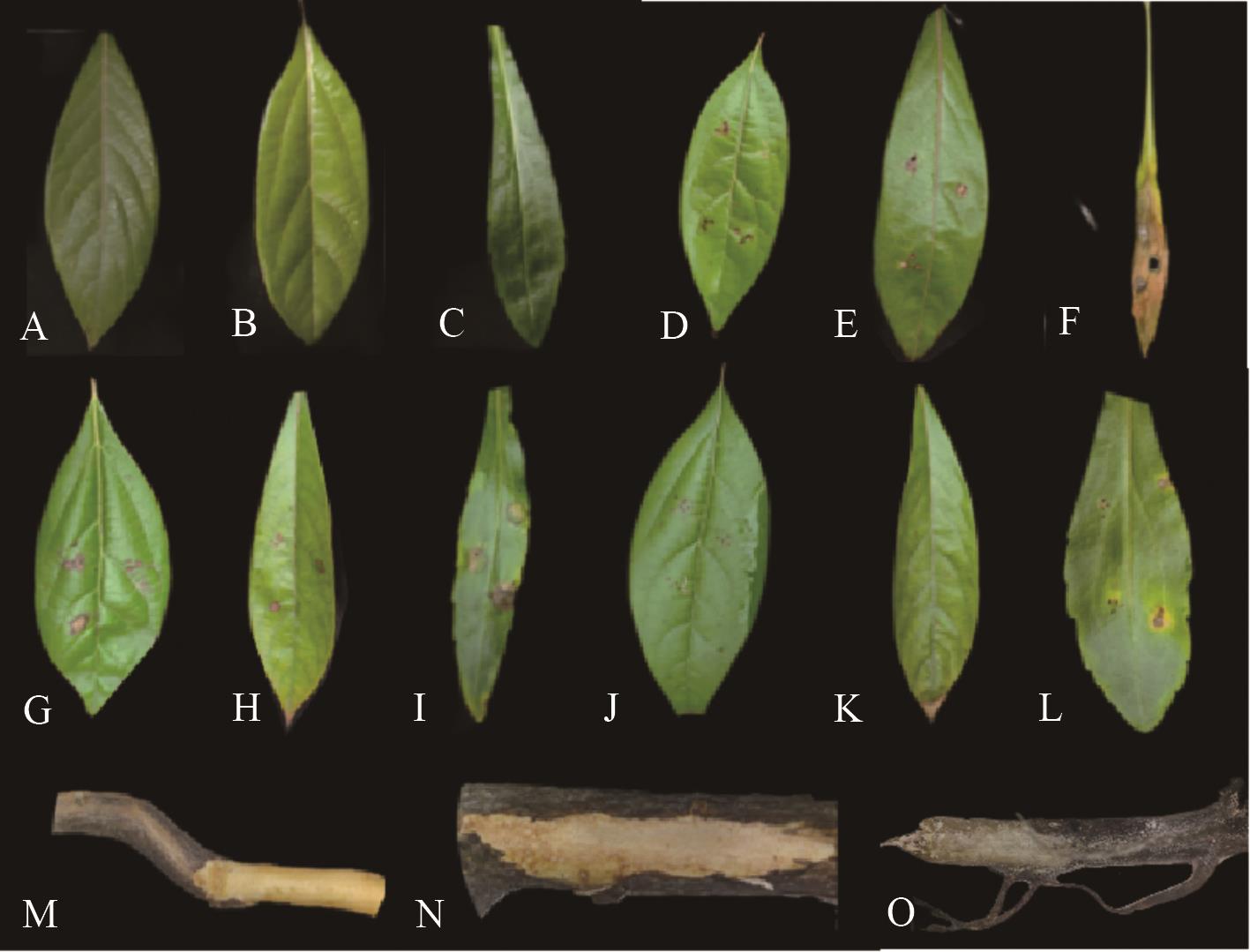
图1 叶片与根部接种图A-C:叶片无菌琼脂块对照(香樟、楠木、加拿大一枝黄花,下同);D-F:叶片接种SC02;G-I:叶片接种SC06;J-L:叶片接种SC07;M-O:根部接种SC02
Fig. 1 Leaf and root inoculation diagramA-C: Leaf sterile agar block control (C. camphora, P. zhennan, S. canadensis, the same below); D-F: leaf inoculation with SC02; G-I: leaf inoculation with SC06; J-L: leaf inoculation with SC07; M-O: root inoculation with SC02
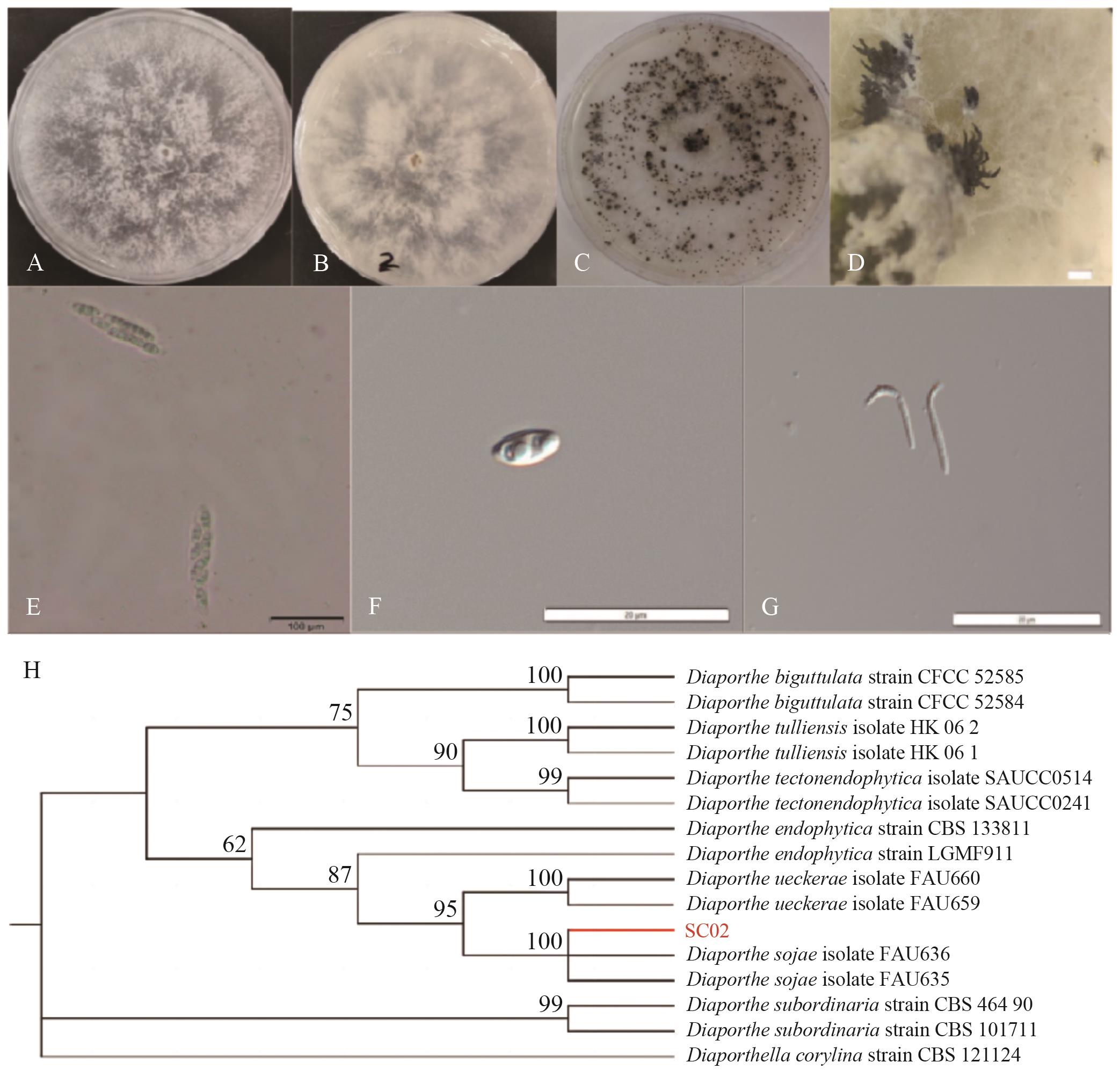
图2 SC02菌株鉴定结果A:菌落图正面;B:菌落图背面;C:产孢培养基;D:子囊壳;E:子囊;F:α分生孢子;G:β分生孢子;H:菌株的系统发育进化树
Fig. 2 Identification results of SC02 strainA: Front view of the colony; B: back view of the colony; C: sporulation medium; D: ascus shell; E: ascus; F: α-conidia; G: β-conidia; H: phylogenetic tree of strains
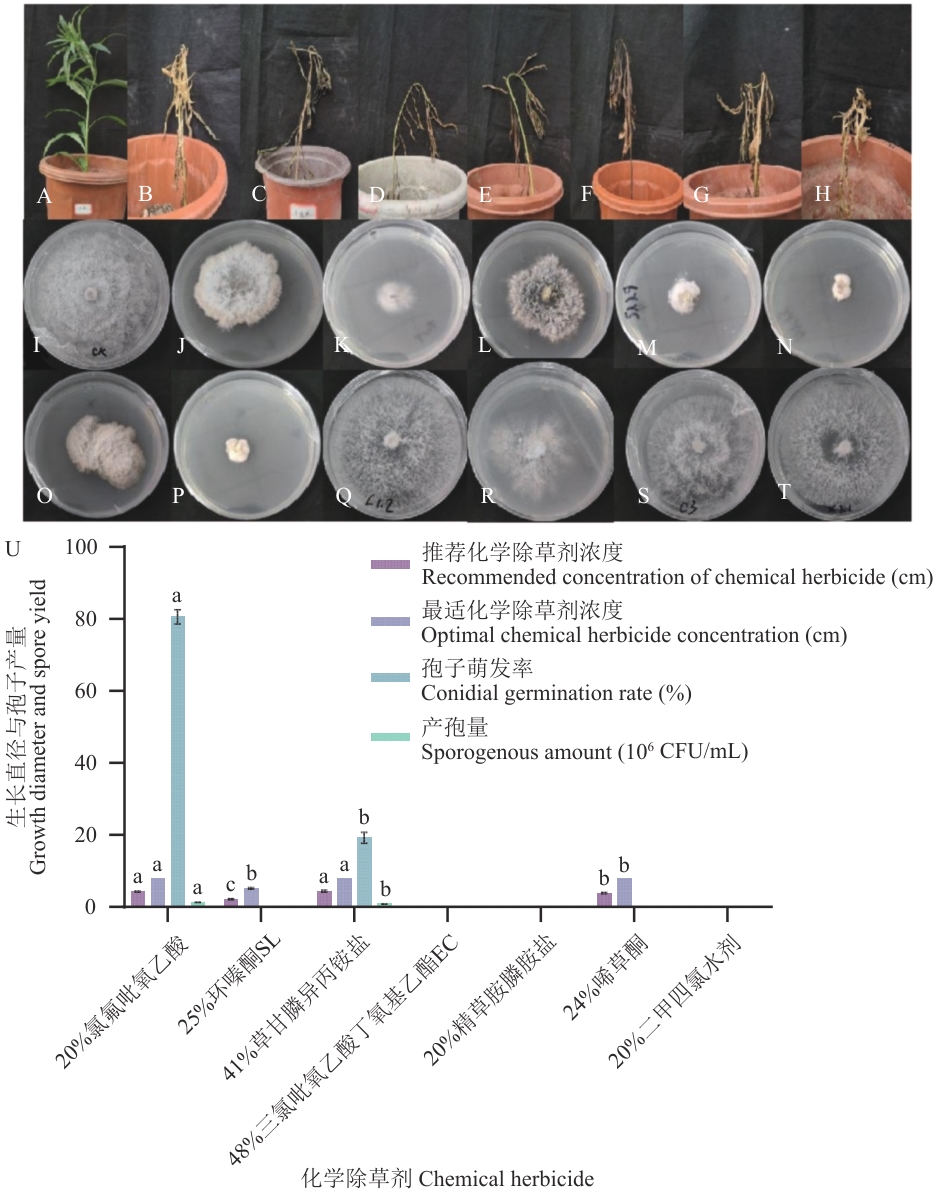
图3 复配除草剂筛选结果A-H:单剂实验,分别为CK、20%氯氟吡氧乙酸、25%环嗪酮、41%草甘膦异丙铵盐、48%三氯吡氧乙酸丁氧基乙酯、10%精草胺膦胺盐、20%唏草酮、20%二甲四氯水剂组;I-P:化学除草剂推荐浓度筛选平板实验,分别为CK、20%氯氟吡氧乙酸、25%环嗪酮SL、41%草甘膦异丙铵盐、48%三氯吡氧乙酸丁氧基乙酯EC、10%精草胺膦胺盐、24%唏草酮、20%二甲四氯水剂组;Q-T:化学除草剂最适浓度筛选平板实验,20%氯氟吡氧乙酸、25%环嗪酮SL、41%草甘膦异丙铵盐、24%唏草酮组;U:加拿大一枝黄花复配除草剂筛选柱状图,图中推荐浓度为购买农药时官方推荐稀释浓度,最适浓度为推荐浓度稀释后病原菌最优生长浓度,不同小写字母表示同一时间不同处理间的差异显著性(P<0.001),下同
Fig. 3 Screening results of compound herbicidesA-H: Single-dose test. CK, 20% clopyralid, 25% carfentrazone, 41% glyphosate isopropylamine salt, 48% triclopyr butoxyethyl ester, 10% quizalofop-p-ethyl, 20% flumioxazin, 20% dimethachlor aqueous solution group, respectively. I-P: Screening plate for recommended concentrations of chemical herbicides. CK, 20% clopyralid, 25% carfentrazone SL, 41% glyphosate isopropylamine salt, 48% triclopyr butoxyethyl ester EC, 10% quizalofop-p-ethyl, 24% flumioxazin, 20% dimethachlor aqueous solution group, respectively. Q-T: Screening plate for optimal concentrations of chemical herbicides. 20% clopyralid, 25% carfentrazone SL, 41% glyphosate isopropylamine salt, 24% flumioxazin group, respectively. U: Bar chart of screening results for compound herbicides against S. canadensis. The recommended concentration refers to the dilution concentration officially recommended for the purchased herbicide. The optimal concentration indicates the dilution of the recommended concentration that supports the optimal growth of the pathogen. Different lowercase letters indicate significant differences among different treatments at the same time (P<0.001), the same below
化学除草剂 Chemical herbicides | 推荐浓度 Recommended concentration | 死亡率 Mortality rate (%) | 死亡时间 Time of death (d) | 死亡症状 Symptoms of death |
|---|---|---|---|---|
| 20%氯氟吡氧乙酸 | 1 μL/mL | 100 | 4 | 全株死亡,茎秆叶片全部萎蔫枯死 |
| 25%环嗪酮SL | 0.02 g/mL | 100 | 8 | 全株死亡,但有少量叶片茎秆泛绿,短时间未完全失活 |
| 41%草甘膦异丙铵盐 | 0.02 g/mL | 100 | 6 | 全株死亡,但部分茎秆短时间未失活 |
| 48%三氯吡氧乙酸丁氧基乙酯EC | 10 μL/mL | 90 | 9 | 大部分植株枯死,但有少量植株茎秆存活 |
| 10%精草胺膦胺盐 | 10 μL/mL | 100 | 8 | 全株死亡,茎秆叶片全部萎蔫枯死 |
| 24%唏草酮 | 1 μL/mL | 100 | 5 | 全株死亡,茎秆叶片全部萎蔫枯死 |
| 20%二甲四氯水剂 | 5 μg/mL | 100 | 4 | 全株死亡,茎秆叶片全部萎蔫枯死 |
表5 化学除草剂单剂筛选结果
Table 5 Screening results of individual chemical herbicide
化学除草剂 Chemical herbicides | 推荐浓度 Recommended concentration | 死亡率 Mortality rate (%) | 死亡时间 Time of death (d) | 死亡症状 Symptoms of death |
|---|---|---|---|---|
| 20%氯氟吡氧乙酸 | 1 μL/mL | 100 | 4 | 全株死亡,茎秆叶片全部萎蔫枯死 |
| 25%环嗪酮SL | 0.02 g/mL | 100 | 8 | 全株死亡,但有少量叶片茎秆泛绿,短时间未完全失活 |
| 41%草甘膦异丙铵盐 | 0.02 g/mL | 100 | 6 | 全株死亡,但部分茎秆短时间未失活 |
| 48%三氯吡氧乙酸丁氧基乙酯EC | 10 μL/mL | 90 | 9 | 大部分植株枯死,但有少量植株茎秆存活 |
| 10%精草胺膦胺盐 | 10 μL/mL | 100 | 8 | 全株死亡,茎秆叶片全部萎蔫枯死 |
| 24%唏草酮 | 1 μL/mL | 100 | 5 | 全株死亡,茎秆叶片全部萎蔫枯死 |
| 20%二甲四氯水剂 | 5 μg/mL | 100 | 4 | 全株死亡,茎秆叶片全部萎蔫枯死 |
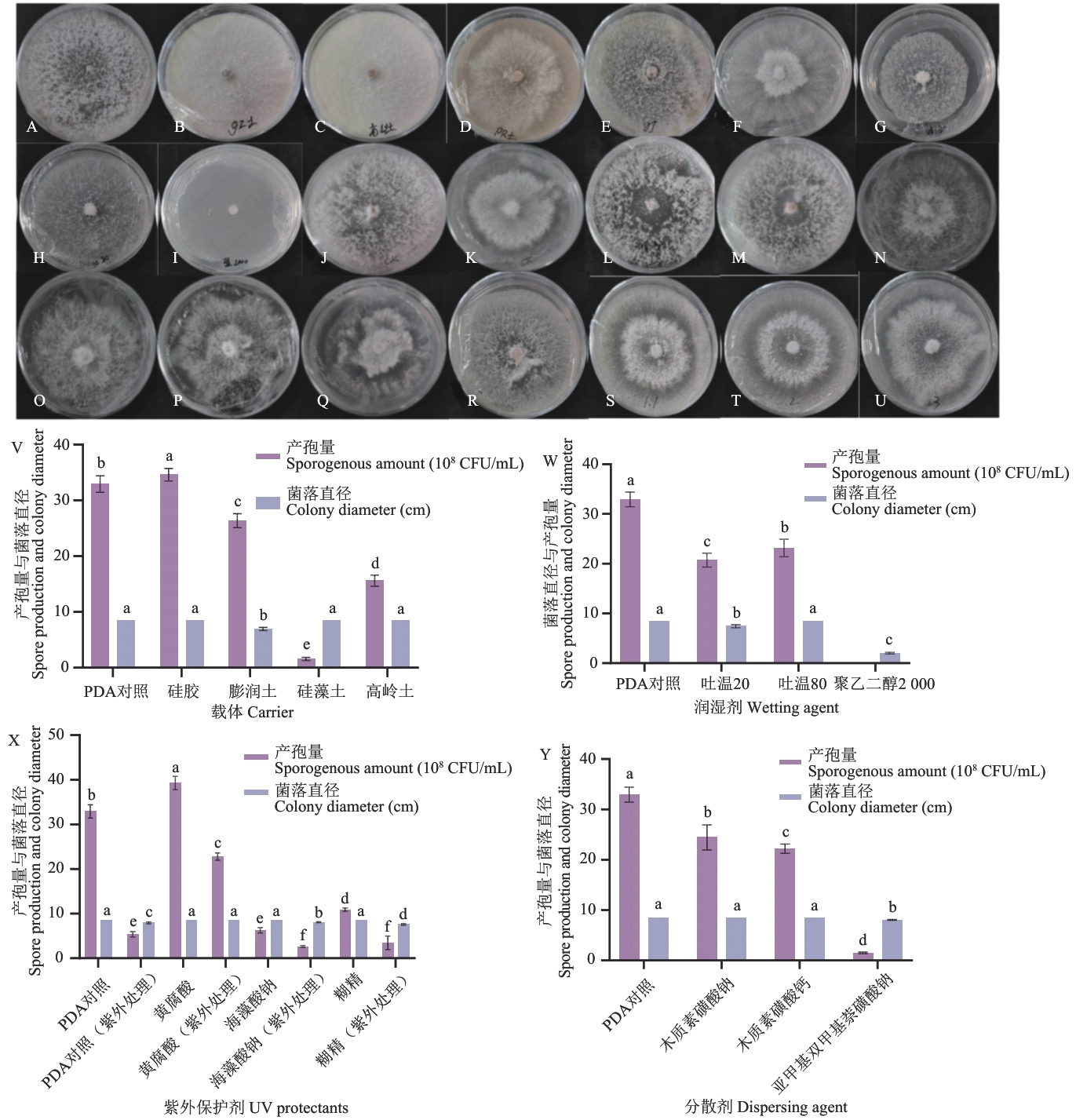
图4 载体与3种助剂筛选结果A-E:载体(CK、硅藻土、高岭土、膨润土、硅胶)筛选结果;F-I:润湿剂(CK、吐温20、吐温80、PEG2000)筛选结果;J-Q:紫外保护剂(CK、紫外处理CK、黄腐酸、紫外处理黄腐酸、海藻酸钠、紫外处理海藻酸钠、糊精、紫外处理糊精)筛选结果;R-U:分散剂(CK、木质素磺酸钠、木质素磺酸钙、亚甲基双甲基萘磺酸钠)筛选结果; V-Y:载体、润湿剂、紫外保护剂、分散剂筛选结果
Fig. 4 Screening results for carriers and three adjuvantsA-E: Carrier (CK, diatomaceous earth, kaolin, bentonite, silica gel) screening results. F-I: Wetting agent (CK, Tween 20, Tween 80, PEG 2000) screening results. J-Q: Ultraviolet protection agent (CK, UV-treated CK, humic acid, UV-treated humic acid, sodium alginate, UV-treated sodium alginate, dextrin, UV-treated dextrin) screening results. R-U: Dispersant (CK, sodium lignosulfonate, calcium lignosulfonate, methylene bis-naphthalenesulfonate) screening results. V-Y: Screening results for carrier, wetting agent, ultraviolet protection agent, and dispersant
润湿剂 Wetting agents | 润湿时间 Wetting time (±SE) (s) | ||
|---|---|---|---|
| 1% | 3% | 5% | |
| 吐温20 Tween 20 | 32±0.58b | 20±0.52b | 11±1.88b |
| 吐温80 Tween 80 | 24±0.68c | 14±1.28c | 10±0.75b |
| PEG2000 | 54±0.78a | 45±1.05a | 36±0.62a |
表6 不同润湿剂润湿时间测定
Table 6 Determination of wetting time of different wetting agents
润湿剂 Wetting agents | 润湿时间 Wetting time (±SE) (s) | ||
|---|---|---|---|
| 1% | 3% | 5% | |
| 吐温20 Tween 20 | 32±0.58b | 20±0.52b | 11±1.88b |
| 吐温80 Tween 80 | 24±0.68c | 14±1.28c | 10±0.75b |
| PEG2000 | 54±0.78a | 45±1.05a | 36±0.62a |
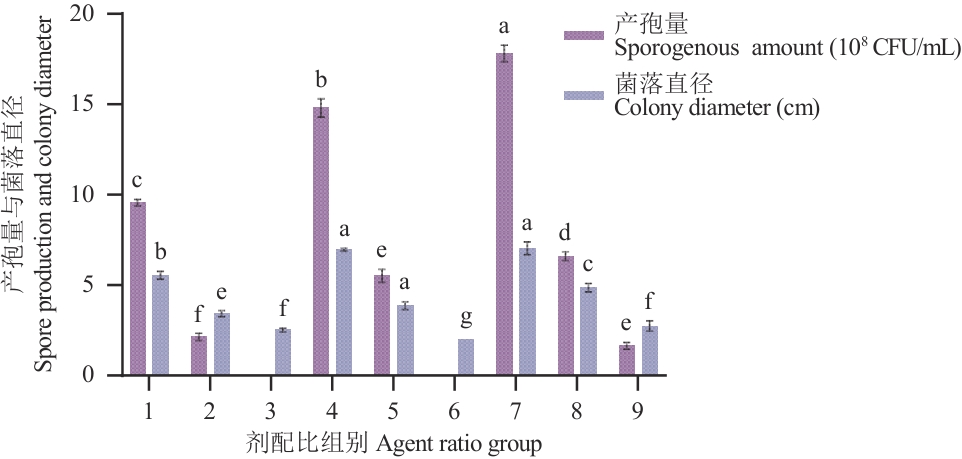
图5 三种助剂最佳剂配比筛选结果
Fig. 5 Screening results of the optimal ratio of three additives
指标 Index | 国家标准值 National standards | 测量值 Measured value |
|---|---|---|
| 润湿时间 Wetting time (s) | ≤180 | 36±1 |
| 悬浮率 Suspensibility (%) | ≥70 | 74 |
| 含孢量 Spore content (CFU/g) | 1.65×10⁹ | |
| pH | 5.0-8.0 | 6.5 |
| 细度 Fineness (%) | ≥90 | 92 |
| 起泡性 Frothiness (mL) | ≤10 mL | 7 mL |
| 干燥减量 Drying reduction (%) | ≤6 | 5.65 |
| 贮存稳定性 Storage stability (%) | ≥80 | ≥81.5 |
表7 大豆间座壳菌SC02可湿性粉剂复配剂质量检测结果
Table 7 Quality test results of wettable powder mixture of D. sojae SC02
指标 Index | 国家标准值 National standards | 测量值 Measured value |
|---|---|---|
| 润湿时间 Wetting time (s) | ≤180 | 36±1 |
| 悬浮率 Suspensibility (%) | ≥70 | 74 |
| 含孢量 Spore content (CFU/g) | 1.65×10⁹ | |
| pH | 5.0-8.0 | 6.5 |
| 细度 Fineness (%) | ≥90 | 92 |
| 起泡性 Frothiness (mL) | ≤10 mL | 7 mL |
| 干燥减量 Drying reduction (%) | ≤6 | 5.65 |
| 贮存稳定性 Storage stability (%) | ≥80 | ≥81.5 |
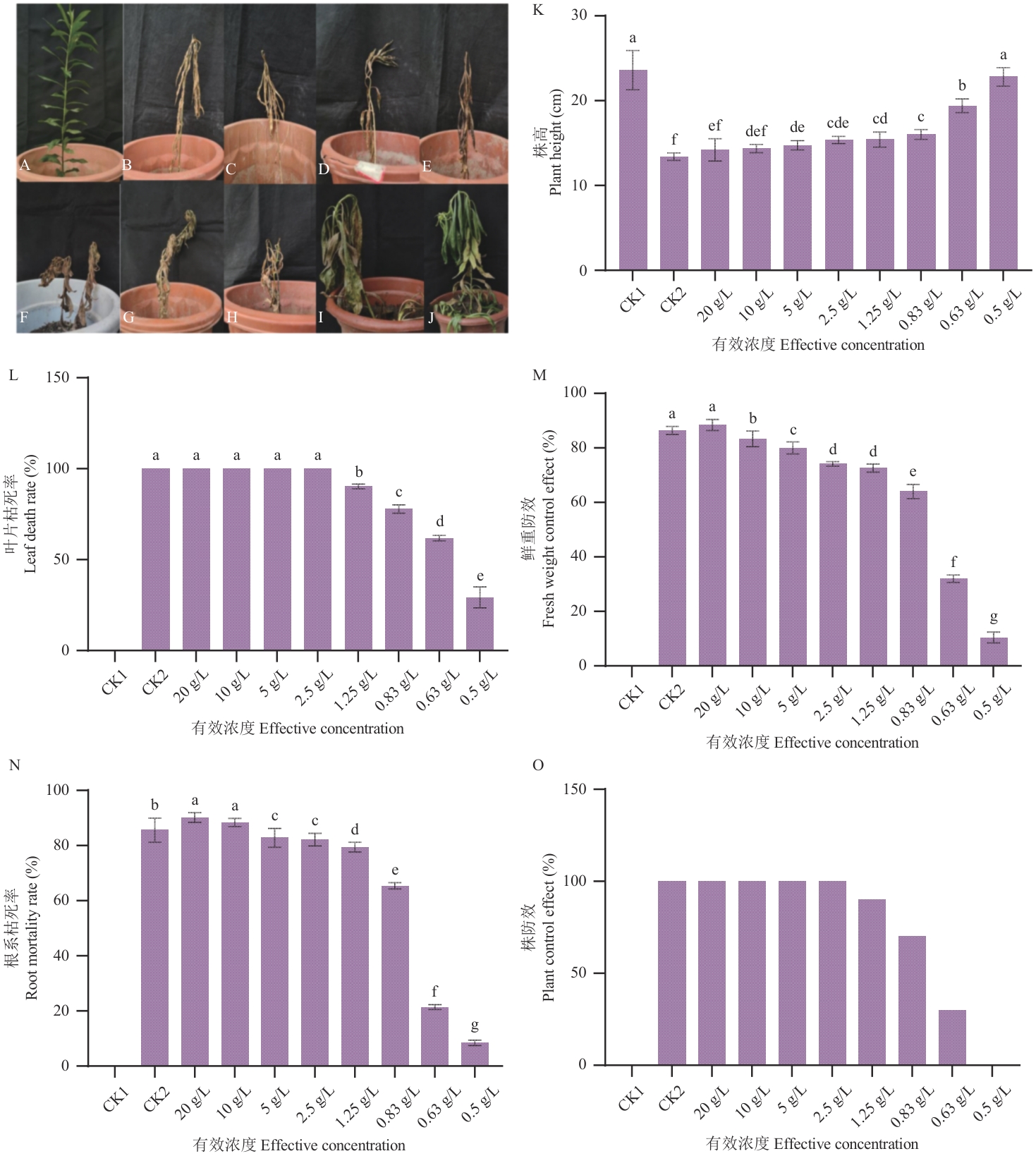
图6 盆栽试验结果A-J:CK1清水、CK2氯氟吡氧乙酸,20、10、5、2.5、1.25、0.83、0.63、0.5 g/L稀释浓度处理效果;K-O:盆栽防治试验中株高、叶片枯死率、鲜重防效、根系枯死率、株防效结果
Fig. 6 Results of the pot experimentsA-J: CK1 distilled water, CK2 clopyralid, 20, 10, 5, 2.5, 1.25, 0.83, 0.63, 0.5 g/L dilution concentration treatment effect. K-O: Plant height, leaf necrosis rate, fresh weight control effect, root necrosis rate, and plant control effect results in potted control trials
| [1] | 鞠瑞亭, 李慧, 石正人, 等. 近十年中国生物入侵研究进展 [J]. 生物多样性, 2012, 20(5): 581-611. |
| Ju RT, Li H, Shi ZR, et al. Progress of biological invasions research in China over the last decade [J]. Biodivers Sci, 2012, 20(5): 581-611. | |
| [2] | Theoharides KA, Dukes JS. Plant invasion across space and time: factors affecting nonindigenous species success during four stages of invasion [J]. New Phytol, 2007, 176(2): 256-273. |
| [3] | 杨昌洪, 肖晓华, 刘春, 等. 噬菌核霉可湿性粉剂防治油菜菌核病试验示范 [J]. 南方农业, 2016, 10(19): 19-21. |
| Yang CH, Xiao XH, Liu C, et al. Experimental demonstration on control of Sclerotinia sclerotiorum with wettable powder [J]. South China Agric, 2016, 10(19): 19-21. | |
| [4] | 陈娥. 顶孢霉可湿性粉剂和微粉剂的药效评价及田间应用技术研究 [D]. 兰州: 甘肃农业大学, 2016. |
| Chen E. Evaluation and field application technology of WP and MDP of Acremonium hansfordii [D]. Lanzhou: Gansu Agricultural University, 2016. | |
| [5] | 王均伟, 黄晓慧, 杨然迪, 等. 草甘膦与新型原卟啉原氧化酶抑制剂X18002复配减量应用研究 [J]. 农药学学报, 2023, 25(4): 817-828. |
| Wang JW, Huang XH, Yang RD, et al. Study on usage reduction of glyphosate mixed with a novel protoporphyrinogen oxidase inhibitor-X18002 [J]. Chin J Pestic Sci, 2023, 25(4): 817-828. | |
| [6] | 何丽烂, 区焯林, 王芳, 等. 尖孢镰刀菌与草甘膦复配对空心莲子草防御酶的影响 [J]. 广东农业科学, 2011, 38(22): 78-79, 86. |
| He LL, Ou ZL, Wang F, et al. Influence of Fusarium oxysporum mixed with Glyphosate on Alternanthera philoxeroides defense enzymes [J]. Guangdong Agric Sci, 2011, 38(22): 78-79, 86. | |
| [7] | 李鑫, 郭冉, 杨娟, 等. 黏质沙雷氏菌Ha1培养条件优化及其与化学除草剂复配研究 [J]. 杂草学报, 2020, 38(2): 21-32. |
| Li X, Guo R, Yang J, et al. Optimization of culture conditions of Serratia marcescens Ha1 and its compounding with herbicides [J]. J Weed Sci, 2020, 38(2): 21-32. | |
| [8] | 商美妮. 木霉固体发酵培养条件优化及含木霉生物基质育苗效应研究 [D]. 南京: 南京农业大学, 2020. |
| Shang MN. Study on optimization of solid fermentation culture conditions of Trichoderma and the effect of biological substrate containing Trichoderma on seedling growth [D]. Nanjing: Nanjing Agricultural University, 2020. | |
| [9] | 翟森, 靳文涛, 柳丽杰, 等. 龙泉山森林公园入侵植物加拿大一枝黄花的调查及风险性分析 [J]. 安徽农业科学, 2025, 53(9): 118-122. |
| Zhai S, Jin WT, Liu LJ, et al. Investigation and risk analysis of invasive plant Solidago canadensis in longquanshan forest park [J]. J Anhui Agric Sci, 2025, 53(9): 118-122. | |
| [10] | 王前程, 张迎迎, 戴陶宇, 等. 拟康宁木霉T-51菌株对番茄枯萎病的生物防治及其机理研究 [J]. 西北植物学报, 2022, 42(6): 974-982. |
| Wang QC, Zhang YY, Dai TY, et al. Study on biological control effect and mechanism of Trichoderma koningiopsis T-51 on tomato Fusarium wilt [J]. Acta Bot Boreali Occidentalia Sin, 2022, 42(6): 974-982. | |
| [11] | 袁树忠, 何平平, 廉吉衷, 等. 一种镰刀菌对空心莲子草的致病力与寄主专一性测定 [J]. 中国生物防治, 2006(2): 137-141. |
| Yuan SZ, He PP, Lian JZ, et al. Host range and pathogenicity of a Fusarium species to Alternanthera philoxeroides [J]. Chin J Biol Control, 2006(2): 137-141. | |
| [12] | 李思, 尚晓静, 张富美, 等. 蓝莓根部内生木霉分离鉴定及其拮抗作用 [J]. 核农学报, 2022, 36(8): 1569-1578. |
| Li S, Shang XJ, Zhang FM, et al. Diversity of endophytic Trichoderma in the roots of blueberries and its antagonistic effects [J]. J Nucl Agric Sci, 2022, 36(8): 1569-1578. | |
| [13] | 司璐, 吴彤, 甄锦程, 等. 大兴安岭凋落物中可培养真菌分离、鉴定及活性筛选 [J]. 中国农学通报, 2022, 38(26): 118-123. |
| Si L, Wu T, Zhen JC, et al. Isolation, identification and activity screening of culturable fungi from litter in the greater Hinggan Mountains [J]. Chin Agric Sci Bull, 2022, 38(26): 118-123. | |
| [14] | 闫佳佳, 万璐, 尤梦瑶, 等. 产香兰素内生真菌GP20的鉴定及发酵条件研究 [J]. 中国调味品, 2022, 47(11): 44-49. |
| Yan JJ, Wan L, You MY, et al. Study on identification and fermentation conditions of vanillin-producing endophytic fungus GP20 [J]. China Condiment, 2022, 47(11): 44-49. | |
| [15] | 巨亚雯, 陈亚丽, 徐蓬, 等. 植物生长调节剂与磺酰脲类除草剂混用对防除麦田杂草的协同增效作用 [J]. 杂草学报, 2022, 40(4): 43-49. |
| Ju YW, Chen YL, Xu P, et al. Synergistic interaction of plant growth regulators mixed with sulfonylurea herbicides on weeding in wheat fields [J]. J Weed Sci, 2022, 40(4): 43-49. | |
| [16] | 张英财, 农向群, 张泽华, 等. 18种化学农药与绿僵菌相容性研究 [J]. 中国生物防治学报, 2012, 28(2): 186-191. |
| Zhang YC, Nong XQ, Zhang ZH, et al. Compatibility of eighteen chemical pesticides with Metarhizium anisopliae [J]. Chin J Biol Control, 2012, 28(2): 186-191. | |
| [17] | 朱文珊. 长枝木霉拌种对芸豆生长及根际土壤酶活性的影响 [D]. 大庆: 黑龙江八一农垦大学, 2022. |
| Zhu WS. Effects of seed dressing in Trichoderma longibrachiatum on kidney bean growth and enzyme activities in rhizosphere soil [D]. Daqing: Heilongjiang Bayi Agricultural University, 2022. | |
| [18] | 何祖传, 周健, 张洪泉, 等. 化学除草剂对加拿大一枝黄花的防除效果试验 [J]. 现代农业科技, 2020(10): 82, 88. |
| He ZC, Zhou J, Zhang HQ, et al. Effect of chemical herbicide on Solidago canadensis L [J]. Mod Agric Sci Technol, 2020(10): 82, 88. | |
| [19] | 韩敏, 张海艳, 洪爱梅, 等. 几种除草剂对加拿大一枝黄花的防除效果评价 [J]. 世界农药, 2024, 46(10): 56-62. |
| Han M, Zhang HY, Hong AM, et al. Evaluation of the control effects of several herbicides on Solidago canadensis [J]. World Pestic, 2024, 46(10): 56-62. | |
| [20] | 王博, 李嘉, 马莉莉, 等. 异丙甲草胺乳油不同用量防治玉米田禾本科杂草田间药效试验 [J]. 云南农业科技, 2021(5): 36-38. |
| Wang B, Li J, Ma LL, et al. Field experiments of metolachlor EC with different amounts on grassy weeds in corn field [J]. Yunnan Agric Sci Technol, 2021(5): 36-38. | |
| [21] | 咸洪泉, 李雅华. 木霉菌株Td31代谢产物对立枯丝核菌的拮抗作用 [J]. 沈阳农业大学学报, 2009, 40(5): 566-570. |
| Xian HQ, Li YH. The antagonism of metabolite by Trichoderma.Td31 to Rhizoctonia solani [J]. J Shenyang Agric Univ, 2009, 40(5): 566-570. | |
| [22] | 孙文. 短短芽胞杆菌ch2-22发酵动力学与水分散粒剂的研究 [D]. 天津: 河北工业大学, 2017. |
| Sun W. Study on fermentation kinetics of Brevibacillus brevis Ch2-22 and preparation of water dispresible granule [D]. Tianjin: Hebei University of Technology, 2017. | |
| [23] | 陈慧. 绛红褐链霉菌颗粒剂的研究 [D]. 雅安: 四川农业大学, 2015. |
| Chen H. Reseach of granule formulation for Streptomyces purpeofuscus [D]. Yaan: Sichuan Agricultural University, 2015. | |
| [24] | 古丽君, 徐秉良, 张德瑞, 等. 深绿木霉病原菌制剂加工工艺研究: 中国植物保护学会2009年学术年会[C], 武汉, 2009. |
| Gu LJ, Xu BL, Zhang DR, et al. Study on Processing Technology of Trichoderma atroviride Pathogen Preparation[C]. Proceedings of the 2009 Annual Conference of the China Society of Plant Protection, Wuhan, 2009. | |
| [25] | 戴启星. 长枝木霉T6菌株可湿性粉剂研制及复配菌剂协同增效作用研究 [D]. 兰州: 甘肃农业大学, 2019. |
| Dai QX. Development of Trichoderma longibrachiatum T6 wettable powder and synergistic compounding agents [D]. Lanzhou: Gansu Agricultural University, 2019. | |
| [26] | 邹益泽. 草茎点霉水分散粒剂的研发及其对鸭跖草防除效果研究 [D]. 沈阳: 沈阳农业大学, 2019. |
| Zou YZ. Development of Phoma herbarum WG and its control effect against Commelina communis L. [D]. Shenyang: Shenyang Agricultural University, 2019. | |
| [27] | 王建锋, 陆宁海. 木霉菌在农业中的研究与应用前景 [J]. 安徽农学通报, 2008, 14(14): 41-43, 136. |
| Wang JF, Lu NH. Rogress in agriculture research with Trichoderma [J]. Anhui Agric Sci Bull, 2008, 14(14): 41-43, 136. | |
| [28] | 叶素丹, 冯明光. 生防真菌耐旱特性的生理生化基础及其利用 [J]. 应用生态学报, 2004, 15(12): 2383-2387. |
| Ye SD, Feng MG. Physiological and biochemical bases of xero-tolerance of fungal biocontrol agents and their application [J]. Chin J Appl Ecol, 2004, 15(12): 2383-2387. | |
| [29] | 杨肖. 金龟子绿僵菌和小檗碱复配及其可湿性粉剂和水分散粒剂的制备 [D]. 北京: 北京化工大学, 2021. |
| Yang X. Preparation of Metarhizium anisopliae and berberine and their wettable powder and water dispersible granuie [D]. Beijing: Beijing University of Chemical Technology, 2021. | |
| [30] | 农药可湿性粉剂润湿性测定方法: [S]. 2001. |
| Test method for wettability of pesticide wettable powders: [S]. 2001. | |
| [31] | 农药可湿性粉剂悬浮率剂测定方法: [S]. 1993. |
| Test method for suspensibility of pesticide wettable powders: [S]. 1993. | |
| [32] | 冯月. 木霉菌株产酶培养及其特定底物酶解过程研究 [D]. 北京: 北京林业大学, 2012. |
| Feng Y. Studies on cellulase-produced fermentation of Trichoderma strains and enzymatic hydrolysis of the specific substrate [D]. Beijing: Beijing Forestry University, 2012. | |
| [33] | 农药pH值的测定方法: [S]. 1993. |
| Test method for pH value of pesticides: [S]. 1993. | |
| [34] | 国家技术监督局. 农药粉剂、可湿性粉剂细度测定方法: [S]. 北京: 中国标准出版社, 2004. |
| State Bureau of Quality and Technical Supervision of the People's Republic of China. Seive test for dustable and wettable powders of pesticides: [S]. Beijing: Standards Press of China, 2004. | |
| [35] | 国家质量监督检验检疫总局, 中国国家标准化管理委员会. 农药持久起泡性测定方法: [S]. 北京: 中国标准出版社, 2012. |
| General Administration of Quality Supervision, Inspection and Quarantine of the People's Republic of China, Standardization Administration of the People's Republic of China. Testing method of persistent foaming for pesticides: [S]. Beijing: Standards Press of China, 2012. | |
| [36] | 农药干燥减量的测定方法: [S]. 2013. |
| Test method for drying reduction of pesticides: [S]. 2013. | |
| [37] | 周欣欣, 张宏军, 张佳, 等. 除草剂田间药效试验申请应注意的几个问题 [J]. 农药科学与管理, 2012, 33(7): 8-12. |
| Zhou XX, Zhang HJ, Zhang J, et al. Several problems that should be paid attention to in the application of herbicide field efficacy test [J]. Pestic Sci Adm, 2012, 33(7): 8-12. | |
| [38] | 常悦, 李玉静, 李周旭, 等. 基于Maxent和ArcGIS加拿大一枝黄花适生区预测 [J]. 农学学报, 2024, 14(3): 40-47. |
| Chang Y, Li YJ, Li ZX, et al. Prediction of suitable growing areas of Solidago canadensis L. based on maxent and ArcGIS [J]. J Agric, 2024, 14(3): 40-47. | |
| [39] | 叶梅荣, 刘庆安, 马纪忠, 等. 41%草甘膦水剂对加拿大一枝黄花的防除效果 [J]. 江苏农业科学, 2010, 38(2): 130-132. |
| Ye MR, Liu QA, Ma JZ, et al. Controlling effects of 41% glyphosate aqueous solution on Solidago canadensis L [J]. Jiangsu Agric Sci, 2010, 38(2): 130-132. | |
| [40] | 李玲燕. 生物除草剂齐整小核菌SC64颗粒剂的研究 [D]. 南京: 南京农业大学, 2015. |
| Li LY. A study on solid granule of bioherbicide Sclerotium rolfsii strain SC64 [D]. Nanjing: Nanjing Agricultural University, 2015. | |
| [41] | 曹晶晶, 谷涛, 张自常, 等. 防除不同生境下加拿大一枝黄花的除草剂研究 [J]. 杂草学报, 2024, 42(4): 82-90. |
| Cao JJ, Gu T, Zhang ZC, et al. Research on herbicides for controlling Solidago canadensis L. in different habitats [J]. J Weed Sci, 2024, 42(4): 82-90. |
| [1] | 迪丽拜尔·吐尔逊, 祖丽胡玛尔·亚库普, 包慧芳, 詹发强, 杨蓉, 史应武, 杨红梅, 楚敏, 房世杰, 王宁. 番茄根际放线菌GNLJ-7菌株的生物功能及全基因组分析[J]. 生物技术通报, 2026, 42(8): 276-286. |
| [2] | 邱宇洁, 王茜, 曾琳, 侯虹吉, 苟玉梅, 邹兰, 黄晶. 枯草芽胞杆菌JY-7-2L对乌头根腐病的生防能力及其潜在作用机制解析[J]. 生物技术通报, 2026, 42(8): 298-311. |
| [3] | 朱志炎, 宋芷薇, 何珊, 张德清, 何勇, 田志宏. 烟草靶斑病拮抗菌的鉴定及其防治特性[J]. 生物技术通报, 2026, 42(4): 310-320. |
| [4] | 张蔓, 党静波, 蒋媛, 位杰, 邢杰, 王哲, 孙黎. 梨火疫病生防菌的筛选、鉴定及防效测定[J]. 生物技术通报, 2026, 42(1): 279-293. |
| [5] | 贾雪, 隋丽, 邹晓威, 路杨, 张正坤, 李启云. 真菌病毒BbOCuV1对寄主球孢白僵菌生长发育和亚洲玉米螟致病力的影响[J]. 生物技术通报, 2025, 41(7): 312-325. |
| [6] | 张吉昌, 许云凤, 蒋凌雁. 柱花草内生细菌ZW21发酵条件优化及其抑菌物质稳定性测定[J]. 生物技术通报, 2025, 41(5): 280-289. |
| [7] | 吴琼, 陈德勇, 朱鹤, 王丹, 张晓军, 陈捷胤. 洋葱伯克霍尔德氏菌KRS634对棉花红腐病的生防效果[J]. 生物技术通报, 2025, 41(12): 294-303. |
| [8] | 慕雪男, 吴桐, 郑子薇, 张越, 王志刚, 徐伟慧. 一株番茄青枯病生防细菌的筛选、鉴定及其生防潜力分析[J]. 生物技术通报, 2025, 41(1): 276-286. |
| [9] | 刘倩, 马连杰, 张慧, 王冬, 范茂, 廖敦秀, 赵正武, 卢文才. 辣椒炭疽病生防菌株TN2的筛选鉴定与抑菌效果[J]. 生物技术通报, 2025, 41(1): 287-297. |
| [10] | 王美玲, 耿丽丽, 房瑜, 束长龙, 张杰. 苏云金芽胞杆菌4BM1菌株对油菜菌核病的防治潜力[J]. 生物技术通报, 2024, 40(9): 260-269. |
| [11] | 王芳, 于璐, 齐泽铮, 周长军, 于吉东. 大豆镰刀菌根腐病拮抗菌的筛选及生防效果[J]. 生物技术通报, 2024, 40(7): 216-225. |
| [12] | 范宗强, 冯靖涵, 郑丽雪, 王硕, 彭向前, 陈芳. 枯草芽孢杆菌B579对黄瓜枯萎病的防治及其诱导抗性研究[J]. 生物技术通报, 2024, 40(7): 226-234. |
| [13] | 徐伟芳, 李贺宇, 张慧, 何仔昂, 高文恒, 谢紫洋, 王传文, 尹登科. 生防细菌HX0037对栝楼炭疽病的防病能力及其机制[J]. 生物技术通报, 2024, 40(4): 228-241. |
| [14] | 许沛冬, 易剑锋, 陈迪, 潘磊, 谢丙炎, 赵文军. 贝莱斯芽孢杆菌生防次级代谢产物研究进展[J]. 生物技术通报, 2024, 40(3): 75-88. |
| [15] | 丁艳哲, 姚鑫鑫, 孙卓, 杨利民, 韩忠明, 王云贺. 刺五加黑斑病生防细菌分离、鉴定、优选及发酵条件优化[J]. 生物技术通报, 2024, 40(12): 218-226. |
| 阅读次数 | ||||||
|
全文 |
|
|||||
|
摘要 |
|
|||||
